International Migration in the Americas an overview Departament of Social Inclusion (DIS) Secretariat for Access to Rights and Equity (SARE-OAS) Juan Manuel Jiménez Scope and sources of the presentation International migration inflows in
"International Migration in the Americas – an" is the property of its rightful owner. Permission is granted to
download and print the materials on this website for personal, non-commercial use only, and to display it
on your personal computer provided you do not modify the materials and that you retain all copyright
notices contained in the materials. By downloading content from our website, you accept the terms of this
agreement.
Presentation Transcript
01
International Migration in the Americas – an overview Departament of Social Inclusion (DIS) Secretariat for Access to Rights and Equity (SARE-OAS) Juan Manuel Jiménez<br>
02
Scope and sources of the presentation International migration inflows in the Americas
Migration movements from the Americas Measuring international migration: censuses, surveys, administrative records - entry and exit records at entry / exit points and records based on entry and stay permits according to the country's immigration laws (visas, residence permits, etc.) . The information is incorporated daily. Mesures migration flows.
Countries of the Americas: includes Latin America and the Caribbean (South America, Central America and the Caribbean) and North America<br>
03
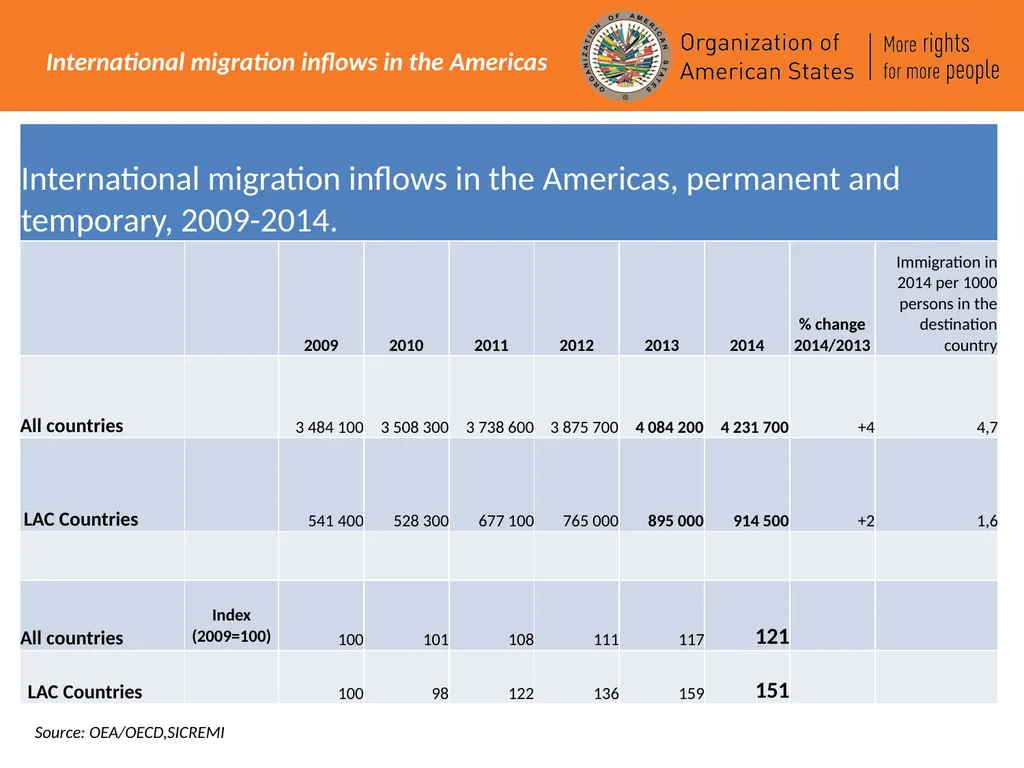
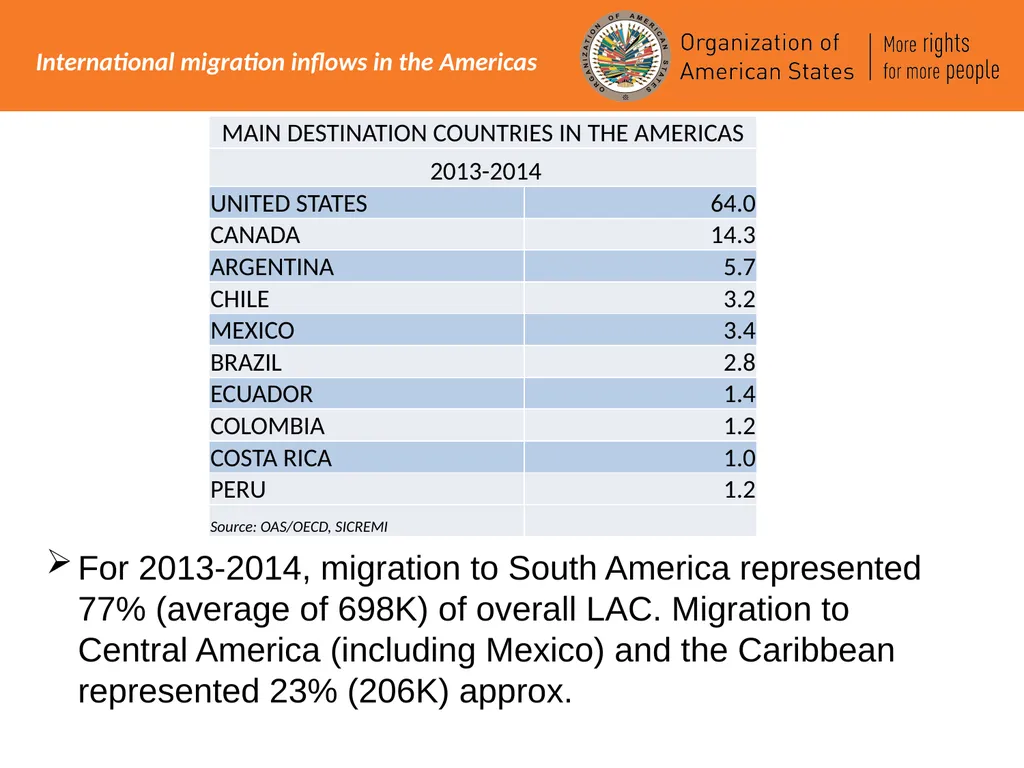
International migration inflows in the Americas Source: OEA/OECD,SICREMI<br>
04
International migration inflows in the Americas For 2009-2014, immigration in the Americas increased by 21% overall but 51% in Latin America and the Caribbean.
Immigration to Latin America and the Caribbean (LAC) about 914,000 in 2014, one fifth of all immigration in the Americas (4.2 million approx).
Immigration levels for every 1,000 inhabitants in Latin American and Caribbean countries (LAC) are low compared to Canada (16.6) and the United States (8.8), but some countries are approaching the level of the United States, such as Chile (7.8) and Costa Rica (6.7)<br>
05
International migration inflows in the Americas For 2013-2014, migration to South America represented 77% (average of 698K) of overall LAC. Migration to Central America (including Mexico) and the Caribbean represented 23% (206K) approx.<br>
06
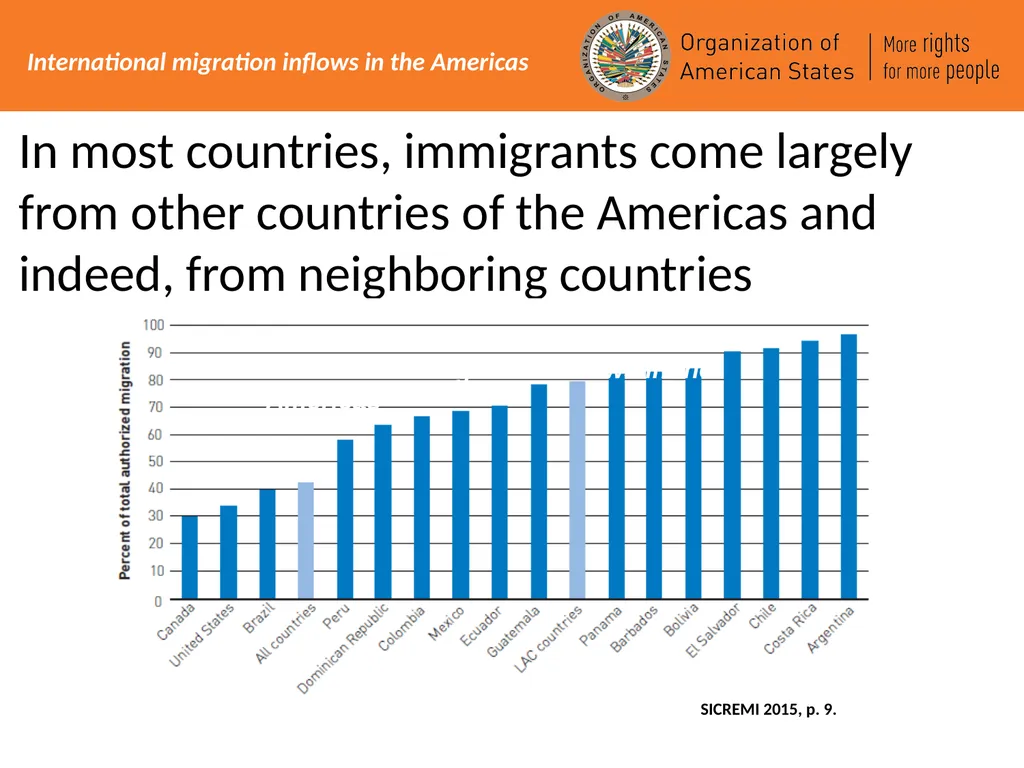
In most countries, immigrants come largely from other countries of the Americas and indeed, from neighboring countries SICREMI 2015, p. 9. International migration inflows in the Americas International migration inflows in the Americas<br>
07
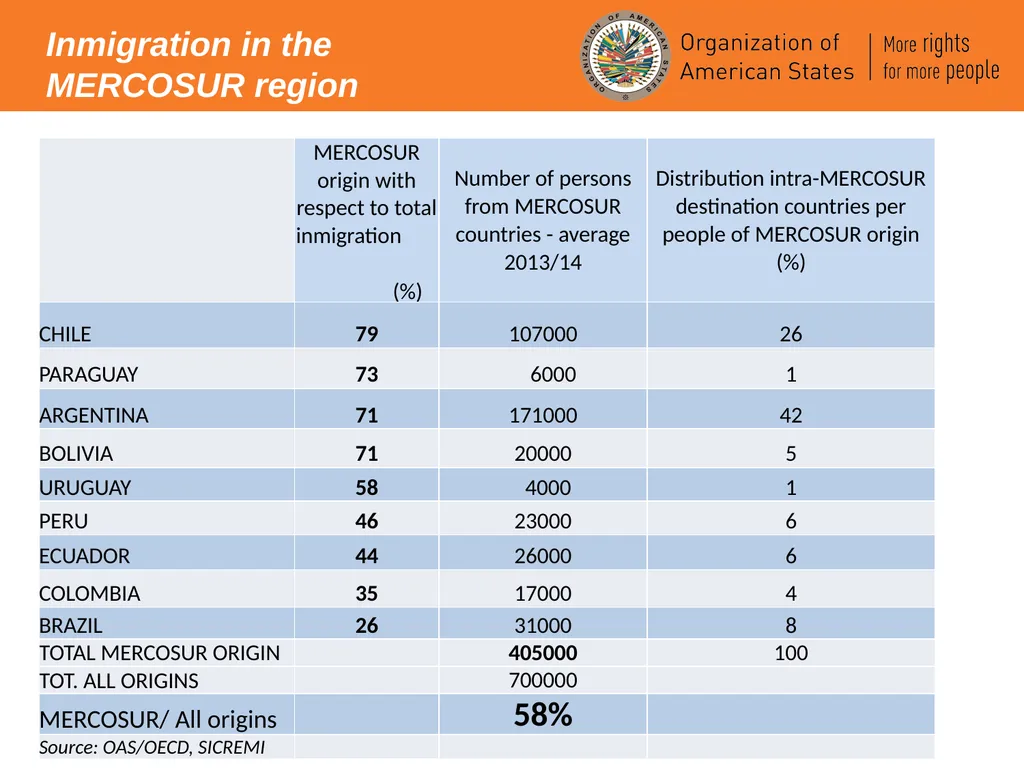
Inmigration in the MERCOSUR region<br>
08
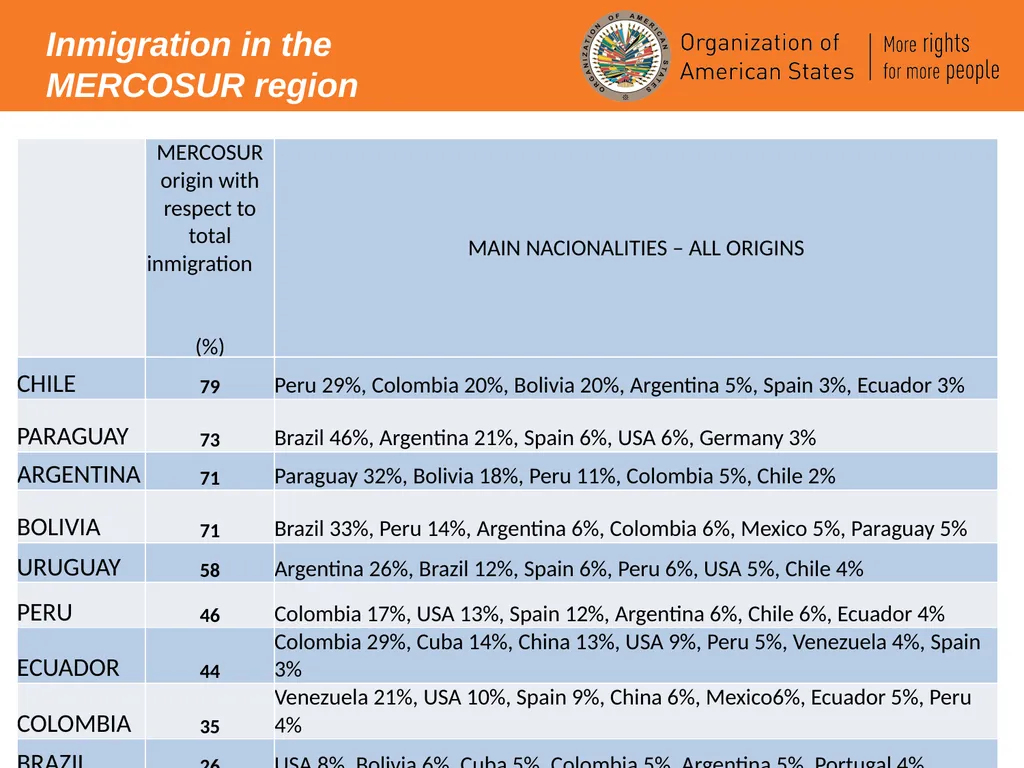
Inmigration in the MERCOSUR region<br>
09
Out-migration 2011-2014
from countries of the Americas<br>
10
Out-migration 2011-2014
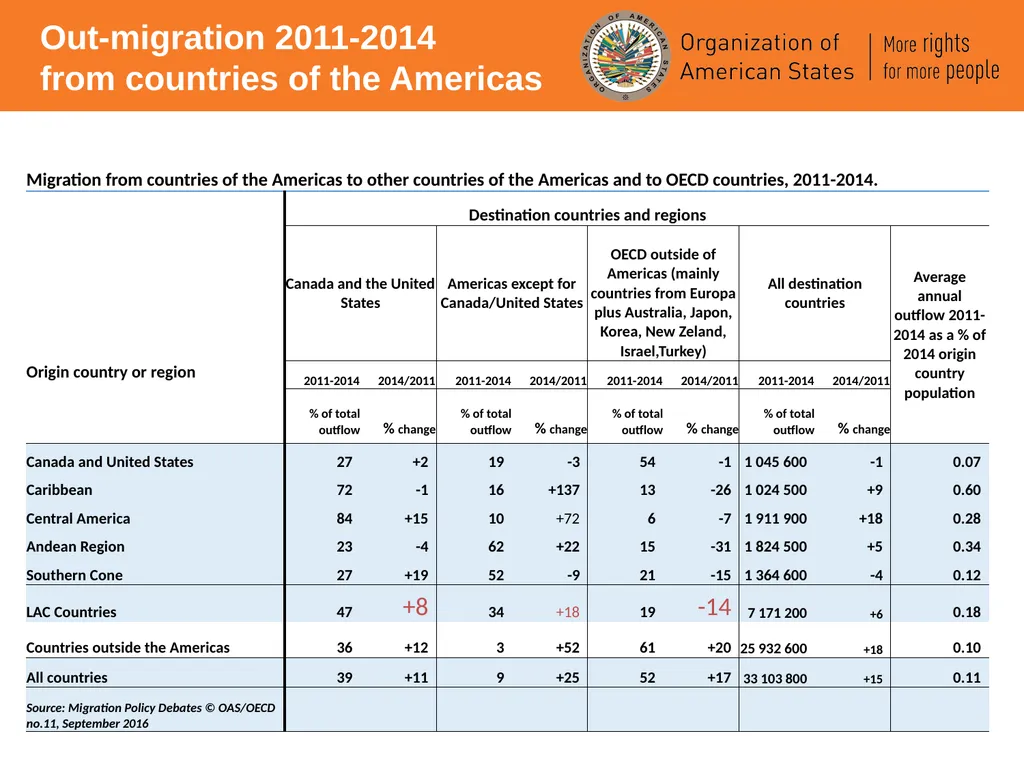
from countries of the Americas Out-migration increased by 8% to the United States and Canada, 18% to LAC and decreased by 14% to OECD countries outside the Americas (mainly Europe and Japan)
47% of the emigrants from the Americas went to the United States and Canada, 34% to LAC countries and 19% to OECD countries outside the Americas (Europe and Japan)
Emigration from Central America increased 18%, from the Caribbean 9%, from the Andean Region 5% and decreased 4% from the Southern Cone.<br>
11
Out-migration 2011-2014
from countries of the Americas A significant increase in out-migration from the Caribbean (+ 137%) and Central America (+ 72%) to other LAC countries.
At country level, out-migration increased in Cuba (+ 57%), Nicaragua (+ 63%), Venezuela (+ 33%) and Colombia (+ 29%)
Generally, LAC countries show high emigration rates, except for those of the Southern Cone<br>
12
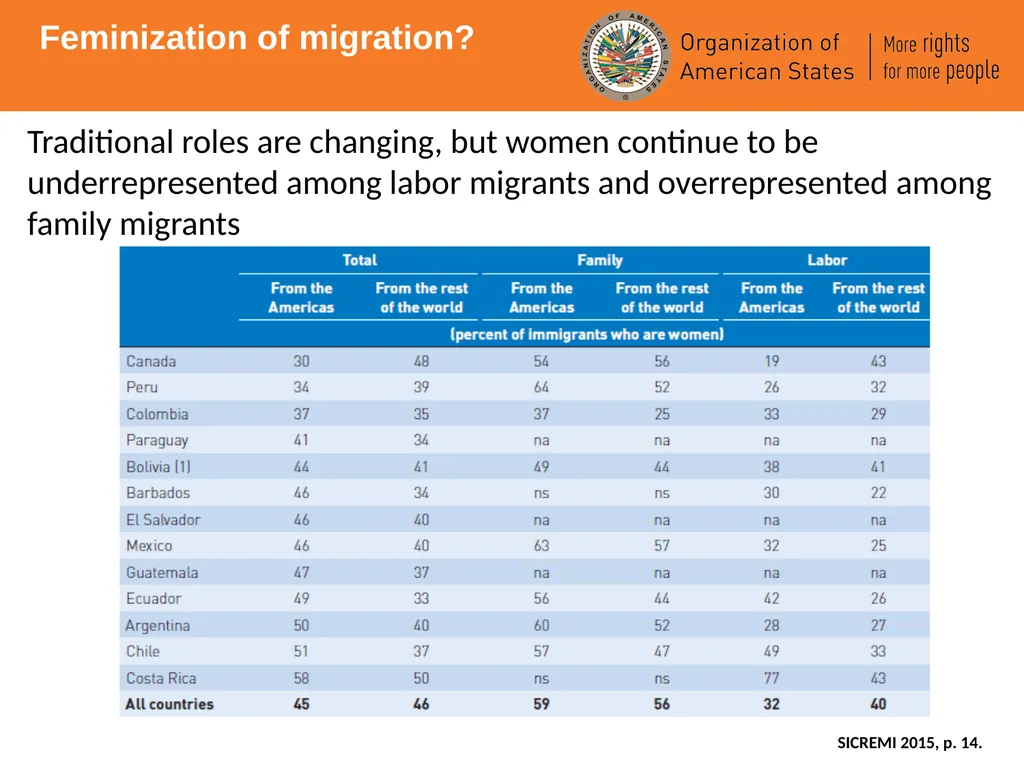
Feminization of migration? Traditional roles are changing, but women continue to be underrepresented among labor migrants and overrepresented among family migrants SICREMI 2015, p. 14.<br>
13
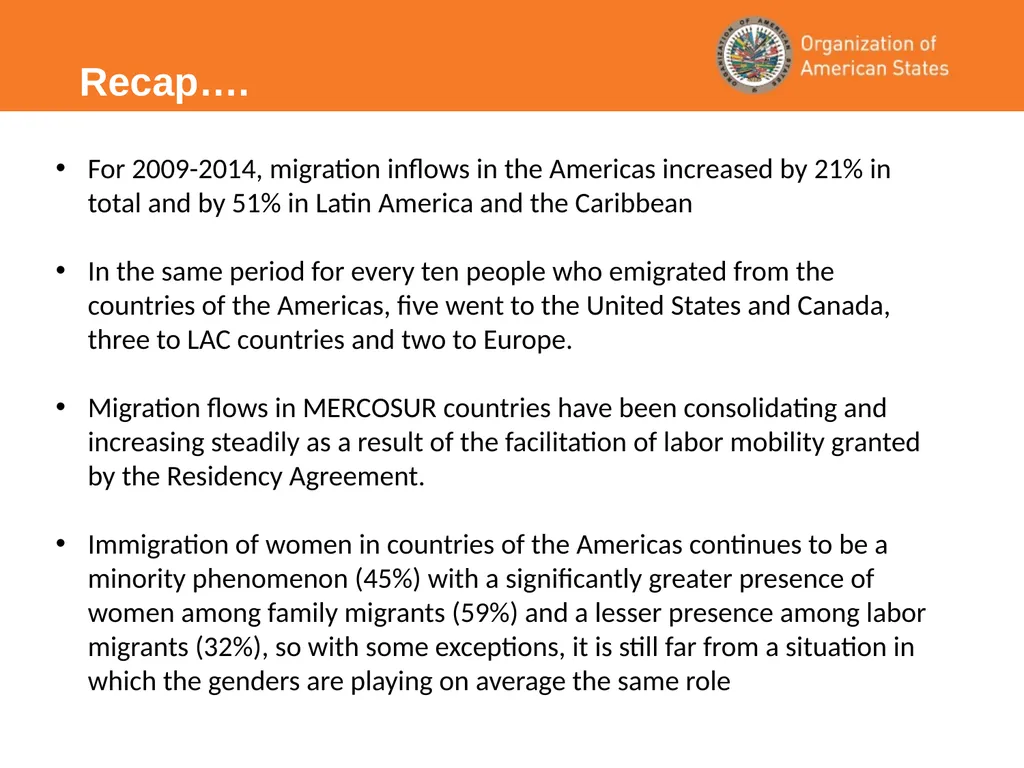
Recap…. For 2009-2014, migration inflows in the Americas increased by 21% in total and by 51% in Latin America and the Caribbean
In the same period for every ten people who emigrated from the countries of the Americas, five went to the United States and Canada, three to LAC countries and two to Europe.
Migration flows in MERCOSUR countries have been consolidating and increasing steadily as a result of the facilitation of labor mobility granted by the Residency Agreement.
Immigration of women in countries of the Americas continues to be a minority phenomenon (45%) with a significantly greater presence of women among family migrants (59%) and a lesser presence among labor migrants (32%), so with some exceptions, it is still far from a situation in which the genders are playing on average the same role<br>
14
Thank you for your attention! http://www.migracionoea.org/index.php/es/sicremi-es/reportes.html