
International Relations: the changing
GB
Published · 10 slides · 0 views
1 / 1
Description
International Relations: the changing international order 1918c.2001 with Germany 19251955: The People and the State Annotated Sample Question Paper 02 AO3 (5) This will always be a comparison of two primary sources requiring evaluation
Related Topics
Share
Embed code
Download this presentation From Below
"International Relations: the changing" is the property of its rightful owner. Permission is granted to download and print the materials on this website for personal, non-commercial use only, and to display it on your personal computer provided you do not modify the materials and that you retain all copyright notices contained in the materials. By downloading content from our website, you accept the terms of this agreement.
Presentation Transcript
01
International Relations: the changing international order 1918–c.2001 with Germany 1925–1955: The People and the State
Annotated Sample Question Paper /02<br>
Annotated Sample Question Paper /02<br>
02
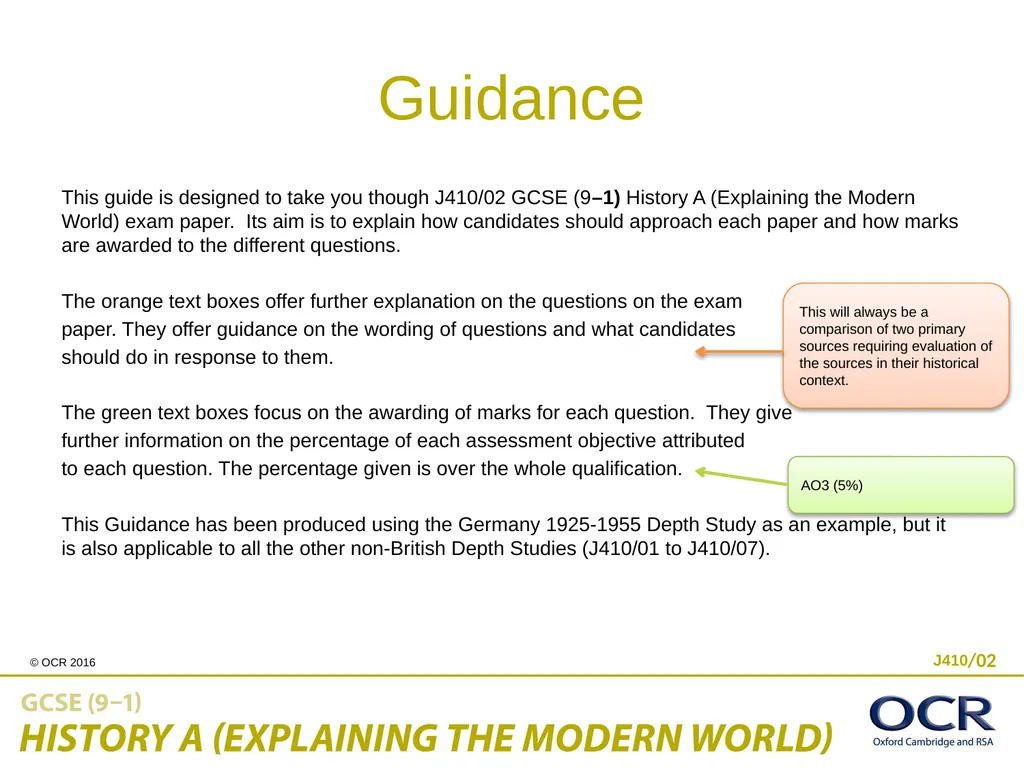
AO3 (5%) This will always be a comparison of two primary sources requiring evaluation of the sources in their historical context. This guide is designed to take you though J410/02 GCSE (9–1) History A (Explaining the Modern World) exam paper. Its aim is to explain how candidates should approach each paper and how marks are awarded to the different questions.
The orange text boxes offer further explanation on the questions on the exam
paper. They offer guidance on the wording of questions and what candidates
should do in response to them.
The green text boxes focus on the awarding of marks for each question. They give
further information on the percentage of each assessment objective attributed
to each question. The percentage given is over the whole qualification.
This Guidance has been produced using the Germany 1925-1955 Depth Study as an example, but it is also applicable to all the other non-British Depth Studies (J410/01 to J410/07). Guidance /02<br>
03
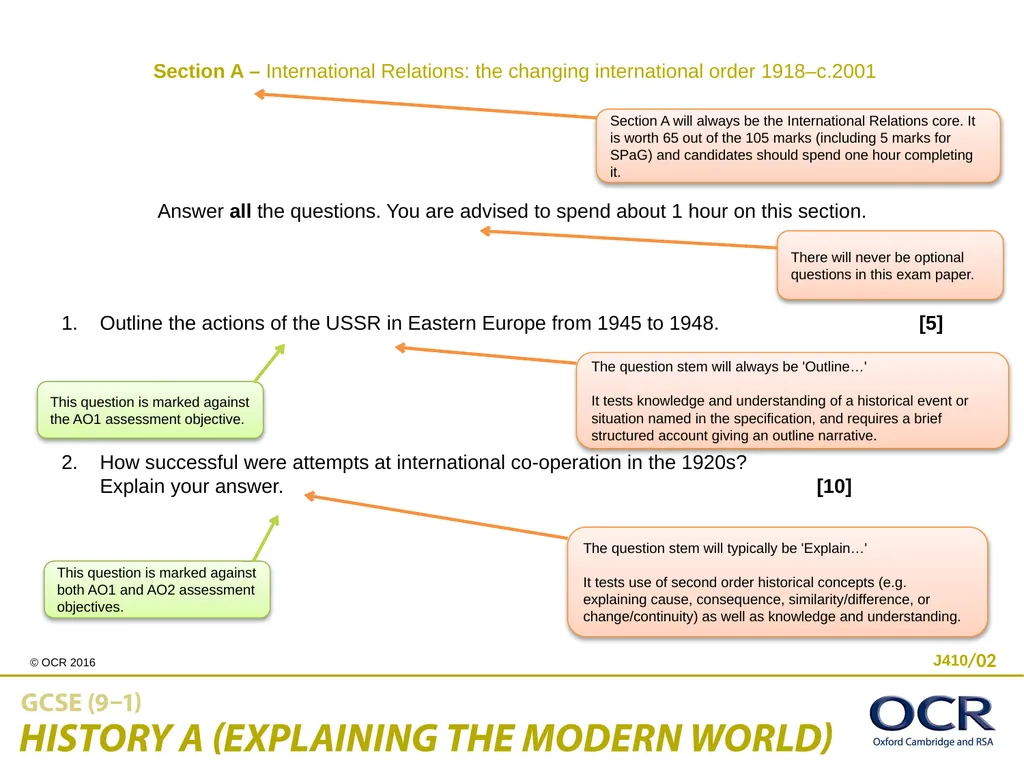
Section A will always be the International Relations core. It is worth 65 out of the 105 marks (including 5 marks for SPaG) and candidates should spend one hour completing it. The question stem will always be 'Outline…'
It tests knowledge and understanding of a historical event or situation named in the specification, and requires a brief structured account giving an outline narrative. There will never be optional questions in this exam paper. This question is marked against the AO1 assessment objective. The question stem will typically be 'Explain…'
It tests use of second order historical concepts (e.g. explaining cause, consequence, similarity/difference, or change/continuity) as well as knowledge and understanding. This question is marked against both AO1 and AO2 assessment objectives. Section A – International Relations: the changing international order 1918–c.2001
Answer all the questions. You are advised to spend about 1 hour on this section.
Outline the actions of the USSR in Eastern Europe from 1945 to 1948. [5]
How successful were attempts at international co-operation in the 1920s? Explain your answer. [10] /02<br>
04
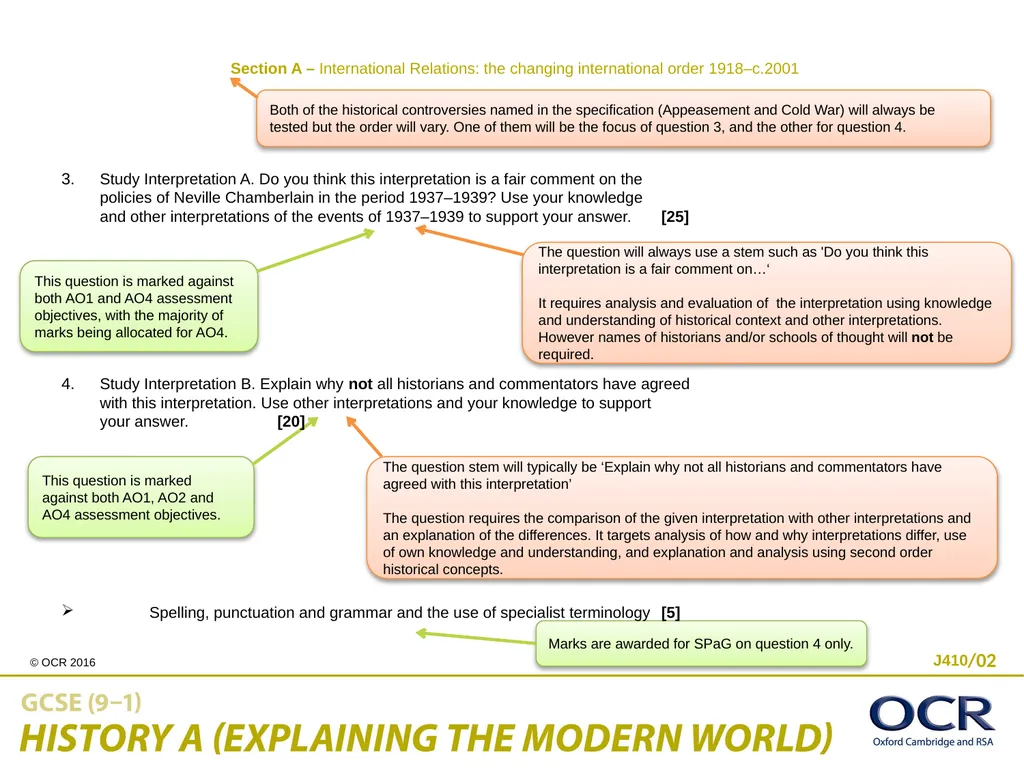
The question will always use a stem such as 'Do you think this interpretation is a fair comment on…‘
It requires analysis and evaluation of the interpretation using knowledge and understanding of historical context and other interpretations. However names of historians and/or schools of thought will not be required. This question is marked against both AO1, AO2 and AO4 assessment objectives. Both of the historical controversies named in the specification (Appeasement and Cold War) will always be tested but the order will vary. One of them will be the focus of question 3, and the other for question 4. The question stem will typically be ‘Explain why not all historians and commentators have agreed with this interpretation’
The question requires the comparison of the given interpretation with other interpretations and an explanation of the differences. It targets analysis of how and why interpretations differ, use of own knowledge and understanding, and explanation and analysis using second order historical concepts. This question is marked against both AO1 and AO4 assessment objectives, with the majority of marks being allocated for AO4. Marks are awarded for SPaG on question 4 only. /02 Section A – International Relations: the changing international order 1918–c.2001
Study Interpretation A. Do you think this interpretation is a fair comment on the policies of Neville Chamberlain in the period 1937–1939? Use your knowledge and other interpretations of the events of 1937–1939 to support your answer. [25]
Study Interpretation B. Explain why not all historians and commentators have agreed with this interpretation. Use other interpretations and your knowledge to support your answer. [20]
Spelling, punctuation and grammar and the use of specialist terminology [5]<br>
05
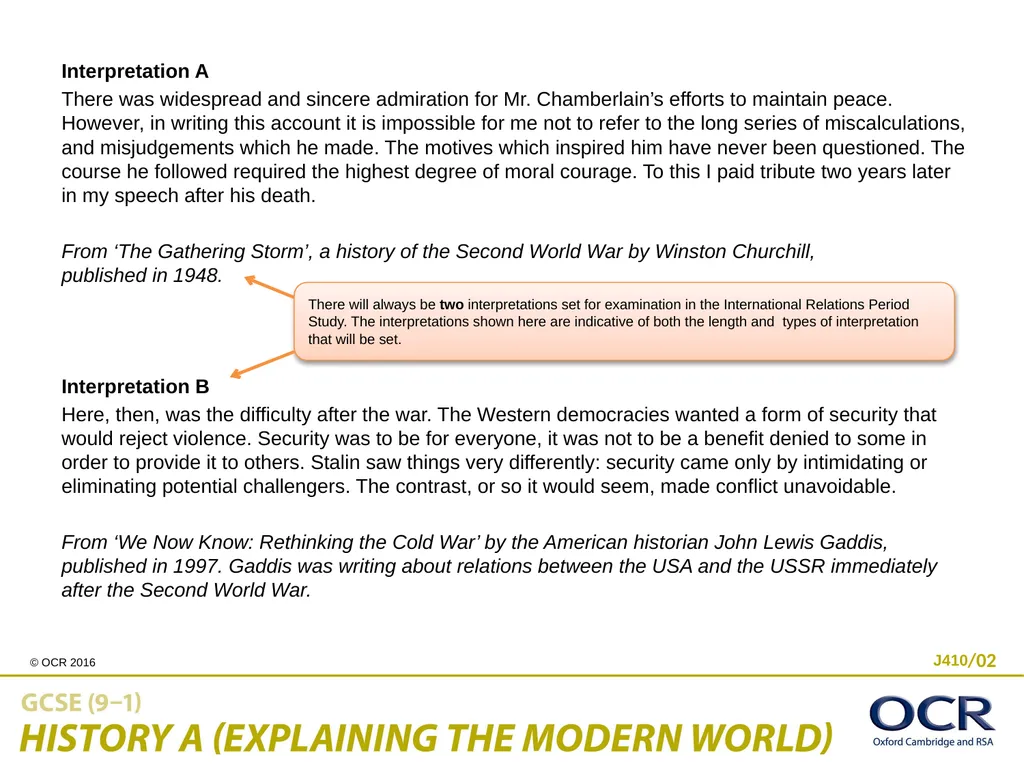
There will always be two interpretations set for examination in the International Relations Period Study. The interpretations shown here are indicative of both the length and types of interpretation that will be set. /02 Interpretation A
There was widespread and sincere admiration for Mr. Chamberlain’s efforts to maintain peace. However, in writing this account it is impossible for me not to refer to the long series of miscalculations, and misjudgements which he made. The motives which inspired him have never been questioned. The course he followed required the highest degree of moral courage. To this I paid tribute two years later in my speech after his death.
From ‘The Gathering Storm’, a history of the Second World War by Winston Churchill, published in 1948.
Interpretation B
Here, then, was the difficulty after the war. The Western democracies wanted a form of security that would reject violence. Security was to be for everyone, it was not to be a benefit denied to some in order to provide it to others. Stalin saw things very differently: security came only by intimidating or eliminating potential challengers. The contrast, or so it would seem, made conflict unavoidable.
From ‘We Now Know: Rethinking the Cold War’ by the American historian John Lewis Gaddis, published in 1997. Gaddis was writing about relations between the USA and the USSR immediately after the Second World War.<br>
06
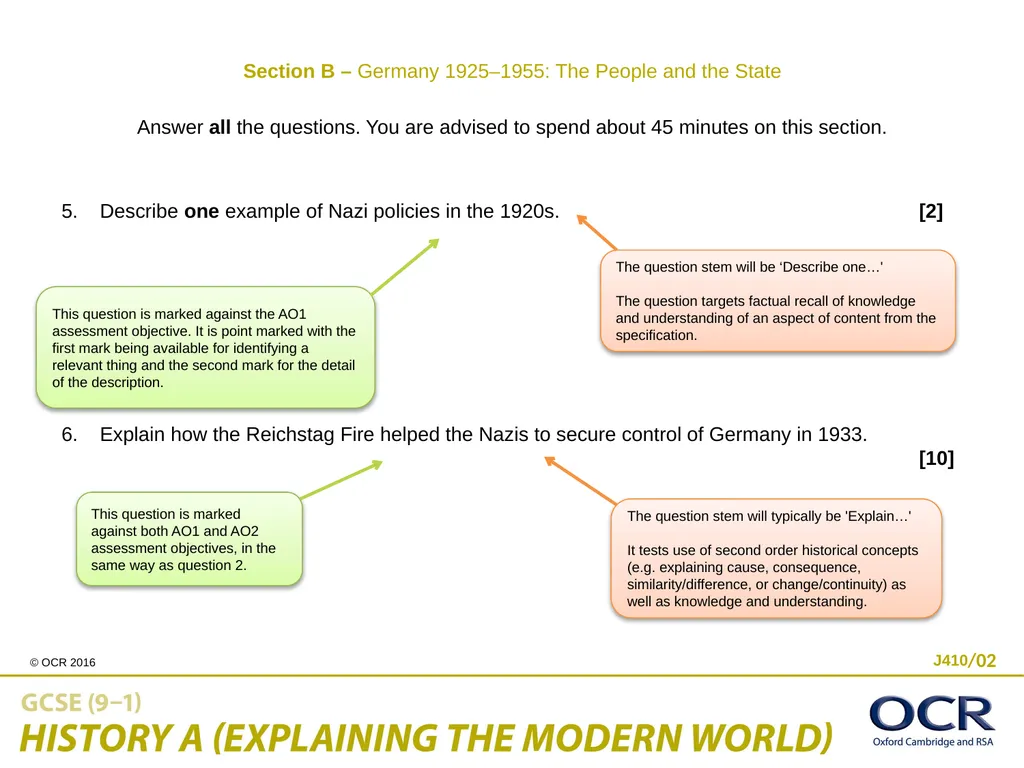
The question stem will be ‘Describe one…'
The question targets factual recall of knowledge and understanding of an aspect of content from the specification. The question stem will typically be 'Explain…'
It tests use of second order historical concepts (e.g. explaining cause, consequence, similarity/difference, or change/continuity) as well as knowledge and understanding. This question is marked against the AO1 assessment objective. It is point marked with the first mark being available for identifying a relevant thing and the second mark for the detail of the description. This question is marked against both AO1 and AO2 assessment objectives, in the same way as question 2. /02 Section B – Germany 1925–1955: The People and the State
Answer all the questions. You are advised to spend about 45 minutes on this section.
Describe one example of Nazi policies in the 1920s. [2]
Explain how the Reichstag Fire helped the Nazis to secure control of Germany in 1933. [10]<br>
07
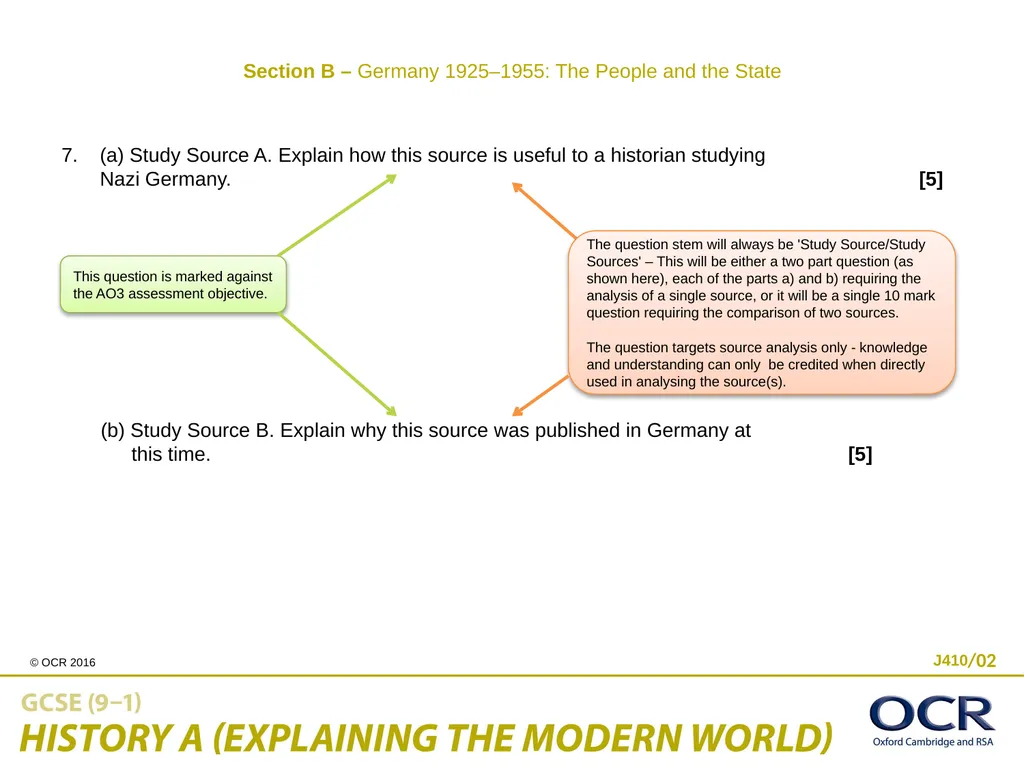
The question stem will always be 'Study Source/Study Sources' – This will be either a two part question (as shown here), each of the parts a) and b) requiring the analysis of a single source, or it will be a single 10 mark question requiring the comparison of two sources.
The question targets source analysis only - knowledge
and understanding can only be credited when directly used in analysing the source(s). This question is marked against the AO3 assessment objective. /02 Section B – Germany 1925–1955: The People and the State
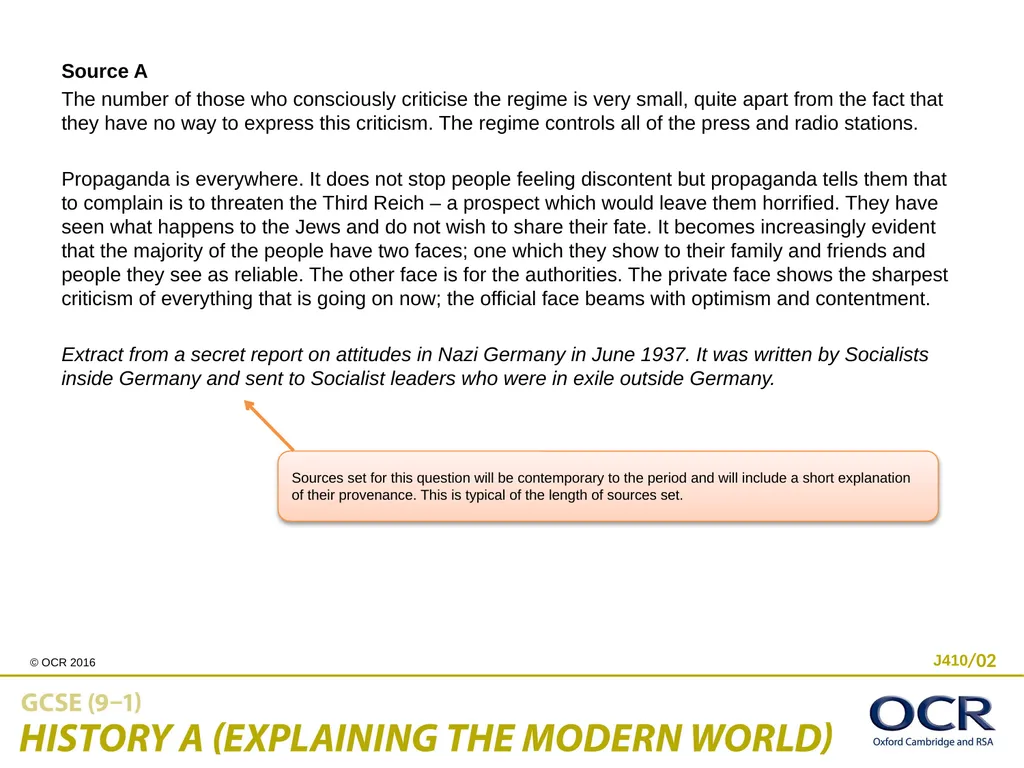
(a) Study Source A. Explain how this source is useful to a historian studying Nazi Germany. [5]
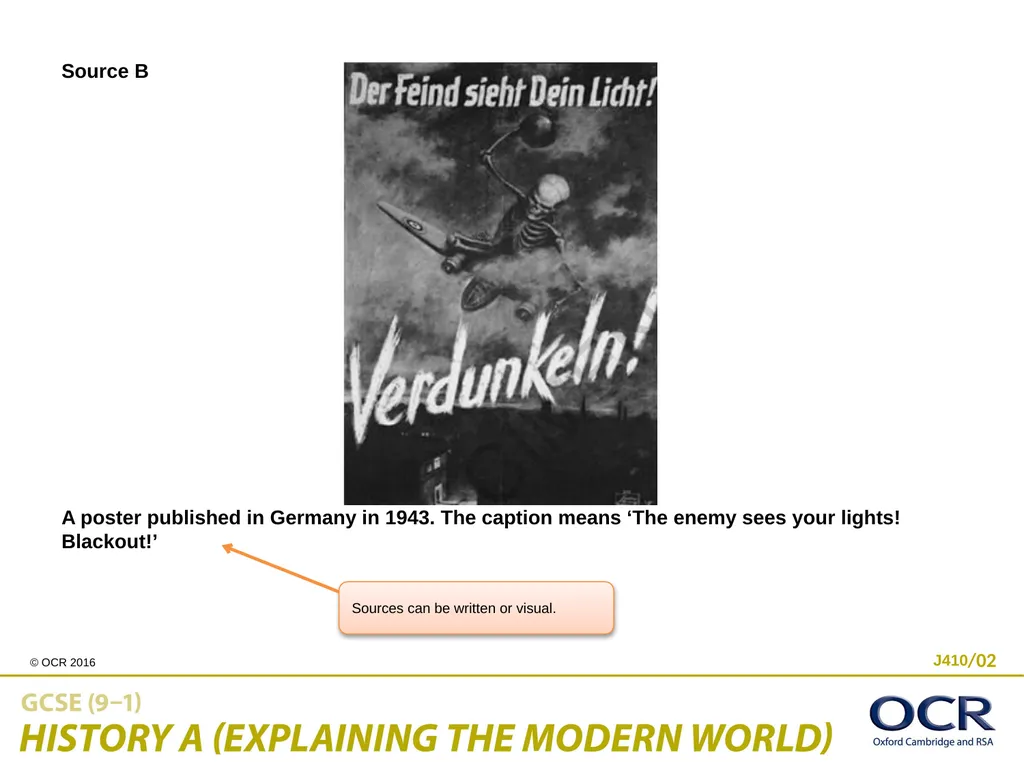
(b) Study Source B. Explain why this source was published in Germany at this time. [5]<br>
08
Sources set for this question will be contemporary to the period and will include a short explanation of their provenance. This is typical of the length of sources set. /02 Source A
The number of those who consciously criticise the regime is very small, quite apart from the fact that they have no way to express this criticism. The regime controls all of the press and radio stations.
Propaganda is everywhere. It does not stop people feeling discontent but propaganda tells them that to complain is to threaten the Third Reich – a prospect which would leave them horrified. They have seen what happens to the Jews and do not wish to share their fate. It becomes increasingly evident that the majority of the people have two faces; one which they show to their family and friends and people they see as reliable. The other face is for the authorities. The private face shows the sharpest criticism of everything that is going on now; the official face beams with optimism and contentment.
Extract from a secret report on attitudes in Nazi Germany in June 1937. It was written by Socialists inside Germany and sent to Socialist leaders who were in exile outside Germany.<br>
09
Sources can be written or visual. /02 Source B
A poster published in Germany in 1943. The caption means ‘The enemy sees your lights! Blackout!’<br>
A poster published in Germany in 1943. The caption means ‘The enemy sees your lights! Blackout!’<br>
10
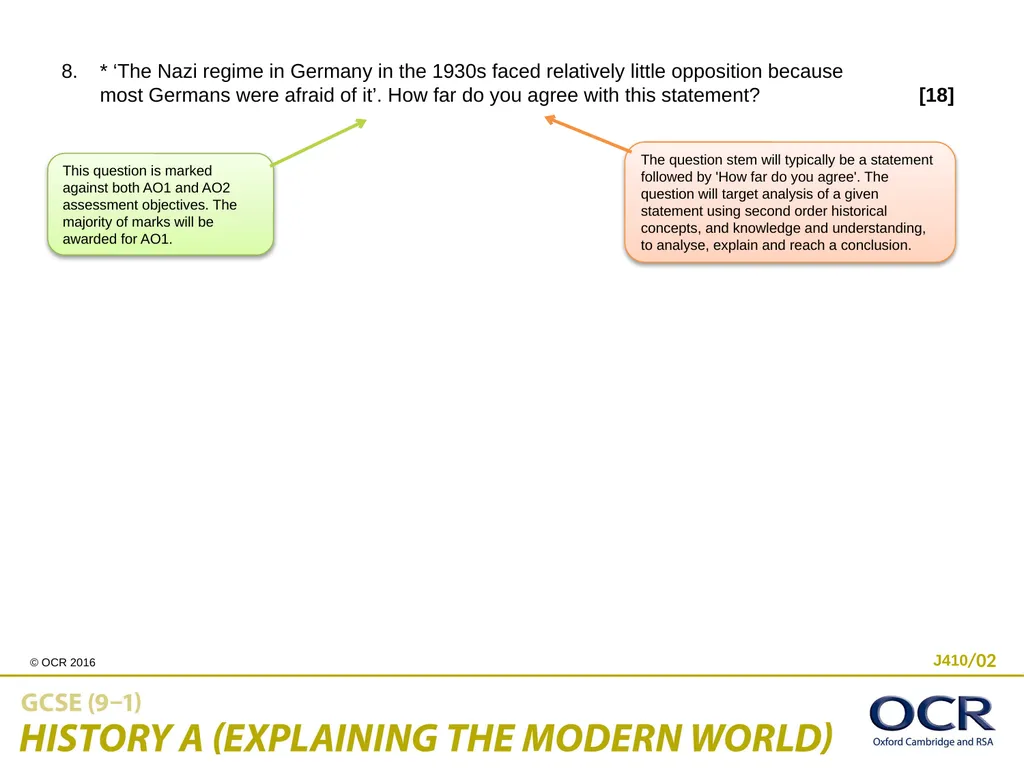
The question stem will typically be a statement followed by 'How far do you agree'. The question will target analysis of a given statement using second order historical concepts, and knowledge and understanding, to analyse, explain and reach a conclusion. This question is marked against both AO1 and AO2 assessment objectives. The majority of marks will be awarded for AO1. /02 * ‘The Nazi regime in Germany in the 1930s faced relatively little opposition because
most Germans were afraid of it’. How far do you agree with this statement? [18]<br>