International Symposium on Transport Security of Nuclear and other Radioactive Material; Tokyo, Japan, November 2019 IAEA International Nuclear Security Conference February 10-14, 2020 Vienna, Austria Integrated Support Center for Nuclear
"International Symposium on Transport Security of" is the property of its rightful owner. Permission is granted to
download and print the materials on this website for personal, non-commercial use only, and to display it
on your personal computer provided you do not modify the materials and that you retain all copyright
notices contained in the materials. By downloading content from our website, you accept the terms of this
agreement.
Presentation Transcript
01
International Symposium on Transport Security of Nuclear and other Radioactive Material;
Tokyo, Japan, November 2019 IAEA International Nuclear Security Conference
February 10-14, 2020
Vienna, Austria Integrated Support Center for Nuclear Nonproliferation and Nuclear Security Japan Atomic Energy Agency ISCN/JAEA: NORO Naoko
DOE/NNSA: Brian Abeyta, Katherine Holt
ORNL: David Duhamel<br>
02
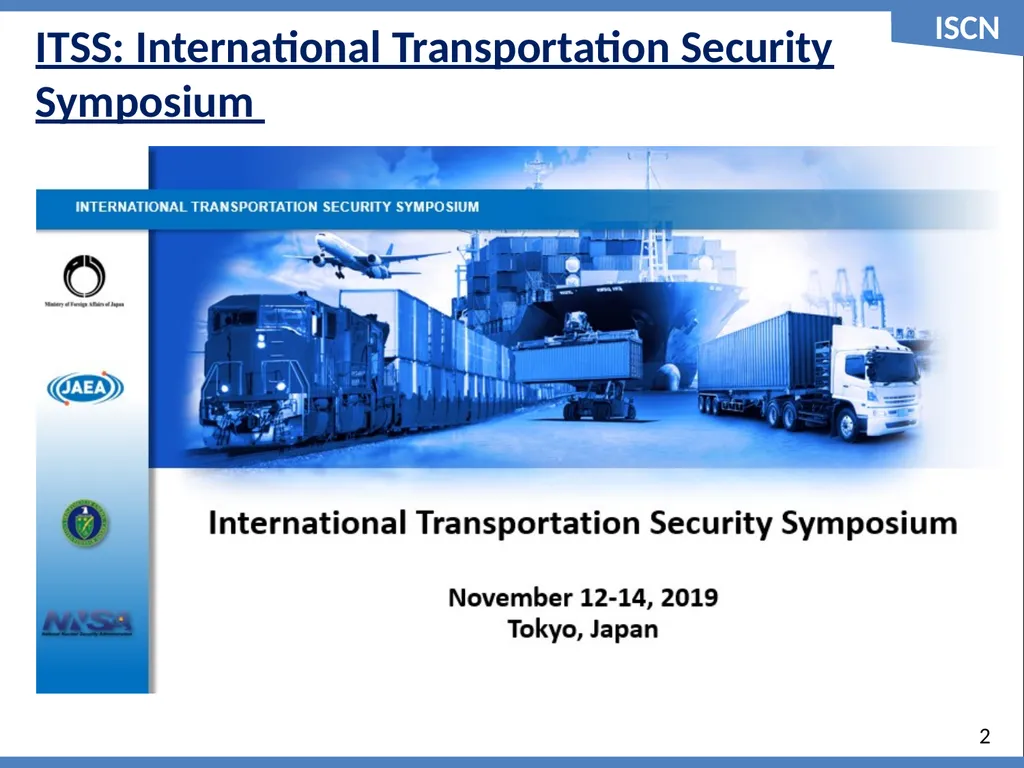
1 ITSS: International Transportation Security Symposium<br>
03
2 ITSS: International Transportation Security Symposium Organizers: Ministry of Foreign Affairs of Japan, in cooperation with Japan Atomic Energy Agency (JAEA), supported by U.S. Department of Energy, National Nuclear Security Administration (DOE/NNSA)
Dates: November 12-14, 2019
Venue: Tokyo, Japan
Participants: 104 from 38 countries and international organizations<br>
04
Nuclear Security Summit Gift basket for transportation security
Japan led the international effort on the development of “Good Practices Guides” for air, rail, road and sea transport modes
INFCIRC/909: Joint Statement
Japan sponsored the IAEA Information Circular 909 (INFCIRC/909), Joint Statement on Transport of Nuclear Materials
commitment to further exchange national practices on the transport security of nuclear and radioactive materials and actively support the IAEA, Global Initiative to Combat Nuclear Terrorism (GICNT), and the Global Partnership Against the Spread of Weapons and Materials of Mass Destruction (GP) in advancing nuclear transport security obligations<br>
05
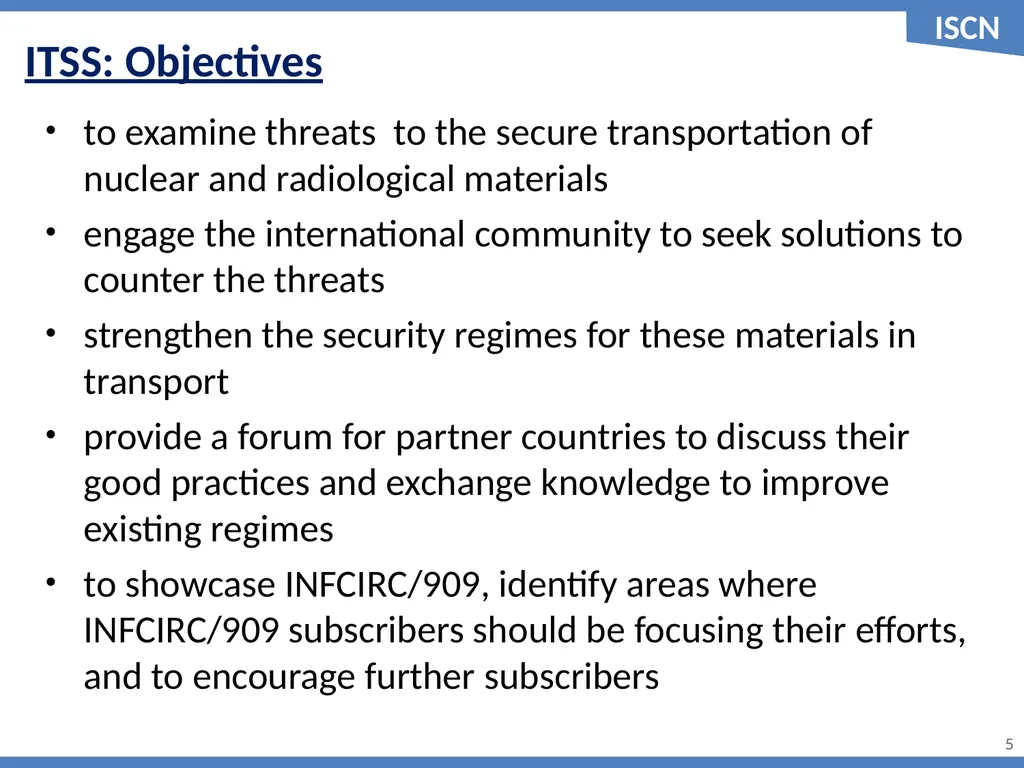
4 4 ITSS: Objectives to examine threats to the secure transportation of nuclear and radiological materials
engage the international community to seek solutions to counter the threats
strengthen the security regimes for these materials in transport
provide a forum for partner countries to discuss their good practices and exchange knowledge to improve existing regimes
to showcase INFCIRC/909, identify areas where INFCIRC/909 subscribers should be focusing their efforts, and to encourage further subscribers<br>
06
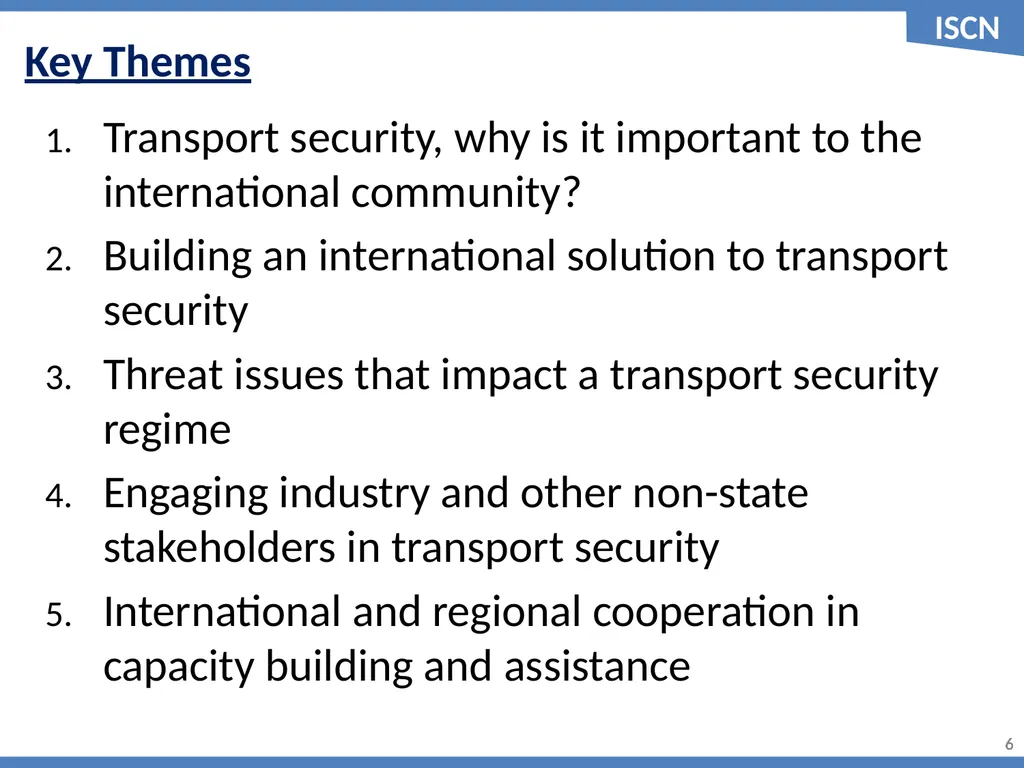
5 5 Key Themes Transport security, why is it important to the international community?
Building an international solution to transport security
Threat issues that impact a transport security regime
Engaging industry and other non-state stakeholders in transport security
International and regional cooperation in capacity building and assistance<br>
07
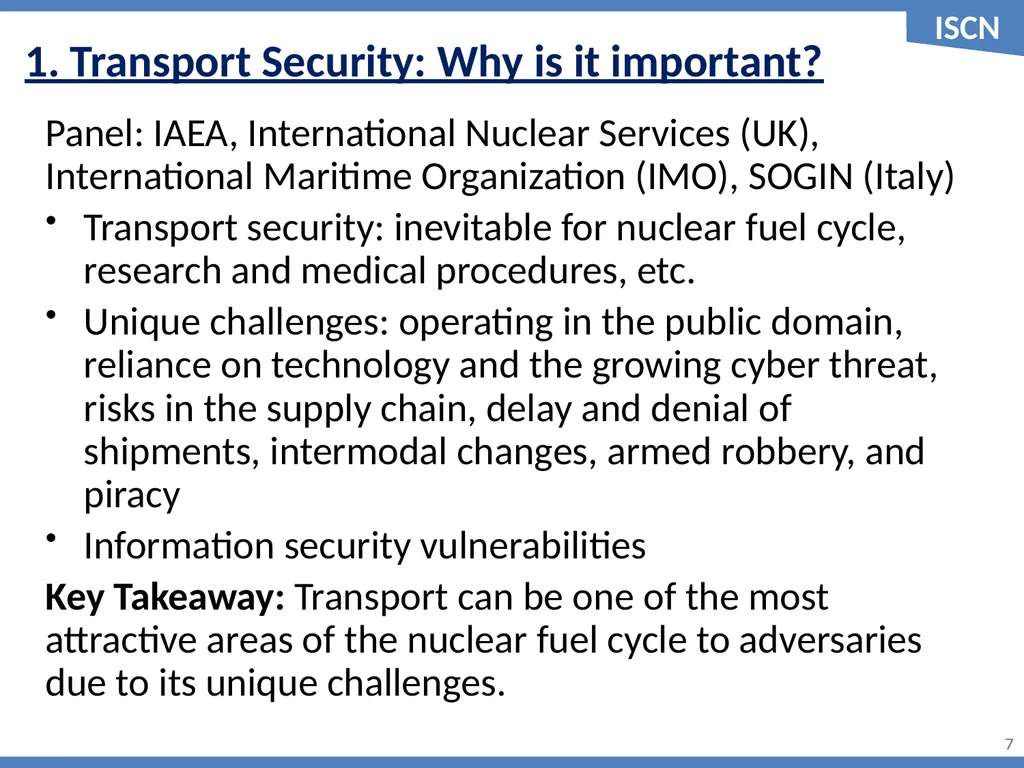
6 6 1. Transport Security: Why is it important? Panel: IAEA, International Nuclear Services (UK), International Maritime Organization (IMO), SOGIN (Italy)
Transport security: inevitable for nuclear fuel cycle, research and medical procedures, etc.
Unique challenges: operating in the public domain, reliance on technology and the growing cyber threat, risks in the supply chain, delay and denial of shipments, intermodal changes, armed robbery, and piracy
Information security vulnerabilities
Key Takeaway: Transport can be one of the most attractive areas of the nuclear fuel cycle to adversaries due to its unique challenges.<br>
08
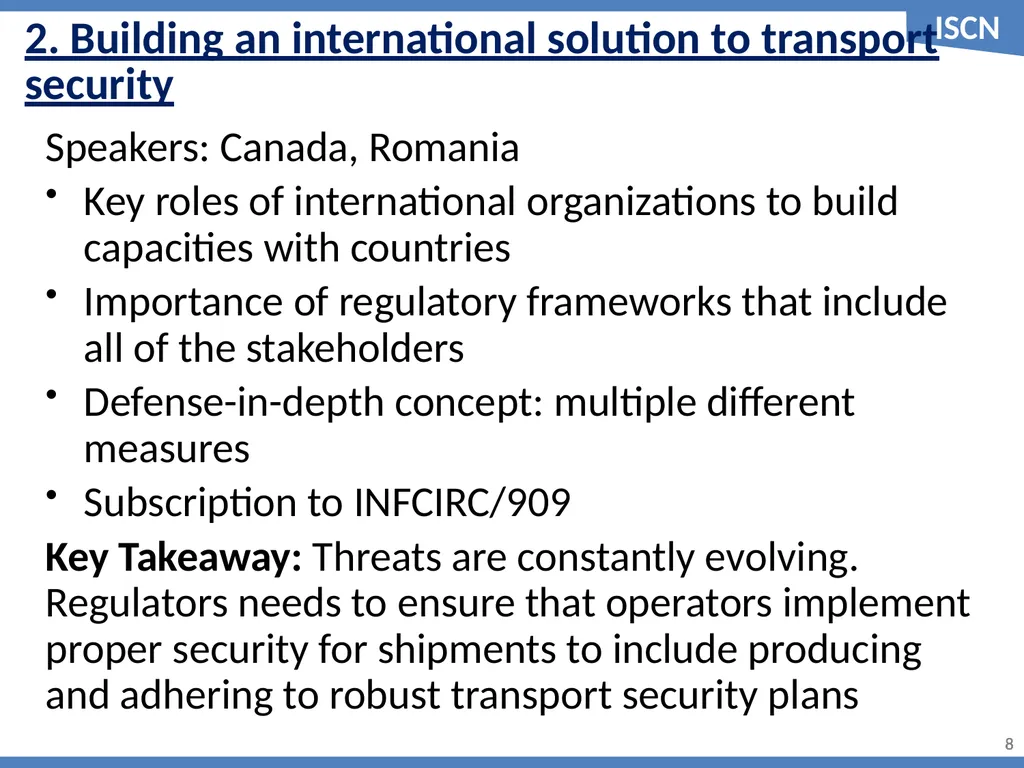
7 7 2. Building an international solution to transport security Speakers: Canada, Romania
Key roles of international organizations to build capacities with countries
Importance of regulatory frameworks that include all of the stakeholders
Defense-in-depth concept: multiple different measures
Subscription to INFCIRC/909
Key Takeaway: Threats are constantly evolving. Regulators needs to ensure that operators implement proper security for shipments to include producing and adhering to robust transport security plans<br>
09
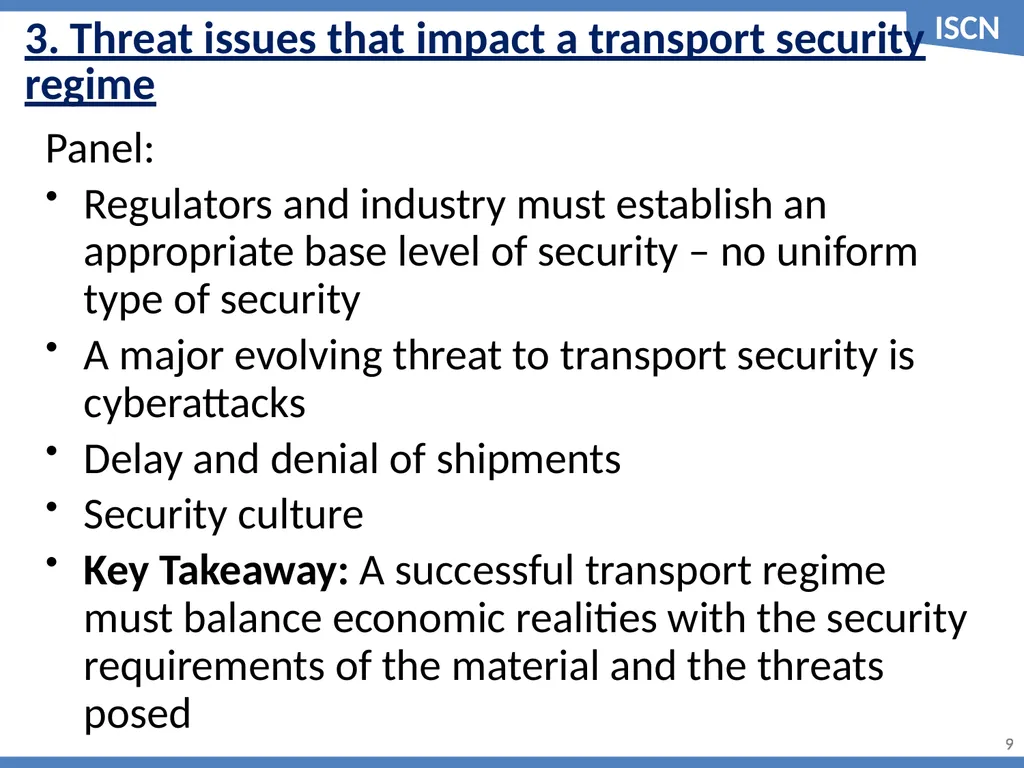
8 8 3. Threat issues that impact a transport security regime Panel:
Regulators and industry must establish an appropriate base level of security – no uniform type of security
A major evolving threat to transport security is cyberattacks
Delay and denial of shipments
Security culture
Key Takeaway: A successful transport regime must balance economic realities with the security requirements of the material and the threats posed<br>
10
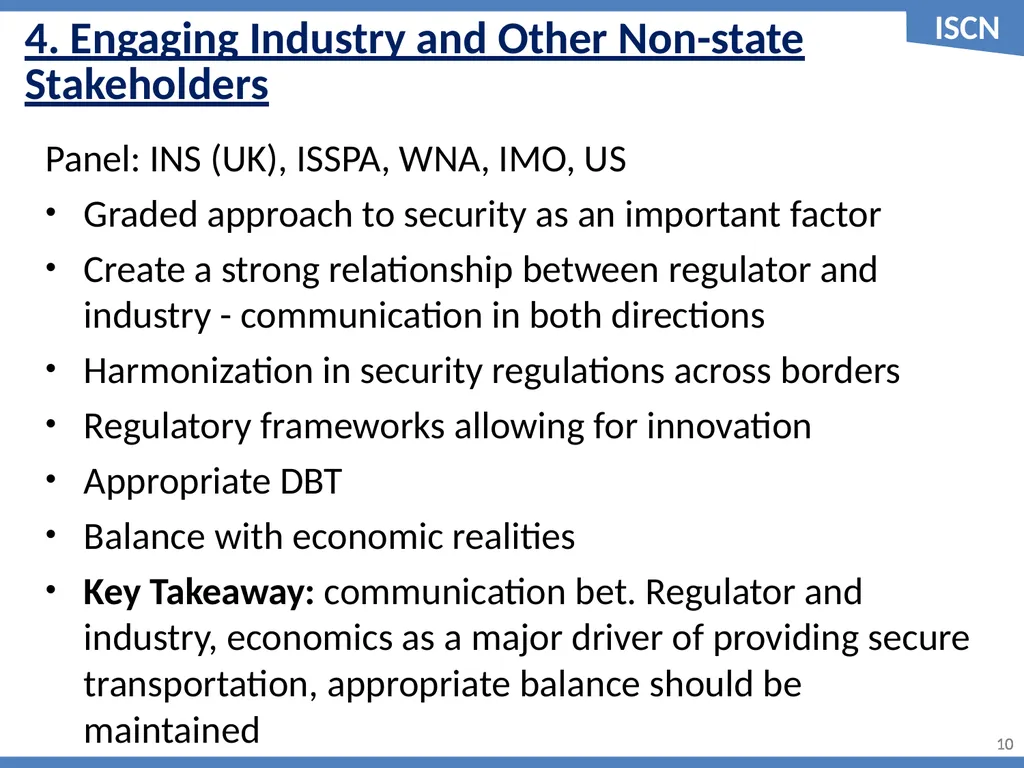
9 9 4. Engaging Industry and Other Non-state Stakeholders Panel: INS (UK), ISSPA, WNA, IMO, US
Graded approach to security as an important factor
Create a strong relationship between regulator and industry - communication in both directions
Harmonization in security regulations across borders
Regulatory frameworks allowing for innovation
Appropriate DBT
Balance with economic realities
Key Takeaway: communication bet. Regulator and industry, economics as a major driver of providing secure transportation, appropriate balance should be maintained<br>
11
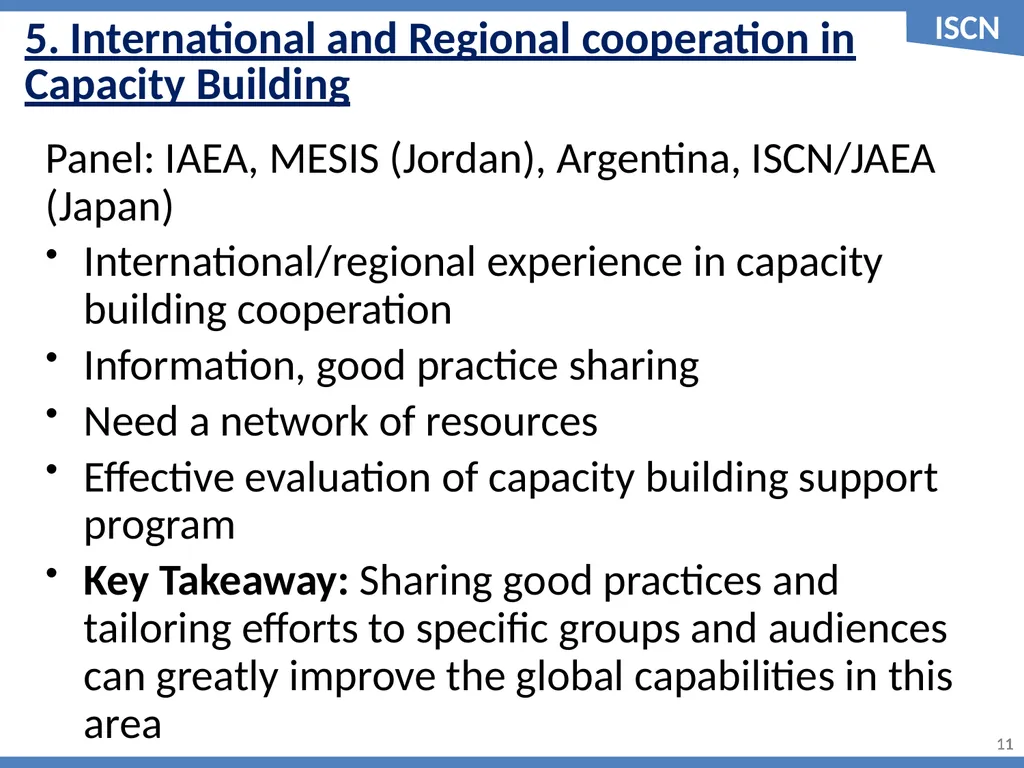
10 10 5. International and Regional cooperation in Capacity Building Panel: IAEA, MESIS (Jordan), Argentina, ISCN/JAEA (Japan)
International/regional experience in capacity building cooperation
Information, good practice sharing
Need a network of resources
Effective evaluation of capacity building support program
Key Takeaway: Sharing good practices and tailoring efforts to specific groups and audiences can greatly improve the global capabilities in this area<br>
12
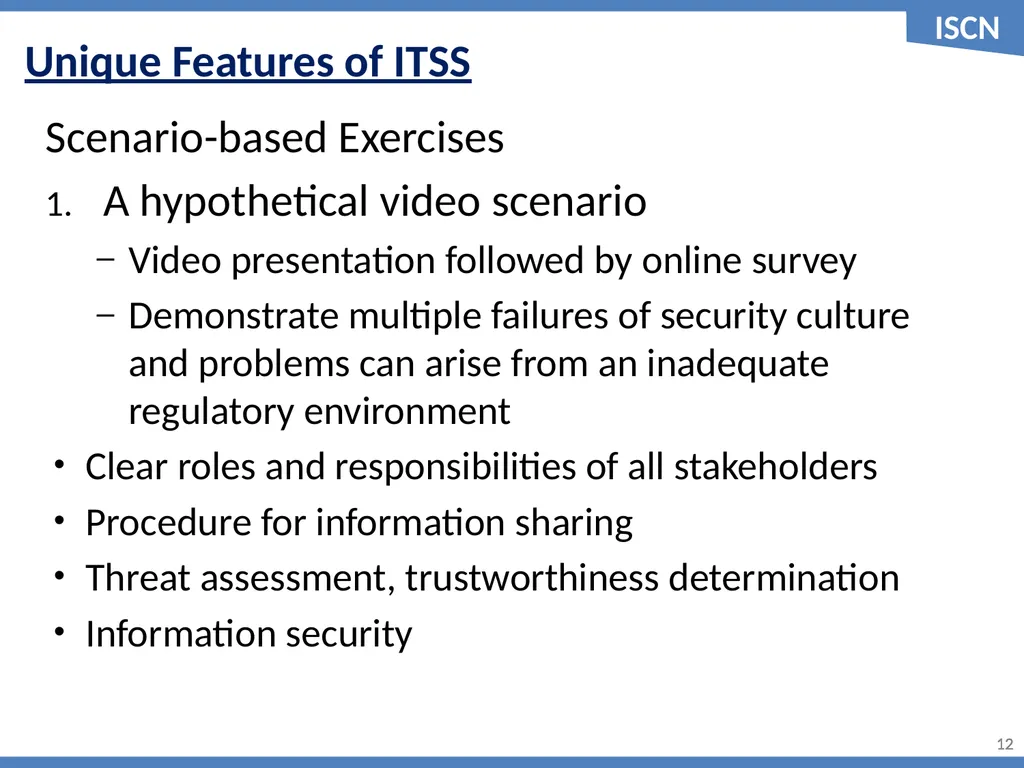
11 11 Unique Features of ITSS Scenario-based Exercises
A hypothetical video scenario
Video presentation followed by online survey
Demonstrate multiple failures of security culture and problems can arise from an inadequate regulatory environment
Clear roles and responsibilities of all stakeholders
Procedure for information sharing
Threat assessment, trustworthiness determination
Information security<br>
13
12 12 Unique Features of ITSS Scenario-based Exercises
Breakout session for focused discussion
Laws and regulatory framework
Effective coordination among competent authorities
Implementation guidance for operators
Challenge in sharing threat information
A national CBRN response plan facilitate the different stakeholders to communicate and prepare response<br>
14
13 13 Unique Features of ITSS Scenario-based Exercises
Breakout session for focused discussion
Physical protection systems and response
Defence-in-depth with performance verification and effective inspection
Coordination with law enforcement
Training and exercise
Insider threats
Trustworthiness determination program
Mitigating strategies: behavior observation
Safe and secure communication on shipments
Sharing information with law enforcement<br>
15
14 14 Conclusion and Next Step Shared commitment to continue the conversation on transport security
Encourage subscription to INFCIRC/909 – identify the benefits of INFCIRC/909
Importance of raising awareness through existing international frameworks (i.e., ICONS)
IAEA Technical Meeting on transport security
NSSC Network<br>