International Trade Grade 10 A Special Note for Teachers Students will Learn Basic language and concepts of trade including terms such as import and export The purpose and function of international trade Canadas major imports and
Related Topics
Share
Embed code
Download this presentation From Below
"International Trade Grade 10+ A Special Note for" is the property of its rightful owner. Permission is granted to
download and print the materials on this website for personal, non-commercial use only, and to display it
on your personal computer provided you do not modify the materials and that you retain all copyright
notices contained in the materials. By downloading content from our website, you accept the terms of this
agreement.
Presentation Transcript
01
International Trade Grade 10+<br>
02
A Special Note for Teachers<br>
03
Students will Learn… Basic language and concepts of trade including terms such as "import" and "export"
The purpose and function of international trade
Canada's major imports and exports
How to think about trade issues and ethical concerns regarding international trade<br>
04
Minds On Activity Think-Pair-Share
Have you heard of “imports” and “exports”? What are they?<br>
05
Academic Language Imports: Goods or services that are brought into a country from another country
Exports: Goods or services that are sent out of a country to another country
Goods: Merchandise, things for sale, physical products, "things or stuff"
Services: Work done, or help provided, often for a fee or wage
Domestic: Existing or occurring inside a particular country; not foreign or international
Economy: Wealth and resources of a country or region, especially in terms of the production and consumption of goods and services<br>
06
Classroom Economy We will learn about international trade by turning the classroom into a global mock economy!
Instructions:
Divide the class into small groups of preferably 3-4 students.
Each group will choose a country to research from an online resource or atlas.
Research the top imports and top exports for your country (for example: fuel, food, computer chips, social media providers).<br>
07
Classroom Economy In this simulation, each country has a national budget of $500 in U.S. dollars to purchase imports*. (Of course, you can also trade with goods and/or services.)
Display your country’s name and your top exports on your tables.
The top imports are the resources that your country needs. Walk around the room and find out which country exports those resources. Write down the names of those countries.
*Note: It is optional to convert between currencies. For an added challenge, foreign currency exchange can be incorporated into this activity.<br>
08
Classroom Economy Strategize and prepare for negotiations:
Which country do you want to negotiate with for a trade deal?
How much money are you willing to pay to purchase the import?
Is there a goods or service you have that can be used in the trade deal? What is the quantity you are willing to trade for?<br>
09
Classroom Economy<br>
10
Classroom Economy Return to your groups and discuss:
Were you able to negotiate for a trade? Were the negotiations easy or difficult?
Were you able to import everything that your country needs?
If you traded successfully: in your opinion, was it a fair trade? Or did you have to settle because there were no better options?<br>
11
Made in Canada? Activity What are some top resources we make in Canada and export to the rest of the world? What are some of your favourite things (goods or services) that are imported into Canada from another country?
Think-Pair-Share
Why do we bring goods or services into Canada?
Why do we sell goods or services to other countries?
Why is it important to trade with other countries?<br>
12
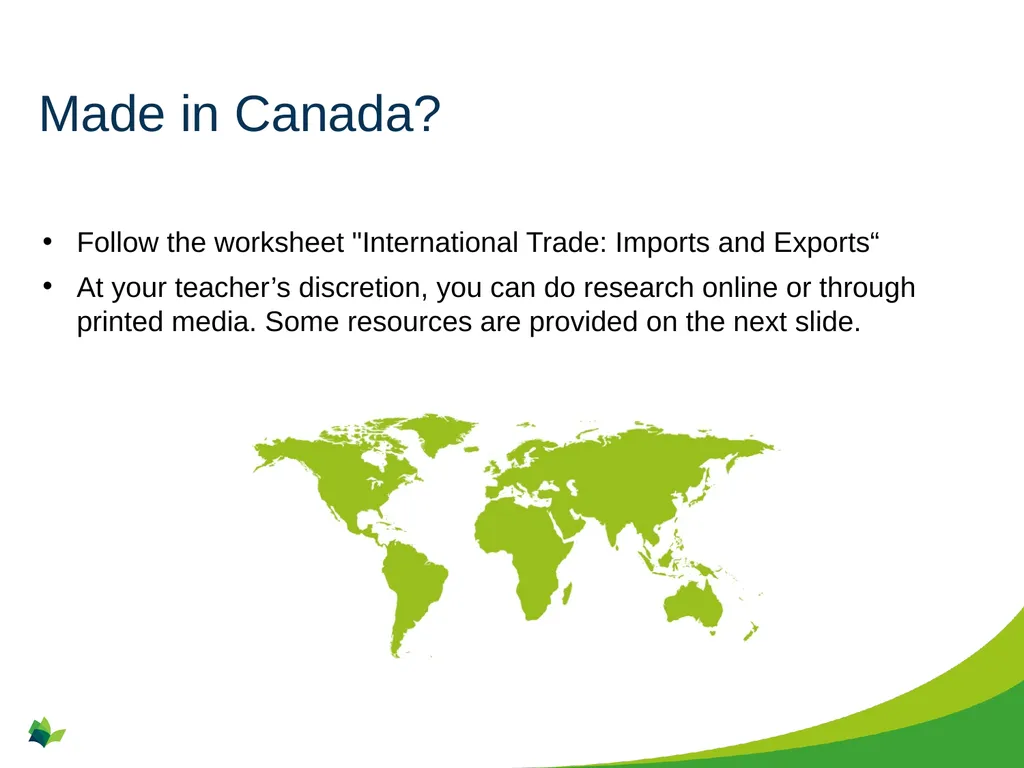
Made in Canada? Follow the worksheet "International Trade: Imports and Exports“
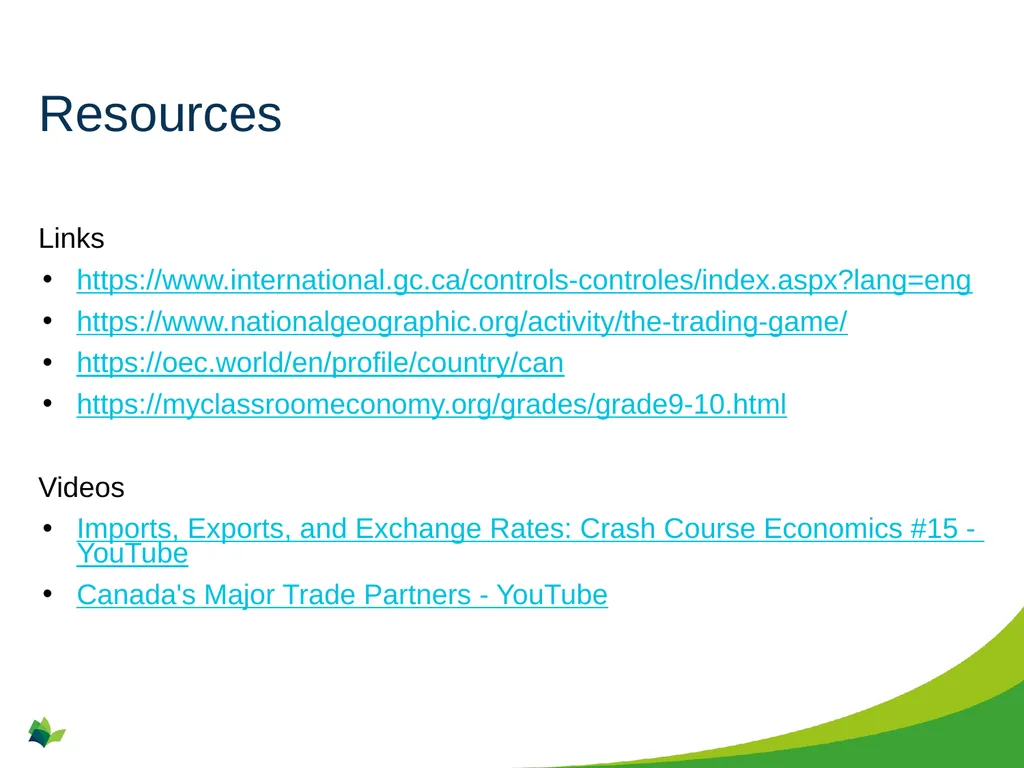
At your teacher’s discretion, you can do research online or through printed media. Some resources are provided on the next slide.<br>
Videos
Imports, Exports, and Exchange Rates: Crash Course Economics #15 - YouTube
Canada's Major Trade Partners - YouTube<br>
14
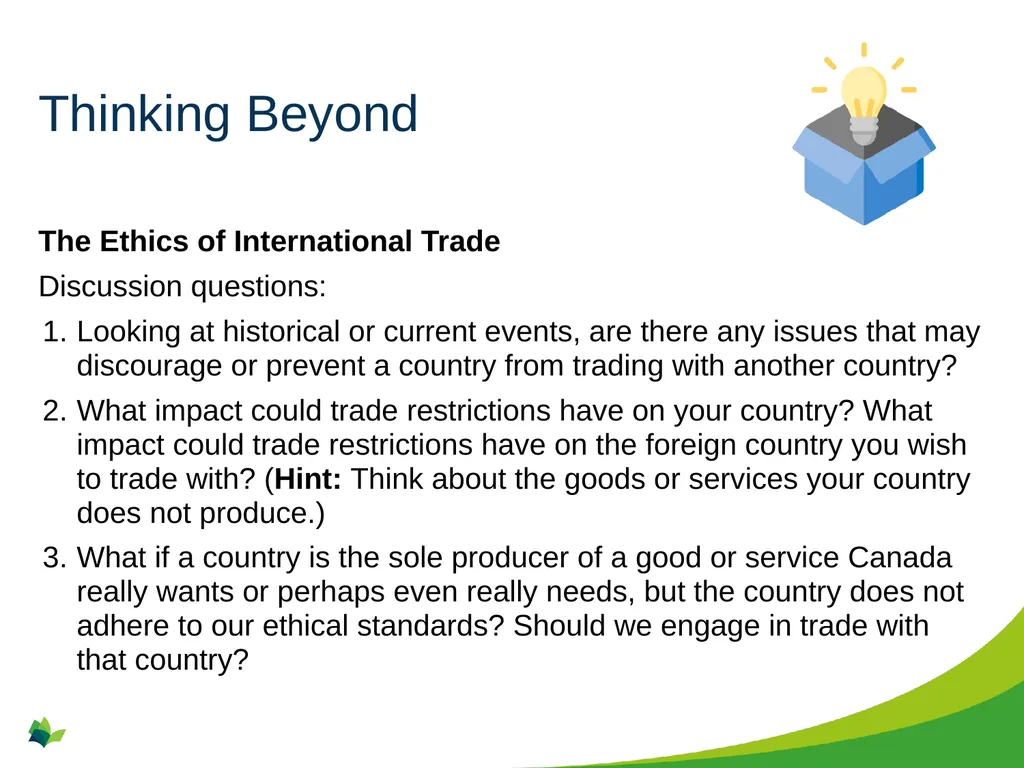
Thinking Beyond The Ethics of International Trade
Discussion questions:
Looking at historical or current events, are there any issues that may discourage or prevent a country from trading with another country?
What impact could trade restrictions have on your country? What impact could trade restrictions have on the foreign country you wish to trade with? (Hint: Think about the goods or services your country does not produce.)
What if a country is the sole producer of a good or service Canada really wants or perhaps even really needs, but the country does not adhere to our ethical standards? Should we engage in trade with that country?<br>
15
Activity Extension What are the ethical standards in Canada for trade, and do they apply fairly to other places in the world?
Producing and exporting goods requires energy use.
Have students represent different countries and research:
How does this country produce energy emissions compared to how Canada does?
What is the average ecological footprint of a person in this country compared to someone in Canada?
Is Canada meeting it’s targets on reducing greenhouse emissions?<br>