
International Trade Risk Management Practical
Description: International Trade Risk Management Practical Solutions for the Trade Creditor Raul Davila Senior Manager, International Credit RAVAGO S.A. RAVAGO S.A. The Ravago group represents over 3,400,000 metric tons of annual polymer sales serving
Related Topics
Download Presentation
"International Trade Risk Management Practical" is the property of its rightful owner. Permission is granted to download and print the materials on this website for personal, non-commercial use only, and to display it on your personal computer provided you do not modify the materials and that you retain all copyright notices contained in the materials. By downloading content from our website, you accept the terms of this agreement.
Presentation Transcript
slide1. International Trade Risk Management
Practical Solutions for the Trade Creditor
Raul Davila
Senior Manager, International Credit
RAVAGO S.A.<br>
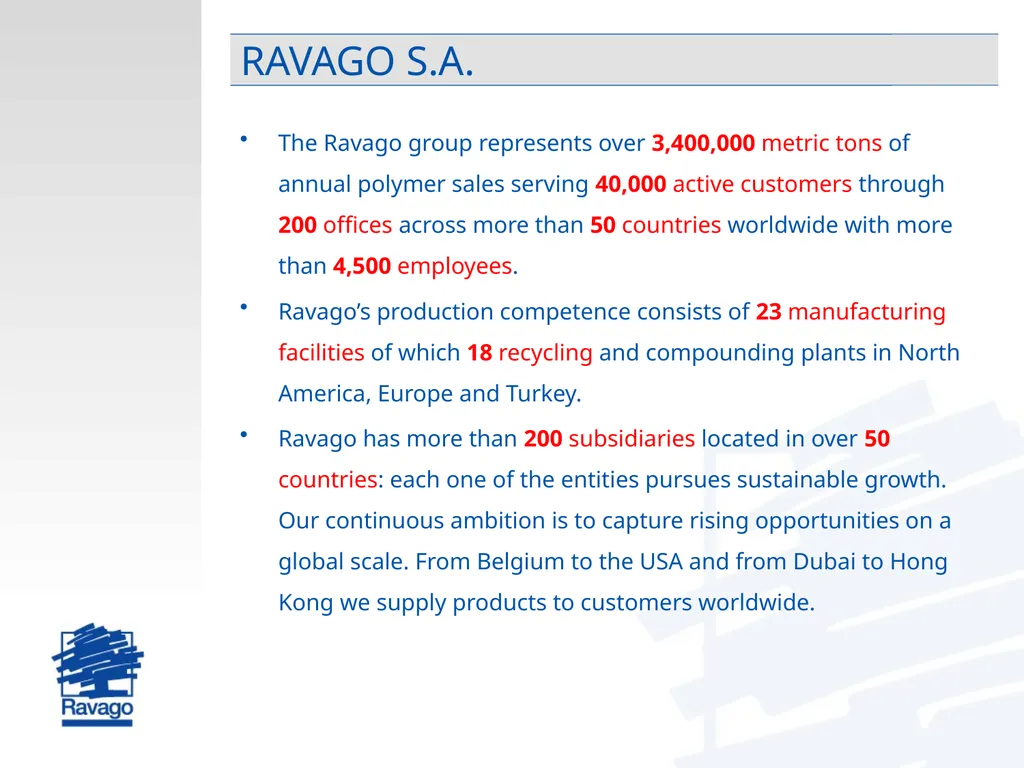
slide2. RAVAGO S.A. The Ravago group represents over 3,400,000 metric tons of annual polymer sales serving 40,000 active customers through 200 offices across more than 50 countries worldwide with more than 4,500 employees.
Ravago’s production competence consists of 23 manufacturing facilities of which 18 recycling and compounding plants in North America, Europe and Turkey.
Ravago has more than 200 subsidiaries located in over 50 countries: each one of the entities pursues sustainable growth. Our continuous ambition is to capture rising opportunities on a global scale. From Belgium to the USA and from Dubai to Hong Kong we supply products to customers worldwide.<br>
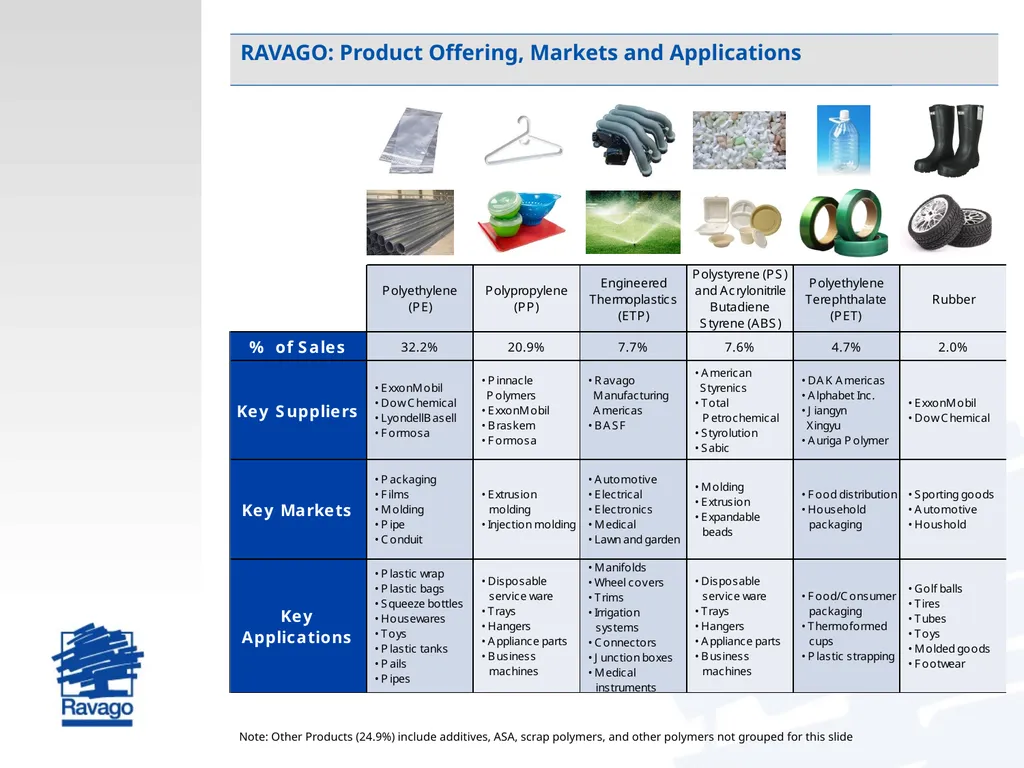
slide3. RAVAGO: Product Offering, Markets and Applications Note: Other Products (24.9%) include additives, ASA, scrap polymers, and other polymers not grouped for this slide<br>
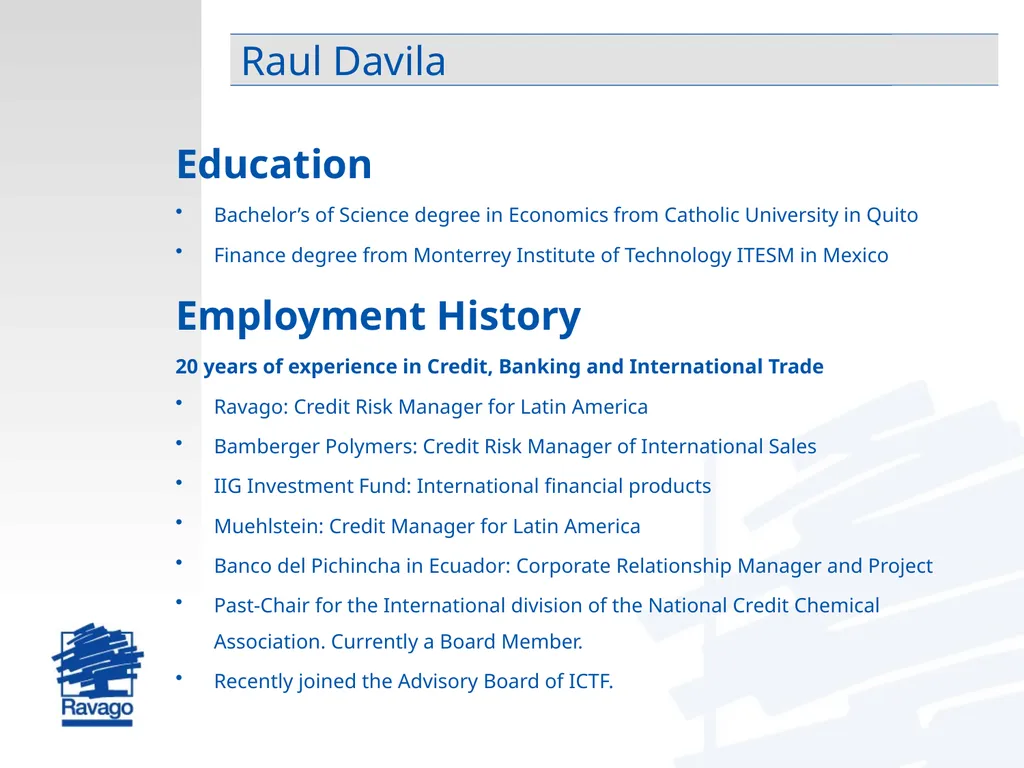
slide4. Raul Davila Education
Bachelor’s of Science degree in Economics from Catholic University in Quito
Finance degree from Monterrey Institute of Technology ITESM in Mexico
Employment History
20 years of experience in Credit, Banking and International Trade
Ravago: Credit Risk Manager for Latin America
Bamberger Polymers: Credit Risk Manager of International Sales
IIG Investment Fund: International financial products
Muehlstein: Credit Manager for Latin America
Banco del Pichincha in Ecuador: Corporate Relationship Manager and Project
Past-Chair for the International division of the National Credit Chemical Association. Currently a Board Member.
Recently joined the Advisory Board of ICTF.<br>
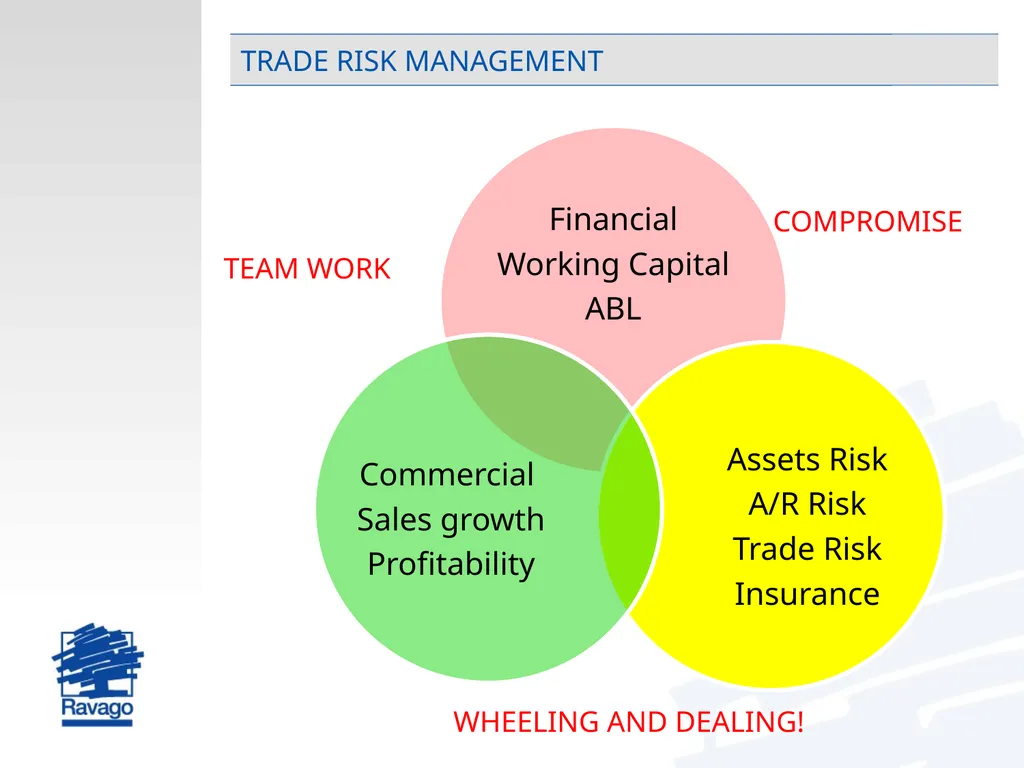
slide5. TRADE RISK MANAGEMENT COMPROMISE TEAM WORK WHEELING AND DEALING!<br>
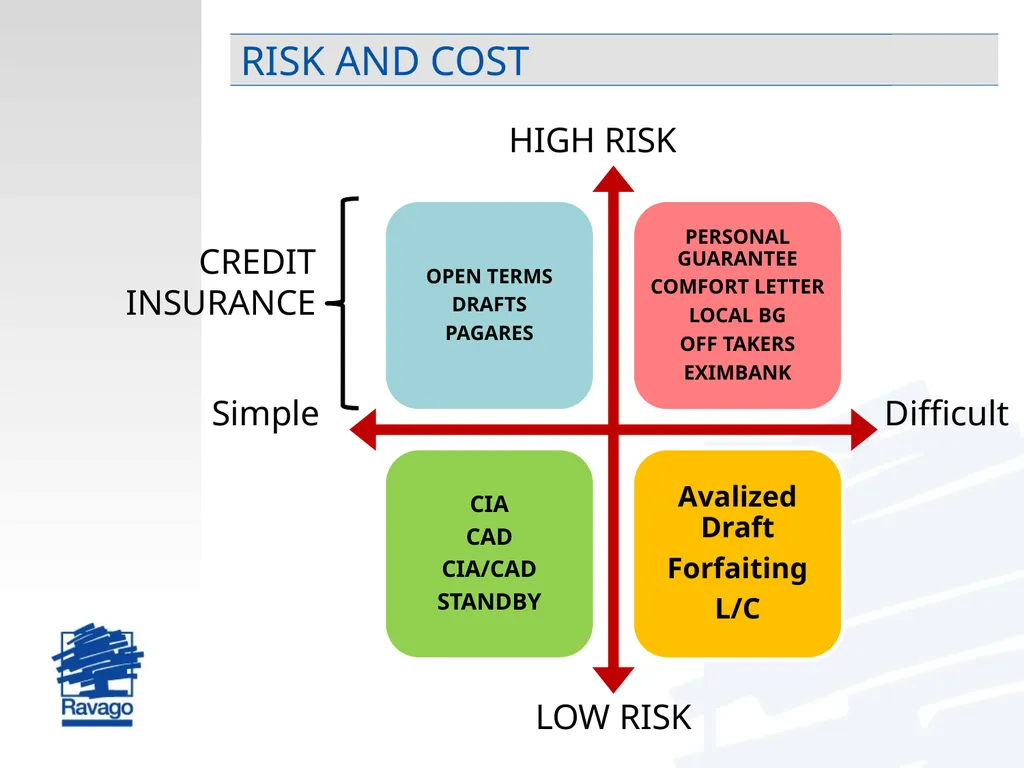
slide6. RISK AND COST HIGH RISK LOW RISK Difficult Simple CREDIT INSURANCE<br>
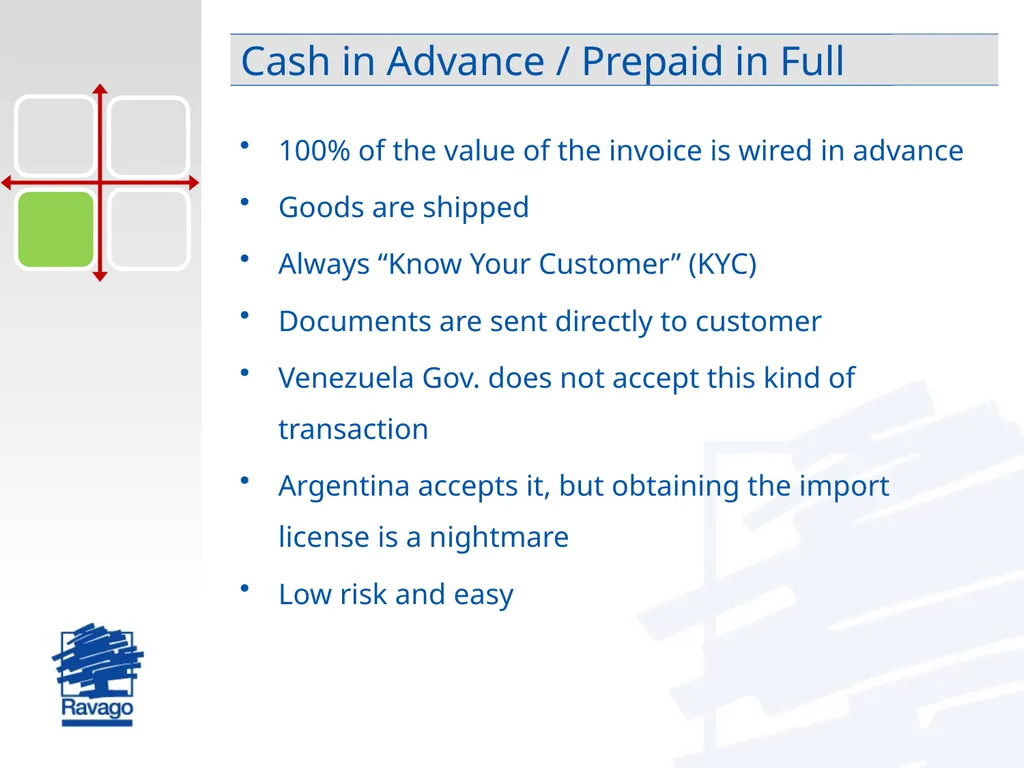
slide7. Cash in Advance / Prepaid in Full 100% of the value of the invoice is wired in advance
Goods are shipped
Always “Know Your Customer” (KYC)
Documents are sent directly to customer
Venezuela Gov. does not accept this kind of transaction
Argentina accepts it, but obtaining the import license is a nightmare
Low risk and easy<br>
slide8. Cash Against Document Payment against proof of shipment. “B/L”, invoice, certificates.
In reality, it is Cash against Document at Arrival
Consignee of Documents:
“To the Order” Low Risk
“To the Bank” Low Risk
“To the Subsidiary” Low Risk
“To the Customer” High Risk
Documents comply with the regulation of the country. For example, Argentina.
Credit Department must check and set limits to these types of transactions “KYC”.
Documentation should be handled by foreign banks, subsidiaries or trustful agents.<br>
slide9. Cash Against Documents – 2 - What happens if we don’t receive payment?
RE-EXPORT? In Brazil, products can be at the port for 60 days. After that, the product has to be moved to a bond warehouse for up to six months. Filing the paperwork for re-export takes 45 days. The product could be seized by Customs and the entire cargo could be lost. Each country has its own laws, regulations and cost about re-export.
SELL TO ANOTHER CUSTOMER? Some countries don’t allow it if the country requests an Import License.<br>
slide10. Combination: 20%CIA 80%CAD Customers must have skin in the game. Is 20% enough?
In commodities Prices fluctuate. Customers can back out of the deal at any point. For example, you’ve shipped the product. Two months later, product arrives at the port and the price has dropped more than 20%.
Credit Review. Is this customer paying taxes?
Who has the Documents? Who is the consignee?
Argentinean Banks don’t accept to be consignees
In Brazil, banks don’t accept to be consignees if you ship to tax-free agreement zones
Every country needs to be checked
In these cases, Documents should be sent to your subsidiaries or trustworthy agents.
Usually not covered by Credit Insurance<br>
slide11. Open Term Invoice Credit department reviews and approves Credit Lines and orders
Risk of the customer
Can be Credit Insured
Documents consigned to customers, could be consigned to the order, bank or branches.
Keep “Term” on line with your goal of DSO but competitive with the market and cash flow of customer.
Invoices are subject of Finance and Credit Insurance<br>
slide12. Open Term Invoice -2- Trade Risk vs. Country Risk
Do customers in risky countries pay well?
Customers keep the international suppliers
Colombia, Ecuador and Chile
No payment
Demand payment with Invoices in court
Ordinary action takes 3-4 years (up to 6) to have a court final decision.
You have to prove in court the delivery of the goods and the debt validity.<br>
slide13. Open Term w/Draft/Promissory Note Promissory Note (Pagare) has executive way.
Improve our comfort level.
IT IS NOT A GUARANTEE.
Default payment
Demand in court with an Executive action
Court processes take 2-3 years. It doesn’t mean we will collect.
Pagares are different for each country and have to conform with Civil code and commercial practices in each country.
Complicated to implement and not cheap.
Very low rate of success on collection in LA<br>
slide14. Terms with Fianza Solidaria Almost the same as Pagare
Guarantor is a third party
Usually owner or sister company
Owner or sister Company is located in another country
It is better to have the Pagare with Aval of owners<br>
slide15. Comfort letter Improve our comfort level for a Subsidiary of a Rated Related Company.
If they don’t pay, we pay.
Corporate Pressure to Pay.
Lawyer has to review documents, according to the law of the country of the guarantor.
Check the conditions of acceleration of payment.
How long is it valid and if shipments are going to be covered before the expiration of CL.
It doesn’t have legal rights. It is an Intention.
Legally, it is weaker than the Pagare.<br>
slide16. Local Bank Guarantee Shift the risk from customer to a local bank.
Subject to local financial laws.
Who executed??
Who presents to the local bank? A person legally authorized?
Some legislations allow foreign companies to be the beneficiary, others don’t.
Evaluate the risk of the issuing bank.
Set of conditions very simple.
Can be used for some forfaiting transactions.
Costs can be high but is paid by customer.<br>
slide17. Standby L/C Risk shifts from customer to issuing bank if advised or confirming bank.
Risk transfers to Banks and UCP Rules.
Set the conditions, the simpler the better.
Operational risk, establish a way to control shipments, terms against expiration of the L/C.
Cost is negotiated between Customer and Beneficiary.
Easier than a regular Letter of Credit.<br>
slide18. Off taker agreements/3rd party Inv. To secure payment from the customers of our customers to shift some of the risk.
Customer doesn’t qualify for open credit or impossibility of Letter of Credit.
Customer’s customer has to agree with the “cession” “transfer” of invoices.
Performing Risk, customer has a contract to supply inputs, but issues of quality and rejects can be a problem.
Really difficult to implement and control.<br>
slide19. Avalized Draft Shift risk from customer to a local Bank, when a local Bank guarantees the customer.
No credit Insurance needed.
Customer has to have a Credit Line available with a Bank.
Bank has to accept the Draft, add AVAL to the draft. Like an acceptance.
Negotiate the Aval and immediately get cash.
The Aval discounts are subject to local rates in US dollars.
Very common in North Africa and Middle East<br>
slide20. Forfaiting Faster collection and Longer Terms.
Covers risk: Forfaiting is discount without recourse and covers country risk (political and transfer risk), currency risk, and interest rate risk. More than factoring that covers only commercial risk
Discount cost and fees can be included in the sale.
After the first transaction, speed process increases and becomes more simple.
Documentation should be simple and straight forward. Copy of invoice and shipping documents and negotiable instrument are signed by debtor. Also, confirmation from debtor bank that signatures in negotiable instrument are authentic and valid.<br>
slide21. Forfaiting Disadvantages:
Discount rate is normally competitive but commitment fee and flat fee increase the cost considerably. Also, consider documentary collection fees.
Process: first transactions are long. Debtor needs to be qualified, then you need to negotiate costs and finally documentation needs to be sent thru a bank.
Only works for higher amounts and terms higher than 150 days.<br>
slide22. Letter of Credit Shift risk from customer to the issuing or confirming bank at transactional level.
No credit Insurance needed. (When calculating the sales for credit insurance take this out)
Discount Rates can be very attractive. Banks have better rates than companies.
Be aware of foreign banks’ branches confirming in the US. Usually higher discount rates.
Check with your bank if risk is acceptable when only advising. If the issuing bank is on “the list”.
Be aware of adv. Bank, who is processing Docs.
Labor intensive, lots of detail.<br>
slide23. ExIm bank For Export of US products only
For Export to countries approved by Exim bank
Customers will benefit from longer terms, 180 days
Exporter receives information that the customer has a credit line facility of Exim bank Line by a Commercial Bank, sells the products and presents documents for payment.
All documents are reviewed by a third party bank
Documents can be rejected by the bank for no availability. Exporter didn’t know. And now?
Documents are sent to the Customer and then presented to the bank?
My customers with Exim bank perform poorly.<br>
slide24. Credit Insurance Excellent tool to support Credit Management and Sales Growth.
Shift the risk to a “Risk Enabler”.
Single Named buyer vs Catastrophic.
Global Policy vs Country Base vs Customer Base.
Facilitator of Trade Finance, ABL and A/R financing.
Banks request Credit Insurance programs that secure export receivables.
Factoring, Forfaiting programs are Credit Insurance supported.<br>
slide25. Credit Insurance–Single Buyer Limit Insurance approves credit limits for each customer above DCL.
Insurance becomes your credit department.
Credit Department has lots of paperwork and filing requirements. Administratively intense.
How many customers, few hundred vs. few thousands.
Low deductible but higher premiums and cost
Disadvantage: What is your market share or unique market knowledge and core competency.
But if you don’t have a market share or market knowledge, it is a great tool.
Depends on how strong your credit department is<br>
slide26. Credit Insurance - Catastrophic Provides lots of freedom for decision making, based on your credit Policies, financial ratios, payment history, written credit references.
Need a Credit Department with strong knowledge of customers and markets.
Less intensive paperwork and fewer reports
High deductible and low premiums
You keep most of your market info in house
Disadvantage: High deductibles, not good for market penetration, or countries with poor knowledge and presence.<br>
slide27. Credit Insurance GLOBAL POLICY vs. COUNTRY
Legal Issues of the insurer in different countries
Claims in different countries could be very complicated to pay.
How to pays taxes, VAT in different countries
Local policies with global deductibles or local deductibles
You can insure one country that you target for commercial or risk reasons
Appetite for country risk: Argentina?
Credit Insurance Syndication
So what are the options?<br>
slide28. The option is: Don’t sell, which means there is no need for credit managers, there is no job for me.<br>
Practical Solutions for the Trade Creditor
Raul Davila
Senior Manager, International Credit
RAVAGO S.A.<br>
slide2. RAVAGO S.A. The Ravago group represents over 3,400,000 metric tons of annual polymer sales serving 40,000 active customers through 200 offices across more than 50 countries worldwide with more than 4,500 employees.
Ravago’s production competence consists of 23 manufacturing facilities of which 18 recycling and compounding plants in North America, Europe and Turkey.
Ravago has more than 200 subsidiaries located in over 50 countries: each one of the entities pursues sustainable growth. Our continuous ambition is to capture rising opportunities on a global scale. From Belgium to the USA and from Dubai to Hong Kong we supply products to customers worldwide.<br>
slide3. RAVAGO: Product Offering, Markets and Applications Note: Other Products (24.9%) include additives, ASA, scrap polymers, and other polymers not grouped for this slide<br>
slide4. Raul Davila Education
Bachelor’s of Science degree in Economics from Catholic University in Quito
Finance degree from Monterrey Institute of Technology ITESM in Mexico
Employment History
20 years of experience in Credit, Banking and International Trade
Ravago: Credit Risk Manager for Latin America
Bamberger Polymers: Credit Risk Manager of International Sales
IIG Investment Fund: International financial products
Muehlstein: Credit Manager for Latin America
Banco del Pichincha in Ecuador: Corporate Relationship Manager and Project
Past-Chair for the International division of the National Credit Chemical Association. Currently a Board Member.
Recently joined the Advisory Board of ICTF.<br>
slide5. TRADE RISK MANAGEMENT COMPROMISE TEAM WORK WHEELING AND DEALING!<br>
slide6. RISK AND COST HIGH RISK LOW RISK Difficult Simple CREDIT INSURANCE<br>
slide7. Cash in Advance / Prepaid in Full 100% of the value of the invoice is wired in advance
Goods are shipped
Always “Know Your Customer” (KYC)
Documents are sent directly to customer
Venezuela Gov. does not accept this kind of transaction
Argentina accepts it, but obtaining the import license is a nightmare
Low risk and easy<br>
slide8. Cash Against Document Payment against proof of shipment. “B/L”, invoice, certificates.
In reality, it is Cash against Document at Arrival
Consignee of Documents:
“To the Order” Low Risk
“To the Bank” Low Risk
“To the Subsidiary” Low Risk
“To the Customer” High Risk
Documents comply with the regulation of the country. For example, Argentina.
Credit Department must check and set limits to these types of transactions “KYC”.
Documentation should be handled by foreign banks, subsidiaries or trustful agents.<br>
slide9. Cash Against Documents – 2 - What happens if we don’t receive payment?
RE-EXPORT? In Brazil, products can be at the port for 60 days. After that, the product has to be moved to a bond warehouse for up to six months. Filing the paperwork for re-export takes 45 days. The product could be seized by Customs and the entire cargo could be lost. Each country has its own laws, regulations and cost about re-export.
SELL TO ANOTHER CUSTOMER? Some countries don’t allow it if the country requests an Import License.<br>
slide10. Combination: 20%CIA 80%CAD Customers must have skin in the game. Is 20% enough?
In commodities Prices fluctuate. Customers can back out of the deal at any point. For example, you’ve shipped the product. Two months later, product arrives at the port and the price has dropped more than 20%.
Credit Review. Is this customer paying taxes?
Who has the Documents? Who is the consignee?
Argentinean Banks don’t accept to be consignees
In Brazil, banks don’t accept to be consignees if you ship to tax-free agreement zones
Every country needs to be checked
In these cases, Documents should be sent to your subsidiaries or trustworthy agents.
Usually not covered by Credit Insurance<br>
slide11. Open Term Invoice Credit department reviews and approves Credit Lines and orders
Risk of the customer
Can be Credit Insured
Documents consigned to customers, could be consigned to the order, bank or branches.
Keep “Term” on line with your goal of DSO but competitive with the market and cash flow of customer.
Invoices are subject of Finance and Credit Insurance<br>
slide12. Open Term Invoice -2- Trade Risk vs. Country Risk
Do customers in risky countries pay well?
Customers keep the international suppliers
Colombia, Ecuador and Chile
No payment
Demand payment with Invoices in court
Ordinary action takes 3-4 years (up to 6) to have a court final decision.
You have to prove in court the delivery of the goods and the debt validity.<br>
slide13. Open Term w/Draft/Promissory Note Promissory Note (Pagare) has executive way.
Improve our comfort level.
IT IS NOT A GUARANTEE.
Default payment
Demand in court with an Executive action
Court processes take 2-3 years. It doesn’t mean we will collect.
Pagares are different for each country and have to conform with Civil code and commercial practices in each country.
Complicated to implement and not cheap.
Very low rate of success on collection in LA<br>
slide14. Terms with Fianza Solidaria Almost the same as Pagare
Guarantor is a third party
Usually owner or sister company
Owner or sister Company is located in another country
It is better to have the Pagare with Aval of owners<br>
slide15. Comfort letter Improve our comfort level for a Subsidiary of a Rated Related Company.
If they don’t pay, we pay.
Corporate Pressure to Pay.
Lawyer has to review documents, according to the law of the country of the guarantor.
Check the conditions of acceleration of payment.
How long is it valid and if shipments are going to be covered before the expiration of CL.
It doesn’t have legal rights. It is an Intention.
Legally, it is weaker than the Pagare.<br>
slide16. Local Bank Guarantee Shift the risk from customer to a local bank.
Subject to local financial laws.
Who executed??
Who presents to the local bank? A person legally authorized?
Some legislations allow foreign companies to be the beneficiary, others don’t.
Evaluate the risk of the issuing bank.
Set of conditions very simple.
Can be used for some forfaiting transactions.
Costs can be high but is paid by customer.<br>
slide17. Standby L/C Risk shifts from customer to issuing bank if advised or confirming bank.
Risk transfers to Banks and UCP Rules.
Set the conditions, the simpler the better.
Operational risk, establish a way to control shipments, terms against expiration of the L/C.
Cost is negotiated between Customer and Beneficiary.
Easier than a regular Letter of Credit.<br>
slide18. Off taker agreements/3rd party Inv. To secure payment from the customers of our customers to shift some of the risk.
Customer doesn’t qualify for open credit or impossibility of Letter of Credit.
Customer’s customer has to agree with the “cession” “transfer” of invoices.
Performing Risk, customer has a contract to supply inputs, but issues of quality and rejects can be a problem.
Really difficult to implement and control.<br>
slide19. Avalized Draft Shift risk from customer to a local Bank, when a local Bank guarantees the customer.
No credit Insurance needed.
Customer has to have a Credit Line available with a Bank.
Bank has to accept the Draft, add AVAL to the draft. Like an acceptance.
Negotiate the Aval and immediately get cash.
The Aval discounts are subject to local rates in US dollars.
Very common in North Africa and Middle East<br>
slide20. Forfaiting Faster collection and Longer Terms.
Covers risk: Forfaiting is discount without recourse and covers country risk (political and transfer risk), currency risk, and interest rate risk. More than factoring that covers only commercial risk
Discount cost and fees can be included in the sale.
After the first transaction, speed process increases and becomes more simple.
Documentation should be simple and straight forward. Copy of invoice and shipping documents and negotiable instrument are signed by debtor. Also, confirmation from debtor bank that signatures in negotiable instrument are authentic and valid.<br>
slide21. Forfaiting Disadvantages:
Discount rate is normally competitive but commitment fee and flat fee increase the cost considerably. Also, consider documentary collection fees.
Process: first transactions are long. Debtor needs to be qualified, then you need to negotiate costs and finally documentation needs to be sent thru a bank.
Only works for higher amounts and terms higher than 150 days.<br>
slide22. Letter of Credit Shift risk from customer to the issuing or confirming bank at transactional level.
No credit Insurance needed. (When calculating the sales for credit insurance take this out)
Discount Rates can be very attractive. Banks have better rates than companies.
Be aware of foreign banks’ branches confirming in the US. Usually higher discount rates.
Check with your bank if risk is acceptable when only advising. If the issuing bank is on “the list”.
Be aware of adv. Bank, who is processing Docs.
Labor intensive, lots of detail.<br>
slide23. ExIm bank For Export of US products only
For Export to countries approved by Exim bank
Customers will benefit from longer terms, 180 days
Exporter receives information that the customer has a credit line facility of Exim bank Line by a Commercial Bank, sells the products and presents documents for payment.
All documents are reviewed by a third party bank
Documents can be rejected by the bank for no availability. Exporter didn’t know. And now?
Documents are sent to the Customer and then presented to the bank?
My customers with Exim bank perform poorly.<br>
slide24. Credit Insurance Excellent tool to support Credit Management and Sales Growth.
Shift the risk to a “Risk Enabler”.
Single Named buyer vs Catastrophic.
Global Policy vs Country Base vs Customer Base.
Facilitator of Trade Finance, ABL and A/R financing.
Banks request Credit Insurance programs that secure export receivables.
Factoring, Forfaiting programs are Credit Insurance supported.<br>
slide25. Credit Insurance–Single Buyer Limit Insurance approves credit limits for each customer above DCL.
Insurance becomes your credit department.
Credit Department has lots of paperwork and filing requirements. Administratively intense.
How many customers, few hundred vs. few thousands.
Low deductible but higher premiums and cost
Disadvantage: What is your market share or unique market knowledge and core competency.
But if you don’t have a market share or market knowledge, it is a great tool.
Depends on how strong your credit department is<br>
slide26. Credit Insurance - Catastrophic Provides lots of freedom for decision making, based on your credit Policies, financial ratios, payment history, written credit references.
Need a Credit Department with strong knowledge of customers and markets.
Less intensive paperwork and fewer reports
High deductible and low premiums
You keep most of your market info in house
Disadvantage: High deductibles, not good for market penetration, or countries with poor knowledge and presence.<br>
slide27. Credit Insurance GLOBAL POLICY vs. COUNTRY
Legal Issues of the insurer in different countries
Claims in different countries could be very complicated to pay.
How to pays taxes, VAT in different countries
Local policies with global deductibles or local deductibles
You can insure one country that you target for commercial or risk reasons
Appetite for country risk: Argentina?
Credit Insurance Syndication
So what are the options?<br>
slide28. The option is: Don’t sell, which means there is no need for credit managers, there is no job for me.<br>