
Intervention in a Flash Presented By: Karen Brown


Description: Intervention in a Flash Presented By: Karen Brown Evidence Based Practice University of Utah Training School Psychologists to be Experts in Evidence Based Practices for Tertiary Students with Serious Emotional DisturbanceBehavior Disorders
Related Topics
Download Presentation
"Intervention in a Flash Presented By: Karen Brown" is the property of its rightful owner. Permission is granted to download and print the materials on this website for personal, non-commercial use only, and to display it on your personal computer provided you do not modify the materials and that you retain all copyright notices contained in the materials. By downloading content from our website, you accept the terms of this agreement.
Presentation Transcript
slide1. Intervention in a Flash Presented By: Karen Brown Evidence Based Practice University of Utah Training School Psychologists to be Experts in Evidence Based Practices for Tertiary Students with Serious Emotional Disturbance/Behavior Disorders
US Office of Education 84.325K
H325K080308<br>
slide2. Interventions in a Flash-What Is It & Who Is It For? A strategy to use with students struggling to acquire or retain a skill such as math facts, reading sight words, or spelling
One-on-One Format
Can be used as a Tier 2 or Tier 3 intervention<br>
slide3. Rationale and Evidenced Based Practice Basic, foundational skills must be acquired prior to more complex concepts and higher order thinking skills
Students who do not have automaticity in their basic skills struggle to stay “on grade level” and maintain interest
Failure to attain these basic skills negatively effects overall academic competency
Math: basic skills include operational facts
Reading: basic skills include phonemic awareness and sight words<br>
slide4. Rationale and Evidenced Based Practice cont. Research has shown that instructional interventions must be:
Targeted skills
Explicitly taught
Appropriate level of instruction and challenge
High opportunities to respond
Immediate feedback given
Using flash cards to increase student’s automaticity incorporates the above needs and has been shown effective with
Struggling readers to improve sight word fluency
Basic math facts
General education and Special Education populations<br>
slide5. Advantage to the Educator Inexpensive to use and can be developed quickly and as feedback is given for student response
Keep easy data using the cards developed
Limited materials
Index or note cards
Folder
Markers
Checklist
3 types to choose from<br>
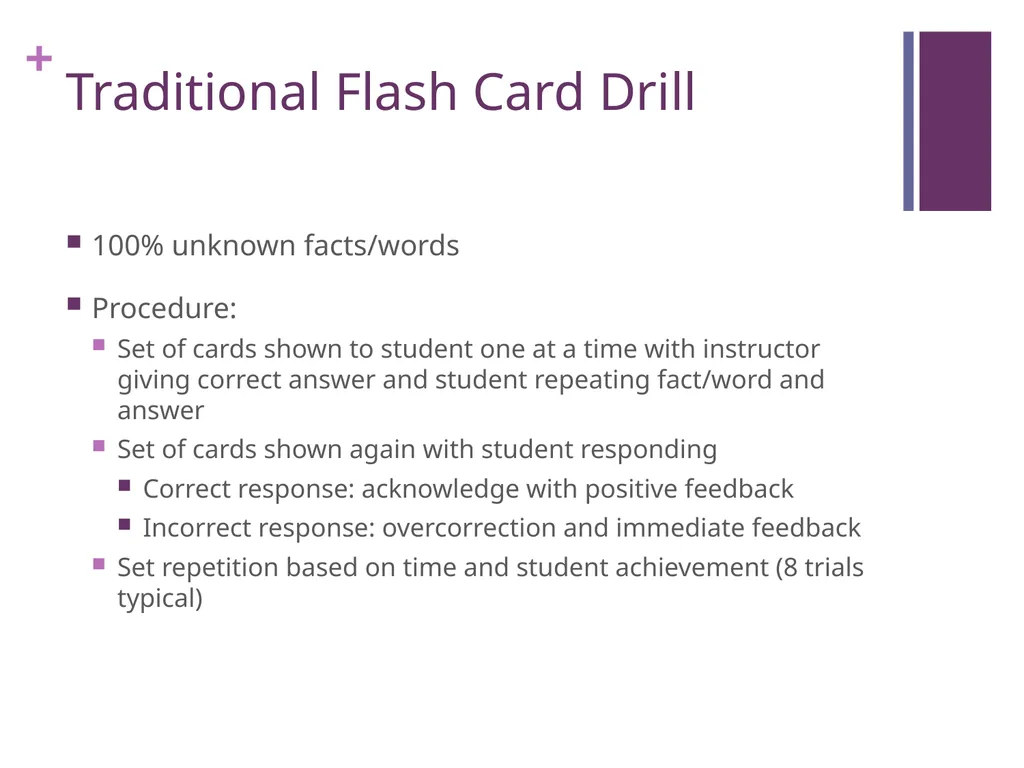
slide6. Traditional Flash Card Drill 100% unknown facts/words
Procedure:
Set of cards shown to student one at a time with instructor giving correct answer and student repeating fact/word and answer
Set of cards shown again with student responding
Correct response: acknowledge with positive feedback
Incorrect response: overcorrection and immediate feedback
Set repetition based on time and student achievement (8 trials typical)<br>
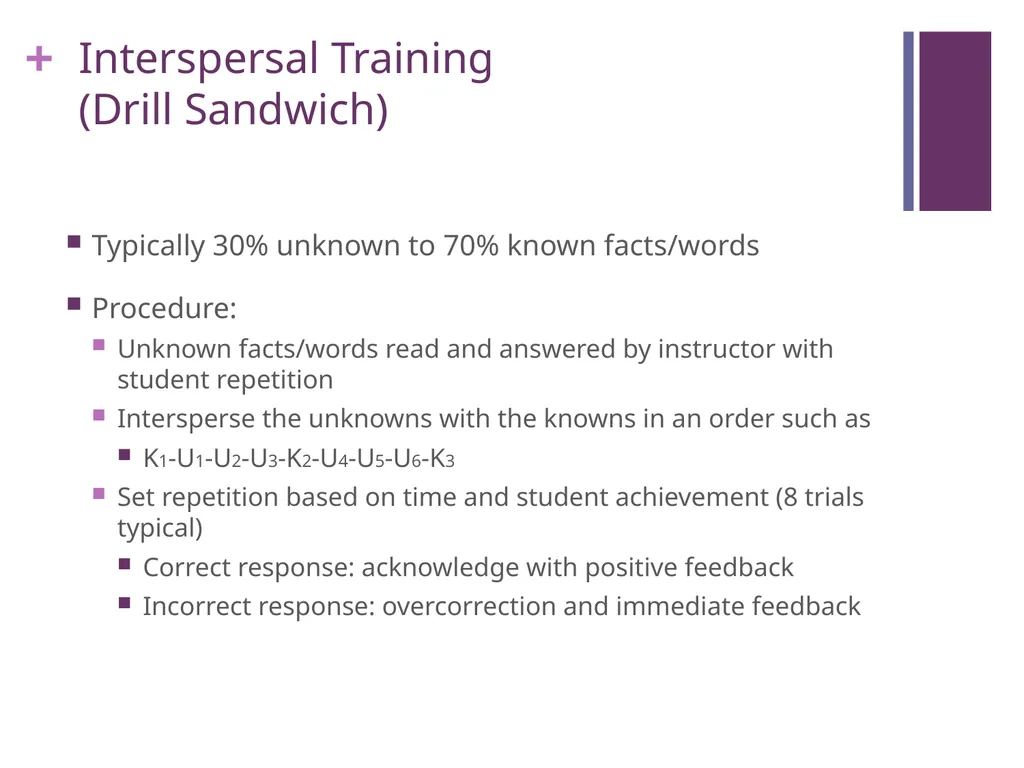
slide7. Interspersal Training (Drill Sandwich) Typically 30% unknown to 70% known facts/words
Procedure:
Unknown facts/words read and answered by instructor with student repetition
Intersperse the unknowns with the knowns in an order such as
K1-U1-U2-U3-K2-U4-U5-U6-K3
Set repetition based on time and student achievement (8 trials typical)
Correct response: acknowledge with positive feedback
Incorrect response: overcorrection and immediate feedback<br>
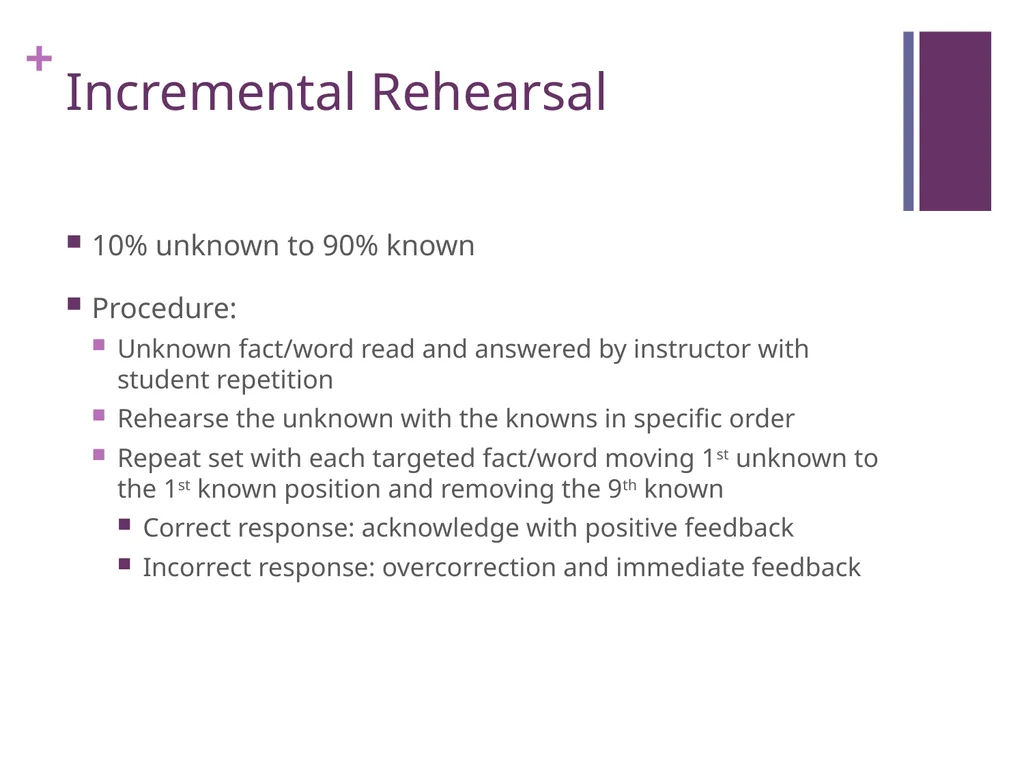
slide8. Incremental Rehearsal 10% unknown to 90% known
Procedure:
Unknown fact/word read and answered by instructor with student repetition
Rehearse the unknown with the knowns in specific order
Repeat set with each targeted fact/word moving 1st unknown to the 1st known position and removing the 9th known
Correct response: acknowledge with positive feedback
Incorrect response: overcorrection and immediate feedback<br>
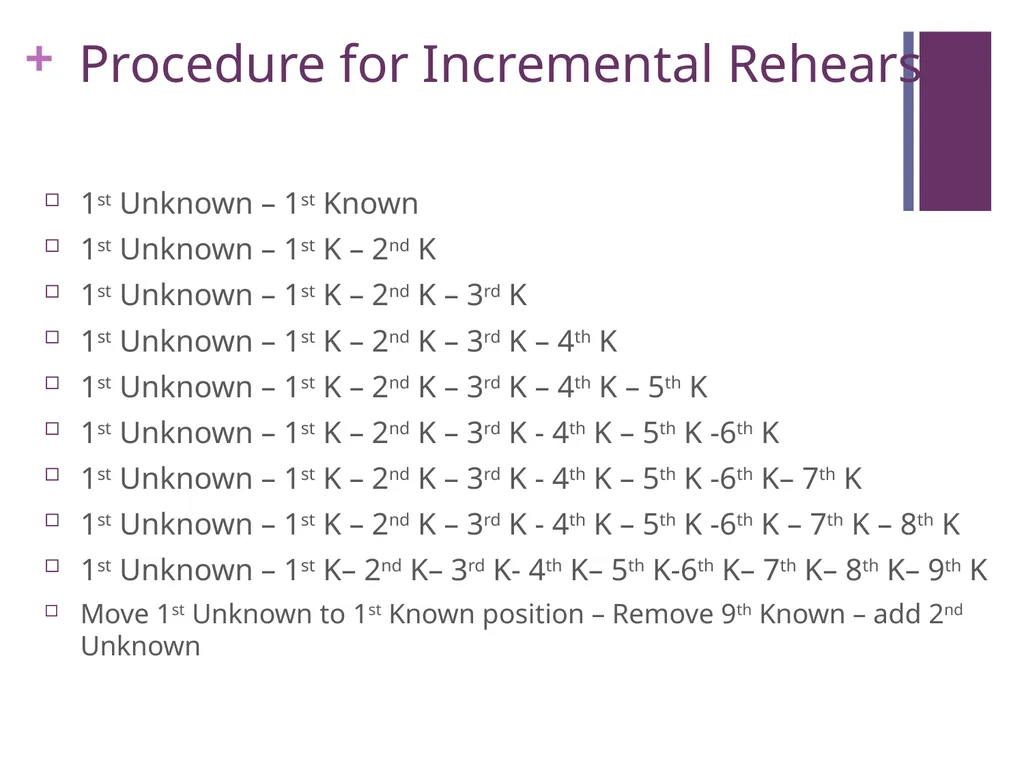
slide9. Procedure for Incremental Rehearsal 1st Unknown – 1st Known
1st Unknown – 1st K – 2nd K
1st Unknown – 1st K – 2nd K – 3rd K
1st Unknown – 1st K – 2nd K – 3rd K – 4th K
1st Unknown – 1st K – 2nd K – 3rd K – 4th K – 5th K
1st Unknown – 1st K – 2nd K – 3rd K - 4th K – 5th K -6th K
1st Unknown – 1st K – 2nd K – 3rd K - 4th K – 5th K -6th K– 7th K
1st Unknown – 1st K – 2nd K – 3rd K - 4th K – 5th K -6th K – 7th K – 8th K
1st Unknown – 1st K– 2nd K– 3rd K- 4th K– 5th K-6th K– 7th K– 8th K– 9th K
Move 1st Unknown to 1st Known position – Remove 9th Known – add 2nd Unknown<br>
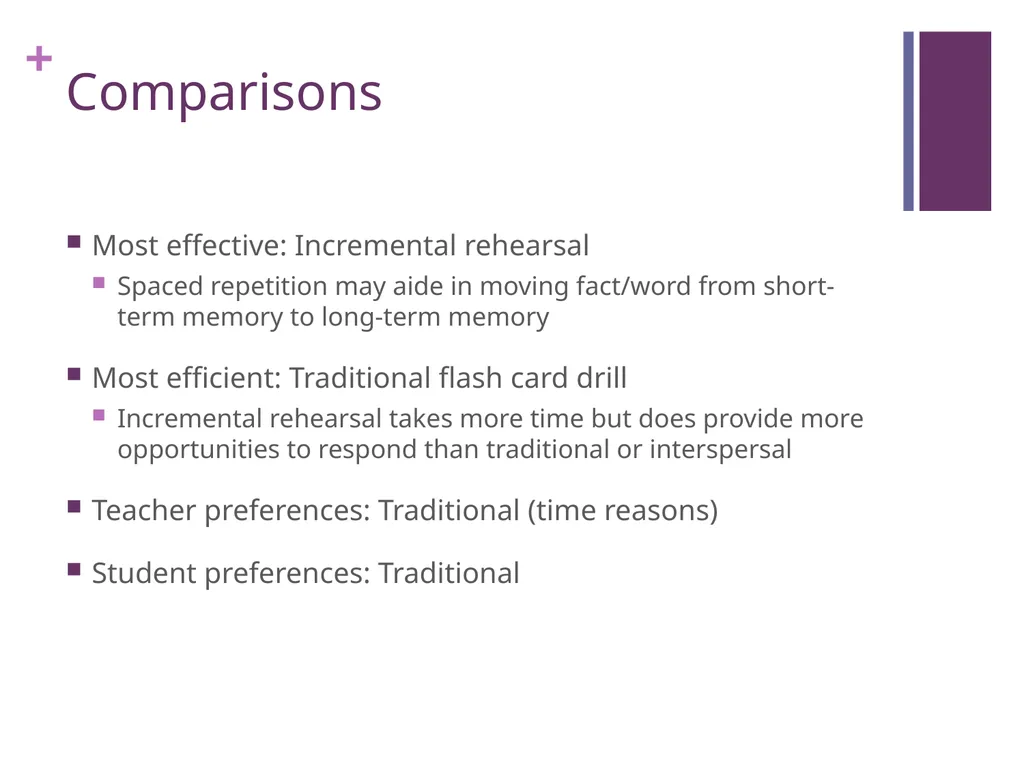
slide10. Comparisons Most effective: Incremental rehearsal
Spaced repetition may aide in moving fact/word from short-term memory to long-term memory
Most efficient: Traditional flash card drill
Incremental rehearsal takes more time but does provide more opportunities to respond than traditional or interspersal
Teacher preferences: Traditional (time reasons)
Student preferences: Traditional<br>
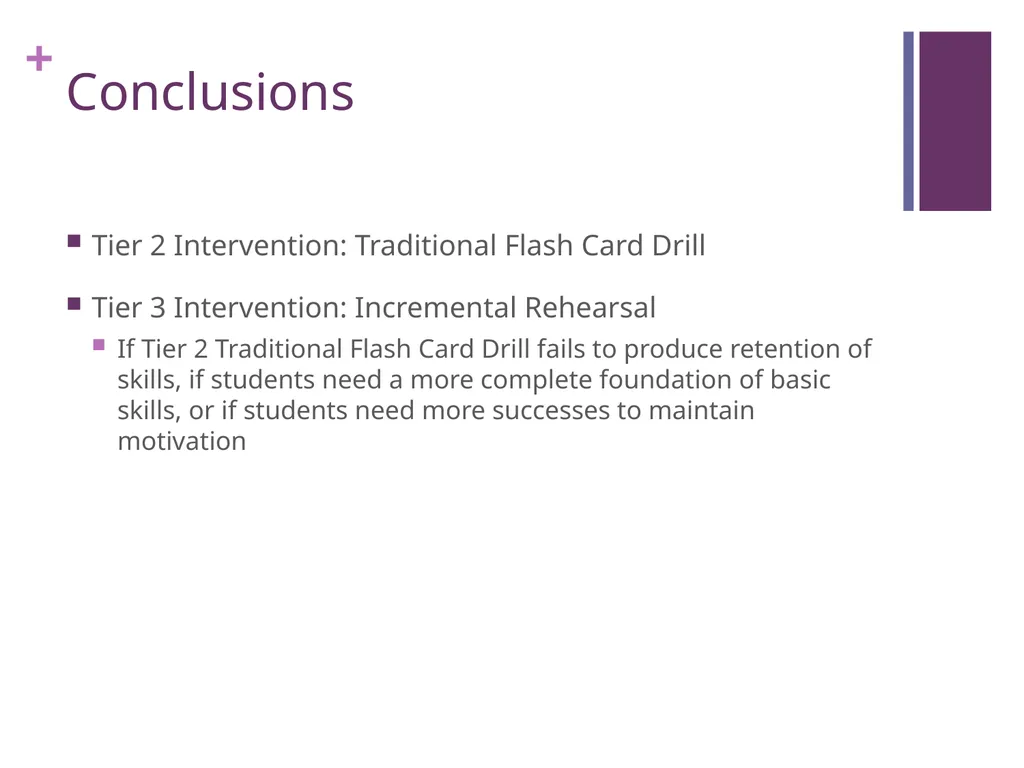
slide11. Conclusions Tier 2 Intervention: Traditional Flash Card Drill
Tier 3 Intervention: Incremental Rehearsal
If Tier 2 Traditional Flash Card Drill fails to produce retention of skills, if students need a more complete foundation of basic skills, or if students need more successes to maintain motivation<br>
slide12. Simple Set-Up Scenario #1 math fact intervention for use as a whole class/peer tutoring – Tier 1 or 2<br>
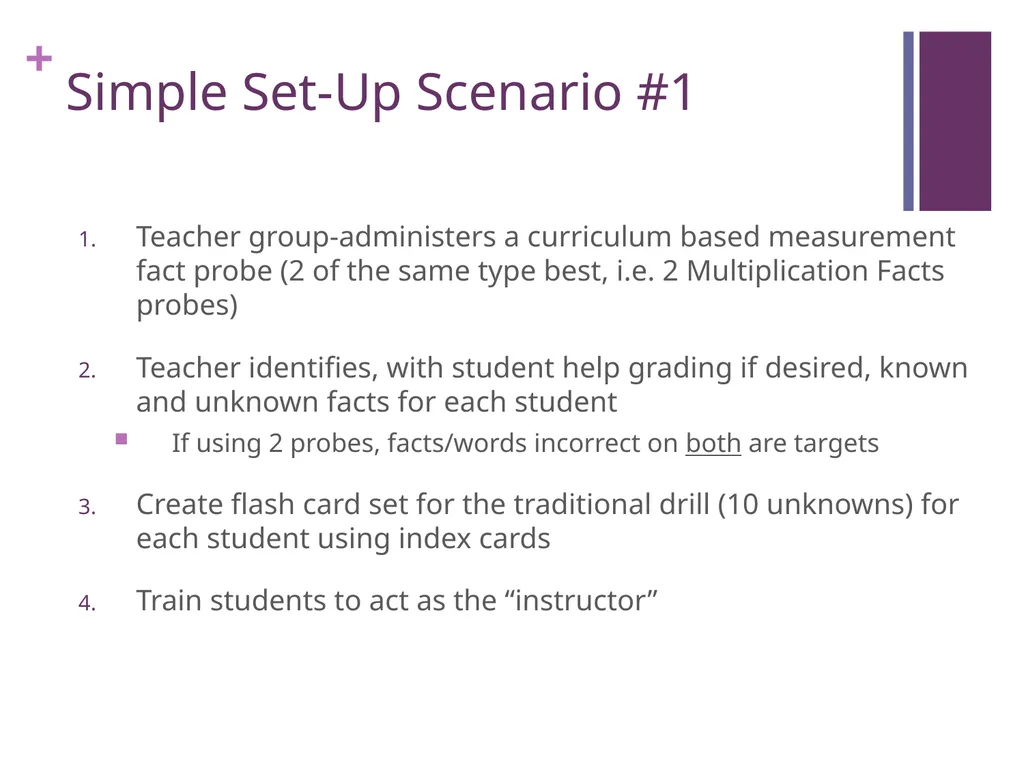
slide13. Simple Set-Up Scenario #1 Teacher group-administers a curriculum based measurement fact probe (2 of the same type best, i.e. 2 Multiplication Facts probes)
Teacher identifies, with student help grading if desired, known and unknown facts for each student
If using 2 probes, facts/words incorrect on both are targets
Create flash card set for the traditional drill (10 unknowns) for each student using index cards
Train students to act as the “instructor”<br>
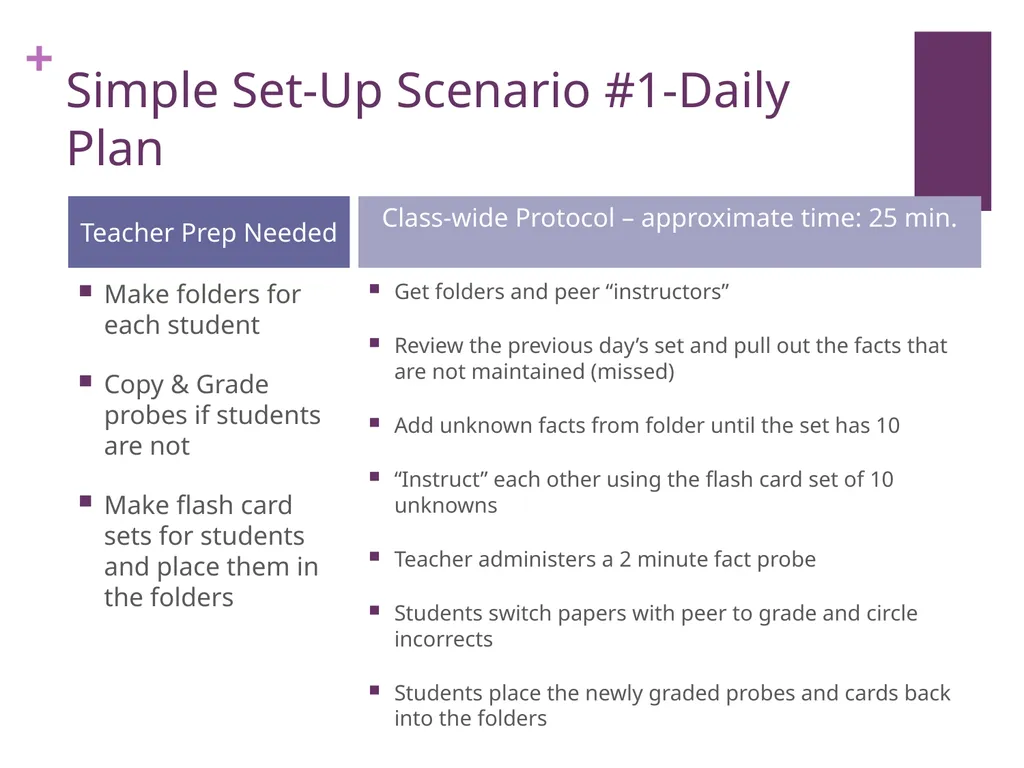
slide14. Simple Set-Up Scenario #1-Daily Plan Make folders for each student
Copy & Grade probes if students are not
Make flash card sets for students and place them in the folders Get folders and peer “instructors”
Review the previous day’s set and pull out the facts that are not maintained (missed)
Add unknown facts from folder until the set has 10
“Instruct” each other using the flash card set of 10 unknowns
Teacher administers a 2 minute fact probe
Students switch papers with peer to grade and circle incorrects
Students place the newly graded probes and cards back into the folders Teacher Prep Needed Class-wide Protocol – approximate time: 25 min.<br>
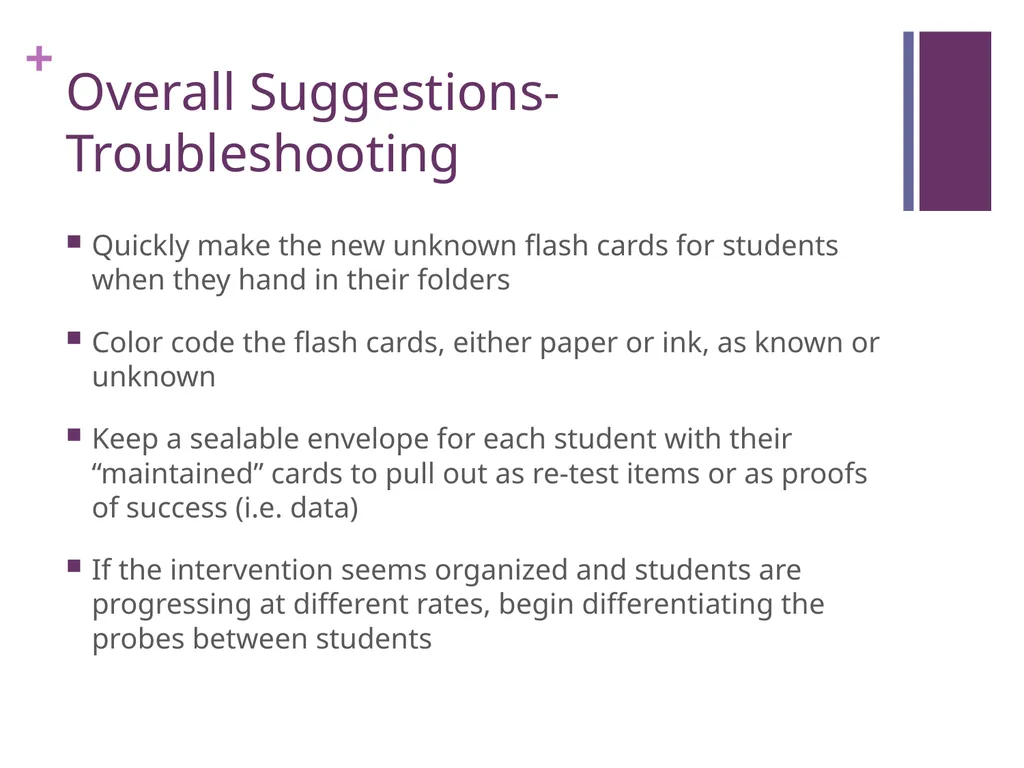
slide15. Overall Suggestions-Troubleshooting Quickly make the new unknown flash cards for students when they hand in their folders
Color code the flash cards, either paper or ink, as known or unknown
Keep a sealable envelope for each student with their “maintained” cards to pull out as re-test items or as proofs of success (i.e. data)
If the intervention seems organized and students are progressing at different rates, begin differentiating the probes between students<br>
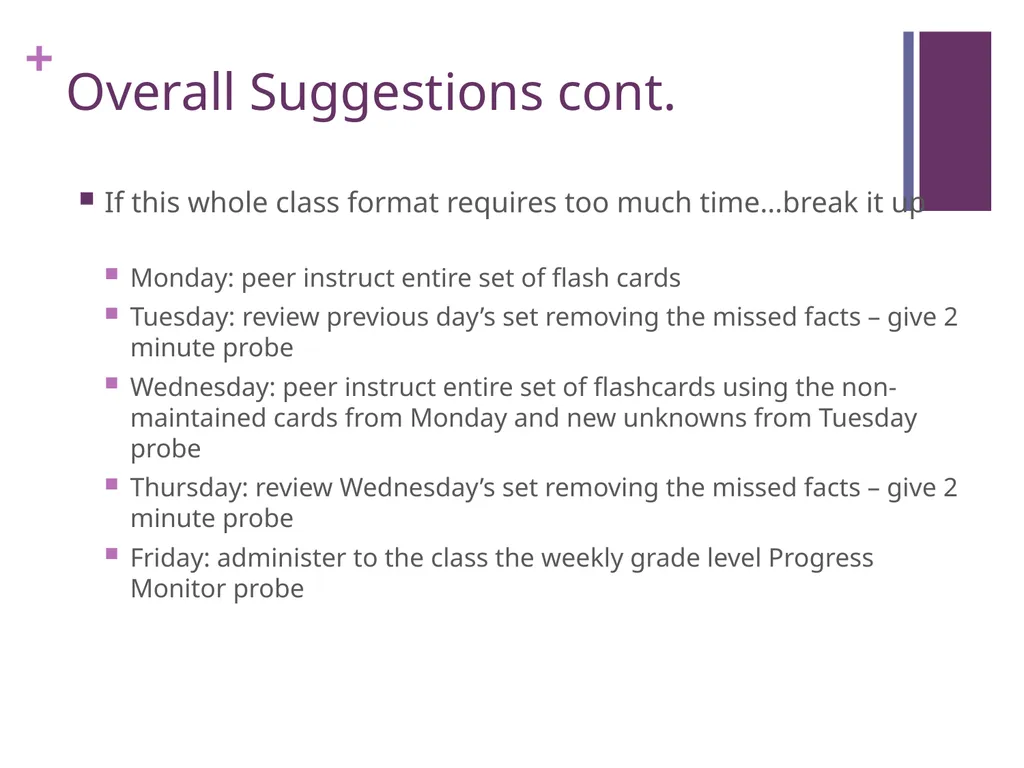
slide16. Overall Suggestions cont. If this whole class format requires too much time…break it up
Monday: peer instruct entire set of flash cards
Tuesday: review previous day’s set removing the missed facts – give 2 minute probe
Wednesday: peer instruct entire set of flashcards using the non-maintained cards from Monday and new unknowns from Tuesday probe
Thursday: review Wednesday’s set removing the missed facts – give 2 minute probe
Friday: administer to the class the weekly grade level Progress Monitor probe<br>
slide17. Simple Set-Up Scenario #2 Reading fluency intervention for use as a small group – Tier 3<br>
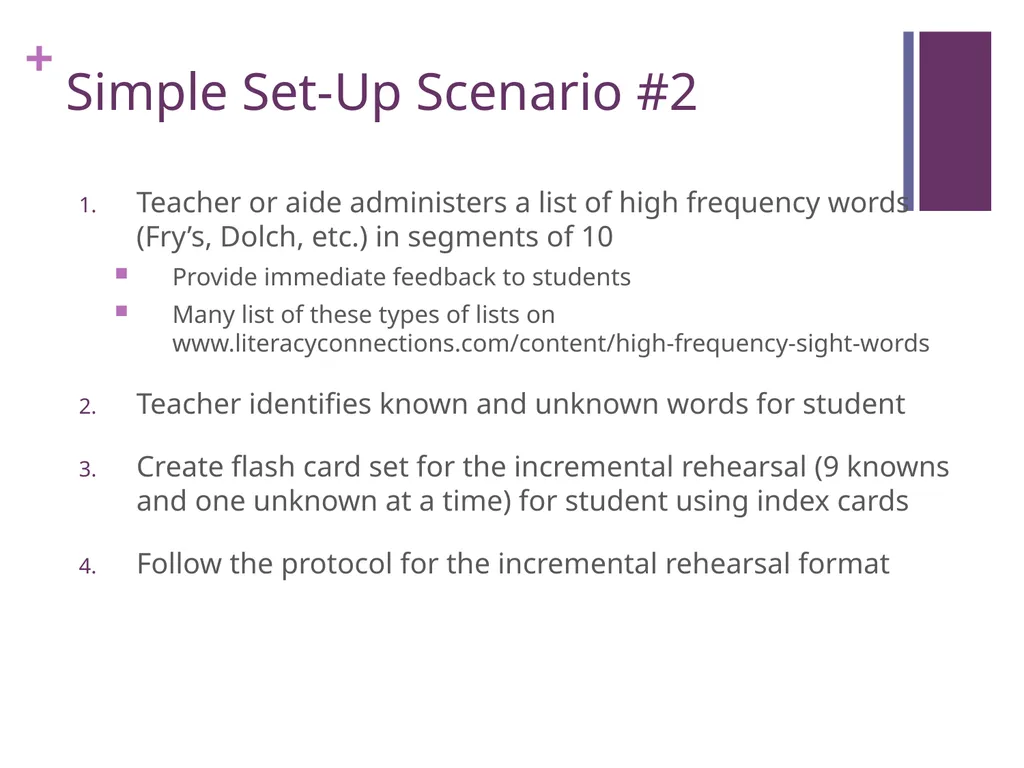
slide18. Simple Set-Up Scenario #2 Teacher or aide administers a list of high frequency words (Fry’s, Dolch, etc.) in segments of 10
Provide immediate feedback to students
Many list of these types of lists on www.literacyconnections.com/content/high-frequency-sight-words
Teacher identifies known and unknown words for student
Create flash card set for the incremental rehearsal (9 knowns and one unknown at a time) for student using index cards
Follow the protocol for the incremental rehearsal format<br>
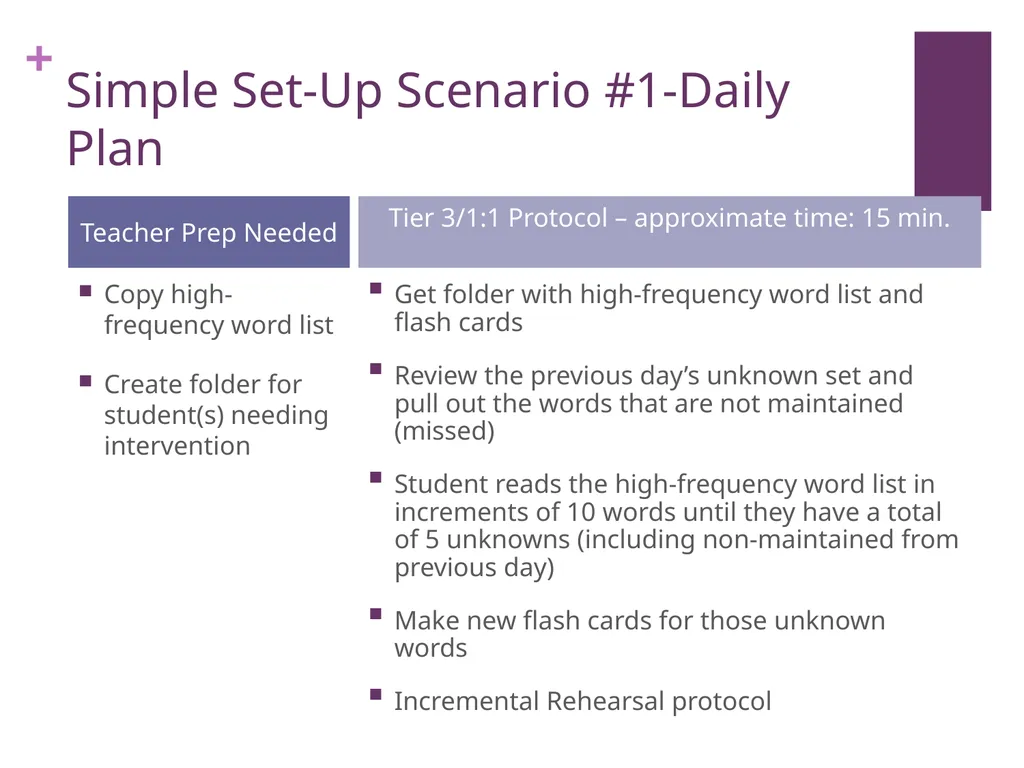
slide19. Simple Set-Up Scenario #1-Daily Plan Copy high-frequency word list
Create folder for student(s) needing intervention Get folder with high-frequency word list and flash cards
Review the previous day’s unknown set and pull out the words that are not maintained (missed)
Student reads the high-frequency word list in increments of 10 words until they have a total of 5 unknowns (including non-maintained from previous day)
Make new flash cards for those unknown words
Incremental Rehearsal protocol Teacher Prep Needed Tier 3/1:1 Protocol – approximate time: 15 min.<br>
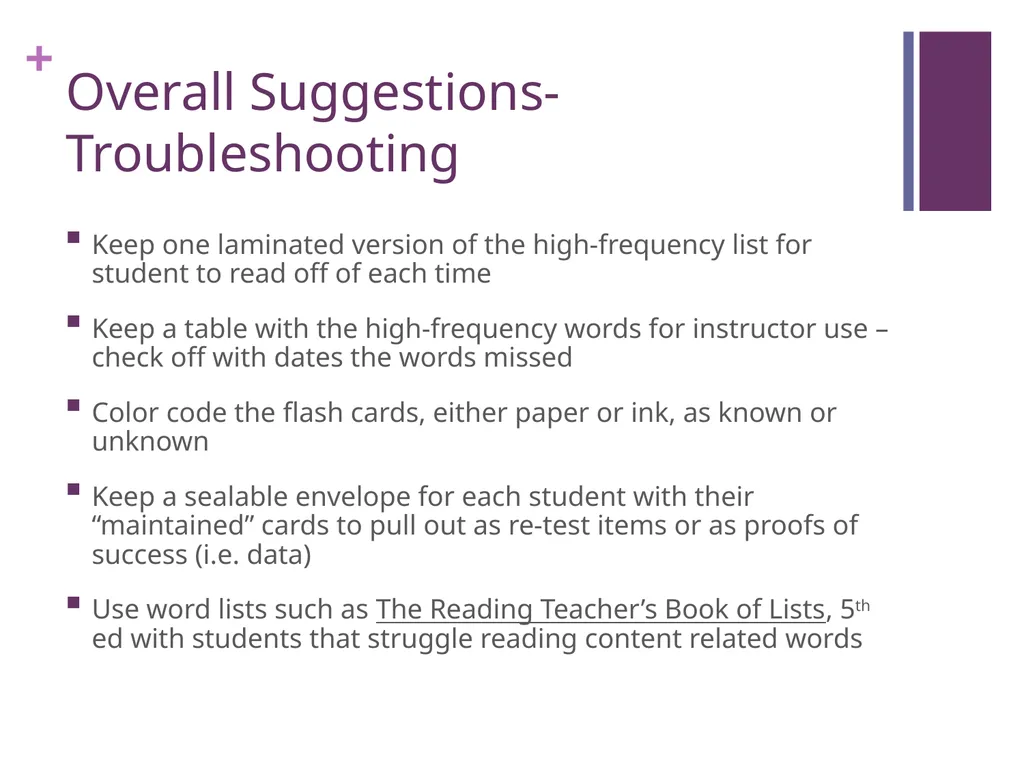
slide20. Overall Suggestions-Troubleshooting Keep one laminated version of the high-frequency list for student to read off of each time
Keep a table with the high-frequency words for instructor use – check off with dates the words missed
Color code the flash cards, either paper or ink, as known or unknown
Keep a sealable envelope for each student with their “maintained” cards to pull out as re-test items or as proofs of success (i.e. data)
Use word lists such as The Reading Teacher’s Book of Lists, 5th ed with students that struggle reading content related words<br>
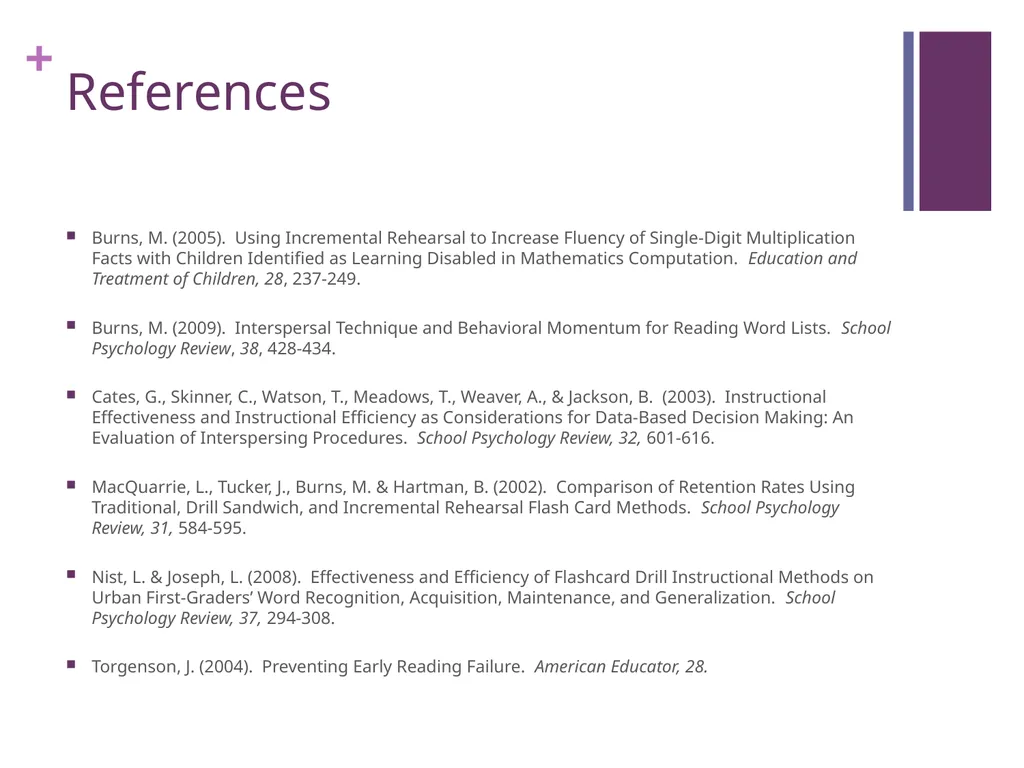
slide21. References Burns, M. (2005). Using Incremental Rehearsal to Increase Fluency of Single-Digit Multiplication Facts with Children Identified as Learning Disabled in Mathematics Computation. Education and Treatment of Children, 28, 237-249.
Burns, M. (2009). Interspersal Technique and Behavioral Momentum for Reading Word Lists. School Psychology Review, 38, 428-434.
Cates, G., Skinner, C., Watson, T., Meadows, T., Weaver, A., & Jackson, B. (2003). Instructional Effectiveness and Instructional Efficiency as Considerations for Data-Based Decision Making: An Evaluation of Interspersing Procedures. School Psychology Review, 32, 601-616.
MacQuarrie, L., Tucker, J., Burns, M. & Hartman, B. (2002). Comparison of Retention Rates Using Traditional, Drill Sandwich, and Incremental Rehearsal Flash Card Methods. School Psychology Review, 31, 584-595.
Nist, L. & Joseph, L. (2008). Effectiveness and Efficiency of Flashcard Drill Instructional Methods on Urban First-Graders’ Word Recognition, Acquisition, Maintenance, and Generalization. School Psychology Review, 37, 294-308.
Torgenson, J. (2004). Preventing Early Reading Failure. American Educator, 28.<br>
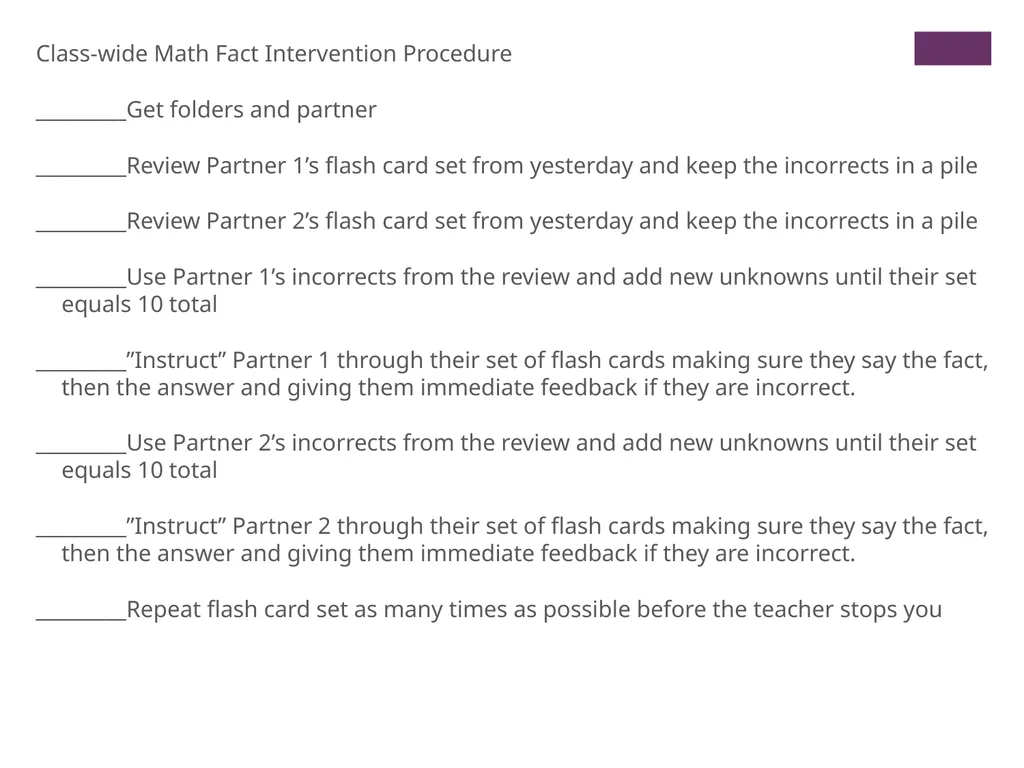
slide22. Class-wide Math Fact Intervention Procedure
_________Get folders and partner
_________Review Partner 1’s flash card set from yesterday and keep the incorrects in a pile
_________Review Partner 2’s flash card set from yesterday and keep the incorrects in a pile
_________Use Partner 1’s incorrects from the review and add new unknowns until their set equals 10 total
_________”Instruct” Partner 1 through their set of flash cards making sure they say the fact, then the answer and giving them immediate feedback if they are incorrect.
_________Use Partner 2’s incorrects from the review and add new unknowns until their set equals 10 total
_________”Instruct” Partner 2 through their set of flash cards making sure they say the fact, then the answer and giving them immediate feedback if they are incorrect.
_________Repeat flash card set as many times as possible before the teacher stops you<br>
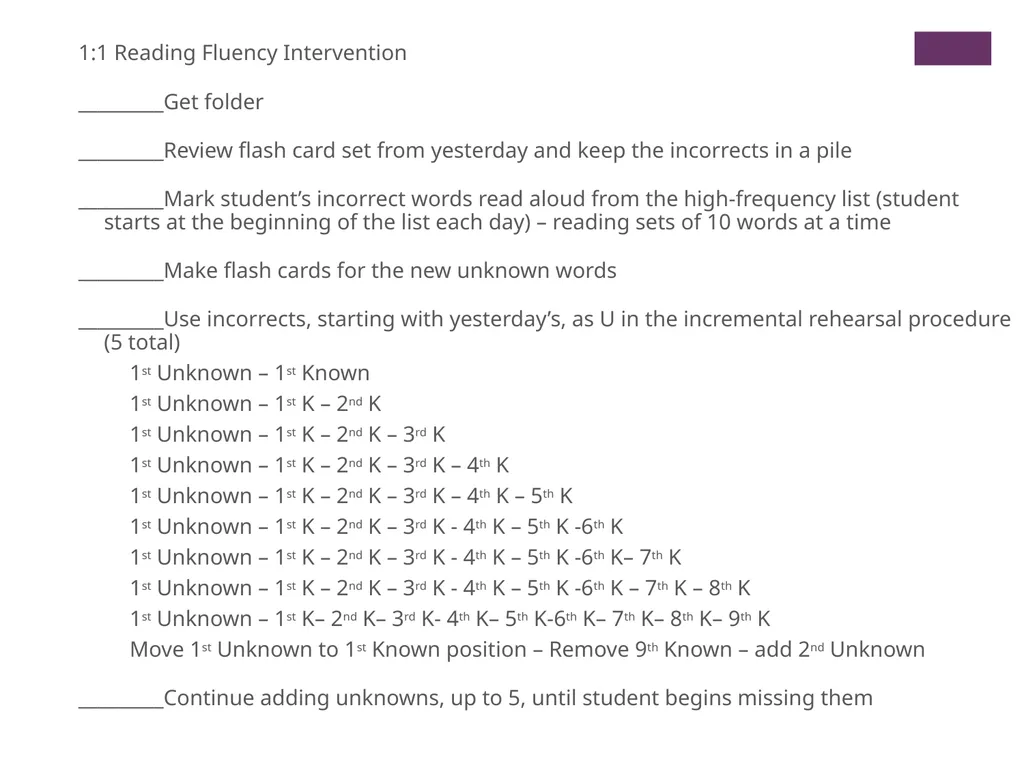
slide23. 1:1 Reading Fluency Intervention
_________Get folder
_________Review flash card set from yesterday and keep the incorrects in a pile
_________Mark student’s incorrect words read aloud from the high-frequency list (student starts at the beginning of the list each day) – reading sets of 10 words at a time
_________Make flash cards for the new unknown words
_________Use incorrects, starting with yesterday’s, as U in the incremental rehearsal procedure (5 total)
1st Unknown – 1st Known
1st Unknown – 1st K – 2nd K
1st Unknown – 1st K – 2nd K – 3rd K
1st Unknown – 1st K – 2nd K – 3rd K – 4th K
1st Unknown – 1st K – 2nd K – 3rd K – 4th K – 5th K
1st Unknown – 1st K – 2nd K – 3rd K - 4th K – 5th K -6th K
1st Unknown – 1st K – 2nd K – 3rd K - 4th K – 5th K -6th K– 7th K
1st Unknown – 1st K – 2nd K – 3rd K - 4th K – 5th K -6th K – 7th K – 8th K
1st Unknown – 1st K– 2nd K– 3rd K- 4th K– 5th K-6th K– 7th K– 8th K– 9th K
Move 1st Unknown to 1st Known position – Remove 9th Known – add 2nd Unknown
_________Continue adding unknowns, up to 5, until student begins missing them<br>
US Office of Education 84.325K
H325K080308<br>
slide2. Interventions in a Flash-What Is It & Who Is It For? A strategy to use with students struggling to acquire or retain a skill such as math facts, reading sight words, or spelling
One-on-One Format
Can be used as a Tier 2 or Tier 3 intervention<br>
slide3. Rationale and Evidenced Based Practice Basic, foundational skills must be acquired prior to more complex concepts and higher order thinking skills
Students who do not have automaticity in their basic skills struggle to stay “on grade level” and maintain interest
Failure to attain these basic skills negatively effects overall academic competency
Math: basic skills include operational facts
Reading: basic skills include phonemic awareness and sight words<br>
slide4. Rationale and Evidenced Based Practice cont. Research has shown that instructional interventions must be:
Targeted skills
Explicitly taught
Appropriate level of instruction and challenge
High opportunities to respond
Immediate feedback given
Using flash cards to increase student’s automaticity incorporates the above needs and has been shown effective with
Struggling readers to improve sight word fluency
Basic math facts
General education and Special Education populations<br>
slide5. Advantage to the Educator Inexpensive to use and can be developed quickly and as feedback is given for student response
Keep easy data using the cards developed
Limited materials
Index or note cards
Folder
Markers
Checklist
3 types to choose from<br>
slide6. Traditional Flash Card Drill 100% unknown facts/words
Procedure:
Set of cards shown to student one at a time with instructor giving correct answer and student repeating fact/word and answer
Set of cards shown again with student responding
Correct response: acknowledge with positive feedback
Incorrect response: overcorrection and immediate feedback
Set repetition based on time and student achievement (8 trials typical)<br>
slide7. Interspersal Training (Drill Sandwich) Typically 30% unknown to 70% known facts/words
Procedure:
Unknown facts/words read and answered by instructor with student repetition
Intersperse the unknowns with the knowns in an order such as
K1-U1-U2-U3-K2-U4-U5-U6-K3
Set repetition based on time and student achievement (8 trials typical)
Correct response: acknowledge with positive feedback
Incorrect response: overcorrection and immediate feedback<br>
slide8. Incremental Rehearsal 10% unknown to 90% known
Procedure:
Unknown fact/word read and answered by instructor with student repetition
Rehearse the unknown with the knowns in specific order
Repeat set with each targeted fact/word moving 1st unknown to the 1st known position and removing the 9th known
Correct response: acknowledge with positive feedback
Incorrect response: overcorrection and immediate feedback<br>
slide9. Procedure for Incremental Rehearsal 1st Unknown – 1st Known
1st Unknown – 1st K – 2nd K
1st Unknown – 1st K – 2nd K – 3rd K
1st Unknown – 1st K – 2nd K – 3rd K – 4th K
1st Unknown – 1st K – 2nd K – 3rd K – 4th K – 5th K
1st Unknown – 1st K – 2nd K – 3rd K - 4th K – 5th K -6th K
1st Unknown – 1st K – 2nd K – 3rd K - 4th K – 5th K -6th K– 7th K
1st Unknown – 1st K – 2nd K – 3rd K - 4th K – 5th K -6th K – 7th K – 8th K
1st Unknown – 1st K– 2nd K– 3rd K- 4th K– 5th K-6th K– 7th K– 8th K– 9th K
Move 1st Unknown to 1st Known position – Remove 9th Known – add 2nd Unknown<br>
slide10. Comparisons Most effective: Incremental rehearsal
Spaced repetition may aide in moving fact/word from short-term memory to long-term memory
Most efficient: Traditional flash card drill
Incremental rehearsal takes more time but does provide more opportunities to respond than traditional or interspersal
Teacher preferences: Traditional (time reasons)
Student preferences: Traditional<br>
slide11. Conclusions Tier 2 Intervention: Traditional Flash Card Drill
Tier 3 Intervention: Incremental Rehearsal
If Tier 2 Traditional Flash Card Drill fails to produce retention of skills, if students need a more complete foundation of basic skills, or if students need more successes to maintain motivation<br>
slide12. Simple Set-Up Scenario #1 math fact intervention for use as a whole class/peer tutoring – Tier 1 or 2<br>
slide13. Simple Set-Up Scenario #1 Teacher group-administers a curriculum based measurement fact probe (2 of the same type best, i.e. 2 Multiplication Facts probes)
Teacher identifies, with student help grading if desired, known and unknown facts for each student
If using 2 probes, facts/words incorrect on both are targets
Create flash card set for the traditional drill (10 unknowns) for each student using index cards
Train students to act as the “instructor”<br>
slide14. Simple Set-Up Scenario #1-Daily Plan Make folders for each student
Copy & Grade probes if students are not
Make flash card sets for students and place them in the folders Get folders and peer “instructors”
Review the previous day’s set and pull out the facts that are not maintained (missed)
Add unknown facts from folder until the set has 10
“Instruct” each other using the flash card set of 10 unknowns
Teacher administers a 2 minute fact probe
Students switch papers with peer to grade and circle incorrects
Students place the newly graded probes and cards back into the folders Teacher Prep Needed Class-wide Protocol – approximate time: 25 min.<br>
slide15. Overall Suggestions-Troubleshooting Quickly make the new unknown flash cards for students when they hand in their folders
Color code the flash cards, either paper or ink, as known or unknown
Keep a sealable envelope for each student with their “maintained” cards to pull out as re-test items or as proofs of success (i.e. data)
If the intervention seems organized and students are progressing at different rates, begin differentiating the probes between students<br>
slide16. Overall Suggestions cont. If this whole class format requires too much time…break it up
Monday: peer instruct entire set of flash cards
Tuesday: review previous day’s set removing the missed facts – give 2 minute probe
Wednesday: peer instruct entire set of flashcards using the non-maintained cards from Monday and new unknowns from Tuesday probe
Thursday: review Wednesday’s set removing the missed facts – give 2 minute probe
Friday: administer to the class the weekly grade level Progress Monitor probe<br>
slide17. Simple Set-Up Scenario #2 Reading fluency intervention for use as a small group – Tier 3<br>
slide18. Simple Set-Up Scenario #2 Teacher or aide administers a list of high frequency words (Fry’s, Dolch, etc.) in segments of 10
Provide immediate feedback to students
Many list of these types of lists on www.literacyconnections.com/content/high-frequency-sight-words
Teacher identifies known and unknown words for student
Create flash card set for the incremental rehearsal (9 knowns and one unknown at a time) for student using index cards
Follow the protocol for the incremental rehearsal format<br>
slide19. Simple Set-Up Scenario #1-Daily Plan Copy high-frequency word list
Create folder for student(s) needing intervention Get folder with high-frequency word list and flash cards
Review the previous day’s unknown set and pull out the words that are not maintained (missed)
Student reads the high-frequency word list in increments of 10 words until they have a total of 5 unknowns (including non-maintained from previous day)
Make new flash cards for those unknown words
Incremental Rehearsal protocol Teacher Prep Needed Tier 3/1:1 Protocol – approximate time: 15 min.<br>
slide20. Overall Suggestions-Troubleshooting Keep one laminated version of the high-frequency list for student to read off of each time
Keep a table with the high-frequency words for instructor use – check off with dates the words missed
Color code the flash cards, either paper or ink, as known or unknown
Keep a sealable envelope for each student with their “maintained” cards to pull out as re-test items or as proofs of success (i.e. data)
Use word lists such as The Reading Teacher’s Book of Lists, 5th ed with students that struggle reading content related words<br>
slide21. References Burns, M. (2005). Using Incremental Rehearsal to Increase Fluency of Single-Digit Multiplication Facts with Children Identified as Learning Disabled in Mathematics Computation. Education and Treatment of Children, 28, 237-249.
Burns, M. (2009). Interspersal Technique and Behavioral Momentum for Reading Word Lists. School Psychology Review, 38, 428-434.
Cates, G., Skinner, C., Watson, T., Meadows, T., Weaver, A., & Jackson, B. (2003). Instructional Effectiveness and Instructional Efficiency as Considerations for Data-Based Decision Making: An Evaluation of Interspersing Procedures. School Psychology Review, 32, 601-616.
MacQuarrie, L., Tucker, J., Burns, M. & Hartman, B. (2002). Comparison of Retention Rates Using Traditional, Drill Sandwich, and Incremental Rehearsal Flash Card Methods. School Psychology Review, 31, 584-595.
Nist, L. & Joseph, L. (2008). Effectiveness and Efficiency of Flashcard Drill Instructional Methods on Urban First-Graders’ Word Recognition, Acquisition, Maintenance, and Generalization. School Psychology Review, 37, 294-308.
Torgenson, J. (2004). Preventing Early Reading Failure. American Educator, 28.<br>
slide22. Class-wide Math Fact Intervention Procedure
_________Get folders and partner
_________Review Partner 1’s flash card set from yesterday and keep the incorrects in a pile
_________Review Partner 2’s flash card set from yesterday and keep the incorrects in a pile
_________Use Partner 1’s incorrects from the review and add new unknowns until their set equals 10 total
_________”Instruct” Partner 1 through their set of flash cards making sure they say the fact, then the answer and giving them immediate feedback if they are incorrect.
_________Use Partner 2’s incorrects from the review and add new unknowns until their set equals 10 total
_________”Instruct” Partner 2 through their set of flash cards making sure they say the fact, then the answer and giving them immediate feedback if they are incorrect.
_________Repeat flash card set as many times as possible before the teacher stops you<br>
slide23. 1:1 Reading Fluency Intervention
_________Get folder
_________Review flash card set from yesterday and keep the incorrects in a pile
_________Mark student’s incorrect words read aloud from the high-frequency list (student starts at the beginning of the list each day) – reading sets of 10 words at a time
_________Make flash cards for the new unknown words
_________Use incorrects, starting with yesterday’s, as U in the incremental rehearsal procedure (5 total)
1st Unknown – 1st Known
1st Unknown – 1st K – 2nd K
1st Unknown – 1st K – 2nd K – 3rd K
1st Unknown – 1st K – 2nd K – 3rd K – 4th K
1st Unknown – 1st K – 2nd K – 3rd K – 4th K – 5th K
1st Unknown – 1st K – 2nd K – 3rd K - 4th K – 5th K -6th K
1st Unknown – 1st K – 2nd K – 3rd K - 4th K – 5th K -6th K– 7th K
1st Unknown – 1st K – 2nd K – 3rd K - 4th K – 5th K -6th K – 7th K – 8th K
1st Unknown – 1st K– 2nd K– 3rd K- 4th K– 5th K-6th K– 7th K– 8th K– 9th K
Move 1st Unknown to 1st Known position – Remove 9th Known – add 2nd Unknown
_________Continue adding unknowns, up to 5, until student begins missing them<br>