
Interview Collected and Compiled by Dr.S.R.Nikam
A
Published · 65 slides · 0 views
1 / 1

Description
Interview Collected and Compiled by Dr.S.R.Nikam Personal Interview It is an art of ascertaining job seeker eligibility for employment. Which involve one to one interaction. What is an interview? The term interview has been derived from the
Related Topics
Share
Embed code
Download this presentation From Below
"Interview Collected and Compiled by Dr.S.R.Nikam" is the property of its rightful owner. Permission is granted to download and print the materials on this website for personal, non-commercial use only, and to display it on your personal computer provided you do not modify the materials and that you retain all copyright notices contained in the materials. By downloading content from our website, you accept the terms of this agreement.
Presentation Transcript
01
Interview
Collected and Compiled by Dr.S.R.Nikam<br>
02
Personal Interview It is an art of ascertaining job seeker eligibility for employment. Which involve one to one interaction.<br>
03
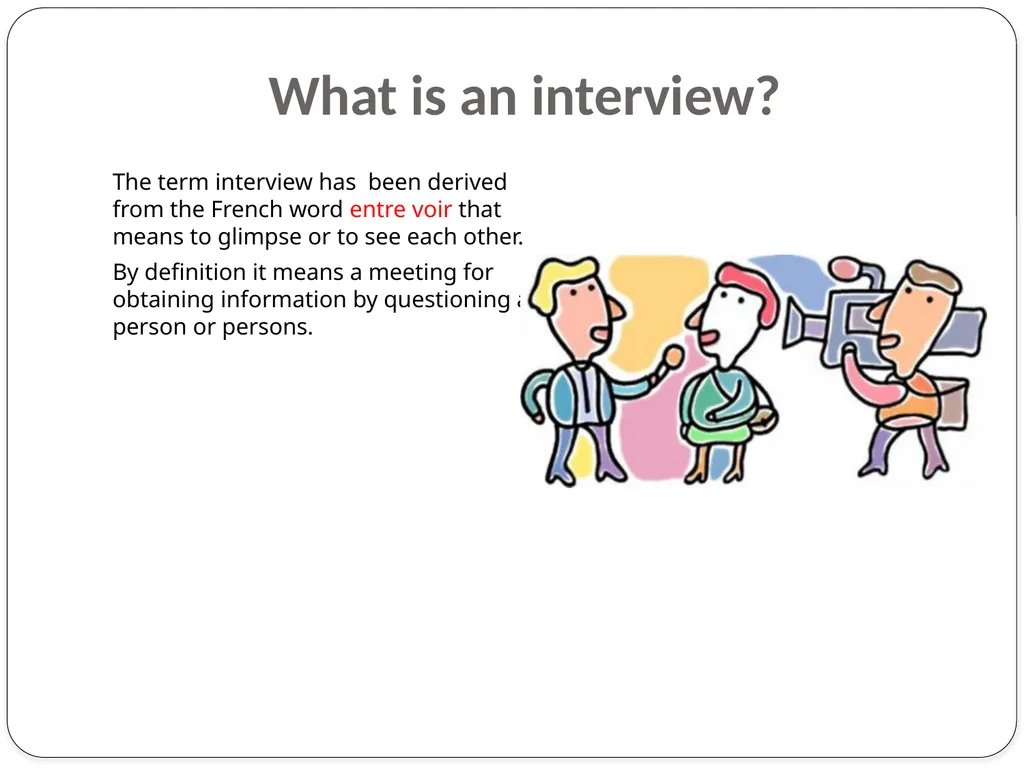
What is an interview? The term interview has been derived from the French word entre voir that means to glimpse or to see each other.
By definition it means a meeting for obtaining information by questioning a person or persons.<br>
By definition it means a meeting for obtaining information by questioning a person or persons.<br>
04
A formal meeting at which somebody is asked questions to see if they are suitable for a particular job or course of study of a college/university.
Private meeting between people where questions are asked and answered.
To ask somebody about their life, opinions especially on radio or television or for the newspaper or magazine.
To give an interview is to agree to answer questions. Interview as defined by The Oxford Advanced Learner’s dictionary<br>
Private meeting between people where questions are asked and answered.
To ask somebody about their life, opinions especially on radio or television or for the newspaper or magazine.
To give an interview is to agree to answer questions. Interview as defined by The Oxford Advanced Learner’s dictionary<br>
05
Meaning of the term ‘Interview’ Basically ,an interview is a conversation between two people (the interviewer and the interviewee) where questions are asked by the interviewer to obtain information from the interviewee.
The word interview can have different meanings. For example a reporter interviews a celebrity for television. This kind of interviews can be one-on-one but usually when it comes to television there are many reporters from different channels.<br>
The word interview can have different meanings. For example a reporter interviews a celebrity for television. This kind of interviews can be one-on-one but usually when it comes to television there are many reporters from different channels.<br>
06
There are also job interviews which a person has to go through in order to get a job he wants. Job interviews are usually face-to-face interviews and include paperwork.
During an interview you can expect to be asked questions about your educational background, previous work experiences and questions relating to your personal characteristics and goals. But what happens after that? It depends on what interview style your interviewer prefers. Below are some of the more common interview styles used.<br>
During an interview you can expect to be asked questions about your educational background, previous work experiences and questions relating to your personal characteristics and goals. But what happens after that? It depends on what interview style your interviewer prefers. Below are some of the more common interview styles used.<br>
07
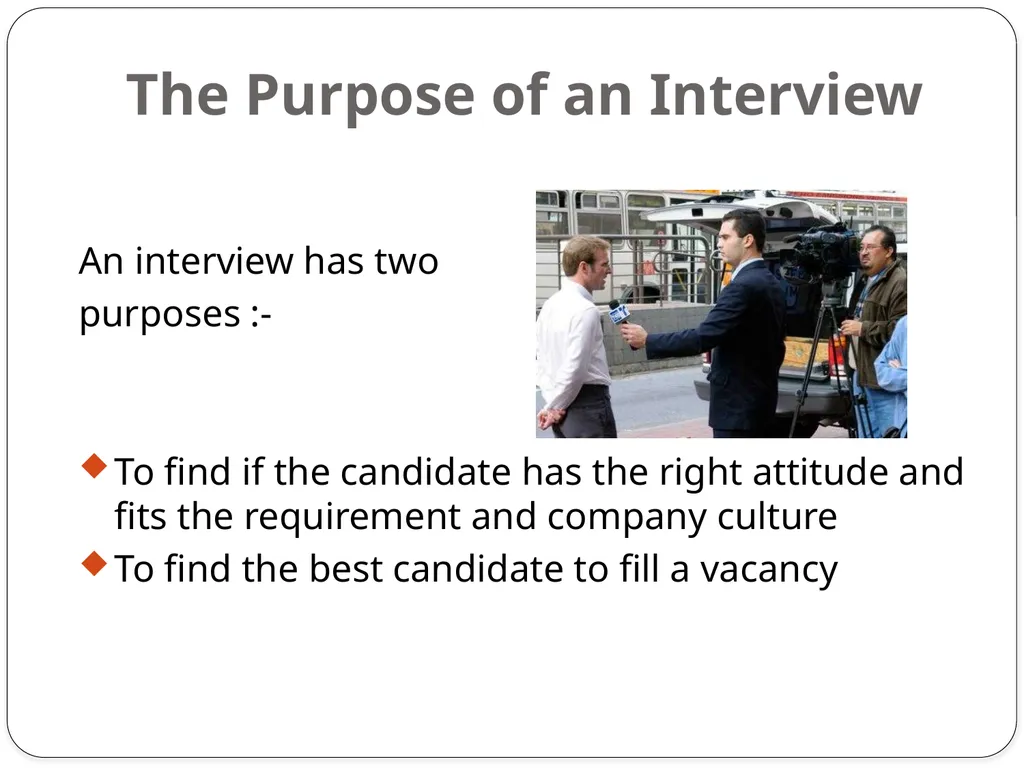
The Purpose of an Interview An interview has two
purposes :-
To find if the candidate has the right attitude and fits the requirement and company culture
To find the best candidate to fill a vacancy<br>
purposes :-
To find if the candidate has the right attitude and fits the requirement and company culture
To find the best candidate to fill a vacancy<br>
08
Interviews<br>
09
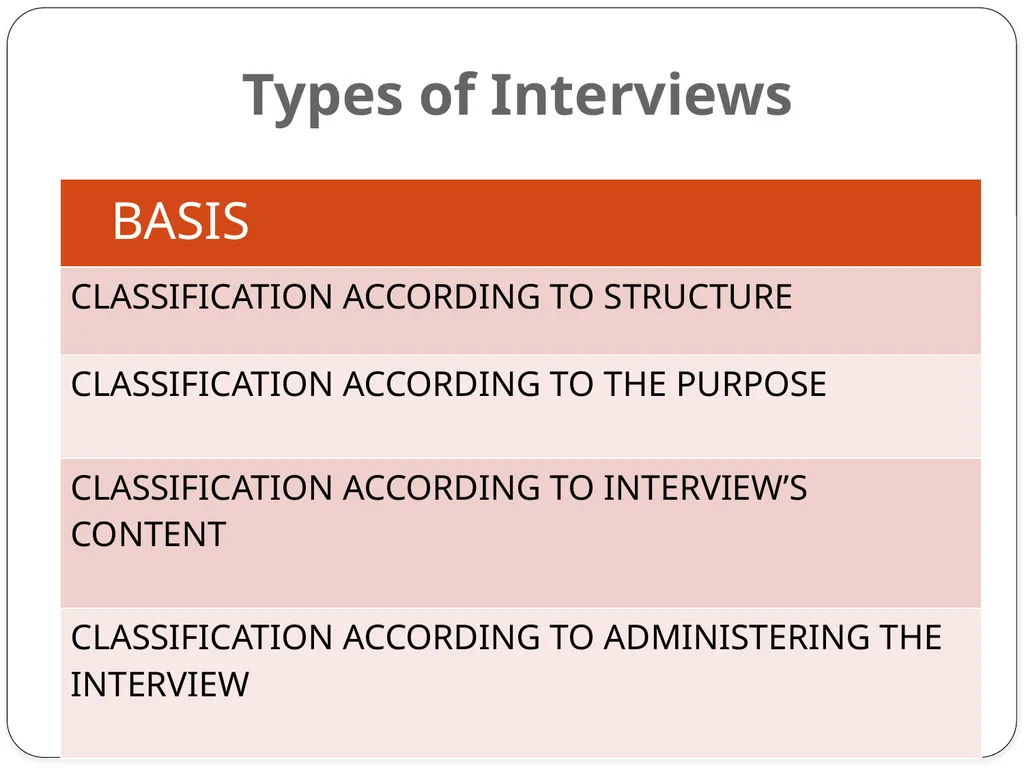
Types of Interviews<br>
10
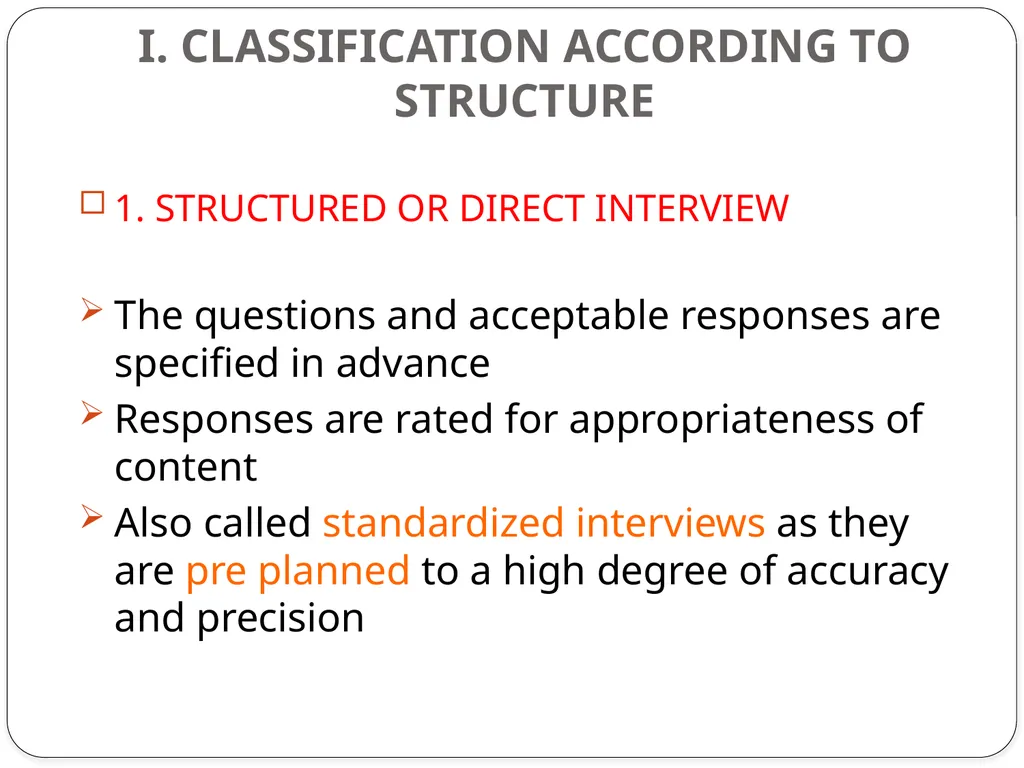
I. CLASSIFICATION ACCORDING TO STRUCTURE 1. STRUCTURED OR DIRECT INTERVIEW
The questions and acceptable responses are specified in advance
Responses are rated for appropriateness of content
Also called standardized interviews as they are pre planned to a high degree of accuracy and precision<br>
The questions and acceptable responses are specified in advance
Responses are rated for appropriateness of content
Also called standardized interviews as they are pre planned to a high degree of accuracy and precision<br>
11
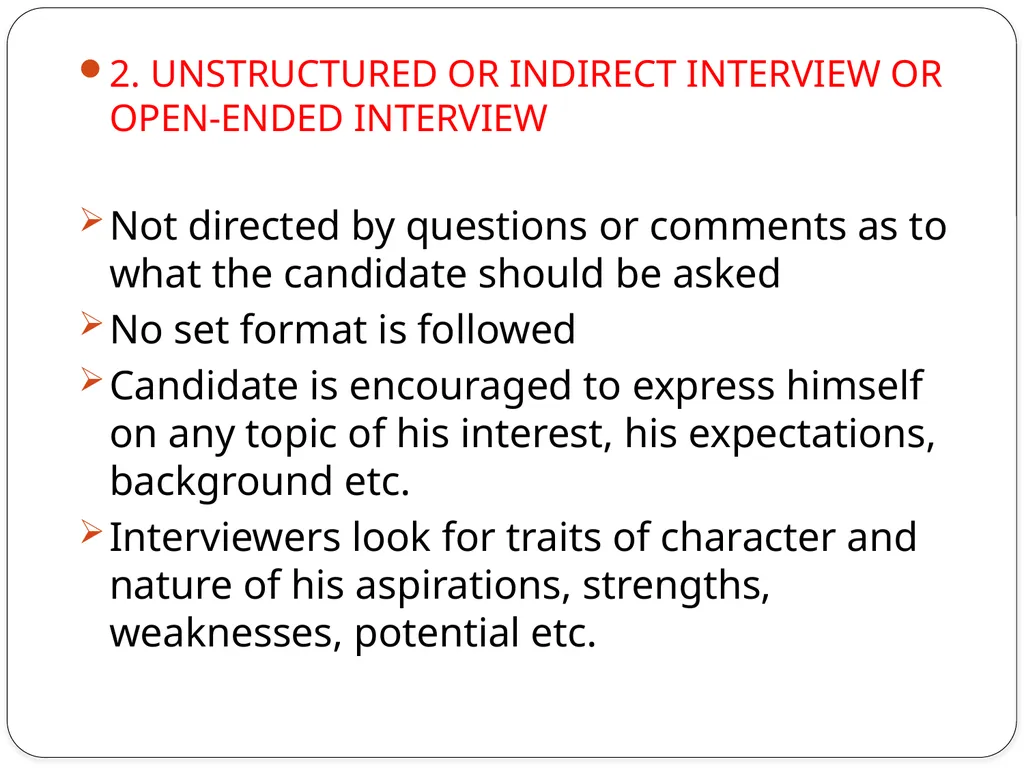
2. UNSTRUCTURED OR INDIRECT INTERVIEW OR OPEN-ENDED INTERVIEW
Not directed by questions or comments as to what the candidate should be asked
No set format is followed
Candidate is encouraged to express himself on any topic of his interest, his expectations, background etc.
Interviewers look for traits of character and nature of his aspirations, strengths, weaknesses, potential etc.<br>
Not directed by questions or comments as to what the candidate should be asked
No set format is followed
Candidate is encouraged to express himself on any topic of his interest, his expectations, background etc.
Interviewers look for traits of character and nature of his aspirations, strengths, weaknesses, potential etc.<br>
12
3. SEMI-STRUCTURED INTERVIEW
specific topic areas
a general set of questions
but the interview flows like a conversation and topics are covered as they come up.<br>
specific topic areas
a general set of questions
but the interview flows like a conversation and topics are covered as they come up.<br>
13
Pros and Cons of Structured & Unstructured Interview STRUCTURED INTERVIEWS
More reliable and valid as all candidates are asked the same set of questions
Enhance consistency across candidates
UNSTRUCTURED INTERVIEWS
Flexibility to pursue points of interest as they develop
Help in assessing the clarity of thoughts of the candidate<br>
More reliable and valid as all candidates are asked the same set of questions
Enhance consistency across candidates
UNSTRUCTURED INTERVIEWS
Flexibility to pursue points of interest as they develop
Help in assessing the clarity of thoughts of the candidate<br>
14
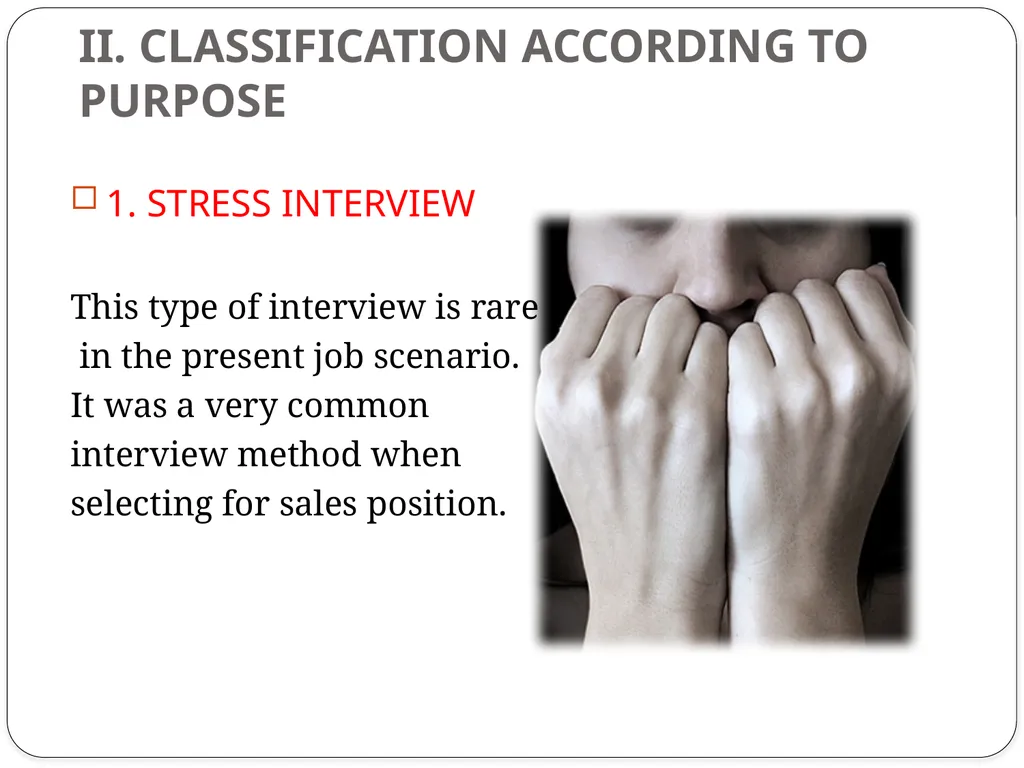
II. CLASSIFICATION ACCORDING TO PURPOSE 1. STRESS INTERVIEW
This type of interview is rare
in the present job scenario.
It was a very common
interview method when
selecting for sales position.<br>
This type of interview is rare
in the present job scenario.
It was a very common
interview method when
selecting for sales position.<br>
15
Stress interview means- Being asked more than one question at a time;
Being asked further questions without being allowed adequate time to respond;
The interviewer adopts a hostile behavior and deliberately puts the candidate on defensive by trying to annoy, embarrass or frustrate him;
He asks questions rapidly, criticizes his/her answers, interrupts him/her frequently, makes derogatory remarks etc.
Having his/her feelings provoked.<br>
Being asked further questions without being allowed adequate time to respond;
The interviewer adopts a hostile behavior and deliberately puts the candidate on defensive by trying to annoy, embarrass or frustrate him;
He asks questions rapidly, criticizes his/her answers, interrupts him/her frequently, makes derogatory remarks etc.
Having his/her feelings provoked.<br>
16
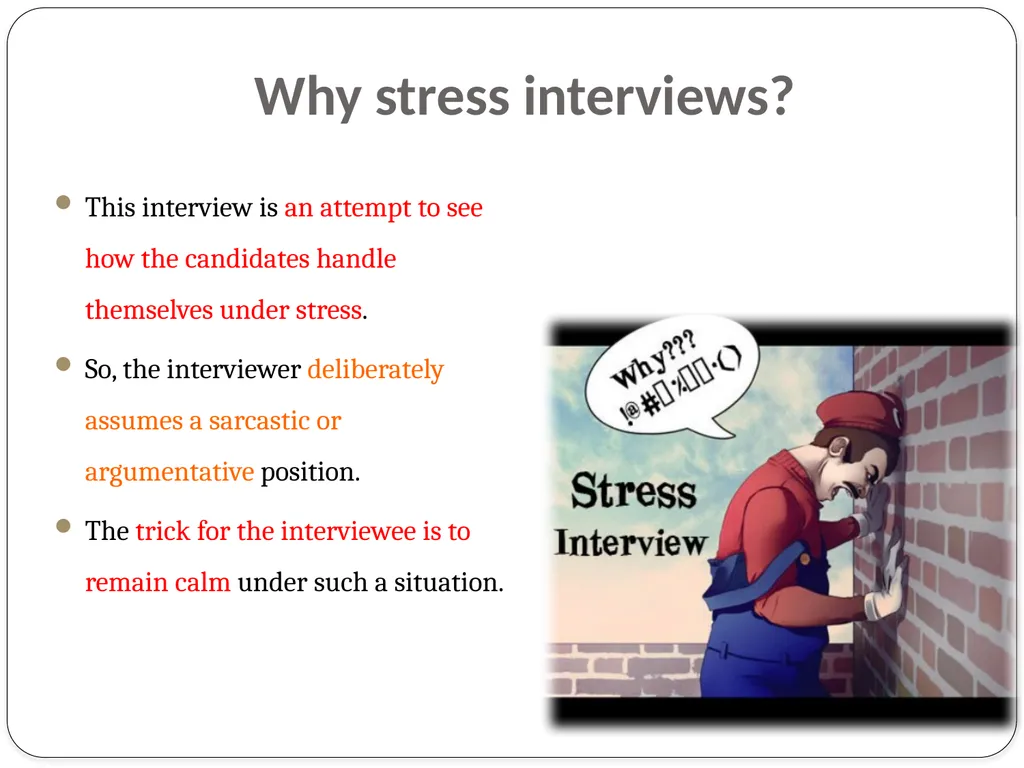
Why stress interviews? This interview is an attempt to see how the candidates handle themselves under stress.
So, the interviewer deliberately assumes a sarcastic or argumentative position.
The trick for the interviewee is to remain calm under such a situation.<br>
So, the interviewer deliberately assumes a sarcastic or argumentative position.
The trick for the interviewee is to remain calm under such a situation.<br>
17
2. APPRAISAL/ ASSESSMENT INTERVIEW
A discussion following a performance appraisal
In which the supervisor and employee discuss the employee’s rating and
Possible remedial actions to be taken.<br>
A discussion following a performance appraisal
In which the supervisor and employee discuss the employee’s rating and
Possible remedial actions to be taken.<br>
18
3. EXIT INTERVIEW
When an employee leaves the company for any reason, an exit interview is conducted
Aims at eliciting information about the job or related matters
Help the employer in having a better insight into what is right or wrong about the company
Highlights the work of an HR Manager<br>
When an employee leaves the company for any reason, an exit interview is conducted
Aims at eliciting information about the job or related matters
Help the employer in having a better insight into what is right or wrong about the company
Highlights the work of an HR Manager<br>
19
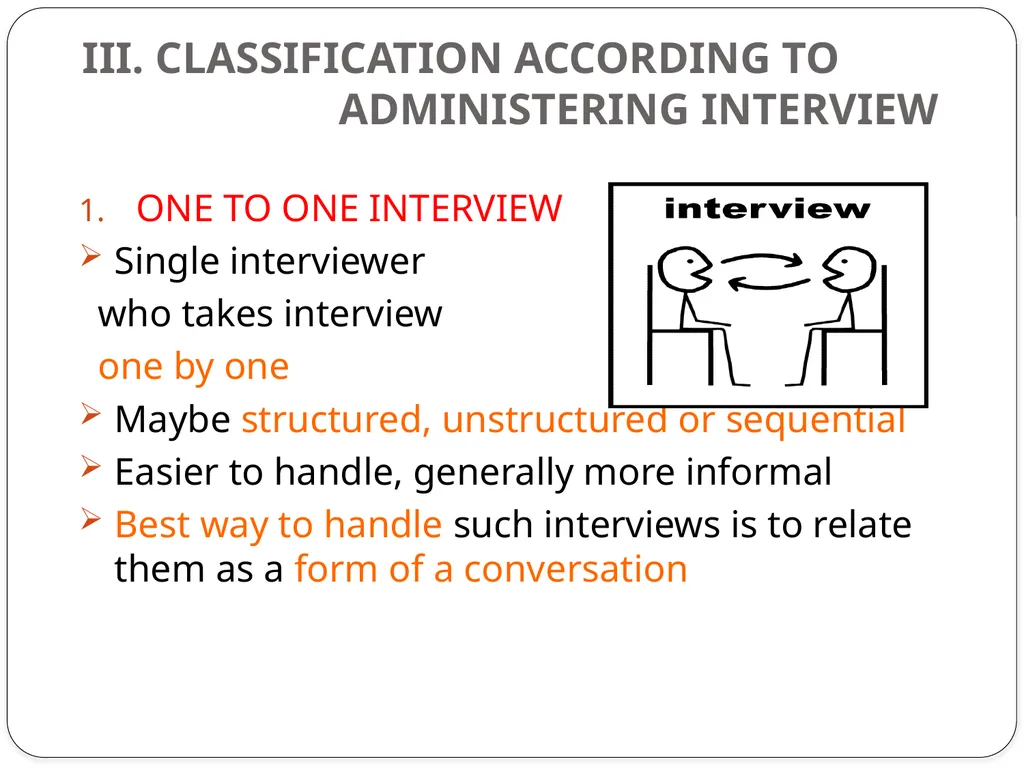
III. CLASSIFICATION ACCORDING TO ADMINISTERING INTERVIEW ONE TO ONE INTERVIEW
Single interviewer
who takes interview
one by one
Maybe structured, unstructured or sequential
Easier to handle, generally more informal
Best way to handle such interviews is to relate them as a form of a conversation<br>
Single interviewer
who takes interview
one by one
Maybe structured, unstructured or sequential
Easier to handle, generally more informal
Best way to handle such interviews is to relate them as a form of a conversation<br>
20
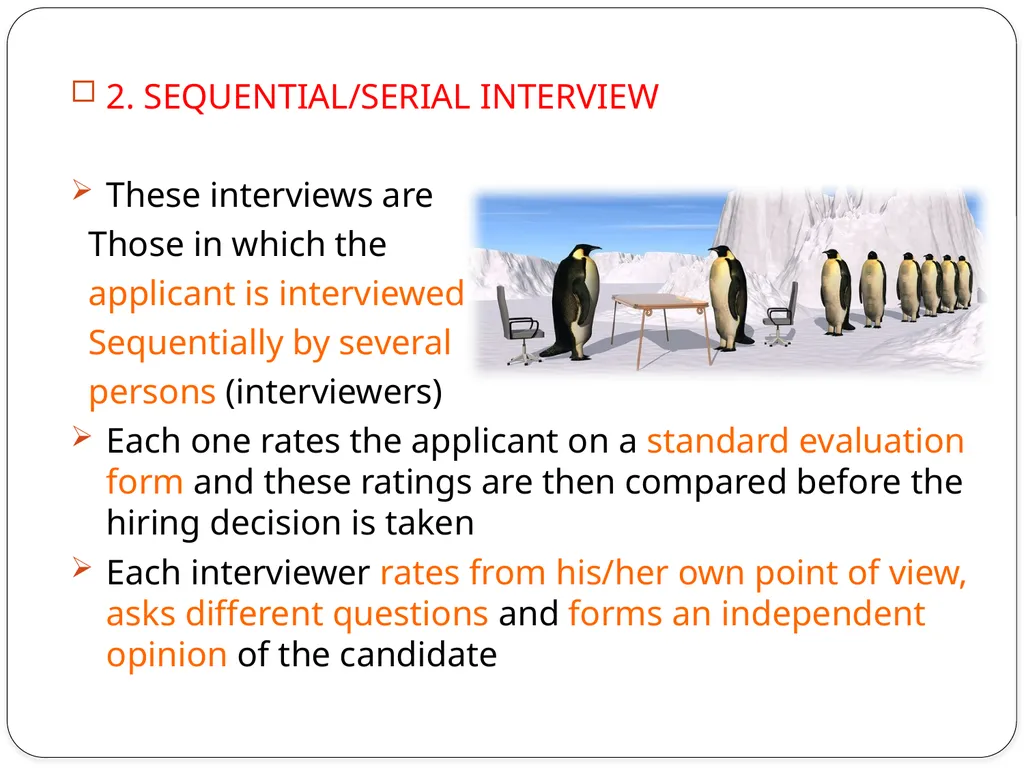
2. SEQUENTIAL/SERIAL INTERVIEW
These interviews are
Those in which the
applicant is interviewed
Sequentially by several
persons (interviewers)
Each one rates the applicant on a standard evaluation form and these ratings are then compared before the hiring decision is taken
Each interviewer rates from his/her own point of view, asks different questions and forms an independent opinion of the candidate<br>
These interviews are
Those in which the
applicant is interviewed
Sequentially by several
persons (interviewers)
Each one rates the applicant on a standard evaluation form and these ratings are then compared before the hiring decision is taken
Each interviewer rates from his/her own point of view, asks different questions and forms an independent opinion of the candidate<br>
21
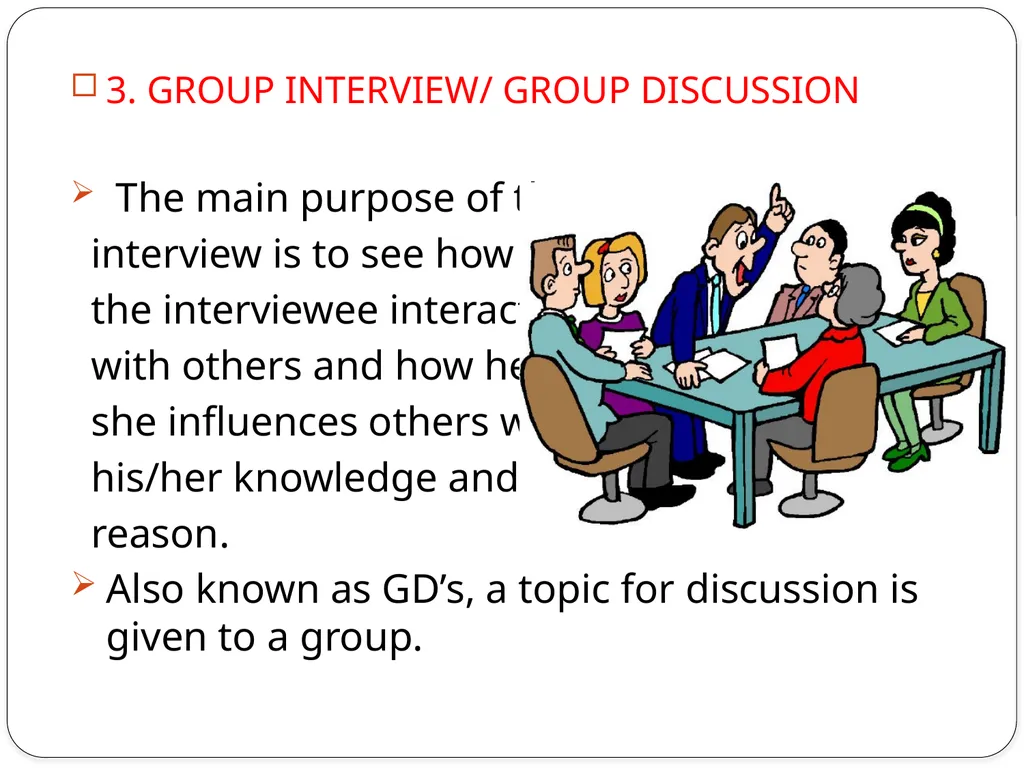
3. GROUP INTERVIEW/ GROUP DISCUSSION
The main purpose of this
interview is to see how
the interviewee interacts
with others and how he/
she influences others with
his/her knowledge and
reason.
Also known as GD’s, a topic for discussion is given to a group.<br>
The main purpose of this
interview is to see how
the interviewee interacts
with others and how he/
she influences others with
his/her knowledge and
reason.
Also known as GD’s, a topic for discussion is given to a group.<br>
22
Why group interviews? Group interview is also the best
way to discover any leadership
potential, group participation, team
playing skills and communication
skills among the candidates.
The selected candidates from the group interview are then taken for an informal one to one interview.<br>
way to discover any leadership
potential, group participation, team
playing skills and communication
skills among the candidates.
The selected candidates from the group interview are then taken for an informal one to one interview.<br>
23
4. PANEL INTERVIEW/ COMMITTEE INTERVIEW
A panel interview comprises more than two members interviewing a person for the hiring.
It is most common mode of interview when hiring at the senior level.
The interviewee should try to connect with each interviewer and the best way to do this is to read the personality of each interviewer.<br>
A panel interview comprises more than two members interviewing a person for the hiring.
It is most common mode of interview when hiring at the senior level.
The interviewee should try to connect with each interviewer and the best way to do this is to read the personality of each interviewer.<br>
24
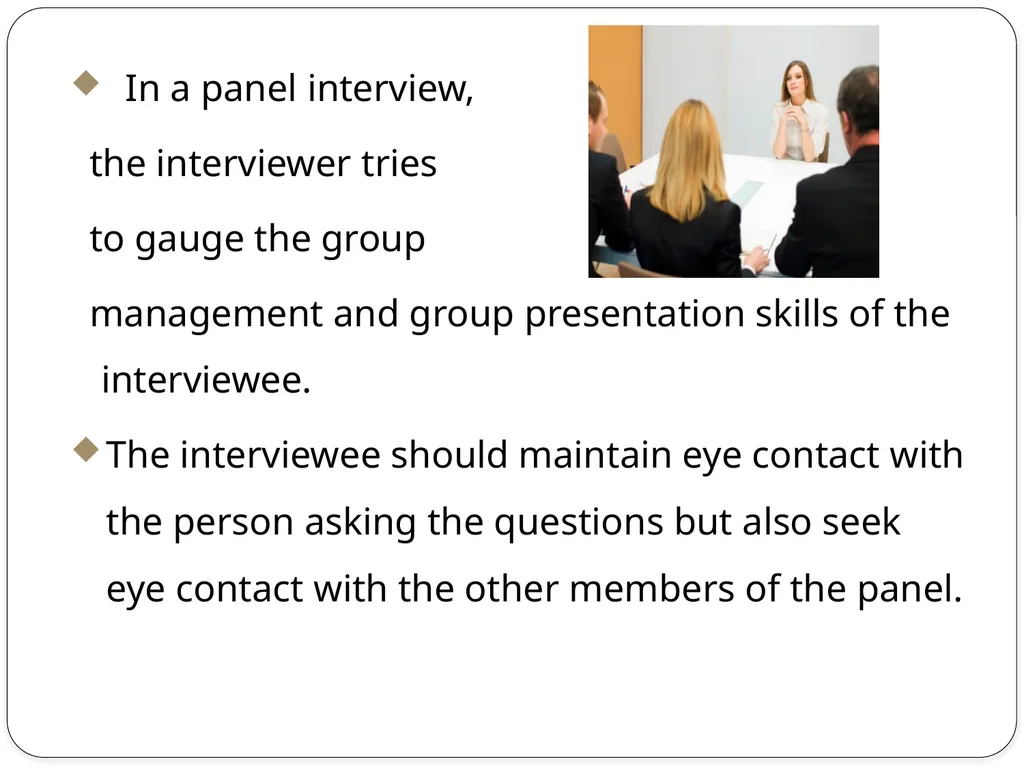
In a panel interview,
the interviewer tries
to gauge the group
management and group presentation skills of the interviewee.
The interviewee should maintain eye contact with the person asking the questions but also seek eye contact with the other members of the panel.<br>
the interviewer tries
to gauge the group
management and group presentation skills of the interviewee.
The interviewee should maintain eye contact with the person asking the questions but also seek eye contact with the other members of the panel.<br>
25
IV. CLASSIFICATION ACCORDING TO INTERVIEW’S CONTENT 1. SITUATIONAL INTERVIEW
Here the interview will focus on the individual’s ability to project what his behavior will be in a given situation.
The interview can be both structured and situational with predetermined questions requiring the candidate to project what his behavior will be.<br>
Here the interview will focus on the individual’s ability to project what his behavior will be in a given situation.
The interview can be both structured and situational with predetermined questions requiring the candidate to project what his behavior will be.<br>
26
2. JOB RELATED INTERVIEW
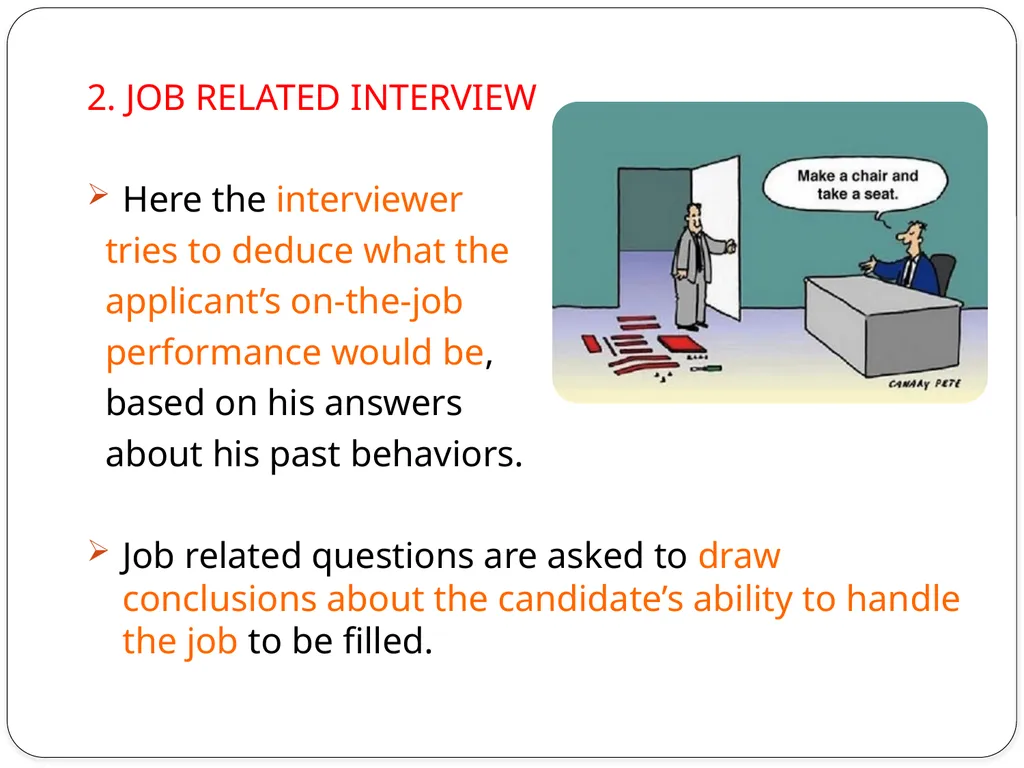
Here the interviewer
tries to deduce what the
applicant’s on-the-job
performance would be,
based on his answers
about his past behaviors.
Job related questions are asked to draw conclusions about the candidate’s ability to handle the job to be filled.<br>
Here the interviewer
tries to deduce what the
applicant’s on-the-job
performance would be,
based on his answers
about his past behaviors.
Job related questions are asked to draw conclusions about the candidate’s ability to handle the job to be filled.<br>
27
3. BEHAVIOURAL INTERVIEW
Here a situation is described and candidates are asked how they have behaved in the past in such a situation.
While situational interviews ask candidates to describe how they would react to a situation in future,
The behavioral interviews seek candidates to describe how did they react to situations in the past.<br>
Here a situation is described and candidates are asked how they have behaved in the past in such a situation.
While situational interviews ask candidates to describe how they would react to a situation in future,
The behavioral interviews seek candidates to describe how did they react to situations in the past.<br>
28
4. PSYCHOLOGICAL INTERVIEWS
Psychological interviews are interviews conducted by a psychologist,
In which questions are intended to assess personal traits such as reliability or dependability etc.<br>
Psychological interviews are interviews conducted by a psychologist,
In which questions are intended to assess personal traits such as reliability or dependability etc.<br>
29
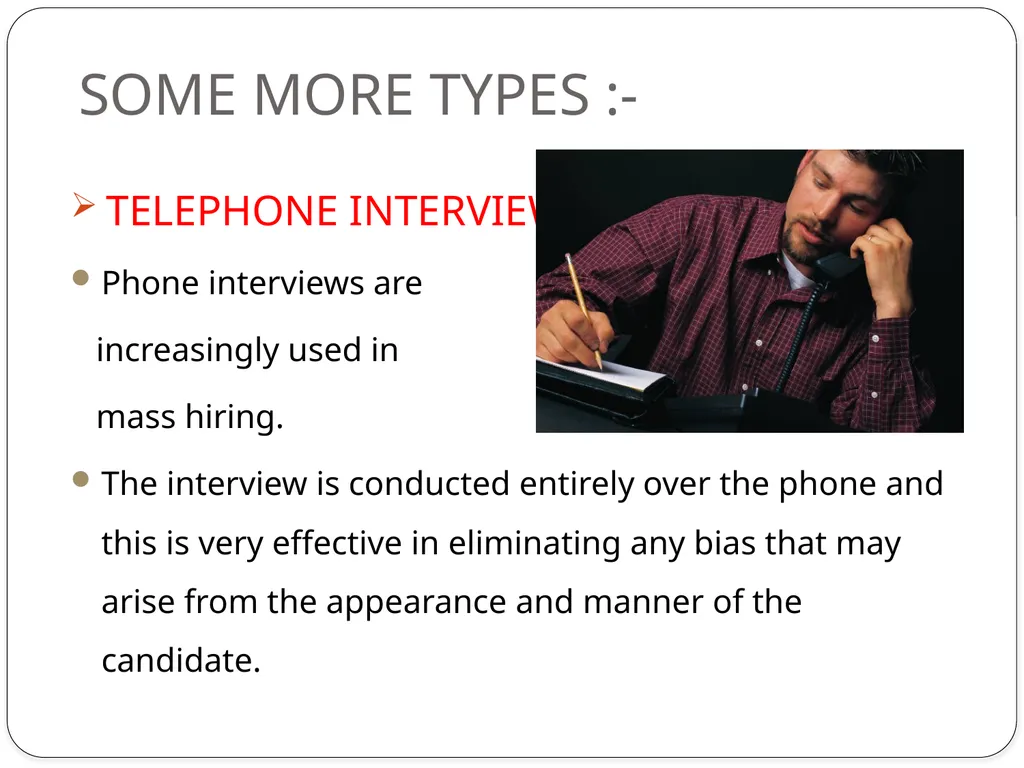
SOME MORE TYPES :- TELEPHONE INTERVIEW
Phone interviews are
increasingly used in
mass hiring.
The interview is conducted entirely over the phone and this is very effective in eliminating any bias that may arise from the appearance and manner of the candidate.<br>
Phone interviews are
increasingly used in
mass hiring.
The interview is conducted entirely over the phone and this is very effective in eliminating any bias that may arise from the appearance and manner of the candidate.<br>
30
PROMOTION INTERVIEW (of the employees who are due for promotion)
ANNUAL INTERVIEW (before writing annual reports, reporting officer interacts with employees subordination)
PERIODICAL INTERVIEW (with the existing employees)
PROBLEM INTERVIEW (of an employee whose performance is unsatisfactory-to find out reasons and find solutions)
COMPUTERIZED INTERVIEW (questions are presented in MCQs)
WALK-IN INTERVIEW (no specific candidates are called, but those who are eligible can come with their valid documents)
VIDEO CONFERENCING (using video technology; clothing, body language and dialogue are important here as well)
CASE INTERVIEW (to solve problems ‘on the spot’)<br>
ANNUAL INTERVIEW (before writing annual reports, reporting officer interacts with employees subordination)
PERIODICAL INTERVIEW (with the existing employees)
PROBLEM INTERVIEW (of an employee whose performance is unsatisfactory-to find out reasons and find solutions)
COMPUTERIZED INTERVIEW (questions are presented in MCQs)
WALK-IN INTERVIEW (no specific candidates are called, but those who are eligible can come with their valid documents)
VIDEO CONFERENCING (using video technology; clothing, body language and dialogue are important here as well)
CASE INTERVIEW (to solve problems ‘on the spot’)<br>
31
Interview Procedure Put the applicant at ease
Explain how the candidate and organization can benefit from an interview
Explain area that will be covered during an interview
Ask questions that elicit answer to the dimensions in each area
Describe the job and organization
Ask the candidate if he has any question
Close the interview<br>
Explain how the candidate and organization can benefit from an interview
Explain area that will be covered during an interview
Ask questions that elicit answer to the dimensions in each area
Describe the job and organization
Ask the candidate if he has any question
Close the interview<br>
32
Three things you need to do before an interview Preparation
Preparation
Preparation<br>
Preparation
Preparation<br>
33
1. Preparation RESEARCH yourself
RESEARCH the job
RESEARCH the organisation
RESEARCH the sector<br>
RESEARCH the job
RESEARCH the organisation
RESEARCH the sector<br>
34
2. Preparation Knowledge about yourself
Re-read your application
Strengths and weaknesses
Why you want the job?
Knowledge about the job itself
What skills do you need?
How can you demonstrate these skills with examples?
Knowledge about the organisation & sector
Why do you want to work for that organisation?
What’s happening in the sector right now?<br>
Re-read your application
Strengths and weaknesses
Why you want the job?
Knowledge about the job itself
What skills do you need?
How can you demonstrate these skills with examples?
Knowledge about the organisation & sector
Why do you want to work for that organisation?
What’s happening in the sector right now?<br>
35
3. Preparation What will the interview format be?
How will you get there?
Rehearse your answers<br>
How will you get there?
Rehearse your answers<br>
36
Preparation is the key to success Review own skills, experiences and qualities
Check CV
Anticipate questions and identify relevant examples
Prepare key selling points
Research organisation
Websites, reports, articles, company literature, etc
Contacts with knowledge of organisation or sector
Relevant articles in the press
Personal visit or telephone call
Research job and occupational area
Job description – or similar
Current issues
Prepare your questions
Practice<br>
Check CV
Anticipate questions and identify relevant examples
Prepare key selling points
Research organisation
Websites, reports, articles, company literature, etc
Contacts with knowledge of organisation or sector
Relevant articles in the press
Personal visit or telephone call
Research job and occupational area
Job description – or similar
Current issues
Prepare your questions
Practice<br>
37
Typical Interview Format Introduction phase
Information about the organization
Summing up / questions about the job<br>
Information about the organization
Summing up / questions about the job<br>
38
Every job interview is a ‘marketing’ exercise, so… Be clear about what you want to communicate
Support what you say with evidence (more on this later)<br>
Support what you say with evidence (more on this later)<br>
39
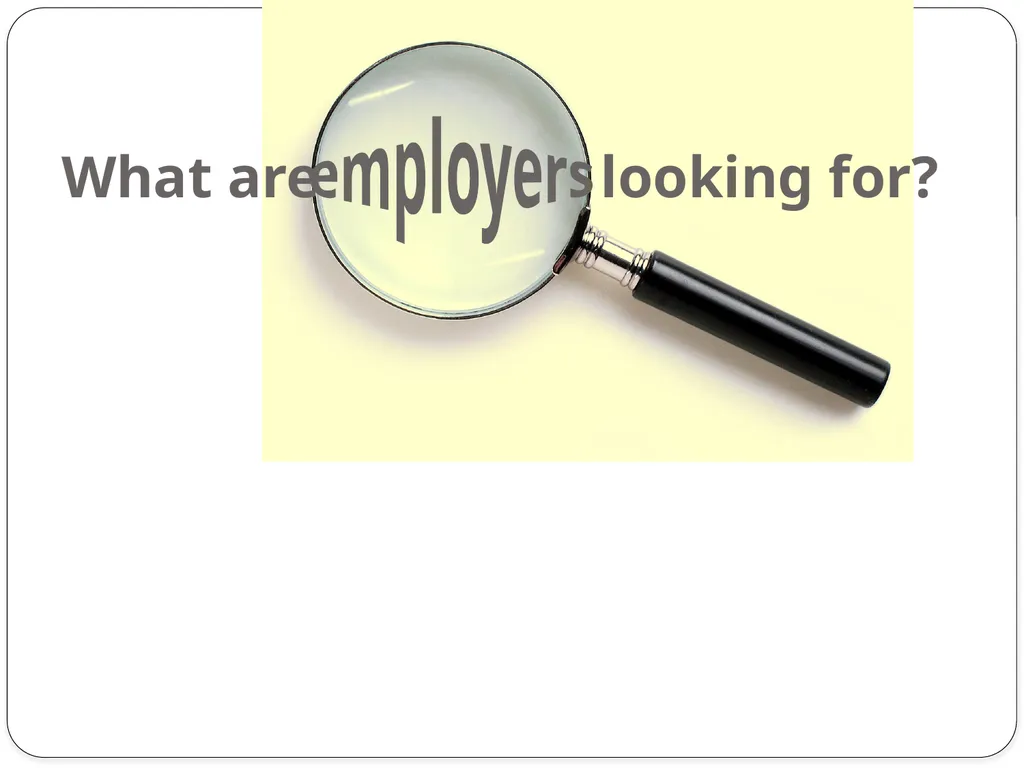
What are looking for? employers<br>
40
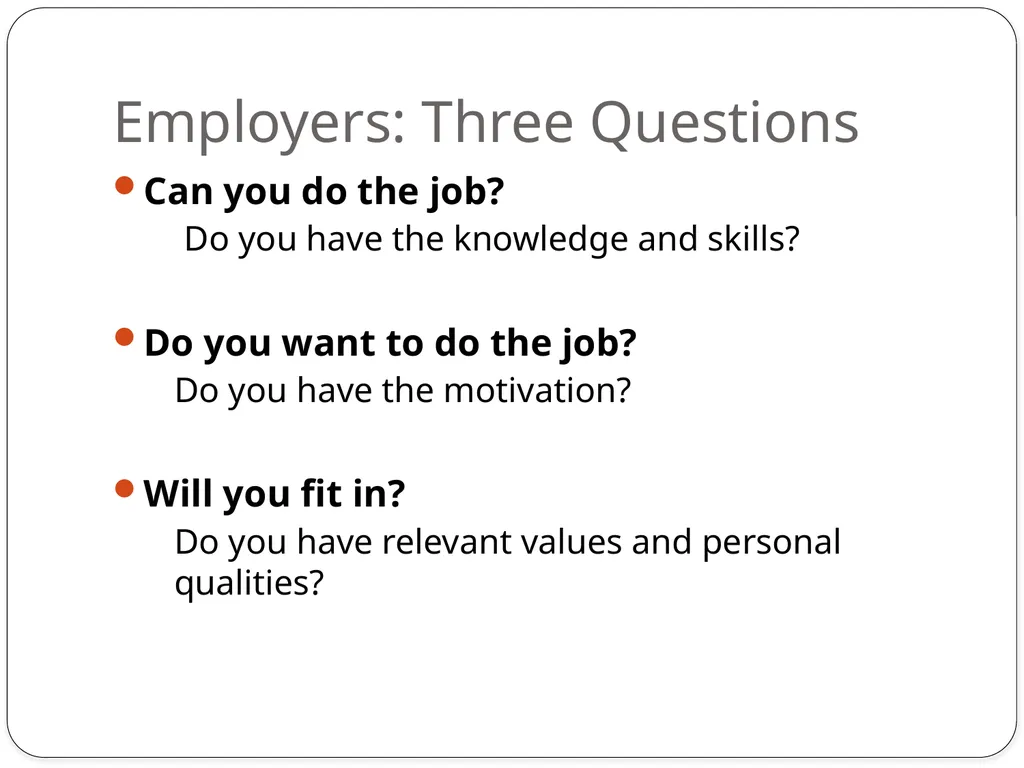
Employers: Three Questions Can you do the job?
Do you have the knowledge and skills?
Do you want to do the job?
Do you have the motivation?
Will you fit in?
Do you have relevant values and personal qualities?<br>
Do you have the knowledge and skills?
Do you want to do the job?
Do you have the motivation?
Will you fit in?
Do you have relevant values and personal qualities?<br>
41
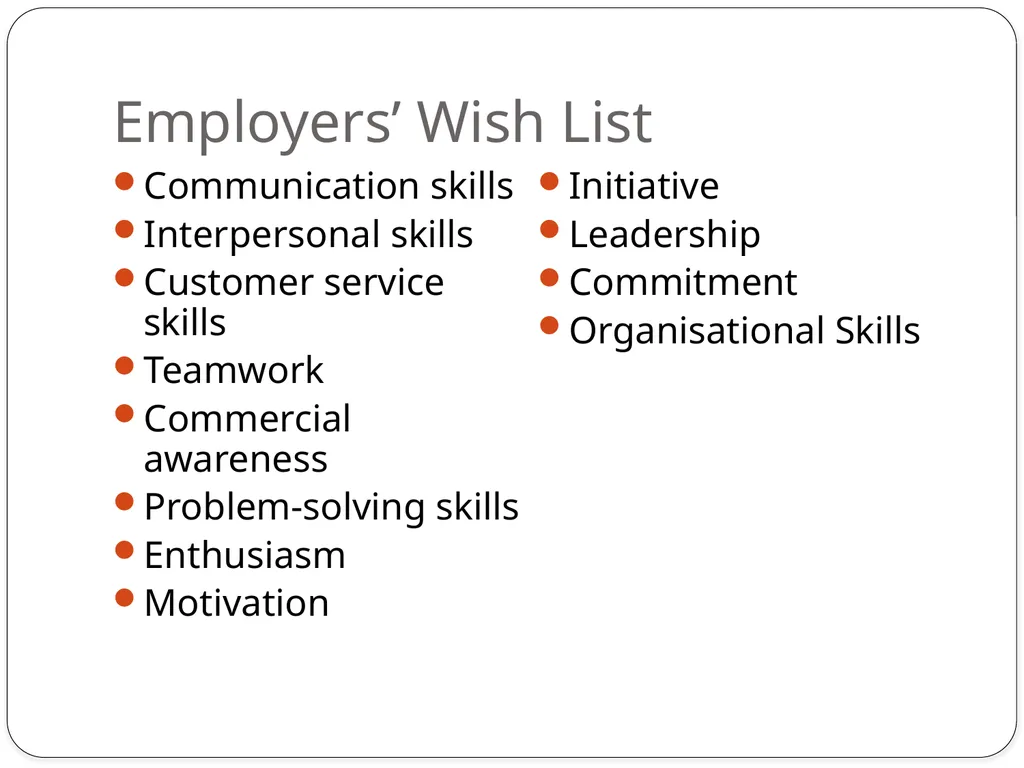
Employers’ Wish List Communication skills
Interpersonal skills
Customer service skills
Teamwork
Commercial awareness
Problem-solving skills
Enthusiasm
Motivation
Initiative
Leadership
Commitment
Organisational Skills<br>
Interpersonal skills
Customer service skills
Teamwork
Commercial awareness
Problem-solving skills
Enthusiasm
Motivation
Initiative
Leadership
Commitment
Organisational Skills<br>
42
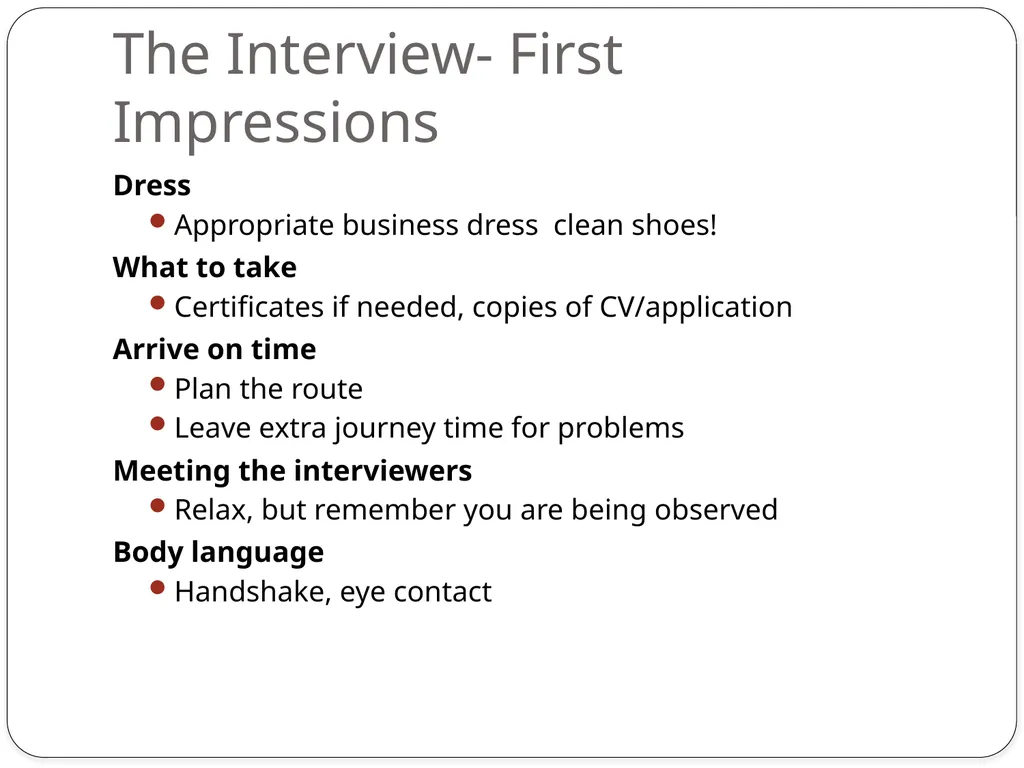
The Interview- First Impressions Dress
Appropriate business dress clean shoes!
What to take
Certificates if needed, copies of CV/application
Arrive on time
Plan the route
Leave extra journey time for problems
Meeting the interviewers
Relax, but remember you are being observed
Body language
Handshake, eye contact<br>
Appropriate business dress clean shoes!
What to take
Certificates if needed, copies of CV/application
Arrive on time
Plan the route
Leave extra journey time for problems
Meeting the interviewers
Relax, but remember you are being observed
Body language
Handshake, eye contact<br>
43
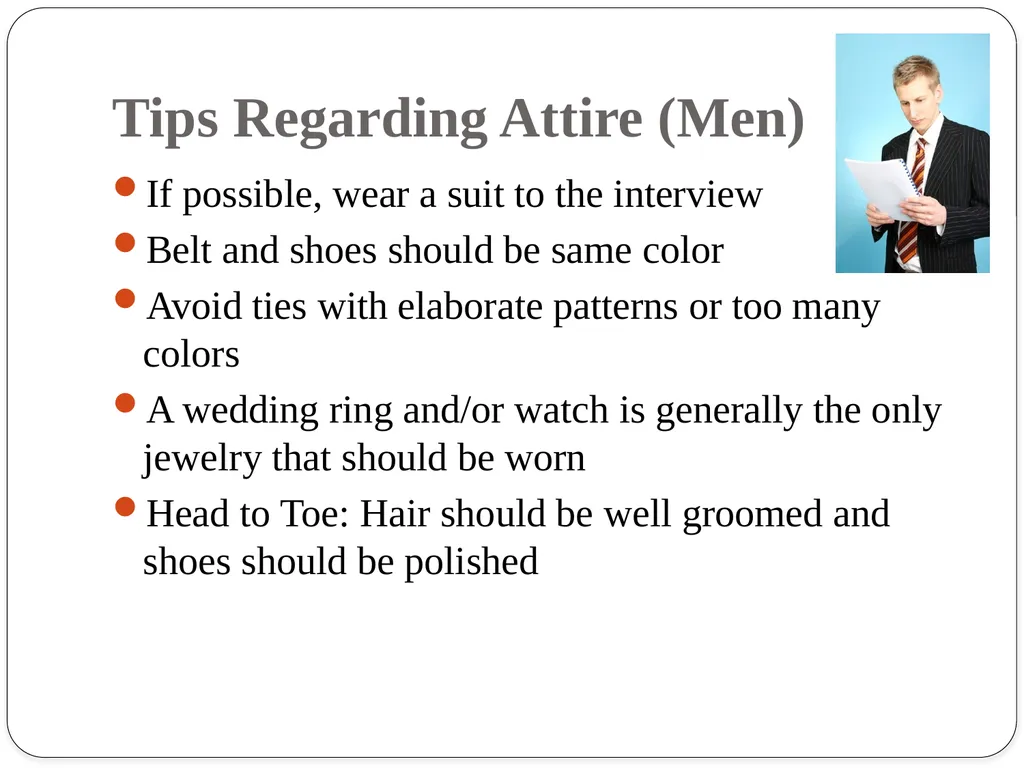
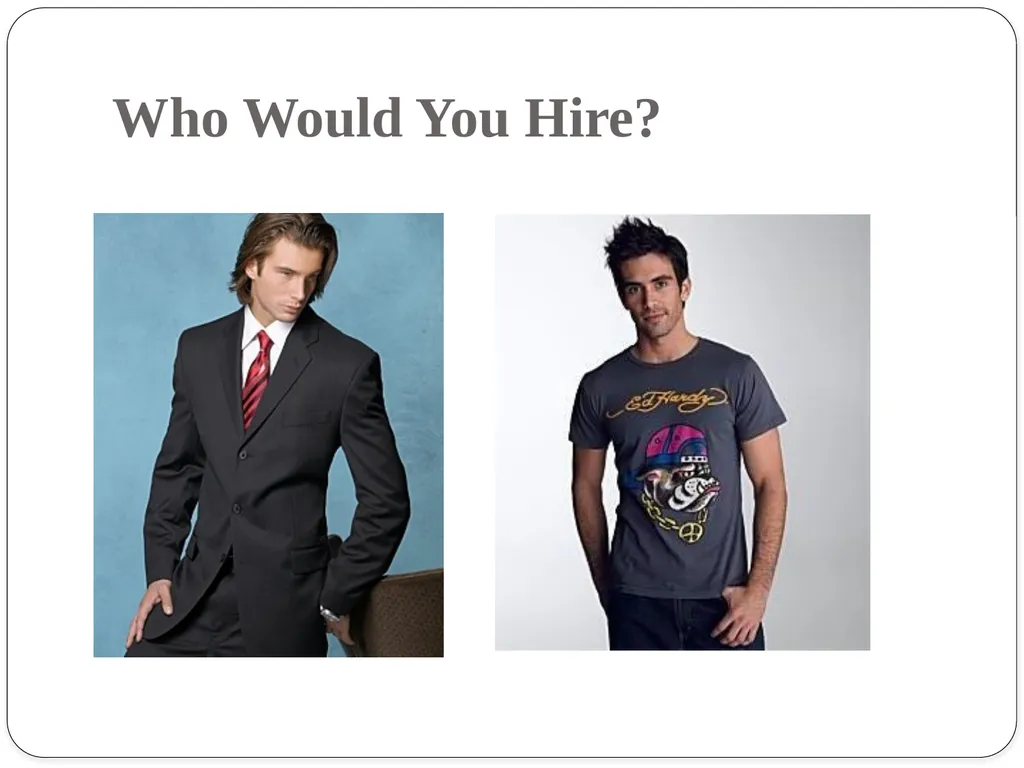
Tips Regarding Attire (Men) If possible, wear a suit to the interview
Belt and shoes should be same color
Avoid ties with elaborate patterns or too many colors
A wedding ring and/or watch is generally the only jewelry that should be worn
Head to Toe: Hair should be well groomed and shoes should be polished<br>
Belt and shoes should be same color
Avoid ties with elaborate patterns or too many colors
A wedding ring and/or watch is generally the only jewelry that should be worn
Head to Toe: Hair should be well groomed and shoes should be polished<br>
44
Who Would You Hire?<br>
45
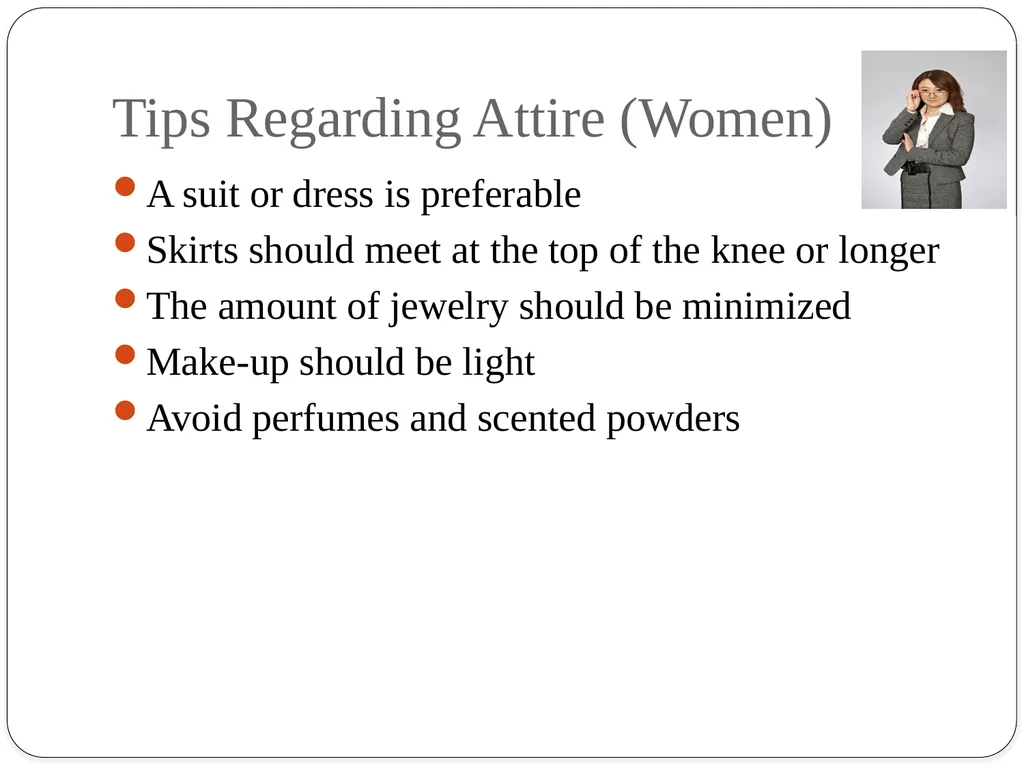
Tips Regarding Attire (Women) A suit or dress is preferable
Skirts should meet at the top of the knee or longer
The amount of jewelry should be minimized
Make-up should be light
Avoid perfumes and scented powders<br>
Skirts should meet at the top of the knee or longer
The amount of jewelry should be minimized
Make-up should be light
Avoid perfumes and scented powders<br>
46
Stylish Look, But Not For An Interview<br>
47
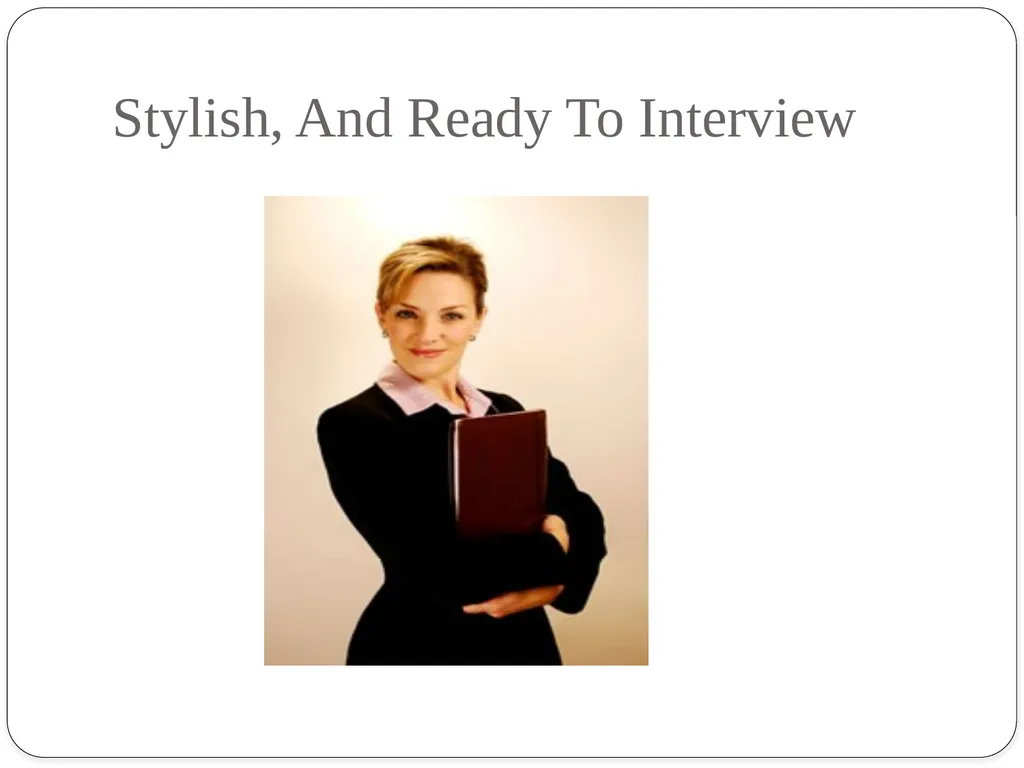
Stylish, And Ready To Interview<br>
48
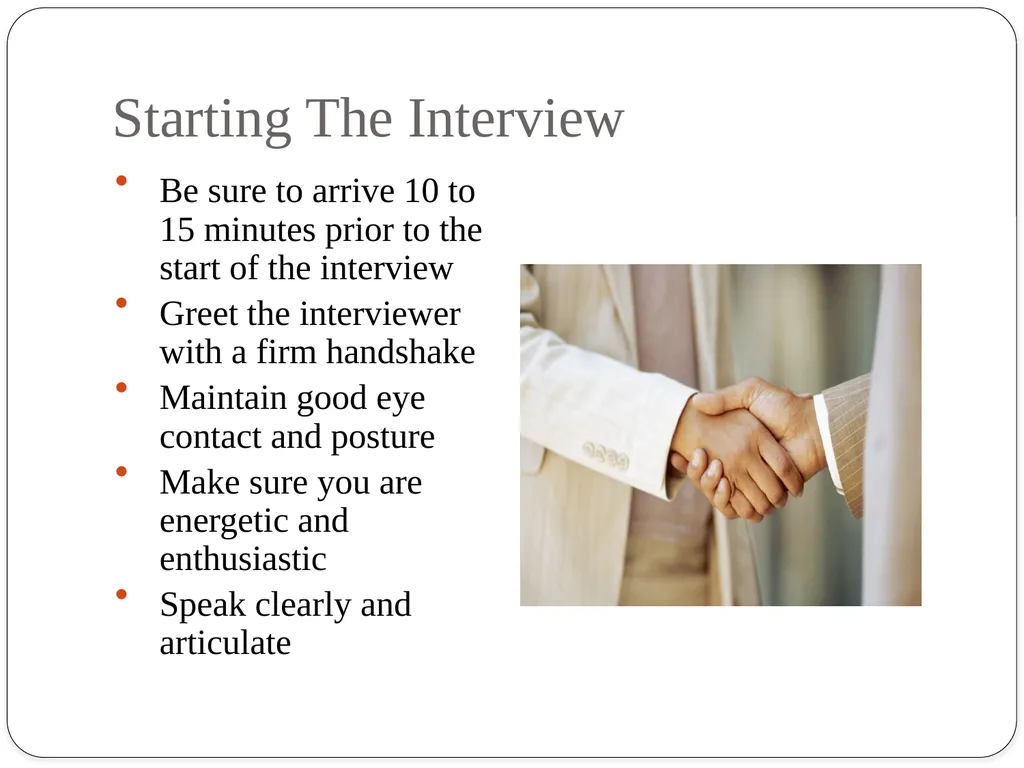
Starting The Interview Be sure to arrive 10 to 15 minutes prior to the start of the interview
Greet the interviewer with a firm handshake
Maintain good eye contact and posture
Make sure you are energetic and enthusiastic
Speak clearly and articulate<br>
Greet the interviewer with a firm handshake
Maintain good eye contact and posture
Make sure you are energetic and enthusiastic
Speak clearly and articulate<br>
49
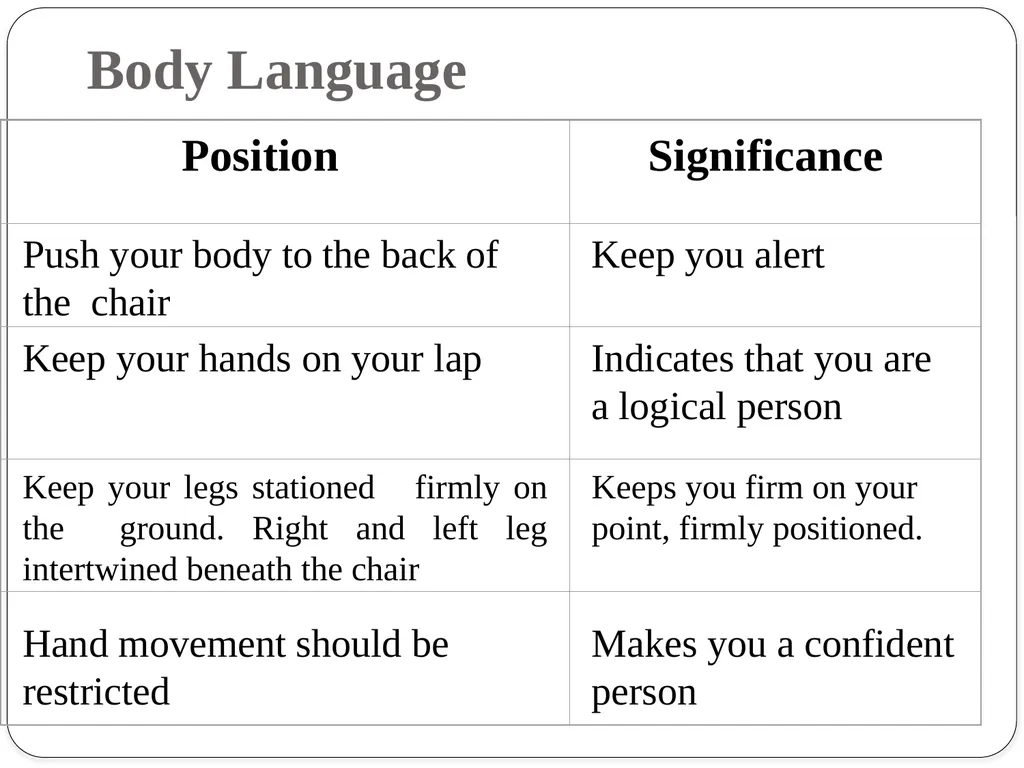
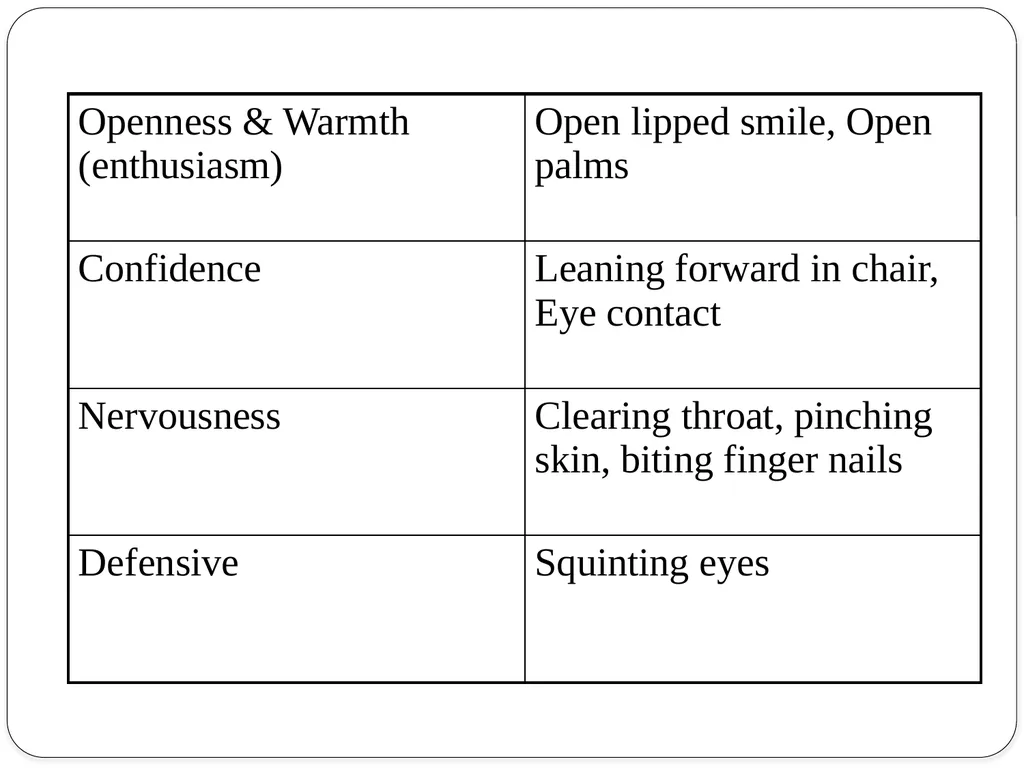
Body Language<br>
50
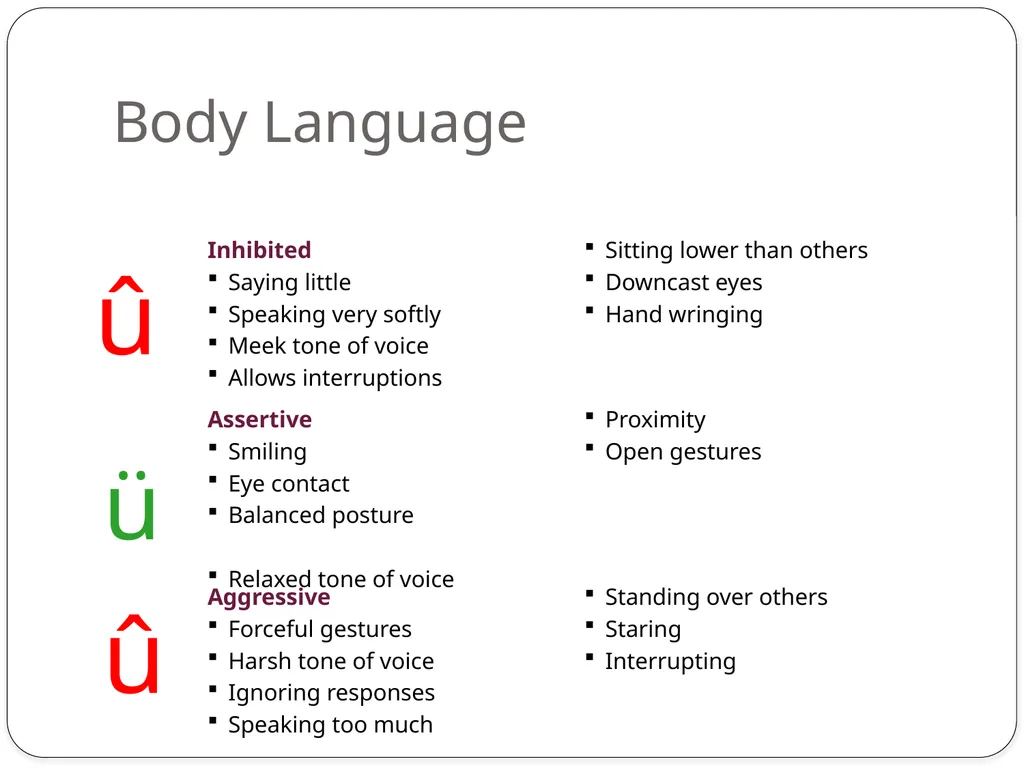
Body Language Inhibited
Saying little
Speaking very softly
Meek tone of voice
Allows interruptions
Sitting lower than others
Downcast eyes
Hand wringing Assertive
Smiling
Eye contact
Balanced posture
Relaxed tone of voice
Proximity
Open gestures Aggressive
Forceful gestures
Harsh tone of voice
Ignoring responses
Speaking too much
Standing over others
Staring
Interrupting û ü û<br>
Saying little
Speaking very softly
Meek tone of voice
Allows interruptions
Sitting lower than others
Downcast eyes
Hand wringing Assertive
Smiling
Eye contact
Balanced posture
Relaxed tone of voice
Proximity
Open gestures Aggressive
Forceful gestures
Harsh tone of voice
Ignoring responses
Speaking too much
Standing over others
Staring
Interrupting û ü û<br>
51
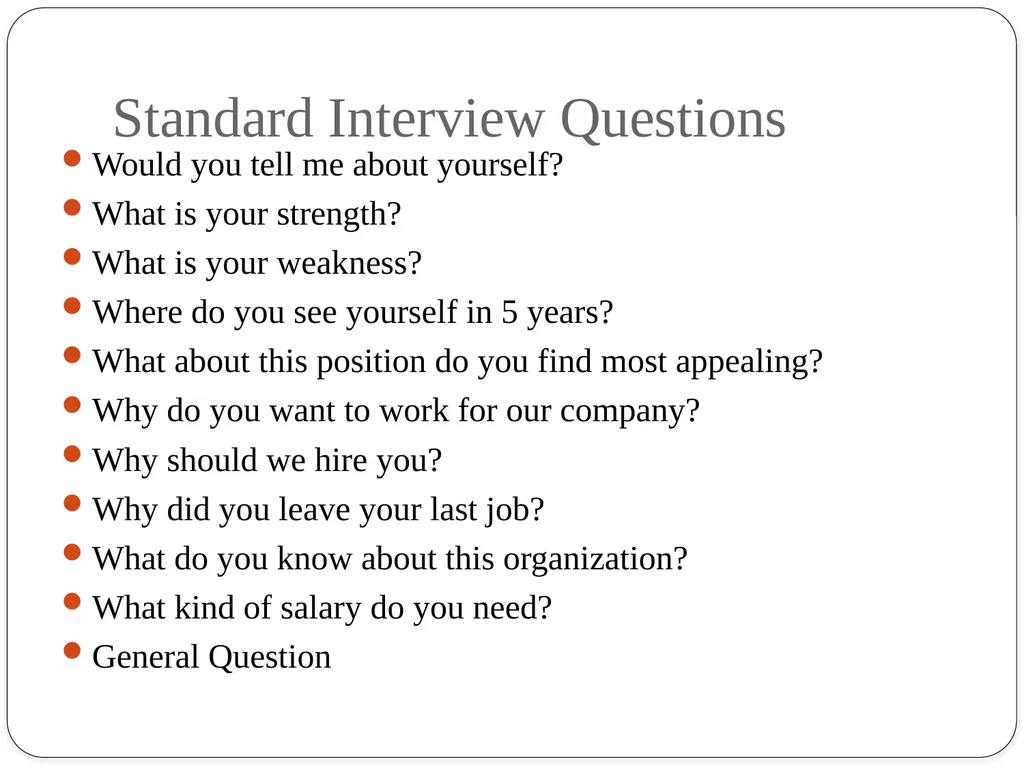
Standard Interview Questions Would you tell me about yourself?
What is your strength?
What is your weakness?
Where do you see yourself in 5 years?
What about this position do you find most appealing?
Why do you want to work for our company?
Why should we hire you?
Why did you leave your last job?
What do you know about this organization?
What kind of salary do you need?
General Question<br>
What is your strength?
What is your weakness?
Where do you see yourself in 5 years?
What about this position do you find most appealing?
Why do you want to work for our company?
Why should we hire you?
Why did you leave your last job?
What do you know about this organization?
What kind of salary do you need?
General Question<br>
52
Types of Questions Motivational Questions
Technical Questions
Competency Questions<br>
Technical Questions
Competency Questions<br>
53
Motivational Questions Designed to test your motivation for the job
and the organisation
Why do you want to work here?
How much do you know about our organisation?
Where do you see yourself in 5/10 years time?<br>
and the organisation
Why do you want to work here?
How much do you know about our organisation?
Where do you see yourself in 5/10 years time?<br>
54
Technical Questions These relate to your ability to use the technology you have learnt from your course/work experience
“What systems and software are you competent in?”
“What do you know about working in a photographic laboratory?”
“What experience do you have of using the following… ?”<br>
“What systems and software are you competent in?”
“What do you know about working in a photographic laboratory?”
“What experience do you have of using the following… ?”<br>
55
Competency Questions Questions based on the general competencies all employers expect from graduates (team skills, communication, problem solving etc..)
eg “Can you tell us about a time when you...worked in a team/dealt with a difficult situation?”<br>
eg “Can you tell us about a time when you...worked in a team/dealt with a difficult situation?”<br>
56
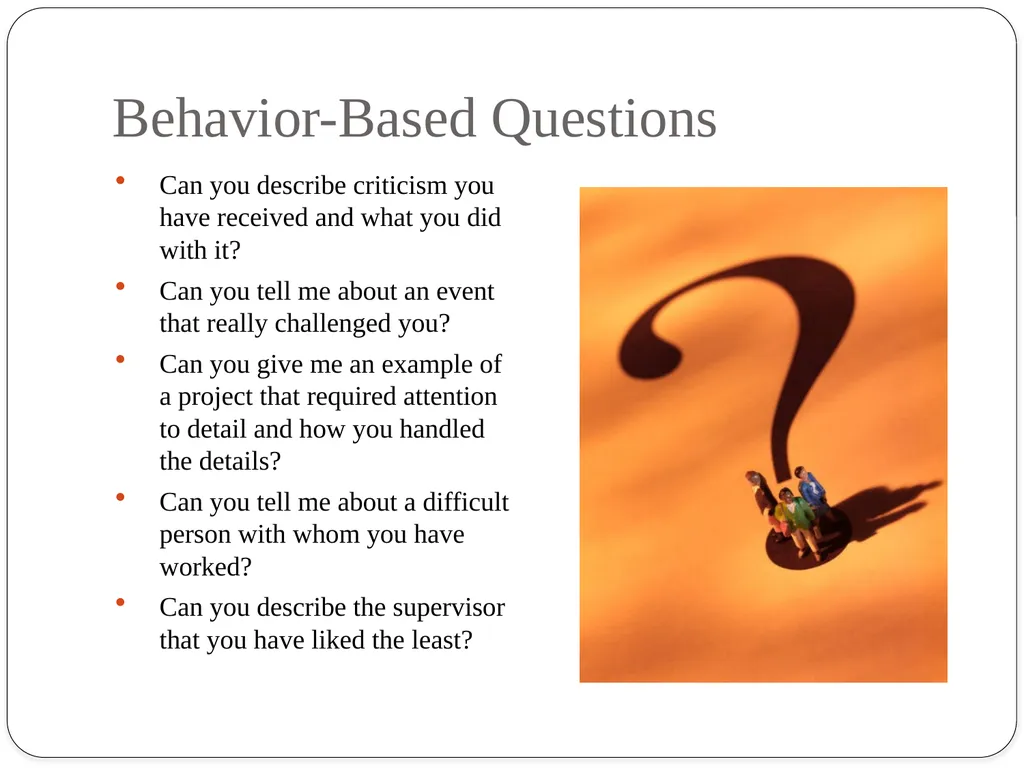
Behavior-Based Questions Can you describe criticism you have received and what you did with it?
Can you tell me about an event that really challenged you?
Can you give me an example of a project that required attention to detail and how you handled the details?
Can you tell me about a difficult person with whom you have worked?
Can you describe the supervisor that you have liked the least?<br>
Can you tell me about an event that really challenged you?
Can you give me an example of a project that required attention to detail and how you handled the details?
Can you tell me about a difficult person with whom you have worked?
Can you describe the supervisor that you have liked the least?<br>
57
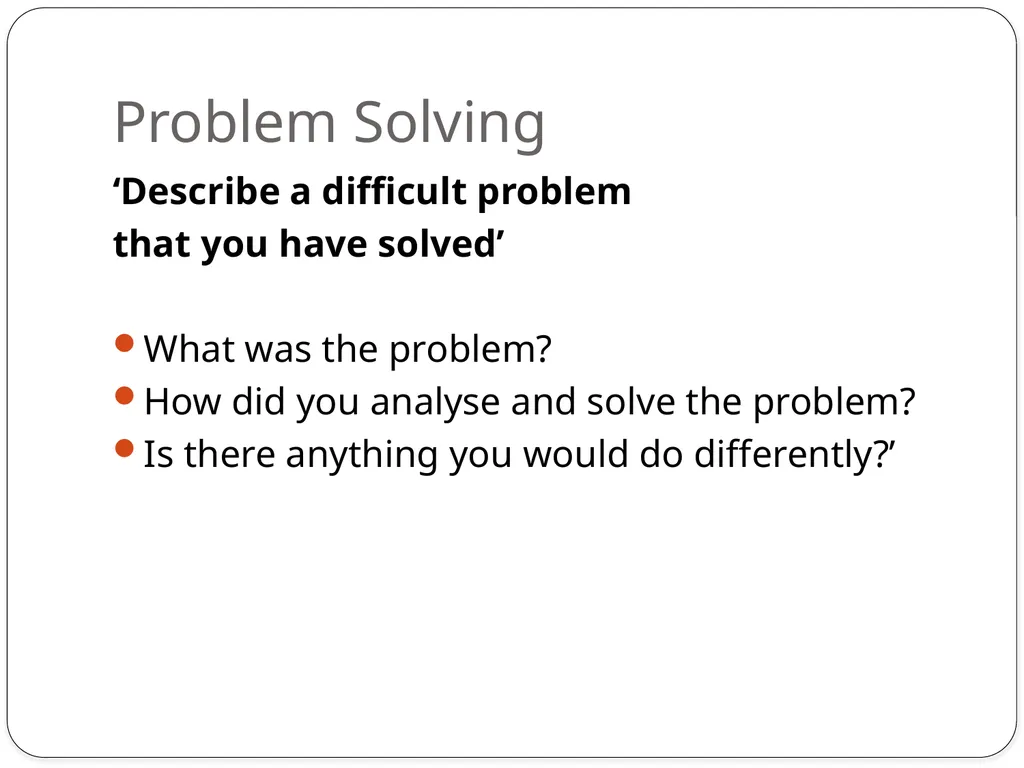
Problem Solving ‘Describe a difficult problem
that you have solved’
What was the problem?
How did you analyse and solve the problem?
Is there anything you would do differently?’<br>
that you have solved’
What was the problem?
How did you analyse and solve the problem?
Is there anything you would do differently?’<br>
58
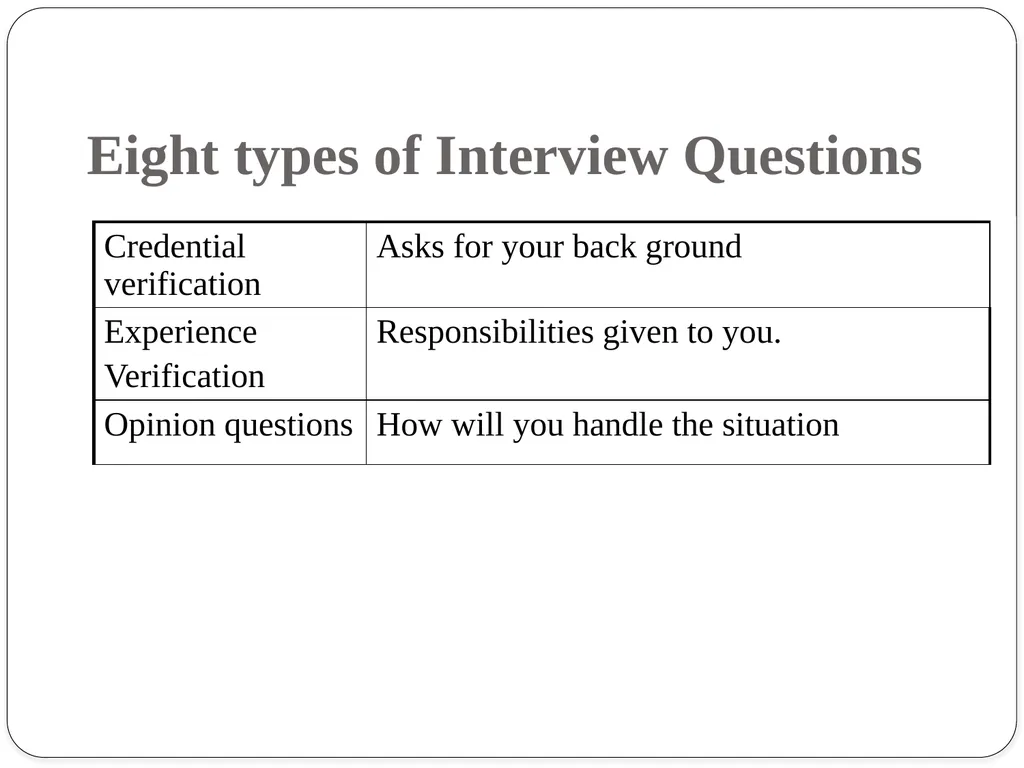
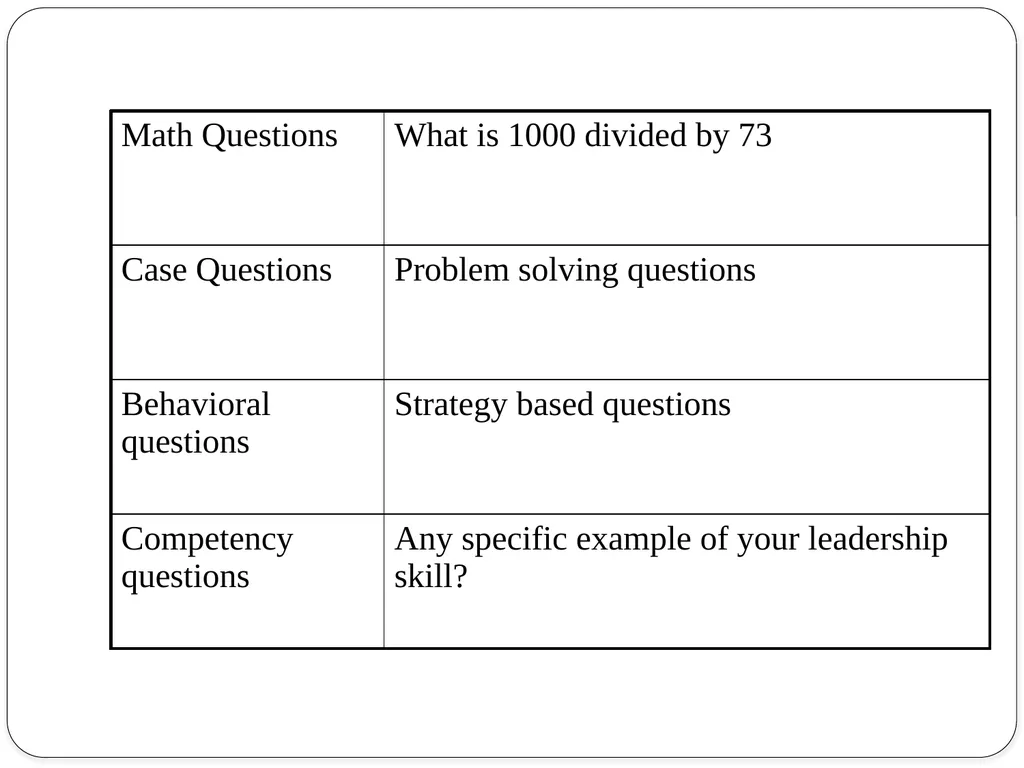
Eight types of Interview Questions<br>
59
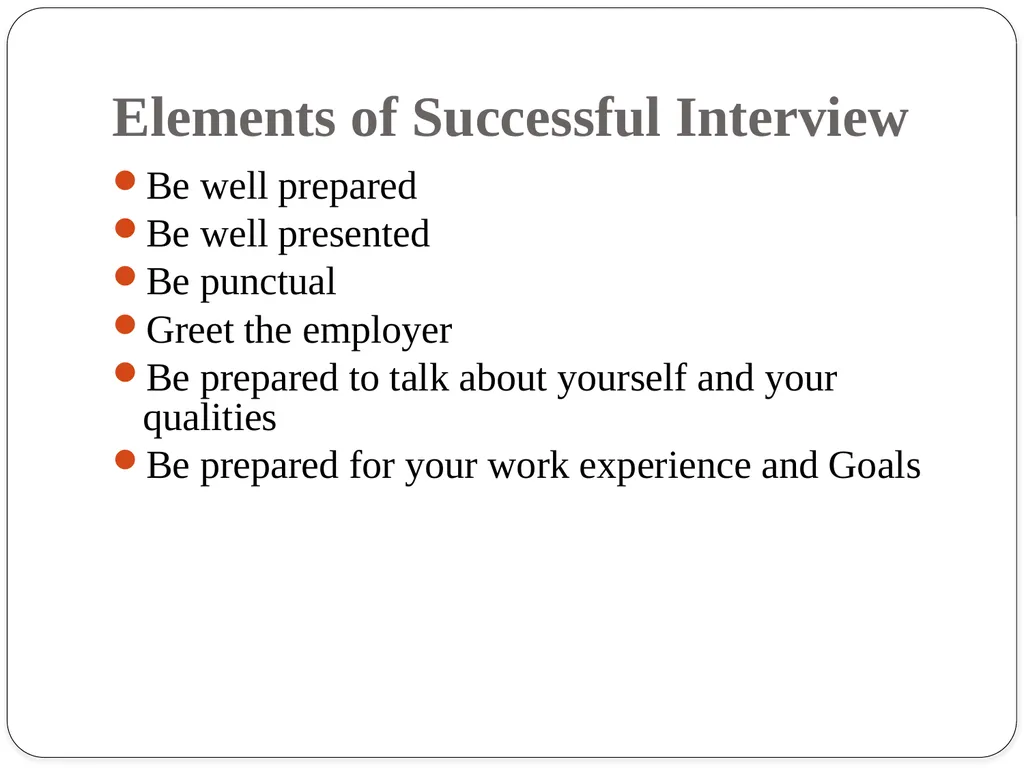
Elements of Successful Interview Be well prepared
Be well presented
Be punctual
Greet the employer
Be prepared to talk about yourself and your qualities
Be prepared for your work experience and Goals<br>
Be well presented
Be punctual
Greet the employer
Be prepared to talk about yourself and your qualities
Be prepared for your work experience and Goals<br>
60
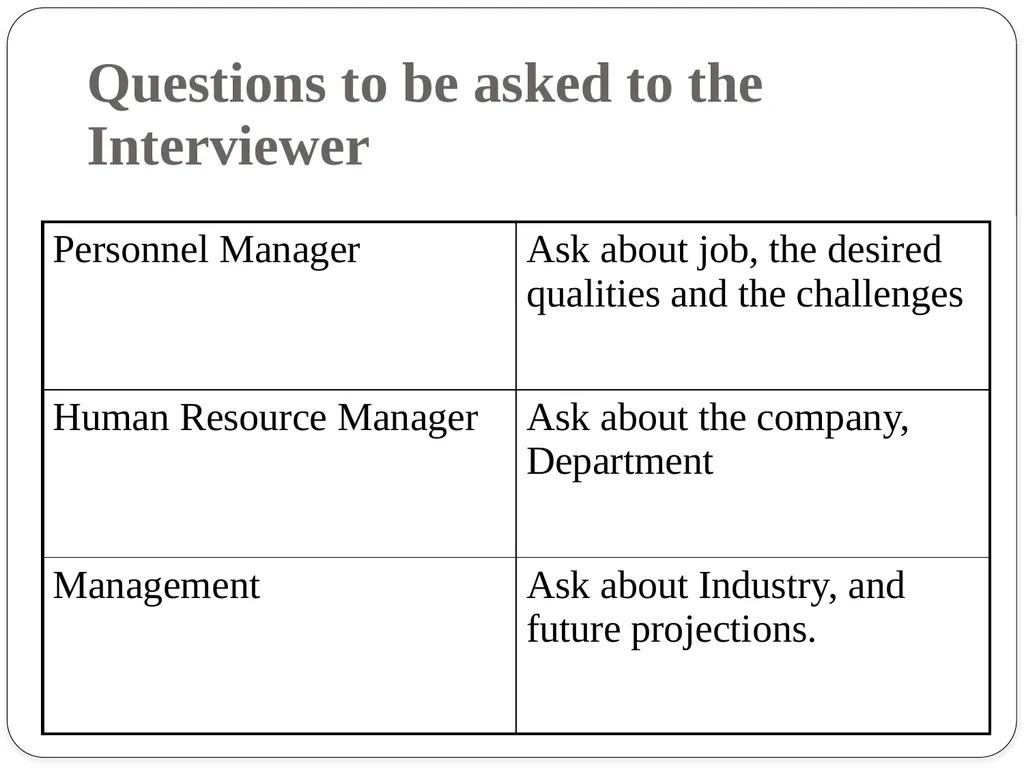
Questions to be asked to the Interviewer<br>
61
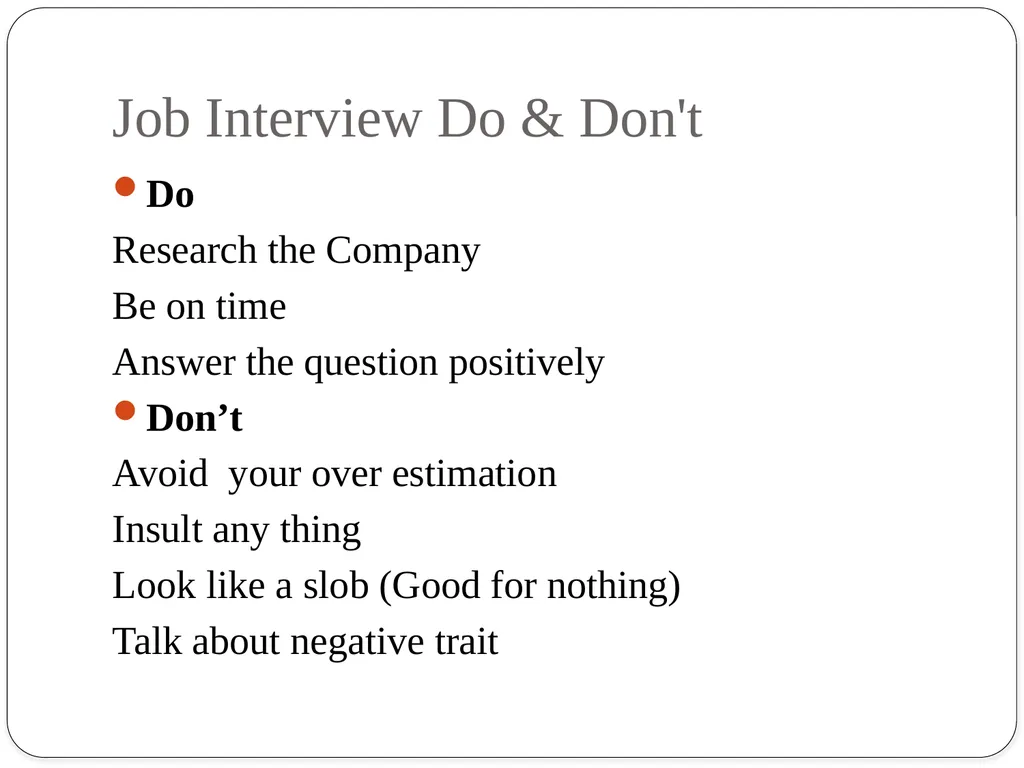
Job Interview Do & Don't Do
Research the Company
Be on time
Answer the question positively
Don’t
Avoid your over estimation
Insult any thing
Look like a slob (Good for nothing)
Talk about negative trait<br>
Research the Company
Be on time
Answer the question positively
Don’t
Avoid your over estimation
Insult any thing
Look like a slob (Good for nothing)
Talk about negative trait<br>
62
Thank You<br>
63
Session open for discussion<br>