
Intimate Partner Violence: Understanding the
TD
Published · 29 slides · 0 views
1 / 1


Description
Intimate Partner Violence: Understanding the Batterer and the impact on families Prepared by: Darlene Thomas M.S.S.W. Executive Director GreenHouse17 Technology Facilitated Gender Based Violence Sextortion (blackmail by threatening suxual
Related Topics
Share
Embed code
Download this presentation From Below
"Intimate Partner Violence: Understanding the" is the property of its rightful owner. Permission is granted to download and print the materials on this website for personal, non-commercial use only, and to display it on your personal computer provided you do not modify the materials and that you retain all copyright notices contained in the materials. By downloading content from our website, you accept the terms of this agreement.
Presentation Transcript
01
Intimate Partner Violence: Understanding the Batterer and the impact on families Prepared by:
Darlene Thomas M.S.S.W.
Executive Director
GreenHouse17<br>
Darlene Thomas M.S.S.W.
Executive Director
GreenHouse17<br>
02
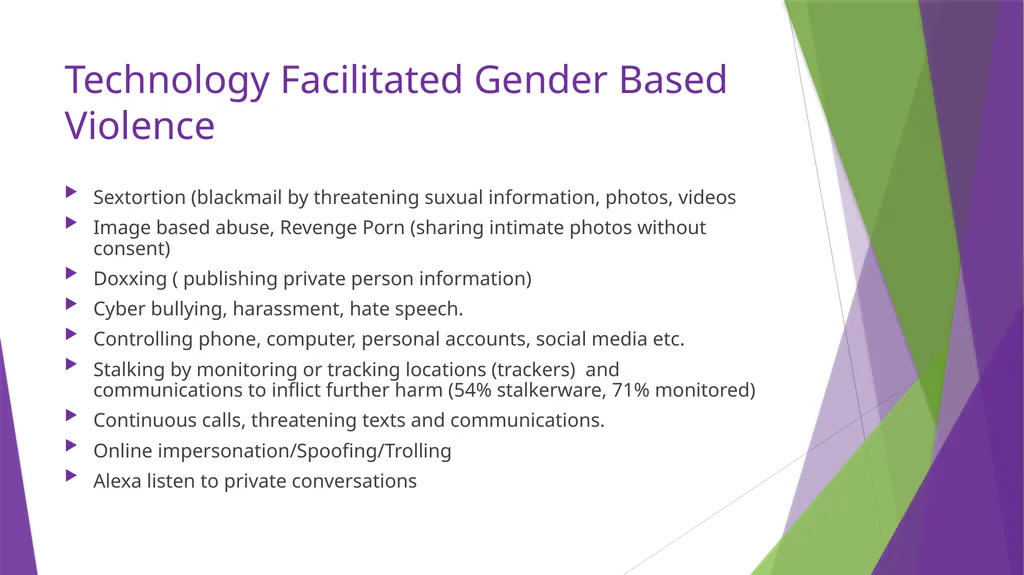
Technology Facilitated Gender Based Violence Sextortion (blackmail by threatening suxual information, photos, videos
Image based abuse, Revenge Porn (sharing intimate photos without consent)
Doxxing ( publishing private person information)
Cyber bullying, harassment, hate speech.
Controlling phone, computer, personal accounts, social media etc.
Stalking by monitoring or tracking locations (trackers) and communications to inflict further harm (54% stalkerware, 71% monitored)
Continuous calls, threatening texts and communications.
Online impersonation/Spoofing/Trolling
Alexa listen to private conversations<br>
Image based abuse, Revenge Porn (sharing intimate photos without consent)
Doxxing ( publishing private person information)
Cyber bullying, harassment, hate speech.
Controlling phone, computer, personal accounts, social media etc.
Stalking by monitoring or tracking locations (trackers) and communications to inflict further harm (54% stalkerware, 71% monitored)
Continuous calls, threatening texts and communications.
Online impersonation/Spoofing/Trolling
Alexa listen to private conversations<br>
03
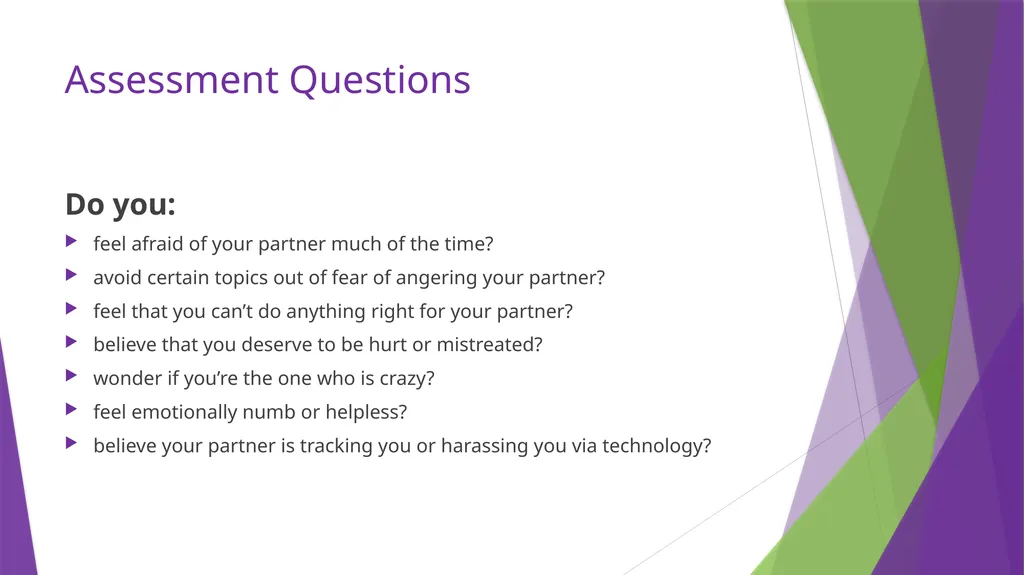
Assessment Questions Do you:
feel afraid of your partner much of the time?
avoid certain topics out of fear of angering your partner?
feel that you can’t do anything right for your partner?
believe that you deserve to be hurt or mistreated?
wonder if you’re the one who is crazy?
feel emotionally numb or helpless?
believe your partner is tracking you or harassing you via technology?<br>
feel afraid of your partner much of the time?
avoid certain topics out of fear of angering your partner?
feel that you can’t do anything right for your partner?
believe that you deserve to be hurt or mistreated?
wonder if you’re the one who is crazy?
feel emotionally numb or helpless?
believe your partner is tracking you or harassing you via technology?<br>
04
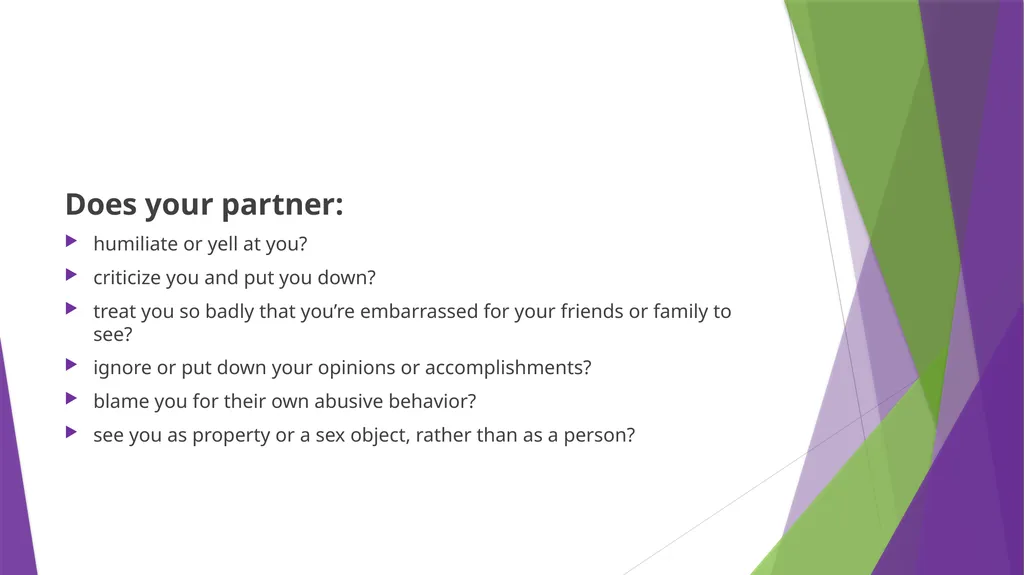
Does your partner:
humiliate or yell at you?
criticize you and put you down?
treat you so badly that you’re embarrassed for your friends or family to see?
ignore or put down your opinions or accomplishments?
blame you for their own abusive behavior?
see you as property or a sex object, rather than as a person?<br>
humiliate or yell at you?
criticize you and put you down?
treat you so badly that you’re embarrassed for your friends or family to see?
ignore or put down your opinions or accomplishments?
blame you for their own abusive behavior?
see you as property or a sex object, rather than as a person?<br>
05
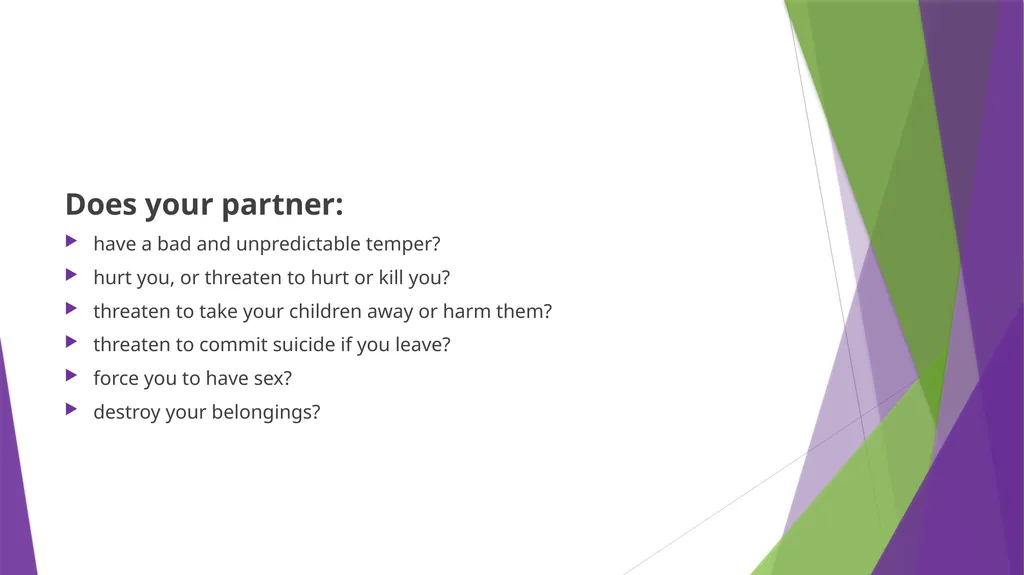
Does your partner:
have a bad and unpredictable temper?
hurt you, or threaten to hurt or kill you?
threaten to take your children away or harm them?
threaten to commit suicide if you leave?
force you to have sex?
destroy your belongings?<br>
have a bad and unpredictable temper?
hurt you, or threaten to hurt or kill you?
threaten to take your children away or harm them?
threaten to commit suicide if you leave?
force you to have sex?
destroy your belongings?<br>
06
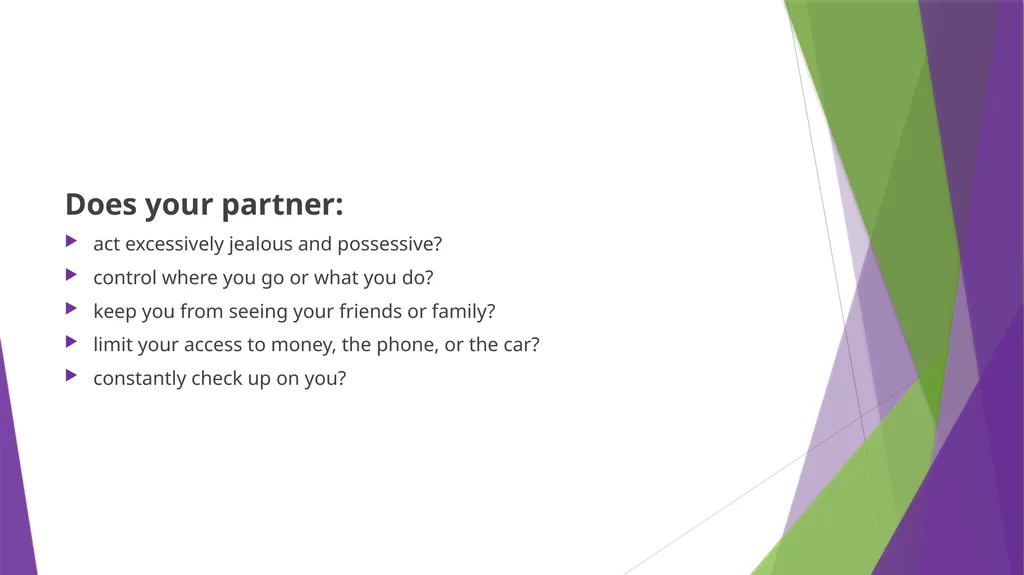
Does your partner:
act excessively jealous and possessive?
control where you go or what you do?
keep you from seeing your friends or family?
limit your access to money, the phone, or the car?
constantly check up on you?<br>
act excessively jealous and possessive?
control where you go or what you do?
keep you from seeing your friends or family?
limit your access to money, the phone, or the car?
constantly check up on you?<br>
07
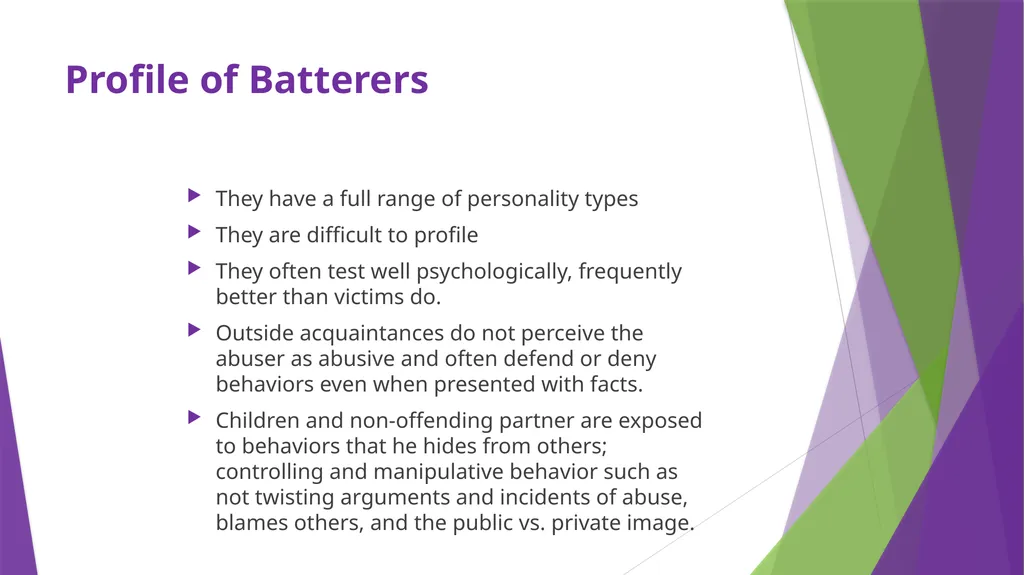
Profile of Batterers They have a full range of personality types
They are difficult to profile
They often test well psychologically, frequently better than victims do.
Outside acquaintances do not perceive the abuser as abusive and often defend or deny behaviors even when presented with facts.
Children and non-offending partner are exposed to behaviors that he hides from others; controlling and manipulative behavior such as not twisting arguments and incidents of abuse, blames others, and the public vs. private image.<br>
They are difficult to profile
They often test well psychologically, frequently better than victims do.
Outside acquaintances do not perceive the abuser as abusive and often defend or deny behaviors even when presented with facts.
Children and non-offending partner are exposed to behaviors that he hides from others; controlling and manipulative behavior such as not twisting arguments and incidents of abuse, blames others, and the public vs. private image.<br>
08
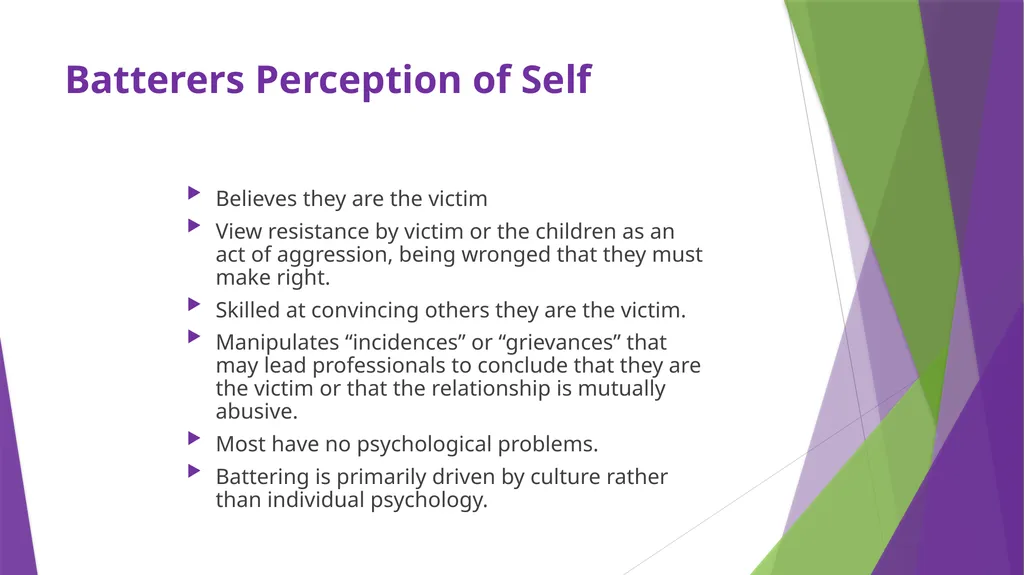
Batterers Perception of Self Believes they are the victim
View resistance by victim or the children as an act of aggression, being wronged that they must make right.
Skilled at convincing others they are the victim.
Manipulates “incidences” or “grievances” that may lead professionals to conclude that they are the victim or that the relationship is mutually abusive.
Most have no psychological problems.
Battering is primarily driven by culture rather than individual psychology.<br>
View resistance by victim or the children as an act of aggression, being wronged that they must make right.
Skilled at convincing others they are the victim.
Manipulates “incidences” or “grievances” that may lead professionals to conclude that they are the victim or that the relationship is mutually abusive.
Most have no psychological problems.
Battering is primarily driven by culture rather than individual psychology.<br>
09
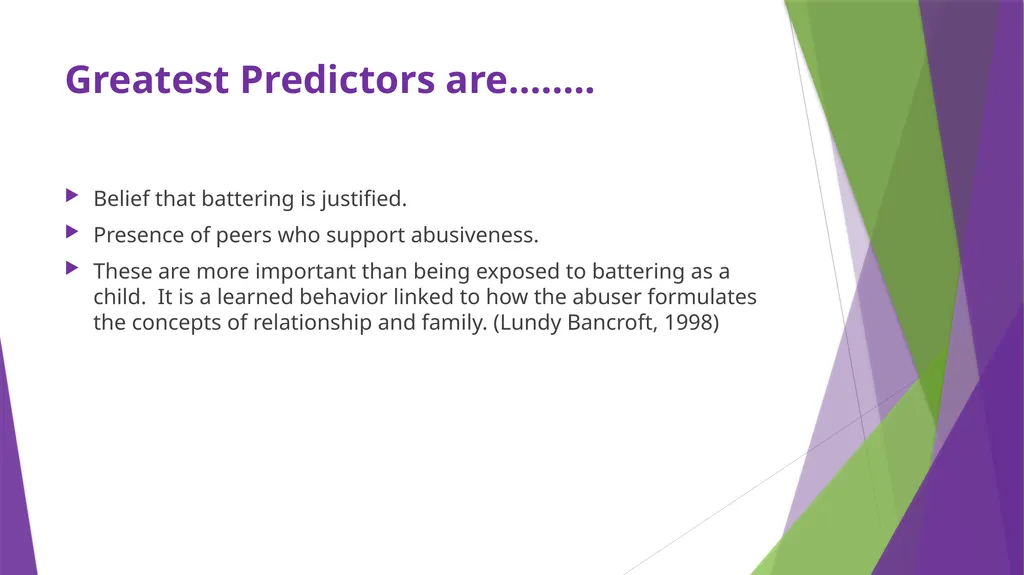
Greatest Predictors are…….. Belief that battering is justified.
Presence of peers who support abusiveness.
These are more important than being exposed to battering as a child. It is a learned behavior linked to how the abuser formulates the concepts of relationship and family. (Lundy Bancroft, 1998)<br>
Presence of peers who support abusiveness.
These are more important than being exposed to battering as a child. It is a learned behavior linked to how the abuser formulates the concepts of relationship and family. (Lundy Bancroft, 1998)<br>
10
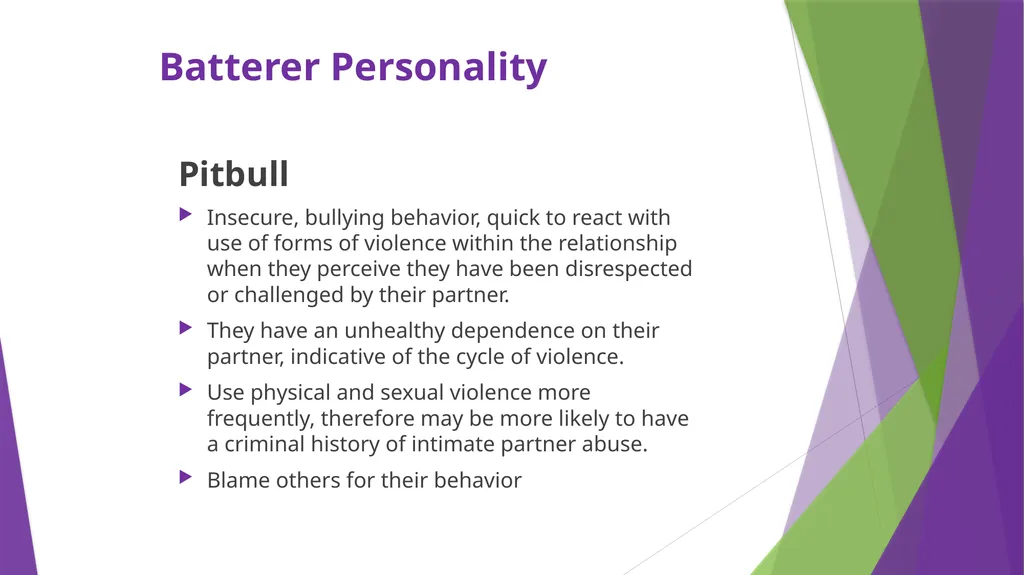
Batterer Personality Pitbull
Insecure, bullying behavior, quick to react with use of forms of violence within the relationship when they perceive they have been disrespected or challenged by their partner.
They have an unhealthy dependence on their partner, indicative of the cycle of violence.
Use physical and sexual violence more frequently, therefore may be more likely to have a criminal history of intimate partner abuse.
Blame others for their behavior<br>
Insecure, bullying behavior, quick to react with use of forms of violence within the relationship when they perceive they have been disrespected or challenged by their partner.
They have an unhealthy dependence on their partner, indicative of the cycle of violence.
Use physical and sexual violence more frequently, therefore may be more likely to have a criminal history of intimate partner abuse.
Blame others for their behavior<br>
11
Cobra
Methodical and Purposeful in their use of violence
Perfectionistic
May have been victimized as children
Use of tactics to control are a natural part of life.
Jacobson and Gottman(1998)<br>
Methodical and Purposeful in their use of violence
Perfectionistic
May have been victimized as children
Use of tactics to control are a natural part of life.
Jacobson and Gottman(1998)<br>
12
Three Subtypes of Batterers
Severity of Marital Violence, Generality of Violence, and Psychopathology/personality disorders. Family-only
Those who are generally only violent within the family, levels of physical violence maybe less than the other subtypes.
Often only directed toward the intimate partner.
May include abuse of the children (directly), children are exposed to the batterers behaviors when not directly the victim)
Demonstrate little psychopathology.
Difficult for victims to explain to others or feel they will be believed<br>
Those who are generally only violent within the family, levels of physical violence maybe less than the other subtypes.
Often only directed toward the intimate partner.
May include abuse of the children (directly), children are exposed to the batterers behaviors when not directly the victim)
Demonstrate little psychopathology.
Difficult for victims to explain to others or feel they will be believed<br>
13
Character pathology
Typically have depression
Emotional dependent on their partner
Volatile with emotional expressions
Often have issues with substance abuse/misuse
Generally Violent
Exhibit high rates of violence with partner
Usually have criminal history, past history of violent acts
Anti-social
Narcissism
May also have substance abuse issues<br>
Typically have depression
Emotional dependent on their partner
Volatile with emotional expressions
Often have issues with substance abuse/misuse
Generally Violent
Exhibit high rates of violence with partner
Usually have criminal history, past history of violent acts
Anti-social
Narcissism
May also have substance abuse issues<br>
14
Risks to Victims Post-Traumatic Stress Disorder/Hostage Syndrome
Fear
Intimidation
Isolation
Severe/serious injury
Loss of sense of self.
Sense of hopelessness
Fear of Loss of children (systemic or by batterer)
Death (intentionally or accidentally)<br>
Fear
Intimidation
Isolation
Severe/serious injury
Loss of sense of self.
Sense of hopelessness
Fear of Loss of children (systemic or by batterer)
Death (intentionally or accidentally)<br>
15
Trauma Symptoms Post-traumatic Stress Disorder/Hostage Syndrome
Victims of DV and Rape suffer from the same syndrome as survivors of war.
Helplessness and isolation are the core experiences of psychological trauma.
Traumatic reactions occur when neither resistance nor escape is possible. Stripped of ordinary human adaptations that give people a sense of control, connection, and meaning.<br>
Victims of DV and Rape suffer from the same syndrome as survivors of war.
Helplessness and isolation are the core experiences of psychological trauma.
Traumatic reactions occur when neither resistance nor escape is possible. Stripped of ordinary human adaptations that give people a sense of control, connection, and meaning.<br>
16
Destroys the sense of self.
Persons who have never experienced prolonged terror or trauma presume that they would show greater courage and resistance than the victim in similar circumstances.
Therefore, the common tendency is to account for the victim’s behavior by seeking flaws in her personality or moral character.
Trauma and Recovery, by Judith Lewis Herman, M.D.<br>
Persons who have never experienced prolonged terror or trauma presume that they would show greater courage and resistance than the victim in similar circumstances.
Therefore, the common tendency is to account for the victim’s behavior by seeking flaws in her personality or moral character.
Trauma and Recovery, by Judith Lewis Herman, M.D.<br>
17
Children Exposed to Batterers
Research is increasingly clear that children are not passive onlookers, they actively seek to make meaning of their experiences and navigate the situations which confront them. Laing, (2000) Violent and Non-Violence Exposures
Violence during pregnancy
Injury from attempting to intervene
Witnessing injuries, hearing incidents of violence
Isolation/Family Secret
Emotional, verbal abuse
Economic Depravation<br>
Violence during pregnancy
Injury from attempting to intervene
Witnessing injuries, hearing incidents of violence
Isolation/Family Secret
Emotional, verbal abuse
Economic Depravation<br>
18
Intervention effects (police, rushed upheavals, disruption in schooling, new environments, loss of pets, friends, toys etc.)
Younger children understand situations surrounding violence while older children demonstrate the context of intentionality, entitlement and control.
Report fear, helplessness, despair, self-blame and depression.
Report hiding, intervening, trying to sleep through and caring for younger siblings.
They report non-offending parent were able to assist and support them
Even after the non-offending parent separated, children were still exposed to abusive behaviors either directly or indirectly. New partners and/or move from periphery to the center of the abusive behaviors.<br>
Younger children understand situations surrounding violence while older children demonstrate the context of intentionality, entitlement and control.
Report fear, helplessness, despair, self-blame and depression.
Report hiding, intervening, trying to sleep through and caring for younger siblings.
They report non-offending parent were able to assist and support them
Even after the non-offending parent separated, children were still exposed to abusive behaviors either directly or indirectly. New partners and/or move from periphery to the center of the abusive behaviors.<br>
19
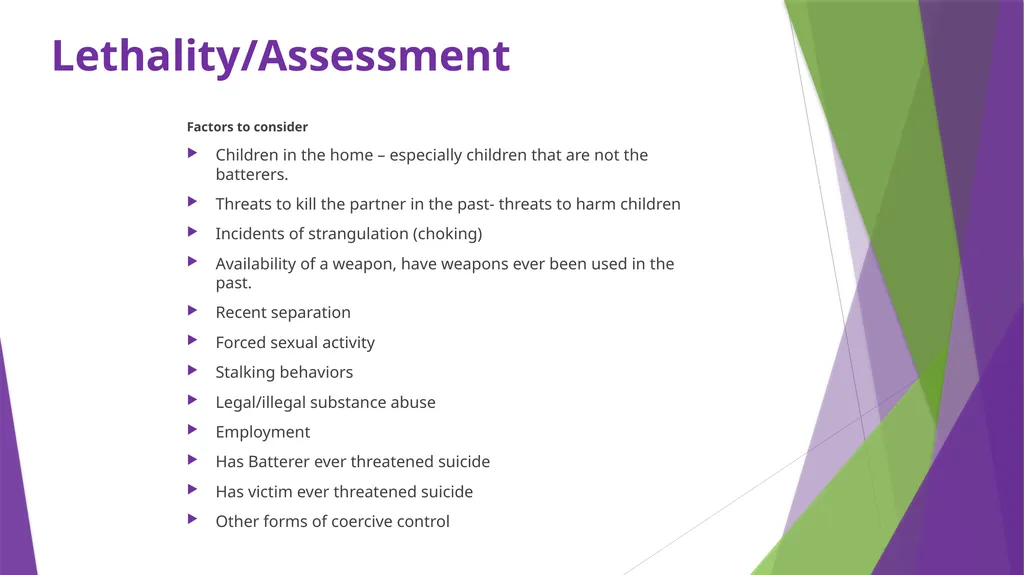
Lethality/Assessment Factors to consider
Children in the home – especially children that are not the batterers.
Threats to kill the partner in the past- threats to harm children
Incidents of strangulation (choking)
Availability of a weapon, have weapons ever been used in the past.
Recent separation
Forced sexual activity
Stalking behaviors
Legal/illegal substance abuse
Employment
Has Batterer ever threatened suicide
Has victim ever threatened suicide
Other forms of coercive control<br>
Children in the home – especially children that are not the batterers.
Threats to kill the partner in the past- threats to harm children
Incidents of strangulation (choking)
Availability of a weapon, have weapons ever been used in the past.
Recent separation
Forced sexual activity
Stalking behaviors
Legal/illegal substance abuse
Employment
Has Batterer ever threatened suicide
Has victim ever threatened suicide
Other forms of coercive control<br>
20
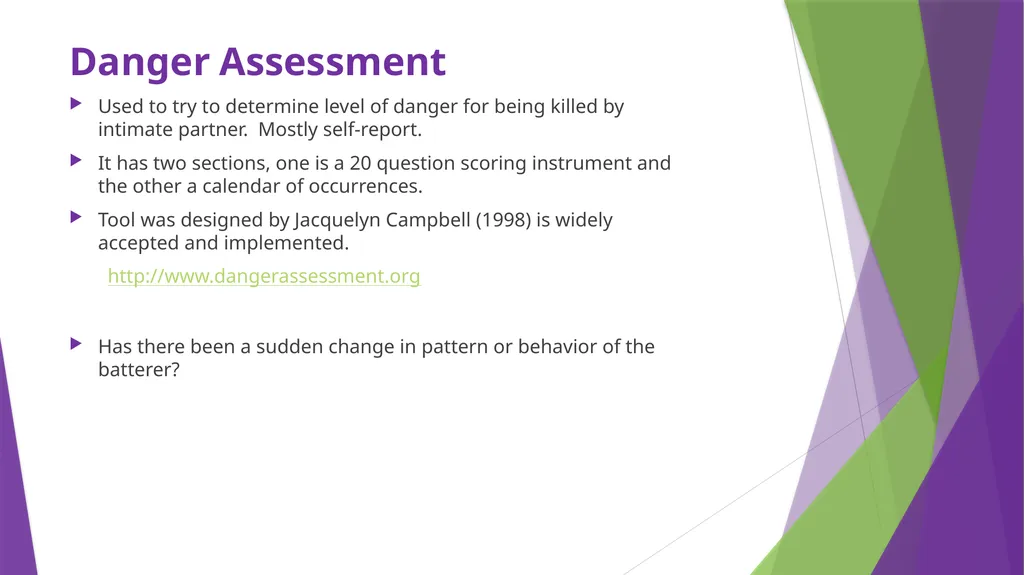
Danger Assessment
Used to try to determine level of danger for being killed by intimate partner. Mostly self-report.
It has two sections, one is a 20 question scoring instrument and the other a calendar of occurrences.
Tool was designed by Jacquelyn Campbell (1998) is widely accepted and implemented.
http://www.dangerassessment.org
Has there been a sudden change in pattern or behavior of the batterer?<br>
Used to try to determine level of danger for being killed by intimate partner. Mostly self-report.
It has two sections, one is a 20 question scoring instrument and the other a calendar of occurrences.
Tool was designed by Jacquelyn Campbell (1998) is widely accepted and implemented.
http://www.dangerassessment.org
Has there been a sudden change in pattern or behavior of the batterer?<br>
21
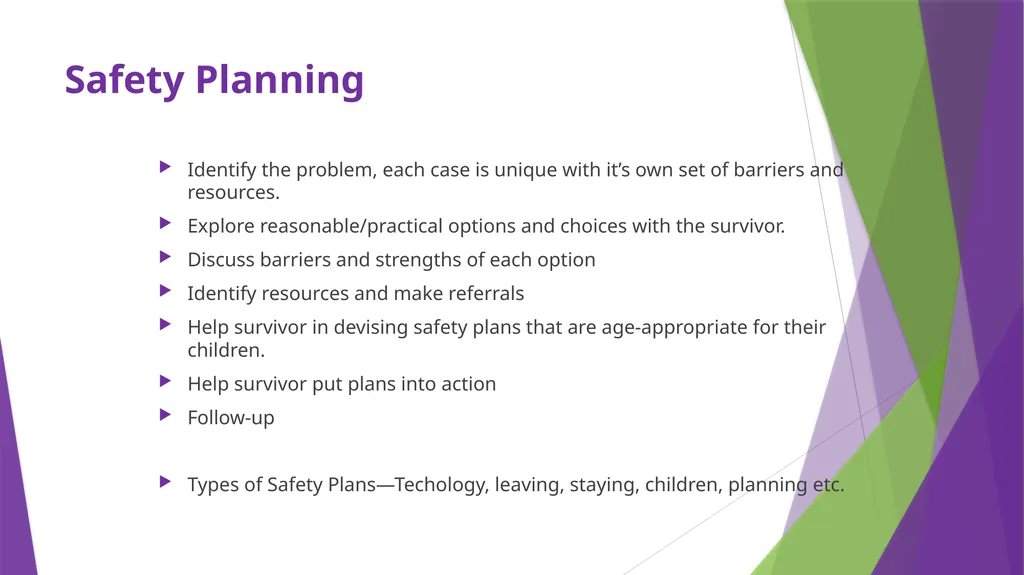
Safety Planning Identify the problem, each case is unique with it’s own set of barriers and resources.
Explore reasonable/practical options and choices with the survivor.
Discuss barriers and strengths of each option
Identify resources and make referrals
Help survivor in devising safety plans that are age-appropriate for their children.
Help survivor put plans into action
Follow-up
Types of Safety Plans—Techology, leaving, staying, children, planning etc.<br>
Explore reasonable/practical options and choices with the survivor.
Discuss barriers and strengths of each option
Identify resources and make referrals
Help survivor in devising safety plans that are age-appropriate for their children.
Help survivor put plans into action
Follow-up
Types of Safety Plans—Techology, leaving, staying, children, planning etc.<br>
22
Legal Considerations<br>
23
KRS 209A: Spousal abuse/neglect - major changes go into effect June 29, 2017
KRS 620: Child dependency/abuse/neglect
KRS 209: “Vulnerable” adult abuse/neglect/exploitation
KRS 202A/645: Duty to Warn (only applies to certain professionals)
Civil Protections-Interpersonal Protective Orders
Criminal options- typically assault, stalking, terroristic threatening, and harassment. Felonies and Misdemeanor in Domestic Violence.<br>
KRS 620: Child dependency/abuse/neglect
KRS 209: “Vulnerable” adult abuse/neglect/exploitation
KRS 202A/645: Duty to Warn (only applies to certain professionals)
Civil Protections-Interpersonal Protective Orders
Criminal options- typically assault, stalking, terroristic threatening, and harassment. Felonies and Misdemeanor in Domestic Violence.<br>
24
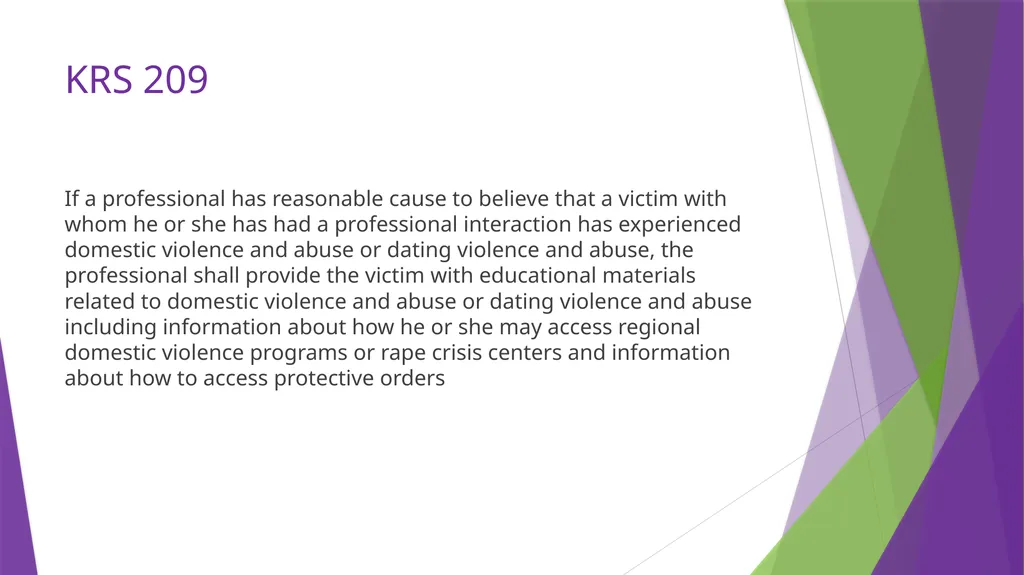
KRS 209 If a professional has reasonable cause to believe that a victim with whom he or she has had a professional interaction has experienced domestic violence and abuse or dating violence and abuse, the professional shall provide the victim with educational materials related to domestic violence and abuse or dating violence and abuse including information about how he or she may access regional domestic violence programs or rape crisis centers and information about how to access protective orders<br>
25
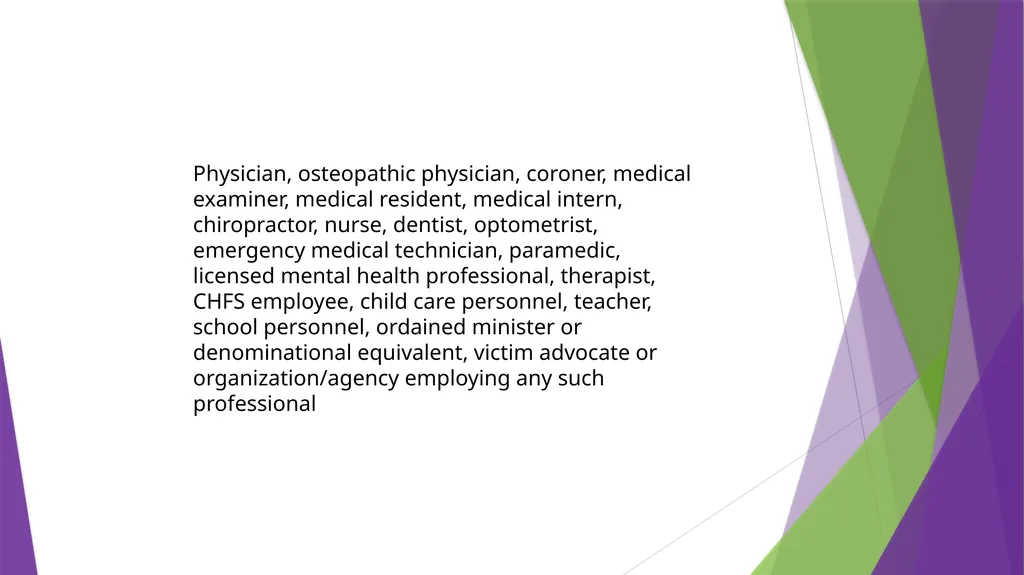
Physician, osteopathic physician, coroner, medical examiner, medical resident, medical intern, chiropractor, nurse, dentist, optometrist, emergency medical technician, paramedic, licensed mental health professional, therapist, CHFS employee, child care personnel, teacher, school personnel, ordained minister or denominational equivalent, victim advocate or organization/agency employing any such professional<br>
26
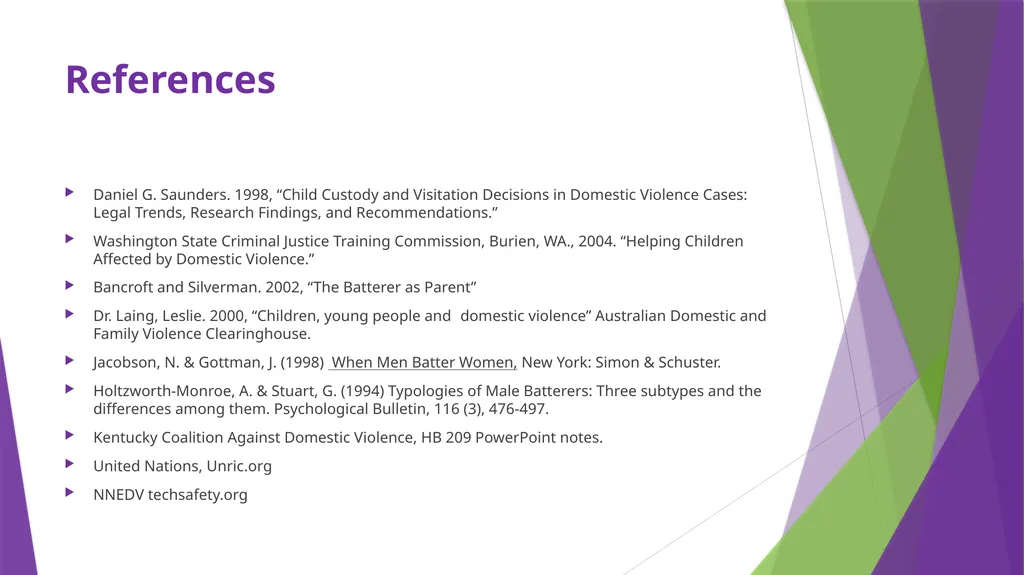
References Daniel G. Saunders. 1998, “Child Custody and Visitation Decisions in Domestic Violence Cases: Legal Trends, Research Findings, and Recommendations.”
Washington State Criminal Justice Training Commission, Burien, WA., 2004. “Helping Children Affected by Domestic Violence.”
Bancroft and Silverman. 2002, “The Batterer as Parent”
Dr. Laing, Leslie. 2000, “Children, young people and domestic violence” Australian Domestic and Family Violence Clearinghouse.
Jacobson, N. & Gottman, J. (1998) When Men Batter Women, New York: Simon & Schuster.
Holtzworth-Monroe, A. & Stuart, G. (1994) Typologies of Male Batterers: Three subtypes and the differences among them. Psychological Bulletin, 116 (3), 476-497.
Kentucky Coalition Against Domestic Violence, HB 209 PowerPoint notes.
United Nations, Unric.org
NNEDV techsafety.org<br>
Washington State Criminal Justice Training Commission, Burien, WA., 2004. “Helping Children Affected by Domestic Violence.”
Bancroft and Silverman. 2002, “The Batterer as Parent”
Dr. Laing, Leslie. 2000, “Children, young people and domestic violence” Australian Domestic and Family Violence Clearinghouse.
Jacobson, N. & Gottman, J. (1998) When Men Batter Women, New York: Simon & Schuster.
Holtzworth-Monroe, A. & Stuart, G. (1994) Typologies of Male Batterers: Three subtypes and the differences among them. Psychological Bulletin, 116 (3), 476-497.
Kentucky Coalition Against Domestic Violence, HB 209 PowerPoint notes.
United Nations, Unric.org
NNEDV techsafety.org<br>
27
Thank You
Darlene Thomas
dthomas@greenhouse17.org
859.519.1903
Crisis Support
800.544.2022
GreenHouse17.org
Follow us on Facebook, Twitter and Instagram<br>
Darlene Thomas
dthomas@greenhouse17.org
859.519.1903
Crisis Support
800.544.2022
GreenHouse17.org
Follow us on Facebook, Twitter and Instagram<br>