Intrinsic Material At a given temperature there is a certain concentration of electron-hole pairs ni. If a steady state carrier concentration is maintained, there must be recombination of EHPs at the same rate at which they are generated.
"Intrinsic Material At a given temperature there is" is the property of its rightful owner. Permission is granted to
download and print the materials on this website for personal, non-commercial use only, and to display it
on your personal computer provided you do not modify the materials and that you retain all copyright
notices contained in the materials. By downloading content from our website, you accept the terms of this
agreement.
Presentation Transcript
01
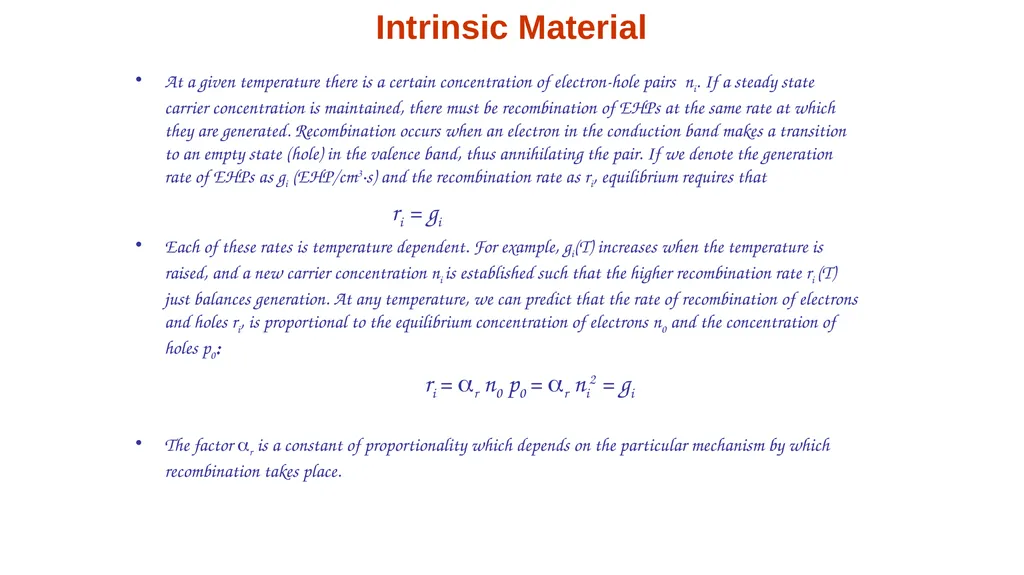
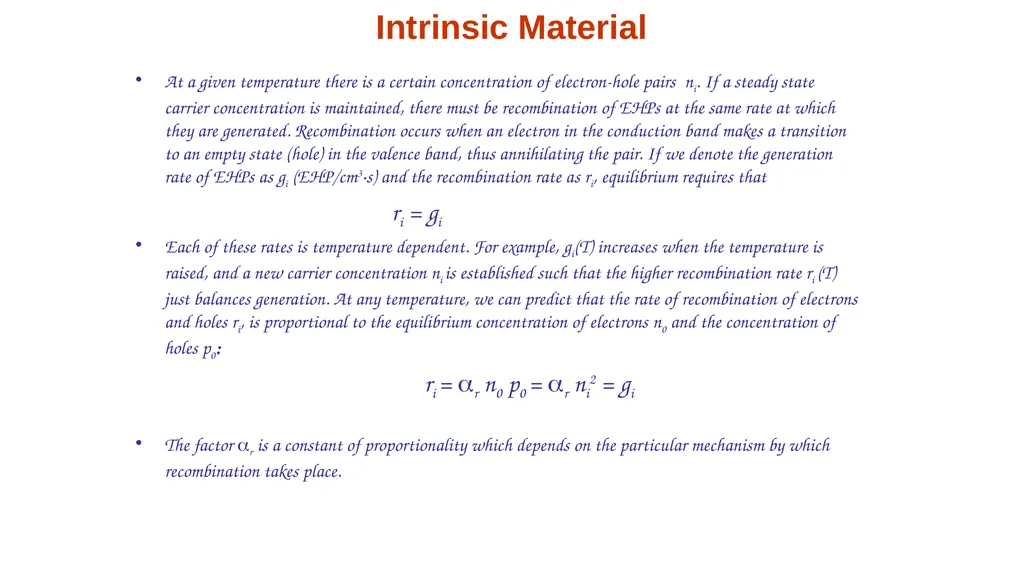
Intrinsic Material At a given temperature there is a certain concentration of electron-hole pairs ni. If a steady state carrier concentration is maintained, there must be recombination of EHPs at the same rate at which they are generated. Recombination occurs when an electron in the conduction band makes a transition to an empty state (hole) in the valence band, thus annihilating the pair. If we denote the generation rate of EHPs as gi (EHP/cm3·s) and the recombination rate as ri, equilibrium requires that
ri = gi
Each of these rates is temperature dependent. For example, gi(T) increases when the temperature is raised, and a new carrier concentration ni is established such that the higher recombination rate ri (T) just balances generation. At any temperature, we can predict that the rate of recombination of electrons and holes ri, is proportional to the equilibrium concentration of electrons n0 and the concentration of holes p0:
ri = r n0 p0 = r ni2 = gi
The factor r is a constant of proportionality which depends on the particular mechanism by which recombination takes place.<br>
02
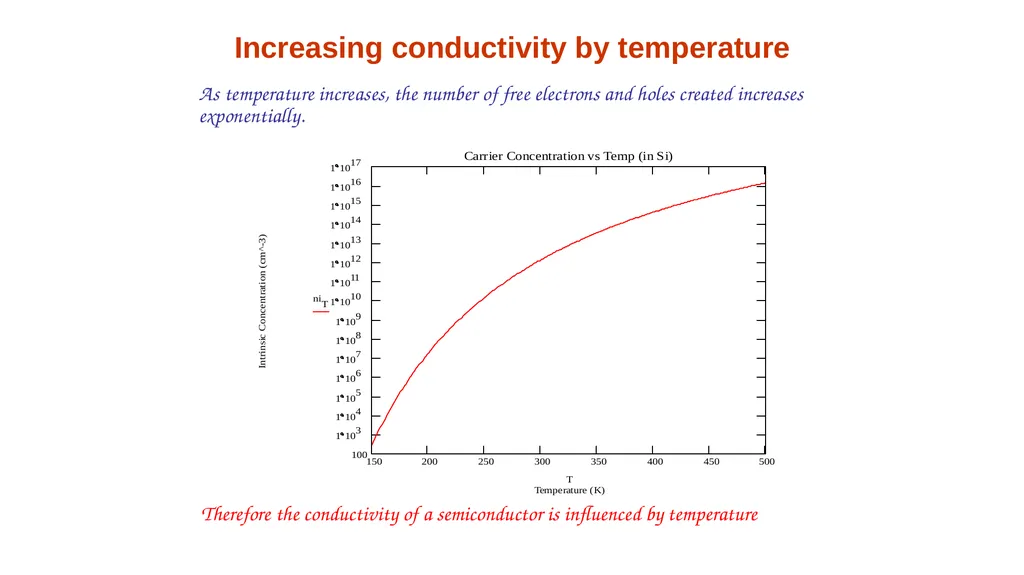
Increasing conductivity by temperature Therefore the conductivity of a semiconductor is influenced by temperature As temperature increases, the number of free electrons and holes created increases exponentially.<br>
03
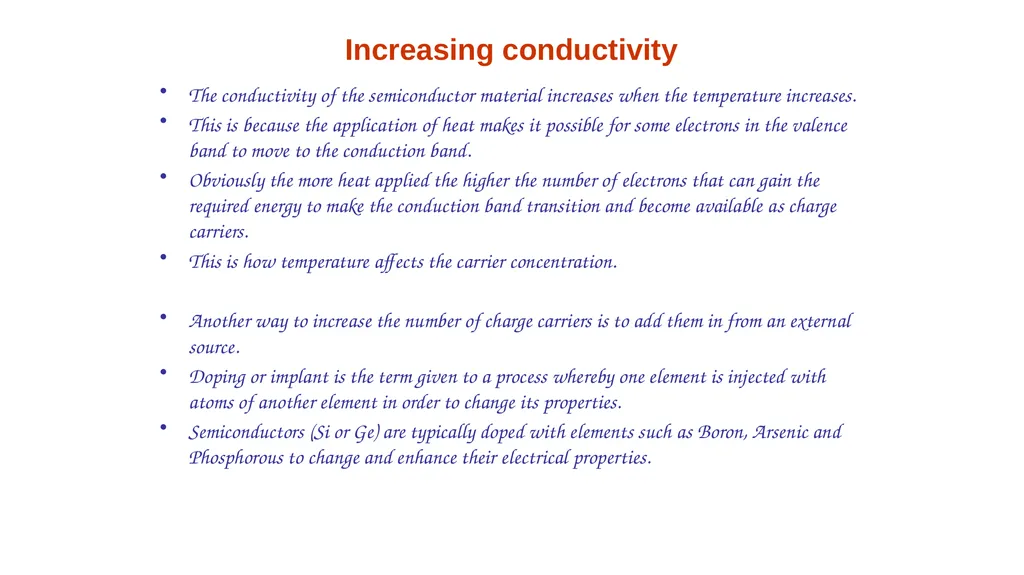
The conductivity of the semiconductor material increases when the temperature increases.
This is because the application of heat makes it possible for some electrons in the valence band to move to the conduction band.
Obviously the more heat applied the higher the number of electrons that can gain the required energy to make the conduction band transition and become available as charge carriers.
This is how temperature affects the carrier concentration.
Another way to increase the number of charge carriers is to add them in from an external source.
Doping or implant is the term given to a process whereby one element is injected with atoms of another element in order to change its properties.
Semiconductors (Si or Ge) are typically doped with elements such as Boron, Arsenic and Phosphorous to change and enhance their electrical properties. Increasing conductivity<br>
04
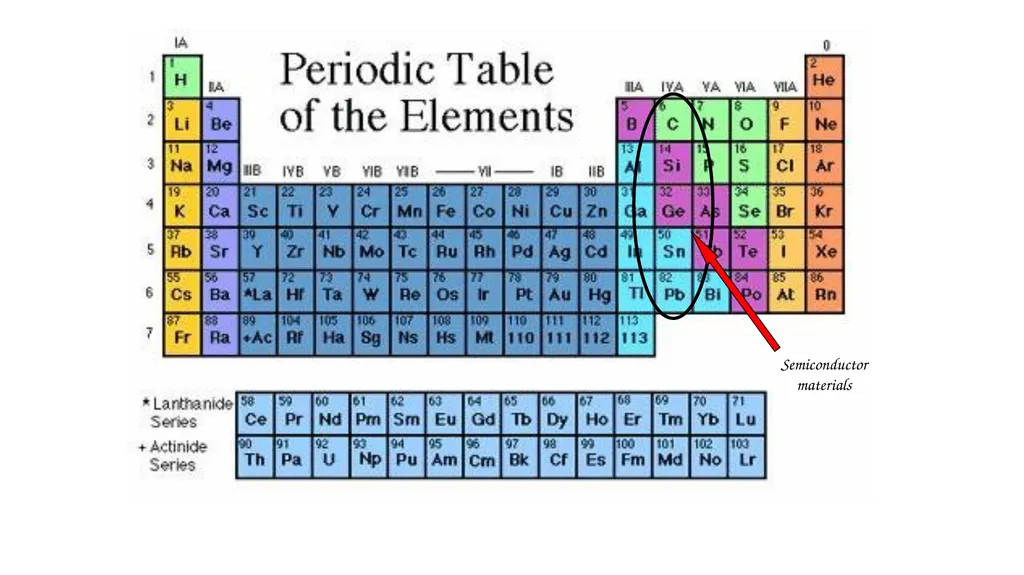
Semiconductor materials<br>
05
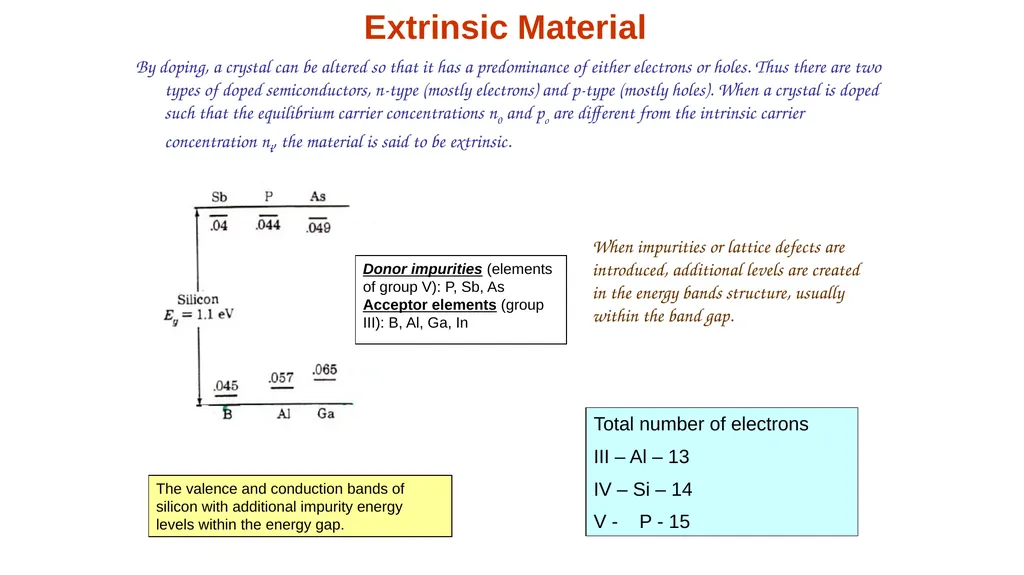
Extrinsic Material By doping, a crystal can be altered so that it has a predominance of either electrons or holes. Thus there are two types of doped semiconductors, n-type (mostly electrons) and p-type (mostly holes). When a crystal is doped such that the equilibrium carrier concentrations n0 and po are different from the intrinsic carrier concentration ni, the material is said to be extrinsic. Donor impurities (elements of group V): P, Sb, As
Acceptor elements (group III): B, Al, Ga, In The valence and conduction bands of silicon with additional impurity energy levels within the energy gap. When impurities or lattice defects are introduced, additional levels are created in the energy bands structure, usually within the band gap. Total number of electrons
III – Al – 13
IV – Si – 14
V - P - 15<br>
06
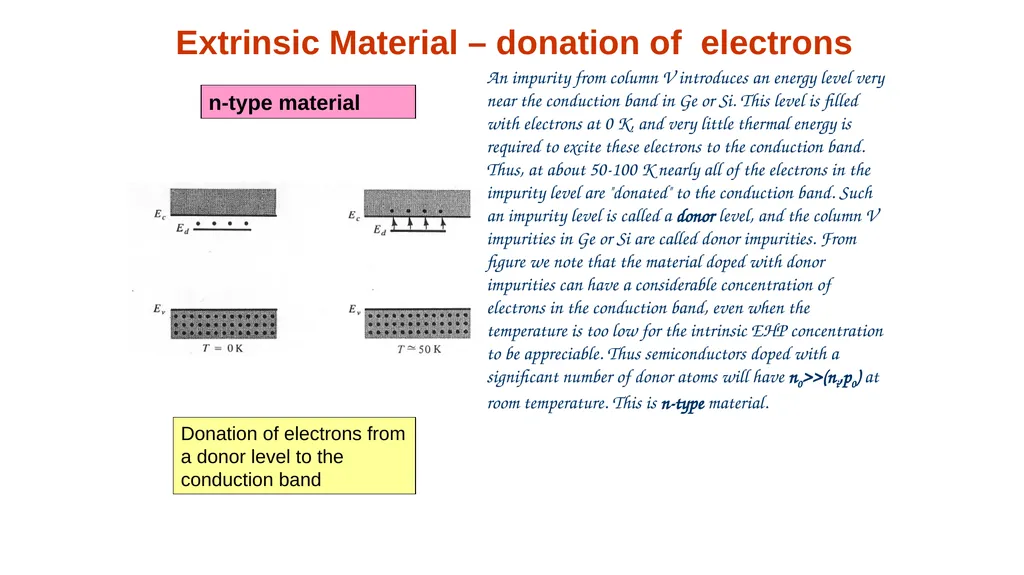
Extrinsic Material – donation of electrons An impurity from column V introduces an energy level very near the conduction band in Ge or Si. This level is filled with electrons at 0 K, and very little thermal energy is required to excite these electrons to the conduction band. Thus, at about 50-100 K nearly all of the electrons in the impurity level are "donated" to the conduction band. Such an impurity level is called a donor level, and the column V impurities in Ge or Si are called donor impurities. From figure we note that the material doped with donor impurities can have a considerable concentration of electrons in the conduction band, even when the temperature is too low for the intrinsic EHP concentration to be appreciable. Thus semiconductors doped with a significant number of donor atoms will have n0>>(ni,p0) at room temperature. This is n-type material. Donation of electrons from a donor level to the conduction band n-type material<br>
07
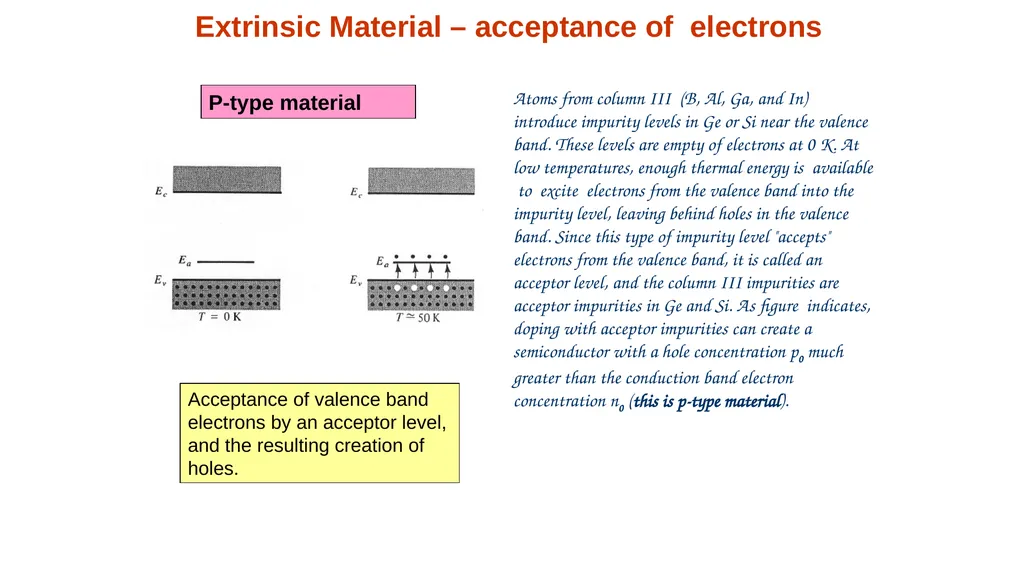
Extrinsic Material – acceptance of electrons Acceptance of valence band electrons by an acceptor level, and the resulting creation of holes. Atoms from column III (B, Al, Ga, and In) introduce impurity levels in Ge or Si near the valence band. These levels are empty of electrons at 0 K. At low temperatures, enough thermal energy is available to excite electrons from the valence band into the impurity level, leaving behind holes in the valence band. Since this type of impurity level "accepts" electrons from the valence band, it is called an acceptor level, and the column III impurities are acceptor impurities in Ge and Si. As figure indicates, doping with acceptor impurities can create a semiconductor with a hole concentration p0 much greater than the conduction band electron concentration n0 (this is p-type material). P-type material<br>
08
Donor and acceptors in covalent bonding model In the covalent bonding model, donor and acceptor atoms can be visualized as shown in the Figure. An Sb atom (column V) in the Si lattice has the four necessary valence electrons to complete the covalent bonds with the neighboring Si atoms, plus one extra electron. This fifth electron does not fit into the bonding structure of the lattice and is therefore loosely bound to the Sb atom. A small amount of thermal energy enables this extra electron to overcome its coulombic binding to the impurity atom and be donated to the lattice as a whole. Thus it is free to participate in current conduction. This process is a qualitative model of the excitation of electrons out of a donor level and into the conduction band.
Similarly, the column III impurity Al has only three valence electrons to contribute to the covalent bonding, thereby leaving one bond incomplete. With a small amount of thermal energy, this incomplete bond can be transferred to other atoms as the bonding electrons exchange positions. Donor and acceptor atoms in the covalent bonding model of a Si crystal.<br>
09
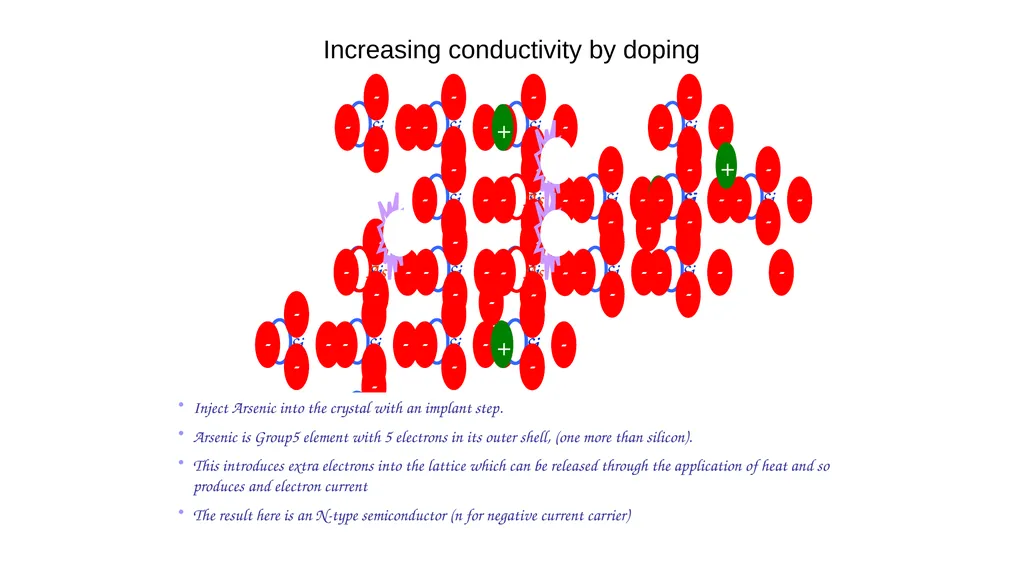
Inject Arsenic into the crystal with an implant step.
Arsenic is Group5 element with 5 electrons in its outer shell, (one more than silicon).
This introduces extra electrons into the lattice which can be released through the application of heat and so produces and electron current
The result here is an N-type semiconductor (n for negative current carrier) Increasing conductivity by doping +<br>
10
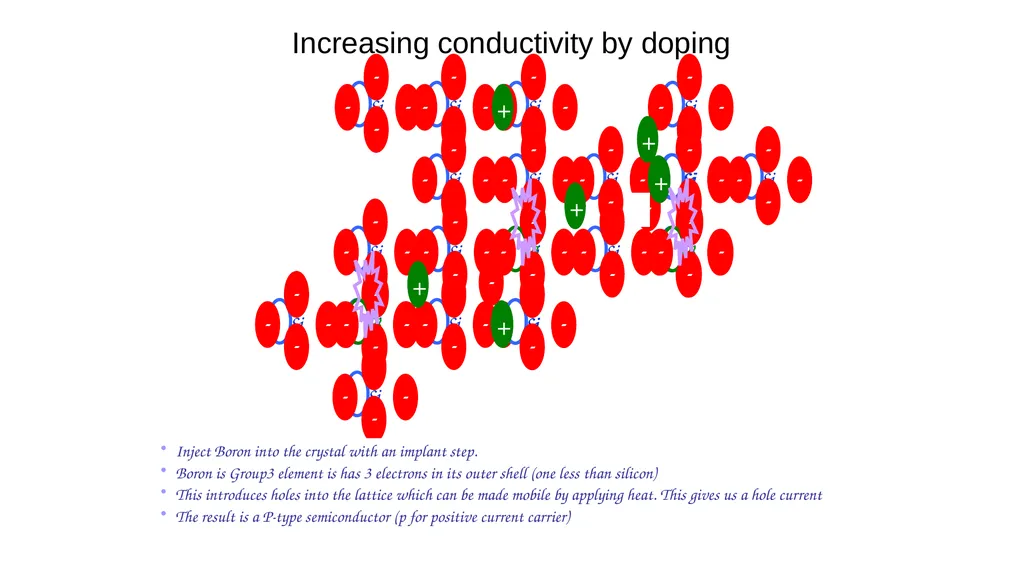
Increasing conductivity by doping Inject Boron into the crystal with an implant step.
Boron is Group3 element is has 3 electrons in its outer shell (one less than silicon)
This introduces holes into the lattice which can be made mobile by applying heat. This gives us a hole current
The result is a P-type semiconductor (p for positive current carrier) +<br>