02
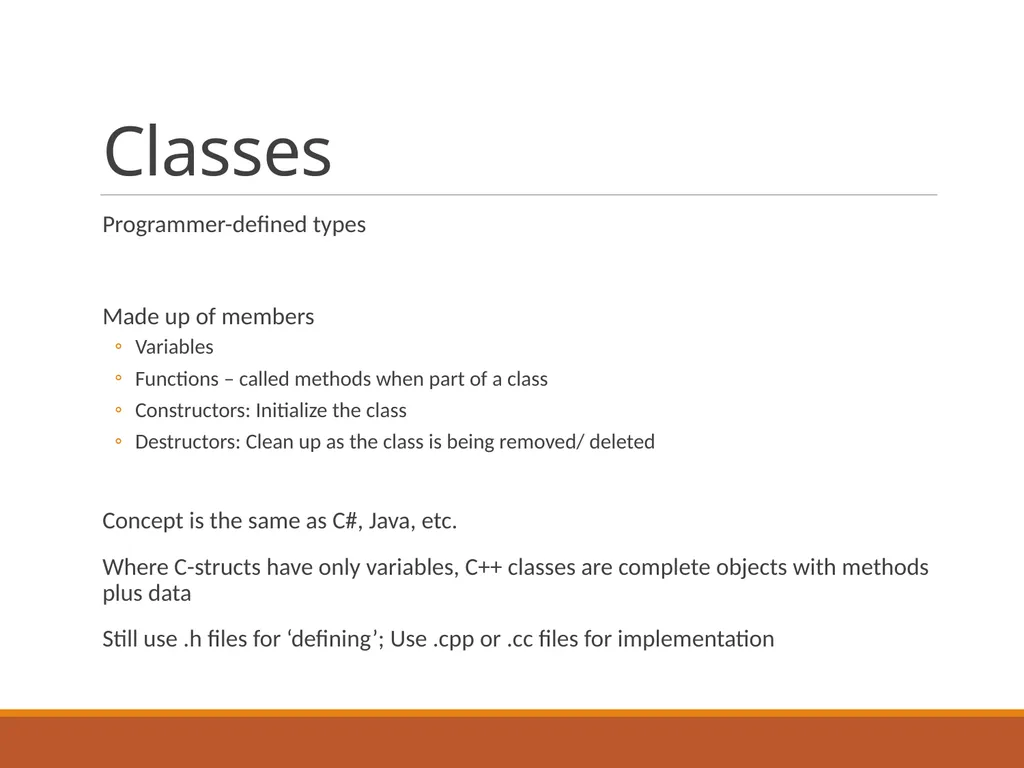
Classes Programmer-defined types
Made up of members
Variables
Functions – called methods when part of a class
Constructors: Initialize the class
Destructors: Clean up as the class is being removed/ deleted
Concept is the same as C#, Java, etc.
Where C-structs have only variables, C++ classes are complete objects with methods plus data
Still use .h files for ‘defining’; Use .cpp or .cc files for implementation<br>
04
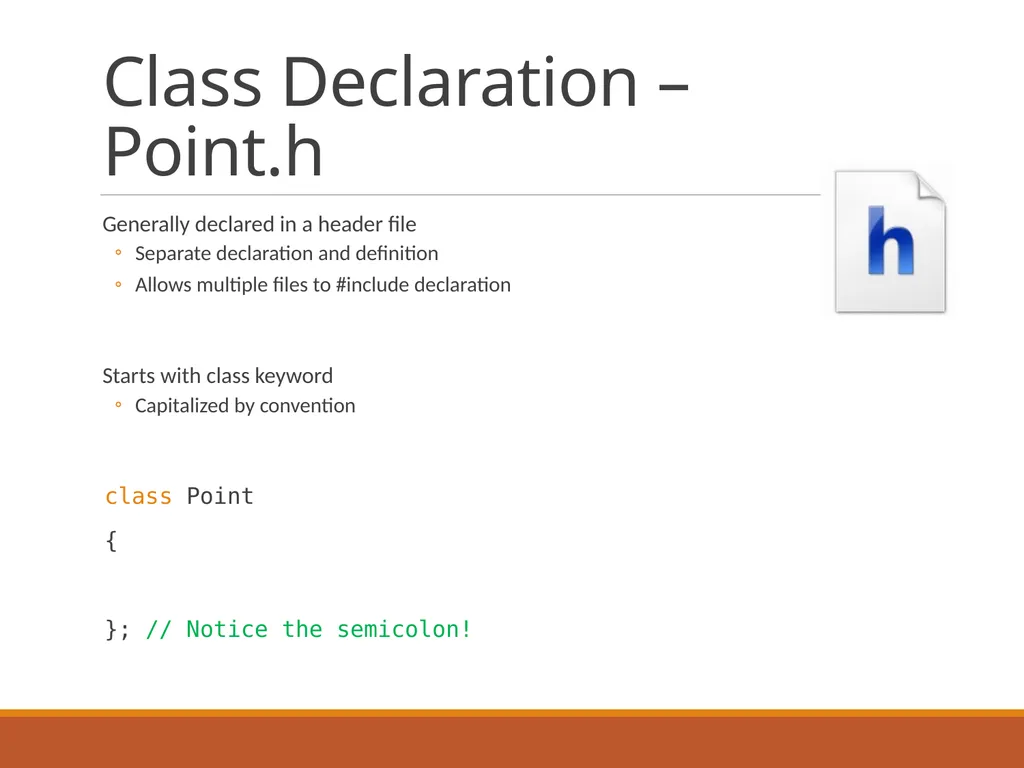
Class Declaration – Point.h Generally declared in a header file
Separate declaration and definition
Allows multiple files to #include declaration
Starts with class keyword
Capitalized by convention
class Point
{
}; // Notice the semicolon!<br>
05
Class Access Specifiers By default, all class members are private
Change with access specifiers
public [visible to everyone]
private [visible only to the original class]
protected [visible to the original class and derived classes]
Usage is different from C# / Java
Define sections with specified access<br>
06
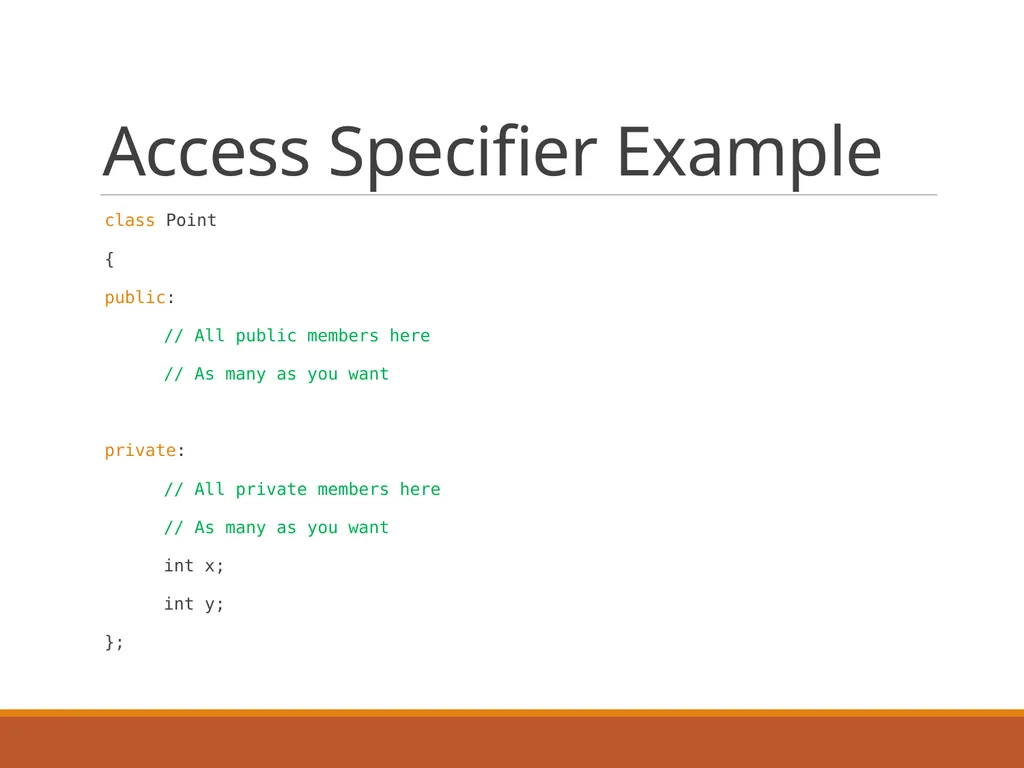
Access Specifier Example class Point
{
public:
// All public members here
// As many as you want
private:
// All private members here
// As many as you want
int x;
int y;
};<br>
07
Constructors Code to be run when object is created
Ideally gives all variables useful values
“Constructs” the object
Called automatically when object is created
Can have zero parameters
Default constructor
Can require parameters<br>
08
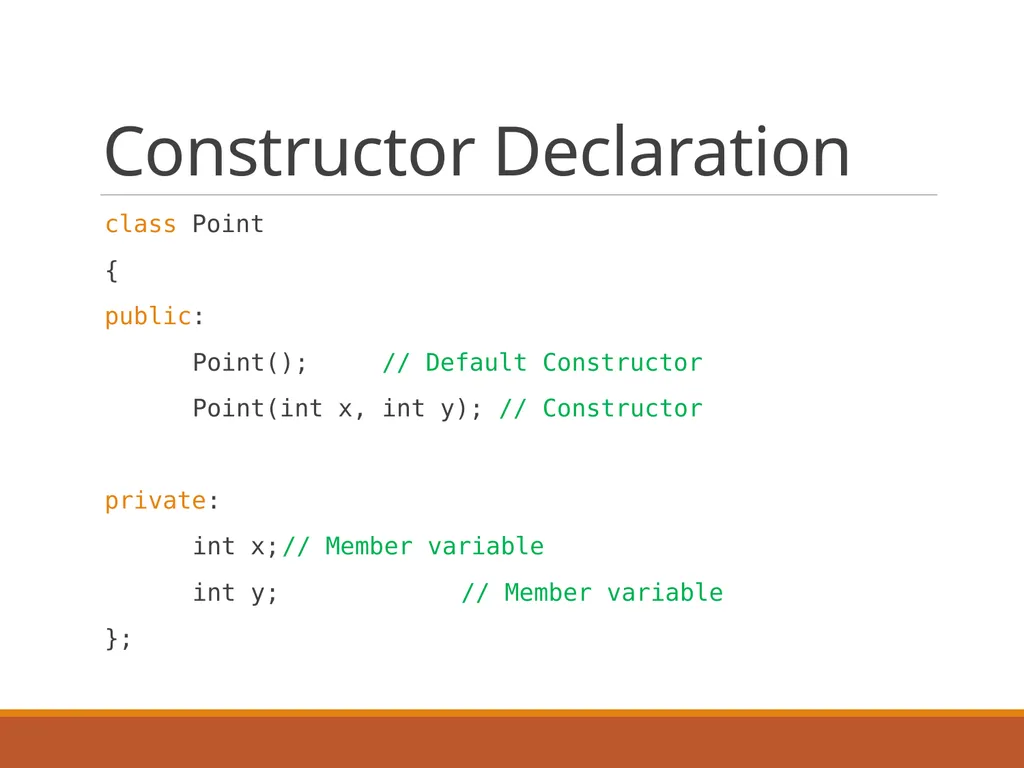
Constructor Declaration class Point
{
public:
Point(); // Default Constructor
Point(int x, int y); // Constructor
private:
int x; // Member variable
int y; // Member variable
};<br>
09
Methods Functions declared as class members
“Member functions”
Methods have access to other class members
Other methods
Variables
Methods can use “this” keyword
A pointer to this object
More on pointers & objects soon<br>
10
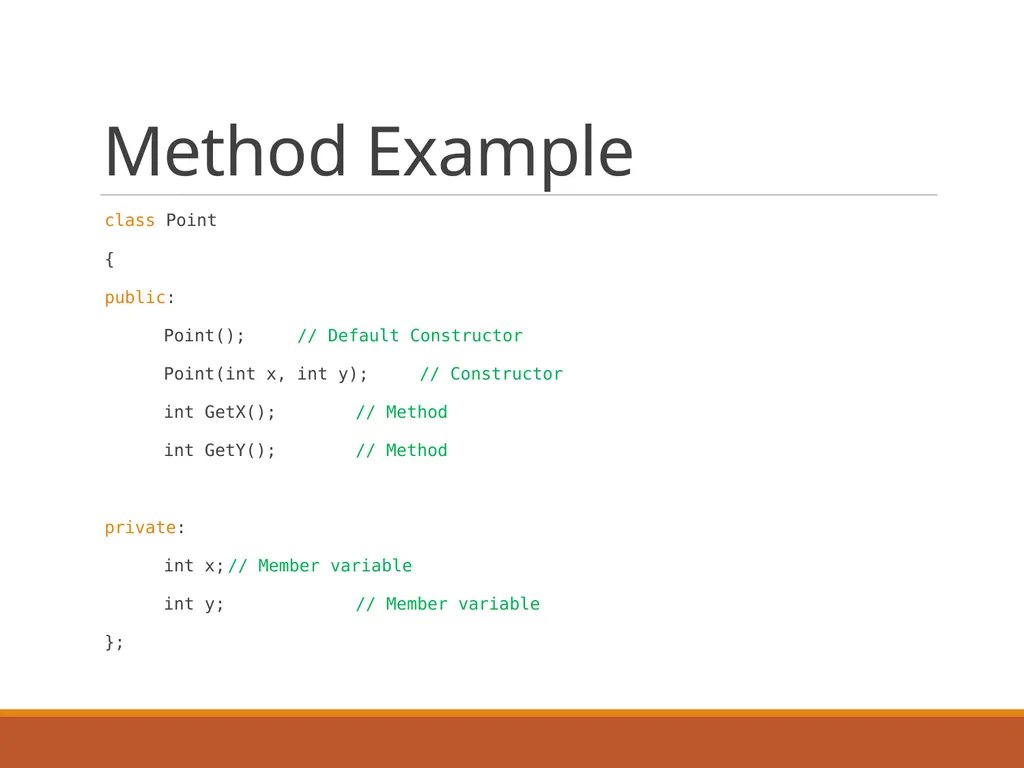
Method Example class Point
{
public:
Point(); // Default Constructor
Point(int x, int y); // Constructor
int GetX(); // Method
int GetY(); // Method
private:
int x; // Member variable
int y; // Member variable
};<br>
11
Class Implementation – Point.cpp Generally defined in a .cpp file
#include associated header file
Should define code of all members
Methods
Constructors
Destructors
No “class” keyword in .cpp file!
Must use scope operator<br>
12
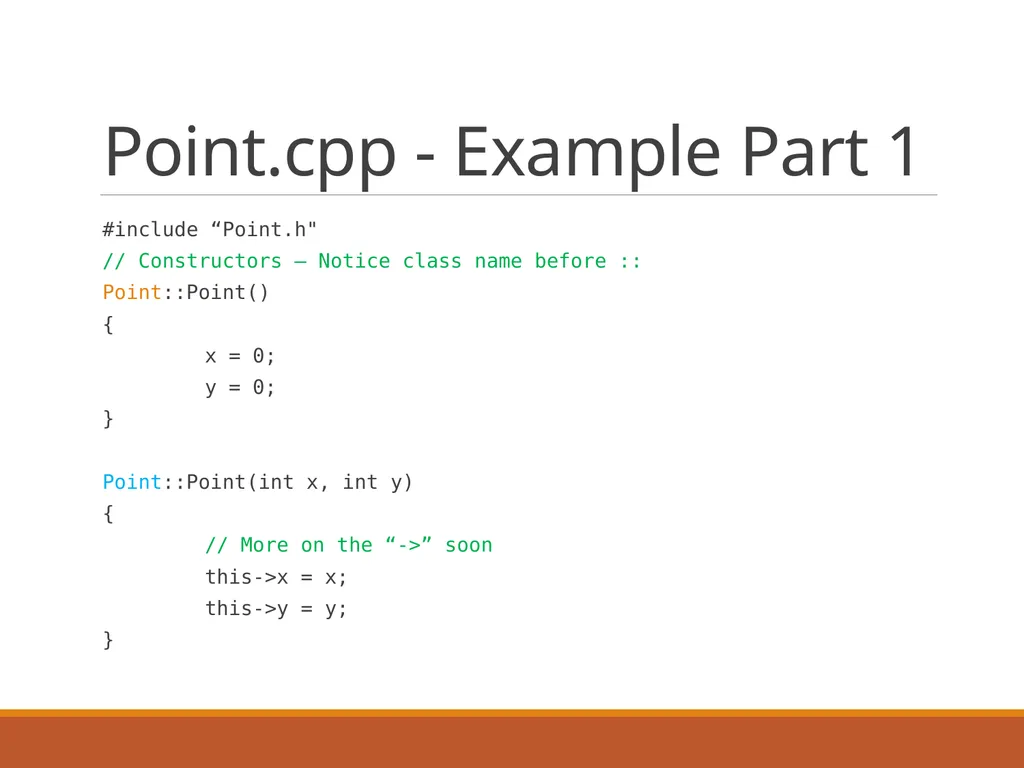
Point.cpp - Example Part 1 #include “Point.h"
// Constructors – Notice class name before ::
Point::Point()
{
x = 0;
y = 0;
}
Point::Point(int x, int y)
{
// More on the “->” soon
this->x = x;
this->y = y;
}<br>
13
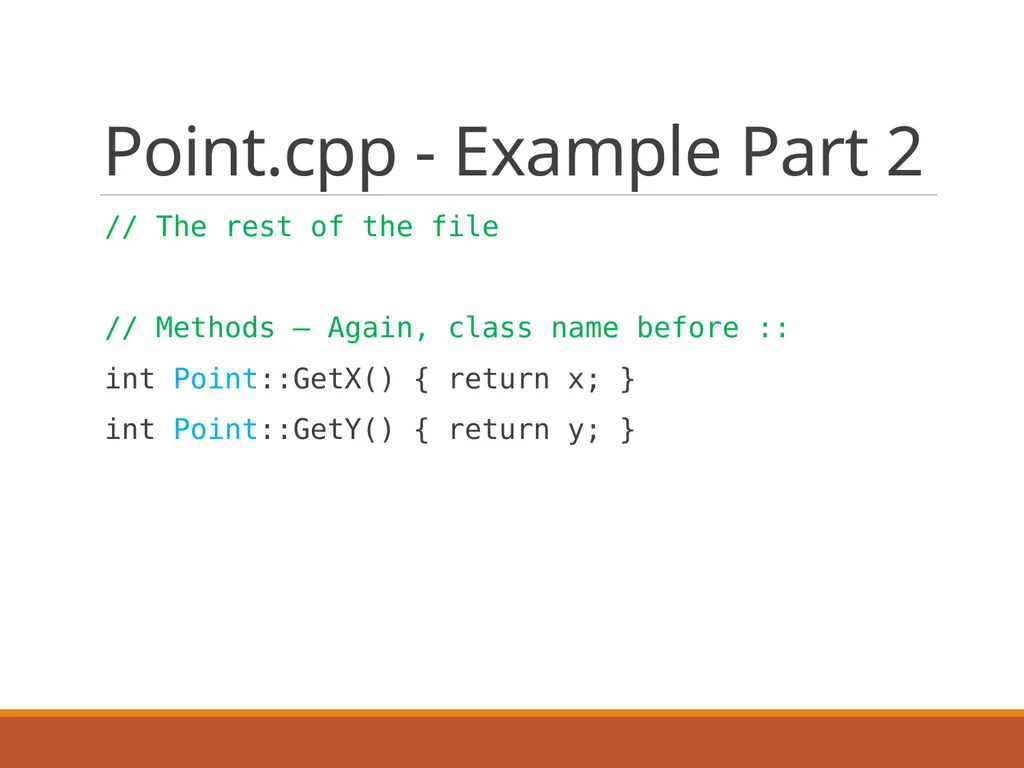
Point.cpp - Example Part 2 // The rest of the file
// Methods – Again, class name before ::
int Point::GetX() { return x; }
int Point::GetY() { return y; }<br>
14
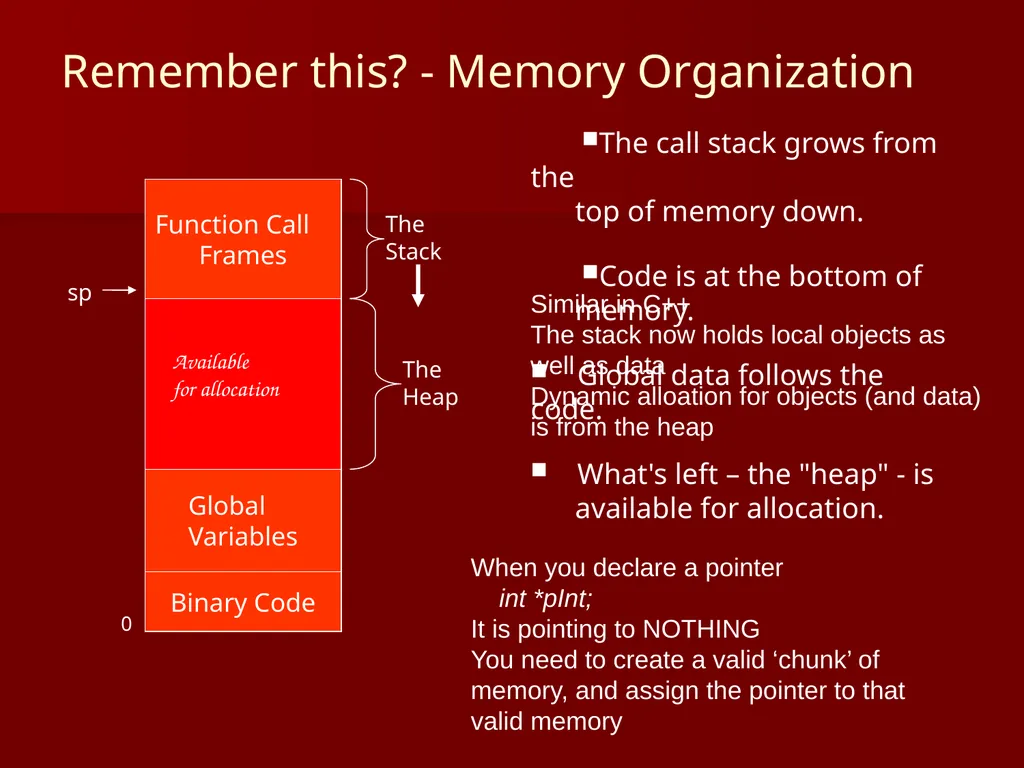
Remember this? - Memory Organization The call stack grows from the� top of memory down.�
Code is at the bottom of� memory.�
Global data follows the code.�
What's left – the "heap" - is� available for allocation. Binary Code Global
Variables 0 Function Call
Frames sp Available
for allocation The
Stack The
Heap When you declare a pointer
int *pInt;
It is pointing to NOTHING
You need to create a valid ‘chunk’ of memory, and assign the pointer to that valid memory Similar in C++
The stack now holds local objects as well as data
Dynamic alloation for objects (and data) is from the heap<br>
15
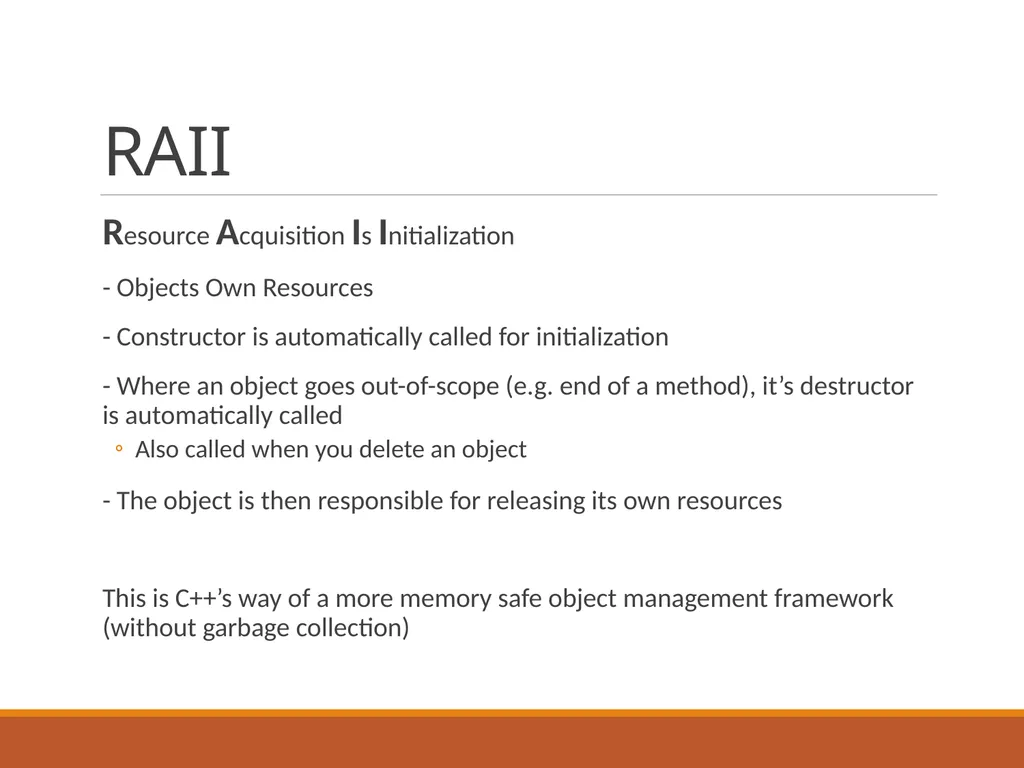
RAII Resource Acquisition Is Initialization
- Objects Own Resources
- Constructor is automatically called for initialization
- Where an object goes out-of-scope (e.g. end of a method), it’s destructor is automatically called
Also called when you delete an object
- The object is then responsible for releasing its own resources
This is C++’s way of a more memory safe object management framework (without garbage collection)<br>
16
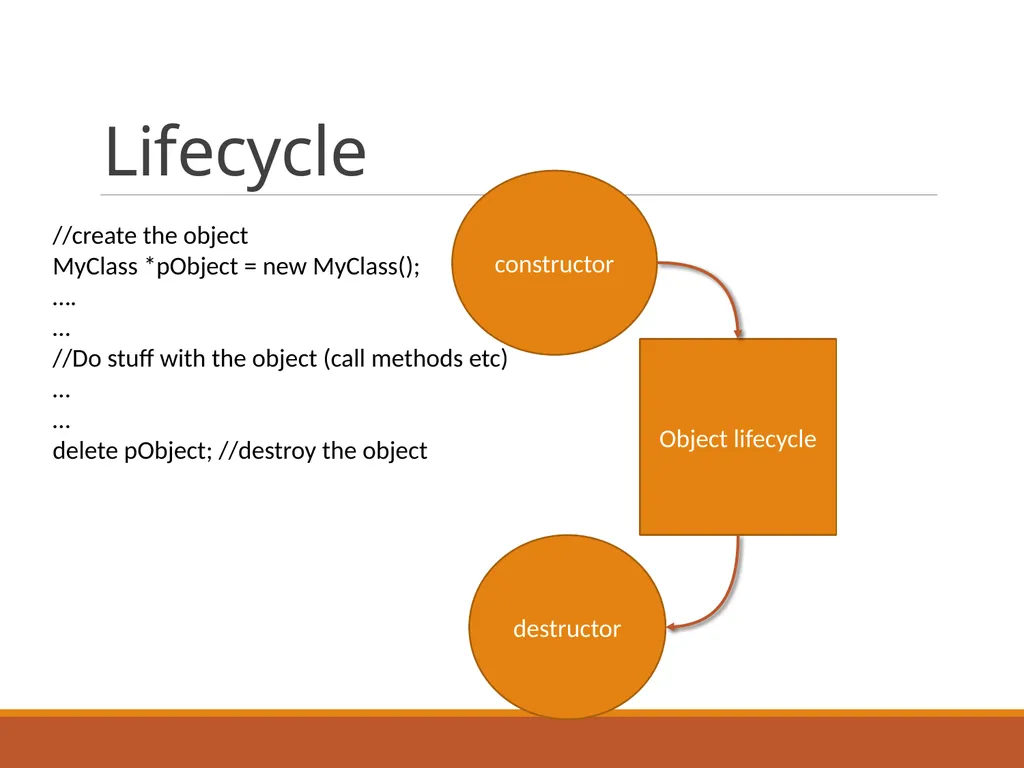
Lifecycle //create the object
MyClass *pObject = new MyClass();
….
…
//Do stuff with the object (call methods etc)
…
…
delete pObject; //destroy the object constructor Object lifecycle destructor<br>
17
Instantiating Objects of a Class Objects are instances of a class
Can be on the stack or the heap
Just like arrays & other variables
Many syntax options for creating objects<br>
18
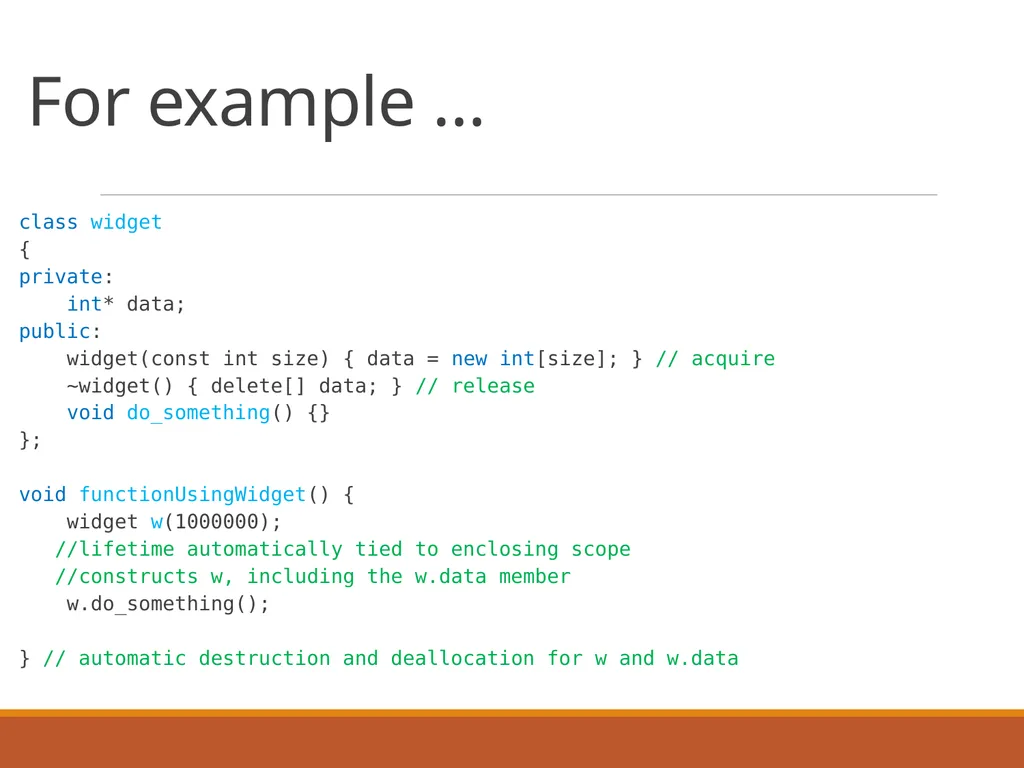
For example … class widget
{
private:
int* data;
public:
widget(const int size) { data = new int[size]; } // acquire
~widget() { delete[] data; } // release
void do_something() {}
};
void functionUsingWidget() {
widget w(1000000);
//lifetime automatically tied to enclosing scope
//constructs w, including the w.data member
w.do_something();
} // automatic destruction and deallocation for w and w.data<br>
19
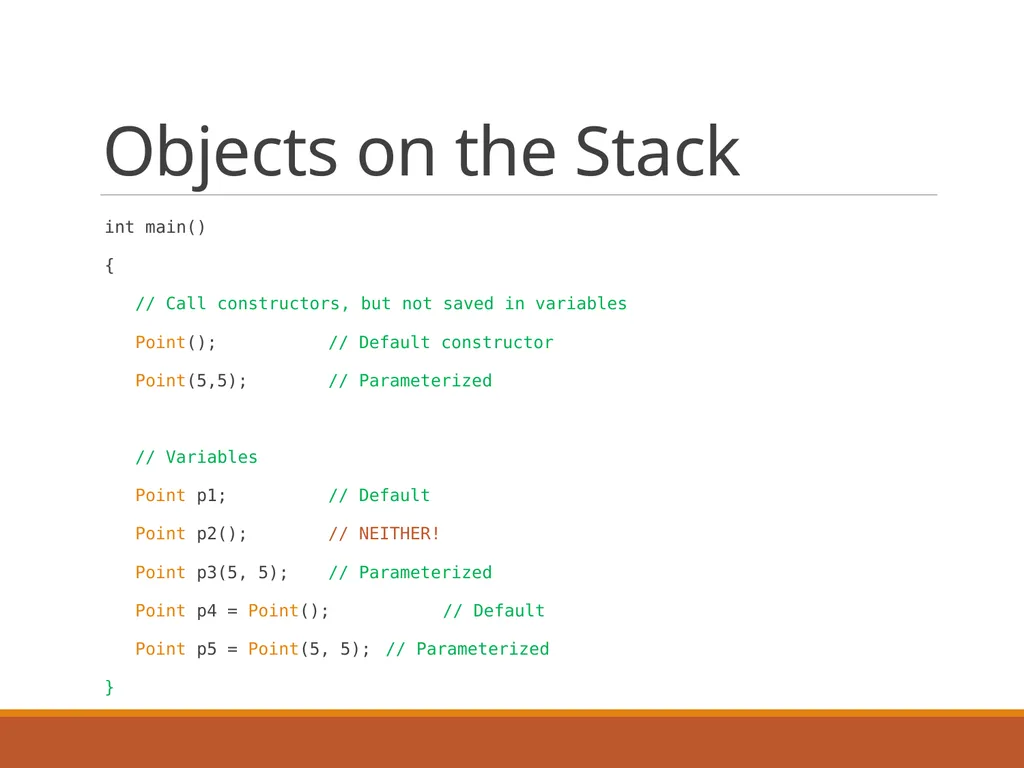
Objects on the Stack int main()
{
// Call constructors, but not saved in variables
Point(); // Default constructor
Point(5,5); // Parameterized
// Variables
Point p1; // Default
Point p2(); // NEITHER!
Point p3(5, 5); // Parameterized
Point p4 = Point(); // Default
Point p5 = Point(5, 5); // Parameterized
}<br>
20
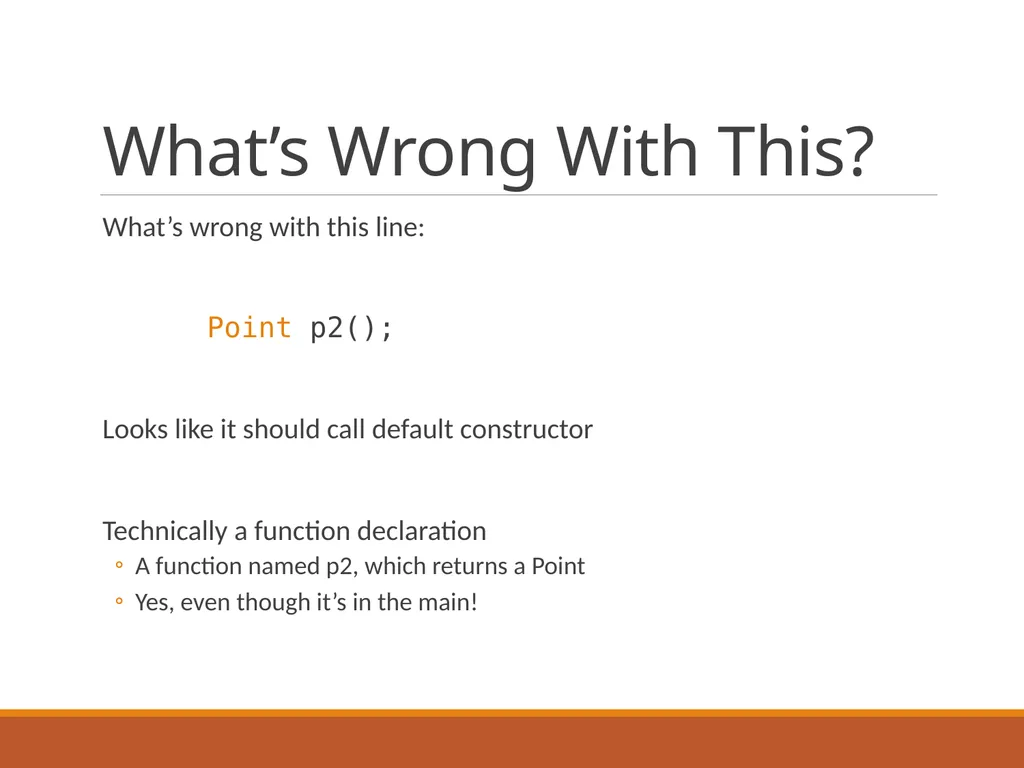
What’s Wrong With This? What’s wrong with this line:
Point p2();
Looks like it should call default constructor
Technically a function declaration
A function named p2, which returns a Point
Yes, even though it’s in the main!<br>
21
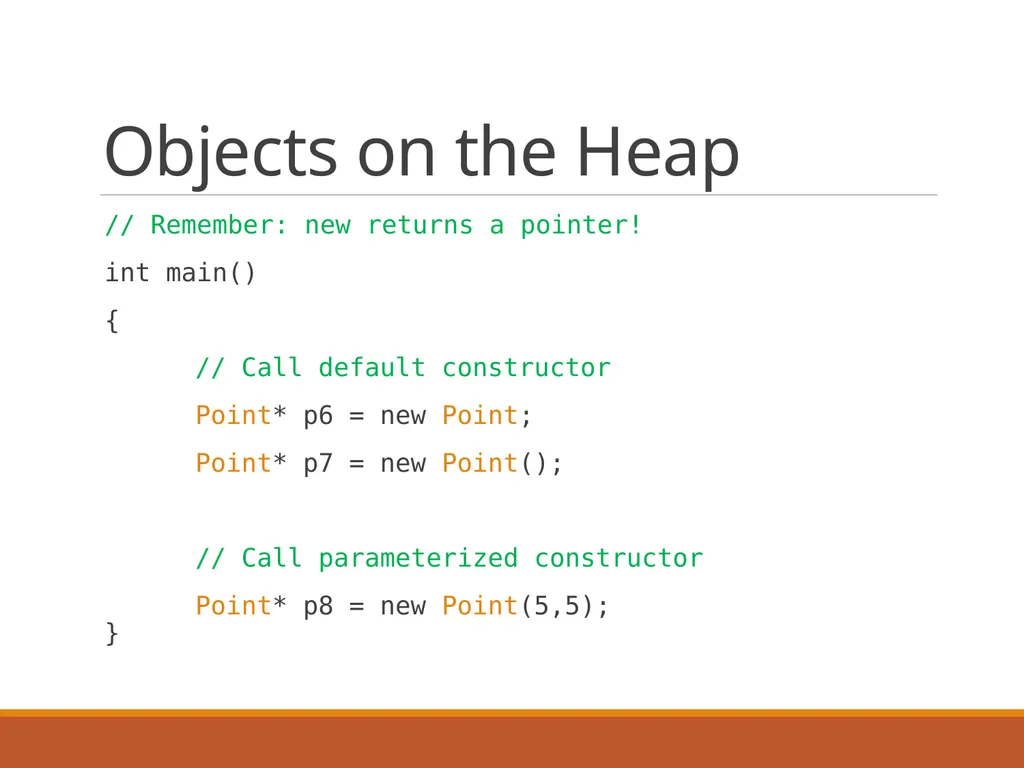
Objects on the Heap // Remember: new returns a pointer!
int main()
{
// Call default constructor
Point* p6 = new Point;
Point* p7 = new Point();
// Call parameterized constructor
Point* p8 = new Point(5,5);�}<br>
22
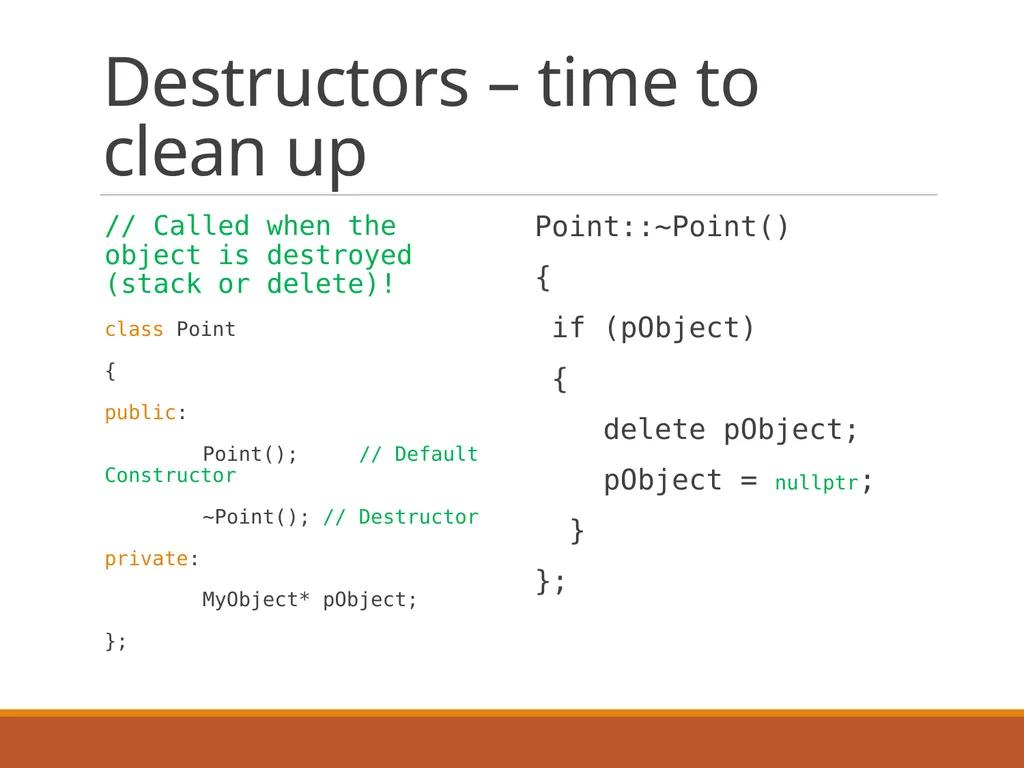
Destructors – time to clean up // Called when the object is destroyed (stack or delete)!
class Point
{
public:
Point(); // Default Constructor
~Point(); // Destructor
private:
MyObject* pObject;
}; Point::~Point()
{
if (pObject)
{
delete pObject;
pObject = nullptr;
}
};<br>
23
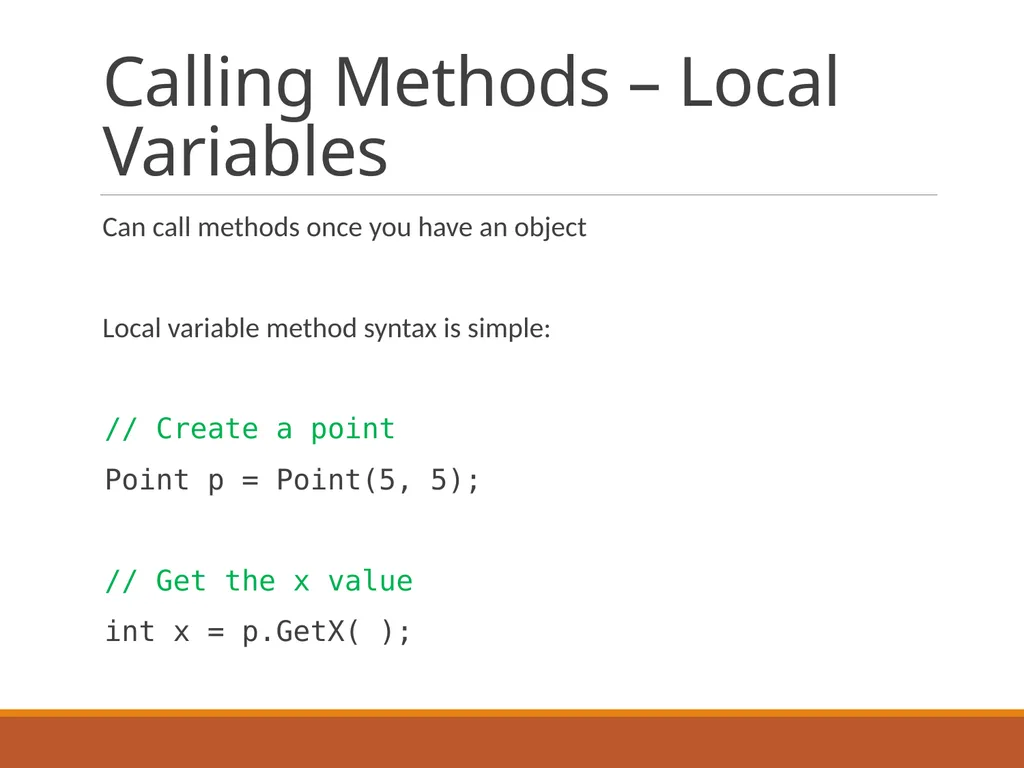
Calling Methods – Local Variables Can call methods once you have an object
Local variable method syntax is simple:
// Create a point
Point p = Point(5, 5);
// Get the x value
int x = p.GetX( );<br>
24
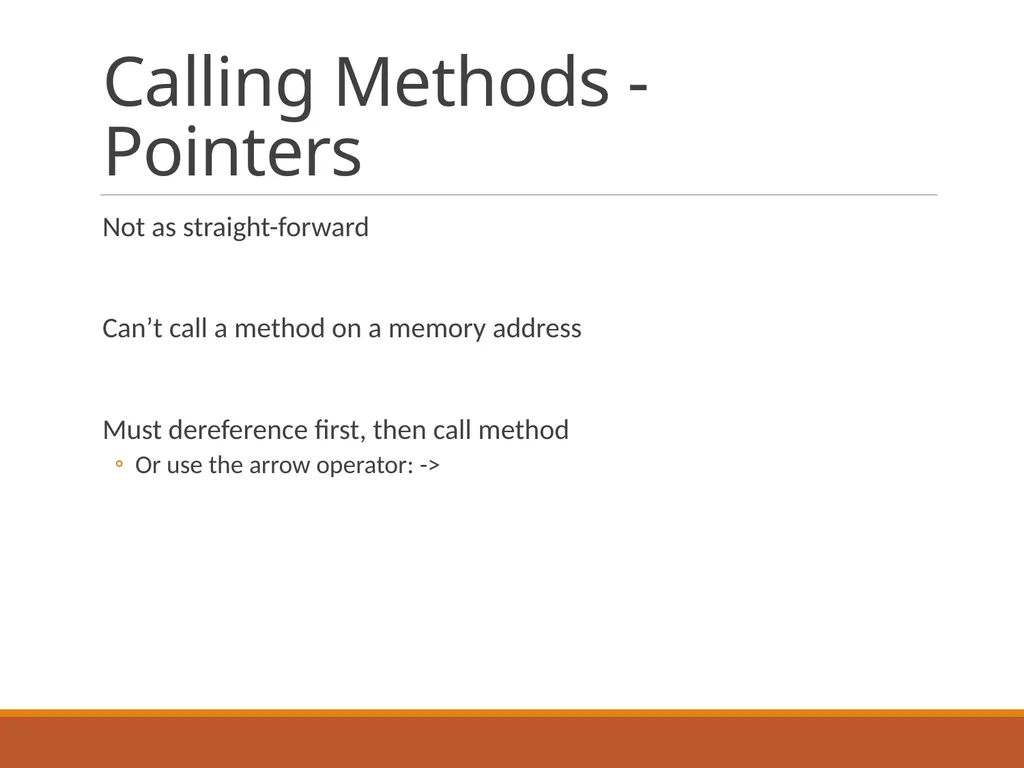
Calling Methods - Pointers Not as straight-forward
Can’t call a method on a memory address
Must dereference first, then call method
Or use the arrow operator: -><br>
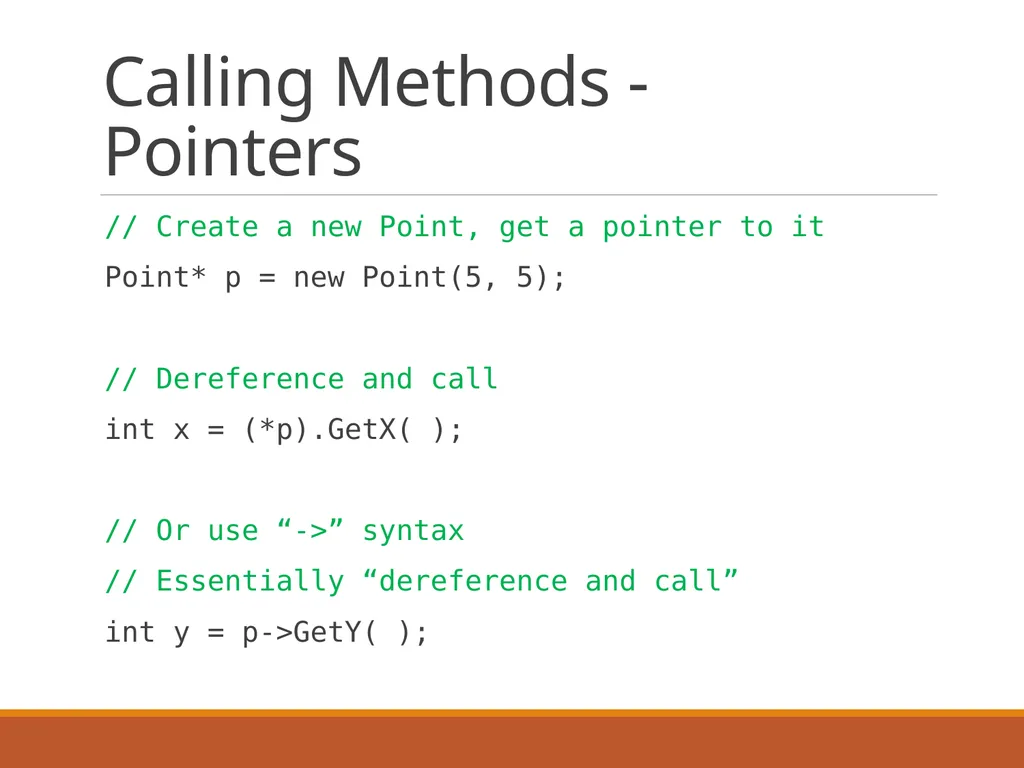
25
Calling Methods - Pointers // Create a new Point, get a pointer to it
Point* p = new Point(5, 5);
// Dereference and call
int x = (*p).GetX( );
// Or use “->” syntax
// Essentially “dereference and call”
int y = p->GetY( );<br>
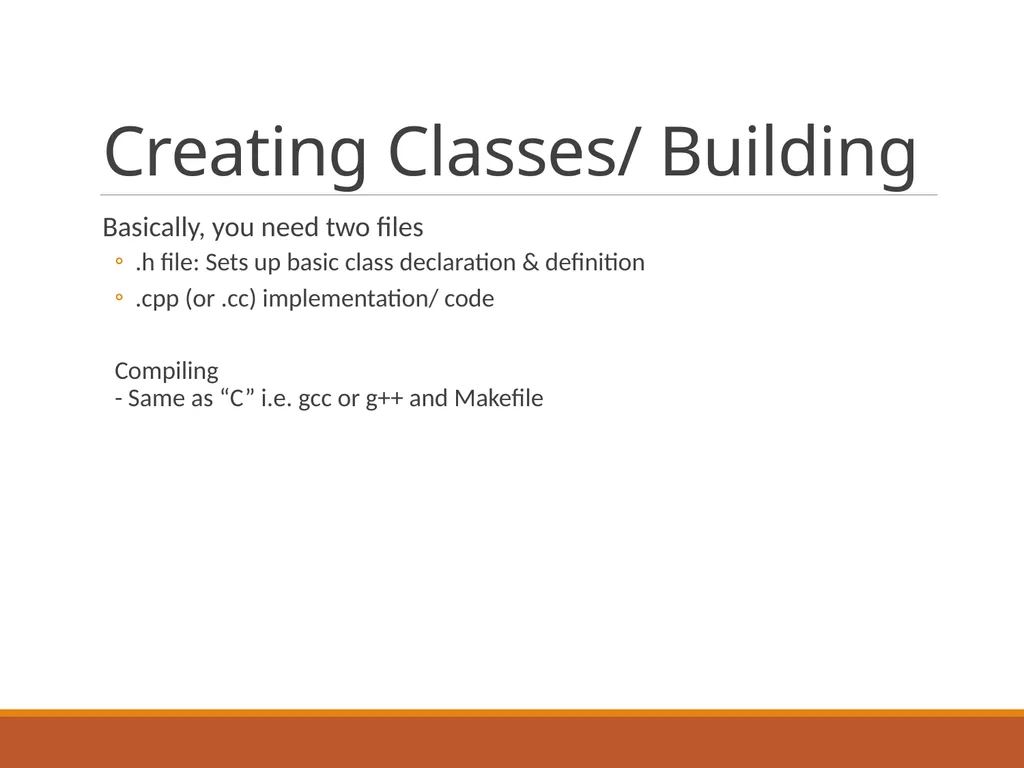
26
Creating Classes/ Building Basically, you need two files
.h file: Sets up basic class declaration & definition
.cpp (or .cc) implementation/ code
Compiling�- Same as “C” i.e. gcc or g++ and Makefile<br>