Intro to EDM Which tools to use in class Week 1, video 1 Big Data in Education This textbook In this MOOC, youll learn methods used for exploring big data in education Two communities International Educational Data Mining Society First
"Intro to EDM Which tools to use in class Week" is the property of its rightful owner. Permission is granted to
download and print the materials on this website for personal, non-commercial use only, and to display it
on your personal computer provided you do not modify the materials and that you retain all copyright
notices contained in the materials. By downloading content from our website, you accept the terms of this
agreement.
Presentation Transcript
01
Intro to EDM Which tools to use in class Week 1, video 1<br>
02
Big Data in Education<br>
03
This textbook In this MOOC, you’ll learn methods used for exploring big data in education<br>
04
Two communities International Educational Data Mining Society
First event: EDM workshop in 2005 (at AAAI)
First conference: EDM2008
Publishing JEDM since 2009
Society for Learning Analytics Research
First conference: LAK2011
Journal of Learning Analytics (founded 2012)<br>
05
Two communities Joint goal of exploring the “big data” now available on learners and learning
To promote
New scientific discoveries & to advance learning sciences
Better assessment of learners along multiple dimensions
Social, cognitive, emotional, meta-cognitive, etc.
Better real-time support for learners
Adaptive learning systems
Actionable information for teachers and other school personnel<br>
06
What this course is about This course is about the key problems, methods, and open questions in the field
You’ll learn both classic methods and emerging methods – and some of them are emerging fast<br>
07
Where we’re at This course is now in its 8th edition
It’s been amazing to watch all the changes that have happened in these years, and it’s been a great privilege to have had the opportunity to have been part of some of them
The hardest part has been keeping this course close to current, when things are moving so fast<br>
08
Where do methods come from? Some of the methods would be familiar to someone with a background in Data Mining or Machine Learning
Some of the methods would be familiar to someone with a background in Psychometrics or traditional Statistics
You don’t have to have either of these backgrounds to get something out of the course
Pick and choose what you find most useful
Over the years, the students who have gotten the most out of this course are the ones who focus in on what they find most useful<br>
09
What makes data “big”? Laney (2000) “The Three Vs”
Volume
How much total data?
Velocity
How fast is data coming in? (and how fast do you have to handle it?)
Variety
Incompatible formats, non-aligned data structures, inconsistent data semantics<br>
10
The fourth and fifth V Lots of folks want to tell you what the fourth or fifth V are, in order to get you to cite them
Veracity
Value
Variability
Visualization
Validity
Velociraptors<br>
11
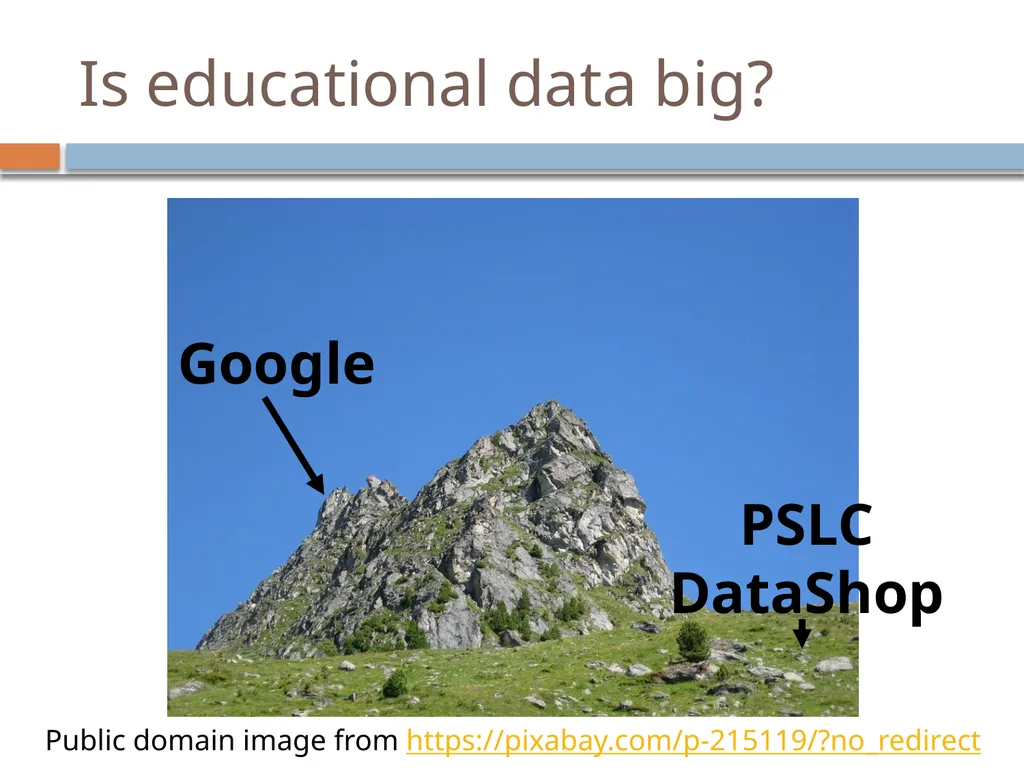
Is educational data big? Public domain image from https://pixabay.com/p-215119/?no_redirect Google PSLC DataShop<br>
12
Not that big? But the name of the course is big data in education!<br>
13
Not that big? But the name of the course is big data in education!
Thanks to someone in marketing in 2013<br>
14
Not that big? Big data in education is big
Big by comparison to most classical education research
Big compared to common data sets in many domains
But it’s not human genome project or google big<br>
15
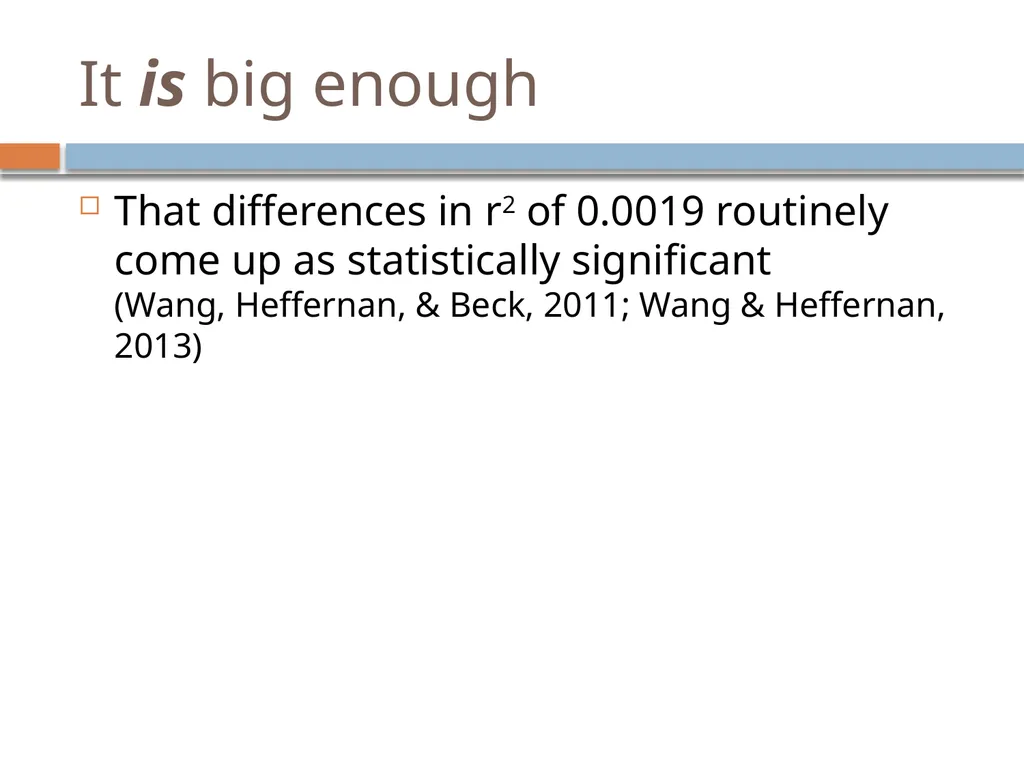
It is big enough That differences in r2 of 0.0019 routinely come up as statistically significant (Wang, Heffernan, & Beck, 2011; Wang & Heffernan, 2013)<br>
16
I will talk about statistical significance Sometimes
But it will not be a focus of the class<br>
17
I will talk about statistical significance Sometimes
But it will not be a focus of the class
Also: statisticians note, terminology is sometimes conflicting between stats and data mining/machine learning
I’ll highlight particularly annoying cases where they emerge<br>
18
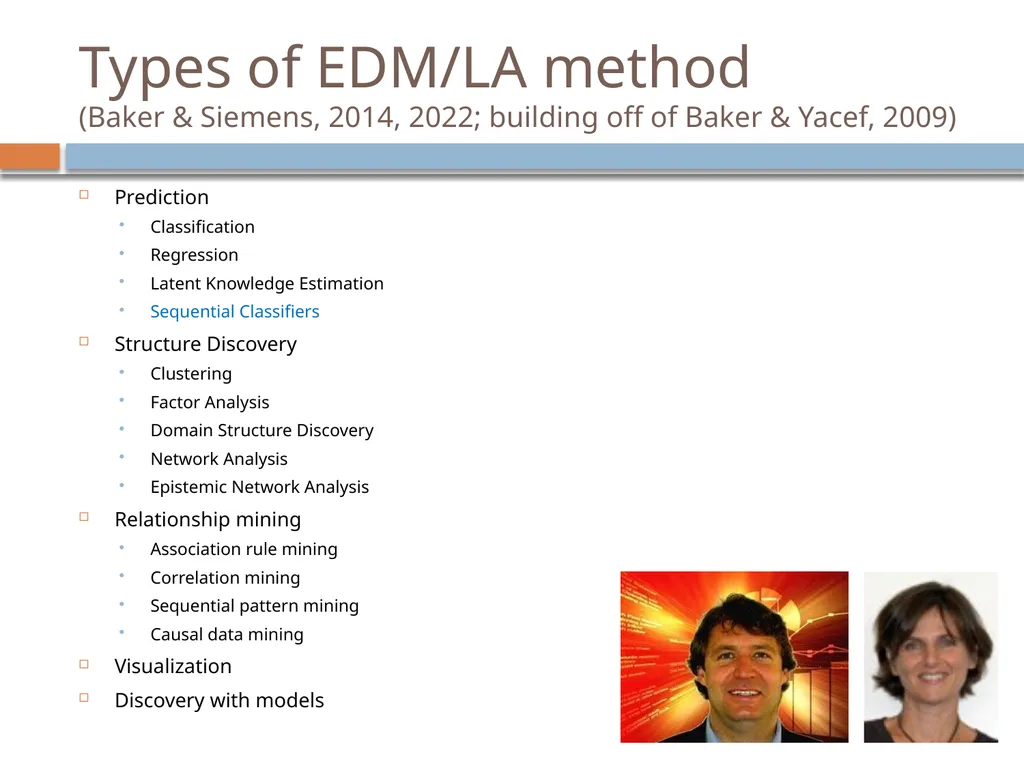
Types of EDM/LA method (Baker & Siemens, 2014, 2022; building off of Baker & Yacef, 2009) Prediction
Classification
Regression
Latent Knowledge Estimation
Sequential Classifiers
Structure Discovery
Clustering
Factor Analysis
Domain Structure Discovery
Network Analysis
Epistemic Network Analysis
Relationship mining
Association rule mining
Correlation mining
Sequential pattern mining
Causal data mining
Visualization
Discovery with models<br>
19
Prediction Develop a model which can infer a single aspect of the data (predicted variable) from some combination of other aspects of the data (predictor variables)
Which students are off-task?
Which students will fail the class?<br>
20
Structure Discovery Find structure and patterns in the data that emerge “naturally”
No specific target or predictor variable<br>
21
Relationship Mining Discover relationships between variables in a data set with many variables<br>
22
Discovery with Models Pre-existing model (developed with EDM prediction methods… or clustering… or knowledge engineering)
Applied to data and used as a component in another analysis<br>
23
What about Generative AI/LLMs? In some ways its own category
Automated content generation
Automated content adaptation
Also can be used in some existing areas
Originally sequential classification
But also now classification in general, new types of structure discovery (topic and code discovery)
Chapter 7 is now all about Generative AI/LLMs
New as of 8th edition!
But it will also be mentioned throughout the course, where appropriate<br>
24
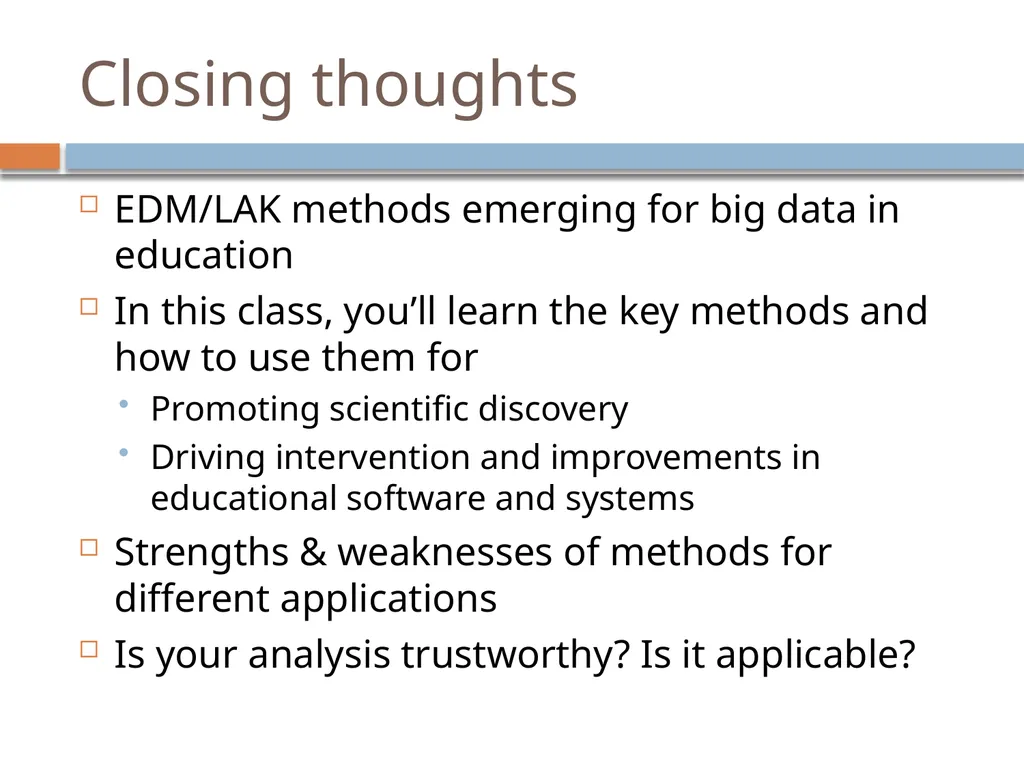
Closing thoughts EDM/LAK methods emerging for big data in education
In this class, you’ll learn the key methods and how to use them for
Promoting scientific discovery
Driving intervention and improvements in educational software and systems
Strengths & weaknesses of methods for different applications
Is your analysis trustworthy? Is it applicable?<br>