Introduce the aims and objectives for the session. Explain the budgeting process and the advantages disadvantages. Arrange the budgeting advantage and disadvantage cards in groups. Calculate favourable and adverse variances as a group.
"Introduce the aims and objectives for the session." is the property of its rightful owner. Permission is granted to
download and print the materials on this website for personal, non-commercial use only, and to display it
on your personal computer provided you do not modify the materials and that you retain all copyright
notices contained in the materials. By downloading content from our website, you accept the terms of this
agreement.
Presentation Transcript
01
Introduce the aims and objectives for the session.
Explain the budgeting process and the advantages/ disadvantages.
Arrange the budgeting advantage and disadvantage cards in groups.
Calculate favourable and adverse variances as a group.
Recalculate favourable and adverse variances individually.
Recap the aims and objectives for the session. Budgeting – Aims<br>
02
A budget is a financial plan of action normally covering a specific time period, for example, six months or one year.
A budget will describe expected levels of expenditure and revenues of a business.
Large businesses will prepare budgets on a departmental basis or in relation to business functions. For example, a business will have an overall budget based upon the budgets of departments such as marketing, purchasing and human resources. Budgeting<br>
03
All budgets should be objective driven. This means that the expected revenues and expenditures of each department will be ultimately based on what the business is trying to achieve.
Therefore, if a business has the objective of increasing sales by 20%, then the overall budget and departmental budgets should reflect this. Budget objectives<br>
04
Budgeting and monitoring of budgets is an ongoing procedure in large businesses.
Budgets should be continually evolving to adapt to changes. The budgeting process<br>
05
Typically the budgetary process will involve the following procedure:
1) Establish the aims and objectives of the business – what are the profit and market share targets? What is the targeted turnover? Budgeting process<br>
06
2.Set production, marketing and financial budgets. These are the three main functional budgets and each is dependent upon the objectives of the business.
•Production budget – the objectives of the business have established the output levels required. The production budget attempts to put these output levels into practice. This will involve costs of purchasing raw materials and components, direct labour costs and other costs of production. This is an expenditure only budget.<br>
07
•Marketing budget – both revenues and costs are combined. Revenues are from sales predicted and costs are from operating the business’s marketing strategy.
•Financial budget – this will be based upon the business’s cash flow forecast. Will income be able to cover expenditure or will there be a need to examine methods of raising funds to finance other budgets?<br>
08
3.Next the budget should be further broken down. Within each of these budgets, there is the opportunity to break budgets down further, so there may be a training budget, a health and safety budget, a direct selling budget etc.
4.Procedures for monitoring budgets should be established. For example, the monitoring may involve activities such as collecting feedback, checking targets and communicating regularly with budget holders.<br>
09
5.Any variance from predicted budgets should be examined and reacted to.
6.The experience and knowledge gained from setting one period’s budgets should be applied to the setting of the following period’s budgets.<br>
10
•Improved management control of the organisation. Managers know who is spending what, and why they are spending the money.
•Improved financial control. Part of the budgeting process is the monitoring of expenditure and revenues. Any changes from (variances from) budgeted amounts need to be explained and reacted to.
•Budgeting allows managers to be aware of their responsibilities. Managers who are in control of their budgets are aware of what they should be achieving and how their role fits in with organisational objectives. Benefits of budgeting<br>
11
•Budgeting ensures, or should ensure, that limited resources are used effectively. The budgeting process allocates resources to where they are most likely to help achieve the firm’s objectives.
•Budgeting can motivate managers. When managers at all levels are involved in the budgeting process they will have a commitment to ensuring that budgets are met.
•Budgeting can improve communication systems within the organisation. The budgeting process itself will involve communication both up and down the hierarchy. This will help to establish formal methods of communication, which can be used for purposes other than setting and administering budgets.<br>
12
•Those excluded from the budgeting process may not be committed to the budgets and may feel demotivated.
•If budgets are inflexible, then changes in the market or other conditions may not be met by appropriate changes in the budget. For example, if a competitor starts a major new advertising campaign, and the marketing budget does not allow for a response to this, sales are likely to be lost. Problems with budgets<br>
13
•Also an effective budget can only be based on good quality information. Many managers overstate their budgetary needs to protect their departments. This can lead to lack of control and poor allocation of resources.<br>
14
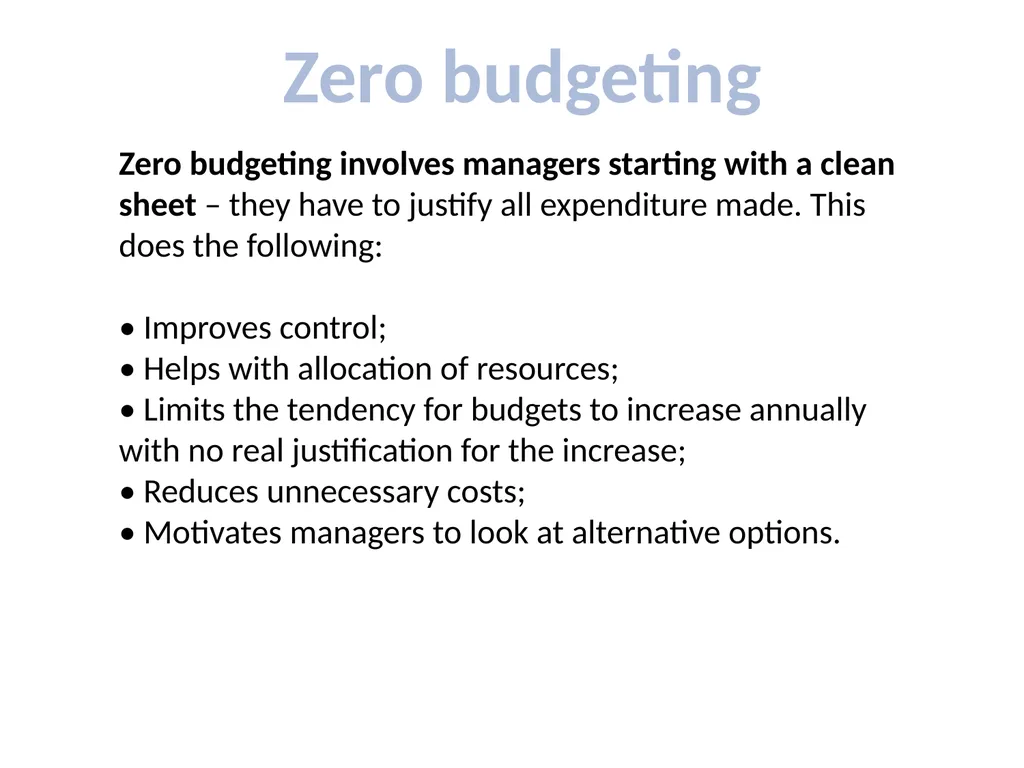
Zero budgeting involves managers starting with a clean sheet – they have to justify all expenditure made. This does the following:
• Improves control;
• Helps with allocation of resources;
• Limits the tendency for budgets to increase annually with no real justification for the increase;
• Reduces unnecessary costs;
• Motivates managers to look at alternative options. Zero budgeting<br>
15
Task:
Arrange the budgeting
Advantage and Disadvantage cards
Time: 10 mins Activity 1<br>
16
The basis of budgetary control is variance analysis. A variance is any unplanned change from the budgeted figure.
Variances can be favourable (F) or adverse (A): Budgetary control<br>
17
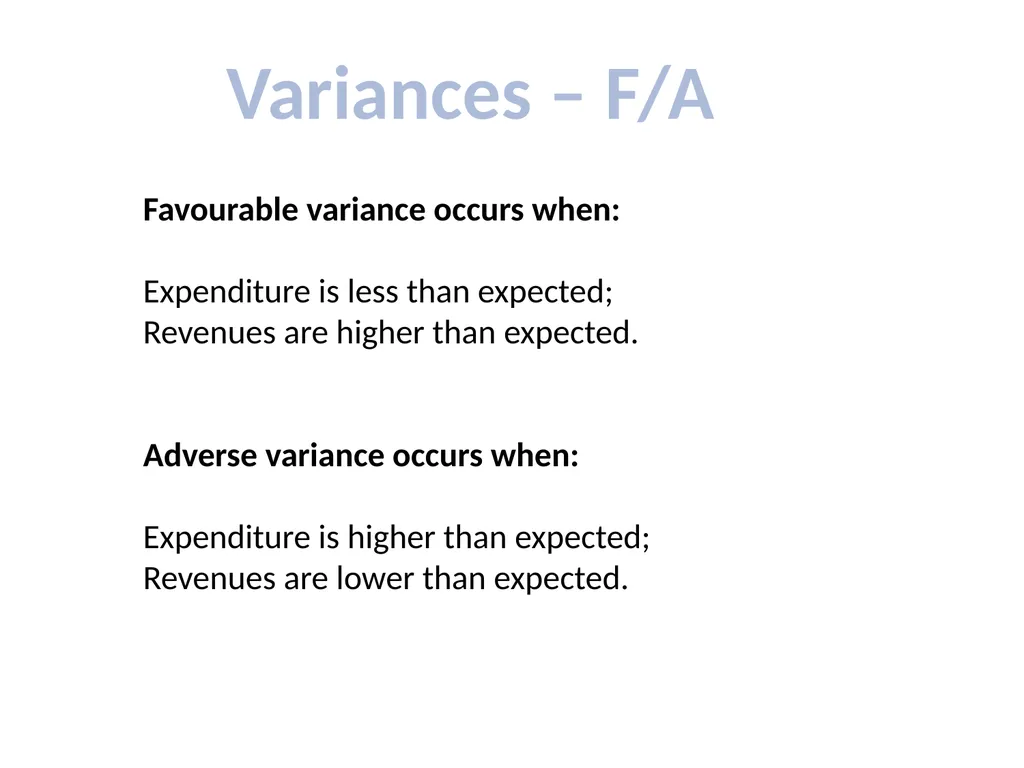
Favourable variance occurs when:
Expenditure is less than expected;
Revenues are higher than expected.
Adverse variance occurs when:
Expenditure is higher than expected;
Revenues are lower than expected. Variances – F/A<br>
18
Calculation of variances is relatively simple.
The actual figure must be compared with the budgeted figure and the difference shown as either favourable (F), or adverse (A).
These variances should then be totalled, to gain an overall favourable (F) or adverse (A) figure. Calculation of variances<br>
19
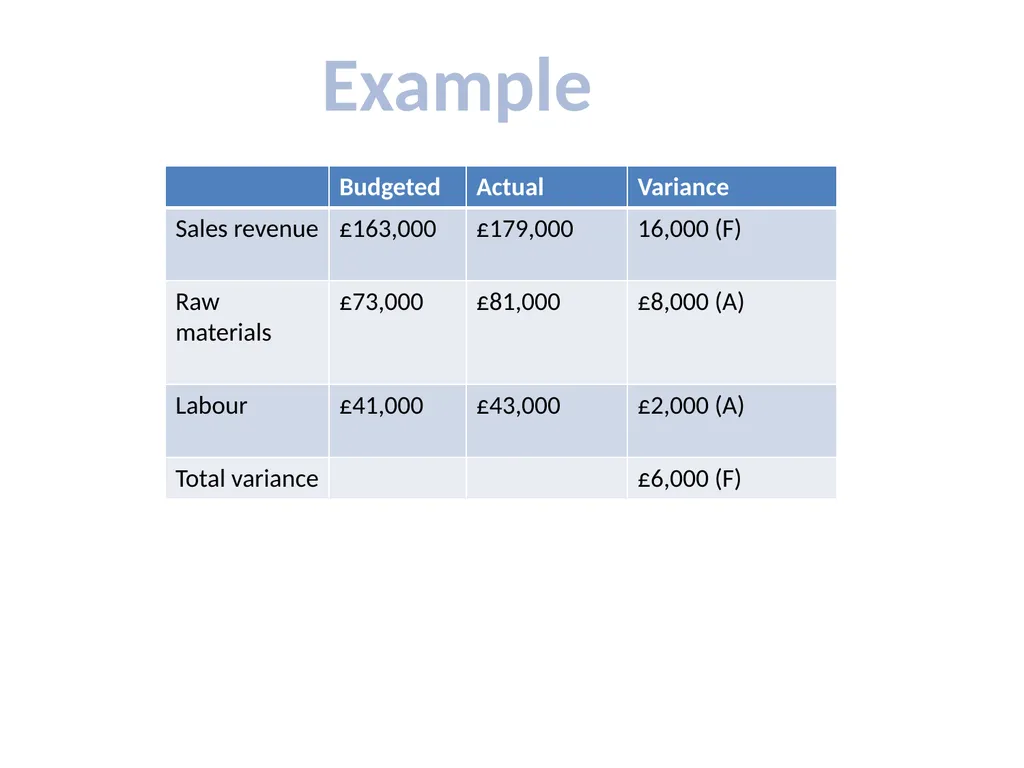
Example<br>
20
Remember
A favourable variance occurs when expenditure is less than expected or revenues are higher than expected.
A adverse variance occurs when expenditure is
Higher than expected and revenues are lower
Than expected. Budgeting – Key point<br>
21
Summary
Budgets are an important management tool. They help with financial control and in co-ordinating business activity.
They can also assist in motivating staff. However, a poorly-prepared budget is valueless: it wastes time, can demotivate staff and may restrict business activities so that management cannot react to changes in the market place. Budgeting conclusion<br>
22
Task:
Calculate adverse / favourable variances.
Time: 10 mins Activity 2<br>
23
Homework task Task:
Calculate adverse / favourable variances.
To be completed by: Monday<br>
24
Introduce the aims and objectives for the session.
Explain the budgeting process and the advantages/ disadvantages.
Arrange the budgeting advantage and disadvantage cards in groups.
Calculate favourable and adverse variances as a group.
Recalculate favourable and adverse variances individually.
Recap the aims and objectives for the session. Budgeting – Aims<br>