
INTRODUCTION Course Outline 12 Lessons and Review
SB
Published · 34 slides · 0 views

1 / 1

Description
INTRODUCTION Course Outline 12 Lessons and Review Exam ANSI Certified Food Safety Professional exam Satisfies North Carolina requirement for certified food protection manager Module Basic Outline Real world examples (actual cases)
Related Topics
Share
Embed code
Download this presentation From Below
"INTRODUCTION Course Outline 12 Lessons and Review" is the property of its rightful owner. Permission is granted to download and print the materials on this website for personal, non-commercial use only, and to display it on your personal computer provided you do not modify the materials and that you retain all copyright notices contained in the materials. By downloading content from our website, you accept the terms of this agreement.
Presentation Transcript
01
INTRODUCTION<br>
02
Course Outline 12 Lessons and Review
Exam
ANSI Certified Food Safety Professional exam
Satisfies North Carolina requirement for certified food protection manager<br>
Exam
ANSI Certified Food Safety Professional exam
Satisfies North Carolina requirement for certified food protection manager<br>
03
Module Basic Outline Real world examples (actual cases)
Instruction
Science based
Prevention/Practice/Control focused
Class discussion of your experience
Activities
Review and Questions<br>
Instruction
Science based
Prevention/Practice/Control focused
Class discussion of your experience
Activities
Review and Questions<br>
04
Sharing Experience News coverage
Past work experience
Behind the scenes stories Anyone who cooks or eats has seen good and bad examples of food safety.
Please share your experiences with the class.<br>
Past work experience
Behind the scenes stories Anyone who cooks or eats has seen good and bad examples of food safety.
Please share your experiences with the class.<br>
05
What is Food Safety? Safeguarding or protection of food from anything that could harm consumers’ health. This includes all the practical measures involved in keeping food safe and wholesome through all the states of production to the point of sale or consumption.<br>
06
The Huffington Post, 7/17/2014 "About 40 minutes into my shift I felt nauseous. My mouth started watering, and I knew I was about to vomit. I ran into the restroom and vomited repeatedly,” Elizabeth Taff told The Huffington Post.
Taff says she then summoned enough strength to get through the lunch rush, hoping to track down another employee to fill in for her. But no one else was available, she said.<br>
Taff says she then summoned enough strength to get through the lunch rush, hoping to track down another employee to fill in for her. But no one else was available, she said.<br>
07
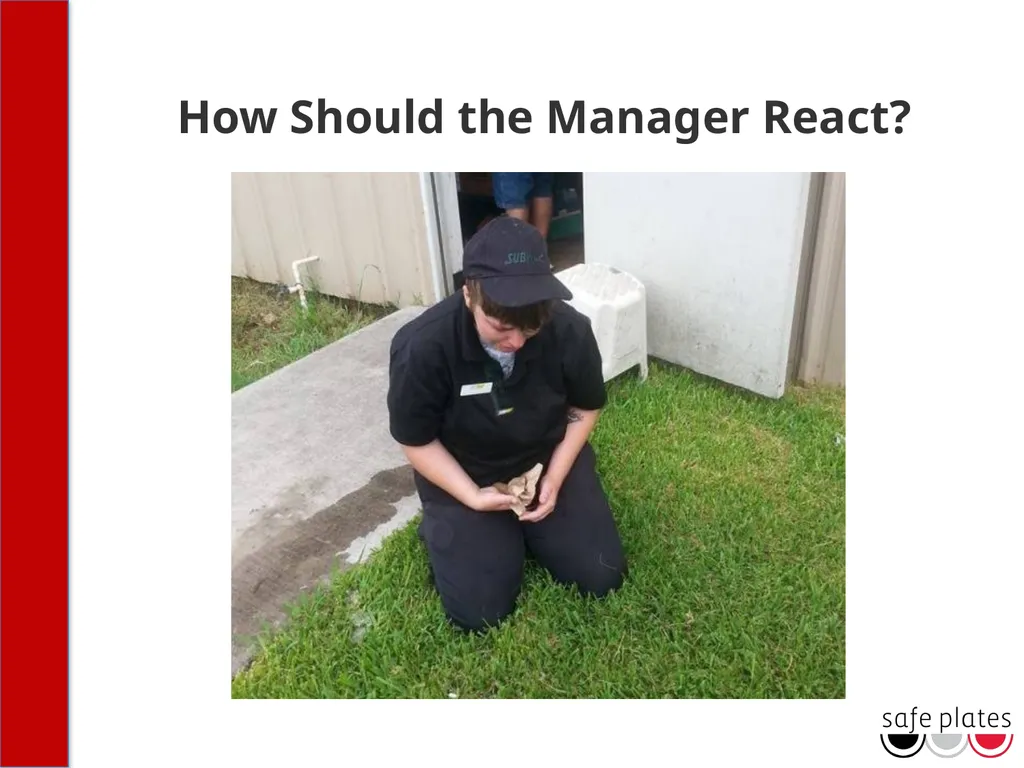
How Should the Manager React?<br>
08
The Huffington Post, 7/17/2014 She noticed vomit on her work clothes and, rather than take a pay cut for a new work shirt, phoned home for someone to bring her a clean outfit, she said. She also maintains she didn't leave work for fear of getting fired and losing her paycheck.
"I went and let my manager know, [but] she told me to find my own replacement after lunch rush."<br>
"I went and let my manager know, [but] she told me to find my own replacement after lunch rush."<br>
09
The Huffington Post, 7/17/2014 "I was on my knees [on the grass outside the restaurant], while [the manager] berated me with remarks such as 'you're so stupid, if you can't handle working while feeling ill you don't need to work here, all you had to do was switch shirts and finish your shift,'" Taff told HuffPost. "She told me I was fired since I was unable to talk, due to vomiting all over the place."<br>
10
Later, one of the employees took to Facebook to post a photo of Taff. The photo’s caption reads: “If you planned on eating at the Freeport Subway today, I'd advice you not to. I witnessed an employee vomiting and her manager telling her just to switch shirts.After calling EMS, it was discovered she had been breathing and serving food with a stomach bug that is contagious!!!!! Then they had the nerve to fire her for calling the ambulance after shaking and passing out!! Sad part she didn't call them, we did [all sic].”<br>
11
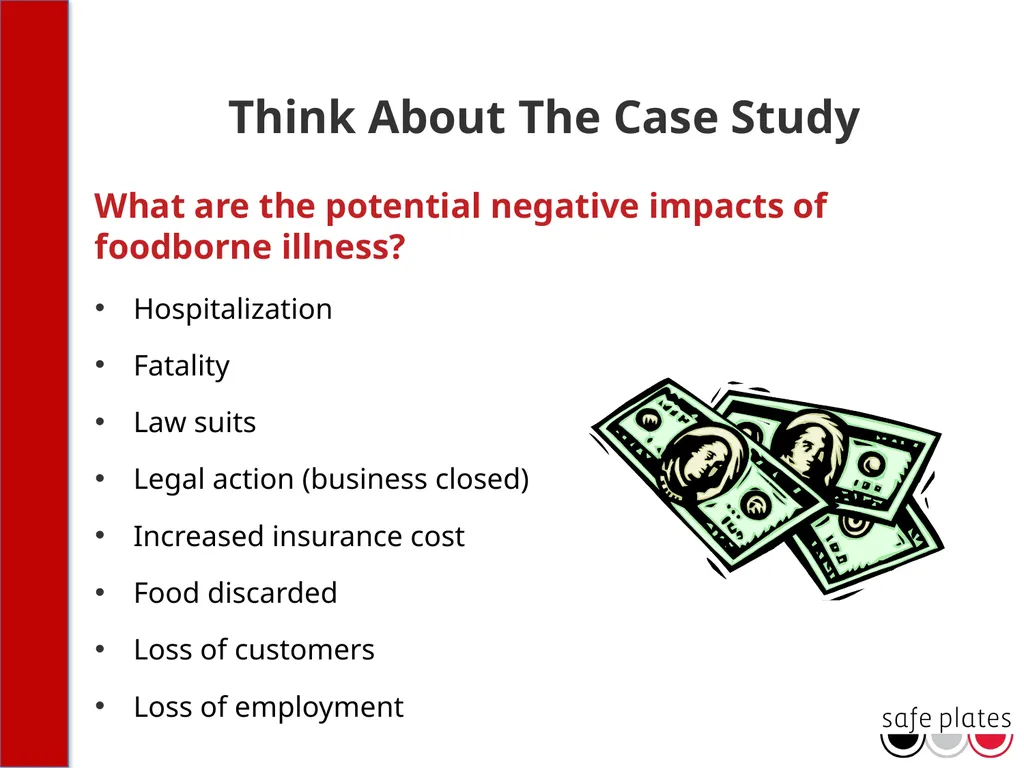
Think About The Case Study Hospitalization
Fatality
Law suits
Legal action (business closed)
Increased insurance cost
Food discarded
Loss of customers
Loss of employment What are the potential negative impacts of foodborne illness?<br>
Fatality
Law suits
Legal action (business closed)
Increased insurance cost
Food discarded
Loss of customers
Loss of employment What are the potential negative impacts of foodborne illness?<br>
12
Importance Of Food Safety Proper food safety prevents food contamination
Foodborne illness sickens approximately 1 in 6 Americans every year
48 million illnesses
128,000 hospitalizations
3,000 deaths
Estimated annual cost $51 – 77.7 billion<br>
Foodborne illness sickens approximately 1 in 6 Americans every year
48 million illnesses
128,000 hospitalizations
3,000 deaths
Estimated annual cost $51 – 77.7 billion<br>
13
Your Role Person in Charge (PIC) Active Management Control Reasonable Care The individual present at a food establishment who is responsible for the operation at the time of an inspection. A certified PIC should be present during all hours of operation. The responsibility of providing safe food for the consumer by developing and implementing food safety management systems to prevent, eliminate, or reduce the occurrence of foodborne illness risk factors. Management’s responsibility to take all reasonable precautions and care to avoid committing a violation of FDA Food Code.<br>
14
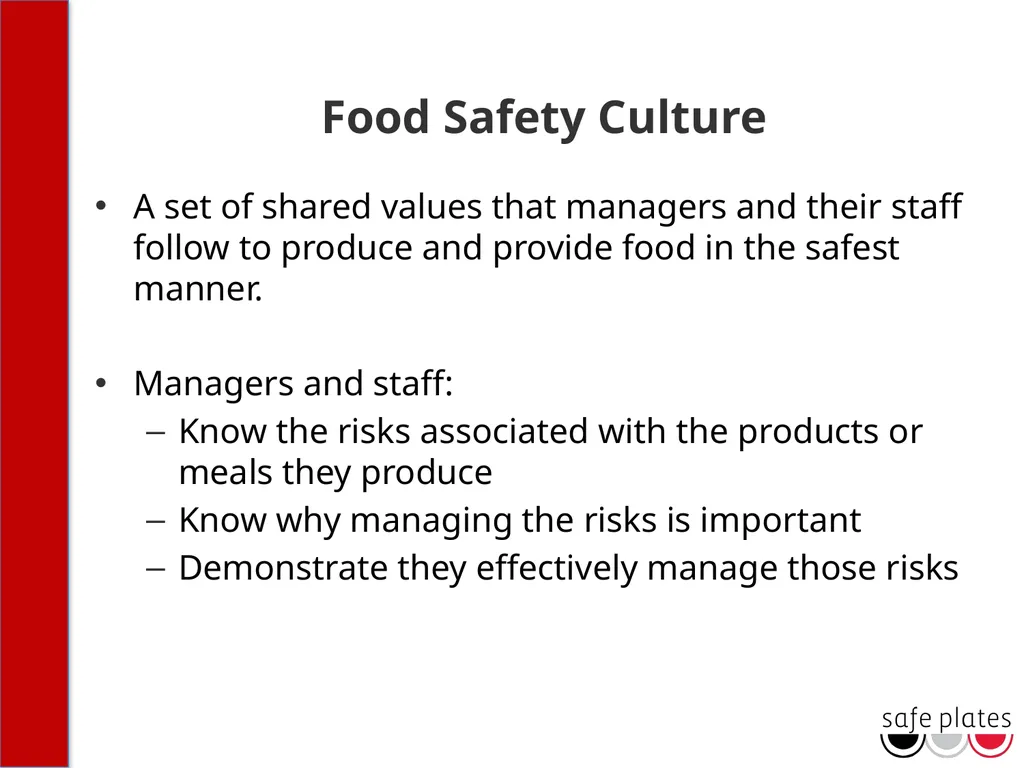
Food Safety Culture A set of shared values that managers and their staff follow to produce and provide food in the safest manner.
Managers and staff:
Know the risks associated with the products or meals they produce
Know why managing the risks is important
Demonstrate they effectively manage those risks<br>
Managers and staff:
Know the risks associated with the products or meals they produce
Know why managing the risks is important
Demonstrate they effectively manage those risks<br>
15
Think About The Case Study What kind of atmosphere did the manager create at their food establishment?<br>
16
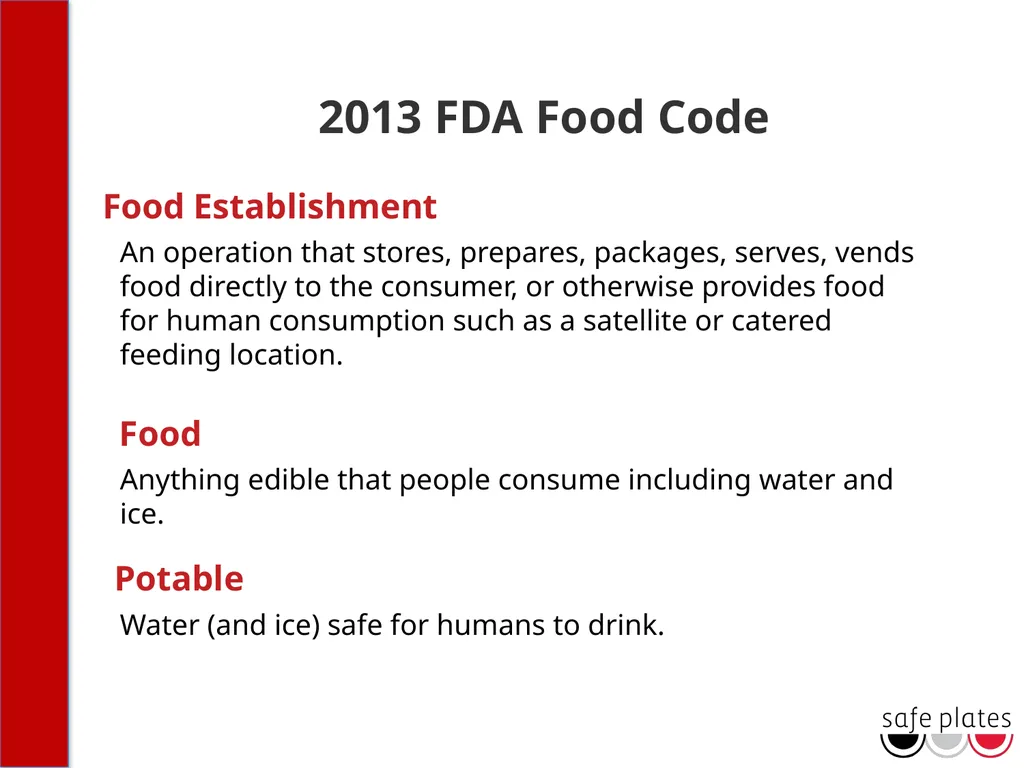
2013 FDA Food Code Food Establishment Food Potable An operation that stores, prepares, packages, serves, vends food directly to the consumer, or otherwise provides food for human consumption such as a satellite or catered feeding location. Anything edible that people consume including water and ice. Water (and ice) safe for humans to drink.<br>
17
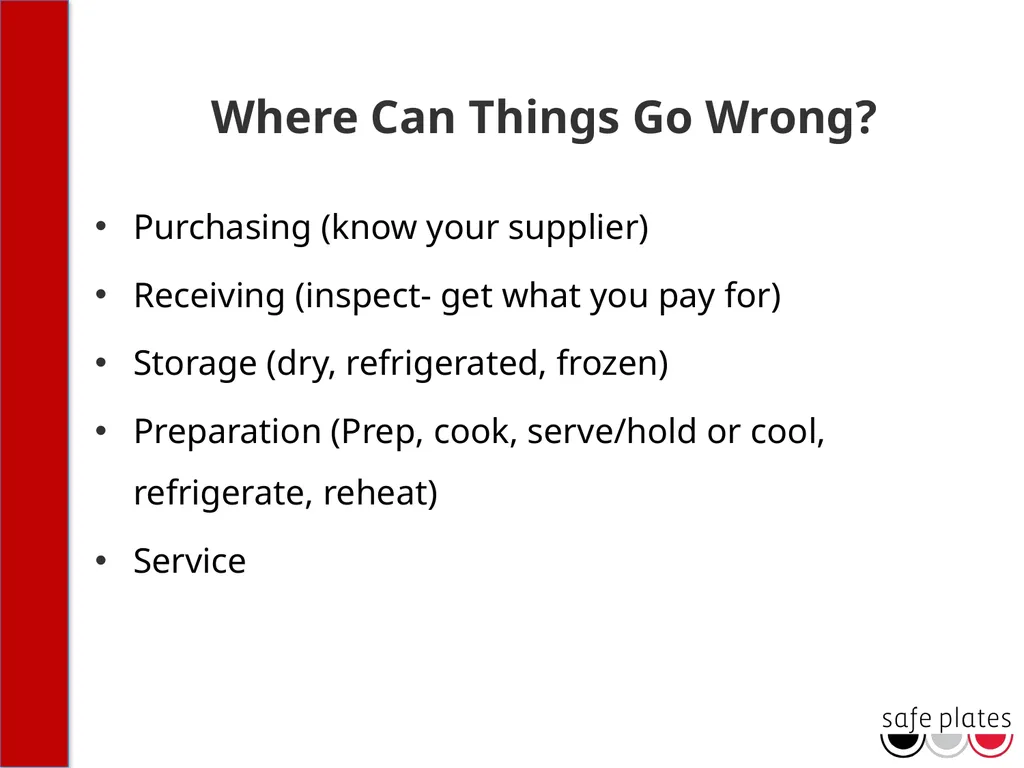
Where Can Things Go Wrong? Purchasing (know your supplier)
Receiving (inspect- get what you pay for)
Storage (dry, refrigerated, frozen)
Preparation (Prep, cook, serve/hold or cool, refrigerate, reheat)
Service<br>
Receiving (inspect- get what you pay for)
Storage (dry, refrigerated, frozen)
Preparation (Prep, cook, serve/hold or cool, refrigerate, reheat)
Service<br>
18
Most Common Factors Contributing to Foodborne Illness Food purchased from unsafe sources
Failure to cook food to correct temperature
Improper holding temperatures
Contaminated equipment
Poor personal hygiene According to the 2013 FDA Food Code<br>
Failure to cook food to correct temperature
Improper holding temperatures
Contaminated equipment
Poor personal hygiene According to the 2013 FDA Food Code<br>
19
Key Terms Hazard – anything that could cause harm to consumers. There are three general categories: physical, chemical and biological.
Contamination – presence of any harmful or objectionable substance or object in food
Vehicles of contamination - hands, utensils, items that can carry microbes onto food and cause contamination
Food contact surface – any surface contacted by food
Hand contact surface – surface touched by hand<br>
Contamination – presence of any harmful or objectionable substance or object in food
Vehicles of contamination - hands, utensils, items that can carry microbes onto food and cause contamination
Food contact surface – any surface contacted by food
Hand contact surface – surface touched by hand<br>
20
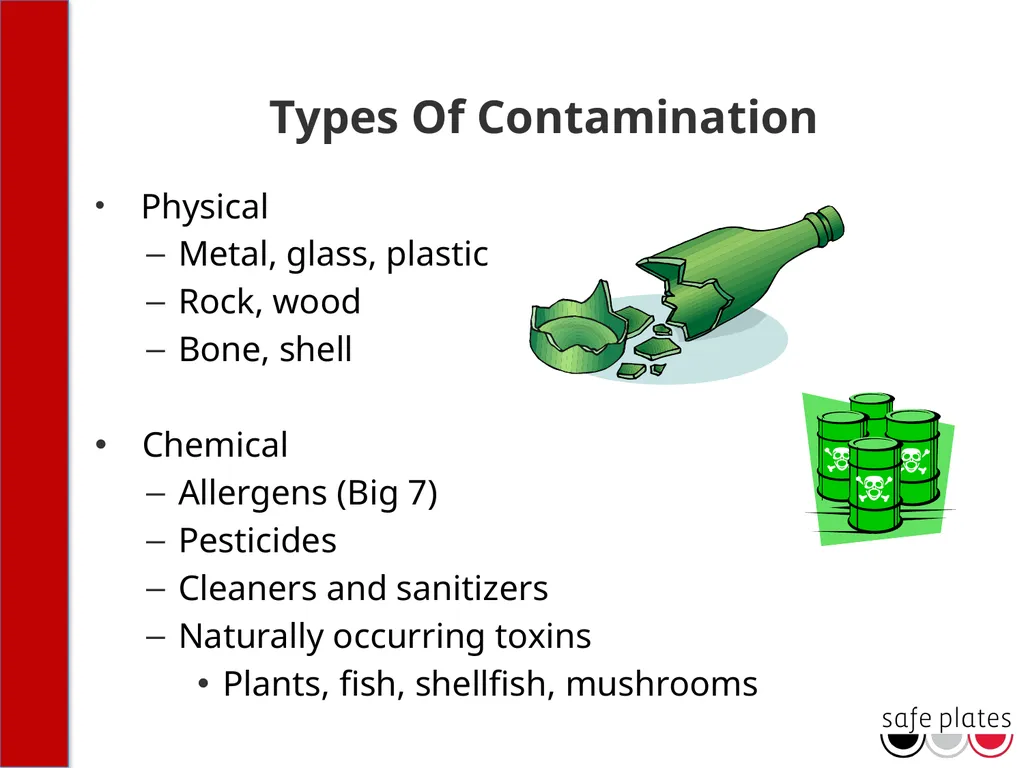
Types Of Contamination Physical
Metal, glass, plastic
Rock, wood
Bone, shell
Chemical
Allergens (Big 7)
Pesticides
Cleaners and sanitizers
Naturally occurring toxins
Plants, fish, shellfish, mushrooms<br>
Metal, glass, plastic
Rock, wood
Bone, shell
Chemical
Allergens (Big 7)
Pesticides
Cleaners and sanitizers
Naturally occurring toxins
Plants, fish, shellfish, mushrooms<br>
21
Types Of Contamination Biological
Bacteria
Fungi (molds, yeasts)
Viruses
Parasites<br>
Bacteria
Fungi (molds, yeasts)
Viruses
Parasites<br>
22
Pathogens Pathogen – a disease causing organism
Many foodborne pathogen illnesses go unreported
Individuals recover and do not seek medical assistance
Estimated that there are 30 cases of unreported foodborne illness for each case of reported illness for some pathogens<br>
Many foodborne pathogen illnesses go unreported
Individuals recover and do not seek medical assistance
Estimated that there are 30 cases of unreported foodborne illness for each case of reported illness for some pathogens<br>
23
Sources Of Pathogens Food handlers
Raw (not cooked or processed) foods
Contaminated water or ice
Soil
Pests and pets
Air, dust, dirt, and food waste<br>
Raw (not cooked or processed) foods
Contaminated water or ice
Soil
Pests and pets
Air, dust, dirt, and food waste<br>
24
Illnesses And Outbreaks Foodborne illness/disease – illness caused by consumption of contaminated food
Case – an instance of a person becoming ill from food; suspected or confirmed
Foodborne disease outbreak – two or more cases of a similar illness that result from eating a common food<br>
Case – an instance of a person becoming ill from food; suspected or confirmed
Foodborne disease outbreak – two or more cases of a similar illness that result from eating a common food<br>
25
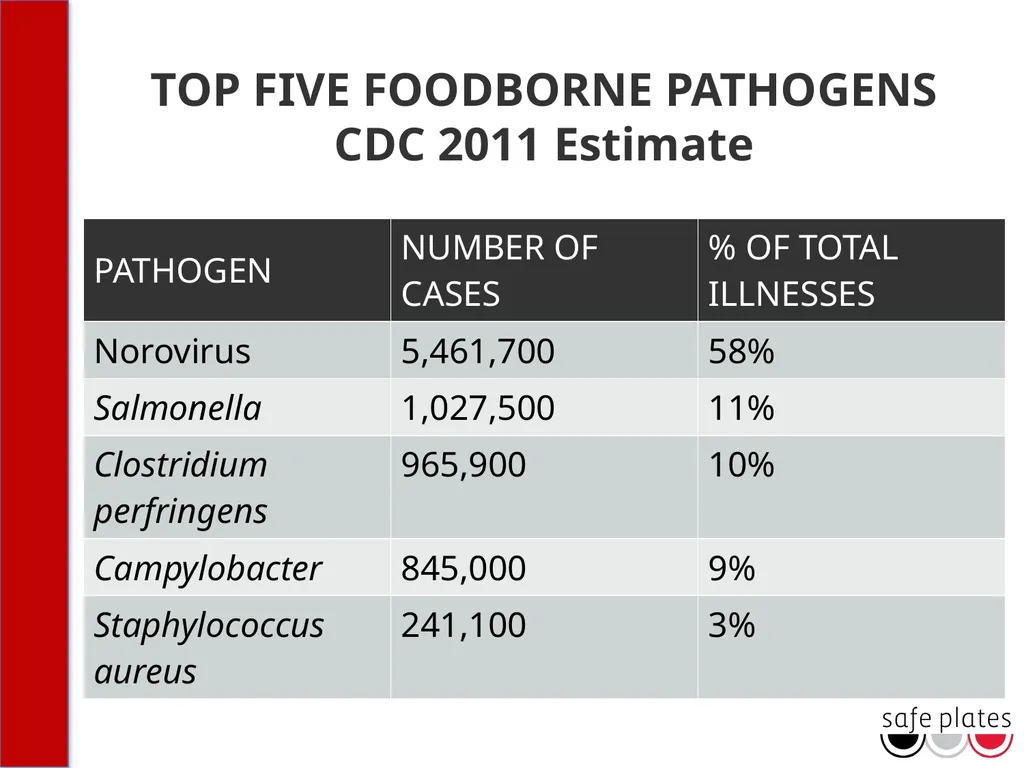
TOP FIVE FOODBORNE PATHOGENS
CDC 2011 Estimate<br>
26
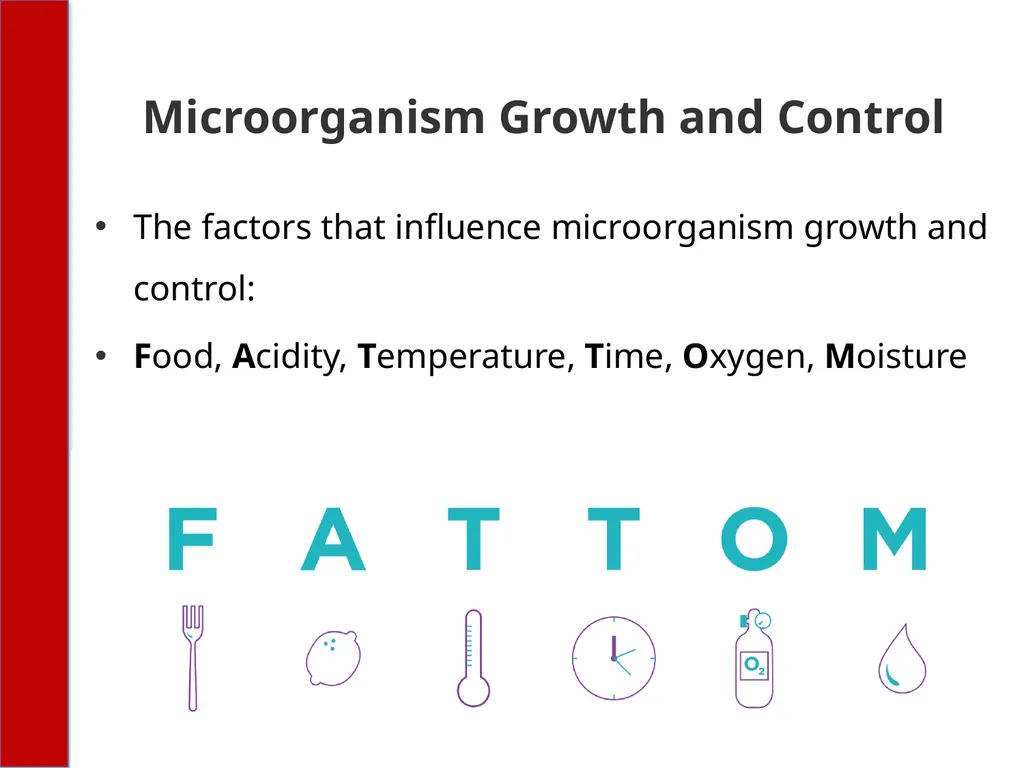
Microorganism Growth and Control The factors that influence microorganism growth and control:
Food, Acidity, Temperature, Time, Oxygen, Moisture<br>
Food, Acidity, Temperature, Time, Oxygen, Moisture<br>
27
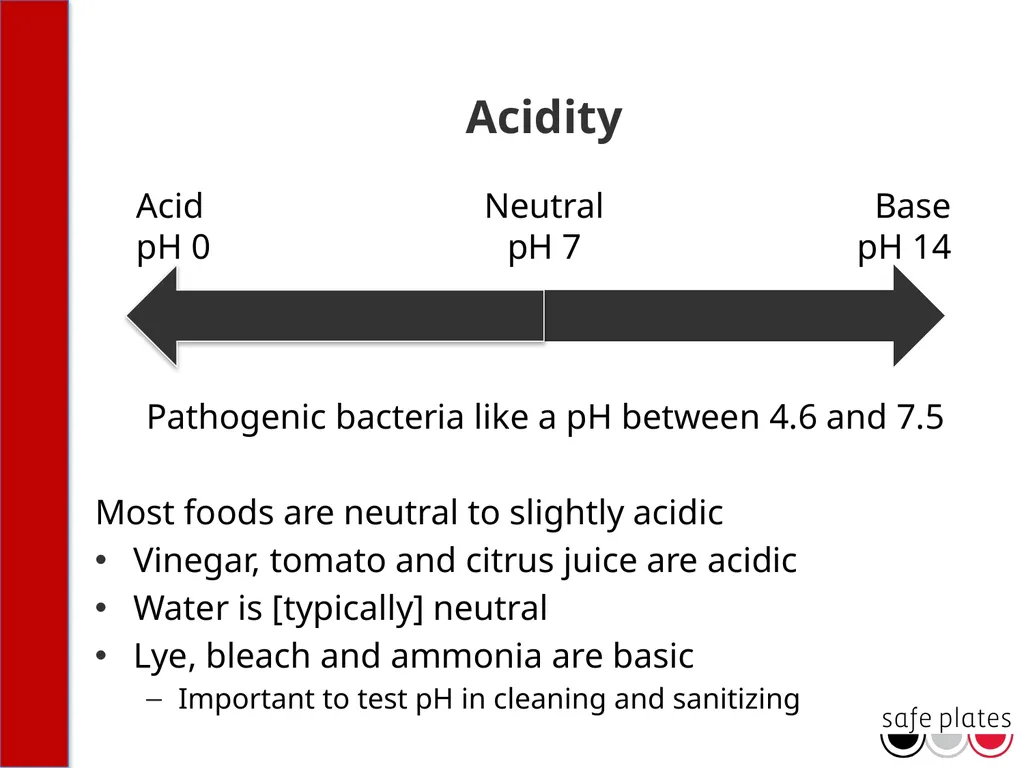
Acidity Pathogenic bacteria like a pH between 4.6 and 7.5
Most foods are neutral to slightly acidic
Vinegar, tomato and citrus juice are acidic
Water is [typically] neutral
Lye, bleach and ammonia are basic
Important to test pH in cleaning and sanitizing<br>
Most foods are neutral to slightly acidic
Vinegar, tomato and citrus juice are acidic
Water is [typically] neutral
Lye, bleach and ammonia are basic
Important to test pH in cleaning and sanitizing<br>
28
Moisture Pathogenic bacteria and fungi need moisture to feed and reproduce
The amount of available water or water activity (aw) is measured from 0-1.0.
Water has a aw of 1.0
Most bacteria need a aw of 0.85 to grow
Molds can grow on much drier food
Drying and adding sugar or salt can lower the amount of available water<br>
The amount of available water or water activity (aw) is measured from 0-1.0.
Water has a aw of 1.0
Most bacteria need a aw of 0.85 to grow
Molds can grow on much drier food
Drying and adding sugar or salt can lower the amount of available water<br>
29
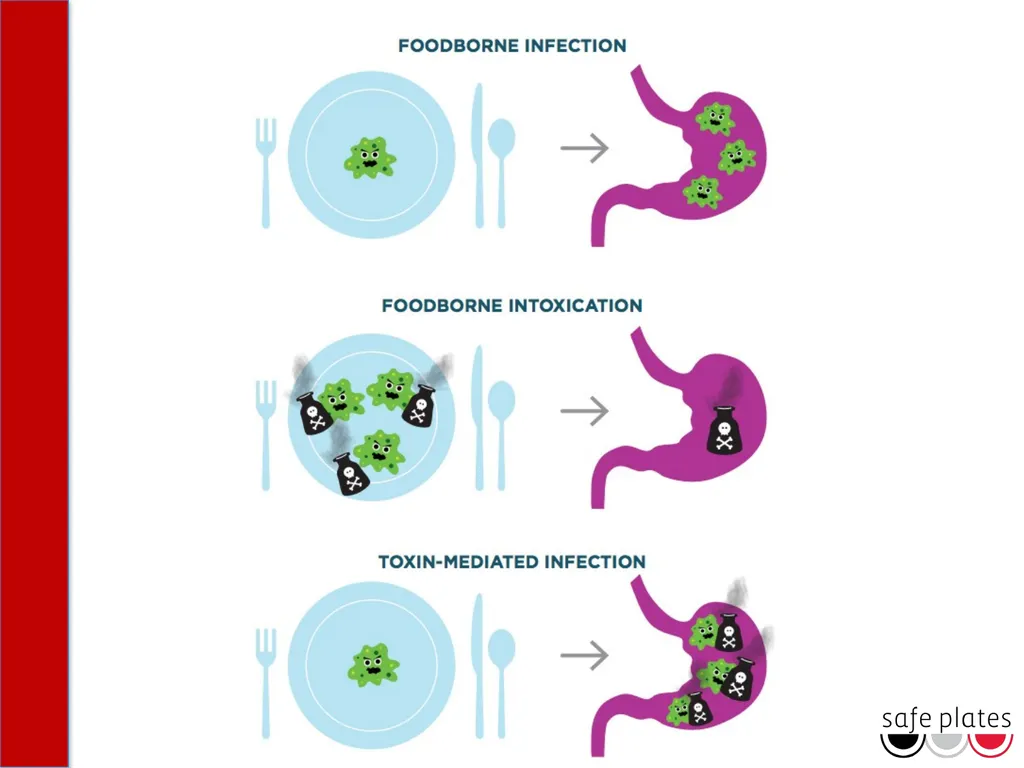
How Pathogens Make Us Sick Foodborne Infection – illness caused by pathogenic microorganisms that live and grow in your body after eating contaminated food
Foodborne Intoxication – illness caused by toxins (poisons) that have been produced by microorganisms in food
Toxin-mediated Infection – illness caused by eating live pathogens that produce toxins in stomach or intestine<br>
Foodborne Intoxication – illness caused by toxins (poisons) that have been produced by microorganisms in food
Toxin-mediated Infection – illness caused by eating live pathogens that produce toxins in stomach or intestine<br>
30
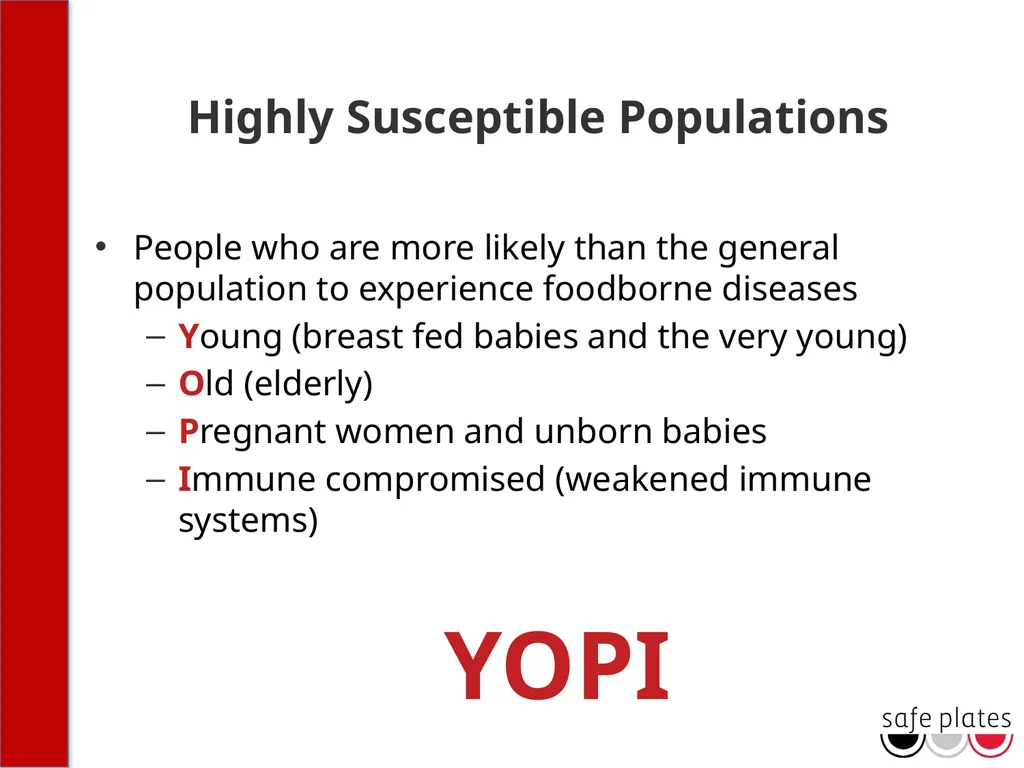
Highly Susceptible Populations People who are more likely than the general population to experience foodborne diseases
Young (breast fed babies and the very young)
Old (elderly)
Pregnant women and unborn babies
Immune compromised (weakened immune systems)
YOPI<br>
Young (breast fed babies and the very young)
Old (elderly)
Pregnant women and unborn babies
Immune compromised (weakened immune systems)
YOPI<br>
31
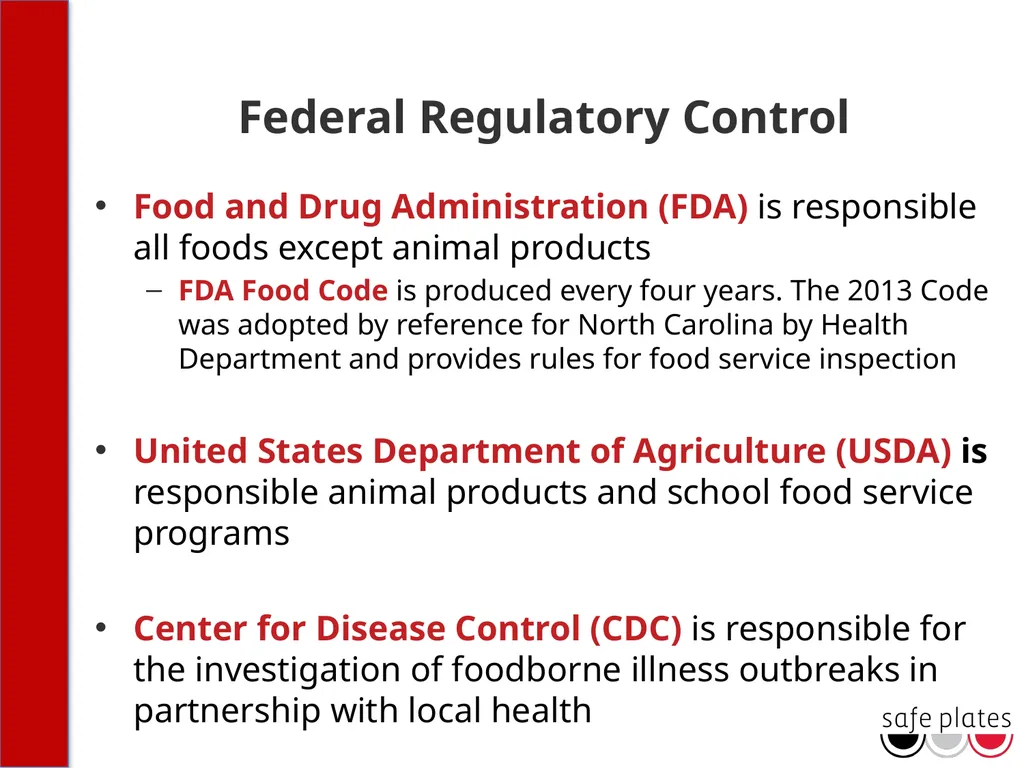
Federal Regulatory Control Food and Drug Administration (FDA) is responsible all foods except animal products
FDA Food Code is produced every four years. The 2013 Code was adopted by reference for North Carolina by Health Department and provides rules for food service inspection
United States Department of Agriculture (USDA) is responsible animal products and school food service programs
Center for Disease Control (CDC) is responsible for the investigation of foodborne illness outbreaks in partnership with local health<br>
FDA Food Code is produced every four years. The 2013 Code was adopted by reference for North Carolina by Health Department and provides rules for food service inspection
United States Department of Agriculture (USDA) is responsible animal products and school food service programs
Center for Disease Control (CDC) is responsible for the investigation of foodborne illness outbreaks in partnership with local health<br>
32
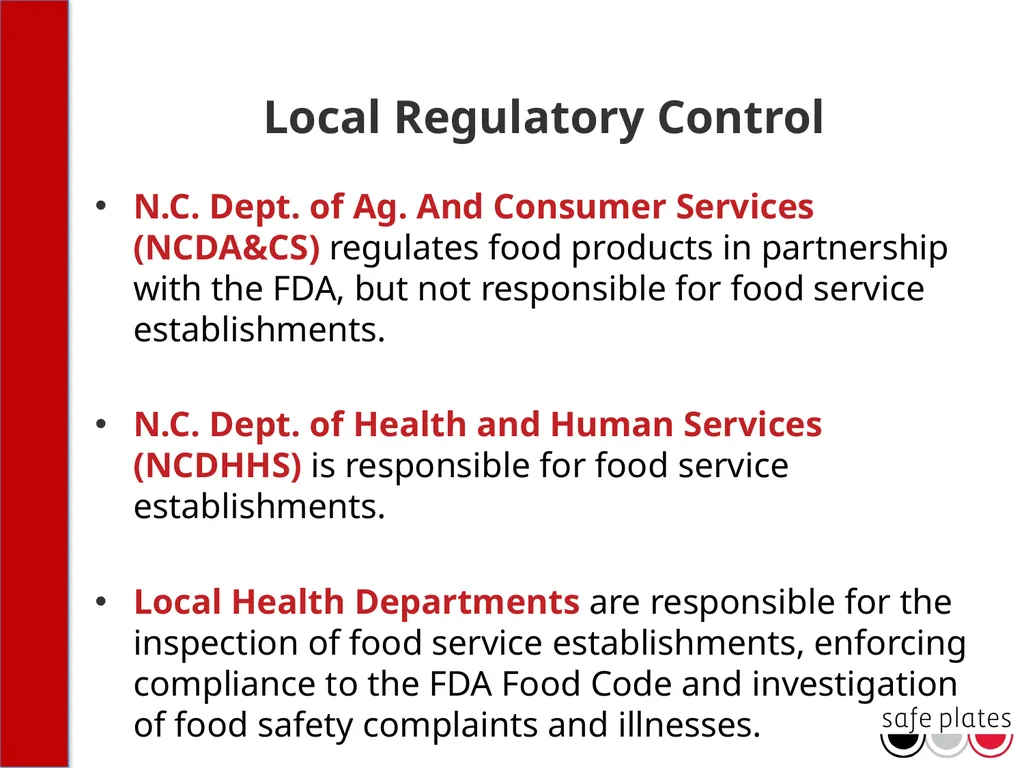
Local Regulatory Control N.C. Dept. of Ag. And Consumer Services (NCDA&CS) regulates food products in partnership with the FDA, but not responsible for food service establishments.
N.C. Dept. of Health and Human Services (NCDHHS) is responsible for food service establishments.
Local Health Departments are responsible for the inspection of food service establishments, enforcing compliance to the FDA Food Code and investigation of food safety complaints and illnesses.<br>
N.C. Dept. of Health and Human Services (NCDHHS) is responsible for food service establishments.
Local Health Departments are responsible for the inspection of food service establishments, enforcing compliance to the FDA Food Code and investigation of food safety complaints and illnesses.<br>
33
Remember Our Case Study? "I was on my knees [on the grass outside the restaurant], while [the manager] berated me with remarks such as 'you're so stupid, if you can't handle working while feeling ill you don't need to work here, all you had to do was switch shirts and finish your shift.’”
Food safety can seem complicated:
Know the risks
Know why it's important
Manage and minimize the risks<br>
Food safety can seem complicated:
Know the risks
Know why it's important
Manage and minimize the risks<br>