
INTRODUCTION Military railroads operate basically
MS
Published · 95 slides · 0 views
1 / 1




Description
INTRODUCTION Military railroads operate basically on the same principles as commercial railroads. Locomotives pull rail cars, loaded with freight or passengers, over miles of track called a division; train movements are controlled by some
Related Topics
Share
Embed code
Download this presentation From Below
"INTRODUCTION Military railroads operate basically" is the property of its rightful owner. Permission is granted to download and print the materials on this website for personal, non-commercial use only, and to display it on your personal computer provided you do not modify the materials and that you retain all copyright notices contained in the materials. By downloading content from our website, you accept the terms of this agreement.
Presentation Transcript
01
INTRODUCTION
Military railroads operate basically on the same
principles as commercial railroads. Locomotives pull rail
cars, loaded with freight or passengers, over miles of track
called a division; train movements are controlled by some sort
of schedule or signal communication; some trains have
superiority over others. The transportation
railway service (TRS), with a mission of
operating and maintaining the military
railroads in a theater of operations, is
organized like any of the commercial railroads in
the United States to carry out four functions: train
operation, maintenance of way, maintenance of equipment, and train
control.
Between the two types of railroads, however, are big
differences. Civilian railroads are built and operated to make money
for their owners; they compete with each other; they offer many
conveniences to passengers and shippers. They must meet all the
legal requirements set up by the Interstate Commerce Commission,
Department of Transportation Federal Railroad Administration and the
Association of American Railroads as well as the agreements made with
organized labor groups. Military railroads, on the other hand, must
be operated economically but the foremost economy is not money.
Time, material, and manpower are the principal things that must not
be wasted; they bring profit to our Government in the form of success
in battle. Conveniences must often be sacrificed; to get troops and
supplies where they are needed on time is the first aim of the TRS in
a theater of operations. Military needs come before legal
requirements, and manpower is used to the maximum.<br>
Military railroads operate basically on the same
principles as commercial railroads. Locomotives pull rail
cars, loaded with freight or passengers, over miles of track
called a division; train movements are controlled by some sort
of schedule or signal communication; some trains have
superiority over others. The transportation
railway service (TRS), with a mission of
operating and maintaining the military
railroads in a theater of operations, is
organized like any of the commercial railroads in
the United States to carry out four functions: train
operation, maintenance of way, maintenance of equipment, and train
control.
Between the two types of railroads, however, are big
differences. Civilian railroads are built and operated to make money
for their owners; they compete with each other; they offer many
conveniences to passengers and shippers. They must meet all the
legal requirements set up by the Interstate Commerce Commission,
Department of Transportation Federal Railroad Administration and the
Association of American Railroads as well as the agreements made with
organized labor groups. Military railroads, on the other hand, must
be operated economically but the foremost economy is not money.
Time, material, and manpower are the principal things that must not
be wasted; they bring profit to our Government in the form of success
in battle. Conveniences must often be sacrificed; to get troops and
supplies where they are needed on time is the first aim of the TRS in
a theater of operations. Military needs come before legal
requirements, and manpower is used to the maximum.<br>
02
Many problems must be faced and solved before setting up a
railway service in a theater of operations. After the service has
been started, three phases of operation are used to obtain maximum
service out of the railways and their facilities. From your study of
the first chapter in this reference text, you should be able to
describe the basis for selecting rail lines and the phases of
operation after the lines are in use. After studying chapter 2, you
should be able to explain how the transportation railway service is
controlled and why it must have a close working relationship with
other
1
agencies. From your study of chapter 3, you should be able to
describe the types of trains and the procedures in operating them.
Annex A is provided to help the reader understand manual block
operation, described in chapter 3.<br>
railway service in a theater of operations. After the service has
been started, three phases of operation are used to obtain maximum
service out of the railways and their facilities. From your study of
the first chapter in this reference text, you should be able to
describe the basis for selecting rail lines and the phases of
operation after the lines are in use. After studying chapter 2, you
should be able to explain how the transportation railway service is
controlled and why it must have a close working relationship with
other
1
agencies. From your study of chapter 3, you should be able to
describe the types of trains and the procedures in operating them.
Annex A is provided to help the reader understand manual block
operation, described in chapter 3.<br>
03
1.1. GENERAL
Military forces operating in a theater generally use existing
railways because constructing new ones is both timeconsuming
and
expensive. What existing rail lines are selected for use? The
tactical situation naturally influences the selection; for example,
those leading into or running parallel to the rear areas of
battlelines are extremely valuable for rapid troop and supply
movements, but how vulnerable are they to enemy penetration? The
selection of a rail line also depends not only on its strategic
importance to an operation but also on its technical or physical
characteristics, such as its yards, shop facilities, and track.
This chapter describes why one rail line is selected before
another. It ends with an explanation of how the transportation
railway service (TRS) has solved the problem of finding enough
skilled men to operate and maintain the trains and all the facilities
required to keep them running.<br>
Military forces operating in a theater generally use existing
railways because constructing new ones is both timeconsuming
and
expensive. What existing rail lines are selected for use? The
tactical situation naturally influences the selection; for example,
those leading into or running parallel to the rear areas of
battlelines are extremely valuable for rapid troop and supply
movements, but how vulnerable are they to enemy penetration? The
selection of a rail line also depends not only on its strategic
importance to an operation but also on its technical or physical
characteristics, such as its yards, shop facilities, and track.
This chapter describes why one rail line is selected before
another. It ends with an explanation of how the transportation
railway service (TRS) has solved the problem of finding enough
skilled men to operate and maintain the trains and all the facilities
required to keep them running.<br>
04
1.2. STRATEGIC IMPORTANCE
If a theater of operations has a highly developed rail net,
selection of certain lines over others is made on the basis of their
strategic importance to the military operation. First, what is the
planned strategy of attack? And what is the probable objective of
the operation? The answers to these questions will certainly help
the planners select the railways most important as support lines.<br>
If a theater of operations has a highly developed rail net,
selection of certain lines over others is made on the basis of their
strategic importance to the military operation. First, what is the
planned strategy of attack? And what is the probable objective of
the operation? The answers to these questions will certainly help
the planners select the railways most important as support lines.<br>
05
Second, where will the lines of advance be? Rail lines leading
in the general direction of the lines of advance are selected as the
primary supply route. Third, what are the enemy dispositions?
Before making a decision, those responsible for selecting the best
rail lines want to know the strength of enemy forces, where they are
located, and what types of units they have at strategic locations.
Rail lines are vulnerable to enemy penetration. For instance, if you
knew that a hostile unit were positioned so that it posed a threat to
rail operations in a certain area, you would select, if possible, a
rail line that would avoid that area.
After the primary rail lines have been selected, alternative
lines should be chosen, in case the others are cut by enemy action,
tied up by a railway accident, or impaired by washouts, landslides,
or floods.<br>
in the general direction of the lines of advance are selected as the
primary supply route. Third, what are the enemy dispositions?
Before making a decision, those responsible for selecting the best
rail lines want to know the strength of enemy forces, where they are
located, and what types of units they have at strategic locations.
Rail lines are vulnerable to enemy penetration. For instance, if you
knew that a hostile unit were positioned so that it posed a threat to
rail operations in a certain area, you would select, if possible, a
rail line that would avoid that area.
After the primary rail lines have been selected, alternative
lines should be chosen, in case the others are cut by enemy action,
tied up by a railway accident, or impaired by washouts, landslides,
or floods.<br>
06
1.3. TECHNICAL ASPECTS
Because operating a railway is a highly technical business, a
great deal of thought must be given to the technical aspects of
existing rail lines and facilities if rail operations are to be
successful. Some of the most important technical characteristics,
both desirable and undesirable, are described in the following
subparagraphs.
a. Classification of railways. Railways are classified according
to their gagethe
distance between the heads of the parallel rails,
measured fiveeighthsinch
below the top of the rails. This
measurement is shown by the broken line in the inserted sketch. The
general gage classifications are standard, broad, narrow, and meter.
Approximately 60 percent of the railway mileage in the world is
standard gage, 56 1/2 inches wide. Broadgage
railways are 66, 63,
and 60 inches wide; narrowgage
railways are 42 and 36 inches and
narrower widths; and metergage
railways are 39 3/8 inches wide. For
defense, some countries construct railways with a different gage from
that used by neighboring countries. Rail equipment built for one
gage does not operate on other gages.<br>
Because operating a railway is a highly technical business, a
great deal of thought must be given to the technical aspects of
existing rail lines and facilities if rail operations are to be
successful. Some of the most important technical characteristics,
both desirable and undesirable, are described in the following
subparagraphs.
a. Classification of railways. Railways are classified according
to their gagethe
distance between the heads of the parallel rails,
measured fiveeighthsinch
below the top of the rails. This
measurement is shown by the broken line in the inserted sketch. The
general gage classifications are standard, broad, narrow, and meter.
Approximately 60 percent of the railway mileage in the world is
standard gage, 56 1/2 inches wide. Broadgage
railways are 66, 63,
and 60 inches wide; narrowgage
railways are 42 and 36 inches and
narrower widths; and metergage
railways are 39 3/8 inches wide. For
defense, some countries construct railways with a different gage from
that used by neighboring countries. Rail equipment built for one
gage does not operate on other gages.<br>
07
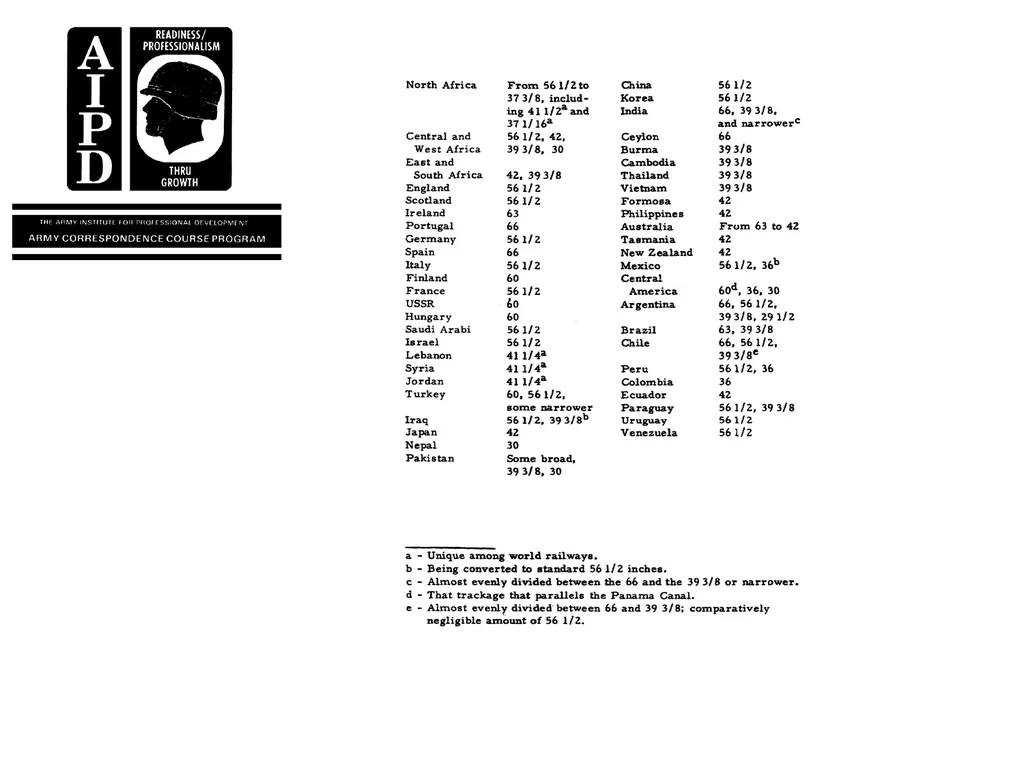
Track gages vary within a country or area, from country to
country, and from continent to continent; table I presents the track
gages found in principal countries and regions of the world.
b. Desirable physical characteristics. The railway system in a
theater of operations may be large enough and complex enough to
afford a choice of the part or parts to be used. Certain physical
characteristics are desirable and must be examined, because they
influence the decision in selecting one railroad instead of another.<br>
country, and from continent to continent; table I presents the track
gages found in principal countries and regions of the world.
b. Desirable physical characteristics. The railway system in a
theater of operations may be large enough and complex enough to
afford a choice of the part or parts to be used. Certain physical
characteristics are desirable and must be examined, because they
influence the decision in selecting one railroad instead of another.<br>
08
yards or terminals. Without adequate yards and terminals, main lines
become congested. Whenever possible, terminal yards should contain
tracks for receiving trains, classifying cars, and making up trains
for departure. The tracks in these yards should be long enough to
hold the longest train to be operated on that rail division.
Facilities are needed to spot cars, unload them, and promptly return
the empties to service. A terminal should include an enginehouse,
car repair tracks, fuel and water stations, and buildings to house
crews of the railway battalion. The heavy repair and maintenance of
rail equipment require adequate shops, located at or near yards and
terminals.<br>
become congested. Whenever possible, terminal yards should contain
tracks for receiving trains, classifying cars, and making up trains
for departure. The tracks in these yards should be long enough to
hold the longest train to be operated on that rail division.
Facilities are needed to spot cars, unload them, and promptly return
the empties to service. A terminal should include an enginehouse,
car repair tracks, fuel and water stations, and buildings to house
crews of the railway battalion. The heavy repair and maintenance of
rail equipment require adequate shops, located at or near yards and
terminals.<br>
09
(2) Single, double, or multiple track. Train density and
overall rail capability are greatly affected by the type and number
of tracks. If there is a usable double track, trains may operate in
both directions without delays in schedules. However, the
transportation railway service often takes the usable parts of a
damaged double track to make one single main line with good passing
tracks.
(3) Seasoned roadbed, good ballast, and heavy rail. The
roadbed, ballast, and weight of the rails affect the speed and weight
of trains. If the railway with the most seasoned roadbed, the best
ballast and the heaviest rail is selected, the number of
interruptions in train operations caused by washouts and buckled rail
is generally reduced.<br>
overall rail capability are greatly affected by the type and number
of tracks. If there is a usable double track, trains may operate in
both directions without delays in schedules. However, the
transportation railway service often takes the usable parts of a
damaged double track to make one single main line with good passing
tracks.
(3) Seasoned roadbed, good ballast, and heavy rail. The
roadbed, ballast, and weight of the rails affect the speed and weight
of trains. If the railway with the most seasoned roadbed, the best
ballast and the heaviest rail is selected, the number of
interruptions in train operations caused by washouts and buckled rail
is generally reduced.<br>
10
(4) Slight grade and curve. Operating trains in mountains with
steep grades requires more motive power. Steep grades usually
require pusher engines at the rear of a train, two or more
locomotives pulling or doubleheaded at the front of a train, or
shorter trains. Strong pulling and sudden braking are hard on rail
cars; they require more maintenance than those used on fairly level
grade.
Running time over a railway is greatly increased if the
line has sharp or long curves. A speed that can be reached on a
straight run of track cannot be maintained on curving track. The
ideal railway, with no grades and no curves, is never realized, but
the rail lines with the slightest grade and fewest, gentlest curves
should be selected<br>
steep grades requires more motive power. Steep grades usually
require pusher engines at the rear of a train, two or more
locomotives pulling or doubleheaded at the front of a train, or
shorter trains. Strong pulling and sudden braking are hard on rail
cars; they require more maintenance than those used on fairly level
grade.
Running time over a railway is greatly increased if the
line has sharp or long curves. A speed that can be reached on a
straight run of track cannot be maintained on curving track. The
ideal railway, with no grades and no curves, is never realized, but
the rail lines with the slightest grade and fewest, gentlest curves
should be selected<br>
11
(5) Adequate sidings and spurs. Sidings and passing tracks
should be long enough to permit the longest train on the division to
clear the mainline
track completely. Spurs are short rail lines
extending from main lines that can be used to load and unload cars or
to store cars; if they are long enough, one train can be held
6
on them while another train passes on the main track. Although spurs
are desirable, they are not a major basis in selecting rail lines.<br>
should be long enough to permit the longest train on the division to
clear the mainline
track completely. Spurs are short rail lines
extending from main lines that can be used to load and unload cars or
to store cars; if they are long enough, one train can be held
6
on them while another train passes on the main track. Although spurs
are desirable, they are not a major basis in selecting rail lines.<br>
12
(6) Strong bridges and tunnels of sufficient clearance. The
strength of railway bridges directly affects the kind of locomotives
operated over them. If bridges, must be rehabilitated or
constructed, they should be made strong enough to support the
locomotives to be run over them. Any tunnels on the railway should
have sufficient clearance to allow passage of such wide and high
loads as bulldozers and cranes.
c. Undesirable physical characteristics. The railway selected
should have a minimum number of vulnerable points where traffic could
possibly be interrupted. Tracks located near high banks or streams
are highly susceptible to washouts or floods. Tunnels with
restrictive clearances prevent moving outsize equipment. Long
bridges or bridges over deep or wide streams are quite vulnerable to
enemy attack. Improperly constructed terminals cause congestion.
Deep cuts and high fills should be avoided whenever possible.<br>
strength of railway bridges directly affects the kind of locomotives
operated over them. If bridges, must be rehabilitated or
constructed, they should be made strong enough to support the
locomotives to be run over them. Any tunnels on the railway should
have sufficient clearance to allow passage of such wide and high
loads as bulldozers and cranes.
c. Undesirable physical characteristics. The railway selected
should have a minimum number of vulnerable points where traffic could
possibly be interrupted. Tracks located near high banks or streams
are highly susceptible to washouts or floods. Tunnels with
restrictive clearances prevent moving outsize equipment. Long
bridges or bridges over deep or wide streams are quite vulnerable to
enemy attack. Improperly constructed terminals cause congestion.
Deep cuts and high fills should be avoided whenever possible.<br>
13
1.4 USING EXISTING FACILITIES
As the theater of operations expands and forces advance,
existing tracks and facilities are used as much as possible.
Captured track is rehabilitated when needed. Constructing new track
is avoided if possible because of the manpower required for it.
However, when new construction would take less time and manpower than
rehabilitation, it may be advisable to construct new track and
facilities.
Those facilities that may require rehabilitation or new
construction are yards, sidings, fuel and water stations, signal
systems, telephone and telegraph lines, and engine houses. Whether
to rehabilitate existing facilities or to construct new ones is
dependent upon their being ready for immediate rather than permanent
use. The following are general regulations governing the
construction or rehabilitation of facilities.<br>
As the theater of operations expands and forces advance,
existing tracks and facilities are used as much as possible.
Captured track is rehabilitated when needed. Constructing new track
is avoided if possible because of the manpower required for it.
However, when new construction would take less time and manpower than
rehabilitation, it may be advisable to construct new track and
facilities.
Those facilities that may require rehabilitation or new
construction are yards, sidings, fuel and water stations, signal
systems, telephone and telegraph lines, and engine houses. Whether
to rehabilitate existing facilities or to construct new ones is
dependent upon their being ready for immediate rather than permanent
use. The following are general regulations governing the
construction or rehabilitation of facilities.<br>
14
a. Main lines, yards, and sidings. When new construction is
required, planning for the location and layout of tracks is of great
importance, to take care of not only current needs but also
future requirements. For rehabilitation, the general track
surface must be good enough to meet immediate requirements. Track
improvement is undertaken only when necessary to meet minimum
requirements for safe operation.<br>
required, planning for the location and layout of tracks is of great
importance, to take care of not only current needs but also
future requirements. For rehabilitation, the general track
surface must be good enough to meet immediate requirements. Track
improvement is undertaken only when necessary to meet minimum
requirements for safe operation.<br>
15
b. Water and fuel stations. Any suitable facilities are used for
fuel and water stations. However, where no water and oil stations
exist, they may be improvised by placing filled rail tank cars at
strategic points along the line. Here are two of the many ways to
improvise coal stations needed when steam locomotives are in use.
Loaded coal cars may be placed on a ramp and the coal emptied into
the locomotive tenders; or hopper cars containing coal may be placed
on a siding and coal shoveled by hand into the tenders, or unloaded
through openings in cars equipped with doors to discharge lading.
c. Signal systems. On newly constructed or rehabilitated lines,
signals of the simplest kind are installed. Automatic block signals
and interlocking switches are used and maintained only when already
in existence; if used, however, they require tight security since
they are highly vulnerable to sabotage.<br>
fuel and water stations. However, where no water and oil stations
exist, they may be improvised by placing filled rail tank cars at
strategic points along the line. Here are two of the many ways to
improvise coal stations needed when steam locomotives are in use.
Loaded coal cars may be placed on a ramp and the coal emptied into
the locomotive tenders; or hopper cars containing coal may be placed
on a siding and coal shoveled by hand into the tenders, or unloaded
through openings in cars equipped with doors to discharge lading.
c. Signal systems. On newly constructed or rehabilitated lines,
signals of the simplest kind are installed. Automatic block signals
and interlocking switches are used and maintained only when already
in existence; if used, however, they require tight security since
they are highly vulnerable to sabotage.<br>
16
d. Telephone and telegraph lines. The most dependable and
expedient method of dispatching trains is by telephone. Any existing
telegraph lines are easily converted for telephone operations. When
sidings are equipped with telephone boxes, train crews can aid the
train dispatcher in moving trains in emergencies.
e. Enginehouses.
Roundhouses and turntables are easily
recognizable from the air. In an area subject to enemy aerial
bombardment, such enginehouse
facilities may have to be avoided. If
roundhouses and turntables do exist, all precautions should be taken
to insure that locomotives will not become useless if the facilities
are disabled. Newly constructed enginehouses
should be simple frame
structures without complicated windows and doors.<br>
expedient method of dispatching trains is by telephone. Any existing
telegraph lines are easily converted for telephone operations. When
sidings are equipped with telephone boxes, train crews can aid the
train dispatcher in moving trains in emergencies.
e. Enginehouses.
Roundhouses and turntables are easily
recognizable from the air. In an area subject to enemy aerial
bombardment, such enginehouse
facilities may have to be avoided. If
roundhouses and turntables do exist, all precautions should be taken
to insure that locomotives will not become useless if the facilities
are disabled. Newly constructed enginehouses
should be simple frame
structures without complicated windows and doors.<br>
17
Wyes like the one sketched are needed to change the direction
of engines. With a pencil, trace the route that an engine or an
entire train takes as it leaves the main line through switch A,
continues down the wye until it clears switch C, and then backs past
switches C and B. Now it is on the main line again and ready to run
in the opposite direction.<br>
of engines. With a pencil, trace the route that an engine or an
entire train takes as it leaves the main line through switch A,
continues down the wye until it clears switch C, and then backs past
switches C and B. Now it is on the main line again and ready to run
in the opposite direction.<br>
18
1.5. PHASES OF OPERATION
As theater territorial limits expand, the problem of supplying
skilled people for rail operations becomes acute. To cope with this
problem, the TRS sets up rail operations in three phases to allow
employment of skilled civilians in rear areas and to release military
men for use in forward areas. Since the phase used depends upon the
existing situation, the order in which the phases are put into effect
does not follow a set pattern. They are discussed in paragraphs 1.6,
1.7, and 1.8.<br>
As theater territorial limits expand, the problem of supplying
skilled people for rail operations becomes acute. To cope with this
problem, the TRS sets up rail operations in three phases to allow
employment of skilled civilians in rear areas and to release military
men for use in forward areas. Since the phase used depends upon the
existing situation, the order in which the phases are put into effect
does not follow a set pattern. They are discussed in paragraphs 1.6,
1.7, and 1.8.<br>
19
1.6. PHASE I
Carried on exclusively by the military, phase I operation is
normally used in combat areas or immediately following the successful
establishment of a lodgment. In a military sense, lodgment means
occupying and holding a position in hostile territory; for example,
gaining a beachhead. Phase I operation is used more often in or near
the combat zone when effective control and operation of existing
lines can be insured only by having railroad troops under a unified
command. Using phase I operation in forward areas and at the
beginning of an operation is required, because under the Geneva
Convention civilians cannot work in combat zones, and the use of
civilians poses language difficulties. Also, using only military
railroaders insures the security of railways in forward areas.
Security demands that military men be used because they are trained
and disciplined; they obey and respond to orders immediately. Phase
I operation may be continued indefinitely in areas critical to
military operation, such as ports, key terminals, or lines with
limited capacity.<br>
Carried on exclusively by the military, phase I operation is
normally used in combat areas or immediately following the successful
establishment of a lodgment. In a military sense, lodgment means
occupying and holding a position in hostile territory; for example,
gaining a beachhead. Phase I operation is used more often in or near
the combat zone when effective control and operation of existing
lines can be insured only by having railroad troops under a unified
command. Using phase I operation in forward areas and at the
beginning of an operation is required, because under the Geneva
Convention civilians cannot work in combat zones, and the use of
civilians poses language difficulties. Also, using only military
railroaders insures the security of railways in forward areas.
Security demands that military men be used because they are trained
and disciplined; they obey and respond to orders immediately. Phase
I operation may be continued indefinitely in areas critical to
military operation, such as ports, key terminals, or lines with
limited capacity.<br>
20
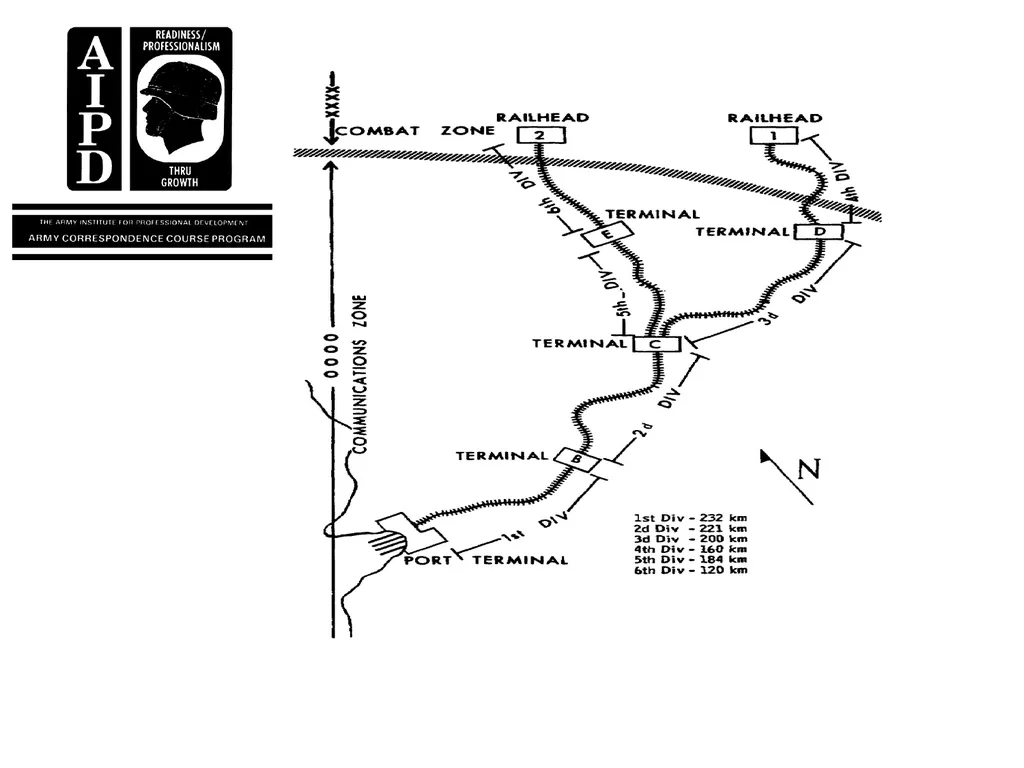
Normally, phase I operation is in effect for all the
geographical area of a theater subject to enemy action. Look at
figure 1.1;<br>
geographical area of a theater subject to enemy action. Look at
figure 1.1;<br>
21
assume that the theater extends inland only from the port terminal to
a point halfway between terminals B and C. Phase I would be used
because the whole area is in the combat zone. However, figure 1.1
actually shows an expanded theater with the combat zone far enough
forward to permit a communications zone (COMMZ) to be established.
Phase I could be in effect for the 4th and 6th rail divisions only.
As you read on, you will see how phase II or a combination of phase
II and phase III operations could be used for the other divisions.<br>
a point halfway between terminals B and C. Phase I would be used
because the whole area is in the combat zone. However, figure 1.1
actually shows an expanded theater with the combat zone far enough
forward to permit a communications zone (COMMZ) to be established.
Phase I could be in effect for the 4th and 6th rail divisions only.
As you read on, you will see how phase II or a combination of phase
II and phase III operations could be used for the other divisions.<br>
22
1.7. PHASE II
Phase II is a joint civilianmilitary
railway operation with the
military retaining control. When combat forces move forward and
communications zones become relatively stable and secure, the phase
II operation is quickly begun. It has several important advantages.
Local economy is aided by restoring civilian railroaders to their
jobs. If the rail transport capability is increased by this type of
operation, some civilian trains may be allowed to operate. Although
military trains have priority, civilian traffic can be permitted
insofar as it does not interfere with military operations.
Look again at figure 1.1. Picture the theater as having
advanced far enough inland from the port terminal to take in
terminals D and E; suppose, too, that the rear limit of the combat
zone is located midway between terminals C and B. If this were true,
phase I operation would be used for the 3d and 5th and the 4th and
6th divisions and phase II for the 1st and 2d divisions. Phase II
also provides an efficient, accelerated transition from phase I to
phase III. In the next paragraph, you will see how phase III is
begun in the theater.<br>
Phase II is a joint civilianmilitary
railway operation with the
military retaining control. When combat forces move forward and
communications zones become relatively stable and secure, the phase
II operation is quickly begun. It has several important advantages.
Local economy is aided by restoring civilian railroaders to their
jobs. If the rail transport capability is increased by this type of
operation, some civilian trains may be allowed to operate. Although
military trains have priority, civilian traffic can be permitted
insofar as it does not interfere with military operations.
Look again at figure 1.1. Picture the theater as having
advanced far enough inland from the port terminal to take in
terminals D and E; suppose, too, that the rear limit of the combat
zone is located midway between terminals C and B. If this were true,
phase I operation would be used for the 3d and 5th and the 4th and
6th divisions and phase II for the 1st and 2d divisions. Phase II
also provides an efficient, accelerated transition from phase I to
phase III. In the next paragraph, you will see how phase III is
begun in the theater.<br>
23
1.8. PHASE III
Phase III operations are conducted by civilians under military
supervision. Usually employed in the rear area of the communications
zone, phase III releases most of the military railroaders for duties
in forward areas. In this phase, more civilian employees are
restored to their jobs, helping the local economy, and additional
civilian trains may be operated because of increased rail transport
capabilities. Although phase III may be set up immediately upon
entry into a theater, this is highly improbable. However, when phase
III operations are in effect, the method of train movement best
understood by the civilians should be adopted. Careful planning is
necessary by officers of the transportation railway service when
putting military trains in civilian train schedules. Civilians
should be thoroughly instructed in military rail transportation
procedures<br>
Phase III operations are conducted by civilians under military
supervision. Usually employed in the rear area of the communications
zone, phase III releases most of the military railroaders for duties
in forward areas. In this phase, more civilian employees are
restored to their jobs, helping the local economy, and additional
civilian trains may be operated because of increased rail transport
capabilities. Although phase III may be set up immediately upon
entry into a theater, this is highly improbable. However, when phase
III operations are in effect, the method of train movement best
understood by the civilians should be adopted. Careful planning is
necessary by officers of the transportation railway service when
putting military trains in civilian train schedules. Civilians
should be thoroughly instructed in military rail transportation
procedures<br>
24
and requirements. Before operations start, necessary bilingual
documents should be prepared using both English and the local
language.
Look at figure 1.1 again. Here is a military railroad net in an
expanded theater. The theater has been developed with phase I and
phase II as explained in paragraphs 1.6 and 1.7; now phase III
operation for part of the theater becomes possible. When trained
civilian railroaders have been oriented in military procedures and
the necessary materials and documents have been prepared, phase III
can be used. The 1st and 2d divisions, located entirely within the
communications zone, could use phase III operation. Divisions 3 and
5, also located entirely in the communications zone but further
forward than the 1st and 2d divisions, could use phase II. Because
the 4th and 6th rail divisions are partly within the communications
zone and partly within the combat zone, phase I would undoubtedly be
used for them to have strict military control. Here is an example,
then, of a situation that permits the maximum use of civilian
railroaders in the rear areas and releases military men for duty in
the forward areas. Keep in mind that both phase II and phase III may
be suspended and replaced by phase I at any time should military
necessity require it.<br>
documents should be prepared using both English and the local
language.
Look at figure 1.1 again. Here is a military railroad net in an
expanded theater. The theater has been developed with phase I and
phase II as explained in paragraphs 1.6 and 1.7; now phase III
operation for part of the theater becomes possible. When trained
civilian railroaders have been oriented in military procedures and
the necessary materials and documents have been prepared, phase III
can be used. The 1st and 2d divisions, located entirely within the
communications zone, could use phase III operation. Divisions 3 and
5, also located entirely in the communications zone but further
forward than the 1st and 2d divisions, could use phase II. Because
the 4th and 6th rail divisions are partly within the communications
zone and partly within the combat zone, phase I would undoubtedly be
used for them to have strict military control. Here is an example,
then, of a situation that permits the maximum use of civilian
railroaders in the rear areas and releases military men for duty in
the forward areas. Keep in mind that both phase II and phase III may
be suspended and replaced by phase I at any time should military
necessity require it.<br>
25
1.9. SUMMARY
A great deal of planning is required before the transportation
railway service can begin operations in a theater. The first big
task is to find out what rail lines exist and then to choose those
most valuable for supporting the military operation. Selections are
made on the basis of our forces' probable objective and planned lines
of advance and the enemy's strength and location.
Although in all probability it will be necessary to use any
existing rail lines, if there is a choice, those with the most
favorable technical characteristics are selected. Adequate yards,
terminals, and shop facilities are required so that main lines can be
kept open; rail cars can be unloaded, loaded, and then made up into a
train and readied for departure; and rail equipment can receive the
heavy repair and maintenance it needs. Double track allows trains to
operate in two directions; if partly damaged, at least one track can
be repaired for use as a main line with adequate passing tracks.
Since roadbed, ballast, and weight of track determine the weight and
speed of trains, a line with seasoned roadbed, good ballast, and
heavy rail is selected. Rail lines with slight grades and few curves
require less motive power, allow for higher train speeds, and are not
as hard on equipment as those with steep grades and sharp or<br>
A great deal of planning is required before the transportation
railway service can begin operations in a theater. The first big
task is to find out what rail lines exist and then to choose those
most valuable for supporting the military operation. Selections are
made on the basis of our forces' probable objective and planned lines
of advance and the enemy's strength and location.
Although in all probability it will be necessary to use any
existing rail lines, if there is a choice, those with the most
favorable technical characteristics are selected. Adequate yards,
terminals, and shop facilities are required so that main lines can be
kept open; rail cars can be unloaded, loaded, and then made up into a
train and readied for departure; and rail equipment can receive the
heavy repair and maintenance it needs. Double track allows trains to
operate in two directions; if partly damaged, at least one track can
be repaired for use as a main line with adequate passing tracks.
Since roadbed, ballast, and weight of track determine the weight and
speed of trains, a line with seasoned roadbed, good ballast, and
heavy rail is selected. Rail lines with slight grades and few curves
require less motive power, allow for higher train speeds, and are not
as hard on equipment as those with steep grades and sharp or<br>
26
long curves. Bridges must be strong enough to hold up under the
heavy weight of locomotives; tunnels must be high and wide enough to
allow the passage of military equipment.
As a theater of operations expands, captured rail lines and
their facilities are rehabilitated if needed and if possible. Only
when they are not adequate for military needs are new ones
constructed. To increase rail transport capabilities in an expanding
theater, three phases of operation are used. Phase I, employing only
the military, is used in combat areas or immediately after gaining a
lodgment, such as a beachhead. Phase II, using civilians and
military with the latter in supervisory positions, is normally
established in the forward areas of the communications zone. Phase
III, set up in rear areas of the communications zone, uses mostly
civilians under military supervision, thereby releasing military
railroaders for duties in forward areas. In both phases II and III,
the local economy is helped because some civilians are restored to
their jobs and some civilian trains may be operated.<br>
heavy weight of locomotives; tunnels must be high and wide enough to
allow the passage of military equipment.
As a theater of operations expands, captured rail lines and
their facilities are rehabilitated if needed and if possible. Only
when they are not adequate for military needs are new ones
constructed. To increase rail transport capabilities in an expanding
theater, three phases of operation are used. Phase I, employing only
the military, is used in combat areas or immediately after gaining a
lodgment, such as a beachhead. Phase II, using civilians and
military with the latter in supervisory positions, is normally
established in the forward areas of the communications zone. Phase
III, set up in rear areas of the communications zone, uses mostly
civilians under military supervision, thereby releasing military
railroaders for duties in forward areas. In both phases II and III,
the local economy is helped because some civilians are restored to
their jobs and some civilian trains may be operated.<br>
27
2.1. GENERAL
The transportation railway service consists of the command and
supervisory, operating, maintenance, and service units needed to
operate railway trains, maintain rail lines of communications, and
perform organizational and direct support maintenance of locomotives
and rolling stock in a theater of operations. Normally, the TRS is
an interzonal service and may operate over long distances throughout
the theater. To insure that the capabilities of the TRS are
exploited to the fullest extent possible, all supervisory and
subordinate rail units in a theater are assigned to and operate under
the command and supervision of a senior transportation organization,
normally the transportation command of the theater army support
command (TASCOM). Regardless of the extension of the railway service
through other commands or territorial jurisdictions in the
communications or combat zones, commanders of area support commands
or areas within the combat zone influence rail operations only by
coordination through command and technical channels<br>
The transportation railway service consists of the command and
supervisory, operating, maintenance, and service units needed to
operate railway trains, maintain rail lines of communications, and
perform organizational and direct support maintenance of locomotives
and rolling stock in a theater of operations. Normally, the TRS is
an interzonal service and may operate over long distances throughout
the theater. To insure that the capabilities of the TRS are
exploited to the fullest extent possible, all supervisory and
subordinate rail units in a theater are assigned to and operate under
the command and supervision of a senior transportation organization,
normally the transportation command of the theater army support
command (TASCOM). Regardless of the extension of the railway service
through other commands or territorial jurisdictions in the
communications or combat zones, commanders of area support commands
or areas within the combat zone influence rail operations only by
coordination through command and technical channels<br>
28
The senior railway unit in a theater is responsible for planning
the organization of the railway service and the employment of all TRS
units. In a theater, the senior railway unit may be a transportation
railway group. Where there are three or more groups, a railway
brigade is the senior railway unit; where there are fewer than three
groups, they are under TASCOM's transportation command. A railway
group can command from two to six railway battalions and normally
supervises up to 960 kilometers of main rail line. Each battalion
commands attached operating and maintenance units and normally
controls the operation of 145 to 241 kilometers of rail linea
rail
division. Rail engineering, equipment maintenance, and train
operating companies, as required, are attached to the battalion.
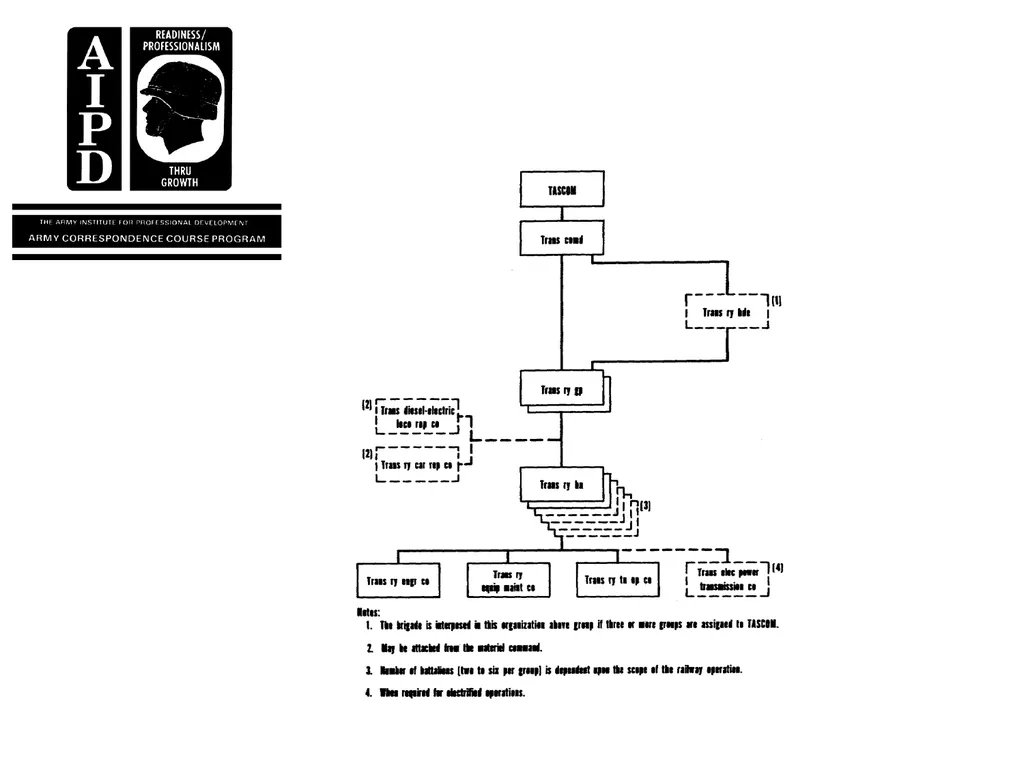
Figure 2.1 illustrates the transportation railway service
organization.<br>
the organization of the railway service and the employment of all TRS
units. In a theater, the senior railway unit may be a transportation
railway group. Where there are three or more groups, a railway
brigade is the senior railway unit; where there are fewer than three
groups, they are under TASCOM's transportation command. A railway
group can command from two to six railway battalions and normally
supervises up to 960 kilometers of main rail line. Each battalion
commands attached operating and maintenance units and normally
controls the operation of 145 to 241 kilometers of rail linea
rail
division. Rail engineering, equipment maintenance, and train
operating companies, as required, are attached to the battalion.
Figure 2.1 illustrates the transportation railway service
organization.<br>
29
What is the relationship between the transportation railway
service and other agencies? For the overall military effort in a
14
Figure 2.1. Transportation Railway Service Organization.
15
theater of operations to be successful, a maximum degree of
cooperation must be maintained constantly among all agencies. The
TRS often assists other agencies in carrying out their missions. For
example, it locates rail sidings for the medical command to loan and
unload the wounded, helps in locating dump and depot sites, assists
in handling heavy lifts with locomotive cranes, and may even help to
make emergency repairs of equipment belonging to other agencies. To
draw a picture of how the services of the TRS and other agencies in a
theater of operations fit together, the remaining paragraphs of this
chapter point out the relationship of the TRS to the theater army
support command and its personnel, medical, engineer, transportation,
materiel, and area support commands; the strategic communications
command; the military police; and civilian agencies.<br>
service and other agencies? For the overall military effort in a
14
Figure 2.1. Transportation Railway Service Organization.
15
theater of operations to be successful, a maximum degree of
cooperation must be maintained constantly among all agencies. The
TRS often assists other agencies in carrying out their missions. For
example, it locates rail sidings for the medical command to loan and
unload the wounded, helps in locating dump and depot sites, assists
in handling heavy lifts with locomotive cranes, and may even help to
make emergency repairs of equipment belonging to other agencies. To
draw a picture of how the services of the TRS and other agencies in a
theater of operations fit together, the remaining paragraphs of this
chapter point out the relationship of the TRS to the theater army
support command and its personnel, medical, engineer, transportation,
materiel, and area support commands; the strategic communications
command; the military police; and civilian agencies.<br>
30
2.2. THEATER ARMY SUPPORT COMMAND
A major subordinate command of theater army, the theater army
support command (TASCOM) provides combat service support to all U. S.
Army forces in the theater and to other forces as directed. Thus,
the TASCOM commander directs combat service support operations both
within the COMMZ and between it and the combat zone. As the major
commander operating in the COMMZ, he is usually responsible for its
territory.
Five mission commands and one operating command carry out
TASCOM's mission. Directly supporting the combat operations are
these five mission commands: personnel, medical, engineer,
transportation, and materiel. Providing combat service support and
rear area protection (RAP) for units in the COMMZ is the one
operating command: theater army area command (TAACOM).<br>
A major subordinate command of theater army, the theater army
support command (TASCOM) provides combat service support to all U. S.
Army forces in the theater and to other forces as directed. Thus,
the TASCOM commander directs combat service support operations both
within the COMMZ and between it and the combat zone. As the major
commander operating in the COMMZ, he is usually responsible for its
territory.
Five mission commands and one operating command carry out
TASCOM's mission. Directly supporting the combat operations are
these five mission commands: personnel, medical, engineer,
transportation, and materiel. Providing combat service support and
rear area protection (RAP) for units in the COMMZ is the one
operating command: theater army area command (TAACOM).<br>
31
2.3. PERSONNEL COMMAND
The personnel command provides general support personnel,
administrative, finance, replacement, chaplain, postal, special
services, military police, stockade and rehabilitation, crime
laboratory, and graves registration services to the theater. It
operates the personnel administration center (PAC) that controls data
processing actions and handles reports control, personnel management,
and records management for the theater.<br>
The personnel command provides general support personnel,
administrative, finance, replacement, chaplain, postal, special
services, military police, stockade and rehabilitation, crime
laboratory, and graves registration services to the theater. It
operates the personnel administration center (PAC) that controls data
processing actions and handles reports control, personnel management,
and records management for the theater.<br>
32
2.4. MEDICAL COMMAND
The medical command owns and operates ambulance trains to
evacuate patients from hospitals or holding units of the combat zone
to the COMMZ, between hospitals of the COMMZ, and from hospitals to
aerial or water ports of embarkation. The train commander is a
Medical Corps officer; he is responsible for the command,
administration, coordination, and operation of the ambulance train
unit. The TRS, however, furnishes the motive power and is
responsible for scheduling, operating, and maintaining the train.
Running repairs and direct support maintenance are provided by TRS
ambulance train maintenance units which are attached to the senior
transportation railway unit in the theater.<br>
The medical command owns and operates ambulance trains to
evacuate patients from hospitals or holding units of the combat zone
to the COMMZ, between hospitals of the COMMZ, and from hospitals to
aerial or water ports of embarkation. The train commander is a
Medical Corps officer; he is responsible for the command,
administration, coordination, and operation of the ambulance train
unit. The TRS, however, furnishes the motive power and is
responsible for scheduling, operating, and maintaining the train.
Running repairs and direct support maintenance are provided by TRS
ambulance train maintenance units which are attached to the senior
transportation railway unit in the theater.<br>
33
2.5. ENGINEER COMMAND
The engineer command (ENCOM) constructs, rehabilitates, and
performs major maintenance on military rail lines and rail
facilities, including structures, bridges, tunnels, and roadbeds.
The ENCOM stocks construction equipment and materials, such as rails,
spikes, ties, and ballast, as planned for and requested by the TRS.
The ENCOM is also responsible for constructing and rehabilitating
primary electric power sources, thirdrail
or overhead systems, and
lines needed to transmit electric current from these sources for
operating electrified railways and railway signaling systems. The
overall view of how the ENCOM fits into the maintenance and supply
picture is discussed in paragraph 2.7.<br>
The engineer command (ENCOM) constructs, rehabilitates, and
performs major maintenance on military rail lines and rail
facilities, including structures, bridges, tunnels, and roadbeds.
The ENCOM stocks construction equipment and materials, such as rails,
spikes, ties, and ballast, as planned for and requested by the TRS.
The ENCOM is also responsible for constructing and rehabilitating
primary electric power sources, thirdrail
or overhead systems, and
lines needed to transmit electric current from these sources for
operating electrified railways and railway signaling systems. The
overall view of how the ENCOM fits into the maintenance and supply
picture is discussed in paragraph 2.7.<br>
34
The transportation railway service is responsible for planning
and recommending to the transportation command (TRANSCOM) the rail
facilities that must be constructed or rehabilitated. The plans are
coordinated with the engineer command and, when necessary, the TRS
furnishes technical advice and assistance and cooperates closely with
engineer units. When directed, the railway service aids engineer
units to accomplish their tasks.<br>
and recommending to the transportation command (TRANSCOM) the rail
facilities that must be constructed or rehabilitated. The plans are
coordinated with the engineer command and, when necessary, the TRS
furnishes technical advice and assistance and cooperates closely with
engineer units. When directed, the railway service aids engineer
units to accomplish their tasks.<br>
35
The TRS rehabilitates within its capabilities, but when major
repairsmaintenance
requiring major items of construction
equipmentmust
be made, it requests the engineer command to make the
repairs and do any necessary construction. Such requests are
forwarded through command channels to the transportation command for
coordination with the engineer command and for establishment of the
work priority.<br>
repairsmaintenance
requiring major items of construction
equipmentmust
be made, it requests the engineer command to make the
repairs and do any necessary construction. Such requests are
forwarded through command channels to the transportation command for
coordination with the engineer command and for establishment of the
work priority.<br>
36
2.6. TRANSPORTATION COMMAND
The major army transportation headquarters in a theater is the
transportation command (TRANSCOM). Its organizational structure
consists of a headquarters and headquarters company; an automatic
data processing unit (ADPU); a movements control group; a terminal
transfer company; and motor, air, water, and rail groups, enabling
the command to provide complete transportation and movement services
in a theater of operations.<br>
The major army transportation headquarters in a theater is the
transportation command (TRANSCOM). Its organizational structure
consists of a headquarters and headquarters company; an automatic
data processing unit (ADPU); a movements control group; a terminal
transfer company; and motor, air, water, and rail groups, enabling
the command to provide complete transportation and movement services
in a theater of operations.<br>
37
The transportation command exercises centralized control over
TASCOM's transportation resources. It commands and controls the
transportation groups and operating units assigned or attached to it,
coordinates the employment of airlift and sealift allocated to
TASCOM, and supervises the operation of the transportation interzonal
services. The TRANSCOM's major subordinates include group and
battalion level headquarters to command the units performing terminal
services, movements management services, and mode operations. In the
field army, transportation support is provided by a transportation
brigade, which is directly subordinate to the field army support
command (FASCOM), and by corps support brigades, which control motor
transport and movement units. Air and motor transport are the
primary transport modes used in the field army. Rail transport is
used if available, but the length of time and the construction effort
required to repair combatdamaged
rail lines usually make rail
operations impossible while the field army commander controls the
area. Rail operations in the field army area are part of the
interzonal service and are controlled by the TRANSCOM though a
portion of the rail capability may be allocated by field army<br>
TASCOM's transportation resources. It commands and controls the
transportation groups and operating units assigned or attached to it,
coordinates the employment of airlift and sealift allocated to
TASCOM, and supervises the operation of the transportation interzonal
services. The TRANSCOM's major subordinates include group and
battalion level headquarters to command the units performing terminal
services, movements management services, and mode operations. In the
field army, transportation support is provided by a transportation
brigade, which is directly subordinate to the field army support
command (FASCOM), and by corps support brigades, which control motor
transport and movement units. Air and motor transport are the
primary transport modes used in the field army. Rail transport is
used if available, but the length of time and the construction effort
required to repair combatdamaged
rail lines usually make rail
operations impossible while the field army commander controls the
area. Rail operations in the field army area are part of the
interzonal service and are controlled by the TRANSCOM though a
portion of the rail capability may be allocated by field army<br>
38
2.7. MATERIEL COMMAND
Supply and maintenance are vital to the transportation railway
service in a theater of operations. Transportation railway supply
may be relatively complex since it could include the support of not
only standard U.S. Army equipment but also foreign equipment used in
support of military operations. Included in transportation railway
maintenance in a theater is that of rail lines and facilities and of
locomotives and rolling stock. Such maintenance ranges from
rehabilitation of rail systems and major repairs on locomotives and
rolling stock to minor repairs accomplished in the units during
daily inspections and services. Supply and maintenance for the
TRS in a theater are responsibilities held jointly by the
TRS, the engineer command (ENCOM), and the Materiel Command
(MATCOM). The subparagraphs following explain the responsibilities<br>
Supply and maintenance are vital to the transportation railway
service in a theater of operations. Transportation railway supply
may be relatively complex since it could include the support of not
only standard U.S. Army equipment but also foreign equipment used in
support of military operations. Included in transportation railway
maintenance in a theater is that of rail lines and facilities and of
locomotives and rolling stock. Such maintenance ranges from
rehabilitation of rail systems and major repairs on locomotives and
rolling stock to minor repairs accomplished in the units during
daily inspections and services. Supply and maintenance for the
TRS in a theater are responsibilities held jointly by the
TRS, the engineer command (ENCOM), and the Materiel Command
(MATCOM). The subparagraphs following explain the responsibilities<br>
39
of each as they relate to railway supply, maintenance of way, and
maintenance of motive power and rolling stock.
a. Railway supply. The supplies needed for operation and
maintenance of railways are designated technical supplies. They are
classified as follows: class III, operating fuels; class IV, roadway
maintenance items; class VII, rolling stock end items; and class IX,
rolling stock repair parts. The supply section of the senior railway
unit in the theater is responsible for all classes of supply,
including end items. The unit obtains the supplies from the
appropriate MATCOM depot. The railway car repair company of MATCOM
is responsible for issuing repair parts for organizational and direct
support maintenance of railway equipment. The engineer command is
responsible for stocking material and equipment needed to construct
or rehabilitate the railway net.<br>
maintenance of motive power and rolling stock.
a. Railway supply. The supplies needed for operation and
maintenance of railways are designated technical supplies. They are
classified as follows: class III, operating fuels; class IV, roadway
maintenance items; class VII, rolling stock end items; and class IX,
rolling stock repair parts. The supply section of the senior railway
unit in the theater is responsible for all classes of supply,
including end items. The unit obtains the supplies from the
appropriate MATCOM depot. The railway car repair company of MATCOM
is responsible for issuing repair parts for organizational and direct
support maintenance of railway equipment. The engineer command is
responsible for stocking material and equipment needed to construct
or rehabilitate the railway net.<br>
40
b. Maintenance of way. Although construction and rehabilitation
of a railway's fixed facilities are the responsibility of the
engineer command, the TRS is responsible for maintaining both the
rightofway
and the equipment used by railway battalions in
performing their daily duties. Normally, the transportation railway
battalion makes the necessary reconnaissance and develops information
for new construction and major maintenance projects. The battalion
commander, the maintenanceofway
superintendent, and all TRS
railroaders cooperate fully with the engineer command in any new
construction or major maintenance projects for the military railroad.
At times, by prearrangement, such work is done jointly by the TRS and
the engineer command.
Organizational and direct support maintenance are the
responsibility of the TRS after the railway is turned over to it.
The battalion commander has overall responsibility to see that his
division of the railway is maintained properly. The battalion
maintenanceofway
superintendent, however, is directly responsible
for maintenance of track and structures, for proper supervision of
all maintenance work and procedures, and for all necessary inspection
of track and structures on the division.<br>
of a railway's fixed facilities are the responsibility of the
engineer command, the TRS is responsible for maintaining both the
rightofway
and the equipment used by railway battalions in
performing their daily duties. Normally, the transportation railway
battalion makes the necessary reconnaissance and develops information
for new construction and major maintenance projects. The battalion
commander, the maintenanceofway
superintendent, and all TRS
railroaders cooperate fully with the engineer command in any new
construction or major maintenance projects for the military railroad.
At times, by prearrangement, such work is done jointly by the TRS and
the engineer command.
Organizational and direct support maintenance are the
responsibility of the TRS after the railway is turned over to it.
The battalion commander has overall responsibility to see that his
division of the railway is maintained properly. The battalion
maintenanceofway
superintendent, however, is directly responsible
for maintenance of track and structures, for proper supervision of
all maintenance work and procedures, and for all necessary inspection
of track and structures on the division.<br>
41
c. Maintenance of motive power and rolling stock. Performing
organizational and direct support maintenance on locomotives, rolling
stock, and special and captured equipment are TRS responsibilities.
The MATCOM, however, has some maintenance responsibilities for this
equipment.<br>
organizational and direct support maintenance on locomotives, rolling
stock, and special and captured equipment are TRS responsibilities.
The MATCOM, however, has some maintenance responsibilities for this
equipment.<br>
42
(1) Motive power. Organizational and direct support
maintenance as well as daily or trip, monthly, quarterly, and
semiannual inspections are taken care of by the TRS. Units of the
MATCOM make the annual inspection of motive power; however, the TRS
makes the annual inspection if there is no MATCOM in the theater.<br>
maintenance as well as daily or trip, monthly, quarterly, and
semiannual inspections are taken care of by the TRS. Units of the
MATCOM make the annual inspection of motive power; however, the TRS
makes the annual inspection if there is no MATCOM in the theater.<br>
43
(2) Maintenance of rolling stock. Organizational and direct
support maintenance are responsibilities of the TRS. Organizational
maintenance is performed by operating units and by car inspectors at
the train's originating point and at en route inspection points to
insure safe movement. Airbrakes, running gear, and other parts are
inspected; journal boxes are examined and lubricated. For ambulance
trains and cars, the ambulance train maintenance sections and crews
take care of those items just mentioned; in addition, their
responsibilities include stocking of other than medical suppliesfuel,
water, ice, etc.; placing cars on and removing cars from precooling
or heating facilities; and operating and controlling heating,
airconditioning,
and carlighting
equipment. Direct support
maintenance is done by the railway equipment maintenance company and
the mobile workshop. Such maintenance consists of providing safe
operation of freight equipment and comfortable operation of passenger
and hospital cars. General support (GS) maintenance is taken care of
by the dieselelectric
locomotive repair company and by the car
repair company of the materiel command. Not only does this GS
maintenance activity support the maintenance overflow from direct
support but also takes care of the heavy maintenance involved in
stripping, assembling, erecting, and painting railway cars and in
assembling and inspecting knockeddown
new equipment brought into the
theater.<br>
support maintenance are responsibilities of the TRS. Organizational
maintenance is performed by operating units and by car inspectors at
the train's originating point and at en route inspection points to
insure safe movement. Airbrakes, running gear, and other parts are
inspected; journal boxes are examined and lubricated. For ambulance
trains and cars, the ambulance train maintenance sections and crews
take care of those items just mentioned; in addition, their
responsibilities include stocking of other than medical suppliesfuel,
water, ice, etc.; placing cars on and removing cars from precooling
or heating facilities; and operating and controlling heating,
airconditioning,
and carlighting
equipment. Direct support
maintenance is done by the railway equipment maintenance company and
the mobile workshop. Such maintenance consists of providing safe
operation of freight equipment and comfortable operation of passenger
and hospital cars. General support (GS) maintenance is taken care of
by the dieselelectric
locomotive repair company and by the car
repair company of the materiel command. Not only does this GS
maintenance activity support the maintenance overflow from direct
support but also takes care of the heavy maintenance involved in
stripping, assembling, erecting, and painting railway cars and in
assembling and inspecting knockeddown
new equipment brought into the
theater.<br>
44
(3) Maintenance of special and captured equipment. The TRS is
responsible for maintaining such special equipment as that used on
wreck trains as well as wreck and other cranes, heavy roadway
equipment, tools add enginehouse
machinery, and other similar
equipment. Captured railway equipment that may have been taken over
for operation is repaired and serviced by the TRS before being sent
out on the line.<br>
responsible for maintaining such special equipment as that used on
wreck trains as well as wreck and other cranes, heavy roadway
equipment, tools add enginehouse
machinery, and other similar
equipment. Captured railway equipment that may have been taken over
for operation is repaired and serviced by the TRS before being sent
out on the line.<br>
45
2.8. THEATER ARMY AREA COMMAND
The mission of the theater army area command (TAACOM) is to
provide direct support, except medical, communications security
(COMSEC), map supply, and ammunition, to the theater army support
command, to units passing through or located in the COMMZ, and to
other forces as directed by the TASCOM commander. The TAACOM is also
responsible for rear area protection (RAP) within the COMMZ.<br>
The mission of the theater army area command (TAACOM) is to
provide direct support, except medical, communications security
(COMSEC), map supply, and ammunition, to the theater army support
command, to units passing through or located in the COMMZ, and to
other forces as directed by the TASCOM commander. The TAACOM is also
responsible for rear area protection (RAP) within the COMMZ.<br>
46
Assigned to the TAACOM are area support groups. Through them,
the TAACOM accomplishes its combat service support and RAP missions.
Based on densities of military units and materiel to be supported,
political boundaries, and identifiable terrain features, the groups
are assigned areas of responsibility within the COMMZ and are
deployed throughout it. Each group provides direct support to
approximately 15,000 troops; with additional units attached or
assigned, it can support up to 30,000 troops. Since the group has no
organic rail transport capability, the transportation command
provides rail transport whenever the group requires it.<br>
the TAACOM accomplishes its combat service support and RAP missions.
Based on densities of military units and materiel to be supported,
political boundaries, and identifiable terrain features, the groups
are assigned areas of responsibility within the COMMZ and are
deployed throughout it. Each group provides direct support to
approximately 15,000 troops; with additional units attached or
assigned, it can support up to 30,000 troops. Since the group has no
organic rail transport capability, the transportation command
provides rail transport whenever the group requires it.<br>
47
2.9. UNITED STATES ARMY STRATEGIC COMMUNICATIONS COMMAND (THEATER)
Construction and rehabilitation of wire circuits for dispatching
trains and administering military railroads, as well as maintaining
certain communications, are the responsibility of the United States
Army strategic communications command (theater) (USASTRATCOM
(theater)). The TRS plans this work and coordinates with USASTRATCOM
(theater) in getting the job done. The USASTRATCOM (theater)
supplies any communications and signaling equipment not organic to
the TRS and is responsible for stocking signal and communications
supplies and equipment. It is also responsible for maintaining
communications systems for military railways; however, when all
circuits along the line are turned over to the TRS for its exclusive
use, they are then maintained by the TRS. When communications
circuits are used jointly by the TRS and other agencies, maintenance
is the responsibility of the USASTRATCOM (theater). Such joint use
is allowed only by directive from higher command.<br>
Construction and rehabilitation of wire circuits for dispatching
trains and administering military railroads, as well as maintaining
certain communications, are the responsibility of the United States
Army strategic communications command (theater) (USASTRATCOM
(theater)). The TRS plans this work and coordinates with USASTRATCOM
(theater) in getting the job done. The USASTRATCOM (theater)
supplies any communications and signaling equipment not organic to
the TRS and is responsible for stocking signal and communications
supplies and equipment. It is also responsible for maintaining
communications systems for military railways; however, when all
circuits along the line are turned over to the TRS for its exclusive
use, they are then maintained by the TRS. When communications
circuits are used jointly by the TRS and other agencies, maintenance
is the responsibility of the USASTRATCOM (theater). Such joint use
is allowed only by directive from higher command.<br>
48
When land lines are damaged and inoperable, the USASTRATCOM
(theater) provides an automatic radio communications system, when
approved by the theater commander, until land communications can be
reestablished. A radio repair team is provided and attached to the
railway battalion to supervise the installation of this radio
equipment and to maintain and repair it while it is in use. However,
the railway battalion operates the equipment.<br>
(theater) provides an automatic radio communications system, when
approved by the theater commander, until land communications can be
reestablished. A radio repair team is provided and attached to the
railway battalion to supervise the installation of this radio
equipment and to maintain and repair it while it is in use. However,
the railway battalion operates the equipment.<br>
49
2.10. MILITARY POLICE
A military police battalion, railway guard, is attached to the
transportation command on the basis of one battalion for each
transportation railway group. Assigned to the military police (MP)
battalion are MP companiesone
company for each transportation
railway battalion. Normally, the companies remain under the command
of the MP battalion while providing guard service to the railway
battalion<br>
A military police battalion, railway guard, is attached to the
transportation command on the basis of one battalion for each
transportation railway group. Assigned to the military police (MP)
battalion are MP companiesone
company for each transportation
railway battalion. Normally, the companies remain under the command
of the MP battalion while providing guard service to the railway
battalion<br>
50
Military police units are assigned to the TRS for one specific
purpose: the protection and security of trains and their lading. The
MP's guard trains and freight en route, and guard cars or trains in
rail yards. Traincrews and guards work closely together; maximum
cooperation between them is necessary to provide adequate railway
security.<br>
purpose: the protection and security of trains and their lading. The
MP's guard trains and freight en route, and guard cars or trains in
rail yards. Traincrews and guards work closely together; maximum
cooperation between them is necessary to provide adequate railway
security.<br>
51
2.11. CIVILIAN AGENCIES
The transportation railway service coordinates its rail
operations with civilian railway agencies. Coordination normally
begins with the start of military railroad operations and ends only
when United States forces leave the theater. During the planning
stage of a phase II operation, this coordination is particularly
important since civilians will be used in running the railroad and a
good relationship must be established for the later phase III
operation.<br>
The transportation railway service coordinates its rail
operations with civilian railway agencies. Coordination normally
begins with the start of military railroad operations and ends only
when United States forces leave the theater. During the planning
stage of a phase II operation, this coordination is particularly
important since civilians will be used in running the railroad and a
good relationship must be established for the later phase III
operation.<br>
52
Those working with civilian railroaders should have been
instructed in personnel management. Sound management principles are
the same anywhere in the world; praise and fair treatment get the
same reaction from people everywhere. Before assuming supervisory
duties, those in the TRS who will work with local civilians should
become familiar with their habits, customs, laws, language, religion,
and economic and political views. Supervisors will then better
understand why the civilians work the way they do. For example, if
men don't appear for work on a particular day, it may be a religious
holiday; if they take time out at a definite period each day, it may
be the customary tea or siesta time. These breaks must be known and,
if possible, allowed for even if the volume of work is reduced
because of them.<br>
instructed in personnel management. Sound management principles are
the same anywhere in the world; praise and fair treatment get the
same reaction from people everywhere. Before assuming supervisory
duties, those in the TRS who will work with local civilians should
become familiar with their habits, customs, laws, language, religion,
and economic and political views. Supervisors will then better
understand why the civilians work the way they do. For example, if
men don't appear for work on a particular day, it may be a religious
holiday; if they take time out at a definite period each day, it may
be the customary tea or siesta time. These breaks must be known and,
if possible, allowed for even if the volume of work is reduced
because of them.<br>
53
2.12. SUMMARY
A good working relationship must be maintained between the
transportation railway service and other military agencies and
commands. Each assists the other. The theater army support command
is a major subordinate command of theater army that has six commands
to carry out its mission. The personnel command provides general
support personnel, administrative, and other such services to the
theater. The medical command's ambulance trains are pulled by TRS
motive power. The TRS schedules, operates, and maintains the trains.
Such maintenance is taken care of by ambulance train maintenance
units. The TRS depends on the engineer command to construct,
rehabilitate, and perform major maintenance on military rail lines
and such facilities as bridges, tunnels, and roadbeds. After
making a reconnaissance of rail lines, the TRS develops plans<br>
A good working relationship must be maintained between the
transportation railway service and other military agencies and
commands. Each assists the other. The theater army support command
is a major subordinate command of theater army that has six commands
to carry out its mission. The personnel command provides general
support personnel, administrative, and other such services to the
theater. The medical command's ambulance trains are pulled by TRS
motive power. The TRS schedules, operates, and maintains the trains.
Such maintenance is taken care of by ambulance train maintenance
units. The TRS depends on the engineer command to construct,
rehabilitate, and perform major maintenance on military rail lines
and such facilities as bridges, tunnels, and roadbeds. After
making a reconnaissance of rail lines, the TRS develops plans<br>
54
for the work needed on them; these plans are then coordinated with
the engineers who do the work.
The transportation command provides complete transportation and
movement services in a theater of operation through its motor, air,
water, rail, and other organizations; the TRANSCOM also operates the
transportation interzonal service.
The materiel command works closely with the TRS in
rehabilitating rail systems, and in making major and minor repairs on
locomotives and rolling stock. The senior railway unit in the
theater is responsible for furnishing all supplies, and obtains them
from the appropriate MATCOM depot. The theater army area command
provides direct support, except medical and ammunition, to TASCOM, to
units passing through or located in the COMMZ, and to other forces as
directed. Rear area protection in the COMMZ is also TAACOM's
responsibility. The command accomplishes its mission through area
support groups.<br>
the engineers who do the work.
The transportation command provides complete transportation and
movement services in a theater of operation through its motor, air,
water, rail, and other organizations; the TRANSCOM also operates the
transportation interzonal service.
The materiel command works closely with the TRS in
rehabilitating rail systems, and in making major and minor repairs on
locomotives and rolling stock. The senior railway unit in the
theater is responsible for furnishing all supplies, and obtains them
from the appropriate MATCOM depot. The theater army area command
provides direct support, except medical and ammunition, to TASCOM, to
units passing through or located in the COMMZ, and to other forces as
directed. Rear area protection in the COMMZ is also TAACOM's
responsibility. The command accomplishes its mission through area
support groups.<br>
55
The United States Army strategic communications command
(theater) is responsible for constructing and rehabilitating wire
circuits needed for train dispatching and the administration of
military railroads, and also for maintaining certain communications.
The TRS plans this work and then coordinates with the USASTRATCOM
(theater). If land communications have been damaged and are
inoperable, the USASTRATCOM (theater) provides a radio communications
system, supervising its installation and repairing the radio
equipment while in use; however, the TRS operates the equipment.
Military police provide protection and security for trains and
freight while en route and in rail yards. Close coordination is
maintained between the transportation railway service and civilian
railway agencies as along as our forces are in foreign territory.<br>
(theater) is responsible for constructing and rehabilitating wire
circuits needed for train dispatching and the administration of
military railroads, and also for maintaining certain communications.
The TRS plans this work and then coordinates with the USASTRATCOM
(theater). If land communications have been damaged and are
inoperable, the USASTRATCOM (theater) provides a radio communications
system, supervising its installation and repairing the radio
equipment while in use; however, the TRS operates the equipment.
Military police provide protection and security for trains and
freight while en route and in rail yards. Close coordination is
maintained between the transportation railway service and civilian
railway agencies as along as our forces are in foreign territory.<br>
56
3.1. GENERAL
When it has been determined that the transportation railway
service will operate trains in support of military activities in a
theater, many things must happen and any officer involved in the
planning must know how to make them happen efficiently and in proper
order. If you were involved with the rail transport effort, you
would need to know the scope and purpose of the military mission.
You would collect and evaluate all the data you have on the rail net
in the area of operation. From it, you would determine which lines
and what facilities you would use, what TRS units would be required
to conduct train operations over the selected rail net, and how much
rehabilitation and construction effort would be necessary to make it
operational as quickly as possible. You would also have to determine
what kind of equipment you would need, how much of it was already on
hand in the theater, and how much more you would have to bring in to
get the job done. After the rail net is selected, the TRS units are
phased into the area, and the lines are opened for operation, you
must be able to decide which method of train operation would be the
most efficient.<br>
When it has been determined that the transportation railway
service will operate trains in support of military activities in a
theater, many things must happen and any officer involved in the
planning must know how to make them happen efficiently and in proper
order. If you were involved with the rail transport effort, you
would need to know the scope and purpose of the military mission.
You would collect and evaluate all the data you have on the rail net
in the area of operation. From it, you would determine which lines
and what facilities you would use, what TRS units would be required
to conduct train operations over the selected rail net, and how much
rehabilitation and construction effort would be necessary to make it
operational as quickly as possible. You would also have to determine
what kind of equipment you would need, how much of it was already on
hand in the theater, and how much more you would have to bring in to
get the job done. After the rail net is selected, the TRS units are
phased into the area, and the lines are opened for operation, you
must be able to decide which method of train operation would be the
most efficient.<br>
57
This chapter discusses the types of trains normally found in a
theater of operations, the establishing of rail operations, and the
methods of train operations. The rules given are not rigid but are,
of necessity, flexible enough to meet the everchanging
requirements
that combat imposes. However, they have proved effective in the past
and may be expected to be effective in future military operations.<br>
theater of operations, the establishing of rail operations, and the
methods of train operations. The rules given are not rigid but are,
of necessity, flexible enough to meet the everchanging
requirements
that combat imposes. However, they have proved effective in the past
and may be expected to be effective in future military operations.<br>
58
3.2. TYPES OF TRAINS
Trains operating over military railroads are designated
according to the freight they carry or according to the equipment on
the train. The primary types of trains found in a theater are
freight, passenger, work, wreck, and ambulance.<br>
Trains operating over military railroads are designated
according to the freight they carry or according to the equipment on
the train. The primary types of trains found in a theater are
freight, passenger, work, wreck, and ambulance.<br>
59
a. Freight trains. Through freight trains make long hauls at
relatively fast speeds; they handle the bulk of supplies needed for
military operations in a theater. When necessary, freight cars may
be used for large troop movements; in such a haul, the trains are
classed as passenger trains. In contrast with through freights,
local freight trains operate at much slower speeds and make frequent
stops at small stations.
b. Passenger trains. Through passenger trains are used to move
passengers, express, and mail over long runs. Local passenger trains
may operate at a relatively slow speed and make frequent stops at
small stations.
c. Work trains and wreck trains. Work trains carry equipment and
workmen to maintain railways and rail facilities. Wreck trains carry
heavy equipment to remove disabled trains or wrecks from the rail
lines so that train operations may continue. Work and wreck trains
do not carry passengers or freight.<br>
relatively fast speeds; they handle the bulk of supplies needed for
military operations in a theater. When necessary, freight cars may
be used for large troop movements; in such a haul, the trains are
classed as passenger trains. In contrast with through freights,
local freight trains operate at much slower speeds and make frequent
stops at small stations.
b. Passenger trains. Through passenger trains are used to move
passengers, express, and mail over long runs. Local passenger trains
may operate at a relatively slow speed and make frequent stops at
small stations.
c. Work trains and wreck trains. Work trains carry equipment and
workmen to maintain railways and rail facilities. Wreck trains carry
heavy equipment to remove disabled trains or wrecks from the rail
lines so that train operations may continue. Work and wreck trains
do not carry passengers or freight.<br>
60
d. Ambulance trains. Normally, most patients removed from the
combat zone by surface transportation are evacuated by ambulance
trains. Through TRANSCOM's movements control center (MCC), the TRS
furnishes the medical command (MEDCOM) the motive power, operating
crews, and maintenance for ambulance trains. The responsibility for
the movement priority of such trains lies with the TRS. They have
priority over all other trains except those necessary to meet
emergencies affecting combat forces, for example, an ammunition
train. The TRS also performs running repairs on ambulance trains;
one direct support ambulance train maintenance crew is assigned to
each ambulance train. Red Cross markings are displayed on all
ambulance trains, as provided for in the Geneva Conventions.
Normally, these trains operate from railheads in or near the combat
zone to ports, airports, or terminals at the rear of the theater.
The MCC furnishes the MEDCOM with a train schedule regarding pickup
and destination stations.<br>
combat zone by surface transportation are evacuated by ambulance
trains. Through TRANSCOM's movements control center (MCC), the TRS
furnishes the medical command (MEDCOM) the motive power, operating
crews, and maintenance for ambulance trains. The responsibility for
the movement priority of such trains lies with the TRS. They have
priority over all other trains except those necessary to meet
emergencies affecting combat forces, for example, an ammunition
train. The TRS also performs running repairs on ambulance trains;
one direct support ambulance train maintenance crew is assigned to
each ambulance train. Red Cross markings are displayed on all
ambulance trains, as provided for in the Geneva Conventions.
Normally, these trains operate from railheads in or near the combat
zone to ports, airports, or terminals at the rear of the theater.
The MCC furnishes the MEDCOM with a train schedule regarding pickup
and destination stations.<br>
61
3.3. ESTABLISHING RAIL OPERATIONS
In the initial phase of military operations in a theater,
establishing rail transportation is a difficult task; however,
certain procedures have been set up for use in starting rail service.
The exact order does not matter greatly since many of the functions,
discussed in the following subparagraphs, may be accomplished
concurrently<br>
In the initial phase of military operations in a theater,
establishing rail transportation is a difficult task; however,
certain procedures have been set up for use in starting rail service.
The exact order does not matter greatly since many of the functions,
discussed in the following subparagraphs, may be accomplished
concurrently<br>
62
a. Phasing in of rail units. Naturally, the first step is
moving rail units into the objective area. This is accomplished in
25
three echelons: the advance party, the main body, and the rear
echelon. Limited rail operations may be started within a few hours
after the military railroaders have arrived.
b. Reconnaissance. The second step is the reconnaissance of the
railway net and rail facilities. Although the highest TRS command
unit is responsible for reconnaissance of captured or liberated
railway lines, the railway battalion makes the actual reconnaissance.
During the planning stages of theater operations, the transportation
railway service is normally provided with aerial reconnaissance
photographs and intelligence data of the objective area. Command
decisions are made on the railways which would be most advantageous
for rail transportation in support of the military effort. Although
general information about the railways is normally known before
entering the theater, it is impossible to predict what they will
actually be like ahead of time.<br>
moving rail units into the objective area. This is accomplished in
25
three echelons: the advance party, the main body, and the rear
echelon. Limited rail operations may be started within a few hours
after the military railroaders have arrived.
b. Reconnaissance. The second step is the reconnaissance of the
railway net and rail facilities. Although the highest TRS command
unit is responsible for reconnaissance of captured or liberated
railway lines, the railway battalion makes the actual reconnaissance.
During the planning stages of theater operations, the transportation
railway service is normally provided with aerial reconnaissance
photographs and intelligence data of the objective area. Command
decisions are made on the railways which would be most advantageous
for rail transportation in support of the military effort. Although
general information about the railways is normally known before
entering the theater, it is impossible to predict what they will
actually be like ahead of time.<br>
63
Railways, rail facilities, and communications nets are more
often than not destroyed or damaged by previous combat. Therefore,
when the railway battalions are deployed to tentative locations in
the objective area, the first task of their commanders is to find out
how much damage has been done to their rail divisions. If necessary,
they may get help from higher TRS command units in doing this. This
reconnaissance should determine the characteristics of the rail line,
usefulness of existing facilities and equipment, and availability of
civilian railroaders. Collected information is forwarded to the
highest transportation railway service supervisory unit in the
theater.<br>
often than not destroyed or damaged by previous combat. Therefore,
when the railway battalions are deployed to tentative locations in
the objective area, the first task of their commanders is to find out
how much damage has been done to their rail divisions. If necessary,
they may get help from higher TRS command units in doing this. This
reconnaissance should determine the characteristics of the rail line,
usefulness of existing facilities and equipment, and availability of
civilian railroaders. Collected information is forwarded to the
highest transportation railway service supervisory unit in the
theater.<br>
64
c. Evaluation and deployment. The highest TRS command in the
theater makes final judgments on the capabilities and limitations of
the railway lines and facilities to be used. After determining the
method of operation to be used, it issues the necessary instructions
for rail operations. Subordinate rail units are oriented on the
characteristics of the rail lines and the operation to be undertaken;
after they are deployed, rail operations begin.<br>
theater makes final judgments on the capabilities and limitations of
the railway lines and facilities to be used. After determining the
method of operation to be used, it issues the necessary instructions
for rail operations. Subordinate rail units are oriented on the
characteristics of the rail lines and the operation to be undertaken;
after they are deployed, rail operations begin.<br>
65
3.4. METHODS OF OPERATION.
The transportation railway service uses any and all railway
facilities found in a theater of operations. Although railway
signals and communication lines are important for safe and efficient
operation, it is not reasonable to expect to find them ready for use.
Any form of centralized traffic control, interlocking plants, and
automatic block signaling devices are usually damaged or destroyed.<br>
The transportation railway service uses any and all railway
facilities found in a theater of operations. Although railway
signals and communication lines are important for safe and efficient
operation, it is not reasonable to expect to find them ready for use.
Any form of centralized traffic control, interlocking plants, and
automatic block signaling devices are usually damaged or destroyed.<br>
66
Such devices are easily sabotaged, and damage to them can pose a
serious hazard to moving trains safely.
Four methods of train operation aid in overcoming the
difficulties encountered immediately upon entry into a theater.
Careful plans should be made in determining the proper method for
early railway operations; any one or a combination of methods may be
used. The four methods of train operation are fleet, manual block,
train order, and timetable. They are discussed in that order in the
four main paragraphs that follow; important points about the four
methods are summarized in table II which follows paragraph 3.8.<br>
serious hazard to moving trains safely.
Four methods of train operation aid in overcoming the
difficulties encountered immediately upon entry into a theater.
Careful plans should be made in determining the proper method for
early railway operations; any one or a combination of methods may be
used. The four methods of train operation are fleet, manual block,
train order, and timetable. They are discussed in that order in the
four main paragraphs that follow; important points about the four
methods are summarized in table II which follows paragraph 3.8.<br>
67
3.5. FLEET OPERATION
During the early stages of theater development, before
communications are established and before railway sidings are
rehabilitated or constructed, the fleet operation is used. The
primary advantage of this method is its simplicity. Loaded trains
move forward for specific periods, normally 4, 8, 12, or 24 hours.
At the end of the designated period, empty trains return toward rear
areas for a corresponding period.<br>
During the early stages of theater development, before
communications are established and before railway sidings are
rehabilitated or constructed, the fleet operation is used. The
primary advantage of this method is its simplicity. Loaded trains
move forward for specific periods, normally 4, 8, 12, or 24 hours.
At the end of the designated period, empty trains return toward rear
areas for a corresponding period.<br>
68
Figure 3.1 shows a railway
as it might appear in an
undeveloped theater. Imagine
that the forward area of the
combat zone is just forward of
railhead A, and the remainder of
the railway north of it is in
enemy hands. The theater has
not yet expanded far enough to
establish a communications zone,
and the sidings at stations X
and Y are not usable. A singletrack
railway runs from the port
terminal to the railhead.
Locomotives and railway cars are
ready to begin fleet operation.
Railhead A can accommodate four
trains at one time.<br>
as it might appear in an
undeveloped theater. Imagine
that the forward area of the
combat zone is just forward of
railhead A, and the remainder of
the railway north of it is in
enemy hands. The theater has
not yet expanded far enough to
establish a communications zone,
and the sidings at stations X
and Y are not usable. A singletrack
railway runs from the port
terminal to the railhead.
Locomotives and railway cars are
ready to begin fleet operation.
Railhead A can accommodate four
trains at one time.<br>
69
Four trains are sent out at
1hour
intervals from the port
terminal to the railhead.
It takes 10 hours running
time for each train and 10
hours to unload each train
at the railhead. Therefore,
the forward movement
time of the four trains is 24 hoursl0
hours
running time, 10 hours unloading time, 1 hour between trains, and 1
extra hour for any unexpected delay. The rear movement
time is also
24 hours, assuming that loading time at the port terminal is 10
hours; again, 1 extra hour is allowed for unforeseen delays.<br>
1hour
intervals from the port
terminal to the railhead.
It takes 10 hours running
time for each train and 10
hours to unload each train
at the railhead. Therefore,
the forward movement
time of the four trains is 24 hoursl0
hours
running time, 10 hours unloading time, 1 hour between trains, and 1
extra hour for any unexpected delay. The rear movement
time is also
24 hours, assuming that loading time at the port terminal is 10
hours; again, 1 extra hour is allowed for unforeseen delays.<br>
70
This is how the schedule might work out. Train No. 1 would
leave the port terminal at midnight and arrive at railhead A at 1000
hours; train No. 2 would leave at 0100 hours and arrive at 1100
hours; train No. 3 would leave at 0200 hours and arrive at 1200
hours; and train No. 4 would leave at 0300 hours and arrive at 1300
hours. Since unloading would begin on each train as it arrived at
the railhead, all four trains would be unloaded by 2300 hours.
Leaving 1 hour for unforeseen delays, train No. 4 would be the first
to leave the railhead at midnight and begin the empty run back to the
port terminal. It would be followed at 1hour
intervals by the other
three trains in reverse order from their forward movement. When they
arrive at the port terminal, they would be loaded and ready to begin
a return trip at midnight on the following day. This completes the
first cycle of fleet operation; it is tabulated below.<br>
leave the port terminal at midnight and arrive at railhead A at 1000
hours; train No. 2 would leave at 0100 hours and arrive at 1100
hours; train No. 3 would leave at 0200 hours and arrive at 1200
hours; and train No. 4 would leave at 0300 hours and arrive at 1300
hours. Since unloading would begin on each train as it arrived at
the railhead, all four trains would be unloaded by 2300 hours.
Leaving 1 hour for unforeseen delays, train No. 4 would be the first
to leave the railhead at midnight and begin the empty run back to the
port terminal. It would be followed at 1hour
intervals by the other
three trains in reverse order from their forward movement. When they
arrive at the port terminal, they would be loaded and ready to begin
a return trip at midnight on the following day. This completes the
first cycle of fleet operation; it is tabulated below.<br>
71
With extra locomotives and rail cars at the port terminal, four
other trains could already have been made up and be ready to depart
when the last empty train arrived. Thus, a new cycle could be
started immediately after the last empty train arrived at the port
terminal, eliminating the delay of 11 hours.<br>
other trains could already have been made up and be ready to depart
when the last empty train arrived. Thus, a new cycle could be
started immediately after the last empty train arrived at the port
terminal, eliminating the delay of 11 hours.<br>
72
The fleet method is limited by the capacity of forward terminals
or railheads to receive and unload cars; this lowers the number
of locomotives and cars that can be used. For instance, since
railhead A can accommodate only four trains at one time, many
locomotives and cars may be standing idle that might otherwise
be in operation, supporting combat forces and strengthening the
military effort.<br>
or railheads to receive and unload cars; this lowers the number
of locomotives and cars that can be used. For instance, since
railhead A can accommodate only four trains at one time, many
locomotives and cars may be standing idle that might otherwise
be in operation, supporting combat forces and strengthening the
military effort.<br>
73
3.6. MANUAL BLOCK OPERATION
Before a dependable railway communications net is established,
the manual block operation method may be used if there are passing
tracks or sidings. The railway line is divided into blocks running
from station to station. Trains operate from one station to the
next, and at each they are either cleared to proceed to the next or
held until the track to the next station is clear. The train moves
from one block to the next only when the station agent at one station
gets permission from both the station agent at the next station ahead
and the train dispatcher. Thus, the station agents are always aware
whether another train is in the block.<br>
Before a dependable railway communications net is established,
the manual block operation method may be used if there are passing
tracks or sidings. The railway line is divided into blocks running
from station to station. Trains operate from one station to the
next, and at each they are either cleared to proceed to the next or
held until the track to the next station is clear. The train moves
from one block to the next only when the station agent at one station
gets permission from both the station agent at the next station ahead
and the train dispatcher. Thus, the station agents are always aware
whether another train is in the block.<br>
74
The two kinds of manual block operation are permissive and
positive. In permissive block operation, more than one train may
occupy a block of rail at one time if all the trains are moving in
the same direction. In positive block operation, only one train is
allowed in a rail block at any one time. This method is normally
used when the railway line is subject to guerrilla attack, enemy
action, or sabotage. If the track is blocked, this method allows the
train to back up to the nearest station. Positive block operation
would normally be used in forward areas.<br>
positive. In permissive block operation, more than one train may
occupy a block of rail at one time if all the trains are moving in
the same direction. In positive block operation, only one train is
allowed in a rail block at any one time. This method is normally
used when the railway line is subject to guerrilla attack, enemy
action, or sabotage. If the track is blocked, this method allows the
train to back up to the nearest station. Positive block operation
would normally be used in forward areas.<br>
75
With the aid of annex A, follow the moves on a railway net where
manual block operation is being used. Printed down the left side of
the annex are cutout blocks representing the six trains involved in
the operation. Cut out the blocks, and place them on the railway net
as tabulated below and as shown in figure 3.2. Now set the annex to
one side and as the text describes each train's move, change the
train to its new position.<br>
manual block operation is being used. Printed down the left side of
the annex are cutout blocks representing the six trains involved in
the operation. Cut out the blocks, and place them on the railway net
as tabulated below and as shown in figure 3.2. Now set the annex to
one side and as the text describes each train's move, change the
train to its new position.<br>
76
Note that this railway net is a singletrack
line that connects
the port terminal with railhead A and passes through stations X and
Y. Both X and Y have adequate sidings. Because the track and
facilities from Y to A are subject to guerrilla action, positive
block operation is used for this segment of line. However, since the
line from port terminal to Y is reasonably secure from enemy attack,
permissive block operation is being used for that segment. Our
problem is to move train No. 44 from its position at the port
terminal to A.<br>
line that connects
the port terminal with railhead A and passes through stations X and
Y. Both X and Y have adequate sidings. Because the track and
facilities from Y to A are subject to guerrilla action, positive
block operation is used for this segment of line. However, since the
line from port terminal to Y is reasonably secure from enemy attack,
permissive block operation is being used for that segment. Our
problem is to move train No. 44 from its position at the port
terminal to A.<br>
77
Normally, any train moving toward the forward area has priority
over trains headed to the rear. So, No. 44 leaves for X and is the
only train on that block of line. Trains 109 and 533 have both
departed Y for X. This is allowed in permissive block operation.
Train 91 is on a siding at Y and cannot proceed toward A until No. 77
has reached A because positive block operation allows only one train
within any block at one time. Since train 551 is rearbound,
it must
wait at A until both 77 and 91 reach that terminal because they have
priority over 551<br>
over trains headed to the rear. So, No. 44 leaves for X and is the
only train on that block of line. Trains 109 and 533 have both
departed Y for X. This is allowed in permissive block operation.
Train 91 is on a siding at Y and cannot proceed toward A until No. 77
has reached A because positive block operation allows only one train
within any block at one time. Since train 551 is rearbound,
it must
wait at A until both 77 and 91 reach that terminal because they have
priority over 551<br>
78
Now for the next move, as depicted in figure 3.3. Number 109,
reaching station X, takes the siding there; No. 44 reaches X and
waits there for the arrival of 533. Meanwhile, No. 77 reaches
railhead A and No. 91 departs Y for A. Number 533 is delayed getting
to X because of a temporary breakdown.<br>
reaching station X, takes the siding there; No. 44 reaches X and
waits there for the arrival of 533. Meanwhile, No. 77 reaches
railhead A and No. 91 departs Y for A. Number 533 is delayed getting
to X because of a temporary breakdown.<br>
79
In the next move, is shown in figure 3.4, No. 91 arrives at A
and No. 551 leaves A for Y. Number 533 arrives at X and takes a
siding. Number 44 leaves X and arrives at Y where it must wait the
arrival of No. 551. The stationmaster at Y learns that No. 77 is
ready to depart railhead A on an empty run to the rear. He orders 77
to hold at A because No. 44 is headed toward the forward area and has
priority over No. 77. When No. 551 arrives at Y, No. 44 proceeds to
A. Our problem is now complete.
Although manual block operation is less efficient than train
order and timetable, it provides a relatively safe method for early
train operations in a theater. Many foreign countries use manual
block operation.<br>
and No. 551 leaves A for Y. Number 533 arrives at X and takes a
siding. Number 44 leaves X and arrives at Y where it must wait the
arrival of No. 551. The stationmaster at Y learns that No. 77 is
ready to depart railhead A on an empty run to the rear. He orders 77
to hold at A because No. 44 is headed toward the forward area and has
priority over No. 77. When No. 551 arrives at Y, No. 44 proceeds to
A. Our problem is now complete.
Although manual block operation is less efficient than train
order and timetable, it provides a relatively safe method for early
train operations in a theater. Many foreign countries use manual
block operation.<br>
80
3.7. TRAIN ORDER OPERATION
A more efficient and flexible method is train order operation.
It is started after dependable communications have been established,
and adequate railway sidings have been provided. Trains operate on
orders from the train dispatcher at the railway battalion's
headquarters to station agents at rail stations. The order is issued
by telephone to the station agent who writes it down and repeats it
orally to the dispatcher as a check for accuracy. The station agent
gives one copy to the engineman and one to the conductor.<br>
A more efficient and flexible method is train order operation.
It is started after dependable communications have been established,
and adequate railway sidings have been provided. Trains operate on
orders from the train dispatcher at the railway battalion's
headquarters to station agents at rail stations. The order is issued
by telephone to the station agent who writes it down and repeats it
orally to the dispatcher as a check for accuracy. The station agent
gives one copy to the engineman and one to the conductor.<br>
81
Suppose that train order operation were in effect for the
railway net illustrated in figure 3.2. The train dispatcher at
battalion headquarters at the port terminal wants to dispatch train
No. 44 to railhead B and give that train priority over all other
trains operating on the division. He would call the station agent at
X and tell him to hold train No. 109 there until No. 44 clears that
station. This method is superior to manual block operation because
it is more efficient and flexible. It accelerates train movements by
allowing the meeting and passing of trains on single tracks to be
arranged and changed, and train superiority can be conferred or
reversed. In train order operation, all trains are extra; none are
run on a schedule.<br>
railway net illustrated in figure 3.2. The train dispatcher at
battalion headquarters at the port terminal wants to dispatch train
No. 44 to railhead B and give that train priority over all other
trains operating on the division. He would call the station agent at
X and tell him to hold train No. 109 there until No. 44 clears that
station. This method is superior to manual block operation because
it is more efficient and flexible. It accelerates train movements by
allowing the meeting and passing of trains on single tracks to be
arranged and changed, and train superiority can be conferred or
reversed. In train order operation, all trains are extra; none are
run on a schedule.<br>
82
3.8. TIMETABLE OPERATION
The timetable method is not used until rail traffic in a theater
has been stabilized. As the title suggests, a timetable is provided
that contains a schedule of regular train movements and any special
instructions on the characteristics of that particular railway. It
gives each listed train the right to occupy a portion of track at a
given time; it tells who must wait for whom, who must take the
siding, and where. Each member of the traincrew must have a copy of
the timetable on his person at all times while on duty. Extra trains
may be run on train order from the dispatcher; they are not listed in
the timetable. An extra train must clear the main line without
interfering with trains on the timetable unless the extra is given
right by a train order over the scheduled trains. Although it is
possible that rail operations in a theater would consist entirely of
extra trains, timetable operation is normally used with train order
and manual block operation to provide more flexibility.<br>
The timetable method is not used until rail traffic in a theater
has been stabilized. As the title suggests, a timetable is provided
that contains a schedule of regular train movements and any special
instructions on the characteristics of that particular railway. It
gives each listed train the right to occupy a portion of track at a
given time; it tells who must wait for whom, who must take the
siding, and where. Each member of the traincrew must have a copy of
the timetable on his person at all times while on duty. Extra trains
may be run on train order from the dispatcher; they are not listed in
the timetable. An extra train must clear the main line without
interfering with trains on the timetable unless the extra is given
right by a train order over the scheduled trains. Although it is
possible that rail operations in a theater would consist entirely of
extra trains, timetable operation is normally used with train order
and manual block operation to provide more flexibility.<br>
83
3.9. SUMMARY
Freight, passenger, work, wreck, and ambulance trains are all
normally operated in a theater of operations. After the rail net is
selected, the TRS units are phased into the area, and the lines are
opened for operation, the most efficient method of train operation
must be decided upon. The four methods of operation are fleet,
manual block, train order, and timetable. Fleet operation, normally
conducted in forward areas, is used before communications are
established and before railway sidings are usable. It is simply a
method where loaded trains run forward for a given period and then
the empty trains return toward the rear for an equal period. Manual
block operation is also used before a railway communications net is
established. Trains run from one block station to the next, having
permission from the train dispatcher and the block station agent. In
permissive block, more than one train may occupy a block at the same
time, providing they are moving in the same direction. In positive
block, only one train may occupy a block at any one time; this allows
the train to back up to the station in the rear if it is attacked.<br>
Freight, passenger, work, wreck, and ambulance trains are all
normally operated in a theater of operations. After the rail net is
selected, the TRS units are phased into the area, and the lines are
opened for operation, the most efficient method of train operation
must be decided upon. The four methods of operation are fleet,
manual block, train order, and timetable. Fleet operation, normally
conducted in forward areas, is used before communications are
established and before railway sidings are usable. It is simply a
method where loaded trains run forward for a given period and then
the empty trains return toward the rear for an equal period. Manual
block operation is also used before a railway communications net is
established. Trains run from one block station to the next, having
permission from the train dispatcher and the block station agent. In
permissive block, more than one train may occupy a block at the same
time, providing they are moving in the same direction. In positive
block, only one train may occupy a block at any one time; this allows
the train to back up to the station in the rear if it is attacked.<br>
84
Train order operation, started after dependable communications
are established and sidings are usable, is more efficient and
flexible than fleet or manual block. Trains are operated under
orders from the train dispatcher to block station agents. The agent
writes the order and repeats it back for accuracy. One copy is given
to the train conductor and one to the engineman. Train movements are
expedited because meeting and passing of trains can be arranged or
changed, and train rights conferred or reversed. Timetable
operation, used after rail traffic has been stabilized, is the most
efficient method. The timetable gives a train the right to occupy a
stretch of track at a specified time; it tells which train has right
over another train and which one must take the siding and where. In
a theater, timetable operation is normally used with train order and
manual block operation to provide more flexibility<br>
are established and sidings are usable, is more efficient and
flexible than fleet or manual block. Trains are operated under
orders from the train dispatcher to block station agents. The agent
writes the order and repeats it back for accuracy. One copy is given
to the train conductor and one to the engineman. Train movements are
expedited because meeting and passing of trains can be arranged or
changed, and train rights conferred or reversed. Timetable
operation, used after rail traffic has been stabilized, is the most
efficient method. The timetable gives a train the right to occupy a
stretch of track at a specified time; it tells which train has right
over another train and which one must take the siding and where. In
a theater, timetable operation is normally used with train order and
manual block operation to provide more flexibility<br>