
Introduction Roger Jones PPAP has been asked to
DJ
Published · 14 slides · 0 views

1 / 1



Description
Introduction Roger Jones PPAP has been asked to provide a new Particle Physics roadmap in response to the ESPPU. Its important for the UK to have a national positional following the ESPPU to input into other exercises going on in Europe
Related Topics
Share
Embed code
Download this presentation From Below
"Introduction Roger Jones PPAP has been asked to" is the property of its rightful owner. Permission is granted to download and print the materials on this website for personal, non-commercial use only, and to display it on your personal computer provided you do not modify the materials and that you retain all copyright notices contained in the materials. By downloading content from our website, you accept the terms of this agreement.
Presentation Transcript
01
Introduction Roger Jones<br>
02
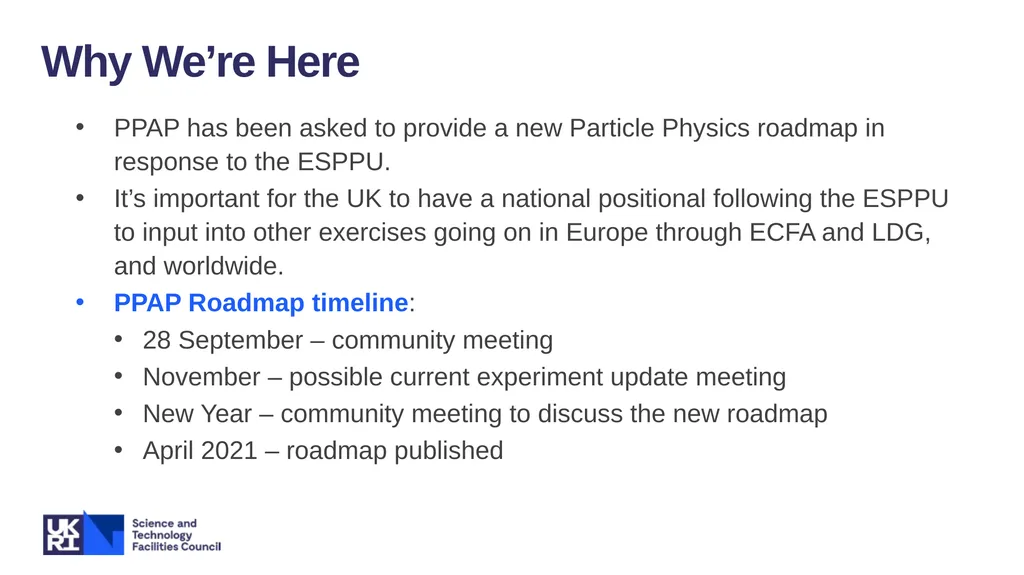
PPAP has been asked to provide a new Particle Physics roadmap in response to the ESPPU.
It’s important for the UK to have a national positional following the ESPPU to input into other exercises going on in Europe through ECFA and LDG, and worldwide.
PPAP Roadmap timeline:
28 September – community meeting
November – possible current experiment update meeting
New Year – community meeting to discuss the new roadmap
April 2021 – roadmap published Why We’re Here<br>
It’s important for the UK to have a national positional following the ESPPU to input into other exercises going on in Europe through ECFA and LDG, and worldwide.
PPAP Roadmap timeline:
28 September – community meeting
November – possible current experiment update meeting
New Year – community meeting to discuss the new roadmap
April 2021 – roadmap published Why We’re Here<br>
03
Different to previous 2-3 day community meetings held in person.
This meeting will focus on discussion.
Using Zoom breakout rooms to hold parallel sessions – in the morning the focus will be within science themes, and the afternoon session will look across the programme.
The output from this meeting will be used by PPAP to inform the new roadmap.
If you wish to contribute to the roadmap process on themes other than your breakout room theme (or feel you were unable to contribute fully during this meeting), PPAP welcome written contributions to ppap@stfc.ac.uk at any time. Structure of this Meeting<br>
This meeting will focus on discussion.
Using Zoom breakout rooms to hold parallel sessions – in the morning the focus will be within science themes, and the afternoon session will look across the programme.
The output from this meeting will be used by PPAP to inform the new roadmap.
If you wish to contribute to the roadmap process on themes other than your breakout room theme (or feel you were unable to contribute fully during this meeting), PPAP welcome written contributions to ppap@stfc.ac.uk at any time. Structure of this Meeting<br>
04
Please set your microphone to mute as default.
Use the ‘raise hand’ and chat functions during the breakout sessions to make comments/contributions/ask questions.
Try to make your comments as concise as possible – we are large in number and short on time!
There is limited capacity to answer questions in the plenary sessions owing to the number of people in the meeting, so please use the chat function to ask questions and we will endeavour to pick these up in real time or answer them after the meeting. Zoom Etiquette<br>
Use the ‘raise hand’ and chat functions during the breakout sessions to make comments/contributions/ask questions.
Try to make your comments as concise as possible – we are large in number and short on time!
There is limited capacity to answer questions in the plenary sessions owing to the number of people in the meeting, so please use the chat function to ask questions and we will endeavour to pick these up in real time or answer them after the meeting. Zoom Etiquette<br>
05
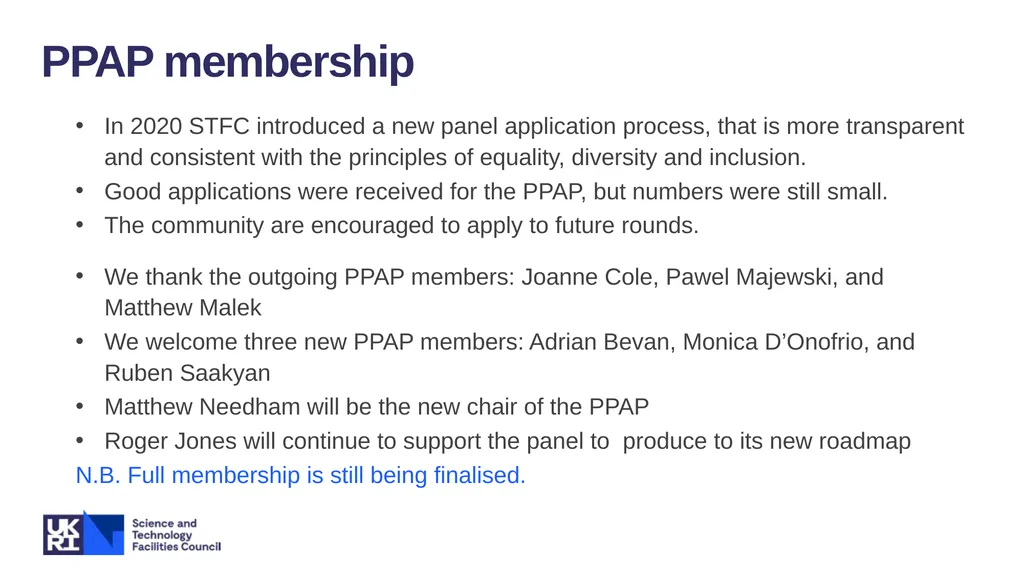
In 2020 STFC introduced a new panel application process, that is more transparent and consistent with the principles of equality, diversity and inclusion.
Good applications were received for the PPAP, but numbers were still small.
The community are encouraged to apply to future rounds.
We thank the outgoing PPAP members: Joanne Cole, Pawel Majewski, and Matthew Malek
We welcome three new PPAP members: Adrian Bevan, Monica D’Onofrio, and Ruben Saakyan
Matthew Needham will be the new chair of the PPAP
Roger Jones will continue to support the panel to produce to its new roadmap
N.B. Full membership is still being finalised. PPAP membership<br>
Good applications were received for the PPAP, but numbers were still small.
The community are encouraged to apply to future rounds.
We thank the outgoing PPAP members: Joanne Cole, Pawel Majewski, and Matthew Malek
We welcome three new PPAP members: Adrian Bevan, Monica D’Onofrio, and Ruben Saakyan
Matthew Needham will be the new chair of the PPAP
Roger Jones will continue to support the panel to produce to its new roadmap
N.B. Full membership is still being finalised. PPAP membership<br>
06
European
Strategy key
points and current UK programme<br>
Strategy key
points and current UK programme<br>
07
The European Strategy has seven sections:
Major developments from the 2013 Strategy
General considerations for the 2020 update
High-priority future initiatives
Other essential scientific activities for particle physics
Synergies with neighbouring fields
Organisational issues
Environmental and societal impact
Overall, the UK programme aligns reasonably well with the European Strategy, but there is more we can do.
It will be important for the future UK programme to be focussed and to identify priorities. European Particle Physics Strategy 2020<br>
Major developments from the 2013 Strategy
General considerations for the 2020 update
High-priority future initiatives
Other essential scientific activities for particle physics
Synergies with neighbouring fields
Organisational issues
Environmental and societal impact
Overall, the UK programme aligns reasonably well with the European Strategy, but there is more we can do.
It will be important for the future UK programme to be focussed and to identify priorities. European Particle Physics Strategy 2020<br>
08
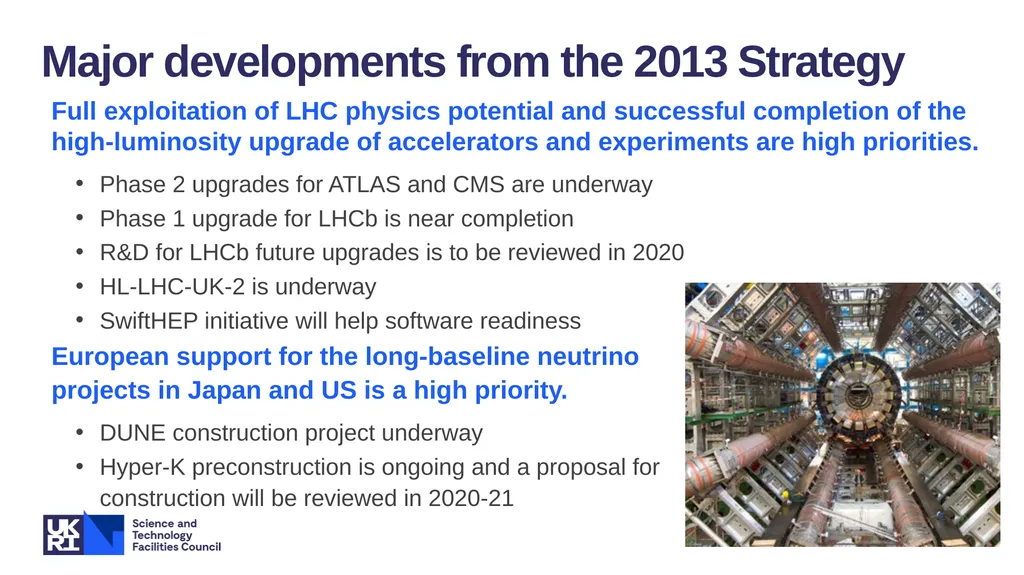
Major developments from the 2013 Strategy Full exploitation of LHC physics potential and successful completion of the high-luminosity upgrade of accelerators and experiments are high priorities.
Phase 2 upgrades for ATLAS and CMS are underway
Phase 1 upgrade for LHCb is near completion
R&D for LHCb future upgrades is to be reviewed in 2020
HL-LHC-UK-2 is underway
SwiftHEP initiative will help software readiness
European support for the long-baseline neutrino projects in Japan and US is a high priority.
DUNE construction project underway
Hyper-K preconstruction is ongoing and a proposal for construction will be reviewed in 2020-21<br>
Phase 2 upgrades for ATLAS and CMS are underway
Phase 1 upgrade for LHCb is near completion
R&D for LHCb future upgrades is to be reviewed in 2020
HL-LHC-UK-2 is underway
SwiftHEP initiative will help software readiness
European support for the long-baseline neutrino projects in Japan and US is a high priority.
DUNE construction project underway
Hyper-K preconstruction is ongoing and a proposal for construction will be reviewed in 2020-21<br>
09
General considerations for the 2020 update The implementation of the European strategy should ensure Europe’s continued scientific and technological leadership, strengthen the ecosystem of research centres in Europe, and be in collaboration with global partners and neighbouring fields.
UK researchers regularly hold leadership positions in experiments – current spokespersons for DUNE, LHCb and NA62.
We should look for ways to make the most of UK national laboratory facilities through collaboration within the UK, and with European partners, CERN, and beyond.
The UK community is encouraged to actively engage in the implementation of the strategy, working with ECFA, the European Lab Directors’ Group and the other relevant committees.<br>
UK researchers regularly hold leadership positions in experiments – current spokespersons for DUNE, LHCb and NA62.
We should look for ways to make the most of UK national laboratory facilities through collaboration within the UK, and with European partners, CERN, and beyond.
The UK community is encouraged to actively engage in the implementation of the strategy, working with ECFA, the European Lab Directors’ Group and the other relevant committees.<br>
10
High-priority future initiatives The strategy calls for increased R&D for accelerator technologies: high-field superconducting magnets, high-gradient accelerating structures, plasma wakefield, muon colliders, etc. and investigating the technical and financial feasibility of a future hadron and e+e- collider at CERN.
The International Linear Collider (ILC) in Japan is highlighted in the strategy, with a timely realisation being consistent with that strategy.
Its potential was noted in the STFC infrastructure prioritisation process (PPAP flagged this as true for all HE e+e- options).
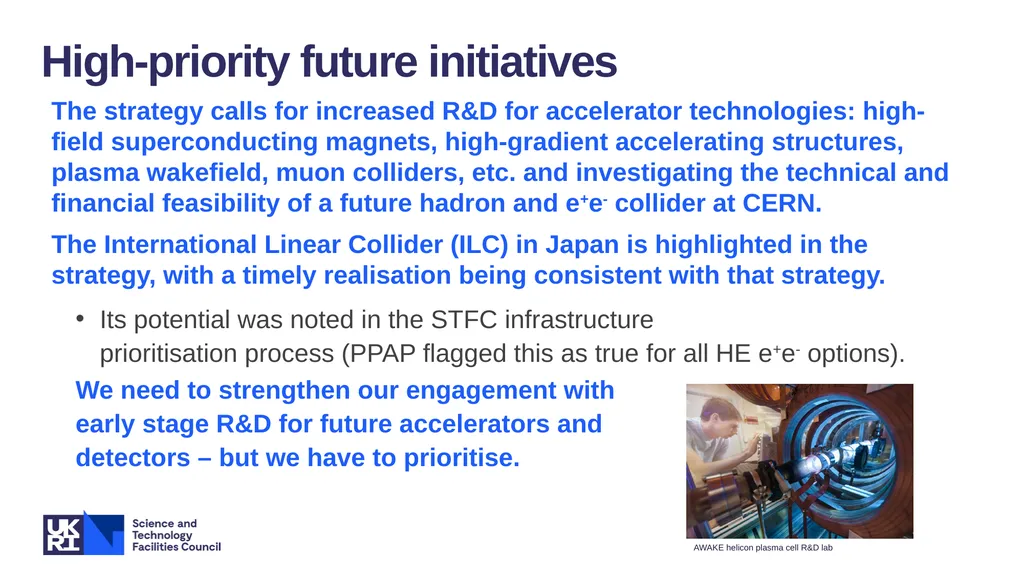
We need to strengthen our engagement with early stage R&D for future accelerators and detectors – but we have to prioritise. AWAKE helicon plasma cell R&D lab<br>
The International Linear Collider (ILC) in Japan is highlighted in the strategy, with a timely realisation being consistent with that strategy.
Its potential was noted in the STFC infrastructure prioritisation process (PPAP flagged this as true for all HE e+e- options).
We need to strengthen our engagement with early stage R&D for future accelerators and detectors – but we have to prioritise. AWAKE helicon plasma cell R&D lab<br>
11
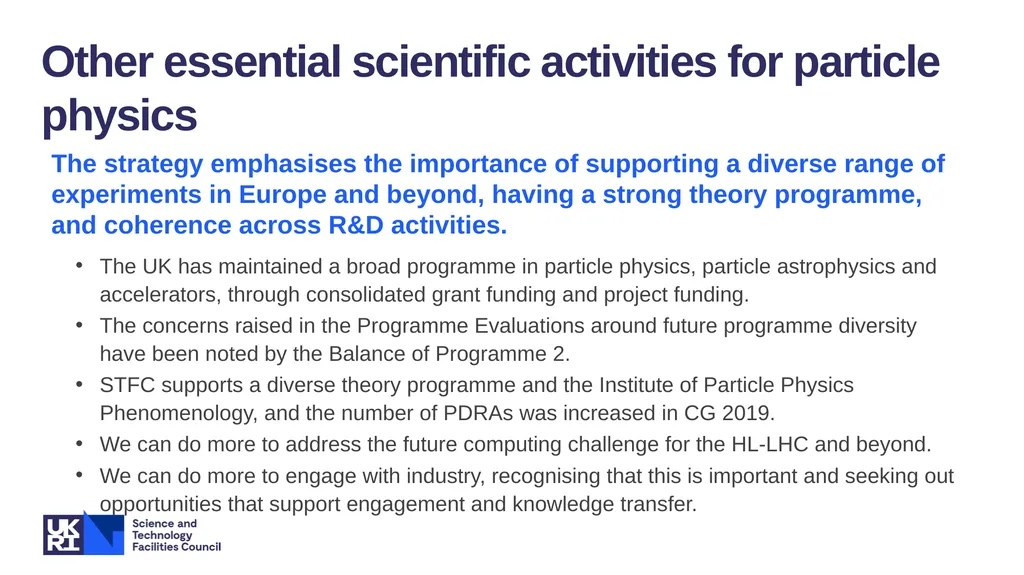
Other essential scientific activities for particle physics The strategy emphasises the importance of supporting a diverse range of experiments in Europe and beyond, having a strong theory programme, and coherence across R&D activities.
The UK has maintained a broad programme in particle physics, particle astrophysics and accelerators, through consolidated grant funding and project funding.
The concerns raised in the Programme Evaluations around future programme diversity have been noted by the Balance of Programme 2.
STFC supports a diverse theory programme and the Institute of Particle Physics Phenomenology, and the number of PDRAs was increased in CG 2019.
We can do more to address the future computing challenge for the HL-LHC and beyond.
We can do more to engage with industry, recognising that this is important and seeking out opportunities that support engagement and knowledge transfer.<br>
The UK has maintained a broad programme in particle physics, particle astrophysics and accelerators, through consolidated grant funding and project funding.
The concerns raised in the Programme Evaluations around future programme diversity have been noted by the Balance of Programme 2.
STFC supports a diverse theory programme and the Institute of Particle Physics Phenomenology, and the number of PDRAs was increased in CG 2019.
We can do more to address the future computing challenge for the HL-LHC and beyond.
We can do more to engage with industry, recognising that this is important and seeking out opportunities that support engagement and knowledge transfer.<br>
12
Synergies with neighbouring fields The strategy notes the importance of synergies between particle physics with particle astrophysics and nuclear physics.
The importance of supporting PA and NP is recognised in Balance of Programme 2, including concerns around levels of funding.
The Electron-Ion Collider (EIC) was seen as a high priority in the STFC infrastructure prioritisation process.<br>
The importance of supporting PA and NP is recognised in Balance of Programme 2, including concerns around levels of funding.
The Electron-Ion Collider (EIC) was seen as a high priority in the STFC infrastructure prioritisation process.<br>
13
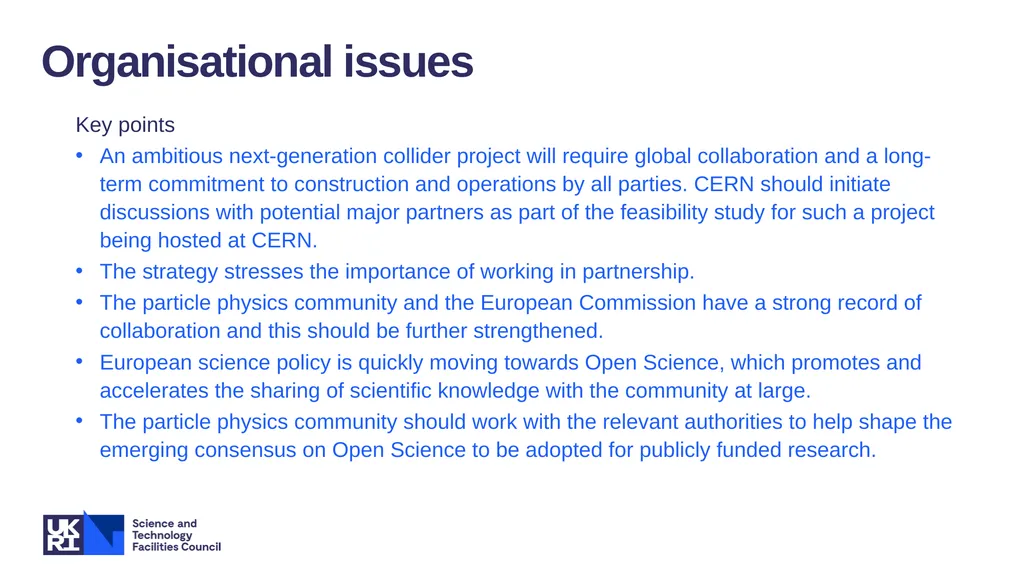
Organisational issues Key points
An ambitious next-generation collider project will require global collaboration and a long-term commitment to construction and operations by all parties. CERN should initiate discussions with potential major partners as part of the feasibility study for such a project being hosted at CERN.
The strategy stresses the importance of working in partnership.
The particle physics community and the European Commission have a strong record of collaboration and this should be further strengthened.
European science policy is quickly moving towards Open Science, which promotes and accelerates the sharing of scientific knowledge with the community at large.
The particle physics community should work with the relevant authorities to help shape the emerging consensus on Open Science to be adopted for publicly funded research.<br>
An ambitious next-generation collider project will require global collaboration and a long-term commitment to construction and operations by all parties. CERN should initiate discussions with potential major partners as part of the feasibility study for such a project being hosted at CERN.
The strategy stresses the importance of working in partnership.
The particle physics community and the European Commission have a strong record of collaboration and this should be further strengthened.
European science policy is quickly moving towards Open Science, which promotes and accelerates the sharing of scientific knowledge with the community at large.
The particle physics community should work with the relevant authorities to help shape the emerging consensus on Open Science to be adopted for publicly funded research.<br>
14
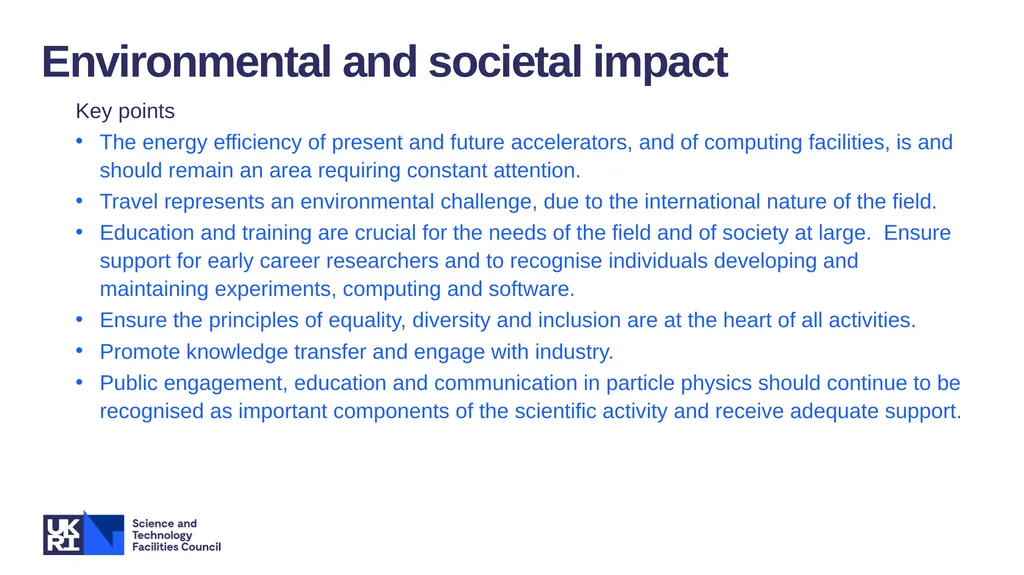
Environmental and societal impact Key points
The energy efficiency of present and future accelerators, and of computing facilities, is and should remain an area requiring constant attention.
Travel represents an environmental challenge, due to the international nature of the field.
Education and training are crucial for the needs of the field and of society at large. Ensure support for early career researchers and to recognise individuals developing and maintaining experiments, computing and software.
Ensure the principles of equality, diversity and inclusion are at the heart of all activities.
Promote knowledge transfer and engage with industry.
Public engagement, education and communication in particle physics should continue to be recognised as important components of the scientific activity and receive adequate support.<br>
The energy efficiency of present and future accelerators, and of computing facilities, is and should remain an area requiring constant attention.
Travel represents an environmental challenge, due to the international nature of the field.
Education and training are crucial for the needs of the field and of society at large. Ensure support for early career researchers and to recognise individuals developing and maintaining experiments, computing and software.
Ensure the principles of equality, diversity and inclusion are at the heart of all activities.
Promote knowledge transfer and engage with industry.
Public engagement, education and communication in particle physics should continue to be recognised as important components of the scientific activity and receive adequate support.<br>