
Introduction This resource is not a teaching and
CB
Published · 36 slides · 0 views
1 / 1
Description
Introduction This resource is not a teaching and learning program. It should be used in conjunction with Year 8 term 3 program From page to stage. Introduction for the teacher 1 Instructions for use Instructions for the teacher Classroom
Related Topics
Share
Embed code
Download this presentation From Below
"Introduction This resource is not a teaching and" is the property of its rightful owner. Permission is granted to download and print the materials on this website for personal, non-commercial use only, and to display it on your personal computer provided you do not modify the materials and that you retain all copyright notices contained in the materials. By downloading content from our website, you accept the terms of this agreement.
Presentation Transcript
01
Introduction This resource is not a teaching and learning program. It should be used in conjunction with Year 8 term 3 program ‘From page to stage’. Introduction for the teacher 1<br>
02
Instructions for use Instructions for the teacher Classroom teachers are encouraged to add and adapt slides as required to meet the needs of their students.
Save a copy of the file to make changes to the slide deck. Go to File > Download a Copy (this downloads a copy to the computer to edit in the PowerPoint application).
To convert the PowerPoint to Google Slides:
Upload the file into Google Drive and open it.
Go to File > Save as Google Slides.
(Note – conversion may cause formatting changes in the slides.) 2<br>
Save a copy of the file to make changes to the slide deck. Go to File > Download a Copy (this downloads a copy to the computer to edit in the PowerPoint application).
To convert the PowerPoint to Google Slides:
Upload the file into Google Drive and open it.
Go to File > Save as Google Slides.
(Note – conversion may cause formatting changes in the slides.) 2<br>
03
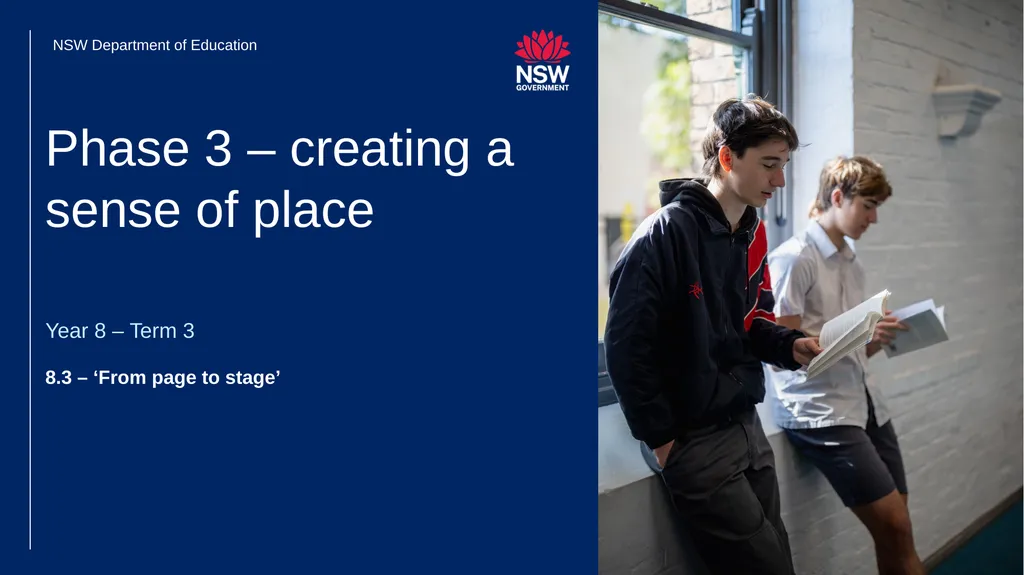
Phase 3 – creating a sense of place Year 8 – Term 3 8.3 – ‘From page to stage’ NSW Department of Education<br>
04
Sharing learning intentions and success criteria NSW Department of Education<br>
05
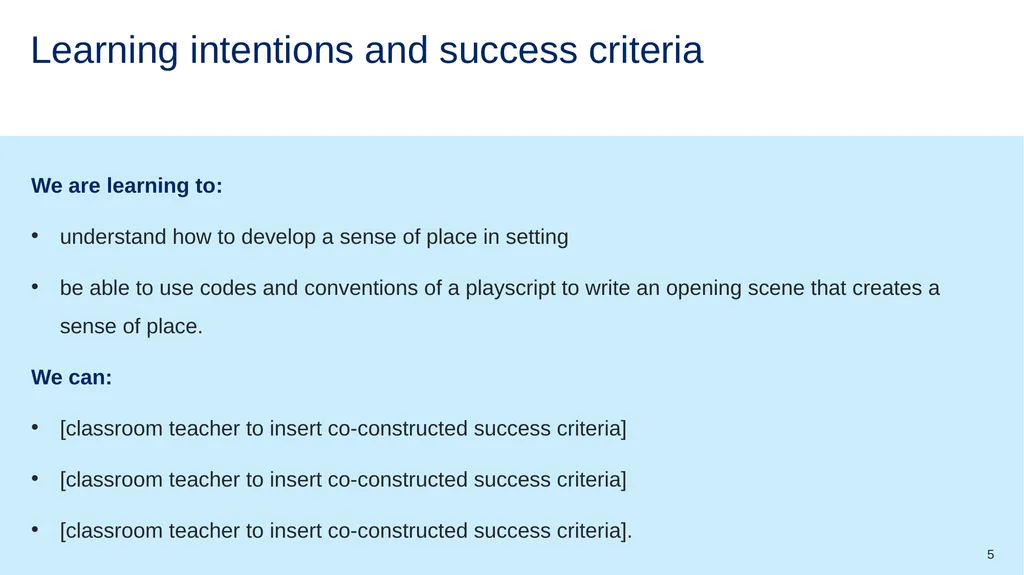
Learning intentions and success criteria We are learning to:
understand how to develop a sense of place in setting
be able to use codes and conventions of a playscript to write an opening scene that creates a sense of place.
We can:
[classroom teacher to insert co-constructed success criteria]
[classroom teacher to insert co-constructed success criteria]
[classroom teacher to insert co-constructed success criteria]. 5<br>
understand how to develop a sense of place in setting
be able to use codes and conventions of a playscript to write an opening scene that creates a sense of place.
We can:
[classroom teacher to insert co-constructed success criteria]
[classroom teacher to insert co-constructed success criteria]
[classroom teacher to insert co-constructed success criteria]. 5<br>
06
Connecting learning NSW Department of Education<br>
07
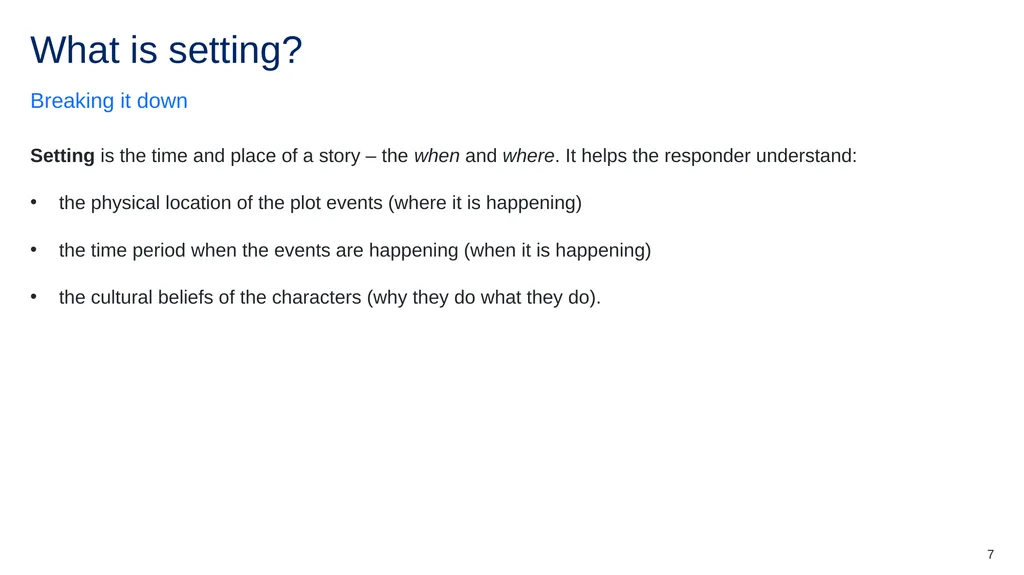
What is setting? Breaking it down Setting is the time and place of a story – the when and where. It helps the responder understand:
the physical location of the plot events (where it is happening)
the time period when the events are happening (when it is happening)
the cultural beliefs of the characters (why they do what they do). 7<br>
the physical location of the plot events (where it is happening)
the time period when the events are happening (when it is happening)
the cultural beliefs of the characters (why they do what they do). 7<br>
08
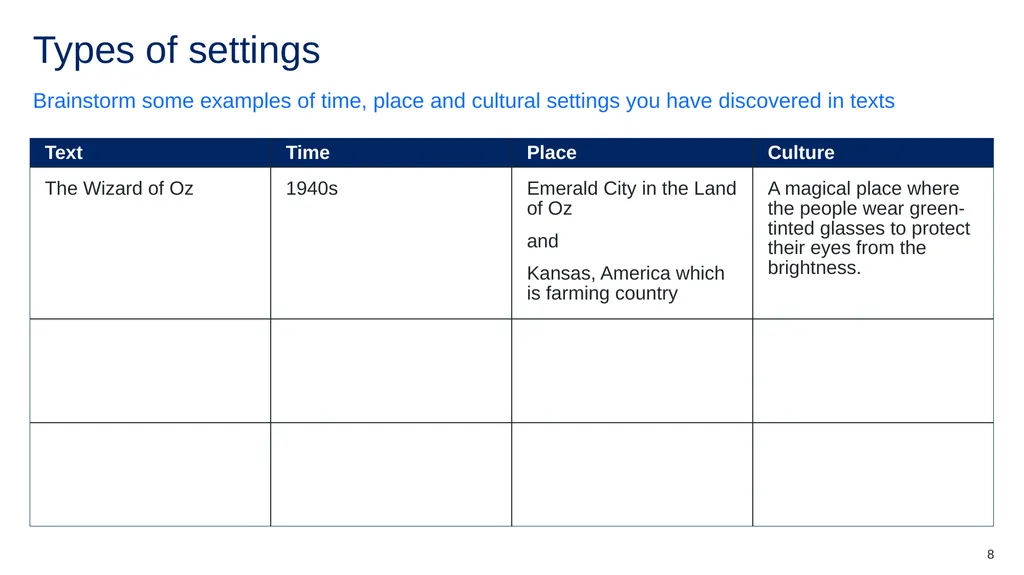
Types of settings Brainstorm some examples of time, place and cultural settings you have discovered in texts 8<br>
09
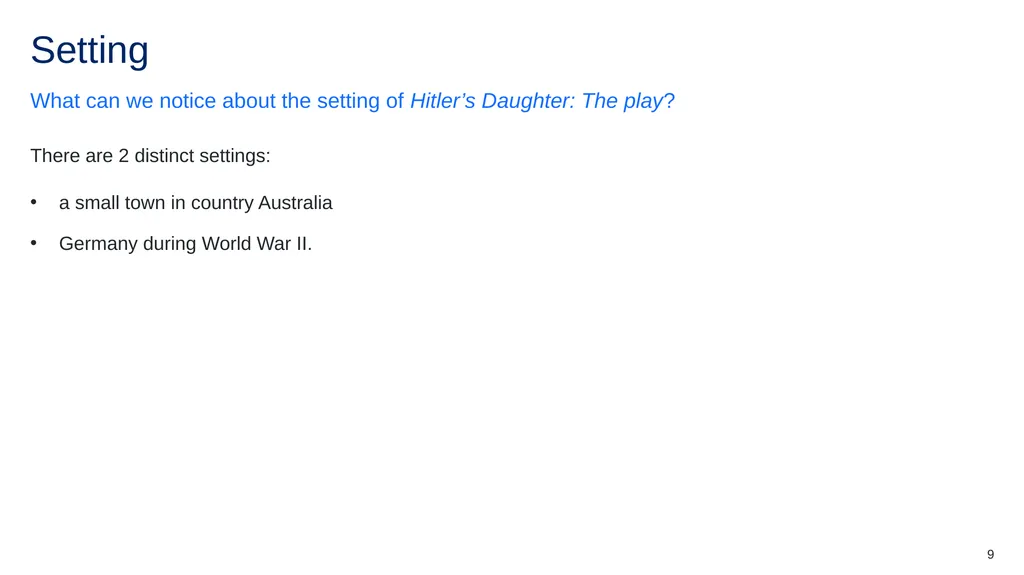
Setting (1) What can we notice about the setting of Hitler’s Daughter: The play? There are 2 distinct settings:
a small town in country Australia
Germany during World War II. 9<br>
a small town in country Australia
Germany during World War II. 9<br>
10
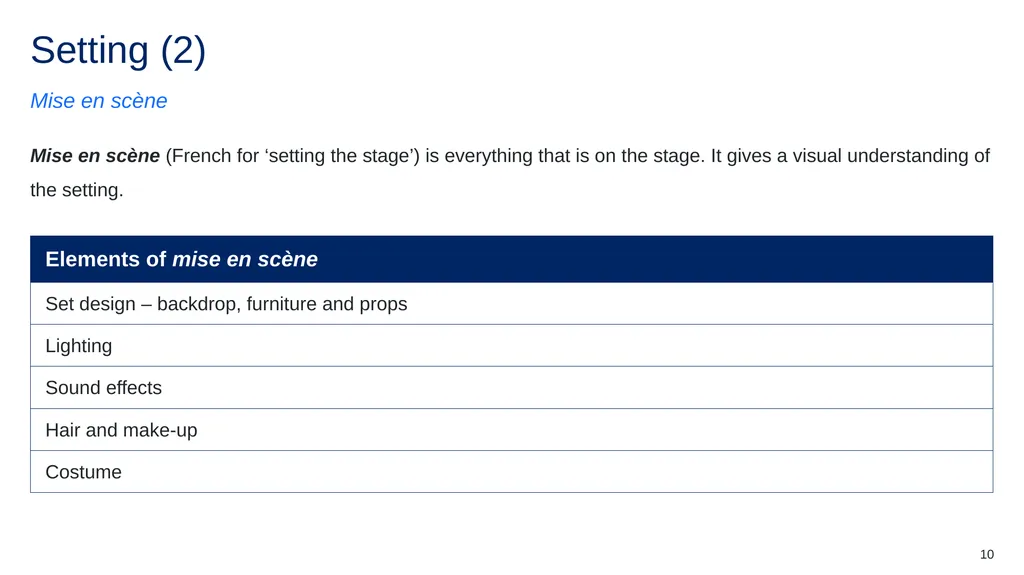
Setting (2) (2) Mise en scène Mise en scène (French for ‘setting the stage’) is everything that is on the stage. It gives a visual understanding of the setting. 10<br>
11
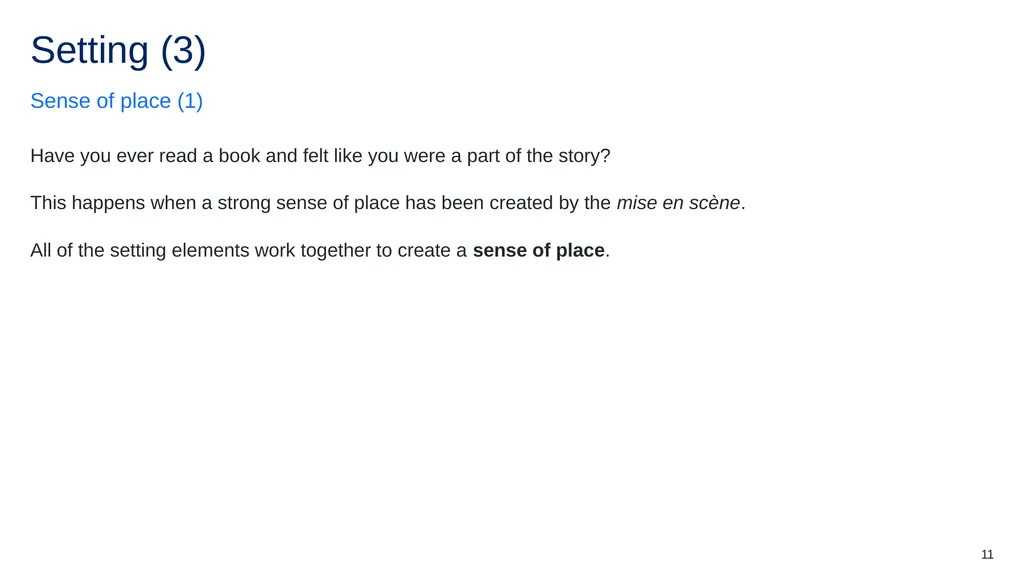
Setting (3) (3) Sense of place (1) Have you ever read a book and felt like you were a part of the story?
This happens when a strong sense of place has been created by the mise en scène.
All of the setting elements work together to create a sense of place. 11<br>
This happens when a strong sense of place has been created by the mise en scène.
All of the setting elements work together to create a sense of place. 11<br>
12
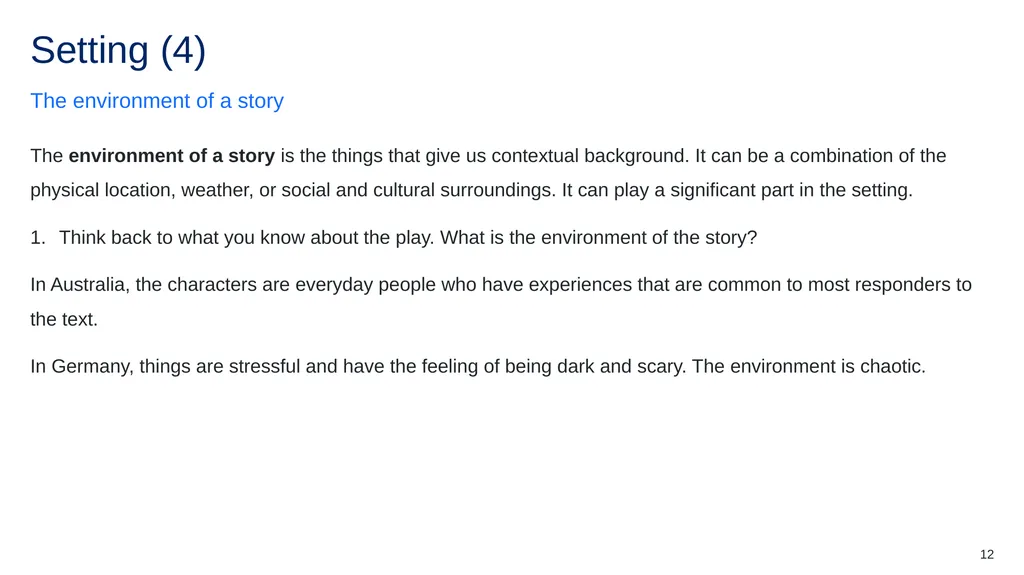
Setting (4)) The environment of a story The environment of a story is the things that give us contextual background. It can be a combination of the physical location, weather, or social and cultural surroundings. It can play a significant part in the setting.
Think back to what you know about the play. What is the environment of the story?
In Australia, the characters are everyday people who have experiences that are common to most responders to the text.
In Germany, things are stressful and have the feeling of being dark and scary. The environment is chaotic. 12<br>
Think back to what you know about the play. What is the environment of the story?
In Australia, the characters are everyday people who have experiences that are common to most responders to the text.
In Germany, things are stressful and have the feeling of being dark and scary. The environment is chaotic. 12<br>
13
Gradual release of responsibility NSW Department of Education<br>
14
Creating a sense of place (1) NSW Department of Education<br>
15
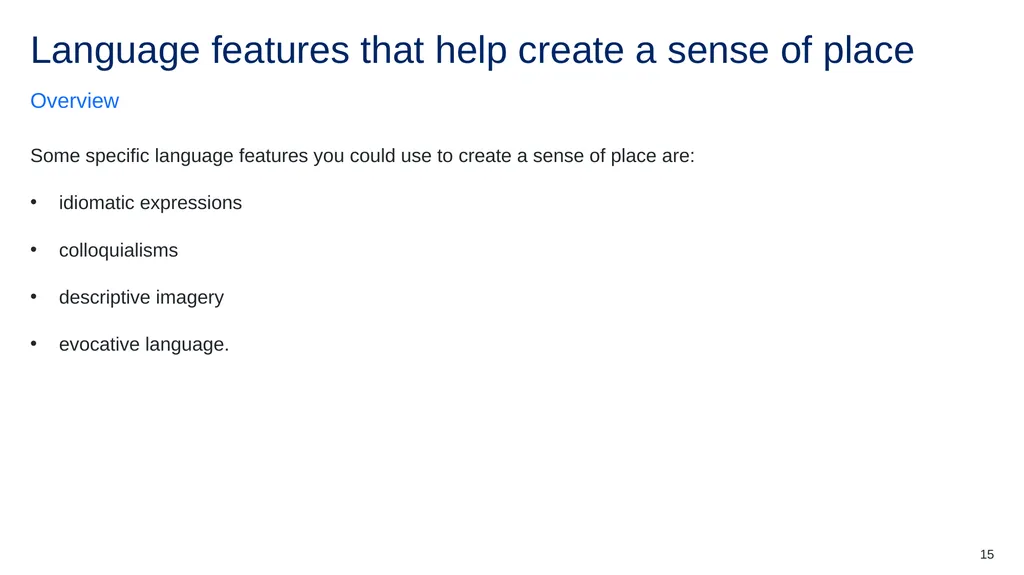
Language features that help create a sense of place Overview Some specific language features you could use to create a sense of place are:
idiomatic expressions
colloquialisms
descriptive imagery
evocative language. 15<br>
idiomatic expressions
colloquialisms
descriptive imagery
evocative language. 15<br>
16
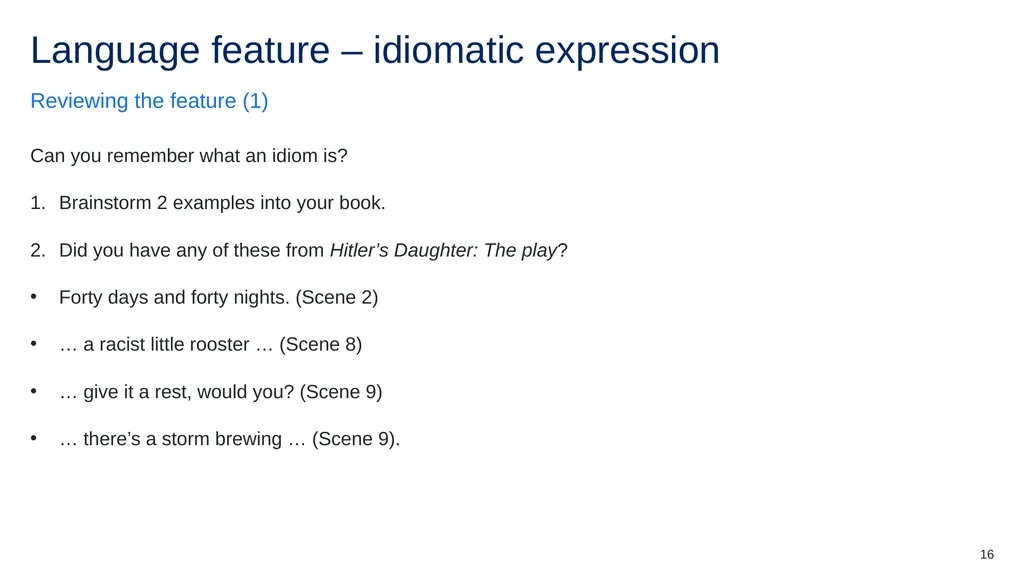
Language feature – idiomatic expression Reviewing the feature (1) Can you remember what an idiom is?
Brainstorm 2 examples into your book.
Did you have any of these from Hitler’s Daughter: The play?
Forty days and forty nights. (Scene 2)
… a racist little rooster … (Scene 8)
… give it a rest, would you? (Scene 9)
… there’s a storm brewing … (Scene 9). 16<br>
Brainstorm 2 examples into your book.
Did you have any of these from Hitler’s Daughter: The play?
Forty days and forty nights. (Scene 2)
… a racist little rooster … (Scene 8)
… give it a rest, would you? (Scene 9)
… there’s a storm brewing … (Scene 9). 16<br>
17
Checking for understanding NSW Department of Education<br>
18
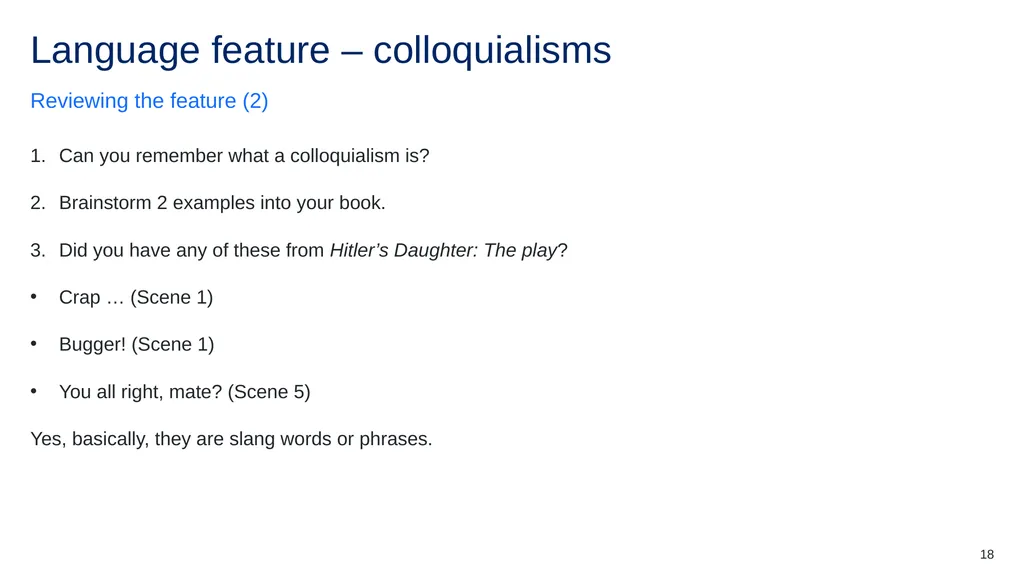
Language feature – colloquialisms Reviewing the feature (2) Can you remember what a colloquialism is?
Brainstorm 2 examples into your book.
Did you have any of these from Hitler’s Daughter: The play?
Crap … (Scene 1)
Bugger! (Scene 1)
You all right, mate? (Scene 5)
Yes, basically, they are slang words or phrases. 18<br>
Brainstorm 2 examples into your book.
Did you have any of these from Hitler’s Daughter: The play?
Crap … (Scene 1)
Bugger! (Scene 1)
You all right, mate? (Scene 5)
Yes, basically, they are slang words or phrases. 18<br>
19
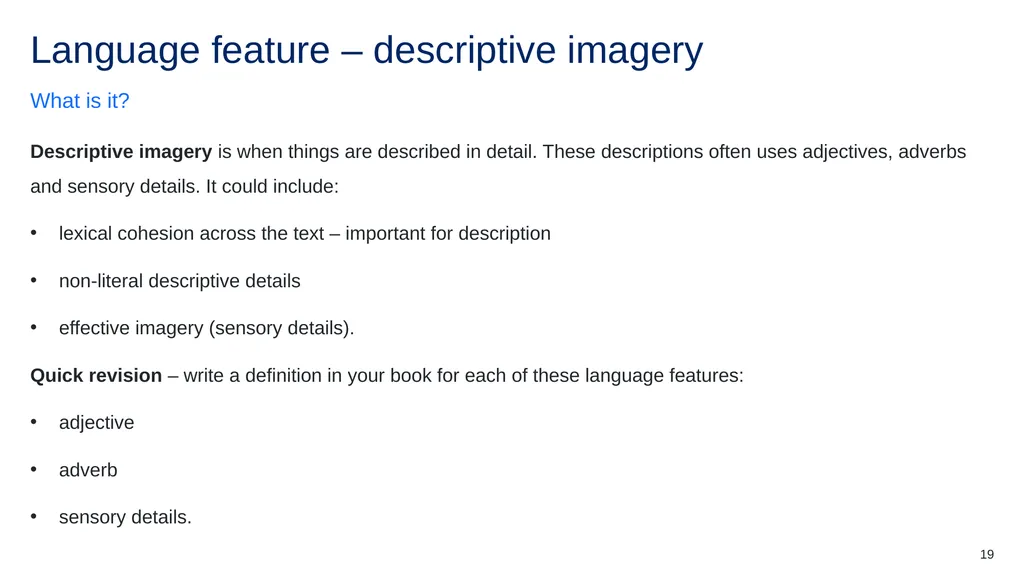
Language feature – descriptive imagery (1) What is it? Descriptive imagery is when things are described in detail. These descriptions often uses adjectives, adverbs and sensory details. It could include:
lexical cohesion across the text – important for description
non-literal descriptive details
effective imagery (sensory details).
Quick revision – write a definition in your book for each of these language features:
adjective
adverb
sensory details. 19<br>
lexical cohesion across the text – important for description
non-literal descriptive details
effective imagery (sensory details).
Quick revision – write a definition in your book for each of these language features:
adjective
adverb
sensory details. 19<br>
20
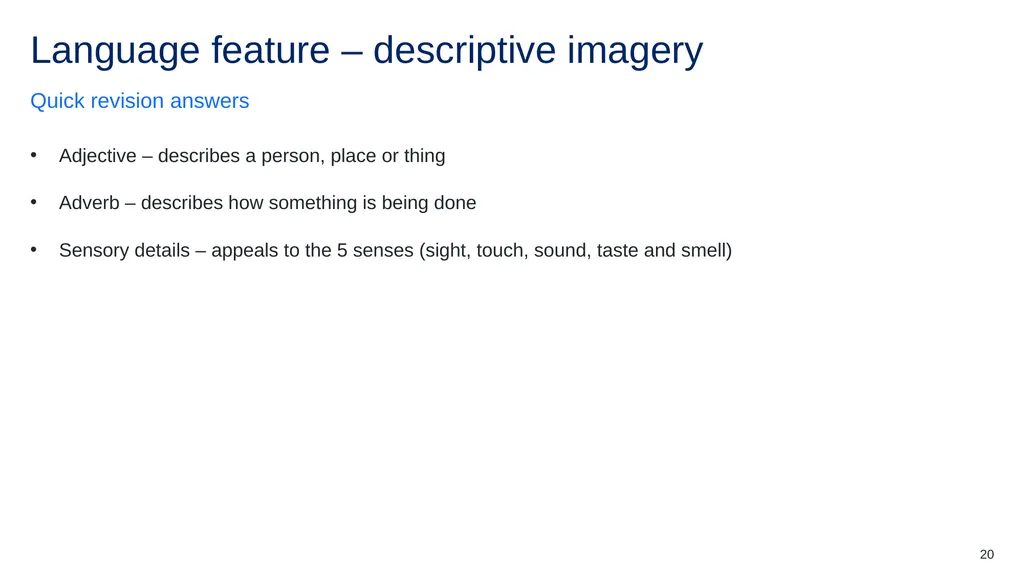
Language feature – descriptive imagery (2) Quick revision answers Adjective – describes a person, place or thing
Adverb – describes how something is being done
Sensory details – appeals to the 5 senses (sight, touch, sound, taste and smell) 20<br>
Adverb – describes how something is being done
Sensory details – appeals to the 5 senses (sight, touch, sound, taste and smell) 20<br>
21
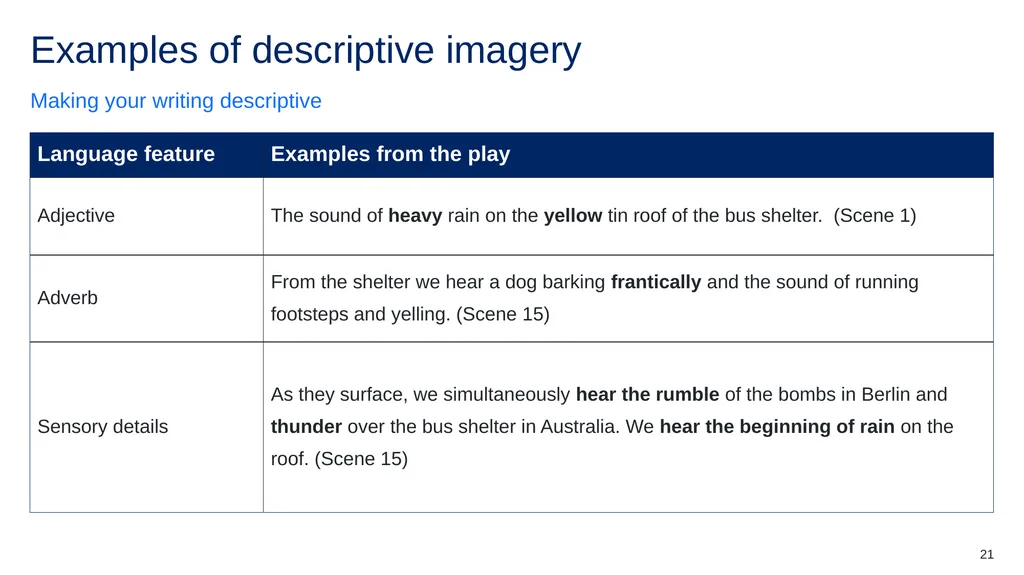
Examples of descriptive imagery Making your writing descriptive 21<br>
22
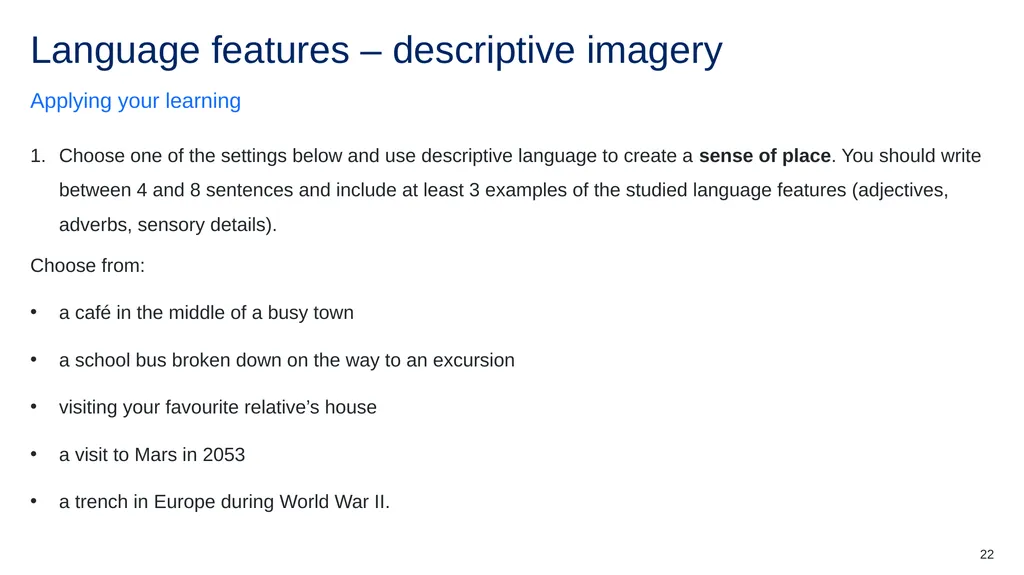
Language features – descriptive imagery (3) Applying your learning Choose one of the settings below and use descriptive language to create a sense of place. You should write between 4 and 8 sentences and include at least 3 examples of the studied language features (adjectives, adverbs, sensory details).
Choose from:
a café in the middle of a busy town
a school bus broken down on the way to an excursion
visiting your favourite relative’s house
a visit to Mars in 2053
a trench in Europe during World War II. 22<br>
Choose from:
a café in the middle of a busy town
a school bus broken down on the way to an excursion
visiting your favourite relative’s house
a visit to Mars in 2053
a trench in Europe during World War II. 22<br>
23
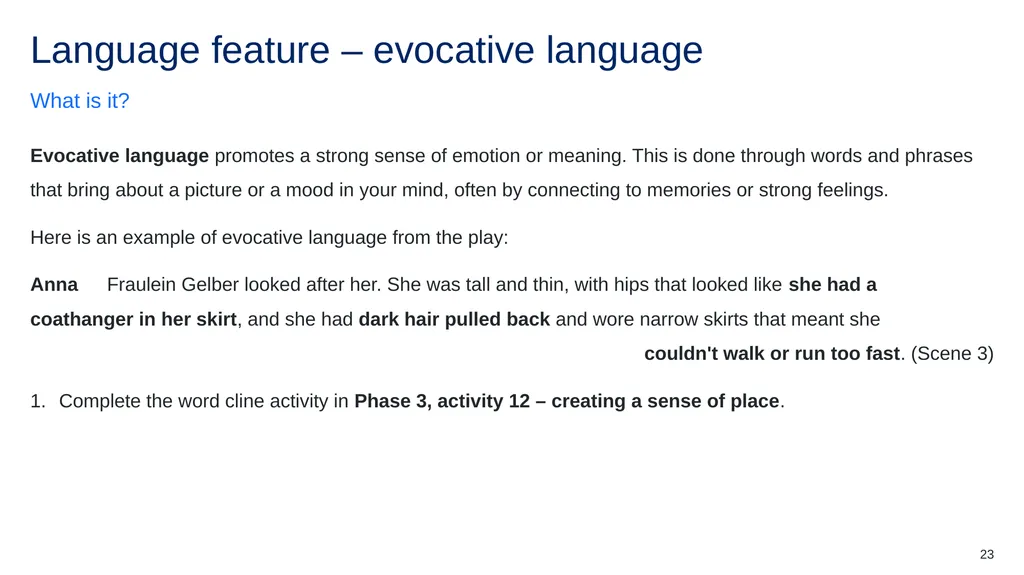
Language feature – evocative language What is it? Evocative language promotes a strong sense of emotion or meaning. This is done through words and phrases that bring about a picture or a mood in your mind, often by connecting to memories or strong feelings.
Here is an example of evocative language from the play:
Anna Fraulein Gelber looked after her. She was tall and thin, with hips that looked like she had a coathanger in her skirt, and she had dark hair pulled back and wore narrow skirts that meant she couldn't walk or run too fast. (Scene 3)
Complete the word cline activity in Phase 3, activity 12 – creating a sense of place. 23<br>
Here is an example of evocative language from the play:
Anna Fraulein Gelber looked after her. She was tall and thin, with hips that looked like she had a coathanger in her skirt, and she had dark hair pulled back and wore narrow skirts that meant she couldn't walk or run too fast. (Scene 3)
Complete the word cline activity in Phase 3, activity 12 – creating a sense of place. 23<br>
24
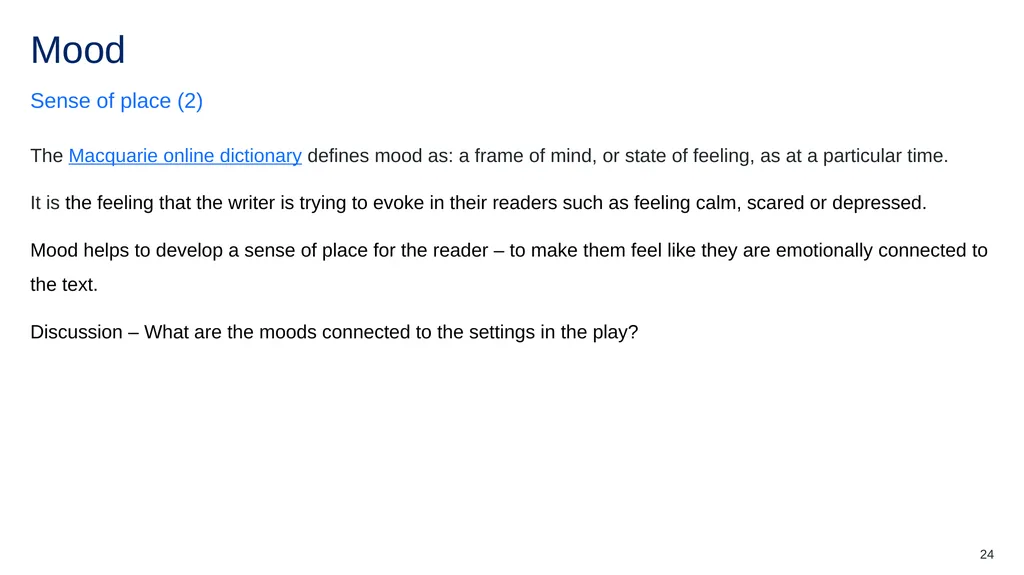
Mood Sense of place (2) The Macquarie online dictionary defines mood as: a frame of mind, or state of feeling, as at a particular time.
It is the feeling that the writer is trying to evoke in their readers such as feeling calm, scared or depressed.
Mood helps to develop a sense of place for the reader – to make them feel like they are emotionally connected to the text.
Discussion – What are the moods connected to the settings in the play? 24<br>
It is the feeling that the writer is trying to evoke in their readers such as feeling calm, scared or depressed.
Mood helps to develop a sense of place for the reader – to make them feel like they are emotionally connected to the text.
Discussion – What are the moods connected to the settings in the play? 24<br>
25
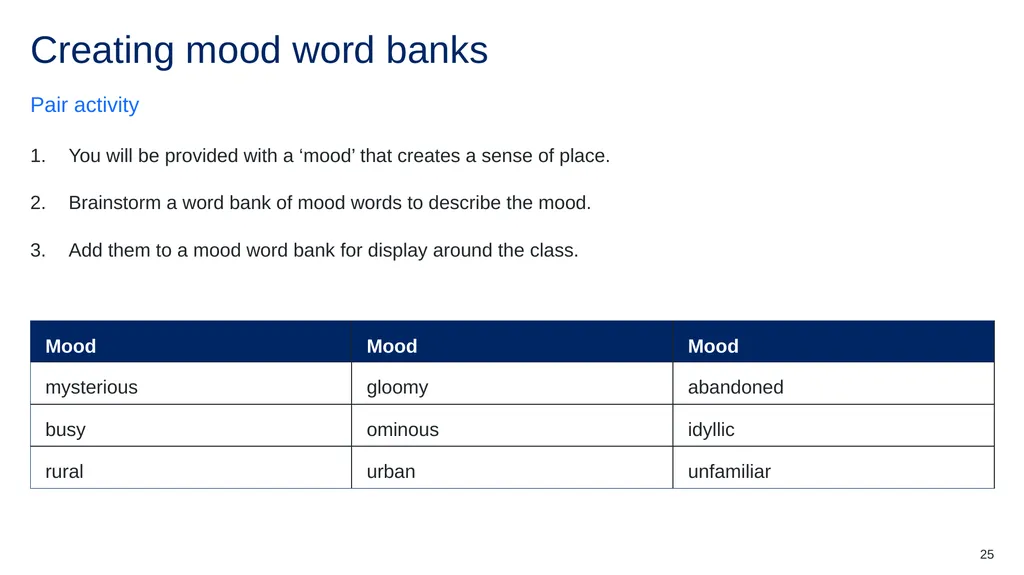
Creating mood word banks Pair activity You will be provided with a ‘mood’ that creates a sense of place.
Brainstorm a word bank of mood words to describe the mood.
Add them to a mood word bank for display around the class. 25<br>
Brainstorm a word bank of mood words to describe the mood.
Add them to a mood word bank for display around the class. 25<br>
26
Using dialogue to create a sense of place NSW Department of Education<br>
27
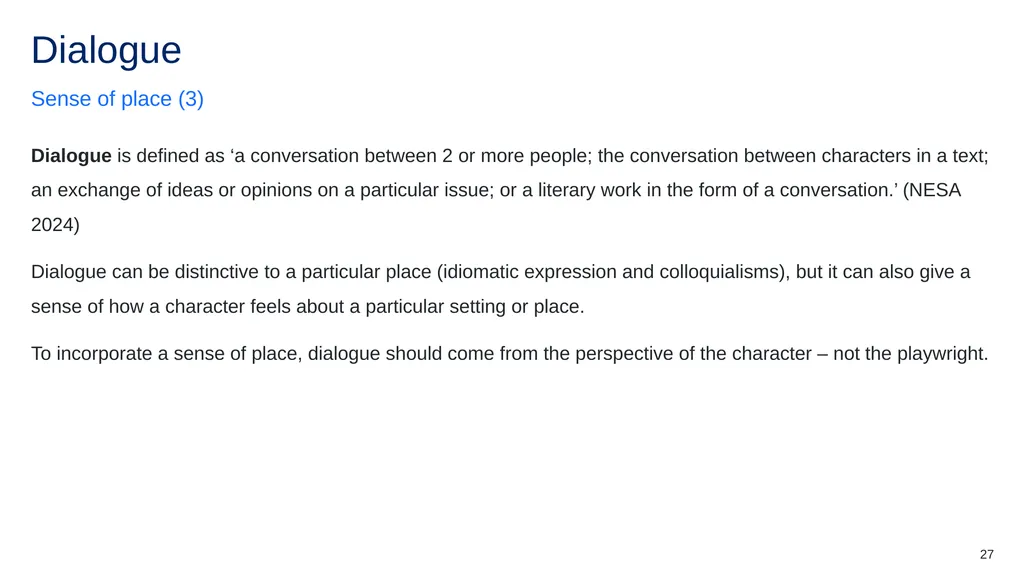
Dialogue Sense of place (3) Dialogue is defined as ‘a conversation between 2 or more people; the conversation between characters in a text; an exchange of ideas or opinions on a particular issue; or a literary work in the form of a conversation.’ (NESA 2024)
Dialogue can be distinctive to a particular place (idiomatic expression and colloquialisms), but it can also give a sense of how a character feels about a particular setting or place.
To incorporate a sense of place, dialogue should come from the perspective of the character – not the playwright. 27<br>
Dialogue can be distinctive to a particular place (idiomatic expression and colloquialisms), but it can also give a sense of how a character feels about a particular setting or place.
To incorporate a sense of place, dialogue should come from the perspective of the character – not the playwright. 27<br>
28
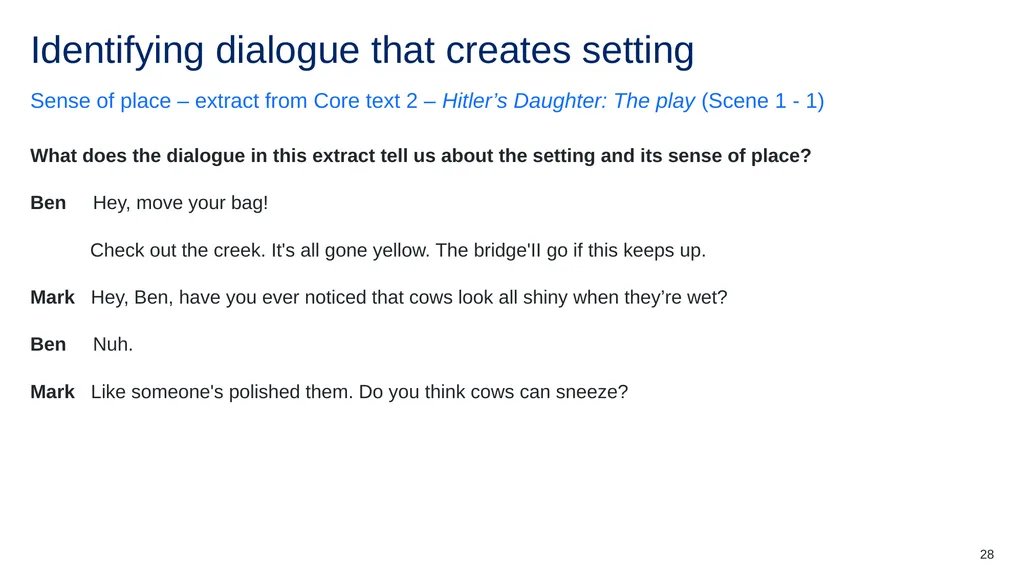
Identifying dialogue that creates setting Sense of place – extract from Core text 2 – Hitler’s Daughter: The play (Scene 1 - 1) What does the dialogue in this extract tell us about the setting and its sense of place?
Ben Hey, move your bag!
Check out the creek. It's all gone yellow. The bridge'II go if this keeps up.
Mark Hey, Ben, have you ever noticed that cows look all shiny when they’re wet?
Ben Nuh.
Mark Like someone's polished them. Do you think cows can sneeze? 28<br>
Ben Hey, move your bag!
Check out the creek. It's all gone yellow. The bridge'II go if this keeps up.
Mark Hey, Ben, have you ever noticed that cows look all shiny when they’re wet?
Ben Nuh.
Mark Like someone's polished them. Do you think cows can sneeze? 28<br>
29
Suggested responses Sense of place – extract from Core text 1 – Hitler’s Daughter – The play (Scene 1 – 2) What does the dialogue in this extract tell us about the setting and its
sense of place?
Ben Hey, move your bag!
Check out the creek. It's all gone yellow. The bridge'II go if this keeps up.
Mark Hey, Ben, have you ever noticed that cows look all shiny when they’re wet?
Ben Nuh.
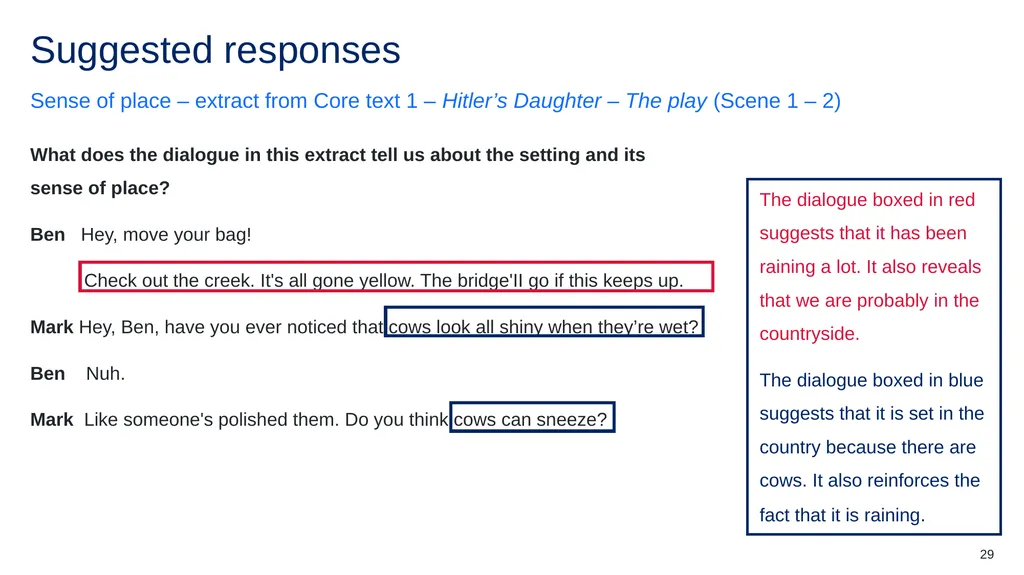
Mark Like someone's polished them. Do you think cows can sneeze? The dialogue boxed in red suggests that it has been raining a lot. It also reveals that we are probably in the countryside.
The dialogue boxed in blue suggests that it is set in the country because there are cows. It also reinforces the fact that it is raining. 29<br>
Ben Hey, move your bag!
Check out the creek. It's all gone yellow. The bridge'II go if this keeps up.
Mark Hey, Ben, have you ever noticed that cows look all shiny when they’re wet?
Ben Nuh.
Mark Like someone's polished them. Do you think cows can sneeze? The dialogue boxed in red suggests that it has been raining a lot. It also reveals that we are probably in the countryside.
The dialogue boxed in blue suggests that it is set in the country because there are cows. It also reinforces the fact that it is raining. 29<br>
30
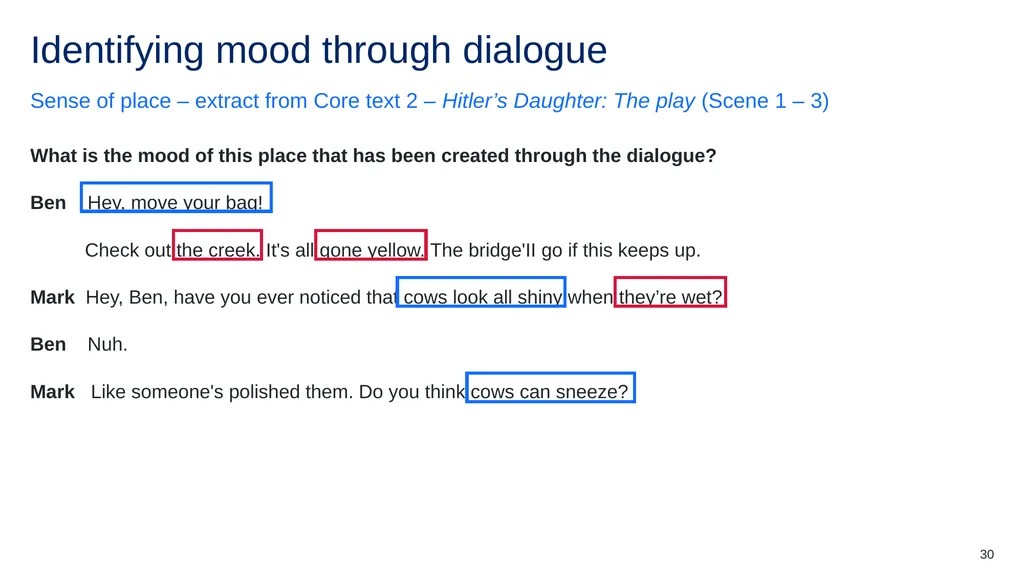
Identifying mood through dialogue Sense of place – extract from Core text 2 – Hitler’s Daughter: The play (Scene 1 – 3) What is the mood of this place that has been created through the dialogue?
Ben Hey, move your bag!
Check out the creek. It's all gone yellow. The bridge'II go if this keeps up.
Mark Hey, Ben, have you ever noticed that cows look all shiny when they’re wet?
Ben Nuh.
Mark Like someone's polished them. Do you think cows can sneeze? 30<br>
Ben Hey, move your bag!
Check out the creek. It's all gone yellow. The bridge'II go if this keeps up.
Mark Hey, Ben, have you ever noticed that cows look all shiny when they’re wet?
Ben Nuh.
Mark Like someone's polished them. Do you think cows can sneeze? 30<br>
31
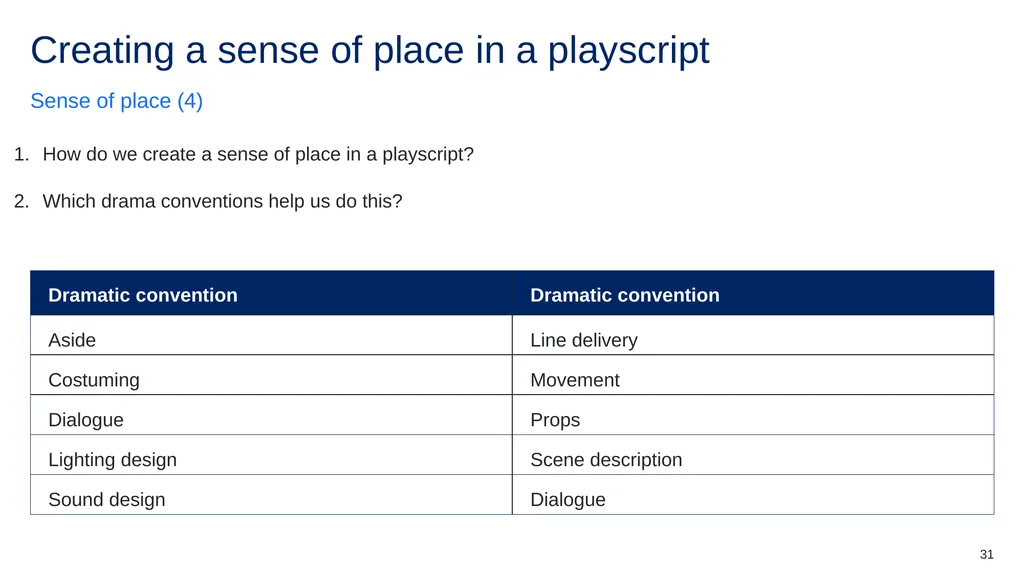
Creating a sense of place in a playscript Sense of place (4) How do we create a sense of place in a playscript?
Which drama conventions help us do this? 31<br>
Which drama conventions help us do this? 31<br>
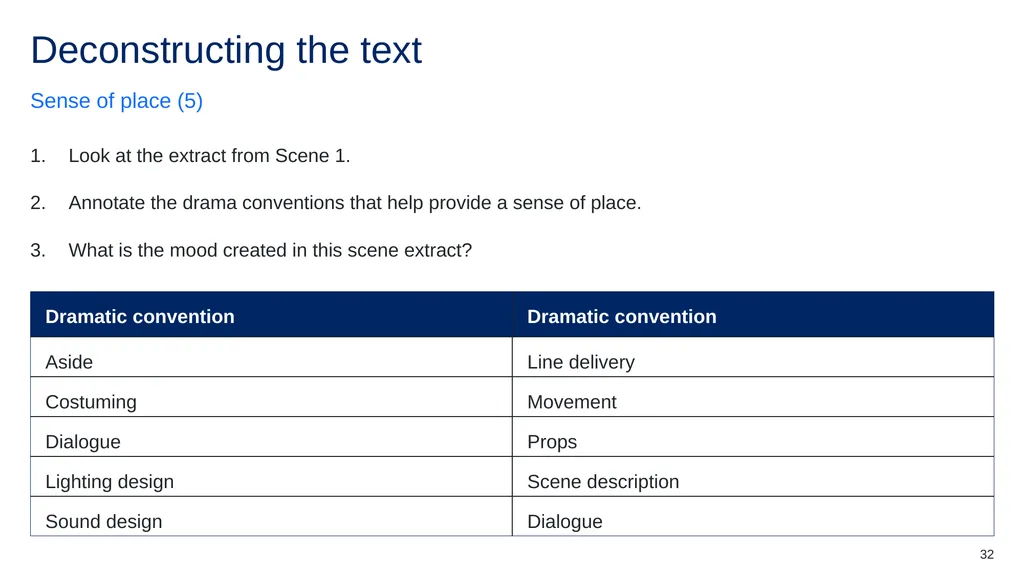
32
Deconstructing the text Sense of place (5) Look at the extract from Scene 1.
Annotate the drama conventions that help provide a sense of place.
What is the mood created in this scene extract? 32<br>
Annotate the drama conventions that help provide a sense of place.
What is the mood created in this scene extract? 32<br>
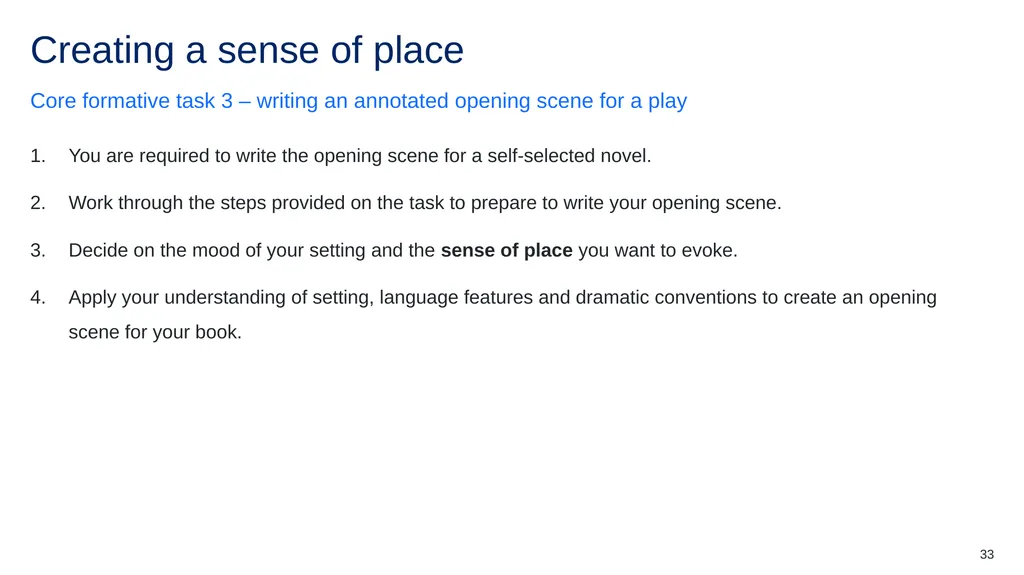
33
Creating a sense of place (2) Core formative task 3 – writing an annotated opening scene for a play You are required to write the opening scene for a self-selected novel.
Work through the steps provided on the task to prepare to write your opening scene.
Decide on the mood of your setting and the sense of place you want to evoke.
Apply your understanding of setting, language features and dramatic conventions to create an opening scene for your book. 33<br>
Work through the steps provided on the task to prepare to write your opening scene.
Decide on the mood of your setting and the sense of place you want to evoke.
Apply your understanding of setting, language features and dramatic conventions to create an opening scene for your book. 33<br>
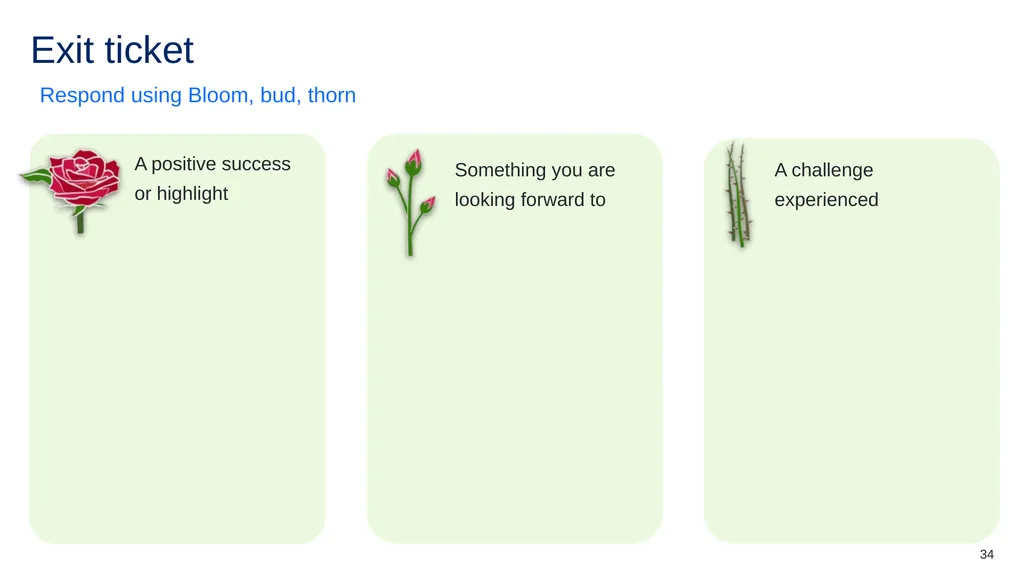
34
Exit ticket Respond using Bloom, bud, thorn A positive success
or highlight Something you are looking forward to A challenge experienced 34<br>
35
References This presentation contains NSW Curriculum and syllabus content. The NSW Curriculum is developed by the NSW Education Standards Authority. This content is prepared by NESA for and on behalf of the Crown in the right of the State of New South Wales. The material is protected by Crown copyright.
Please refer to the NESA Copyright Disclaimer for more information https://educationstandards.nsw.edu.au/wps/portal/nesa/mini-footer/copyright.
NESA holds the only official and up-to-date versions of the NSW Curriculum and syllabus documents. Please visit the NSW Education Standards Authority (NESA) website https://educationstandards.nsw.edu.au and the NSW Curriculum website https://curriculum.nsw.edu.au. English K–10 Syllabus © NSW Education Standards Authority (NESA) for and on behalf of the Crown in right of the State of New South Wales, 2022.
AERO (Australian Education Research Organisation) (2024a) Explain learning objectives, AERO website, accessed 13 March 2026.
AERO (2024b) Explicit instruction, AERO website, 13 March 2026.
Baum L F (1900) The Wonderful Wizard of Oz, Project Gutenberg website, accessed 13 March 2026.
CESE (Centre for Education Statistics and Evaluation) (2017) Cognitive load theory: Research that teachers really need to understand, NSW Department of Education,
accessed 13 March 2026.
Di Cesare E, Eldridge S and McGarry T (2007) Hitler’s Daughter: The play, Currency Press, Sydney.
Griffin P (2018) Assessment for teaching, Cambridge University Press.
NESA (2024) ‘Glossary’, Resources, NESA website, accessed 13 March 2026.
Pan Macmillan Australia (2024) Macquarie Dictionary Online, accessed 13 March 2026.
State of New South Wales (Department of Education) (2024) Explicit teaching strategies, NSW Department of Education website, accessed 13 March 2026. 35<br>
Please refer to the NESA Copyright Disclaimer for more information https://educationstandards.nsw.edu.au/wps/portal/nesa/mini-footer/copyright.
NESA holds the only official and up-to-date versions of the NSW Curriculum and syllabus documents. Please visit the NSW Education Standards Authority (NESA) website https://educationstandards.nsw.edu.au and the NSW Curriculum website https://curriculum.nsw.edu.au. English K–10 Syllabus © NSW Education Standards Authority (NESA) for and on behalf of the Crown in right of the State of New South Wales, 2022.
AERO (Australian Education Research Organisation) (2024a) Explain learning objectives, AERO website, accessed 13 March 2026.
AERO (2024b) Explicit instruction, AERO website, 13 March 2026.
Baum L F (1900) The Wonderful Wizard of Oz, Project Gutenberg website, accessed 13 March 2026.
CESE (Centre for Education Statistics and Evaluation) (2017) Cognitive load theory: Research that teachers really need to understand, NSW Department of Education,
accessed 13 March 2026.
Di Cesare E, Eldridge S and McGarry T (2007) Hitler’s Daughter: The play, Currency Press, Sydney.
Griffin P (2018) Assessment for teaching, Cambridge University Press.
NESA (2024) ‘Glossary’, Resources, NESA website, accessed 13 March 2026.
Pan Macmillan Australia (2024) Macquarie Dictionary Online, accessed 13 March 2026.
State of New South Wales (Department of Education) (2024) Explicit teaching strategies, NSW Department of Education website, accessed 13 March 2026. 35<br>
36
Copyright © State of New South Wales (Department of Education), 2026 The copyright material published in this resource is subject to the Copyright Act 1968 (Cth) and is owned by the NSW Department of Education or, where indicated, by a party other than the NSW Department of Education (third-party material).
Copyright material available in this resource and owned by the NSW Department of Education is licensed under a Creative Commons Attribution 4.0 International (CC BY 4.0) license.
This license allows you to share and adapt the material for any purpose, even commercially.
Attribution should be given to © State of New South Wales (Department of Education), 2026.
Material in this resource not available under a Creative Commons license:
the NSW Department of Education logo, other logos and trademark-protected material
Material owned by a third party that has been reproduced with permission. You will need to obtain permission from the third party to reuse its material.
Links to third-party material and websites
Please note that the provided (reading/viewing material/list/links/texts) are a suggestion only and implies no endorsement, by the New South Wales Department of Education, of any author, publisher, or book title. School principals and teachers are best placed to assess the suitability of resources that would complement the curriculum and reflect the needs and interests of their students.
If you use the links provided in this document to access a third-party’s website, you acknowledge that the terms of use, including licence terms set out on the third-party’s website apply to the use which may be made of the materials on that third-party website or where permitted by the Copyright Act 1968 (Cth). The department accepts no responsibility for content on third-party websites.<br>
Copyright material available in this resource and owned by the NSW Department of Education is licensed under a Creative Commons Attribution 4.0 International (CC BY 4.0) license.
This license allows you to share and adapt the material for any purpose, even commercially.
Attribution should be given to © State of New South Wales (Department of Education), 2026.
Material in this resource not available under a Creative Commons license:
the NSW Department of Education logo, other logos and trademark-protected material
Material owned by a third party that has been reproduced with permission. You will need to obtain permission from the third party to reuse its material.
Links to third-party material and websites
Please note that the provided (reading/viewing material/list/links/texts) are a suggestion only and implies no endorsement, by the New South Wales Department of Education, of any author, publisher, or book title. School principals and teachers are best placed to assess the suitability of resources that would complement the curriculum and reflect the needs and interests of their students.
If you use the links provided in this document to access a third-party’s website, you acknowledge that the terms of use, including licence terms set out on the third-party’s website apply to the use which may be made of the materials on that third-party website or where permitted by the Copyright Act 1968 (Cth). The department accepts no responsibility for content on third-party websites.<br>