
Introduction This resource is not a teaching and
TD
Published · 15 slides · 0 views
1 / 1
Description
Introduction This resource is not a teaching and learning program. It should be used in conjunction with From page to stage. Introduction for the teacher 1 Instructions for use Instructions for the teacher Classroom teachers are
Related Topics
Share
Embed code
Download this presentation From Below
"Introduction This resource is not a teaching and" is the property of its rightful owner. Permission is granted to download and print the materials on this website for personal, non-commercial use only, and to display it on your personal computer provided you do not modify the materials and that you retain all copyright notices contained in the materials. By downloading content from our website, you accept the terms of this agreement.
Presentation Transcript
01
Introduction This resource is not a teaching and learning program. It should be used in conjunction with ‘From page to stage’. Introduction for the teacher 1<br>
02
Instructions for use Instructions for the teacher Classroom teachers are encouraged to add and adapt slides as required to meet the needs of their students.
Save a copy of the file to make changes to the slide deck. Go to File > Download a Copy (this downloads a copy to the computer to edit in the PowerPoint application).
To convert the PowerPoint to Google Slides:
Upload the file into Google Drive and open it.
Go to File > Save as Google Slides.
(Note – conversion may cause formatting changes in the slides.) 2<br>
Save a copy of the file to make changes to the slide deck. Go to File > Download a Copy (this downloads a copy to the computer to edit in the PowerPoint application).
To convert the PowerPoint to Google Slides:
Upload the file into Google Drive and open it.
Go to File > Save as Google Slides.
(Note – conversion may cause formatting changes in the slides.) 2<br>
03
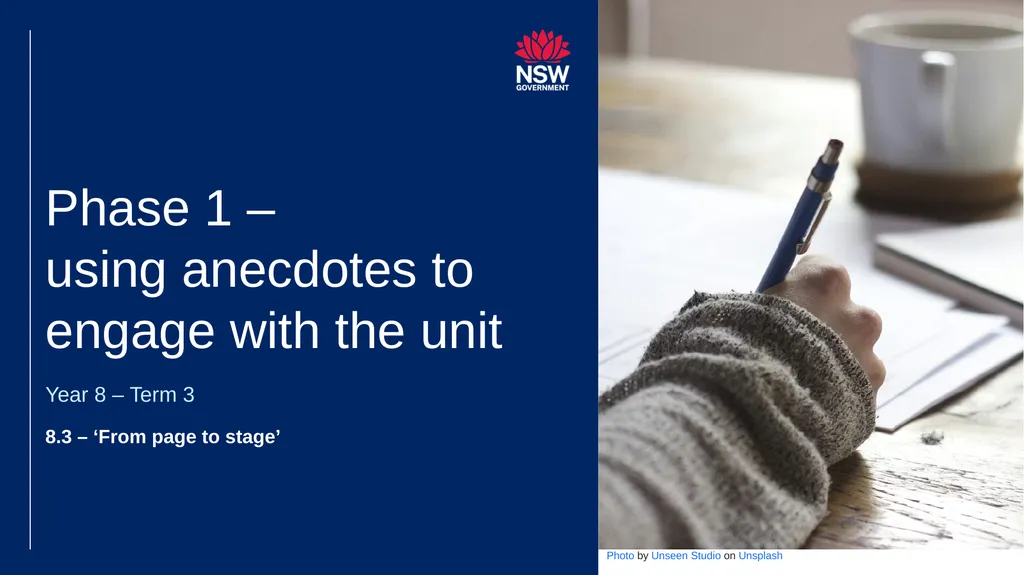
Phase 1 – using anecdotes to engage with the unit Year 8 – Term 3 8.3 – ‘From page to stage’ Photo by Unseen Studio on Unsplash<br>
04
Sharing learning intentions and success criteria 4<br>
05
Learning intentions and success criteria We are learning to:
understand what an anecdote is
identify how anecdotes are used in persuasive writing
create different types of anecdotes to support a persuasive pitch.
We can:
[classroom teacher to insert sample success criteria]
[classroom teacher to insert sample success criteria]
[classroom teacher to insert sample success criteria]. 5<br>
understand what an anecdote is
identify how anecdotes are used in persuasive writing
create different types of anecdotes to support a persuasive pitch.
We can:
[classroom teacher to insert sample success criteria]
[classroom teacher to insert sample success criteria]
[classroom teacher to insert sample success criteria]. 5<br>
06
What is an anecdote? Understanding the definition An anecdote is a short and interesting story used to support a point or make an idea memorable.
Anecdotes often:
focus on one event
are short and easy to follow
provide insight into human experiences
Activity: Quick write
Answer the following in your English book:
Why might a writer use a short story instead of just explaining their opinion?
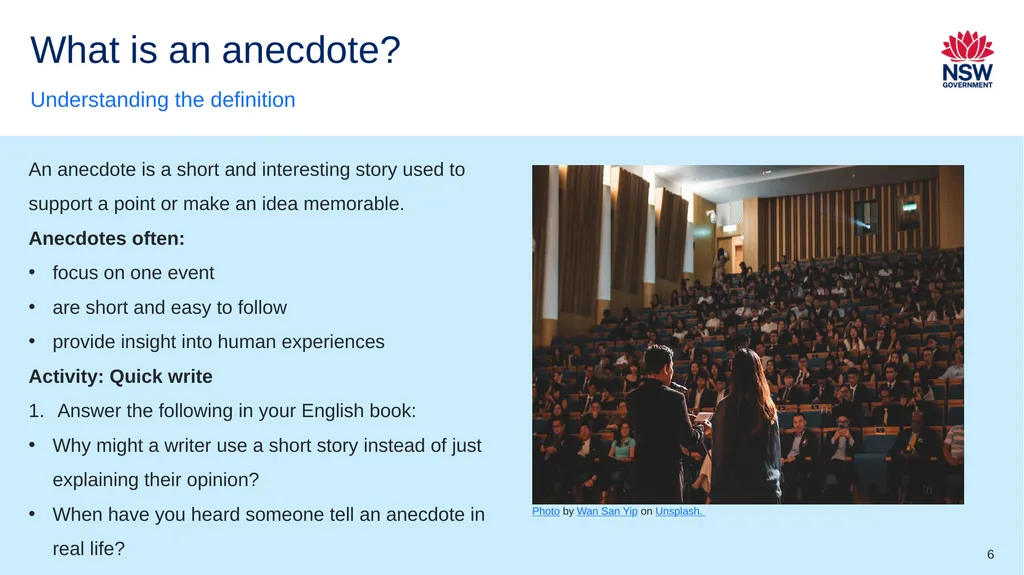
When have you heard someone tell an anecdote in real life? Photo by Wan San Yip on Unsplash. 6<br>
Anecdotes often:
focus on one event
are short and easy to follow
provide insight into human experiences
Activity: Quick write
Answer the following in your English book:
Why might a writer use a short story instead of just explaining their opinion?
When have you heard someone tell an anecdote in real life? Photo by Wan San Yip on Unsplash. 6<br>
07
Features of anecdotes What makes an anecdote effective? Anecdotes are usually:
written in first person
focused on one character
centred on one event
short and engaging
written to entertain, inform or persuade.
Activity: Think Pair Share
With a partner, choose two features from the list and discuss why these features help make anecdotes effective.
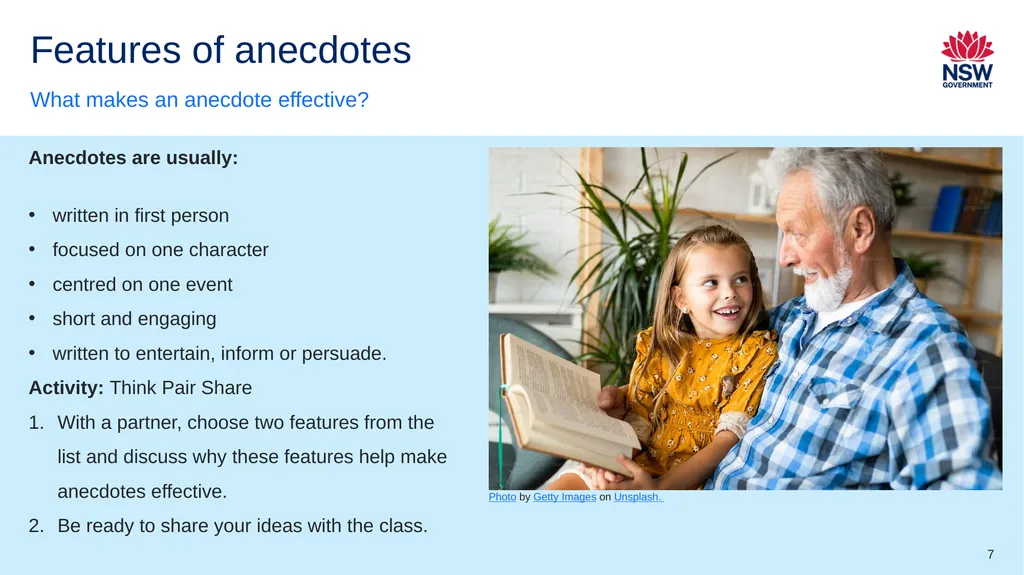
Be ready to share your ideas with the class. Photo by Getty Images on Unsplash. 7<br>
written in first person
focused on one character
centred on one event
short and engaging
written to entertain, inform or persuade.
Activity: Think Pair Share
With a partner, choose two features from the list and discuss why these features help make anecdotes effective.
Be ready to share your ideas with the class. Photo by Getty Images on Unsplash. 7<br>
08
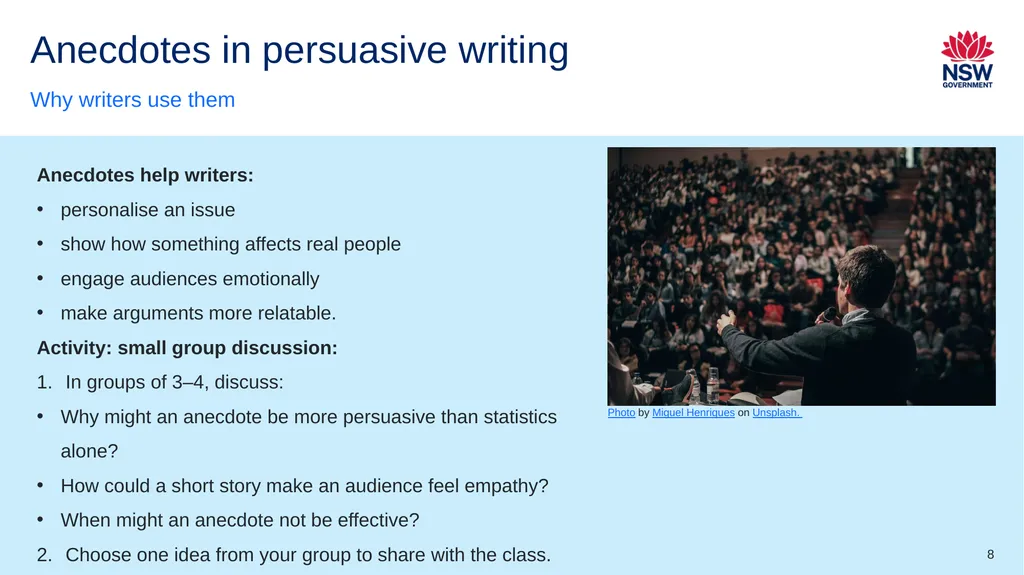
Anecdotes in persuasive writing Why writers use them Anecdotes help writers:
personalise an issue
show how something affects real people
engage audiences emotionally
make arguments more relatable.
Activity: small group discussion:
In groups of 3–4, discuss:
Why might an anecdote be more persuasive than statistics alone?
How could a short story make an audience feel empathy?
When might an anecdote not be effective?
Choose one idea from your group to share with the class. Photo by Miguel Henriques on Unsplash. 8<br>
personalise an issue
show how something affects real people
engage audiences emotionally
make arguments more relatable.
Activity: small group discussion:
In groups of 3–4, discuss:
Why might an anecdote be more persuasive than statistics alone?
How could a short story make an audience feel empathy?
When might an anecdote not be effective?
Choose one idea from your group to share with the class. Photo by Miguel Henriques on Unsplash. 8<br>
09
Gradual release of responsibility 9<br>
10
Types of anecdotes Personal anecdote A personal anecdote is a short story about something that happened in a person’s life. It gives insight into someone’s experiences, feelings or personality.
Example:
‘When I was 7, I mistakenly locked myself in the bathroom for hours, leading to a family-wide search. The incident taught me the importance of staying calm in unexpected situations and became a humorous family memory.’ Your turn:
Write a personal anecdote in your English book. This could be:
• a family memory
• a moment from school
• a story connected to your product or
pitch.
Remember: the anecdote should be short, focused and engaging. It does not need to be true, the audience just needs to think it is true. 10<br>
Example:
‘When I was 7, I mistakenly locked myself in the bathroom for hours, leading to a family-wide search. The incident taught me the importance of staying calm in unexpected situations and became a humorous family memory.’ Your turn:
Write a personal anecdote in your English book. This could be:
• a family memory
• a moment from school
• a story connected to your product or
pitch.
Remember: the anecdote should be short, focused and engaging. It does not need to be true, the audience just needs to think it is true. 10<br>
11
Types of anecdotes (2) Humorous anecdote A humorous anecdote is a short story designed to make the audience laugh. Humorous anecdotes often involve:
misunderstandings
unexpected situations
ironic or surprising outcomes
Example: ‘Once, a friend tried to bake a cake with salt instead of sugar because the containers were switched. The guests’ puzzled faces upon tasting the salty dessert quickly turned into laughter when the mistake was discovered.’
Your turn:
Write a humorous anecdote in your English book about an embarrassing moment, a misunderstanding or something unexpected that happened. 11<br>
misunderstandings
unexpected situations
ironic or surprising outcomes
Example: ‘Once, a friend tried to bake a cake with salt instead of sugar because the containers were switched. The guests’ puzzled faces upon tasting the salty dessert quickly turned into laughter when the mistake was discovered.’
Your turn:
Write a humorous anecdote in your English book about an embarrassing moment, a misunderstanding or something unexpected that happened. 11<br>
12
Types of anecdotes (3) Cautionary anecdote A cautionary anecdote shows the negative consequences of certain actions or decisions. These anecdotes remind the audience what could happen if they do not take action.
Example:
‘When travelling I once forgot my portable battery charger. Of course, the inevitable happened – my phone died and I could no longer access my bookings or directions. Forgetting that one small charger caused a lot of frustration.’
Your turn:
Write a cautionary anecdote in your English book. Think about a time when:
something went wrong
someone forgot something important
a small mistake caused a bigger problem. 12<br>
Example:
‘When travelling I once forgot my portable battery charger. Of course, the inevitable happened – my phone died and I could no longer access my bookings or directions. Forgetting that one small charger caused a lot of frustration.’
Your turn:
Write a cautionary anecdote in your English book. Think about a time when:
something went wrong
someone forgot something important
a small mistake caused a bigger problem. 12<br>
13
Types of anecdotes (4) Inspirational anecdote An inspirational anecdote tells a story about overcoming challenges or achieving success. These anecdotes are designed to:
motivate the audience
inspire hope
encourage perseverance.
Example: A Paralympian wins a gold medal after years of training and overcoming challenges. Their story shows how determination and resilience can lead to success.
Your turn:
Write an inspirational anecdote in your English book. Think about a story where:
someone overcame a challenge
hard work led to success
a person showed courage or determination. 13<br>
motivate the audience
inspire hope
encourage perseverance.
Example: A Paralympian wins a gold medal after years of training and overcoming challenges. Their story shows how determination and resilience can lead to success.
Your turn:
Write an inspirational anecdote in your English book. Think about a story where:
someone overcame a challenge
hard work led to success
a person showed courage or determination. 13<br>
14
References This presentation contains NSW Curriculum and syllabus content. The NSW Curriculum is developed by the NSW Education Standards Authority. This content is prepared by NESA for and on behalf of the Crown in the right of the State of New South Wales. The material is protected by Crown copyright.
Please refer to the NESA Copyright Disclaimer for more information https://educationstandards.nsw.edu.au/wps/portal/nesa/mini-footer/copyright.
NESA holds the only official and up-to-date versions of the NSW Curriculum and syllabus documents. Please visit the NSW Education Standards Authority (NESA) website https://educationstandards.nsw.edu.au/wps/portal/nesa/home and the NSW Curriculum website https://curriculum.nsw.edu.au. English K–10 Syllabus (2022) © NSW Education Standards Authority (NESA) for and on behalf of the Crown in right of the State of New South Wales, 2022.
Getty Images (2022) Happy little girl with cute grandfather reading story book at home [photo], Unsplash, accessed 11 March 2026.
Henriques M (2018) man speaking in front of crowd [photo], Unsplash, accessed 11 March 2026.
Unseen Studio (2015) Designer sketching Wireframes [photo], Unsplash, accessed 11 March 2026.
Yip W (2020) Speech given by VIP during X-Award ceremony [photo], Unsplash, accessed 11 March 2026. 14<br>
Please refer to the NESA Copyright Disclaimer for more information https://educationstandards.nsw.edu.au/wps/portal/nesa/mini-footer/copyright.
NESA holds the only official and up-to-date versions of the NSW Curriculum and syllabus documents. Please visit the NSW Education Standards Authority (NESA) website https://educationstandards.nsw.edu.au/wps/portal/nesa/home and the NSW Curriculum website https://curriculum.nsw.edu.au. English K–10 Syllabus (2022) © NSW Education Standards Authority (NESA) for and on behalf of the Crown in right of the State of New South Wales, 2022.
Getty Images (2022) Happy little girl with cute grandfather reading story book at home [photo], Unsplash, accessed 11 March 2026.
Henriques M (2018) man speaking in front of crowd [photo], Unsplash, accessed 11 March 2026.
Unseen Studio (2015) Designer sketching Wireframes [photo], Unsplash, accessed 11 March 2026.
Yip W (2020) Speech given by VIP during X-Award ceremony [photo], Unsplash, accessed 11 March 2026. 14<br>
15
Copyright © State of New South Wales (Department of Education), 2026 The copyright material published in this resource is subject to the Copyright Act 1968 (Cth) and is owned by the NSW Department of Education or, where indicated, by a party other than the NSW Department of Education (third-party material).
Copyright material available in this resource and owned by the NSW Department of Education is licensed under a Creative Commons Attribution 4.0 International (CC BY 4.0) license.
This license allows you to share and adapt the material for any purpose, even commercially.
Attribution should be given to © State of New South Wales (Department of Education), 2026.
Material in this resource not available under a Creative Commons license:
the NSW Department of Education logo, other logos and trademark-protected material
Material owned by a third party that has been reproduced with permission. You will need to obtain permission from the third party to reuse its material.
Links to third-party material and websites
Please note that the provided (reading/viewing material/list/links/texts) are a suggestion only and implies no endorsement, by the New South Wales Department of Education, of any author, publisher, or book title. School principals and teachers are best placed to assess the suitability of resources that would complement the curriculum and reflect the needs and interests of their students.
If you use the links provided in this document to access a third-party’s website, you acknowledge that the terms of use, including licence terms set out on the third-party’s website apply to the use which may be made of the materials on that third-party website or where permitted by the Copyright Act 1968 (Cth). The department accepts no responsibility for content on third-party websites.<br>
Copyright material available in this resource and owned by the NSW Department of Education is licensed under a Creative Commons Attribution 4.0 International (CC BY 4.0) license.
This license allows you to share and adapt the material for any purpose, even commercially.
Attribution should be given to © State of New South Wales (Department of Education), 2026.
Material in this resource not available under a Creative Commons license:
the NSW Department of Education logo, other logos and trademark-protected material
Material owned by a third party that has been reproduced with permission. You will need to obtain permission from the third party to reuse its material.
Links to third-party material and websites
Please note that the provided (reading/viewing material/list/links/texts) are a suggestion only and implies no endorsement, by the New South Wales Department of Education, of any author, publisher, or book title. School principals and teachers are best placed to assess the suitability of resources that would complement the curriculum and reflect the needs and interests of their students.
If you use the links provided in this document to access a third-party’s website, you acknowledge that the terms of use, including licence terms set out on the third-party’s website apply to the use which may be made of the materials on that third-party website or where permitted by the Copyright Act 1968 (Cth). The department accepts no responsibility for content on third-party websites.<br>