Introduction This resource is not a teaching and learning program. It should be used in conjunction with Year 7 term 3 program Escape into the world of the novel. Introduction for the teacher 1 Instructions for use Instructions for the
"Introduction This resource is not a teaching and" is the property of its rightful owner. Permission is granted to
download and print the materials on this website for personal, non-commercial use only, and to display it
on your personal computer provided you do not modify the materials and that you retain all copyright
notices contained in the materials. By downloading content from our website, you accept the terms of this
agreement.
Presentation Transcript
01
Introduction This resource is not a teaching and learning program. It should be used in conjunction with Year 7 term 3 program Escape into the world of the novel. Introduction for the teacher 1<br>
02
Instructions for use Instructions for the teacher This resource is not a teaching and learning program. It should be used in conjunction with (Insert unit name and link).
Classroom teachers are encouraged to add and adapt slides as required to meet the needs of their students.
Save a copy of the file to make changes to the slide deck. Go to File > Download a Copy (this downloads a copy to the computer to edit in the PowerPoint application).
To convert the PowerPoint to Google Slides:
Upload the file into Google Drive and open it.
Go to File > Save as Google Slides.
(Note – conversion may cause formatting changes in the slides.) 2<br>
03
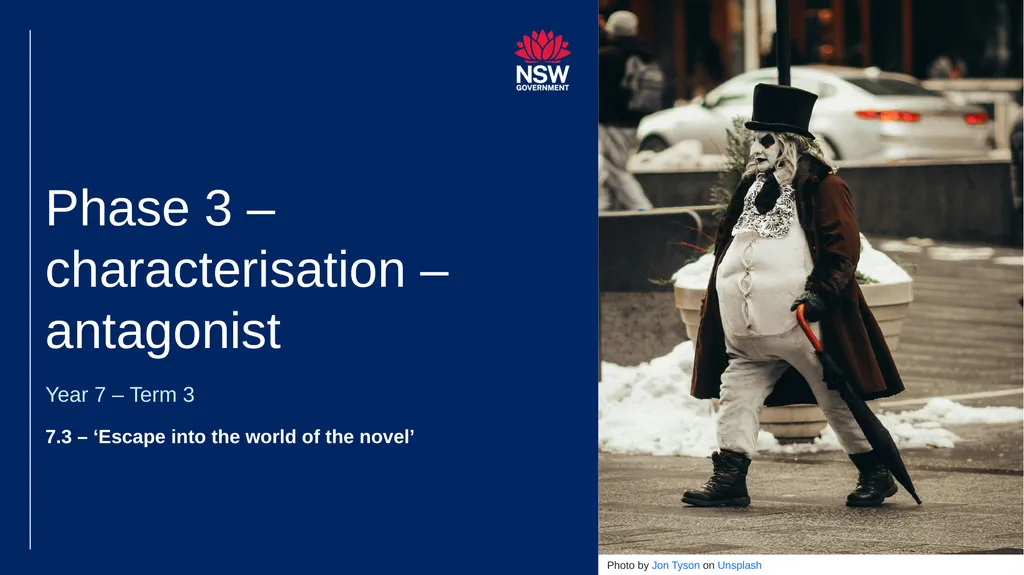
Phase 3 – characterisation – antagonist Year 7 – Term 3 7.3 – ‘Escape into the world of the novel’ Photo by Jon Tyson on Unsplash<br>
04
Sharing learning intentions and success criteria 4<br>
05
Learning intentions and success criteria We are learning to:
understand how dialogue and description can be used to construct engaging characters
be able to distinguish the role and importance of external conflict centred on the antagonist.
We can:
[classroom teacher to insert sample success criteria]
[classroom teacher to insert sample success criteria]
[classroom teacher to insert sample success criteria]. 5<br>
06
Characterisation of the antagonist in Alice’s Adventures in Wonderland<br>
07
Prefix Understanding prefixes A morpheme is the smallest unit of meaning in a word. For example, jumps has 2 morphemes: jump + s (NSW Education Standards Authority, 2022).
A prefix is a bound morpheme made up of letters that appear before a base word to make a new word. For example, un- in ‘unhappy’ means ‘not’ (un + happy = not happy) (NSW Education Standards Authority, 2022). 7<br>
08
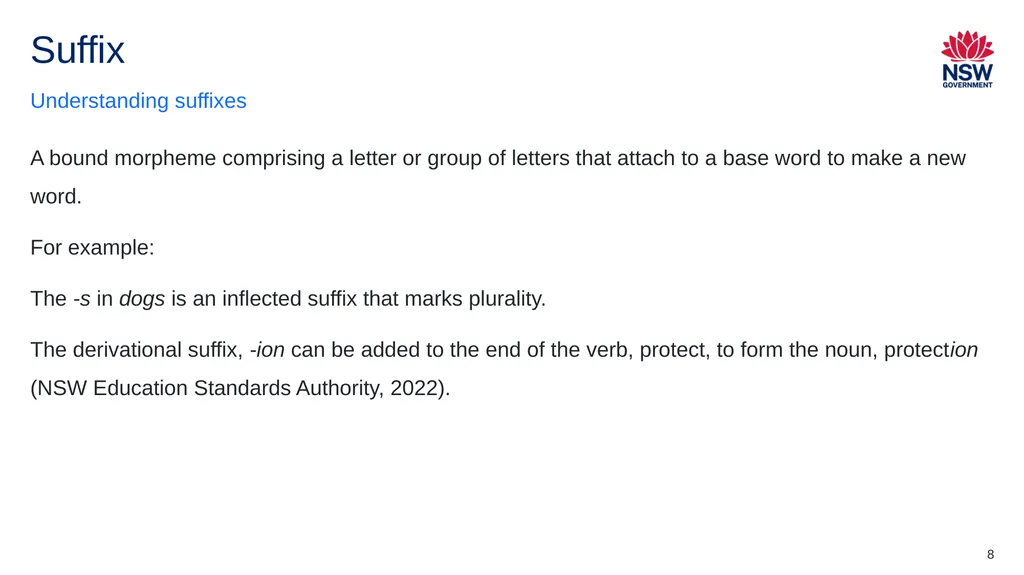
Suffix Understanding suffixes A bound morpheme comprising a letter or group of letters that attach to a base word to make a new word.
For example:
The -s in dogs is an inflected suffix that marks plurality.
The derivational suffix, -ion can be added to the end of the verb, protect, to form the noun, protection (NSW Education Standards Authority, 2022). 8<br>
09
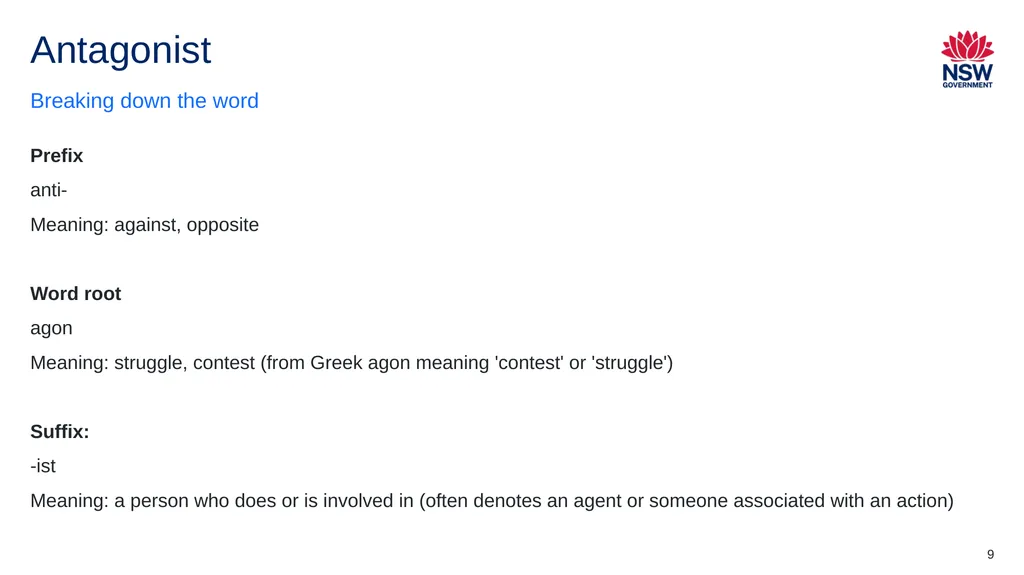
Antagonist Breaking down the word Prefix
anti-
Meaning: against, opposite
Word root
agon
Meaning: struggle, contest (from Greek agon meaning 'contest' or 'struggle')
Suffix:
-ist
Meaning: a person who does or is involved in (often denotes an agent or someone associated with an action) 9<br>
10
Using effective questioning 10<br>
11
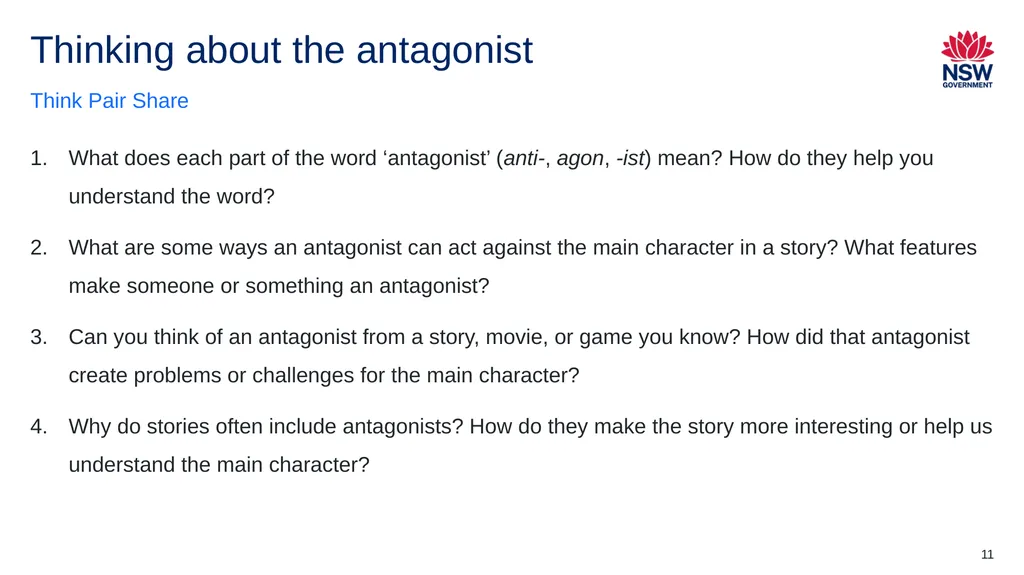
Thinking about the antagonist Think Pair Share What does each part of the word ‘antagonist’ (anti-, agon, -ist) mean? How do they help you understand the word?
What are some ways an antagonist can act against the main character in a story? What features make someone or something an antagonist?
Can you think of an antagonist from a story, movie, or game you know? How did that antagonist create problems or challenges for the main character?
Why do stories often include antagonists? How do they make the story more interesting or help us understand the main character? 11<br>
12
Think Pair Share What do you know about the antagonist? Think Pair Share 12<br>
13
Extracts from Alice’s Adventures in Wonderland by Lewis Carroll<br>
14
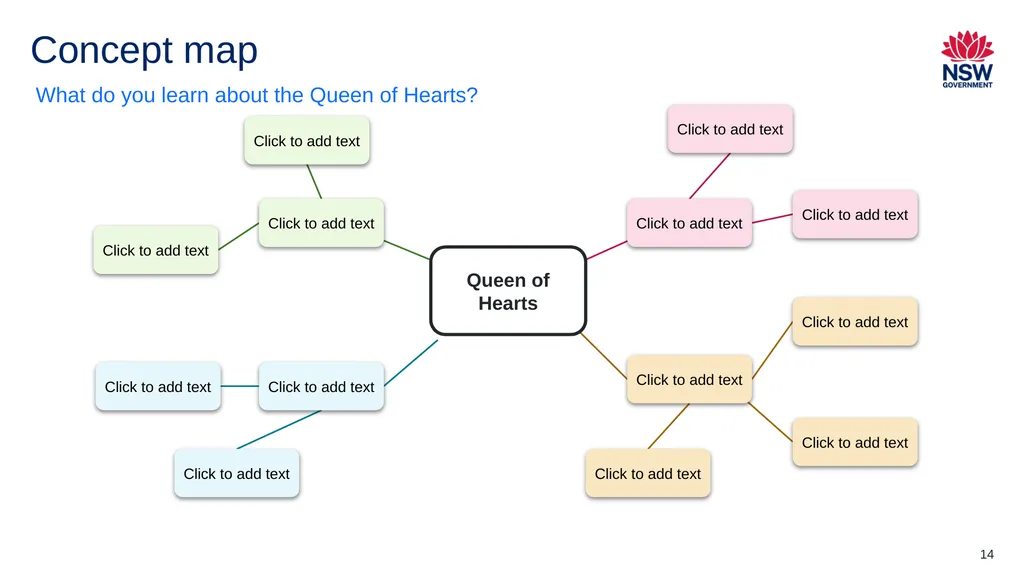
Concept map What do you learn about the Queen of Hearts? Queen of Hearts Click to add text Click to add text Click to add text Click to add text Click to add text Click to add text Click to add text Click to add text Click to add text Click to add text Click to add text Click to add text Click to add text 14<br>
15
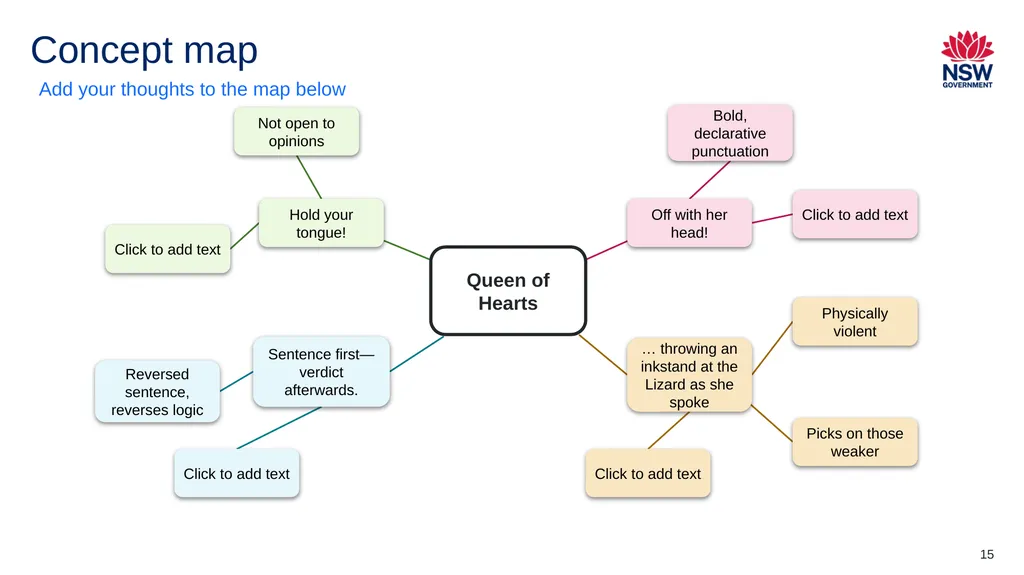
Concept map Add your thoughts to the map below Not open to opinions Hold your tongue! Reversed sentence, reverses logic Sentence first—verdict afterwards. Click to add text Queen of Hearts Bold, declarative punctuation Off with her head! Click to add text Click to add text … throwing an inkstand at the Lizard as she spoke Physically violent Picks on those weaker Click to add text 15<br>