
Introduction to Ancient Philosophy Introduction to

Description: Introduction to Ancient Philosophy Introduction to the course Overview of the pre-Socratics The Milesians: Thales, Anaximander and Anaximenes Social and Cultural Context Sense of wonder at the world Trading and colonisation Mathematical and
Related Topics
Download Presentation
"Introduction to Ancient Philosophy Introduction to" is the property of its rightful owner. Permission is granted to download and print the materials on this website for personal, non-commercial use only, and to display it on your personal computer provided you do not modify the materials and that you retain all copyright notices contained in the materials. By downloading content from our website, you accept the terms of this agreement.
Presentation Transcript
slide1. Introduction to Ancient Philosophy Introduction to the course
Overview of the pre-Socratics
The Milesians: Thales, Anaximander and Anaximenes<br>
slide2. Social and Cultural Context Sense of wonder at the world
Trading and colonisation
Mathematical and scientific discoveries
Exposed to new cultures (emergence of anthropology, cf. Herodotus)
Religious detachment and indifferentism
Freedom from physical labour<br>
slide3. Pre-Socratic Philosophy ‘Philosophy’ (philia = love; sophos = wisdom)
Didn’t think of themselves as philosophers
“Pre-Socratics” – misnomer
Asked questions about the cosmos
‘Physis’
Rational explanation of the world
Shift away from cosmos towards man
Physis and ‘nomos’<br>
slide4. Reading the Pre-Socratics Fragments
Second-hand sources
Language
Writing styles
Audience<br>
slide5. Questions to ask about the Milesians How did their approach differ from those thinkers who came before them?
What is it that they said?
What is it about their thought that is philosophical?<br>
slide6. Hesiod’s Theogony “Hail, children of Zeus, grant a sweet song and tell…”
“Tell me this, you Muses… …and tell which of them first came into being”
“first of all came Expanse; and then wide-bosomed Earth
“and from Night came Ether and Day whom she conceived and bore after joining with Darkness in love Earth bore first, equal to herself”<br>
slide7. Thales “the earth rests because it can float, like a log or something else of that sort (for none of these things rest on air, but they can rest on water)”
(Aristotle, On the Heavens)
“He held that water is the principle of all things”
(Diogenes Laertius, Lives of the Philosophers)<br>
slide8. System-builders In asking ‘what single thing explains everything?’ Thales is searching for impersonal, general laws
Thales was the first to offer a logos of nature
The Greeks had a very strong desire to systematise
When you take one fundamental matter – water – and claim that everything else is a differentiation of that matter, you have constructed a system. It’s a system because everything is explained in terms of this one thing<br>
slide9. Thales’ new kind of thought Doesn’t account for the world in terms of anthropomorphised gods, he explains (“logos”) things in terms of natural causes
Impersonal forces and the search for general laws
Everything is a formal differentiation of water
Systematic thinking in ancient Greek thought<br>
slide10. Aristotle’s Definition of a Principle “That from which all things have their origin and that into which all things are dissolved”
A principle (arche) is:
The source or origin of all things
The final goal of all things
The permanent sustained or substrate of all things<br>
slide11. Aristotle’s Definition of a Principle Three characteristics of a principle (arche):
It encompasses everything
It steers everything
It’s divine
Note: ‘divine’ is meant in a natural, not a spiritual, sense.<br>
slide12. Anaximander First to use ‘principle’ as a technical term
Apeiron (= infinite, unlimited)
The problem with Thales’ principle of water
Separating out from the mass
Importance of heat and constant movement<br>
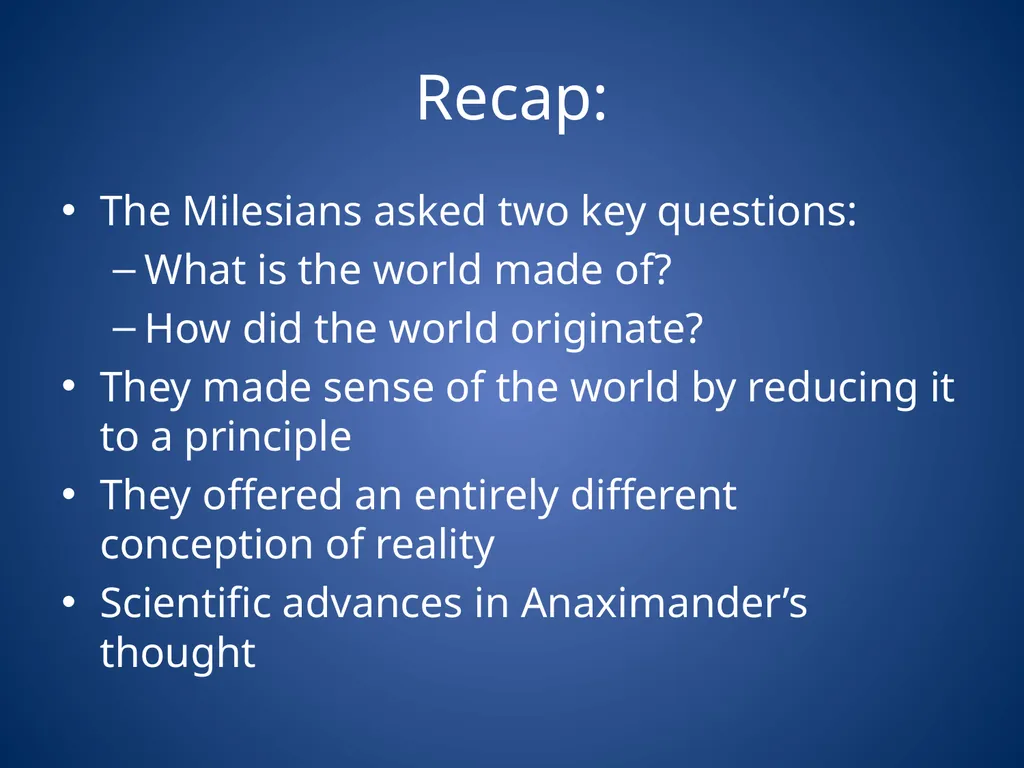
slide13. Recap: The Milesians asked two key questions:
What is the world made of?
How did the world originate?
They made sense of the world by reducing it to a principle
They offered an entirely different conception of reality
Scientific advances in Anaximander’s thought<br>
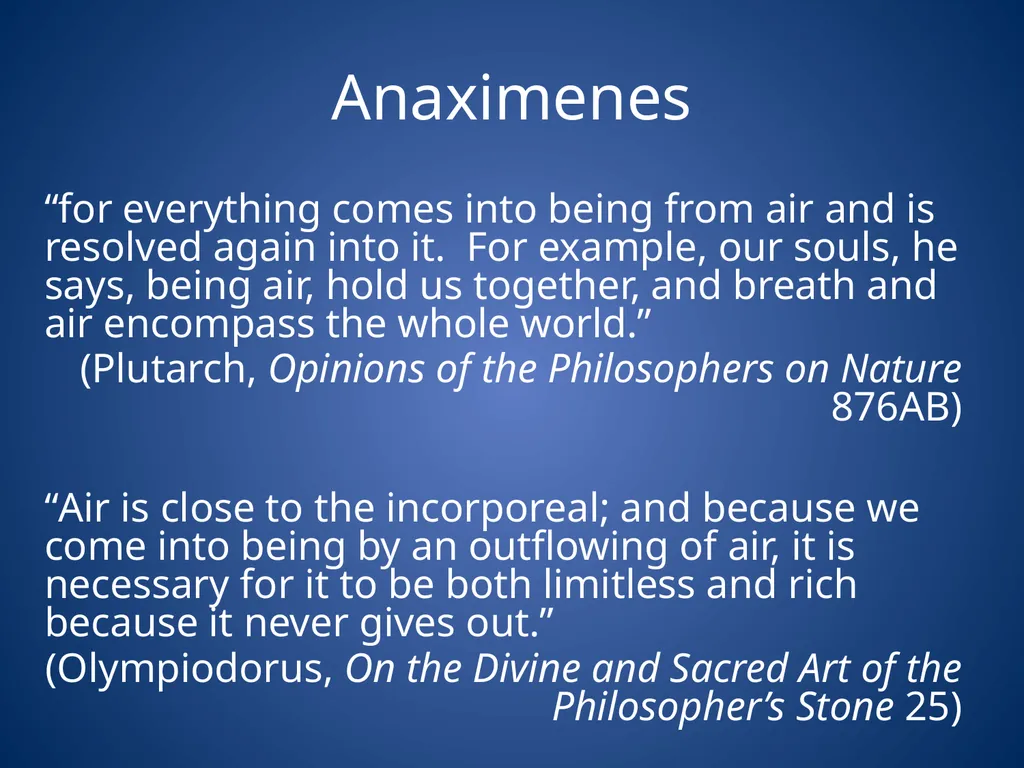
slide14. Anaximenes “for everything comes into being from air and is resolved again into it. For example, our souls, he says, being air, hold us together, and breath and air encompass the whole world.”
(Plutarch, Opinions of the Philosophers on Nature 876AB)
“Air is close to the incorporeal; and because we come into being by an outflowing of air, it is necessary for it to be both limitless and rich because it never gives out.”
(Olympiodorus, On the Divine and Sacred Art of the Philosopher’s Stone 25)<br>
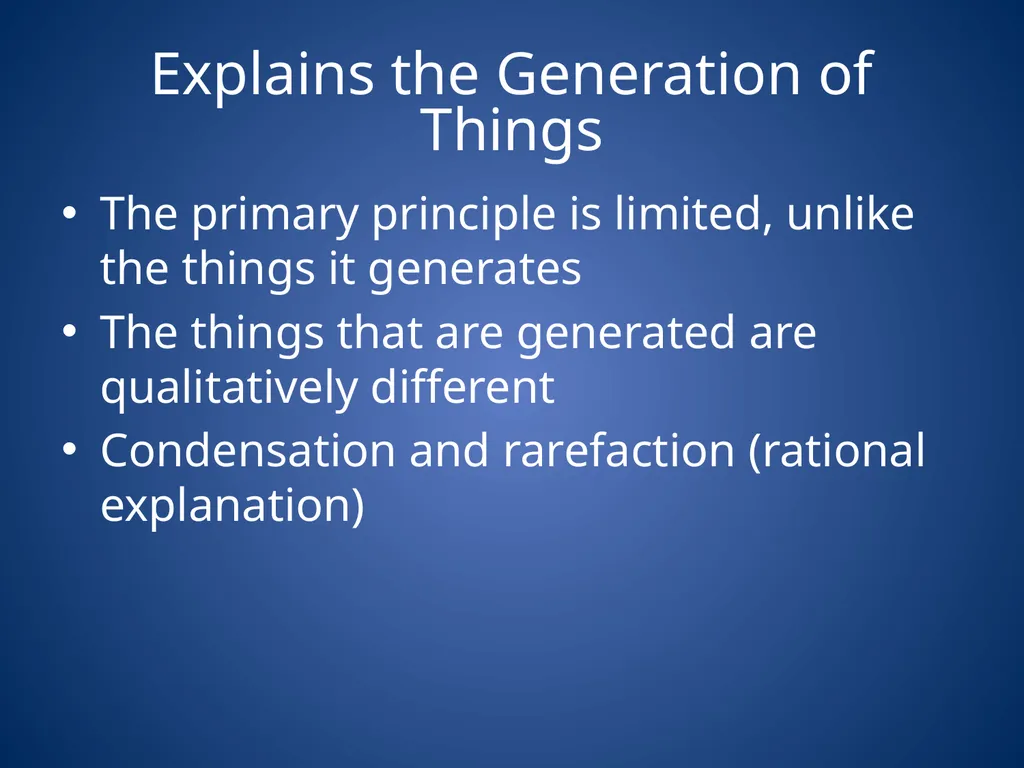
slide15. Explains the Generation of Things The primary principle is limited, unlike the things it generates
The things that are generated are qualitatively different
Condensation and rarefaction (rational explanation)<br>
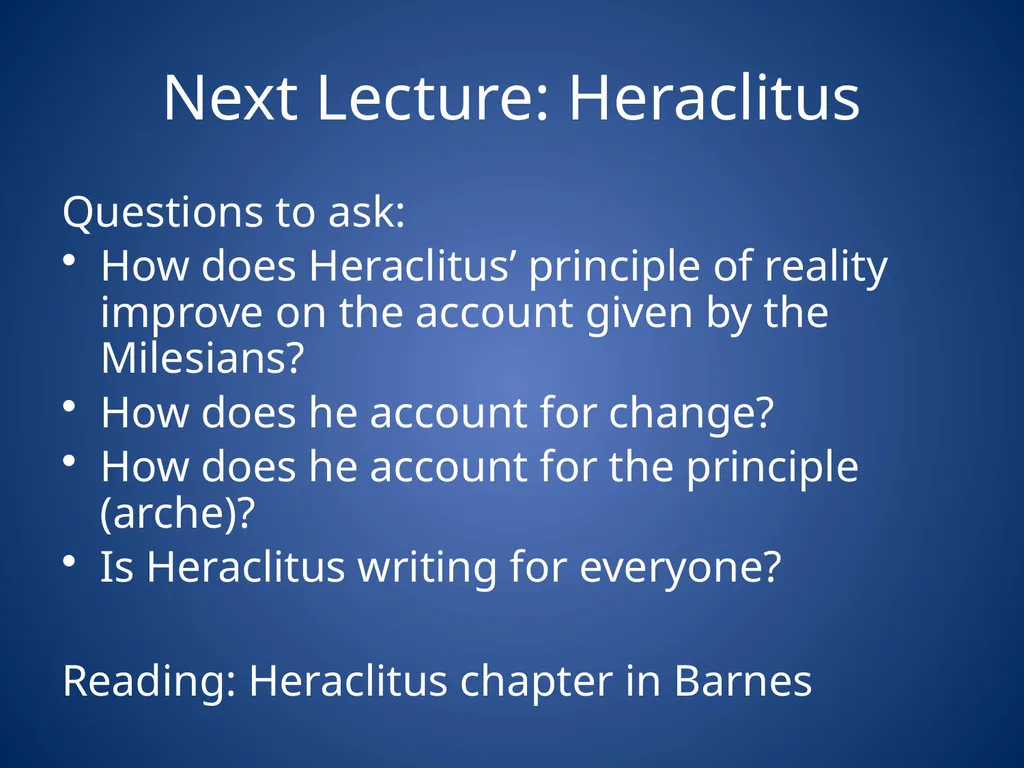
slide16. Next Lecture: Heraclitus Questions to ask:
How does Heraclitus’ principle of reality improve on the account given by the Milesians?
How does he account for change?
How does he account for the principle (arche)?
Is Heraclitus writing for everyone?
Reading: Heraclitus chapter in Barnes<br>
Overview of the pre-Socratics
The Milesians: Thales, Anaximander and Anaximenes<br>
slide2. Social and Cultural Context Sense of wonder at the world
Trading and colonisation
Mathematical and scientific discoveries
Exposed to new cultures (emergence of anthropology, cf. Herodotus)
Religious detachment and indifferentism
Freedom from physical labour<br>
slide3. Pre-Socratic Philosophy ‘Philosophy’ (philia = love; sophos = wisdom)
Didn’t think of themselves as philosophers
“Pre-Socratics” – misnomer
Asked questions about the cosmos
‘Physis’
Rational explanation of the world
Shift away from cosmos towards man
Physis and ‘nomos’<br>
slide4. Reading the Pre-Socratics Fragments
Second-hand sources
Language
Writing styles
Audience<br>
slide5. Questions to ask about the Milesians How did their approach differ from those thinkers who came before them?
What is it that they said?
What is it about their thought that is philosophical?<br>
slide6. Hesiod’s Theogony “Hail, children of Zeus, grant a sweet song and tell…”
“Tell me this, you Muses… …and tell which of them first came into being”
“first of all came Expanse; and then wide-bosomed Earth
“and from Night came Ether and Day whom she conceived and bore after joining with Darkness in love Earth bore first, equal to herself”<br>
slide7. Thales “the earth rests because it can float, like a log or something else of that sort (for none of these things rest on air, but they can rest on water)”
(Aristotle, On the Heavens)
“He held that water is the principle of all things”
(Diogenes Laertius, Lives of the Philosophers)<br>
slide8. System-builders In asking ‘what single thing explains everything?’ Thales is searching for impersonal, general laws
Thales was the first to offer a logos of nature
The Greeks had a very strong desire to systematise
When you take one fundamental matter – water – and claim that everything else is a differentiation of that matter, you have constructed a system. It’s a system because everything is explained in terms of this one thing<br>
slide9. Thales’ new kind of thought Doesn’t account for the world in terms of anthropomorphised gods, he explains (“logos”) things in terms of natural causes
Impersonal forces and the search for general laws
Everything is a formal differentiation of water
Systematic thinking in ancient Greek thought<br>
slide10. Aristotle’s Definition of a Principle “That from which all things have their origin and that into which all things are dissolved”
A principle (arche) is:
The source or origin of all things
The final goal of all things
The permanent sustained or substrate of all things<br>
slide11. Aristotle’s Definition of a Principle Three characteristics of a principle (arche):
It encompasses everything
It steers everything
It’s divine
Note: ‘divine’ is meant in a natural, not a spiritual, sense.<br>
slide12. Anaximander First to use ‘principle’ as a technical term
Apeiron (= infinite, unlimited)
The problem with Thales’ principle of water
Separating out from the mass
Importance of heat and constant movement<br>
slide13. Recap: The Milesians asked two key questions:
What is the world made of?
How did the world originate?
They made sense of the world by reducing it to a principle
They offered an entirely different conception of reality
Scientific advances in Anaximander’s thought<br>
slide14. Anaximenes “for everything comes into being from air and is resolved again into it. For example, our souls, he says, being air, hold us together, and breath and air encompass the whole world.”
(Plutarch, Opinions of the Philosophers on Nature 876AB)
“Air is close to the incorporeal; and because we come into being by an outflowing of air, it is necessary for it to be both limitless and rich because it never gives out.”
(Olympiodorus, On the Divine and Sacred Art of the Philosopher’s Stone 25)<br>
slide15. Explains the Generation of Things The primary principle is limited, unlike the things it generates
The things that are generated are qualitatively different
Condensation and rarefaction (rational explanation)<br>
slide16. Next Lecture: Heraclitus Questions to ask:
How does Heraclitus’ principle of reality improve on the account given by the Milesians?
How does he account for change?
How does he account for the principle (arche)?
Is Heraclitus writing for everyone?
Reading: Heraclitus chapter in Barnes<br>