
INTRODUCTION TO BOOK KEEPING AND ACCOUNTING














Description: INTRODUCTION TO BOOK KEEPING AND ACCOUNTING MEANING OF ACCOUNTING Accounting is the process of collecting, recording, classifying, selecting, measuring, interpreting, and communicating financial data of an organisation to enable users make
Related Topics
Download Presentation
"INTRODUCTION TO BOOK KEEPING AND ACCOUNTING" is the property of its rightful owner. Permission is granted to download and print the materials on this website for personal, non-commercial use only, and to display it on your personal computer provided you do not modify the materials and that you retain all copyright notices contained in the materials. By downloading content from our website, you accept the terms of this agreement.
Presentation Transcript
slide1. INTRODUCTION TO BOOK KEEPING AND ACCOUNTING MEANING OF ACCOUNTING
Accounting is the process of collecting, recording, classifying, selecting, measuring, interpreting, and communicating financial data of an organisation to enable users make decision.
It incorporates measurement and reporting of profit and loss.it is concerned with the use to which the book keeping records are put, the analysis and interpretation.
MEANING OF BOOK KEEPING
Book keeping is the systematic recording of transactions on a daily basis in the appropriate books.
It is an integral part of accounting.<br>
slide2. USERS OF ACCOUNTING INFORMATION
The principal users are;
Managers
Employees
Competitors
Government
Public
Owners
Creditors
Analysts
Tax authorities
Financial analysts
bank<br>
slide3. Users Of Accounting Information
The users of accounting information are classified into two. They are;
1 internal users: internal users includes the employees, trade union, management, internal auditors, executive or board of directors.
2. External users: this include government, general public, financial analyst, shareholders or investors, financial institutions, creditors, researcher, stock brokers, taxation analysts, external auditors, competitors<br>
slide4. USES OF ACCOUNTING INFORMATION
For planning
For control
For co-ordination
For performance evaluation
For decision making
PURPOSE OF ACCOUNTING INFORMATION TO USERS
Owners / shareholders: to know whether the business is making profit and whether it is financially strong
Manager : to make decisions that will affect the progress and financial strength of the business.<br>
slide5. Creditors: to determine whether a business will be able to pay back its debts
Employees / Trade unions : for the purpose of bargaining for better conditions of service. To also find out if the company will be able to pay their salaries and also offer them employment for a long time.
Competitors: for fixing their own prices and in determining their position in the market.
Public: to know whether to invest in the enterprise
Bankers: to know the ability of the firm to repay the loan or overdraft as at when due<br>
slide6. Financial analyst: for giving pieces of advices
Investors: in determining the net worth of the enterprise
Tax authorities: to determine taxes to impose the company
Career Opportunities
The study of accounting includes the following careers;
Financial accounting
Management accounting
Cost accounting<br>
slide7. 4. Cost accounting
5. Public sector accounting / government accounting
6. Financial management
7. Auditing and investigation
8. Taxation or tax management
Functions Of Accounting
To provide quantitative and qualitative information that can be used by the management for effective planning and control, evaluation of resources, utilization and as well as decision making
Analyze transactions<br>
slide8. 3. Handle routine book keeping tasks
4. Structure information so that it can be used to evaluate the performance and health of the business.
LIMITATIONS TO ACCOUNTING INFORMATION
It is expressed in monetary terms
Accounting information is historical in nature.
Advantages/ Benefits of Accounting
1.It provides a written record which is essential for the proper conduct of business.
2.The existence of reliable financial records helps in management decision making.
3. It facilitates reference making to past transactions.<br>
slide9. 4. Good book keeping practices enable us to ascertain the profit or loss made during a trading period.
Accounting Ethics
1. Honesty
2. Integrity
3. Transparency
4. Objectivity
5.Confidentiality
6.Professional behaviour<br>
slide10. IMPORTANCE OF BOOK KEEPING AND ACCOUNTING
Accounting information can be used for decision making
It provides permanent records for all transactions
It helps to determine the profitability of business concern.
Accounting records are used for tax assessment.
Help to prevent fraudulent practices.
The records provide a means which the finances of a business are controlled.
The records show income and expenditure.
The assets and liabilities are shown by the accounting records.<br>
slide11. HISTORY OF ACCOUNTING IN NIGERIA
There is no accurate record as to when accounts started, but available information suggests that record keeping is as old as man. The modus operandi for keeping records then was to make marks on the wall or stone or papyrus or wax tablets. The method of keeping financial records was highly primitive.
The history of accounting is not complete without mentioning the name of an italian monk and mathematician LUCCA PACIOLO. IN 1494, the crucial event in accounting was the introduction of double entry book system in Italy dsecribed as ‘’ Italian method’’. In his famous treatise Summa De. Arithmetical Geometrical Proportion et Proportionalita.<br>
slide12. . He described the double entry system by giving insight into the reasoning behind accounting. He postulated that all entries must have double entry one a debtor, and one a creditor.
After Paciolo, a Dutchman advocated the profit and loss account at yearly interval.the level of civilization and technology advancement helped in the development of modern accounting. During industrial revolution there was need for sophisticated accounting methods. Different professional bodies were formed.<br>
slide13. In Nigeria, record keeping has antecedents in the ancient kingdoms and empire and prominent then was the periodic contributons which were recorded on the wall. But the granting of royal character to Royal Niger Company was the turning point in record keeping. The governing accounting principles in Nigeria was almost the same as the ones in Britain.
In 1965, the Institute of Chartered Accountant of Nigeria was established and affiliated with the professional institutes in Britain and USA.<br>
slide14. Accounting Professional Bodies
Institute Of Chartered Accountants of Scotland
Institute of Chartered Accountants of England and Wales
Institute of Chartered Accountants of Ireland
Association of Chartered Accountants
Institute of Cost and Management Accountants
Chartered Institute of Public Finance and Accountancy
Association of Accounting Technicians
Institute of Chartered Accountants of Nigeria ( ICAN)
Association of National Accountants of Nigeria ( ANAN)<br>
slide15. TOPIC: CLASSIFICATION OF ACCOUNTS Financial transaction can be classified to cash and credit transactions.
Cash transactions: the buyers pay immediately for goods bought. Here no account will be opened in respect of supplier and customer
Credit transaction: this means that the transfer of ownership take place before payment to supplier.<br>
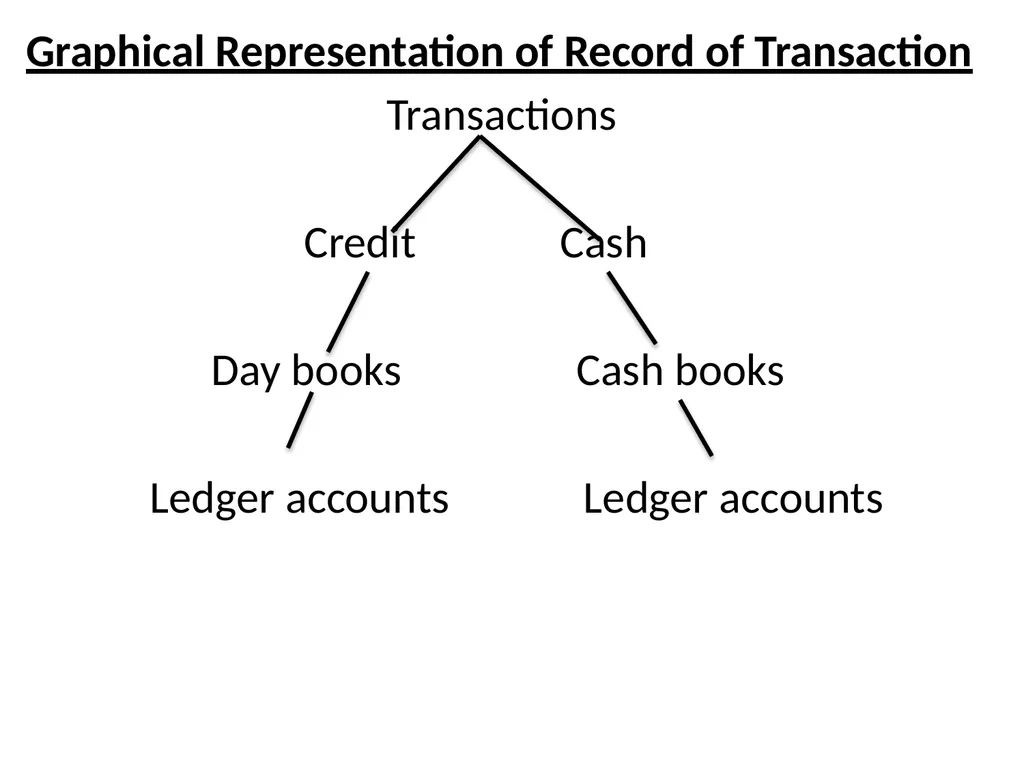
slide16. Graphical Representation of Record of Transaction
Transactions
Credit Cash
Day books Cash books
Ledger accounts Ledger accounts<br>
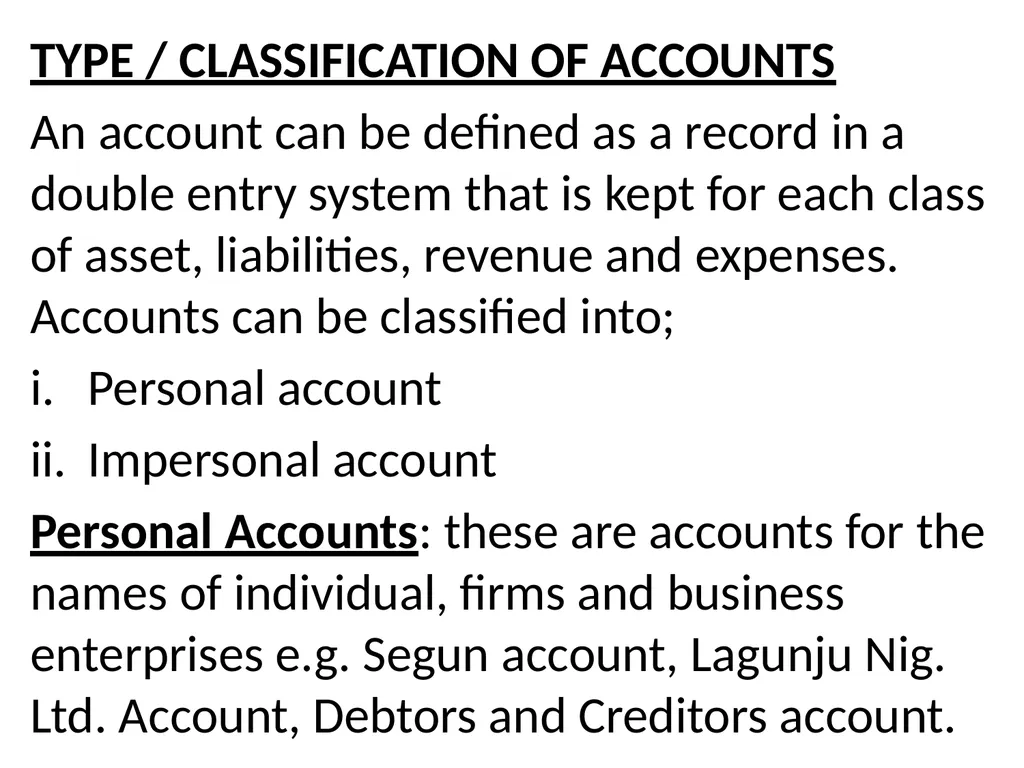
slide17. TYPE / CLASSIFICATION OF ACCOUNTS
An account can be defined as a record in a double entry system that is kept for each class of asset, liabilities, revenue and expenses. Accounts can be classified into;
Personal account
Impersonal account
Personal Accounts: these are accounts for the names of individual, firms and business enterprises e.g. Segun account, Lagunju Nig. Ltd. Account, Debtors and Creditors account.<br>
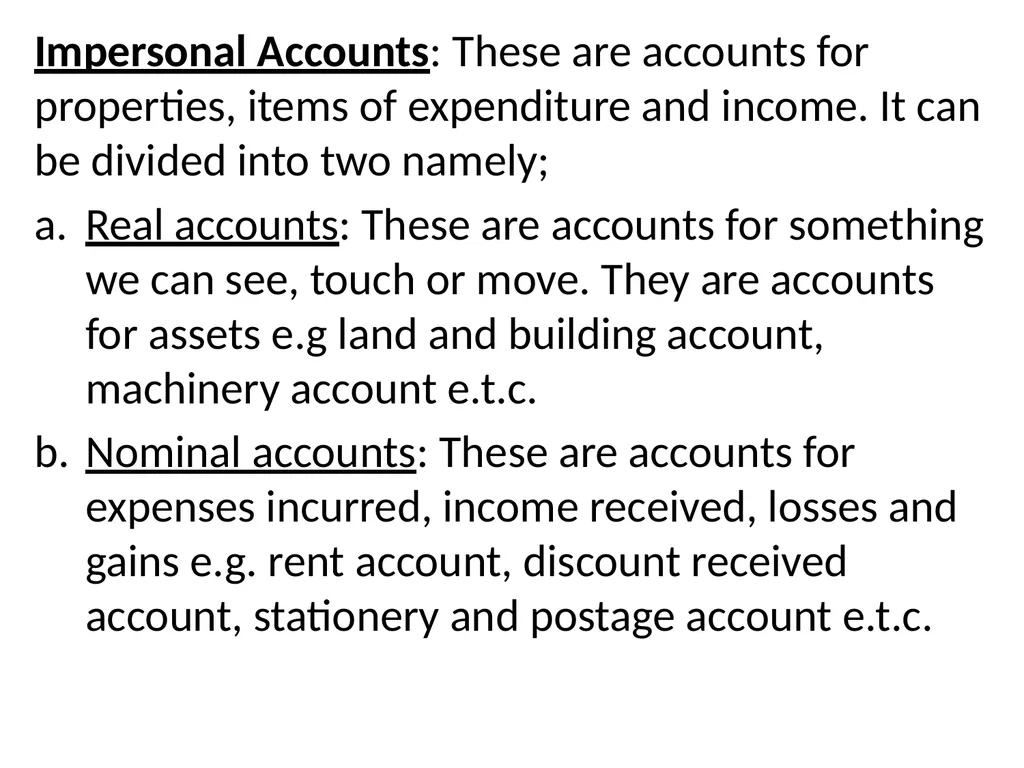
slide18. Impersonal Accounts: These are accounts for properties, items of expenditure and income. It can be divided into two namely;
Real accounts: These are accounts for something we can see, touch or move. They are accounts for assets e.g land and building account, machinery account e.t.c.
Nominal accounts: These are accounts for expenses incurred, income received, losses and gains e.g. rent account, discount received account, stationery and postage account e.t.c.<br>
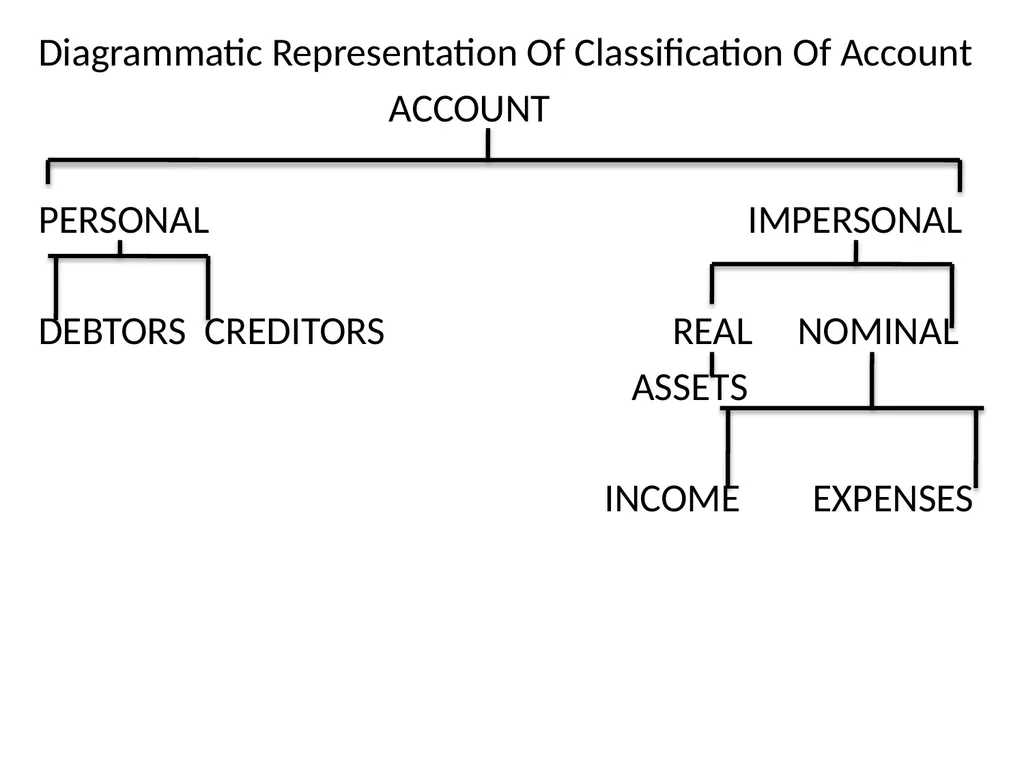
slide19. Diagrammatic Representation Of Classification Of Account
ACCOUNT
PERSONAL IMPERSONAL
DEBTORS CREDITORS REAL NOMINAL
ASSETS
INCOME EXPENSES<br>
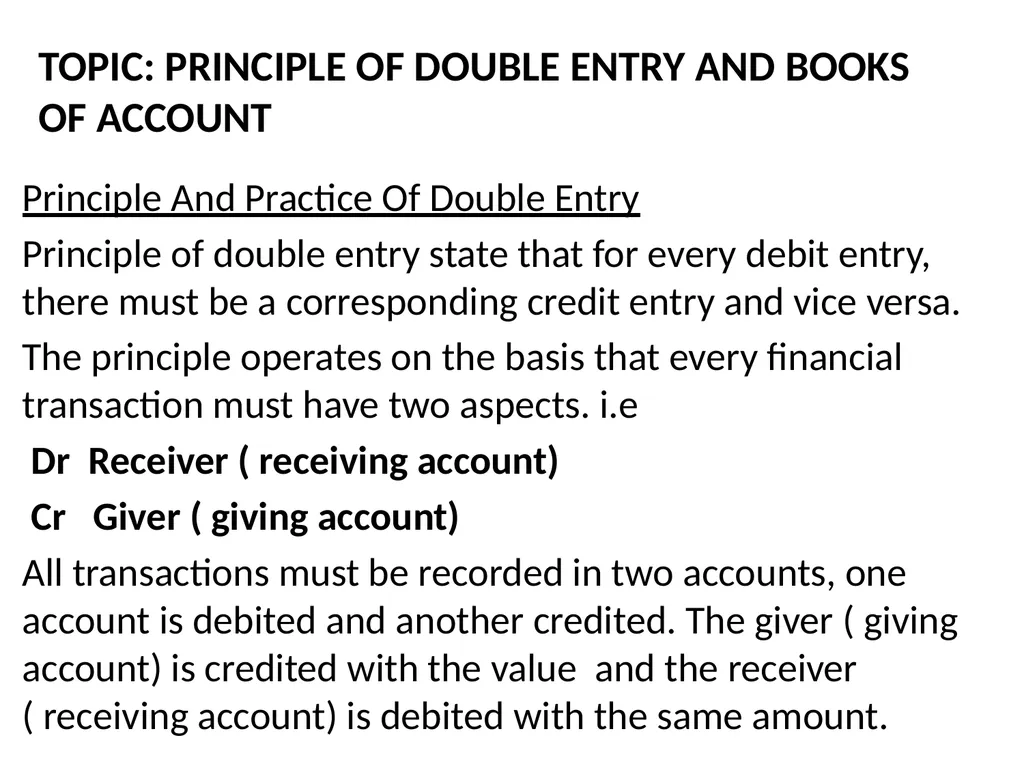
slide20. TOPIC: PRINCIPLE OF DOUBLE ENTRY AND BOOKS OF ACCOUNT Principle And Practice Of Double Entry
Principle of double entry state that for every debit entry, there must be a corresponding credit entry and vice versa.
The principle operates on the basis that every financial transaction must have two aspects. i.e
Dr Receiver ( receiving account)
Cr Giver ( giving account)
All transactions must be recorded in two accounts, one account is debited and another credited. The giver ( giving account) is credited with the value and the receiver ( receiving account) is debited with the same amount.<br>
slide21. RULES FOR DEBITING AND CREDITING
i. The account which “receives” is debited with the values that comes into the account
ii. The account which “gives” is credited with the value that goes out of the account. These rules can now be applied to the classes of account.<br>
slide22. THE ACCOUNTING EQUATION
The totality of financial accounting is based on the accounting equation. The principle of double entry developed from the axiom of accounting equation. The fundamental equation is given as;
Assets = Capital + Liabilities
Assets: These are the properties of a business. They are owned by a business and are expected to be of future benefit e.g. furniture and fitting, motor van, equipment, stock, cash , land and building, bank etc.<br>
slide23. Liabilities: This is an amount owed by the business to outsiders. It is an obligation to pay someone in either money or money’s worth e.g. creditors, bank overdraft, etc.
Capital: This is the total amount invested by the owner in a business. It is the proprietor’s fund or net worth of a business.
Assets or properties or resources of a business are attributable to two main groups of people who are distinct from the business i.e. sources of assets,
i.The proprietors or owners.
ii.Liabilities or claims of outsiders.<br>
slide26. Books Of Accounts
There are two books of accounts:
Subsidiary books
Principal books
The two books are very necessary in recording of financial transactions. All transactions must pass through the books of account.<br>
slide27. Subsidiary Books
Subsidiary books are defined as the books of original or prime entry, they are books where transactions are first recorded.
Before any entry can be made in the ledger ( principal book), it must be recorded in the subsidiary books. The subsidiary books do not form part of the double entry.<br>
slide28. Divisions Of Subsidiary Books
Subsidiary books can be divided into six books, they are
Sales day book or sales journal
Purchases day book or journal
Sales returns or returns inwards journal
Purchases returns or return outwards journal
Cash book
General journal or principal journal or journal proper.<br>
slide29. USES OF SUBSIDIARY BOOKS / REASONS FOR SUBSIDIARY BOOKS
To know the total sales and purchases
They are used as books to make first entry of transactions
To keep tract of people to whom money is owed and of the people who owed money<br>
slide30. Sales day book or sales journal: This is a book of original entry in which credit sales are recorded before posting to the ledger. Cash sales , sales of assets must not be recorded and do not form part of double entry. The seller will enter the sales journal from sales invoices. Total will credited to sales account.
Format Sales Day Book / Journal<br>
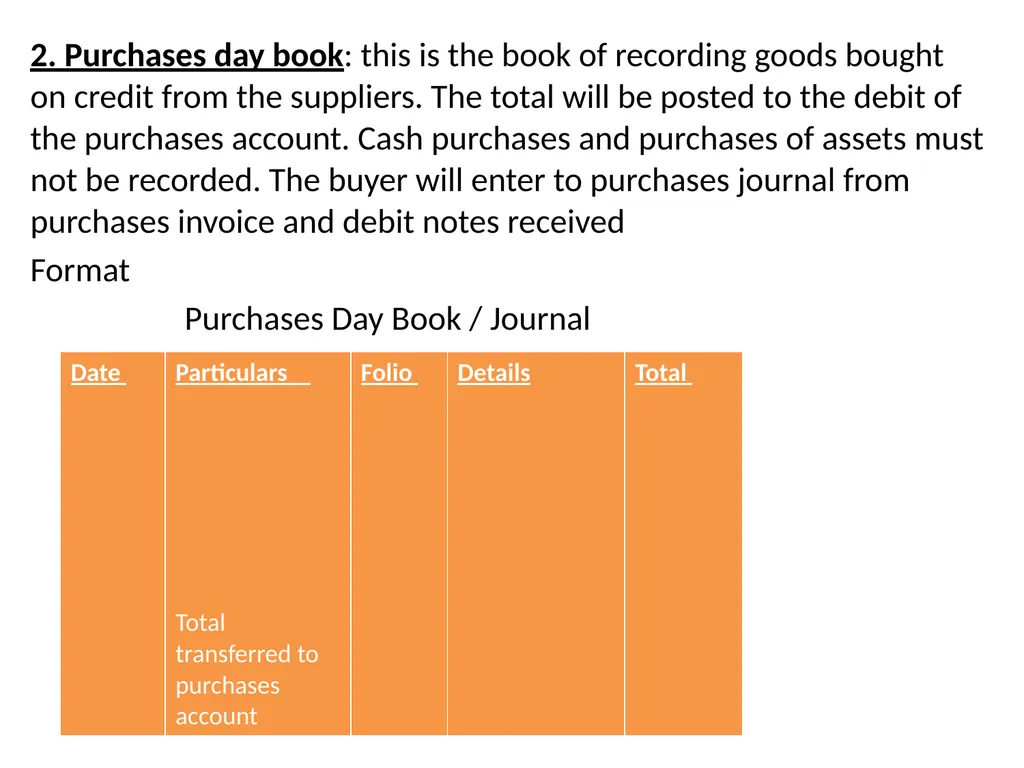
slide31. 2. Purchases day book: this is the book of recording goods bought on credit from the suppliers. The total will be posted to the debit of the purchases account. Cash purchases and purchases of assets must not be recorded. The buyer will enter to purchases journal from purchases invoice and debit notes received
Format
Purchases Day Book / Journal<br>
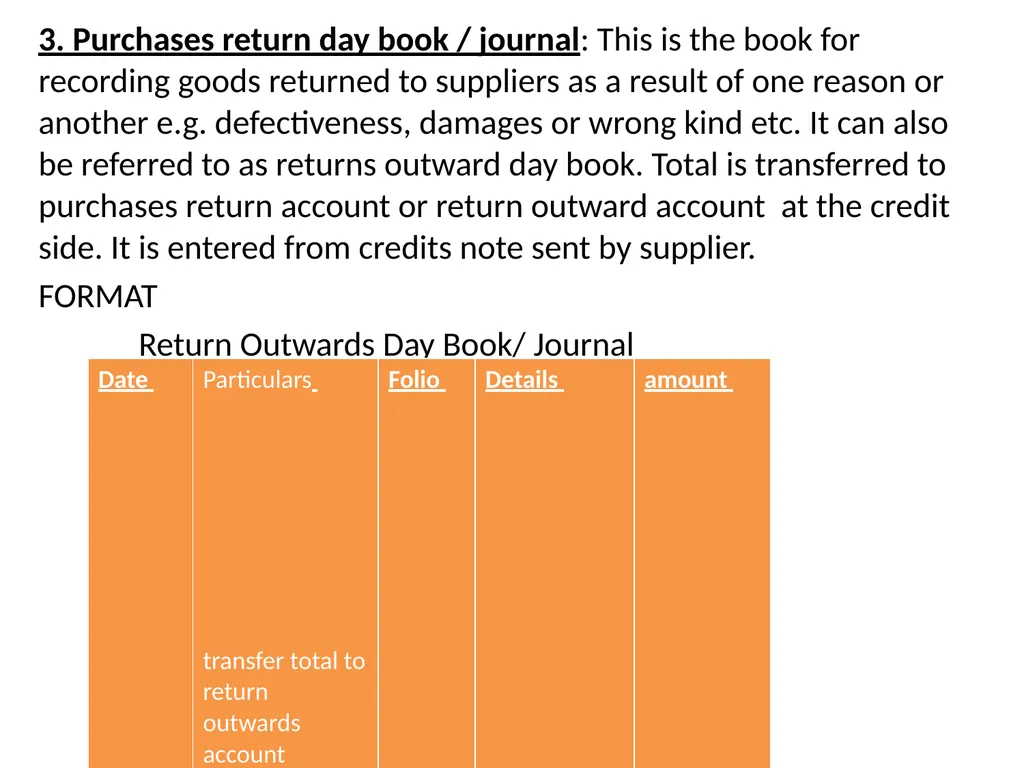
slide32. 3. Purchases return day book / journal: This is the book for recording goods returned to suppliers as a result of one reason or another e.g. defectiveness, damages or wrong kind etc. It can also be referred to as returns outward day book. Total is transferred to purchases return account or return outward account at the credit side. It is entered from credits note sent by supplier.
FORMAT
Return Outwards Day Book/ Journal<br>
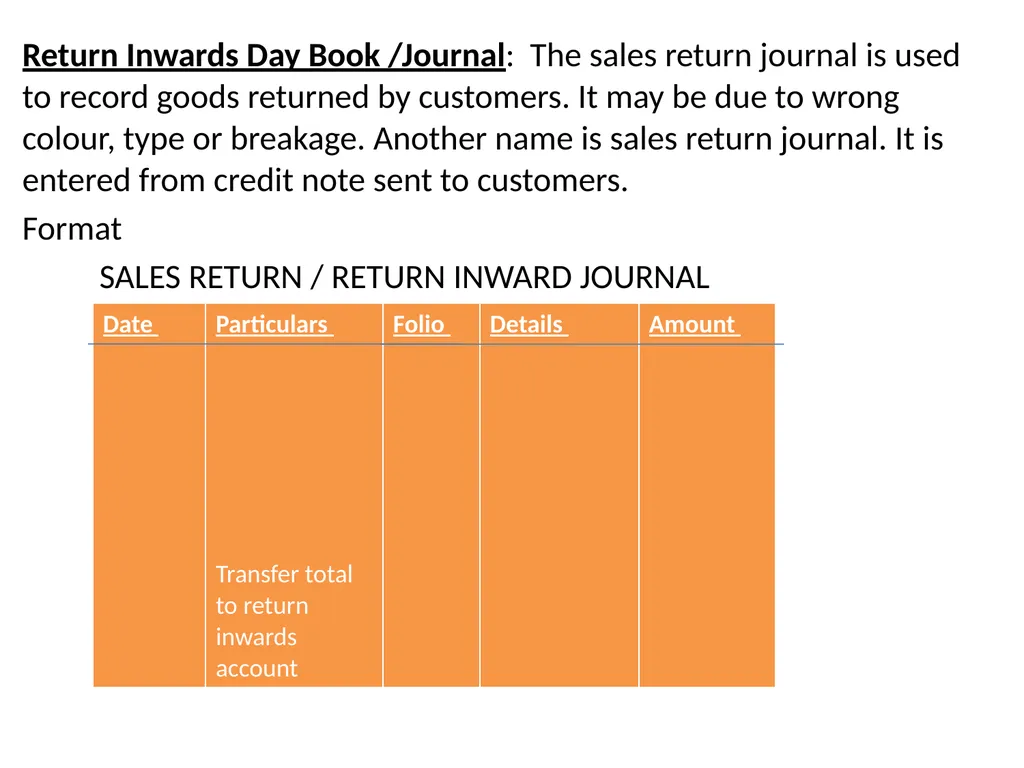
slide33. Return Inwards Day Book /Journal: The sales return journal is used to record goods returned by customers. It may be due to wrong colour, type or breakage. Another name is sales return journal. It is entered from credit note sent to customers.
Format
SALES RETURN / RETURN INWARD JOURNAL<br>
slide34. THE PRINCIPAL BOOK: LEDGER
Meaning: The ledger can be defined as a book which contains in a classified and summarized form, a permanent record of all transactions which is based on the principle of double entry.
The ledger is the final destination of all transactions in the subsidiary books. It is the most important book of account.<br>
slide35. Division Of Ledger
The classifications are as follows;
Personal ledgers: These are the ledgers for creditors accounts and debtors accounts.
General ledgers: These are the ledgers for sales account, purchase account.
Impersonal ledger: These are the ledgers for real and nominal accounts<br>
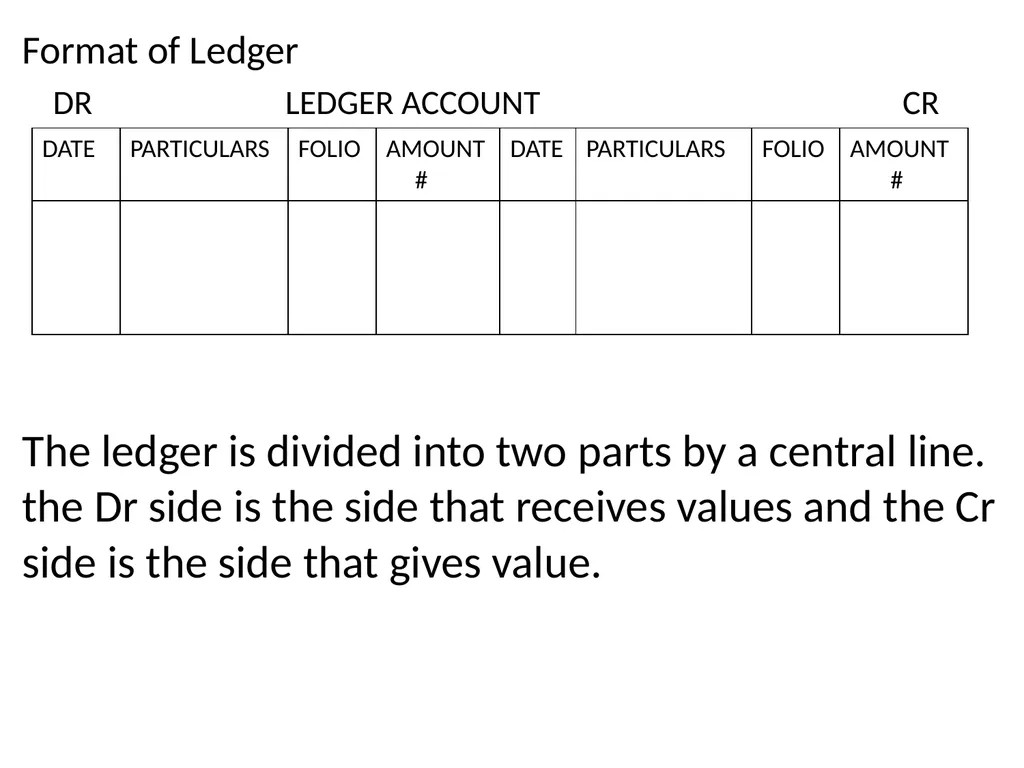
slide36. Format of Ledger
DR LEDGER ACCOUNT CR
The ledger is divided into two parts by a central line. the Dr side is the side that receives values and the Cr side is the side that gives value.<br>
slide37. TOPIC: BUSINESS DOCUMENTS / SOURCE DOCUMENTS MEANING: Business documents are also called source documents. The source documents provide detail information for the preparation of book of accounts the documents are;
Invoice
Credit note
Debit note
Petty cash voucher
Statement of account
Receipts<br>
slide38. Invoice: the invoice sets out the full details of goods sold and bought stating the quantity, price, discount given and terms of payment. It can be viewed from two ways; sales invoice and purchases invoice.
Credit note: this is a document sent by the seller to the customers for reduction in the amount owed by him. There has been overcharge of goods returned. It can be viewed from two perspectives;<br>
slide39. Credit note received from suppliers: if the credit notes relate to goods return to supplier , it will be recorded in return outwards book.
Credit note issued to customers: This will be posted to return inwards book.
Debit note: This is a document sent by the seller to the buyer to correct an undercharge or when goods are not charged on the invoice. It can be viewed from two perspectives; Debit note from suppliers and debit note issued to customers.<br>
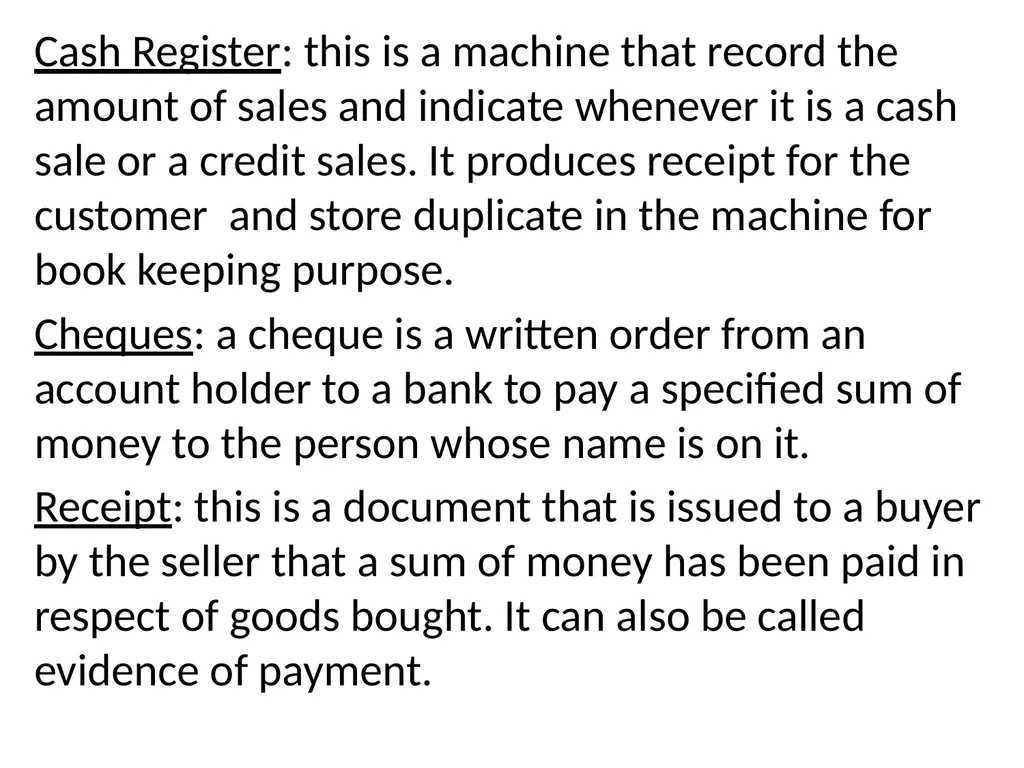
slide40. Cash Register: this is a machine that record the amount of sales and indicate whenever it is a cash sale or a credit sales. It produces receipt for the customer and store duplicate in the machine for book keeping purpose.
Cheques: a cheque is a written order from an account holder to a bank to pay a specified sum of money to the person whose name is on it.
Receipt: this is a document that is issued to a buyer by the seller that a sum of money has been paid in respect of goods bought. It can also be called evidence of payment.<br>
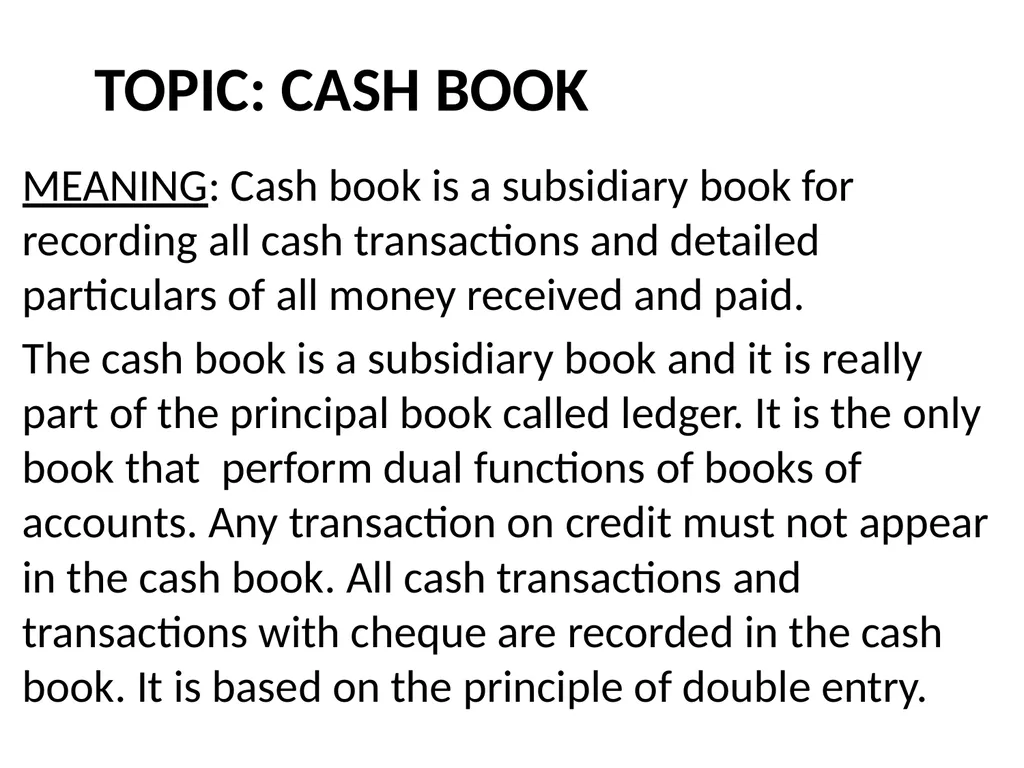
slide41. TOPIC: CASH BOOK MEANING: Cash book is a subsidiary book for recording all cash transactions and detailed particulars of all money received and paid.
The cash book is a subsidiary book and it is really part of the principal book called ledger. It is the only book that perform dual functions of books of accounts. Any transaction on credit must not appear in the cash book. All cash transactions and transactions with cheque are recorded in the cash book. It is based on the principle of double entry.<br>
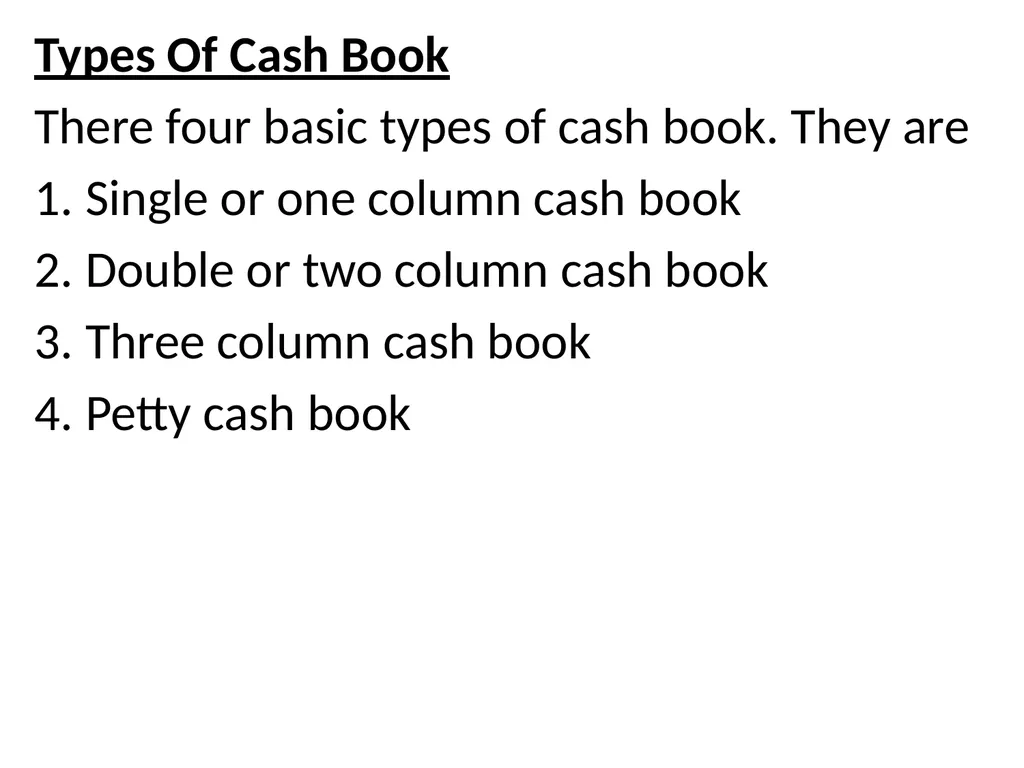
slide42. Types Of Cash Book
There four basic types of cash book. They are
Single or one column cash book
Double or two column cash book
Three column cash book
Petty cash book<br>
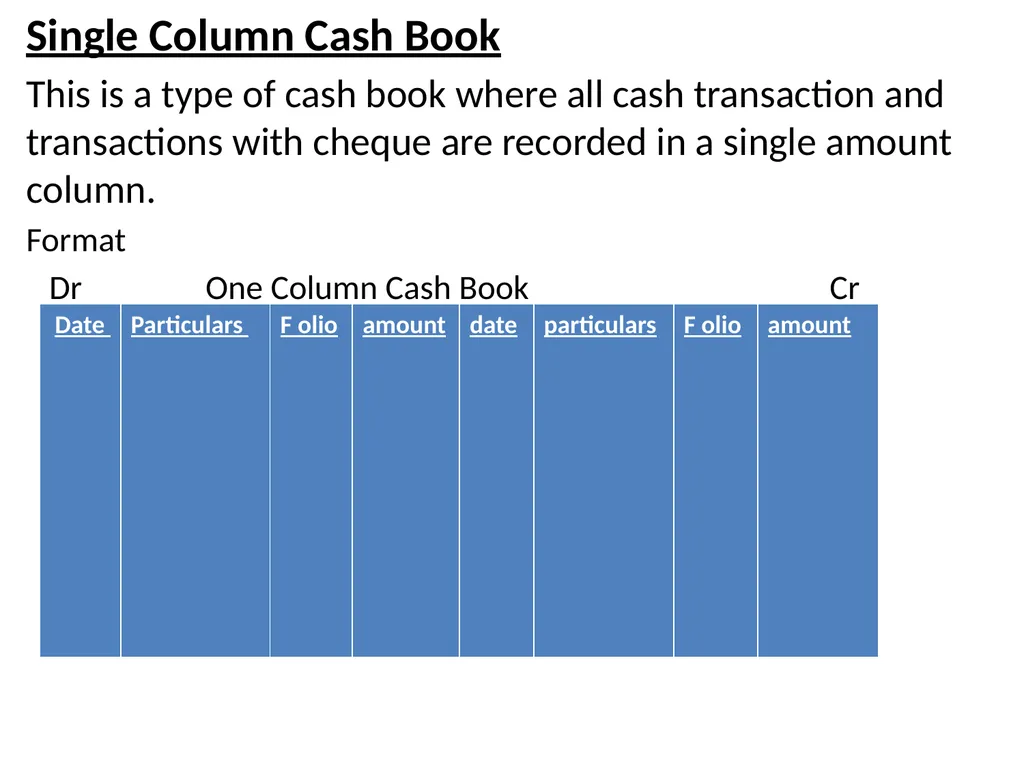
slide43. Single Column Cash Book
This is a type of cash book where all cash transaction and transactions with cheque are recorded in a single amount column.
Format
Dr One Column Cash Book Cr<br>
slide44. Two Column Cash Book
In this type of cash book, two separate accounts cash and bank , are combined for the sake of convenience. There will be separate column for cash and bank in order to know the total cash in hand and the total cash at bank at the end of the period.
Contra Entries: these are made in the cash book when cash is deposited into the bank account out of the cash in hand or when cash is withdrawn from bank for business or office use. It is denoted by letter ‘’ C’’ .<br>
slide45. Example 1
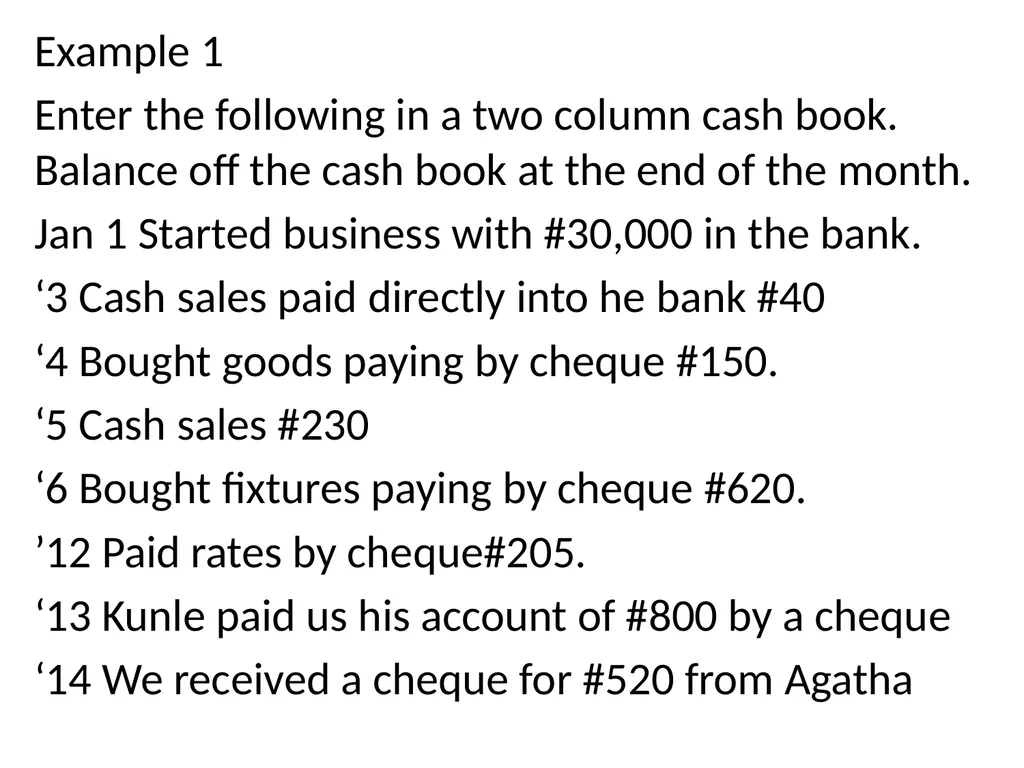
Enter the following in a two column cash book. Balance off the cash book at the end of the month.
Jan 1 Started business with #30,000 in the bank.
‘3 Cash sales paid directly into he bank #40
‘4 Bought goods paying by cheque #150.
‘5 Cash sales #230
‘6 Bought fixtures paying by cheque #620.
’12 Paid rates by cheque#205.
‘13 Kunle paid us his account of #800 by a cheque
‘14 We received a cheque for #520 from Agatha<br>
slide46. ‘17 Cash sales #700.
‘20 Paid wages #30 by cash.
‘25 Paid expenses by cash #50.
‘30 Bought motor van #18 by cash.<br>
slide47. Assignment
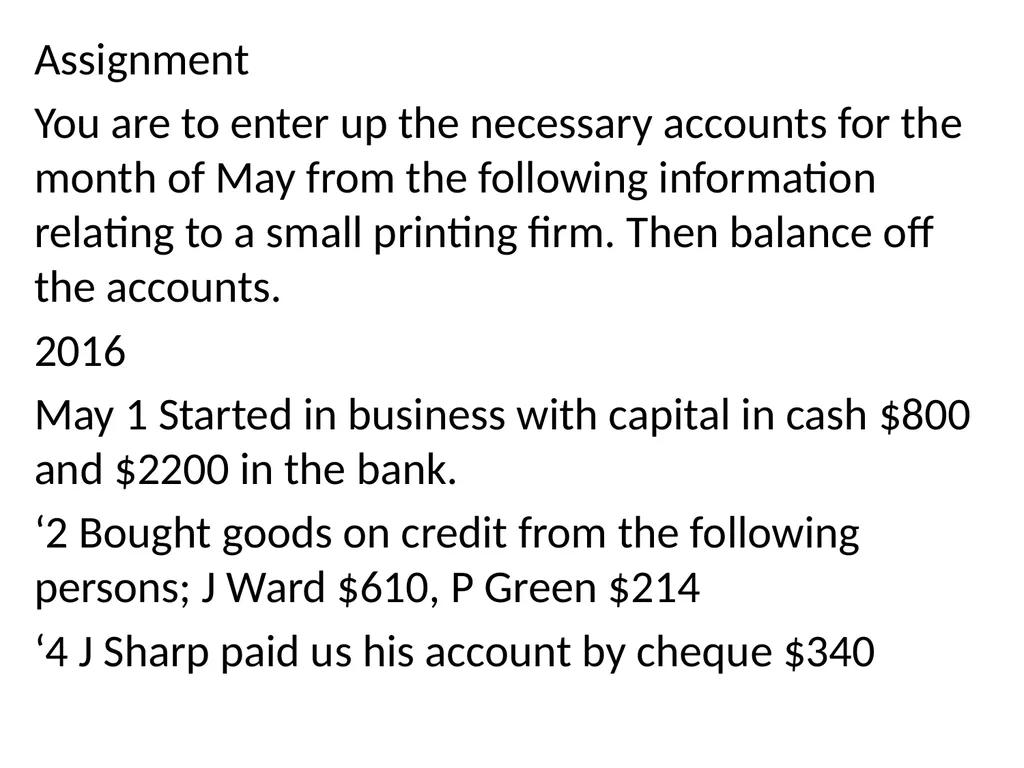
You are to enter up the necessary accounts for the month of May from the following information relating to a small printing firm. Then balance off the accounts.
2016
May 1 Started in business with capital in cash $800 and $2200 in the bank.
‘2 Bought goods on credit from the following persons; J Ward $610, P Green $214
‘4 J Sharp paid us his account by cheque $340<br>
slide48. ‘’10 F Titmus paid us $1000 by cheque.
‘11 We paid the following by cheque; M Taylor $174, J Ward $610
‘12 Paid carriage by cash $38.
‘18 Bought goods by cash from P Green $291; S Gemmill $940
‘21 Sold goods on credit to G. Boycott $810
‘31 Paid rent by cheque $230<br>
slide51. SECOND TERM INTEGRATED SCHEME ( WAEC and IGCSE)
THEME: SOURCES AND RECORDING OF ACCOUNTING DATA
WEEK TOPIC
1.Revisions of last term’s work
2.Discounts- Meaning, Types, Reasons
Distinguish between and account for trade discounts and cash discounts
Calculations of discounts
3.Three Column Cash Book- Working exercises and processing accounting data.<br>
slide52. 4.Petty Cash Book- Meaning, Terminologies
-Explain and apply the imprest system of petty cash book
5.Posting Subsidiary books into Ledgers
-Post transactions to the ledger accounts
-Balance ledger accounts as required and make transfers to final accounts
-Interpret ledger accounts and their balances.
6.Verification of Accounting Records
Trial Balance- Meaning; understand that a trial balance is a statement of ledger balances on a particular date.<br>
slide53. -Outline the uses and limitations of a trial balance.
-Prepare a trial balance from a given list of balances and amend a trial balance which contains errors
7.Principles of Financial Statements
Income Statement/ Trading Account
-Meaning, Reasons, format
-Prepare and calculate gross profit and profit for the year based on accounting principles for a specified period.
8.Income Statement/ Profit and Loss Account
Reasons, format<br>
slide54. -Preparation and calculate net profit or loss for the year.
9.Statements of Financial Position/ Balance Sheet
-Meaning, Reason
-Recognise and define non current assets ( fixed assets), intangible assets, current assets, current liabilities, non current liabilities, working capital, capital employed and capital owned.
-Prepare financial position
-Explain the difference between a trading business and a service business.<br>
slide55. Verification of Accounting Records
Bank Reconciliation
-Understand the use and purpose of a bank statement
-Reasons for preparation
-Terminologies
11. Revisions
12.Examinations<br>
slide56. TOPIC: DISCOUNTS
MEANING: Discount can be defined as the reduction in the price of goods in order to encourage bulk purchase and prompt payment.
Reasons For Granting Discounts
To encourage large quantity purchases.
Helps to avoid risk of bad debt.
To encourage prompt payment.
Discount attracts customers.
It provides for the buyer’s profit margin.
To avoid tying down business capital.<br>
slide57. Types Of Discounts
Trade discount
Cash discount
Quantity discount
Seasonal discount
Trade Discount
This is an allowance made by the manufacturer or wholesaler to retailer in form of deduction from catalogue prices of goods supplied. It is an inducement to the customer to buy goods in large quantity. It appears in day books alone and deducted before cash discount.<br>
slide58. Cash Discount
This is a percentage allowance for prompt payment of an account or for payment within a specified period of time. It is deducted after trade discount and appear in cash book.
Classification Of Cash Discount
a. Discount allowed: this is discount allowed by a firm to its customers when they pay their accounts quickly or promptly. It is entered on the debit side of the three column cash book and is treated as an expense in the profit and loss account.<br>
slide59. b. Discount Received: this is the discount received by a firm from its suppliers when it pays its accounts quickly. It is treated as an income and credited to the three column cash book. It is posted to the income side of the profit and loss account.
Calculations Of Discounts
% of discounts x total amounts.<br>
slide60. TOPIC: THREE COLUMN CASH BOOK
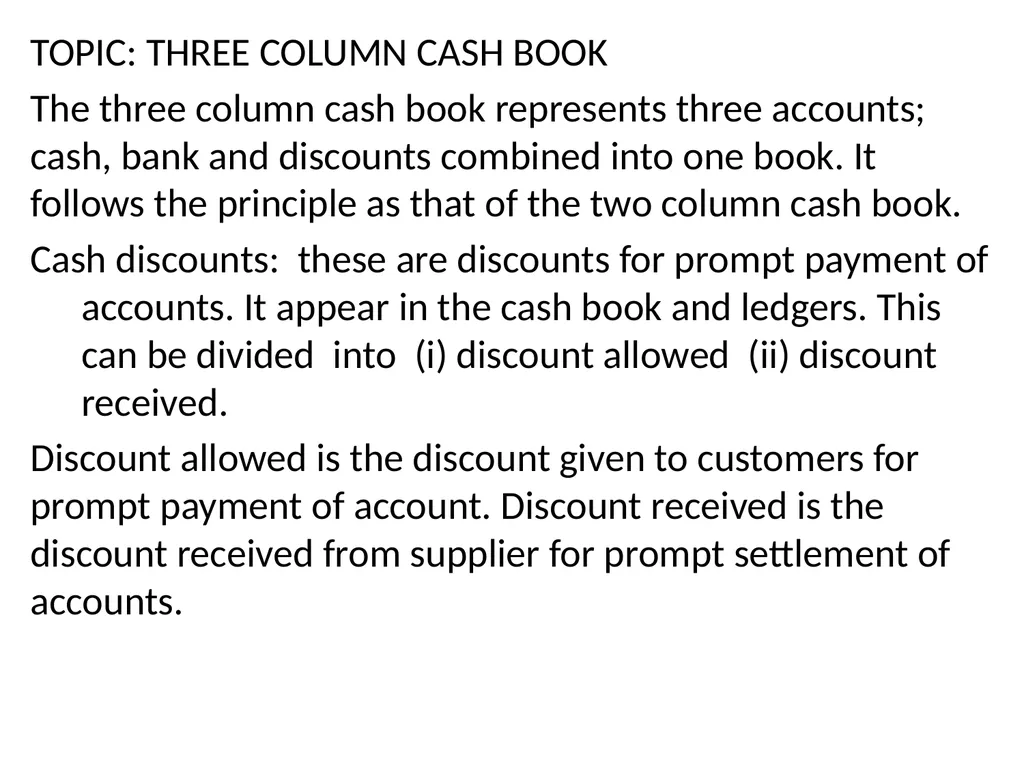
The three column cash book represents three accounts; cash, bank and discounts combined into one book. It follows the principle as that of the two column cash book.
Cash discounts: these are discounts for prompt payment of accounts. It appear in the cash book and ledgers. This can be divided into (i) discount allowed (ii) discount received.
Discount allowed is the discount given to customers for prompt payment of account. Discount received is the discount received from supplier for prompt settlement of accounts.<br>
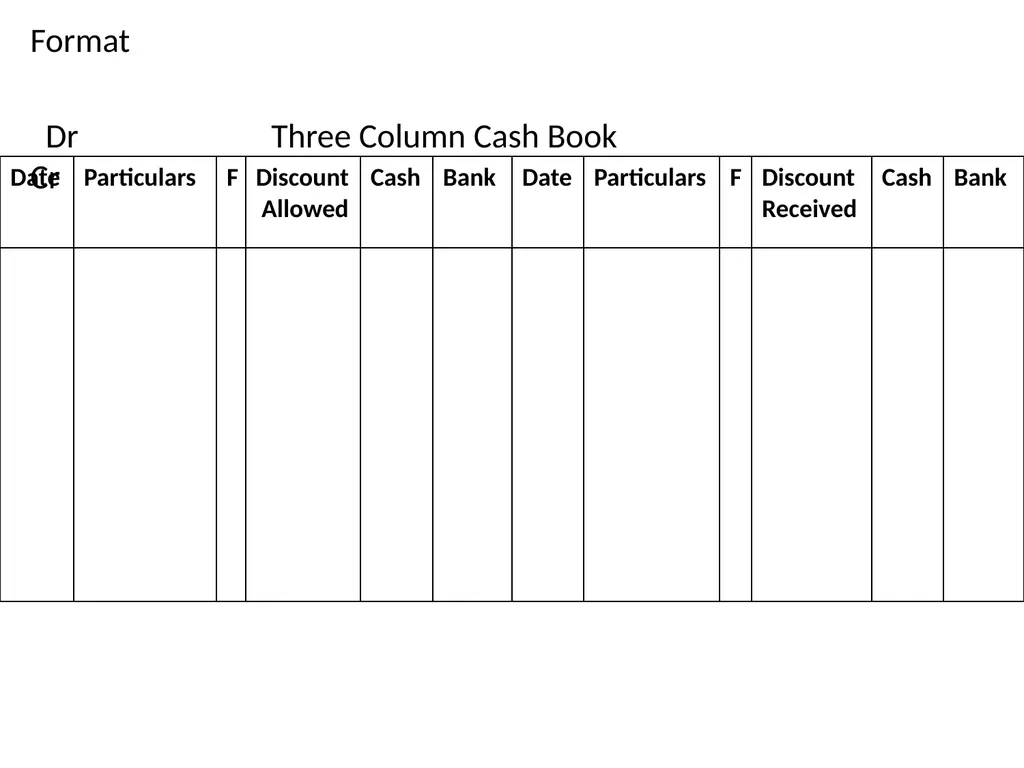
slide61. Format
Dr Three Column Cash Book Cr<br>
slide62. TOPIC: PETTY CASH BOOK
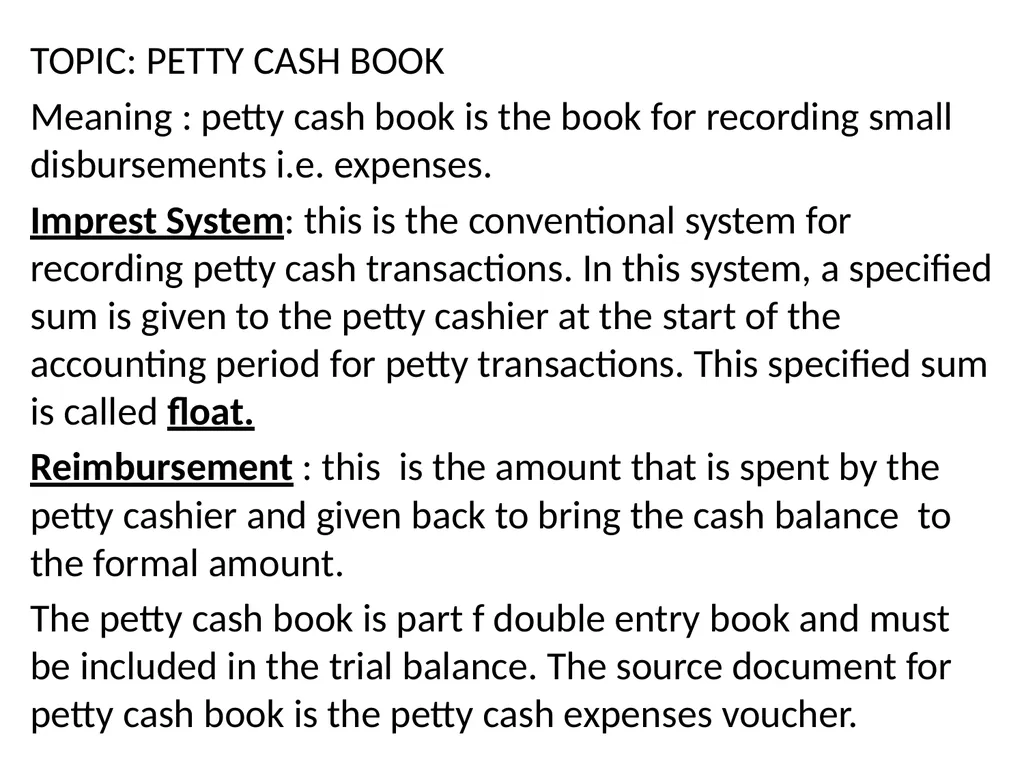
Meaning : petty cash book is the book for recording small disbursements i.e. expenses.
Imprest System: this is the conventional system for recording petty cash transactions. In this system, a specified sum is given to the petty cashier at the start of the accounting period for petty transactions. This specified sum is called float.
Reimbursement : this is the amount that is spent by the petty cashier and given back to bring the cash balance to the formal amount.
The petty cash book is part f double entry book and must be included in the trial balance. The source document for petty cash book is the petty cash expenses voucher.<br>
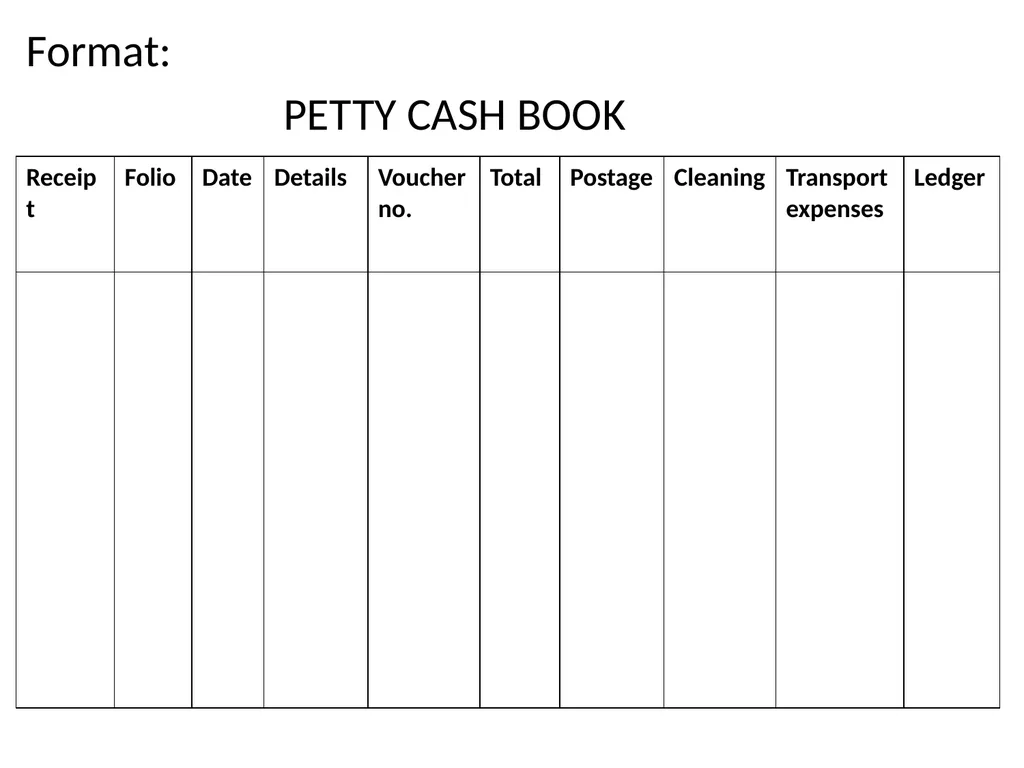
slide63. Format:
PETTY CASH BOOK<br>
slide64. TOPIC: POSTING TO LEDGERS AND BALANCING THE LEDGER ACCOUNTS
Side of accounts for posting from subsidiary books to ledger are as follows;
Transfer total from sales journal to credit side of sales account.
Transfer total from sales returns or return inward journal to debit side of sales returns account.
Transfer total from purchases day book to debit side of purchases account.
Transfer total from purchases returns or returns outward journal to the credit side of purchases returns account<br>
slide65. all items on the debit side of the cash book will be posted to the credit side of their respective accounts, while all items on the credit side of the cash book will appear on the debit side of their respective account.
Procedure To Balance Ledger Accounts
In order to balance an account it will be necessary to;
Add all the items on the debit side
Add all the items on the credit side
Compare both totals.<br>
slide66. A “debit balance” is an excess of debit items over credit items.
A “credit balance”is an excess of credit items over debit items.
Balance carried down ( bal c/d ): difference between credit side and debit that is insert on the lesser side in order to make totals at the both side of an account to be equal. When it is shown as an opening balance in the next accounting period, it is referred to as balance brought down ( bal b/d ).<br>
slide67. TOPIC: TRIAL BALANCE MEANING: Trial balance can be defined as the schedule or list that shows the debit and credit balances extracted from the ledger, to show the arithmetical accuracy of the ledger balances.
All ledgers accounts must be balanced off and entered in the trial balance to prove the accuracy of the book keeping. The totals of debit and credit must be equal. When there is a difference between the two sides, then some errors have been made.
Needs / Uses Of Trial Balance
The trial balance helps in testing the accuracy of the double entry.
Helps in the preparation of the final statements.
It is used to detect accounting errors.<br>
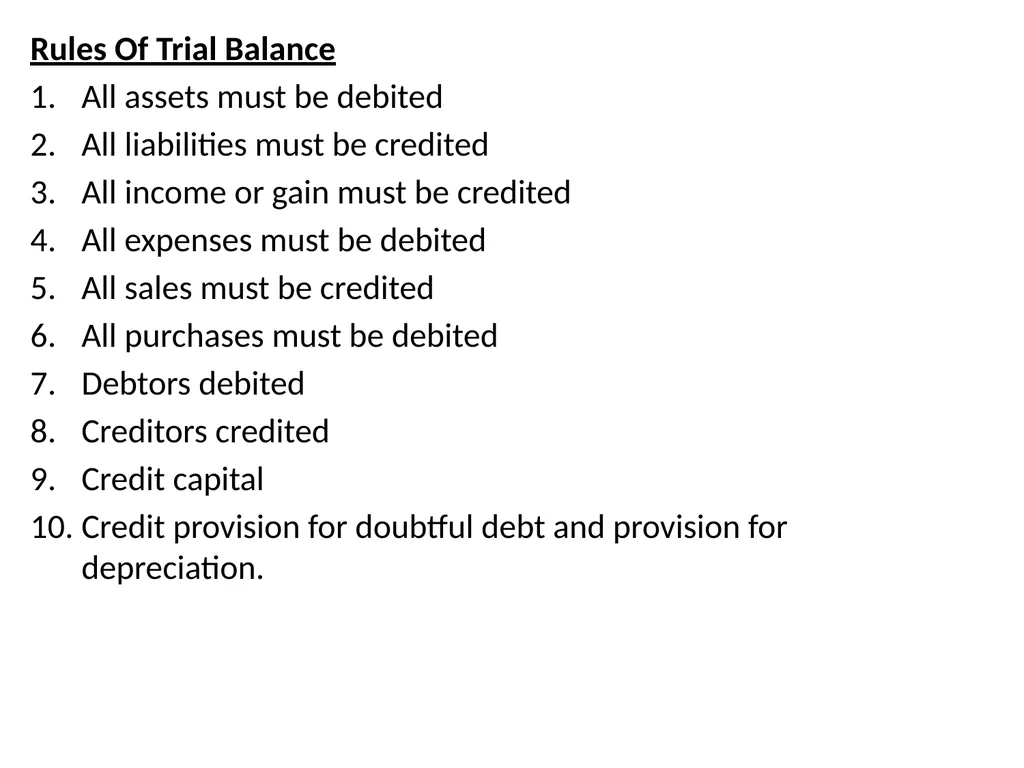
slide68. Rules Of Trial Balance
All assets must be debited
All liabilities must be credited
All income or gain must be credited
All expenses must be debited
All sales must be credited
All purchases must be debited
Debtors debited
Creditors credited
Credit capital
Credit provision for doubtful debt and provision for depreciation.<br>
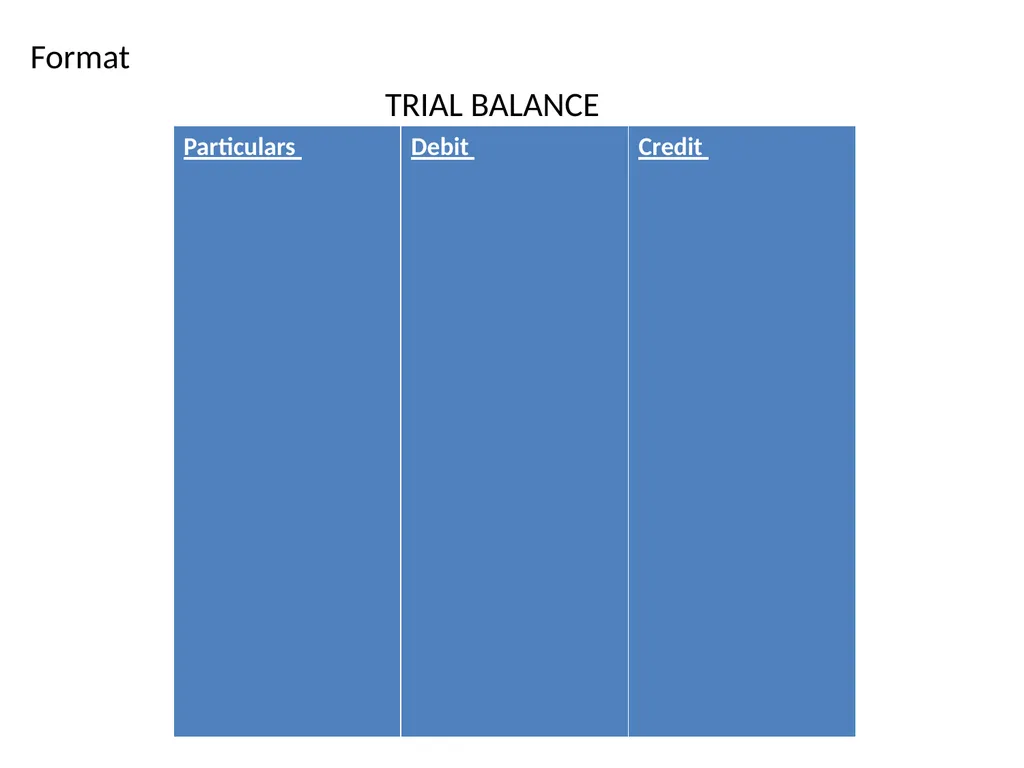
slide69. Format
TRIAL BALANCE<br>
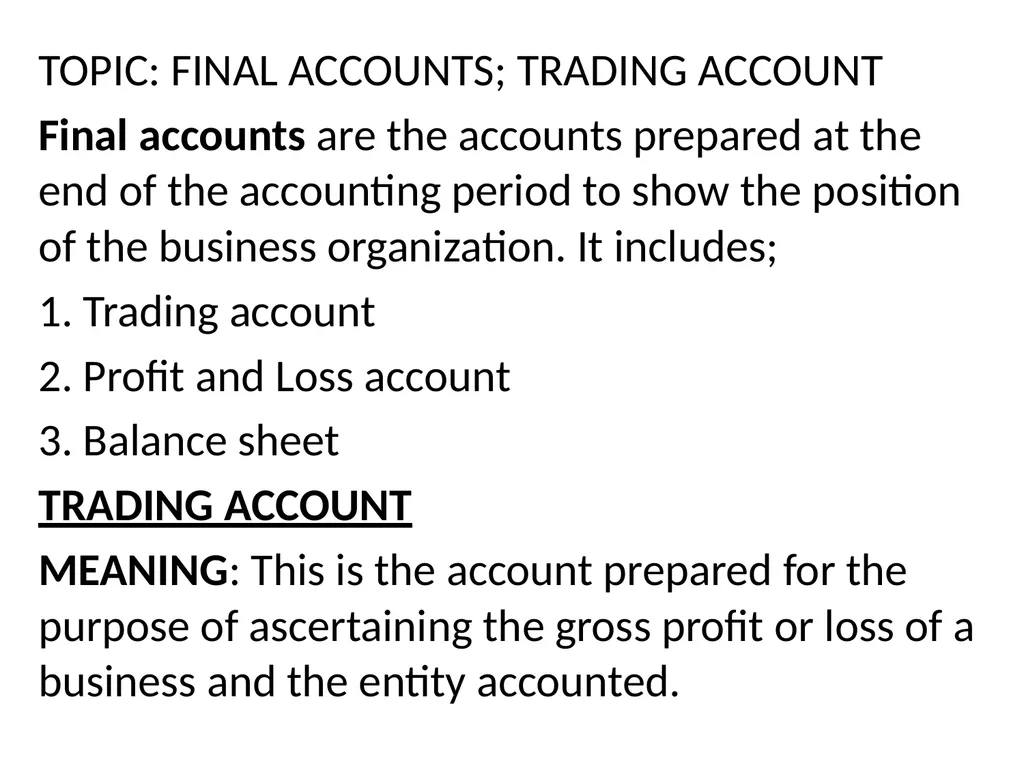
slide70. TOPIC: FINAL ACCOUNTS; TRADING ACCOUNT
Final accounts are the accounts prepared at the end of the accounting period to show the position of the business organization. It includes;
1. Trading account
2. Profit and Loss account
3. Balance sheet
TRADING ACCOUNT
MEANING: This is the account prepared for the purpose of ascertaining the gross profit or loss of a business and the entity accounted.<br>
slide71. It is a revenue account and form part of the double entry system. The balance is transferred to the profit and loss account.
Purpose:
The object of a trading account is to ascertain the gross profit or loss resulting from business transactions.
Terminologies:
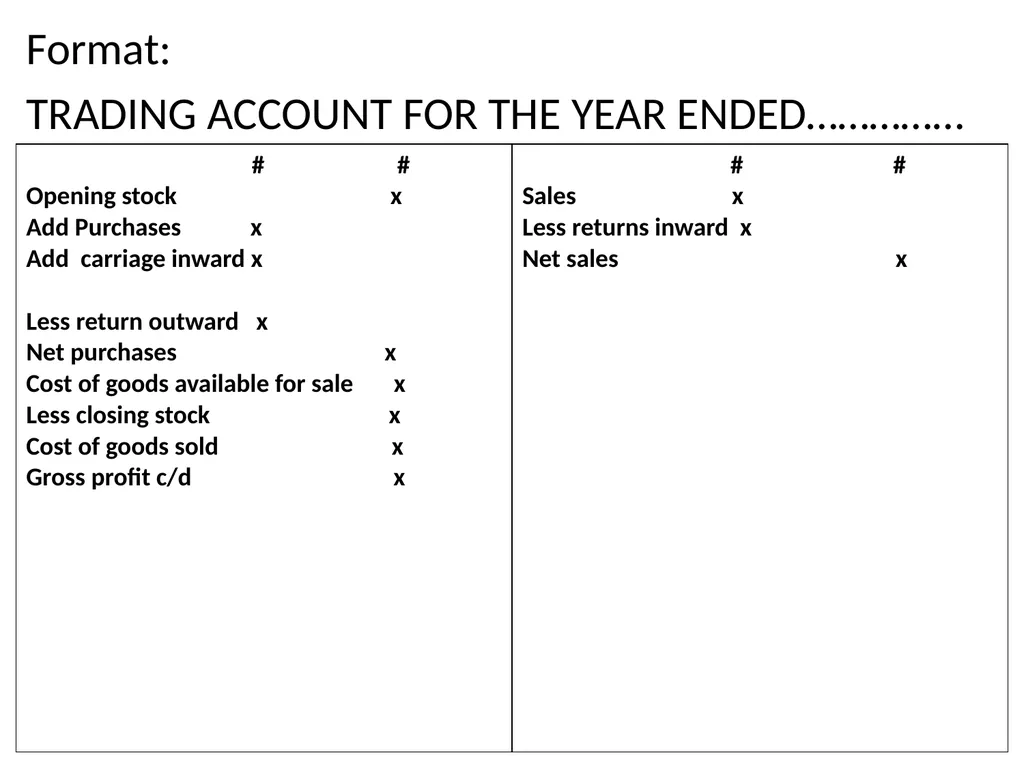
Sales: cash and credit sales during accounting period
Returns inward: this is the total value of goods returned to the seller by the customers out of goods previously sold to them. It is deducted from total sales.<br>
slide72. Carriage inwards: Expenses or cost incurred on transportation of goods sold.
Purchases: Goods bought for resale.
Returns outward: Cost incurred on transportation of goods sold.
Cost of goods sold: Cost of goods sold to customers during the trading period.
Cost of goods available for sale: Cost of goods available in the warehouse or store for customers to buy.
Opening stock: Cost of goods available in the store at the beginning of a trading period.
Closing stock: Cost of unsold goods at the end of a trading period.<br>
slide73. Format:
TRADING ACCOUNT FOR THE YEAR ENDED……………<br>
slide74. TOPIC: PROFIT AND LOSS ACCOUNT
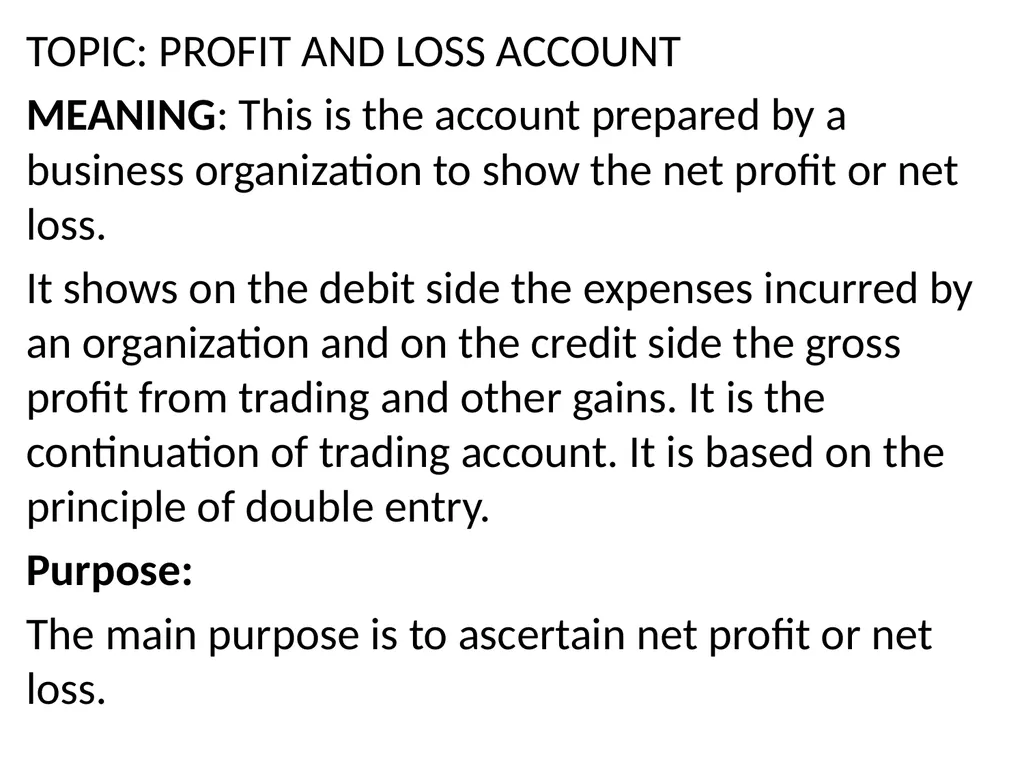
MEANING: This is the account prepared by a business organization to show the net profit or net loss.
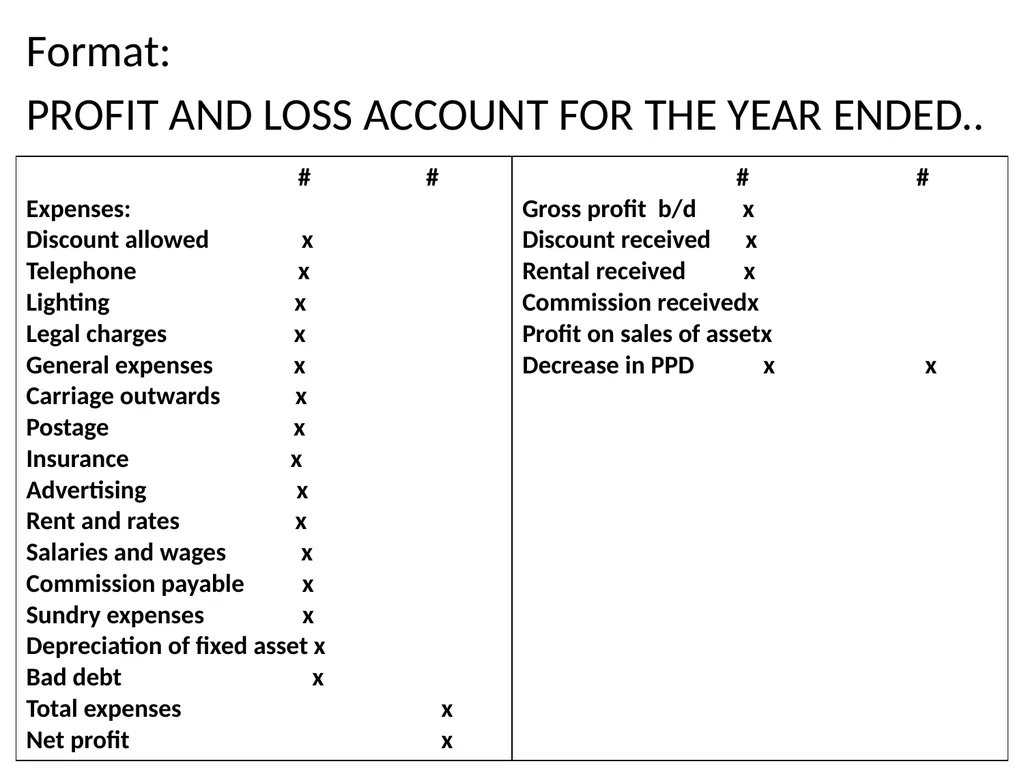
It shows on the debit side the expenses incurred by an organization and on the credit side the gross profit from trading and other gains. It is the continuation of trading account. It is based on the principle of double entry.
Purpose:
The main purpose is to ascertain net profit or net loss.<br>
slide75. Terminologies:
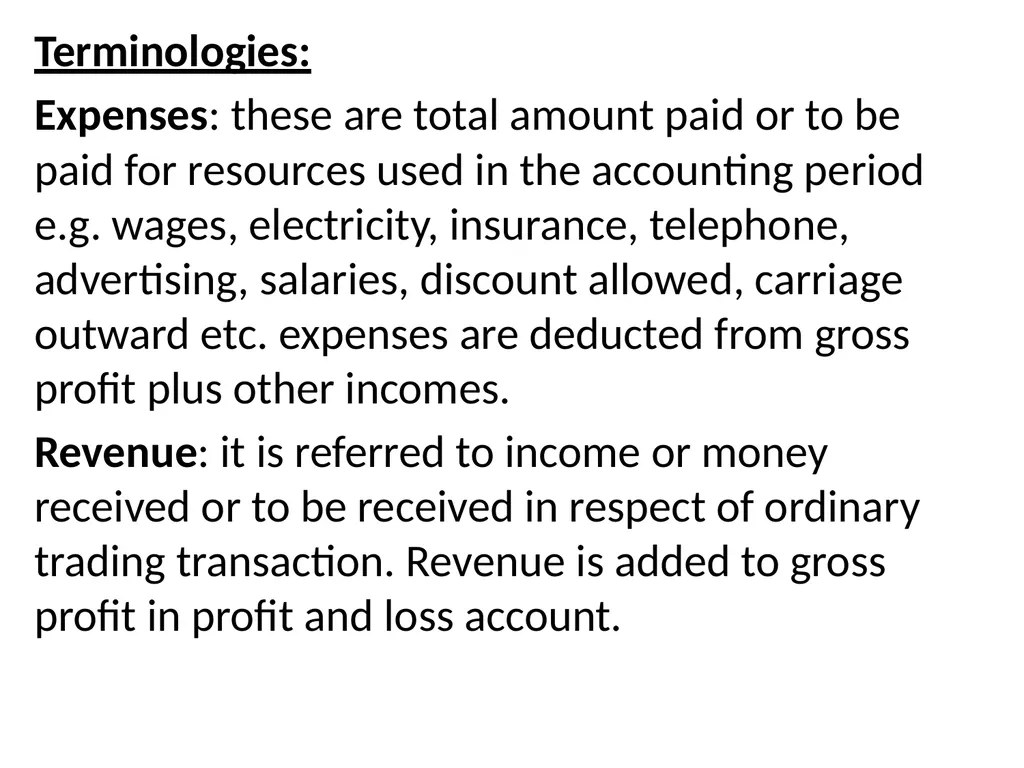
Expenses: these are total amount paid or to be paid for resources used in the accounting period e.g. wages, electricity, insurance, telephone, advertising, salaries, discount allowed, carriage outward etc. expenses are deducted from gross profit plus other incomes.
Revenue: it is referred to income or money received or to be received in respect of ordinary trading transaction. Revenue is added to gross profit in profit and loss account.<br>
slide76. Profit: profit in accounting can be divided into two;
Gross profit: it is ascertained in trading account. It is excess of sales over cost of goods sold.
Net profit: it is ascertained in profit and loss account. It is excess of revenue over total expenses.
Treatment of Goods Stolen And Withdrawn For Use
Goods stolen and goods withdrawn for personal use are deducted from purchases in trading account and also deducted from net profit in balance sheet.<br>
slide77. Format:
PROFIT AND LOSS ACCOUNT FOR THE YEAR ENDED..<br>
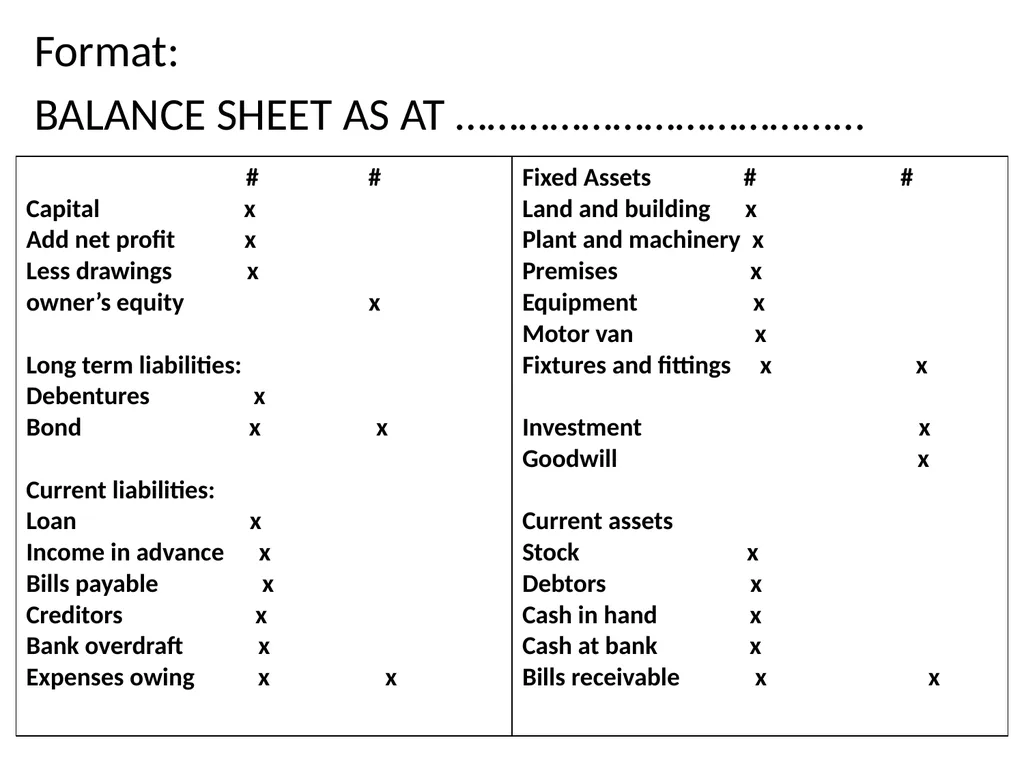
slide79. TOPIC: BALANCE SHEET
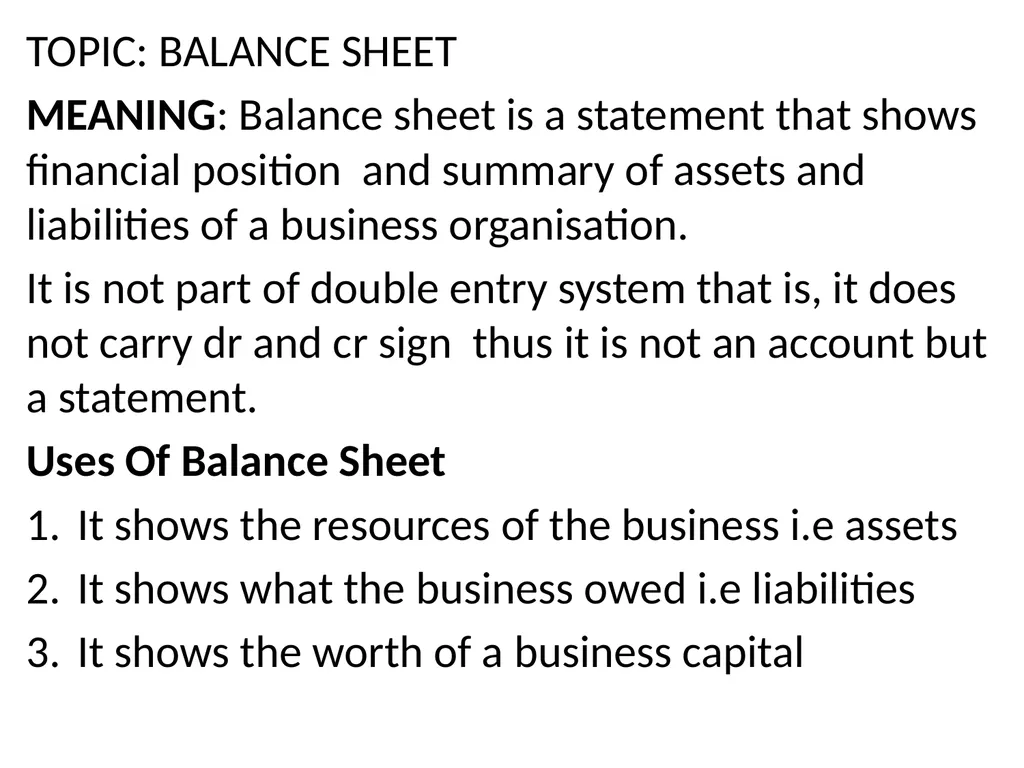
MEANING: Balance sheet is a statement that shows financial position and summary of assets and liabilities of a business organisation.
It is not part of double entry system that is, it does not carry dr and cr sign thus it is not an account but a statement.
Uses Of Balance Sheet
It shows the resources of the business i.e assets
It shows what the business owed i.e liabilities
It shows the worth of a business capital<br>
slide80. Classification of Balance Sheet Items
Balance sheet items can be classified into two;
Assets
Liabilities
Assets
These are resources or properties of a business which are used to generate more income for the business. Assets can be divided into;<br>
slide81. Fixed Assets: these are assets that can last for a long period of time e.g. land and building, motor vehicle, fixtures and fittings, plant and machinery, office equipment etc.
Current Assets: these are assets that can be easily change for money and can last for a short period of time e.g. debtors, stock, cash in hand, cash at bank, bills receivable etc.
Intangible assets: these are asset which have no physical substance or properties but contribute economic benefits to the organisation. The assets can not be seen or touched e.g. goodwill, trademark, patent, copyright etc.<br>
slide82. d. Liquid assets: these are assets which can be easily converted into cash e.g. securities, stock.
e. Fictitious assets: these are assets of unusual character, which resembles those of asset. They are merely debit balances, which are not realizable e.g. preliminary expenses.
f. Wasting assets: they are assets that are used up over a period of time. They become exhausted through being worked upon e.g. mines, timber, crude oil, tin, gold etc.<br>
slide83. Liabilities
These are what a firm or business owed to outsiders i.e. debts. Liabilities can be divided into two;
Long Term Liabilities: these are liabilities which becomes due after more than one year e.g. debentures, long term loan
Current Liabilities: these are liabilities which are due for settlement within one year e.g. creditor, short term loan, bank overdraft, expenses owings, income in advance etc.<br>
slide84. Format:
BALANCE SHEET AS AT …………………………………<br>
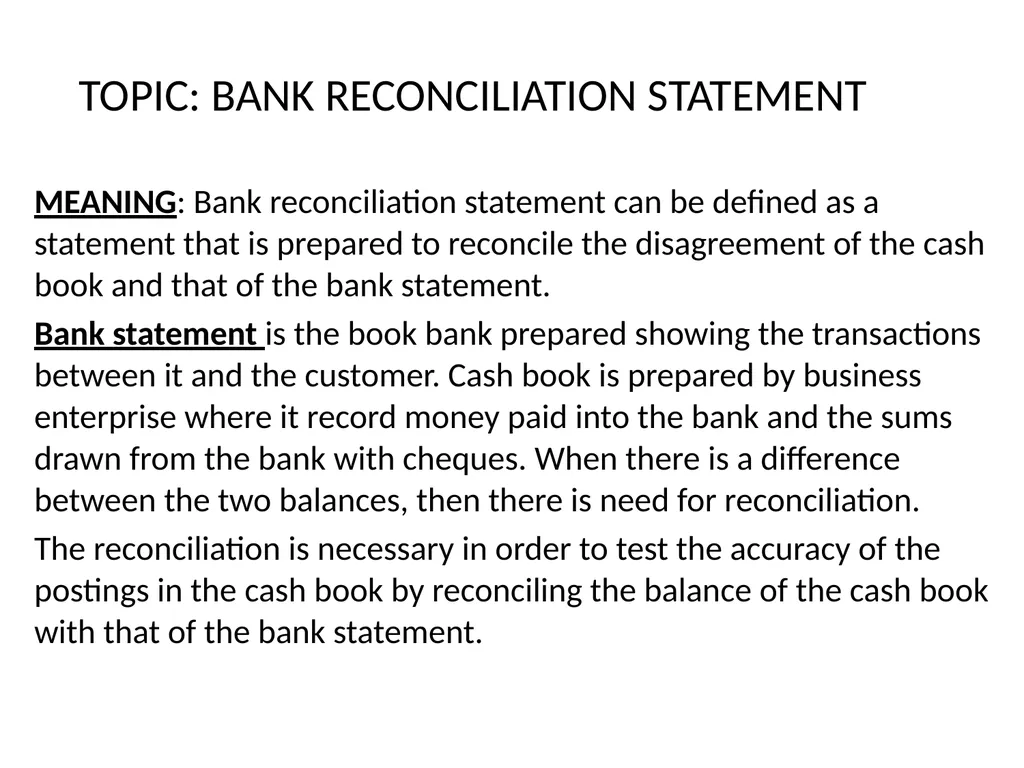
slide86. TOPIC: BANK RECONCILIATION STATEMENT MEANING: Bank reconciliation statement can be defined as a statement that is prepared to reconcile the disagreement of the cash book and that of the bank statement.
Bank statement is the book bank prepared showing the transactions between it and the customer. Cash book is prepared by business enterprise where it record money paid into the bank and the sums drawn from the bank with cheques. When there is a difference between the two balances, then there is need for reconciliation.
The reconciliation is necessary in order to test the accuracy of the postings in the cash book by reconciling the balance of the cash book with that of the bank statement.<br>
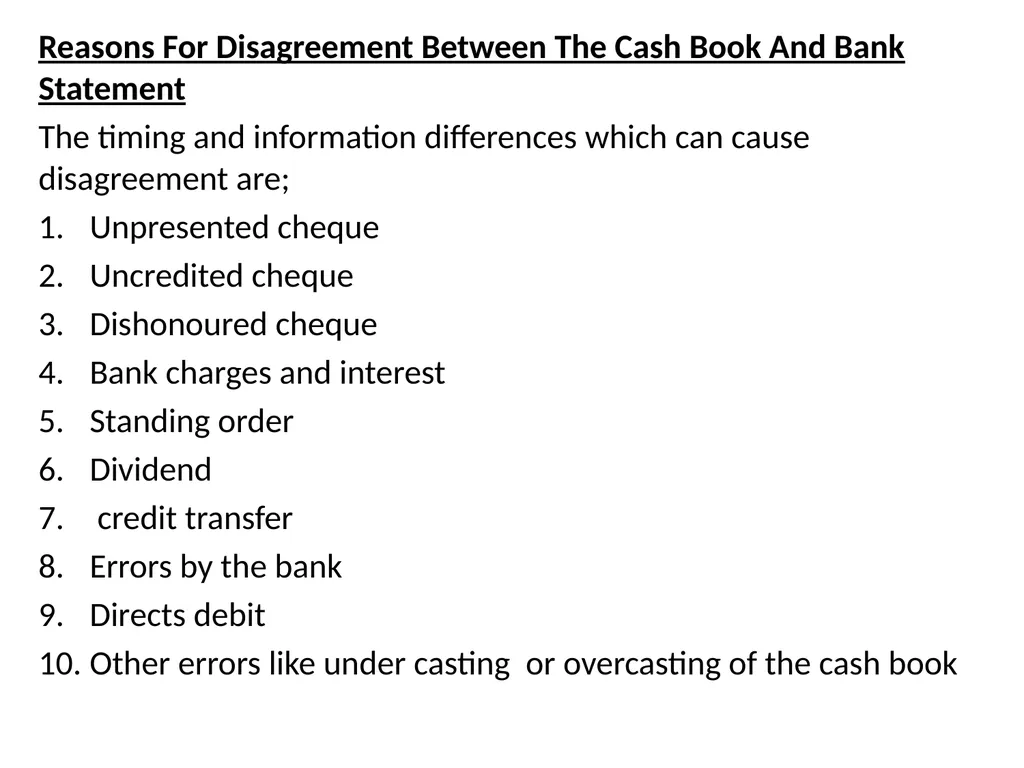
slide87. Reasons For Disagreement Between The Cash Book And Bank Statement
The timing and information differences which can cause disagreement are;
Unpresented cheque
Uncredited cheque
Dishonoured cheque
Bank charges and interest
Standing order
Dividend
credit transfer
Errors by the bank
Directs debit
Other errors like under casting or overcasting of the cash book<br>
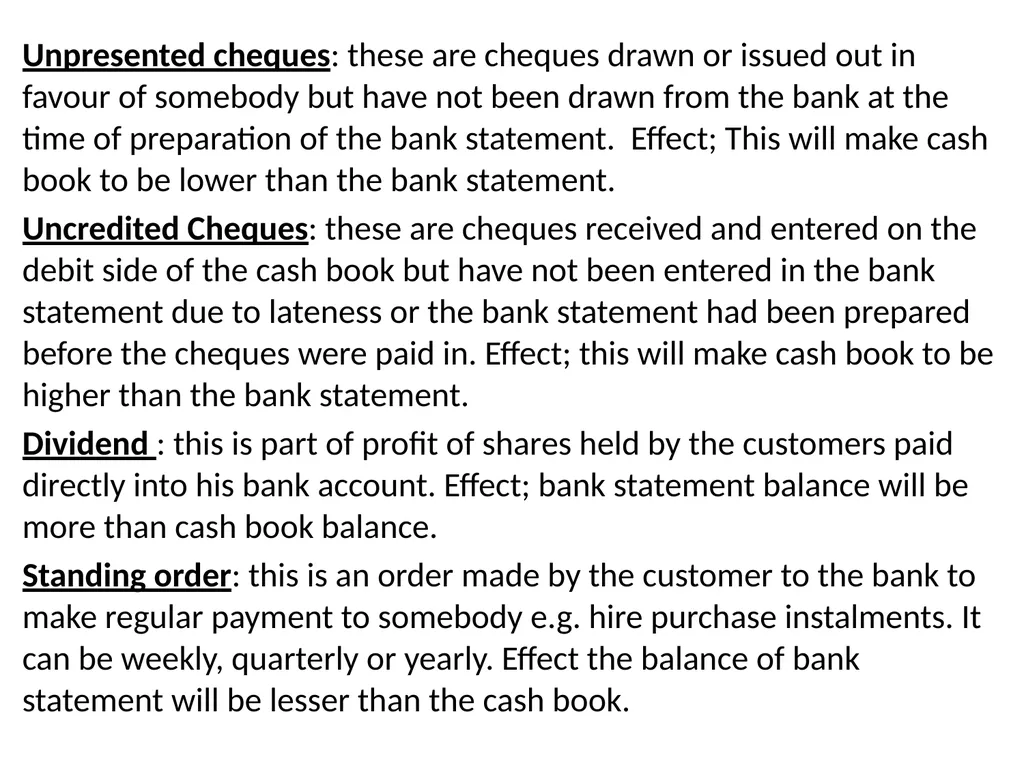
slide88. Unpresented cheques: these are cheques drawn or issued out in favour of somebody but have not been drawn from the bank at the time of preparation of the bank statement. Effect; This will make cash book to be lower than the bank statement.
Uncredited Cheques: these are cheques received and entered on the debit side of the cash book but have not been entered in the bank statement due to lateness or the bank statement had been prepared before the cheques were paid in. Effect; this will make cash book to be higher than the bank statement.
Dividend : this is part of profit of shares held by the customers paid directly into his bank account. Effect; bank statement balance will be more than cash book balance.
Standing order: this is an order made by the customer to the bank to make regular payment to somebody e.g. hire purchase instalments. It can be weekly, quarterly or yearly. Effect the balance of bank statement will be lesser than the cash book.<br>
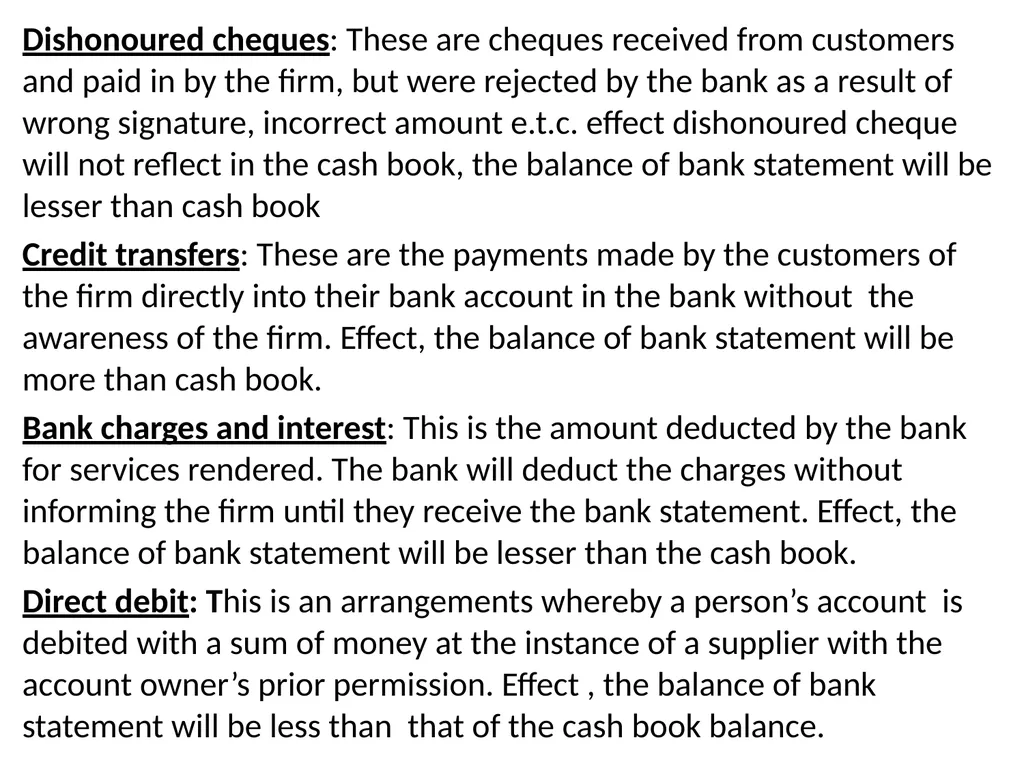
slide89. Dishonoured cheques: These are cheques received from customers and paid in by the firm, but were rejected by the bank as a result of wrong signature, incorrect amount e.t.c. effect dishonoured cheque will not reflect in the cash book, the balance of bank statement will be lesser than cash book
Credit transfers: These are the payments made by the customers of the firm directly into their bank account in the bank without the awareness of the firm. Effect, the balance of bank statement will be more than cash book.
Bank charges and interest: This is the amount deducted by the bank for services rendered. The bank will deduct the charges without informing the firm until they receive the bank statement. Effect, the balance of bank statement will be lesser than the cash book.
Direct debit: This is an arrangements whereby a person’s account is debited with a sum of money at the instance of a supplier with the account owner’s prior permission. Effect , the balance of bank statement will be less than that of the cash book balance.<br>
slide90. Errors by the bank: bank can make mistakes. A sum paid in by a customer may be credited to another customer’s account.
Under casting and overcasting of cash book balance: these will also cause disagreement between the bank statement and cash book balance
Preparation Of Bank Reconciliation Statement
There are two ways of preparing bank reconciliation statement. They are
Preparation of only the bank reconciliation statement
Preparation of adjusted cash book and bank reconciliation statement using the balance of adjusted cash book.<br>
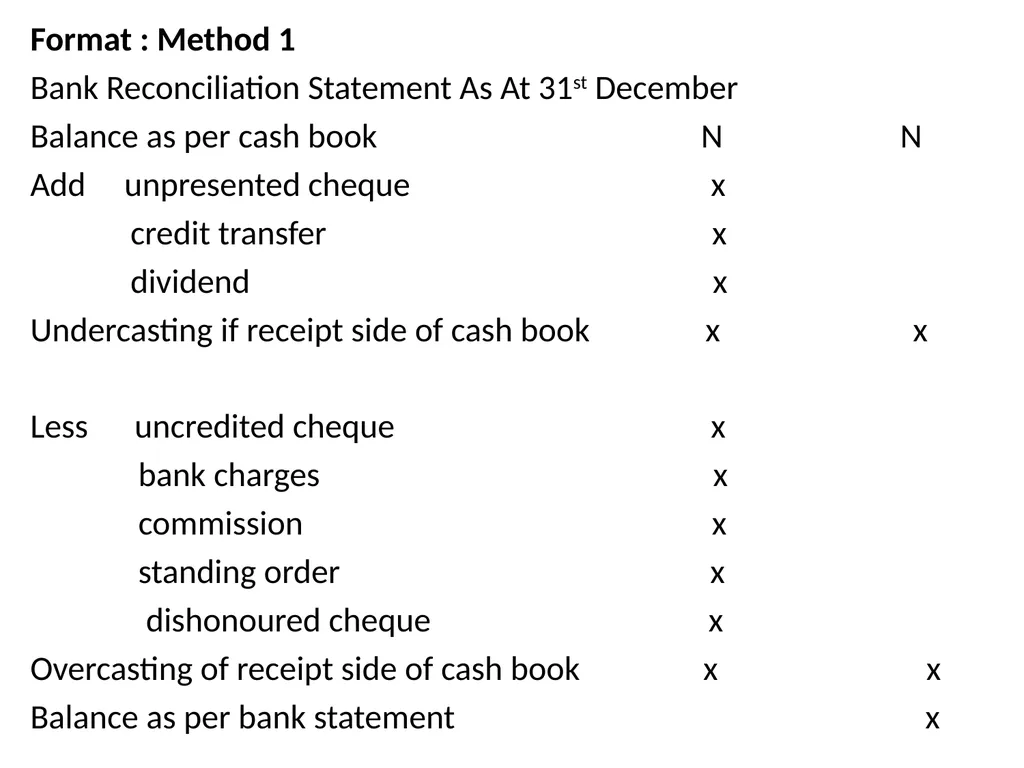
slide91. Format : Method 1
Bank Reconciliation Statement As At 31st December
Balance as per cash book N N
Add unpresented cheque x
credit transfer x
dividend x
Undercasting if receipt side of cash book x x
Less uncredited cheque x
bank charges x
commission x
standing order x
dishonoured cheque x
Overcasting of receipt side of cash book x x
Balance as per bank statement x<br>
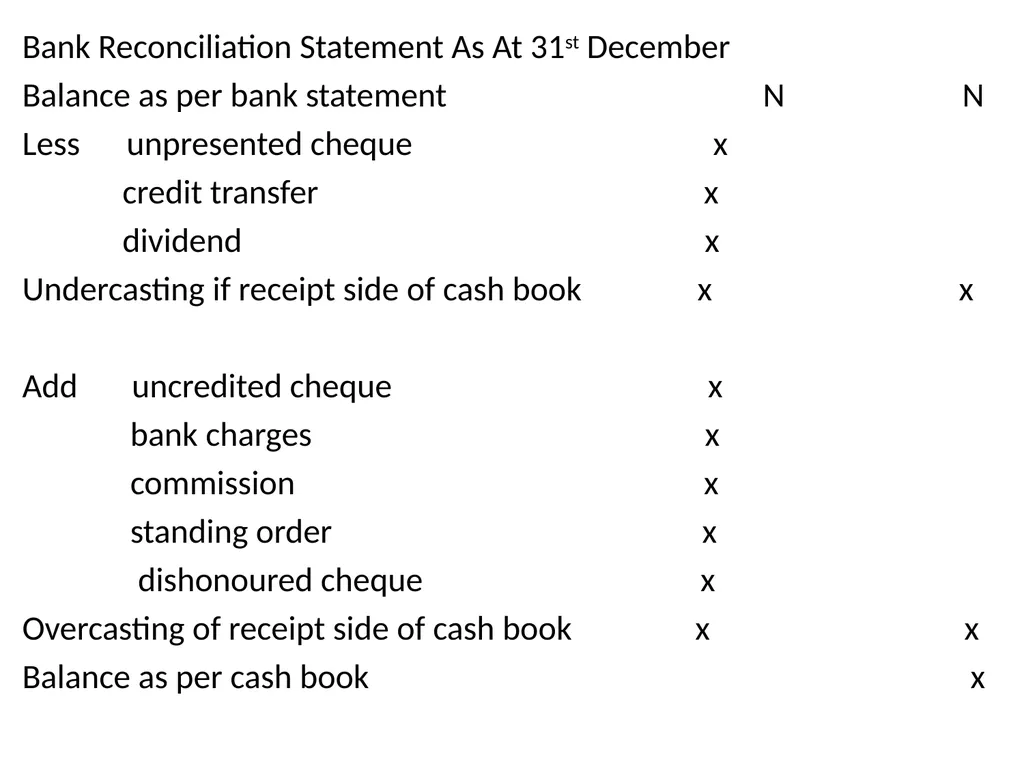
slide92. Bank Reconciliation Statement As At 31st December
Balance as per bank statement N N
Less unpresented cheque x
credit transfer x
dividend x
Undercasting if receipt side of cash book x x
Add uncredited cheque x
bank charges x
commission x
standing order x
dishonoured cheque x
Overcasting of receipt side of cash book x x
Balance as per cash book x<br>
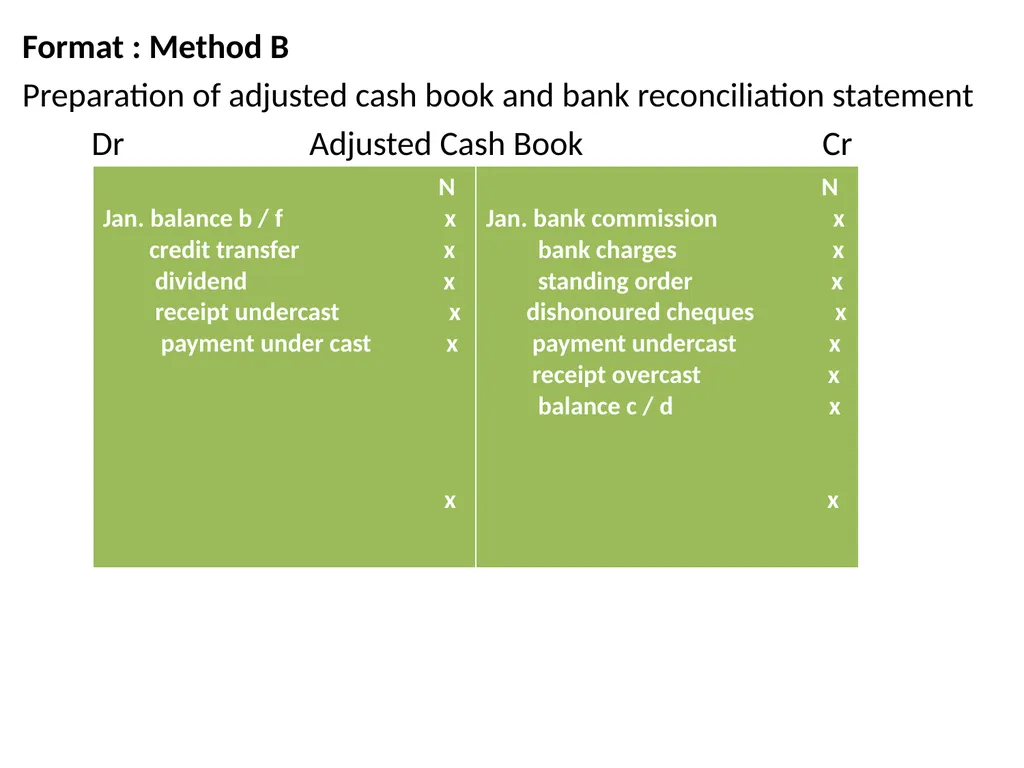
slide93. Format : Method B
Preparation of adjusted cash book and bank reconciliation statement
Dr Adjusted Cash Book Cr<br>
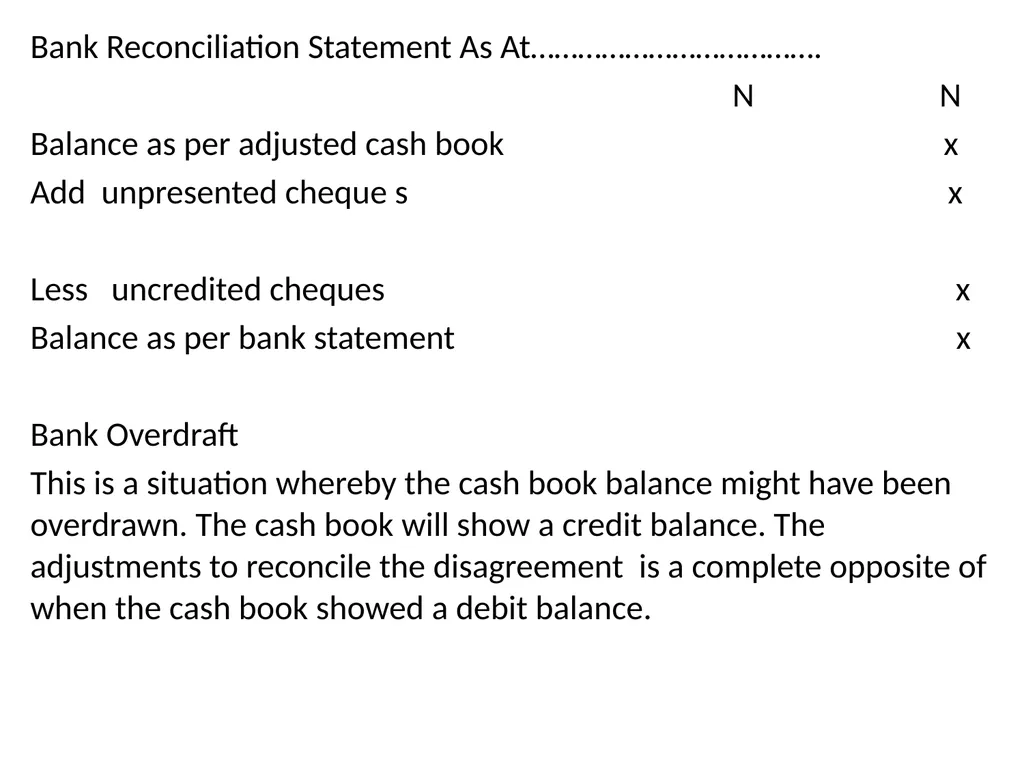
slide94. Bank Reconciliation Statement As At……………………………….
N N
Balance as per adjusted cash book x
Add unpresented cheque s x
Less uncredited cheques x
Balance as per bank statement x
Bank Overdraft
This is a situation whereby the cash book balance might have been overdrawn. The cash book will show a credit balance. The adjustments to reconcile the disagreement is a complete opposite of when the cash book showed a debit balance.<br>
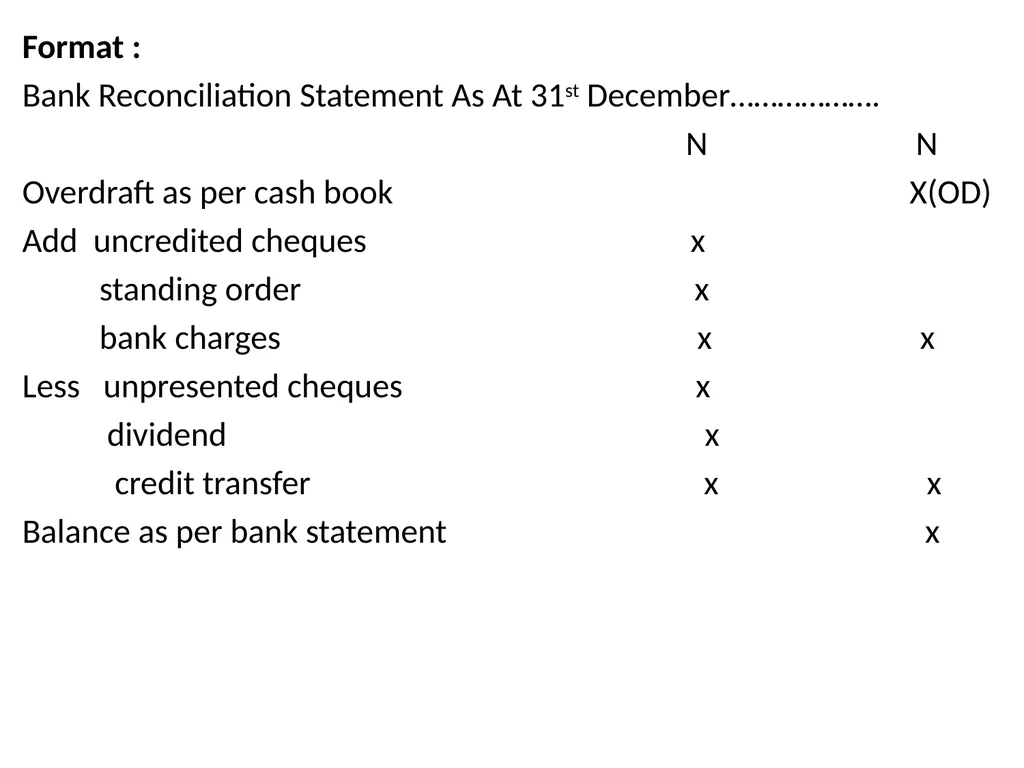
slide95. Format :
Bank Reconciliation Statement As At 31st December……………….
N N
Overdraft as per cash book X(OD)
Add uncredited cheques x
standing order x
bank charges x x
Less unpresented cheques x
dividend x
credit transfer x x
Balance as per bank statement x<br>
Accounting is the process of collecting, recording, classifying, selecting, measuring, interpreting, and communicating financial data of an organisation to enable users make decision.
It incorporates measurement and reporting of profit and loss.it is concerned with the use to which the book keeping records are put, the analysis and interpretation.
MEANING OF BOOK KEEPING
Book keeping is the systematic recording of transactions on a daily basis in the appropriate books.
It is an integral part of accounting.<br>
slide2. USERS OF ACCOUNTING INFORMATION
The principal users are;
Managers
Employees
Competitors
Government
Public
Owners
Creditors
Analysts
Tax authorities
Financial analysts
bank<br>
slide3. Users Of Accounting Information
The users of accounting information are classified into two. They are;
1 internal users: internal users includes the employees, trade union, management, internal auditors, executive or board of directors.
2. External users: this include government, general public, financial analyst, shareholders or investors, financial institutions, creditors, researcher, stock brokers, taxation analysts, external auditors, competitors<br>
slide4. USES OF ACCOUNTING INFORMATION
For planning
For control
For co-ordination
For performance evaluation
For decision making
PURPOSE OF ACCOUNTING INFORMATION TO USERS
Owners / shareholders: to know whether the business is making profit and whether it is financially strong
Manager : to make decisions that will affect the progress and financial strength of the business.<br>
slide5. Creditors: to determine whether a business will be able to pay back its debts
Employees / Trade unions : for the purpose of bargaining for better conditions of service. To also find out if the company will be able to pay their salaries and also offer them employment for a long time.
Competitors: for fixing their own prices and in determining their position in the market.
Public: to know whether to invest in the enterprise
Bankers: to know the ability of the firm to repay the loan or overdraft as at when due<br>
slide6. Financial analyst: for giving pieces of advices
Investors: in determining the net worth of the enterprise
Tax authorities: to determine taxes to impose the company
Career Opportunities
The study of accounting includes the following careers;
Financial accounting
Management accounting
Cost accounting<br>
slide7. 4. Cost accounting
5. Public sector accounting / government accounting
6. Financial management
7. Auditing and investigation
8. Taxation or tax management
Functions Of Accounting
To provide quantitative and qualitative information that can be used by the management for effective planning and control, evaluation of resources, utilization and as well as decision making
Analyze transactions<br>
slide8. 3. Handle routine book keeping tasks
4. Structure information so that it can be used to evaluate the performance and health of the business.
LIMITATIONS TO ACCOUNTING INFORMATION
It is expressed in monetary terms
Accounting information is historical in nature.
Advantages/ Benefits of Accounting
1.It provides a written record which is essential for the proper conduct of business.
2.The existence of reliable financial records helps in management decision making.
3. It facilitates reference making to past transactions.<br>
slide9. 4. Good book keeping practices enable us to ascertain the profit or loss made during a trading period.
Accounting Ethics
1. Honesty
2. Integrity
3. Transparency
4. Objectivity
5.Confidentiality
6.Professional behaviour<br>
slide10. IMPORTANCE OF BOOK KEEPING AND ACCOUNTING
Accounting information can be used for decision making
It provides permanent records for all transactions
It helps to determine the profitability of business concern.
Accounting records are used for tax assessment.
Help to prevent fraudulent practices.
The records provide a means which the finances of a business are controlled.
The records show income and expenditure.
The assets and liabilities are shown by the accounting records.<br>
slide11. HISTORY OF ACCOUNTING IN NIGERIA
There is no accurate record as to when accounts started, but available information suggests that record keeping is as old as man. The modus operandi for keeping records then was to make marks on the wall or stone or papyrus or wax tablets. The method of keeping financial records was highly primitive.
The history of accounting is not complete without mentioning the name of an italian monk and mathematician LUCCA PACIOLO. IN 1494, the crucial event in accounting was the introduction of double entry book system in Italy dsecribed as ‘’ Italian method’’. In his famous treatise Summa De. Arithmetical Geometrical Proportion et Proportionalita.<br>
slide12. . He described the double entry system by giving insight into the reasoning behind accounting. He postulated that all entries must have double entry one a debtor, and one a creditor.
After Paciolo, a Dutchman advocated the profit and loss account at yearly interval.the level of civilization and technology advancement helped in the development of modern accounting. During industrial revolution there was need for sophisticated accounting methods. Different professional bodies were formed.<br>
slide13. In Nigeria, record keeping has antecedents in the ancient kingdoms and empire and prominent then was the periodic contributons which were recorded on the wall. But the granting of royal character to Royal Niger Company was the turning point in record keeping. The governing accounting principles in Nigeria was almost the same as the ones in Britain.
In 1965, the Institute of Chartered Accountant of Nigeria was established and affiliated with the professional institutes in Britain and USA.<br>
slide14. Accounting Professional Bodies
Institute Of Chartered Accountants of Scotland
Institute of Chartered Accountants of England and Wales
Institute of Chartered Accountants of Ireland
Association of Chartered Accountants
Institute of Cost and Management Accountants
Chartered Institute of Public Finance and Accountancy
Association of Accounting Technicians
Institute of Chartered Accountants of Nigeria ( ICAN)
Association of National Accountants of Nigeria ( ANAN)<br>
slide15. TOPIC: CLASSIFICATION OF ACCOUNTS Financial transaction can be classified to cash and credit transactions.
Cash transactions: the buyers pay immediately for goods bought. Here no account will be opened in respect of supplier and customer
Credit transaction: this means that the transfer of ownership take place before payment to supplier.<br>
slide16. Graphical Representation of Record of Transaction
Transactions
Credit Cash
Day books Cash books
Ledger accounts Ledger accounts<br>
slide17. TYPE / CLASSIFICATION OF ACCOUNTS
An account can be defined as a record in a double entry system that is kept for each class of asset, liabilities, revenue and expenses. Accounts can be classified into;
Personal account
Impersonal account
Personal Accounts: these are accounts for the names of individual, firms and business enterprises e.g. Segun account, Lagunju Nig. Ltd. Account, Debtors and Creditors account.<br>
slide18. Impersonal Accounts: These are accounts for properties, items of expenditure and income. It can be divided into two namely;
Real accounts: These are accounts for something we can see, touch or move. They are accounts for assets e.g land and building account, machinery account e.t.c.
Nominal accounts: These are accounts for expenses incurred, income received, losses and gains e.g. rent account, discount received account, stationery and postage account e.t.c.<br>
slide19. Diagrammatic Representation Of Classification Of Account
ACCOUNT
PERSONAL IMPERSONAL
DEBTORS CREDITORS REAL NOMINAL
ASSETS
INCOME EXPENSES<br>
slide20. TOPIC: PRINCIPLE OF DOUBLE ENTRY AND BOOKS OF ACCOUNT Principle And Practice Of Double Entry
Principle of double entry state that for every debit entry, there must be a corresponding credit entry and vice versa.
The principle operates on the basis that every financial transaction must have two aspects. i.e
Dr Receiver ( receiving account)
Cr Giver ( giving account)
All transactions must be recorded in two accounts, one account is debited and another credited. The giver ( giving account) is credited with the value and the receiver ( receiving account) is debited with the same amount.<br>
slide21. RULES FOR DEBITING AND CREDITING
i. The account which “receives” is debited with the values that comes into the account
ii. The account which “gives” is credited with the value that goes out of the account. These rules can now be applied to the classes of account.<br>
slide22. THE ACCOUNTING EQUATION
The totality of financial accounting is based on the accounting equation. The principle of double entry developed from the axiom of accounting equation. The fundamental equation is given as;
Assets = Capital + Liabilities
Assets: These are the properties of a business. They are owned by a business and are expected to be of future benefit e.g. furniture and fitting, motor van, equipment, stock, cash , land and building, bank etc.<br>
slide23. Liabilities: This is an amount owed by the business to outsiders. It is an obligation to pay someone in either money or money’s worth e.g. creditors, bank overdraft, etc.
Capital: This is the total amount invested by the owner in a business. It is the proprietor’s fund or net worth of a business.
Assets or properties or resources of a business are attributable to two main groups of people who are distinct from the business i.e. sources of assets,
i.The proprietors or owners.
ii.Liabilities or claims of outsiders.<br>
slide26. Books Of Accounts
There are two books of accounts:
Subsidiary books
Principal books
The two books are very necessary in recording of financial transactions. All transactions must pass through the books of account.<br>
slide27. Subsidiary Books
Subsidiary books are defined as the books of original or prime entry, they are books where transactions are first recorded.
Before any entry can be made in the ledger ( principal book), it must be recorded in the subsidiary books. The subsidiary books do not form part of the double entry.<br>
slide28. Divisions Of Subsidiary Books
Subsidiary books can be divided into six books, they are
Sales day book or sales journal
Purchases day book or journal
Sales returns or returns inwards journal
Purchases returns or return outwards journal
Cash book
General journal or principal journal or journal proper.<br>
slide29. USES OF SUBSIDIARY BOOKS / REASONS FOR SUBSIDIARY BOOKS
To know the total sales and purchases
They are used as books to make first entry of transactions
To keep tract of people to whom money is owed and of the people who owed money<br>
slide30. Sales day book or sales journal: This is a book of original entry in which credit sales are recorded before posting to the ledger. Cash sales , sales of assets must not be recorded and do not form part of double entry. The seller will enter the sales journal from sales invoices. Total will credited to sales account.
Format Sales Day Book / Journal<br>
slide31. 2. Purchases day book: this is the book of recording goods bought on credit from the suppliers. The total will be posted to the debit of the purchases account. Cash purchases and purchases of assets must not be recorded. The buyer will enter to purchases journal from purchases invoice and debit notes received
Format
Purchases Day Book / Journal<br>
slide32. 3. Purchases return day book / journal: This is the book for recording goods returned to suppliers as a result of one reason or another e.g. defectiveness, damages or wrong kind etc. It can also be referred to as returns outward day book. Total is transferred to purchases return account or return outward account at the credit side. It is entered from credits note sent by supplier.
FORMAT
Return Outwards Day Book/ Journal<br>
slide33. Return Inwards Day Book /Journal: The sales return journal is used to record goods returned by customers. It may be due to wrong colour, type or breakage. Another name is sales return journal. It is entered from credit note sent to customers.
Format
SALES RETURN / RETURN INWARD JOURNAL<br>
slide34. THE PRINCIPAL BOOK: LEDGER
Meaning: The ledger can be defined as a book which contains in a classified and summarized form, a permanent record of all transactions which is based on the principle of double entry.
The ledger is the final destination of all transactions in the subsidiary books. It is the most important book of account.<br>
slide35. Division Of Ledger
The classifications are as follows;
Personal ledgers: These are the ledgers for creditors accounts and debtors accounts.
General ledgers: These are the ledgers for sales account, purchase account.
Impersonal ledger: These are the ledgers for real and nominal accounts<br>
slide36. Format of Ledger
DR LEDGER ACCOUNT CR
The ledger is divided into two parts by a central line. the Dr side is the side that receives values and the Cr side is the side that gives value.<br>
slide37. TOPIC: BUSINESS DOCUMENTS / SOURCE DOCUMENTS MEANING: Business documents are also called source documents. The source documents provide detail information for the preparation of book of accounts the documents are;
Invoice
Credit note
Debit note
Petty cash voucher
Statement of account
Receipts<br>
slide38. Invoice: the invoice sets out the full details of goods sold and bought stating the quantity, price, discount given and terms of payment. It can be viewed from two ways; sales invoice and purchases invoice.
Credit note: this is a document sent by the seller to the customers for reduction in the amount owed by him. There has been overcharge of goods returned. It can be viewed from two perspectives;<br>
slide39. Credit note received from suppliers: if the credit notes relate to goods return to supplier , it will be recorded in return outwards book.
Credit note issued to customers: This will be posted to return inwards book.
Debit note: This is a document sent by the seller to the buyer to correct an undercharge or when goods are not charged on the invoice. It can be viewed from two perspectives; Debit note from suppliers and debit note issued to customers.<br>
slide40. Cash Register: this is a machine that record the amount of sales and indicate whenever it is a cash sale or a credit sales. It produces receipt for the customer and store duplicate in the machine for book keeping purpose.
Cheques: a cheque is a written order from an account holder to a bank to pay a specified sum of money to the person whose name is on it.
Receipt: this is a document that is issued to a buyer by the seller that a sum of money has been paid in respect of goods bought. It can also be called evidence of payment.<br>
slide41. TOPIC: CASH BOOK MEANING: Cash book is a subsidiary book for recording all cash transactions and detailed particulars of all money received and paid.
The cash book is a subsidiary book and it is really part of the principal book called ledger. It is the only book that perform dual functions of books of accounts. Any transaction on credit must not appear in the cash book. All cash transactions and transactions with cheque are recorded in the cash book. It is based on the principle of double entry.<br>
slide42. Types Of Cash Book
There four basic types of cash book. They are
Single or one column cash book
Double or two column cash book
Three column cash book
Petty cash book<br>
slide43. Single Column Cash Book
This is a type of cash book where all cash transaction and transactions with cheque are recorded in a single amount column.
Format
Dr One Column Cash Book Cr<br>
slide44. Two Column Cash Book
In this type of cash book, two separate accounts cash and bank , are combined for the sake of convenience. There will be separate column for cash and bank in order to know the total cash in hand and the total cash at bank at the end of the period.
Contra Entries: these are made in the cash book when cash is deposited into the bank account out of the cash in hand or when cash is withdrawn from bank for business or office use. It is denoted by letter ‘’ C’’ .<br>
slide45. Example 1
Enter the following in a two column cash book. Balance off the cash book at the end of the month.
Jan 1 Started business with #30,000 in the bank.
‘3 Cash sales paid directly into he bank #40
‘4 Bought goods paying by cheque #150.
‘5 Cash sales #230
‘6 Bought fixtures paying by cheque #620.
’12 Paid rates by cheque#205.
‘13 Kunle paid us his account of #800 by a cheque
‘14 We received a cheque for #520 from Agatha<br>
slide46. ‘17 Cash sales #700.
‘20 Paid wages #30 by cash.
‘25 Paid expenses by cash #50.
‘30 Bought motor van #18 by cash.<br>
slide47. Assignment
You are to enter up the necessary accounts for the month of May from the following information relating to a small printing firm. Then balance off the accounts.
2016
May 1 Started in business with capital in cash $800 and $2200 in the bank.
‘2 Bought goods on credit from the following persons; J Ward $610, P Green $214
‘4 J Sharp paid us his account by cheque $340<br>
slide48. ‘’10 F Titmus paid us $1000 by cheque.
‘11 We paid the following by cheque; M Taylor $174, J Ward $610
‘12 Paid carriage by cash $38.
‘18 Bought goods by cash from P Green $291; S Gemmill $940
‘21 Sold goods on credit to G. Boycott $810
‘31 Paid rent by cheque $230<br>
slide51. SECOND TERM INTEGRATED SCHEME ( WAEC and IGCSE)
THEME: SOURCES AND RECORDING OF ACCOUNTING DATA
WEEK TOPIC
1.Revisions of last term’s work
2.Discounts- Meaning, Types, Reasons
Distinguish between and account for trade discounts and cash discounts
Calculations of discounts
3.Three Column Cash Book- Working exercises and processing accounting data.<br>
slide52. 4.Petty Cash Book- Meaning, Terminologies
-Explain and apply the imprest system of petty cash book
5.Posting Subsidiary books into Ledgers
-Post transactions to the ledger accounts
-Balance ledger accounts as required and make transfers to final accounts
-Interpret ledger accounts and their balances.
6.Verification of Accounting Records
Trial Balance- Meaning; understand that a trial balance is a statement of ledger balances on a particular date.<br>
slide53. -Outline the uses and limitations of a trial balance.
-Prepare a trial balance from a given list of balances and amend a trial balance which contains errors
7.Principles of Financial Statements
Income Statement/ Trading Account
-Meaning, Reasons, format
-Prepare and calculate gross profit and profit for the year based on accounting principles for a specified period.
8.Income Statement/ Profit and Loss Account
Reasons, format<br>
slide54. -Preparation and calculate net profit or loss for the year.
9.Statements of Financial Position/ Balance Sheet
-Meaning, Reason
-Recognise and define non current assets ( fixed assets), intangible assets, current assets, current liabilities, non current liabilities, working capital, capital employed and capital owned.
-Prepare financial position
-Explain the difference between a trading business and a service business.<br>
slide55. Verification of Accounting Records
Bank Reconciliation
-Understand the use and purpose of a bank statement
-Reasons for preparation
-Terminologies
11. Revisions
12.Examinations<br>
slide56. TOPIC: DISCOUNTS
MEANING: Discount can be defined as the reduction in the price of goods in order to encourage bulk purchase and prompt payment.
Reasons For Granting Discounts
To encourage large quantity purchases.
Helps to avoid risk of bad debt.
To encourage prompt payment.
Discount attracts customers.
It provides for the buyer’s profit margin.
To avoid tying down business capital.<br>
slide57. Types Of Discounts
Trade discount
Cash discount
Quantity discount
Seasonal discount
Trade Discount
This is an allowance made by the manufacturer or wholesaler to retailer in form of deduction from catalogue prices of goods supplied. It is an inducement to the customer to buy goods in large quantity. It appears in day books alone and deducted before cash discount.<br>
slide58. Cash Discount
This is a percentage allowance for prompt payment of an account or for payment within a specified period of time. It is deducted after trade discount and appear in cash book.
Classification Of Cash Discount
a. Discount allowed: this is discount allowed by a firm to its customers when they pay their accounts quickly or promptly. It is entered on the debit side of the three column cash book and is treated as an expense in the profit and loss account.<br>
slide59. b. Discount Received: this is the discount received by a firm from its suppliers when it pays its accounts quickly. It is treated as an income and credited to the three column cash book. It is posted to the income side of the profit and loss account.
Calculations Of Discounts
% of discounts x total amounts.<br>
slide60. TOPIC: THREE COLUMN CASH BOOK
The three column cash book represents three accounts; cash, bank and discounts combined into one book. It follows the principle as that of the two column cash book.
Cash discounts: these are discounts for prompt payment of accounts. It appear in the cash book and ledgers. This can be divided into (i) discount allowed (ii) discount received.
Discount allowed is the discount given to customers for prompt payment of account. Discount received is the discount received from supplier for prompt settlement of accounts.<br>
slide61. Format
Dr Three Column Cash Book Cr<br>
slide62. TOPIC: PETTY CASH BOOK
Meaning : petty cash book is the book for recording small disbursements i.e. expenses.
Imprest System: this is the conventional system for recording petty cash transactions. In this system, a specified sum is given to the petty cashier at the start of the accounting period for petty transactions. This specified sum is called float.
Reimbursement : this is the amount that is spent by the petty cashier and given back to bring the cash balance to the formal amount.
The petty cash book is part f double entry book and must be included in the trial balance. The source document for petty cash book is the petty cash expenses voucher.<br>
slide63. Format:
PETTY CASH BOOK<br>
slide64. TOPIC: POSTING TO LEDGERS AND BALANCING THE LEDGER ACCOUNTS
Side of accounts for posting from subsidiary books to ledger are as follows;
Transfer total from sales journal to credit side of sales account.
Transfer total from sales returns or return inward journal to debit side of sales returns account.
Transfer total from purchases day book to debit side of purchases account.
Transfer total from purchases returns or returns outward journal to the credit side of purchases returns account<br>
slide65. all items on the debit side of the cash book will be posted to the credit side of their respective accounts, while all items on the credit side of the cash book will appear on the debit side of their respective account.
Procedure To Balance Ledger Accounts
In order to balance an account it will be necessary to;
Add all the items on the debit side
Add all the items on the credit side
Compare both totals.<br>
slide66. A “debit balance” is an excess of debit items over credit items.
A “credit balance”is an excess of credit items over debit items.
Balance carried down ( bal c/d ): difference between credit side and debit that is insert on the lesser side in order to make totals at the both side of an account to be equal. When it is shown as an opening balance in the next accounting period, it is referred to as balance brought down ( bal b/d ).<br>
slide67. TOPIC: TRIAL BALANCE MEANING: Trial balance can be defined as the schedule or list that shows the debit and credit balances extracted from the ledger, to show the arithmetical accuracy of the ledger balances.
All ledgers accounts must be balanced off and entered in the trial balance to prove the accuracy of the book keeping. The totals of debit and credit must be equal. When there is a difference between the two sides, then some errors have been made.
Needs / Uses Of Trial Balance
The trial balance helps in testing the accuracy of the double entry.
Helps in the preparation of the final statements.
It is used to detect accounting errors.<br>
slide68. Rules Of Trial Balance
All assets must be debited
All liabilities must be credited
All income or gain must be credited
All expenses must be debited
All sales must be credited
All purchases must be debited
Debtors debited
Creditors credited
Credit capital
Credit provision for doubtful debt and provision for depreciation.<br>
slide69. Format
TRIAL BALANCE<br>
slide70. TOPIC: FINAL ACCOUNTS; TRADING ACCOUNT
Final accounts are the accounts prepared at the end of the accounting period to show the position of the business organization. It includes;
1. Trading account
2. Profit and Loss account
3. Balance sheet
TRADING ACCOUNT
MEANING: This is the account prepared for the purpose of ascertaining the gross profit or loss of a business and the entity accounted.<br>
slide71. It is a revenue account and form part of the double entry system. The balance is transferred to the profit and loss account.
Purpose:
The object of a trading account is to ascertain the gross profit or loss resulting from business transactions.
Terminologies:
Sales: cash and credit sales during accounting period
Returns inward: this is the total value of goods returned to the seller by the customers out of goods previously sold to them. It is deducted from total sales.<br>
slide72. Carriage inwards: Expenses or cost incurred on transportation of goods sold.
Purchases: Goods bought for resale.
Returns outward: Cost incurred on transportation of goods sold.
Cost of goods sold: Cost of goods sold to customers during the trading period.
Cost of goods available for sale: Cost of goods available in the warehouse or store for customers to buy.
Opening stock: Cost of goods available in the store at the beginning of a trading period.
Closing stock: Cost of unsold goods at the end of a trading period.<br>
slide73. Format:
TRADING ACCOUNT FOR THE YEAR ENDED……………<br>
slide74. TOPIC: PROFIT AND LOSS ACCOUNT
MEANING: This is the account prepared by a business organization to show the net profit or net loss.
It shows on the debit side the expenses incurred by an organization and on the credit side the gross profit from trading and other gains. It is the continuation of trading account. It is based on the principle of double entry.
Purpose:
The main purpose is to ascertain net profit or net loss.<br>
slide75. Terminologies:
Expenses: these are total amount paid or to be paid for resources used in the accounting period e.g. wages, electricity, insurance, telephone, advertising, salaries, discount allowed, carriage outward etc. expenses are deducted from gross profit plus other incomes.
Revenue: it is referred to income or money received or to be received in respect of ordinary trading transaction. Revenue is added to gross profit in profit and loss account.<br>
slide76. Profit: profit in accounting can be divided into two;
Gross profit: it is ascertained in trading account. It is excess of sales over cost of goods sold.
Net profit: it is ascertained in profit and loss account. It is excess of revenue over total expenses.
Treatment of Goods Stolen And Withdrawn For Use
Goods stolen and goods withdrawn for personal use are deducted from purchases in trading account and also deducted from net profit in balance sheet.<br>
slide77. Format:
PROFIT AND LOSS ACCOUNT FOR THE YEAR ENDED..<br>
slide79. TOPIC: BALANCE SHEET
MEANING: Balance sheet is a statement that shows financial position and summary of assets and liabilities of a business organisation.
It is not part of double entry system that is, it does not carry dr and cr sign thus it is not an account but a statement.
Uses Of Balance Sheet
It shows the resources of the business i.e assets
It shows what the business owed i.e liabilities
It shows the worth of a business capital<br>
slide80. Classification of Balance Sheet Items
Balance sheet items can be classified into two;
Assets
Liabilities
Assets
These are resources or properties of a business which are used to generate more income for the business. Assets can be divided into;<br>
slide81. Fixed Assets: these are assets that can last for a long period of time e.g. land and building, motor vehicle, fixtures and fittings, plant and machinery, office equipment etc.
Current Assets: these are assets that can be easily change for money and can last for a short period of time e.g. debtors, stock, cash in hand, cash at bank, bills receivable etc.
Intangible assets: these are asset which have no physical substance or properties but contribute economic benefits to the organisation. The assets can not be seen or touched e.g. goodwill, trademark, patent, copyright etc.<br>
slide82. d. Liquid assets: these are assets which can be easily converted into cash e.g. securities, stock.
e. Fictitious assets: these are assets of unusual character, which resembles those of asset. They are merely debit balances, which are not realizable e.g. preliminary expenses.
f. Wasting assets: they are assets that are used up over a period of time. They become exhausted through being worked upon e.g. mines, timber, crude oil, tin, gold etc.<br>
slide83. Liabilities
These are what a firm or business owed to outsiders i.e. debts. Liabilities can be divided into two;
Long Term Liabilities: these are liabilities which becomes due after more than one year e.g. debentures, long term loan
Current Liabilities: these are liabilities which are due for settlement within one year e.g. creditor, short term loan, bank overdraft, expenses owings, income in advance etc.<br>
slide84. Format:
BALANCE SHEET AS AT …………………………………<br>
slide86. TOPIC: BANK RECONCILIATION STATEMENT MEANING: Bank reconciliation statement can be defined as a statement that is prepared to reconcile the disagreement of the cash book and that of the bank statement.
Bank statement is the book bank prepared showing the transactions between it and the customer. Cash book is prepared by business enterprise where it record money paid into the bank and the sums drawn from the bank with cheques. When there is a difference between the two balances, then there is need for reconciliation.
The reconciliation is necessary in order to test the accuracy of the postings in the cash book by reconciling the balance of the cash book with that of the bank statement.<br>
slide87. Reasons For Disagreement Between The Cash Book And Bank Statement
The timing and information differences which can cause disagreement are;
Unpresented cheque
Uncredited cheque
Dishonoured cheque
Bank charges and interest
Standing order
Dividend
credit transfer
Errors by the bank
Directs debit
Other errors like under casting or overcasting of the cash book<br>
slide88. Unpresented cheques: these are cheques drawn or issued out in favour of somebody but have not been drawn from the bank at the time of preparation of the bank statement. Effect; This will make cash book to be lower than the bank statement.
Uncredited Cheques: these are cheques received and entered on the debit side of the cash book but have not been entered in the bank statement due to lateness or the bank statement had been prepared before the cheques were paid in. Effect; this will make cash book to be higher than the bank statement.
Dividend : this is part of profit of shares held by the customers paid directly into his bank account. Effect; bank statement balance will be more than cash book balance.
Standing order: this is an order made by the customer to the bank to make regular payment to somebody e.g. hire purchase instalments. It can be weekly, quarterly or yearly. Effect the balance of bank statement will be lesser than the cash book.<br>
slide89. Dishonoured cheques: These are cheques received from customers and paid in by the firm, but were rejected by the bank as a result of wrong signature, incorrect amount e.t.c. effect dishonoured cheque will not reflect in the cash book, the balance of bank statement will be lesser than cash book
Credit transfers: These are the payments made by the customers of the firm directly into their bank account in the bank without the awareness of the firm. Effect, the balance of bank statement will be more than cash book.
Bank charges and interest: This is the amount deducted by the bank for services rendered. The bank will deduct the charges without informing the firm until they receive the bank statement. Effect, the balance of bank statement will be lesser than the cash book.
Direct debit: This is an arrangements whereby a person’s account is debited with a sum of money at the instance of a supplier with the account owner’s prior permission. Effect , the balance of bank statement will be less than that of the cash book balance.<br>
slide90. Errors by the bank: bank can make mistakes. A sum paid in by a customer may be credited to another customer’s account.
Under casting and overcasting of cash book balance: these will also cause disagreement between the bank statement and cash book balance
Preparation Of Bank Reconciliation Statement
There are two ways of preparing bank reconciliation statement. They are
Preparation of only the bank reconciliation statement
Preparation of adjusted cash book and bank reconciliation statement using the balance of adjusted cash book.<br>
slide91. Format : Method 1
Bank Reconciliation Statement As At 31st December
Balance as per cash book N N
Add unpresented cheque x
credit transfer x
dividend x
Undercasting if receipt side of cash book x x
Less uncredited cheque x
bank charges x
commission x
standing order x
dishonoured cheque x
Overcasting of receipt side of cash book x x
Balance as per bank statement x<br>
slide92. Bank Reconciliation Statement As At 31st December
Balance as per bank statement N N
Less unpresented cheque x
credit transfer x
dividend x
Undercasting if receipt side of cash book x x
Add uncredited cheque x
bank charges x
commission x
standing order x
dishonoured cheque x
Overcasting of receipt side of cash book x x
Balance as per cash book x<br>
slide93. Format : Method B
Preparation of adjusted cash book and bank reconciliation statement
Dr Adjusted Cash Book Cr<br>
slide94. Bank Reconciliation Statement As At……………………………….
N N
Balance as per adjusted cash book x
Add unpresented cheque s x
Less uncredited cheques x
Balance as per bank statement x
Bank Overdraft
This is a situation whereby the cash book balance might have been overdrawn. The cash book will show a credit balance. The adjustments to reconcile the disagreement is a complete opposite of when the cash book showed a debit balance.<br>
slide95. Format :
Bank Reconciliation Statement As At 31st December……………….
N N
Overdraft as per cash book X(OD)
Add uncredited cheques x
standing order x
bank charges x x
Less unpresented cheques x
dividend x
credit transfer x x
Balance as per bank statement x<br>