
Introduction to Clinical Research Nicole
NS
Published · 45 slides · 0 views

1 / 1


Description
Introduction to Clinical Research Nicole Villemarette-Pittman, PhD Director, Clinical Research Associate Professor (Hon), University of Queensland Medical School Ochsner Health Objectives Am I Doing Human Subjects Research? Human Subjects
Related Topics
Share
Embed code
Download this presentation From Below
"Introduction to Clinical Research Nicole" is the property of its rightful owner. Permission is granted to download and print the materials on this website for personal, non-commercial use only, and to display it on your personal computer provided you do not modify the materials and that you retain all copyright notices contained in the materials. By downloading content from our website, you accept the terms of this agreement.
Presentation Transcript
01
Introduction to Clinical Research Nicole Villemarette-Pittman, PhD
Director, Clinical Research
Associate Professor (Hon), University of Queensland Medical School
Ochsner Health<br>
Director, Clinical Research
Associate Professor (Hon), University of Queensland Medical School
Ochsner Health<br>
02
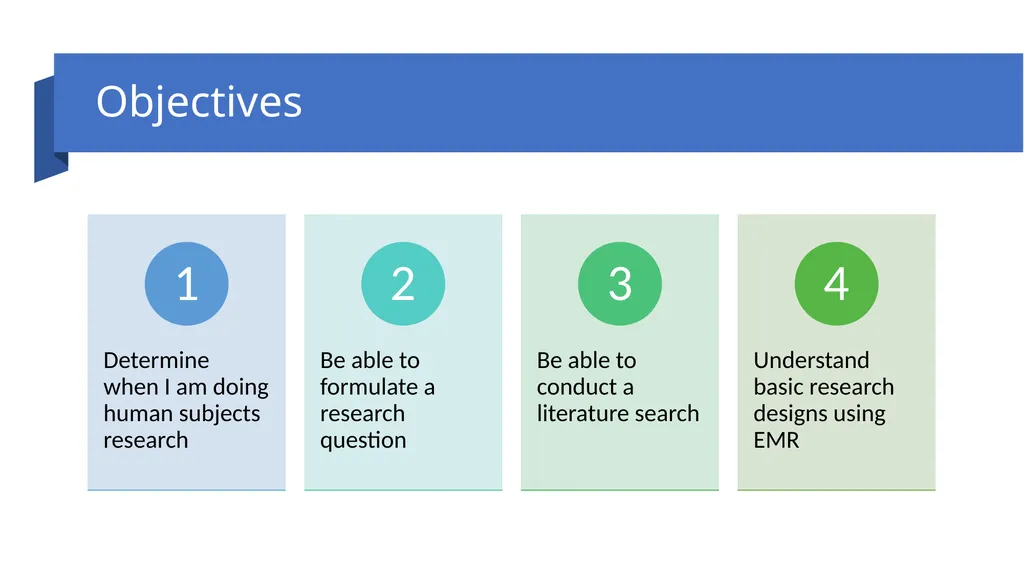
Objectives<br>
03
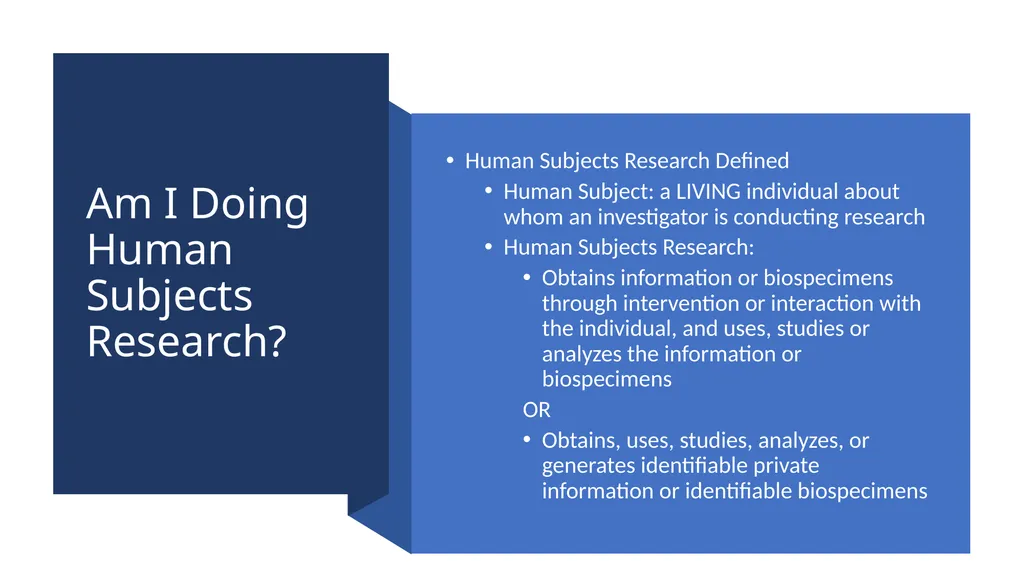
Am I Doing Human Subjects Research? Human Subjects Research Defined
Human Subject: a LIVING individual about whom an investigator is conducting research
Human Subjects Research:
Obtains information or biospecimens through intervention or interaction with the individual, and uses, studies or analyzes the information or biospecimens
OR
Obtains, uses, studies, analyzes, or generates identifiable private information or identifiable biospecimens<br>
Human Subject: a LIVING individual about whom an investigator is conducting research
Human Subjects Research:
Obtains information or biospecimens through intervention or interaction with the individual, and uses, studies or analyzes the information or biospecimens
OR
Obtains, uses, studies, analyzes, or generates identifiable private information or identifiable biospecimens<br>
04
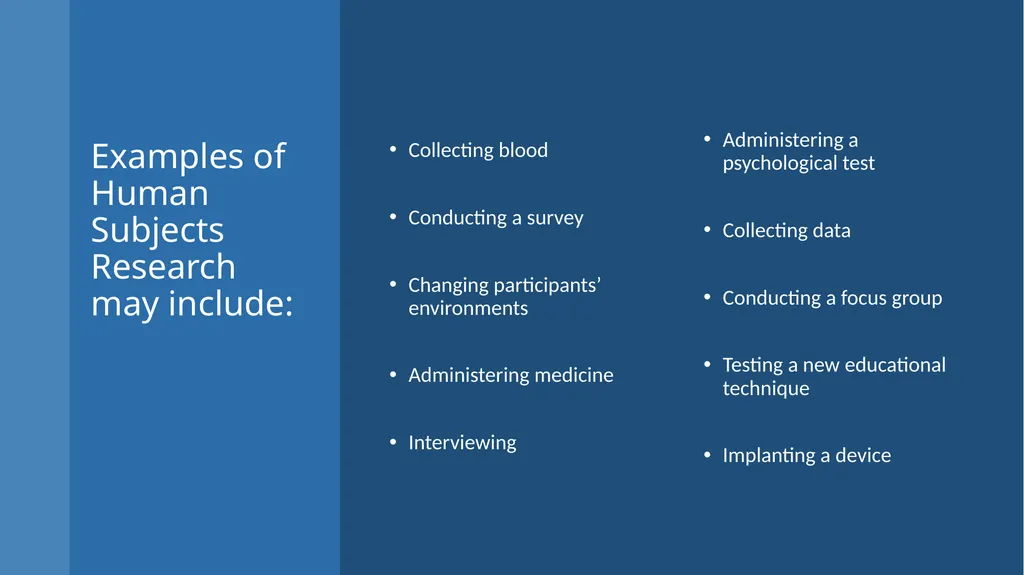
Examples of Human Subjects Research
may include: Collecting blood
Conducting a survey
Changing participants’ environments
Administering medicine
Interviewing Administering a psychological test
Collecting data
Conducting a focus group
Testing a new educational technique
Implanting a device<br>
Conducting a survey
Changing participants’ environments
Administering medicine
Interviewing Administering a psychological test
Collecting data
Conducting a focus group
Testing a new educational technique
Implanting a device<br>
05
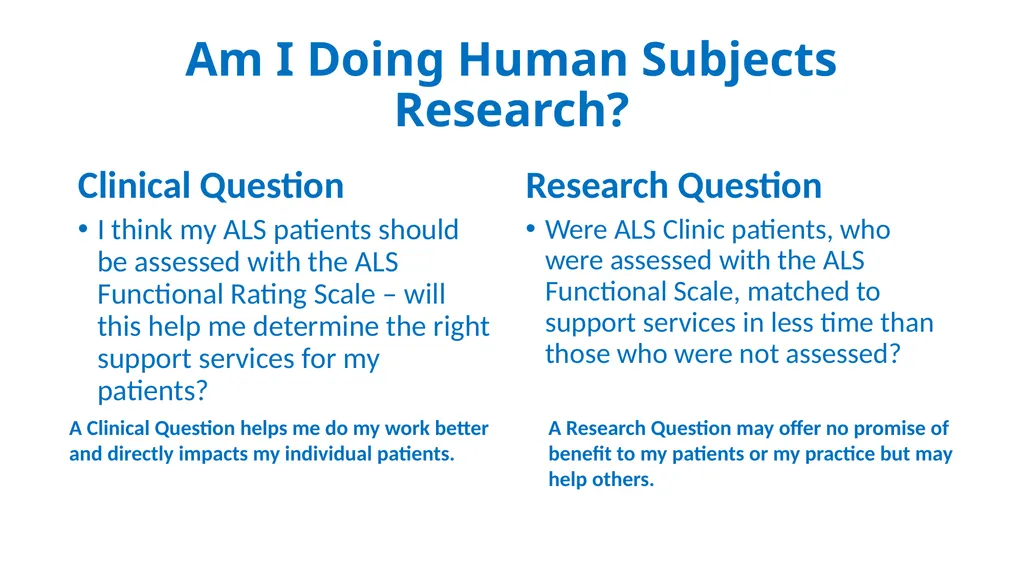
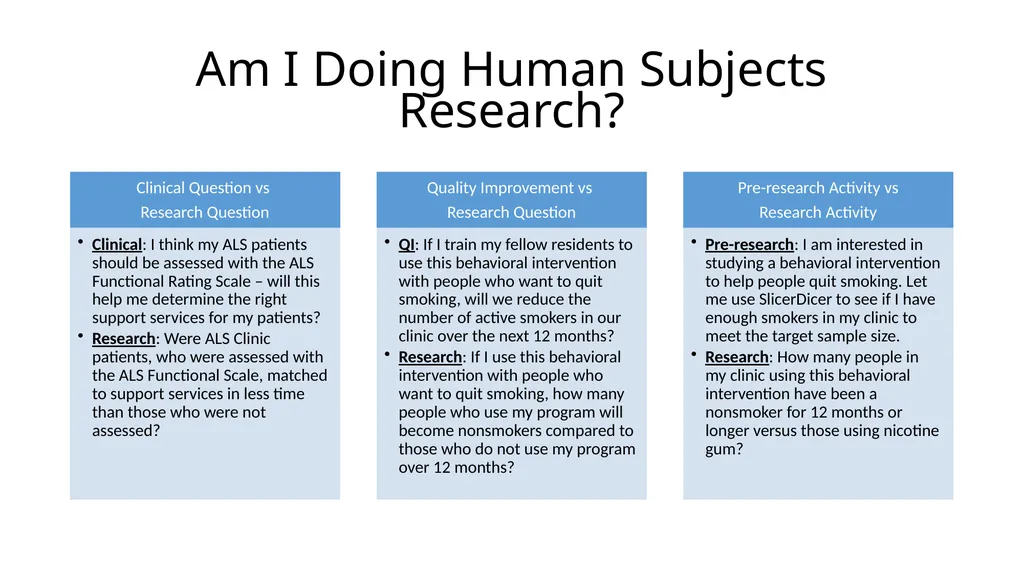
Am I Doing Human Subjects Research? Clinical Question I think my ALS patients should be assessed with the ALS Functional Rating Scale – will this help me determine the right support services for my patients? Research Question Were ALS Clinic patients, who were assessed with the ALS Functional Scale, matched to support services in less time than those who were not assessed? A Clinical Question helps me do my work better and directly impacts my individual patients. A Research Question may offer no promise of benefit to my patients or my practice but may help others.<br>
06
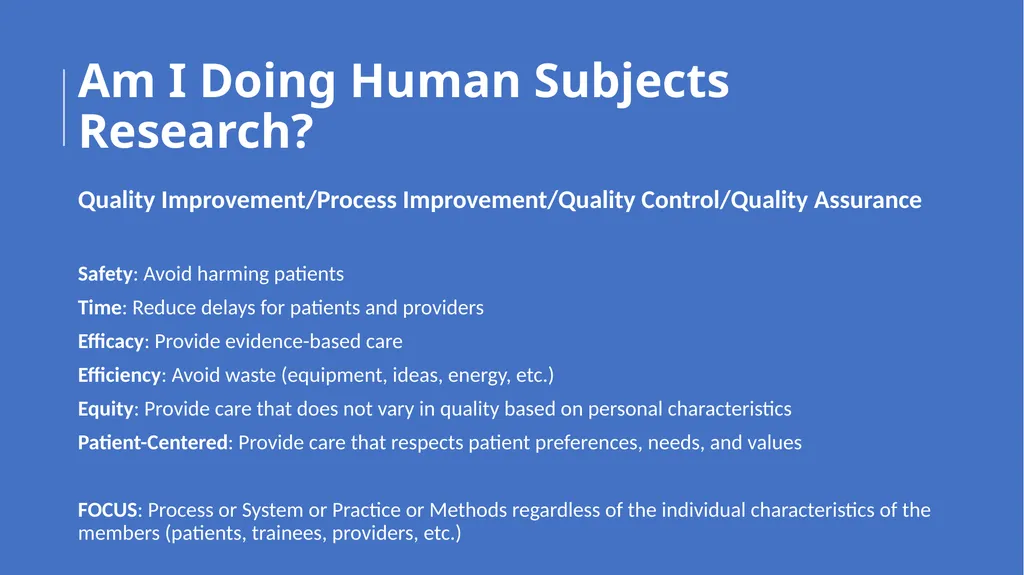
Am I Doing Human Subjects Research? Quality Improvement/Process Improvement/Quality Control/Quality Assurance
Safety: Avoid harming patients
Time: Reduce delays for patients and providers
Efficacy: Provide evidence-based care
Efficiency: Avoid waste (equipment, ideas, energy, etc.)
Equity: Provide care that does not vary in quality based on personal characteristics
Patient-Centered: Provide care that respects patient preferences, needs, and values
FOCUS: Process or System or Practice or Methods regardless of the individual characteristics of the members (patients, trainees, providers, etc.)<br>
Safety: Avoid harming patients
Time: Reduce delays for patients and providers
Efficacy: Provide evidence-based care
Efficiency: Avoid waste (equipment, ideas, energy, etc.)
Equity: Provide care that does not vary in quality based on personal characteristics
Patient-Centered: Provide care that respects patient preferences, needs, and values
FOCUS: Process or System or Practice or Methods regardless of the individual characteristics of the members (patients, trainees, providers, etc.)<br>
07
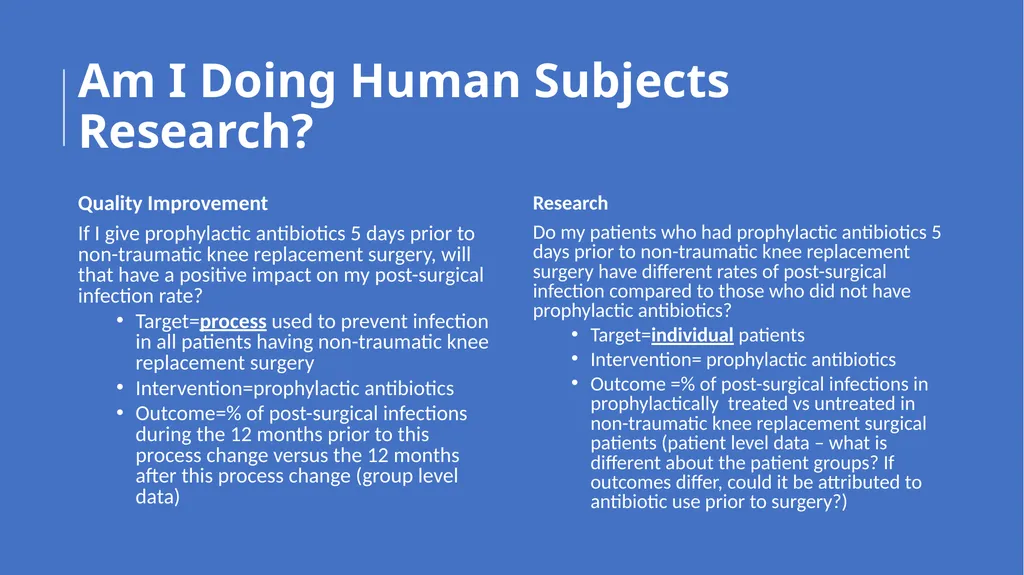
Am I Doing Human Subjects Research? Quality Improvement
If I give prophylactic antibiotics 5 days prior to non-traumatic knee replacement surgery, will that have a positive impact on my post-surgical infection rate?
Target=process used to prevent infection in all patients having non-traumatic knee replacement surgery
Intervention=prophylactic antibiotics
Outcome=% of post-surgical infections during the 12 months prior to this process change versus the 12 months after this process change (group level data) Research
Do my patients who had prophylactic antibiotics 5 days prior to non-traumatic knee replacement surgery have different rates of post-surgical infection compared to those who did not have prophylactic antibiotics?
Target=individual patients
Intervention= prophylactic antibiotics
Outcome =% of post-surgical infections in prophylactically treated vs untreated in non-traumatic knee replacement surgical patients (patient level data – what is different about the patient groups? If outcomes differ, could it be attributed to antibiotic use prior to surgery?)<br>
If I give prophylactic antibiotics 5 days prior to non-traumatic knee replacement surgery, will that have a positive impact on my post-surgical infection rate?
Target=process used to prevent infection in all patients having non-traumatic knee replacement surgery
Intervention=prophylactic antibiotics
Outcome=% of post-surgical infections during the 12 months prior to this process change versus the 12 months after this process change (group level data) Research
Do my patients who had prophylactic antibiotics 5 days prior to non-traumatic knee replacement surgery have different rates of post-surgical infection compared to those who did not have prophylactic antibiotics?
Target=individual patients
Intervention= prophylactic antibiotics
Outcome =% of post-surgical infections in prophylactically treated vs untreated in non-traumatic knee replacement surgical patients (patient level data – what is different about the patient groups? If outcomes differ, could it be attributed to antibiotic use prior to surgery?)<br>
08
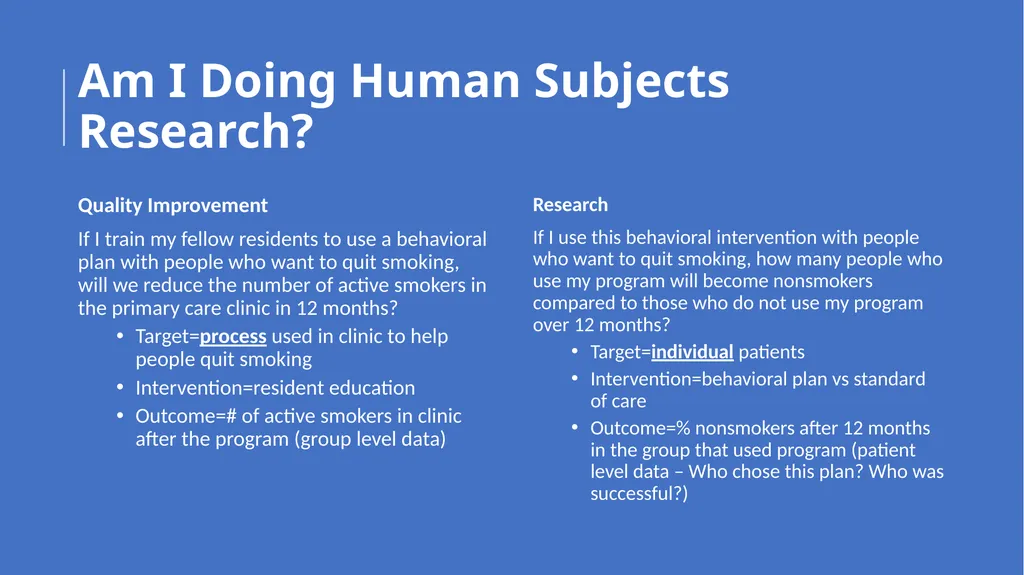
Am I Doing Human Subjects Research? Quality Improvement
If I train my fellow residents to use a behavioral plan with people who want to quit smoking, will we reduce the number of active smokers in the primary care clinic in 12 months?
Target=process used in clinic to help people quit smoking
Intervention=resident education
Outcome=# of active smokers in clinic after the program (group level data) Research
If I use this behavioral intervention with people who want to quit smoking, how many people who use my program will become nonsmokers compared to those who do not use my program over 12 months?
Target=individual patients
Intervention=behavioral plan vs standard of care
Outcome=% nonsmokers after 12 months in the group that used program (patient level data – Who chose this plan? Who was successful?)<br>
If I train my fellow residents to use a behavioral plan with people who want to quit smoking, will we reduce the number of active smokers in the primary care clinic in 12 months?
Target=process used in clinic to help people quit smoking
Intervention=resident education
Outcome=# of active smokers in clinic after the program (group level data) Research
If I use this behavioral intervention with people who want to quit smoking, how many people who use my program will become nonsmokers compared to those who do not use my program over 12 months?
Target=individual patients
Intervention=behavioral plan vs standard of care
Outcome=% nonsmokers after 12 months in the group that used program (patient level data – Who chose this plan? Who was successful?)<br>
09
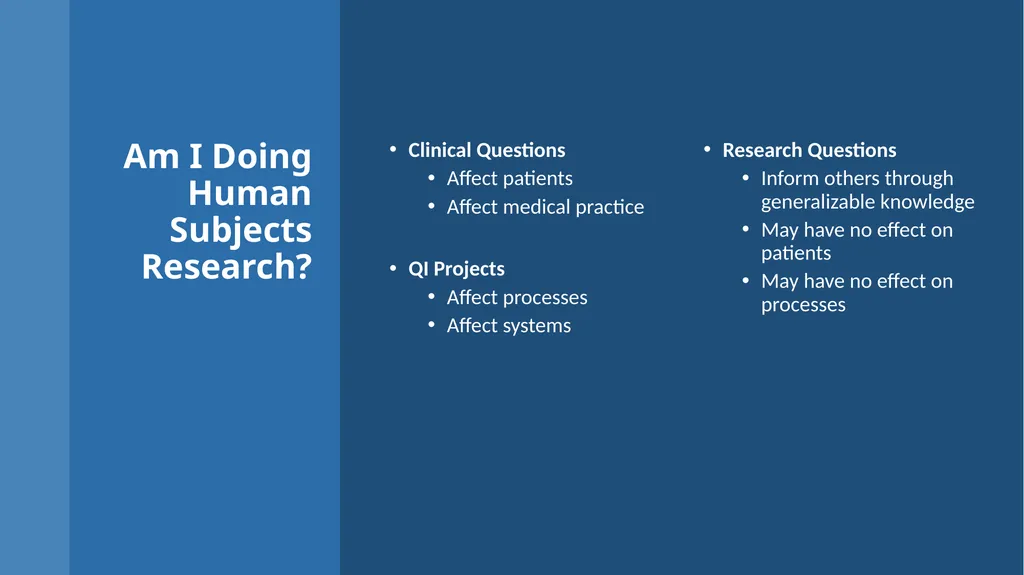
Am I Doing Human Subjects Research? Clinical Questions
Affect patients
Affect medical practice
QI Projects
Affect processes
Affect systems Research Questions
Inform others through generalizable knowledge
May have no effect on patients
May have no effect on processes<br>
Affect patients
Affect medical practice
QI Projects
Affect processes
Affect systems Research Questions
Inform others through generalizable knowledge
May have no effect on patients
May have no effect on processes<br>
10
Am I Doing Human Subjects Research?<br>
11
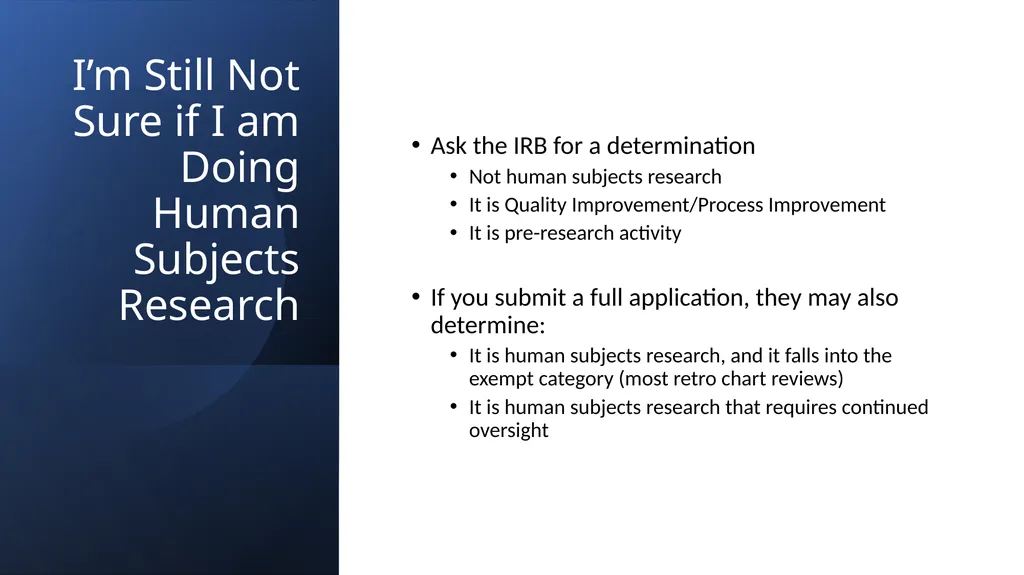
I’m Still Not Sure if I am Doing Human Subjects Research Ask the IRB for a determination
Not human subjects research
It is Quality Improvement/Process Improvement
It is pre-research activity
If you submit a full application, they may also determine:
It is human subjects research, and it falls into the exempt category (most retro chart reviews)
It is human subjects research that requires continued oversight<br>
Not human subjects research
It is Quality Improvement/Process Improvement
It is pre-research activity
If you submit a full application, they may also determine:
It is human subjects research, and it falls into the exempt category (most retro chart reviews)
It is human subjects research that requires continued oversight<br>
12
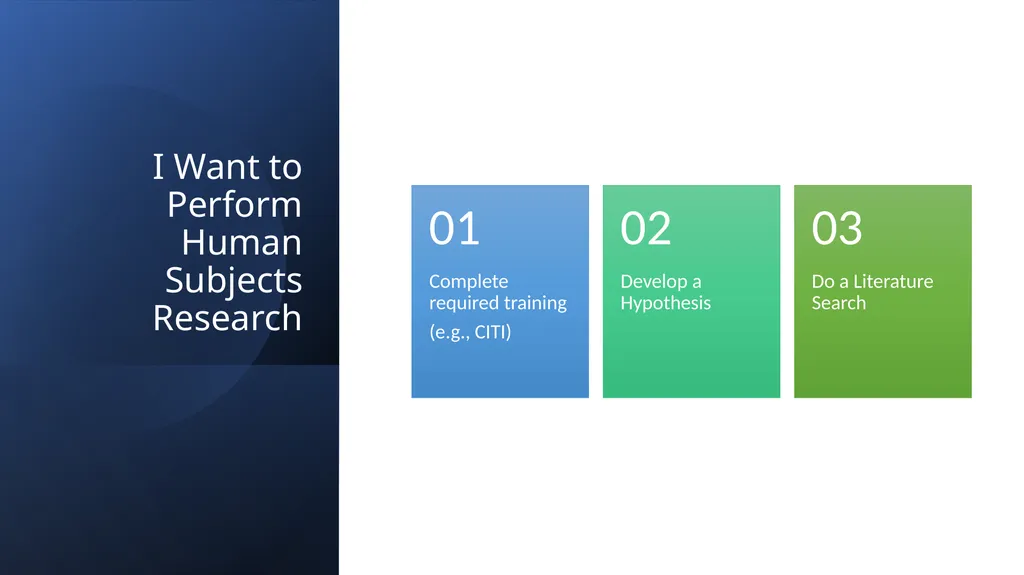
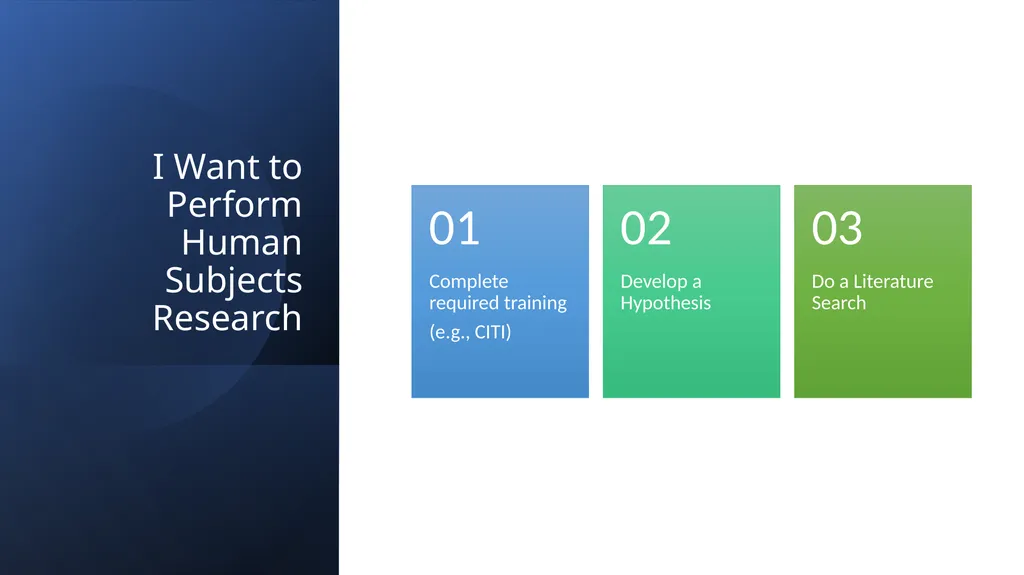
I Want to Perform Human Subjects Research<br>
13
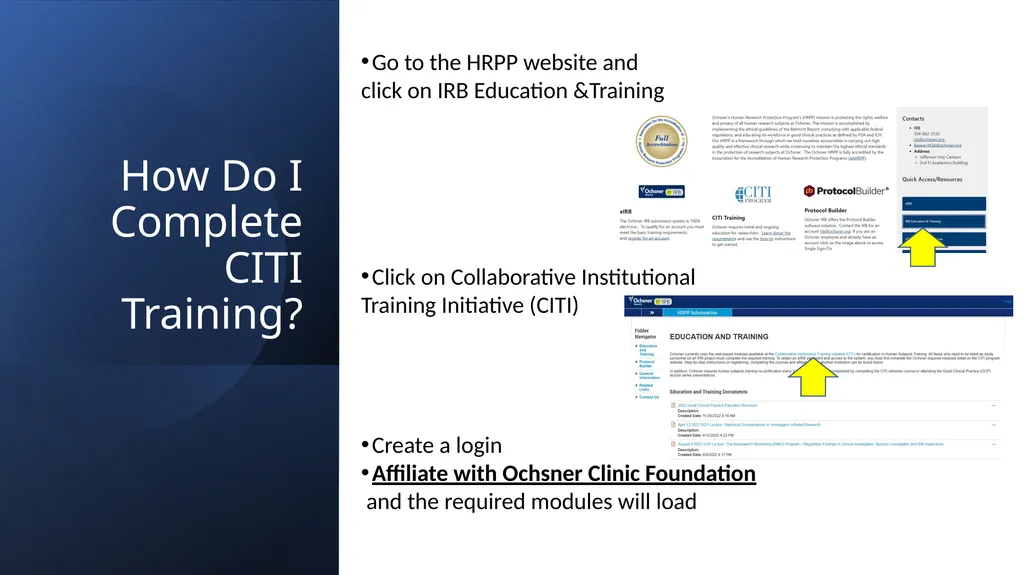
How Do I Complete CITI Training? Go to the HRPP website and
click on IRB Education &Training
Click on Collaborative Institutional
Training Initiative (CITI)
Create a login
Affiliate with Ochsner Clinic Foundation
and the required modules will load<br>
click on IRB Education &Training
Click on Collaborative Institutional
Training Initiative (CITI)
Create a login
Affiliate with Ochsner Clinic Foundation
and the required modules will load<br>
14
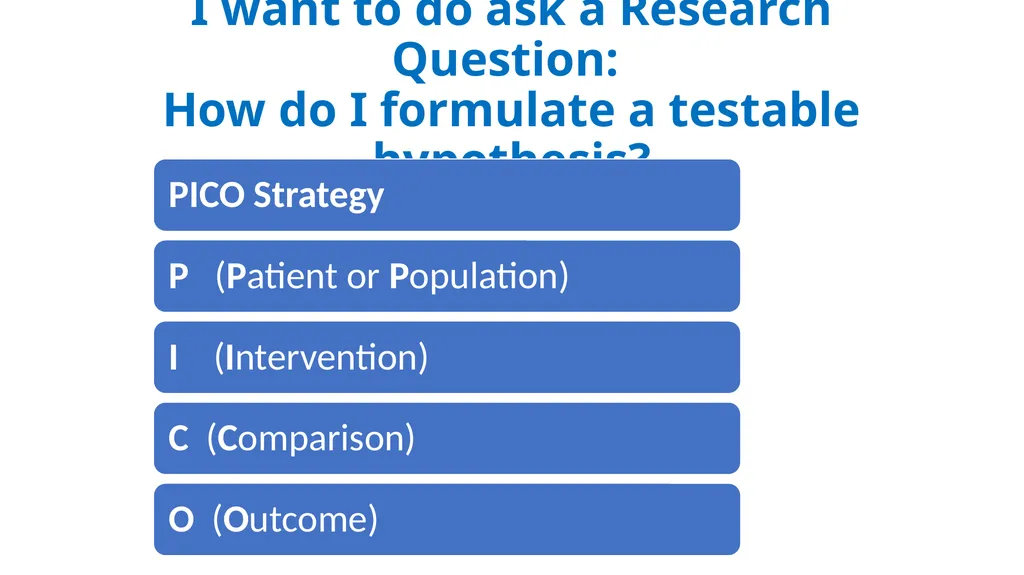
I want to do ask a Research Question:
How do I formulate a testable hypothesis?<br>
15
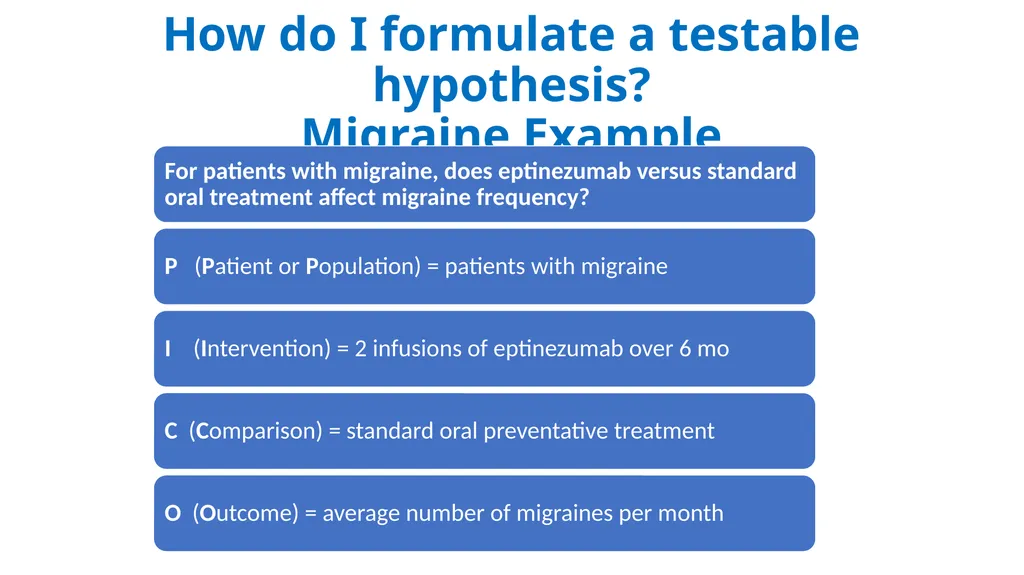
How do I formulate a testable hypothesis?
Migraine Example<br>
16
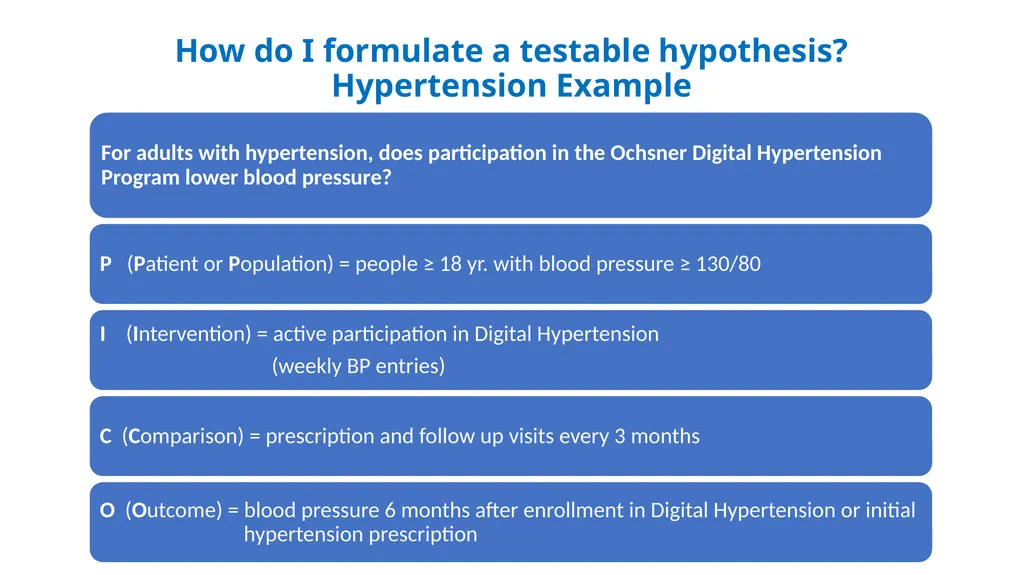
How do I formulate a testable hypothesis?
Hypertension Example<br>
17
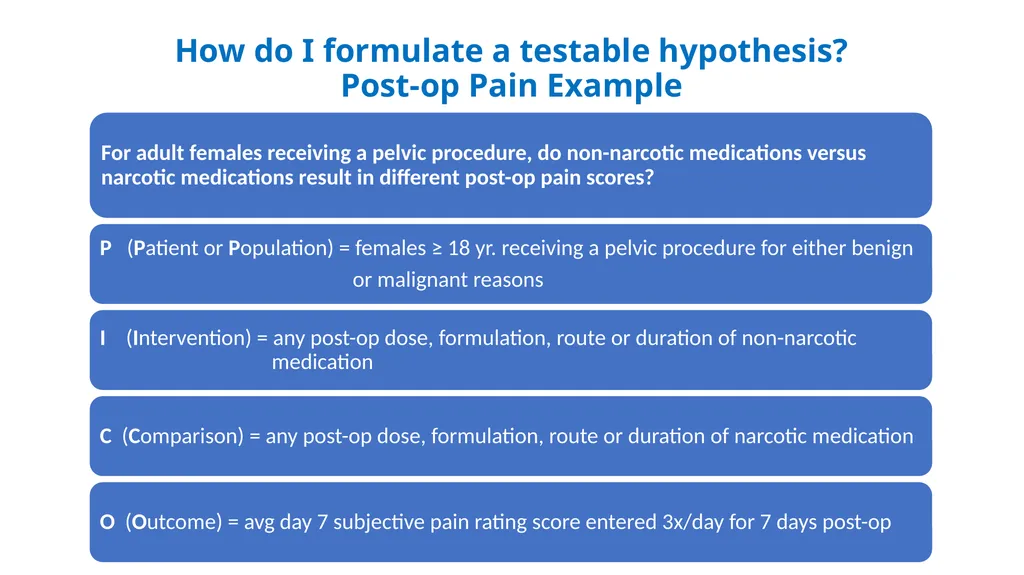
How do I formulate a testable hypothesis?
Post-op Pain Example<br>
18
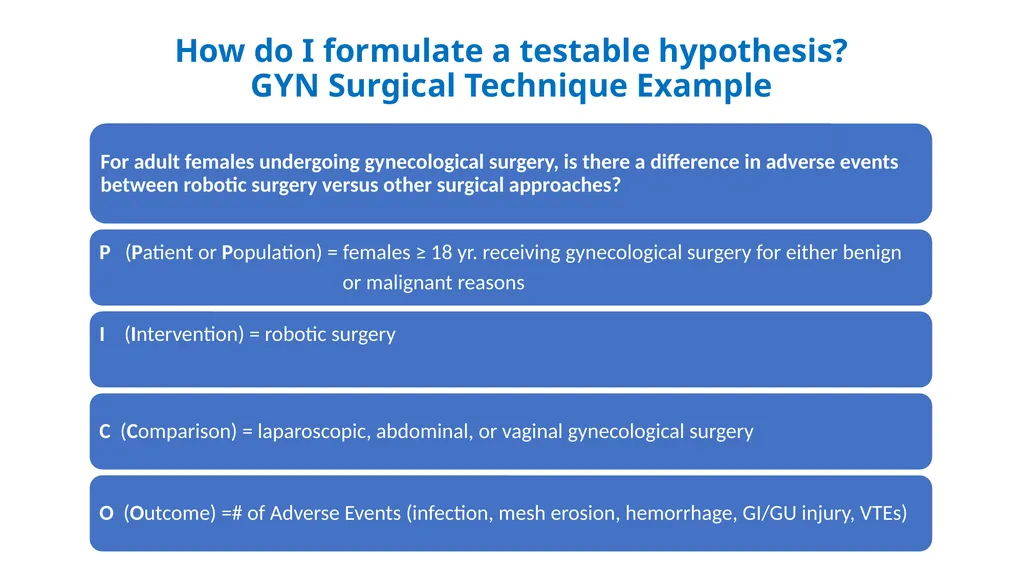
How do I formulate a testable hypothesis?
GYN Surgical Technique Example<br>
19
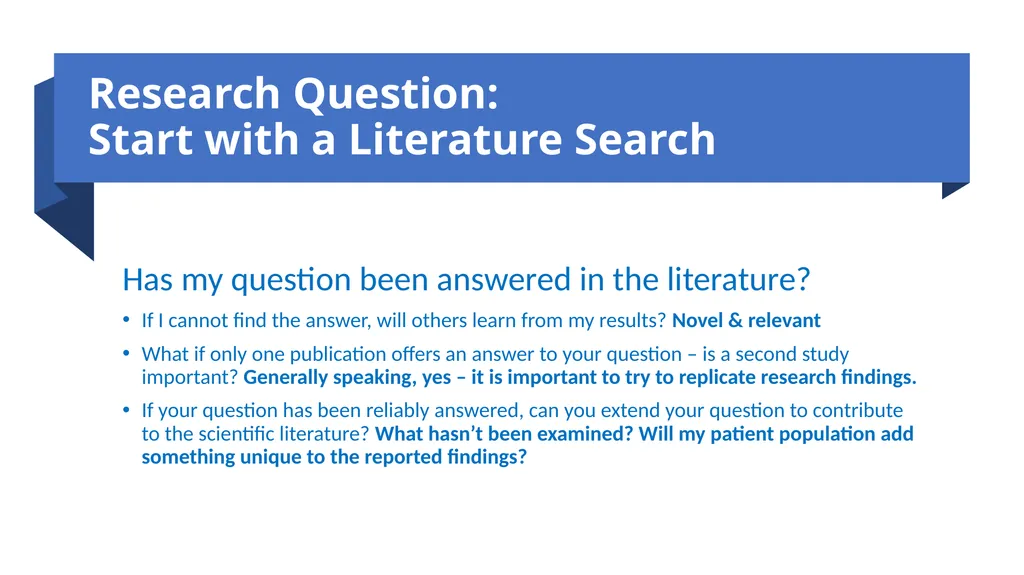
Research Question:
Start with a Literature Search Has my question been answered in the literature?
If I cannot find the answer, will others learn from my results? Novel & relevant
What if only one publication offers an answer to your question – is a second study important? Generally speaking, yes – it is important to try to replicate research findings.
If your question has been reliably answered, can you extend your question to contribute to the scientific literature? What hasn’t been examined? Will my patient population add something unique to the reported findings?<br>
If I cannot find the answer, will others learn from my results? Novel & relevant
What if only one publication offers an answer to your question – is a second study important? Generally speaking, yes – it is important to try to replicate research findings.
If your question has been reliably answered, can you extend your question to contribute to the scientific literature? What hasn’t been examined? Will my patient population add something unique to the reported findings?<br>
20
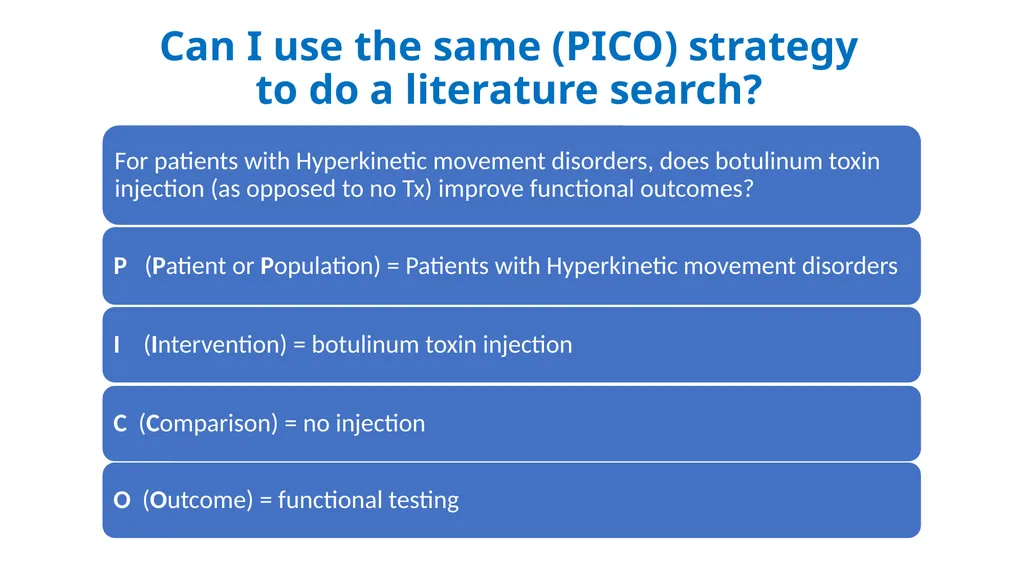
Can I use the same (PICO) strategy
to do a literature search?<br>
21
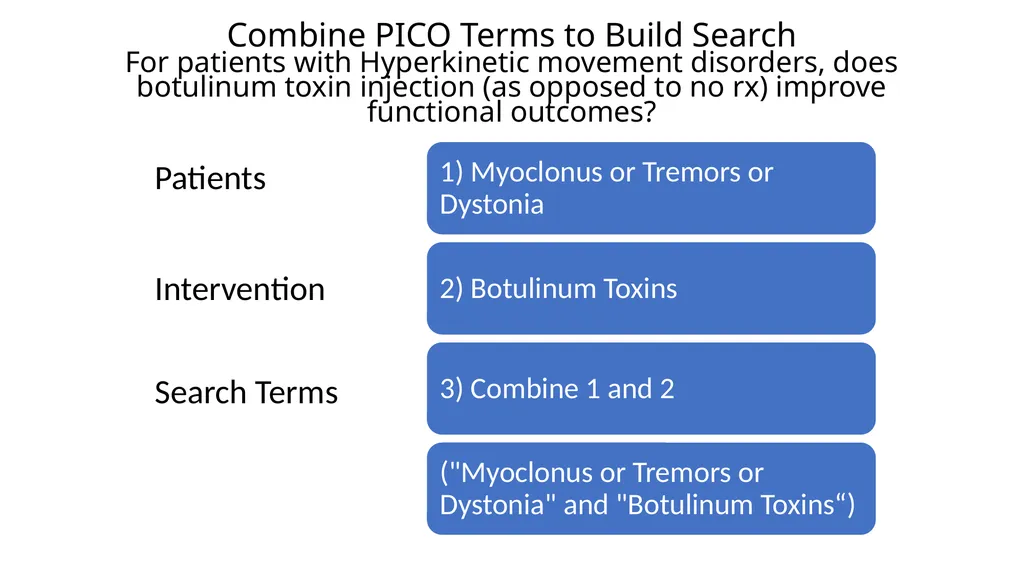
Combine PICO Terms to Build Search
For patients with Hyperkinetic movement disorders, does botulinum toxin injection (as opposed to no rx) improve functional outcomes? Patients
Intervention
Search Terms<br>
Intervention
Search Terms<br>
22
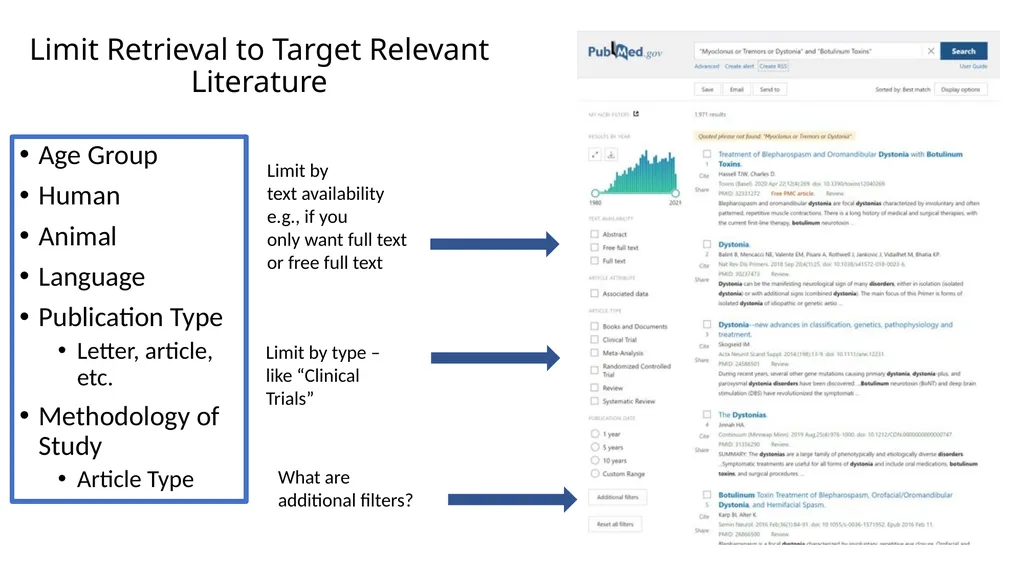
Limit Retrieval to Target Relevant Literature Age Group
Human
Animal
Language
Publication Type
Letter, article, etc.
Methodology of Study
Article Type Limit by text availability
e.g., if you only want full text or free full text Limit by type – like “Clinical Trials” What are additional filters?<br>
Human
Animal
Language
Publication Type
Letter, article, etc.
Methodology of Study
Article Type Limit by text availability
e.g., if you only want full text or free full text Limit by type – like “Clinical Trials” What are additional filters?<br>
23
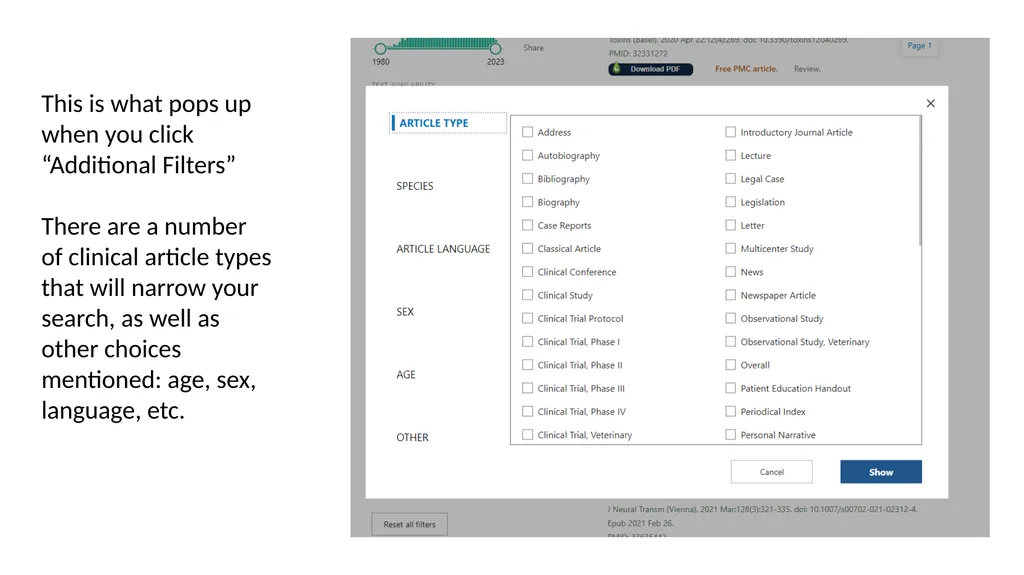
This is what pops up when you click “Additional Filters”
There are a number of clinical article types that will narrow your search, as well as other choices mentioned: age, sex, language, etc.<br>
There are a number of clinical article types that will narrow your search, as well as other choices mentioned: age, sex, language, etc.<br>
24
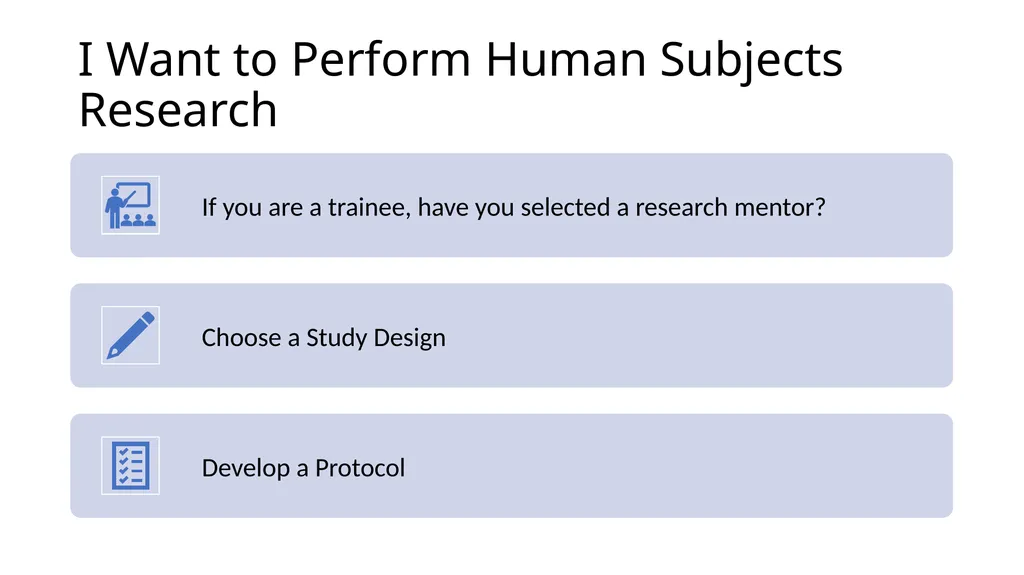
I Want to Perform Human Subjects Research<br>
25
I Want to Perform Human Subjects Research<br>
26
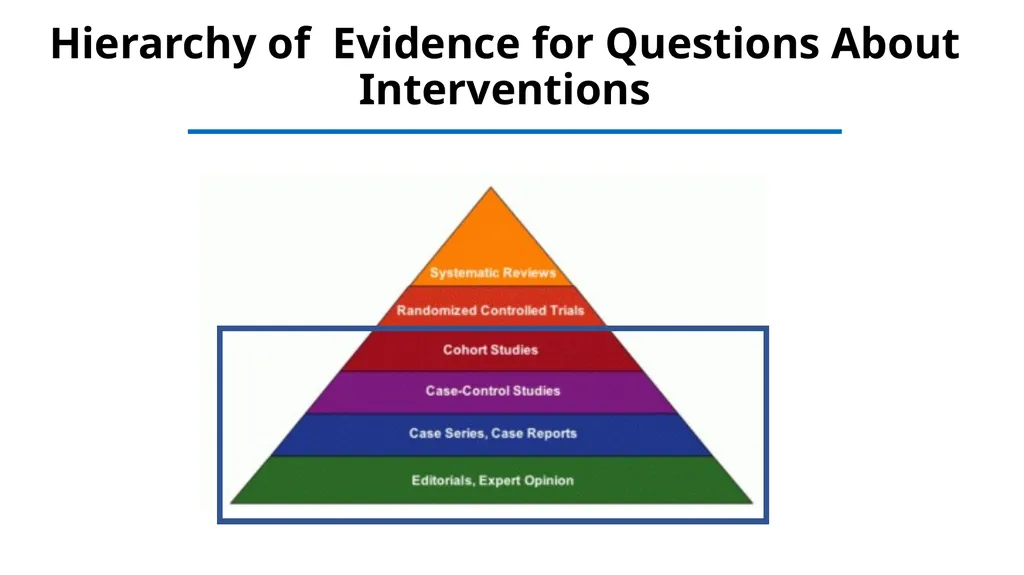
Hierarchy of Evidence for Questions About Interventions<br>
27
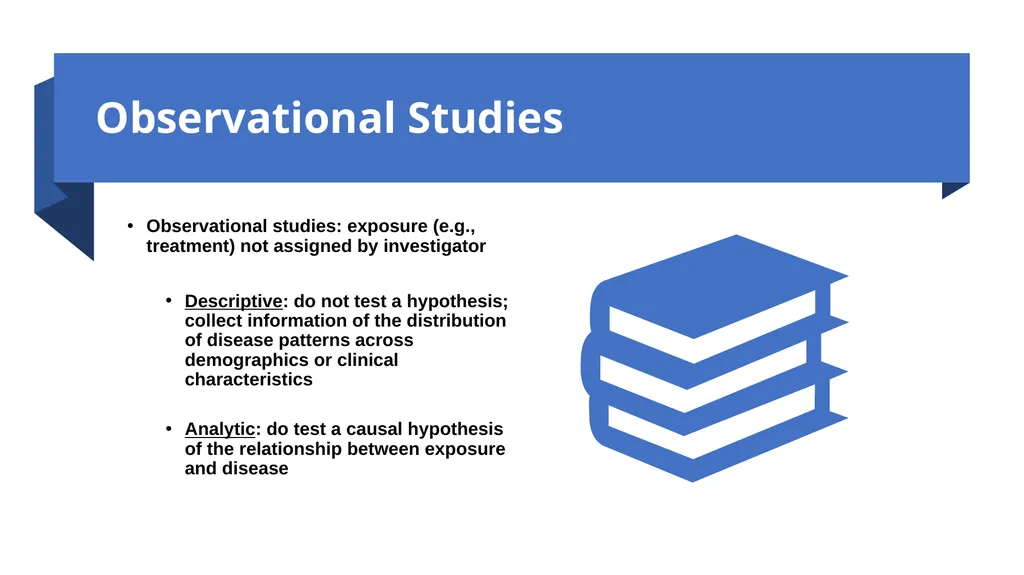
Observational Studies Observational studies: exposure (e.g., treatment) not assigned by investigator
Descriptive: do not test a hypothesis; collect information of the distribution of disease patterns across demographics or clinical characteristics
Analytic: do test a causal hypothesis of the relationship between exposure and disease<br>
Descriptive: do not test a hypothesis; collect information of the distribution of disease patterns across demographics or clinical characteristics
Analytic: do test a causal hypothesis of the relationship between exposure and disease<br>
28
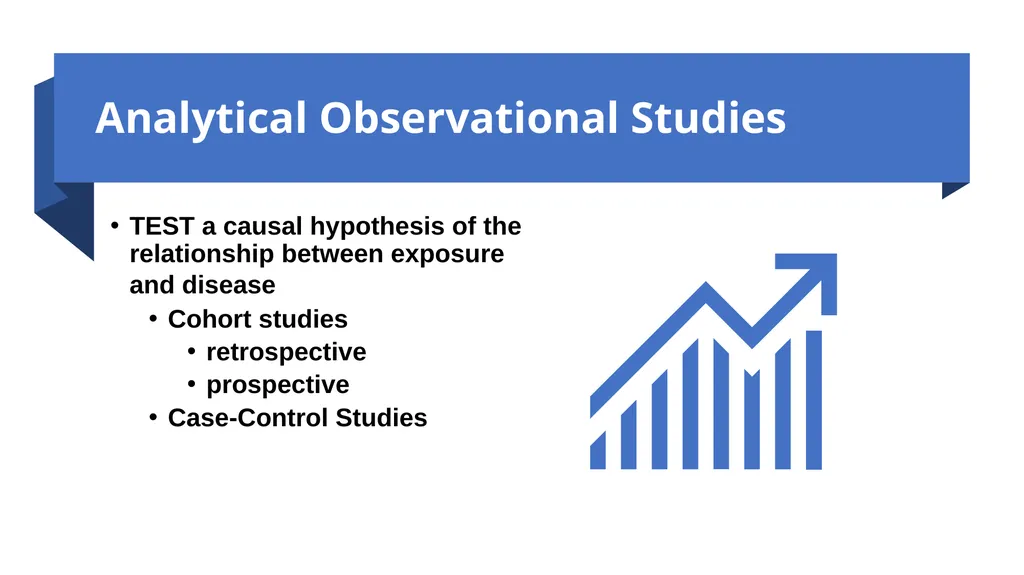
Analytical Observational Studies TEST a causal hypothesis of the relationship between exposure and disease
Cohort studies
retrospective
prospective
Case-Control Studies<br>
Cohort studies
retrospective
prospective
Case-Control Studies<br>
29
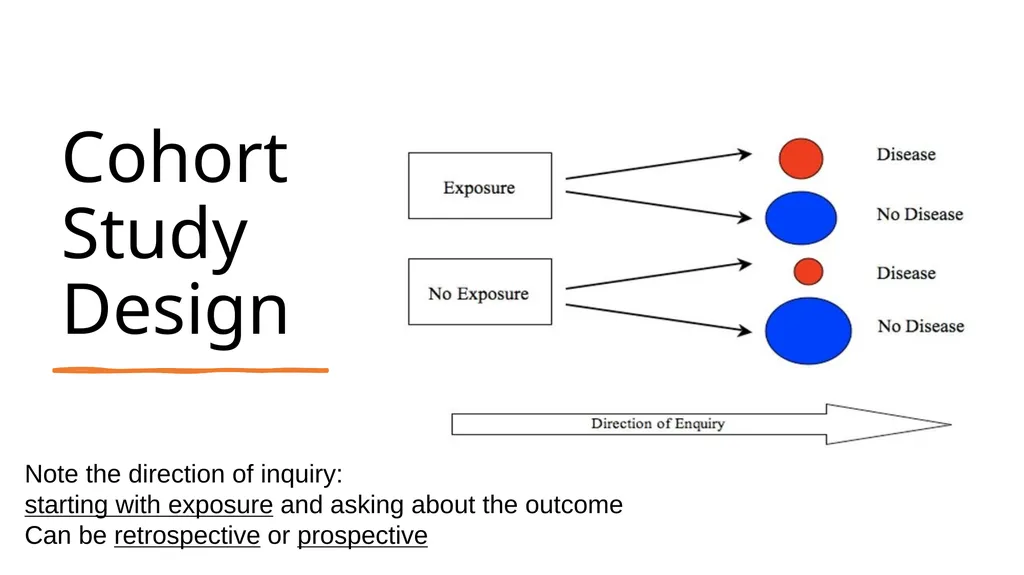
Cohort Study Design Note the direction of inquiry:
starting with exposure and asking about the outcome
Can be retrospective or prospective<br>
starting with exposure and asking about the outcome
Can be retrospective or prospective<br>
30
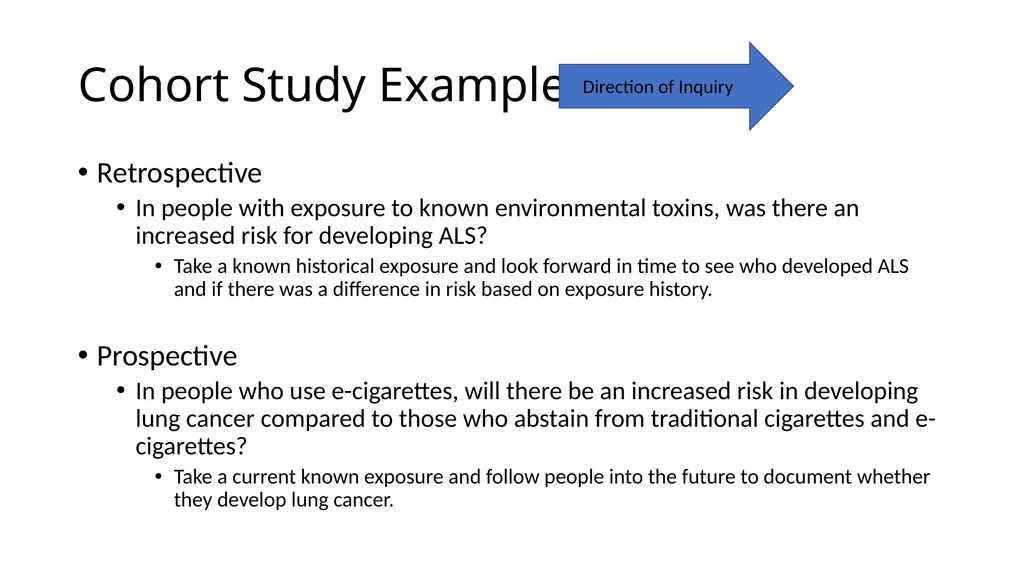
Cohort Study Example Retrospective
In people with exposure to known environmental toxins, was there an increased risk for developing ALS?
Take a known historical exposure and look forward in time to see who developed ALS and if there was a difference in risk based on exposure history.
Prospective
In people who use e-cigarettes, will there be an increased risk in developing lung cancer compared to those who abstain from traditional cigarettes and e-cigarettes?
Take a current known exposure and follow people into the future to document whether they develop lung cancer. Direction of Inquiry<br>
In people with exposure to known environmental toxins, was there an increased risk for developing ALS?
Take a known historical exposure and look forward in time to see who developed ALS and if there was a difference in risk based on exposure history.
Prospective
In people who use e-cigarettes, will there be an increased risk in developing lung cancer compared to those who abstain from traditional cigarettes and e-cigarettes?
Take a current known exposure and follow people into the future to document whether they develop lung cancer. Direction of Inquiry<br>
31
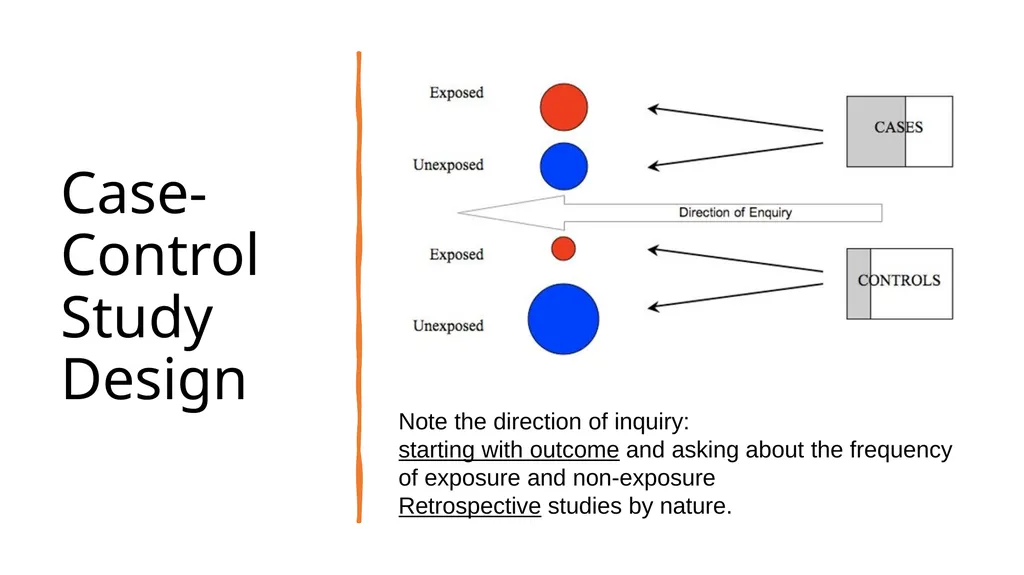
Case-Control Study Design Note the direction of inquiry:
starting with outcome and asking about the frequency of exposure and non-exposure
Retrospective studies by nature.<br>
starting with outcome and asking about the frequency of exposure and non-exposure
Retrospective studies by nature.<br>
32
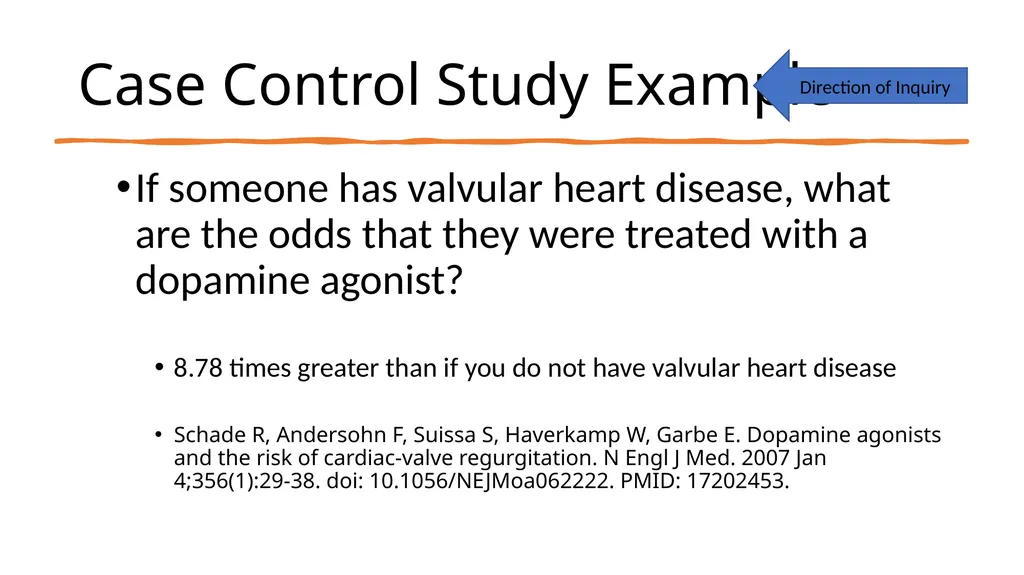
Case Control Study Example If someone has valvular heart disease, what are the odds that they were treated with a dopamine agonist?
8.78 times greater than if you do not have valvular heart disease
Schade R, Andersohn F, Suissa S, Haverkamp W, Garbe E. Dopamine agonists and the risk of cardiac-valve regurgitation. N Engl J Med. 2007 Jan 4;356(1):29-38. doi: 10.1056/NEJMoa062222. PMID: 17202453. Direction of Inquiry<br>
8.78 times greater than if you do not have valvular heart disease
Schade R, Andersohn F, Suissa S, Haverkamp W, Garbe E. Dopamine agonists and the risk of cardiac-valve regurgitation. N Engl J Med. 2007 Jan 4;356(1):29-38. doi: 10.1056/NEJMoa062222. PMID: 17202453. Direction of Inquiry<br>
33
I Want to Perform Human Subjects Research<br>
34
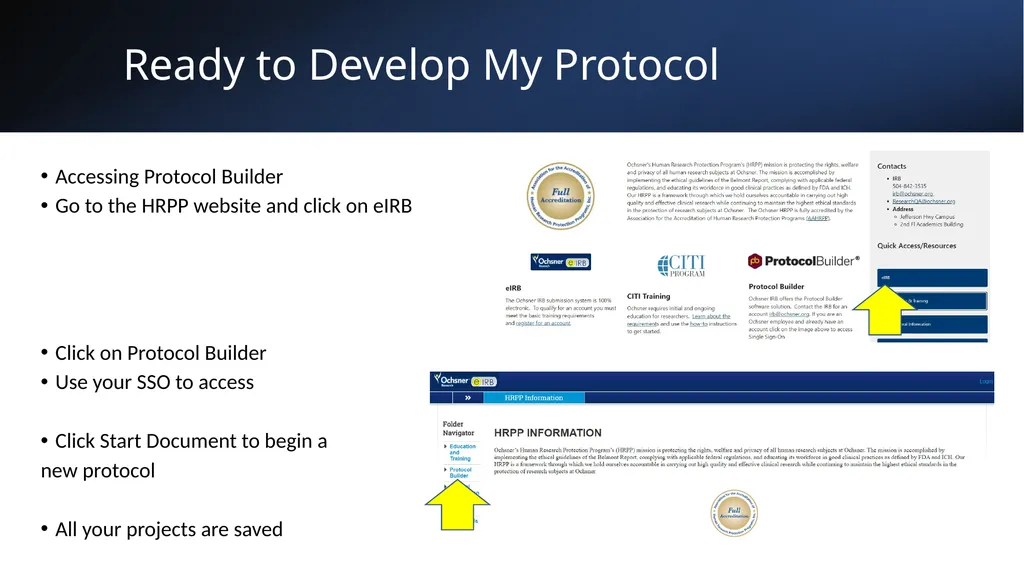
Ready to Develop My Protocol Accessing Protocol Builder
Go to the HRPP website and click on eIRB
Click on Protocol Builder
Use your SSO to access
Click Start Document to begin a
new protocol
All your projects are saved<br>
Go to the HRPP website and click on eIRB
Click on Protocol Builder
Use your SSO to access
Click Start Document to begin a
new protocol
All your projects are saved<br>
35
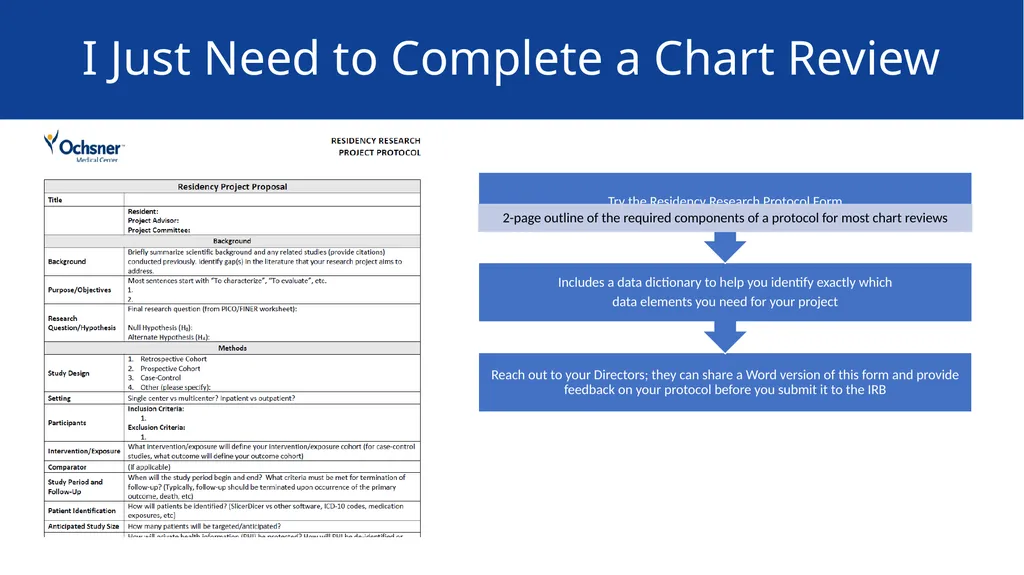
I Just Need to Complete a Chart Review<br>
36
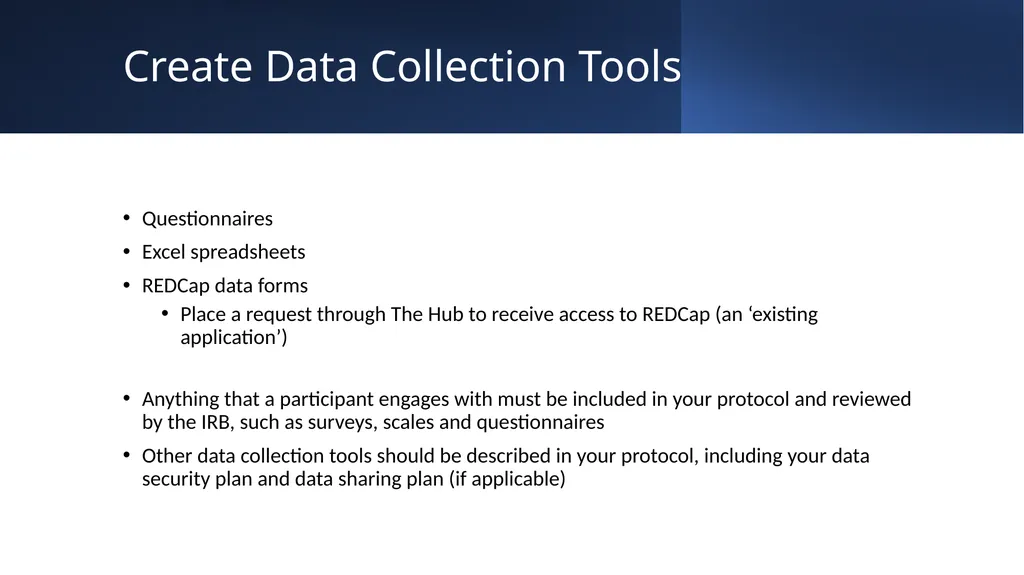
Create Data Collection Tools Questionnaires
Excel spreadsheets
REDCap data forms
Place a request through The Hub to receive access to REDCap (an ‘existing application’)
Anything that a participant engages with must be included in your protocol and reviewed by the IRB, such as surveys, scales and questionnaires
Other data collection tools should be described in your protocol, including your data security plan and data sharing plan (if applicable)<br>
Excel spreadsheets
REDCap data forms
Place a request through The Hub to receive access to REDCap (an ‘existing application’)
Anything that a participant engages with must be included in your protocol and reviewed by the IRB, such as surveys, scales and questionnaires
Other data collection tools should be described in your protocol, including your data security plan and data sharing plan (if applicable)<br>
37
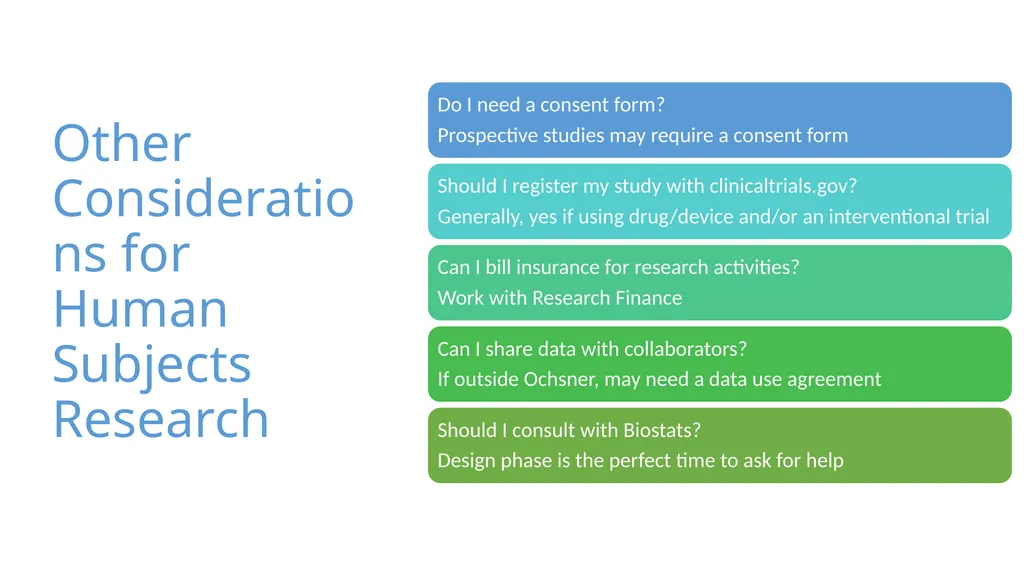
Other
Considerations for
Human Subjects Research<br>
38
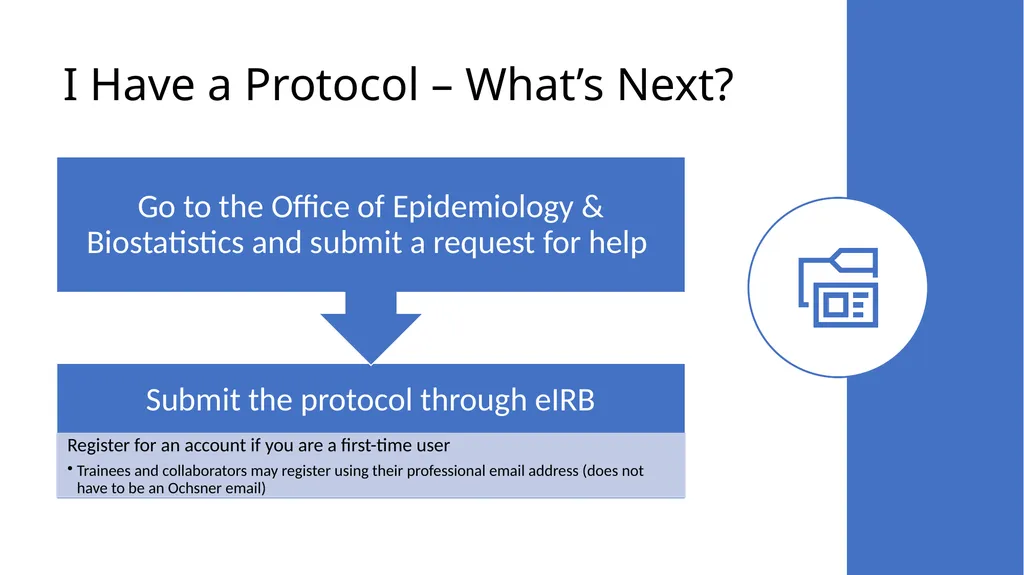
I Have a Protocol – What’s Next?<br>
39
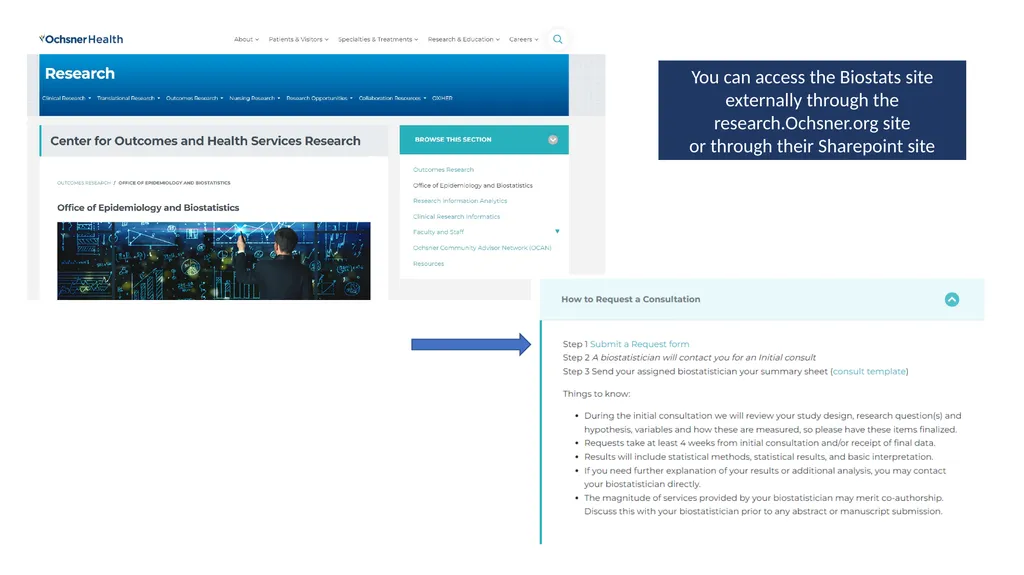
You can access the Biostats site externally through the research.Ochsner.org site
or through their Sharepoint site<br>
or through their Sharepoint site<br>
40
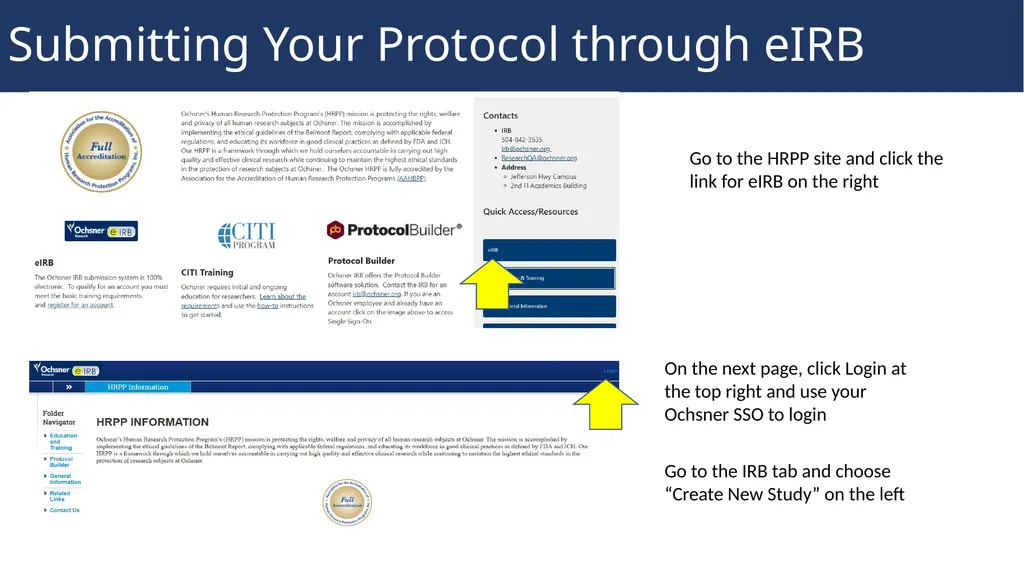
Submitting Your Protocol through eIRB Go to the HRPP site and click the link for eIRB on the right On the next page, click Login at the top right and use your Ochsner SSO to login Go to the IRB tab and choose
“Create New Study” on the left<br>
“Create New Study” on the left<br>
41
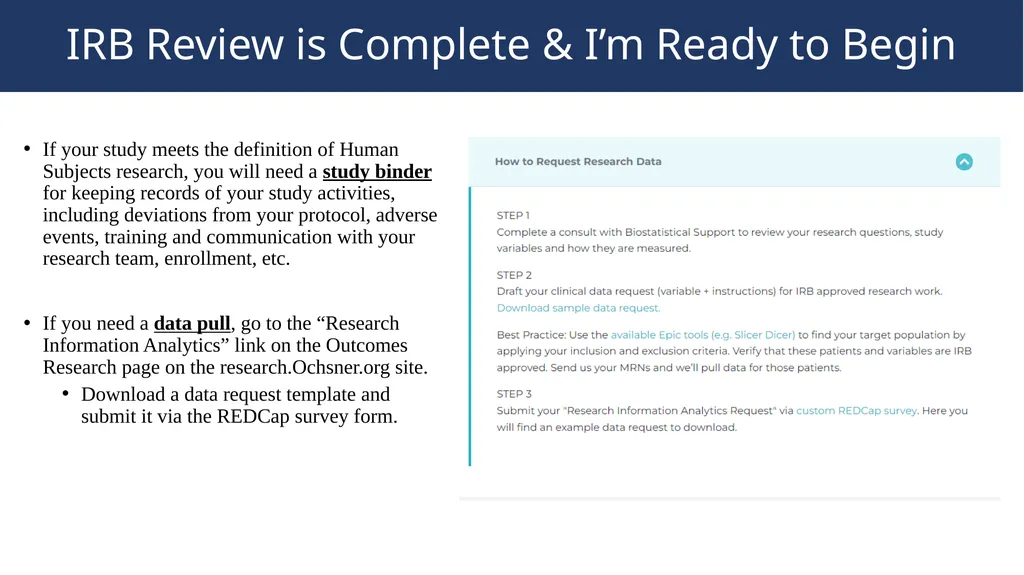
IRB Review is Complete & I’m Ready to Begin If your study meets the definition of Human Subjects research, you will need a study binder for keeping records of your study activities, including deviations from your protocol, adverse events, training and communication with your research team, enrollment, etc.
If you need a data pull, go to the “Research Information Analytics” link on the Outcomes Research page on the research.Ochsner.org site.
Download a data request template and submit it via the REDCap survey form.<br>
If you need a data pull, go to the “Research Information Analytics” link on the Outcomes Research page on the research.Ochsner.org site.
Download a data request template and submit it via the REDCap survey form.<br>
42
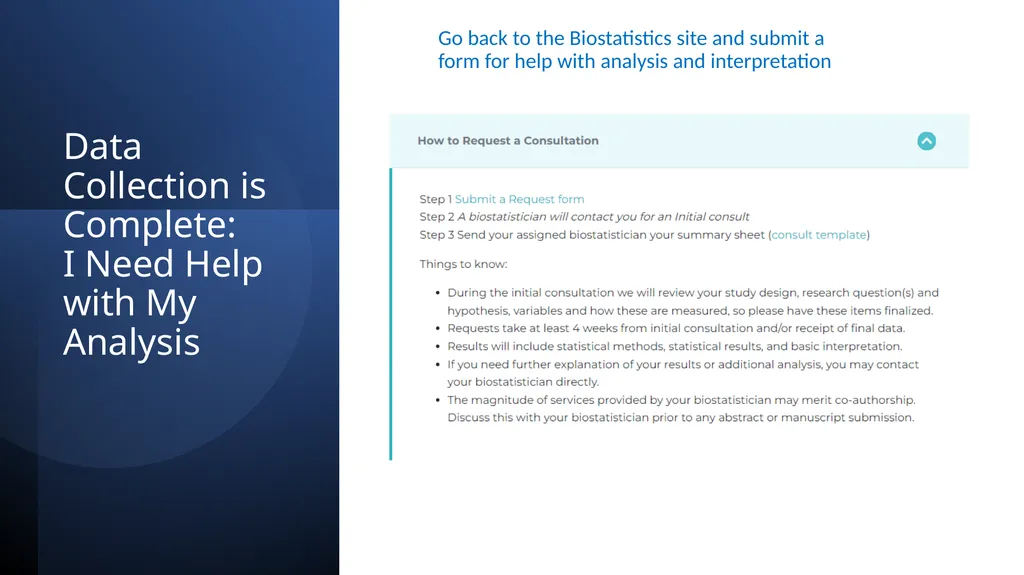
Data Collection is Complete:
I Need Help with My Analysis Go back to the Biostatistics site and submit a form for help with analysis and interpretation<br>
43
I’m Ready to Share My Results Prepare to share your results using de-identified data
Poster presentations often begin with creating and submitting an abstract
Introduction/Background
Purpose/Hypothesis
Design/Methods
Results/Conclusion
Manuscript preparation follows the same general format
Be sure to ask your mentor, colleagues, and/or clinical research directors to review your work and provide feedback<br>
Poster presentations often begin with creating and submitting an abstract
Introduction/Background
Purpose/Hypothesis
Design/Methods
Results/Conclusion
Manuscript preparation follows the same general format
Be sure to ask your mentor, colleagues, and/or clinical research directors to review your work and provide feedback<br>
44
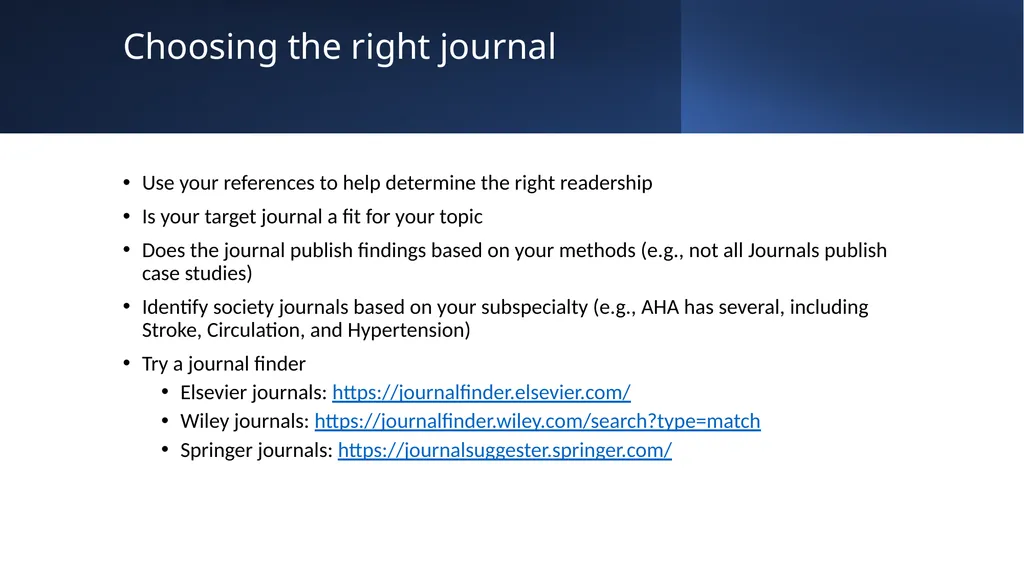
Choosing the right journal Use your references to help determine the right readership
Is your target journal a fit for your topic
Does the journal publish findings based on your methods (e.g., not all Journals publish case studies)
Identify society journals based on your subspecialty (e.g., AHA has several, including Stroke, Circulation, and Hypertension)
Try a journal finder
Elsevier journals: https://journalfinder.elsevier.com/
Wiley journals: https://journalfinder.wiley.com/search?type=match
Springer journals: https://journalsuggester.springer.com/<br>
Is your target journal a fit for your topic
Does the journal publish findings based on your methods (e.g., not all Journals publish case studies)
Identify society journals based on your subspecialty (e.g., AHA has several, including Stroke, Circulation, and Hypertension)
Try a journal finder
Elsevier journals: https://journalfinder.elsevier.com/
Wiley journals: https://journalfinder.wiley.com/search?type=match
Springer journals: https://journalsuggester.springer.com/<br>
45
Resources to be Shared<br>