Introduction to Data Structures Course Administrivia My office hours: Mon 11:30am-1:30pm, Wed 12:30-1:30pm, Fri 11:30am-2:30pm, in this Zoom room. Exams: two midterms and a final. Exams are open-book, open-notes. Six assignments. Each
"Introduction to Data Structures Course" is the property of its rightful owner. Permission is granted to
download and print the materials on this website for personal, non-commercial use only, and to display it
on your personal computer provided you do not modify the materials and that you retain all copyright
notices contained in the materials. By downloading content from our website, you accept the terms of this
agreement.
Presentation Transcript
01
Introduction to Data Structures<br>
02
Course Administrivia My office hours: Mon 11:30am-1:30pm, Wed 12:30-1:30pm, Fri 11:30am-2:30pm, in this Zoom room.
Exams: two midterms and a final.
Exams are open-book, open-notes.
Six assignments.
Each assignment has a written component, due in one week, and a programming component, due in two weeks.
Lectures will be recorded and posted on the website as soon as they are ready.
Powerpoint slides will be posted on the website shortly before start of lecture.
One-on-one meetings this week!
Class should be interactive. Either raise your hand or write in chat to ask questions.<br>
03
Some Helpful Links<br>
04
Organizing Your Data Should you always sort your data?
No. What are the tradeoffs?
An Insert operation becomes more expensive (but a Lookup operation becomes less expensive)
In a backup system, you are constantly adding new information, and you rarely (hopefully never) look up that information.
How should you organize your data? What is the best data structure?
The answer is, invariably, “it depends.”
Otherwise, this class would be called “Data Structure” (singular), I’d teach it to you today, and everyone would go home and get an A.<br>
05
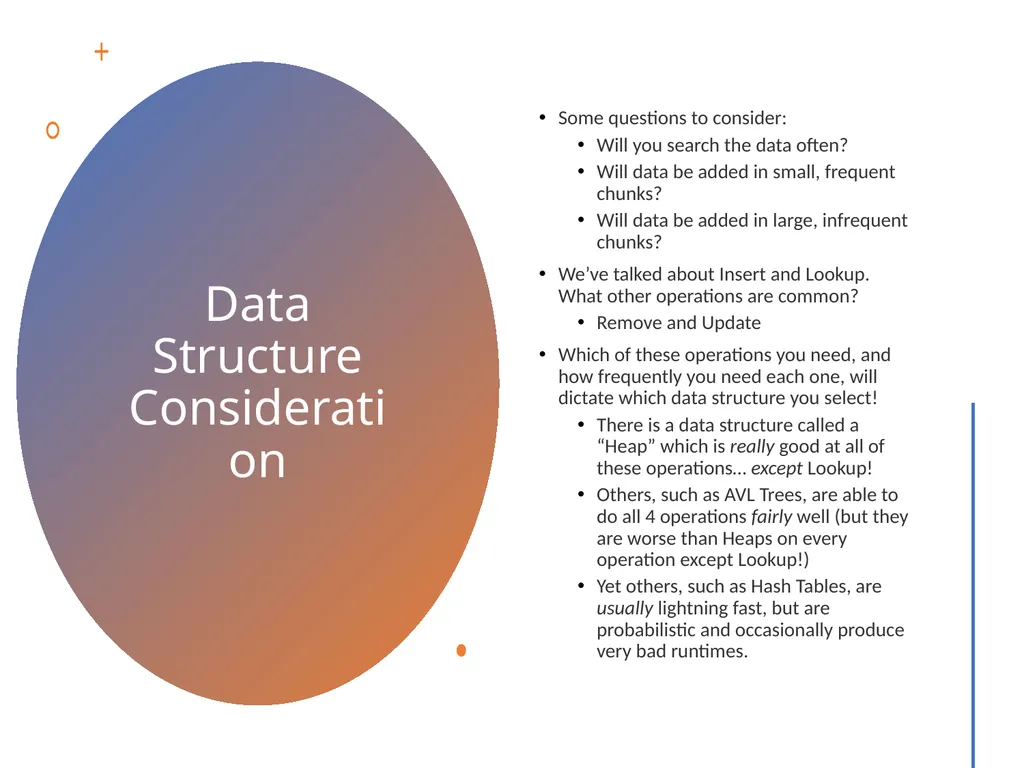
Data Structure Consideration Some questions to consider:
Will you search the data often?
Will data be added in small, frequent chunks?
Will data be added in large, infrequent chunks?
We’ve talked about Insert and Lookup. What other operations are common?
Remove and Update
Which of these operations you need, and how frequently you need each one, will dictate which data structure you select!
There is a data structure called a “Heap” which is really good at all of these operations… except Lookup!
Others, such as AVL Trees, are able to do all 4 operations fairly well (but they are worse than Heaps on every operation except Lookup!)
Yet others, such as Hash Tables, are usually lightning fast, but are probabilistic and occasionally produce very bad runtimes.<br>
06
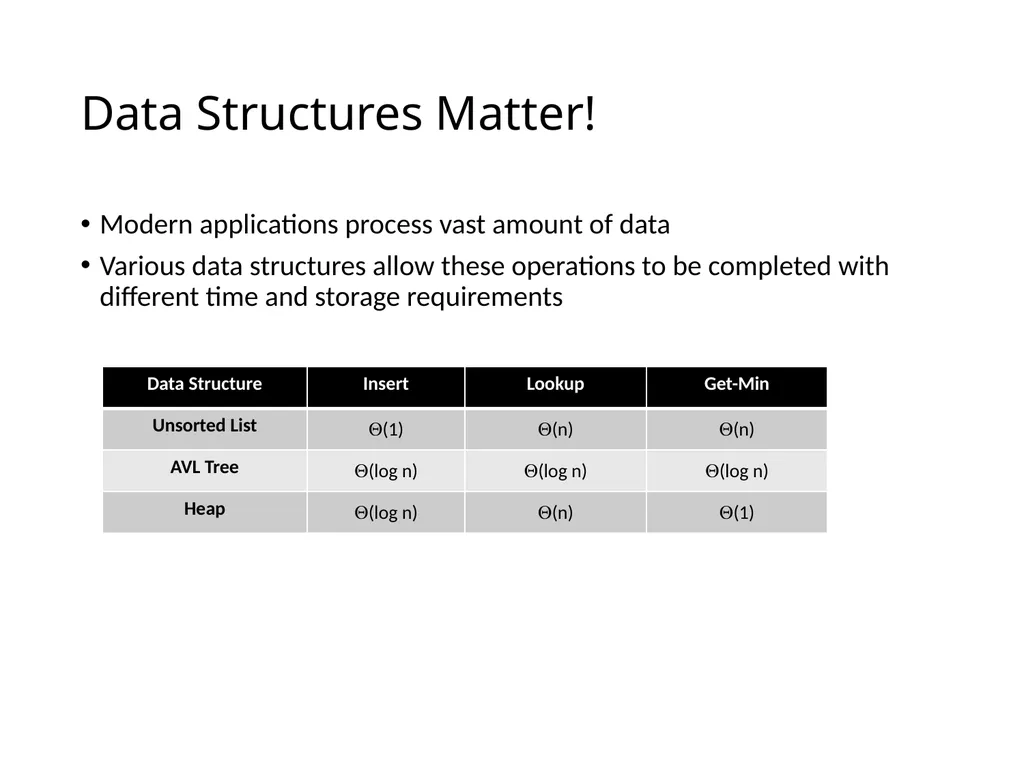
Data Structures Matter! Modern applications process vast amount of data
Various data structures allow these operations to be completed with different time and storage requirements<br>
07
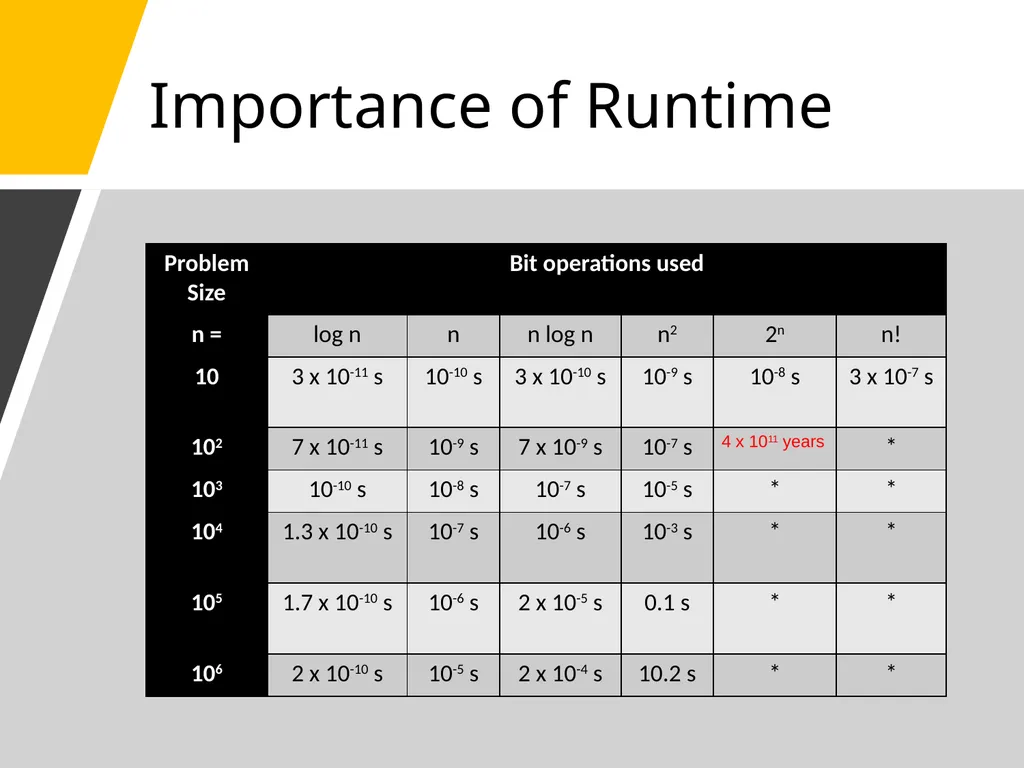
Importance of Runtime 4 x 10¹¹ years<br>
08
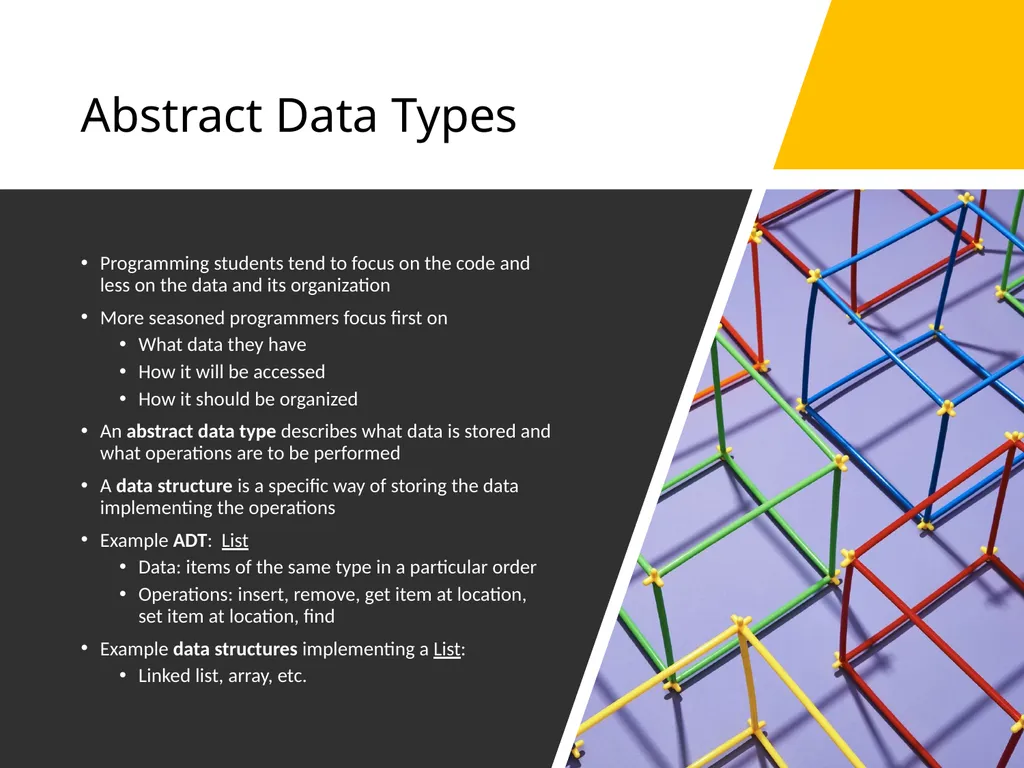
Abstract Data Types Programming students tend to focus on the code and less on the data and its organization
More seasoned programmers focus first on
What data they have
How it will be accessed
How it should be organized
An abstract data type describes what data is stored and what operations are to be performed
A data structure is a specific way of storing the data implementing the operations
Example ADT: List
Data: items of the same type in a particular order
Operations: insert, remove, get item at location, set item at location, find
Example data structures implementing a List:
Linked list, array, etc.<br>
09
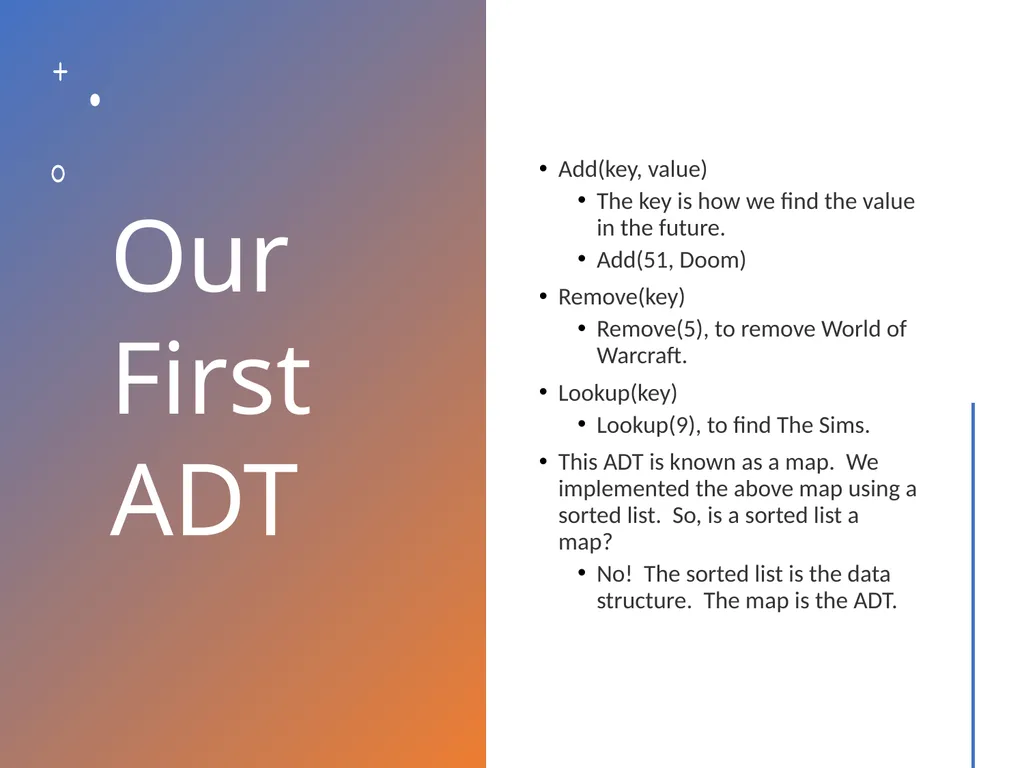
Our First ADT Add(key, value)
The key is how we find the value in the future.
Add(51, Doom)
Remove(key)
Remove(5), to remove World of Warcraft.
Lookup(key)
Lookup(9), to find The Sims.
This ADT is known as a map. We implemented the above map using a sorted list. So, is a sorted list a map?
No! The sorted list is the data structure. The map is the ADT.<br>