INTRODUCTION TO ECONOMICS Dr. Pooja Singh, Assistant Professor, Deptt. Of Economics From minimum or scarce resources maximum output or satisfaction should be achieved or gained. What is Economics? Economics comes from the Greek word
"INTRODUCTION TO ECONOMICS Dr. Pooja Singh," is the property of its rightful owner. Permission is granted to
download and print the materials on this website for personal, non-commercial use only, and to display it
on your personal computer provided you do not modify the materials and that you retain all copyright
notices contained in the materials. By downloading content from our website, you accept the terms of this
agreement.
Presentation Transcript
01
INTRODUCTION TO ECONOMICS Dr. Pooja Singh,
Assistant Professor,
Deptt. Of Economics<br>
02
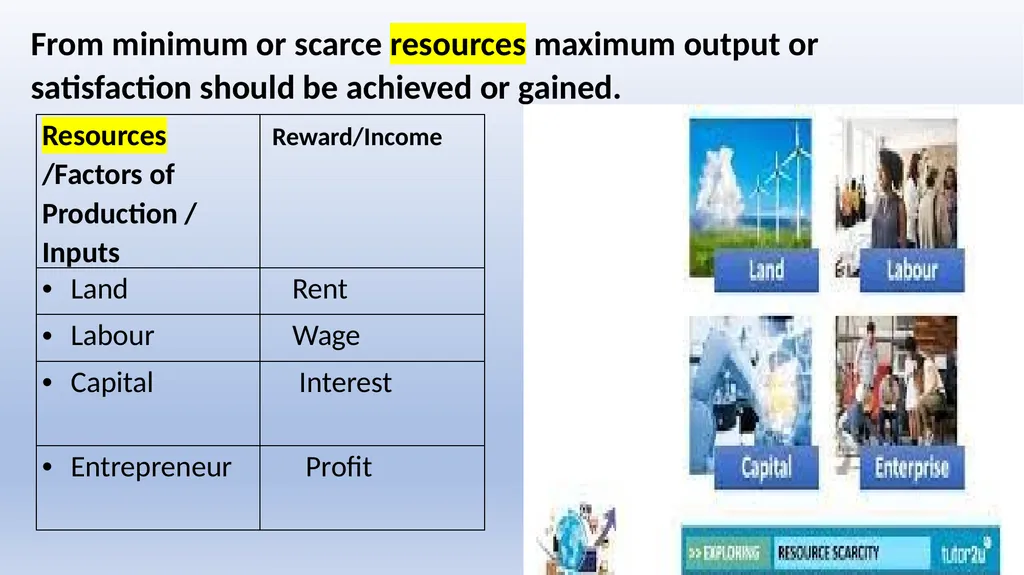
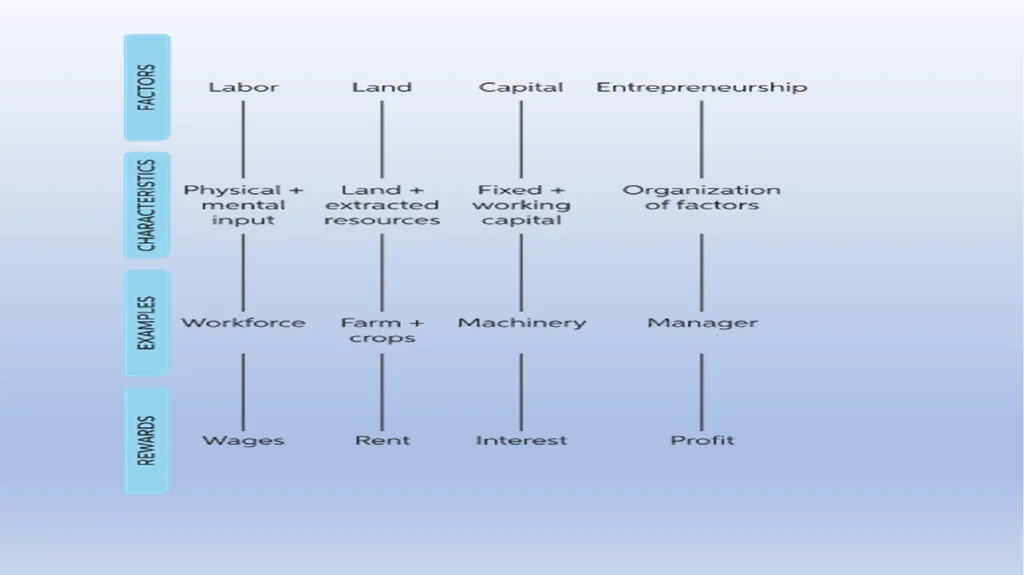
From minimum or scarce resources maximum output or satisfaction should be achieved or gained.<br>
03
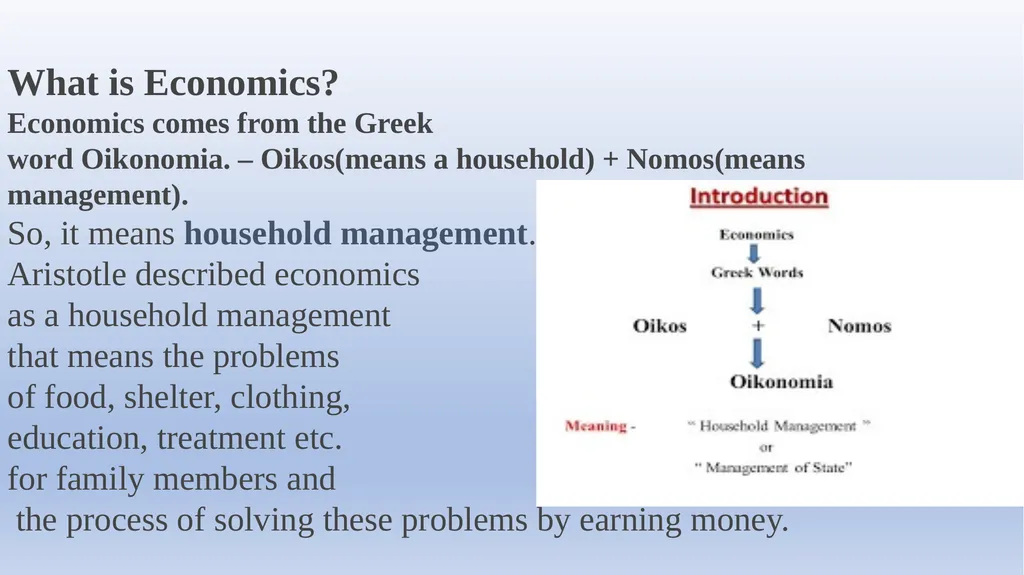
What is Economics?
Economics comes from the Greek
word Oikonomia. – Oikos(means a household) + Nomos(means management).
So, it means household management.
Aristotle described economics
as a household management
that means the problems
of food, shelter, clothing,
education, treatment etc.
for family members and
the process of solving these problems by earning money.<br>
04
Segments of Economics Definitions:
Science of Wealth
Science of Material Well Being
Science of Choice Making
Science of Dynamic Growth
& Development<br>
05
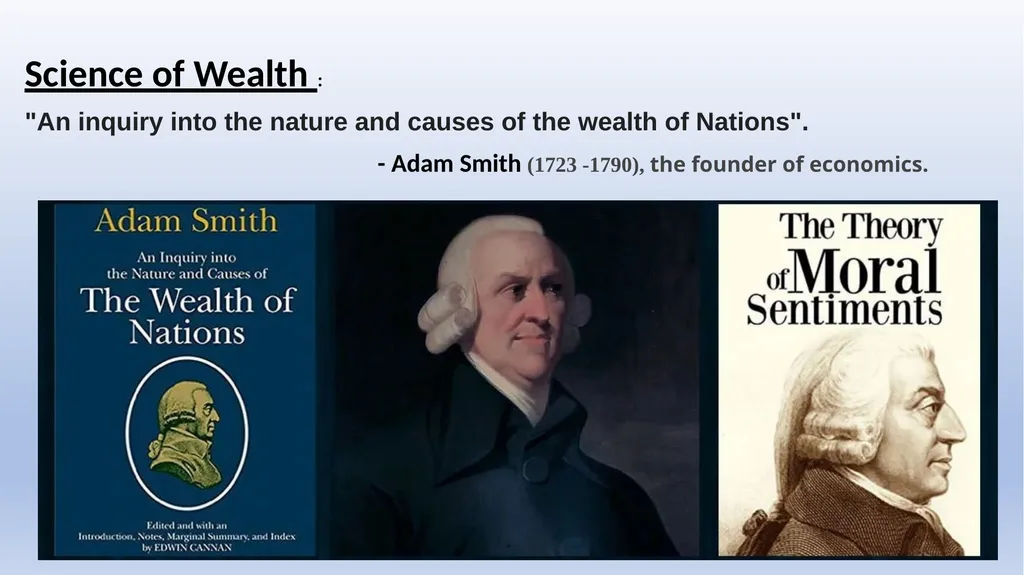
Science of Wealth :
"An inquiry into the nature and causes of the wealth of Nations".
- Adam Smith (1723 -1790), the founder of economics.<br>
06
Features of the Definition-
Study of Wealth:
Economics deals with the study of wealth only. Therefore, it is concerned with the activities of man related to production, consumption, exchange and distribution of wealth.
Only Material Commodities:
This definition conveys the feeling that
Economics constitutes only material
commodities while it ignores
non-material goods
as air, water and sunshine.<br>
07
Stress on Wealth:
Since the main aim of the political economy is to increase the riches of the economy, it gives more stress on wealth, not anything else.
Causes of Wealth:
Economics is considered as study of causes of wealth accumulation which brings economic development. In order to increase wealth, production of material goods will have to be increased.
Economic Man:
This definition is basically based on the man who is always aware of his ‘self-interest’ that leads him to material gains.<br>
08
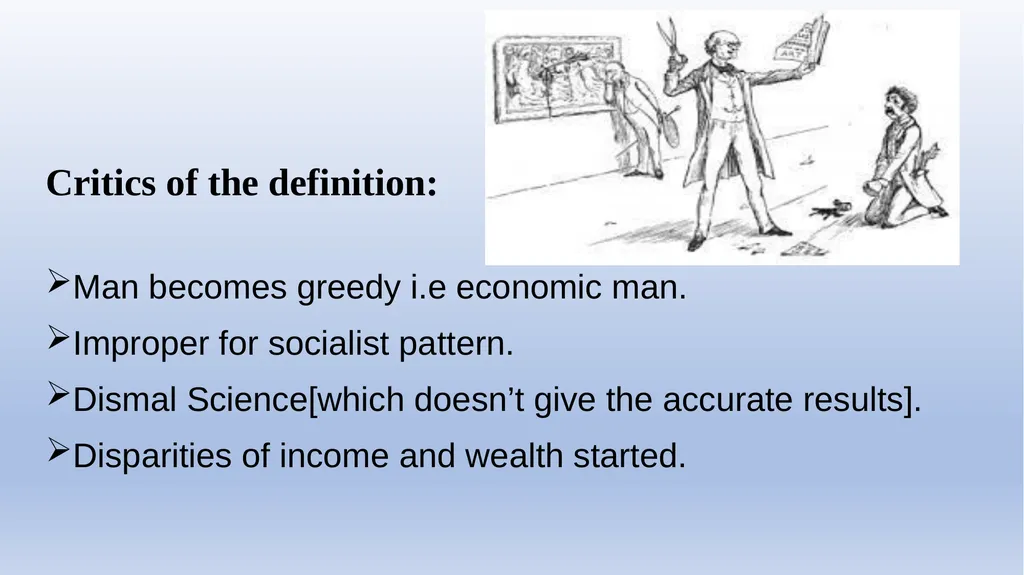
Critics of the definition:
Man becomes greedy i.e economic man.
Improper for socialist pattern.
Dismal Science[which doesn’t give the accurate results].
Disparities of income and wealth started.<br>
09
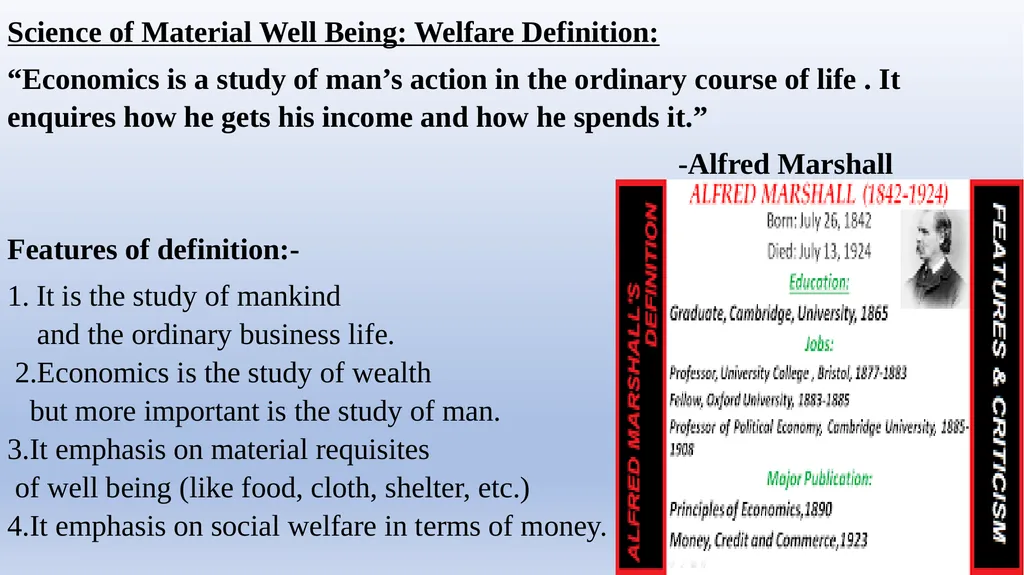
Science of Material Well Being: Welfare Definition:
“Economics is a study of man’s action in the ordinary course of life . It enquires how he gets his income and how he spends it.”
-Alfred Marshall
Features of definition:-
It is the study of mankind
and the ordinary business life.
2.Economics is the study of wealth
but more important is the study of man.
3.It emphasis on material requisites
of well being (like food, cloth, shelter, etc.)
4.It emphasis on social welfare in terms of money.<br>
10
Critics:
1.Some important components
of the definition [ like ordinary
business of like material requisites]
were not clearly explained.
2.Complex Definition.
3.Marshall treated economics
as a social science rather
than a human science.
4.Welfare is subjective.<br>
11
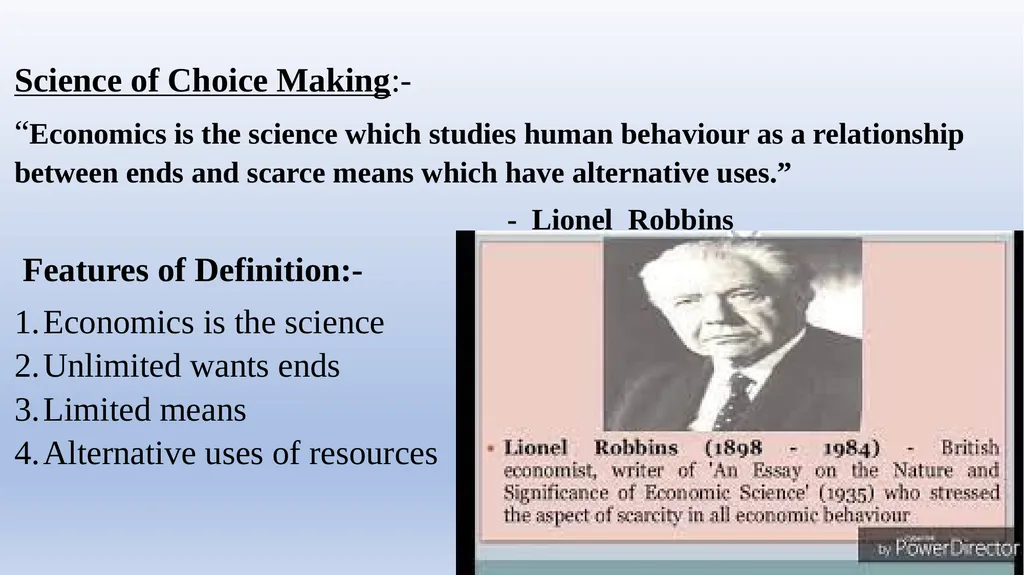
Science of Choice Making:-
“Economics is the science which studies human behaviour as a relationship between ends and scarce means which have alternative uses.”
- Lionel Robbins
Features of Definition:-
Economics is the science
Unlimited wants ends
Limited means
Alternative uses of resources<br>
12
Critics of the definition:
It does not emphasis either
on welfare or on material well being.
This approach is more scientific .
It emphasis on positive aspects of science.
This definition reduces the subject
matter by reducing it to theory of resource allocation.
Robbin does not take into account the possibility of increase in resources overtime<br>
13
Science of Dynamic Growth & Development:
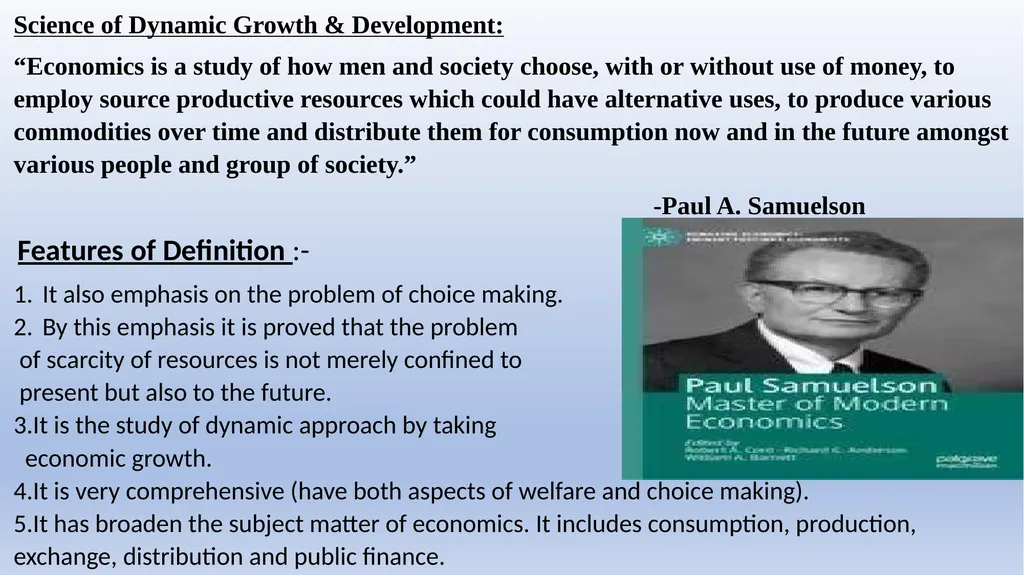
“Economics is a study of how men and society choose, with or without use of money, to employ source productive resources which could have alternative uses, to produce various commodities over time and distribute them for consumption now and in the future amongst various people and group of society.”
-Paul A. Samuelson
Features of Definition :-
It also emphasis on the problem of choice making.
By this emphasis it is proved that the problem
of scarcity of resources is not merely confined to
present but also to the future.
3.It is the study of dynamic approach by taking
economic growth.
4.It is very comprehensive (have both aspects of welfare and choice making).
5.It has broaden the subject matter of economics. It includes consumption, production, exchange, distribution and public finance.<br>
14
References
^ "Economics". Oxford Living Dictionaries. Oxford University Press.
^ "Economics". Merriam-Webster.
^ "economics". Oxford English Dictionary (Online ed.). Oxford University Press. (Subscription or participating institution membershiprequired.)
Smith, Adam (1776). An Inquiry into the Nature and Causes of the Wealth of Nations. and Book IV, as quoted in Groenwegen, Peter (2008). "Political Economy". In Durlauf, Steven N.; Blume, Lawrence E. (eds.). The New Palgrave Dictionary of Economics(second ed.). pp. 476–480. doi:10.1057/9780230226203.1300. ISBN 978-0-333-78676-5.
Marshall, Alfred (1890). Principles of Economics. Macmillan and Company. pp. 1–2.
^ Robbins, Lionel (2007) [1932]. An Essay on the Nature and Significance of Economic Science. Ludwig von Mises Institute. p. 15. ISBN 978-1-61016-039-1.
Further reading:
Samuelson, Paul A; Nordhaus, William D. (2014). Economics. Boston, Mass: Irwin McGraw-Hill.<br>