04
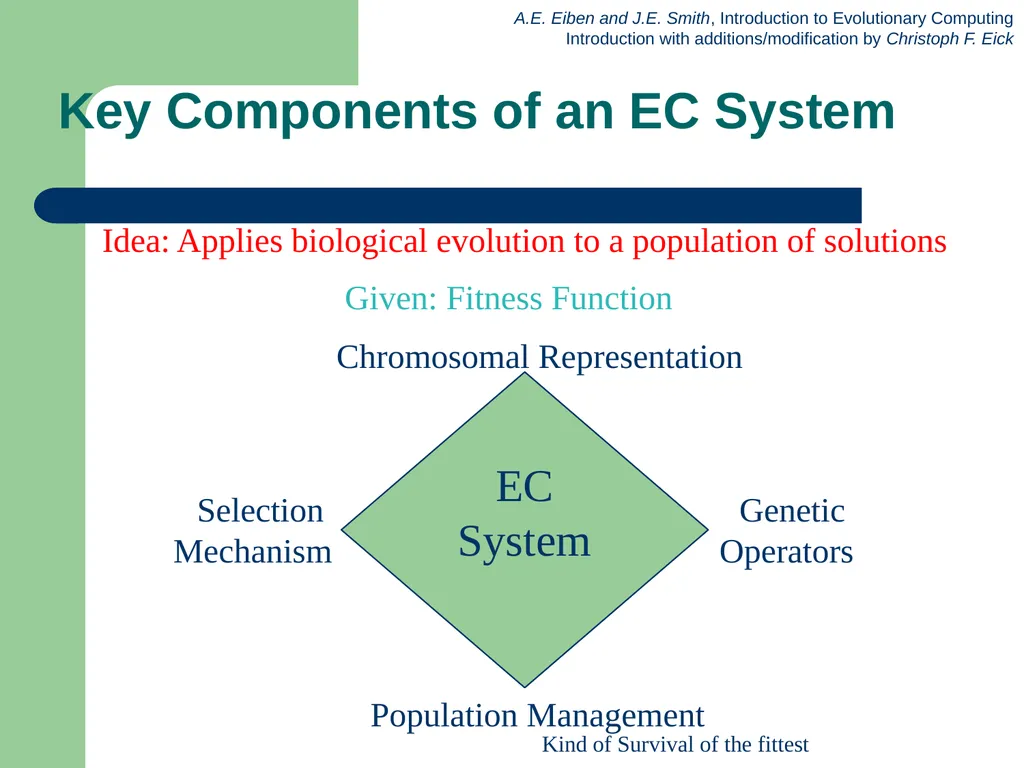
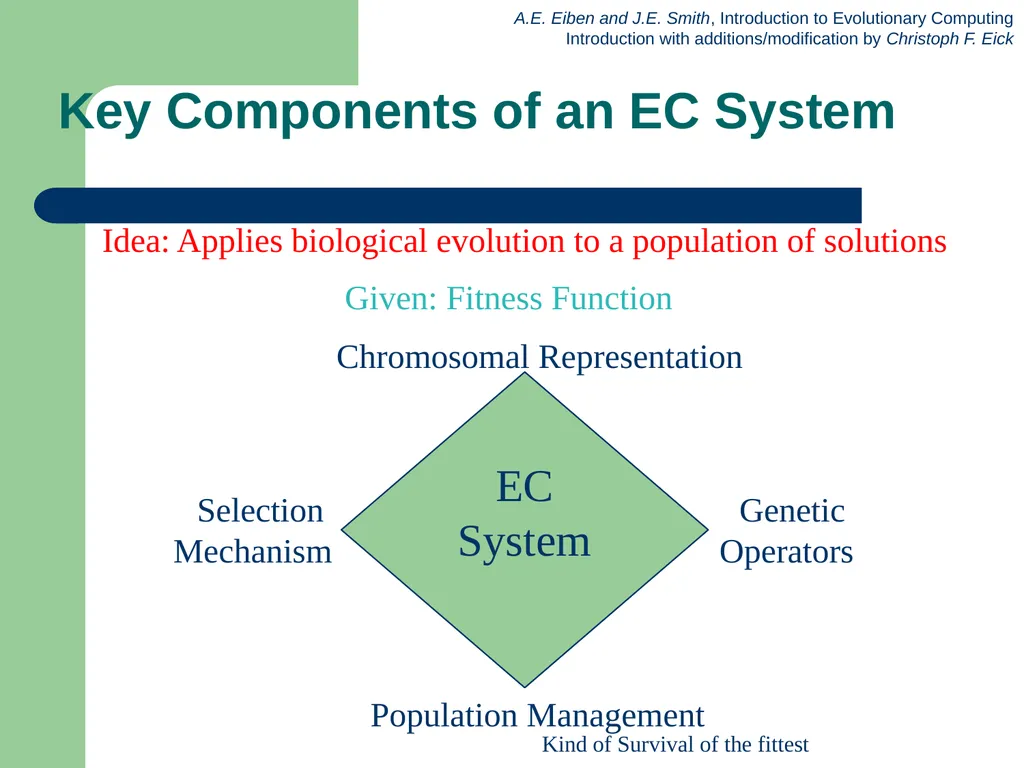
Key Components of an EC System EC
System Population Management Genetic
Operators Selection
Mechanism Chromosomal Representation Given: Fitness Function Kind of Survival of the fittest Idea: Applies biological evolution to a population of solutions<br>
05
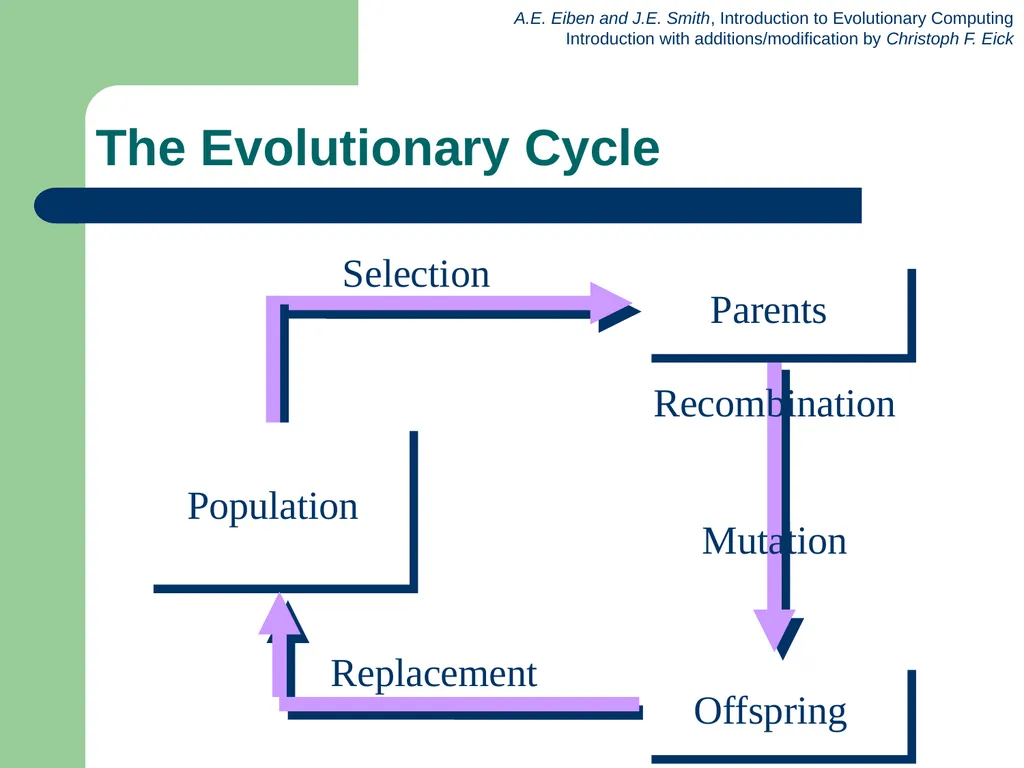
The Evolutionary Cycle Recombination Mutation Selection Replacement<br>
06
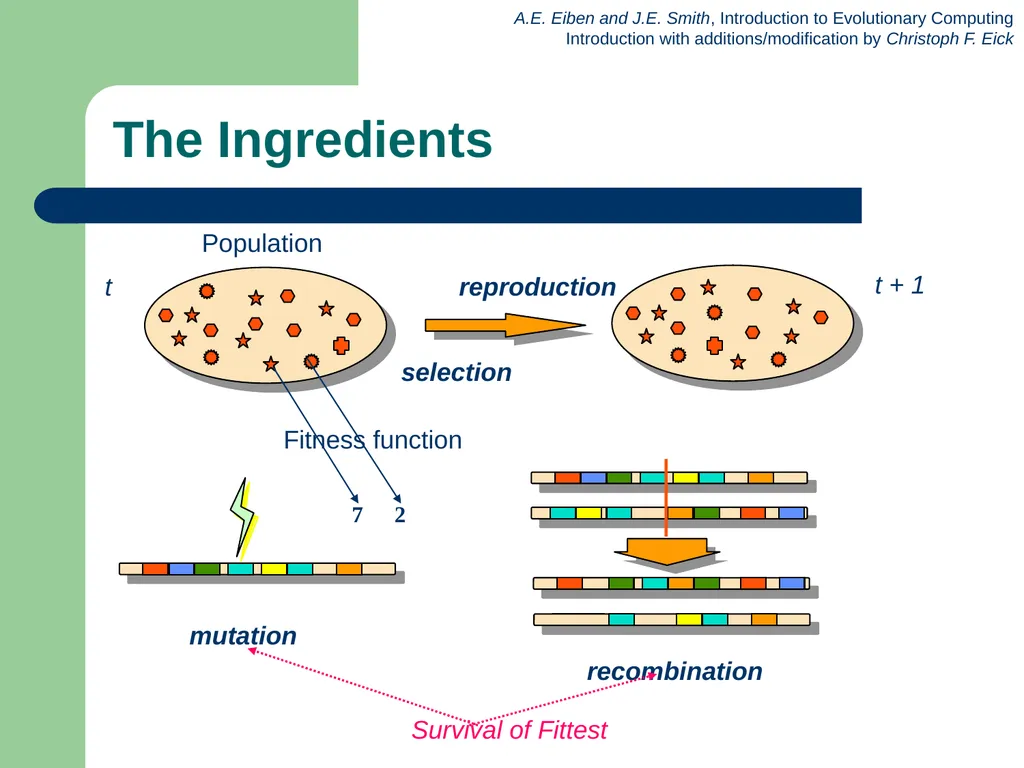
The Ingredients t t + 1 reproduction selection Fitness function 7 2 Population Survival of Fittest<br>
07
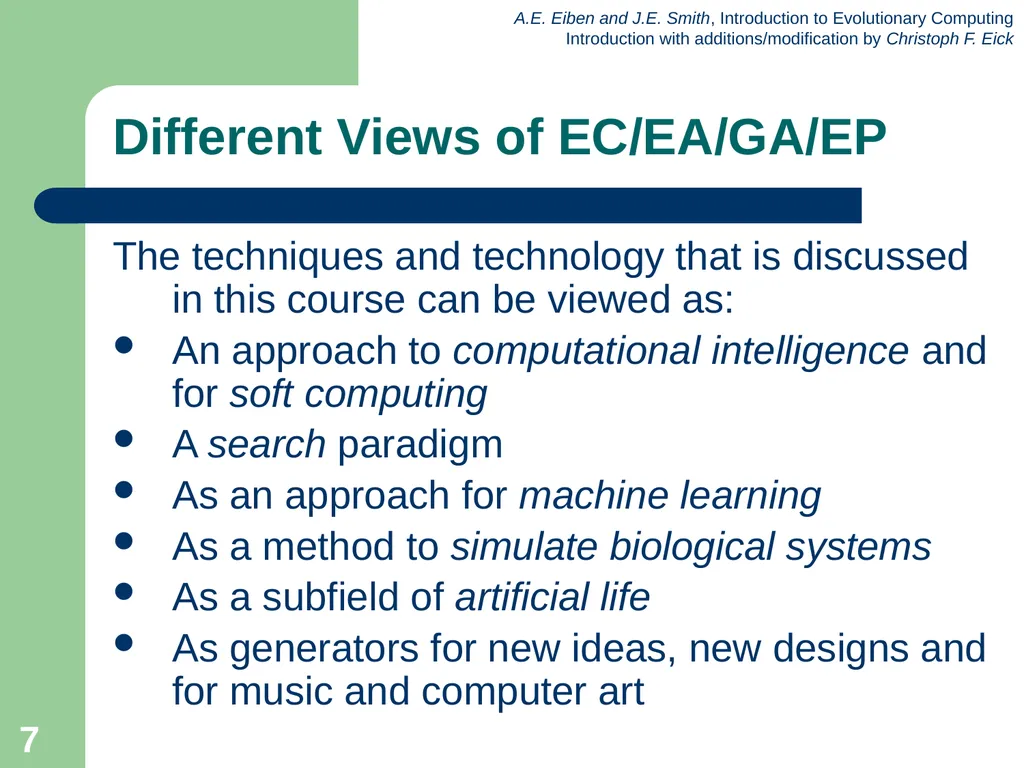
Different Views of EC/EA/GA/EP The techniques and technology that is discussed in this course can be viewed as:
An approach to computational intelligence and for soft computing
A search paradigm
As an approach for machine learning
As a method to simulate biological systems
As a subfield of artificial life
As generators for new ideas, new designs and for music and computer art 7<br>
08
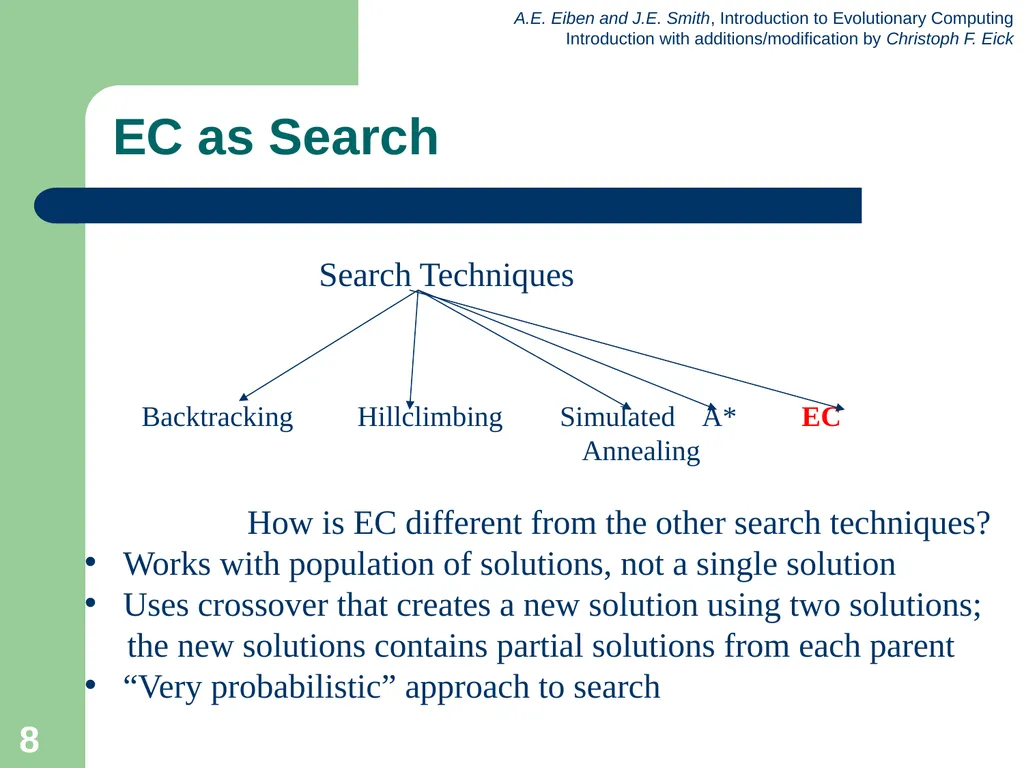
EC as Search Search Techniques Backtracking Hillclimbing Simulated A* EC
Annealing 8 How is EC different from the other search techniques?
Works with population of solutions, not a single solution
Uses crossover that creates a new solution using two solutions;
the new solutions contains partial solutions from each parent
“Very probabilistic” approach to search<br>
09
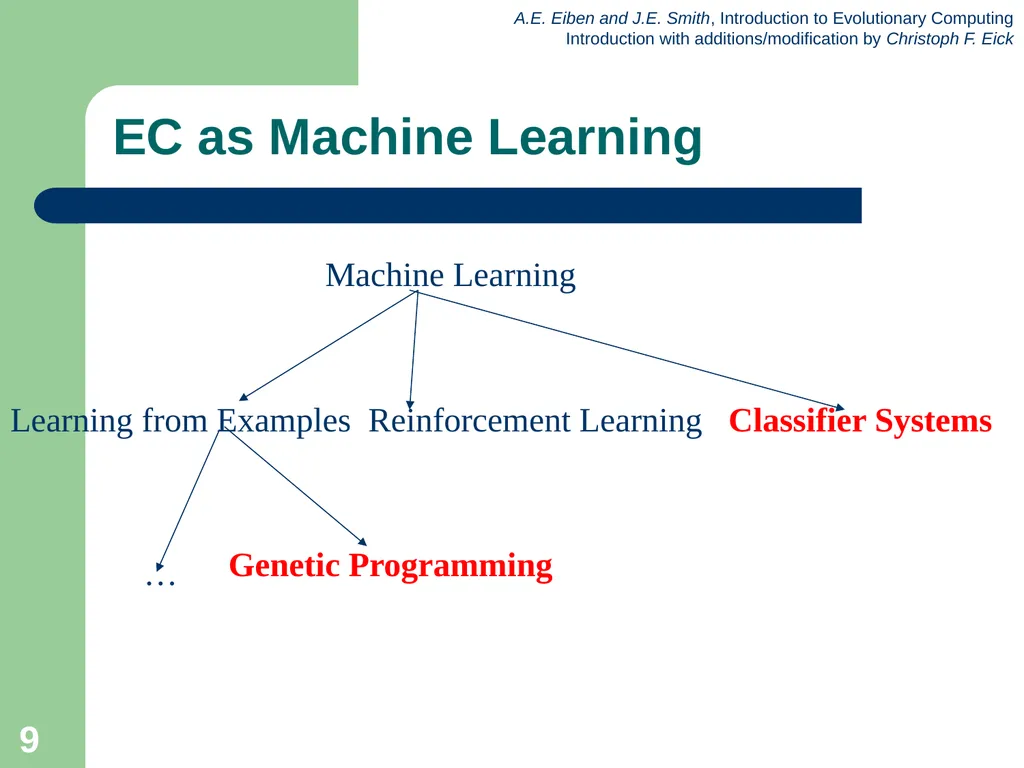
EC as Machine Learning Machine Learning Learning from Examples Reinforcement Learning Classifier Systems Genetic Programming … 9<br>
10
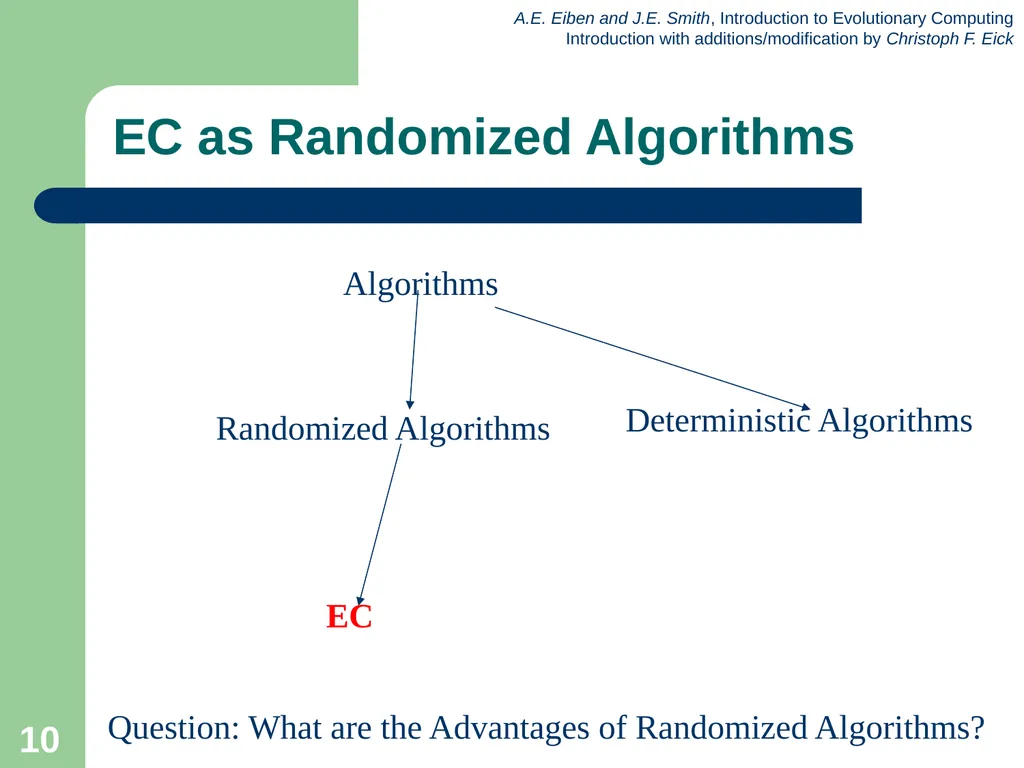
EC as Randomized Algorithms Algorithms Randomized Algorithms EC Deterministic Algorithms Question: What are the Advantages of Randomized Algorithms? 10<br>
11
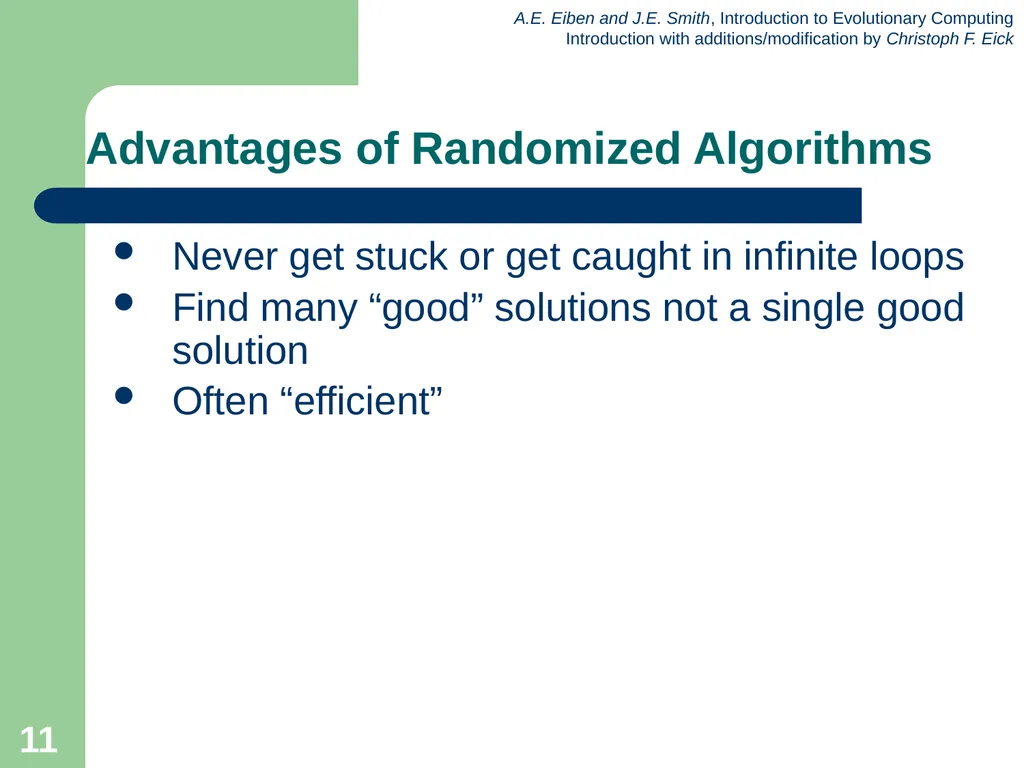
Advantages of Randomized Algorithms Never get stuck or get caught in infinite loops
Find many “good” solutions not a single good solution
Often “efficient” 11<br>
12
Key Components of an EC System EC
System Population Management Genetic
Operators Selection
Mechanism Chromosomal Representation Given: Fitness Function Kind of Survival of the fittest Idea: Applies biological evolution to a population of solutions<br>
13
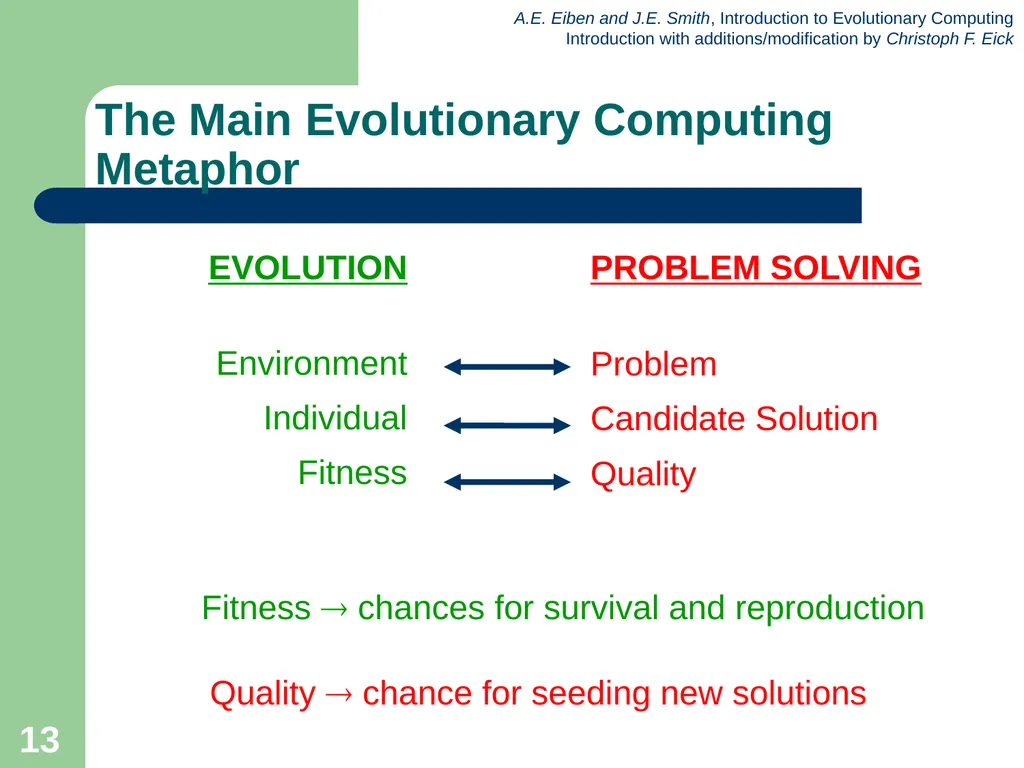
EVOLUTION
Environment
Individual
Fitness The Main Evolutionary Computing Metaphor PROBLEM SOLVING
Problem
Candidate Solution
Quality Quality chance for seeding new solutions Fitness chances for survival and reproduction 13<br>
14
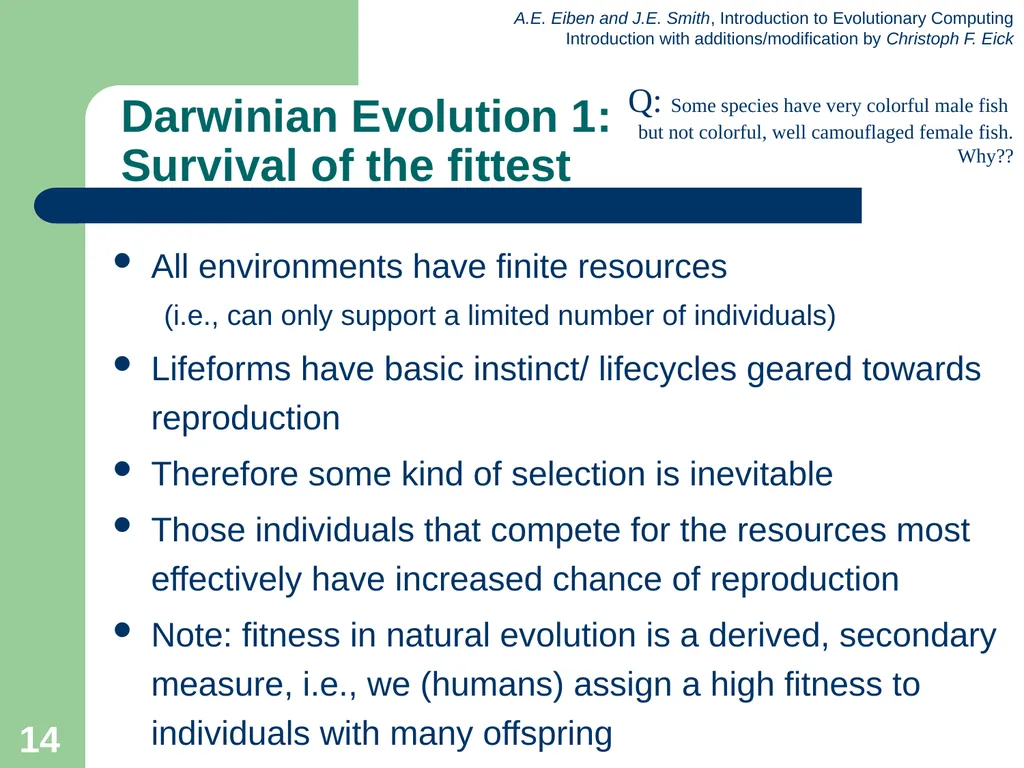
Darwinian Evolution 1: �Survival of the fittest All environments have finite resources
(i.e., can only support a limited number of individuals)
Lifeforms have basic instinct/ lifecycles geared towards reproduction
Therefore some kind of selection is inevitable
Those individuals that compete for the resources most effectively have increased chance of reproduction
Note: fitness in natural evolution is a derived, secondary measure, i.e., we (humans) assign a high fitness to individuals with many offspring 14 Q: Some species have very colorful male fish
but not colorful, well camouflaged female fish.
Why??<br>
15
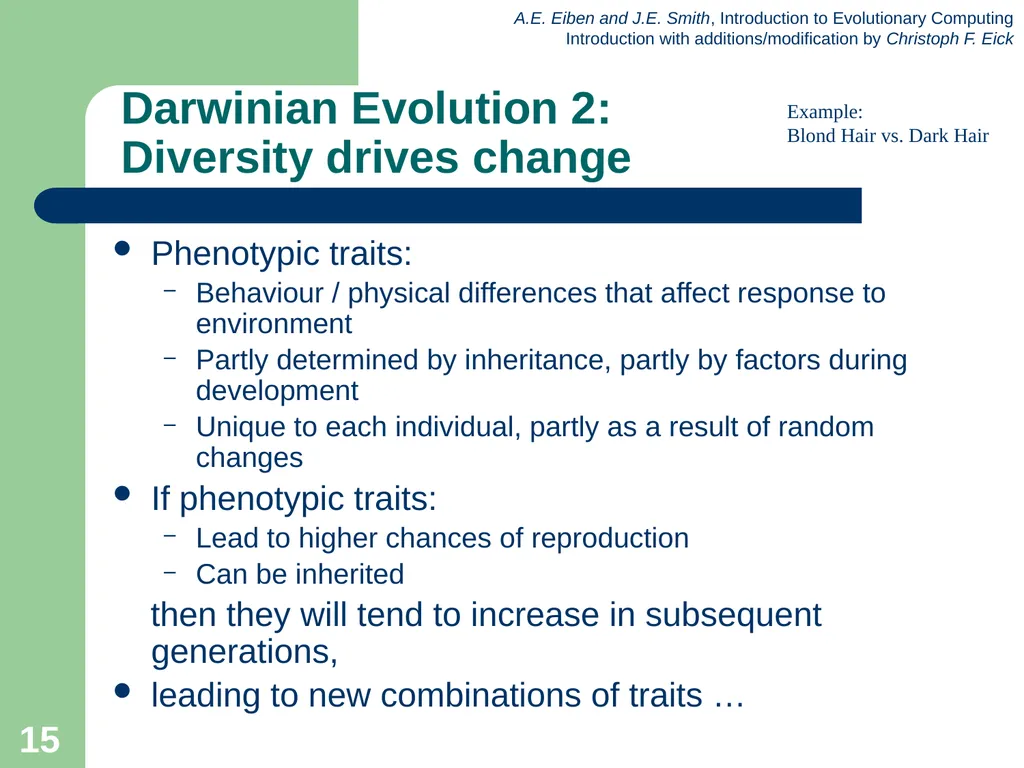
Darwinian Evolution 2: �Diversity drives change Phenotypic traits:
Behaviour / physical differences that affect response to environment
Partly determined by inheritance, partly by factors during development
Unique to each individual, partly as a result of random changes
If phenotypic traits:
Lead to higher chances of reproduction
Can be inherited
then they will tend to increase in subsequent generations,
leading to new combinations of traits … 15 Example:
Blond Hair vs. Dark Hair<br>
16
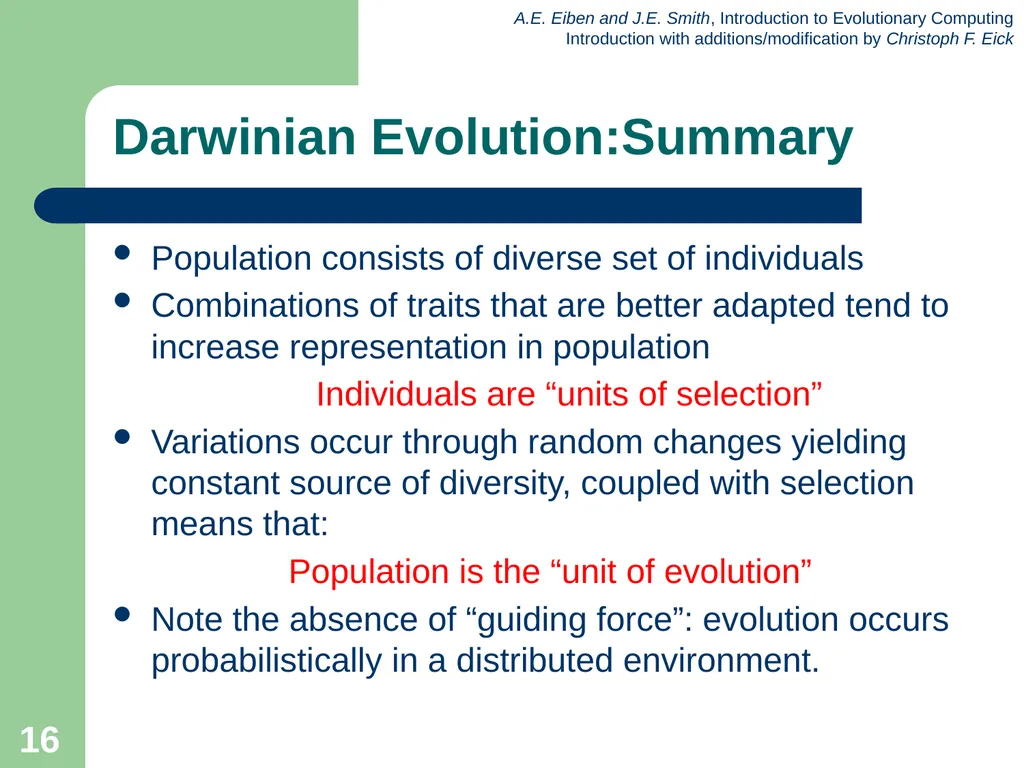
Darwinian Evolution:Summary Population consists of diverse set of individuals
Combinations of traits that are better adapted tend to increase representation in population
Individuals are “units of selection”
Variations occur through random changes yielding constant source of diversity, coupled with selection means that:
Population is the “unit of evolution”
Note the absence of “guiding force”: evolution occurs probabilistically in a distributed environment. 16<br>
17
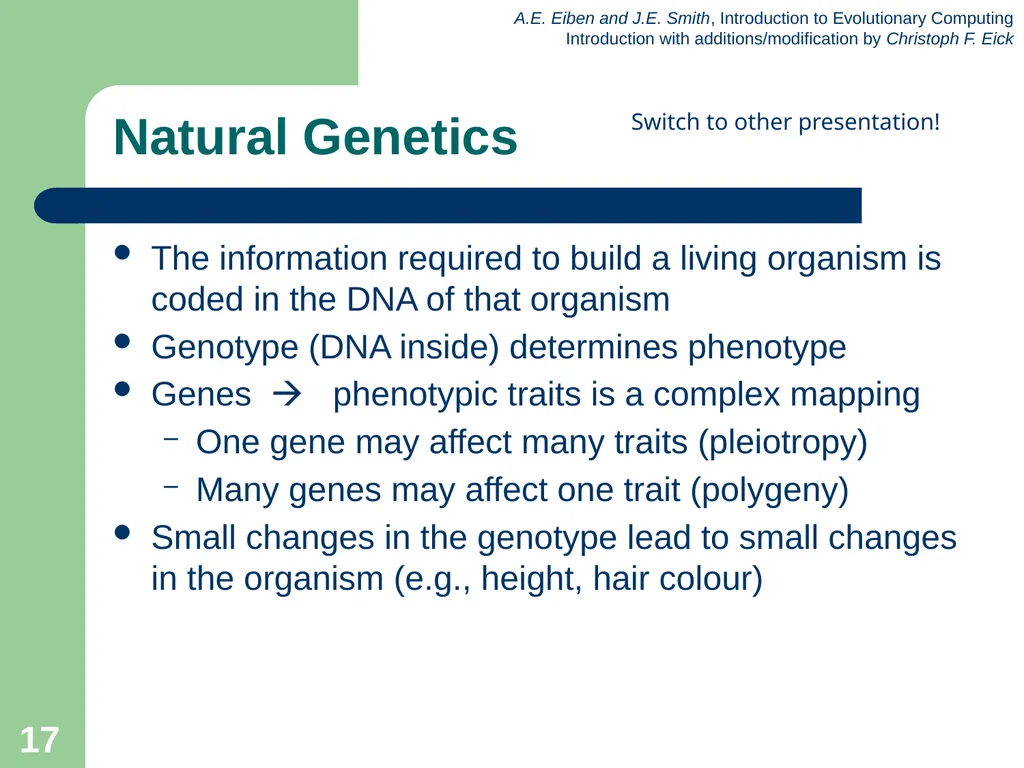
Natural Genetics The information required to build a living organism is coded in the DNA of that organism
Genotype (DNA inside) determines phenotype
Genes phenotypic traits is a complex mapping
One gene may affect many traits (pleiotropy)
Many genes may affect one trait (polygeny)
Small changes in the genotype lead to small changes in the organism (e.g., height, hair colour) 17 Switch to other presentation!<br>
18
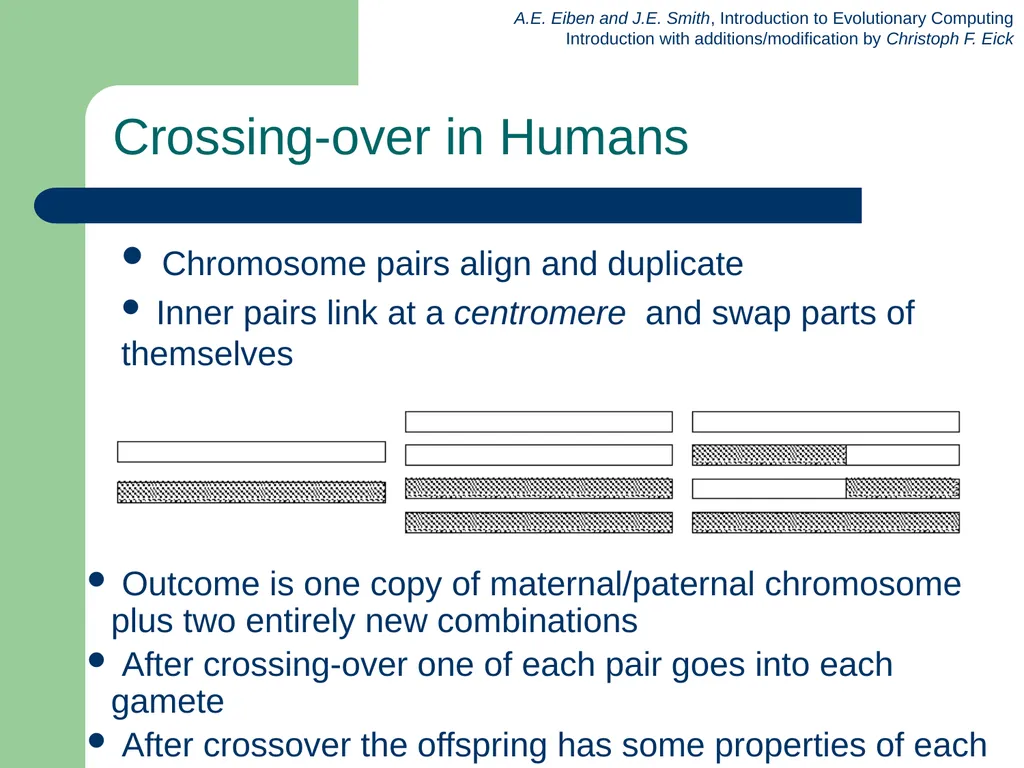
Crossing-over in Humans Chromosome pairs align and duplicate
Inner pairs link at a centromere and swap parts of themselves Outcome is one copy of maternal/paternal chromosome plus two entirely new combinations
After crossing-over one of each pair goes into each gamete
After crossover the offspring has some properties of each parent<br>
19
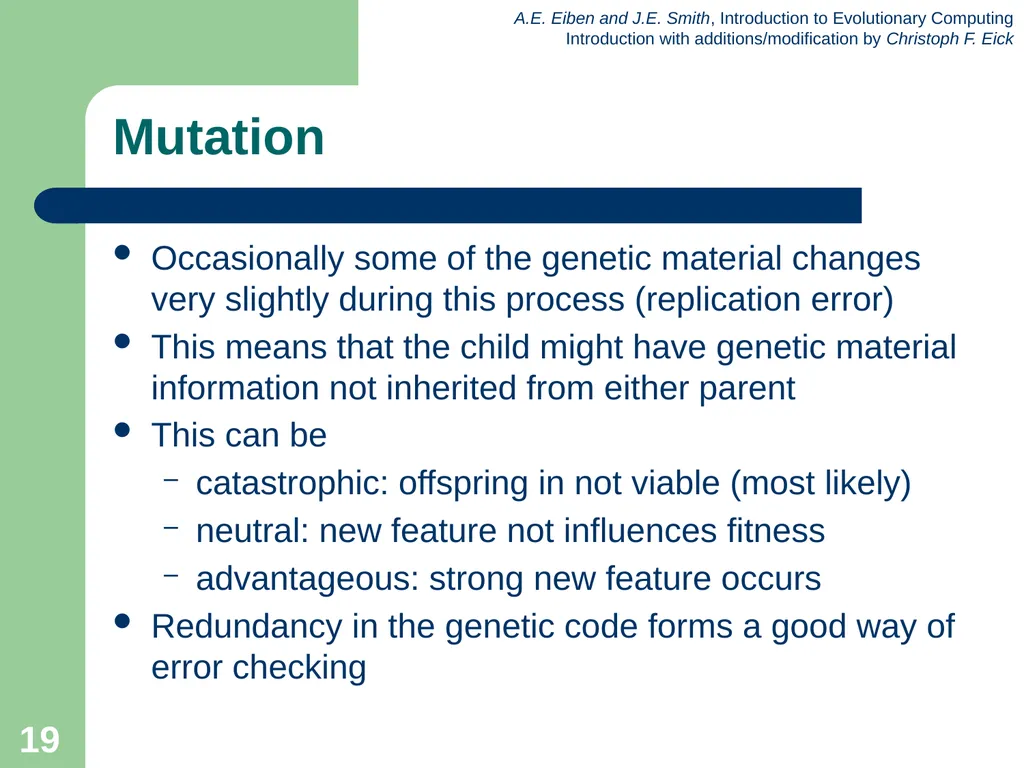
Mutation Occasionally some of the genetic material changes very slightly during this process (replication error)
This means that the child might have genetic material information not inherited from either parent
This can be
catastrophic: offspring in not viable (most likely)
neutral: new feature not influences fitness
advantageous: strong new feature occurs
Redundancy in the genetic code forms a good way of error checking 19<br>
20
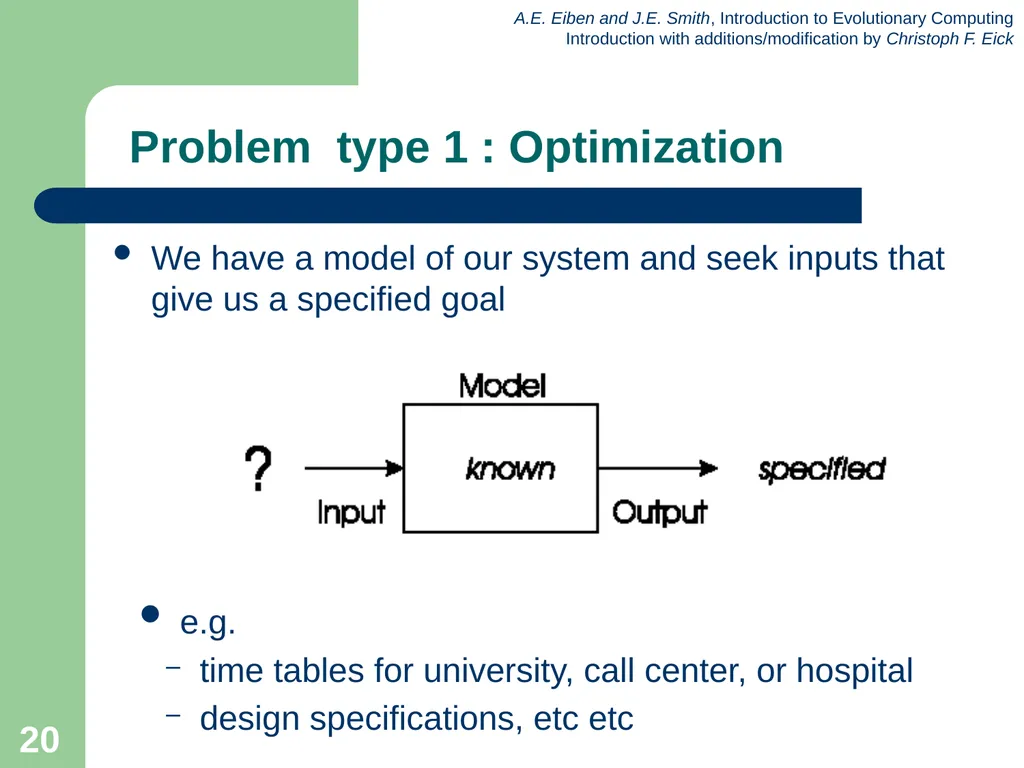
Problem type 1 : Optimization We have a model of our system and seek inputs that give us a specified goal e.g.
time tables for university, call center, or hospital
design specifications, etc etc 20<br>
21
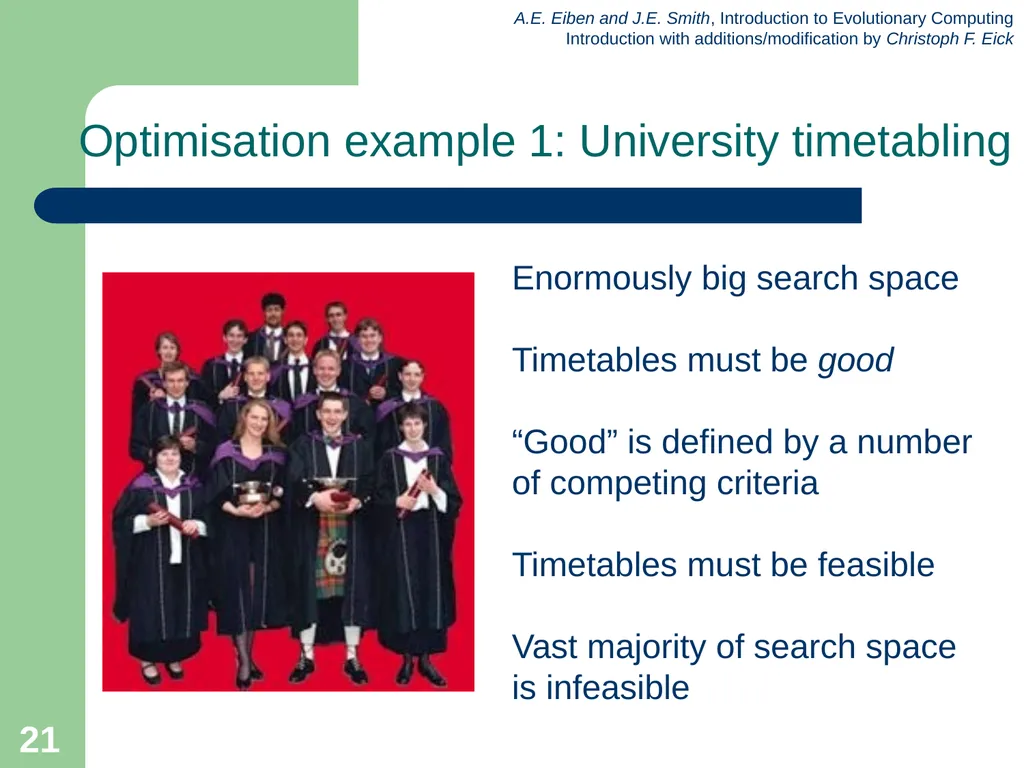
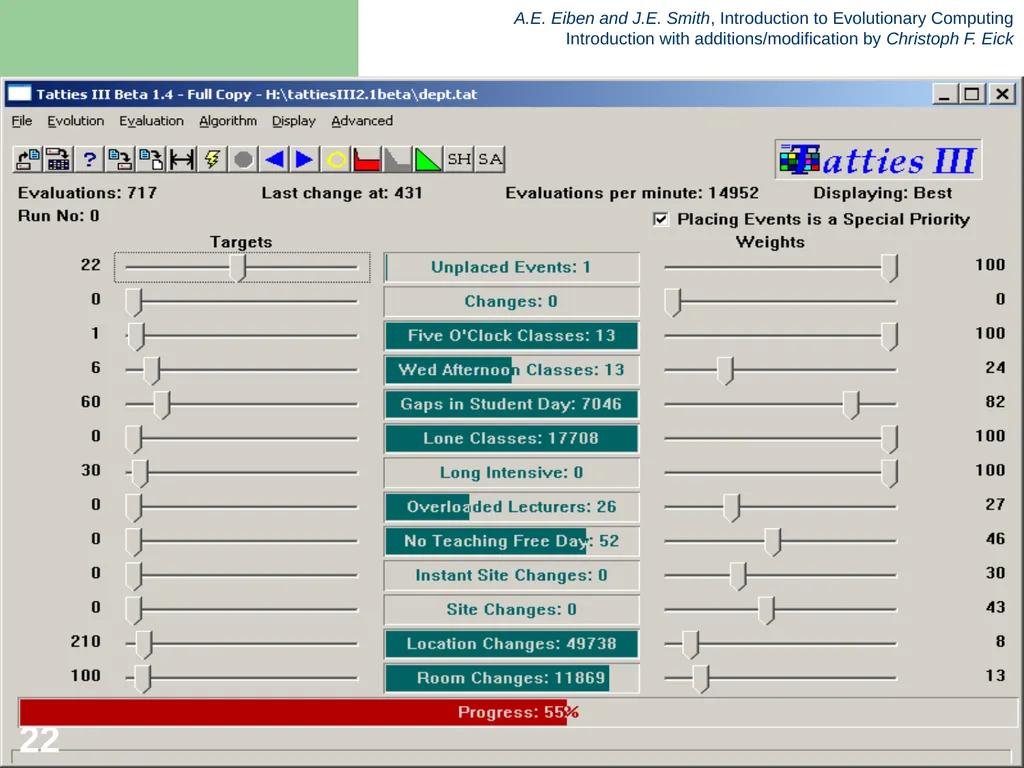
Optimisation example 1: University timetabling Enormously big search space
Timetables must be good
“Good” is defined by a number of competing criteria
Timetables must be feasible
Vast majority of search space is infeasible 21<br>
23
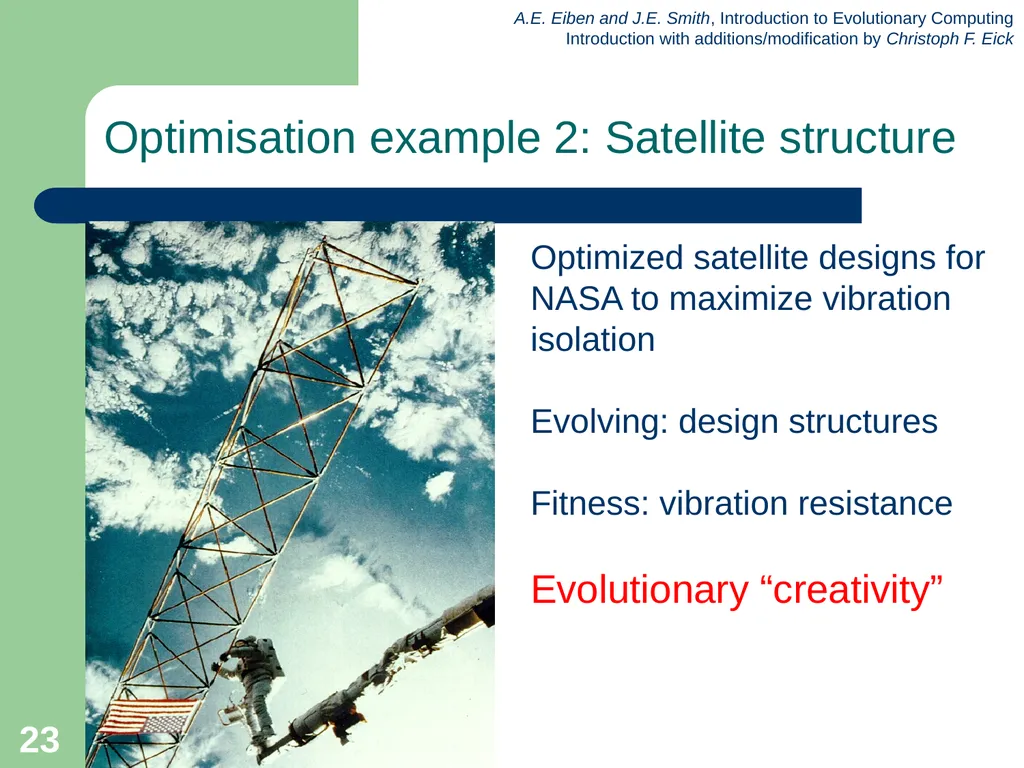
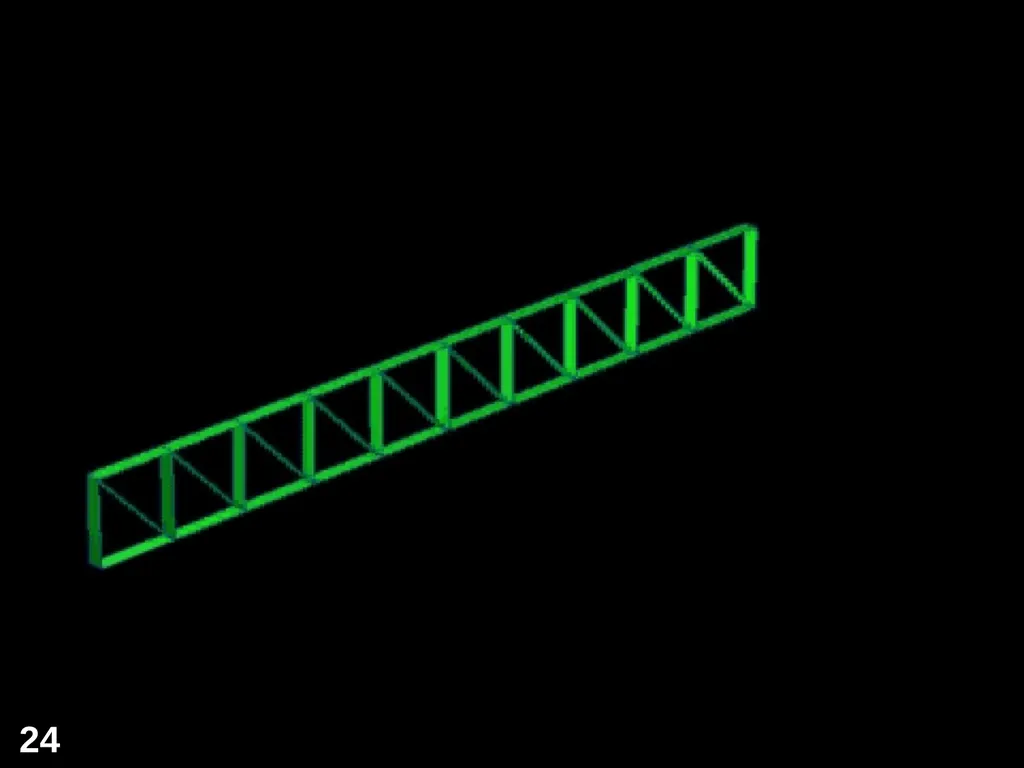
Optimisation example 2: Satellite structure Optimized satellite designs for NASA to maximize vibration isolation
Evolving: design structures
Fitness: vibration resistance
Evolutionary “creativity” 23<br>
25
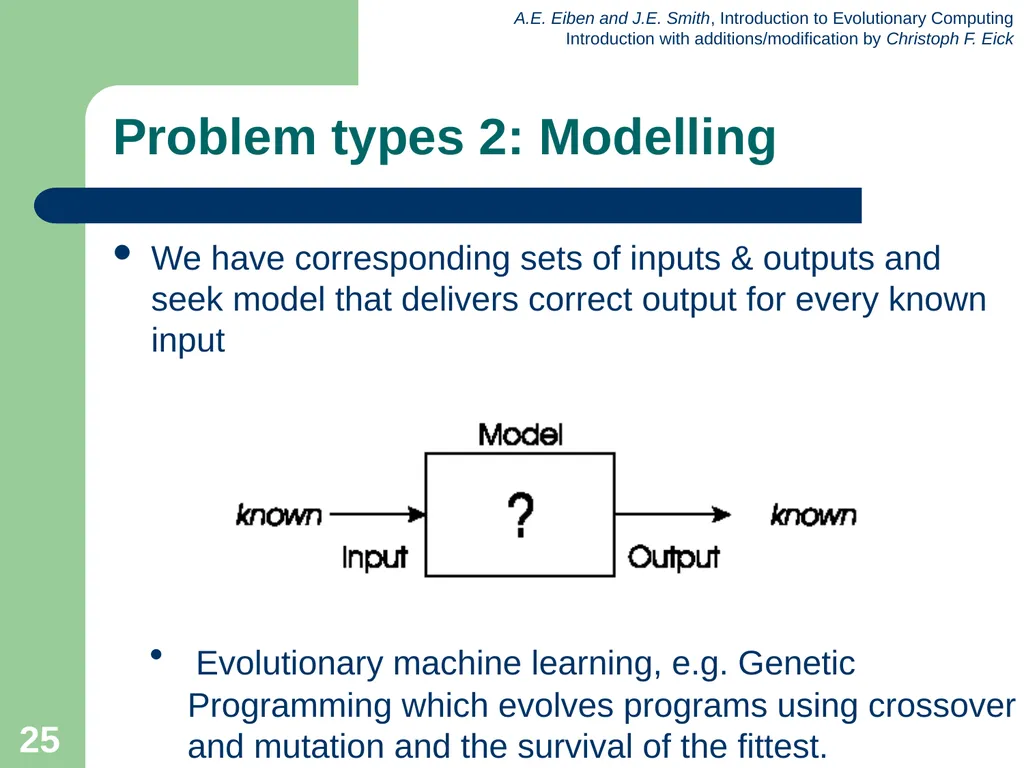
Problem types 2: Modelling We have corresponding sets of inputs & outputs and seek model that delivers correct output for every known input Evolutionary machine learning, e.g. Genetic
Programming which evolves programs using crossover
and mutation and the survival of the fittest. 25<br>
26
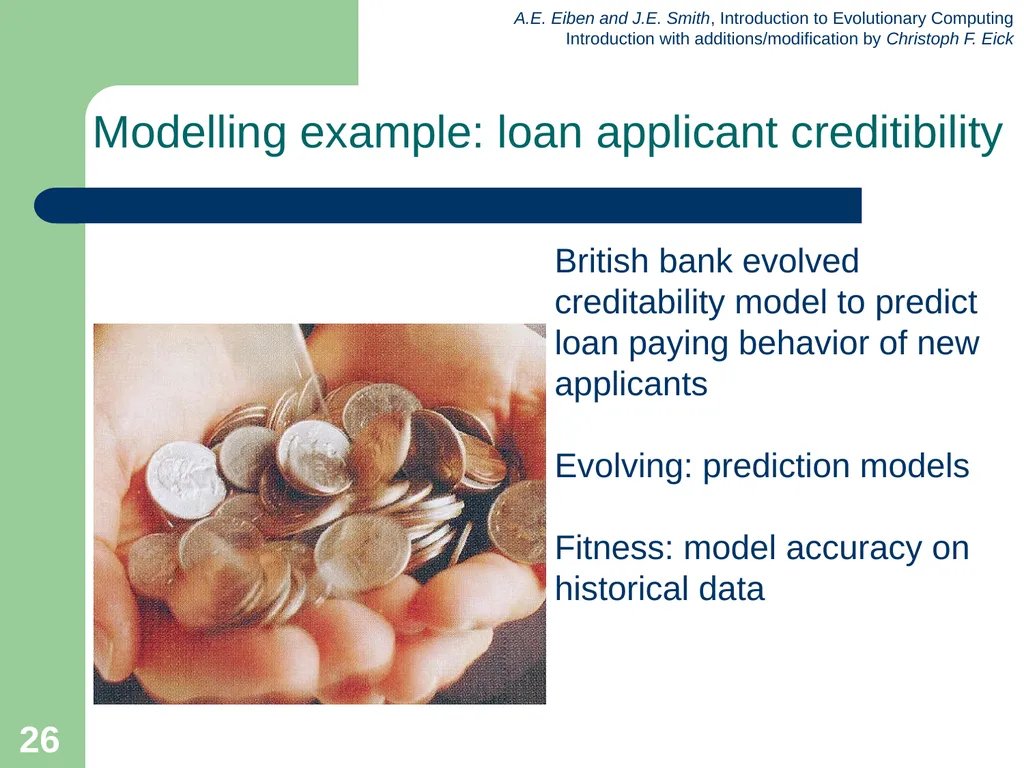
Modelling example: loan applicant creditibility British bank evolved creditability model to predict loan paying behavior of new applicants
Evolving: prediction models
Fitness: model accuracy on
historical data 26<br>
27
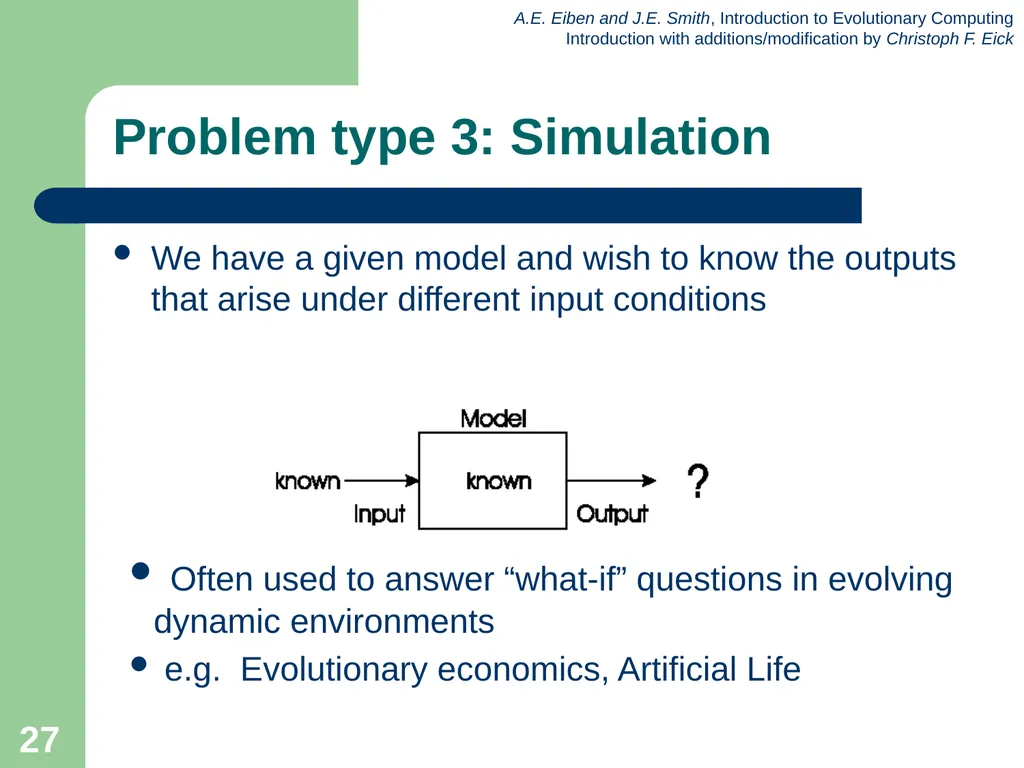
Problem type 3: Simulation We have a given model and wish to know the outputs that arise under different input conditions Often used to answer “what-if” questions in evolving dynamic environments
e.g. Evolutionary economics, Artificial Life 27<br>
28
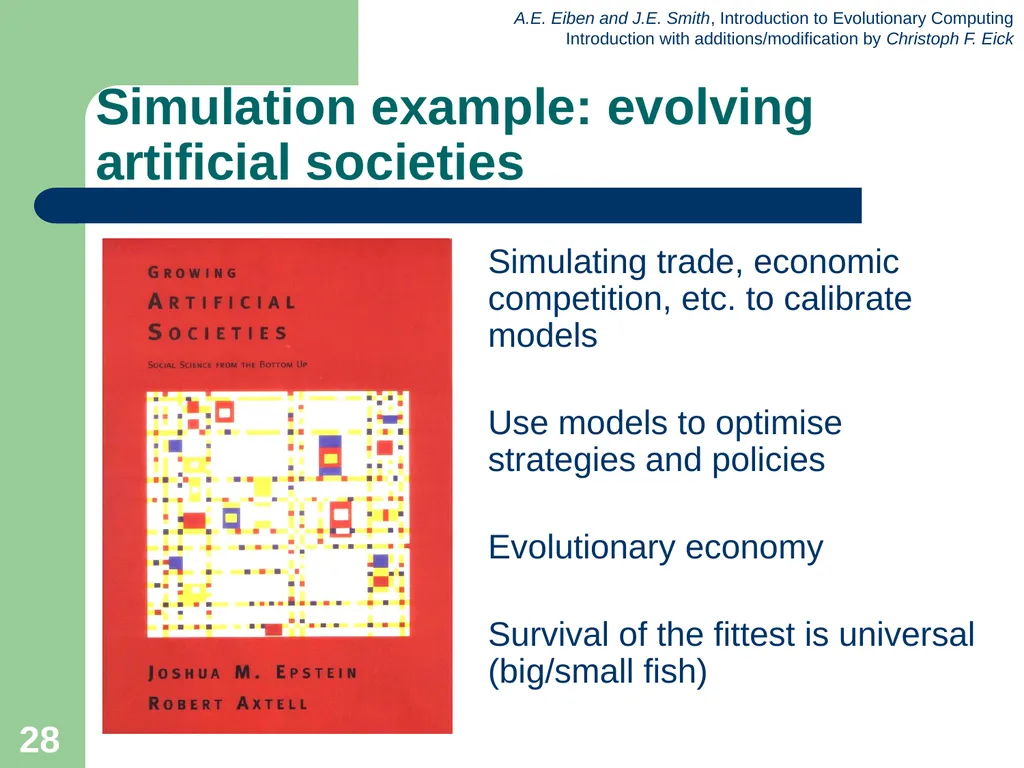
Simulation example: evolving artificial societies Simulating trade, economic competition, etc. to calibrate models
Use models to optimise strategies and policies
Evolutionary economy
Survival of the fittest is universal (big/small fish) 28<br>
29
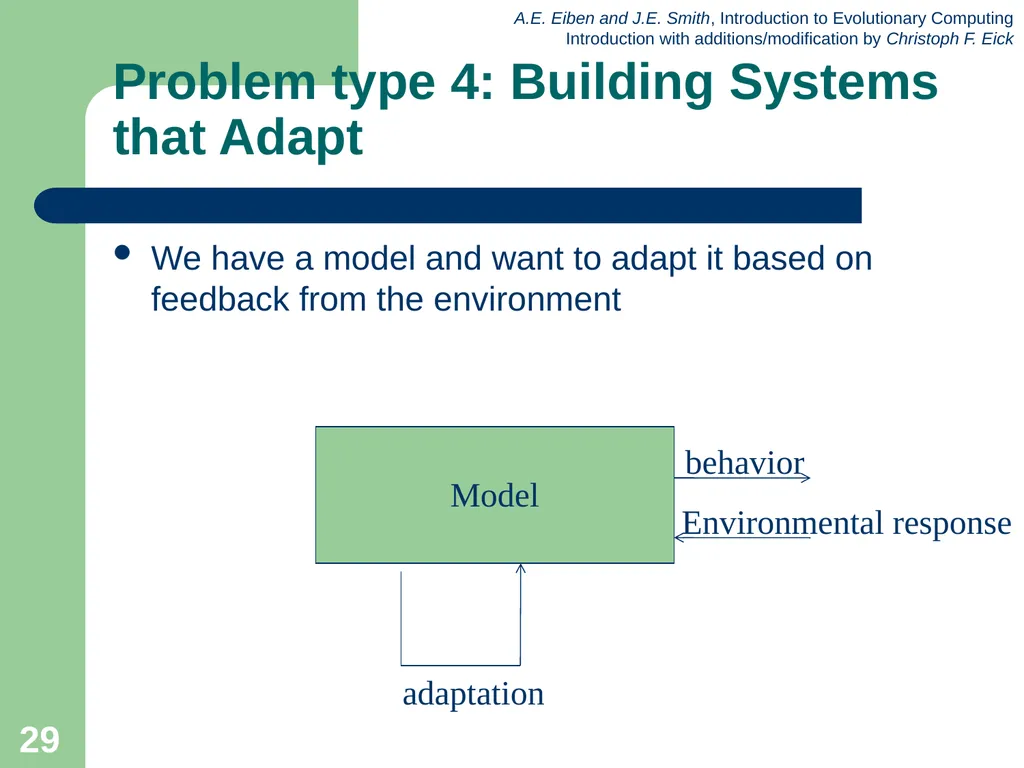
Problem type 4: Building Systems that Adapt We have a model and want to adapt it based on feedback from the environment Model behavior Environmental response adaptation 29<br>
30
Example Problem type 4: Poker Systems that Play Poker
… 30<br>
31
What is unique about EC? EC approaches work on multiple solutions in parallel (a complete population) and not a single solution.
Employ crossover operators which take 2 solutions and create a new solution which shares some properties with the parent solution; traditional search techniques only employ mutation operators.
Can solve problems for which fitness functions are neither differentiable nor continuous. Can operate on symbolic or integer-valued fitness functions.
They employ probabilistic, non-deterministic search strategies which are capable to find different good solutions in a single or in different runs.
They are based on the survival of the fittest: the genetic material of fitter solutions is recombined with a higher probability. Christoph F. Eick<br>