
Introduction to Frankenstein © The English
OM
Published · 32 slides · 0 views

1 / 1





Description
Introduction to Frankenstein The English Teachers Pet http:www.teacherspayteachers.comStoreThe-Englishteachers-Pet Mary Shelley Mary Shelley was born on August 30, 1797,in London, England. She was the daughter of a politically
Related Topics
Share
Embed code
Download this presentation From Below
"Introduction to Frankenstein © The English" is the property of its rightful owner. Permission is granted to download and print the materials on this website for personal, non-commercial use only, and to display it on your personal computer provided you do not modify the materials and that you retain all copyright notices contained in the materials. By downloading content from our website, you accept the terms of this agreement.
Presentation Transcript
01
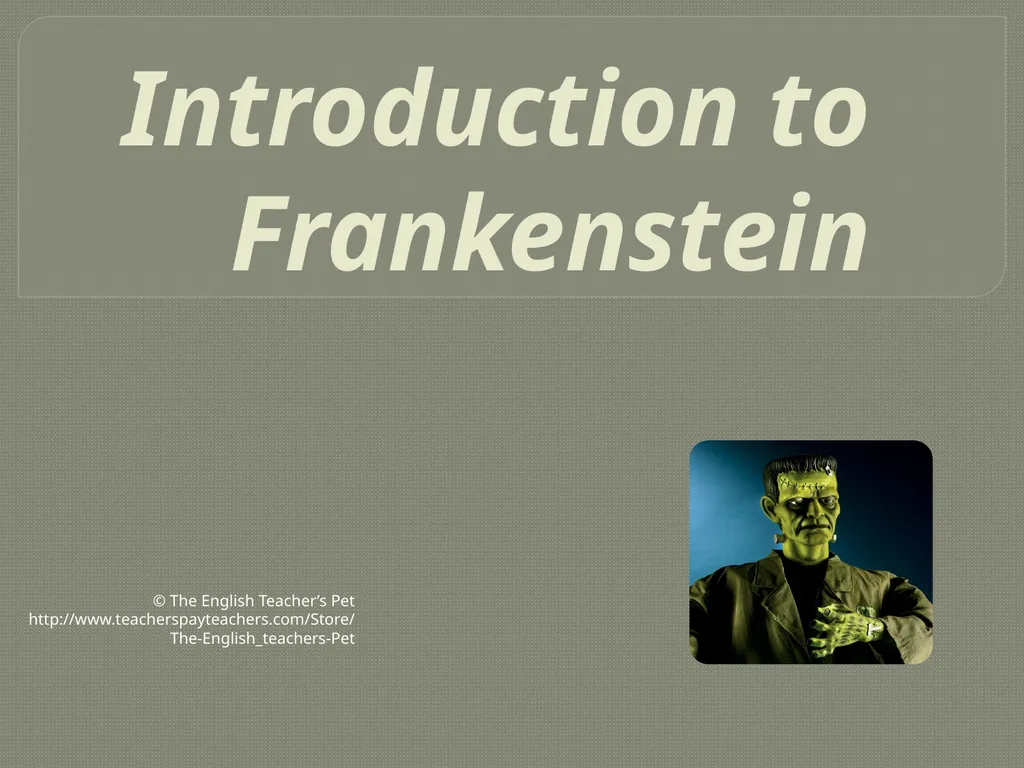
Introduction to Frankenstein © The English Teacher’s Pet
http://www.teacherspayteachers.com/Store/The-English_teachers-Pet<br>
http://www.teacherspayteachers.com/Store/The-English_teachers-Pet<br>
02
Mary Shelley Mary Shelley was born on August 30, 1797,in London, England.
She was the daughter of a politically radical, literary couple
Her father, William Godwin, was a philosopher and writer. Her mother, Mary Wollenstonecraft Godwin, was well-known for her feminist views.
Mary never knew her mother, as she died a few days after giving birth.
Mary Shelley received no formal early education. Instead, she was taught at home by her father.
When she was seventeen, Mary eloped to France with noted poet Percy Bysshe Shelley.
Mary and Percy Shelley spent the summer of 1816 in Switzerland, and were neighbors to Lord Byron, a famous poet.
It was during this time that she began writing Frankenstein.<br>
03
In the summer of 1816, Mary, Percy and some other famous authors went to the Swiss Alps. Unseasonable rain kept them trapped inside their lodgings, where they entertained themselves by reading ghost stories. At the urging of renowned poet Lord Byron, a friend and neighbor, they set their own pens to paper, competing to see who could write the best ghost story. The young woman, Mary Wollstonecraft Godwin, took the prize, having composed a story creepy enough not only to take its place alongside the old German tales that she and her Alpine companions had been reading, but also to become a bestseller in her time and a Gothic classic that still resonates with readers almost two centuries later.<br>
04
The Premise – Creation of Man Shelley's story did not come out of nowhere. Scientists and physicians of her time explored life and death through experiments with lower organisms, human anatomical studies, attempts to resuscitate drowning victims, and experiments using electricity to restore life to the recently dead.<br>
05
LITERARY PARALLELS<br>
06
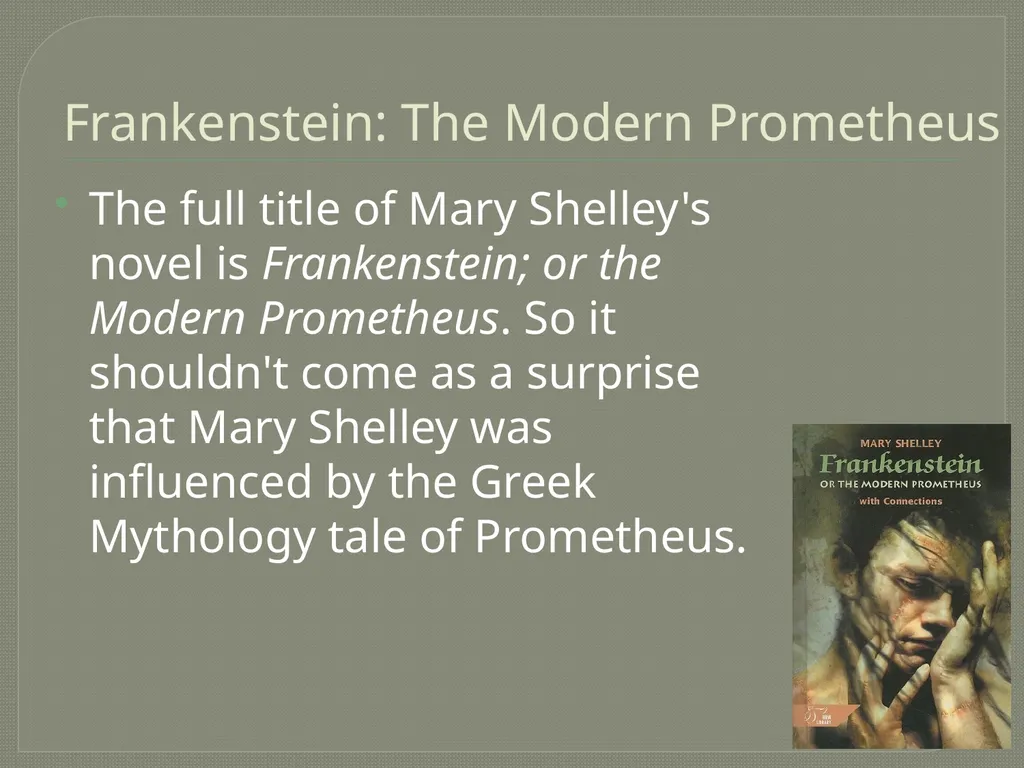
Frankenstein: The Modern Prometheus The full title of Mary Shelley's novel is Frankenstein; or the Modern Prometheus. So it shouldn't come as a surprise that Mary Shelley was influenced by the Greek Mythology tale of Prometheus.<br>
07
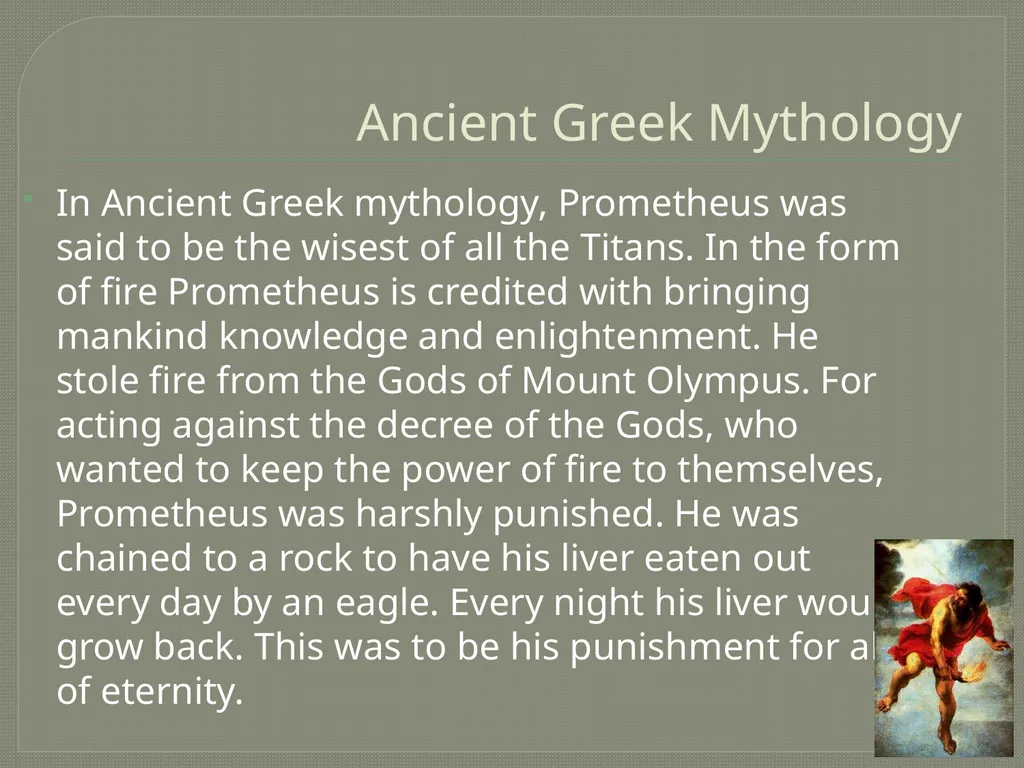
Ancient Greek Mythology In Ancient Greek mythology, Prometheus was said to be the wisest of all the Titans. In the form of fire Prometheus is credited with bringing mankind knowledge and enlightenment. He stole fire from the Gods of Mount Olympus. For acting against the decree of the Gods, who wanted to keep the power of fire to themselves, Prometheus was harshly punished. He was chained to a rock to have his liver eaten out every day by an eagle. Every night his liver would grow back. This was to be his punishment for all of eternity.<br>
08
The Structure The story is told through three intertwined stories:
Captain Robert Walton’s letters home to his sister bookend the story
The narrative related by Victor Frankenstein to Captain Walton is in between the letters
The Creature’s story is central in the novel<br>
Captain Robert Walton’s letters home to his sister bookend the story
The narrative related by Victor Frankenstein to Captain Walton is in between the letters
The Creature’s story is central in the novel<br>
09
Walton Shows us the Moral Walton’s story of his voyage to the Pole is a similar tale for the reader confronting the story of Frankenstein
Parallel situation between Walton and Frankenstein – each has a solitary nature, feels largely self-educated, is obsessed with their ‘quest’ and suffers from hubris
Frankenstein’s narrative warns Walton of the price payable for egocentric obsessions<br>
Parallel situation between Walton and Frankenstein – each has a solitary nature, feels largely self-educated, is obsessed with their ‘quest’ and suffers from hubris
Frankenstein’s narrative warns Walton of the price payable for egocentric obsessions<br>
10
The Creature’s Story This communicates a number of views and values
Uses religious/philosophical ideal that man is essentially good – the creature is like Satan, the fallen angel
His passionate responses to nature are typically Romantic (literary era)
Isolation and loneliness are no good spiritually (much like when Frankenstein isolates himself with his science)<br>
11
Evidentiary Narrative Technique This occurs when the story is told from a number of different perspectives who all view the same events differently.
We have three narrators (when most novels have one) and also letters from other characters<br>
We have three narrators (when most novels have one) and also letters from other characters<br>
12
KEY IDEAS<br>
13
KNOWLEDGE Victor seeks knowledge for his own reasons
Does not consider the ramifications
Walton is a similar character to Frankenstein, just not as dangerously progressed
Victor focused on Alchemy before going to his university and learning about new sciences<br>
Does not consider the ramifications
Walton is a similar character to Frankenstein, just not as dangerously progressed
Victor focused on Alchemy before going to his university and learning about new sciences<br>
14
EDUCATION Romantics favored a ‘natural’ education through reading and adventures, providing self-growth, rather than a formal education in schools.
Walton is self-educated: “my education was neglected, yet I was passionately fond of reading.”
The Creature learns from the DeLacey’s non-formal schooling<br>
Walton is self-educated: “my education was neglected, yet I was passionately fond of reading.”
The Creature learns from the DeLacey’s non-formal schooling<br>
15
PARENTHOOD/FAMILY Author Shelley loses her mother early
Elizabeth’s mother died early during childbirth
Victor does not care for the Creature he ‘parented’ (Victor is the real monster – he neglects his own ‘child’)
Critiques the notion of the individual, of solitariness and introversion, which at the time was being expressed positively<br>
Elizabeth’s mother died early during childbirth
Victor does not care for the Creature he ‘parented’ (Victor is the real monster – he neglects his own ‘child’)
Critiques the notion of the individual, of solitariness and introversion, which at the time was being expressed positively<br>
16
GENRE<br>
17
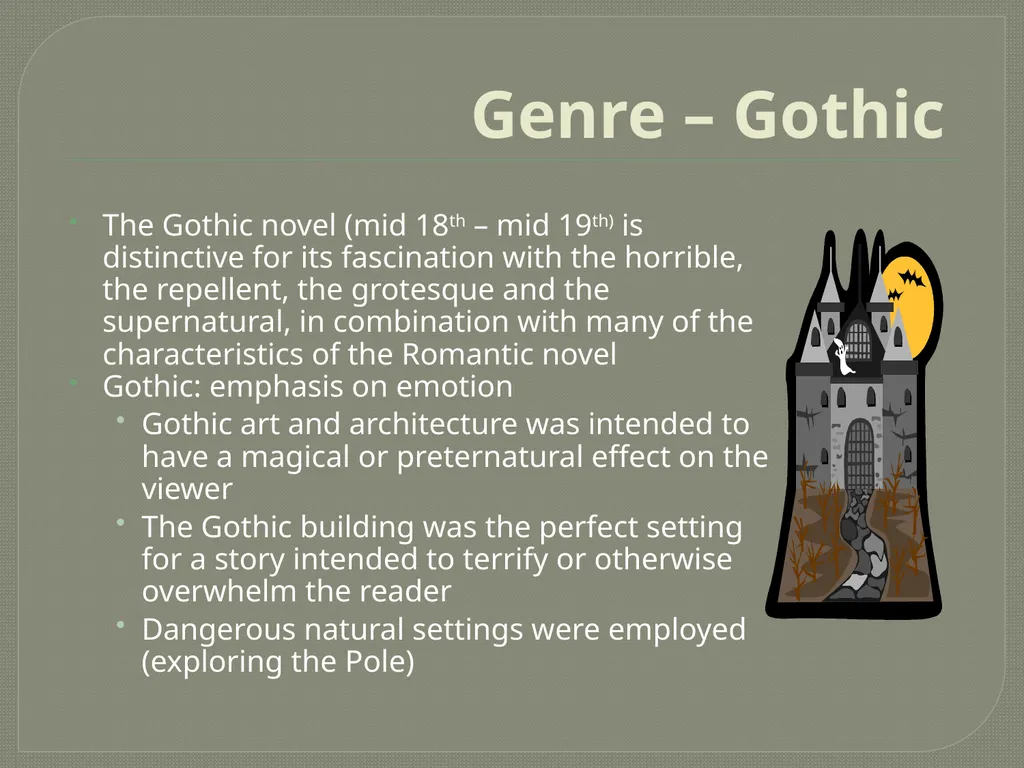
Genre – Gothic The Gothic novel (mid 18th – mid 19th) is distinctive for its fascination with the horrible, the repellent, the grotesque and the supernatural, in combination with many of the characteristics of the Romantic novel
Gothic: emphasis on emotion
Gothic art and architecture was intended to have a magical or preternatural effect on the viewer
The Gothic building was the perfect setting for a story intended to terrify or otherwise overwhelm the reader
Dangerous natural settings were employed (exploring the Pole)<br>
18
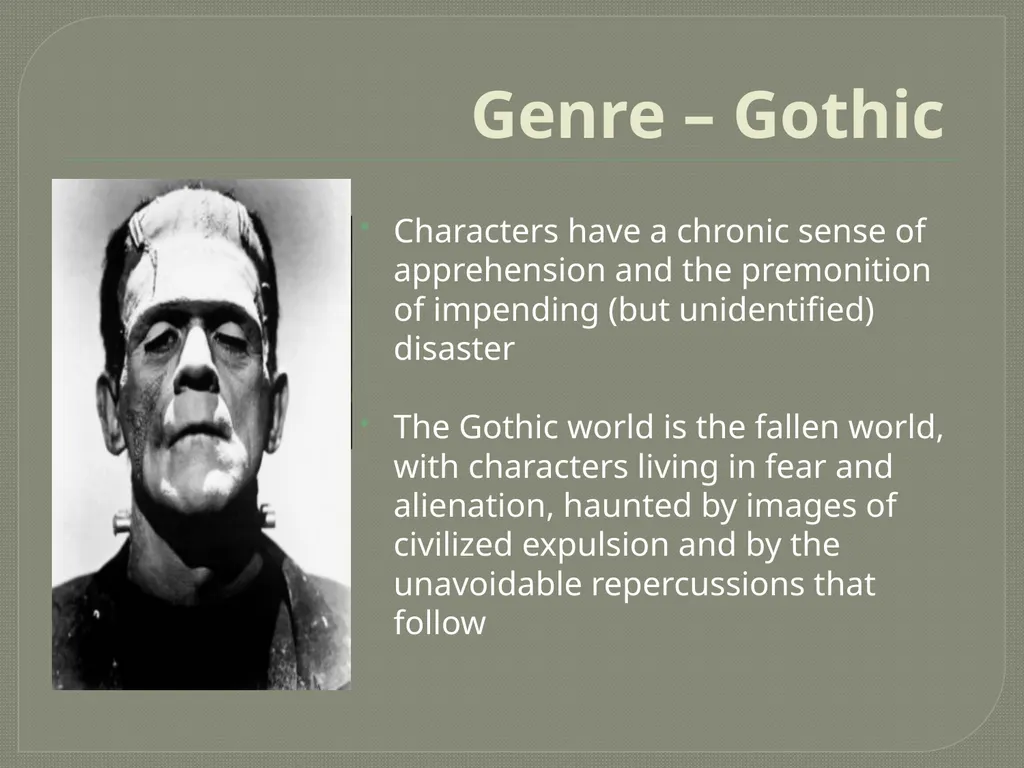
Genre – Gothic Characters have a chronic sense of apprehension and the premonition of impending (but unidentified) disaster
The Gothic world is the fallen world, with characters living in fear and alienation, haunted by images of civilized expulsion and by the unavoidable repercussions that follow<br>
The Gothic world is the fallen world, with characters living in fear and alienation, haunted by images of civilized expulsion and by the unavoidable repercussions that follow<br>
19
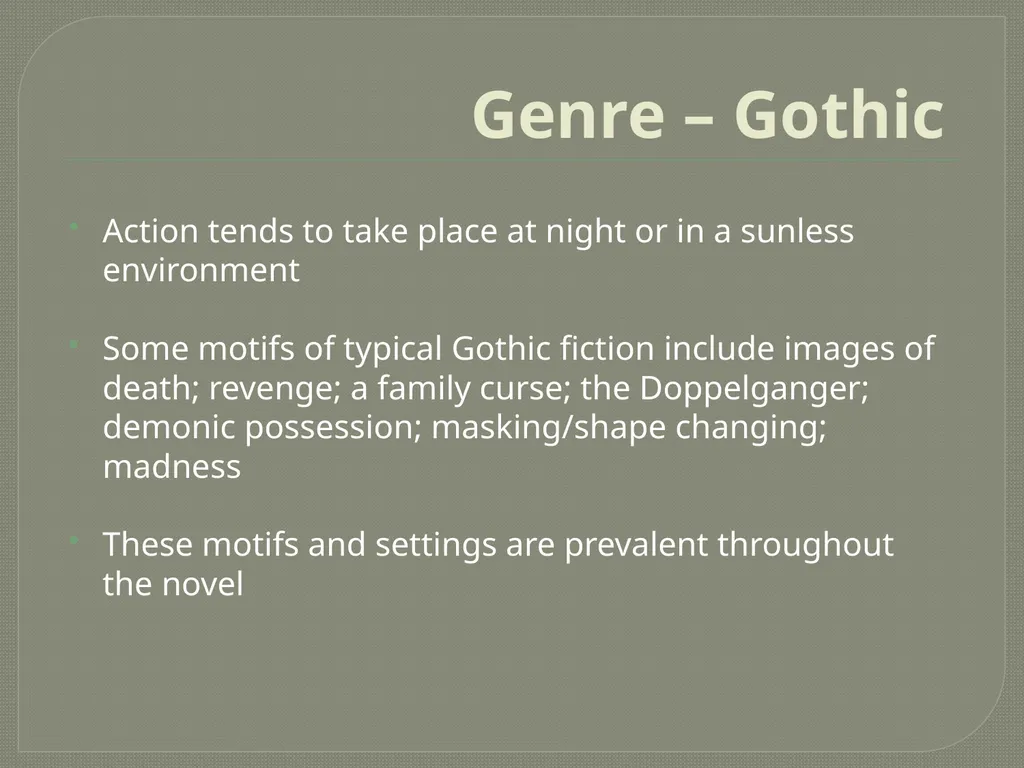
Genre – Gothic Action tends to take place at night or in a sunless environment
Some motifs of typical Gothic fiction include images of death; revenge; a family curse; the Doppelganger; demonic possession; masking/shape changing; madness
These motifs and settings are prevalent throughout the novel<br>
Some motifs of typical Gothic fiction include images of death; revenge; a family curse; the Doppelganger; demonic possession; masking/shape changing; madness
These motifs and settings are prevalent throughout the novel<br>
20
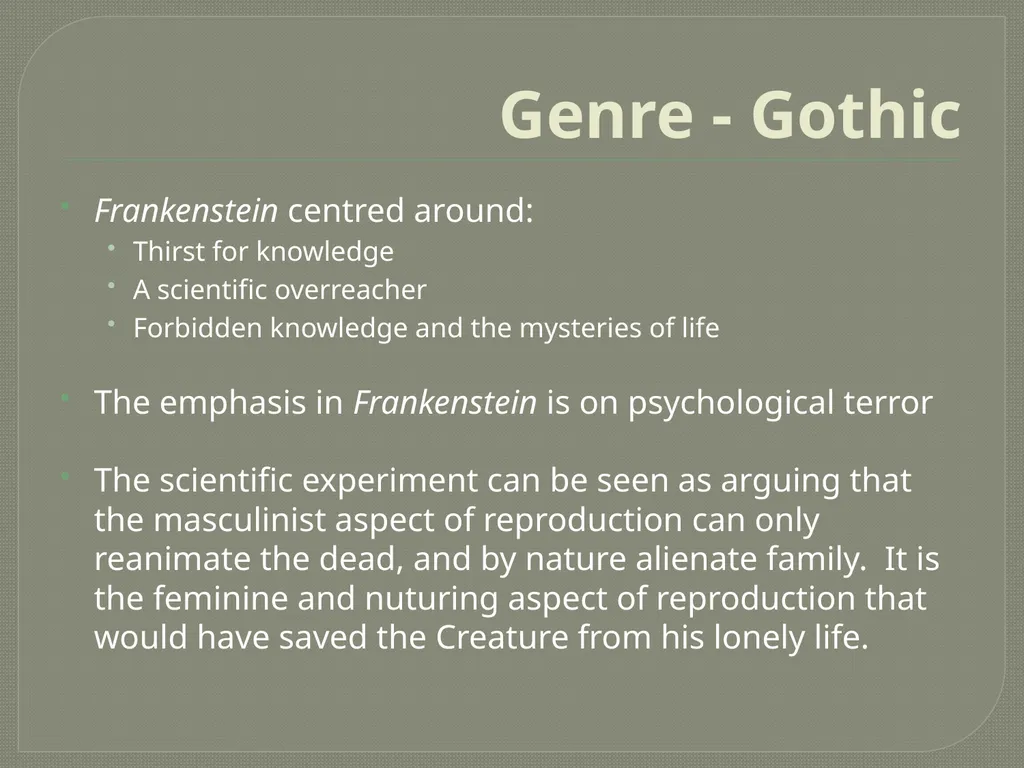
Genre - Gothic Frankenstein centred around:
Thirst for knowledge
A scientific overreacher
Forbidden knowledge and the mysteries of life
The emphasis in Frankenstein is on psychological terror
The scientific experiment can be seen as arguing that the masculinist aspect of reproduction can only reanimate the dead, and by nature alienate family. It is the feminine and nuturing aspect of reproduction that would have saved the Creature from his lonely life.<br>
21
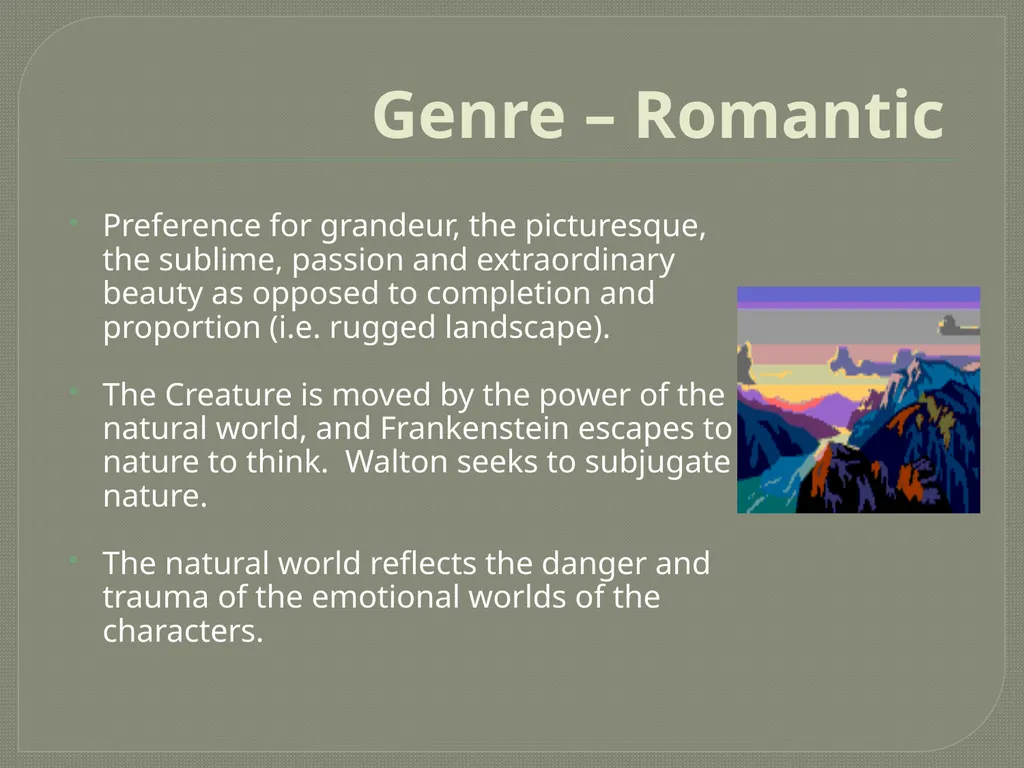
Genre – Romantic Preference for grandeur, the picturesque, the sublime, passion and extraordinary beauty as opposed to completion and proportion (i.e. rugged landscape).
The Creature is moved by the power of the natural world, and Frankenstein escapes to nature to think. Walton seeks to subjugate nature.
The natural world reflects the danger and trauma of the emotional worlds of the characters.<br>
The Creature is moved by the power of the natural world, and Frankenstein escapes to nature to think. Walton seeks to subjugate nature.
The natural world reflects the danger and trauma of the emotional worlds of the characters.<br>
22
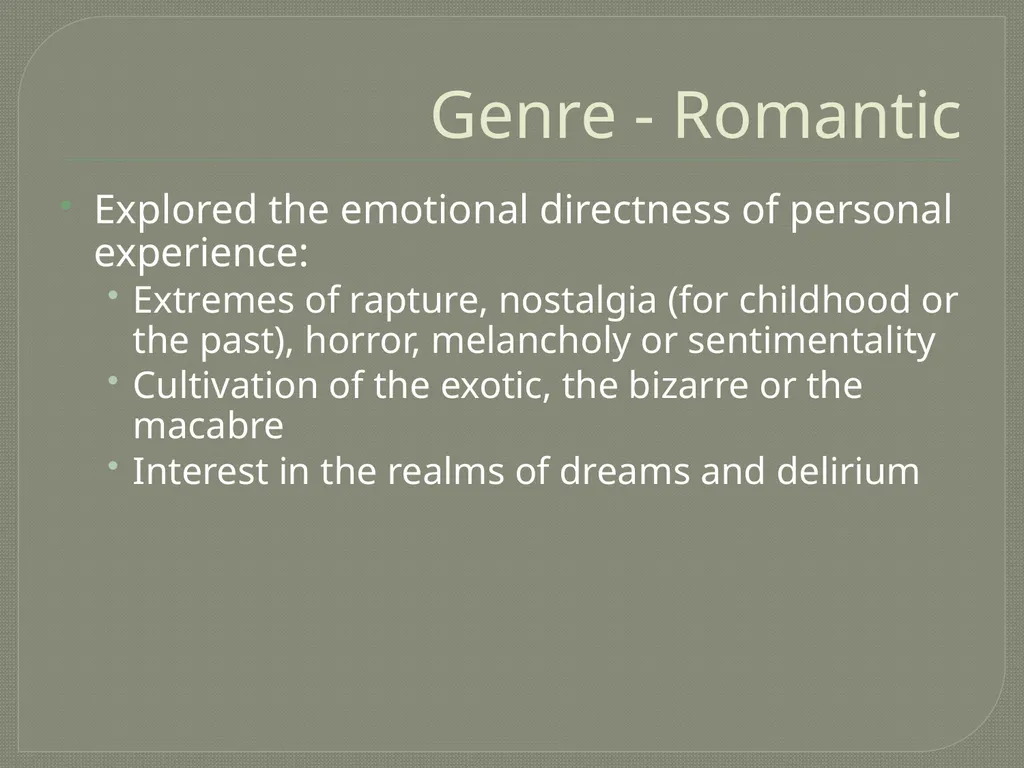
Genre - Romantic Explored the emotional directness of personal experience:
Extremes of rapture, nostalgia (for childhood or the past), horror, melancholy or sentimentality
Cultivation of the exotic, the bizarre or the macabre
Interest in the realms of dreams and delirium<br>
Extremes of rapture, nostalgia (for childhood or the past), horror, melancholy or sentimentality
Cultivation of the exotic, the bizarre or the macabre
Interest in the realms of dreams and delirium<br>
23
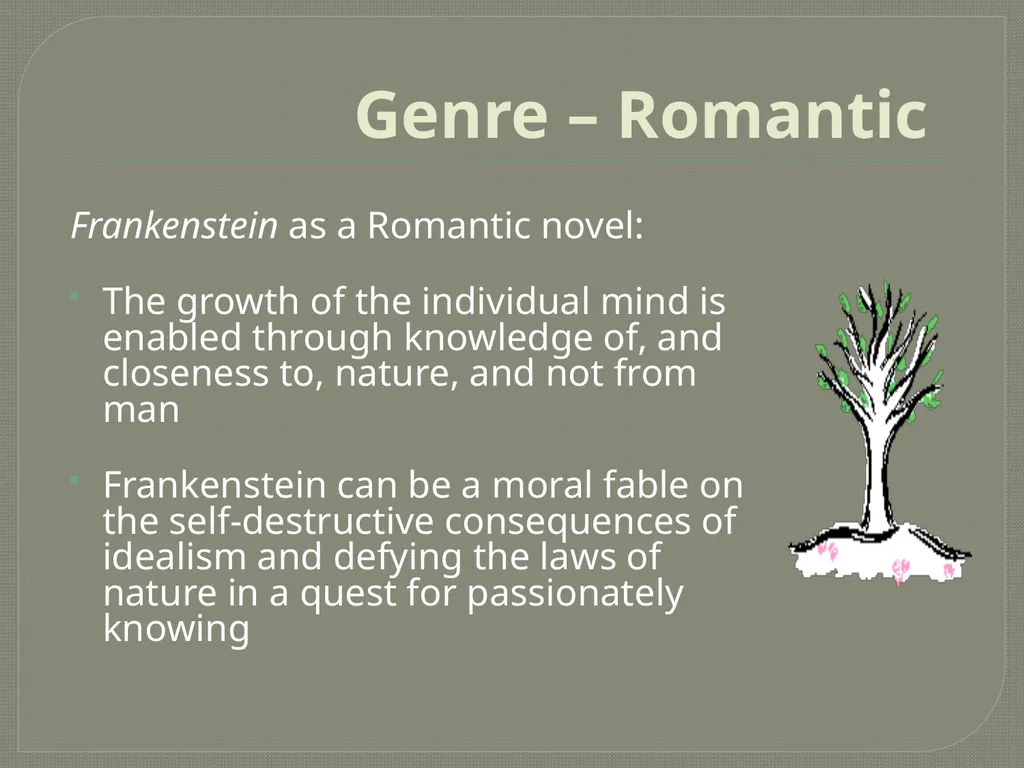
Genre – Romantic Frankenstein as a Romantic novel:
The growth of the individual mind is enabled through knowledge of, and closeness to, nature, and not from man
Frankenstein can be a moral fable on the self-destructive consequences of idealism and defying the laws of nature in a quest for passionately knowing<br>
The growth of the individual mind is enabled through knowledge of, and closeness to, nature, and not from man
Frankenstein can be a moral fable on the self-destructive consequences of idealism and defying the laws of nature in a quest for passionately knowing<br>
24
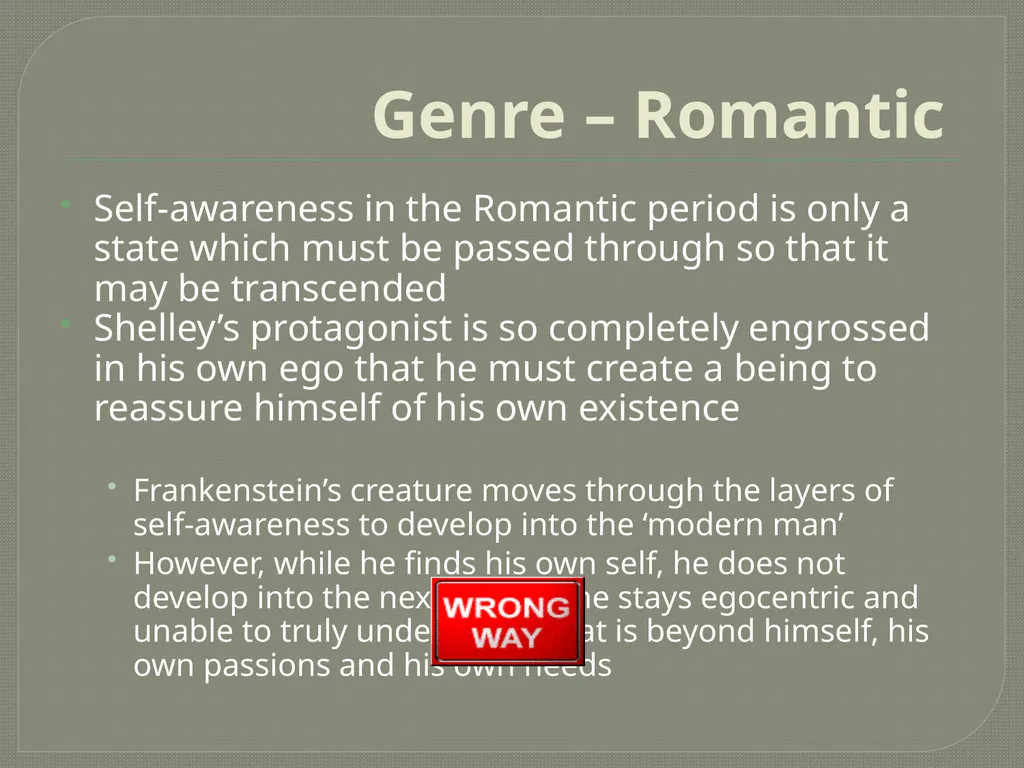
Genre – Romantic Self-awareness in the Romantic period is only a state which must be passed through so that it may be transcended
Shelley’s protagonist is so completely engrossed in his own ego that he must create a being to reassure himself of his own existence
Frankenstein’s creature moves through the layers of self-awareness to develop into the ‘modern man’
However, while he finds his own self, he does not develop into the next ‘stage’ – he stays egocentric and unable to truly understand what is beyond himself, his own passions and his own needs<br>
25
Themes<br>
26
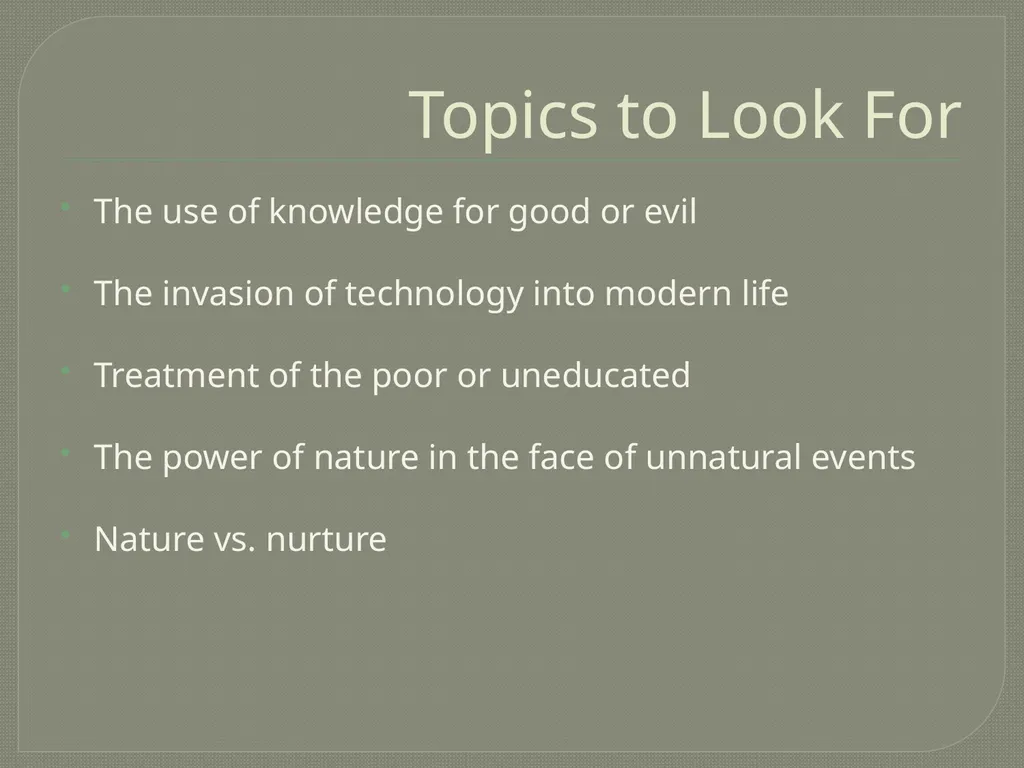
Topics to Look For The use of knowledge for good or evil
The invasion of technology into modern life
Treatment of the poor or uneducated
The power of nature in the face of unnatural events
Nature vs. nurture<br>
The invasion of technology into modern life
Treatment of the poor or uneducated
The power of nature in the face of unnatural events
Nature vs. nurture<br>
27
Hollywood Stereotypes<br>
28
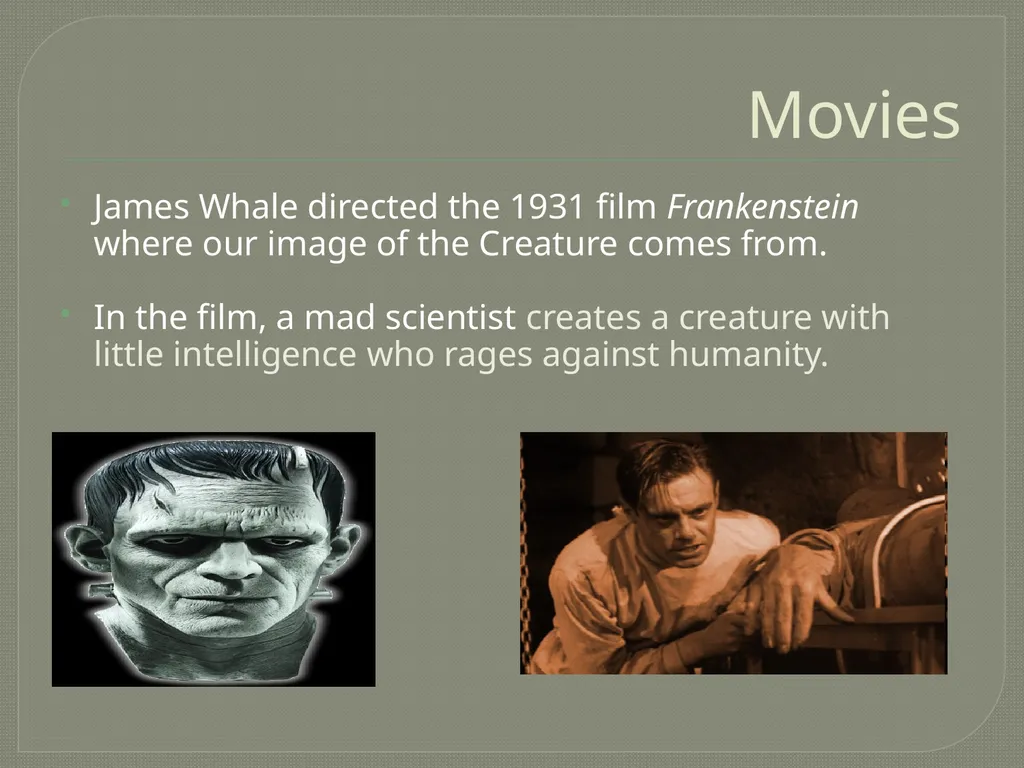
Movies James Whale directed the 1931 film Frankenstein where our image of the Creature comes from.
In the film, a mad scientist creates a creature with little intelligence who rages against humanity.<br>
In the film, a mad scientist creates a creature with little intelligence who rages against humanity.<br>
29
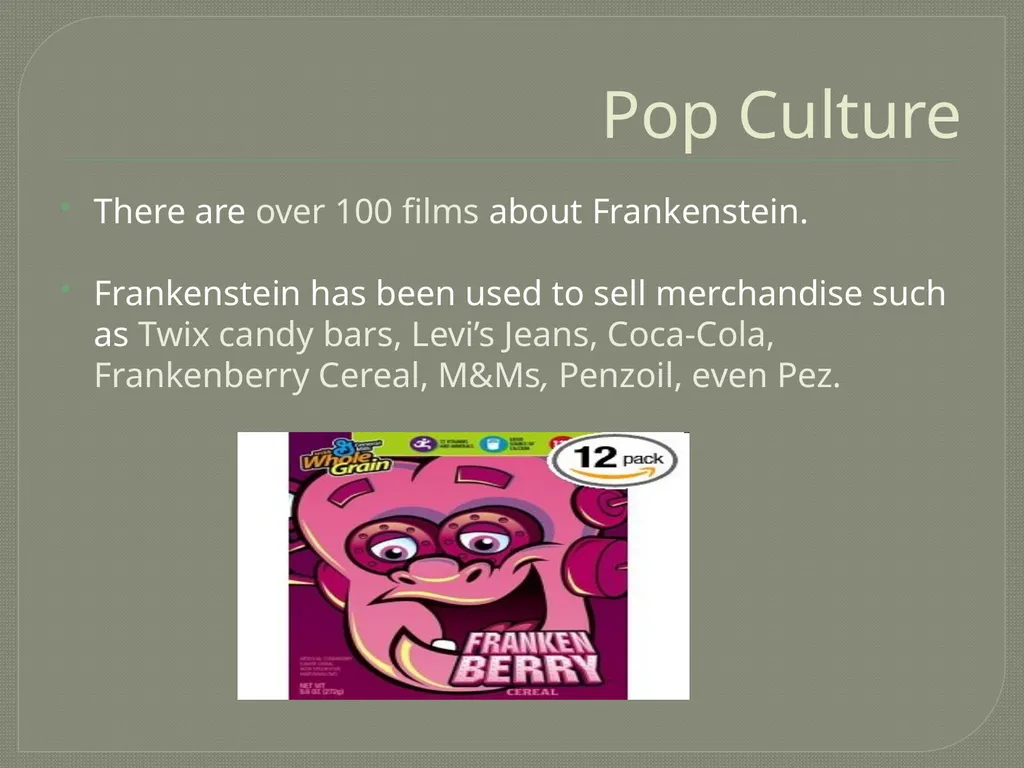
Pop Culture There are over 100 films about Frankenstein.
Frankenstein has been used to sell merchandise such as Twix candy bars, Levi’s Jeans, Coca-Cola, Frankenberry Cereal, M&Ms, Penzoil, even Pez.<br>
Frankenstein has been used to sell merchandise such as Twix candy bars, Levi’s Jeans, Coca-Cola, Frankenberry Cereal, M&Ms, Penzoil, even Pez.<br>
30
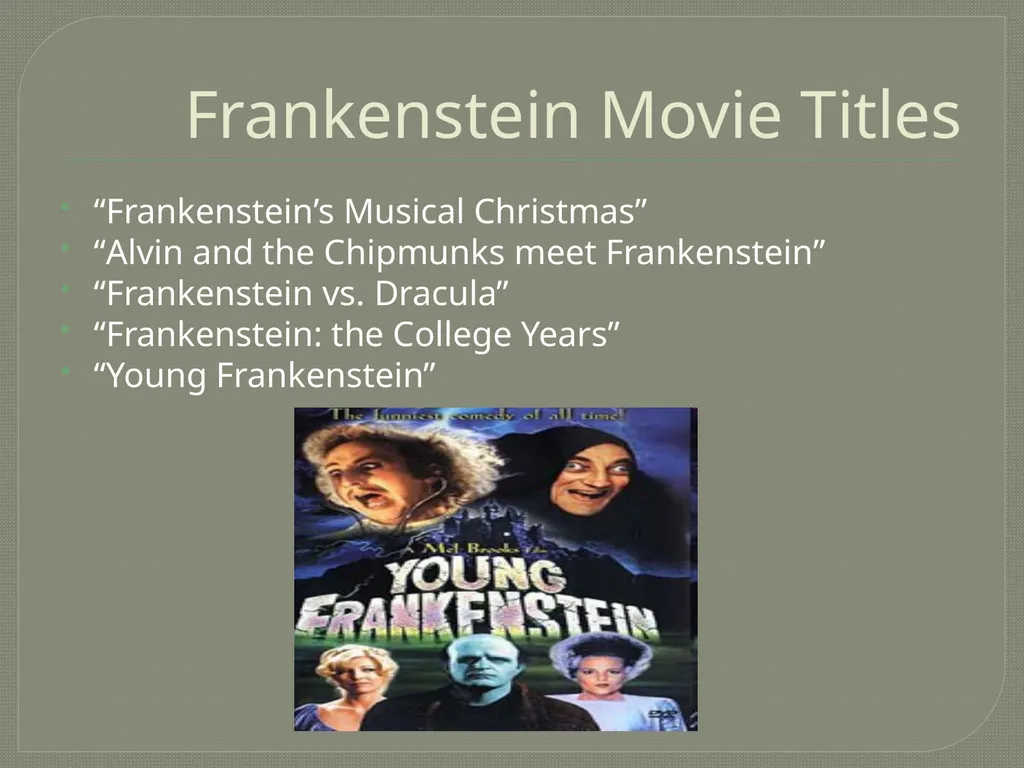
Frankenstein Movie Titles “Frankenstein’s Musical Christmas”
“Alvin and the Chipmunks meet Frankenstein”
“Frankenstein vs. Dracula”
“Frankenstein: the College Years”
“Young Frankenstein”<br>
“Alvin and the Chipmunks meet Frankenstein”
“Frankenstein vs. Dracula”
“Frankenstein: the College Years”
“Young Frankenstein”<br>
31
Thank You for Your Purchase! If you see any errors, or have questions or improvement suggestions, please contact me prior to your leaving feedback, and allow me to have the opportunity to make things right. Customer satisfaction and accuracy are very important to me. Just click on the “Questions and Answers” link for your purchased product in my store for further assistance.
http://www.teacherspayteachers.com/Store/The-English-Teachers-Pet
If you have enjoyed your purchase, please leave feedback on TPT. Leaving feedback will also earn you credits towards your future TPT purchases!
Follow me on TPT to be updated on sales, new products, and freebies exclusively given only to my TPT followers! Find my store- The English Teacher’s Pet- on Teachers Pay Teachers, and click on “Follow Me” at the top of my store page.<br>
32
Copyright/Terms of Use This product is my original work and is subject to copyright. The terms of use are as follows: This item is NOT for commercial use (such as using them to create TPT products) or to be resold as your own. The original purchaser of this Document or PowerPoint is granted permission to view or reproduce the pages in the quantities needed for the purchaser’s classroom only. Minor editing may be permitted if the product is in an editable format. However, the document remains under copyright even when editing is permitted. Duplication for other classes, or for other teachers, or for use in wide distribution (such as for school district use or on the internet) is prohibited. Do not attempt to extract clip art, or any other portions of the product, from the file. This product is not to be resold “as is”, in its entirety or in part, or incorporated into another product, copied, or altered to make derivative works. It is not to be shared, emailed, distributed or traded in print, digital or any other format. Any of these acts would infringe upon the intellectual copyrights. Violations are subject to the penalties of the Digital Millennium Copyright Act. Thank you for abiding by these terms of use.<br>