
Introduction to Infrastructure Investment Trusts
KL
Published · 19 slides · 0 views

1 / 1

Description
Introduction to Infrastructure Investment Trusts (InvITs) Disclaimer 2 Information contained in this presentation is as on December 10, 2021 The information contained in this presentation is only for Educational and Awareness Purposes
Related Topics
Share
Embed code
Download this presentation From Below
"Introduction to Infrastructure Investment Trusts" is the property of its rightful owner. Permission is granted to download and print the materials on this website for personal, non-commercial use only, and to display it on your personal computer provided you do not modify the materials and that you retain all copyright notices contained in the materials. By downloading content from our website, you accept the terms of this agreement.
Presentation Transcript
01
Introduction to
Infrastructure Investment Trusts
(InvITs)<br>
Infrastructure Investment Trusts
(InvITs)<br>
02
Disclaimer 2 Information contained in this presentation is as on December 10, 2021
The information contained in this presentation is only for Educational and Awareness Purposes related to securities market.
This presentation is only for Educational and Investor Awareness Programs and shall not be used for any legal interpretations.
SEBI or Stock Exchanges or Depositories shall not be responsible for any damage or loss to any one of any manner from use of this material.
Suggestions or feedbacks, if any, may please be sent by mail to visitsebi@sebi.gov.in.<br>
The information contained in this presentation is only for Educational and Awareness Purposes related to securities market.
This presentation is only for Educational and Investor Awareness Programs and shall not be used for any legal interpretations.
SEBI or Stock Exchanges or Depositories shall not be responsible for any damage or loss to any one of any manner from use of this material.
Suggestions or feedbacks, if any, may please be sent by mail to visitsebi@sebi.gov.in.<br>
03
3 What are InvITs? - Overview;
Structure of InvITs;
Role of Constituents in InvITs;
Cash flow in InvITs;
Benefits of investing in InvITs;
Who can invest in InvITs;
How to own Units of InvITs;
Rights of unitholders in InvITs;
Taxation aspects of InvITs;
Points to ponder before investing in InvITs. Flow of Presentation<br>
Structure of InvITs;
Role of Constituents in InvITs;
Cash flow in InvITs;
Benefits of investing in InvITs;
Who can invest in InvITs;
How to own Units of InvITs;
Rights of unitholders in InvITs;
Taxation aspects of InvITs;
Points to ponder before investing in InvITs. Flow of Presentation<br>
04
What are InvITs? - Overview InvITs stands for Infrastructure Investment Trusts.
InvITs are also like mutual funds that pool money from investors.
InvITs own and operate operational infrastructure assets like highways, roads, pipelines, warehouses, power plants, etc. They offer regular income (via dividends) and long-term capital appreciation.
InvITs allow pooling of money from multiple investors into a single trust
Trust which is professionally managed by an Investment Manager
Investment Manager invests in infrastructure assets or special purpose vehicles (SPVs) holding such infrastructure assets.
There are listed InvITs, which are traded on the stock exchanges and investors can buy and sell InvIT units just like trading of shares of any listed company.
There are unlisted InvITs as well, in which large institutional investors can participate. 4<br>
InvITs are also like mutual funds that pool money from investors.
InvITs own and operate operational infrastructure assets like highways, roads, pipelines, warehouses, power plants, etc. They offer regular income (via dividends) and long-term capital appreciation.
InvITs allow pooling of money from multiple investors into a single trust
Trust which is professionally managed by an Investment Manager
Investment Manager invests in infrastructure assets or special purpose vehicles (SPVs) holding such infrastructure assets.
There are listed InvITs, which are traded on the stock exchanges and investors can buy and sell InvIT units just like trading of shares of any listed company.
There are unlisted InvITs as well, in which large institutional investors can participate. 4<br>
05
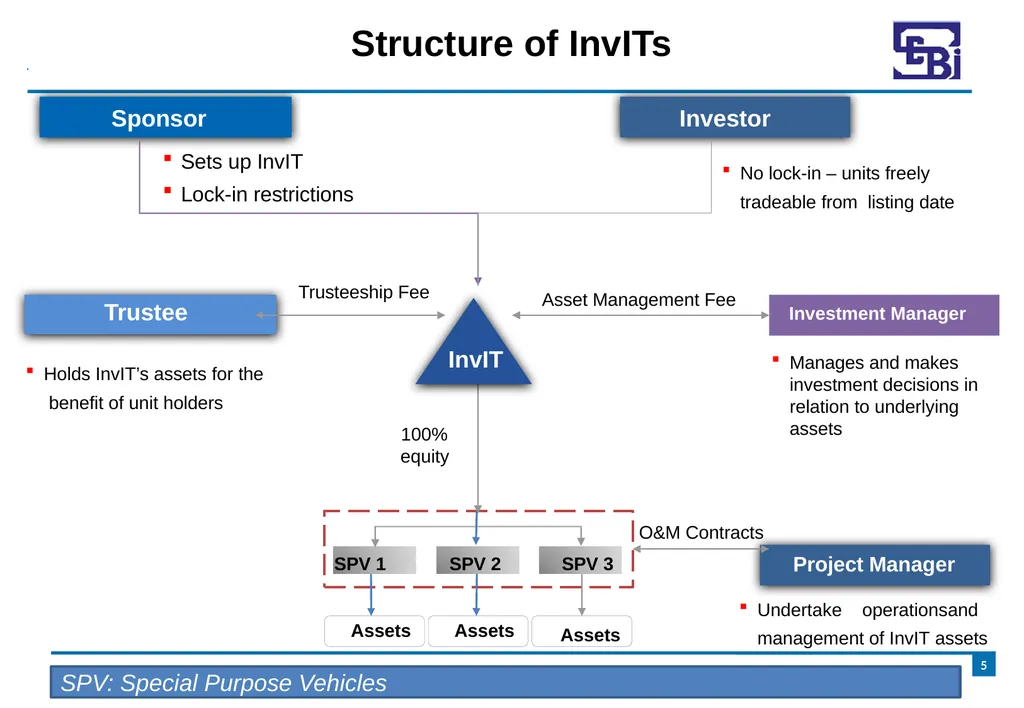
Structure of InvITs 5 Sponsor Trustee SPV 1 Investment Manager Investor SPV 2 Asset Management Fee O&M Contracts Assets Assets Assets InvIT SPV 3 Sets up InvIT
Lock-in restrictions No lock-in – units freely tradeable from listing date Holds InvIT’s assets for the benefit of unit holders Manages and makes investment decisions in relation to underlying assets Project Manager
Undertake operations and management of InvIT assets Trusteeship Fee 100%
equity InvIT SPV: Special Purpose Vehicles<br>
Lock-in restrictions No lock-in – units freely tradeable from listing date Holds InvIT’s assets for the benefit of unit holders Manages and makes investment decisions in relation to underlying assets Project Manager
Undertake operations and management of InvIT assets Trusteeship Fee 100%
equity InvIT SPV: Special Purpose Vehicles<br>
06
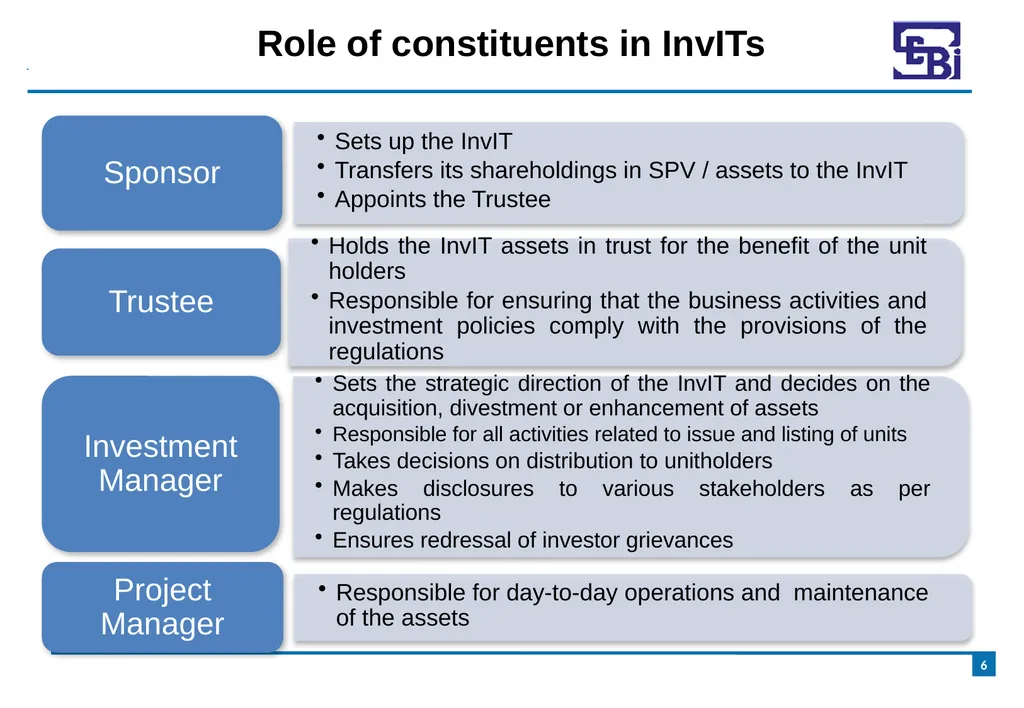
Role of constituents in InvITs 6<br>
07
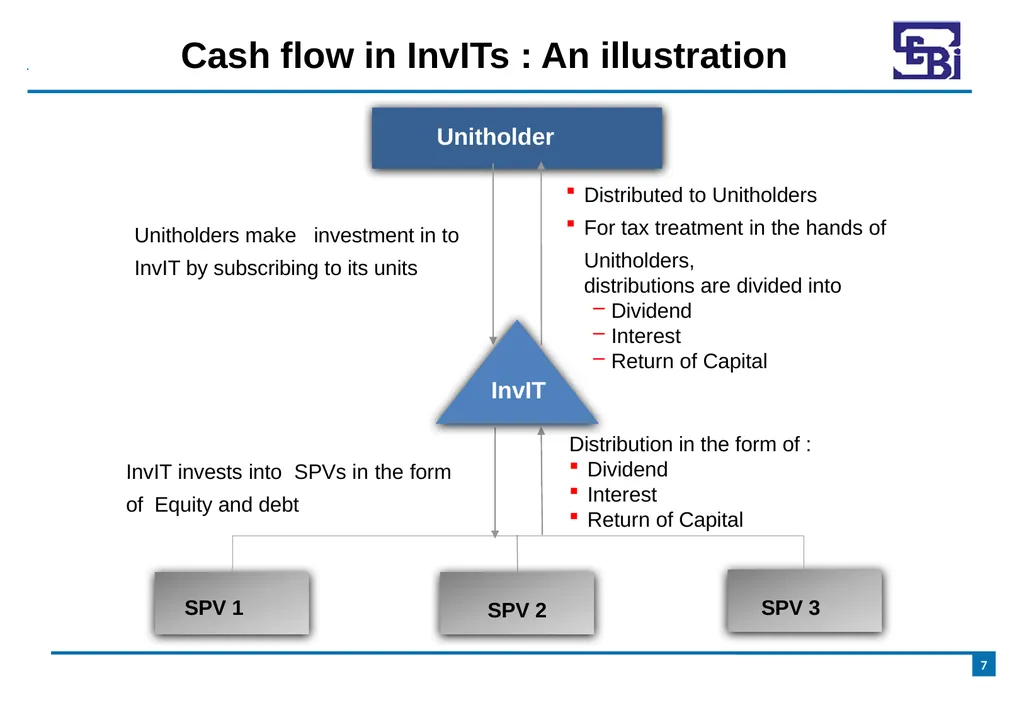
Cash flow in InvITs : An illustration 7 Unitholder SPV 1 SPV 2 SPV 3 Distribution in the form of :
Dividend
Interest
Return of Capital Distributed to Unitholders
For tax treatment in the hands of Unitholders,
distributions are divided into
Dividend
Interest
Return of Capital InvIT invests into SPVs in the form of Equity and debt Unitholders make investment in to InvIT by subscribing to its units InvIT<br>
Dividend
Interest
Return of Capital Distributed to Unitholders
For tax treatment in the hands of Unitholders,
distributions are divided into
Dividend
Interest
Return of Capital InvIT invests into SPVs in the form of Equity and debt Unitholders make investment in to InvIT by subscribing to its units InvIT<br>
08
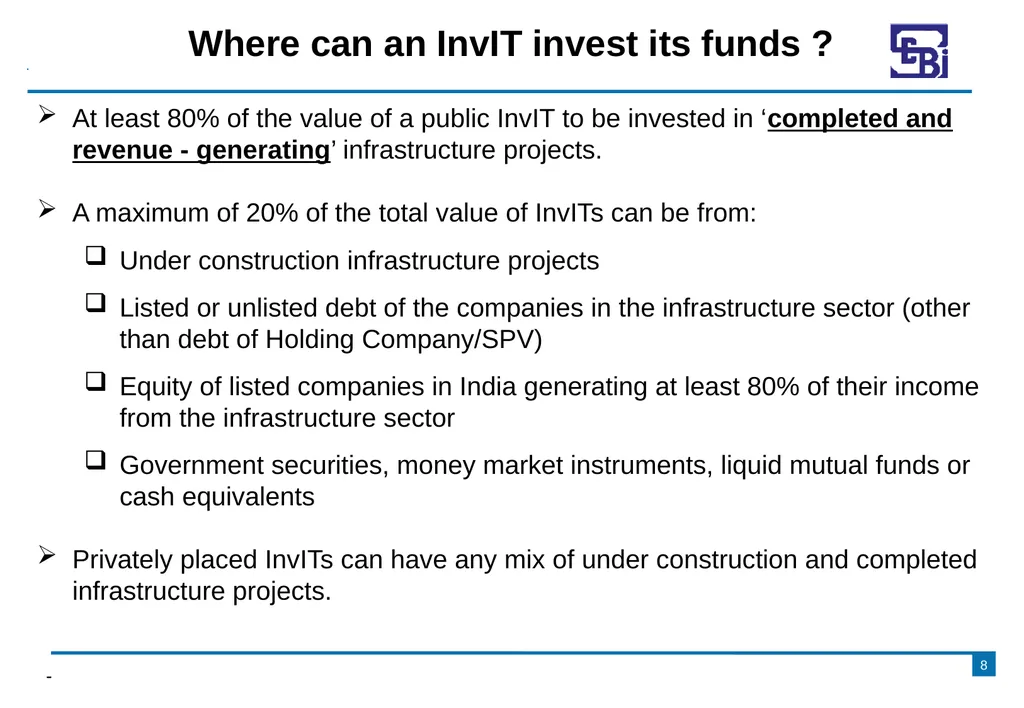
Where can an InvIT invest its funds ? At least 80% of the value of a public InvIT to be invested in ‘completed and revenue - generating’ infrastructure projects.
A maximum of 20% of the total value of InvITs can be from:
Under construction infrastructure projects
Listed or unlisted debt of the companies in the infrastructure sector (other than debt of Holding Company/SPV)
Equity of listed companies in India generating at least 80% of their income from the infrastructure sector
Government securities, money market instruments, liquid mutual funds or cash equivalents
Privately placed InvITs can have any mix of under construction and completed infrastructure projects. 8 -<br>
A maximum of 20% of the total value of InvITs can be from:
Under construction infrastructure projects
Listed or unlisted debt of the companies in the infrastructure sector (other than debt of Holding Company/SPV)
Equity of listed companies in India generating at least 80% of their income from the infrastructure sector
Government securities, money market instruments, liquid mutual funds or cash equivalents
Privately placed InvITs can have any mix of under construction and completed infrastructure projects. 8 -<br>
09
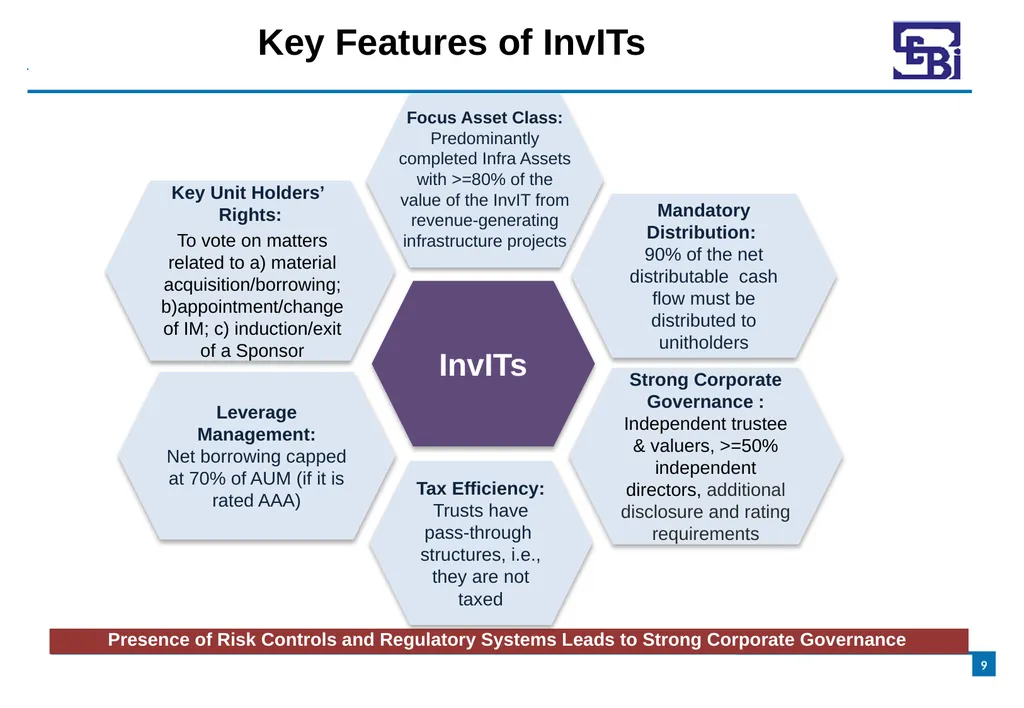
Presence of Risk Controls and Regulatory Systems Leads to Strong Corporate Governance InvITs Key Unit Holders’
Rights:
To vote on matters related to a) material acquisition/borrowing; b)appointment/change of IM; c) induction/exit of a Sponsor Mandatory Distribution:
90% of the net distributable cash flow must be distributed to unitholders Strong Corporate Governance : Independent trustee & valuers, >=50% independent directors, additional disclosure and rating requirements Tax Efficiency:
Trusts have pass-through structures, i.e., they are not taxed Leverage Management:
Net borrowing capped at 70% of AUM (if it is rated AAA) Focus Asset Class:
Predominantly completed Infra Assets with >=80% of the value of the InvIT from revenue-generating infrastructure projects Key Features of InvITs 9<br>
Rights:
To vote on matters related to a) material acquisition/borrowing; b)appointment/change of IM; c) induction/exit of a Sponsor Mandatory Distribution:
90% of the net distributable cash flow must be distributed to unitholders Strong Corporate Governance : Independent trustee & valuers, >=50% independent directors, additional disclosure and rating requirements Tax Efficiency:
Trusts have pass-through structures, i.e., they are not taxed Leverage Management:
Net borrowing capped at 70% of AUM (if it is rated AAA) Focus Asset Class:
Predominantly completed Infra Assets with >=80% of the value of the InvIT from revenue-generating infrastructure projects Key Features of InvITs 9<br>
10
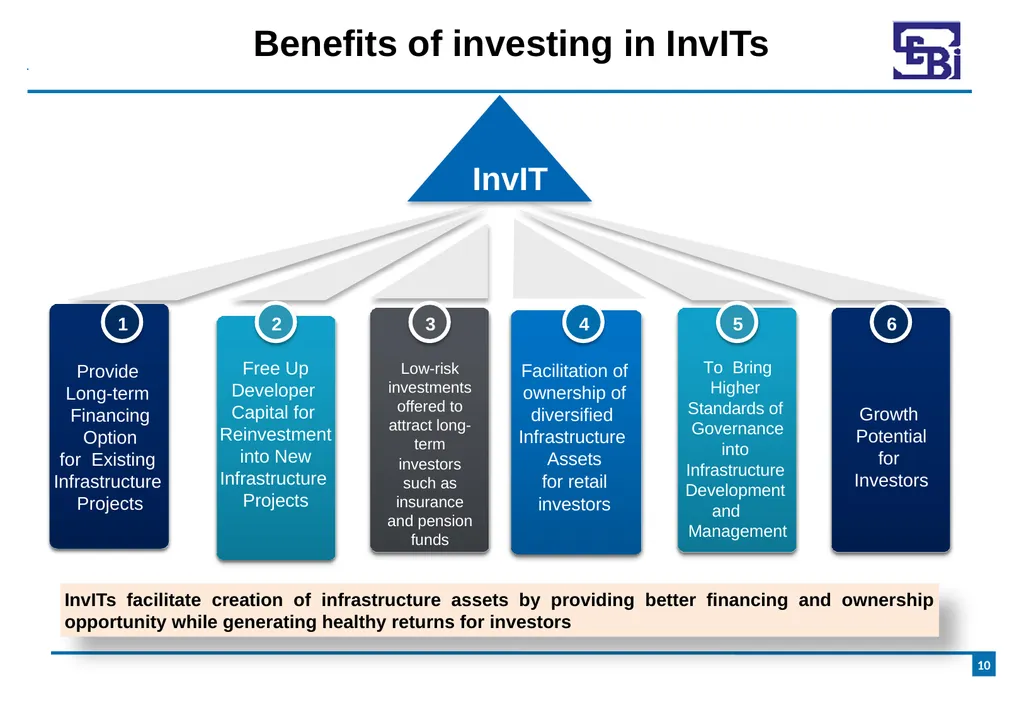
Benefits of investing in InvITs 10 Free Up Developer Capital for Reinvestment into New Infrastructure Projects 2 To Bring Higher Standards of Governance into Infrastructure Development and Management 5 Facilitation of ownership of diversified Infrastructure Assets
for retail investors Low-risk investments offered to attract long-term
investors such as insurance and pension funds 3 Growth Potential for Investors 6 Provide
Long-term Financing Option
for Existing Infrastructure Projects 1 4 InvIT InvITs facilitate creation of infrastructure assets by providing better financing and ownership opportunity while generating healthy returns for investors<br>
for retail investors Low-risk investments offered to attract long-term
investors such as insurance and pension funds 3 Growth Potential for Investors 6 Provide
Long-term Financing Option
for Existing Infrastructure Projects 1 4 InvIT InvITs facilitate creation of infrastructure assets by providing better financing and ownership opportunity while generating healthy returns for investors<br>
11
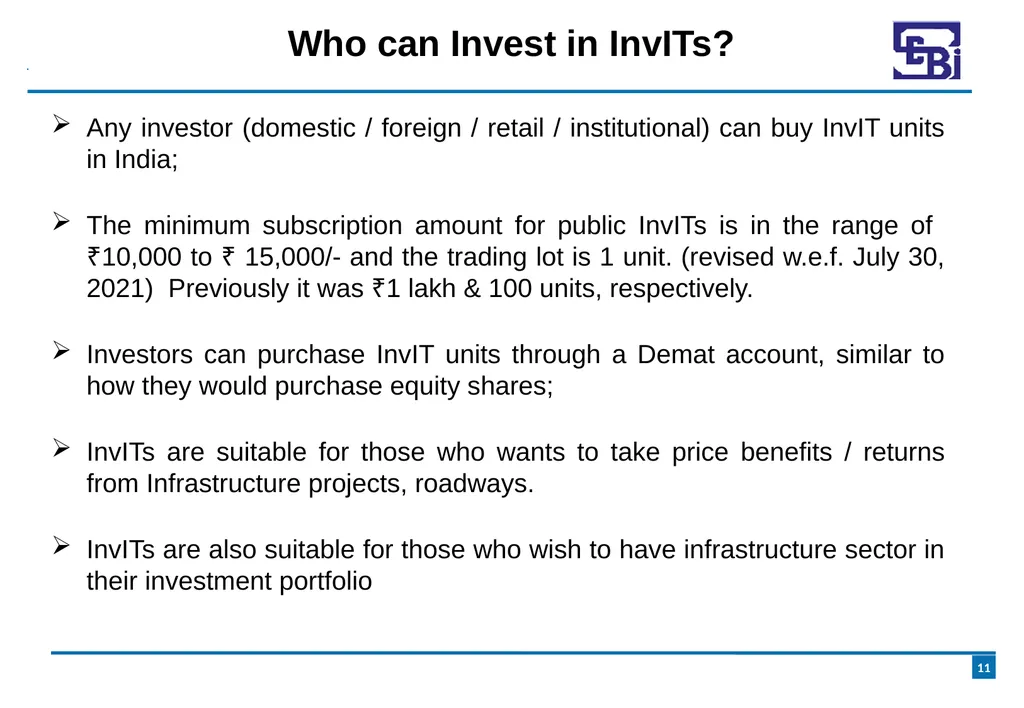
Who can Invest in InvITs? Any investor (domestic / foreign / retail / institutional) can buy InvIT units in India;
The minimum subscription amount for public InvITs is in the range of ₹10,000 to ₹ 15,000/- and the trading lot is 1 unit. (revised w.e.f. July 30, 2021) Previously it was ₹1 lakh & 100 units, respectively.
Investors can purchase InvIT units through a Demat account, similar to how they would purchase equity shares;
InvITs are suitable for those who wants to take price benefits / returns from Infrastructure projects, roadways.
InvITs are also suitable for those who wish to have infrastructure sector in their investment portfolio 11<br>
The minimum subscription amount for public InvITs is in the range of ₹10,000 to ₹ 15,000/- and the trading lot is 1 unit. (revised w.e.f. July 30, 2021) Previously it was ₹1 lakh & 100 units, respectively.
Investors can purchase InvIT units through a Demat account, similar to how they would purchase equity shares;
InvITs are suitable for those who wants to take price benefits / returns from Infrastructure projects, roadways.
InvITs are also suitable for those who wish to have infrastructure sector in their investment portfolio 11<br>
12
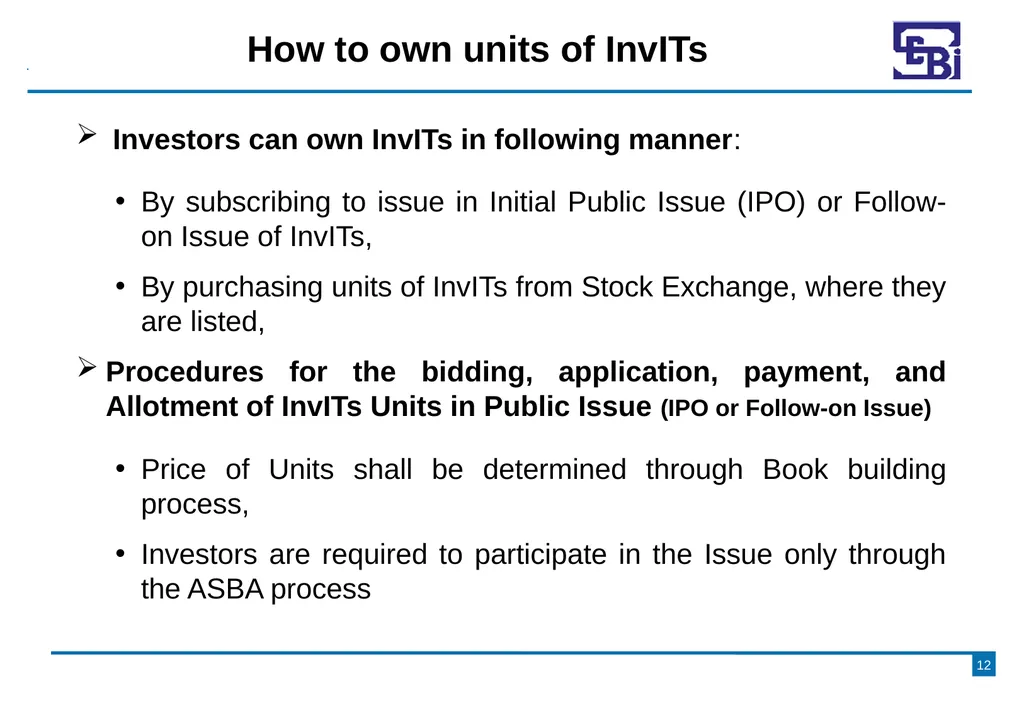
Investors can own InvITs in following manner:
By subscribing to issue in Initial Public Issue (IPO) or Follow-on Issue of InvITs,
By purchasing units of InvITs from Stock Exchange, where they are listed,
Procedures for the bidding, application, payment, and Allotment of InvITs Units in Public Issue (IPO or Follow-on Issue)
Price of Units shall be determined through Book building process,
Investors are required to participate in the Issue only through the ASBA process How to own units of InvITs 12<br>
By subscribing to issue in Initial Public Issue (IPO) or Follow-on Issue of InvITs,
By purchasing units of InvITs from Stock Exchange, where they are listed,
Procedures for the bidding, application, payment, and Allotment of InvITs Units in Public Issue (IPO or Follow-on Issue)
Price of Units shall be determined through Book building process,
Investors are required to participate in the Issue only through the ASBA process How to own units of InvITs 12<br>
13
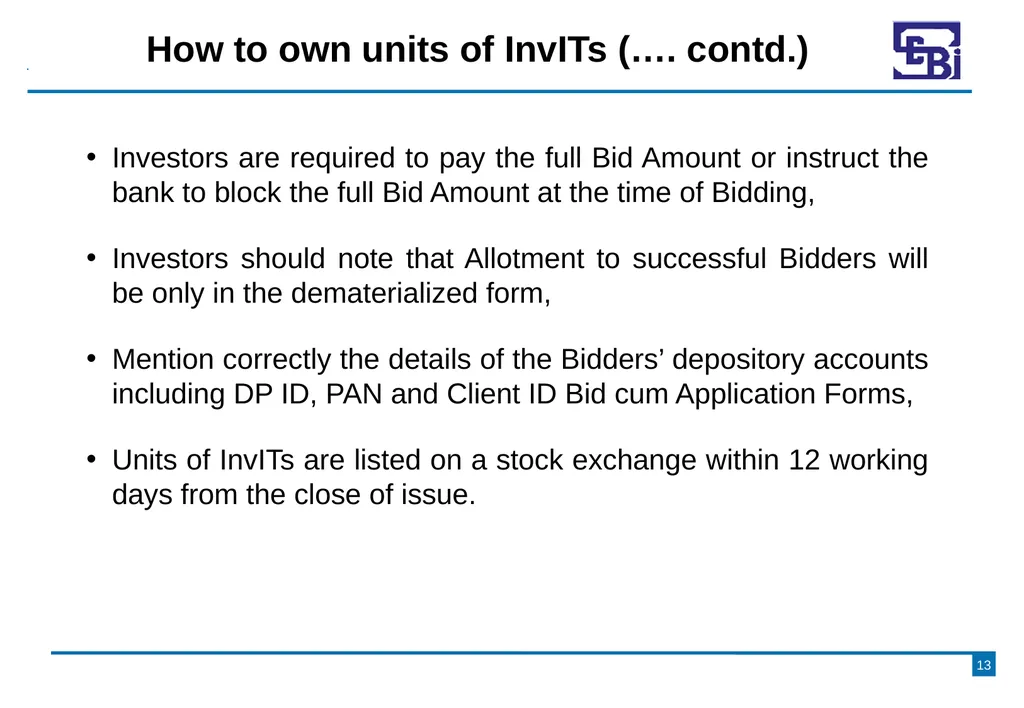
Investors are required to pay the full Bid Amount or instruct the bank to block the full Bid Amount at the time of Bidding,
Investors should note that Allotment to successful Bidders will be only in the dematerialized form,
Mention correctly the details of the Bidders’ depository accounts including DP ID, PAN and Client ID Bid cum Application Forms,
Units of InvITs are listed on a stock exchange within 12 working days from the close of issue. How to own units of InvITs (…. contd.) 13<br>
Investors should note that Allotment to successful Bidders will be only in the dematerialized form,
Mention correctly the details of the Bidders’ depository accounts including DP ID, PAN and Client ID Bid cum Application Forms,
Units of InvITs are listed on a stock exchange within 12 working days from the close of issue. How to own units of InvITs (…. contd.) 13<br>
14
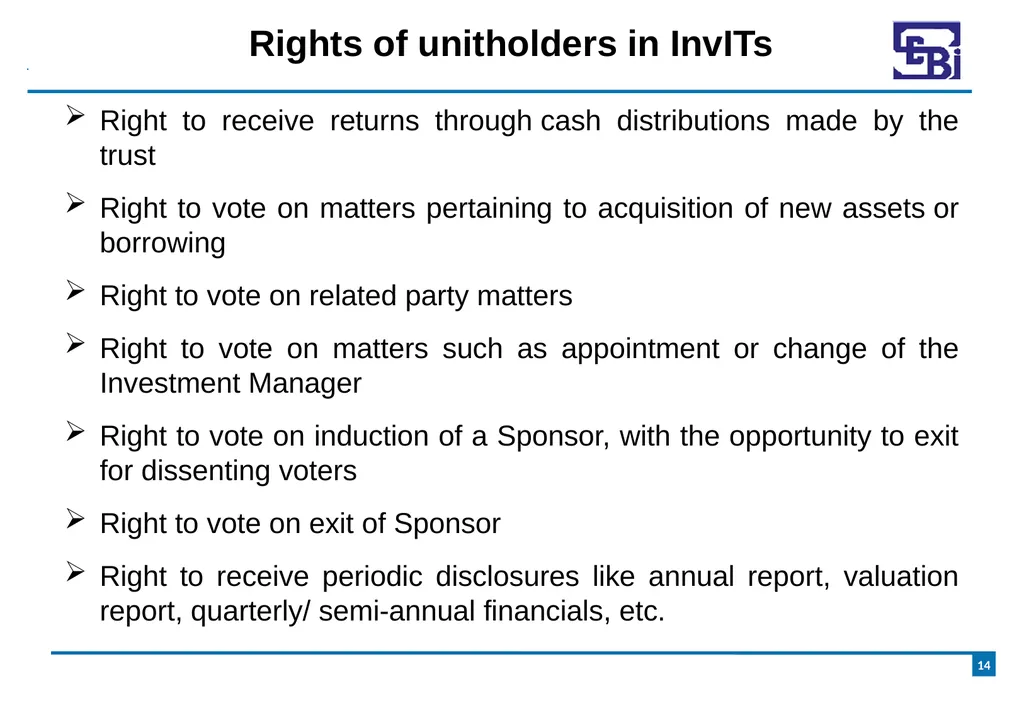
Rights of unitholders in InvITs Right to receive returns through cash distributions made by the trust
Right to vote on matters pertaining to acquisition of new assets or borrowing
Right to vote on related party matters
Right to vote on matters such as appointment or change of the Investment Manager
Right to vote on induction of a Sponsor, with the opportunity to exit for dissenting voters
Right to vote on exit of Sponsor
Right to receive periodic disclosures like annual report, valuation report, quarterly/ semi-annual financials, etc. 14<br>
Right to vote on matters pertaining to acquisition of new assets or borrowing
Right to vote on related party matters
Right to vote on matters such as appointment or change of the Investment Manager
Right to vote on induction of a Sponsor, with the opportunity to exit for dissenting voters
Right to vote on exit of Sponsor
Right to receive periodic disclosures like annual report, valuation report, quarterly/ semi-annual financials, etc. 14<br>
15
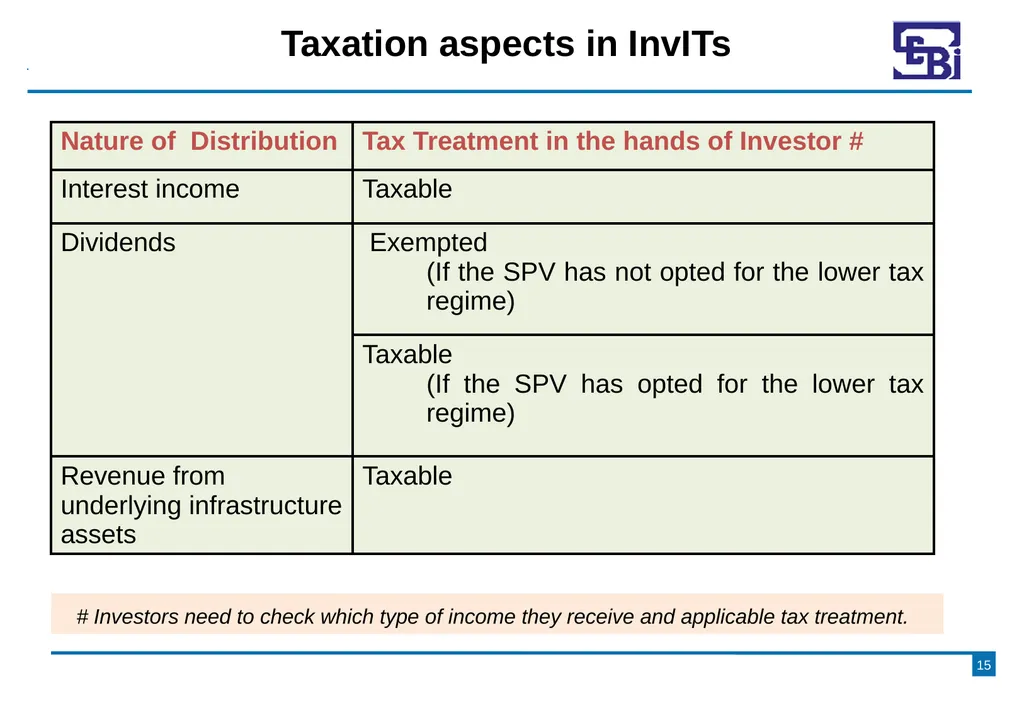
Taxation aspects in InvITs 15 # Investors need to check which type of income they receive and applicable tax treatment.<br>
16
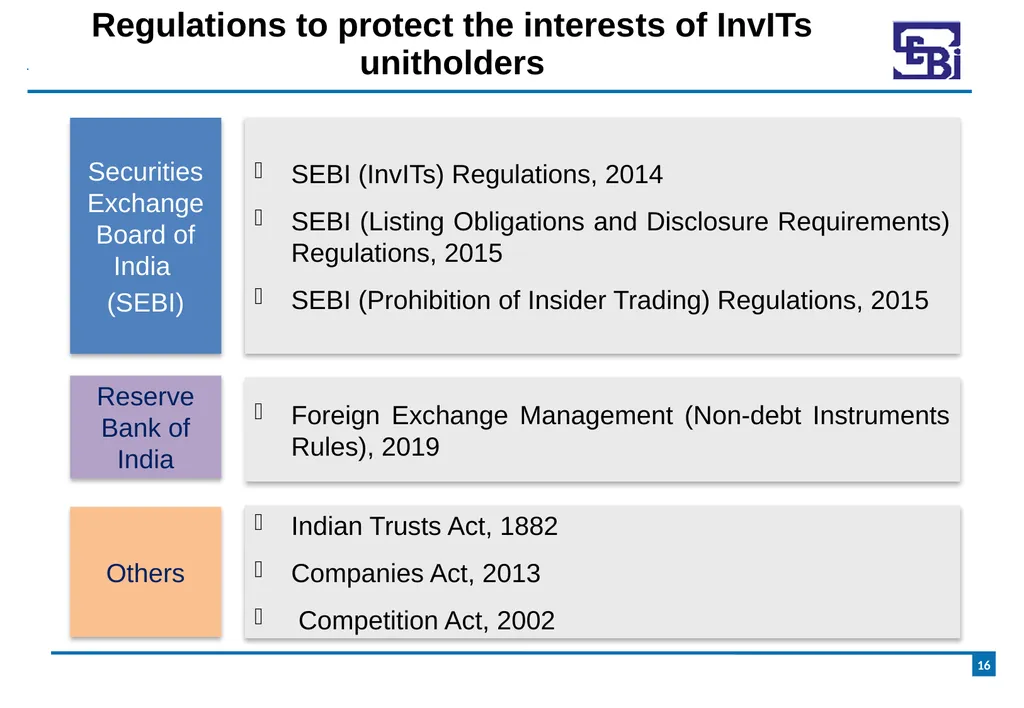
Regulations to protect the interests of InvITs unitholders 16 SEBI (InvITs) Regulations, 2014
SEBI (Listing Obligations and Disclosure Requirements) Regulations, 2015
SEBI (Prohibition of Insider Trading) Regulations, 2015 Securities Exchange Board of India
(SEBI) Reserve Bank of India Foreign Exchange Management (Non-debt Instruments Rules), 2019 Others Indian Trusts Act, 1882
Companies Act, 2013
Competition Act, 2002<br>
SEBI (Listing Obligations and Disclosure Requirements) Regulations, 2015
SEBI (Prohibition of Insider Trading) Regulations, 2015 Securities Exchange Board of India
(SEBI) Reserve Bank of India Foreign Exchange Management (Non-debt Instruments Rules), 2019 Others Indian Trusts Act, 1882
Companies Act, 2013
Competition Act, 2002<br>
17
Points to Ponder while investing in InvITs Stability of income of Trust depends on the stability of income earned from the assets of Trust,
Invest in InvITs which offer better transparency,
Investment in InvITs is to generate income and also to earn capital gains
Due diligence to be made before taking investment decisions 17<br>
Invest in InvITs which offer better transparency,
Investment in InvITs is to generate income and also to earn capital gains
Due diligence to be made before taking investment decisions 17<br>
18
For Further Information, you may visit following websites:
www.sebi.gov.in/
https://investor.sebi.gov.in/
For Grievance Redressal, you may visit following website:
www.scores.gov.in/
Or, you may call SEBI at following Toll-free Helpline Numbers from 9:00am to 6:00pm on all days (excluding declared holidays in the state of Maharashtra):
1800 266 7575
1800 22 7575 5. Additional Information 18 Helpline is Available in 8 Languages: English, Hindi, Bengali, Gujarati, Marathi, Kannada, Telugu and Tamil 18<br>
www.sebi.gov.in/
https://investor.sebi.gov.in/
For Grievance Redressal, you may visit following website:
www.scores.gov.in/
Or, you may call SEBI at following Toll-free Helpline Numbers from 9:00am to 6:00pm on all days (excluding declared holidays in the state of Maharashtra):
1800 266 7575
1800 22 7575 5. Additional Information 18 Helpline is Available in 8 Languages: English, Hindi, Bengali, Gujarati, Marathi, Kannada, Telugu and Tamil 18<br>
19
19 THANK YOU<br>