Introduction to Macroeconomics Prepared by: Dr. Waqar Ahmad, Asstt. Professor Business Management, FASE Week- 1 What is Macroeconomics? Microeconomics examines the behavior of individual decision-making unitsbusiness firms and
Related Topics
Share
Embed code
Download this presentation From Below
"Introduction to Macroeconomics Prepared by: Dr." is the property of its rightful owner. Permission is granted to
download and print the materials on this website for personal, non-commercial use only, and to display it
on your personal computer provided you do not modify the materials and that you retain all copyright
notices contained in the materials. By downloading content from our website, you accept the terms of this
agreement.
Presentation Transcript
01
Introduction
to
Macroeconomics Prepared by:
Dr. Waqar Ahmad, Asstt. Professor
Business Management, FASE Week- 1<br>
02
What is Macroeconomics? • Microeconomics examines the behavior of
individual decision-making units—business firms
and households. • Macroeconomics deals with the economy as a
whole; it examines the behavior of economic
aggregates such as aggregate income,
consumption, investment, and the overall level
of prices. – Aggregate behavior refers to the behavior of all households and firms together.<br>
03
What is Macroeconomics? • When we study the consumption
behaviour or equilibrium of a consumer;
the production pattern & equilibrium of a
firm, the entire analysis is ‘micro’ in
nature……because we study a UNIT and not the SYSTEM in
which it is operating.<br>
04
Why study Macro economics? • The economic well being of consumers
rich or poor is affected by movement in
interest rates, exchange rates, inflation
etc. • Businesses stand to gain or lose considerable amounts of money when
their economic environment changes,
regardless of how well they are managed.<br>
05
Why study Macro economics? • Being prepared for such changes in
fortunes can have considerable value;
more generally, it makes us all better
citizens able to grasp the complex
challenges that our societies face. • Macroeconomics is relevant to voters who
wonder what their governments are up to?<br>
06
Why study Macro economics? • Study of Macroeconomics also help
governments avoid the worst economic
crises that have afflicted modern industrial
societies in the past century—depressions
and hyperinflations. • These extreme situations can tear at a
society’s social fabric, yet can be
prevented when policy-makers apply
sound economic principles.<br>
07
Roots of Macro economics • Before the publication of Keynes “General
Theory….”, the distinction between Micro
& Macro economic issues did not arise at
all. • The need for separate study of macro
economics was felt by Keynes while
understanding and analysing the Great
Depression of 1929.<br>
08
The Roots of Macroeconomics • The Great Depression was
a period of severe economic
contraction and high unemployment that began in
1929 and continued
throughout the 1930s.<br>
09
The Great Depression – What happened ? • Stock Markets crashed! • 9000 banks filed for bankruptcy
• Banks that survived stopped giving loans.
• People cut down spending
• Large amounts of inventories started piling up
• Businesses stopped production….layoffs!( 25%
unemployment)
• Purchasing power declined
• Hawley – Smoot tariff imposed on imports in
1930 • Decline in world trade & economic retaliation.<br>
10
The Roots of Macroeconomics • The accepted economic theory of the pre –
Keynesian era, believed that the economy
usually remains at full employment
level( full utilization of resources). If there
are any departures from this situation,
these are purely temporary and for a short
period of time. • However, these classical models failed to
explain the prolonged existence of high
unemployment during the Great Depression. This provided the impetus for
the development of macroeconomics.<br>
11
The Roots of Macroeconomics • In 1936, John Maynard Keynes published The
General Theory of Employment, Interest, and
Money. • Keynes believed governments could intervene in
the economy and affect the level of output and
employment. • During periods of low private demand, the
government can stimulate aggregate demand to
lift the economy out of recession.<br>
12
Importance of Macro economics • To understand the working of the
economy: Macroeconomic variables like Total
Income, Total Output, Employment and
General Price level help us in analysing
the functioning of the economy.<br>
13
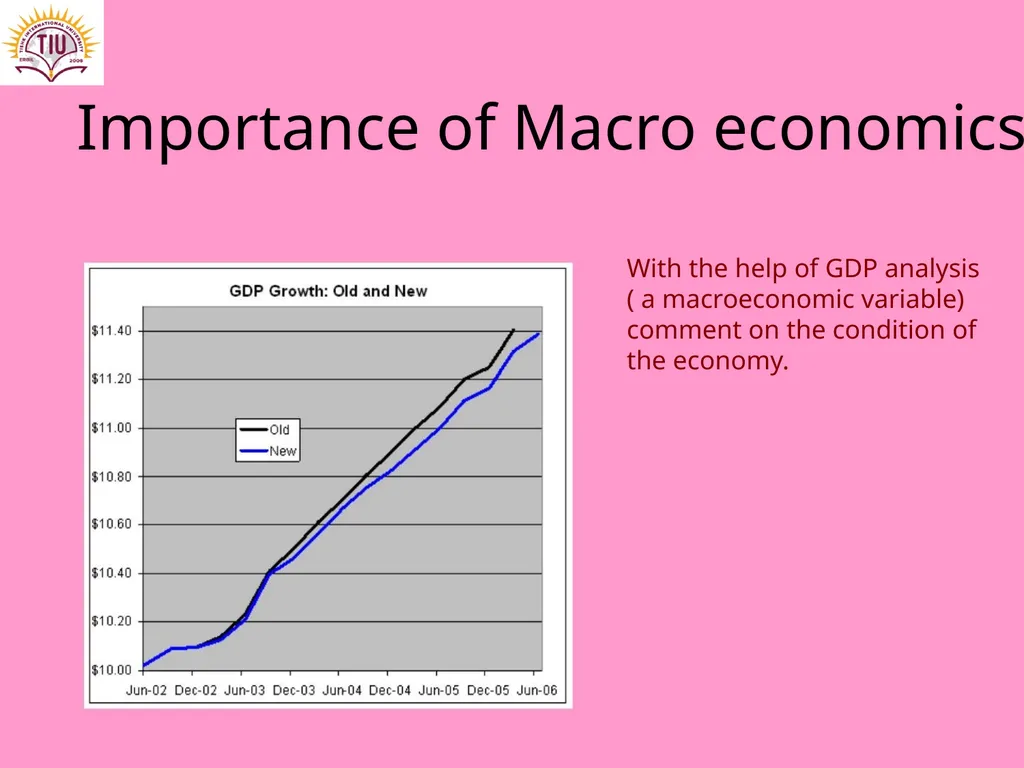
Importance of Macro economics With the help of GDP analysis
( a macroeconomic variable)
comment on the condition of
the economy.<br>
14
Importance of Macro economics In Economic Policies – Macro economic study helps us to find a solution
to complex economic problems of modern times. Ex. 1.General Unemployment, 2. National Income data helps in forecasting
the level of economic activity & to
understand the distribution of income among
different groups of people in the economy.<br>
15
Importance of Macro economics • In Economic Growth – To plan for economic growth, it is
necessary that the macro economic
variables like income, output and
employment are evaluated. In Monetary Problems – Frequent changes in the value of money ( ?)
affects the economy adversely!!<br>
16
Importance of Macro economics • In Business Cycles – Macro economics began to be studied
only after the Great Depression. Thus, its
importance lies in analyzing the causes of
economic fluctuations and in providing
remedies.<br>
17
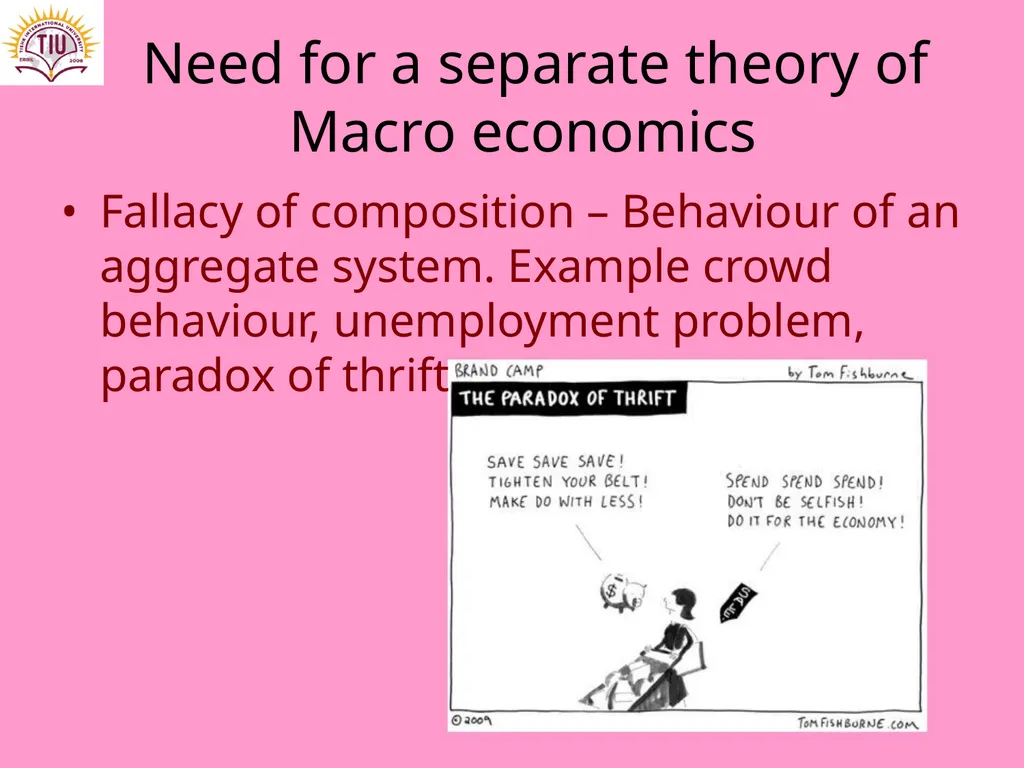
Need for a separate theory of
Macro economics • Fallacy of composition – Behaviour of an
aggregate system. Example crowd
behaviour, unemployment problem,
paradox of thrift<br>
18
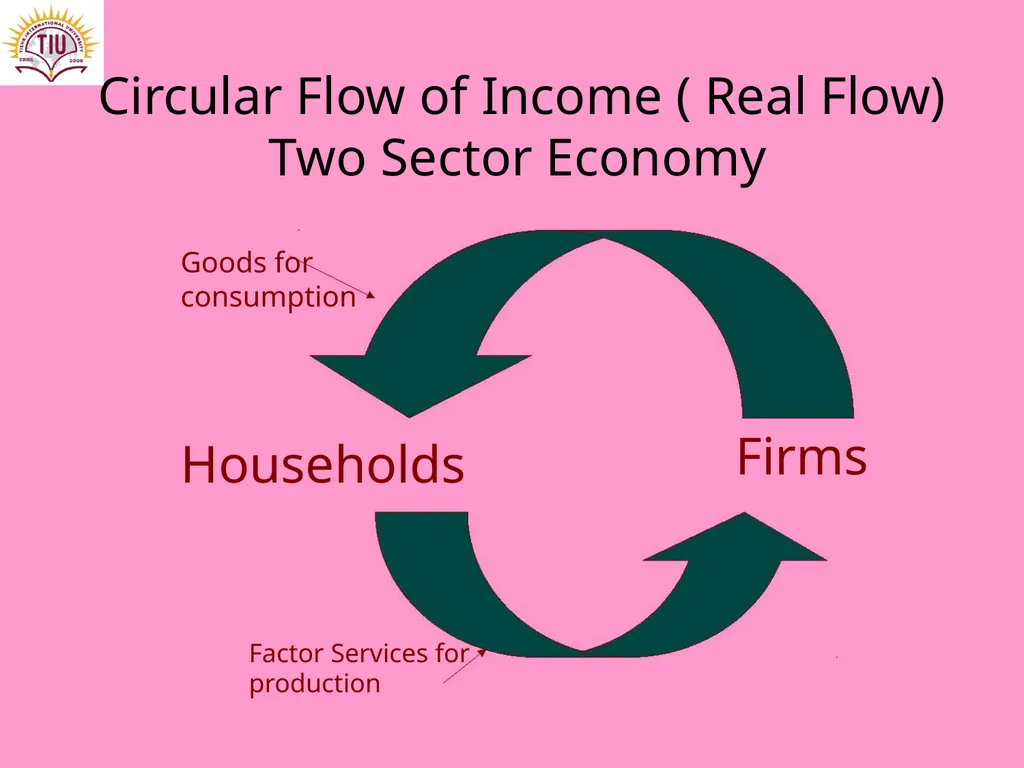
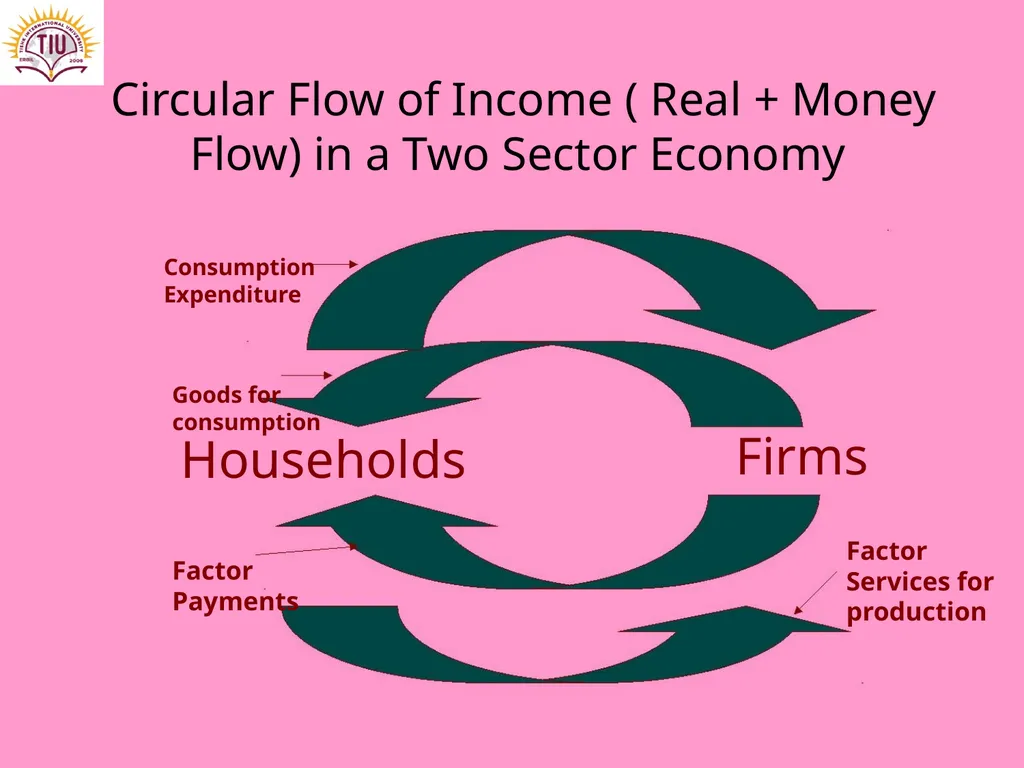
Circular Flow of Income Model • Functioning of an Economy • A model to understand the functioning of a
macro economic system or the economy
as a whole is called the ‘Circular Flow of
Income Model’<br>
19
Circular Flow of Income ( Real Flow)
Two Sector Economy Goods for
consumption Firms Households Factor Services for
production<br>
20
Circular Flow of Income ( Real + Money
Flow) in a Two Sector Economy Consumption
Expenditure Goods for consumption
Households Firms Factor
Services for
production Factor
Payments<br>
21
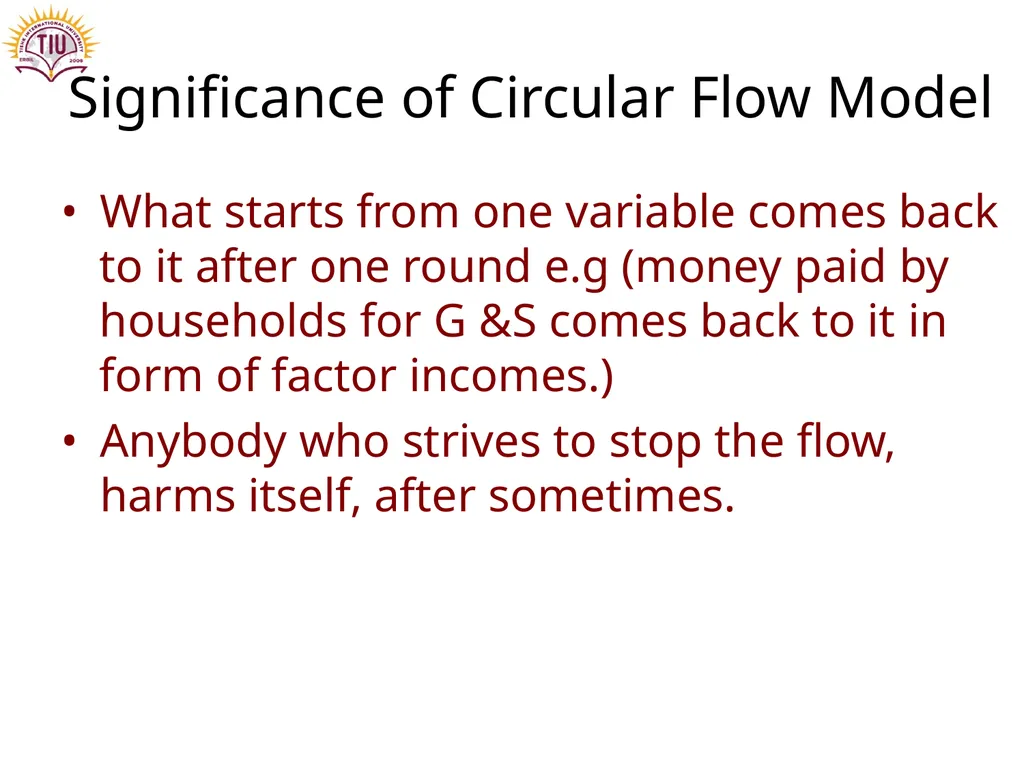
Significance of Circular Flow Model • What starts from one variable comes back
to it after one round e.g (money paid by
households for G &S comes back to it in
form of factor incomes.) • Anybody who strives to stop the flow,
harms itself, after sometimes.<br>
22
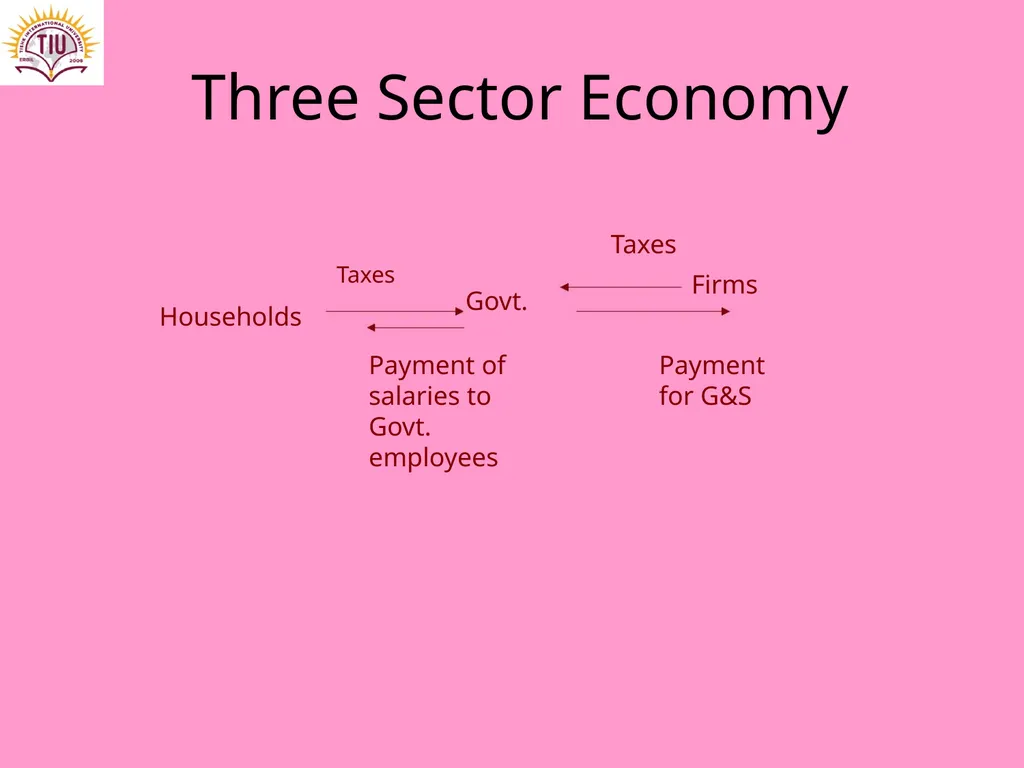
Three Sector Economy Taxes Taxes Firms Govt. Households Payment of
salaries to
Govt. Payment
for G&S employees<br>
23
The Components of
the Macroeconomy • Everyone’s expenditure is
someone
else’s receipt.
Every
transaction
must have two
sides.<br>
24
Questions What is Macroeconomics ?
Why Macroeconomics is different from Microeconomics?
What is circular flow of income trend?
What is great depression and when it was arisen?
Who introduced Macroeconomics in which years? ?<br>