Introduction to Marketing Management Dr. Wan Suryani,.SE,.M.Si What is Marketing? Pemasaran adalah fungsi organisasi dan serangkaian proses untuk menciptakan, berkomunikasi, dan menyampaikan nilai kepada pelanggan dan untuk pengelolaan
Related Topics
Share
Embed code
Download this presentation From Below
"Introduction to Marketing Management Dr. Wan" is the property of its rightful owner. Permission is granted to
download and print the materials on this website for personal, non-commercial use only, and to display it
on your personal computer provided you do not modify the materials and that you retain all copyright
notices contained in the materials. By downloading content from our website, you accept the terms of this
agreement.
Presentation Transcript
01
Introduction to Marketing Management Dr. Wan Suryani,.SE,.M.Si<br>
02
What is Marketing? Pemasaran adalah fungsi organisasi dan serangkaian proses untuk menciptakan, berkomunikasi, dan menyampaikan nilai kepada pelanggan dan untuk pengelolaan
Hubungan pelanggan dengan cara yang menguntungkan
organisasi dan pemangku kepentingannya.<br>
03
Manajemen pemasaran adalah seni dan ilmu memilih pasar sasaran dan mendapatkan, menjaga, dan berkembang
pelanggan melalui penciptaan, penyampaian, dan komunikasi nilai pelanggan yang unggul What is Marketing Management?<br>
04
Definition of Marketing Philip Kotler - “Pemasaran adalah proses Sosial & Manajerial di mana Individu & Kelompok memperoleh apa yang mereka Butuhkan dan Inginkan melalui Penciptaan, Penawaran, dan Pertukaran produk yang memiliki Nilai lain”<br>
05
Definition of Marketing Peter Drucker - Pemasaran adalah suatu proses sosial dimana individu dan kelompok memperoleh apa yang mereka butuhkan dan inginkan melalui penciptaan penawaran, dan secara bebas mempertukarkan produk dan jasa yang bernilai dengan pihak lain. Untuk definisi manajerial, pemasaran sering digambarkan sebagai “seni menjual produk”<br>
06
Definition of Marketing American Marketing Association (AMA) - Pemasaran adalah proses perencanaan dan pelaksanaan konsepsi, penetapan harga, promosi, & distribusi ide, barang, & jasa untuk menciptakan pertukaran yang memenuhi tujuan individu dan organisasi.<br>
07
Why It’s Important Pemasaran yang efektif menempatkan produk di tangan pelanggan sasarannya.<br>
08
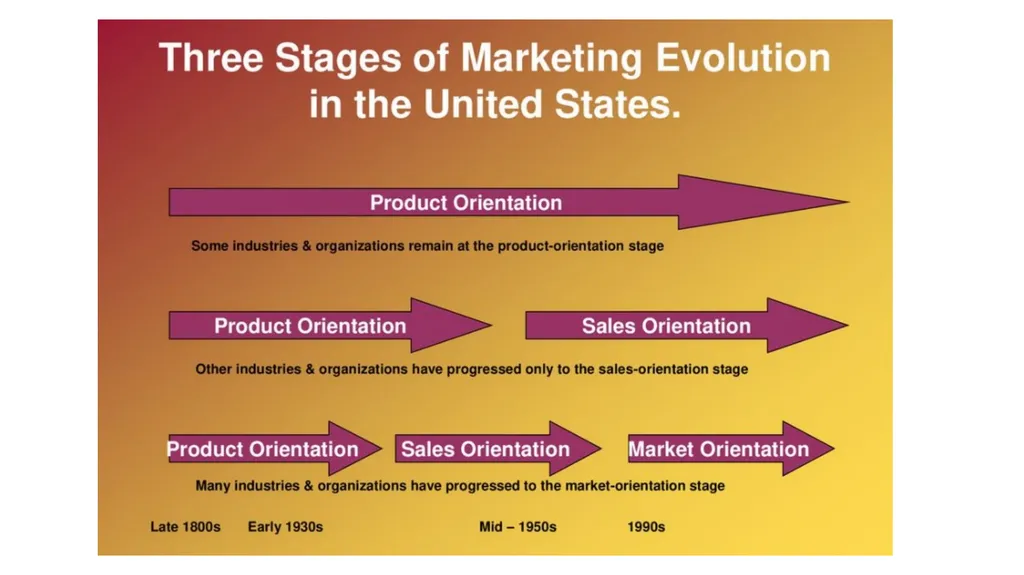
Product – Orientation Stage Produsen dalam tahap orientasi produk biasanya berfokus pada kualitas dan kuantitas output sambil berasumsi bahwa pelanggan akan mencari dan membeli produk dengan harga terjangkau dan dibuat dengan baik.
Di era ketika permintaan terhadap suatu barang umumnya melebihi pasokan, fokus utama dalam bisnis adalah memproduksi produk dalam jumlah besar secara efisien.
Menemukan pelanggan dipandang sebagai fungsi yang relatif kecil.<br>
09
Sales – Orientation Stage Krisis ekonomi dunia pada akhir tahun 1920-an (disebut sebagai Depresi Besar) mengubah persepsi. Menemukan bahwa permasalahan perekonomian bukan lagi bagaimana melakukan produksi secara efisien, melainkan bagaimana menjual output yang dihasilkan. Menawarkan produk yang berkualitas saja bukanlah sebuah jaminan. kesuksesan Para manajer menyadari bahwa untuk menjual produk mereka kepada konsumen yang memiliki sumber daya terbatas dan banyak pilihan, diperlukan upaya pasca produksi yang besar. Tahap orientasi penjualan ditandai dengan ketergantungan yang besar pada aktivitas promosi untuk menjual produk yang ingin dibuat oleh perusahaan.<br>
10
Market – Orientation Stage Pada akhir perang dunia II, terdapat permintaan terpendam yang kuat terhadap barang-barang konsumsi yang disebabkan oleh kekurangan pada masa perang
Dalam upaya untuk merangsang penjualan, perusahaan kembali ke aktivitas promosi & penjualan yang agresif di era orientasi penjualan
Penjual menyadari bahwa tahun-tahun perang juga telah mengubah konsumen
Selain itu, upaya perang membawa banyak perempuan keluar rumah dan memasuki dunia kerja untuk pertama kalinya
Selain itu konsumen mempunyai lebih banyak pilihan
Teknologi yang dikembangkan selama perang memungkinkan produksi barang yang jauh lebih beragam
Pada tahap ini perusahaan mengidentifikasi apa yang diinginkan pelanggan dan menyesuaikan seluruh aktivitas perusahaan untuk memenuhi kebutuhan tersebut seefisien mungkin<br>
11
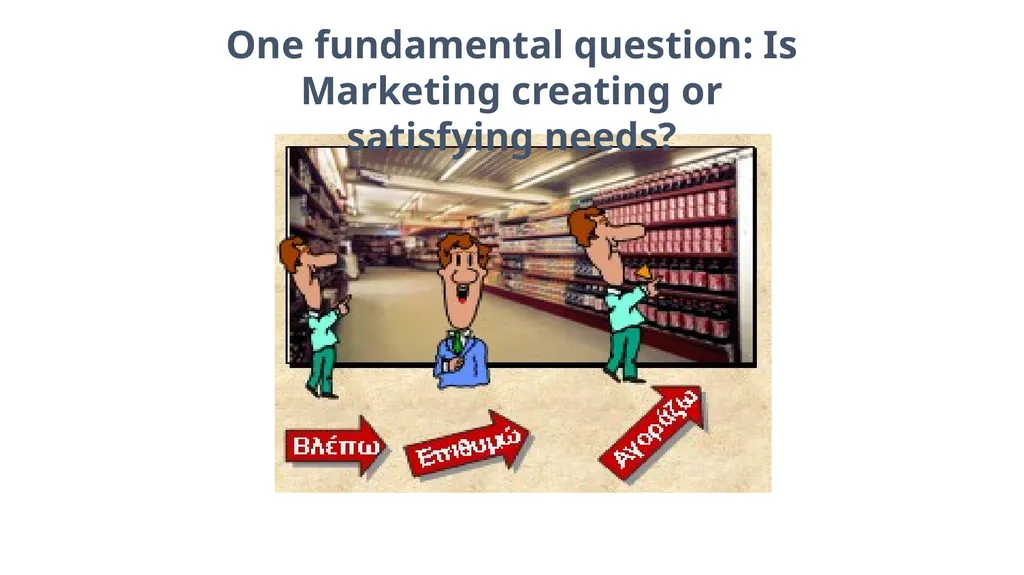
One fundamental question: Is Marketing creating or satisfying needs?<br>
Key Words market research
demographics
channel of distribution
direct distribution
indirect distribution
wholesaler
retailer<br>
14
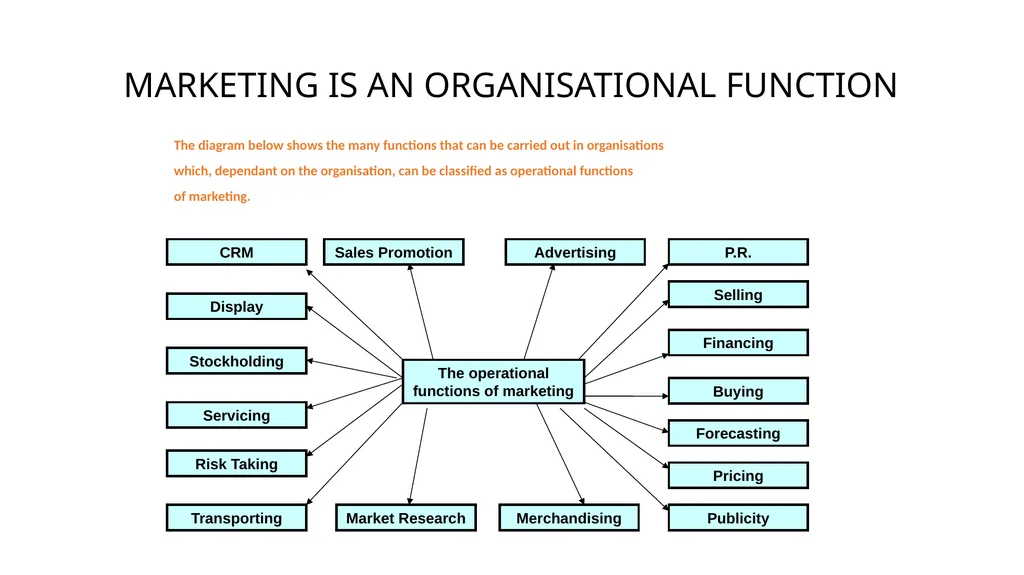
MARKETING IS AN ORGANISATIONAL FUNCTION The diagram below shows the many functions that can be carried out in organisations
which, dependant on the organisation, can be classified as operational functions
of marketing. The operational functions of marketing Advertising P.R. Selling Financing Buying Forecasting Pricing Publicity Merchandising Market Research Transporting Risk Taking Servicing Stockholding Display CRM Sales Promotion<br>
15
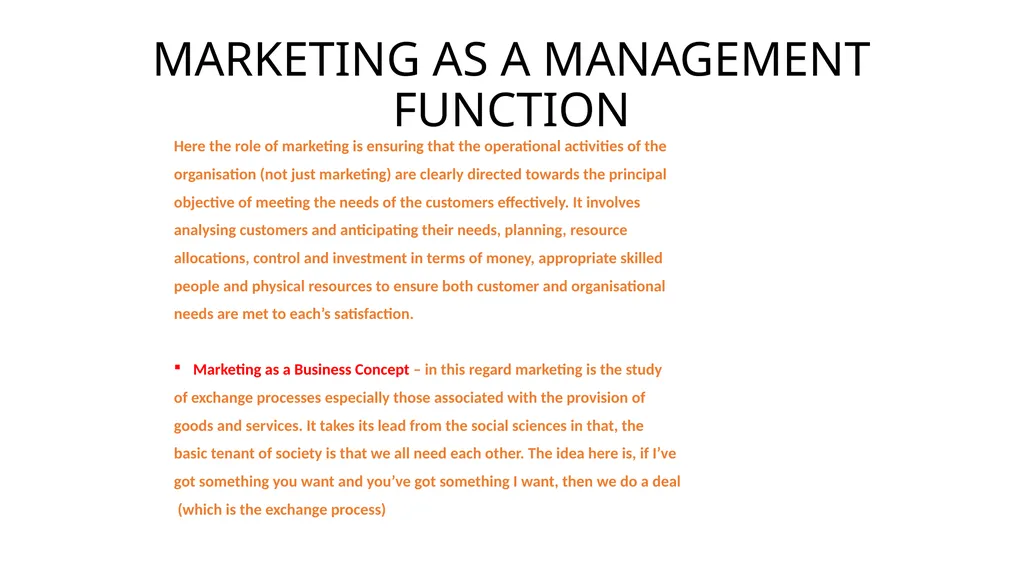
MARKETING AS A MANAGEMENT FUNCTION Here the role of marketing is ensuring that the operational activities of the
organisation (not just marketing) are clearly directed towards the principal
objective of meeting the needs of the customers effectively. It involves
analysing customers and anticipating their needs, planning, resource
allocations, control and investment in terms of money, appropriate skilled
people and physical resources to ensure both customer and organisational
needs are met to each’s satisfaction.
Marketing as a Business Concept – in this regard marketing is the study
of exchange processes especially those associated with the provision of
goods and services. It takes its lead from the social sciences in that, the
basic tenant of society is that we all need each other. The idea here is, if I’ve
got something you want and you’ve got something I want, then we do a deal
(which is the exchange process)<br>
16
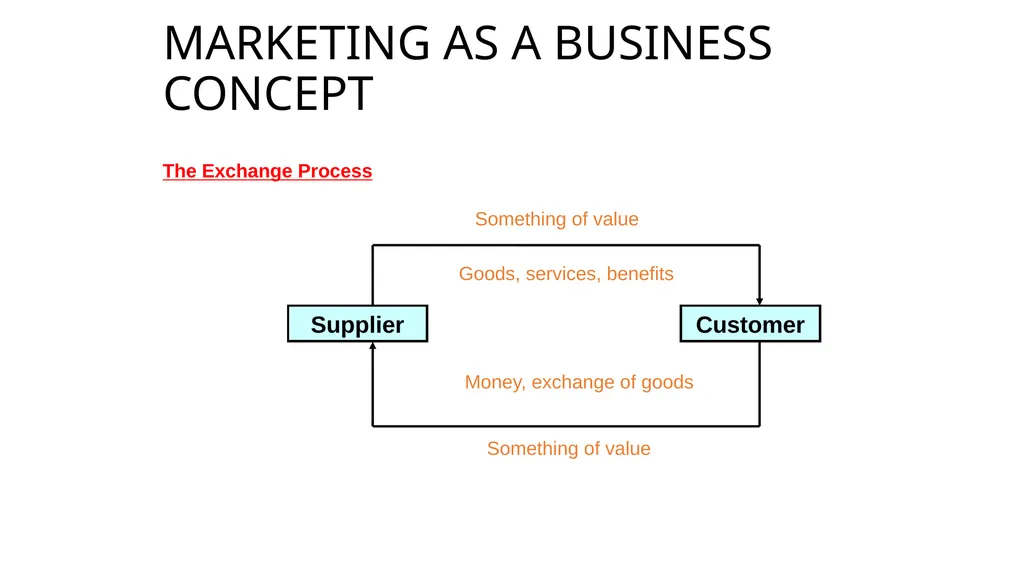
MARKETING AS A BUSINESS CONCEPT Customer Supplier Something of value Goods, services, benefits Something of value Money, exchange of goods The Exchange Process<br>
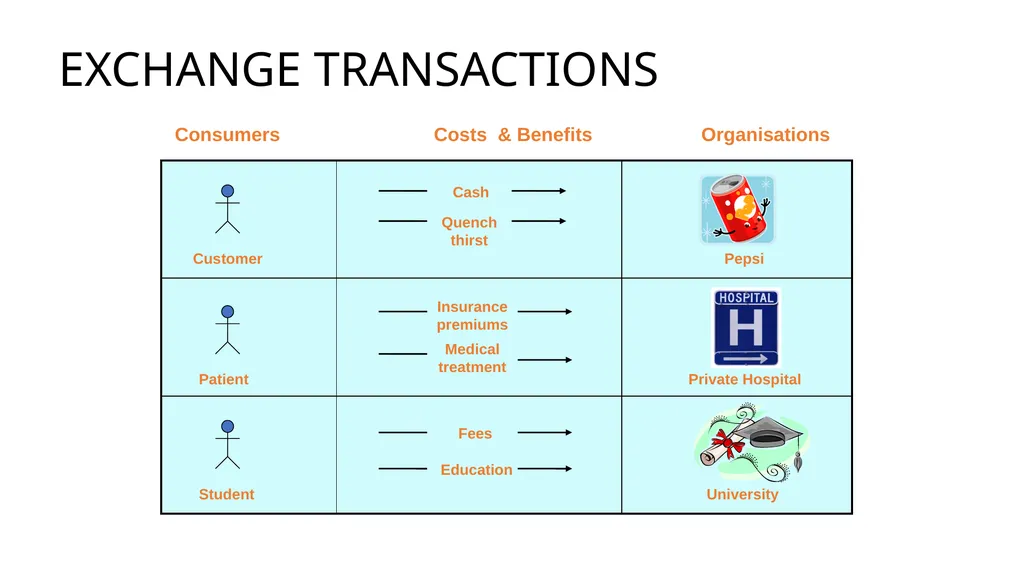
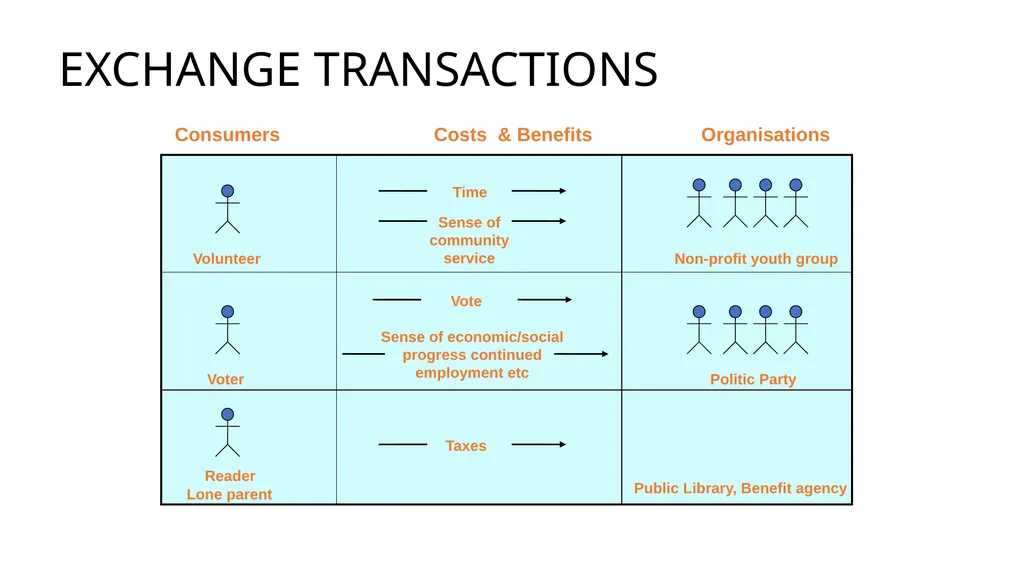
EXCHANGE TRANSACTIONS Consumers Costs & Benefits Organisations Volunteer Time Sense of community service Non-profit youth group Voter Vote Sense of economic/social progress continued employment etc Politic Party Reader Lone parent Taxes Public Library, Benefit agency<br>
19
MARKETING AS A BUSINESS PHILOSOPHY Simply a way (i.e. orientation) towards how the business will
behave.
As a philosophy it recognises the importance of the customer
and that all business exists to serve customers rather than
manufacturing products.
To quote Adam Smith C A in his famous text ‘ The wealth of
“Consumption is the sole purpose of production and the interests
of the product ought to be attended o only so far as it may be
necessary for promoting those of the customer”<br>
20
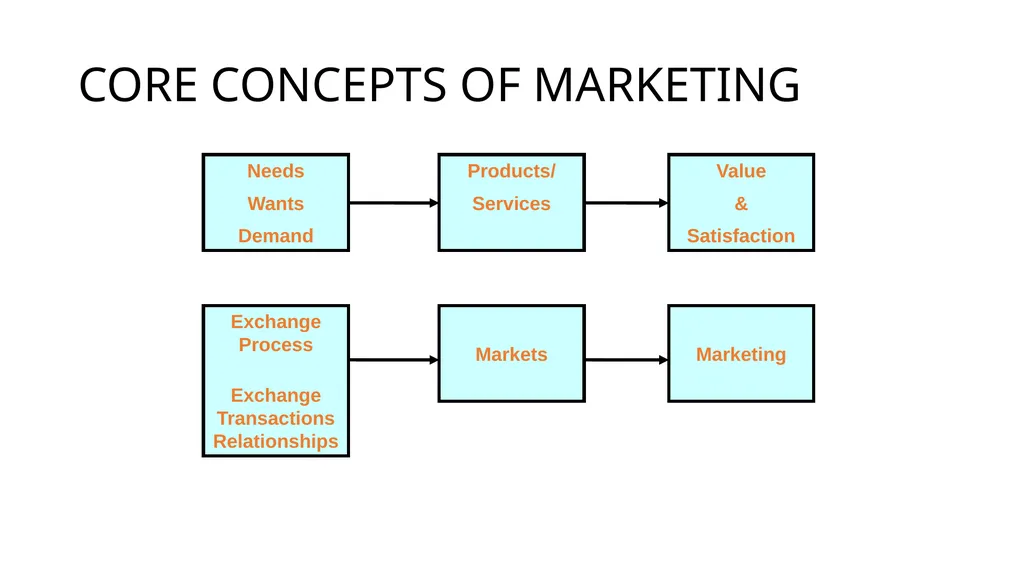
CORE CONCEPTS OF MARKETING Needs
Wants
Demand Products/
Services Value
&
Satisfaction Exchange Process
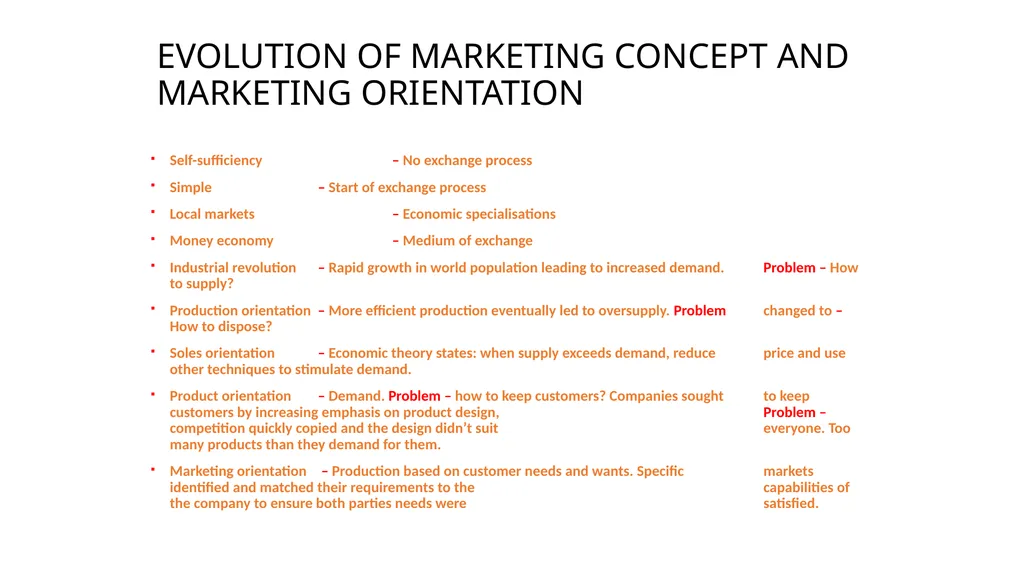
EVOLUTION OF MARKETING CONCEPT AND MARKETING ORIENTATION Self-sufficiency – No exchange process
Simple – Start of exchange process
Local markets – Economic specialisations
Money economy – Medium of exchange
Industrial revolution – Rapid growth in world population leading to increased demand. Problem – How to supply?
Production orientation – More efficient production eventually led to oversupply. Problem changed to – How to dispose?
Soles orientation – Economic theory states: when supply exceeds demand, reduce price and use other techniques to stimulate demand.
Product orientation – Demand. Problem – how to keep customers? Companies sought to keep customers by increasing emphasis on product design, Problem – competition quickly copied and the design didn’t suit everyone. Too many products than they demand for them.
Marketing orientation – Production based on customer needs and wants. Specific markets identified and matched their requirements to the capabilities of the company to ensure both parties needs were satisfied.<br>
22
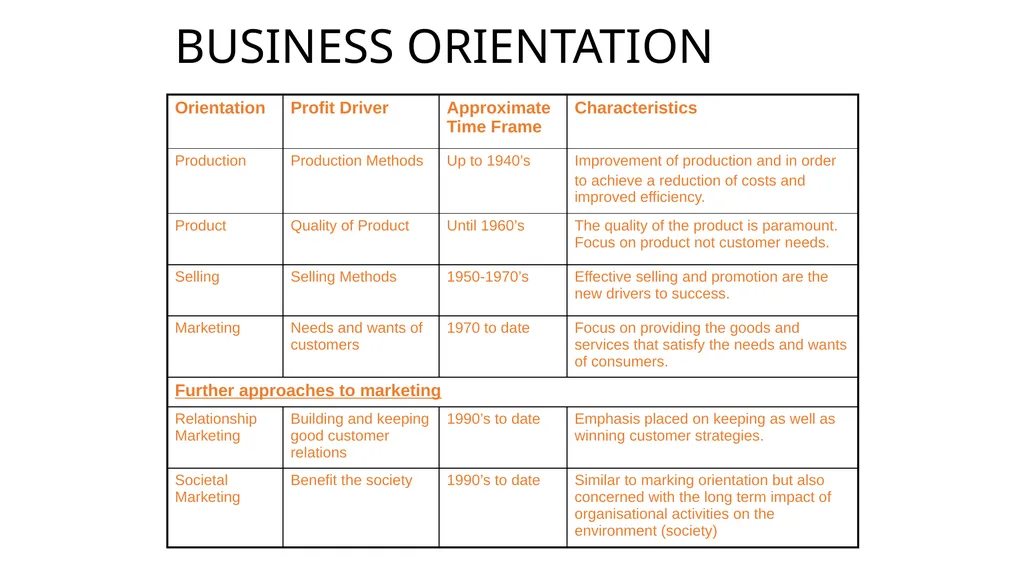
BUSINESS ORIENTATION<br>
23
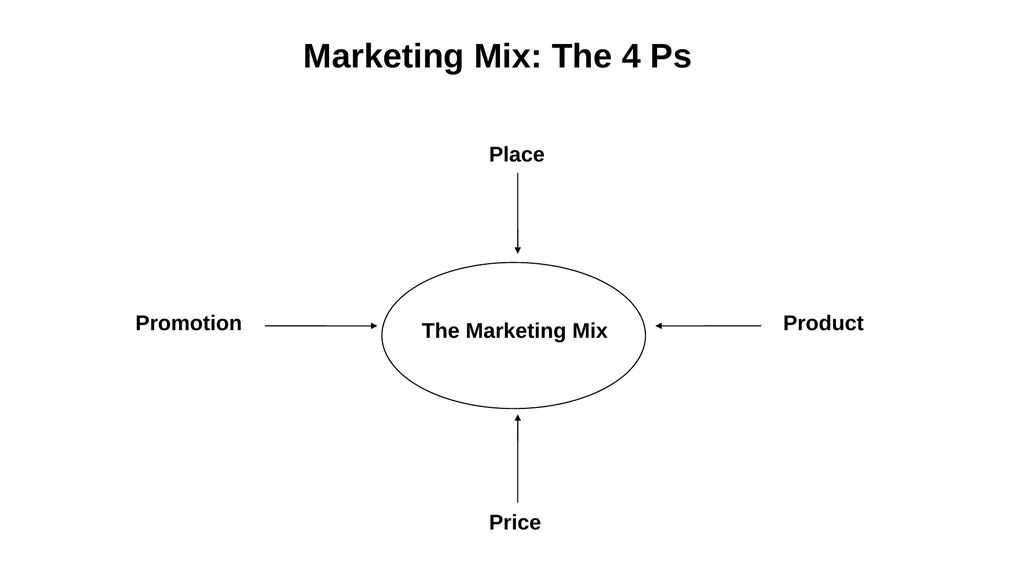
Marketing Mix: The 4 Ps Place Promotion Product Price The Marketing Mix<br>
24
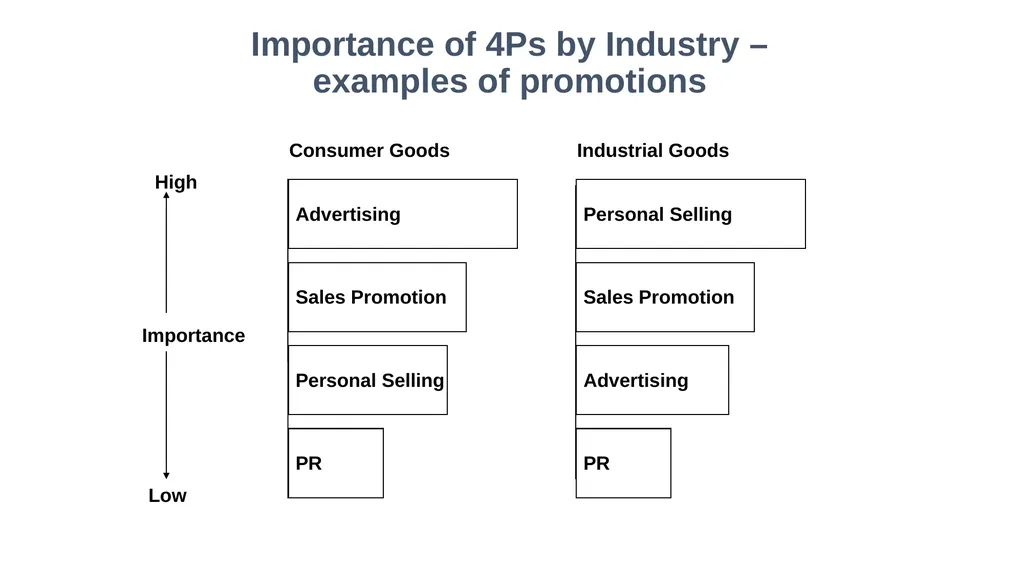
Importance of 4Ps by Industry – examples of promotions Advertising Sales Promotion Personal Selling PR Advertising Sales Promotion Personal Selling PR Consumer Goods Industrial Goods Importance High Low<br>
25
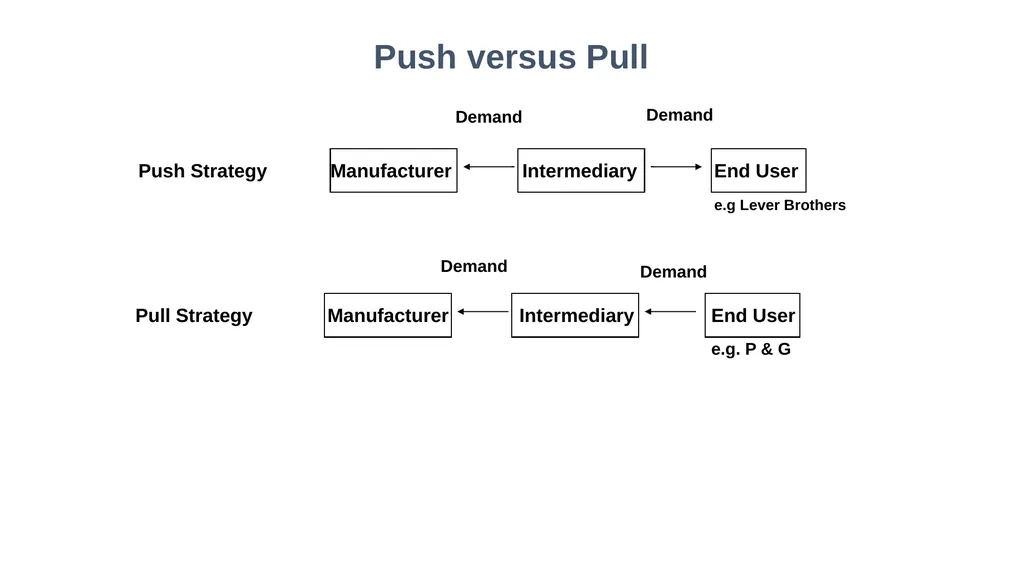
Push versus Pull Push Strategy Manufacturer Intermediary End User
e.g Lever Brothers Pull Strategy Manufacturer Intermediary End User
e.g. P & G Demand Demand Demand Demand<br>