
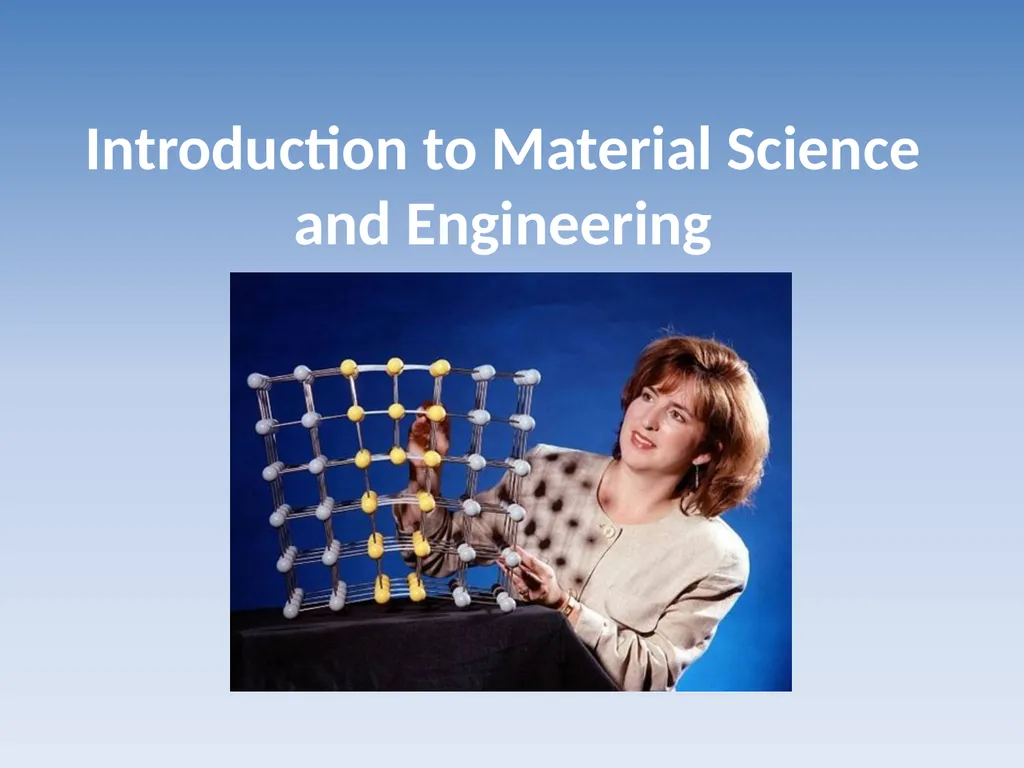
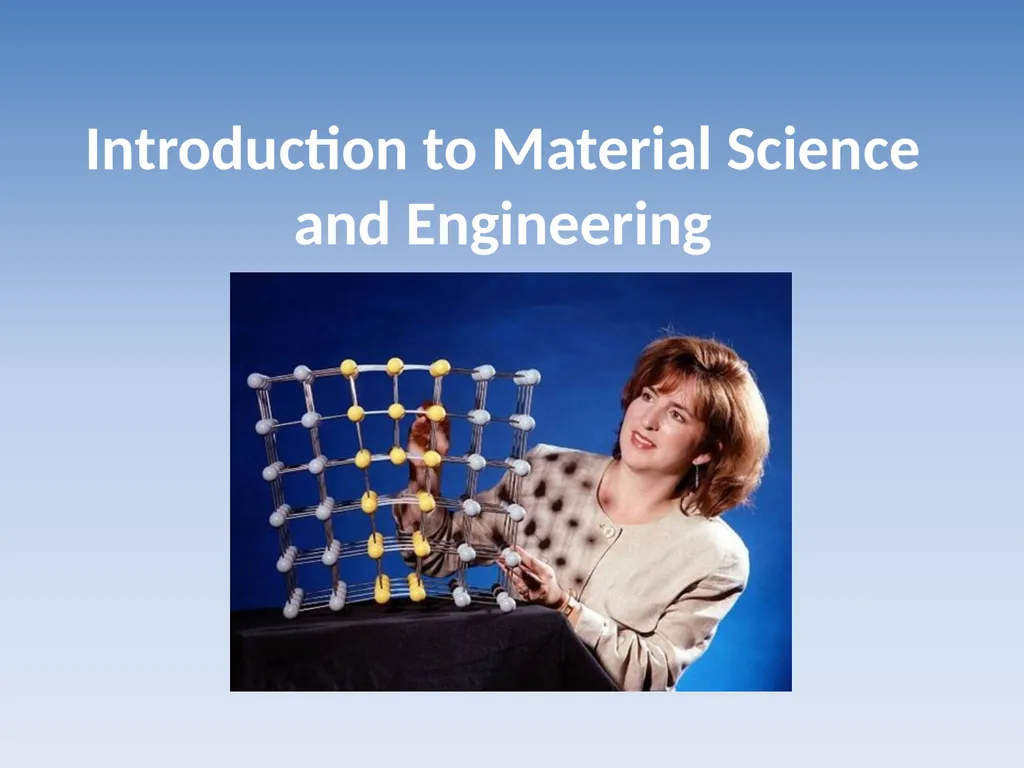
Introduction to Material Science and Engineering
JO
Published · 28 slides · 0 views
1 / 1
Description
Introduction to Material Science and Engineering Introduction Definition 1: A branch of science that focuses on materials; interdisciplinary field composed of physics and chemistry. Definition 2: Relationship of material properties to its
Related Topics
Share
Embed code
Download this presentation From Below
"Introduction to Material Science and Engineering" is the property of its rightful owner. Permission is granted to download and print the materials on this website for personal, non-commercial use only, and to display it on your personal computer provided you do not modify the materials and that you retain all copyright notices contained in the materials. By downloading content from our website, you accept the terms of this agreement.
Presentation Transcript
01
Introduction to Material Science and Engineering<br>
02
Introduction Definition 1: A branch of science that focuses on materials; interdisciplinary field composed of physics and chemistry.
Definition 2: Relationship of material properties to its composition and structure. What is material science? What is a material scientist? A person who uses his/her combined knowledge of physics, chemistry and metallurgy to exploit property-structure combinations for practical use.<br>
Definition 2: Relationship of material properties to its composition and structure. What is material science? What is a material scientist? A person who uses his/her combined knowledge of physics, chemistry and metallurgy to exploit property-structure combinations for practical use.<br>
03
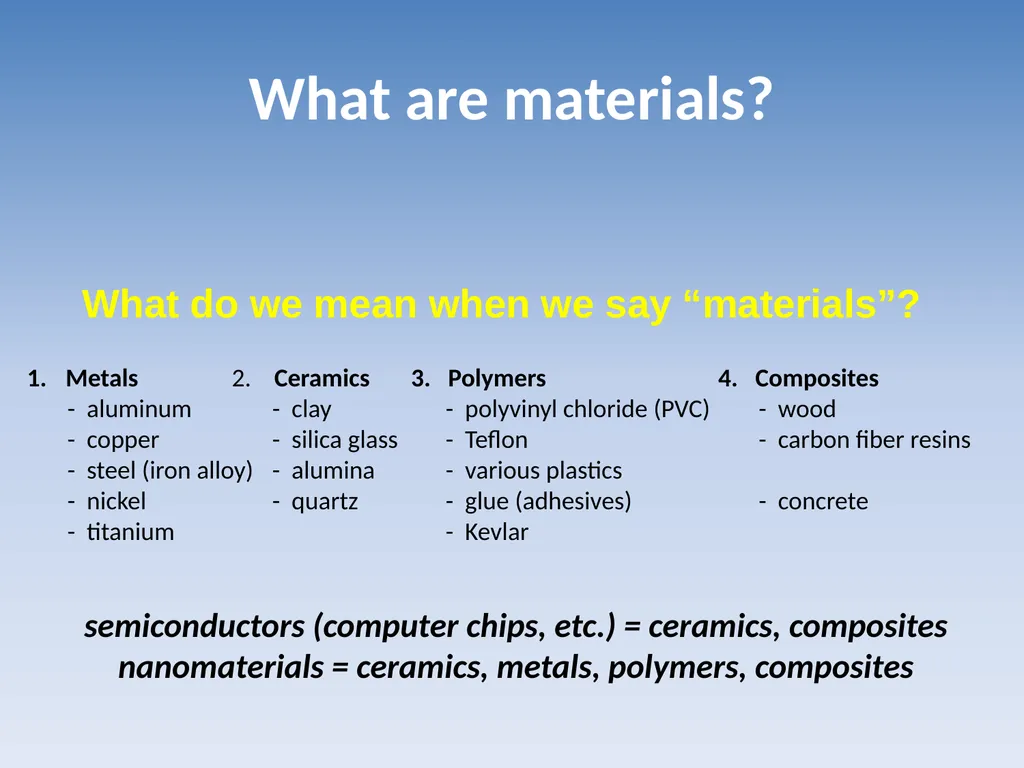
What are materials? What do we mean when we say “materials”? Metals
- aluminum
- copper
- steel (iron alloy)
- nickel
- titanium 2. Ceramics
- clay
- silica glass
- alumina
- quartz 3. Polymers
- polyvinyl chloride (PVC)
- Teflon
- various plastics
- glue (adhesives)
- Kevlar semiconductors (computer chips, etc.) = ceramics, composites
nanomaterials = ceramics, metals, polymers, composites 4. Composites
- wood
- carbon fiber resins
- concrete<br>
- aluminum
- copper
- steel (iron alloy)
- nickel
- titanium 2. Ceramics
- clay
- silica glass
- alumina
- quartz 3. Polymers
- polyvinyl chloride (PVC)
- Teflon
- various plastics
- glue (adhesives)
- Kevlar semiconductors (computer chips, etc.) = ceramics, composites
nanomaterials = ceramics, metals, polymers, composites 4. Composites
- wood
- carbon fiber resins
- concrete<br>
04
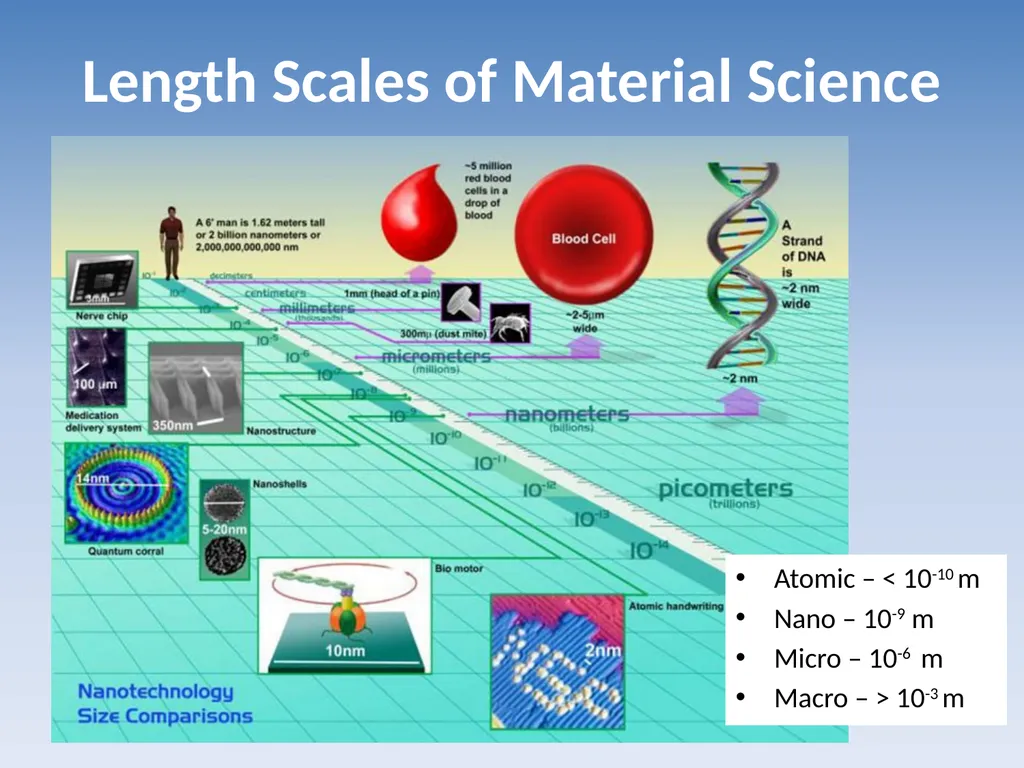
Length Scales of Material Science Atomic – < 10-10 m
Nano – 10-9 m
Micro – 10-6 m
Macro – > 10-3 m<br>
Nano – 10-9 m
Micro – 10-6 m
Macro – > 10-3 m<br>
05
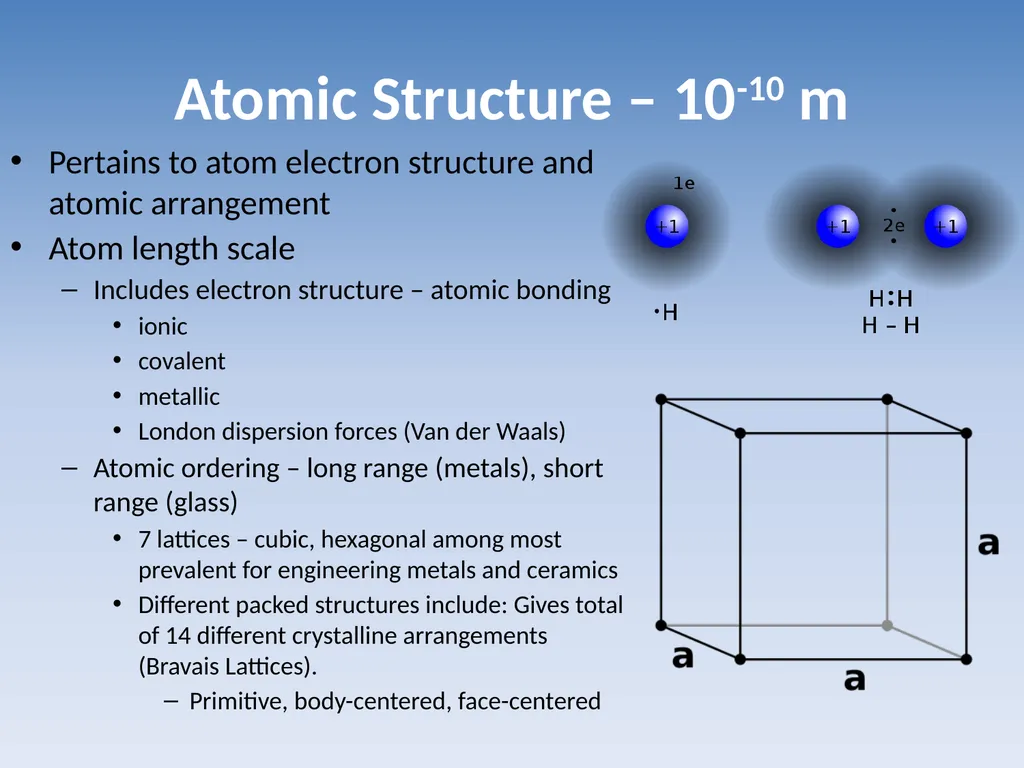
Atomic Structure – 10-10 m Pertains to atom electron structure and atomic arrangement
Atom length scale
Includes electron structure – atomic bonding
ionic
covalent
metallic
London dispersion forces (Van der Waals)
Atomic ordering – long range (metals), short range (glass)
7 lattices – cubic, hexagonal among most prevalent for engineering metals and ceramics
Different packed structures include: Gives total of 14 different crystalline arrangements (Bravais Lattices).
Primitive, body-centered, face-centered<br>
Atom length scale
Includes electron structure – atomic bonding
ionic
covalent
metallic
London dispersion forces (Van der Waals)
Atomic ordering – long range (metals), short range (glass)
7 lattices – cubic, hexagonal among most prevalent for engineering metals and ceramics
Different packed structures include: Gives total of 14 different crystalline arrangements (Bravais Lattices).
Primitive, body-centered, face-centered<br>
06
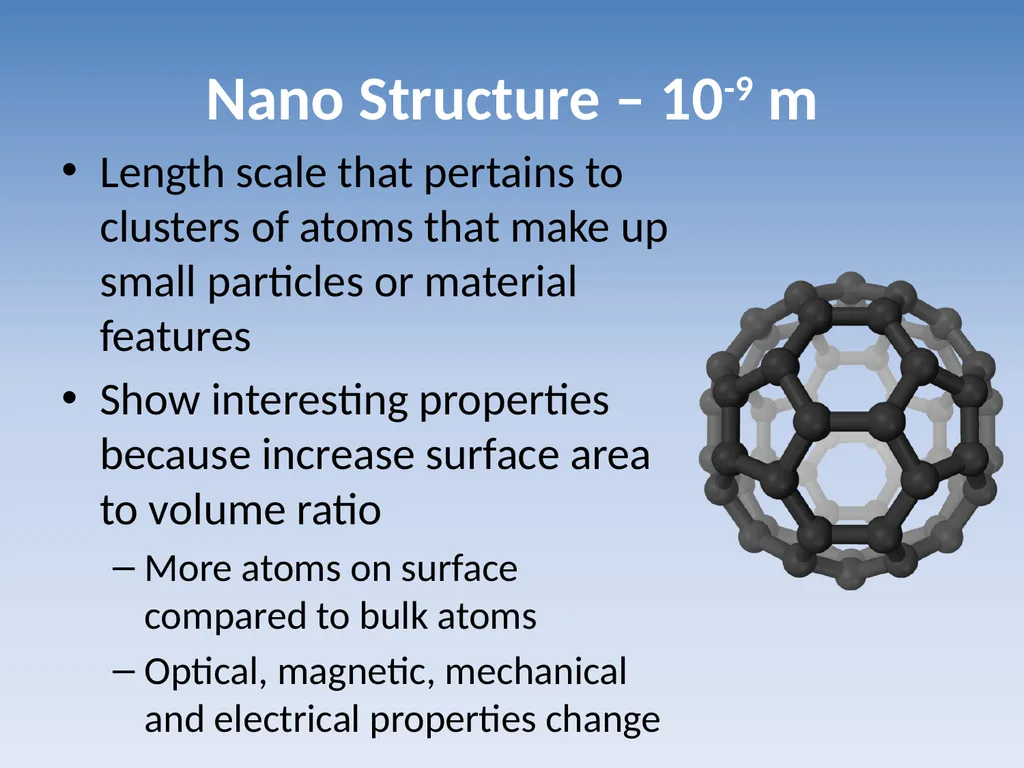
Nano Structure – 10-9 m Length scale that pertains to clusters of atoms that make up small particles or material features
Show interesting properties because increase surface area to volume ratio
More atoms on surface compared to bulk atoms
Optical, magnetic, mechanical and electrical properties change<br>
Show interesting properties because increase surface area to volume ratio
More atoms on surface compared to bulk atoms
Optical, magnetic, mechanical and electrical properties change<br>
07
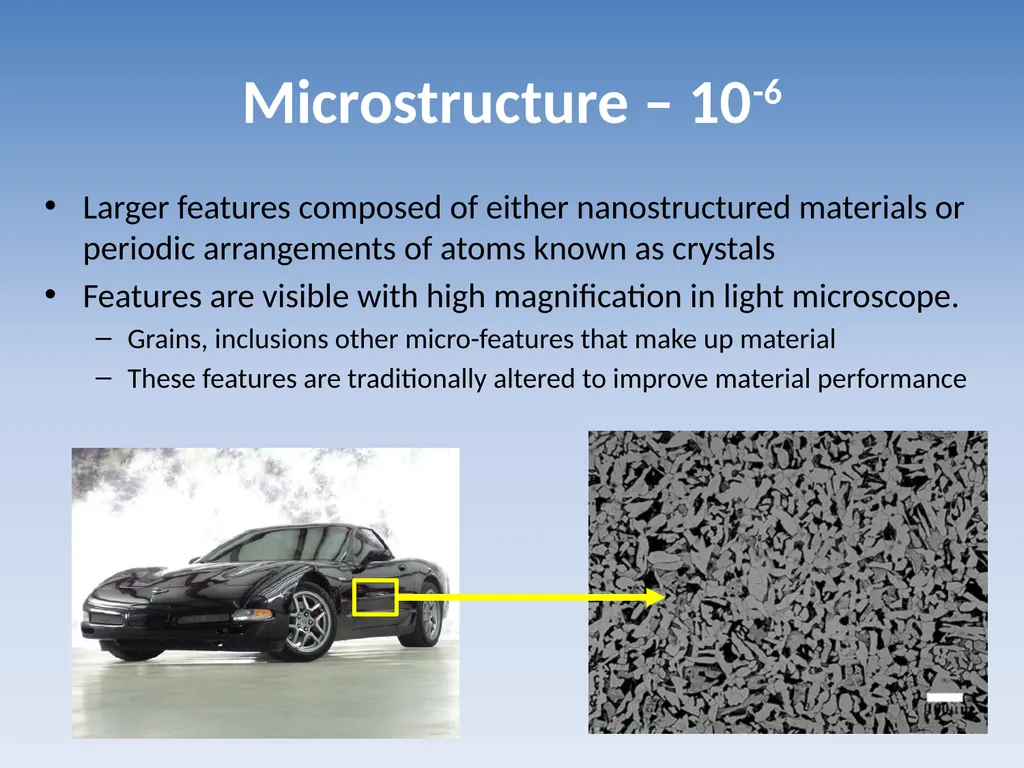
Microstructure – 10-6 Larger features composed of either nanostructured materials or periodic arrangements of atoms known as crystals
Features are visible with high magnification in light microscope.
Grains, inclusions other micro-features that make up material
These features are traditionally altered to improve material performance<br>
Features are visible with high magnification in light microscope.
Grains, inclusions other micro-features that make up material
These features are traditionally altered to improve material performance<br>
08
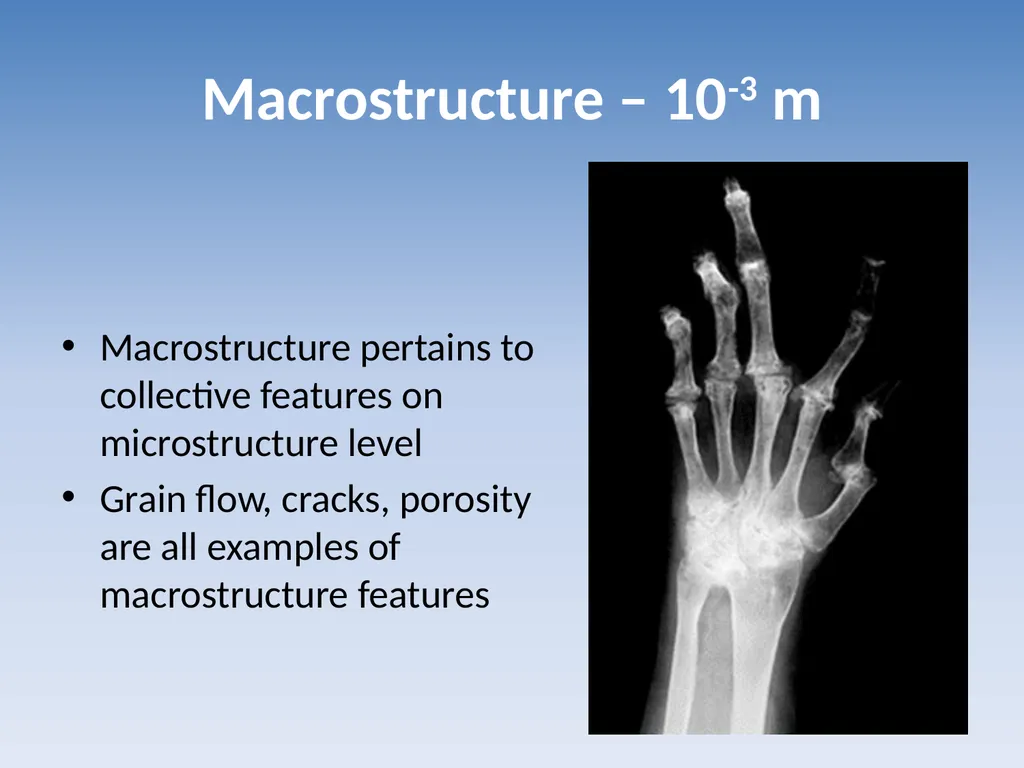
Macrostructure – 10-3 m Macrostructure pertains to collective features on microstructure level
Grain flow, cracks, porosity are all examples of macrostructure features<br>
Grain flow, cracks, porosity are all examples of macrostructure features<br>
09
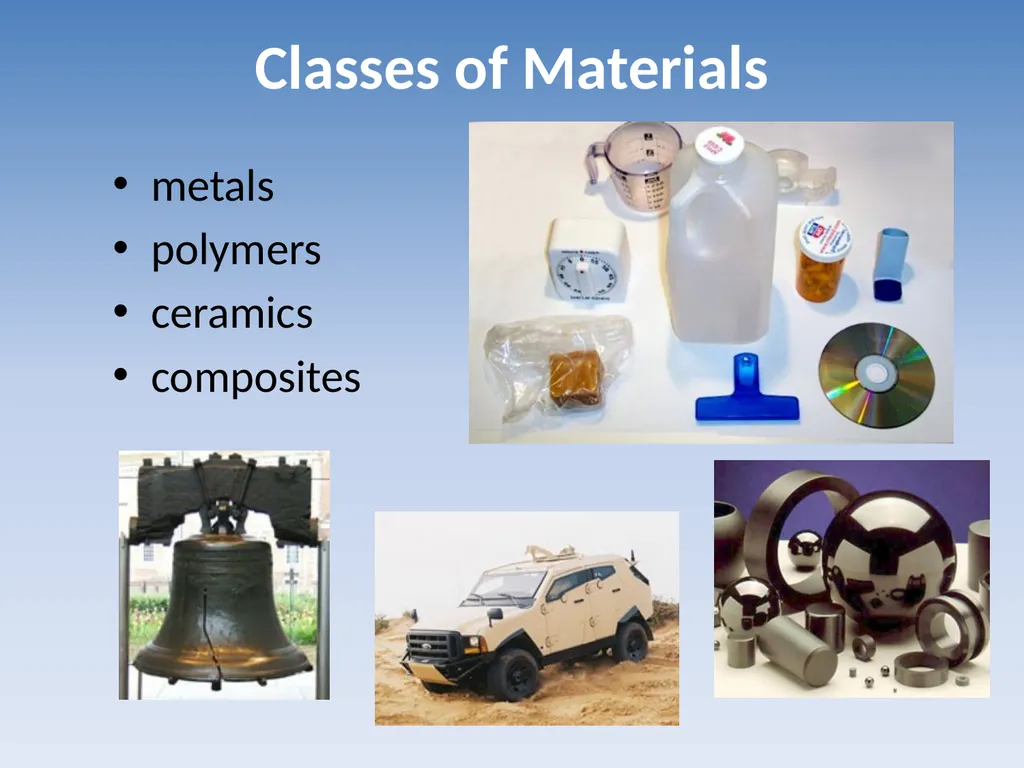
Classes of Materials metals
polymers
ceramics
composites<br>
polymers
ceramics
composites<br>
10
Metals Metals consist of alkaline, alkaline earth, metalloids and transition metals
Metal alloys are mixtures of two or more metal and nonmetal elements (for example, aluminum and copper, Cu-Ni alloy, steel)
Bonding: Metallic
No particular sharing or donating occurs. Electron cloud is formed (that is, free electrons)
Strong bonds with no hybridization or directionality
Properties:
Electrically conductive (free electrons)
Thermally conductive
High strength – large capacity to carry load over x-section area (stress)
Ductile – endure large amounts of deformation before breaking.
Magnetic – ferromagnetism, paramagnetic
Medium melting point<br>
Metal alloys are mixtures of two or more metal and nonmetal elements (for example, aluminum and copper, Cu-Ni alloy, steel)
Bonding: Metallic
No particular sharing or donating occurs. Electron cloud is formed (that is, free electrons)
Strong bonds with no hybridization or directionality
Properties:
Electrically conductive (free electrons)
Thermally conductive
High strength – large capacity to carry load over x-section area (stress)
Ductile – endure large amounts of deformation before breaking.
Magnetic – ferromagnetism, paramagnetic
Medium melting point<br>
11
Metal Applications Electrical wire: aluminum, copper, silver
Heat transfer fins: aluminum, silver
Plumbing: copper
Construction beams (bridges, sky scrapers, rebar, etc.): steel (Fe-C alloys)
Cars: steel (Fe-C alloys)
Consumer goods:
soup cans
appliances (stainless steel sheet metal)
utensils
tools
Many, many, many more…<br>
Heat transfer fins: aluminum, silver
Plumbing: copper
Construction beams (bridges, sky scrapers, rebar, etc.): steel (Fe-C alloys)
Cars: steel (Fe-C alloys)
Consumer goods:
soup cans
appliances (stainless steel sheet metal)
utensils
tools
Many, many, many more…<br>
12
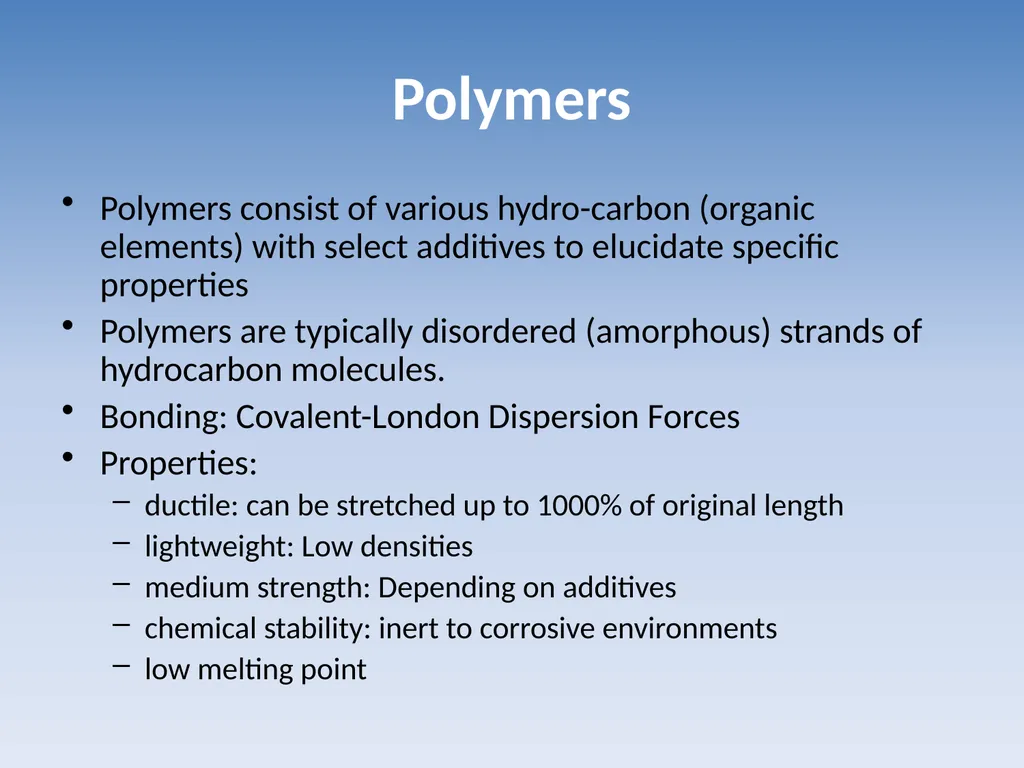
Polymers Polymers consist of various hydro-carbon (organic elements) with select additives to elucidate specific properties
Polymers are typically disordered (amorphous) strands of hydrocarbon molecules.
Bonding: Covalent-London Dispersion Forces
Properties:
ductile: can be stretched up to 1000% of original length
lightweight: Low densities
medium strength: Depending on additives
chemical stability: inert to corrosive environments
low melting point<br>
Polymers are typically disordered (amorphous) strands of hydrocarbon molecules.
Bonding: Covalent-London Dispersion Forces
Properties:
ductile: can be stretched up to 1000% of original length
lightweight: Low densities
medium strength: Depending on additives
chemical stability: inert to corrosive environments
low melting point<br>
13
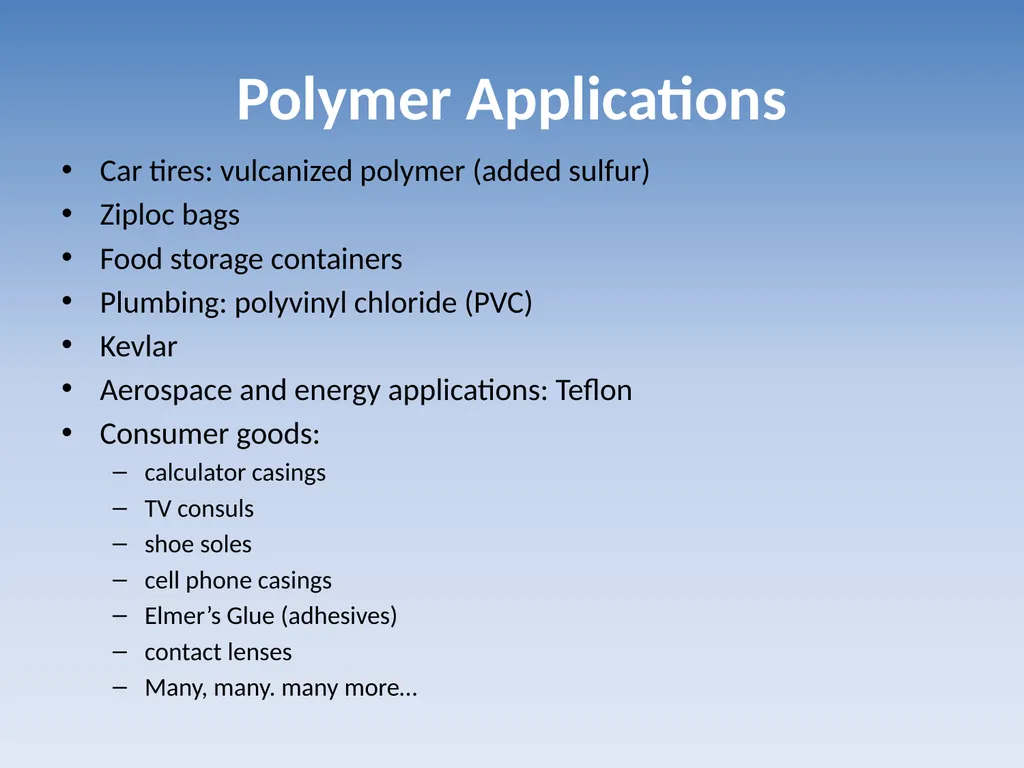
Polymer Applications Car tires: vulcanized polymer (added sulfur)
Ziploc bags
Food storage containers
Plumbing: polyvinyl chloride (PVC)
Kevlar
Aerospace and energy applications: Teflon
Consumer goods:
calculator casings
TV consuls
shoe soles
cell phone casings
Elmer’s Glue (adhesives)
contact lenses
Many, many. many more…<br>
Ziploc bags
Food storage containers
Plumbing: polyvinyl chloride (PVC)
Kevlar
Aerospace and energy applications: Teflon
Consumer goods:
calculator casings
TV consuls
shoe soles
cell phone casings
Elmer’s Glue (adhesives)
contact lenses
Many, many. many more…<br>
14
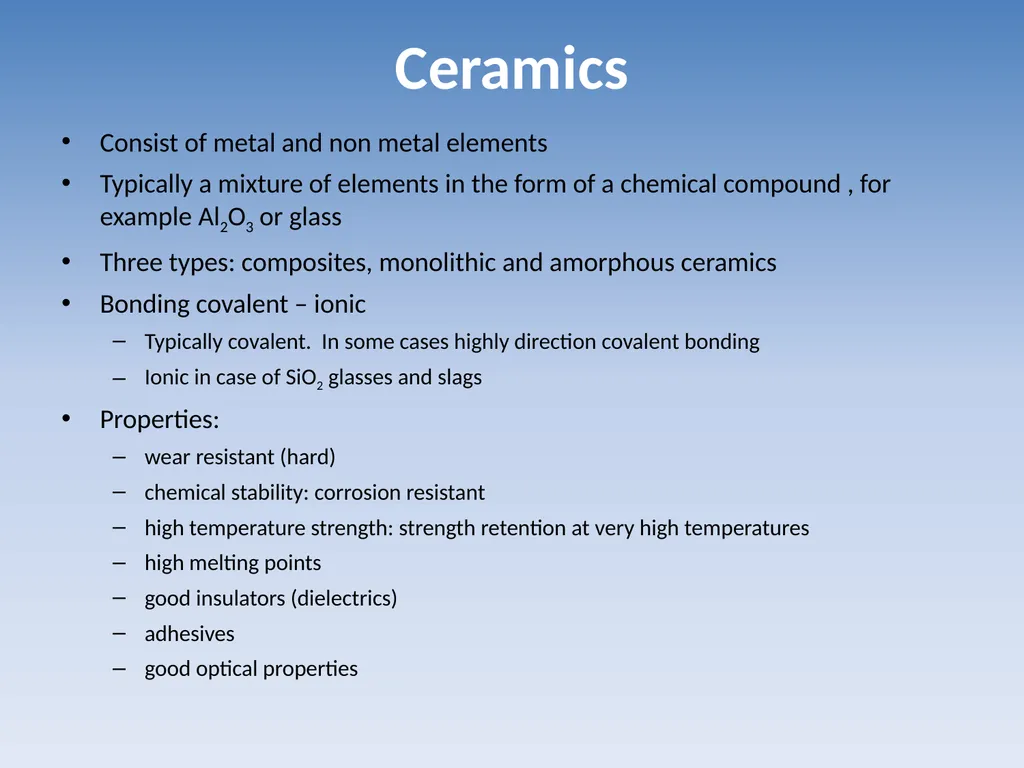
Ceramics Consist of metal and non metal elements
Typically a mixture of elements in the form of a chemical compound , for example Al2O3 or glass
Three types: composites, monolithic and amorphous ceramics
Bonding covalent – ionic
Typically covalent. In some cases highly direction covalent bonding
Ionic in case of SiO2 glasses and slags
Properties:
wear resistant (hard)
chemical stability: corrosion resistant
high temperature strength: strength retention at very high temperatures
high melting points
good insulators (dielectrics)
adhesives
good optical properties<br>
Typically a mixture of elements in the form of a chemical compound , for example Al2O3 or glass
Three types: composites, monolithic and amorphous ceramics
Bonding covalent – ionic
Typically covalent. In some cases highly direction covalent bonding
Ionic in case of SiO2 glasses and slags
Properties:
wear resistant (hard)
chemical stability: corrosion resistant
high temperature strength: strength retention at very high temperatures
high melting points
good insulators (dielectrics)
adhesives
good optical properties<br>
15
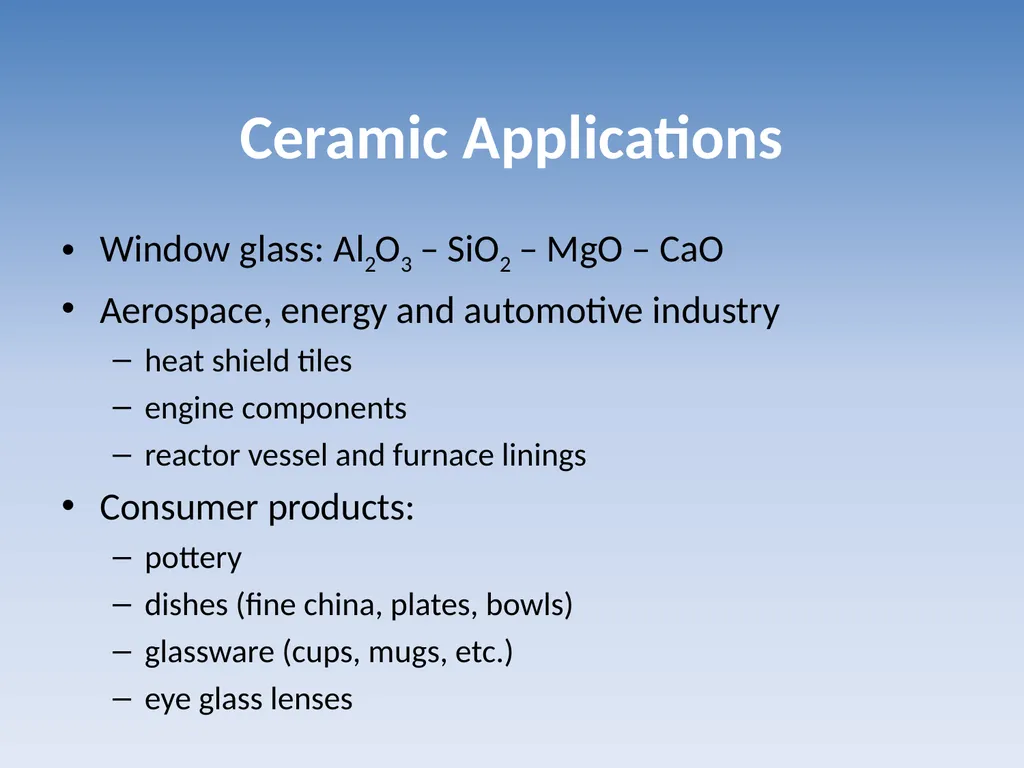
Ceramic Applications Window glass: Al2O3 – SiO2 – MgO – CaO
Aerospace, energy and automotive industry
heat shield tiles
engine components
reactor vessel and furnace linings
Consumer products:
pottery
dishes (fine china, plates, bowls)
glassware (cups, mugs, etc.)
eye glass lenses<br>
Aerospace, energy and automotive industry
heat shield tiles
engine components
reactor vessel and furnace linings
Consumer products:
pottery
dishes (fine china, plates, bowls)
glassware (cups, mugs, etc.)
eye glass lenses<br>
16
Composites A mixture of two different materials to create a new material with combined properties
Types of composites:
Particulate reinforced – discontinuous type with low aspect ratio
Whisker/rod reinforced - discontinuous type with high aspect ratio
Fiber reinforced - continuous type with high aspect ratio (naturally)
Laminated composites - layered structures (surf boards, skate boards)
Bonding: depends on type of composite (strong-covalent, medium-solid solution, weak-tertiary phase layer)
Properties: Depends on composites
High melting points with improved high temperature strength: ceramic-ceramic
High strength and ductile with improved wear resistance: metal-ceramic
High strength and ductile: polymer-polymer<br>
Types of composites:
Particulate reinforced – discontinuous type with low aspect ratio
Whisker/rod reinforced - discontinuous type with high aspect ratio
Fiber reinforced - continuous type with high aspect ratio (naturally)
Laminated composites - layered structures (surf boards, skate boards)
Bonding: depends on type of composite (strong-covalent, medium-solid solution, weak-tertiary phase layer)
Properties: Depends on composites
High melting points with improved high temperature strength: ceramic-ceramic
High strength and ductile with improved wear resistance: metal-ceramic
High strength and ductile: polymer-polymer<br>
17
Composites: Applications Wood: naturally occurring biological material consists of very strong fibers imbedded in a soft matrix
Plywood: laminated wood for buildings
Concrete: basements, bridges, sidewalks
Fiberglass: boats
Carbon fiber resins: bicycle frames<br>
Plywood: laminated wood for buildings
Concrete: basements, bridges, sidewalks
Fiberglass: boats
Carbon fiber resins: bicycle frames<br>
18
Advanced Applications Ceramics & Composites Aerospace and Defense Applications
Structural materials used for missiles, aircraft, space vehicles
What type of materials may be used?
Ultrahigh Temperature Ceramic-Composites (UHTCs)
Metal-nonmetal, Covalent bonded compounds (ZrB2 – SiC)
High melting point materials; strong materials at temperature; excellent oxidation resistance
Why these materials?
Service temperatures are in excess of 2000°C (~1/3 surface temperature of our sun)
Materials have high melting points (>3000°C)
Excellent strength retention at services temperatures
Relative chemical stability at service temperatures
Light weight<br>
Structural materials used for missiles, aircraft, space vehicles
What type of materials may be used?
Ultrahigh Temperature Ceramic-Composites (UHTCs)
Metal-nonmetal, Covalent bonded compounds (ZrB2 – SiC)
High melting point materials; strong materials at temperature; excellent oxidation resistance
Why these materials?
Service temperatures are in excess of 2000°C (~1/3 surface temperature of our sun)
Materials have high melting points (>3000°C)
Excellent strength retention at services temperatures
Relative chemical stability at service temperatures
Light weight<br>
19
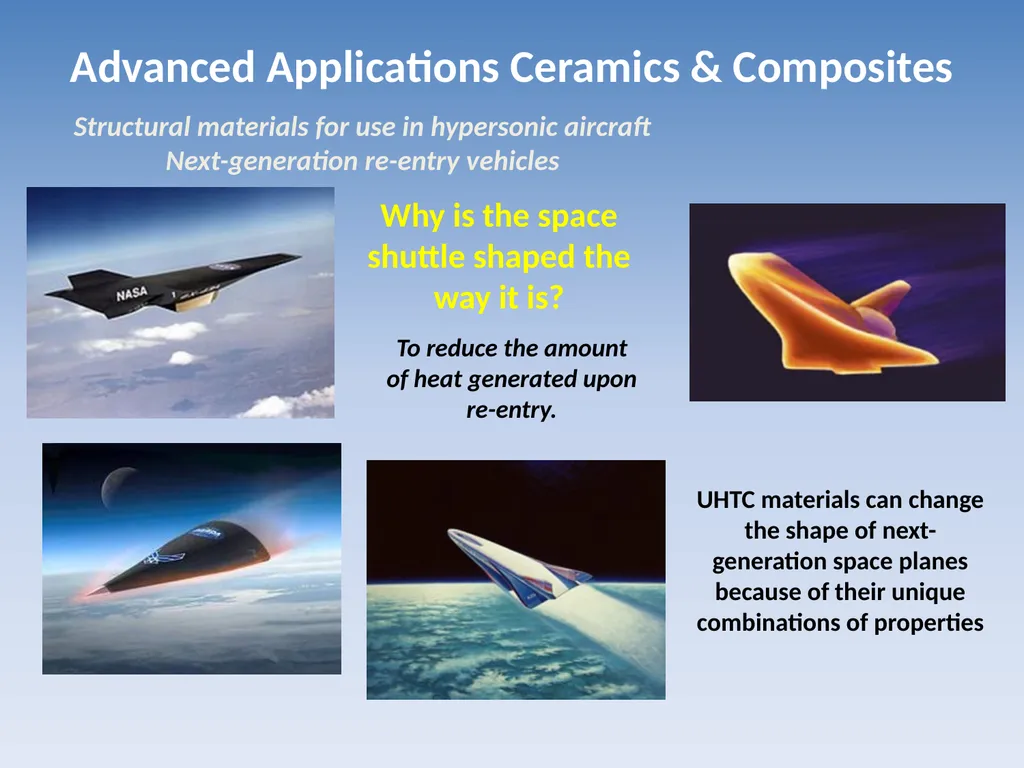
Advanced Applications Ceramics & Composites Structural materials for use in hypersonic aircraft Next-generation re-entry vehicles UHTC materials can change the shape of next-generation space planes because of their unique combinations of properties Why is the space shuttle shaped the way it is? To reduce the amount of heat generated upon re-entry.<br>
20
Advanced Applications Polymers Self-decontaminating polymers
medical, military, security and environmental applications
current applications: look for attachment to textiles for self toxin cleaning fabrics (that is, chemical scavenging and cleaning clothing)
Sulphonated polyether polyetherketone (SPEEK) and polyvnvyl alcohol (PVA) aqueous solutions
Excite solutions with light to form strong reducing benzophenyl ketyl (BPK) radicals; helps break down organic toxic chemicals Little, Brian, “Materials for Advanced Applications: Self-Decontaminating Polymers, photofunctional composites, and electroconductive fibers,” Chemistry and Biochemistry Dissertation, University of Auburn (2012)<br>
medical, military, security and environmental applications
current applications: look for attachment to textiles for self toxin cleaning fabrics (that is, chemical scavenging and cleaning clothing)
Sulphonated polyether polyetherketone (SPEEK) and polyvnvyl alcohol (PVA) aqueous solutions
Excite solutions with light to form strong reducing benzophenyl ketyl (BPK) radicals; helps break down organic toxic chemicals Little, Brian, “Materials for Advanced Applications: Self-Decontaminating Polymers, photofunctional composites, and electroconductive fibers,” Chemistry and Biochemistry Dissertation, University of Auburn (2012)<br>
21
Advanced Applications Metals Hydrogen-absorbing metal alloys for energy transportation or batteries
Electorlyzed hydrogen from water (fuel cell technology) can be stored in tanks fabricated from Hydrogen-absorbing metal alloys (HAMA)
Nickel Metal Hydride (Ni-MH) batteries use the same principle, but to improve battery self discharge
Volume density is significantly higher for gaseous hydrogen; more hydrogen per tank
Typical alloys consist of Mn-Ti-V, Mg-Ni, Zr-Mn/Ti/V, Mn-Ni, La-Ni.
BCC metals show higher storage and desorption properties
Some metals can absorb a gas densities equivalent to liquid hydrogen densities T. Mouri, H. Iba, “Hydrogen-absorbing alloys with a large capacity for a new wnergy carrier,” Materials Science and Engineering A, Vol 329-331, 346-350 (2002). “Light Weight Hydrogen ‘’Tank’ Could Fuel Hydrogen Economy”, Science Daily, http://www.sciencedaily.com/releases/2008/11/081104084215.htm<br>
Electorlyzed hydrogen from water (fuel cell technology) can be stored in tanks fabricated from Hydrogen-absorbing metal alloys (HAMA)
Nickel Metal Hydride (Ni-MH) batteries use the same principle, but to improve battery self discharge
Volume density is significantly higher for gaseous hydrogen; more hydrogen per tank
Typical alloys consist of Mn-Ti-V, Mg-Ni, Zr-Mn/Ti/V, Mn-Ni, La-Ni.
BCC metals show higher storage and desorption properties
Some metals can absorb a gas densities equivalent to liquid hydrogen densities T. Mouri, H. Iba, “Hydrogen-absorbing alloys with a large capacity for a new wnergy carrier,” Materials Science and Engineering A, Vol 329-331, 346-350 (2002). “Light Weight Hydrogen ‘’Tank’ Could Fuel Hydrogen Economy”, Science Daily, http://www.sciencedaily.com/releases/2008/11/081104084215.htm<br>
22
Other well known materials Semiconductors – ceramics
computer chips
memory storage devices
solar cells
image screens
Nanomaterials – ceramics, metals, polymers
gold nanoshells
quantum dots
ferrofluids
medical devices<br>
computer chips
memory storage devices
solar cells
image screens
Nanomaterials – ceramics, metals, polymers
gold nanoshells
quantum dots
ferrofluids
medical devices<br>
23
How do we test materials? We use mechanical, chemical and optical methods
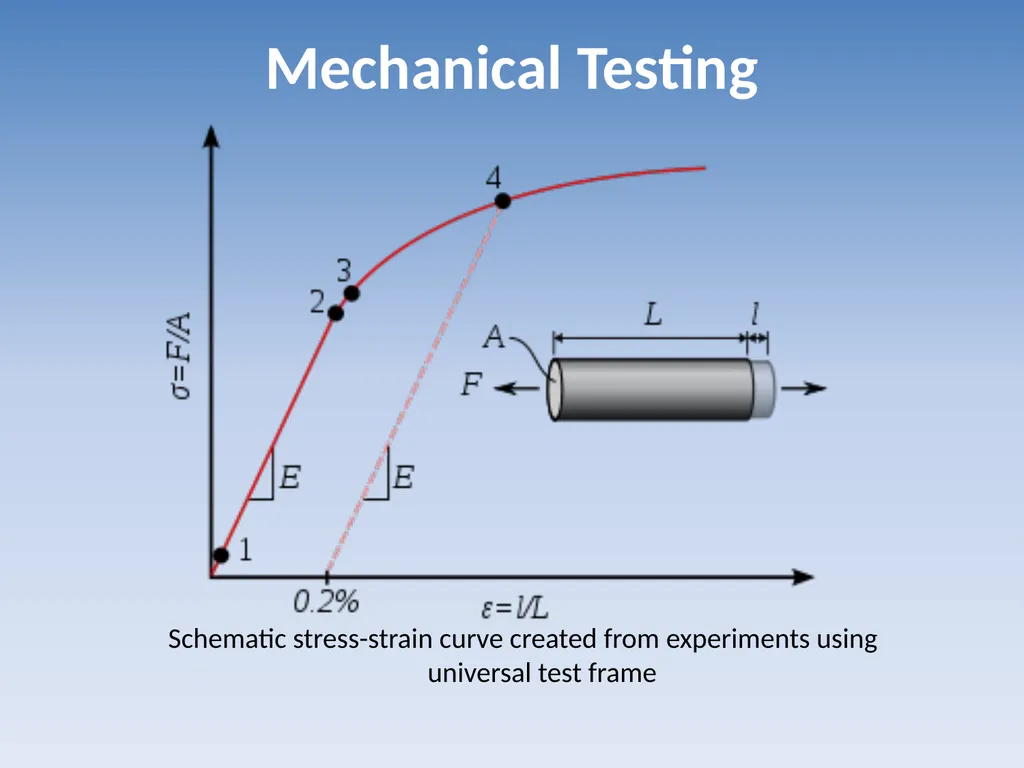
Mechanical testing gives strength, ductility and toughness material information
tensile tests
bend tests
compressive tests
fracture testing
Chemical testing tells us about composition and chemical stability
x-ray diffraction and fluorescence – composition testing
corrosion testing
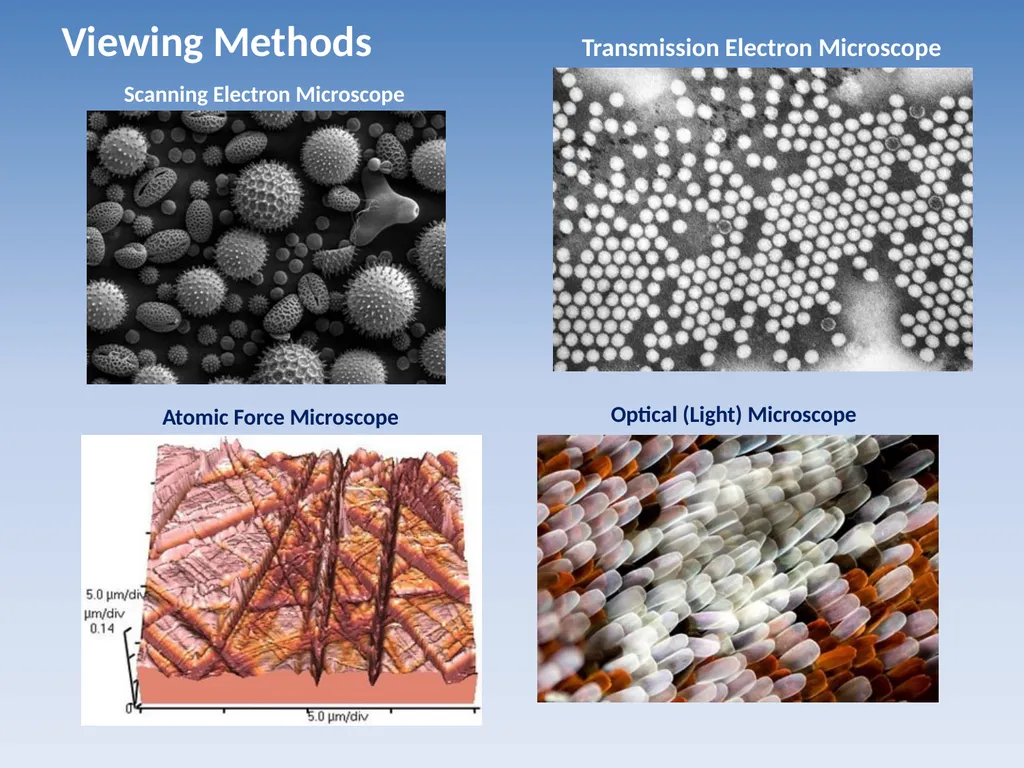
Optical testing is more of a way to view atomic, nano and microstructures, and gives us insight to structure property relationships
light optical microscope – microstructure
scanning electron microscope – microstructure and nano structure
transmission electron microscope – nanostucture and atomic structure
scanning tunneling electron microscope – atomic structures<br>
Mechanical testing gives strength, ductility and toughness material information
tensile tests
bend tests
compressive tests
fracture testing
Chemical testing tells us about composition and chemical stability
x-ray diffraction and fluorescence – composition testing
corrosion testing
Optical testing is more of a way to view atomic, nano and microstructures, and gives us insight to structure property relationships
light optical microscope – microstructure
scanning electron microscope – microstructure and nano structure
transmission electron microscope – nanostucture and atomic structure
scanning tunneling electron microscope – atomic structures<br>
24
Mechanical Testing Schematic stress-strain curve created from experiments using universal test frame<br>
25
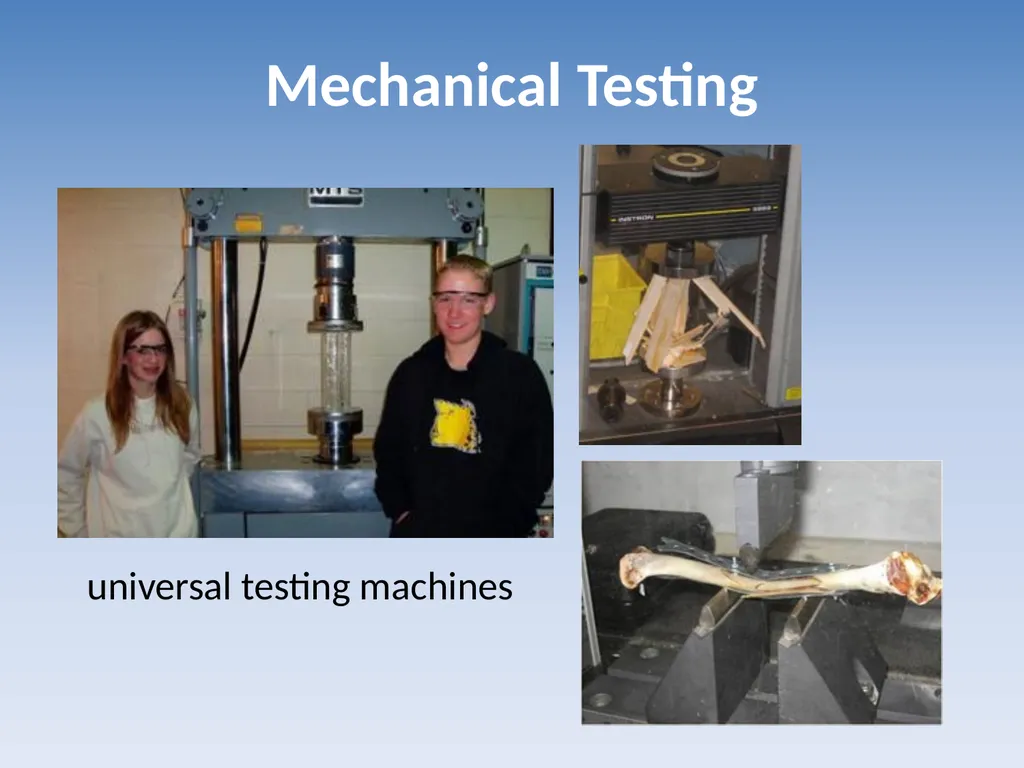
Mechanical Testing universal testing machines<br>
26
Mechanical Testing What is stress and strain?
Is it like force and length change (displacement)?
Stress is defined as the force per unit cross-section area; S = Force/Area
Strain is defined as the ratio of length change to original length; e = (Lf – Li)/(Li) (normalizes the length change)
Why these terms? Stress Scenario: If I apply a force on the eraser of a pencil and apply the same force on a table top, how does each material behave? Can you distinguish which material is stronger? Strain Scenario: If I pull on a 1 inch long piece of taffy and apply the same pulling force on a piece of 2 inch long putty and both lengthen (both have equal diameters), with the taffy and putty stretching the same distance, what does this say about the two materials? They both stretched the same distance. Force as a strength description is inadequate because different sized objects accommodate the force differently. Just because both objects could handle the same force does not mean they are the same STRENGTH! Displacement only cannot distinguish materials that can accommodate large deformations or changes in shape. Thus, the taffy can accommodate larger shape change because the ratio of length change to original length is larger than the putty.<br>
Stress is defined as the force per unit cross-section area; S = Force/Area
Strain is defined as the ratio of length change to original length; e = (Lf – Li)/(Li) (normalizes the length change)
Why these terms? Stress Scenario: If I apply a force on the eraser of a pencil and apply the same force on a table top, how does each material behave? Can you distinguish which material is stronger? Strain Scenario: If I pull on a 1 inch long piece of taffy and apply the same pulling force on a piece of 2 inch long putty and both lengthen (both have equal diameters), with the taffy and putty stretching the same distance, what does this say about the two materials? They both stretched the same distance. Force as a strength description is inadequate because different sized objects accommodate the force differently. Just because both objects could handle the same force does not mean they are the same STRENGTH! Displacement only cannot distinguish materials that can accommodate large deformations or changes in shape. Thus, the taffy can accommodate larger shape change because the ratio of length change to original length is larger than the putty.<br>
27
Chemical Methods x-ray diffraction
mass spectroscopy
gas chromatography
x-ray fluorescence<br>
mass spectroscopy
gas chromatography
x-ray fluorescence<br>
28
Scanning Electron Microscope Transmission Electron Microscope Atomic Force Microscope Viewing Methods Optical (Light) Microscope<br>