
Introduction to Metadata for Research Data




Description: Introduction to Metadata for Research Data management: The DDI Perspective The DDI Training Working Group 29 April 2021 1 This work is licensed under Creative Commons Attribution 4.0 International License. Some Obvious Questions Why should
Related Topics
Download Presentation
"Introduction to Metadata for Research Data" is the property of its rightful owner. Permission is granted to download and print the materials on this website for personal, non-commercial use only, and to display it on your personal computer provided you do not modify the materials and that you retain all copyright notices contained in the materials. By downloading content from our website, you accept the terms of this agreement.
Presentation Transcript
slide1. Introduction to Metadata for Research Data management: The DDI Perspective The DDI Training Working Group
29 April 2021 1 This work is licensed under Creative Commons Attribution 4.0 International License.<br>
slide2. Some Obvious Questions… Why should we care so much about metadata?
Isn’t it just “data about data”?
Shouldn’t we be focused on the data? 2<br>
slide3. If You Care about Data, You Care about Metadata! Metadata is what allows people to discover, assess, and navigate through collections of data
Metadata is what allows people to understand data
Metadata is what allows machines to process and manage data
Metadata is what allows people to harmonize, integrate, and reuse data
If you want FAIR data, you need metadata! 3<br>
slide4. Metadata is the Limiting Factor Your data is only as good as the metadata which describes it
Traditionally, research has focused on data supporting specific research
Now, the demand for larger, cross-cutting research projects places an emphasis on better data management
The answer to providing this is to have good, well-managed metadata! 4<br>
slide5. Different Understandings and Definitions Across research domains, the term “metadata” means many different things
We need to respect these differences…
We also need a shared understanding
The DDI community has spent decades understanding metadata, using it to manage data, and modelling it for implementation in systems
We do not have the only perspective – but we do have a proven, useful one! 5<br>
slide6. Understanding Metadata<br>
slide7. Contents Defining Metadata
Data or Metadata?
Examples
Roles
Usage
Management
Summary 7<br>
slide8. Defining Metadata 8<br>
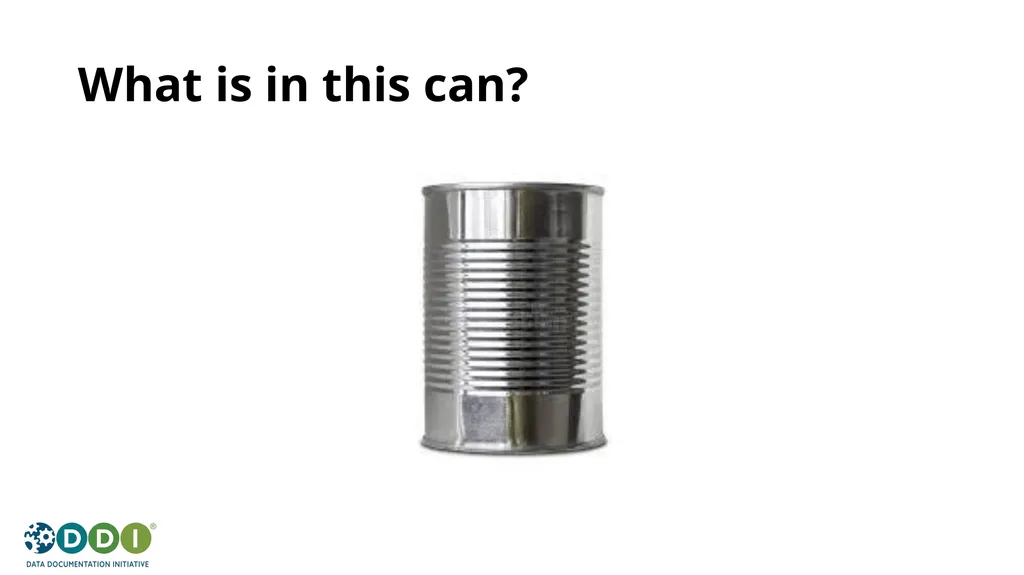
slide9. What is in this can?<br>
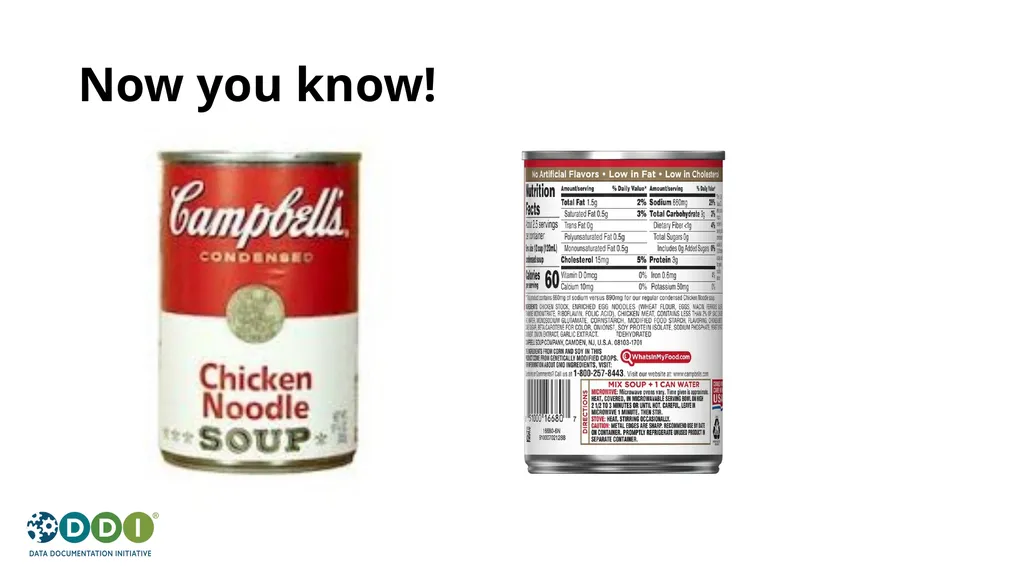
slide10. Now you know!<br>
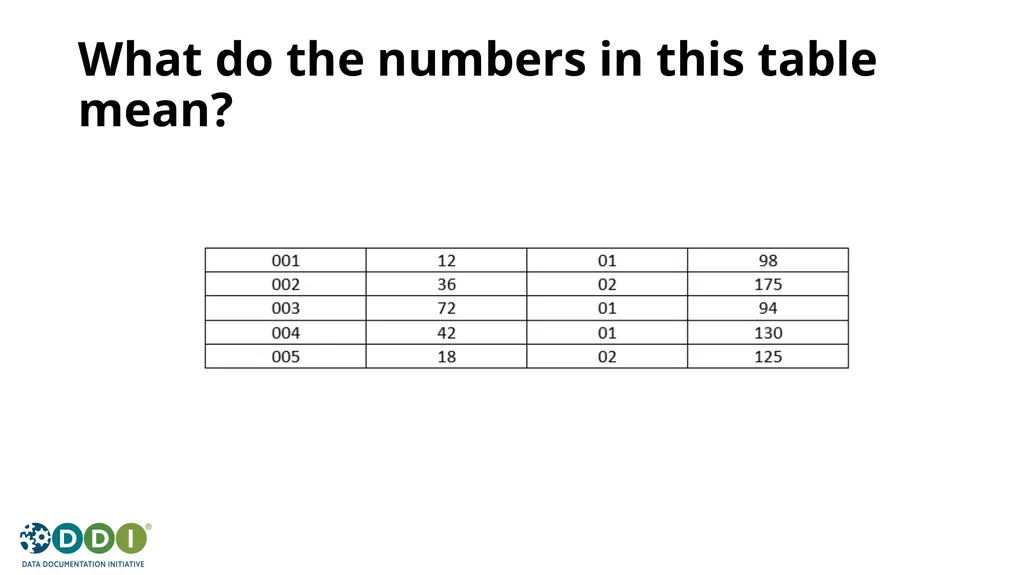
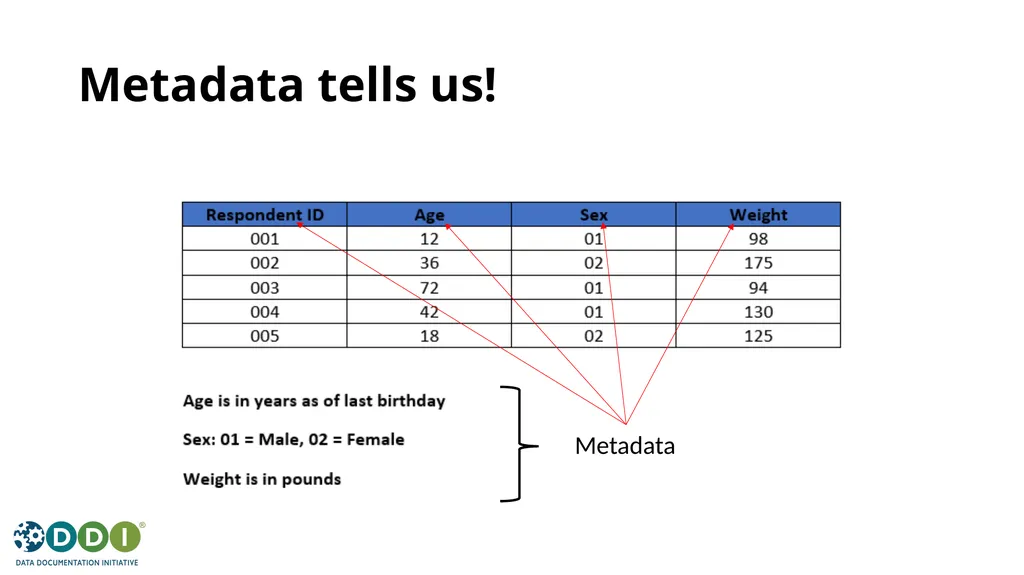
slide11. What do the numbers in this table mean?<br>
slide12. Metadata tells us! Metadata<br>
slide13. What Does “Meta” Mean, Anyway? Metadata are descriptions or information about some thing(s)
Greek: μετά- is a prefix meaning
Beyond
After
Transcending
Literally – metadata are beyond the thing(s) being described<br>
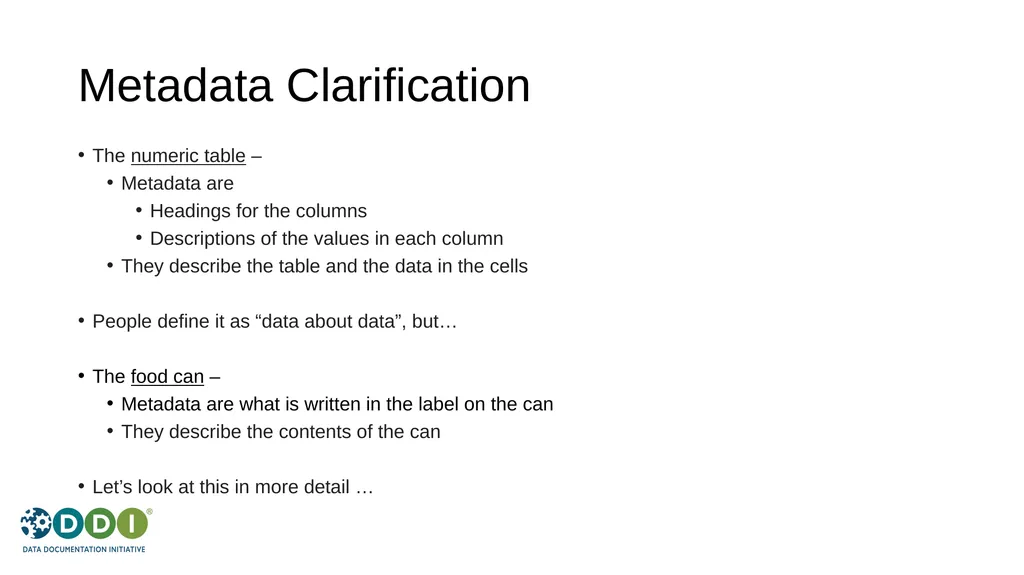
slide14. Metadata Clarification The numeric table –
Metadata are
Headings for the columns
Descriptions of the values in each column
They describe the table and the data in the cells
People define it as “data about data”, but…
The food can –
Metadata are what is written in the label on the can
They describe the contents of the can
Let’s look at this in more detail …<br>
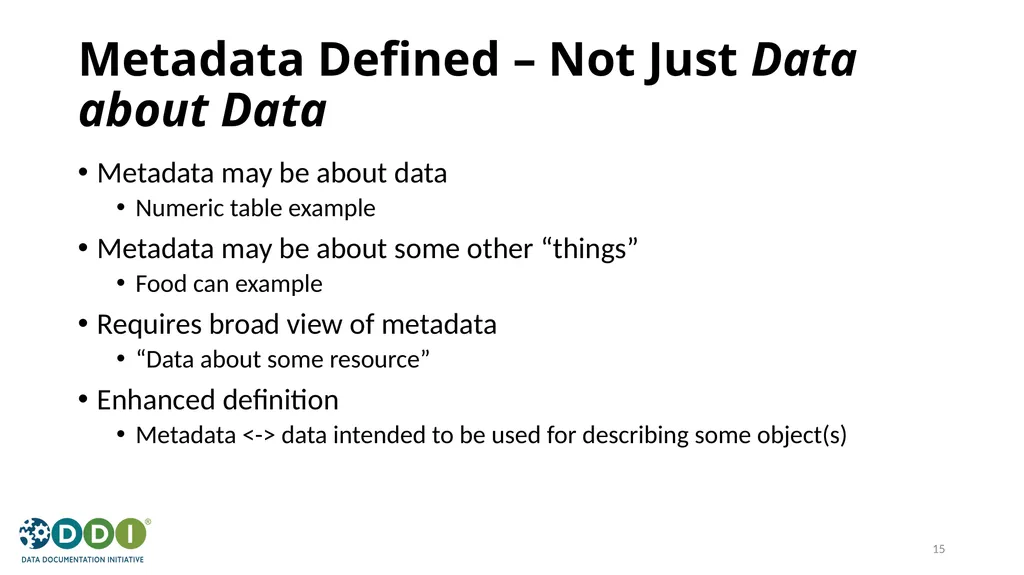
slide15. Metadata Defined – Not Just Data about Data Metadata may be about data
Numeric table example
Metadata may be about some other “things”
Food can example
Requires broad view of metadata
“Data about some resource”
Enhanced definition
Metadata <-> data intended to be used for describing some object(s) 15<br>
slide16. Data or Metadata? 16<br>
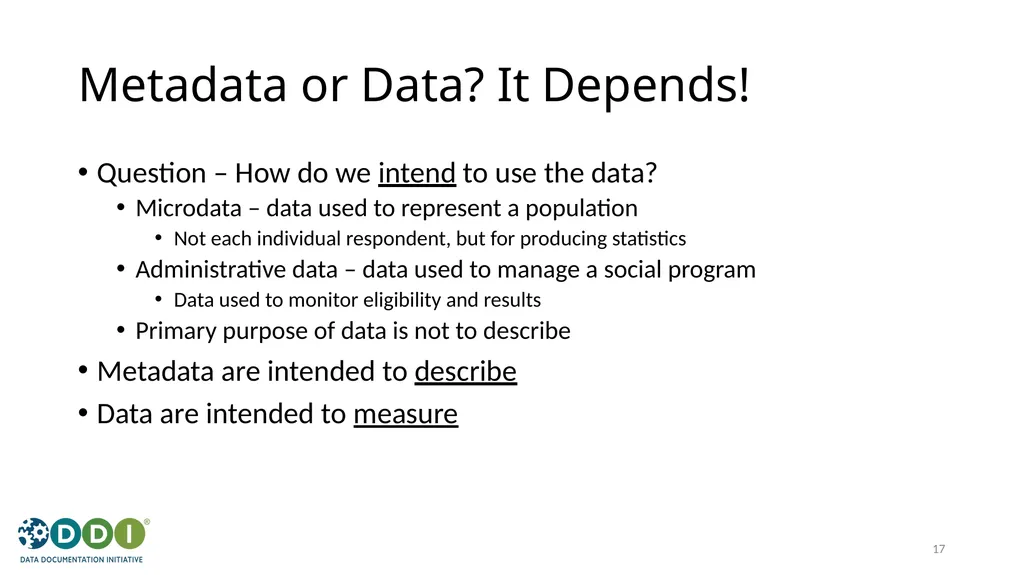
slide17. Metadata or Data? It Depends! Question – How do we intend to use the data?
Microdata – data used to represent a population
Not each individual respondent, but for producing statistics
Administrative data – data used to manage a social program
Data used to monitor eligibility and results
Primary purpose of data is not to describe
Metadata are intended to describe
Data are intended to measure 17<br>
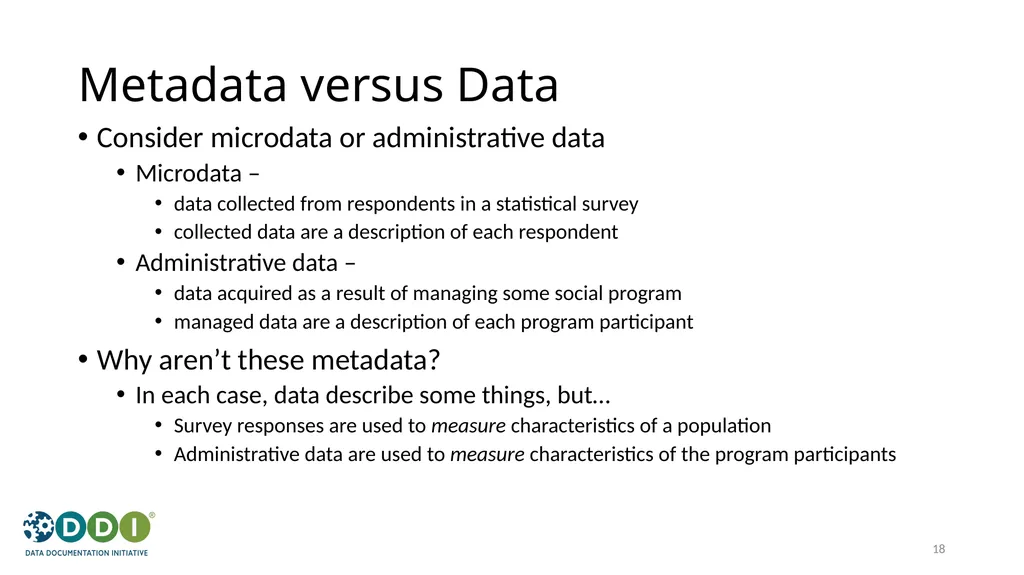
slide18. Metadata versus Data Consider microdata or administrative data
Microdata –
data collected from respondents in a statistical survey
collected data are a description of each respondent
Administrative data –
data acquired as a result of managing some social program
managed data are a description of each program participant
Why aren’t these metadata?
In each case, data describe some things, but…
Survey responses are used to measure characteristics of a population
Administrative data are used to measure characteristics of the program participants 18<br>
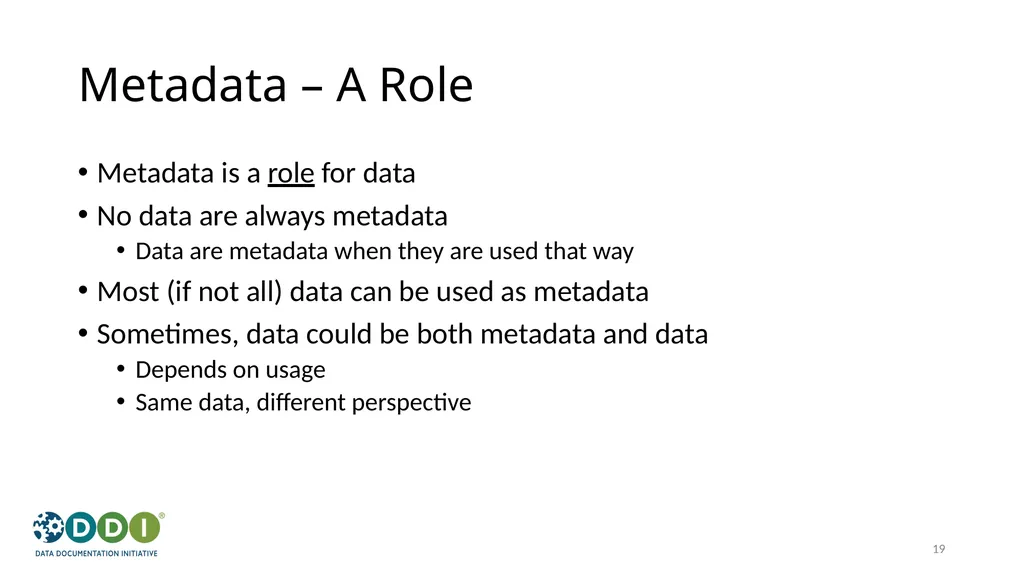
slide19. Metadata – A Role Metadata is a role for data
No data are always metadata
Data are metadata when they are used that way
Most (if not all) data can be used as metadata
Sometimes, data could be both metadata and data
Depends on usage
Same data, different perspective 19<br>
slide20. Examples 20<br>
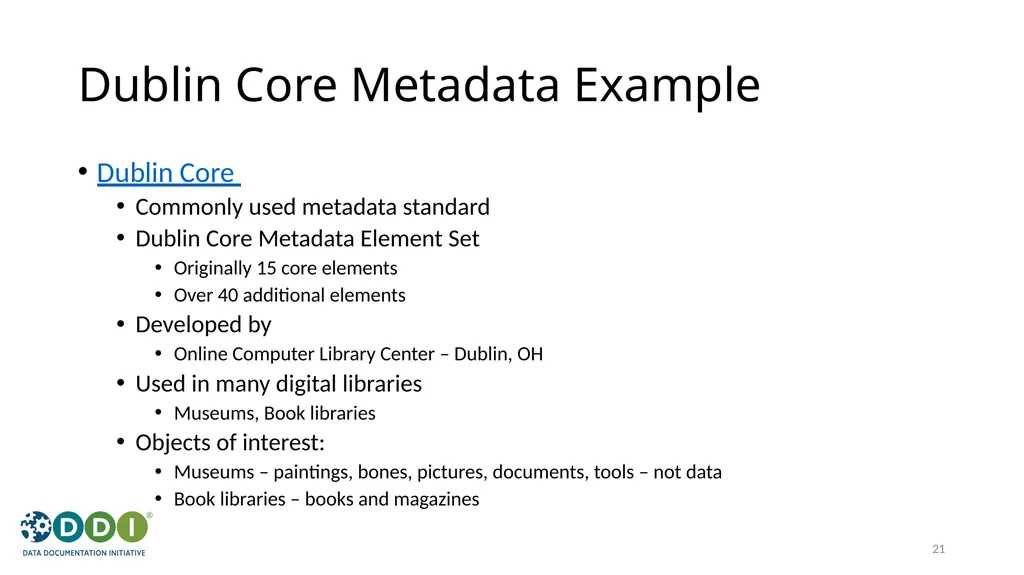
slide21. Dublin Core Metadata Example Dublin Core
Commonly used metadata standard
Dublin Core Metadata Element Set
Originally 15 core elements
Over 40 additional elements
Developed by
Online Computer Library Center – Dublin, OH
Used in many digital libraries
Museums, Book libraries
Objects of interest:
Museums – paintings, bones, pictures, documents, tools – not data
Book libraries – books and magazines 21<br>
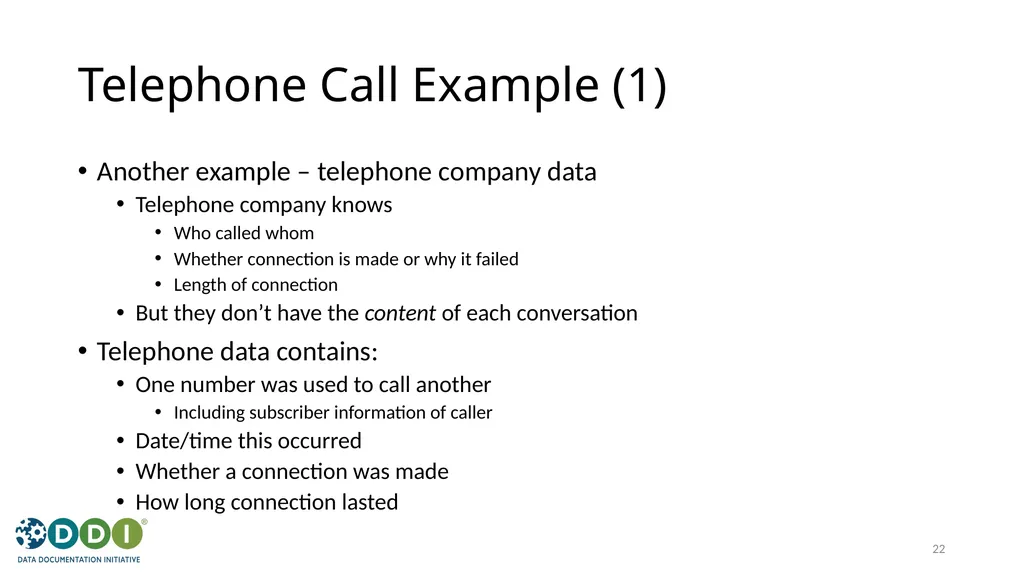
slide22. Telephone Call Example (1) Another example – telephone company data
Telephone company knows
Who called whom
Whether connection is made or why it failed
Length of connection
But they don’t have the content of each conversation
Telephone data contains:
One number was used to call another
Including subscriber information of caller
Date/time this occurred
Whether a connection was made
How long connection lasted 22<br>
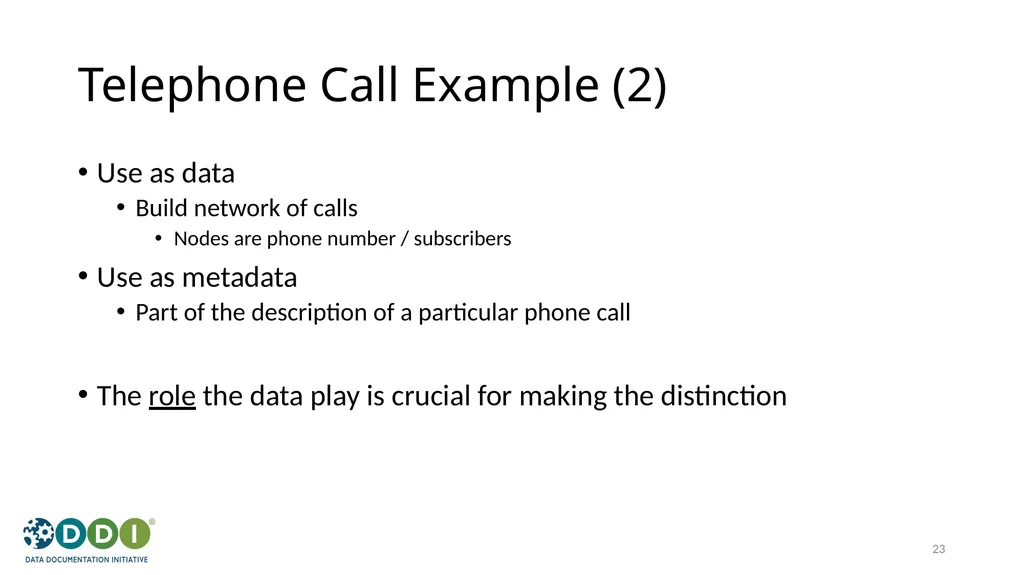
slide23. Telephone Call Example (2) Use as data
Build network of calls
Nodes are phone number / subscribers
Use as metadata
Part of the description of a particular phone call
The role the data play is crucial for making the distinction 23<br>
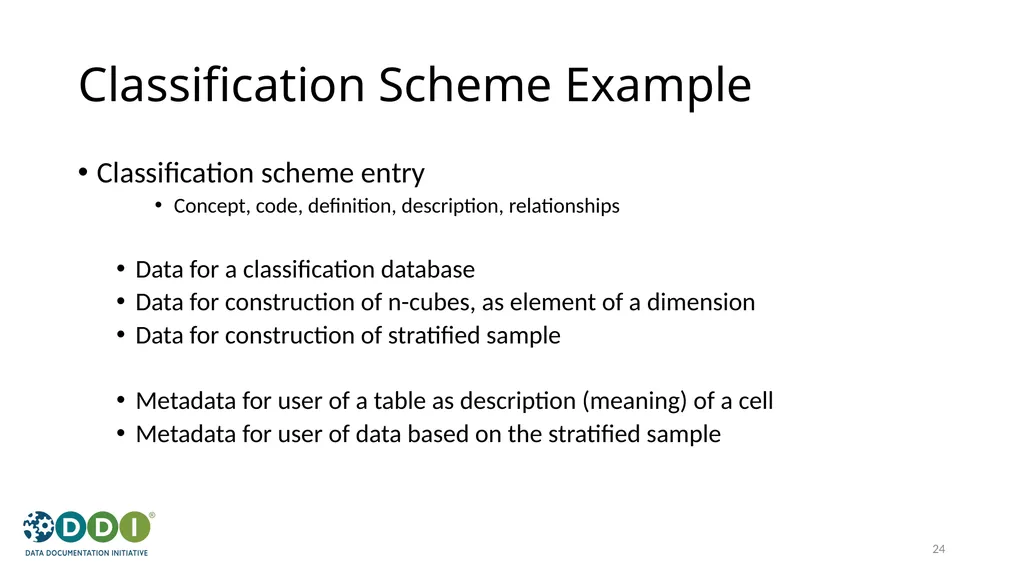
slide24. Classification Scheme Example Classification scheme entry
Concept, code, definition, description, relationships
Data for a classification database
Data for construction of n-cubes, as element of a dimension
Data for construction of stratified sample
Metadata for user of a table as description (meaning) of a cell
Metadata for user of data based on the stratified sample 24<br>
slide25. Roles 25<br>
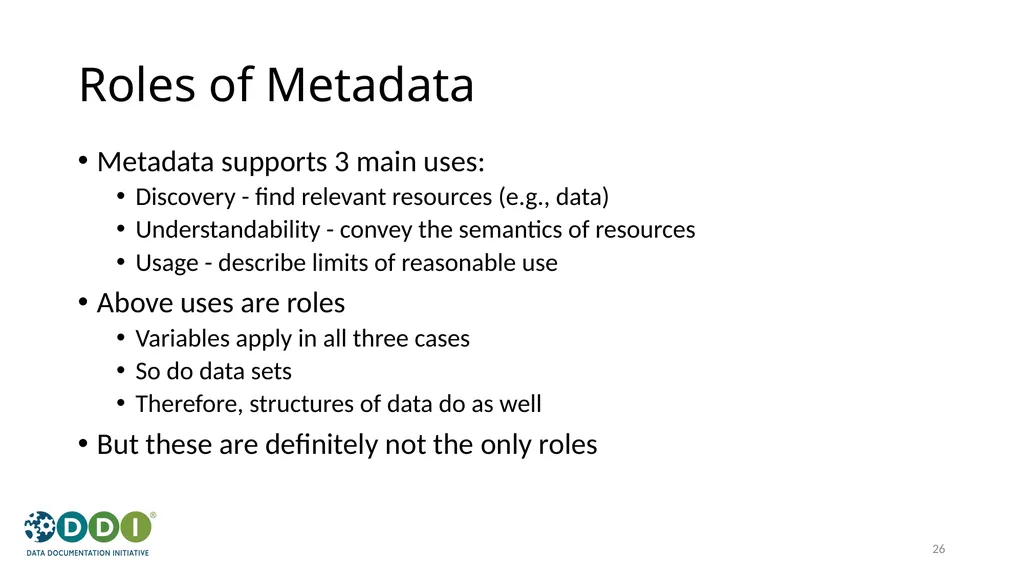
slide26. Roles of Metadata Metadata supports 3 main uses:
Discovery - find relevant resources (e.g., data)
Understandability - convey the semantics of resources
Usage - describe limits of reasonable use
Above uses are roles
Variables apply in all three cases
So do data sets
Therefore, structures of data do as well
But these are definitely not the only roles 26<br>
slide27. Usage 27<br>
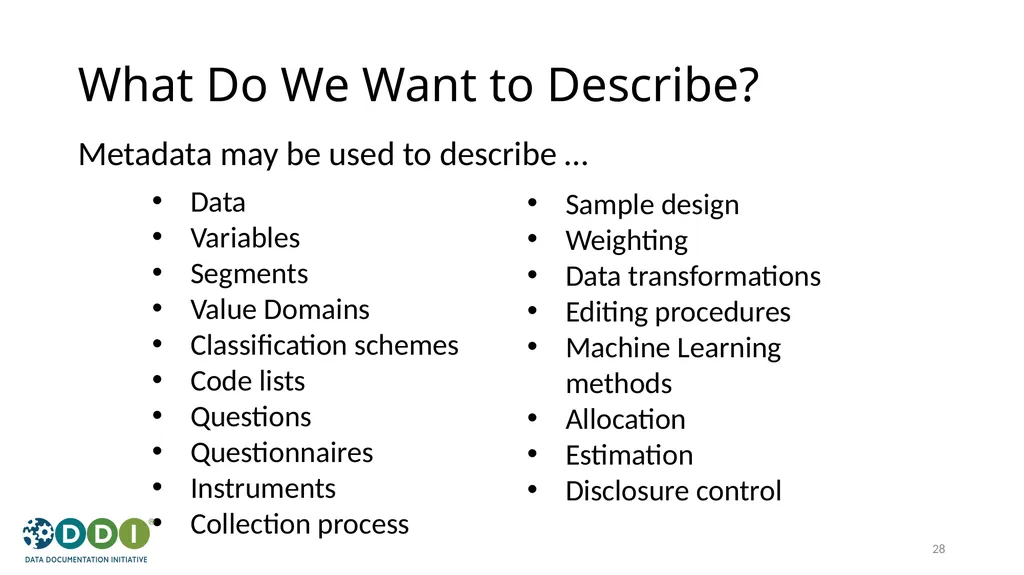
slide28. What Do We Want to Describe? Data
Variables
Segments
Value Domains
Classification schemes
Code lists
Questions
Questionnaires
Instruments
Collection process Sample design
Weighting
Data transformations
Editing procedures
Machine Learning methods
Allocation
Estimation
Disclosure control Metadata may be used to describe … 28<br>
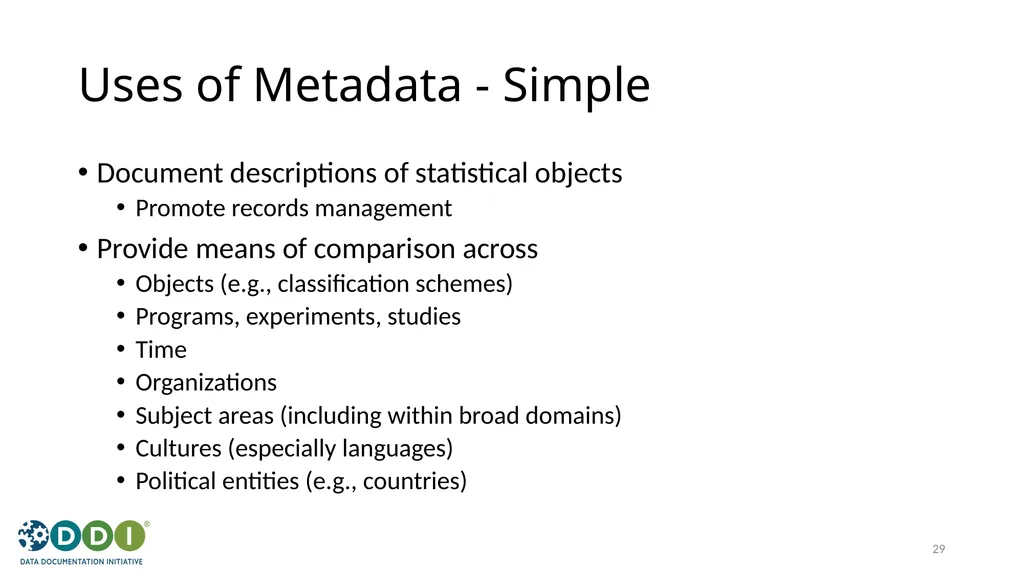
slide29. Uses of Metadata - Simple Document descriptions of statistical objects
Promote records management
Provide means of comparison across
Objects (e.g., classification schemes)
Programs, experiments, studies
Time
Organizations
Subject areas (including within broad domains)
Cultures (especially languages)
Political entities (e.g., countries) 29<br>
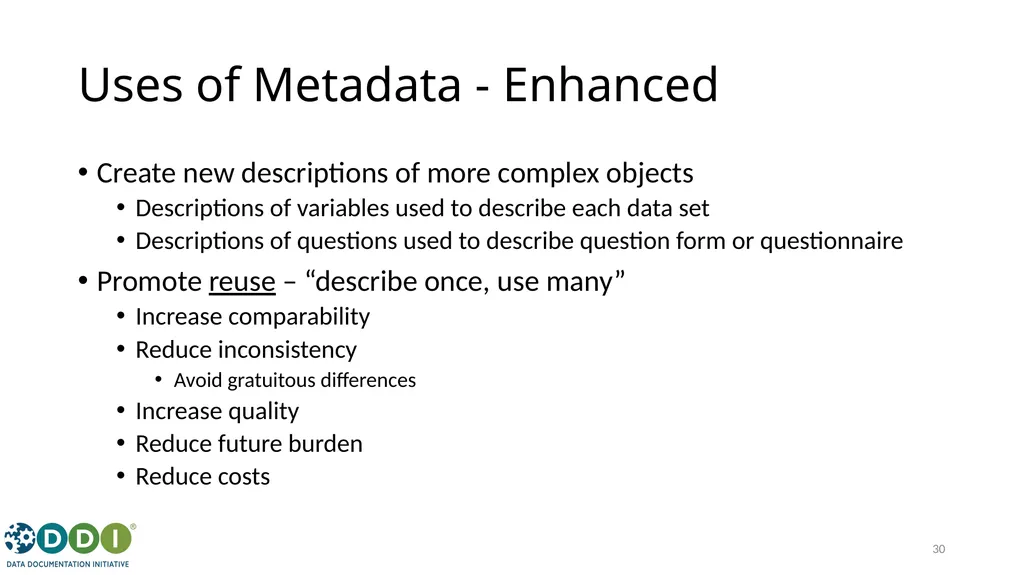
slide30. Uses of Metadata - Enhanced Create new descriptions of more complex objects
Descriptions of variables used to describe each data set
Descriptions of questions used to describe question form or questionnaire
Promote reuse – “describe once, use many”
Increase comparability
Reduce inconsistency
Avoid gratuitous differences
Increase quality
Reduce future burden
Reduce costs 30<br>
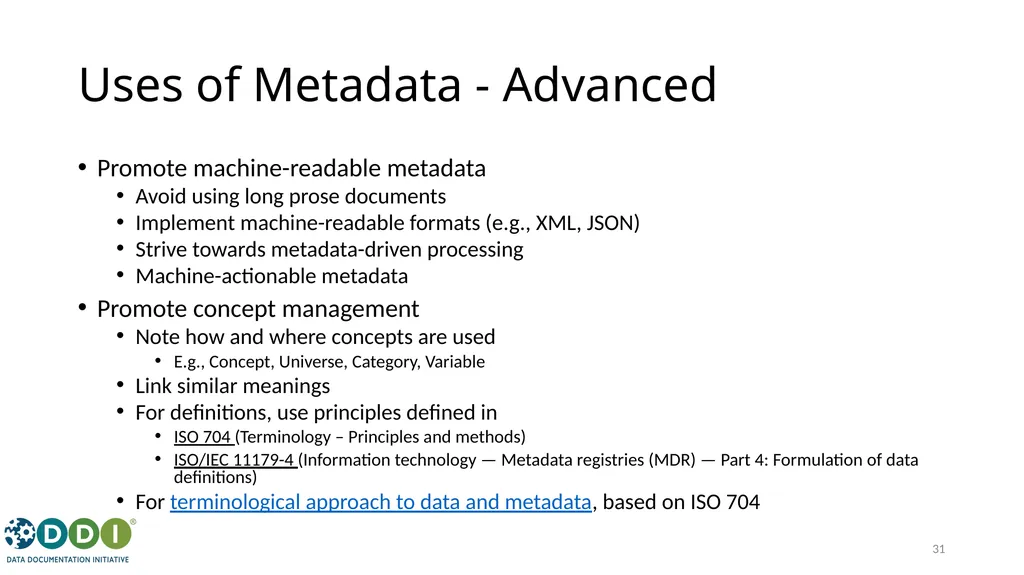
slide31. Uses of Metadata - Advanced Promote machine-readable metadata
Avoid using long prose documents
Implement machine-readable formats (e.g., XML, JSON)
Strive towards metadata-driven processing
Machine-actionable metadata
Promote concept management
Note how and where concepts are used
E.g., Concept, Universe, Category, Variable
Link similar meanings
For definitions, use principles defined in
ISO 704 (Terminology – Principles and methods)
ISO/IEC 11179-4 (Information technology — Metadata registries (MDR) — Part 4: Formulation of data definitions)
For terminological approach to data and metadata, based on ISO 704 31<br>
slide32. Management 32<br>
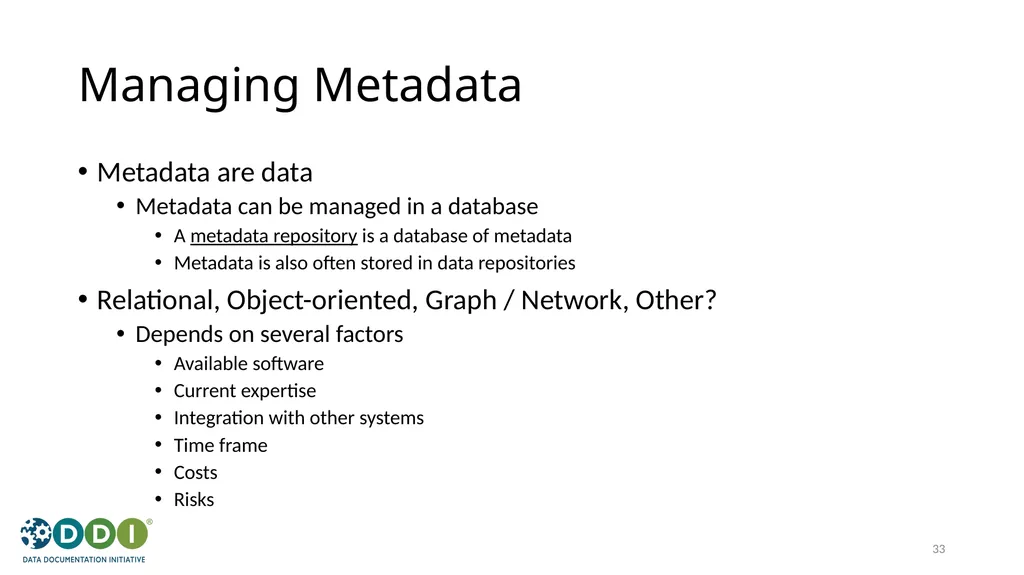
slide33. Managing Metadata Metadata are data
Metadata can be managed in a database
A metadata repository is a database of metadata
Metadata is also often stored in data repositories
Relational, Object-oriented, Graph / Network, Other?
Depends on several factors
Available software
Current expertise
Integration with other systems
Time frame
Costs
Risks 33<br>
slide34. Benefits of Managed Metadata More consistency in the production and dissemination of data
More comparable data
More understandable data
More FAIR data
Assessing and ensuring data quality
Organizational efficiency
Reuse of metadata assets
Better design, implementation, and execution of processes
Increased automation 34<br>
slide35. Summary Definition of metadata
data intended to be used for describing some object(s)
Compare with data
When are data metadata? It depends.
Roles
Metadata can be used for multiple purposes (administrative, semantic, etc.)
Uses
Human readable documentation
Sharing metadata and reusable descriptions
Concept management and machine-readable metadata
Management
Metadata are data, so they may be managed similarly 35<br>
slide36. DDI Products and Evolution 36<br>
slide37. DDI Metadata – Evolution DDI has been producing specifications for metadata in RDM for more than 2 decades
Our understanding of metadata has evolved
Our suite of products has grown to support more aspects of RDM
The evolution is ongoing 37<br>
slide38. DDI: Major Specifications DDI Codebook (aka “DDI 1.0”, “DDI 1.2”, “DDI 2.5”, etc.)
DDI Lifecycle (aka “DDI 3.0”, “DDI 3.1”, “DDI 3.3”, etc.)
DDI Cross Domain Integration (aka “DDI-CDI”) 38<br>
slide39. DDI Codebook An XML description of a “codebook” (a data dictionary)
Rectangular files
No concept of metadata reuse
Based on models in existing analysis tools (Stata, SPSS, SAS, etc.)
Included Dublin Core and descriptive “study-level” metadata
Machine-readable (slightly machine-actionable…)
Described data for a single study (one point in time)
After-the-fact description to support archiving and reuse 39<br>
slide40. DDI Lifecycle Major expansion
Describe multiple waves for longitudinal/repeat data collection
Describe comparison and harmonization
Describe data collection and survey instruments
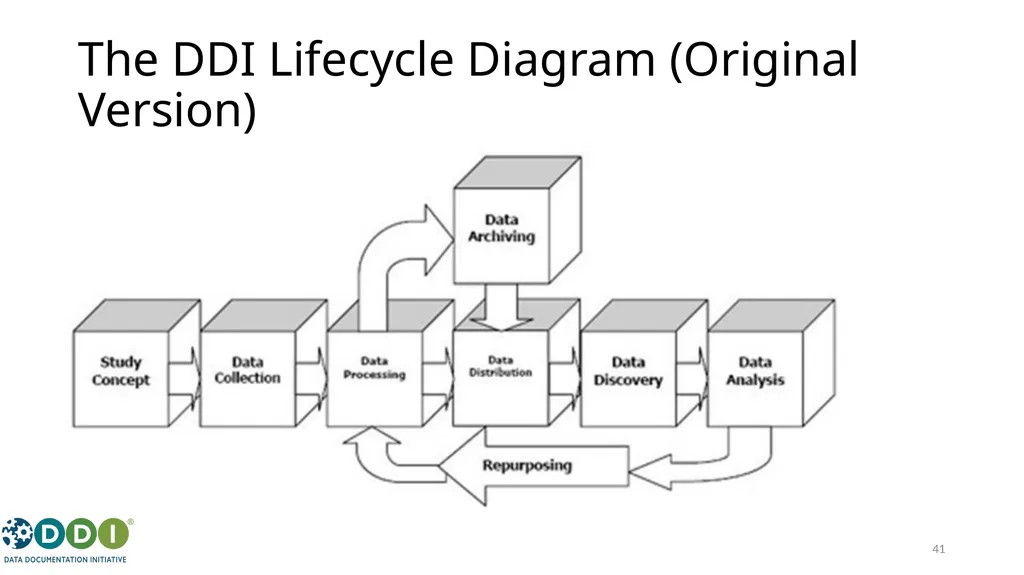
Describe the entire data lifecycle
Reuse of metadata was central to these functions
Support for centralized metadata management
Focus still primarily on rectangular data
XML encoding
Machine-readable
Machine-actionable 40<br>
slide41. The DDI Lifecycle Diagram (Original Version) 41<br>
slide42. An Important Change… DDI Codebook allowed you to reference Concepts from variable descriptions
DDI Lifecycle provided full-blown support for describing Concepts and reusing them
Referenced by Variables
Referenced by Categories in Classifications/Codelists
Referenced by Units/Populations/Universes
With the popular “semantic” technologies, Concepts become central
SKOS is the most-used vocabulary in the RDF world
Basis of sematic mapping between organizations/domains 42<br>
slide43. DDI Cross-Domain Integration (DDI-CDI) An extension of the metadata set found in DDI-C and DDI-L
Not a replacement!
Will be released Summer 2021
Provides support for additional types of data
Long data/sensor data/event data
Multi-dimensional data/data “cubes”
Key-Value data/No SQL data/”big” data
Provides support for describing process and provenance across data sets as data is reused/harmonized/integrated
Very Concept-rich
Focus is on individual “Datums”
Model-based (UML), not just XML
Emphasis on machine-actionable metadata! 43<br>
slide44. Contact E-Mail:
ddi-train@googlegroups.com
Contact form:
https://ddialliance.org/learn/request-a-training-session 44<br>
slide45. Questions? 45<br>
slide46. Florio Orocio Arguillas
Alina Danciu
Adrian Dusa
Jane Fry
Martine Gagnon
Dan Gillman
Arofan Gregory
Taras Günther
Lea Sztuk Haahr
Chifundo Kanjala
Kaia Kulla Credits: DDI Training Working Group Kathryn Lavender
Amber Leahey
Jared Lyle
Alexandre Mairot
Laura Molloy
Lucie Marie
Hayley Mills
Hilde Orten
Anja Perry
Knut Wenzig<br>
29 April 2021 1 This work is licensed under Creative Commons Attribution 4.0 International License.<br>
slide2. Some Obvious Questions… Why should we care so much about metadata?
Isn’t it just “data about data”?
Shouldn’t we be focused on the data? 2<br>
slide3. If You Care about Data, You Care about Metadata! Metadata is what allows people to discover, assess, and navigate through collections of data
Metadata is what allows people to understand data
Metadata is what allows machines to process and manage data
Metadata is what allows people to harmonize, integrate, and reuse data
If you want FAIR data, you need metadata! 3<br>
slide4. Metadata is the Limiting Factor Your data is only as good as the metadata which describes it
Traditionally, research has focused on data supporting specific research
Now, the demand for larger, cross-cutting research projects places an emphasis on better data management
The answer to providing this is to have good, well-managed metadata! 4<br>
slide5. Different Understandings and Definitions Across research domains, the term “metadata” means many different things
We need to respect these differences…
We also need a shared understanding
The DDI community has spent decades understanding metadata, using it to manage data, and modelling it for implementation in systems
We do not have the only perspective – but we do have a proven, useful one! 5<br>
slide6. Understanding Metadata<br>
slide7. Contents Defining Metadata
Data or Metadata?
Examples
Roles
Usage
Management
Summary 7<br>
slide8. Defining Metadata 8<br>
slide9. What is in this can?<br>
slide10. Now you know!<br>
slide11. What do the numbers in this table mean?<br>
slide12. Metadata tells us! Metadata<br>
slide13. What Does “Meta” Mean, Anyway? Metadata are descriptions or information about some thing(s)
Greek: μετά- is a prefix meaning
Beyond
After
Transcending
Literally – metadata are beyond the thing(s) being described<br>
slide14. Metadata Clarification The numeric table –
Metadata are
Headings for the columns
Descriptions of the values in each column
They describe the table and the data in the cells
People define it as “data about data”, but…
The food can –
Metadata are what is written in the label on the can
They describe the contents of the can
Let’s look at this in more detail …<br>
slide15. Metadata Defined – Not Just Data about Data Metadata may be about data
Numeric table example
Metadata may be about some other “things”
Food can example
Requires broad view of metadata
“Data about some resource”
Enhanced definition
Metadata <-> data intended to be used for describing some object(s) 15<br>
slide16. Data or Metadata? 16<br>
slide17. Metadata or Data? It Depends! Question – How do we intend to use the data?
Microdata – data used to represent a population
Not each individual respondent, but for producing statistics
Administrative data – data used to manage a social program
Data used to monitor eligibility and results
Primary purpose of data is not to describe
Metadata are intended to describe
Data are intended to measure 17<br>
slide18. Metadata versus Data Consider microdata or administrative data
Microdata –
data collected from respondents in a statistical survey
collected data are a description of each respondent
Administrative data –
data acquired as a result of managing some social program
managed data are a description of each program participant
Why aren’t these metadata?
In each case, data describe some things, but…
Survey responses are used to measure characteristics of a population
Administrative data are used to measure characteristics of the program participants 18<br>
slide19. Metadata – A Role Metadata is a role for data
No data are always metadata
Data are metadata when they are used that way
Most (if not all) data can be used as metadata
Sometimes, data could be both metadata and data
Depends on usage
Same data, different perspective 19<br>
slide20. Examples 20<br>
slide21. Dublin Core Metadata Example Dublin Core
Commonly used metadata standard
Dublin Core Metadata Element Set
Originally 15 core elements
Over 40 additional elements
Developed by
Online Computer Library Center – Dublin, OH
Used in many digital libraries
Museums, Book libraries
Objects of interest:
Museums – paintings, bones, pictures, documents, tools – not data
Book libraries – books and magazines 21<br>
slide22. Telephone Call Example (1) Another example – telephone company data
Telephone company knows
Who called whom
Whether connection is made or why it failed
Length of connection
But they don’t have the content of each conversation
Telephone data contains:
One number was used to call another
Including subscriber information of caller
Date/time this occurred
Whether a connection was made
How long connection lasted 22<br>
slide23. Telephone Call Example (2) Use as data
Build network of calls
Nodes are phone number / subscribers
Use as metadata
Part of the description of a particular phone call
The role the data play is crucial for making the distinction 23<br>
slide24. Classification Scheme Example Classification scheme entry
Concept, code, definition, description, relationships
Data for a classification database
Data for construction of n-cubes, as element of a dimension
Data for construction of stratified sample
Metadata for user of a table as description (meaning) of a cell
Metadata for user of data based on the stratified sample 24<br>
slide25. Roles 25<br>
slide26. Roles of Metadata Metadata supports 3 main uses:
Discovery - find relevant resources (e.g., data)
Understandability - convey the semantics of resources
Usage - describe limits of reasonable use
Above uses are roles
Variables apply in all three cases
So do data sets
Therefore, structures of data do as well
But these are definitely not the only roles 26<br>
slide27. Usage 27<br>
slide28. What Do We Want to Describe? Data
Variables
Segments
Value Domains
Classification schemes
Code lists
Questions
Questionnaires
Instruments
Collection process Sample design
Weighting
Data transformations
Editing procedures
Machine Learning methods
Allocation
Estimation
Disclosure control Metadata may be used to describe … 28<br>
slide29. Uses of Metadata - Simple Document descriptions of statistical objects
Promote records management
Provide means of comparison across
Objects (e.g., classification schemes)
Programs, experiments, studies
Time
Organizations
Subject areas (including within broad domains)
Cultures (especially languages)
Political entities (e.g., countries) 29<br>
slide30. Uses of Metadata - Enhanced Create new descriptions of more complex objects
Descriptions of variables used to describe each data set
Descriptions of questions used to describe question form or questionnaire
Promote reuse – “describe once, use many”
Increase comparability
Reduce inconsistency
Avoid gratuitous differences
Increase quality
Reduce future burden
Reduce costs 30<br>
slide31. Uses of Metadata - Advanced Promote machine-readable metadata
Avoid using long prose documents
Implement machine-readable formats (e.g., XML, JSON)
Strive towards metadata-driven processing
Machine-actionable metadata
Promote concept management
Note how and where concepts are used
E.g., Concept, Universe, Category, Variable
Link similar meanings
For definitions, use principles defined in
ISO 704 (Terminology – Principles and methods)
ISO/IEC 11179-4 (Information technology — Metadata registries (MDR) — Part 4: Formulation of data definitions)
For terminological approach to data and metadata, based on ISO 704 31<br>
slide32. Management 32<br>
slide33. Managing Metadata Metadata are data
Metadata can be managed in a database
A metadata repository is a database of metadata
Metadata is also often stored in data repositories
Relational, Object-oriented, Graph / Network, Other?
Depends on several factors
Available software
Current expertise
Integration with other systems
Time frame
Costs
Risks 33<br>
slide34. Benefits of Managed Metadata More consistency in the production and dissemination of data
More comparable data
More understandable data
More FAIR data
Assessing and ensuring data quality
Organizational efficiency
Reuse of metadata assets
Better design, implementation, and execution of processes
Increased automation 34<br>
slide35. Summary Definition of metadata
data intended to be used for describing some object(s)
Compare with data
When are data metadata? It depends.
Roles
Metadata can be used for multiple purposes (administrative, semantic, etc.)
Uses
Human readable documentation
Sharing metadata and reusable descriptions
Concept management and machine-readable metadata
Management
Metadata are data, so they may be managed similarly 35<br>
slide36. DDI Products and Evolution 36<br>
slide37. DDI Metadata – Evolution DDI has been producing specifications for metadata in RDM for more than 2 decades
Our understanding of metadata has evolved
Our suite of products has grown to support more aspects of RDM
The evolution is ongoing 37<br>
slide38. DDI: Major Specifications DDI Codebook (aka “DDI 1.0”, “DDI 1.2”, “DDI 2.5”, etc.)
DDI Lifecycle (aka “DDI 3.0”, “DDI 3.1”, “DDI 3.3”, etc.)
DDI Cross Domain Integration (aka “DDI-CDI”) 38<br>
slide39. DDI Codebook An XML description of a “codebook” (a data dictionary)
Rectangular files
No concept of metadata reuse
Based on models in existing analysis tools (Stata, SPSS, SAS, etc.)
Included Dublin Core and descriptive “study-level” metadata
Machine-readable (slightly machine-actionable…)
Described data for a single study (one point in time)
After-the-fact description to support archiving and reuse 39<br>
slide40. DDI Lifecycle Major expansion
Describe multiple waves for longitudinal/repeat data collection
Describe comparison and harmonization
Describe data collection and survey instruments
Describe the entire data lifecycle
Reuse of metadata was central to these functions
Support for centralized metadata management
Focus still primarily on rectangular data
XML encoding
Machine-readable
Machine-actionable 40<br>
slide41. The DDI Lifecycle Diagram (Original Version) 41<br>
slide42. An Important Change… DDI Codebook allowed you to reference Concepts from variable descriptions
DDI Lifecycle provided full-blown support for describing Concepts and reusing them
Referenced by Variables
Referenced by Categories in Classifications/Codelists
Referenced by Units/Populations/Universes
With the popular “semantic” technologies, Concepts become central
SKOS is the most-used vocabulary in the RDF world
Basis of sematic mapping between organizations/domains 42<br>
slide43. DDI Cross-Domain Integration (DDI-CDI) An extension of the metadata set found in DDI-C and DDI-L
Not a replacement!
Will be released Summer 2021
Provides support for additional types of data
Long data/sensor data/event data
Multi-dimensional data/data “cubes”
Key-Value data/No SQL data/”big” data
Provides support for describing process and provenance across data sets as data is reused/harmonized/integrated
Very Concept-rich
Focus is on individual “Datums”
Model-based (UML), not just XML
Emphasis on machine-actionable metadata! 43<br>
slide44. Contact E-Mail:
ddi-train@googlegroups.com
Contact form:
https://ddialliance.org/learn/request-a-training-session 44<br>
slide45. Questions? 45<br>
slide46. Florio Orocio Arguillas
Alina Danciu
Adrian Dusa
Jane Fry
Martine Gagnon
Dan Gillman
Arofan Gregory
Taras Günther
Lea Sztuk Haahr
Chifundo Kanjala
Kaia Kulla Credits: DDI Training Working Group Kathryn Lavender
Amber Leahey
Jared Lyle
Alexandre Mairot
Laura Molloy
Lucie Marie
Hayley Mills
Hilde Orten
Anja Perry
Knut Wenzig<br>