INTRODUCTION TO METHODS OF PROPAGATION Dr. M. Viswanath Assistant Professor MSSSoA, CUTM, PKD PROPAGATION Propagation is the process of creating new plants from a variety of sources: seeds, cuttings, bulbs and other plant parts. It is
"INTRODUCTION TO METHODS OF PROPAGATION Dr. M." is the property of its rightful owner. Permission is granted to
download and print the materials on this website for personal, non-commercial use only, and to display it
on your personal computer provided you do not modify the materials and that you retain all copyright
notices contained in the materials. By downloading content from our website, you accept the terms of this
agreement.
Presentation Transcript
01
INTRODUCTION TO METHODS OF PROPAGATION Dr. M. Viswanath
Assistant Professor
MSSSoA, CUTM, PKD<br>
02
PROPAGATION ▶ Propagation is the process of creating new plants from a variety of sources: seeds, cuttings, bulbs and
other plant parts.
▶ It is of two types –
(1)Sexual method (2)Asexual method
(1) Sexual propagation-
Multiplication of plants by seed.
In this process male and female gametes are fused to produce seed.
The plant produced may or may not similar to their parents.<br>
03
(2)Asexual Propagation Asexual propagation, also called vegetative propagation, is accomplished by taking cuttings, by grafting or budding, by layering, by division of plants, or by separation of specialized structures such as tubers, rhizomes, or bulbs.<br>
04
METHOD OF ASEXUAL PROPAGATION 1. CUTTINGS:
Seperation of mother plant and planting it in a medium suitable for new plants regeneration susccessfully is termed as cutting.
Depending upon the source of origination, it is of 3-types:
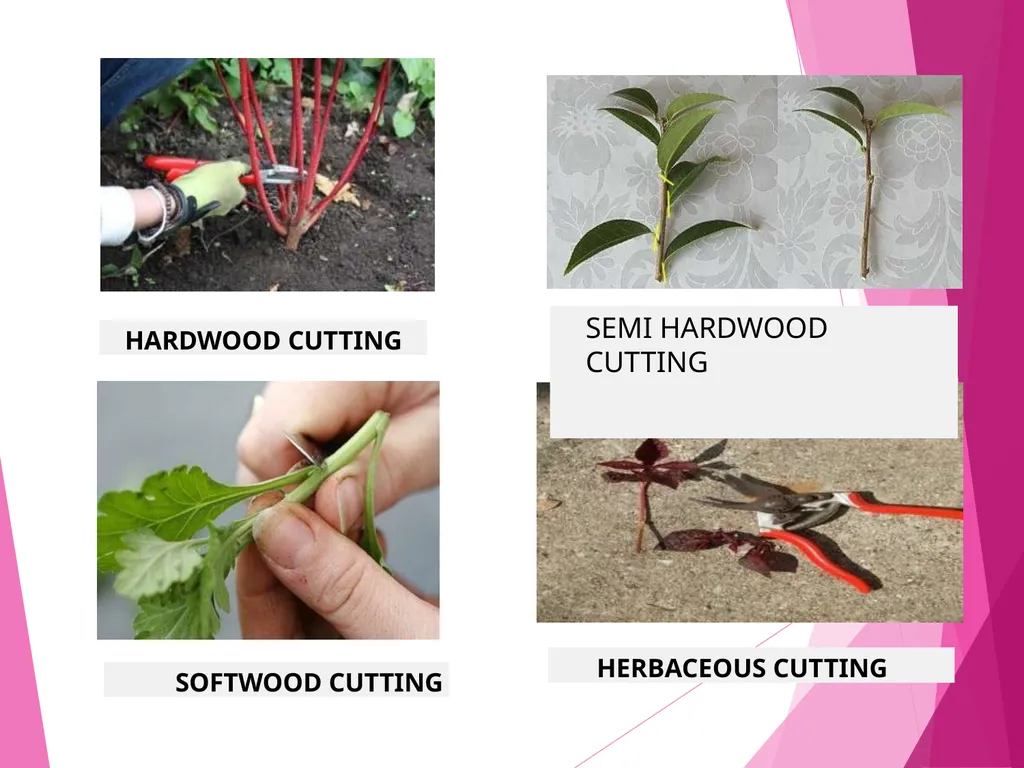
(A) Stem cutting- A portion of stem is taken for propagation. It is of four types
Hardwood cuttings - In this method one year old and mature shoots are selected for propagation. The length of the cutting is kept to 10 to 45cm.
e.g- pomegranate, grape, morus, fig
Semihard wood cutting- Here cuttings of 4 to 9 month old shoot of semi hard nature is used for raising new plants. Shoots of 7-20 cm length are used for preparing cuttings.
E. g– mango, guava, jackfruit, lemon, aonla<br>
05
Softwood cuttings- It is not practised for fruit crops due to high humidity requirement. The length is kept between 10-15 cm usually practised in the mist chamber.
e.g. apple, peach, guava
Herbaceous cuttings- Mostly ornamental plants are planted through herbaceous cuttings. Shoots of 1-2 month age are selected for cuttings.
e.g - alternanthera, coleus.<br>
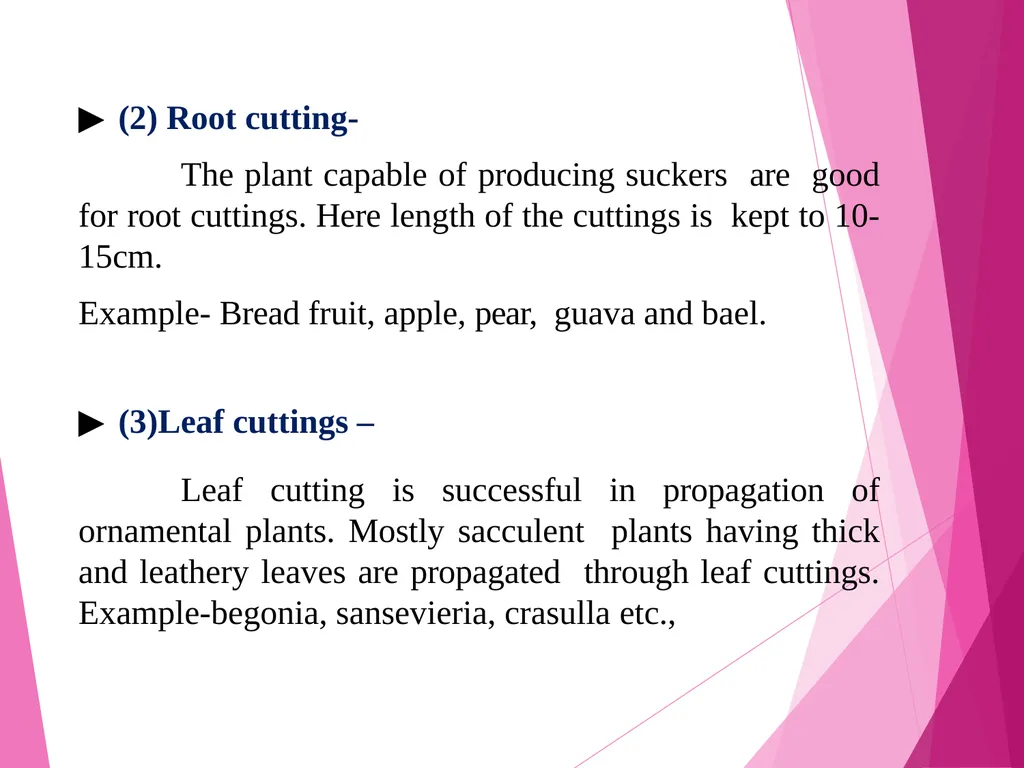
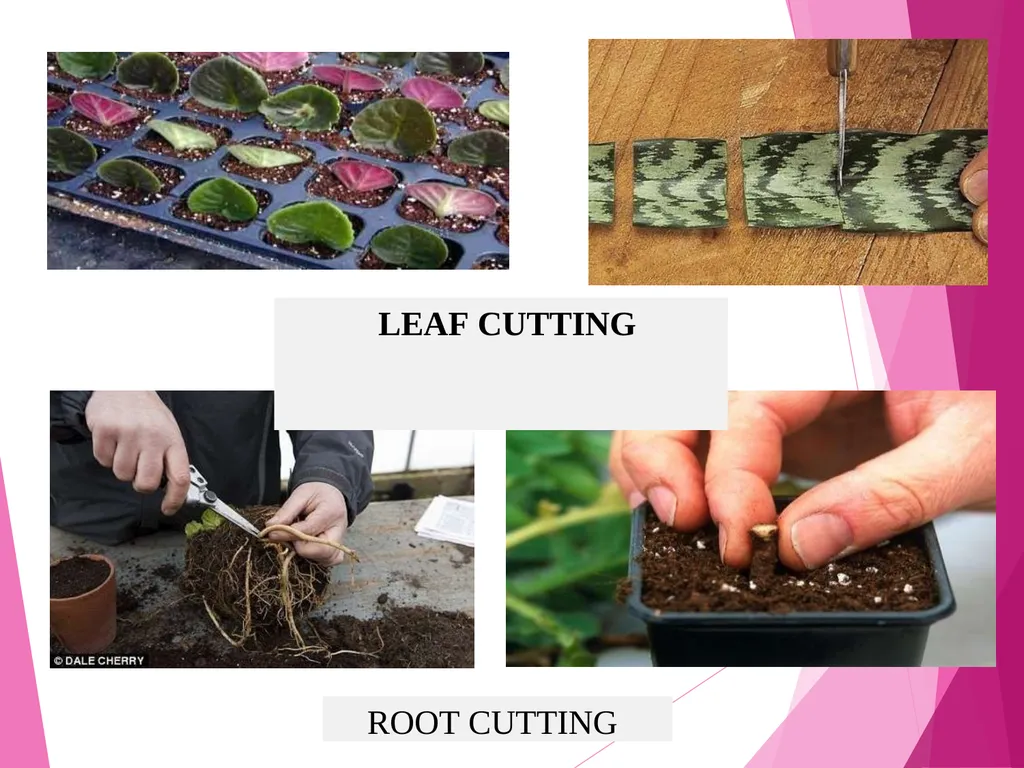
▶ (2) Root cutting-
The plant capable of producing suckers are good for root cuttings. Here length of the cuttings is kept to 10-15cm.
Example- Bread fruit, apple, pear, guava and bael.
▶ (3)Leaf cuttings –
Leaf cutting is successful in propagation of ornamental plants. Mostly sacculent plants having thick and leathery leaves are propagated through leaf cuttings. Example-begonia, sansevieria, crasulla etc.,<br>
08
LEAF CUTTING ROOT CUTTING<br>
09
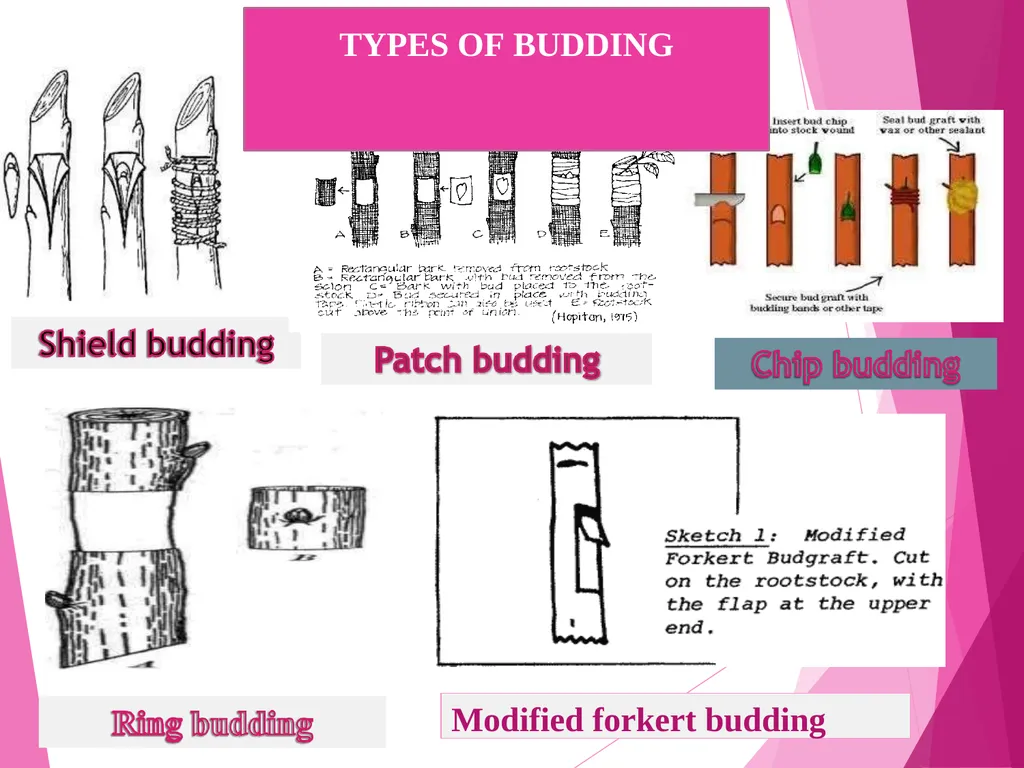
▶ The process of connecting scion, which is a bud, and rootstock in such a manner they may unite and grow successfully as one plants is termed as budding.
▶ It has two components that is bud and bud uniting parts.
▶ The bud which develops framework branches and flower and fruit is termed as scion.
▶ The portion from which bud is united which provide supportive stem and root system to the plant is termed as rootstock or stock. BUDDING<br>
10
TYPES OF BUDDING Modified forkert budding<br>
11
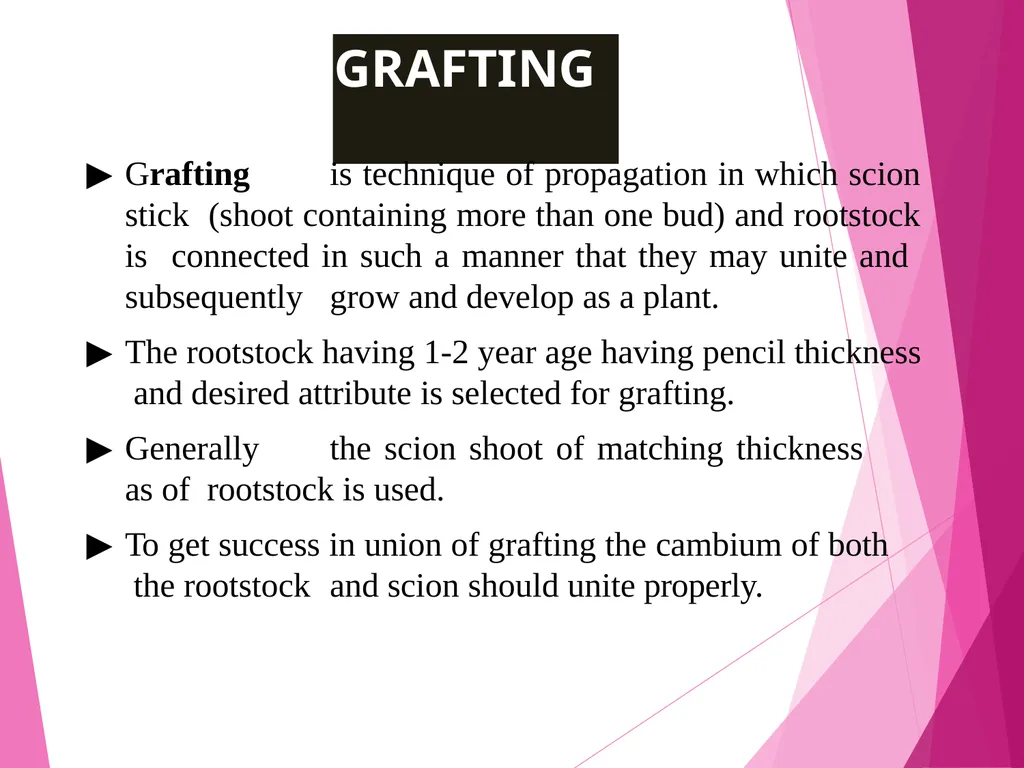
GRAFTING ▶ Grafting is technique of propagation in which scion stick (shoot containing more than one bud) and rootstock is connected in such a manner that they may unite and subsequently grow and develop as a plant.
▶ The rootstock having 1-2 year age having pencil thickness and desired attribute is selected for grafting.
▶ Generally the scion shoot of matching thickness as of rootstock is used.
▶ To get success in union of grafting the cambium of both the rootstock and scion should unite properly.<br>
12
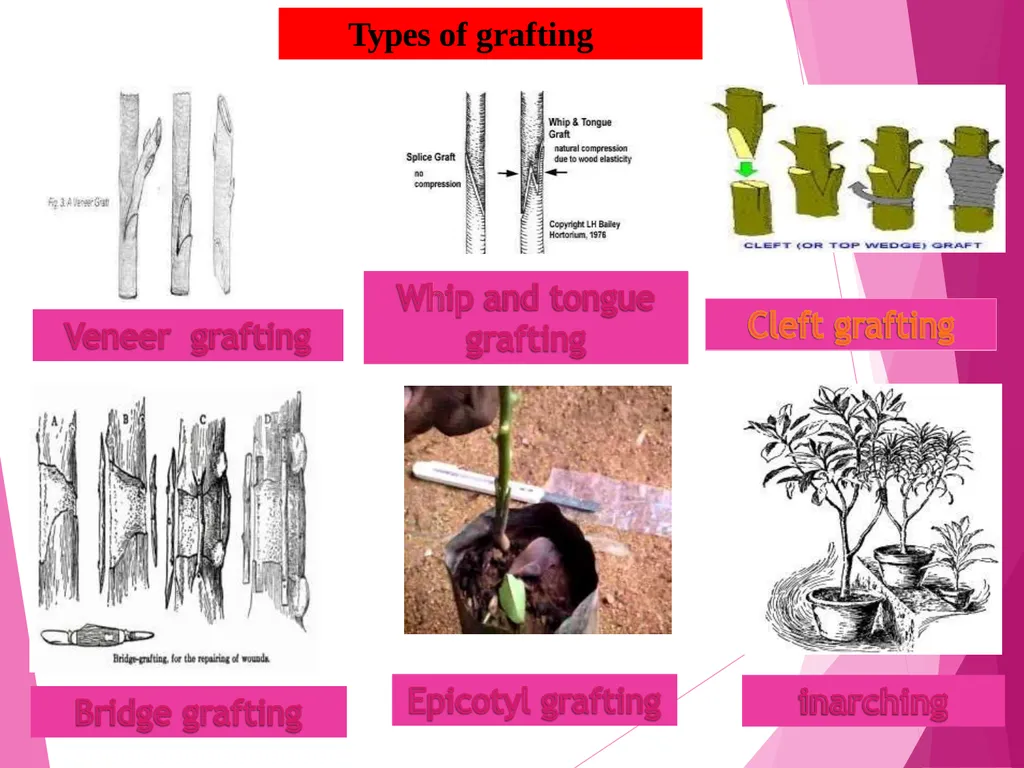
Types of grafting<br>
13
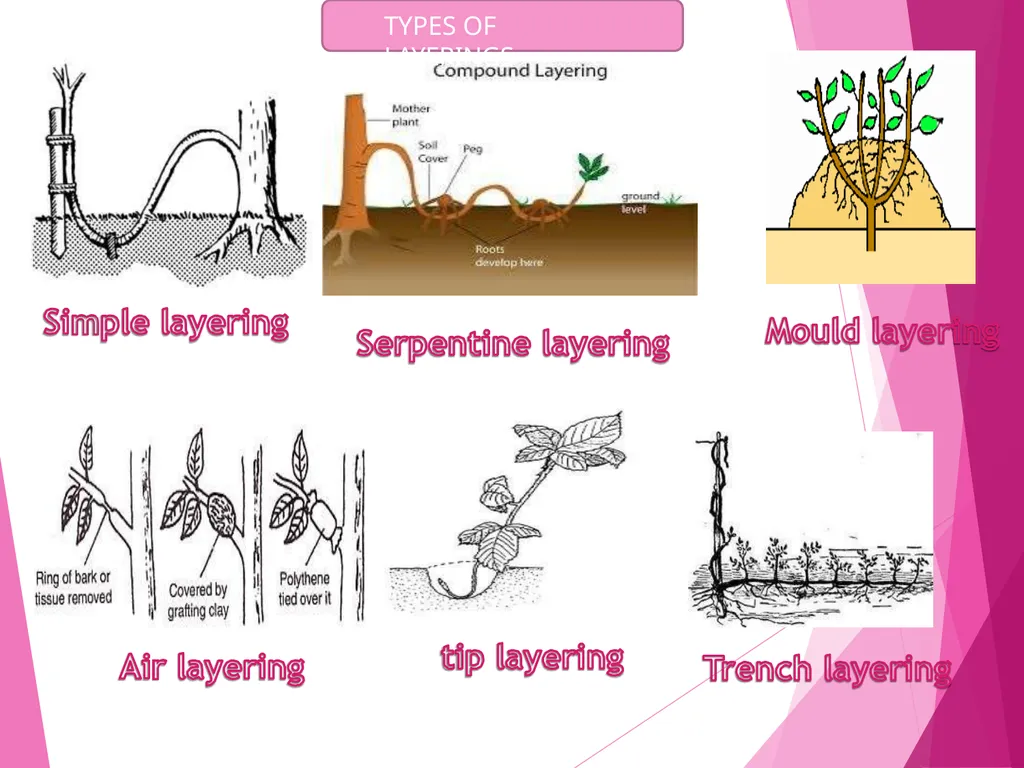
LAYERING ▶ It is a technique of propagation in which a portion of plant is forced to produce adventitious root while it is attached to mother plant.
▶ In this method, a single portion of plant constitute root and shoot.
▶ Upon emergence of root, the shoot is seperated from mother plant, acclimatized in nursery for some time and then planted in the field.<br>
14
TYPES OF LAYERINGS<br>
15
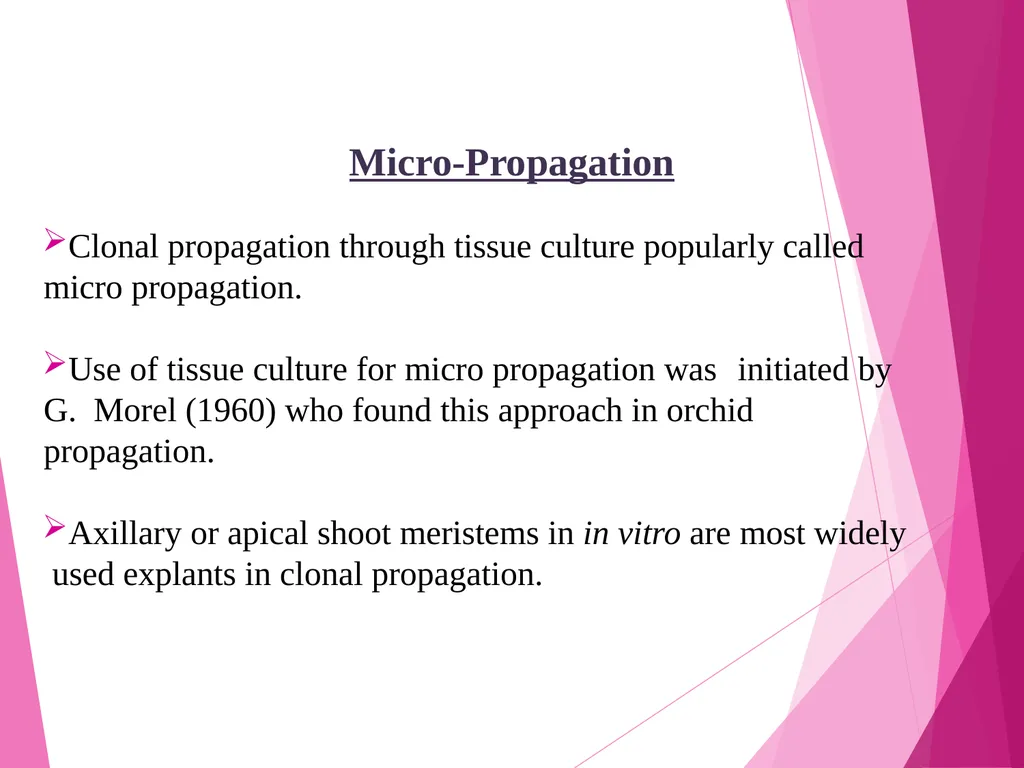
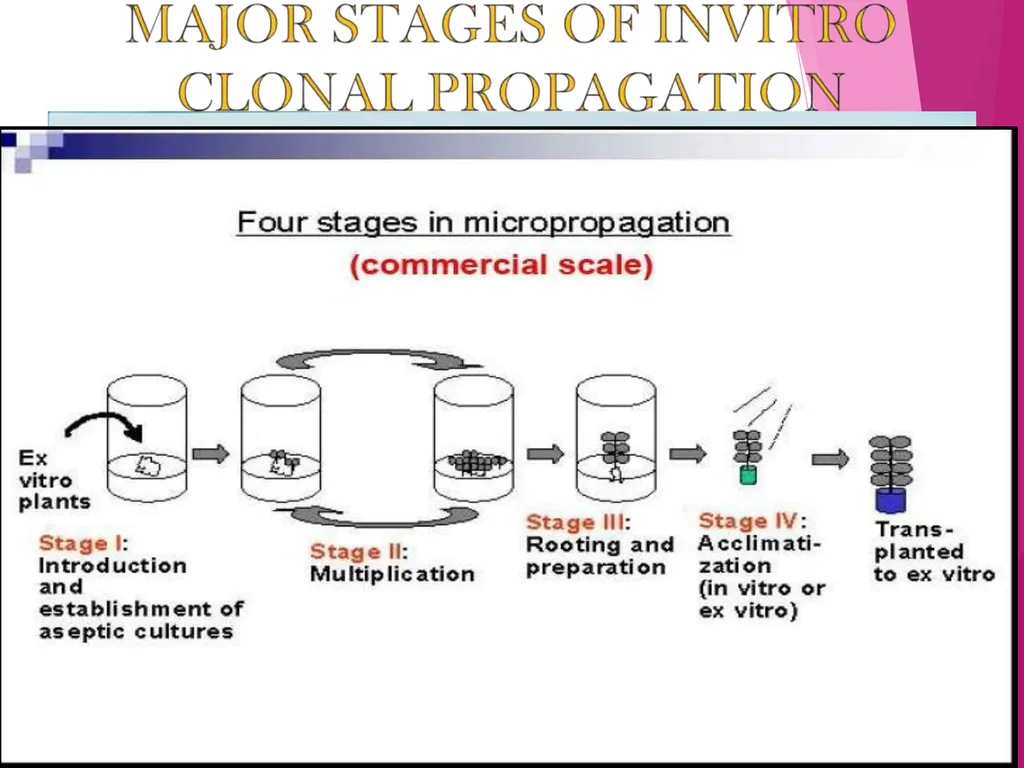
Clonal propagation through tissue culture popularly called micro propagation.
Use of tissue culture for micro propagation was initiated by G. Morel (1960) who found this approach in orchid propagation.
Axillary or apical shoot meristems in in vitro are most widely used explants in clonal propagation. Micro-Propagation<br>
16
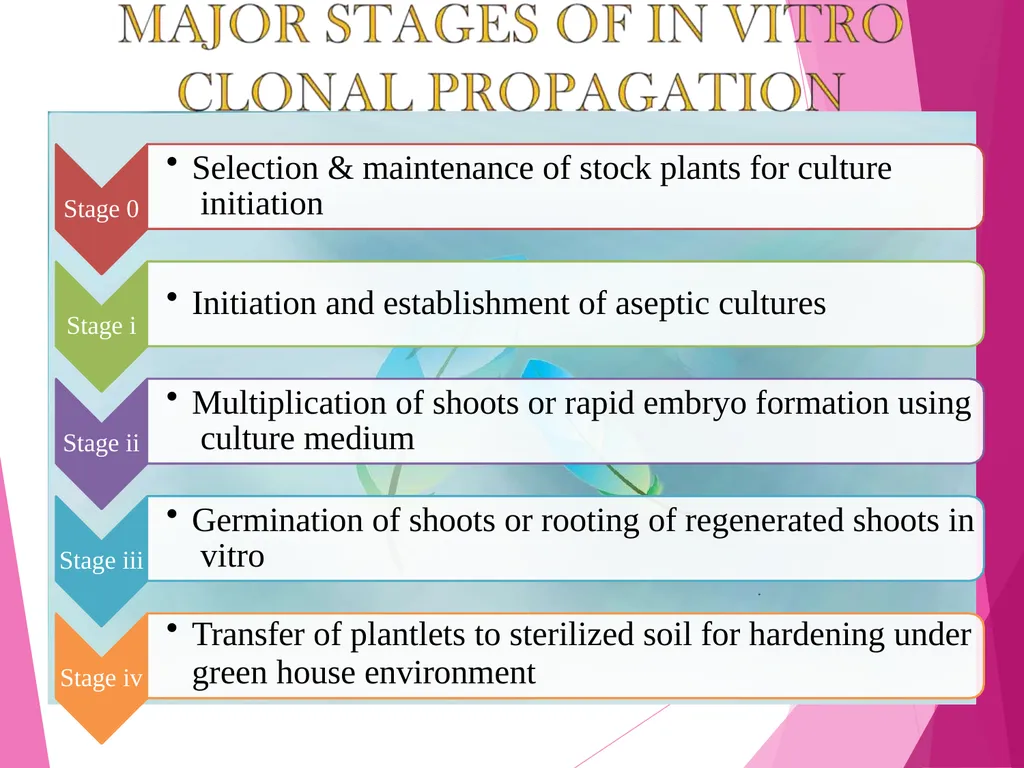
Stage 0 Selection & maintenance of stock plants for culture initiation Stage i Initiation and establishment of aseptic cultures Stage ii Multiplication of shoots or rapid embryo formation using culture medium Stage iii Germination of shoots or rooting of regenerated shoots in vitro Stage iv Transfer of plantlets to sterilized soil for hardening under
green house environment<br>
17
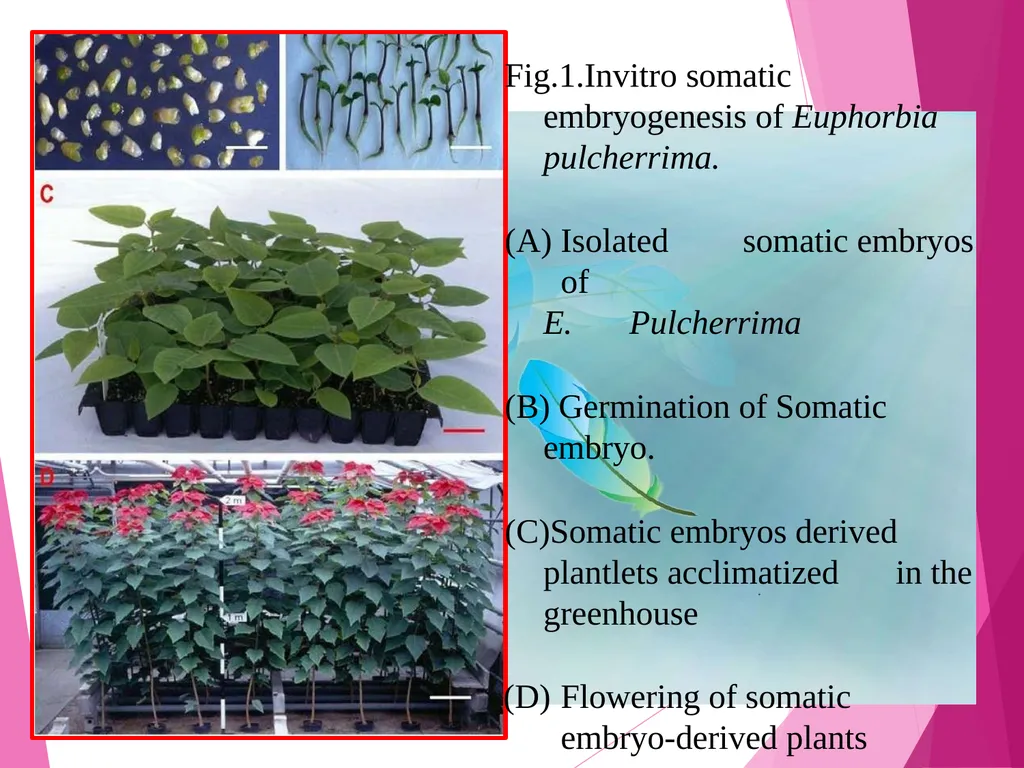
Fig.1.Invitro somatic embryogenesis of Euphorbia pulcherrima.
Isolated somatic embryos of
E. Pulcherrima
Germination of Somatic
embryo.
Somatic embryos derived plantlets acclimatized in the greenhouse
Flowering of somatic embryo-derived plants<br>
18
True to type plants
Off season production of plants
Reduction in life cycle of plant
Germplasm conservation
Genetic transformation
Large scale production of plants Advantages of Clonal Propagation<br>
19
Limitations of Clonal Propagation This technique is costly than sexual propagation
Woody plants does not gives response to clonal propagation
Plants regenerated through clonal propagation are not vigorous in growth<br>