
Introduction to PC-MHI Functions: CCC, CM, and How
LS
Published · 51 slides · 0 views

1 / 1




Description
Introduction to PC-MHI Functions: CCC, CM, and How they Work Together Katherine M. Dollar, PhD Sara Greenwood, MSW Johanna Klaus, PhD Definitions Provided by Dr. Christopher Hunter from literature synthesis for shared definitions
Related Topics
Share
Embed code
Download this presentation From Below
"Introduction to PC-MHI Functions: CCC, CM, and How" is the property of its rightful owner. Permission is granted to download and print the materials on this website for personal, non-commercial use only, and to display it on your personal computer provided you do not modify the materials and that you retain all copyright notices contained in the materials. By downloading content from our website, you accept the terms of this agreement.
Presentation Transcript
01
Introduction to PC-MHI Functions: CCC, CM, and How they Work Together Katherine M. Dollar, PhD
Sara Greenwood, MSW
Johanna Klaus, PhD<br>
Sara Greenwood, MSW
Johanna Klaus, PhD<br>
02
Definitions*
*Provided by Dr. Christopher Hunter from literature synthesis for shared definitions Integrated Care is an overarching term conceptually defined as:
A form of care where behavioral health and primary care providers interact in a systematic manner to meet the behavioral health and health needs of their patients.
Or: “…Unifies care for physical and mental concerns” AHRQ 2008 Butler et al.<br>
A form of care where behavioral health and primary care providers interact in a systematic manner to meet the behavioral health and health needs of their patients.
Or: “…Unifies care for physical and mental concerns” AHRQ 2008 Butler et al.<br>
03
Introduction to Co-located, Collaborative Care Katherine M. Dollar, PhD
August 2011
Based on material previously presented by Andrew Pomerantz, MD and Margaret Dundon, PhD<br>
August 2011
Based on material previously presented by Andrew Pomerantz, MD and Margaret Dundon, PhD<br>
04
Co-location/Co-located Service
A behavioral health provider working in a space that is embedded in (or in close proximity to ) a primary care clinic.
Collaborative Care/Collaboration
The interactions between primary care and behavioral health providers for the purpose of developing treatment plans, providing clinical services and coordinating care to meet the physical and behavioral health needs of patients.<br>
05
Co-located Collaborative Care A state of mind as much as a program
A platform for treatment, not a treatment
Many Dimensions<br>
A platform for treatment, not a treatment
Many Dimensions<br>
06
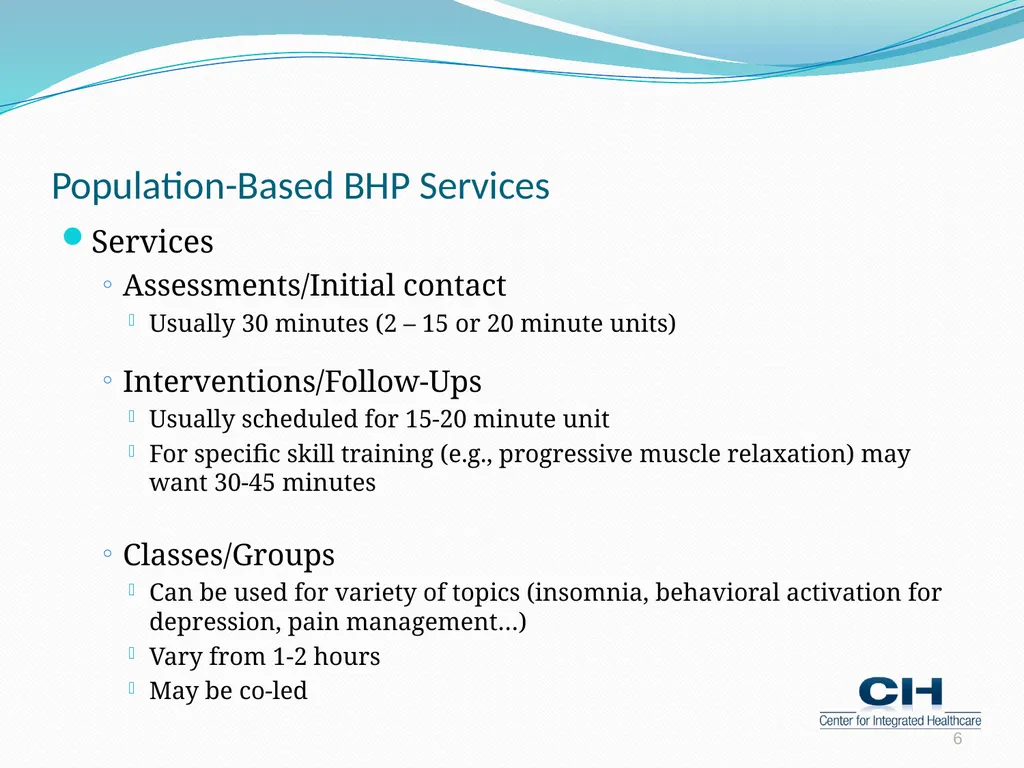
Population-Based BHP Services Services
Assessments/Initial contact
Usually 30 minutes (2 – 15 or 20 minute units)
Interventions/Follow-Ups
Usually scheduled for 15-20 minute unit
For specific skill training (e.g., progressive muscle relaxation) may want 30-45 minutes
Classes/Groups
Can be used for variety of topics (insomnia, behavioral activation for depression, pain management…)
Vary from 1-2 hours
May be co-led 6<br>
Assessments/Initial contact
Usually 30 minutes (2 – 15 or 20 minute units)
Interventions/Follow-Ups
Usually scheduled for 15-20 minute unit
For specific skill training (e.g., progressive muscle relaxation) may want 30-45 minutes
Classes/Groups
Can be used for variety of topics (insomnia, behavioral activation for depression, pain management…)
Vary from 1-2 hours
May be co-led 6<br>
07
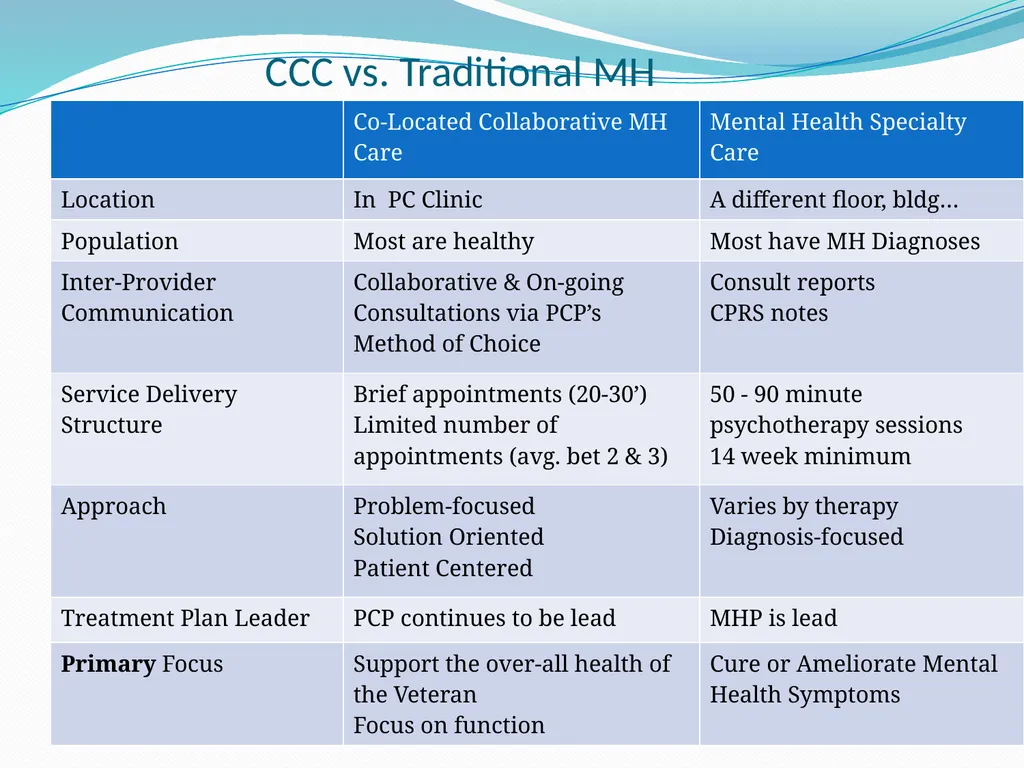
CCC vs. Traditional MH<br>
08
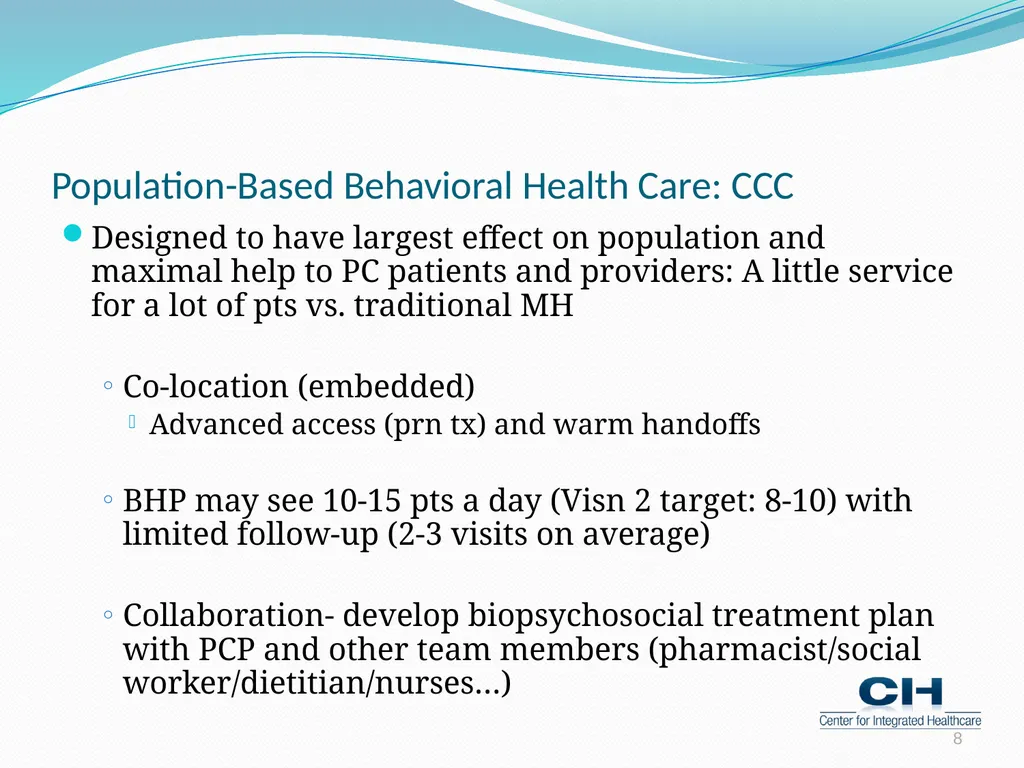
Population-Based Behavioral Health Care: CCC Designed to have largest effect on population and maximal help to PC patients and providers: A little service for a lot of pts vs. traditional MH
Co-location (embedded)
Advanced access (prn tx) and warm handoffs
BHP may see 10-15 pts a day (Visn 2 target: 8-10) with limited follow-up (2-3 visits on average)
Collaboration- develop biopsychosocial treatment plan with PCP and other team members (pharmacist/social worker/dietitian/nurses…) 8<br>
Co-location (embedded)
Advanced access (prn tx) and warm handoffs
BHP may see 10-15 pts a day (Visn 2 target: 8-10) with limited follow-up (2-3 visits on average)
Collaboration- develop biopsychosocial treatment plan with PCP and other team members (pharmacist/social worker/dietitian/nurses…) 8<br>
09
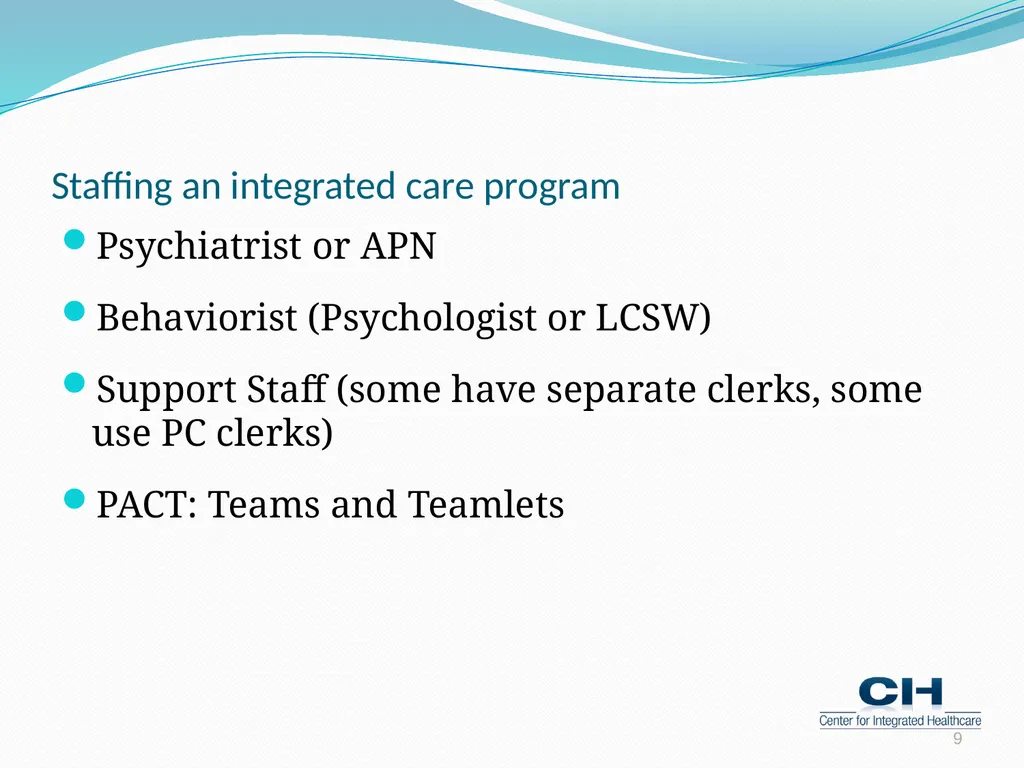
Staffing an integrated care program Psychiatrist or APN
Behaviorist (Psychologist or LCSW)
Support Staff (some have separate clerks, some use PC clerks)
PACT: Teams and Teamlets 9<br>
Behaviorist (Psychologist or LCSW)
Support Staff (some have separate clerks, some use PC clerks)
PACT: Teams and Teamlets 9<br>
10
Scheduling Open Access: from no scheduled appointments (WRJ) to limited schedule appointments or alternating scheduled and open
Minimizes wait times
Allows warm hand-offs and increases linkage success
Passes the endorsement of the PCP to the BHP 10<br>
Minimizes wait times
Allows warm hand-offs and increases linkage success
Passes the endorsement of the PCP to the BHP 10<br>
11
Brief Assessment Tools Interview Assessments Not Rorschach or MMPI or…., but brief evidence-based screens such as
PHQ 9 or PHQ 2
GAD 7
PCL-M
AUDIT C
Blessed Orientation Memory Concentration
Others? Focus on functioning, and tailored around PCP reason for referral
This 30 min. challenge can be organized around 5 A’s:
Assess
Advise
Agree
Assist
Arrange 11<br>
PHQ 9 or PHQ 2
GAD 7
PCL-M
AUDIT C
Blessed Orientation Memory Concentration
Others? Focus on functioning, and tailored around PCP reason for referral
This 30 min. challenge can be organized around 5 A’s:
Assess
Advise
Agree
Assist
Arrange 11<br>
12
5A’s-Assess, Advise, Agree, Assist, Arrange Diagram adapted from: Glasgow, R. E & Nutting, P. A. (2004). Diabetes. In Handbook of Primary Care Psychology. Ed., Hass, L. J. (pp. 299-311) 12 12<br>
13
Brief Interventions Motivational Interviewing
Brief Interventions for SUDs
Problem Solving Therapy
Acceptance and Commitment Therapy
Psychiatric consultations with PCPs 13<br>
Brief Interventions for SUDs
Problem Solving Therapy
Acceptance and Commitment Therapy
Psychiatric consultations with PCPs 13<br>
14
CCC Domains of Competency Domain 1: Clinical Practice
Domain 2: Practice Management
Domain 3: Consultation
Domain 4: Documentation
Domain 5: Teamwork
Domain 6: Administrative Skills 14<br>
Domain 2: Practice Management
Domain 3: Consultation
Domain 4: Documentation
Domain 5: Teamwork
Domain 6: Administrative Skills 14<br>
15
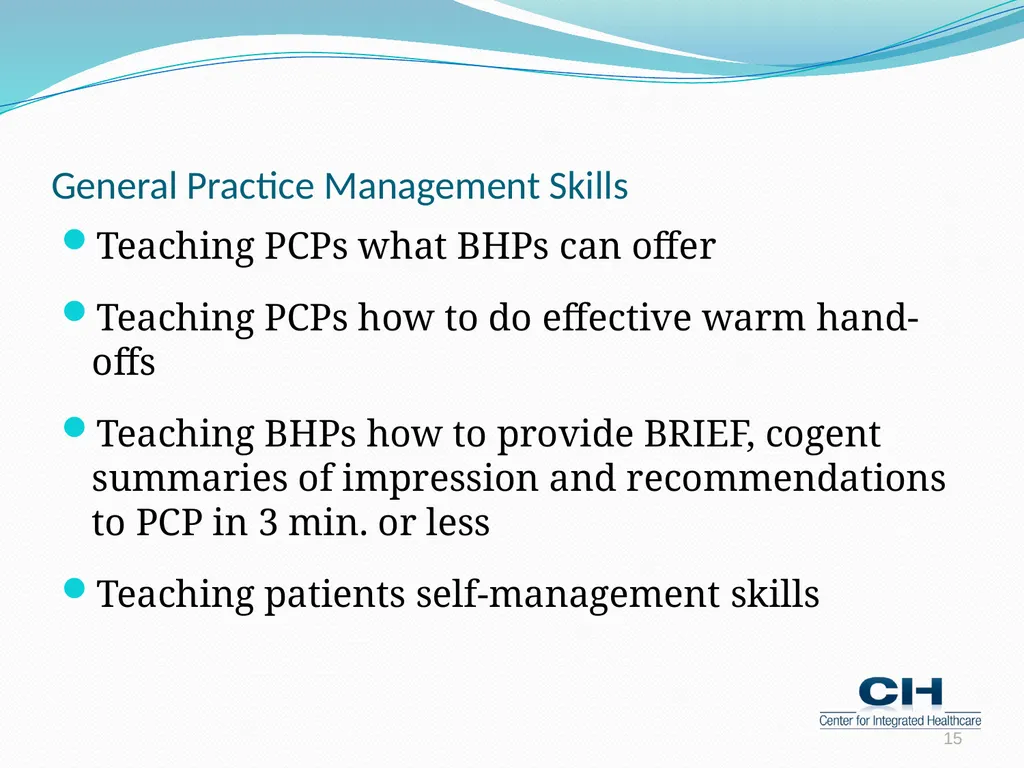
General Practice Management Skills Teaching PCPs what BHPs can offer
Teaching PCPs how to do effective warm hand-offs
Teaching BHPs how to provide BRIEF, cogent summaries of impression and recommendations to PCP in 3 min. or less
Teaching patients self-management skills 15<br>
Teaching PCPs how to do effective warm hand-offs
Teaching BHPs how to provide BRIEF, cogent summaries of impression and recommendations to PCP in 3 min. or less
Teaching patients self-management skills 15<br>
16
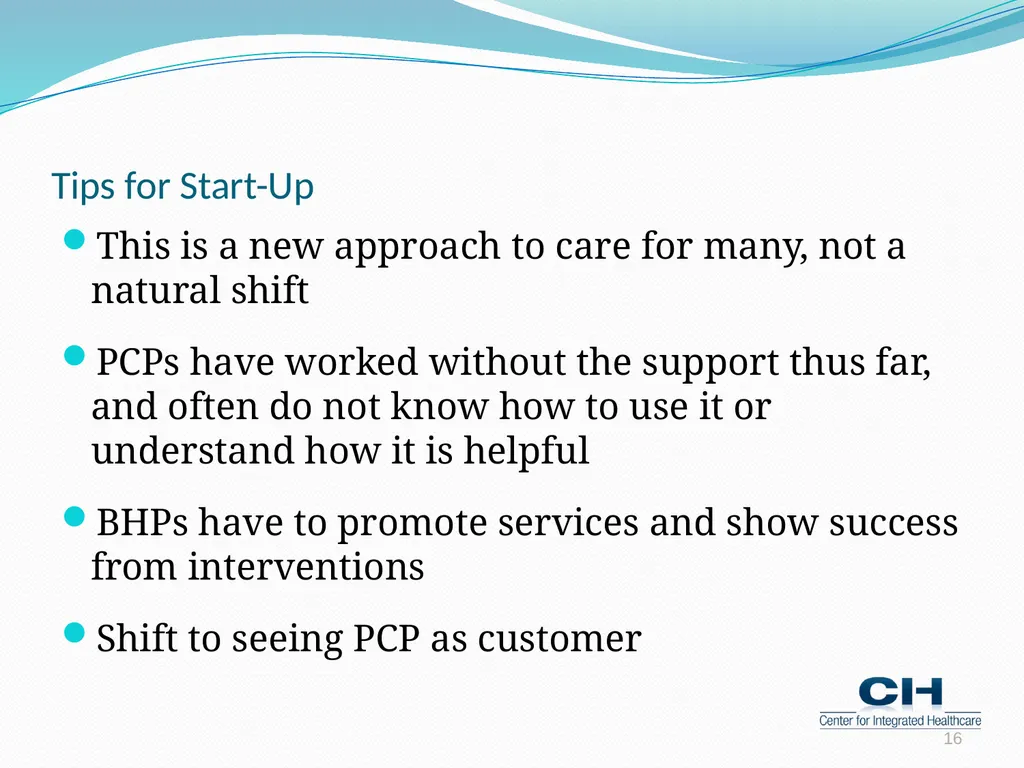
Tips for Start-Up This is a new approach to care for many, not a natural shift
PCPs have worked without the support thus far, and often do not know how to use it or understand how it is helpful
BHPs have to promote services and show success from interventions
Shift to seeing PCP as customer 16<br>
PCPs have worked without the support thus far, and often do not know how to use it or understand how it is helpful
BHPs have to promote services and show success from interventions
Shift to seeing PCP as customer 16<br>
17
Care Management Johanna Klaus, PhD<br>
18
18<br>
19
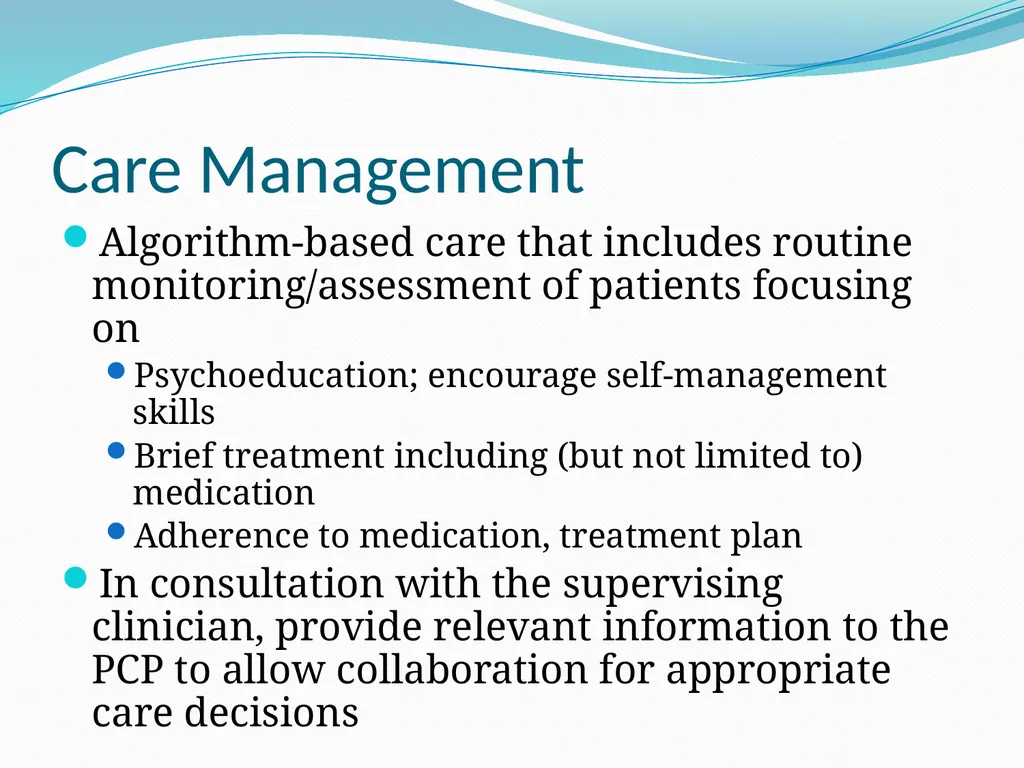
Care Management Algorithm-based care that includes routine monitoring/assessment of patients focusing on
Psychoeducation; encourage self-management skills
Brief treatment including (but not limited to) medication
Adherence to medication, treatment plan
In consultation with the supervising clinician, provide relevant information to the PCP to allow collaboration for appropriate care decisions<br>
Psychoeducation; encourage self-management skills
Brief treatment including (but not limited to) medication
Adherence to medication, treatment plan
In consultation with the supervising clinician, provide relevant information to the PCP to allow collaboration for appropriate care decisions<br>
20
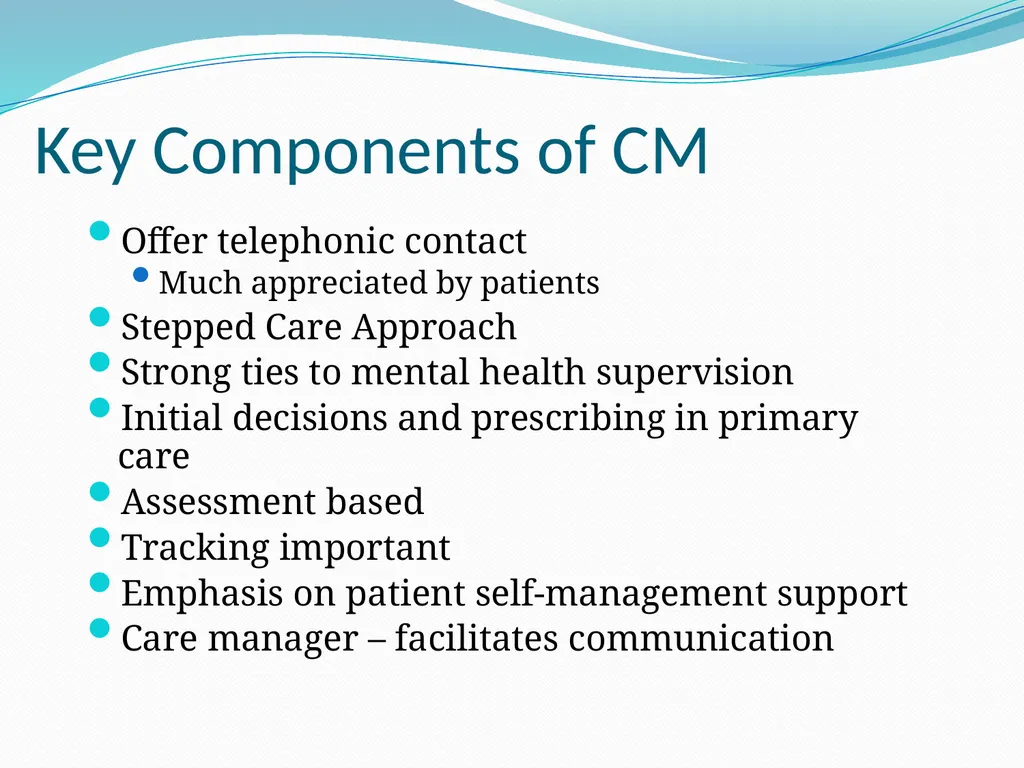
Key Components of CM Offer telephonic contact
Much appreciated by patients
Stepped Care Approach
Strong ties to mental health supervision
Initial decisions and prescribing in primary care
Assessment based
Tracking important
Emphasis on patient self-management support
Care manager – facilitates communication<br>
Much appreciated by patients
Stepped Care Approach
Strong ties to mental health supervision
Initial decisions and prescribing in primary care
Assessment based
Tracking important
Emphasis on patient self-management support
Care manager – facilitates communication<br>
21
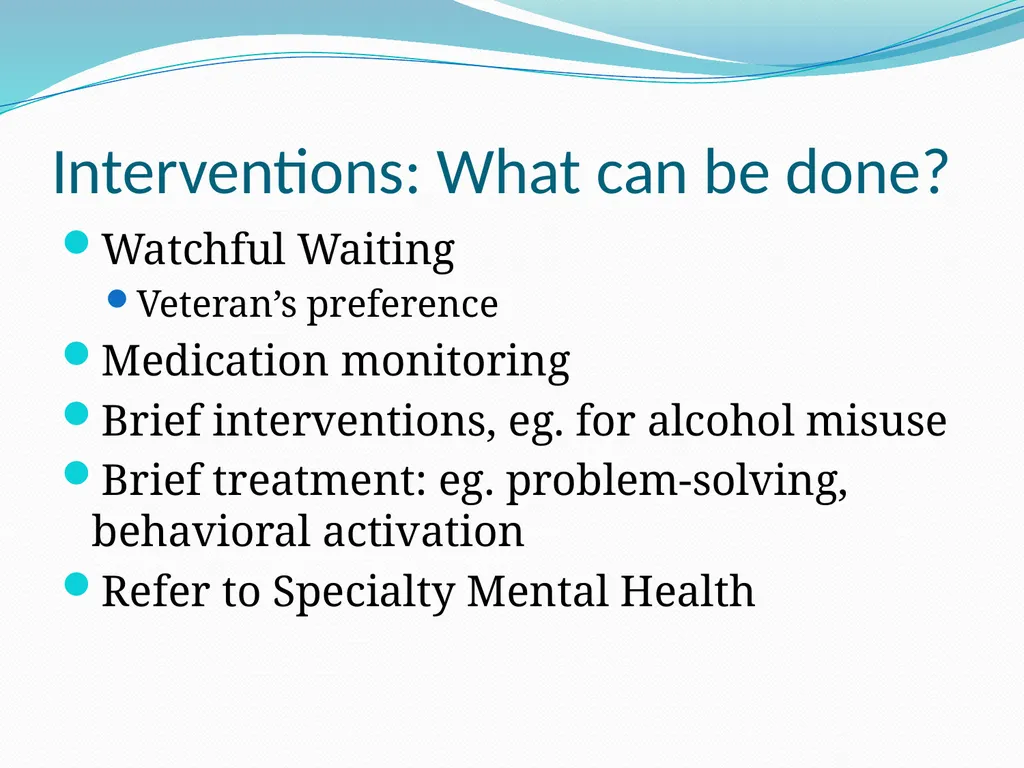
Interventions: What can be done? Watchful Waiting
Veteran’s preference
Medication monitoring
Brief interventions, eg. for alcohol misuse
Brief treatment: eg. problem-solving, behavioral activation
Refer to Specialty Mental Health<br>
Veteran’s preference
Medication monitoring
Brief interventions, eg. for alcohol misuse
Brief treatment: eg. problem-solving, behavioral activation
Refer to Specialty Mental Health<br>
22
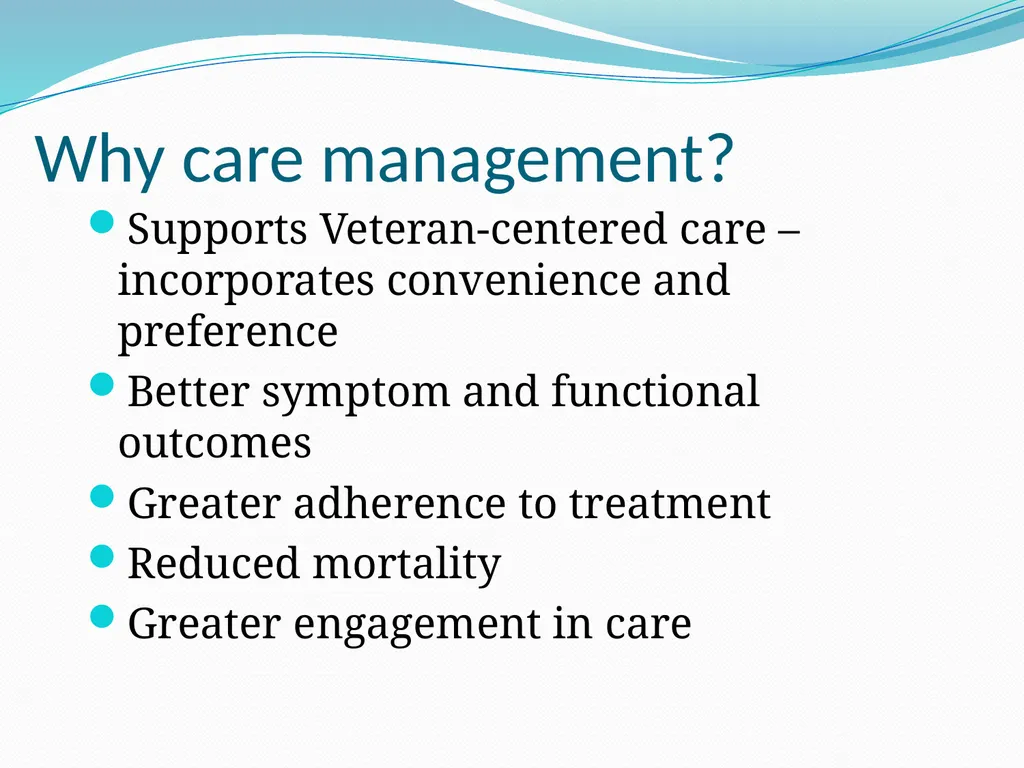
Why care management? Supports Veteran-centered care – incorporates convenience and preference
Better symptom and functional outcomes
Greater adherence to treatment
Reduced mortality
Greater engagement in care<br>
Better symptom and functional outcomes
Greater adherence to treatment
Reduced mortality
Greater engagement in care<br>
23
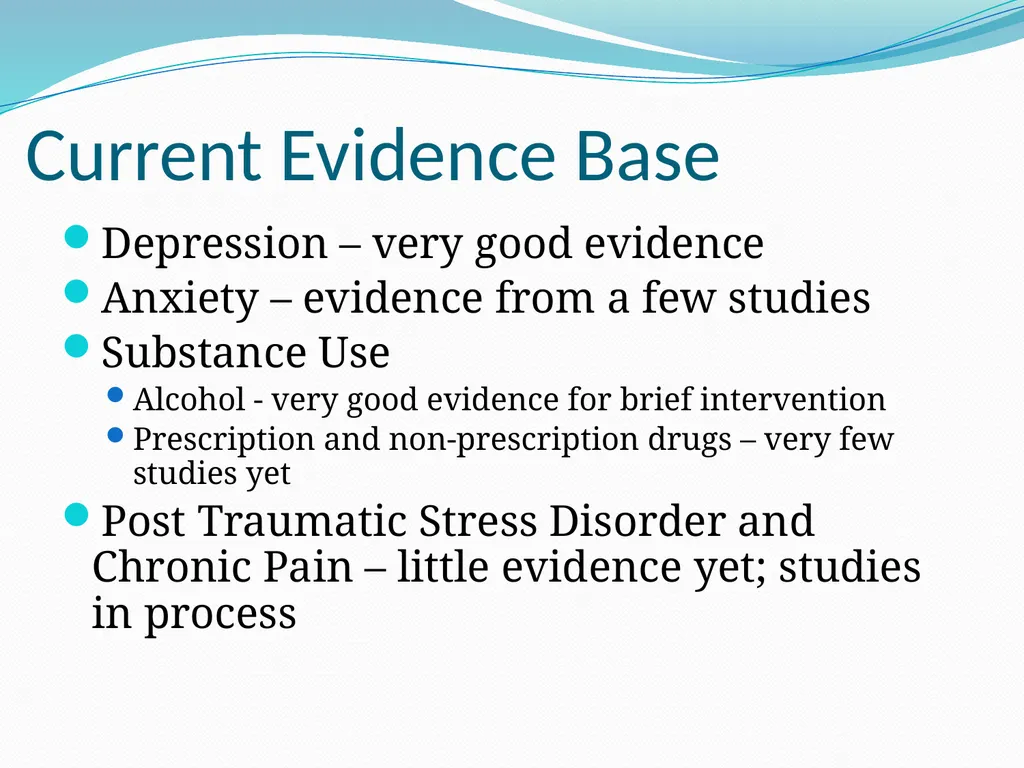
Current Evidence Base Depression – very good evidence
Anxiety – evidence from a few studies
Substance Use
Alcohol - very good evidence for brief intervention
Prescription and non-prescription drugs – very few studies yet
Post Traumatic Stress Disorder and Chronic Pain – little evidence yet; studies in process<br>
Anxiety – evidence from a few studies
Substance Use
Alcohol - very good evidence for brief intervention
Prescription and non-prescription drugs – very few studies yet
Post Traumatic Stress Disorder and Chronic Pain – little evidence yet; studies in process<br>
24
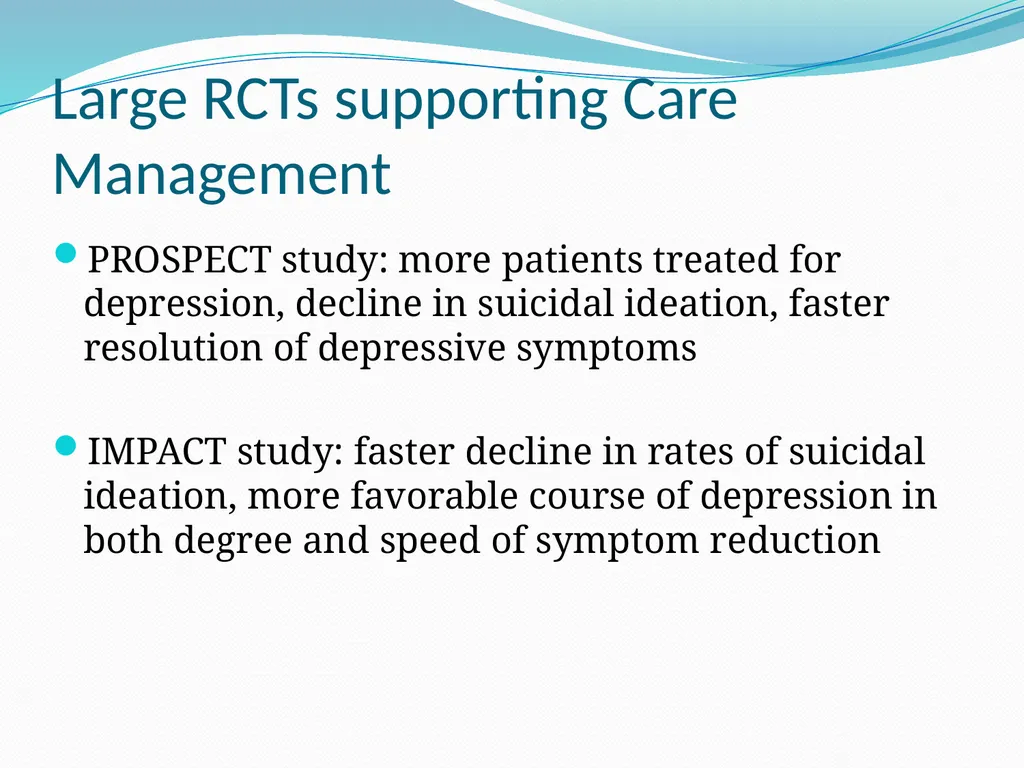
Large RCTs supporting Care Management PROSPECT study: more patients treated for depression, decline in suicidal ideation, faster resolution of depressive symptoms
IMPACT study: faster decline in rates of suicidal ideation, more favorable course of depression in both degree and speed of symptom reduction<br>
IMPACT study: faster decline in rates of suicidal ideation, more favorable course of depression in both degree and speed of symptom reduction<br>
25
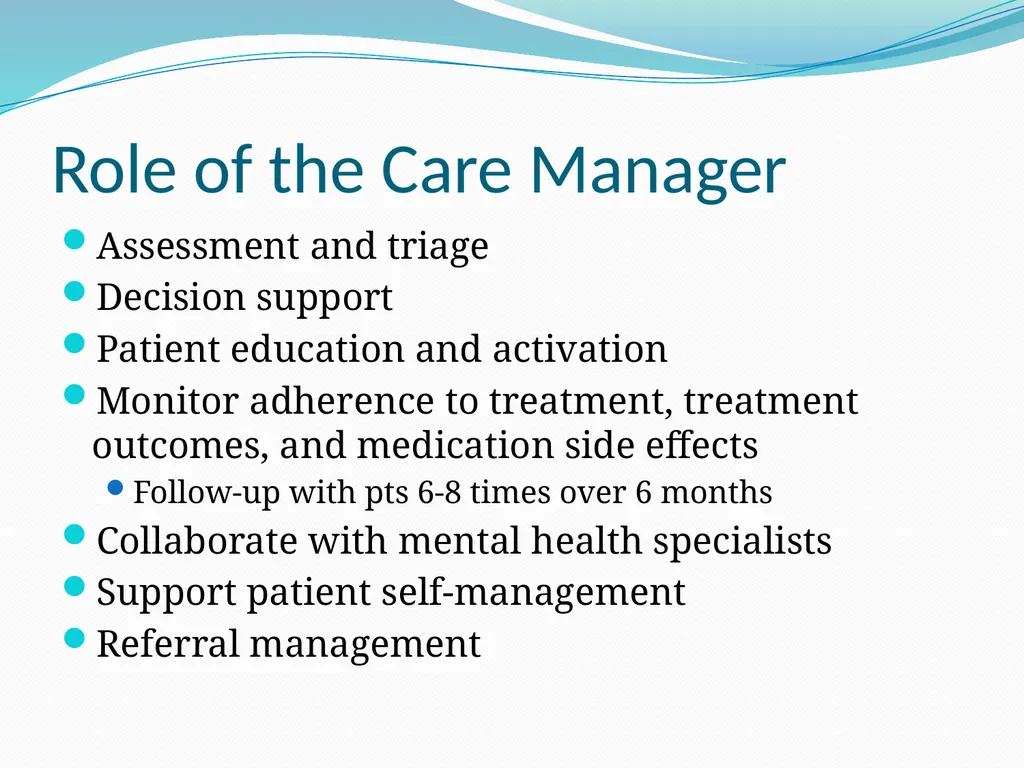
Role of the Care Manager Assessment and triage
Decision support
Patient education and activation
Monitor adherence to treatment, treatment outcomes, and medication side effects
Follow-up with pts 6-8 times over 6 months
Collaborate with mental health specialists
Support patient self-management
Referral management<br>
Decision support
Patient education and activation
Monitor adherence to treatment, treatment outcomes, and medication side effects
Follow-up with pts 6-8 times over 6 months
Collaborate with mental health specialists
Support patient self-management
Referral management<br>
26
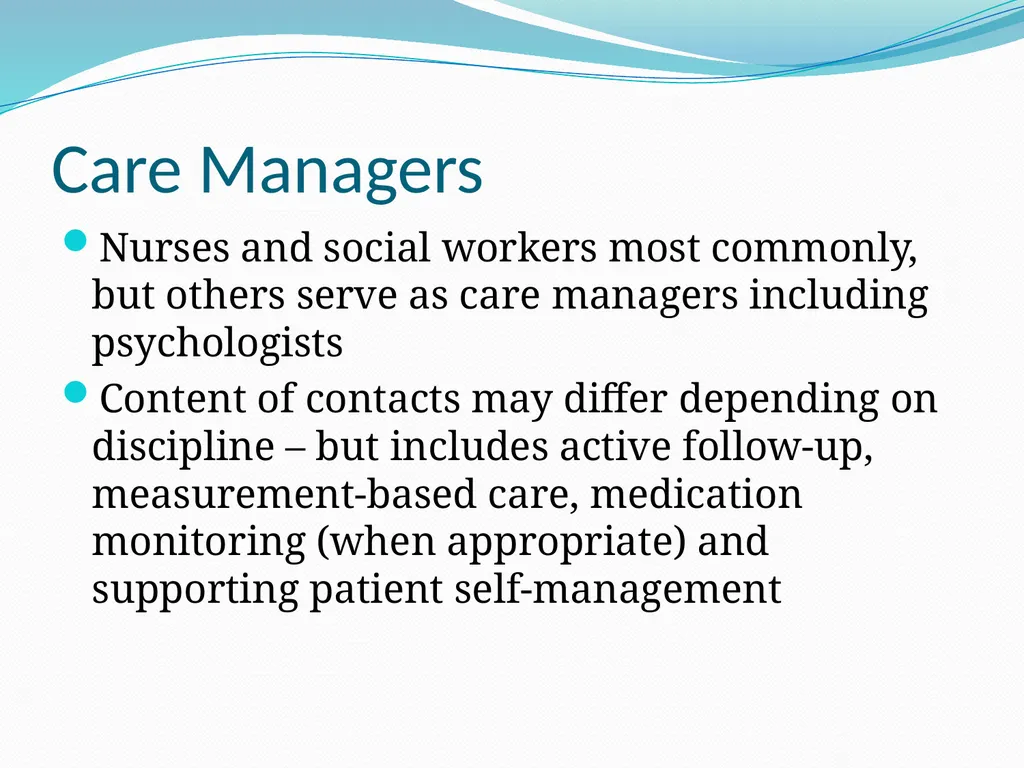
Care Managers Nurses and social workers most commonly, but others serve as care managers including psychologists
Content of contacts may differ depending on discipline – but includes active follow-up, measurement-based care, medication monitoring (when appropriate) and supporting patient self-management<br>
Content of contacts may differ depending on discipline – but includes active follow-up, measurement-based care, medication monitoring (when appropriate) and supporting patient self-management<br>
27
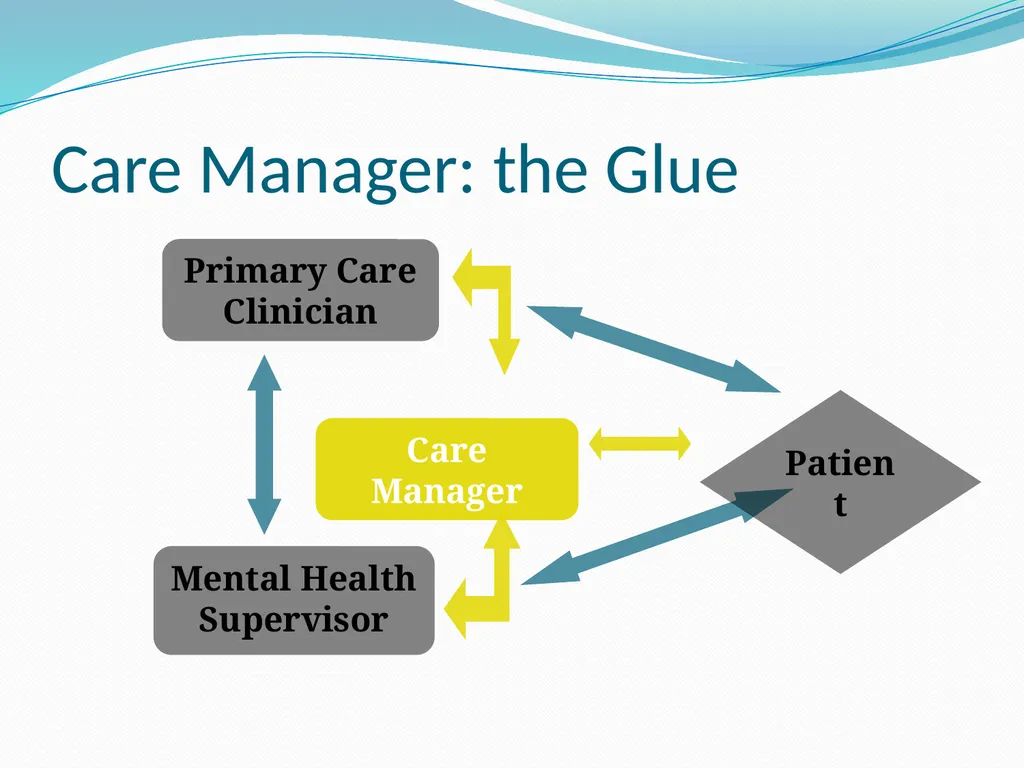
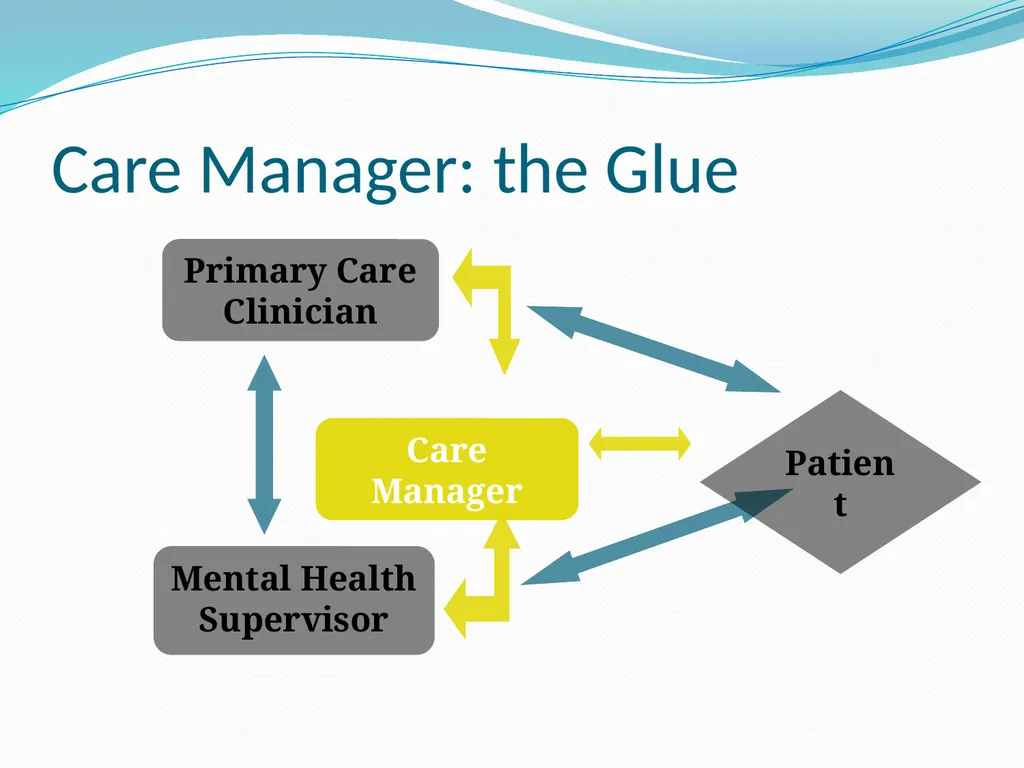
Care Manager: the Glue Primary Care Clinician Mental Health Supervisor Care Manager Patient<br>
28
Care Manager Supervisor Typically psychiatrist, sometimes a psychologist, preferably someone with integrated care clinical experience
Regular supervision, i.e. weekly
Encourage PC providers to prescribe; provide recommendations via care management supervision
Get to know PC providers; provide consultation<br>
Regular supervision, i.e. weekly
Encourage PC providers to prescribe; provide recommendations via care management supervision
Get to know PC providers; provide consultation<br>
29
Case Example<br>
30
30 Mr. Howell
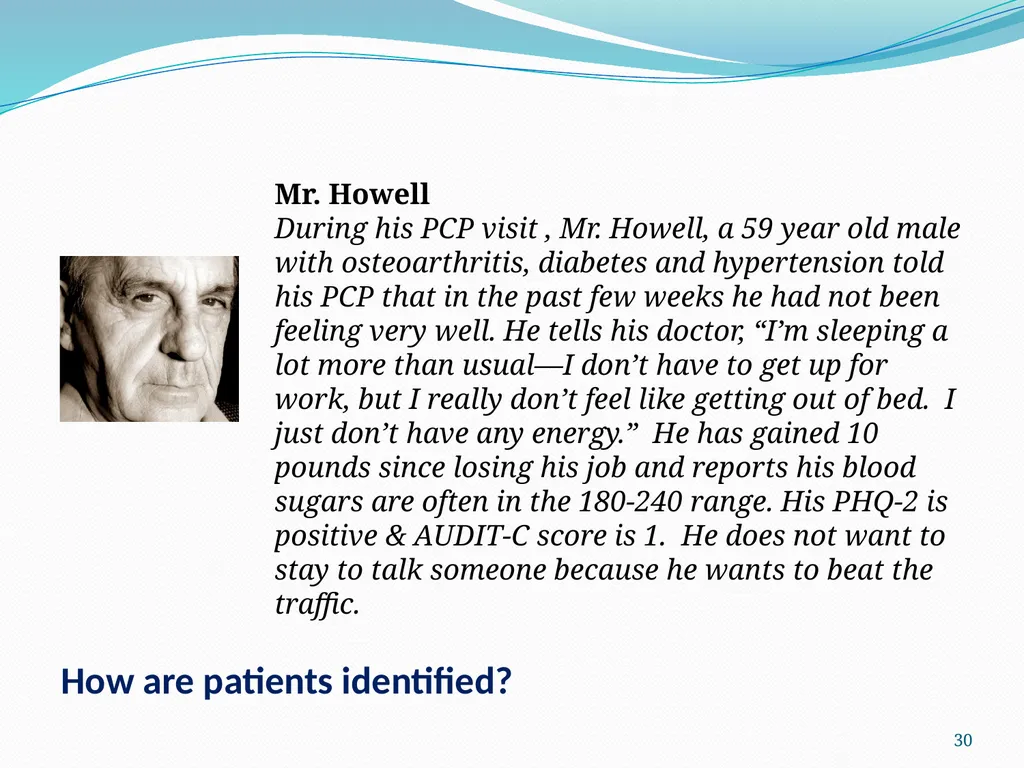
During his PCP visit , Mr. Howell, a 59 year old male with osteoarthritis, diabetes and hypertension told his PCP that in the past few weeks he had not been feeling very well. He tells his doctor, “I’m sleeping a lot more than usual—I don’t have to get up for work, but I really don’t feel like getting out of bed. I just don’t have any energy.” He has gained 10 pounds since losing his job and reports his blood sugars are often in the 180-240 range. His PHQ-2 is positive & AUDIT-C score is 1. He does not want to stay to talk someone because he wants to beat the traffic. How are patients identified?<br>
During his PCP visit , Mr. Howell, a 59 year old male with osteoarthritis, diabetes and hypertension told his PCP that in the past few weeks he had not been feeling very well. He tells his doctor, “I’m sleeping a lot more than usual—I don’t have to get up for work, but I really don’t feel like getting out of bed. I just don’t have any energy.” He has gained 10 pounds since losing his job and reports his blood sugars are often in the 180-240 range. His PHQ-2 is positive & AUDIT-C score is 1. He does not want to stay to talk someone because he wants to beat the traffic. How are patients identified?<br>
31
Assessment Goals of assessment:
Establish Veteran needs and preferences for treatment
Identify patients appropriate for care management services
Recognize patients who may benefit from higher-intensity treatment
Provide "on-time, on-target" information to PCPs and collaboratively make appropriate care decisions
Assessment tools & triage options may vary by site 31<br>
Establish Veteran needs and preferences for treatment
Identify patients appropriate for care management services
Recognize patients who may benefit from higher-intensity treatment
Provide "on-time, on-target" information to PCPs and collaboratively make appropriate care decisions
Assessment tools & triage options may vary by site 31<br>
32
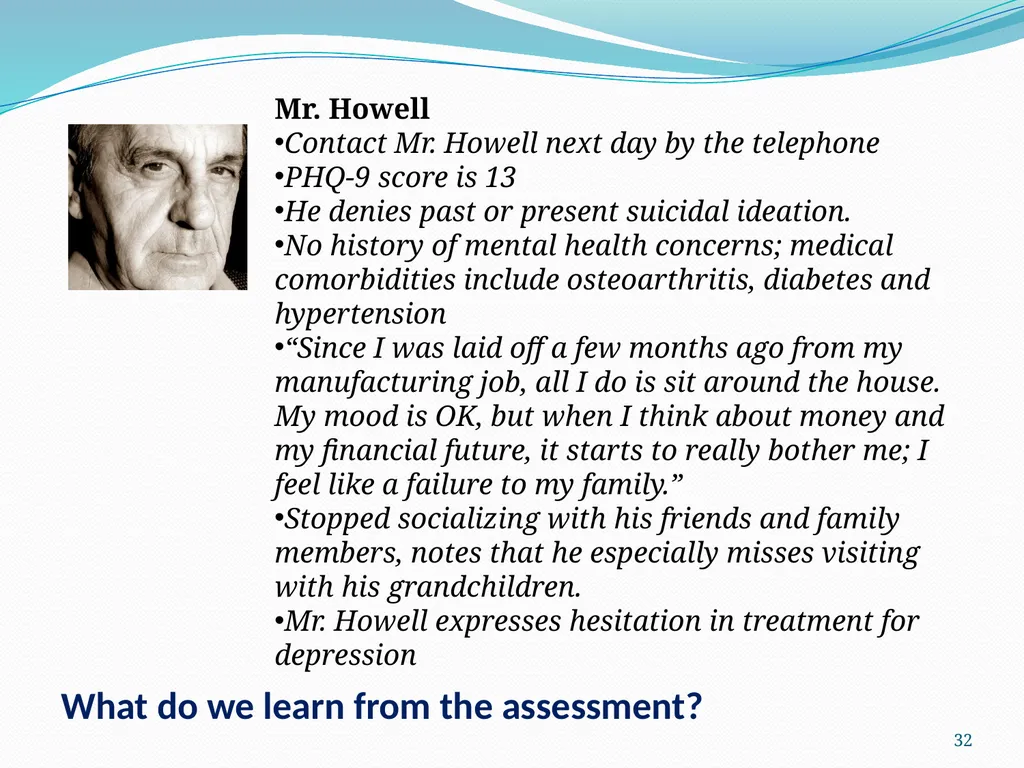
32 Mr. Howell
Contact Mr. Howell next day by the telephone
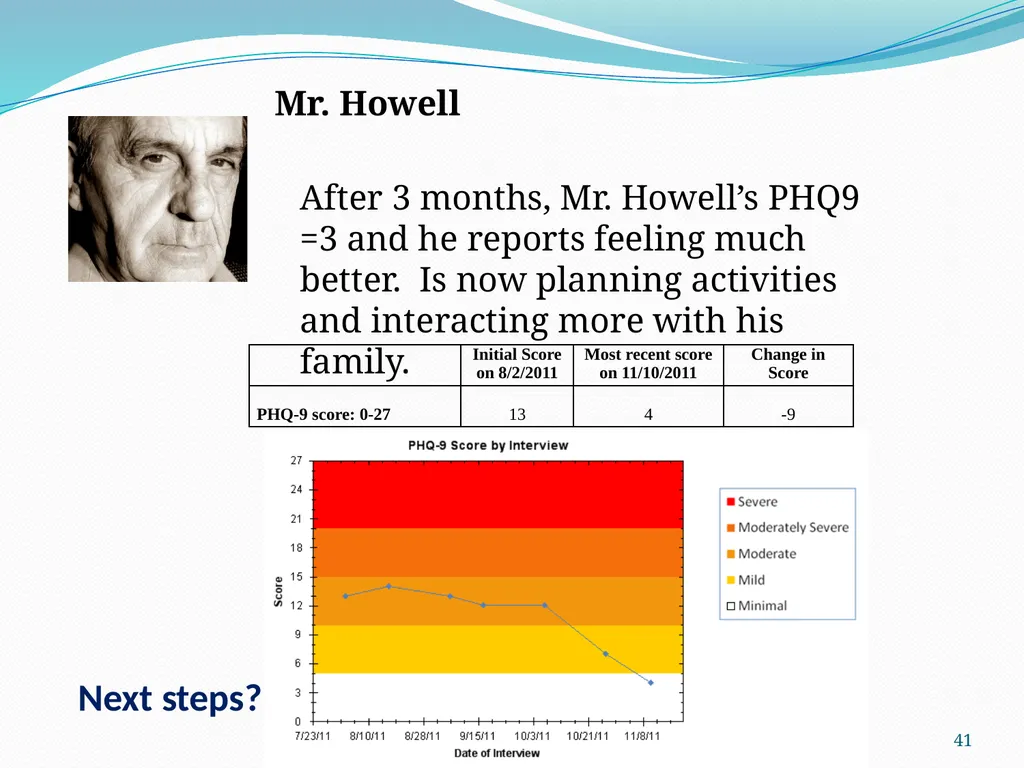
PHQ-9 score is 13
He denies past or present suicidal ideation.
No history of mental health concerns; medical comorbidities include osteoarthritis, diabetes and hypertension
“Since I was laid off a few months ago from my manufacturing job, all I do is sit around the house. My mood is OK, but when I think about money and my financial future, it starts to really bother me; I feel like a failure to my family.”
Stopped socializing with his friends and family members, notes that he especially misses visiting with his grandchildren.
Mr. Howell expresses hesitation in treatment for depression What do we learn from the assessment?<br>
Contact Mr. Howell next day by the telephone
PHQ-9 score is 13
He denies past or present suicidal ideation.
No history of mental health concerns; medical comorbidities include osteoarthritis, diabetes and hypertension
“Since I was laid off a few months ago from my manufacturing job, all I do is sit around the house. My mood is OK, but when I think about money and my financial future, it starts to really bother me; I feel like a failure to my family.”
Stopped socializing with his friends and family members, notes that he especially misses visiting with his grandchildren.
Mr. Howell expresses hesitation in treatment for depression What do we learn from the assessment?<br>
33
Decision Support Treatment algorithms are a set of decision rules aimed at reducing variability in treatment and maximizing patients’ ability to achieve full remission.
The data gathered during the initial assessment help the care manager decide upon a treatment plan to suggest to the PCP.
Although care managers play a critical part in depression treatment, they do not make treatment decisions or prescribe medications. The patient’s PCP will make final decisions about prescribing medicines; the care manager’s input on diagnosis, co-morbidities and other treatment factors will help guide the provider’s choices. 33<br>
The data gathered during the initial assessment help the care manager decide upon a treatment plan to suggest to the PCP.
Although care managers play a critical part in depression treatment, they do not make treatment decisions or prescribe medications. The patient’s PCP will make final decisions about prescribing medicines; the care manager’s input on diagnosis, co-morbidities and other treatment factors will help guide the provider’s choices. 33<br>
34
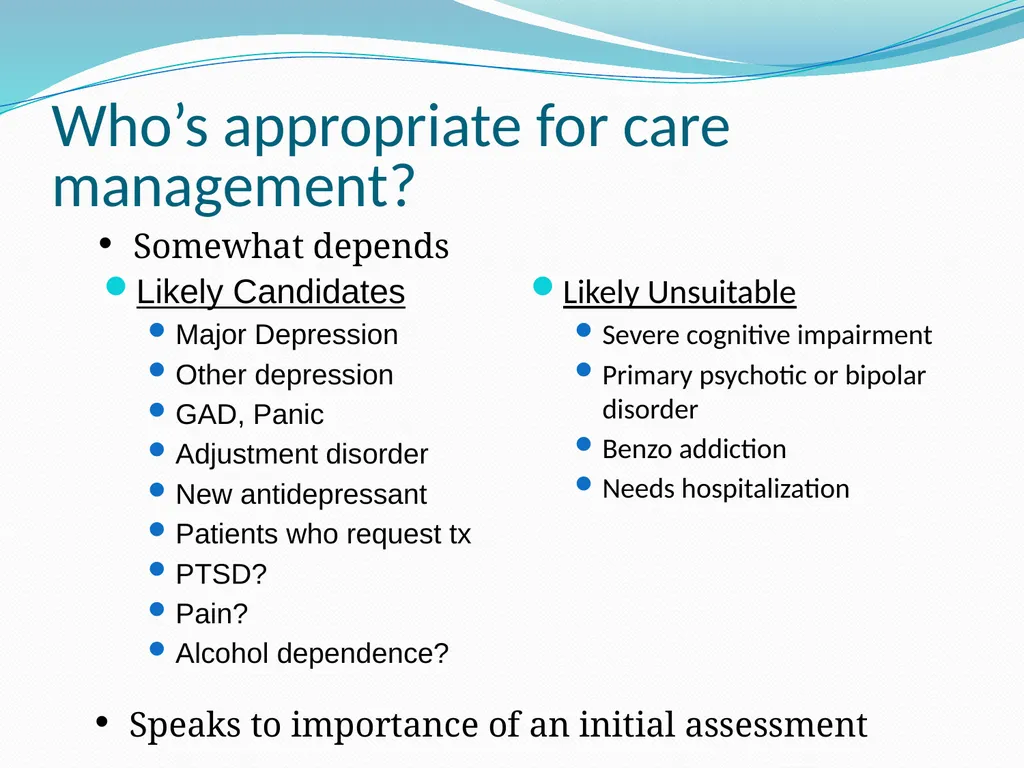
Who’s appropriate for care management? Likely Candidates
Major Depression
Other depression
GAD, Panic
Adjustment disorder
New antidepressant
Patients who request tx
PTSD?
Pain?
Alcohol dependence? Likely Unsuitable
Severe cognitive impairment
Primary psychotic or bipolar disorder
Benzo addiction
Needs hospitalization Somewhat depends Speaks to importance of an initial assessment<br>
Major Depression
Other depression
GAD, Panic
Adjustment disorder
New antidepressant
Patients who request tx
PTSD?
Pain?
Alcohol dependence? Likely Unsuitable
Severe cognitive impairment
Primary psychotic or bipolar disorder
Benzo addiction
Needs hospitalization Somewhat depends Speaks to importance of an initial assessment<br>
35
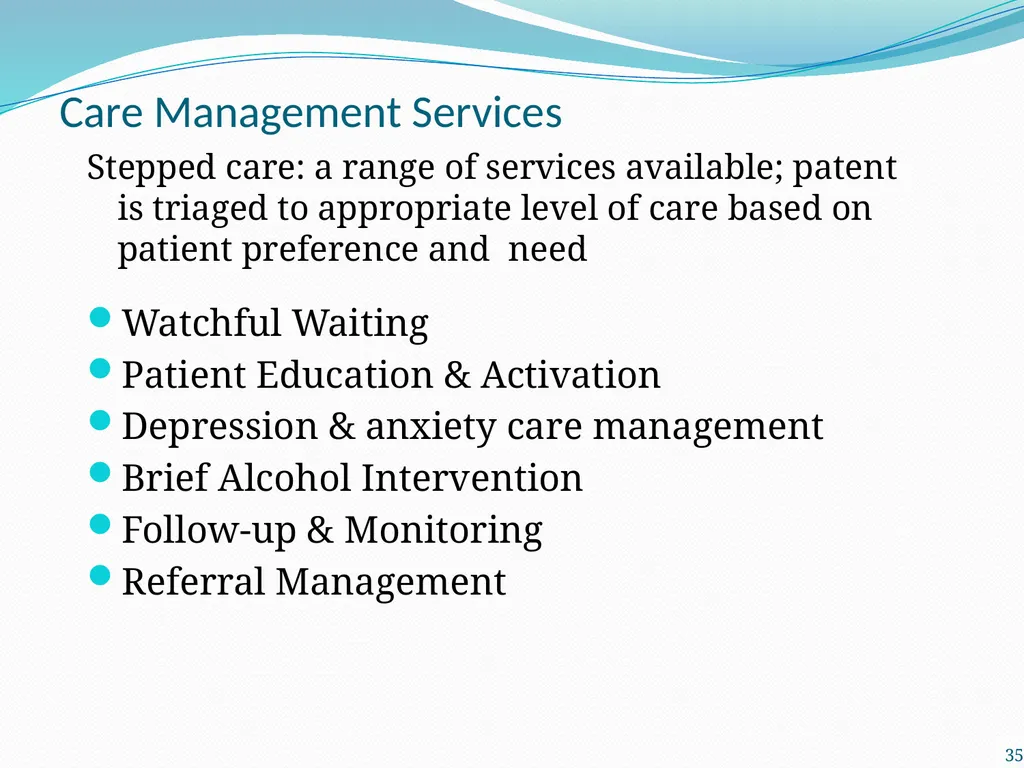
Care Management Services Stepped care: a range of services available; patent is triaged to appropriate level of care based on patient preference and need
Watchful Waiting
Patient Education & Activation
Depression & anxiety care management
Brief Alcohol Intervention
Follow-up & Monitoring
Referral Management 35<br>
Watchful Waiting
Patient Education & Activation
Depression & anxiety care management
Brief Alcohol Intervention
Follow-up & Monitoring
Referral Management 35<br>
36
36 Mr. Howell What treatment plan recommendations would you make?<br>
37
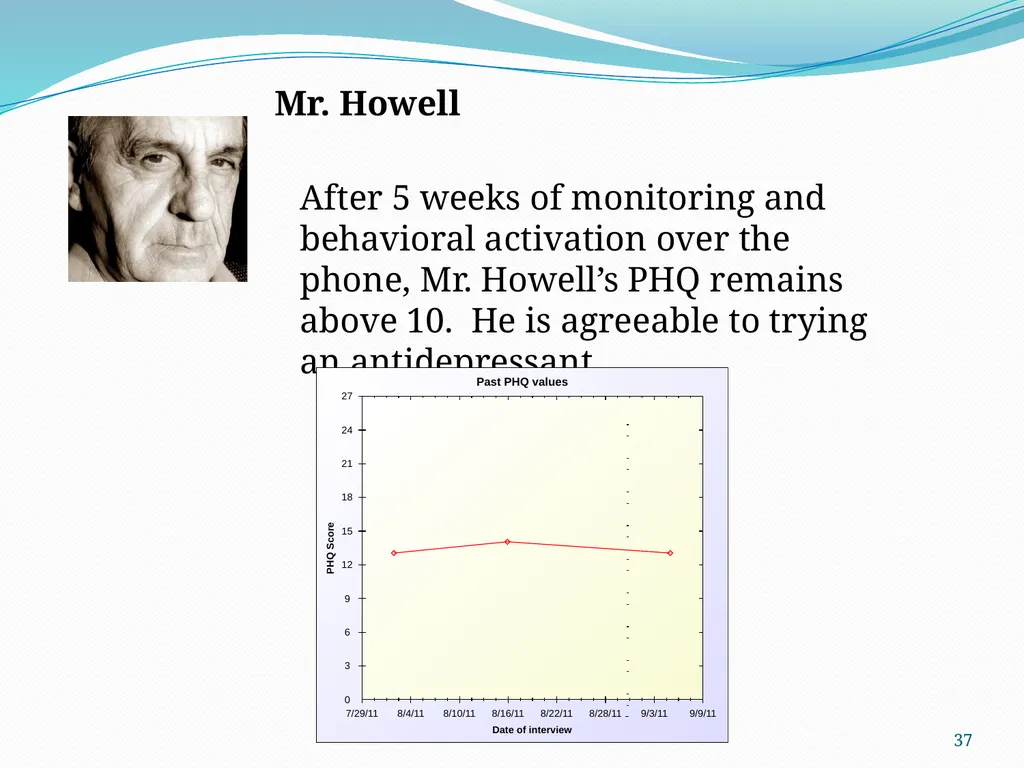
37 Mr. Howell After 5 weeks of monitoring and behavioral activation over the phone, Mr. Howell’s PHQ remains above 10. He is agreeable to trying an antidepressant.<br>
38
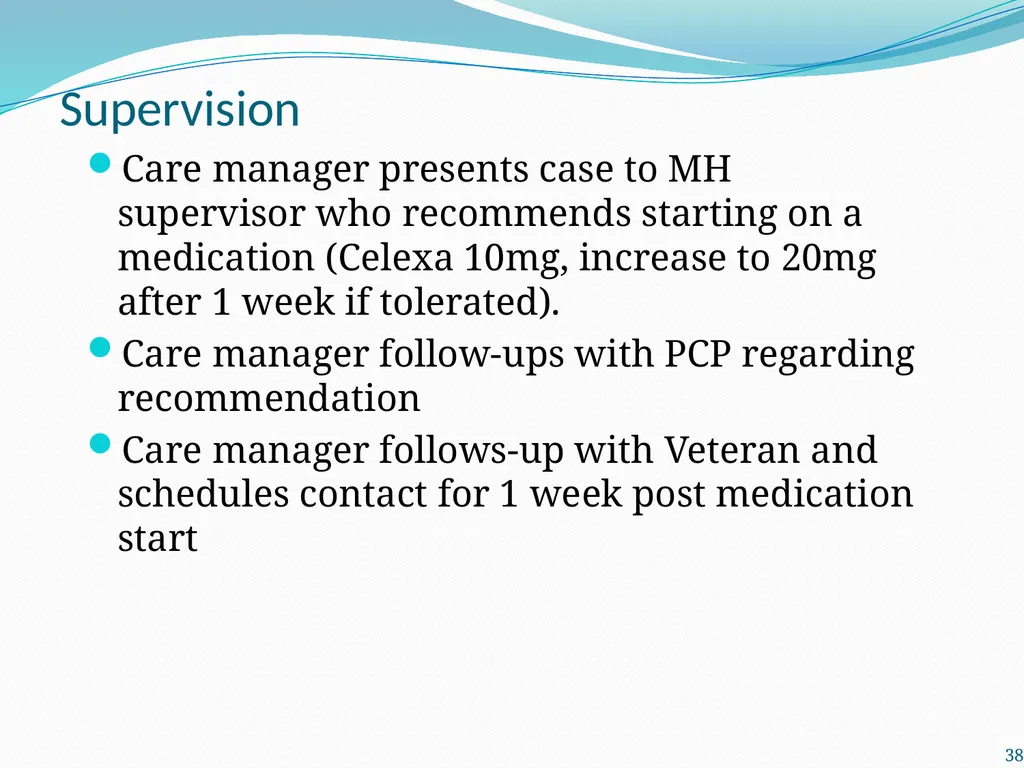
Supervision Care manager presents case to MH supervisor who recommends starting on a medication (Celexa 10mg, increase to 20mg after 1 week if tolerated).
Care manager follow-ups with PCP regarding recommendation
Care manager follows-up with Veteran and schedules contact for 1 week post medication start 38<br>
Care manager follow-ups with PCP regarding recommendation
Care manager follows-up with Veteran and schedules contact for 1 week post medication start 38<br>
39
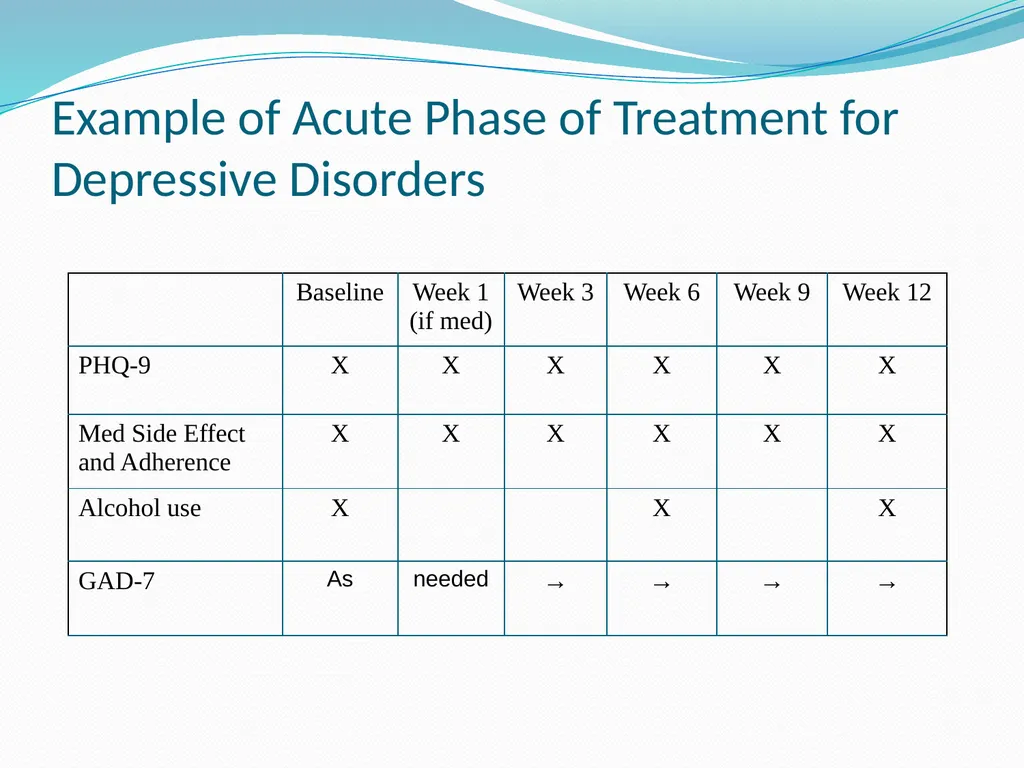
Example of Acute Phase of Treatment for Depressive Disorders<br>
40
Care Manager: the Glue Primary Care Clinician Mental Health Supervisor Care Manager Patient<br>
41
41 Mr. Howell After 3 months, Mr. Howell’s PHQ9 =3 and he reports feeling much better. Is now planning activities and interacting more with his family. Next steps?<br>
42
Maintenance and relapse prevention Follow-up 1 time/month for next 2 months
Provide education on relapse prevention
Per supervision, provide PCP recommendation on medication discontinuation 42<br>
Provide education on relapse prevention
Per supervision, provide PCP recommendation on medication discontinuation 42<br>
43
Review Articles Bower, P., et al. (2006). British Journal of Psychiatry, 189, 484 – 493.
Gilbody, S., et al. (2006). Arch Intern Med, 166(21), 2314-21.
Williams, J.W., et al. (2007). General Hospital Psychiatry, 29(2), 91-116.
Roy-Byrne, et al. (2010) JAMA,303(19):1921-1928<br>
Gilbody, S., et al. (2006). Arch Intern Med, 166(21), 2314-21.
Williams, J.W., et al. (2007). General Hospital Psychiatry, 29(2), 91-116.
Roy-Byrne, et al. (2010) JAMA,303(19):1921-1928<br>
44
In case you have heard of these…
Care Management Models in PC-MHI Translating Initiatives for Depression into Effective Solutions (TIDES)
Evidence-based collaborative care model supporting depression management in the primary care setting
Has promoted improvements in treatment adherence for Veterans with depression in several VISNs
Behavioral Health Laboratory (BHL)
Evidence based clinical service supporting mental health and substance abuse management in the primary care setting
Associated with a significant increase in screening and identification of patients needing MH/SA services (Oslin, et. al. 2005)
Other evidence based strategies approved by the Office of Mental Health Services (ex. IMPACT) 44<br>
Evidence-based collaborative care model supporting depression management in the primary care setting
Has promoted improvements in treatment adherence for Veterans with depression in several VISNs
Behavioral Health Laboratory (BHL)
Evidence based clinical service supporting mental health and substance abuse management in the primary care setting
Associated with a significant increase in screening and identification of patients needing MH/SA services (Oslin, et. al. 2005)
Other evidence based strategies approved by the Office of Mental Health Services (ex. IMPACT) 44<br>
45
Introduction to
Blending Programs Sara Greenwood, MSW
PC-MHI Education & Training Coordinator
With acknowledgement to Mr. Lawrence Daily, LMSW, Network 16 Integrated Care Coordinator for his contribution to content development. 45<br>
PC-MHI Education & Training Coordinator
With acknowledgement to Mr. Lawrence Daily, LMSW, Network 16 Integrated Care Coordinator for his contribution to content development. 45<br>
46
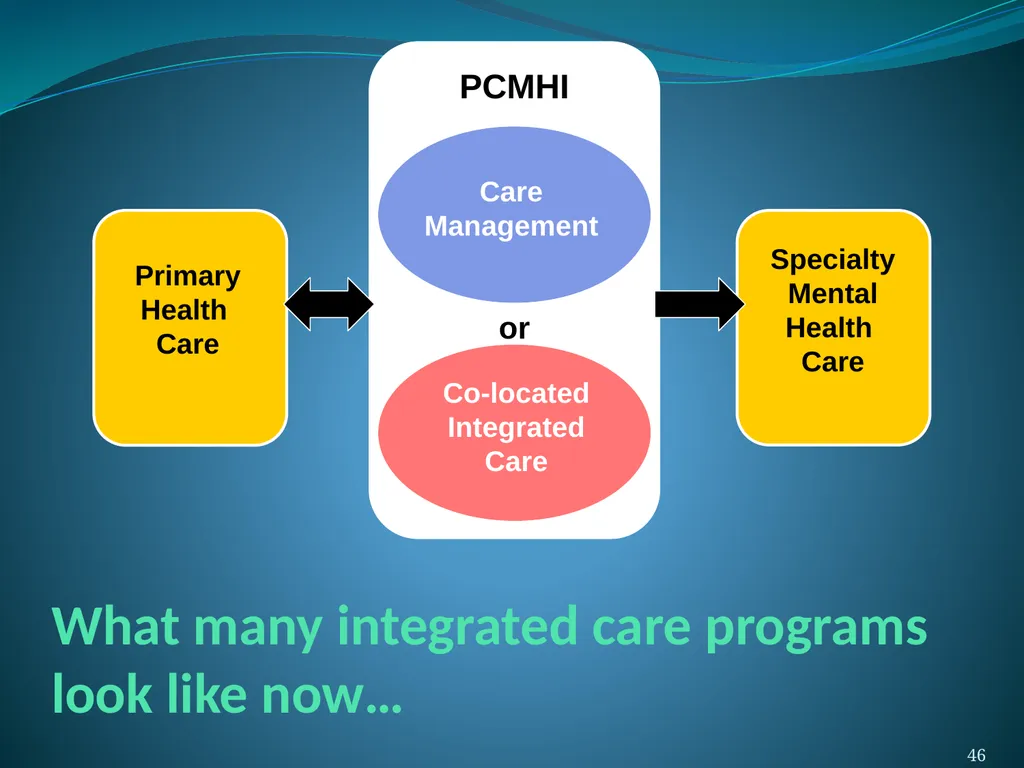
What many integrated care programs look like now… 46<br>
47
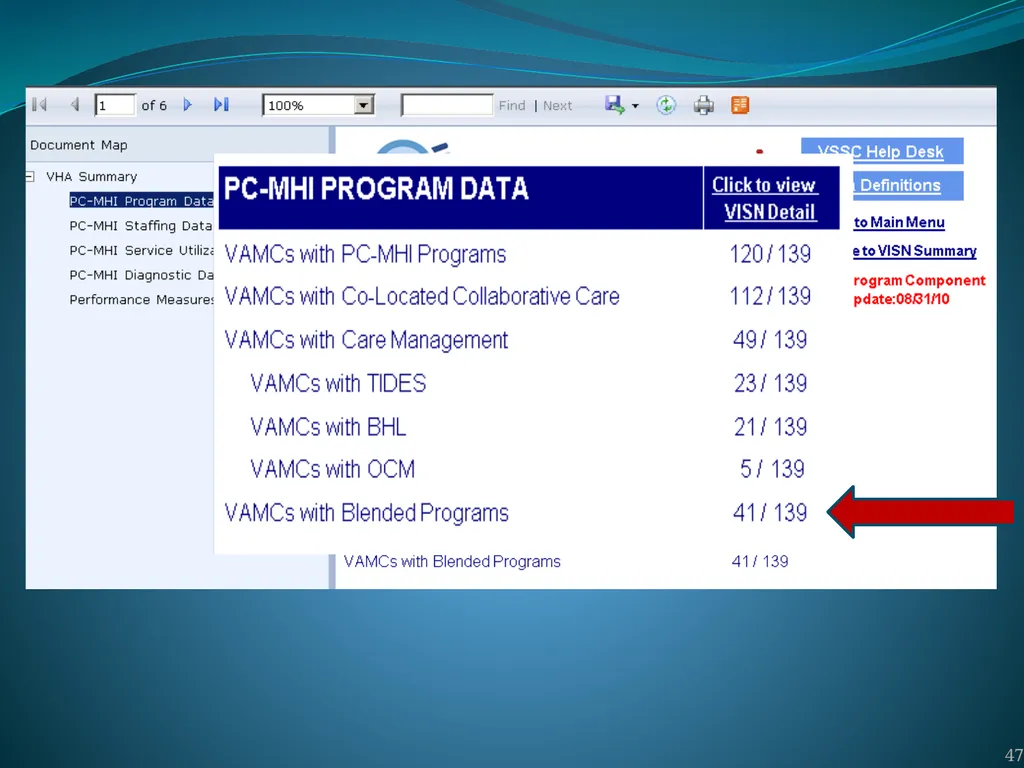
47<br>
48
48 Quickly divide into groups of 4-6 & discuss the following questions [don’t forget to assign a note-taker!]:
What are the functions of colocated collaborative care?
What are the functions of care management?
What functions are similar?
How are the functions complementary?
What unique contributions do each provide? Small Group Pop Quiz!<br>
What are the functions of colocated collaborative care?
What are the functions of care management?
What functions are similar?
How are the functions complementary?
What unique contributions do each provide? Small Group Pop Quiz!<br>
49
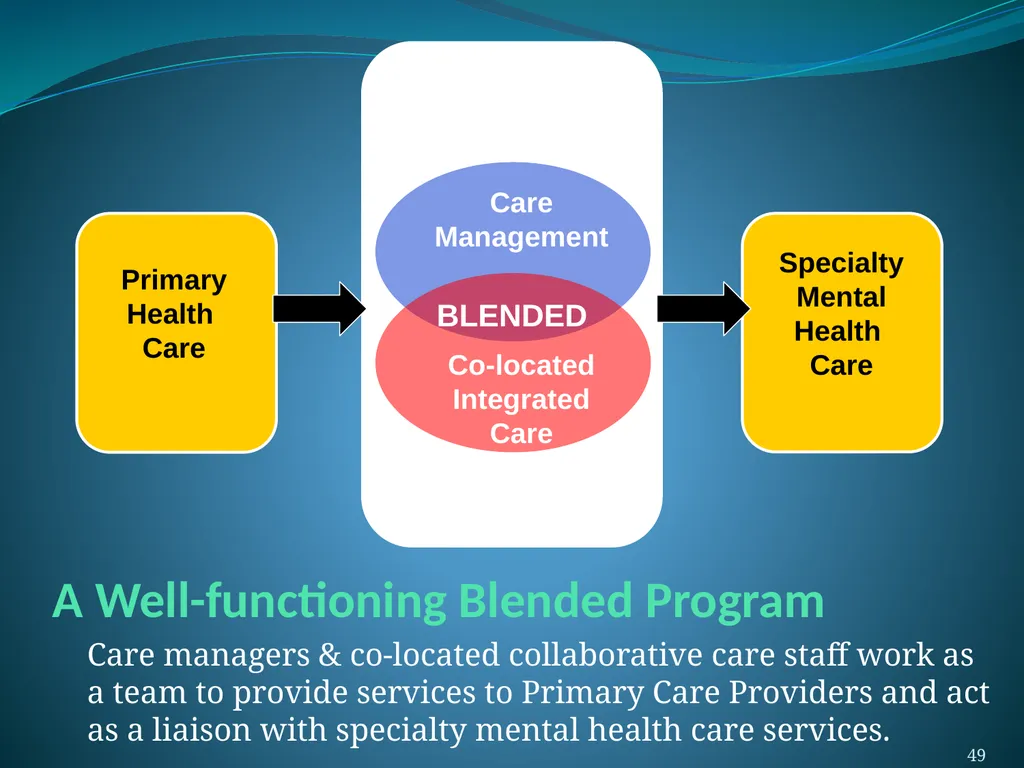
PCMHI A Well-functioning Blended Program Care managers & co-located collaborative care staff work as a team to provide services to Primary Care Providers and act as a liaison with specialty mental health care services. 49<br>
50
50 Mr. Howell
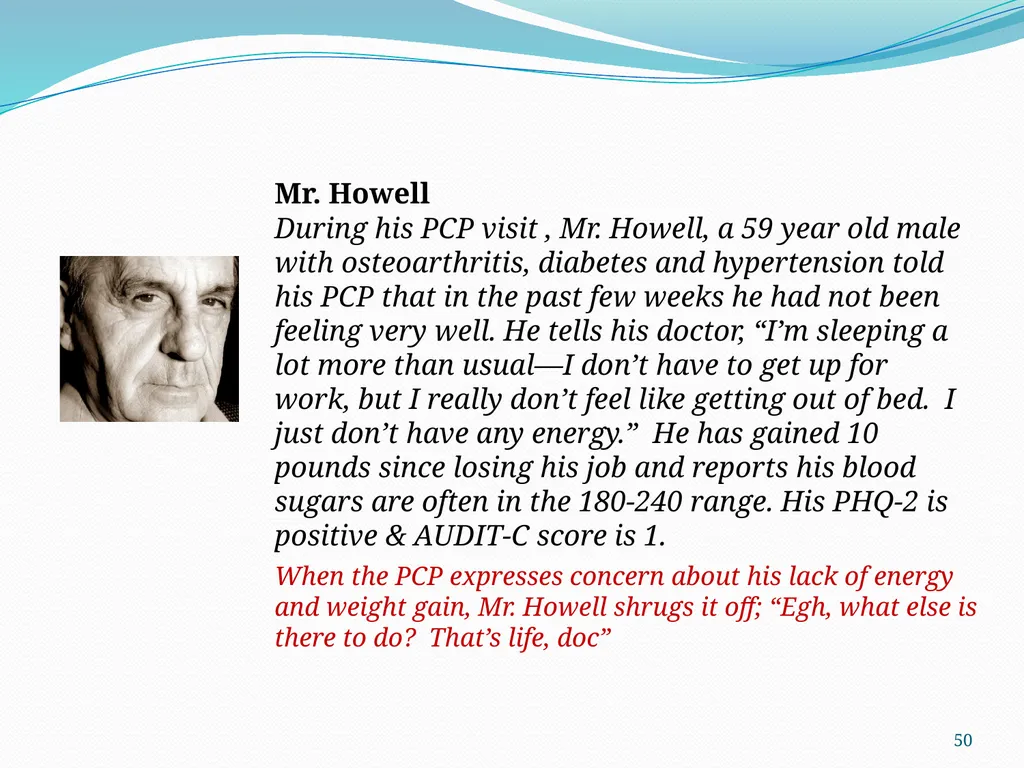
During his PCP visit , Mr. Howell, a 59 year old male with osteoarthritis, diabetes and hypertension told his PCP that in the past few weeks he had not been feeling very well. He tells his doctor, “I’m sleeping a lot more than usual—I don’t have to get up for work, but I really don’t feel like getting out of bed. I just don’t have any energy.” He has gained 10 pounds since losing his job and reports his blood sugars are often in the 180-240 range. His PHQ-2 is positive & AUDIT-C score is 1. When the PCP expresses concern about his lack of energy and weight gain, Mr. Howell shrugs it off; “Egh, what else is there to do? That’s life, doc”<br>
During his PCP visit , Mr. Howell, a 59 year old male with osteoarthritis, diabetes and hypertension told his PCP that in the past few weeks he had not been feeling very well. He tells his doctor, “I’m sleeping a lot more than usual—I don’t have to get up for work, but I really don’t feel like getting out of bed. I just don’t have any energy.” He has gained 10 pounds since losing his job and reports his blood sugars are often in the 180-240 range. His PHQ-2 is positive & AUDIT-C score is 1. When the PCP expresses concern about his lack of energy and weight gain, Mr. Howell shrugs it off; “Egh, what else is there to do? That’s life, doc”<br>
51
51 Mr. Howell
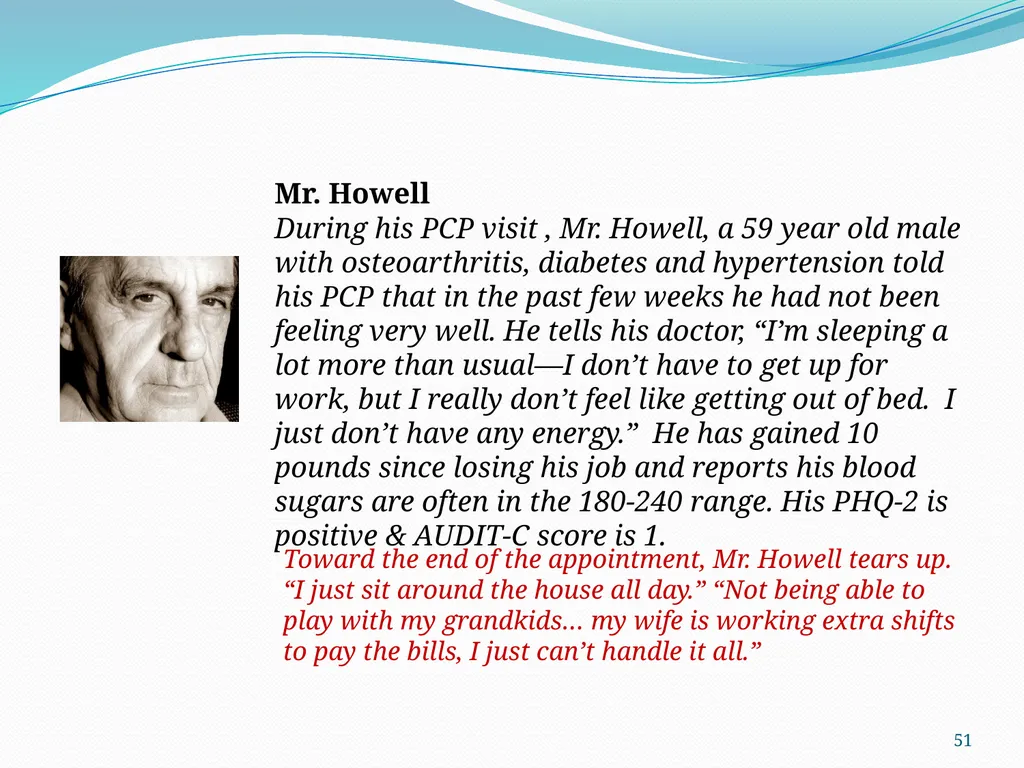
During his PCP visit , Mr. Howell, a 59 year old male with osteoarthritis, diabetes and hypertension told his PCP that in the past few weeks he had not been feeling very well. He tells his doctor, “I’m sleeping a lot more than usual—I don’t have to get up for work, but I really don’t feel like getting out of bed. I just don’t have any energy.” He has gained 10 pounds since losing his job and reports his blood sugars are often in the 180-240 range. His PHQ-2 is positive & AUDIT-C score is 1. Toward the end of the appointment, Mr. Howell tears up. “I just sit around the house all day.” “Not being able to play with my grandkids… my wife is working extra shifts to pay the bills, I just can’t handle it all.”<br>
During his PCP visit , Mr. Howell, a 59 year old male with osteoarthritis, diabetes and hypertension told his PCP that in the past few weeks he had not been feeling very well. He tells his doctor, “I’m sleeping a lot more than usual—I don’t have to get up for work, but I really don’t feel like getting out of bed. I just don’t have any energy.” He has gained 10 pounds since losing his job and reports his blood sugars are often in the 180-240 range. His PHQ-2 is positive & AUDIT-C score is 1. Toward the end of the appointment, Mr. Howell tears up. “I just sit around the house all day.” “Not being able to play with my grandkids… my wife is working extra shifts to pay the bills, I just can’t handle it all.”<br>