
Introduction to Physical Science Accuracy,
Description: Introduction to Physical Science Accuracy, Precision, Significant Figures Presented by Robert Wagner Image Credit: Arbeck, CC BY 4.0 https:creativecommons.orglicensesby4.0, via Wikimedia Commons Accuracy Precision Accuracy How
Related Topics
Download Presentation
"Introduction to Physical Science Accuracy," is the property of its rightful owner. Permission is granted to download and print the materials on this website for personal, non-commercial use only, and to display it on your personal computer provided you do not modify the materials and that you retain all copyright notices contained in the materials. By downloading content from our website, you accept the terms of this agreement.
Presentation Transcript
slide1. Introduction to Physical Science Accuracy, Precision, & Significant Figures
Presented by Robert Wagner<br>
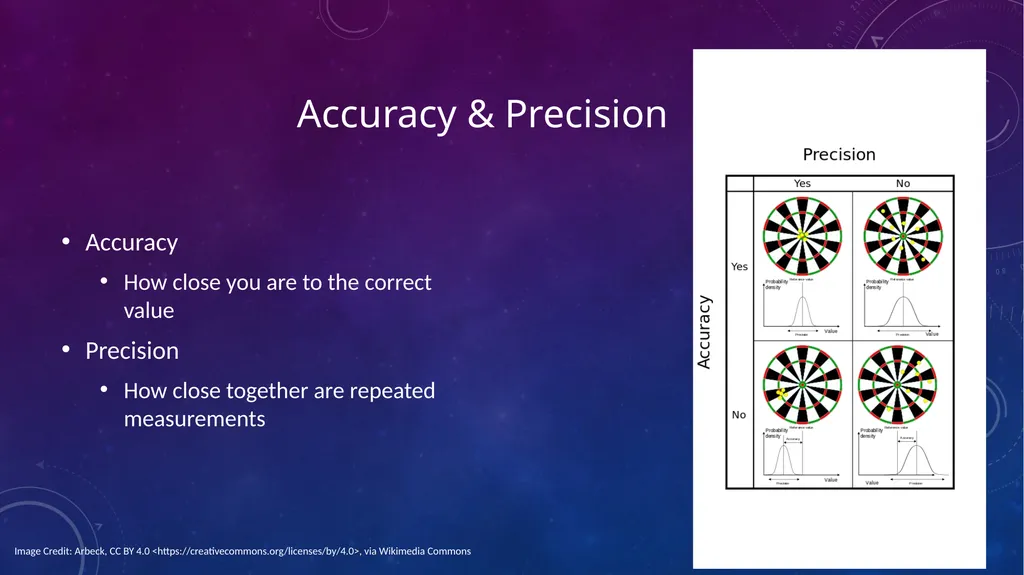
slide2. Image Credit: Arbeck, CC BY 4.0 <https://creativecommons.org/licenses/by/4.0>, via Wikimedia Commons Accuracy & Precision Accuracy
How close you are to the correct value
Precision
How close together are repeated measurements<br>
slide3. Uncertainty How far measured values deviate from expected values
All measurements contain some uncertainty
Ex: 250 meters with an uncertainty of 10 meters
Could be between 240 meters and 260 meters
250 +/- 10 meters<br>
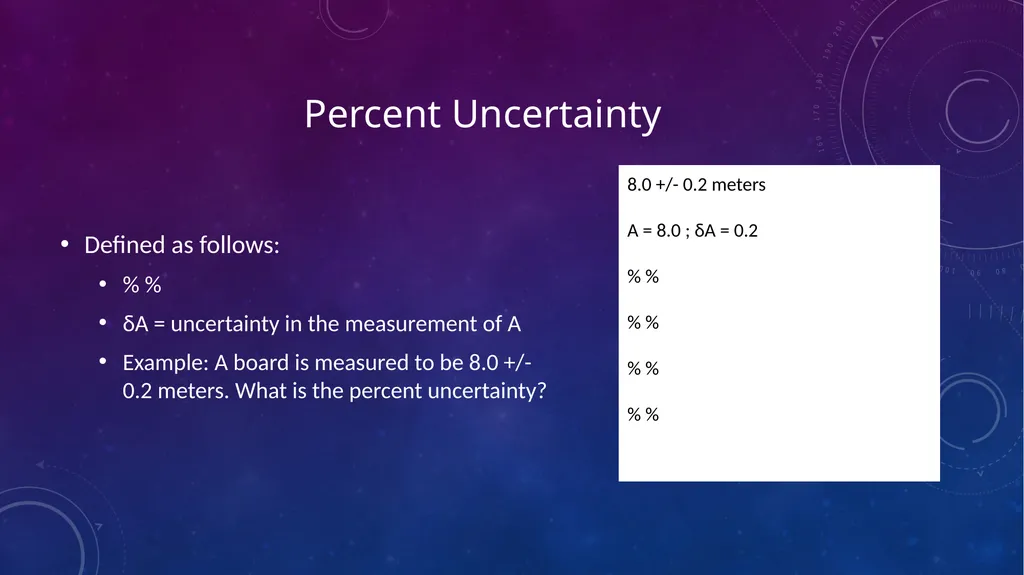
slide4. Percent Uncertainty Defined as follows:
% %
δA = uncertainty in the measurement of A
Example: A board is measured to be 8.0 +/- 0.2 meters. What is the percent uncertainty? 8.0 +/- 0.2 meters
A = 8.0 ; δA = 0.2
% %
% %
% %
% %<br>
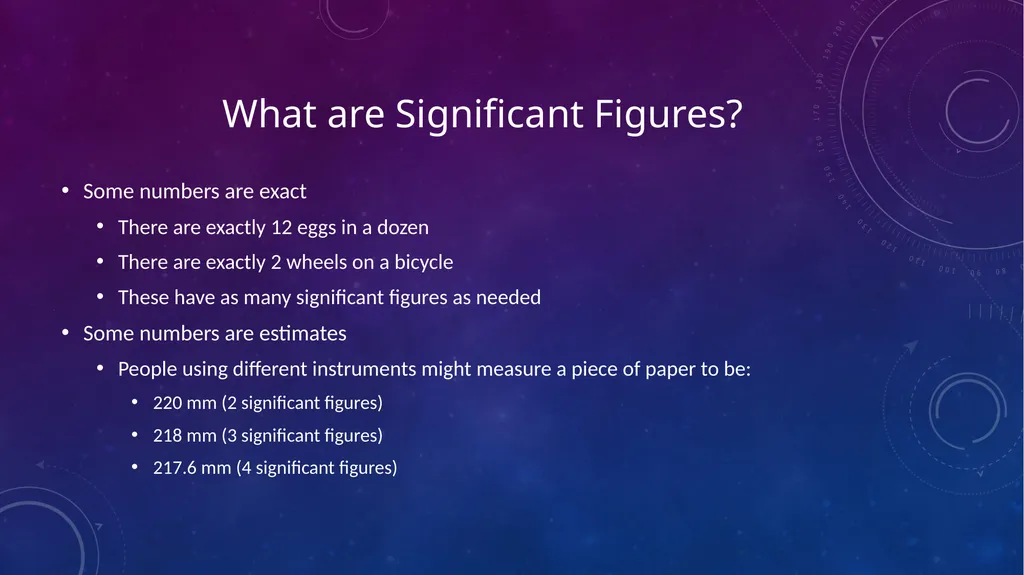
slide5. What are Significant Figures? Some numbers are exact
There are exactly 12 eggs in a dozen
There are exactly 2 wheels on a bicycle
These have as many significant figures as needed
Some numbers are estimates
People using different instruments might measure a piece of paper to be:
220 mm (2 significant figures)
218 mm (3 significant figures)
217.6 mm (4 significant figures)<br>
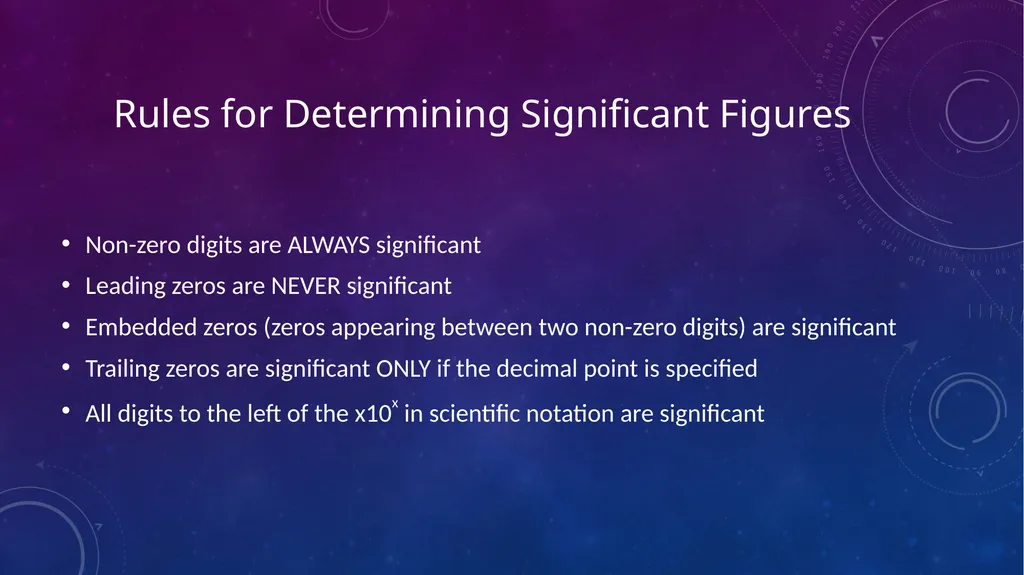
slide6. Rules for Determining Significant Figures Non-zero digits are ALWAYS significant
Leading zeros are NEVER significant
Embedded zeros (zeros appearing between two non-zero digits) are significant
Trailing zeros are significant ONLY if the decimal point is specified
All digits to the left of the x10x in scientific notation are significant<br>
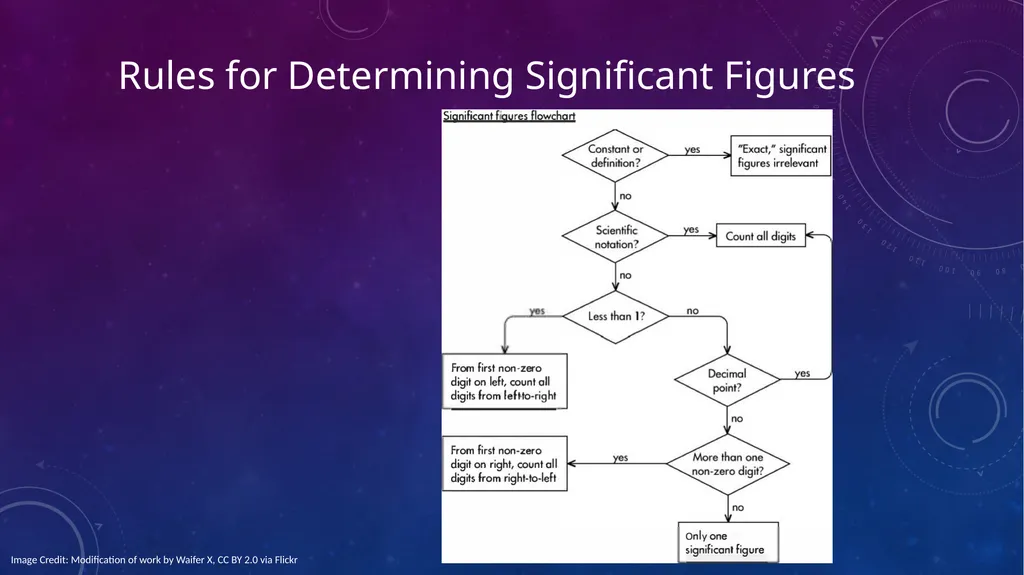
slide7. Rules for Determining Significant Figures Image Credit: Modification of work by Waifer X, CC BY 2.0 via Flickr<br>
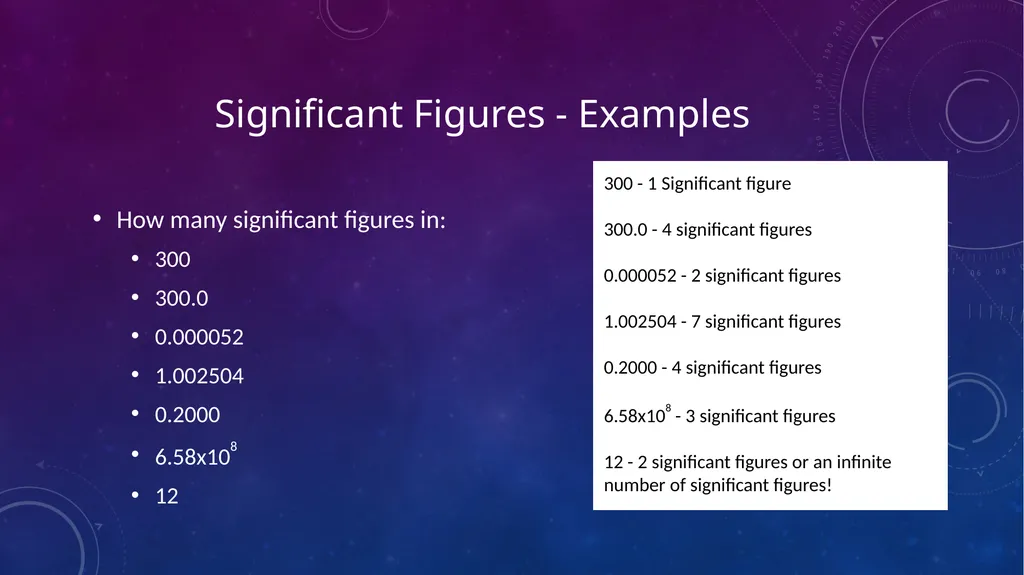
slide8. Significant Figures - Examples 300 - 1 Significant figure
300.0 - 4 significant figures
0.000052 - 2 significant figures
1.002504 - 7 significant figures
0.2000 - 4 significant figures
6.58x10⁸ - 3 significant figures
12 - 2 significant figures or an infinite number of significant figures! How many significant figures in:
300
300.0
0.000052
1.002504
0.2000
6.58x10⁸
12<br>
slide9. Rules for Calculations in Significant Figures When adding or subtracting, the last digit to be retained is determined by the input number that is most estimated (ends at the highest place value)
When multiplying or dividing, the answer can contain no more significant figures than the input number with the least significant digits<br>
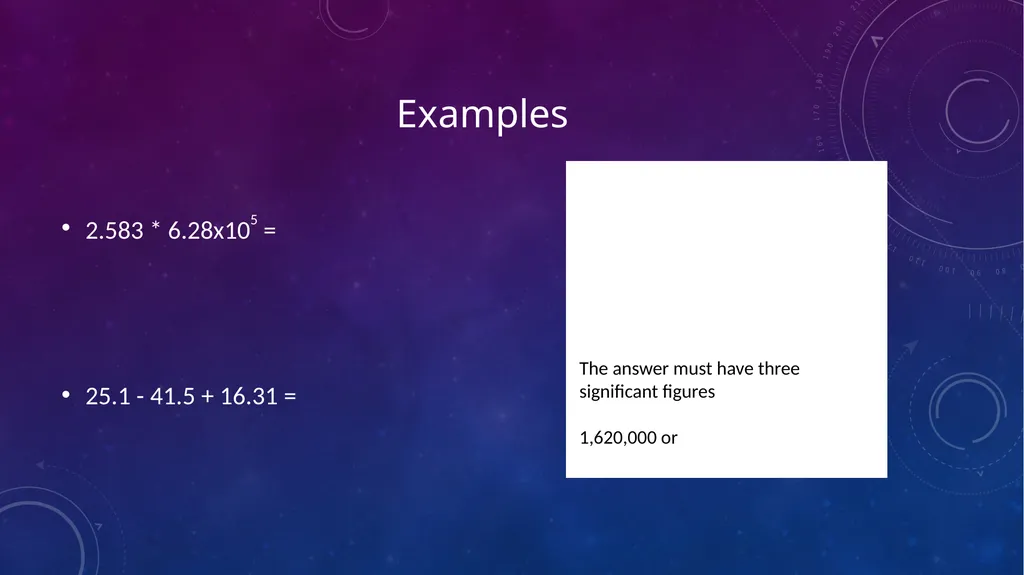
slide10. Examples 2.583 * 6.28x105 =
25.1 - 41.5 + 16.31 = The answer must have three significant figures
1,620,000 or<br>
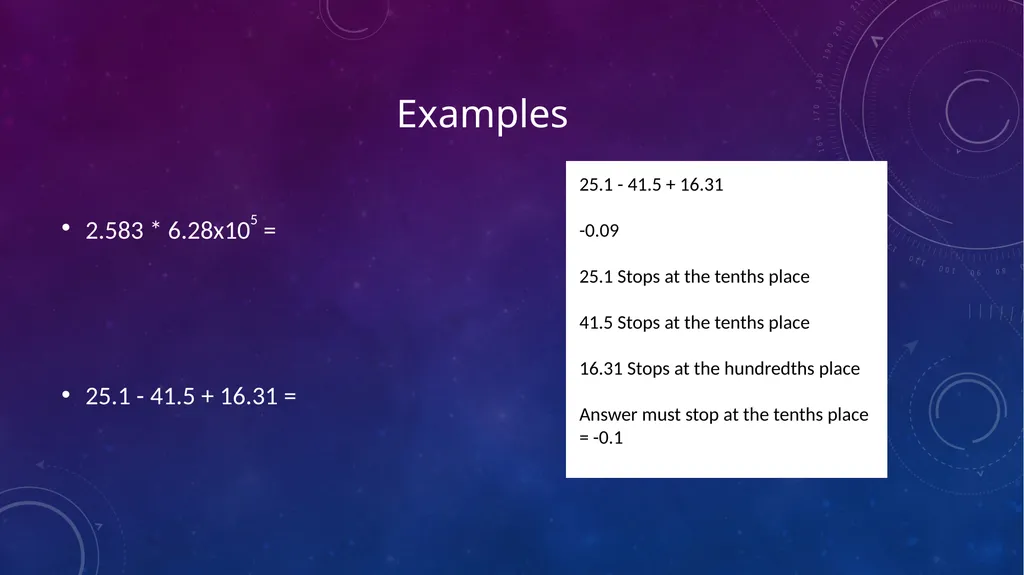
slide11. Examples 2.583 * 6.28x105 =
25.1 - 41.5 + 16.31 = 25.1 - 41.5 + 16.31
-0.09
25.1 Stops at the tenths place
41.5 Stops at the tenths place
16.31 Stops at the hundredths place
Answer must stop at the tenths place = -0.1<br>
slide12. Summary Accuracy and precision can tell us about our measurements
All measurements have an uncertainty this can be expressed as an error (+/-) or a percent uncertainty
Significant figures are important in science as all measurements have an uncertainty associated with them<br>
Presented by Robert Wagner<br>
slide2. Image Credit: Arbeck, CC BY 4.0 <https://creativecommons.org/licenses/by/4.0>, via Wikimedia Commons Accuracy & Precision Accuracy
How close you are to the correct value
Precision
How close together are repeated measurements<br>
slide3. Uncertainty How far measured values deviate from expected values
All measurements contain some uncertainty
Ex: 250 meters with an uncertainty of 10 meters
Could be between 240 meters and 260 meters
250 +/- 10 meters<br>
slide4. Percent Uncertainty Defined as follows:
% %
δA = uncertainty in the measurement of A
Example: A board is measured to be 8.0 +/- 0.2 meters. What is the percent uncertainty? 8.0 +/- 0.2 meters
A = 8.0 ; δA = 0.2
% %
% %
% %
% %<br>
slide5. What are Significant Figures? Some numbers are exact
There are exactly 12 eggs in a dozen
There are exactly 2 wheels on a bicycle
These have as many significant figures as needed
Some numbers are estimates
People using different instruments might measure a piece of paper to be:
220 mm (2 significant figures)
218 mm (3 significant figures)
217.6 mm (4 significant figures)<br>
slide6. Rules for Determining Significant Figures Non-zero digits are ALWAYS significant
Leading zeros are NEVER significant
Embedded zeros (zeros appearing between two non-zero digits) are significant
Trailing zeros are significant ONLY if the decimal point is specified
All digits to the left of the x10x in scientific notation are significant<br>
slide7. Rules for Determining Significant Figures Image Credit: Modification of work by Waifer X, CC BY 2.0 via Flickr<br>
slide8. Significant Figures - Examples 300 - 1 Significant figure
300.0 - 4 significant figures
0.000052 - 2 significant figures
1.002504 - 7 significant figures
0.2000 - 4 significant figures
6.58x10⁸ - 3 significant figures
12 - 2 significant figures or an infinite number of significant figures! How many significant figures in:
300
300.0
0.000052
1.002504
0.2000
6.58x10⁸
12<br>
slide9. Rules for Calculations in Significant Figures When adding or subtracting, the last digit to be retained is determined by the input number that is most estimated (ends at the highest place value)
When multiplying or dividing, the answer can contain no more significant figures than the input number with the least significant digits<br>
slide10. Examples 2.583 * 6.28x105 =
25.1 - 41.5 + 16.31 = The answer must have three significant figures
1,620,000 or<br>
slide11. Examples 2.583 * 6.28x105 =
25.1 - 41.5 + 16.31 = 25.1 - 41.5 + 16.31
-0.09
25.1 Stops at the tenths place
41.5 Stops at the tenths place
16.31 Stops at the hundredths place
Answer must stop at the tenths place = -0.1<br>
slide12. Summary Accuracy and precision can tell us about our measurements
All measurements have an uncertainty this can be expressed as an error (+/-) or a percent uncertainty
Significant figures are important in science as all measurements have an uncertainty associated with them<br>