04
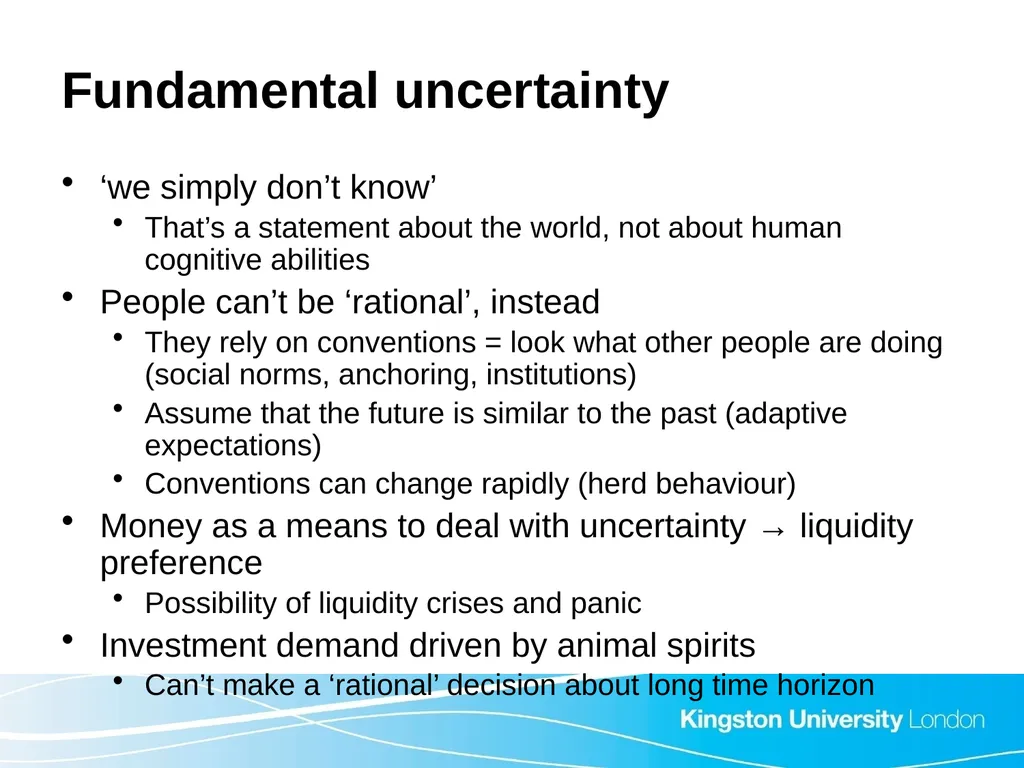
Fundamental uncertainty ‘we simply don’t know’
That’s a statement about the world, not about human cognitive abilities
People can’t be ‘rational’, instead
They rely on conventions = look what other people are doing (social norms, anchoring, institutions)
Assume that the future is similar to the past (adaptive expectations)
Conventions can change rapidly (herd behaviour)
Money as a means to deal with uncertainty → liquidity preference
Possibility of liquidity crises and panic
Investment demand driven by animal spirits
Can’t make a ‘rational’ decision about long time horizon<br>
05
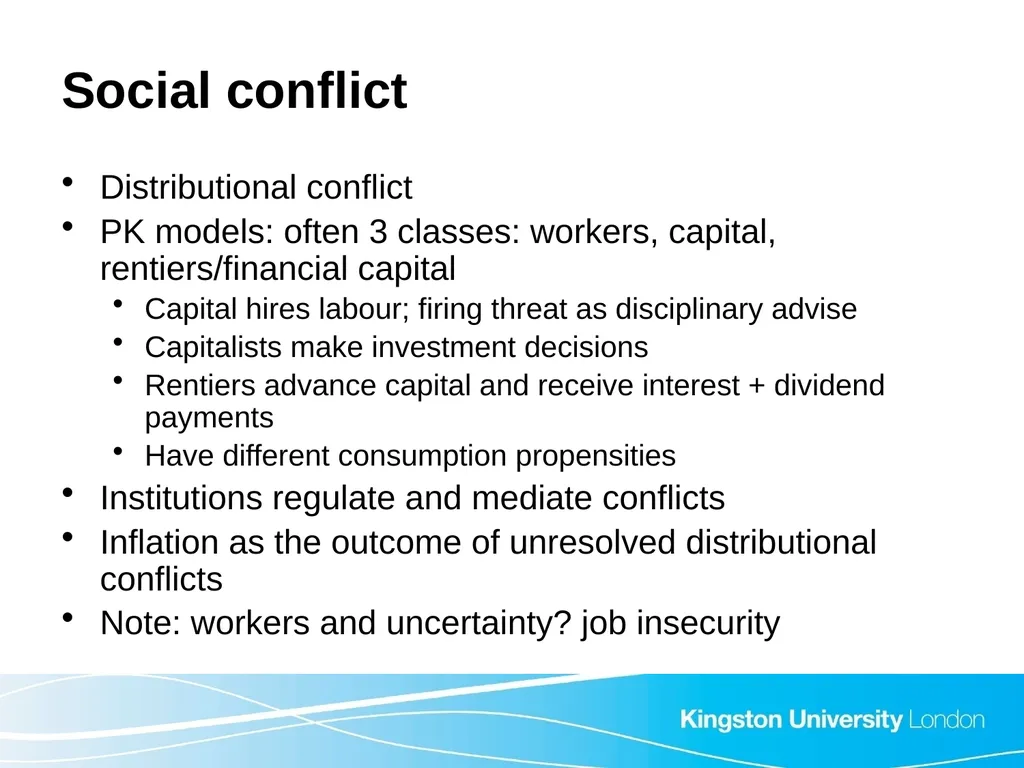
Social conflict Distributional conflict
PK models: often 3 classes: workers, capital, rentiers/financial capital
Capital hires labour; firing threat as disciplinary advise
Capitalists make investment decisions
Rentiers advance capital and receive interest + dividend payments
Have different consumption propensities
Institutions regulate and mediate conflicts
Inflation as the outcome of unresolved distributional conflicts
Note: workers and uncertainty? job insecurity<br>
06
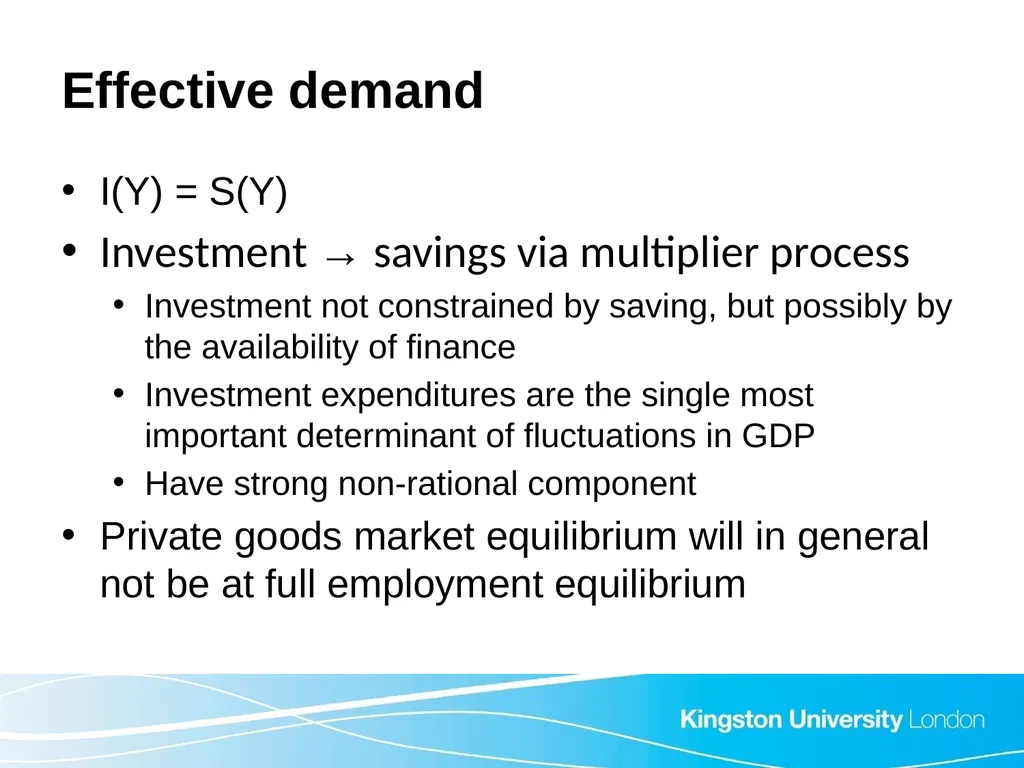
Effective demand I(Y) = S(Y)
Investment → savings via multiplier process
Investment not constrained by saving, but possibly by the availability of finance
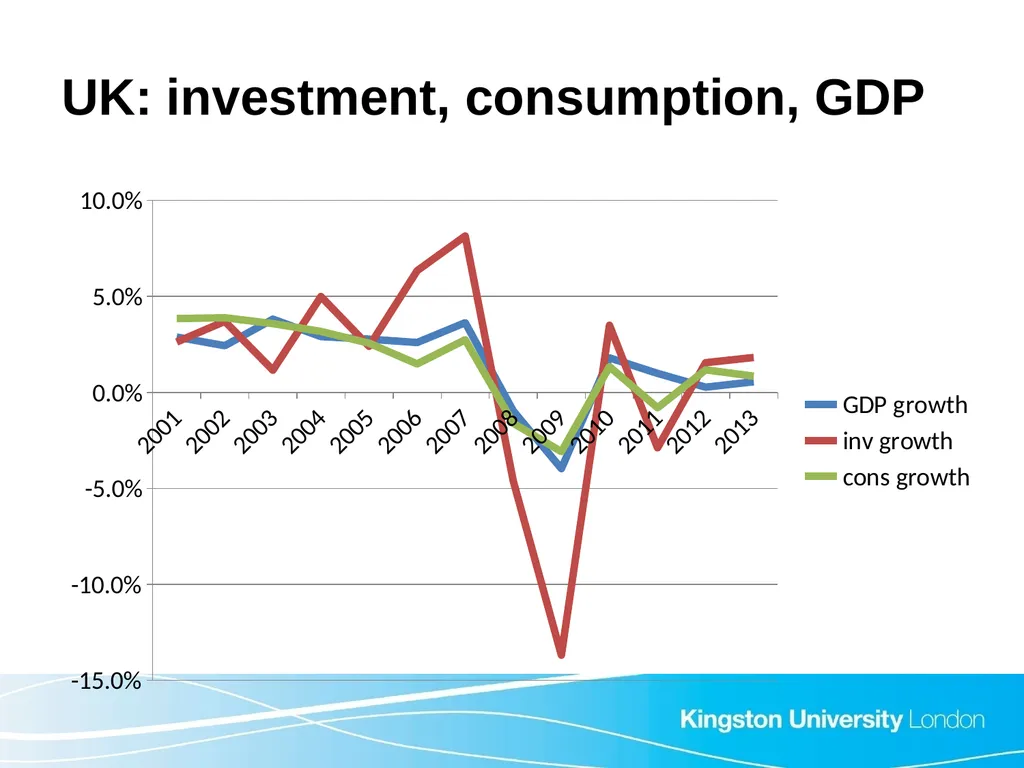
Investment expenditures are the single most important determinant of fluctuations in GDP
Have strong non-rational component
Private goods market equilibrium will in general not be at full employment equilibrium<br>
07
UK: investment, consumption, GDP<br>
08
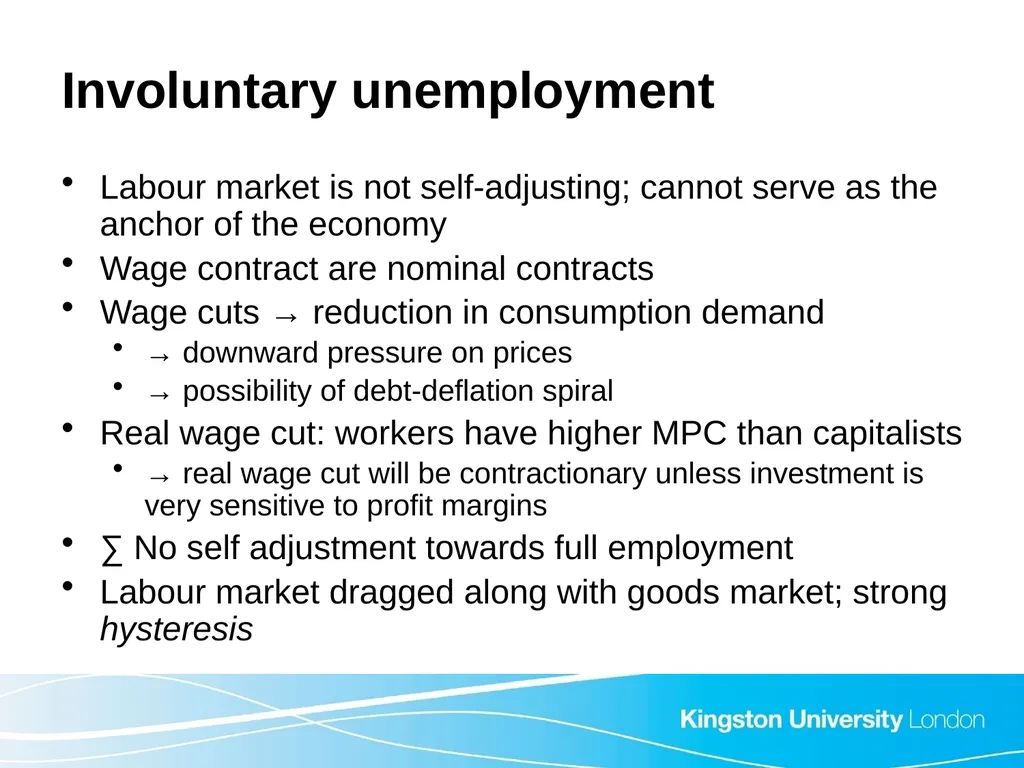
Involuntary unemployment Labour market is not self-adjusting; cannot serve as the anchor of the economy
Wage contract are nominal contracts
Wage cuts → reduction in consumption demand
→ downward pressure on prices
→ possibility of debt-deflation spiral
Real wage cut: workers have higher MPC than capitalists
→ real wage cut will be contractionary unless investment is very sensitive to profit margins
∑ No self adjustment towards full employment
Labour market dragged along with goods market; strong hysteresis<br>
09
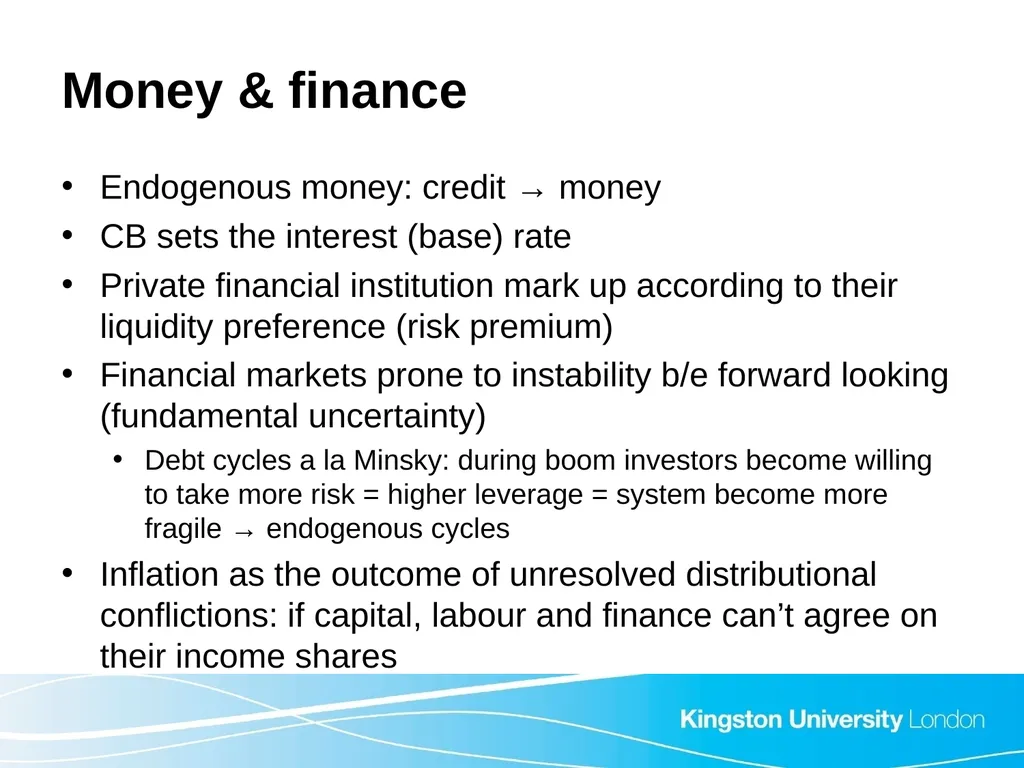
Money & finance Endogenous money: credit → money
CB sets the interest (base) rate
Private financial institution mark up according to their liquidity preference (risk premium)
Financial markets prone to instability b/e forward looking (fundamental uncertainty)
Debt cycles a la Minsky: during boom investors become willing to take more risk = higher leverage = system become more fragile → endogenous cycles
Inflation as the outcome of unresolved distributional conflictions: if capital, labour and finance can’t agree on their income shares<br>
10
UK: cycles in rLoans and rGDP�Source: Haldane (2012 BIS WP)<br>
11
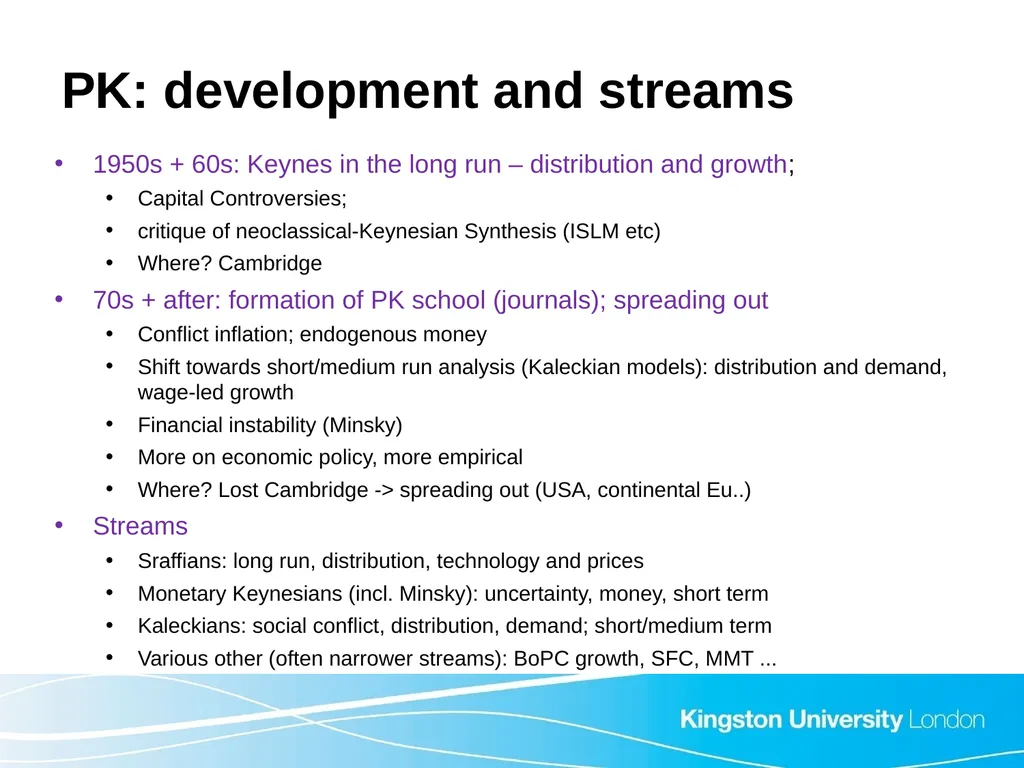
PK: development and streams 1950s + 60s: Keynes in the long run – distribution and growth;
Capital Controversies;
critique of neoclassical-Keynesian Synthesis (ISLM etc)
Where? Cambridge
70s + after: formation of PK school (journals); spreading out
Conflict inflation; endogenous money
Shift towards short/medium run analysis (Kaleckian models): distribution and demand, wage-led growth
Financial instability (Minsky)
More on economic policy, more empirical
Where? Lost Cambridge -> spreading out (USA, continental Eu..)
Streams
Sraffians: long run, distribution, technology and prices
Monetary Keynesians (incl. Minsky): uncertainty, money, short term
Kaleckians: social conflict, distribution, demand; short/medium term
Various other (often narrower streams): BoPC growth, SFC, MMT ...<br>
12
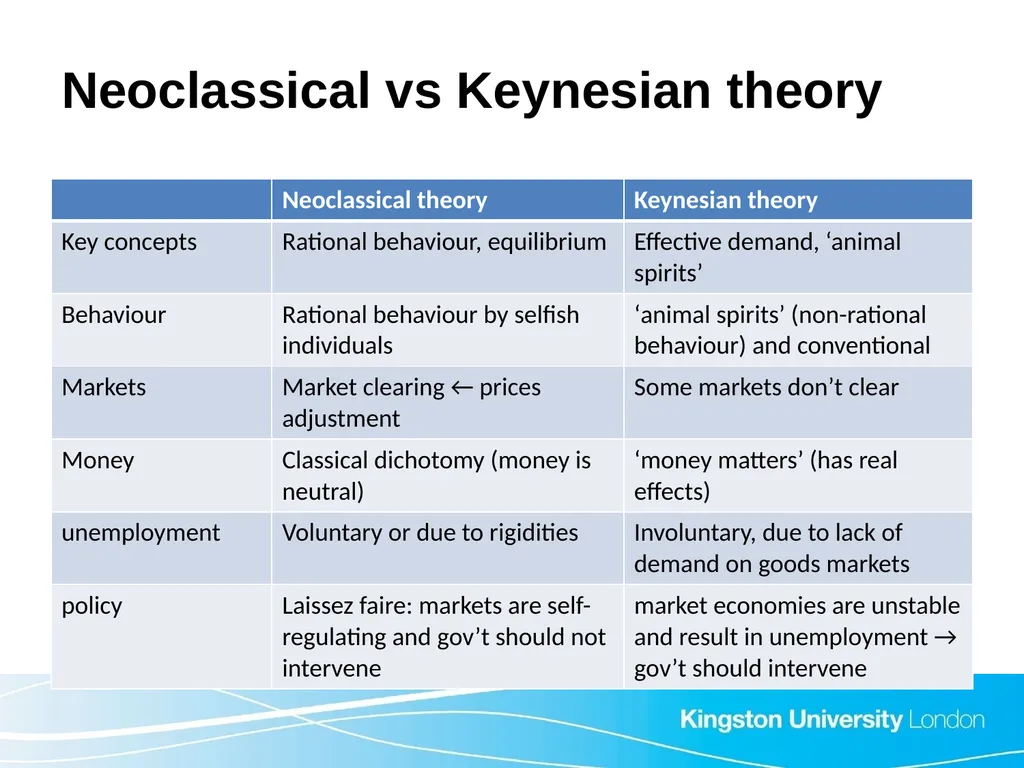
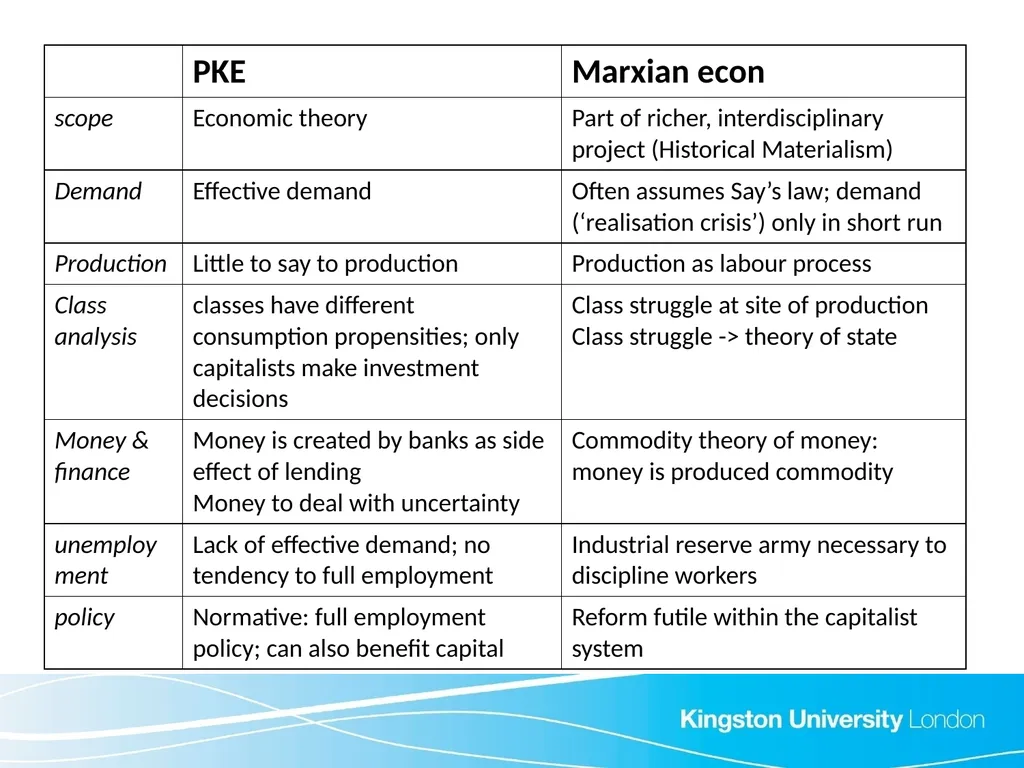
Neoclassical vs Keynesian theory<br>
13
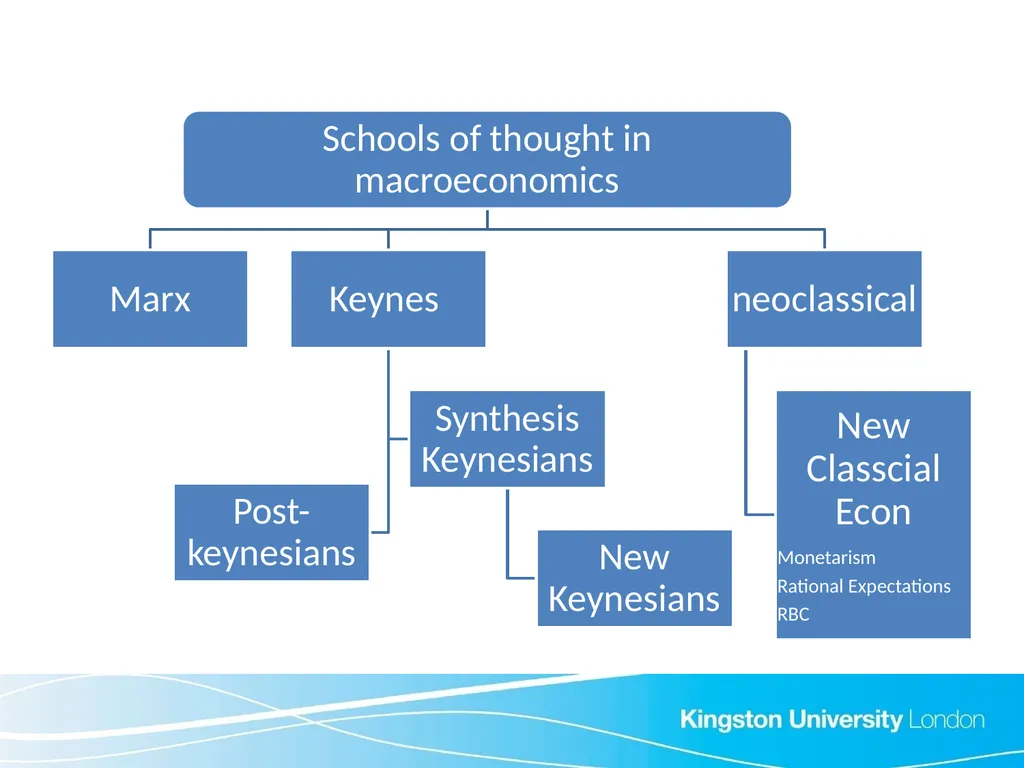
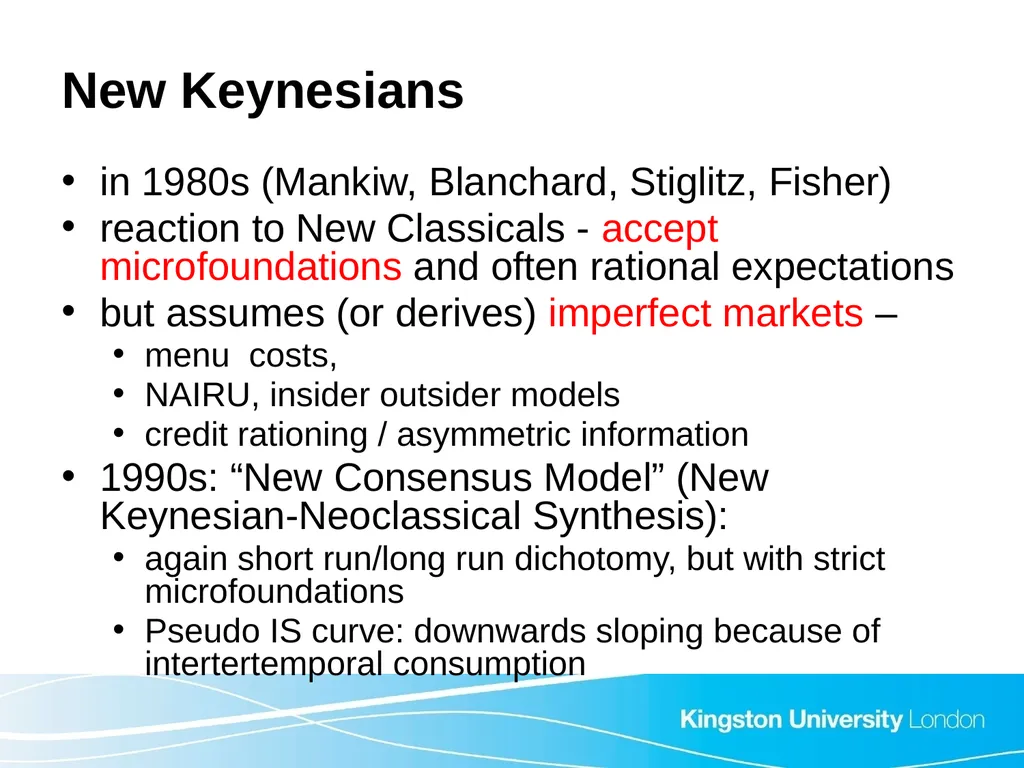
New Keynesians in 1980s (Mankiw, Blanchard, Stiglitz, Fisher)
reaction to New Classicals - accept microfoundations and often rational expectations
but assumes (or derives) imperfect markets –
menu costs,
NAIRU, insider outsider models
credit rationing / asymmetric information
1990s: “New Consensus Model” (New Keynesian-Neoclassical Synthesis):
again short run/long run dichotomy, but with strict microfoundations
Pseudo IS curve: downwards sloping because of intertertemporal consumption<br>
14
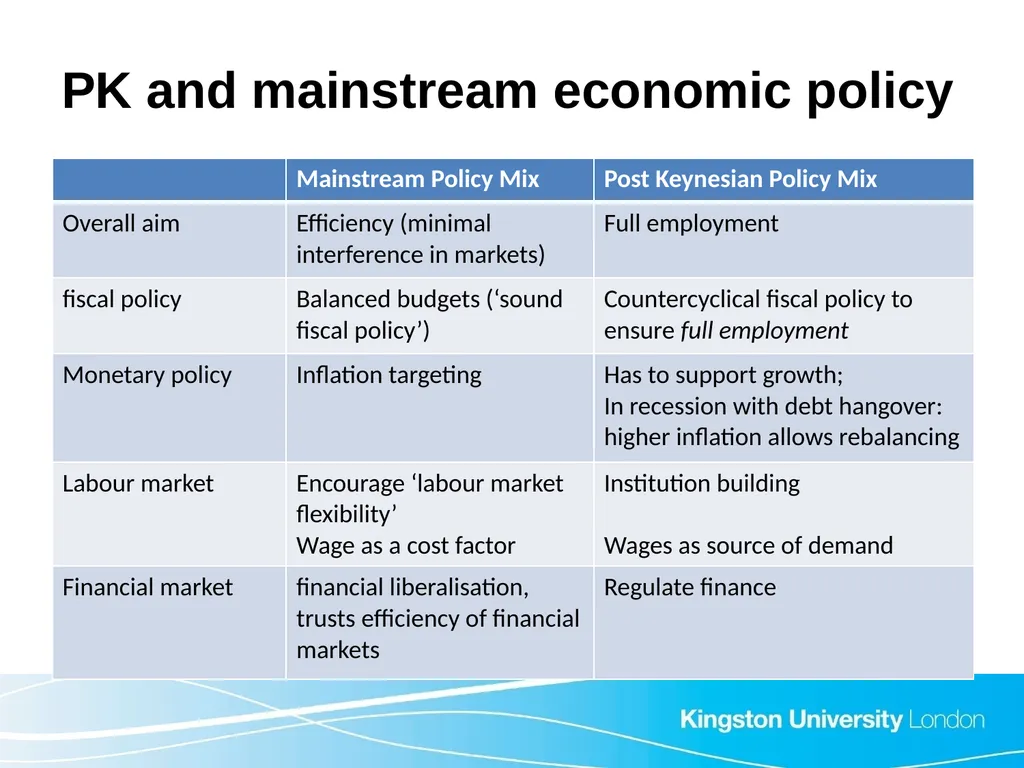
PK and mainstream economic policy<br>
15
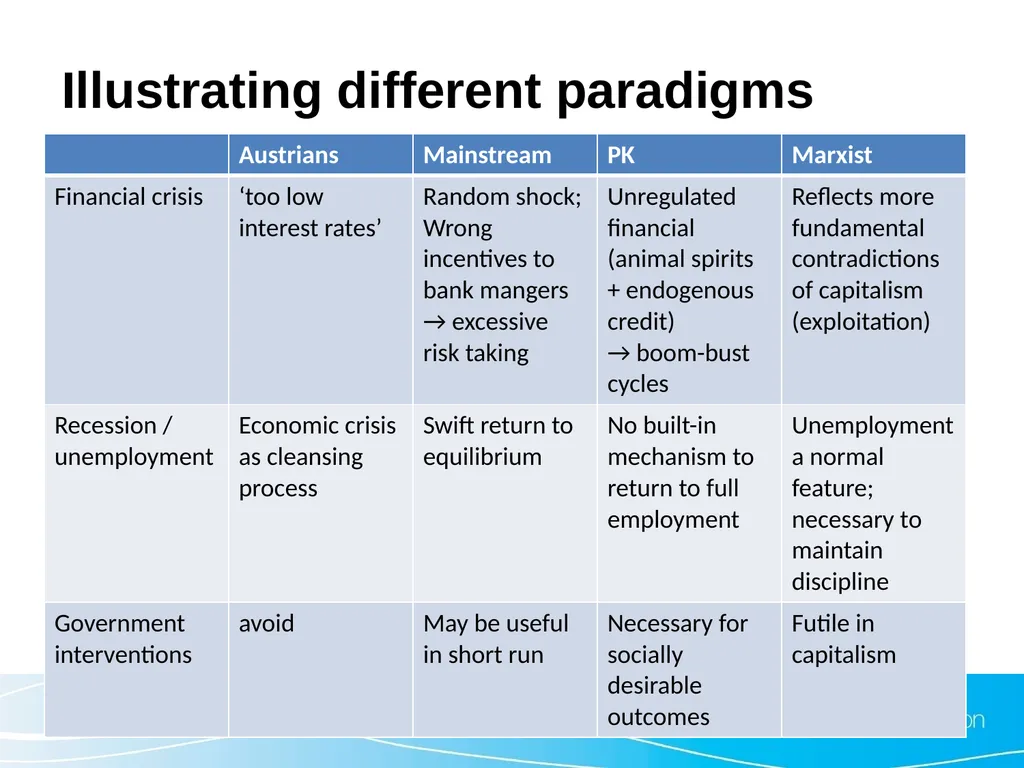
Illustrating different paradigms<br>
16
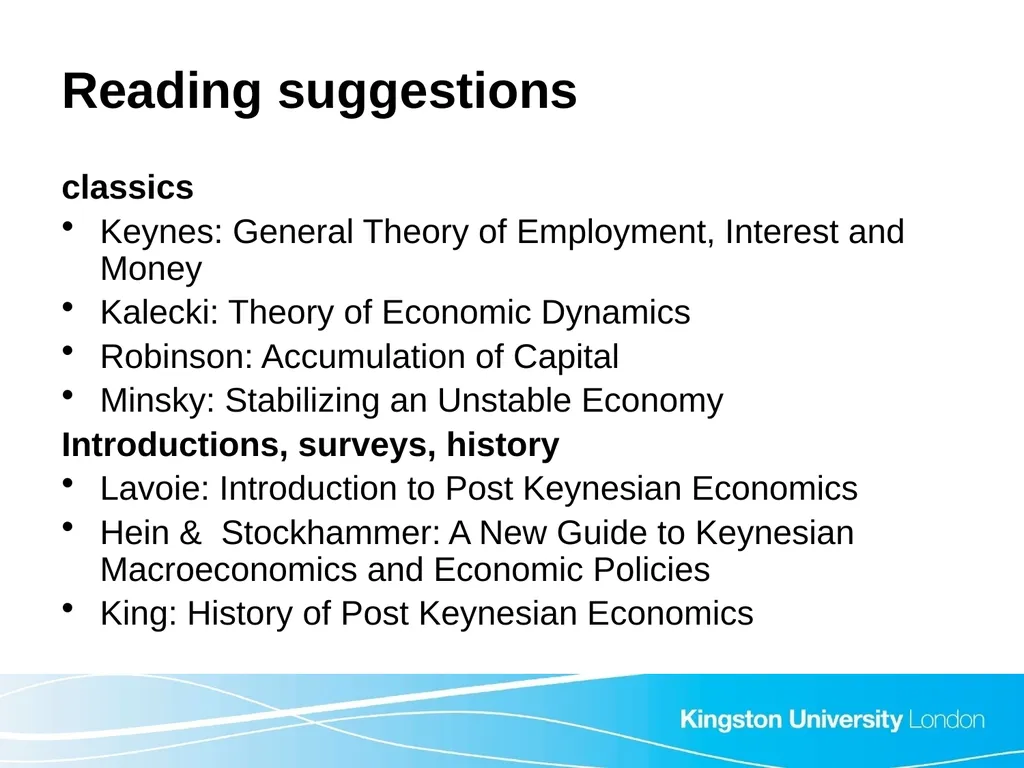
Reading suggestions classics
Keynes: General Theory of Employment, Interest and Money
Kalecki: Theory of Economic Dynamics
Robinson: Accumulation of Capital
Minsky: Stabilizing an Unstable Economy
Introductions, surveys, history
Lavoie: Introduction to Post Keynesian Economics
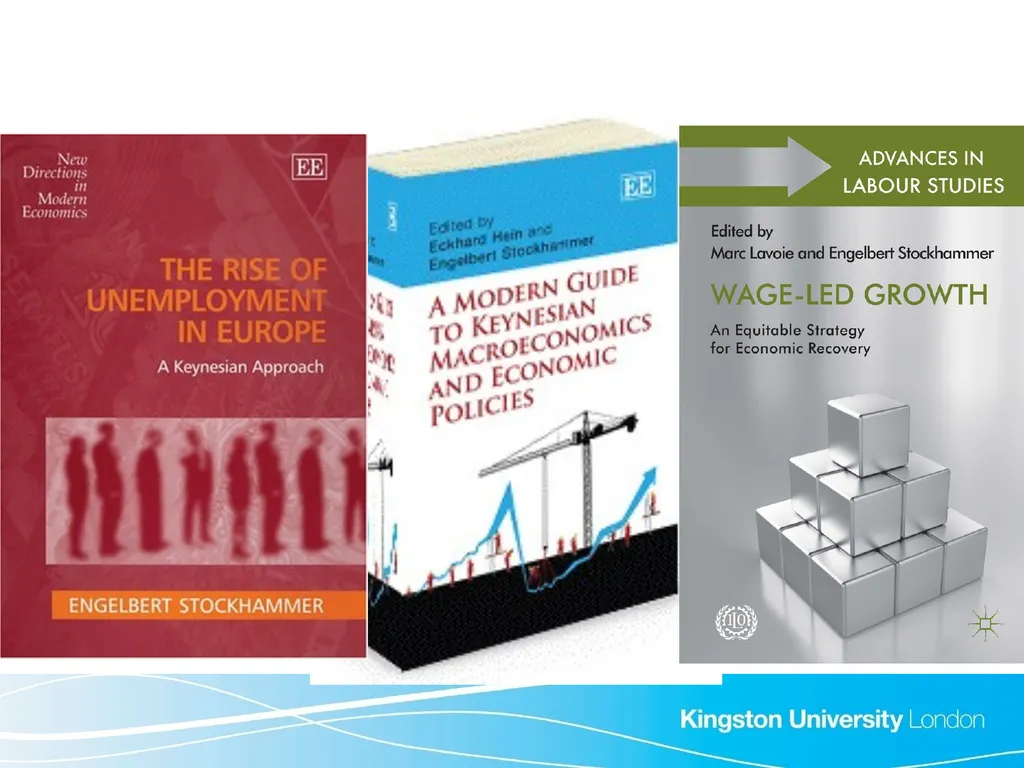
Hein & Stockhammer: A New Guide to Keynesian Macroeconomics and Economic Policies
King: History of Post Keynesian Economics<br>
17
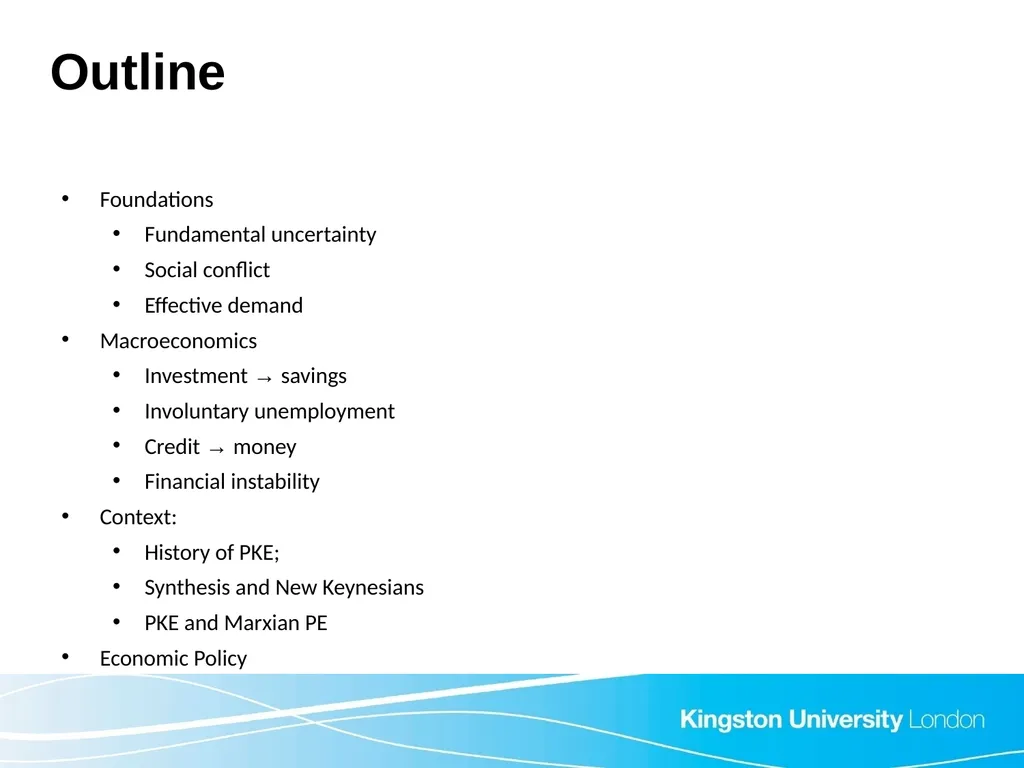
Conclusion: PKE foundations
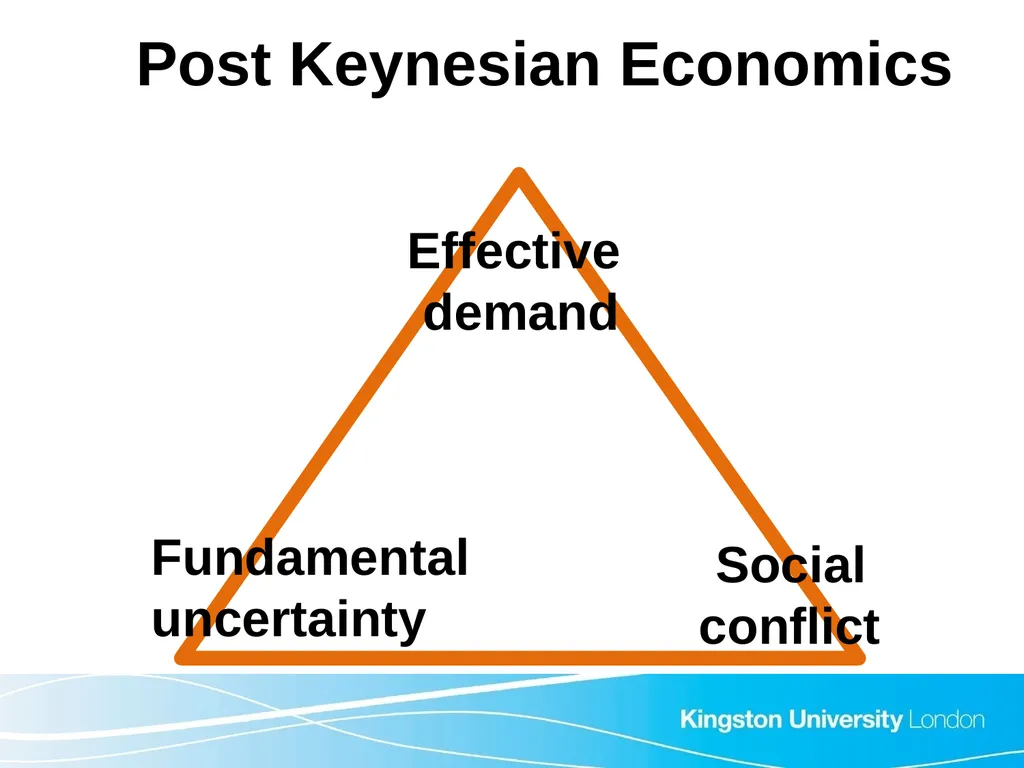
Fundamental uncertainty
Social conflict
Effective demand
Macroeconomics
Investment → savings
Involuntary unemployment
Credit → money
Financial instability<br>
19
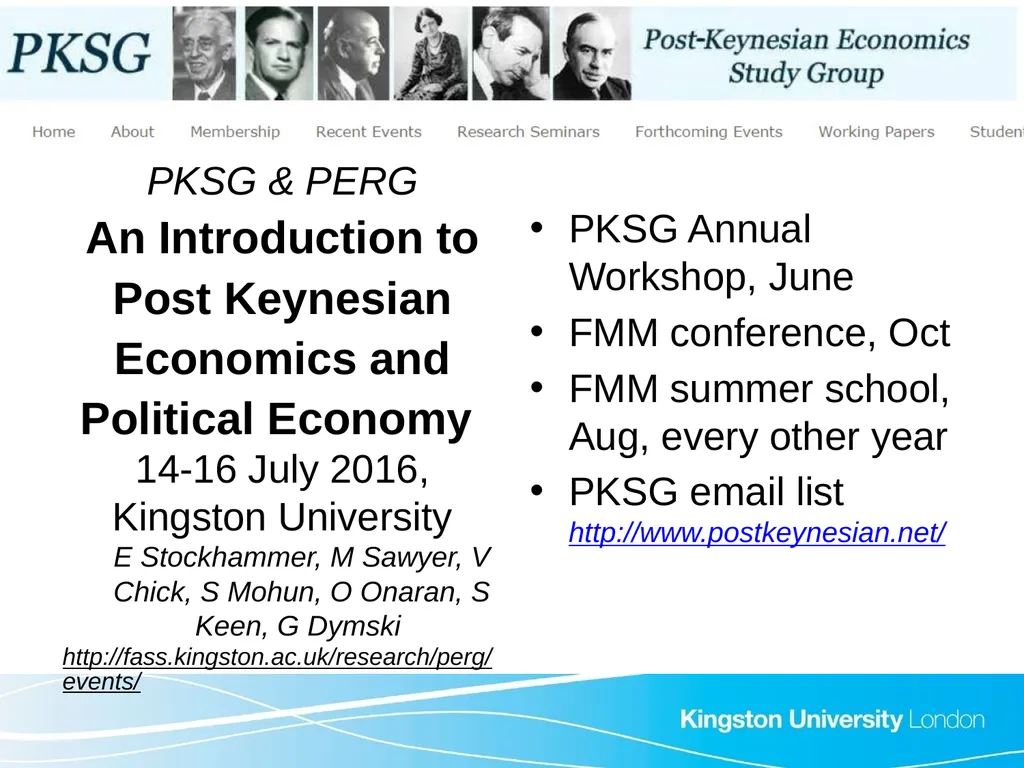
PKSG & PERG
An Introduction to Post Keynesian Economics and Political Economy
14-16 July 2016, Kingston University
E Stockhammer, M Sawyer, V Chick, S Mohun, O Onaran, S Keen, G Dymski
http://fass.kingston.ac.uk/research/perg/events/ PKSG Annual Workshop, June
FMM conference, Oct
FMM summer school, Aug, every other year
PKSG email list http://www.postkeynesian.net/<br>
20
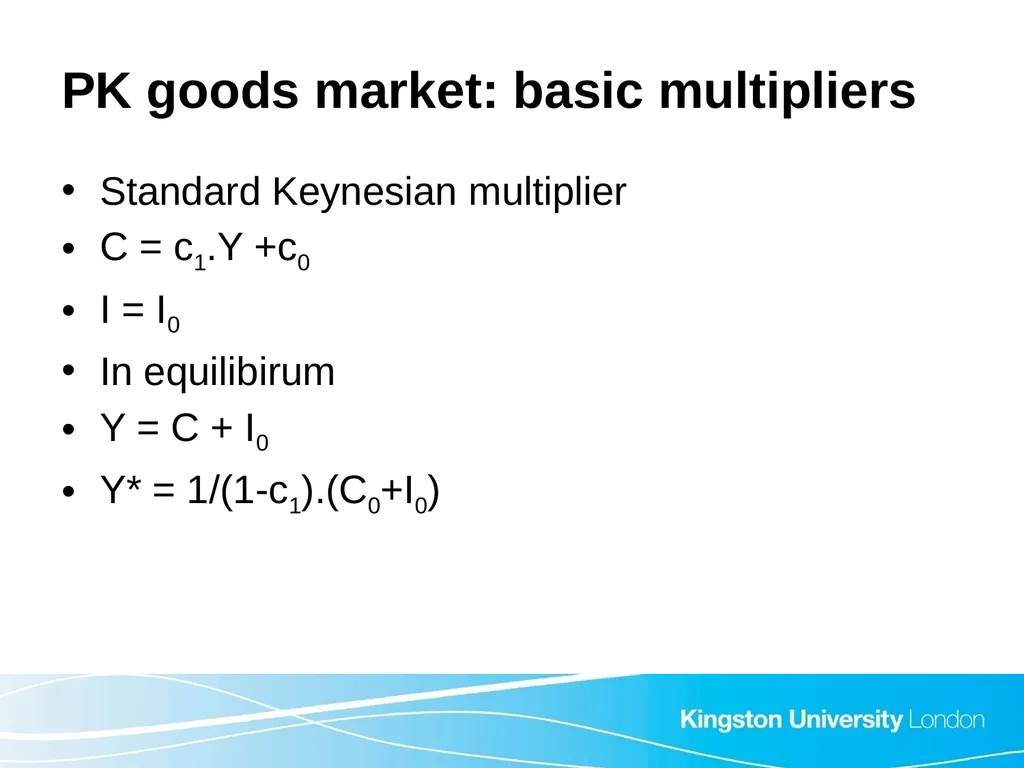
PK goods market: basic multipliers Standard Keynesian multiplier
C = c1.Y +c0
I = I0
In equilibirum
Y = C + I0
Y* = 1/(1-c1).(C0+I0)<br>
21
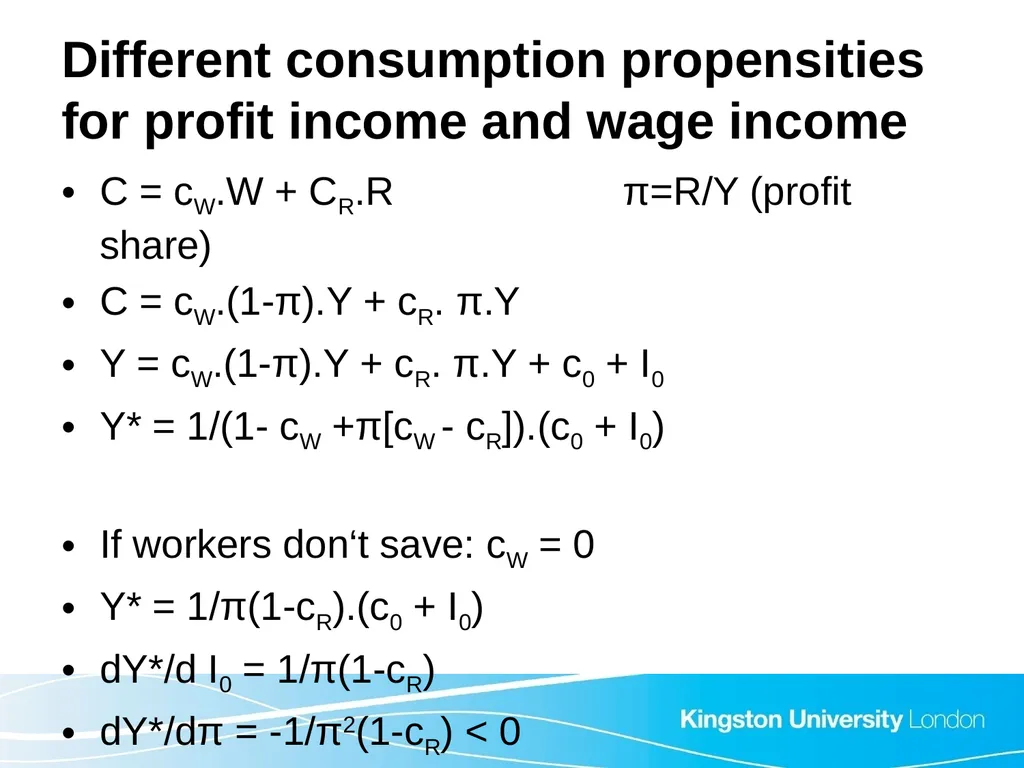
Different consumption propensities for profit income and wage income C = cW.W + CR.R π=R/Y (profit share)
C = cW.(1-π).Y + cR. π.Y
Y = cW.(1-π).Y + cR. π.Y + c0 + I0
Y* = 1/(1- cW +π[cW - cR]).(c0 + I0)
If workers don‘t save: cW = 0
Y* = 1/π(1-cR).(c0 + I0)
dY*/d I0 = 1/π(1-cR)
dY*/dπ = -1/π2(1-cR) < 0<br>
22
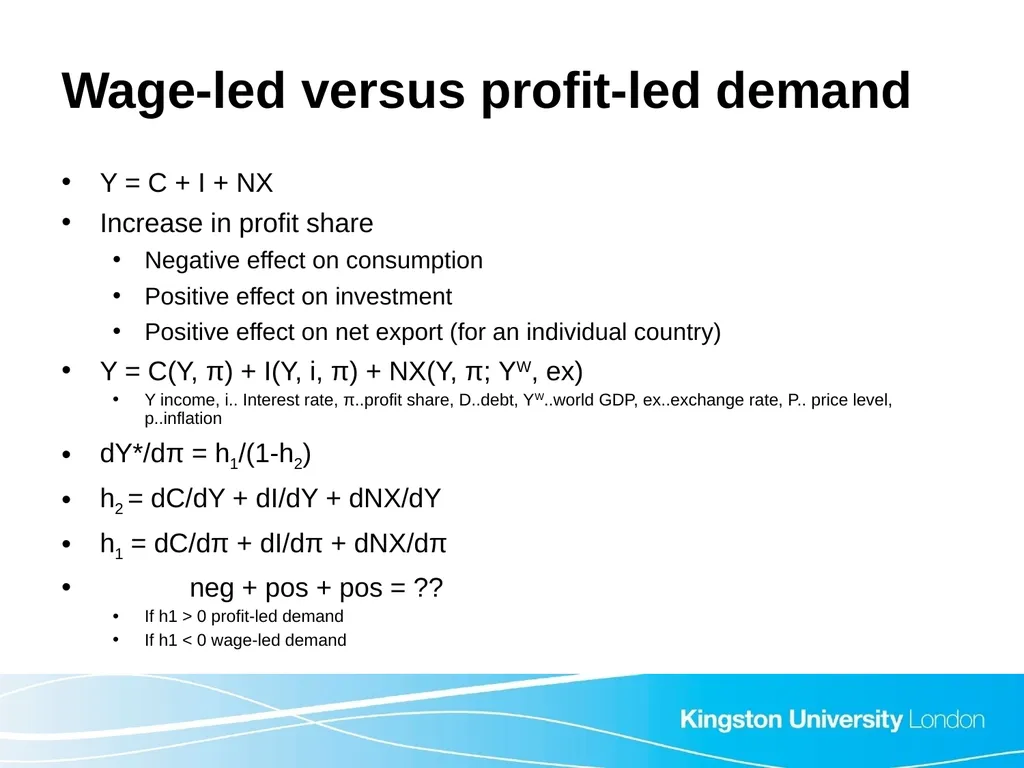
Wage-led versus profit-led demand Y = C + I + NX
Increase in profit share
Negative effect on consumption
Positive effect on investment
Positive effect on net export (for an individual country)
Y = C(Y, π) + I(Y, i, π) + NX(Y, π; YW, ex)
Y income, i.. Interest rate, π..profit share, D..debt, YW..world GDP, ex..exchange rate, P.. price level, p..inflation
dY*/dπ = h1/(1-h2)
h2 = dC/dY + dI/dY + dNX/dY
h1 = dC/dπ + dI/dπ + dNX/dπ
neg + pos + pos = ??
If h1 > 0 profit-led demand
If h1 < 0 wage-led demand<br>
23
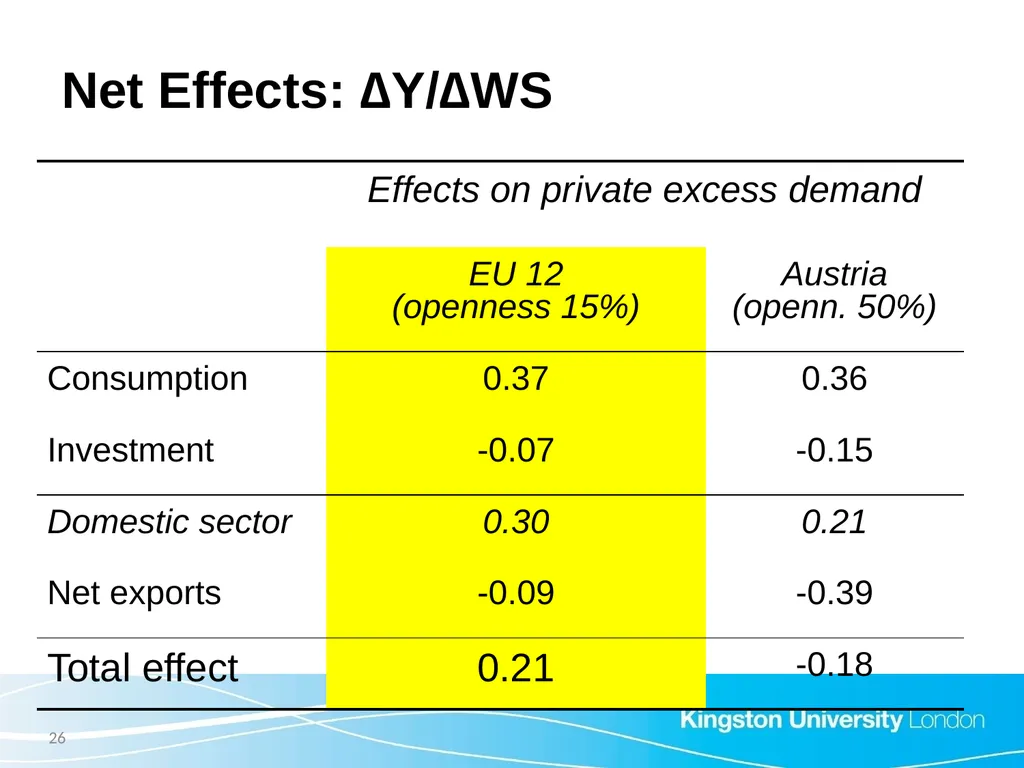
Net Effects: ∆Y/∆WS 26<br>
24
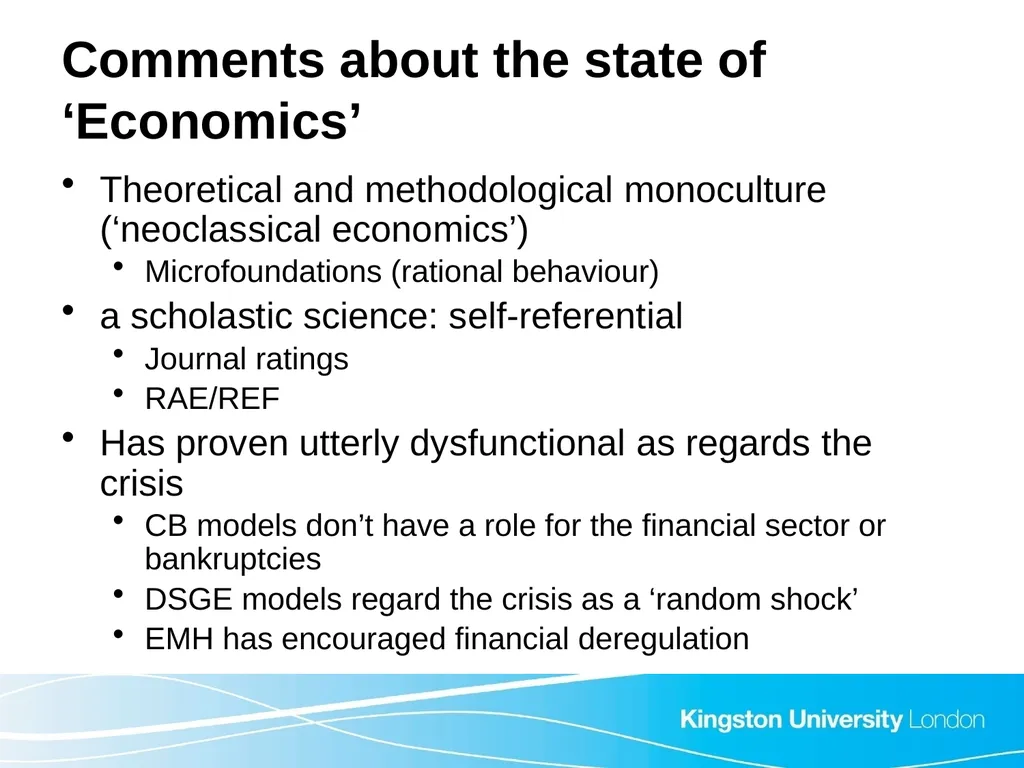
Comments about the state of ‘Economics’ Theoretical and methodological monoculture (‘neoclassical economics’)
Microfoundations (rational behaviour)
a scholastic science: self-referential
Journal ratings
RAE/REF
Has proven utterly dysfunctional as regards the crisis
CB models don’t have a role for the financial sector or bankruptcies
DSGE models regard the crisis as a ‘random shock’
EMH has encouraged financial deregulation<br>
25
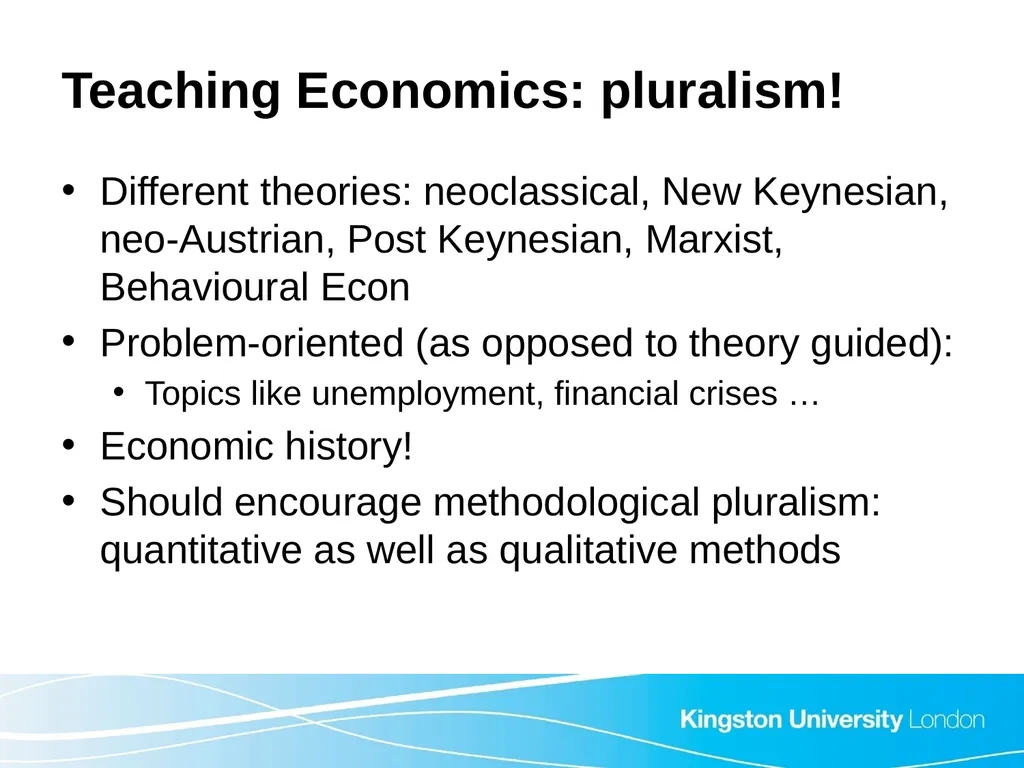
Teaching Economics: pluralism! Different theories: neoclassical, New Keynesian, neo-Austrian, Post Keynesian, Marxist, Behavioural Econ
Problem-oriented (as opposed to theory guided):
Topics like unemployment, financial crises …
Economic history!
Should encourage methodological pluralism: quantitative as well as qualitative methods<br>
26
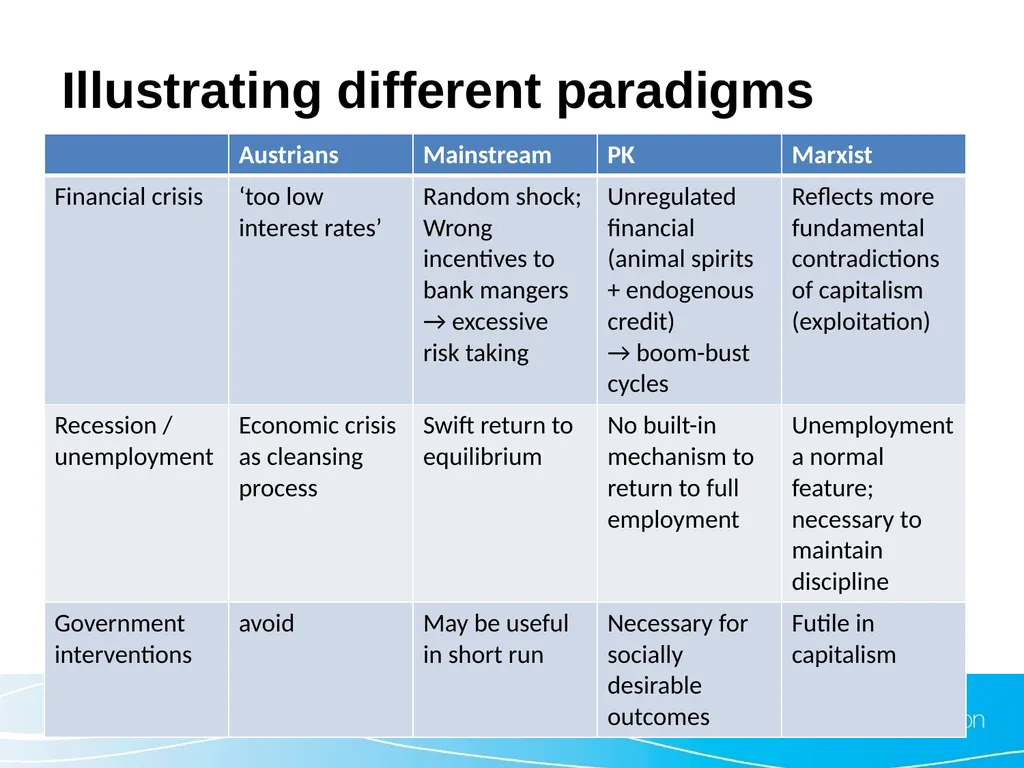
Illustrating different paradigms<br>
27
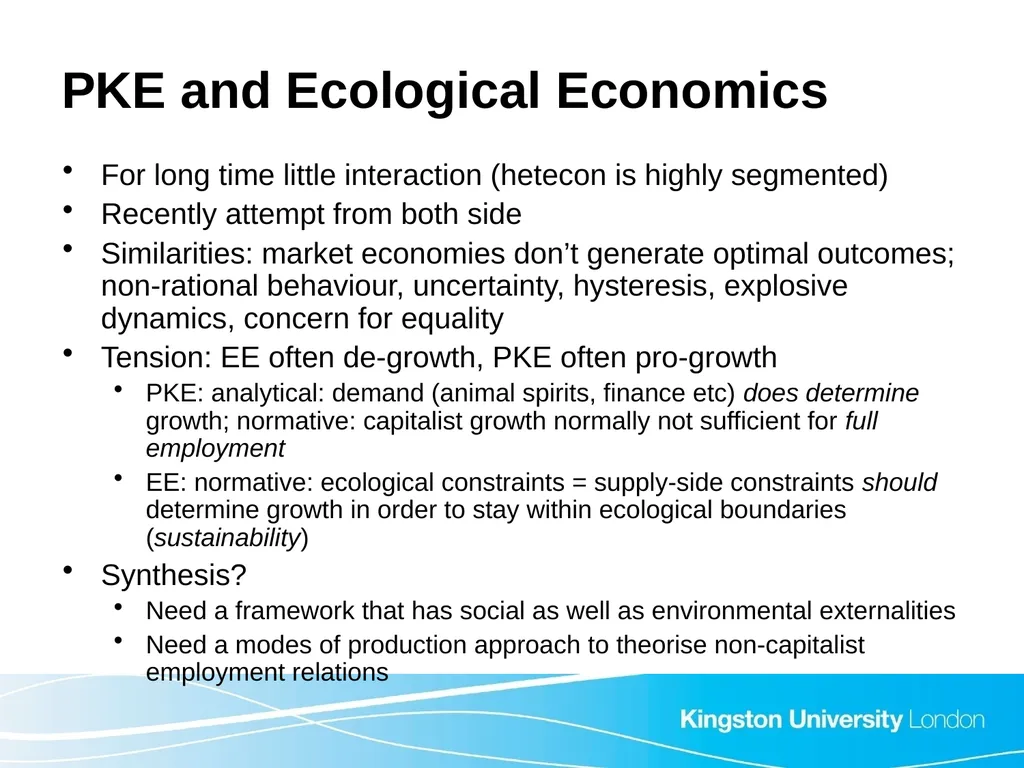
PKE and Ecological Economics For long time little interaction (hetecon is highly segmented)
Recently attempt from both side
Similarities: market economies don’t generate optimal outcomes; non-rational behaviour, uncertainty, hysteresis, explosive dynamics, concern for equality
Tension: EE often de-growth, PKE often pro-growth
PKE: analytical: demand (animal spirits, finance etc) does determine growth; normative: capitalist growth normally not sufficient for full employment
EE: normative: ecological constraints = supply-side constraints should determine growth in order to stay within ecological boundaries (sustainability)
Synthesis?
Need a framework that has social as well as environmental externalities
Need a modes of production approach to theorise non-capitalist employment relations<br>