
Introduction to the Radiology Selective: Selective
YM
Published · 21 slides · 0 views
1 / 1
Description
Introduction to the Radiology Selective: Selective Goals, Learning Objectives, and Logistics Boston University School of Medicine BUSM Institutional Learning Objectives: BU CARES Behaves in a caring, compassionate and sensitive manner
Related Topics
Share
Embed code
Download this presentation From Below
"Introduction to the Radiology Selective: Selective" is the property of its rightful owner. Permission is granted to download and print the materials on this website for personal, non-commercial use only, and to display it on your personal computer provided you do not modify the materials and that you retain all copyright notices contained in the materials. By downloading content from our website, you accept the terms of this agreement.
Presentation Transcript
01
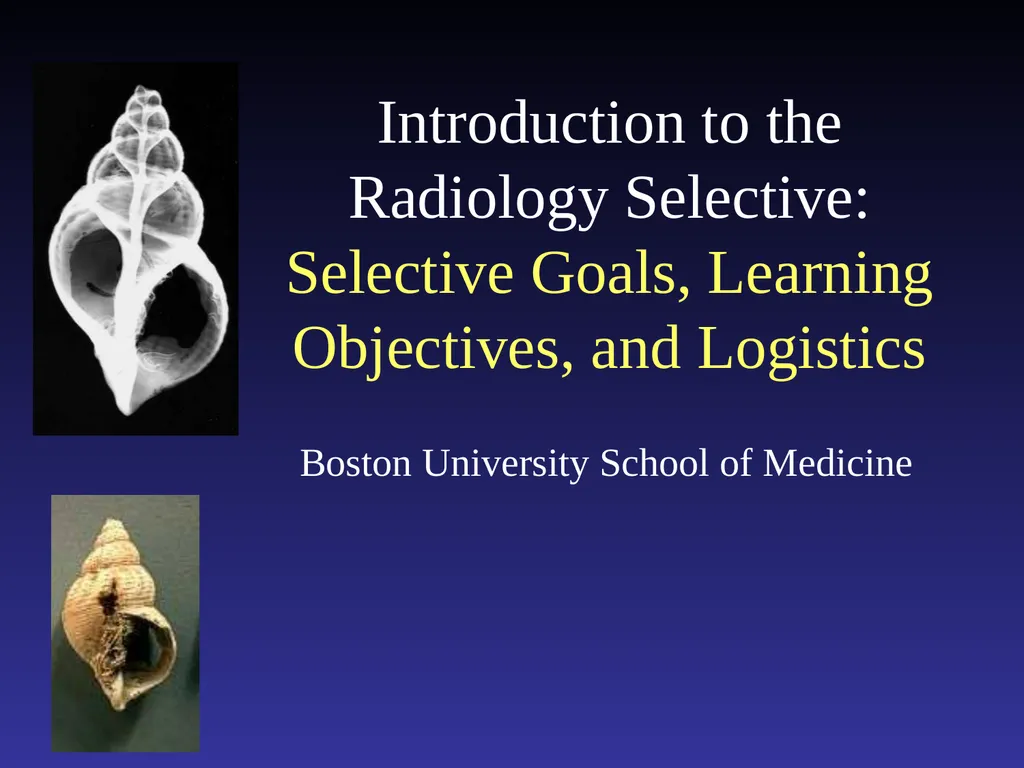
Introduction to the Radiology Selective: Selective Goals, Learning Objectives, and Logistics Boston University School of Medicine<br>
02
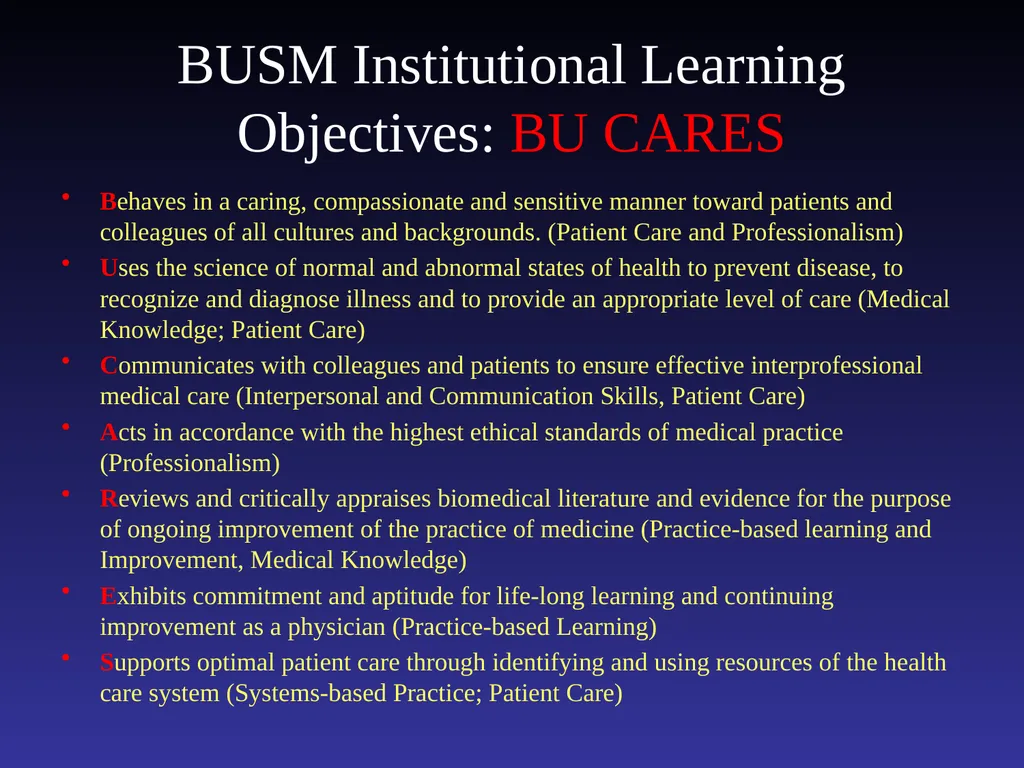
BUSM Institutional Learning Objectives: BU CARES Behaves in a caring, compassionate and sensitive manner toward patients and colleagues of all cultures and backgrounds. (Patient Care and Professionalism)
Uses the science of normal and abnormal states of health to prevent disease, to recognize and diagnose illness and to provide an appropriate level of care (Medical Knowledge; Patient Care)
Communicates with colleagues and patients to ensure effective interprofessional medical care (Interpersonal and Communication Skills, Patient Care)
Acts in accordance with the highest ethical standards of medical practice (Professionalism)
Reviews and critically appraises biomedical literature and evidence for the purpose of ongoing improvement of the practice of medicine (Practice-based learning and Improvement, Medical Knowledge)
Exhibits commitment and aptitude for life-long learning and continuing improvement as a physician (Practice-based Learning)
Supports optimal patient care through identifying and using resources of the health care system (Systems-based Practice; Patient Care)<br>
Uses the science of normal and abnormal states of health to prevent disease, to recognize and diagnose illness and to provide an appropriate level of care (Medical Knowledge; Patient Care)
Communicates with colleagues and patients to ensure effective interprofessional medical care (Interpersonal and Communication Skills, Patient Care)
Acts in accordance with the highest ethical standards of medical practice (Professionalism)
Reviews and critically appraises biomedical literature and evidence for the purpose of ongoing improvement of the practice of medicine (Practice-based learning and Improvement, Medical Knowledge)
Exhibits commitment and aptitude for life-long learning and continuing improvement as a physician (Practice-based Learning)
Supports optimal patient care through identifying and using resources of the health care system (Systems-based Practice; Patient Care)<br>
03
Radiology Selective Goal Expose students to all aspects of imaging, including a variety of imaging modalities.
Provide students with the fundamental knowledge necessary for interpretation of studies and/or radiologic reports as well as an understanding of the principles of evidence-based imaging.<br>
Provide students with the fundamental knowledge necessary for interpretation of studies and/or radiologic reports as well as an understanding of the principles of evidence-based imaging.<br>
04
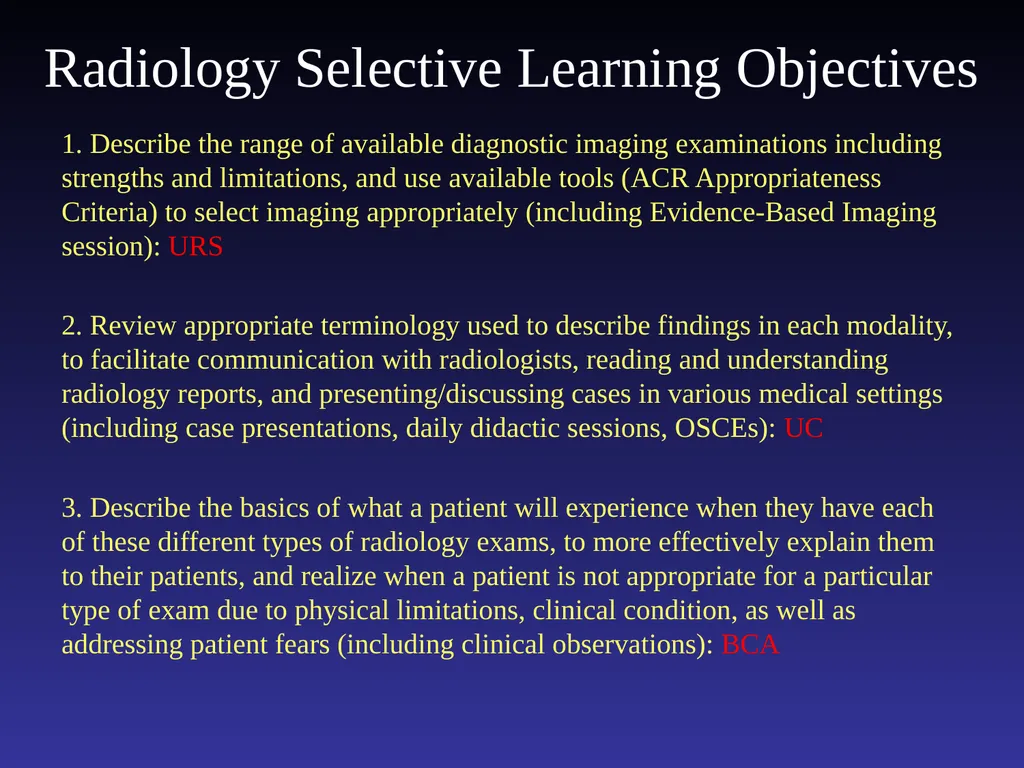
Radiology Selective Learning Objectives 1. Describe the range of available diagnostic imaging examinations including strengths and limitations, and use available tools (ACR Appropriateness Criteria) to select imaging appropriately (including Evidence-Based Imaging session): URS
2. Review appropriate terminology used to describe findings in each modality, to facilitate communication with radiologists, reading and understanding radiology reports, and presenting/discussing cases in various medical settings (including case presentations, daily didactic sessions, OSCEs): UC
3. Describe the basics of what a patient will experience when they have each of these different types of radiology exams, to more effectively explain them to their patients, and realize when a patient is not appropriate for a particular type of exam due to physical limitations, clinical condition, as well as addressing patient fears (including clinical observations): BCA<br>
2. Review appropriate terminology used to describe findings in each modality, to facilitate communication with radiologists, reading and understanding radiology reports, and presenting/discussing cases in various medical settings (including case presentations, daily didactic sessions, OSCEs): UC
3. Describe the basics of what a patient will experience when they have each of these different types of radiology exams, to more effectively explain them to their patients, and realize when a patient is not appropriate for a particular type of exam due to physical limitations, clinical condition, as well as addressing patient fears (including clinical observations): BCA<br>
05
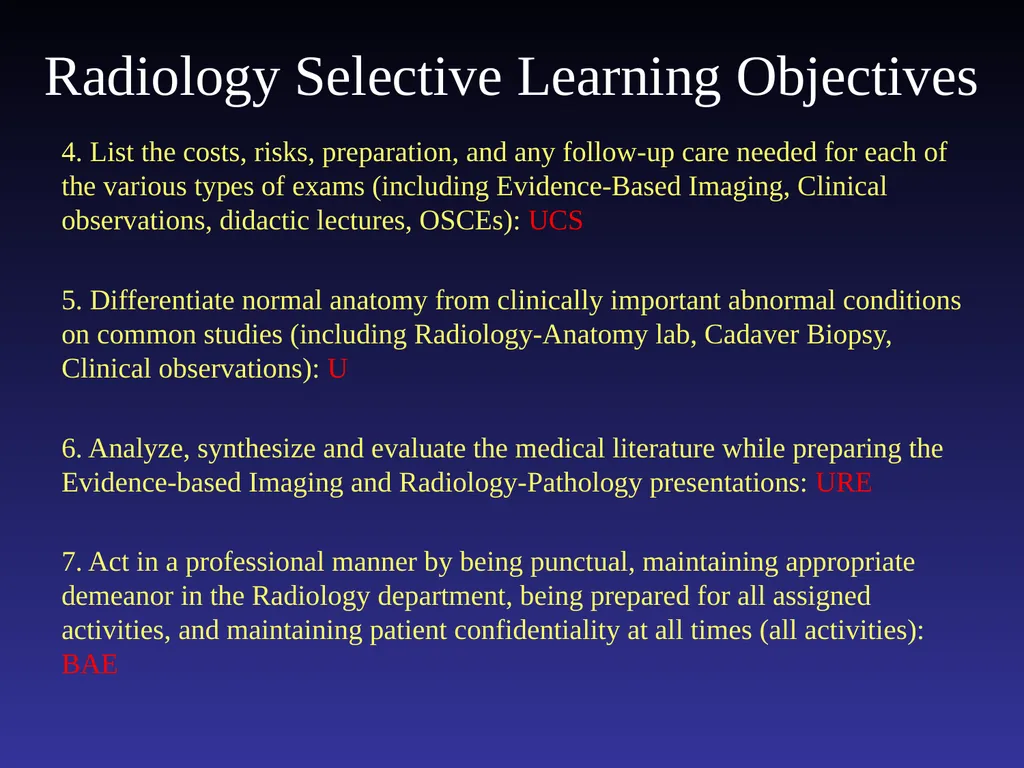
Radiology Selective Learning Objectives 4. List the costs, risks, preparation, and any follow-up care needed for each of the various types of exams (including Evidence-Based Imaging, Clinical observations, didactic lectures, OSCEs): UCS
5. Differentiate normal anatomy from clinically important abnormal conditions on common studies (including Radiology-Anatomy lab, Cadaver Biopsy, Clinical observations): U
6. Analyze, synthesize and evaluate the medical literature while preparing the Evidence-based Imaging and Radiology-Pathology presentations: URE
7. Act in a professional manner by being punctual, maintaining appropriate demeanor in the Radiology department, being prepared for all assigned activities, and maintaining patient confidentiality at all times (all activities): BAE<br>
5. Differentiate normal anatomy from clinically important abnormal conditions on common studies (including Radiology-Anatomy lab, Cadaver Biopsy, Clinical observations): U
6. Analyze, synthesize and evaluate the medical literature while preparing the Evidence-based Imaging and Radiology-Pathology presentations: URE
7. Act in a professional manner by being punctual, maintaining appropriate demeanor in the Radiology department, being prepared for all assigned activities, and maintaining patient confidentiality at all times (all activities): BAE<br>
06
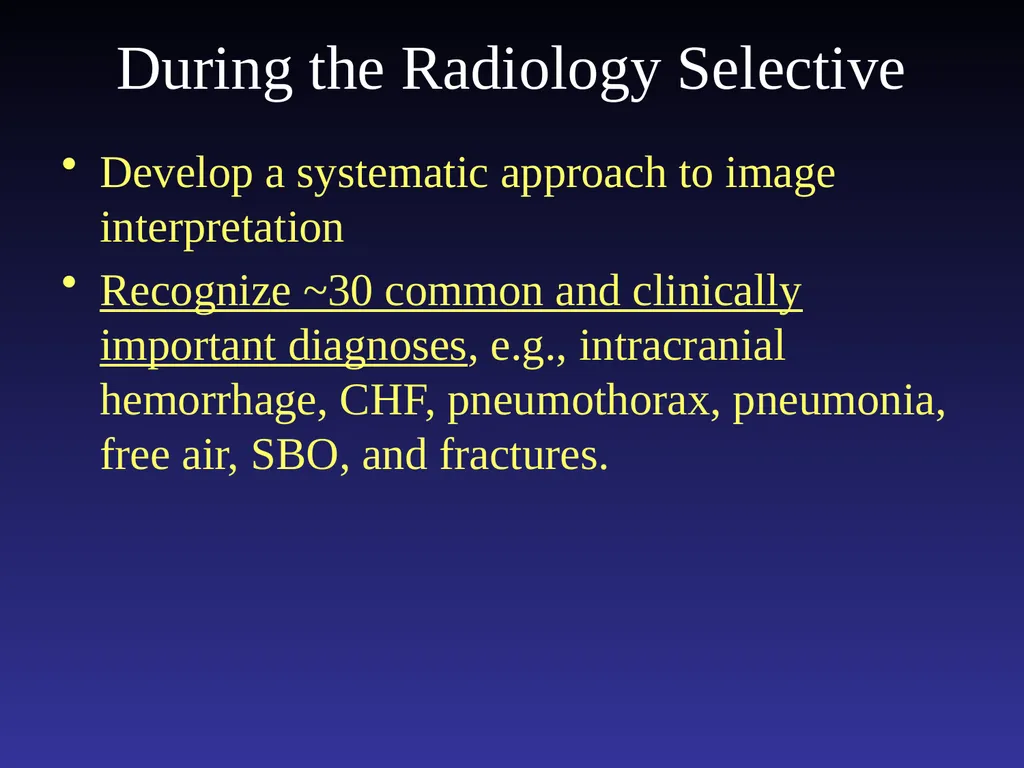
During the Radiology Selective Develop a systematic approach to image interpretation
Recognize ~30 common and clinically important diagnoses, e.g., intracranial hemorrhage, CHF, pneumothorax, pneumonia, free air, SBO, and fractures.<br>
Recognize ~30 common and clinically important diagnoses, e.g., intracranial hemorrhage, CHF, pneumothorax, pneumonia, free air, SBO, and fractures.<br>
07
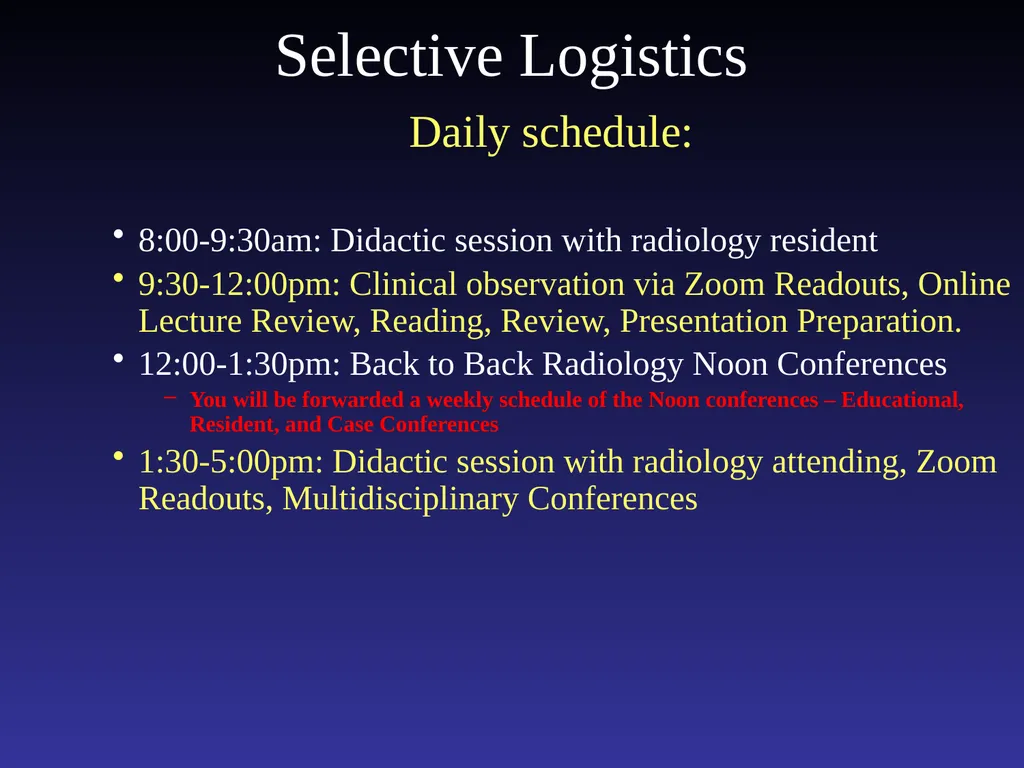
Selective Logistics Daily schedule:
8:00-9:30am: Didactic session with radiology resident
9:30-12:00pm: Clinical observation via Zoom Readouts, Online Lecture Review, Reading, Review, Presentation Preparation.
12:00-1:30pm: Back to Back Radiology Noon Conferences
You will be forwarded a weekly schedule of the Noon conferences – Educational, Resident, and Case Conferences
1:30-5:00pm: Didactic session with radiology attending, Zoom Readouts, Multidisciplinary Conferences<br>
8:00-9:30am: Didactic session with radiology resident
9:30-12:00pm: Clinical observation via Zoom Readouts, Online Lecture Review, Reading, Review, Presentation Preparation.
12:00-1:30pm: Back to Back Radiology Noon Conferences
You will be forwarded a weekly schedule of the Noon conferences – Educational, Resident, and Case Conferences
1:30-5:00pm: Didactic session with radiology attending, Zoom Readouts, Multidisciplinary Conferences<br>
08
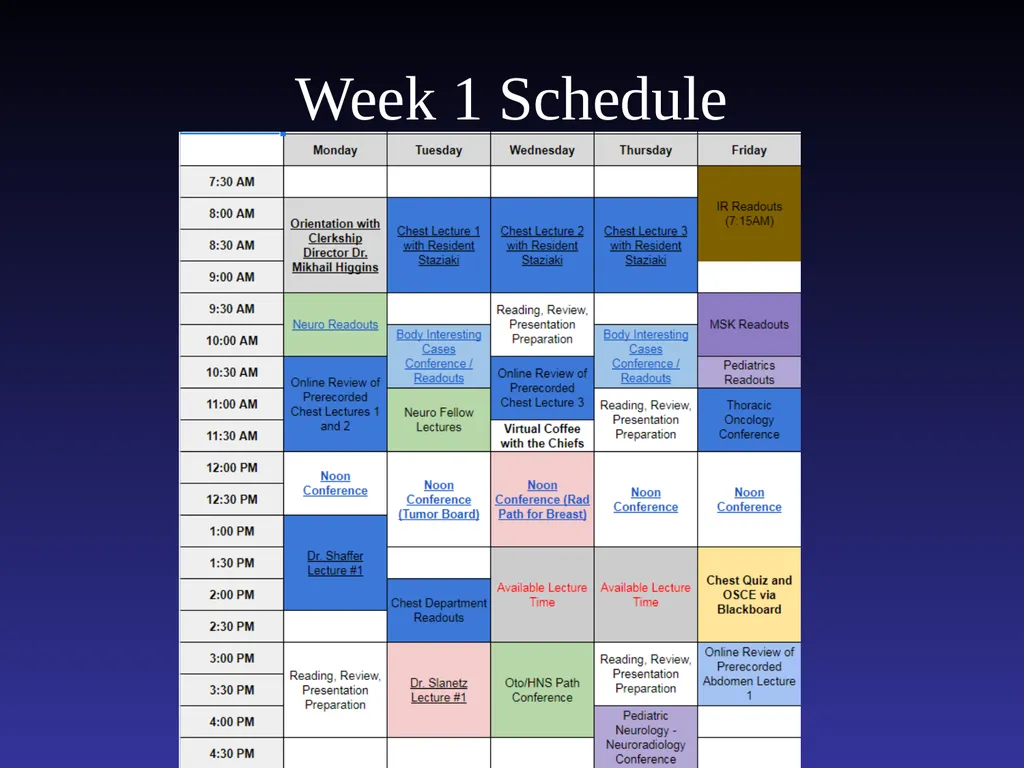
Week 1 Schedule<br>
09
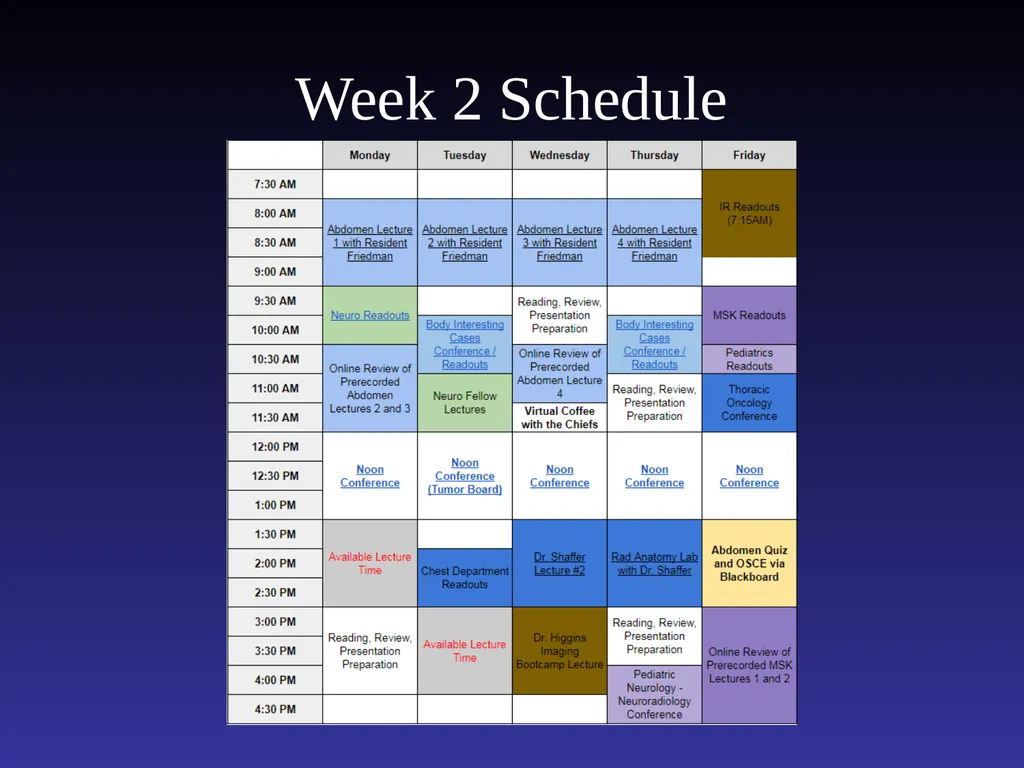
Week 2 Schedule<br>
10
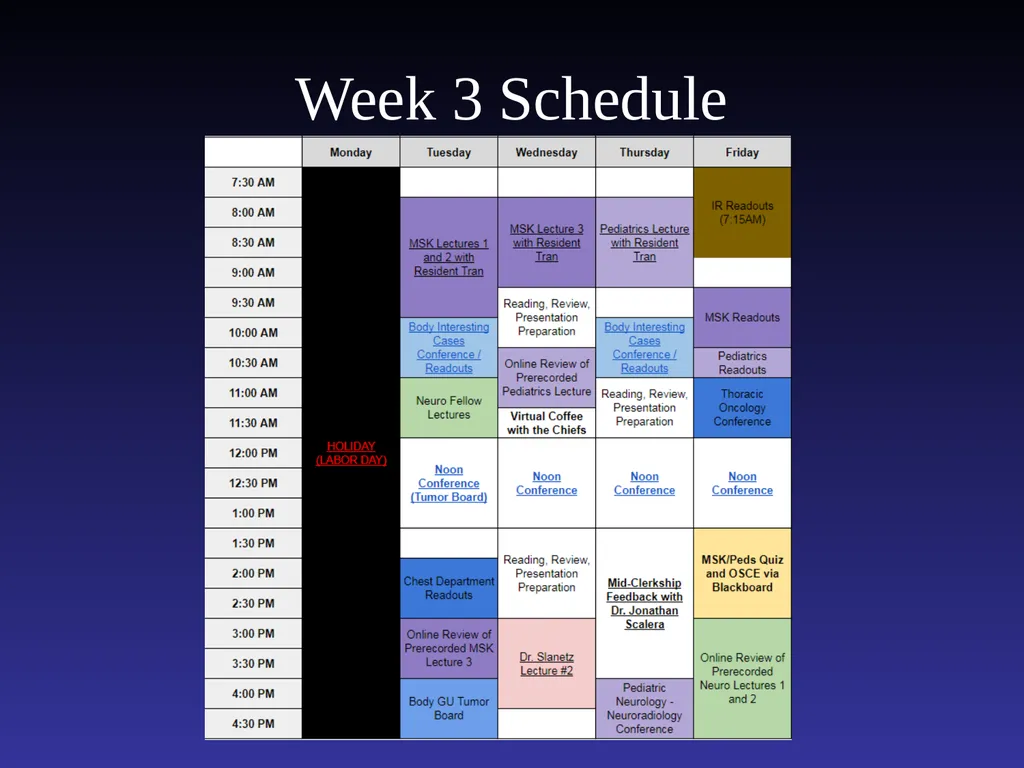
Week 3 Schedule<br>
11
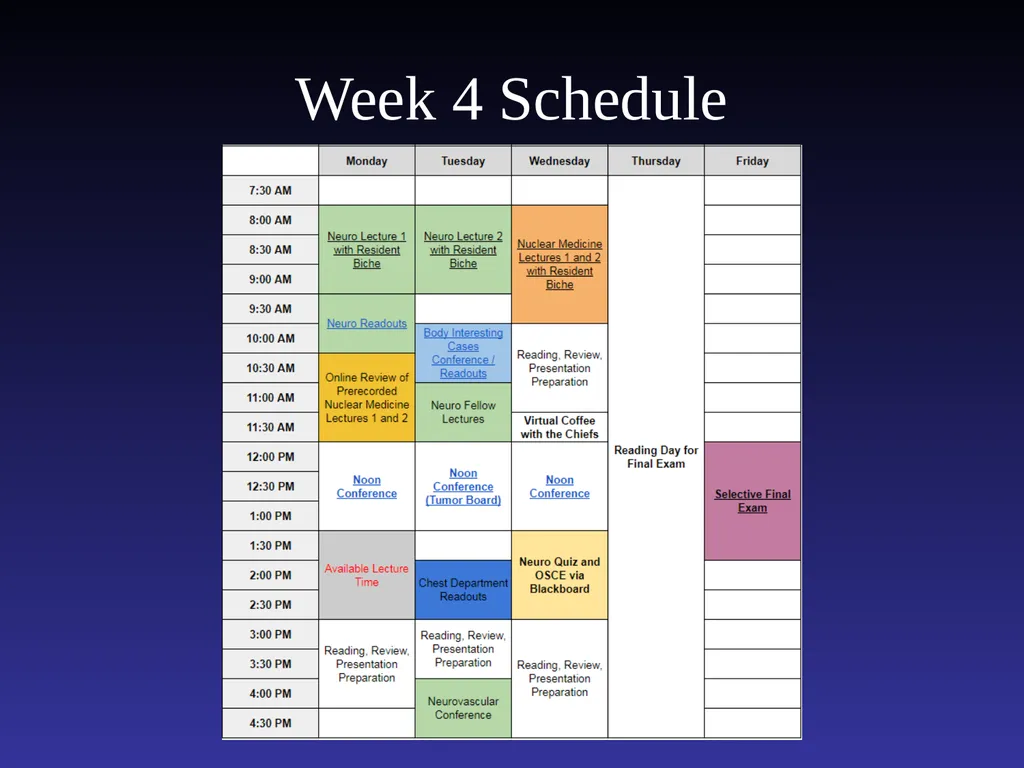
Week 4 Schedule<br>
12
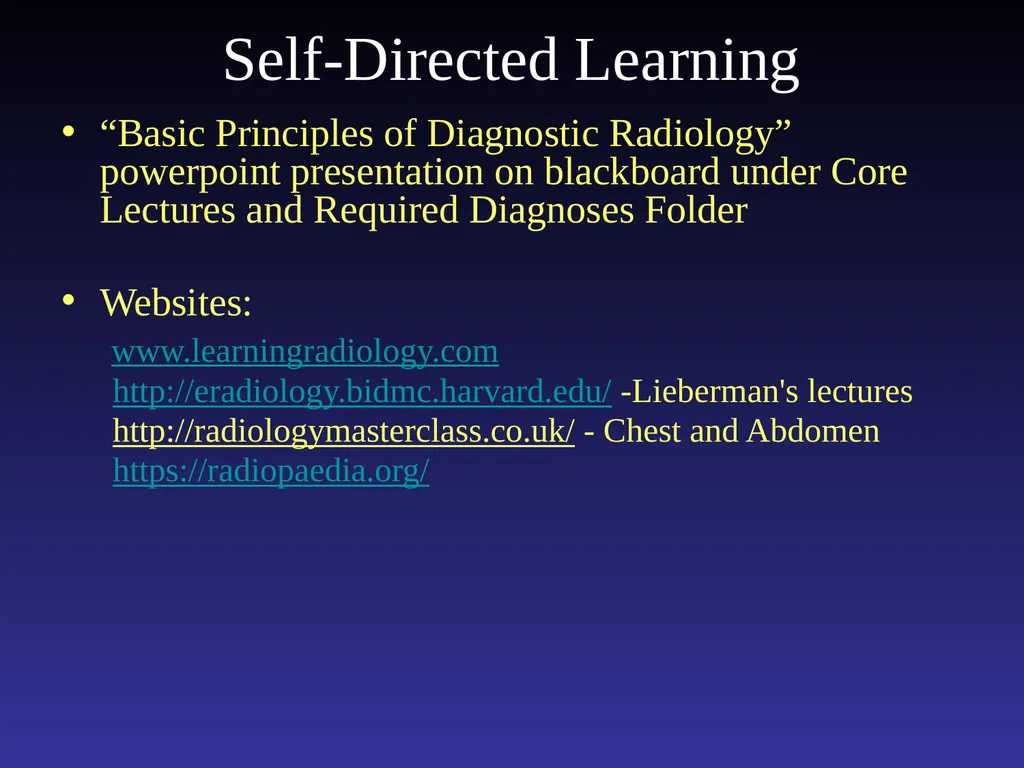
Self-Directed Learning “Basic Principles of Diagnostic Radiology” powerpoint presentation on blackboard under Core Lectures and Required Diagnoses Folder
Websites:
www.learningradiology.com
http://eradiology.bidmc.harvard.edu/ -Lieberman's lectures
http://radiologymasterclass.co.uk/ - Chest and Abdomen
https://radiopaedia.org/<br>
Websites:
www.learningradiology.com
http://eradiology.bidmc.harvard.edu/ -Lieberman's lectures
http://radiologymasterclass.co.uk/ - Chest and Abdomen
https://radiopaedia.org/<br>
13
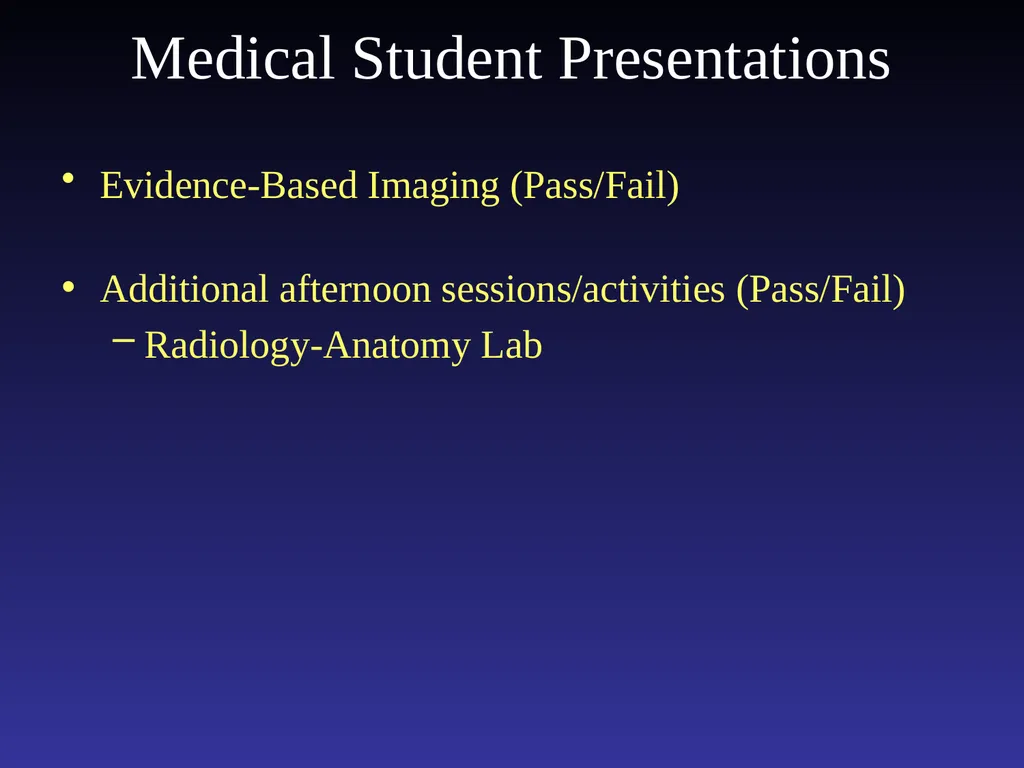
Medical Student Presentations Evidence-Based Imaging (Pass/Fail)
Additional afternoon sessions/activities (Pass/Fail)
Radiology-Anatomy Lab<br>
Additional afternoon sessions/activities (Pass/Fail)
Radiology-Anatomy Lab<br>
14
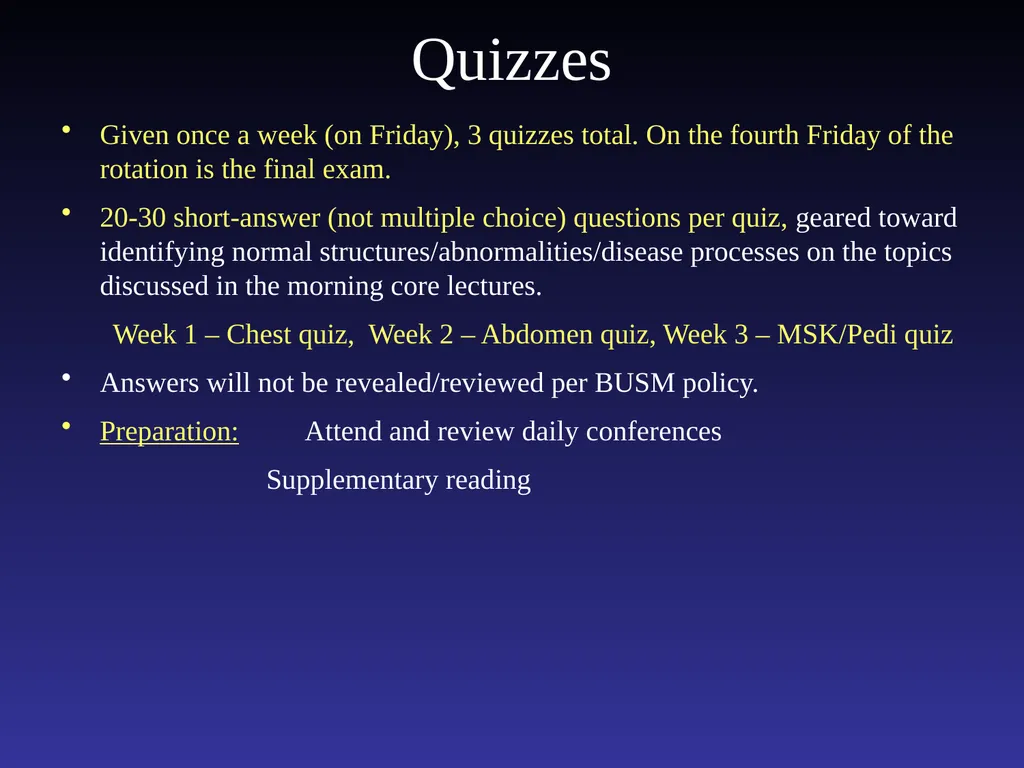
Quizzes Given once a week (on Friday), 3 quizzes total. On the fourth Friday of the rotation is the final exam.
20-30 short-answer (not multiple choice) questions per quiz, geared toward identifying normal structures/abnormalities/disease processes on the topics discussed in the morning core lectures.
Week 1 – Chest quiz, Week 2 – Abdomen quiz, Week 3 – MSK/Pedi quiz
Answers will not be revealed/reviewed per BUSM policy.
Preparation: Attend and review daily conferences
Supplementary reading<br>
20-30 short-answer (not multiple choice) questions per quiz, geared toward identifying normal structures/abnormalities/disease processes on the topics discussed in the morning core lectures.
Week 1 – Chest quiz, Week 2 – Abdomen quiz, Week 3 – MSK/Pedi quiz
Answers will not be revealed/reviewed per BUSM policy.
Preparation: Attend and review daily conferences
Supplementary reading<br>
15
Radiology Selective
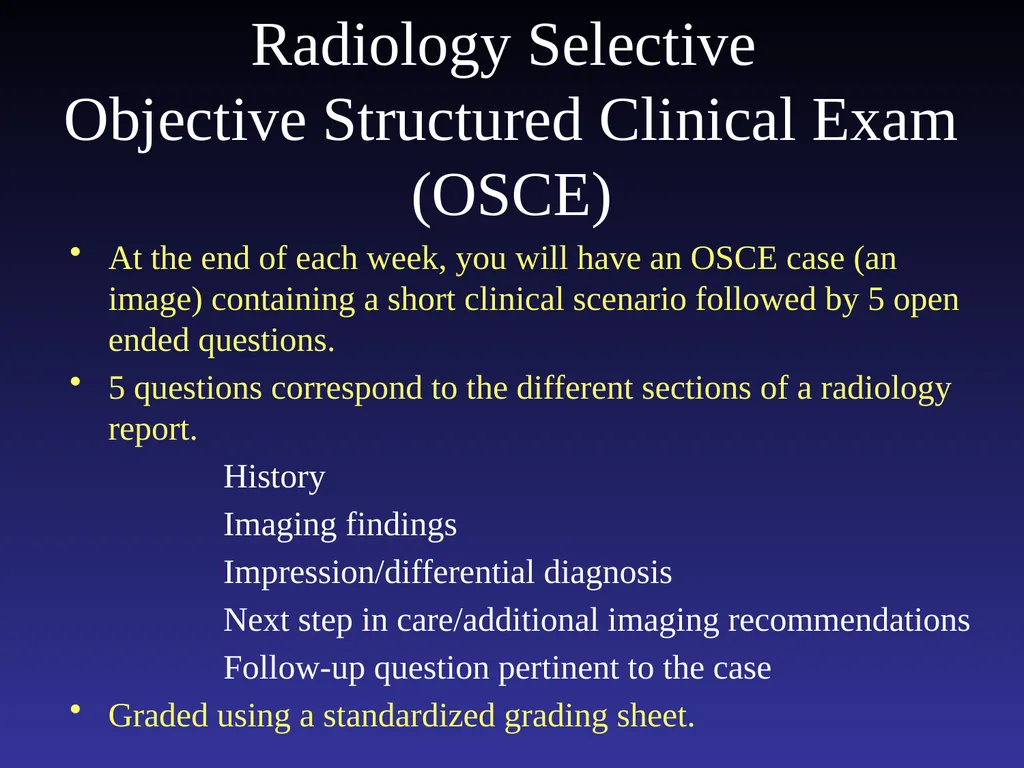
Objective Structured Clinical Exam (OSCE) At the end of each week, you will have an OSCE case (an image) containing a short clinical scenario followed by 5 open ended questions.
5 questions correspond to the different sections of a radiology report.
History
Imaging findings
Impression/differential diagnosis
Next step in care/additional imaging recommendations
Follow-up question pertinent to the case
Graded using a standardized grading sheet.<br>
5 questions correspond to the different sections of a radiology report.
History
Imaging findings
Impression/differential diagnosis
Next step in care/additional imaging recommendations
Follow-up question pertinent to the case
Graded using a standardized grading sheet.<br>
16
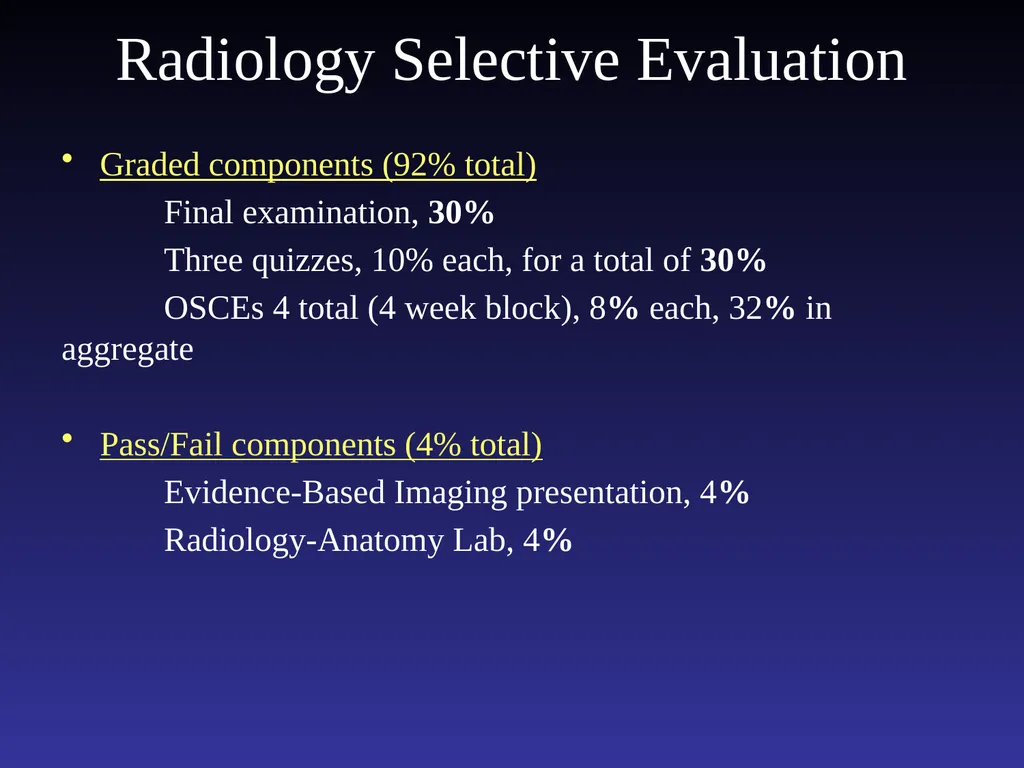
Radiology Selective Evaluation Graded components (92% total)
Final examination, 30%
Three quizzes, 10% each, for a total of 30%
OSCEs 4 total (4 week block), 8% each, 32% in aggregate
Pass/Fail components (4% total)
Evidence-Based Imaging presentation, 4%
Radiology-Anatomy Lab, 4%<br>
Final examination, 30%
Three quizzes, 10% each, for a total of 30%
OSCEs 4 total (4 week block), 8% each, 32% in aggregate
Pass/Fail components (4% total)
Evidence-Based Imaging presentation, 4%
Radiology-Anatomy Lab, 4%<br>
17
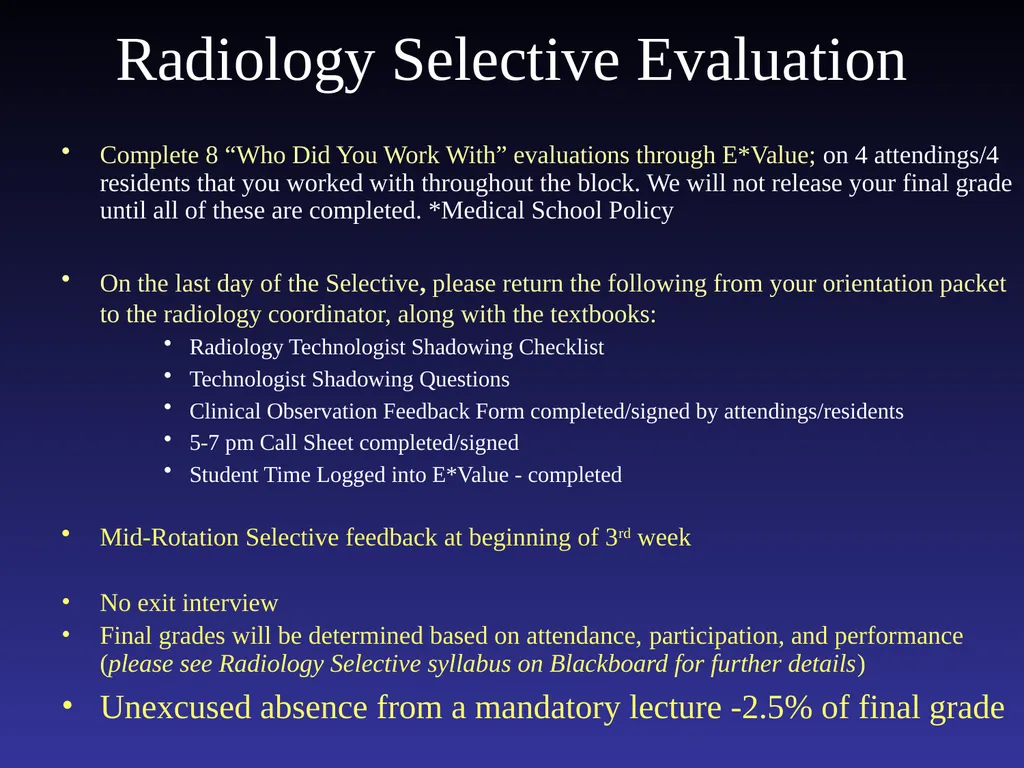
Radiology Selective Evaluation Complete 8 “Who Did You Work With” evaluations through E*Value; on 4 attendings/4 residents that you worked with throughout the block. We will not release your final grade until all of these are completed. *Medical School Policy
On the last day of the Selective, please return the following from your orientation packet to the radiology coordinator, along with the textbooks:
Radiology Technologist Shadowing Checklist
Technologist Shadowing Questions
Clinical Observation Feedback Form completed/signed by attendings/residents
5-7 pm Call Sheet completed/signed
Student Time Logged into E*Value - completed
Mid-Rotation Selective feedback at beginning of 3rd week
No exit interview
Final grades will be determined based on attendance, participation, and performance (please see Radiology Selective syllabus on Blackboard for further details)
Unexcused absence from a mandatory lecture -2.5% of final grade<br>
On the last day of the Selective, please return the following from your orientation packet to the radiology coordinator, along with the textbooks:
Radiology Technologist Shadowing Checklist
Technologist Shadowing Questions
Clinical Observation Feedback Form completed/signed by attendings/residents
5-7 pm Call Sheet completed/signed
Student Time Logged into E*Value - completed
Mid-Rotation Selective feedback at beginning of 3rd week
No exit interview
Final grades will be determined based on attendance, participation, and performance (please see Radiology Selective syllabus on Blackboard for further details)
Unexcused absence from a mandatory lecture -2.5% of final grade<br>
18
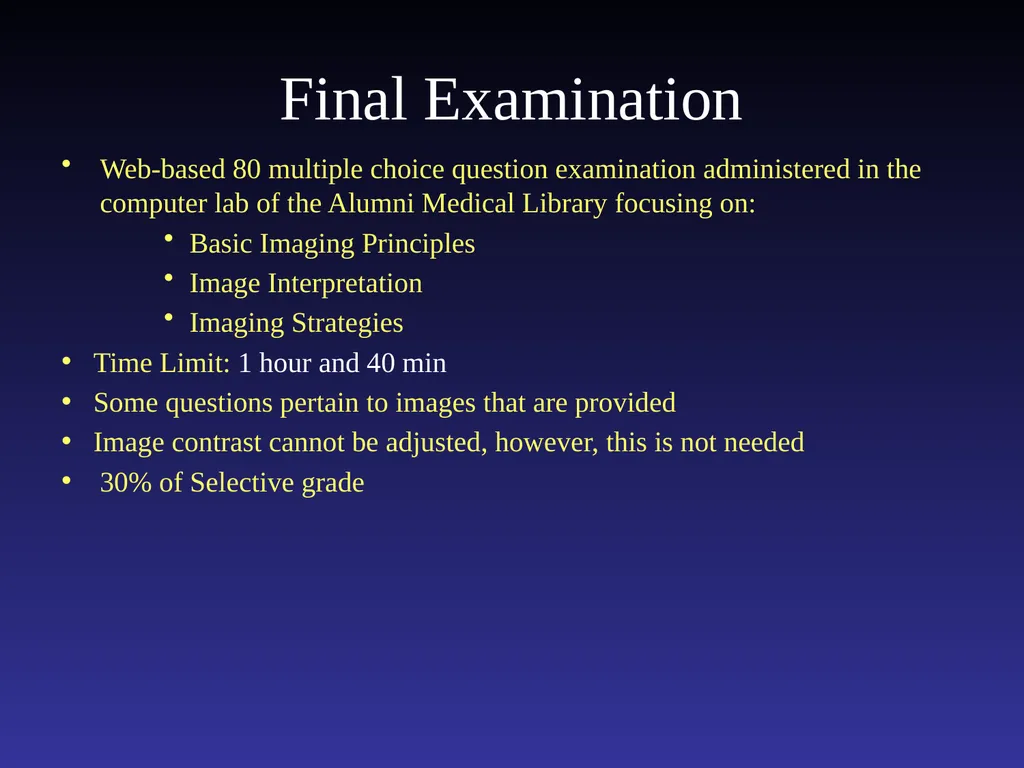
Final Examination Web-based 80 multiple choice question examination administered in the computer lab of the Alumni Medical Library focusing on:
Basic Imaging Principles
Image Interpretation
Imaging Strategies
Time Limit: 1 hour and 40 min
Some questions pertain to images that are provided
Image contrast cannot be adjusted, however, this is not needed
30% of Selective grade<br>
Basic Imaging Principles
Image Interpretation
Imaging Strategies
Time Limit: 1 hour and 40 min
Some questions pertain to images that are provided
Image contrast cannot be adjusted, however, this is not needed
30% of Selective grade<br>
19
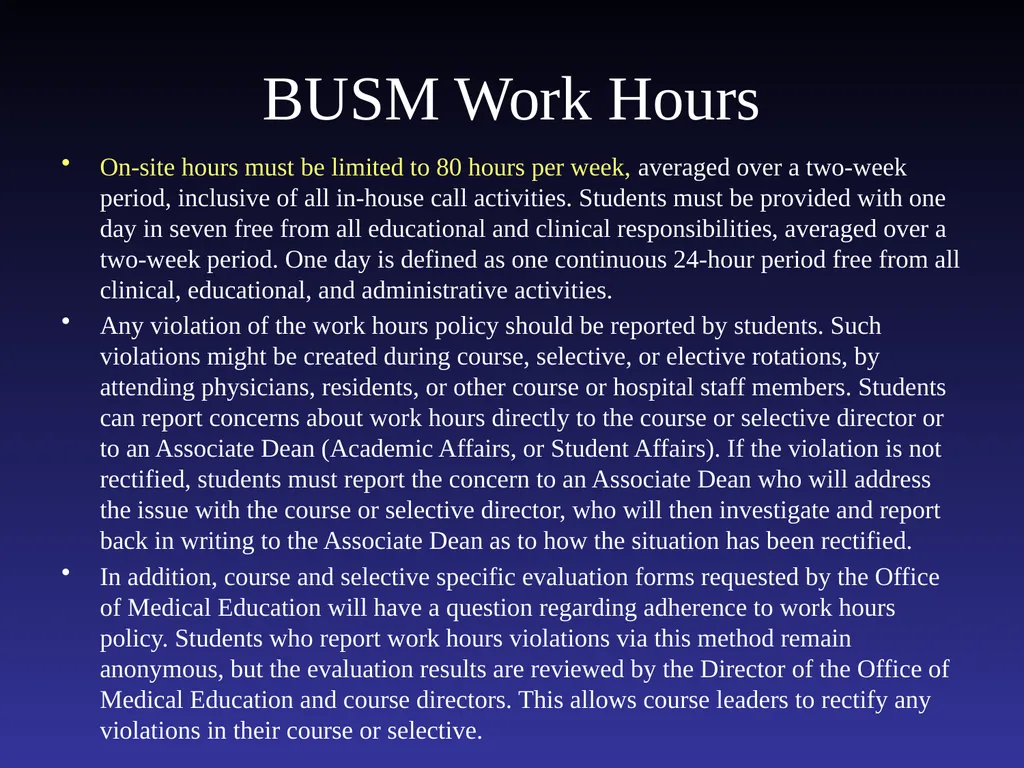
BUSM Work Hours On-site hours must be limited to 80 hours per week, averaged over a two-week period, inclusive of all in-house call activities. Students must be provided with one day in seven free from all educational and clinical responsibilities, averaged over a two-week period. One day is defined as one continuous 24-hour period free from all clinical, educational, and administrative activities.
Any violation of the work hours policy should be reported by students. Such violations might be created during course, selective, or elective rotations, by attending physicians, residents, or other course or hospital staff members. Students can report concerns about work hours directly to the course or selective director or to an Associate Dean (Academic Affairs, or Student Affairs). If the violation is not rectified, students must report the concern to an Associate Dean who will address the issue with the course or selective director, who will then investigate and report back in writing to the Associate Dean as to how the situation has been rectified.
In addition, course and selective specific evaluation forms requested by the Office of Medical Education will have a question regarding adherence to work hours policy. Students who report work hours violations via this method remain anonymous, but the evaluation results are reviewed by the Director of the Office of Medical Education and course directors. This allows course leaders to rectify any violations in their course or selective.<br>
Any violation of the work hours policy should be reported by students. Such violations might be created during course, selective, or elective rotations, by attending physicians, residents, or other course or hospital staff members. Students can report concerns about work hours directly to the course or selective director or to an Associate Dean (Academic Affairs, or Student Affairs). If the violation is not rectified, students must report the concern to an Associate Dean who will address the issue with the course or selective director, who will then investigate and report back in writing to the Associate Dean as to how the situation has been rectified.
In addition, course and selective specific evaluation forms requested by the Office of Medical Education will have a question regarding adherence to work hours policy. Students who report work hours violations via this method remain anonymous, but the evaluation results are reviewed by the Director of the Office of Medical Education and course directors. This allows course leaders to rectify any violations in their course or selective.<br>