03
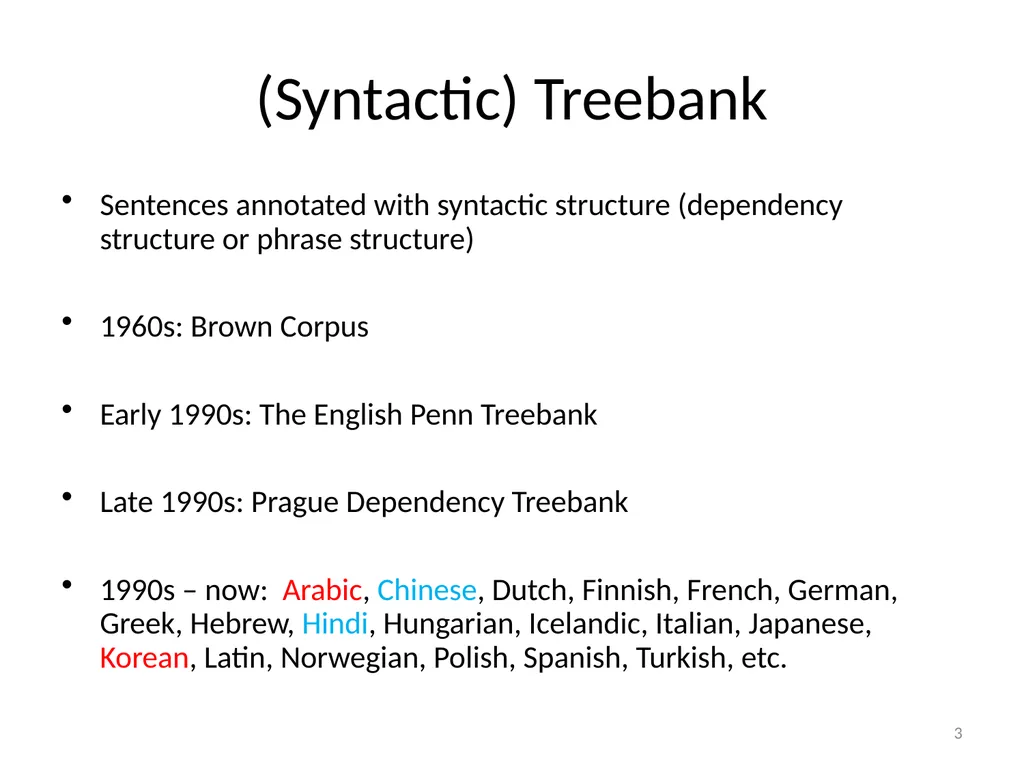
(Syntactic) Treebank Sentences annotated with syntactic structure (dependency structure or phrase structure)
1960s: Brown Corpus
Early 1990s: The English Penn Treebank
Late 1990s: Prague Dependency Treebank
1990s – now: Arabic, Chinese, Dutch, Finnish, French, German, Greek, Hebrew, Hindi, Hungarian, Icelandic, Italian, Japanese, Korean, Latin, Norwegian, Polish, Spanish, Turkish, etc. 3<br>
04
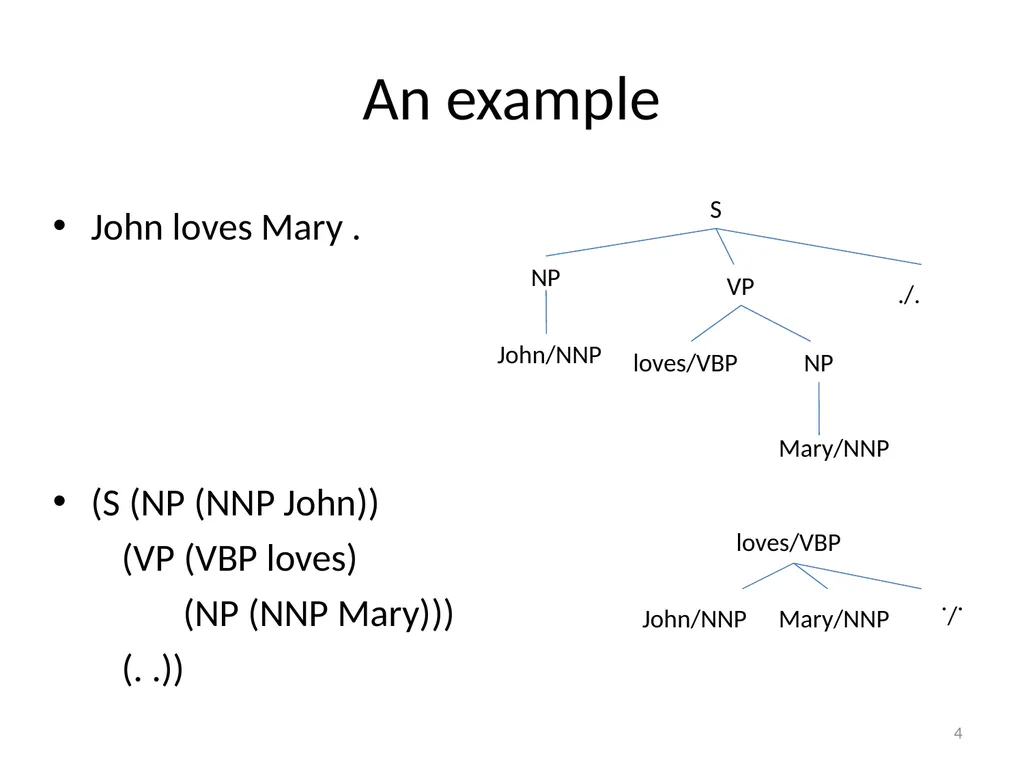
An example John loves Mary .
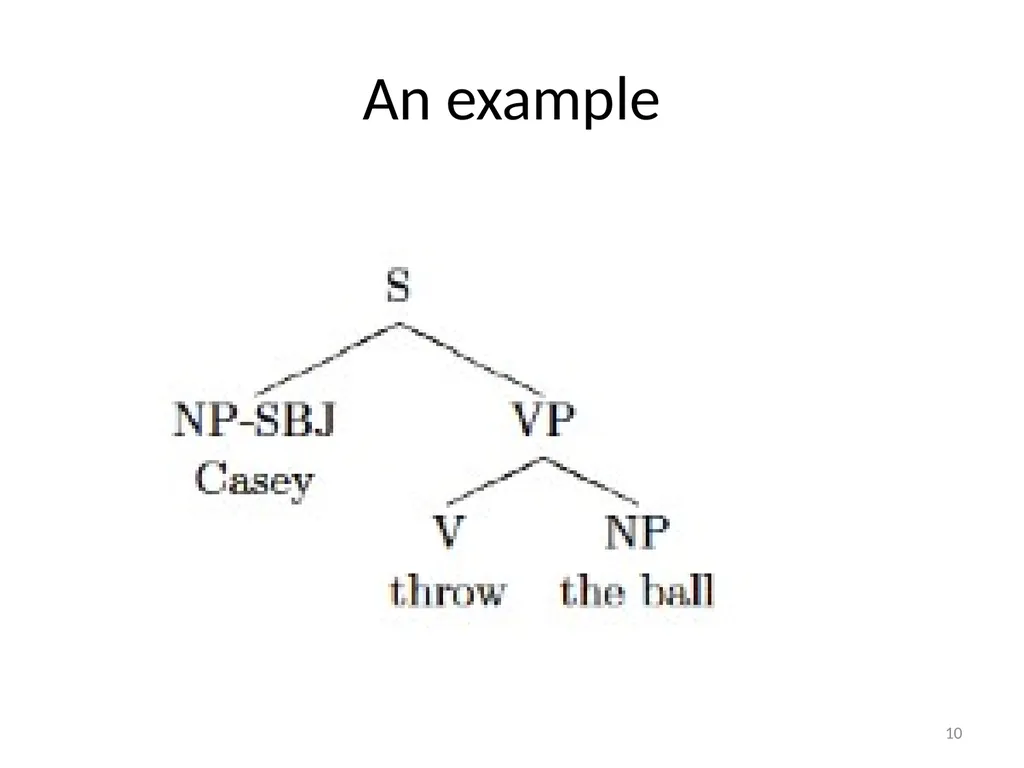
(S (NP (NNP John))
(VP (VBP loves)
(NP (NNP Mary)))
(. .)) 4<br>
05
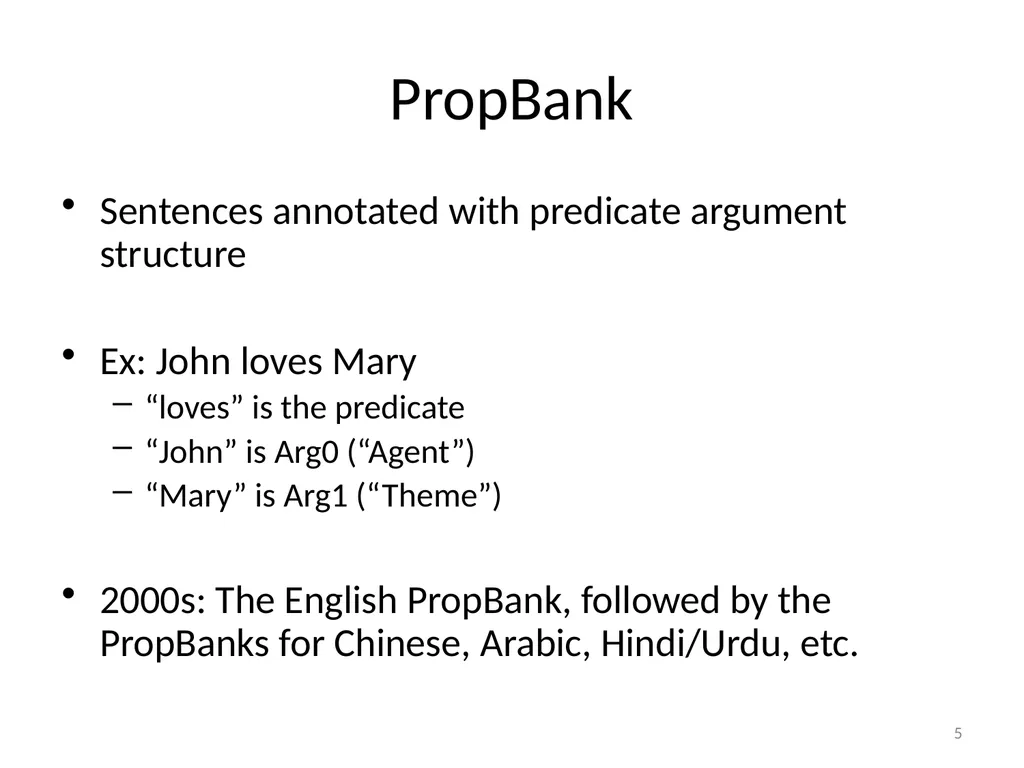
PropBank Sentences annotated with predicate argument structure
Ex: John loves Mary
“loves” is the predicate
“John” is Arg0 (“Agent”)
“Mary” is Arg1 (“Theme”)
2000s: The English PropBank, followed by the PropBanks for Chinese, Arabic, Hindi/Urdu, etc. 5<br>
06
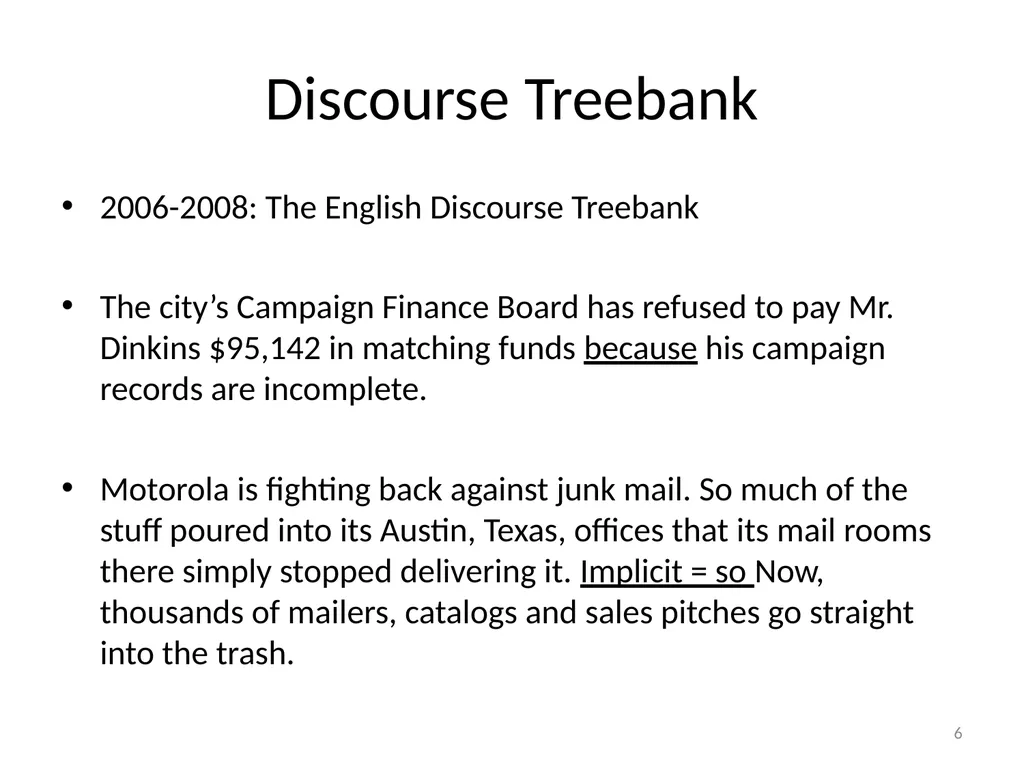
Discourse Treebank 2006-2008: The English Discourse Treebank
The city’s Campaign Finance Board has refused to pay Mr. Dinkins $95,142 in matching funds because his campaign records are incomplete.
Motorola is fighting back against junk mail. So much of the stuff poured into its Austin, Texas, offices that its mail rooms there simply stopped delivering it. Implicit = so Now, thousands of mailers, catalogs and sales pitches go straight into the trash. 6<br>
07
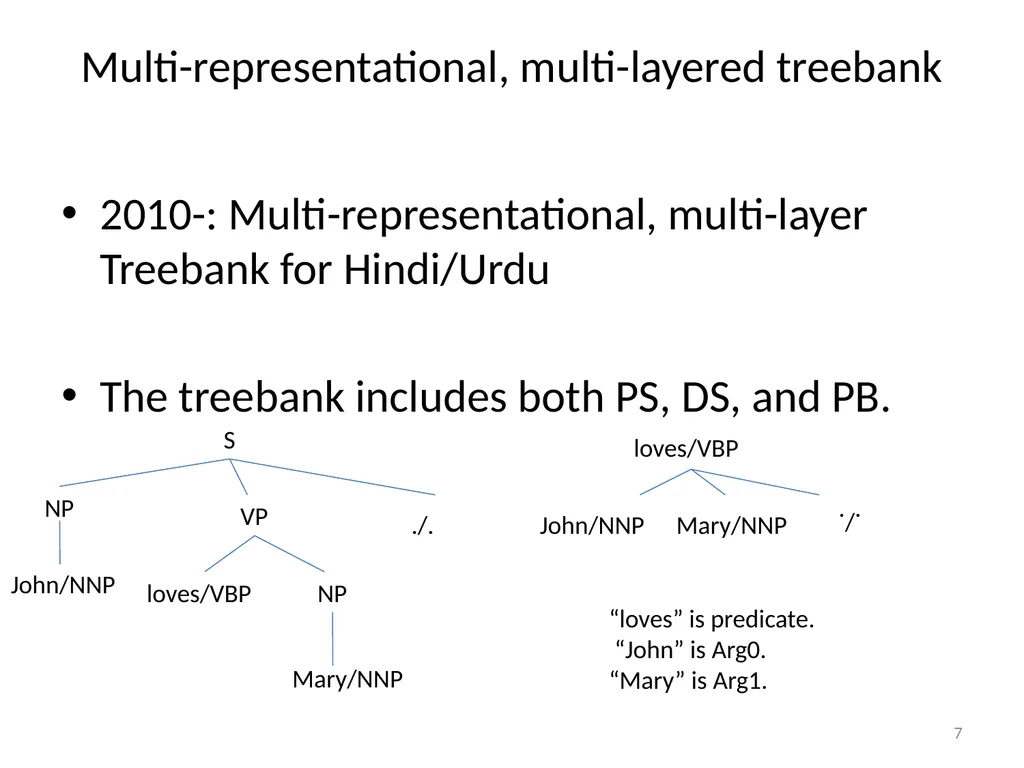
Multi-representational, multi-layered treebank 2010-: Multi-representational, multi-layer Treebank for Hindi/Urdu
The treebank includes both PS, DS, and PB. “loves” is predicate.
“John” is Arg0.
“Mary” is Arg1. 7<br>
08
Outline Types of treebanks
The English Penn Treebank
Why do we need treebanks?
Hw1 8<br>
09
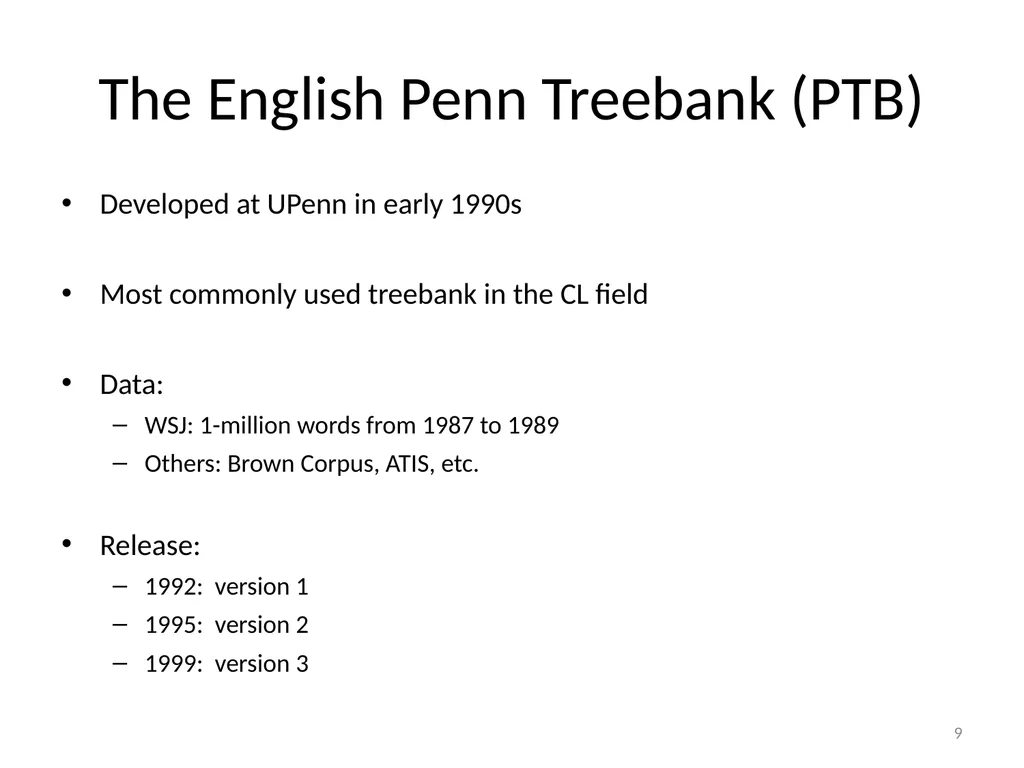
The English Penn Treebank (PTB) Developed at UPenn in early 1990s
Most commonly used treebank in the CL field
Data:
WSJ: 1-million words from 1987 to 1989
Others: Brown Corpus, ATIS, etc.
Release:
1992: version 1
1995: version 2
1999: version 3 9<br>
11
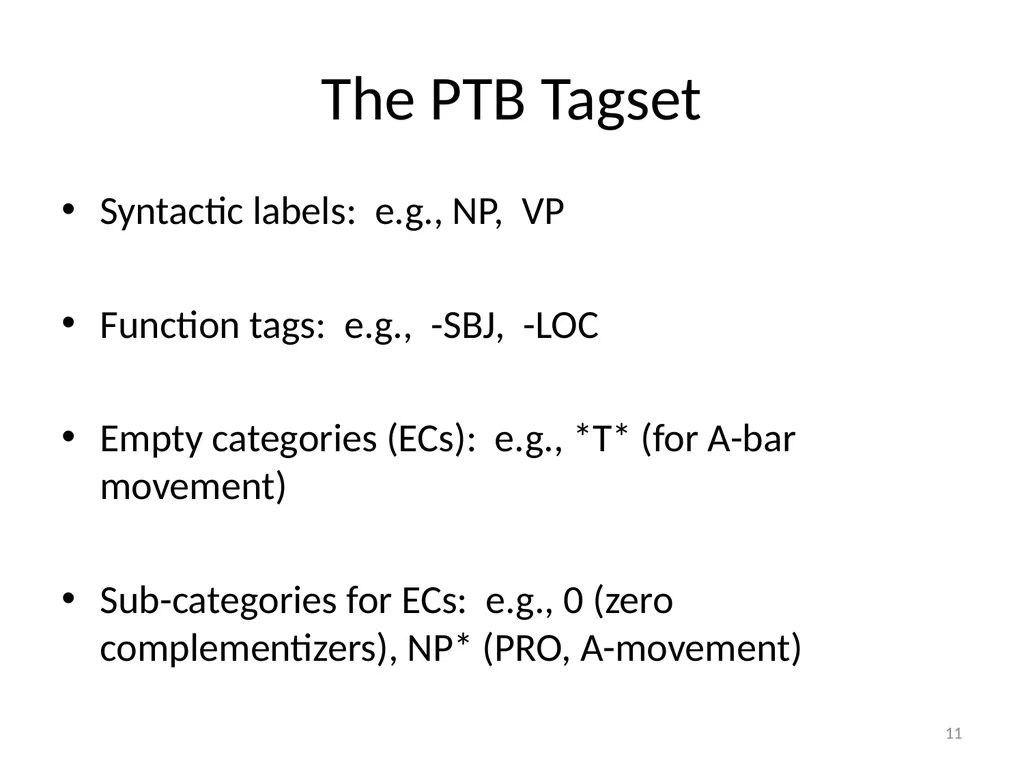
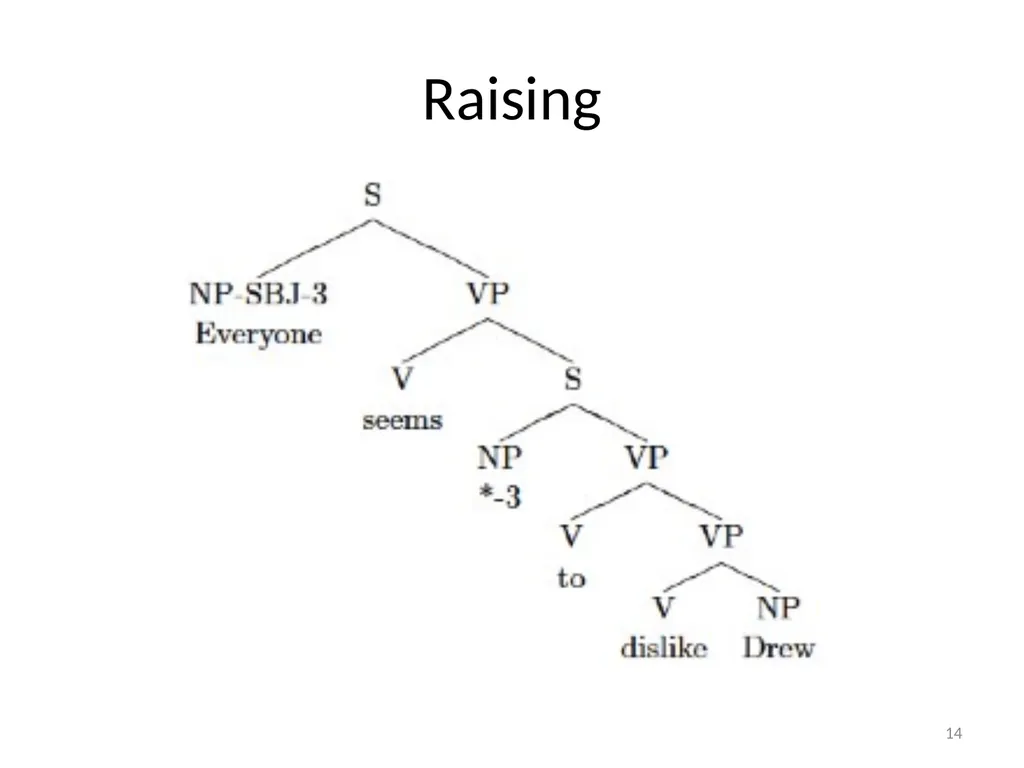
The PTB Tagset Syntactic labels: e.g., NP, VP
Function tags: e.g., -SBJ, -LOC
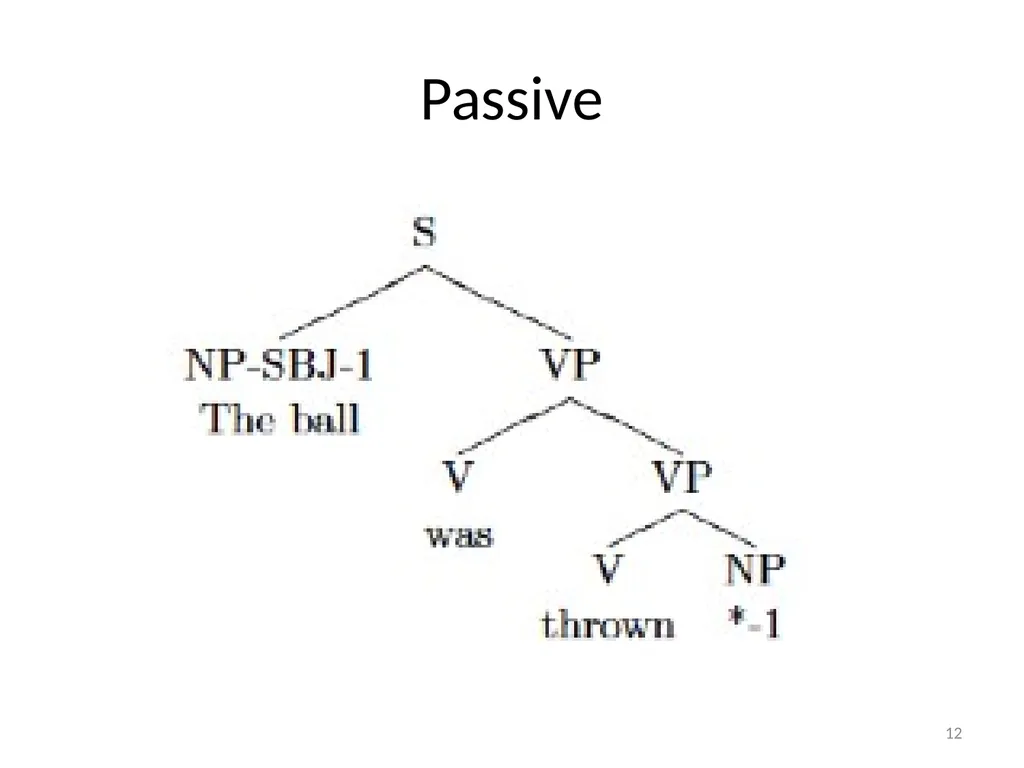
Empty categories (ECs): e.g., *T* (for A-bar movement)
Sub-categories for ECs: e.g., 0 (zero complementizers), NP* (PRO, A-movement) 11<br>
13
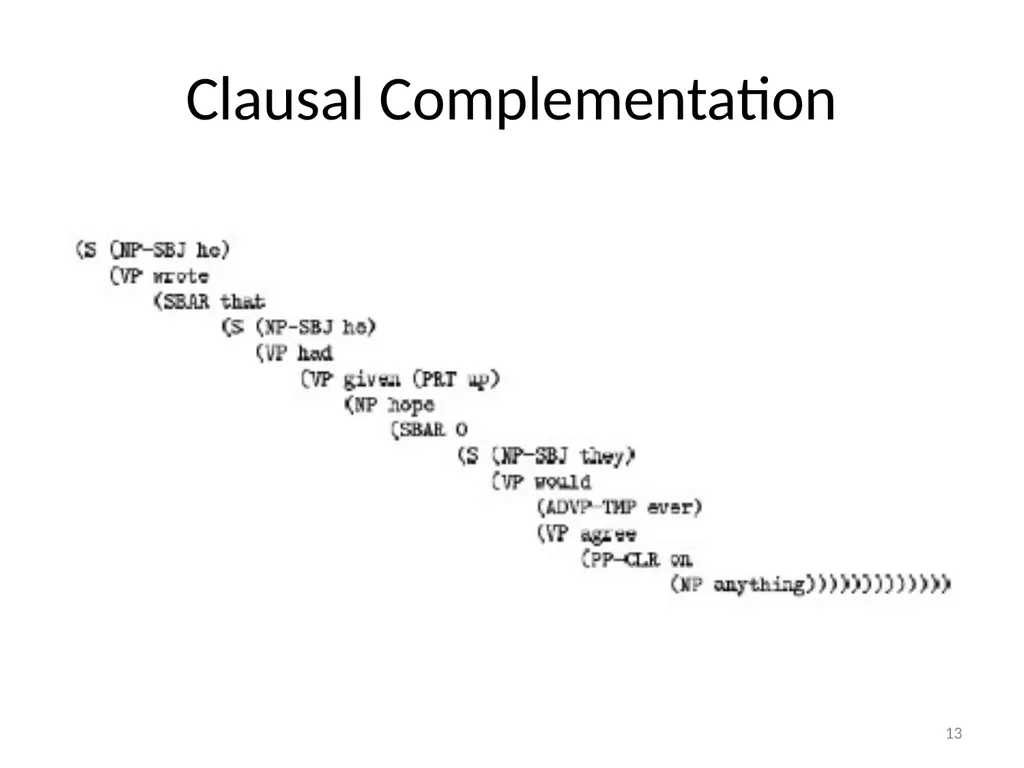
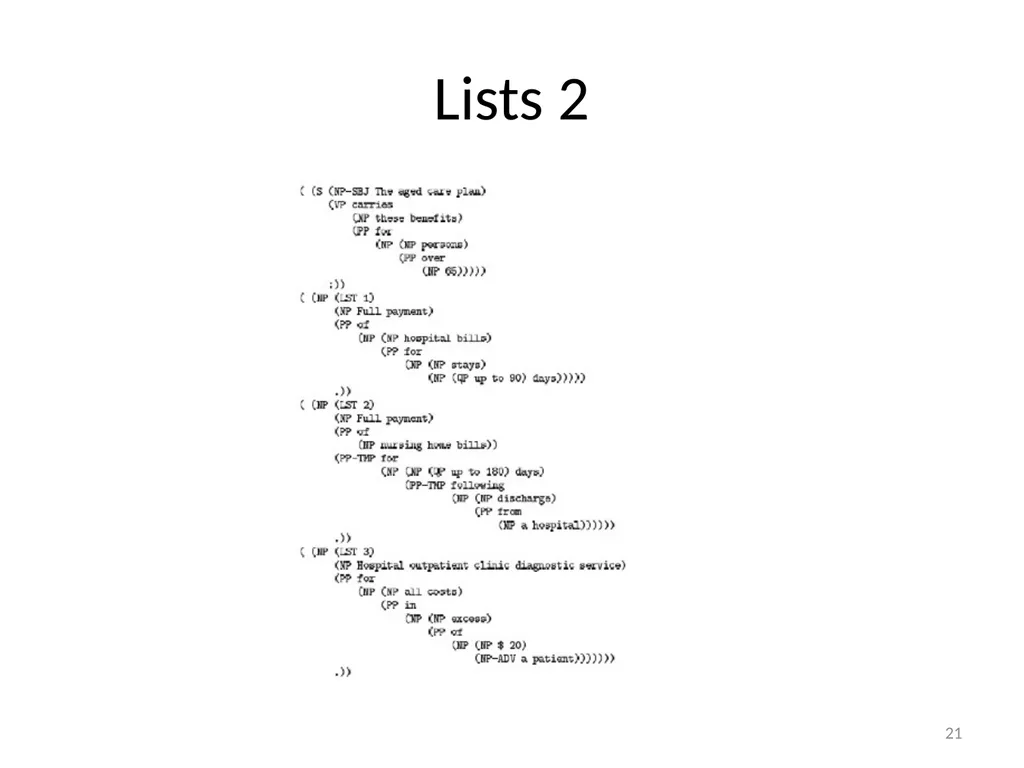
Clausal Complementation 13<br>
15
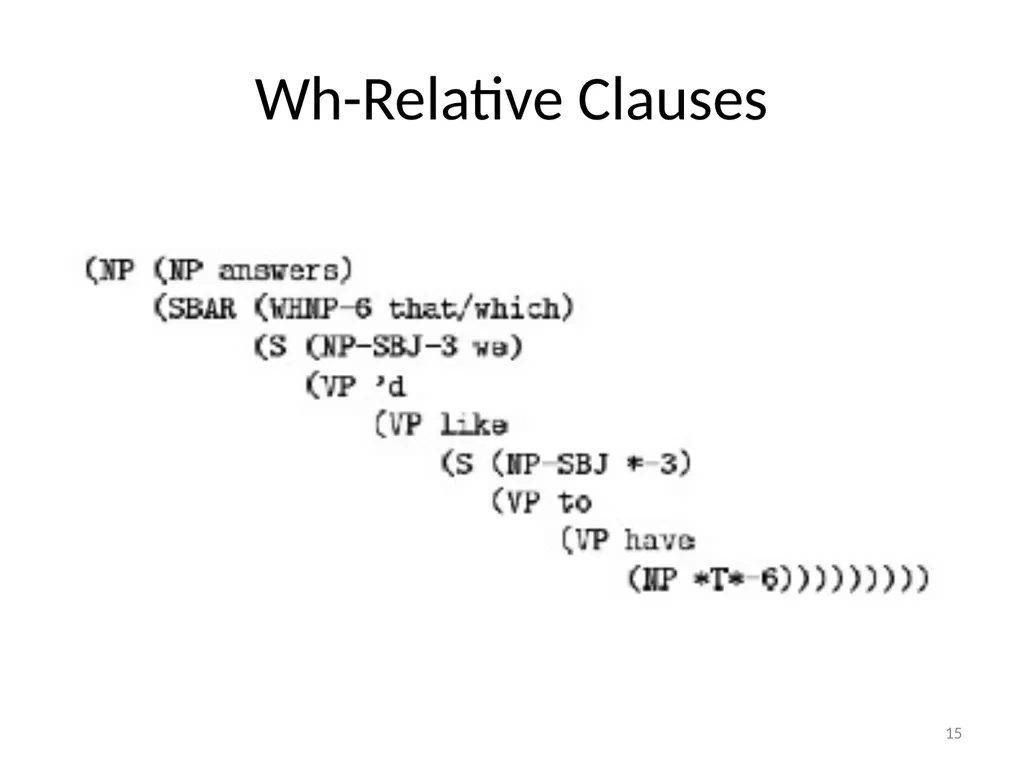
Wh-Relative Clauses 15<br>
16
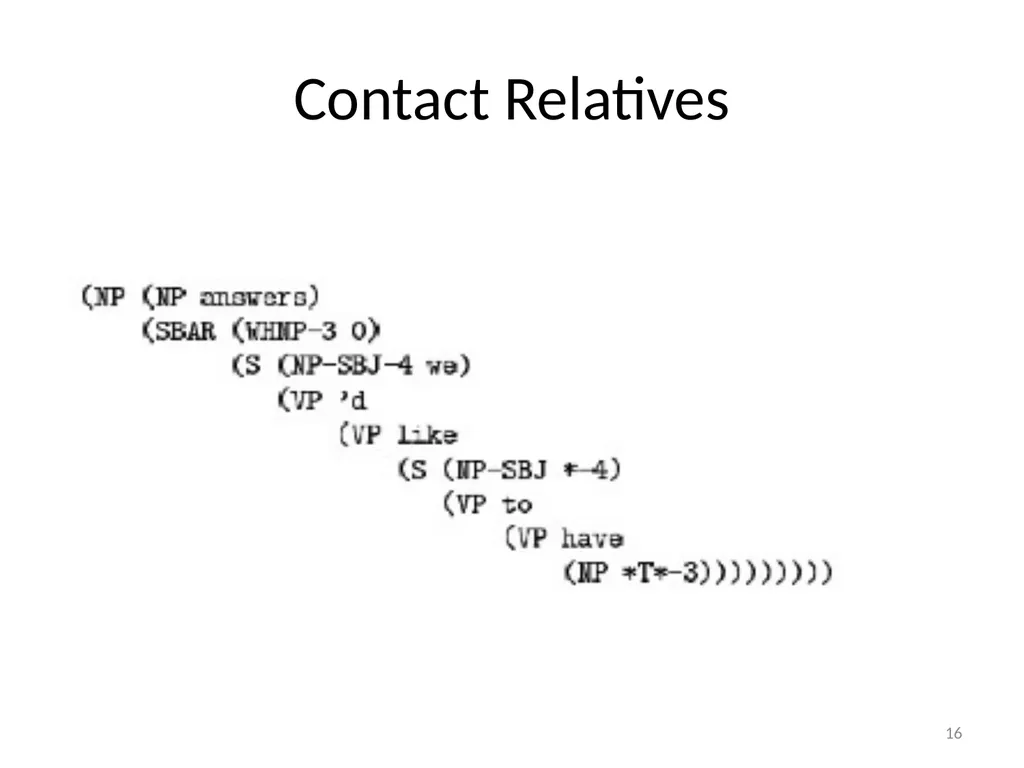
Contact Relatives 16<br>
17
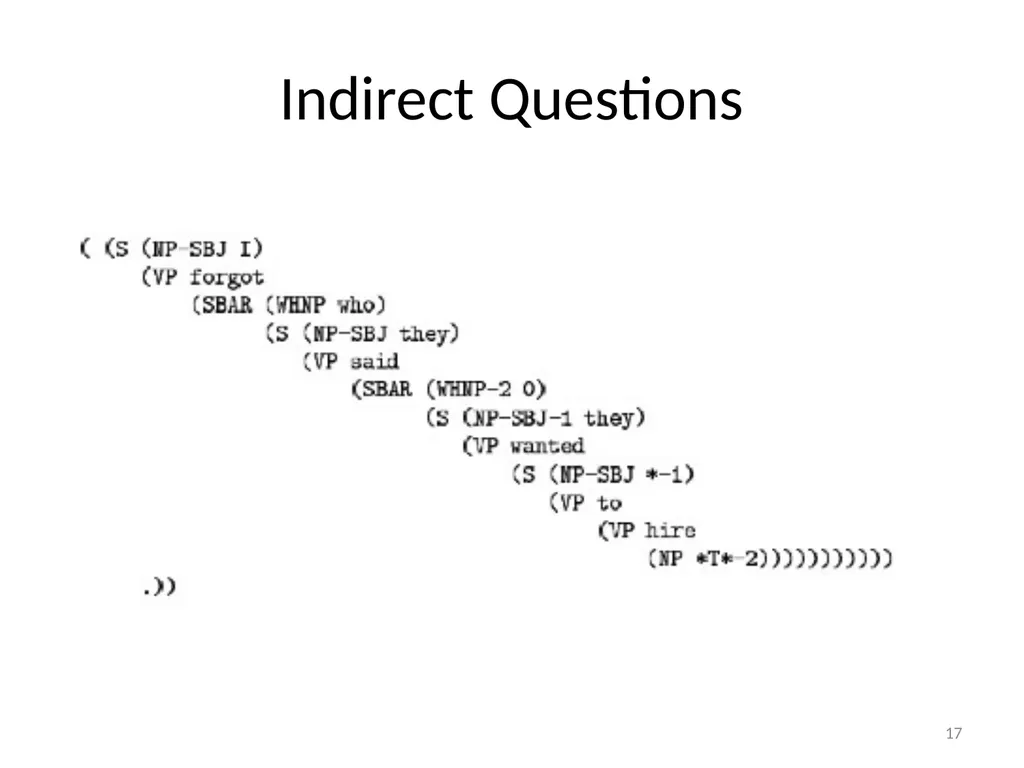
Indirect Questions 17<br>
22
Outline Types of treebanks
The English Penn Treebank
Why do we need treebanks?
Hw1 22<br>
23
Why do we need treebanks? Computational Linguistics: (Session 6-7)
To build and evaluate NLP tools (e.g., word segmenters, part-of-speech taggers, parsers, semantic role labelers)
This leads to significant progress of the CL field
Theoretic linguistics: (Session 2 and 5-6)
Annotation guidelines are like a grammar book, with more detail and coverage
As a discovery tool
One can test linguistic theories and collect statistics by searching treebanks. 23<br>
24
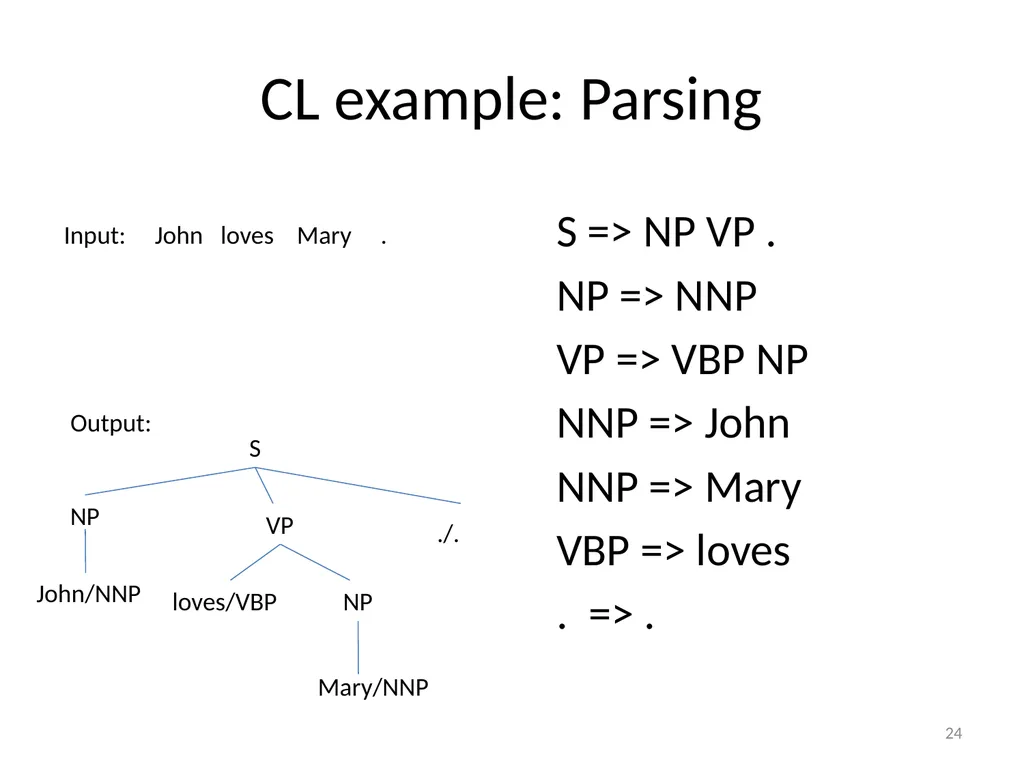
CL example: Parsing S => NP VP .
NP => NNP
VP => VBP NP
NNP => John
NNP => Mary
VBP => loves
. => . Input: John loves Mary . Output: 24<br>
25
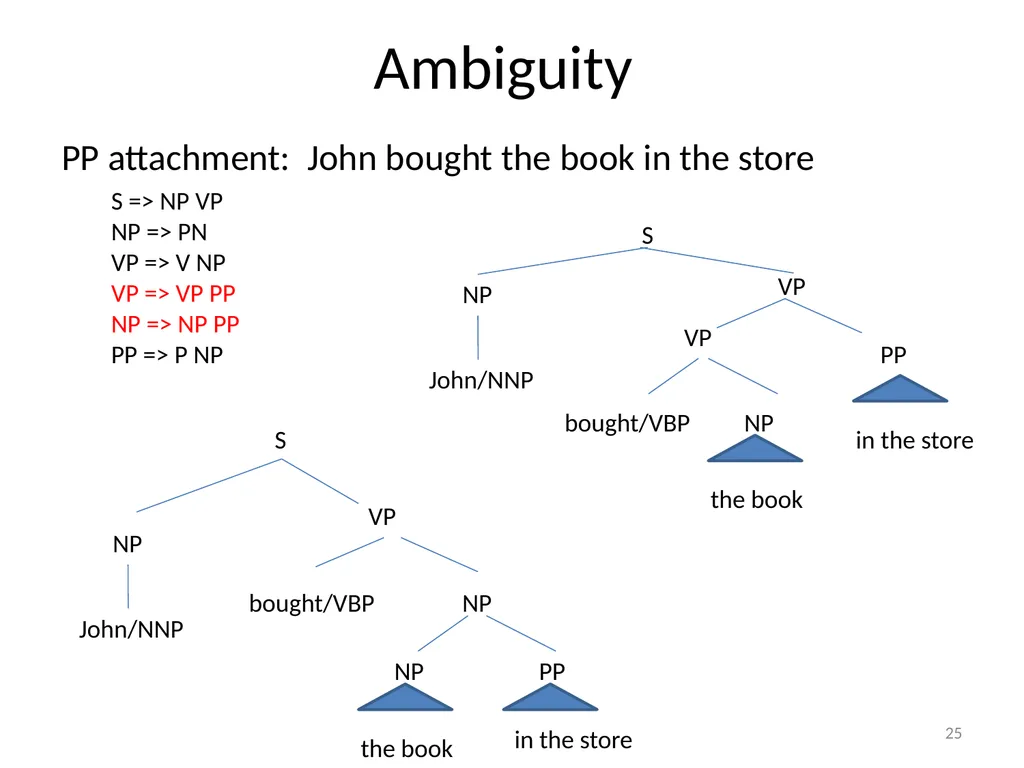
Ambiguity PP attachment: John bought the book in the store S S => NP VP
NP => PN
VP => V NP
VP => VP PP
NP => NP PP
PP => P NP S 25<br>
26
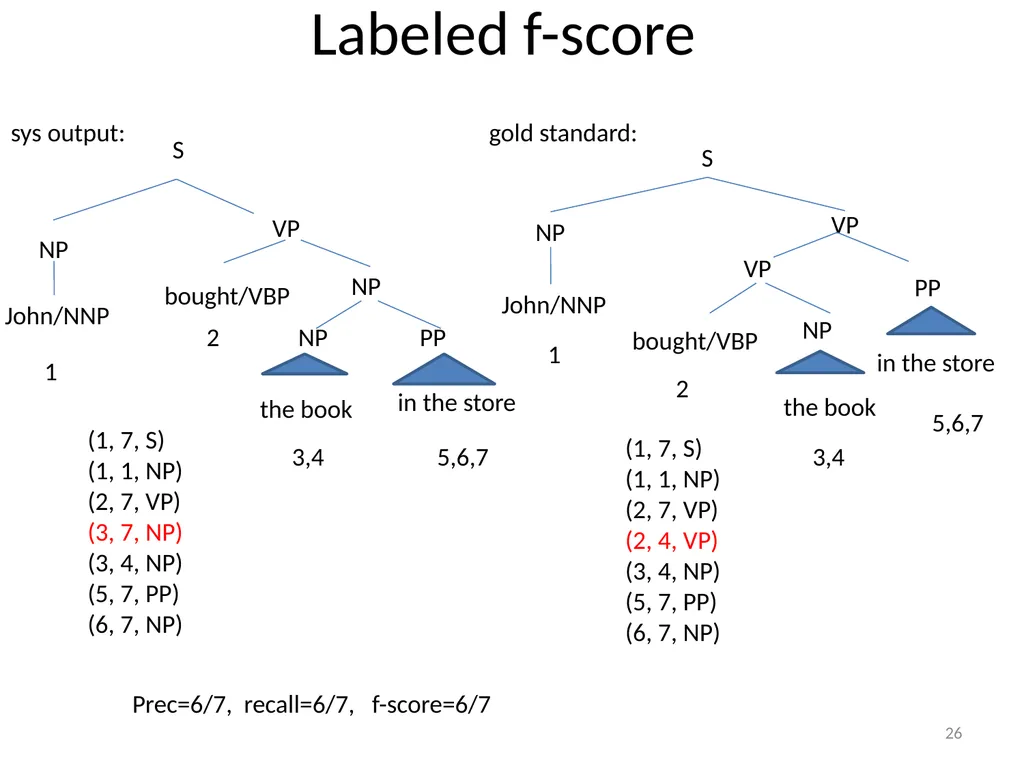
Labeled f-score S S 1 2 3,4 5,6,7 1 2 3,4 5,6,7 (1, 7, S)
(1, 1, NP)
(2, 7, VP)
(3, 7, NP)
(3, 4, NP)
(5, 7, PP)
(6, 7, NP) (1, 7, S)
(1, 1, NP)
(2, 7, VP)
(2, 4, VP)
(3, 4, NP)
(5, 7, PP)
(6, 7, NP) Prec=6/7, recall=6/7, f-score=6/7 sys output: gold standard: 26<br>
27
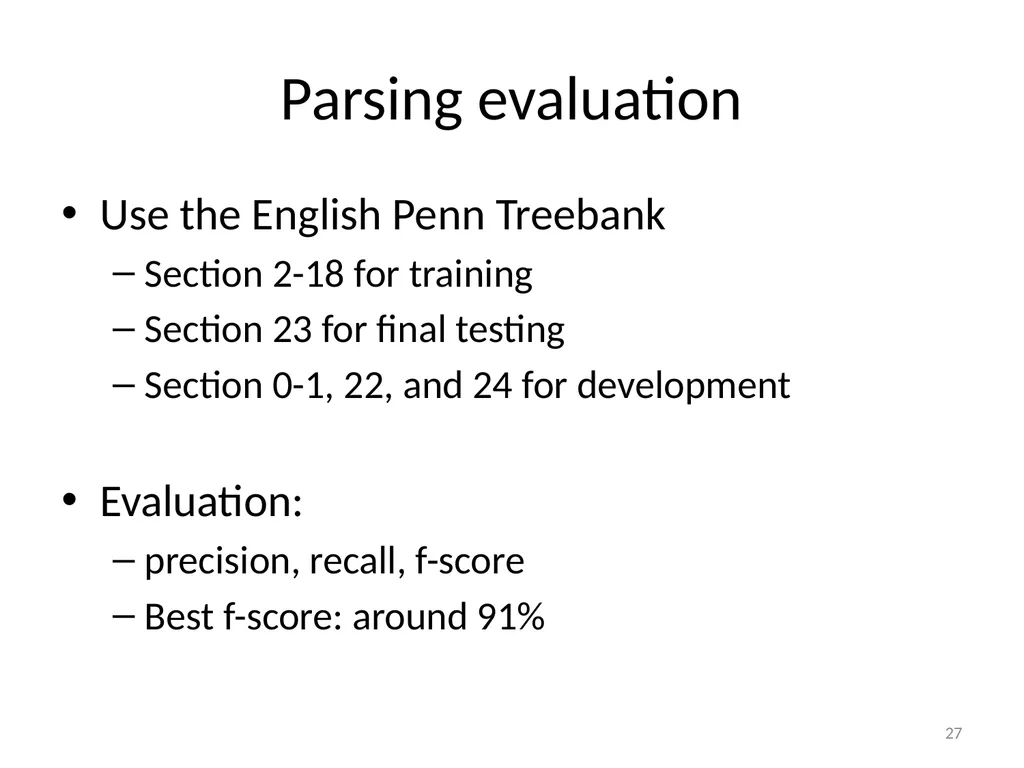
Parsing evaluation Use the English Penn Treebank
Section 2-18 for training
Section 23 for final testing
Section 0-1, 22, and 24 for development
Evaluation:
precision, recall, f-score
Best f-score: around 91% 27<br>
28
Outline Types of treebanks
The English Penn Treebank
Why do we need treebanks?
Hw1 28<br>
29
Hw1: required part Required reading: Chapters 1 and 2 of the PTB guidelines
Assignment:
pick a specific phenomenon handled by the PTB,
discuss the PTB treatment of this phenomenon, and
explain whether you concur with the treatment or not. If you do not, outline how you would have represented it differently. 29<br>