Introductions ..Might be the be-all and the end-all.. Shakespeare, MacBeth Brief explanation Introductions Dos Donts Overview: Brief Explanation Provide a map for readers: Intro: sets scene for reader Main body: visits areas of
"Introductions ‘..Might be the be-all and the" is the property of its rightful owner. Permission is granted to
download and print the materials on this website for personal, non-commercial use only, and to display it
on your personal computer provided you do not modify the materials and that you retain all copyright
notices contained in the materials. By downloading content from our website, you accept the terms of this
agreement.
Presentation Transcript
01
Introductions ‘..Might be the be-all and the end-all..’
Shakespeare, MacBeth<br>
02
Brief explanation
Introductions
Dos
Don’ts Overview:<br>
03
Brief
Explanation<br>
04
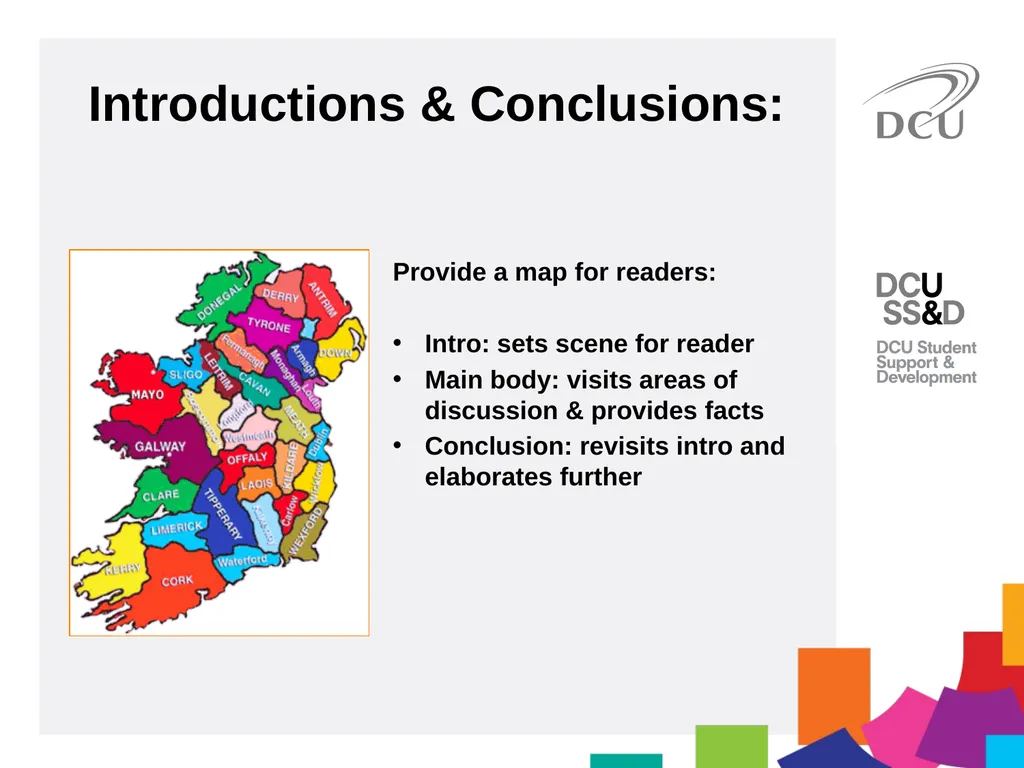
Provide a map for readers:
Intro: sets scene for reader
Main body: visits areas of discussion & provides facts
Conclusion: revisits intro and elaborates further Introductions & Conclusions:<br>
05
Crucial in assignment writing
Present central ideas
Provides outline of information & discussion
Arrange facts in a coherent structure
Give context to facts
Readily present arguments
Reminds the reader of purpose from start to end Introductions & Conclusions:<br>
06
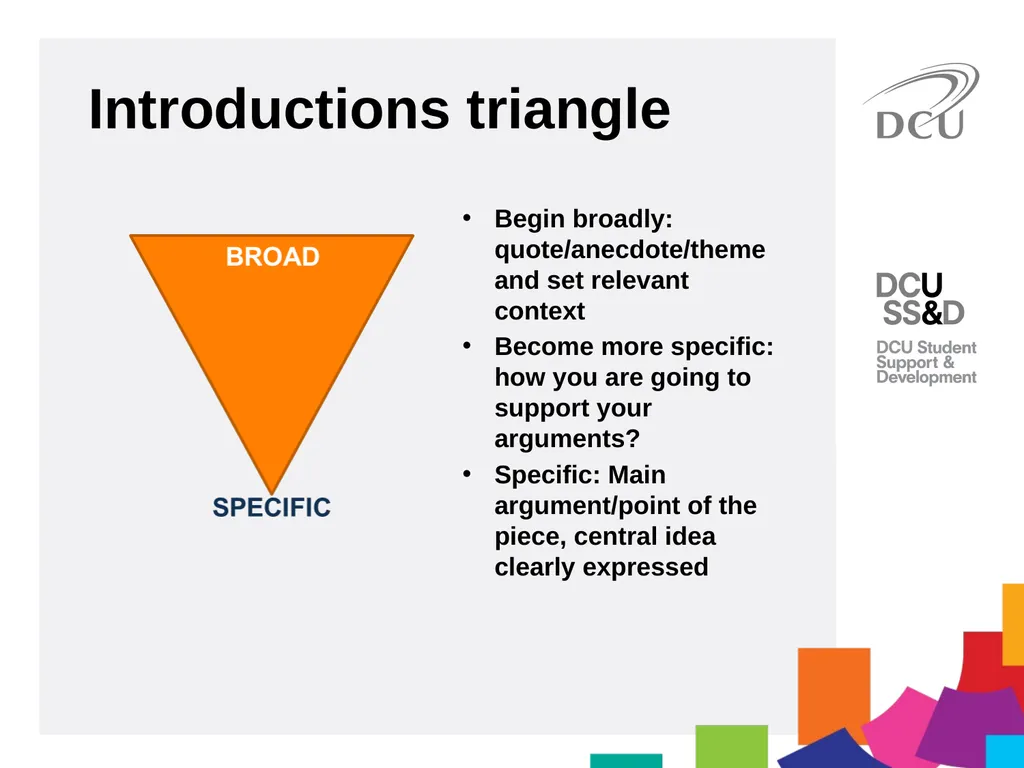
Begin broadly: quote/anecdote/theme and set relevant context
Become more specific: how you are going to support your arguments?
Specific: Main argument/point of the piece, central idea clearly expressed Introductions triangle<br>
07
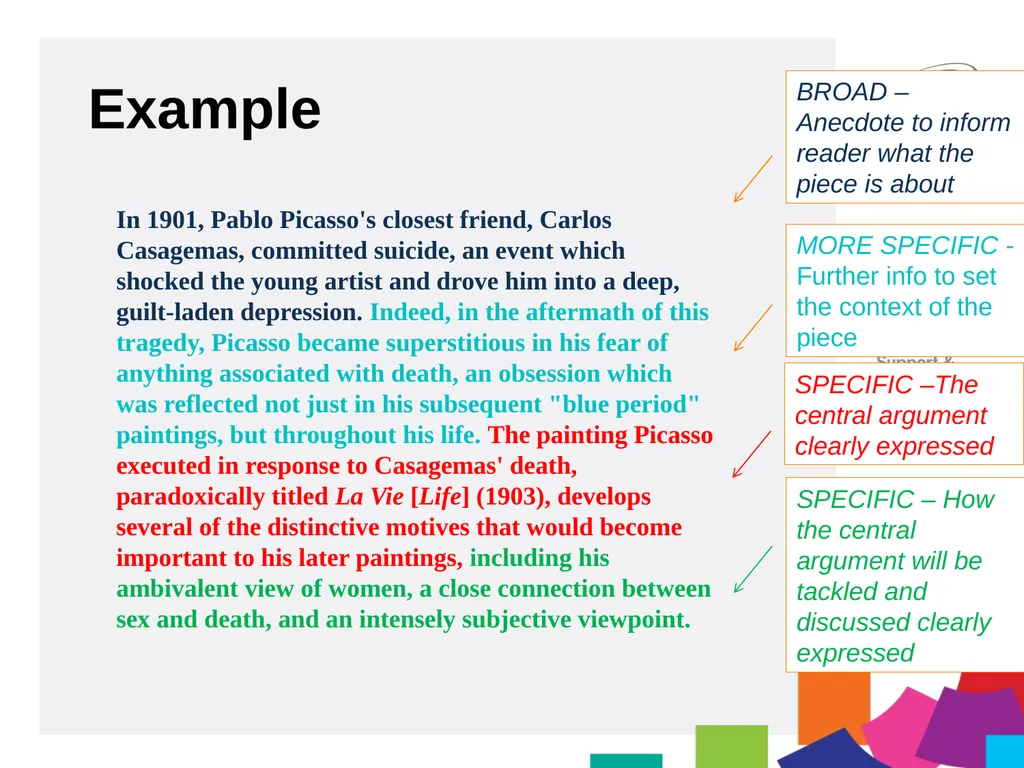
In 1901, Pablo Picasso's closest friend, Carlos Casagemas, committed suicide, an event which shocked the young artist and drove him into a deep, guilt-laden depression. Indeed, in the aftermath of this tragedy, Picasso became superstitious in his fear of anything associated with death, an obsession which was reflected not just in his subsequent "blue period" paintings, but throughout his life. The painting Picasso executed in response to Casagemas' death, paradoxically titled La Vie [Life] (1903), develops several of the distinctive motives that would become important to his later paintings, including his ambivalent view of women, a close connection between sex and death, and an intensely subjective viewpoint. Example<br>
08
YOUR BEST TOOL TO IMPRESS!
First impressions are ever lasting – impress your lecturer immediately
Encourage your reader to WANT to read your assignment
Positive impact
Helps with marking Introductions:<br>
09
Dos: Attract Attention
interesting anecdotes
questions to pique curiosity
apt quotations or statistics
provocative/personal questions or statements Introductions (2): Dos: Explain your piece of writing
The reader should have NO DOUBT as to what your assignment is about
The central point/argument should be CLEAR
The content of your assignment should be OUTLINED<br>
10
Dos: Establish significance
Make the reader see why the topic is important
Convince the reader to care about what you have to say Introductions (3): Dos: Preview how you will demonstrate your points
Briefly list how you will back up your argument
Prepare the reader for these methods
Improves recognition and retention of these points<br>
11
Introductions (4): Don’t: Overdo it!
Keep it short
Word count estimation (~10%)
Usually a single paragraph
Half a page or less Don’t: Introduce background or factual information
Avoid the impulse to start with the story
Data/discussion/historical background/etc. are for main body
Avoid definitions and specificities
Avoid generalisations<br>