
Introductions Your name Where you work Your job
PC
Published · 83 slides · 0 views

1 / 1



Description
Introductions Your name Where you work Your job responsibilities How long you have been in the industry What you hope to get from this class Course 8: Financial Mgmt 2 Agenda Investments Adding Value to the Investment Economic Analysis of a
Related Topics
Share
Embed code
Download this presentation From Below
"Introductions Your name Where you work Your job" is the property of its rightful owner. Permission is granted to download and print the materials on this website for personal, non-commercial use only, and to display it on your personal computer provided you do not modify the materials and that you retain all copyright notices contained in the materials. By downloading content from our website, you accept the terms of this agreement.
Presentation Transcript
01
Introductions Your name
Where you work
Your job responsibilities
How long you have been in the industry
What you hope to get from this class Course 8: Financial Mgmt 2<br>
Where you work
Your job responsibilities
How long you have been in the industry
What you hope to get from this class Course 8: Financial Mgmt 2<br>
02
Agenda Investments
Adding Value to the Investment
Economic Analysis of a Property
Budgets
Property Valuation Course 8: Financial Mgmt 3<br>
Adding Value to the Investment
Economic Analysis of a Property
Budgets
Property Valuation Course 8: Financial Mgmt 3<br>
03
Chapter 1: Investments We will discuss:
What are investments and whether to make them
Advantages and disadvantages of investing in multifamily housing
Different types of ownership and methods of financing Course 8: Financial Mgmt 4<br>
What are investments and whether to make them
Advantages and disadvantages of investing in multifamily housing
Different types of ownership and methods of financing Course 8: Financial Mgmt 4<br>
04
Definition: Investment An investment is the use of funds to earn a profit. Course 8: Financial Mgmt 5<br>
05
Four (4) Factors in Investment Risk – low risk = low return
high risk = high return
Income – may depend on risk involved
Growth – means a potential to increase in value >NOI = greater value
Liquidity - ability to convert to cash Course 8: Financial Mgmt 6<br>
high risk = high return
Income – may depend on risk involved
Growth – means a potential to increase in value >NOI = greater value
Liquidity - ability to convert to cash Course 8: Financial Mgmt 6<br>
06
Owner’s Objectives Why is it important to know the owner’s investment objectives for the property you manage? Course 8: Financial Mgmt 7<br>
07
Activity #1: How the Four Factors Affect Investments How do general economic and market conditions affect investments?
Why is it important to know the owner’s objectives for the property you manage? Course 8: Financial Mgmt 8<br>
Why is it important to know the owner’s objectives for the property you manage? Course 8: Financial Mgmt 8<br>
08
Performance Measures Rate of return on investment (ROI)
Cash-on-cash return
Capitalization rate
Internal rate of return (IRR) Course 8: Financial Mgmt 9<br>
Cash-on-cash return
Capitalization rate
Internal rate of return (IRR) Course 8: Financial Mgmt 9<br>
09
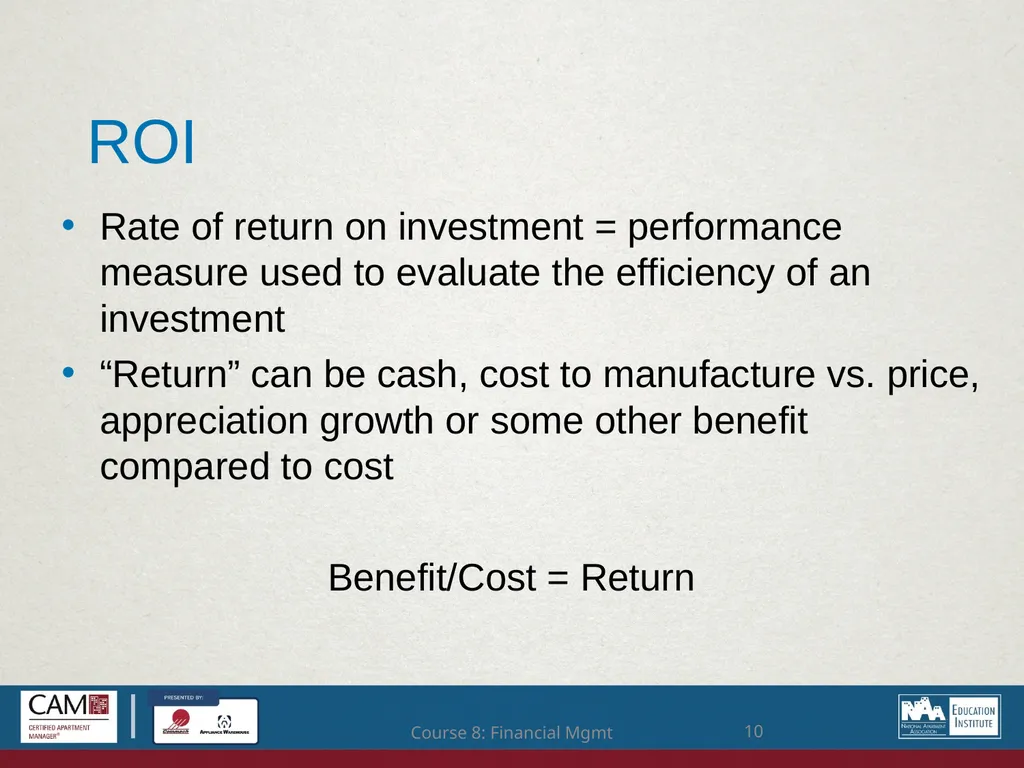
ROI Rate of return on investment = performance measure used to evaluate the efficiency of an investment
“Return” can be cash, cost to manufacture vs. price, appreciation growth or some other benefit compared to cost
Benefit/Cost = Return Course 8: Financial Mgmt 10<br>
“Return” can be cash, cost to manufacture vs. price, appreciation growth or some other benefit compared to cost
Benefit/Cost = Return Course 8: Financial Mgmt 10<br>
10
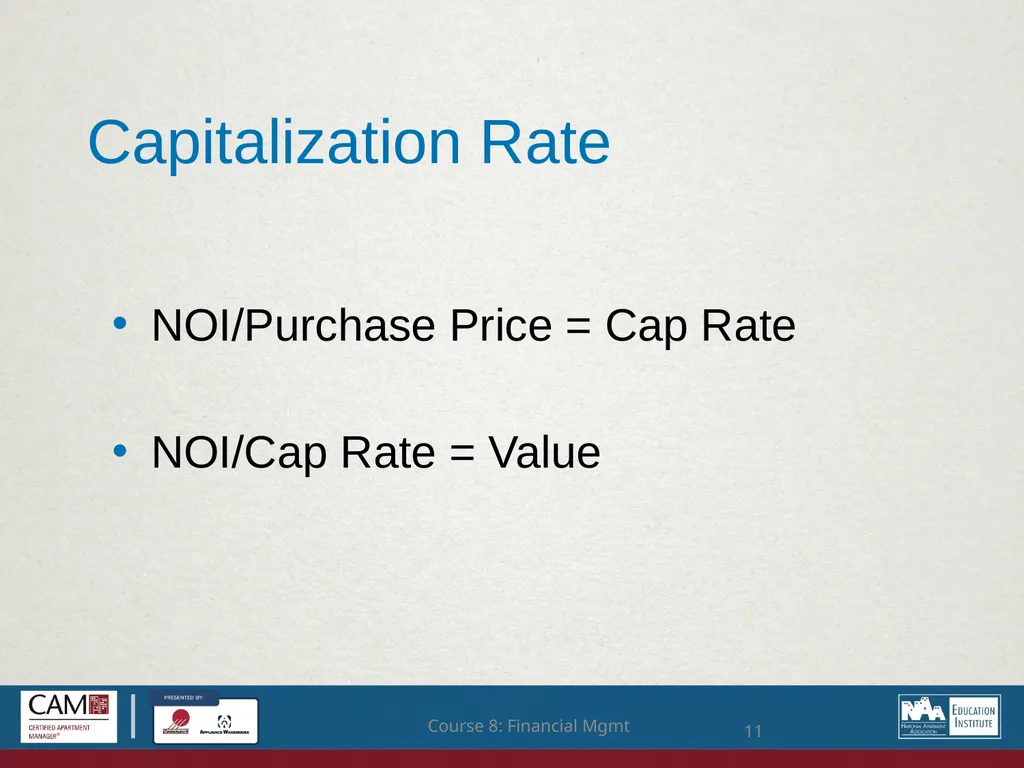
Capitalization Rate NOI/Purchase Price = Cap Rate
NOI/Cap Rate = Value Course 8: Financial Mgmt 11<br>
NOI/Cap Rate = Value Course 8: Financial Mgmt 11<br>
11
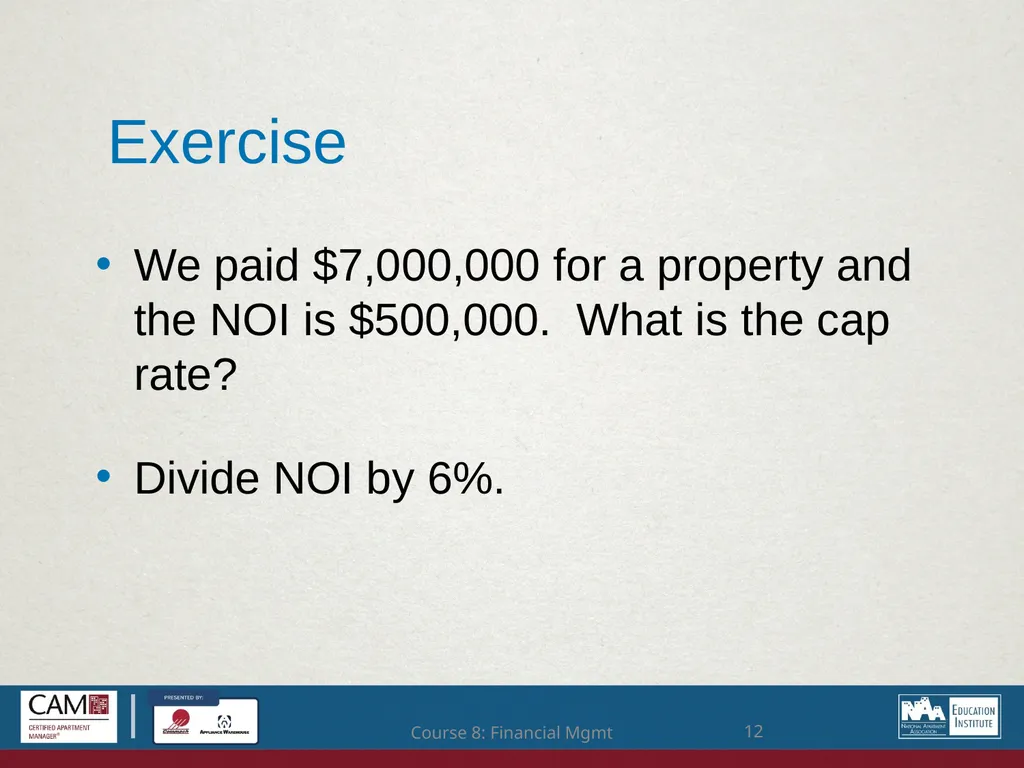
Exercise We paid $7,000,000 for a property and the NOI is $500,000. What is the cap rate?
Divide NOI by 6%. Course 8: Financial Mgmt 12<br>
Divide NOI by 6%. Course 8: Financial Mgmt 12<br>
12
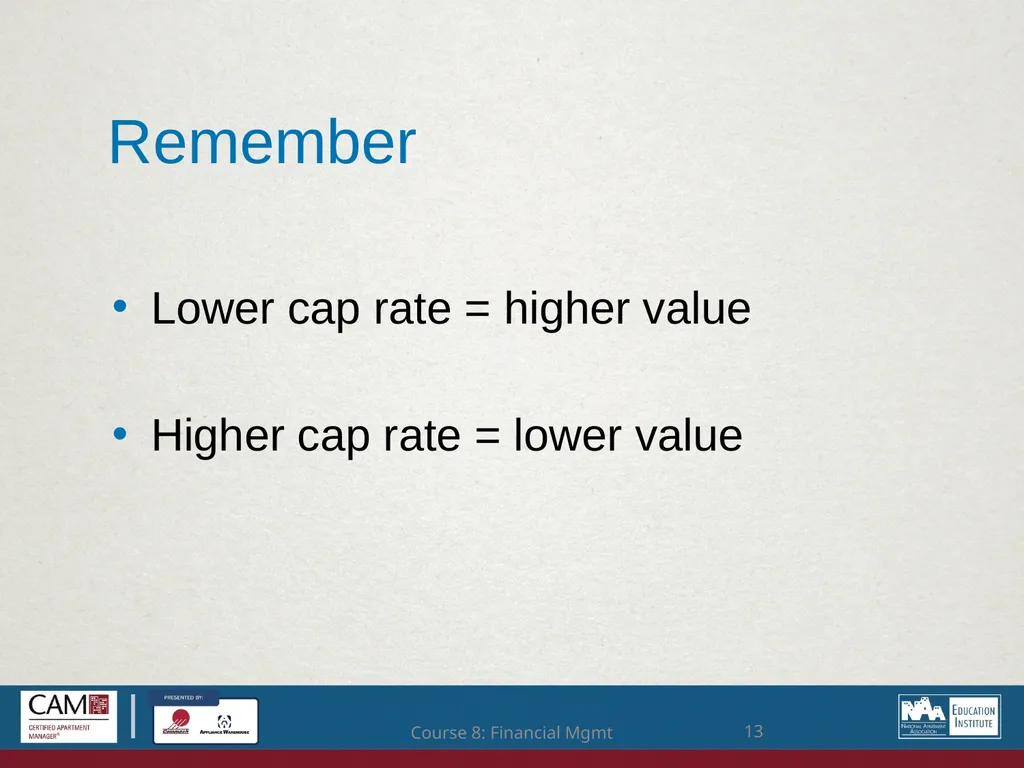
Remember Lower cap rate = higher value
Higher cap rate = lower value Course 8: Financial Mgmt 13<br>
Higher cap rate = lower value Course 8: Financial Mgmt 13<br>
13
Advantages of Investments Advantages include:
Periodic cash payments
Potential for increase in value
Reduction in income taxes due to depreciation
Ability to invest using borrowed funds Course 8: Financial Mgmt 14<br>
Periodic cash payments
Potential for increase in value
Reduction in income taxes due to depreciation
Ability to invest using borrowed funds Course 8: Financial Mgmt 14<br>
14
Disadvantages of Investments Disadvantages include:
Real estate is not a liquid asset
Active participation is often required
Potential for risk (natural disasters, changes in market conditions) Course 8: Financial Mgmt 15<br>
Real estate is not a liquid asset
Active participation is often required
Potential for risk (natural disasters, changes in market conditions) Course 8: Financial Mgmt 15<br>
15
Forms of Ownership Direct ownership/sole proprietor
Limited liability partnership
Limited liability corporation
S corporation
Joint venture
Real Estate Investment Trusts (REITs)
Tenants in Common (TICs) Course 8: Financial Mgmt 16<br>
Limited liability partnership
Limited liability corporation
S corporation
Joint venture
Real Estate Investment Trusts (REITs)
Tenants in Common (TICs) Course 8: Financial Mgmt 16<br>
16
Types of mortgages Fixed rate
Variable rate
Balloon
Bullet loan Course 8: Financial Mgmt 17<br>
Variable rate
Balloon
Bullet loan Course 8: Financial Mgmt 17<br>
17
Where to obtain a mortgage Commercial banks
Finance companies
Savings and loan institutions
Insurance companies
Pension funds
Mutual funds
Federal government (Freddie Mac, Fannie Mae) Course 8: Financial Mgmt 18<br>
Finance companies
Savings and loan institutions
Insurance companies
Pension funds
Mutual funds
Federal government (Freddie Mac, Fannie Mae) Course 8: Financial Mgmt 18<br>
18
Skill Check #1 Chapter 1- Investments Course 8: Financial Mgmt 19<br>
19
Chapter 2 Adding Value to the Investment Course 8: Financial Mgmt 20<br>
20
Adding Value: CAM Responsibilities Generating and collecting as much income as possible
Controlling expenses
Meeting the financial goals of the investment Course 8: Financial Mgmt 21<br>
Controlling expenses
Meeting the financial goals of the investment Course 8: Financial Mgmt 21<br>
21
Additional ways to add value: Reduced staff turnover and lower personnel costs
Reduced resident turnover with better customer service
Aggressive rental rates set by unit type
New income sources through resident services
Better collection of resident charges Course 8: Financial Mgmt 22<br>
Reduced resident turnover with better customer service
Aggressive rental rates set by unit type
New income sources through resident services
Better collection of resident charges Course 8: Financial Mgmt 22<br>
22
Sources of Income Rent
Administrative Fees
Parking/Garage fees
Pet fees
Laundry room/Vending Late fees/collection fees
Clubhouse rental/video rental
Car wash
Cable/Internet/ Phone Course 8: Financial Mgmt 23<br>
Administrative Fees
Parking/Garage fees
Pet fees
Laundry room/Vending Late fees/collection fees
Clubhouse rental/video rental
Car wash
Cable/Internet/ Phone Course 8: Financial Mgmt 23<br>
23
Types of Expenses Maintenance
Administrative
Salaries/Personnel
Taxes Insurance
Utilities
Contract services
Advertising and Marketing Course 8: Financial Mgmt 24<br>
Administrative
Salaries/Personnel
Taxes Insurance
Utilities
Contract services
Advertising and Marketing Course 8: Financial Mgmt 24<br>
24
Three Factors That Affect Rental Income Competitive rental rents
Physical occupancy
Collection percent or economic occupancy Course 8: Financial Mgmt 25<br>
Physical occupancy
Collection percent or economic occupancy Course 8: Financial Mgmt 25<br>
25
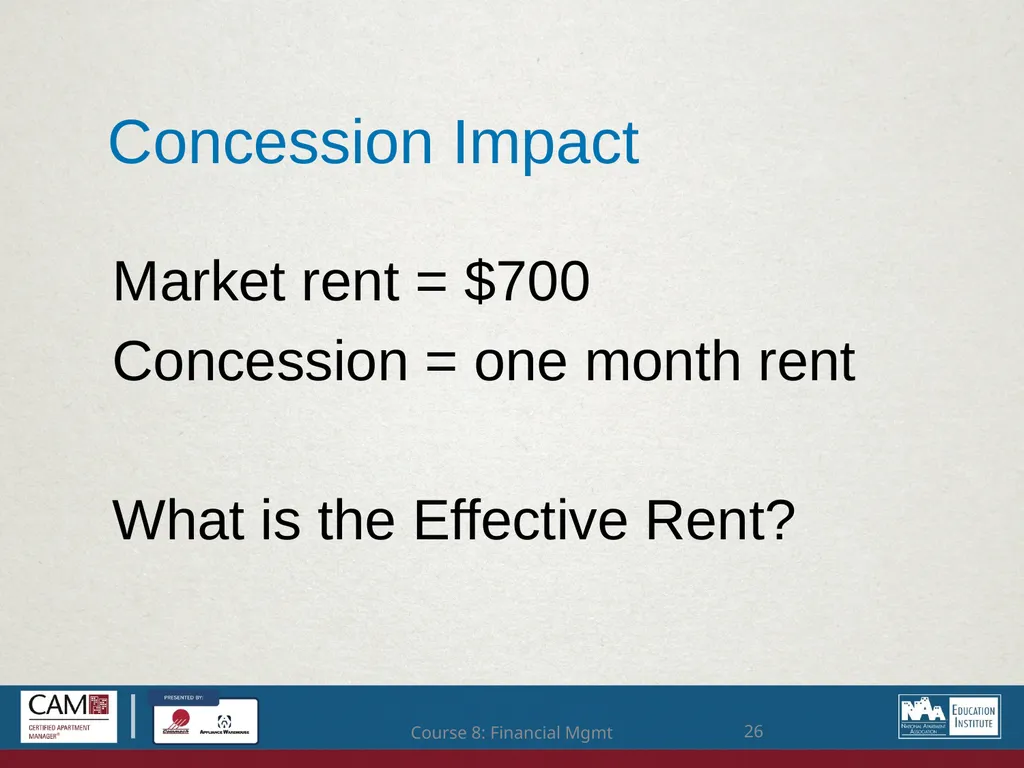
Concession Impact Market rent = $700
Concession = one month rent
What is the Effective Rent? Course 8: Financial Mgmt 26<br>
Concession = one month rent
What is the Effective Rent? Course 8: Financial Mgmt 26<br>
26
Law of Supply and Demand If the demand is high and the supply is low, higher prices can be obtained.
If demand is low and the supply is high, rents must be made competitive to attract residents. Course 8: Financial Mgmt 27<br>
If demand is low and the supply is high, rents must be made competitive to attract residents. Course 8: Financial Mgmt 27<br>
27
Economic Conditions Population growth
Household formation
Job creation Course 8: Financial Mgmt 28<br>
Household formation
Job creation Course 8: Financial Mgmt 28<br>
28
Balancing Rental Rates and Vacancies The goal is to maximize income, not occupancy
Pricing too high may cause longer vacancy
Pricing too low means you are losing money while the unit is occupied Course 8: Financial Mgmt 29<br>
Pricing too high may cause longer vacancy
Pricing too low means you are losing money while the unit is occupied Course 8: Financial Mgmt 29<br>
29
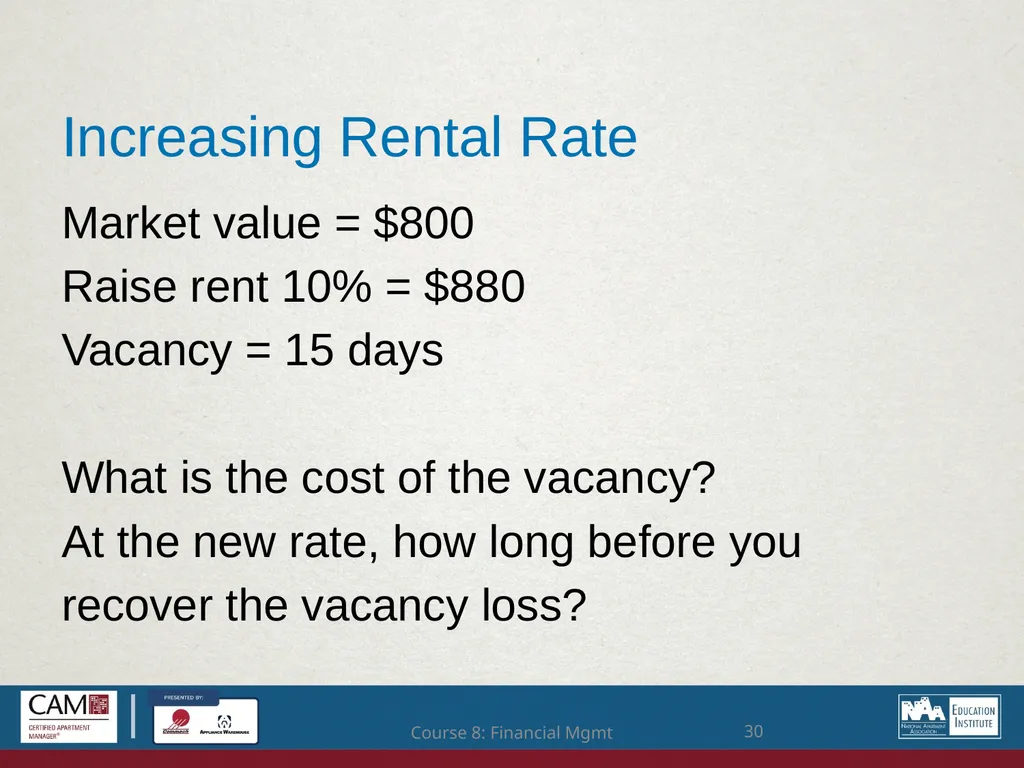
Increasing Rental Rate Market value = $800
Raise rent 10% = $880
Vacancy = 15 days
What is the cost of the vacancy?
At the new rate, how long before you
recover the vacancy loss? Course 8: Financial Mgmt 30<br>
Raise rent 10% = $880
Vacancy = 15 days
What is the cost of the vacancy?
At the new rate, how long before you
recover the vacancy loss? Course 8: Financial Mgmt 30<br>
30
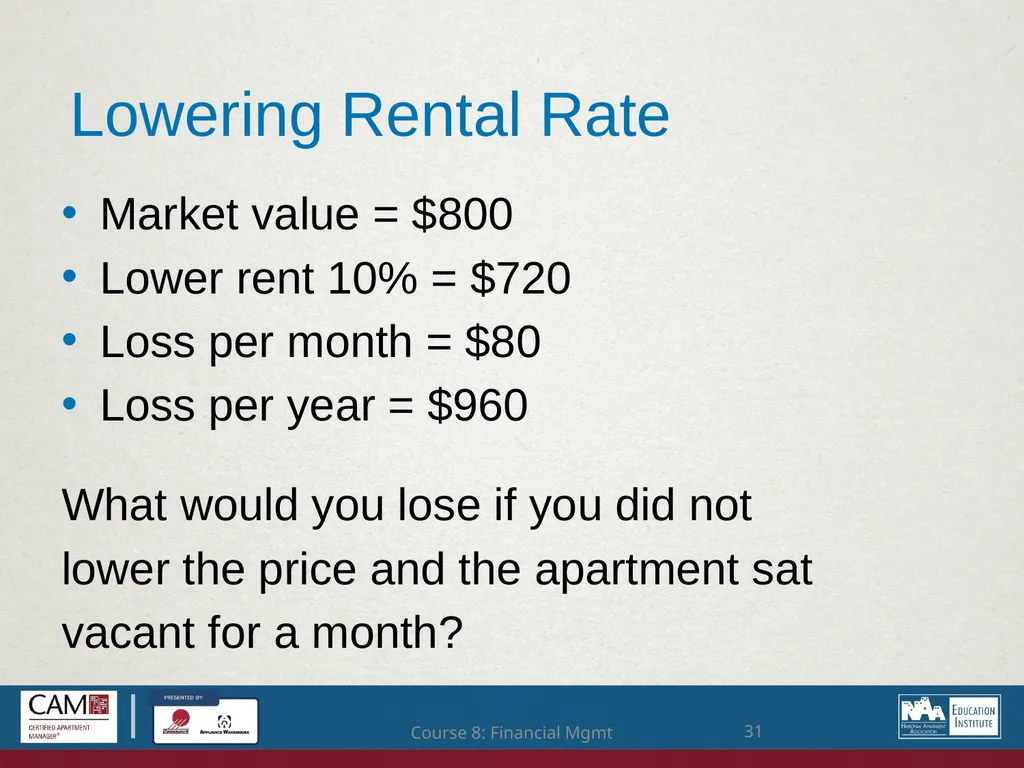
Lowering Rental Rate Market value = $800
Lower rent 10% = $720
Loss per month = $80
Loss per year = $960
What would you lose if you did not
lower the price and the apartment sat
vacant for a month? Course 8: Financial Mgmt 31<br>
Lower rent 10% = $720
Loss per month = $80
Loss per year = $960
What would you lose if you did not
lower the price and the apartment sat
vacant for a month? Course 8: Financial Mgmt 31<br>
31
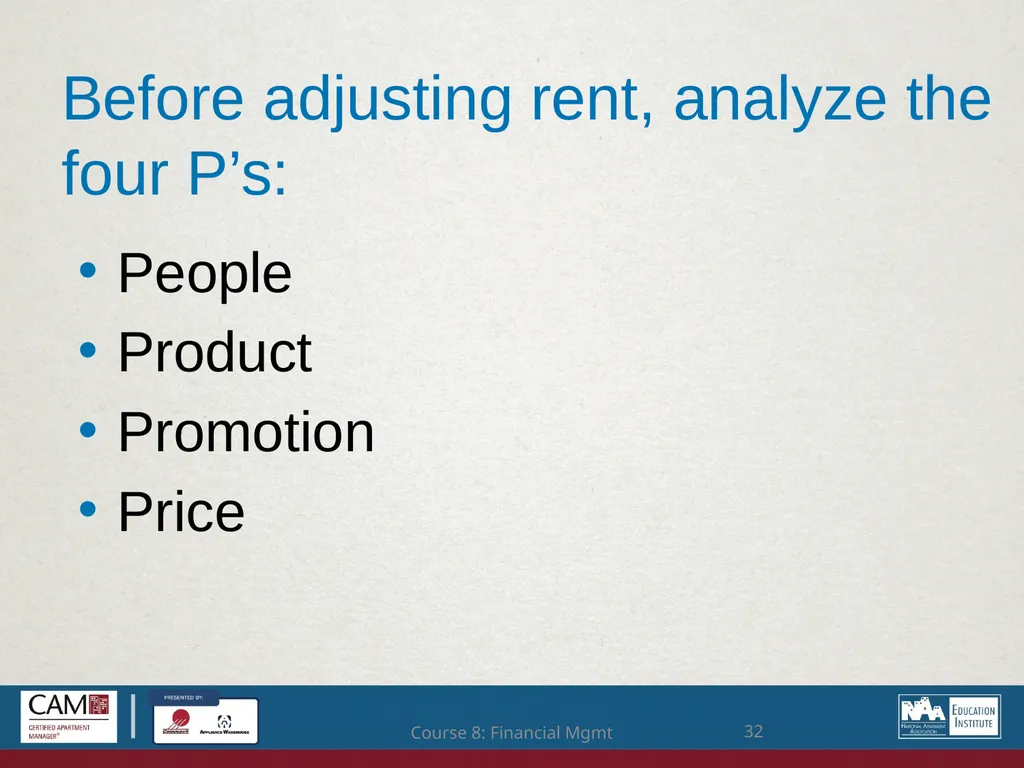
Before adjusting rent, analyze the four P’s: People
Product
Promotion
Price Course 8: Financial Mgmt 32<br>
Product
Promotion
Price Course 8: Financial Mgmt 32<br>
32
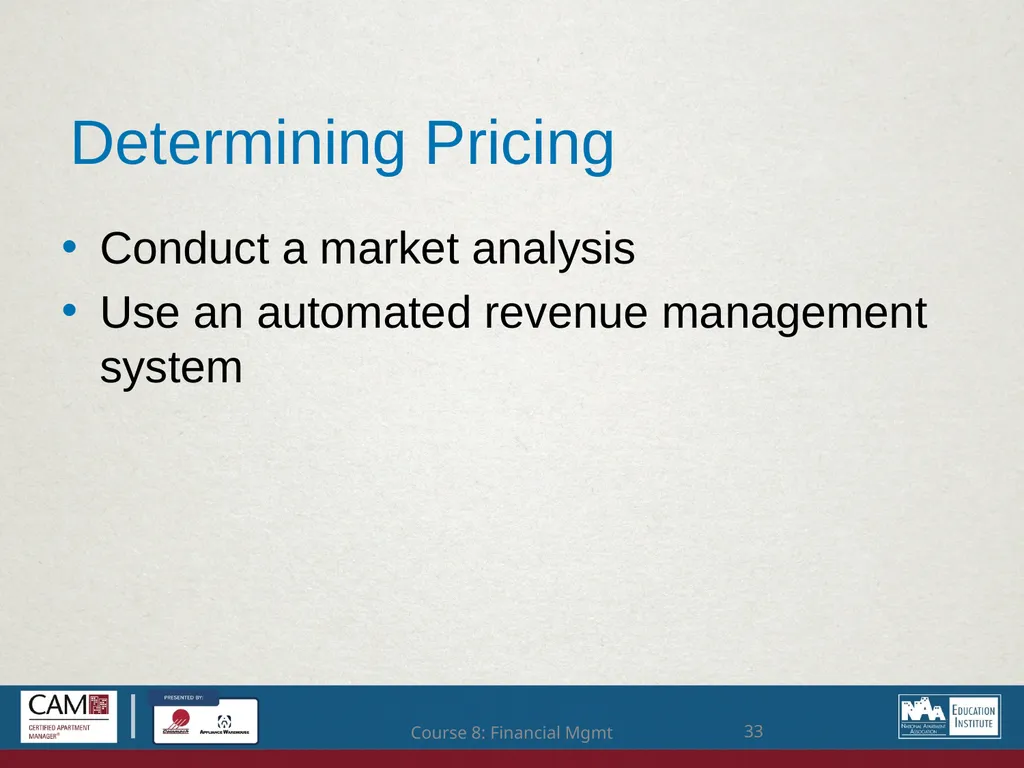
Determining Pricing Conduct a market analysis
Use an automated revenue management system Course 8: Financial Mgmt 33<br>
Use an automated revenue management system Course 8: Financial Mgmt 33<br>
33
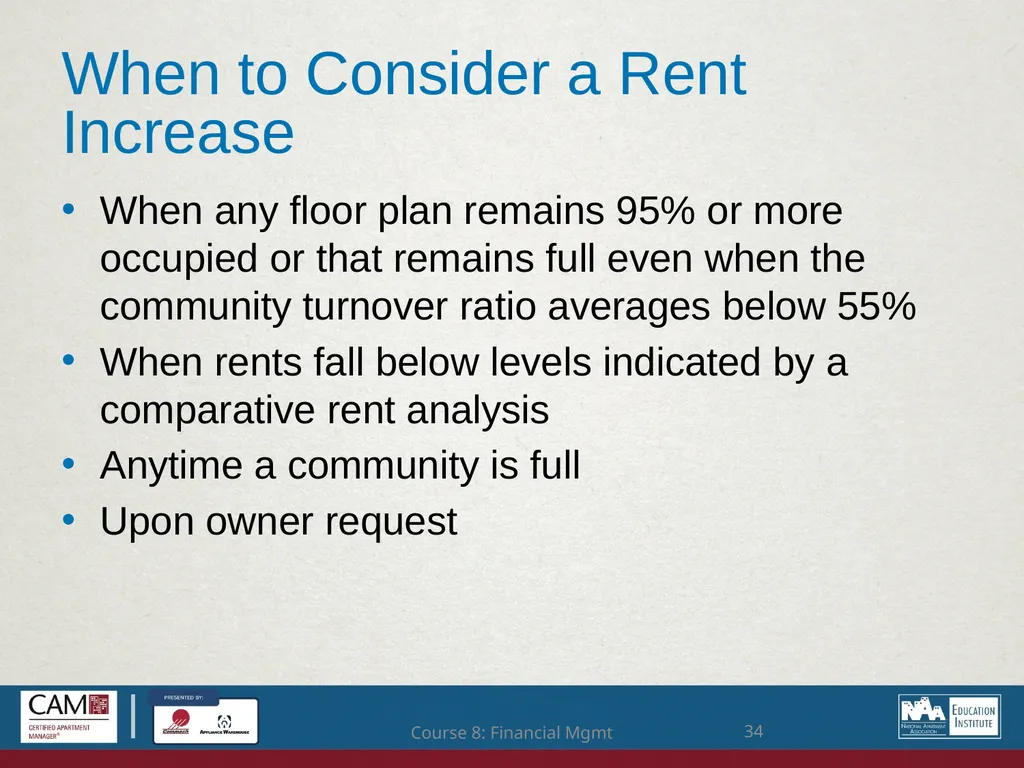
When to Consider a Rent Increase When any floor plan remains 95% or more occupied or that remains full even when the community turnover ratio averages below 55%
When rents fall below levels indicated by a comparative rent analysis
Anytime a community is full
Upon owner request Course 8: Financial Mgmt 34<br>
When rents fall below levels indicated by a comparative rent analysis
Anytime a community is full
Upon owner request Course 8: Financial Mgmt 34<br>
34
Rental Increases: Current residents Increase rent as leases expire, OR
Increase rent selectively on expired leases using a quantifiable, non-discriminatory standard (years of residence or number of previous renewals)
Consider a renewal rate that is slightly lower than the new market rate as an incentive to stay
Provide 60 days’ notice prior to the effective date of the increase Course 8: Financial Mgmt 35<br>
Increase rent selectively on expired leases using a quantifiable, non-discriminatory standard (years of residence or number of previous renewals)
Consider a renewal rate that is slightly lower than the new market rate as an incentive to stay
Provide 60 days’ notice prior to the effective date of the increase Course 8: Financial Mgmt 35<br>
35
Managing Occupancy: Reports Occupancy reports
Rent roll
Delinquency report
Deposit/Income reports
Concession report
Demographics report Course 8: Financial Mgmt 36<br>
Rent roll
Delinquency report
Deposit/Income reports
Concession report
Demographics report Course 8: Financial Mgmt 36<br>
36
Managing Occupancy: Methods Calculate occupancy trend
Manage lease expirations
Calculate turnover ratio Course 8: Financial Mgmt 37<br>
Manage lease expirations
Calculate turnover ratio Course 8: Financial Mgmt 37<br>
37
Activity #2: Adding Value Course 8: Financial Mgmt 38<br>
38
Expenses Fixed – property taxes, insurance
Variable –utilities, turnover costs, etc.
Capital- appliances, HVAC, etc.
Replacement Reserve Account
Debt service Course 8: Financial Mgmt 39<br>
Variable –utilities, turnover costs, etc.
Capital- appliances, HVAC, etc.
Replacement Reserve Account
Debt service Course 8: Financial Mgmt 39<br>
39
Cost Benefit Analysis Potential Expense
Dollars
Time
Image
Potential Benefit
Income
Time
Employee satisfaction
Market position
Image Course 8: Financial Mgmt 40<br>
Dollars
Time
Image
Potential Benefit
Income
Time
Employee satisfaction
Market position
Image Course 8: Financial Mgmt 40<br>
40
Accounting Practices Budget control log
Invoices
Purchase discounts
Check request or payment vouchers
Petty cash
Resident records
Resident security deposit
Collection of former resident accounts Course 8: Financial Mgmt 41<br>
Invoices
Purchase discounts
Check request or payment vouchers
Petty cash
Resident records
Resident security deposit
Collection of former resident accounts Course 8: Financial Mgmt 41<br>
41
Skill Check #2 Chapter 2: Adding Value to the
Investment Course 8: Financial Mgmt 42<br>
Investment Course 8: Financial Mgmt 42<br>
42
Chapter 3 Economic Analysis of a Property Course 8: Financial Mgmt 43<br>
43
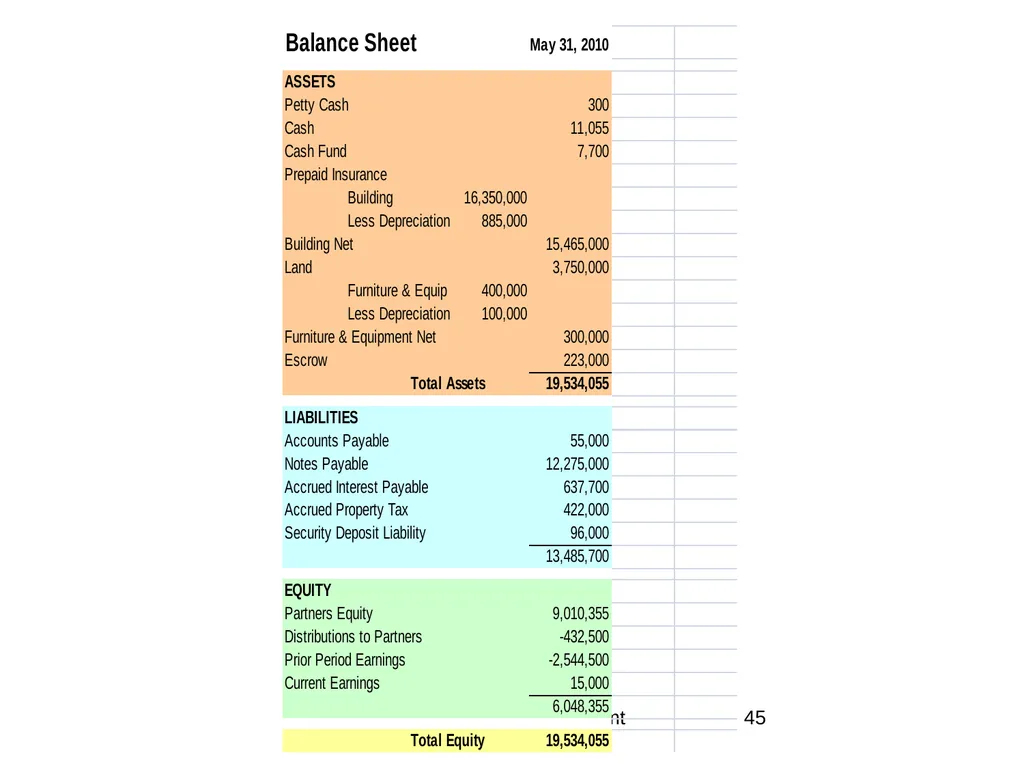
Economic Analysis When analyzing a property, ask
How well has a property performed over a specific time period?
Where does a property stand at a given date in time? Course 8: Financial Mgmt 44<br>
How well has a property performed over a specific time period?
Where does a property stand at a given date in time? Course 8: Financial Mgmt 44<br>
44
Course 8: Financial Mgmt 45<br>
45
Course 8: Financial Mgmt 46<br>
46
Accounting Methods Accrual- records all income and expenses in period they were earned or incurred, regardless of when received or paid
Cash- records all income and expenses when they are actually received or paid Course 8: Financial Mgmt 47<br>
Cash- records all income and expenses when they are actually received or paid Course 8: Financial Mgmt 47<br>
47
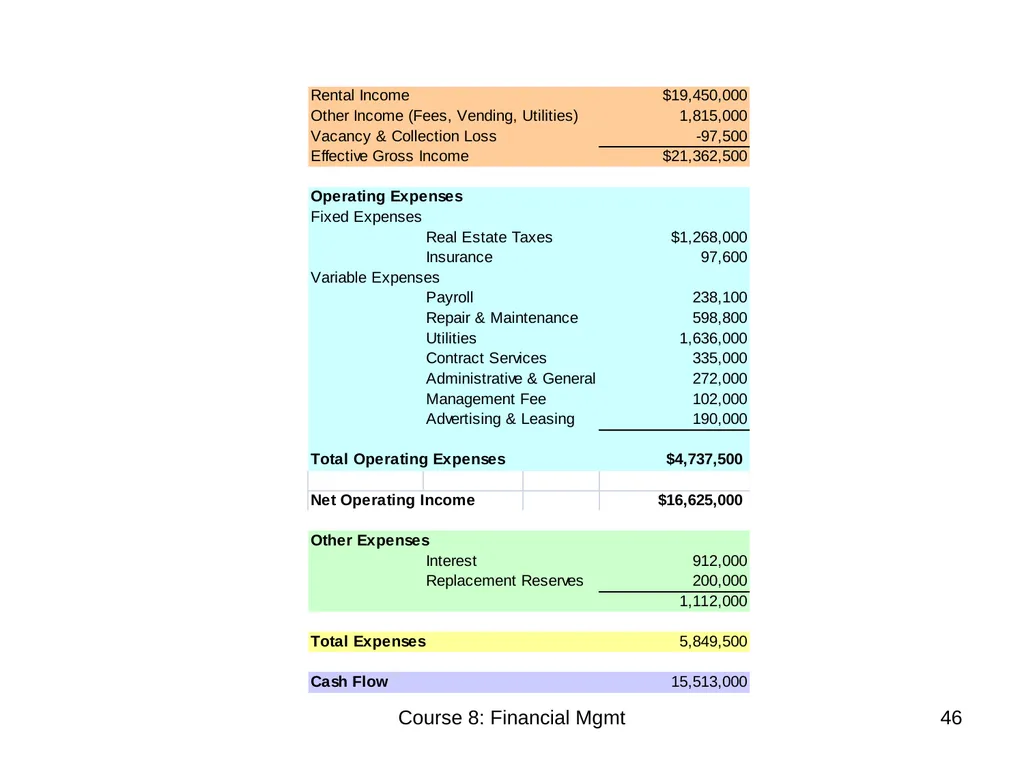
Cash Flow The amount of money left after all sources of income are collected and operating expenses, capital expenses and debt service have been paid
Often referred to as the operating statement Course 8: Financial Mgmt 48<br>
Often referred to as the operating statement Course 8: Financial Mgmt 48<br>
48
Gross Potential Rent (GPR) Current rent charged at 100% occupancy- combines the sum of occupied units at current lease rents plus vacant units at market rents
100% of possible income
All other income and expenses measured and evaluated as % of GPR Course 8: Financial Mgmt 49<br>
100% of possible income
All other income and expenses measured and evaluated as % of GPR Course 8: Financial Mgmt 49<br>
49
Market Rent Total annual income received if 100% of all units were occupied and paying market rents Course 8: Financial Mgmt 50<br>
50
Loss to Lease Variance between market rent and lease rent
Market rent that is “lost” due to lease rents at rates lower than the market rate
For many companies it is a separate line item on the operating statement Course 8: Financial Mgmt 51<br>
Market rent that is “lost” due to lease rents at rates lower than the market rate
For many companies it is a separate line item on the operating statement Course 8: Financial Mgmt 51<br>
51
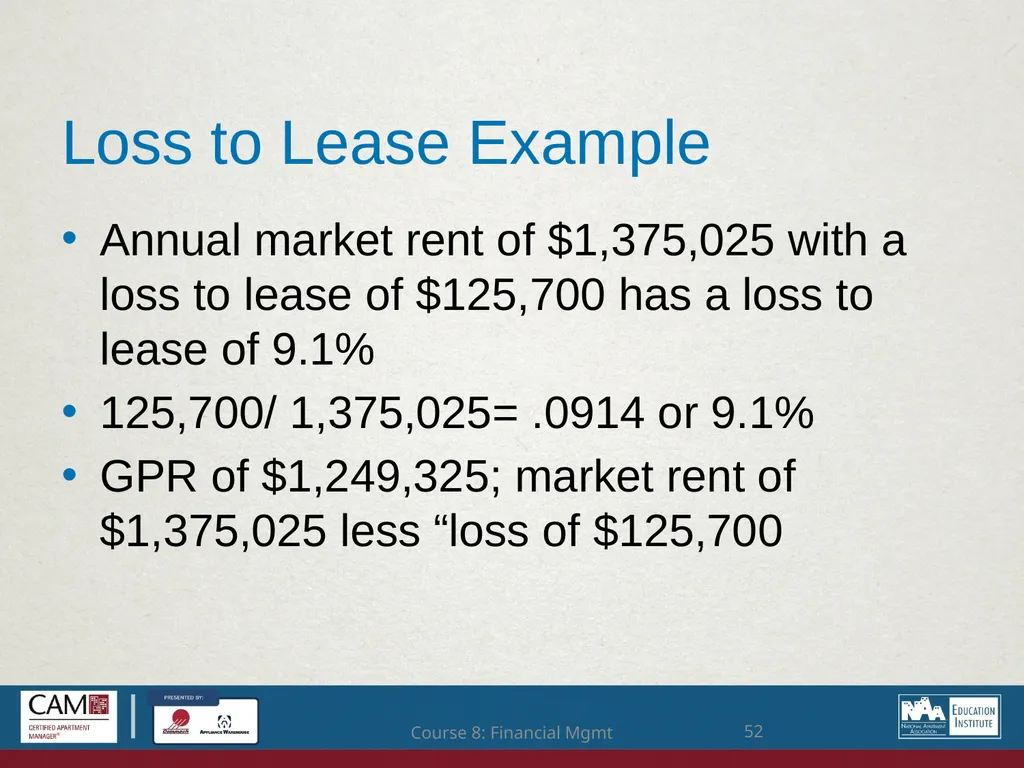
Loss to Lease Example Annual market rent of $1,375,025 with a loss to lease of $125,700 has a loss to lease of 9.1%
125,700/ 1,375,025= .0914 or 9.1%
GPR of $1,249,325; market rent of $1,375,025 less “loss of $125,700 Course 8: Financial Mgmt 52<br>
125,700/ 1,375,025= .0914 or 9.1%
GPR of $1,249,325; market rent of $1,375,025 less “loss of $125,700 Course 8: Financial Mgmt 52<br>
52
Vacancy, Concession, and Collection Loss (VAC) Total value of rent loss from vacant units, concessions given, collection losses from bad debt write-off, rent loss from non-revenue units
Standard for uncollectible/bad debt- 2% of GPR
VAC can be higher than10% of GPR Course 8: Financial Mgmt 53<br>
Standard for uncollectible/bad debt- 2% of GPR
VAC can be higher than10% of GPR Course 8: Financial Mgmt 53<br>
53
Effective Gross Income (EGI) GPR less vacancy, concessions, and collection loss. Also called net rental revenue or total rental income
Represents all rent and only the rent income at the property
GPR-VAC= EGI Course 8: Financial Mgmt 54<br>
Represents all rent and only the rent income at the property
GPR-VAC= EGI Course 8: Financial Mgmt 54<br>
54
Other Income (OI) Income from items other than rent
Laundry, cable, parking, amenity charges, pet fees, application fees, administrative fees, lease premium fees, late fees
Fee policies established by owner or manager
Up to 10% of GPR- NAA survey in 2010 7.2% of GPR or $753 per unit Course 8: Financial Mgmt 55<br>
Laundry, cable, parking, amenity charges, pet fees, application fees, administrative fees, lease premium fees, late fees
Fee policies established by owner or manager
Up to 10% of GPR- NAA survey in 2010 7.2% of GPR or $753 per unit Course 8: Financial Mgmt 55<br>
55
Gross Operating Income (GOI) EGI + OI = GOI
Property’s total revenue
Available to pay property’s operating expenses, capital improvements, and debt service Course 8: Financial Mgmt 56<br>
Property’s total revenue
Available to pay property’s operating expenses, capital improvements, and debt service Course 8: Financial Mgmt 56<br>
56
Operating Expenses (OE) All expenses fixed and variable incurred in the course of managing the property
Controllable and uncontrollable expenses
Capital expenses and reserve for replacement costs are not typically considered operating expenses Course 8: Financial Mgmt 57<br>
Controllable and uncontrollable expenses
Capital expenses and reserve for replacement costs are not typically considered operating expenses Course 8: Financial Mgmt 57<br>
57
Net Operating Income (NOI) GOI-OE=NOI
Applying cap rate to NOI allows you to determine property value using the income approach Course 8: Financial Mgmt 58<br>
Applying cap rate to NOI allows you to determine property value using the income approach Course 8: Financial Mgmt 58<br>
58
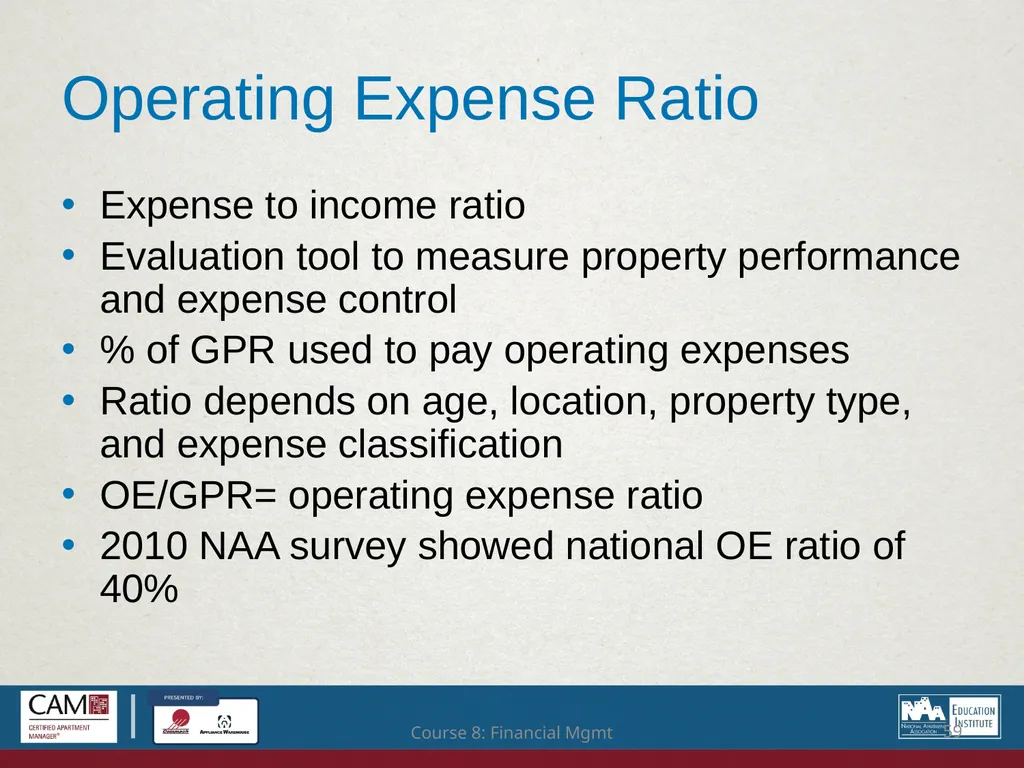
Operating Expense Ratio Expense to income ratio
Evaluation tool to measure property performance and expense control
% of GPR used to pay operating expenses
Ratio depends on age, location, property type, and expense classification
OE/GPR= operating expense ratio
2010 NAA survey showed national OE ratio of 40% Course 8: Financial Mgmt 59<br>
Evaluation tool to measure property performance and expense control
% of GPR used to pay operating expenses
Ratio depends on age, location, property type, and expense classification
OE/GPR= operating expense ratio
2010 NAA survey showed national OE ratio of 40% Course 8: Financial Mgmt 59<br>
59
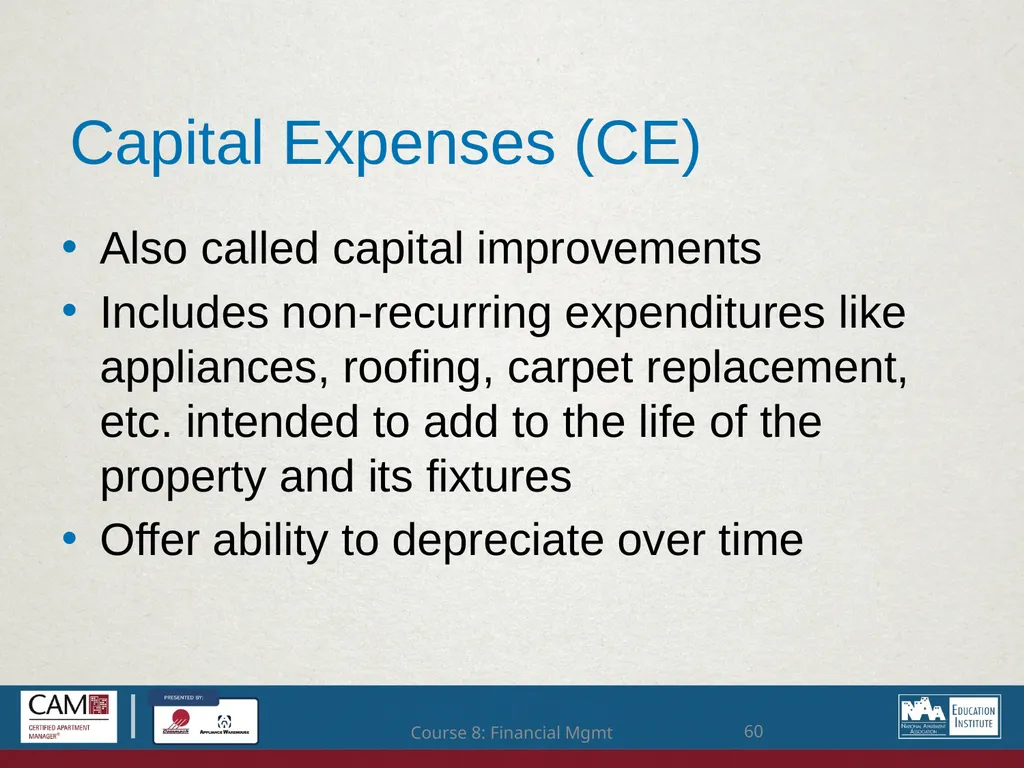
Capital Expenses (CE) Also called capital improvements
Includes non-recurring expenditures like appliances, roofing, carpet replacement, etc. intended to add to the life of the property and its fixtures
Offer ability to depreciate over time Course 8: Financial Mgmt 60<br>
Includes non-recurring expenditures like appliances, roofing, carpet replacement, etc. intended to add to the life of the property and its fixtures
Offer ability to depreciate over time Course 8: Financial Mgmt 60<br>
60
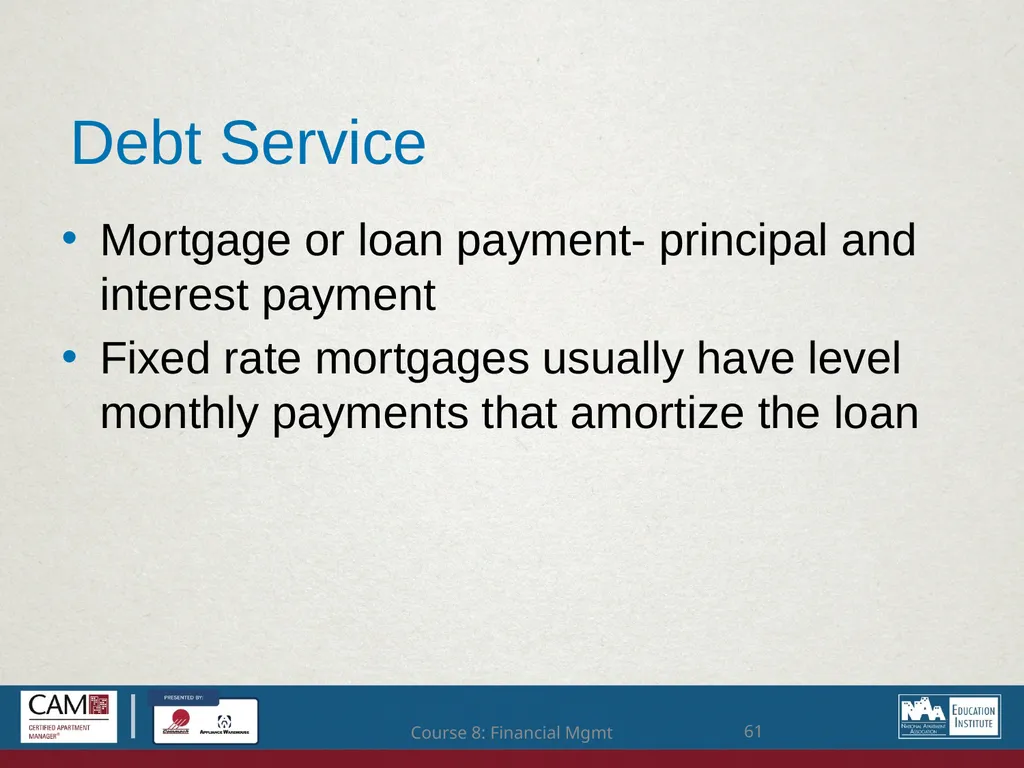
Debt Service Mortgage or loan payment- principal and interest payment
Fixed rate mortgages usually have level monthly payments that amortize the loan Course 8: Financial Mgmt 61<br>
Fixed rate mortgages usually have level monthly payments that amortize the loan Course 8: Financial Mgmt 61<br>
61
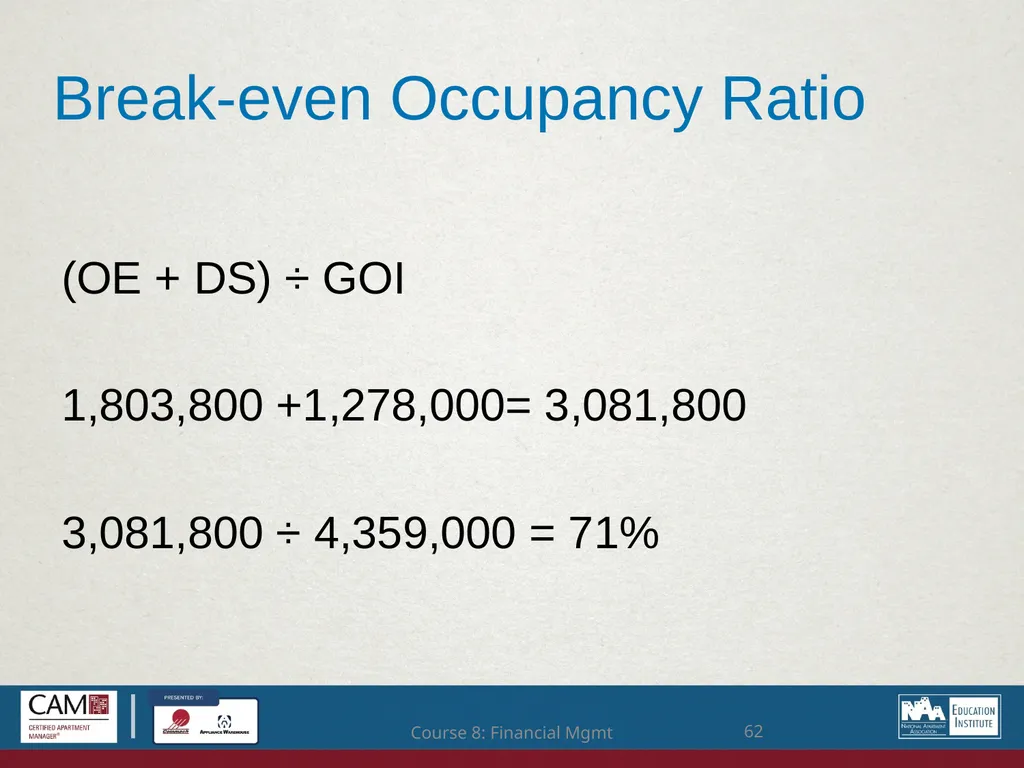
Break-even Occupancy Ratio (OE + DS) ÷ GOI
1,803,800 +1,278,000= 3,081,800
3,081,800 ÷ 4,359,000 = 71% Course 8: Financial Mgmt 62<br>
1,803,800 +1,278,000= 3,081,800
3,081,800 ÷ 4,359,000 = 71% Course 8: Financial Mgmt 62<br>
62
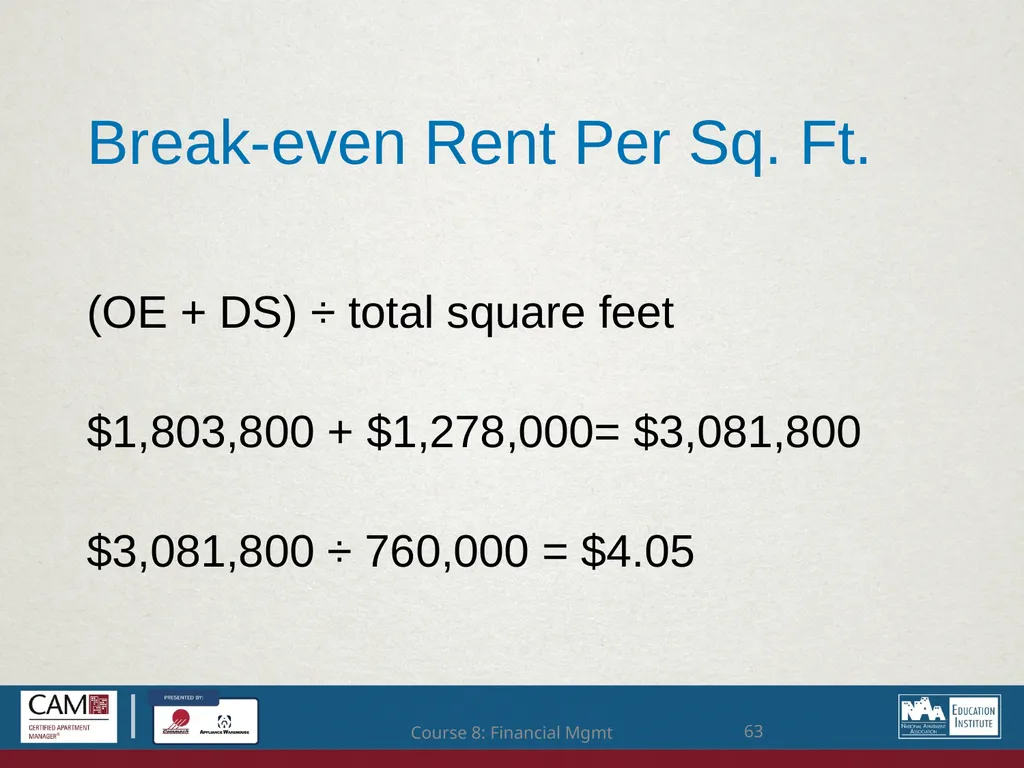
Break-even Rent Per Sq. Ft. (OE + DS) ÷ total square feet
$1,803,800 + $1,278,000= $3,081,800
$3,081,800 ÷ 760,000 = $4.05 Course 8: Financial Mgmt 63<br>
$1,803,800 + $1,278,000= $3,081,800
$3,081,800 ÷ 760,000 = $4.05 Course 8: Financial Mgmt 63<br>
63
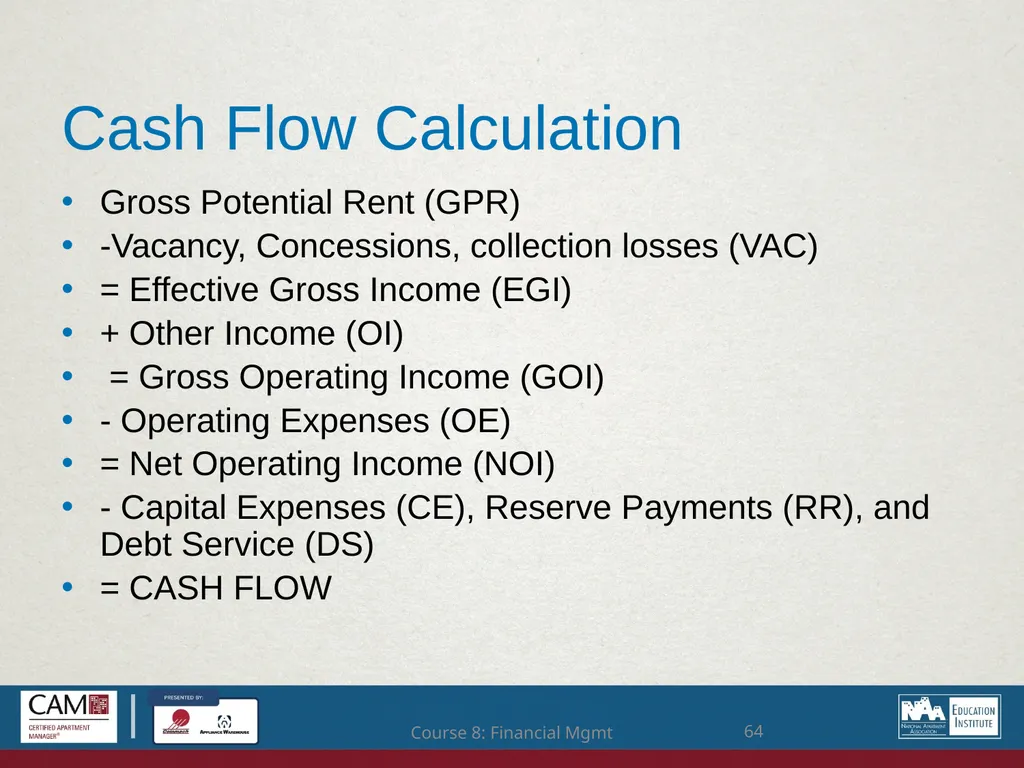
Cash Flow Calculation Gross Potential Rent (GPR)
-Vacancy, Concessions, collection losses (VAC)
= Effective Gross Income (EGI)
+ Other Income (OI)
= Gross Operating Income (GOI)
- Operating Expenses (OE)
= Net Operating Income (NOI)
- Capital Expenses (CE), Reserve Payments (RR), and Debt Service (DS)
= CASH FLOW Course 8: Financial Mgmt 64<br>
-Vacancy, Concessions, collection losses (VAC)
= Effective Gross Income (EGI)
+ Other Income (OI)
= Gross Operating Income (GOI)
- Operating Expenses (OE)
= Net Operating Income (NOI)
- Capital Expenses (CE), Reserve Payments (RR), and Debt Service (DS)
= CASH FLOW Course 8: Financial Mgmt 64<br>
64
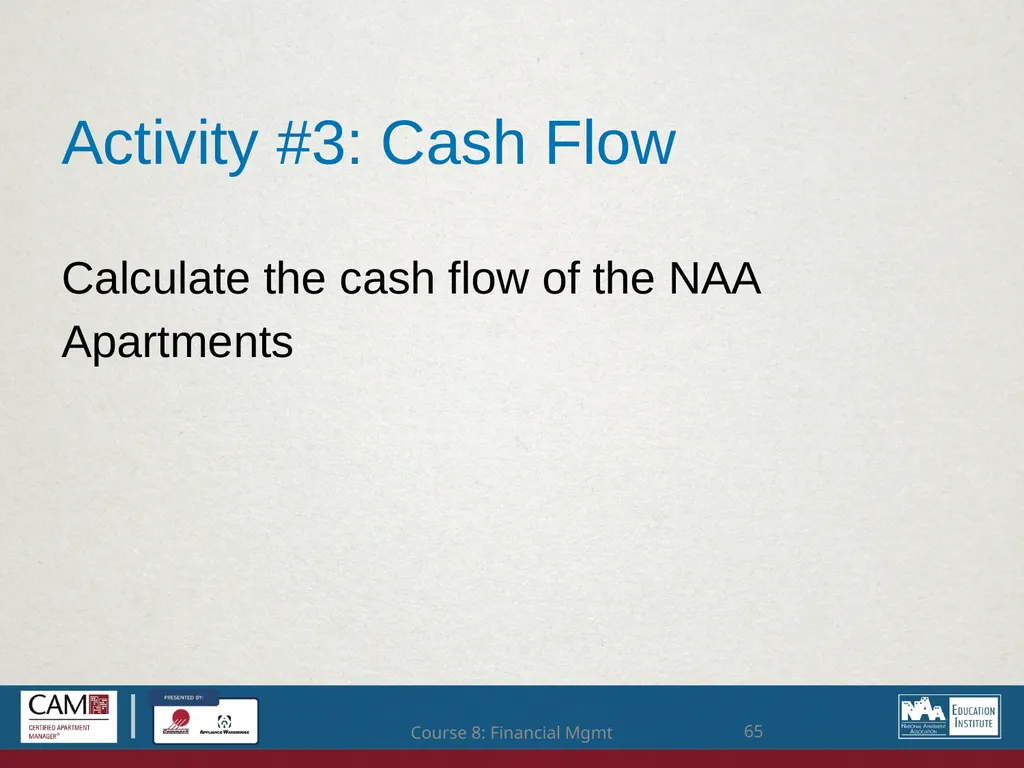
Activity #3: Cash Flow Calculate the cash flow of the NAA
Apartments Course 8: Financial Mgmt 65<br>
Apartments Course 8: Financial Mgmt 65<br>
65
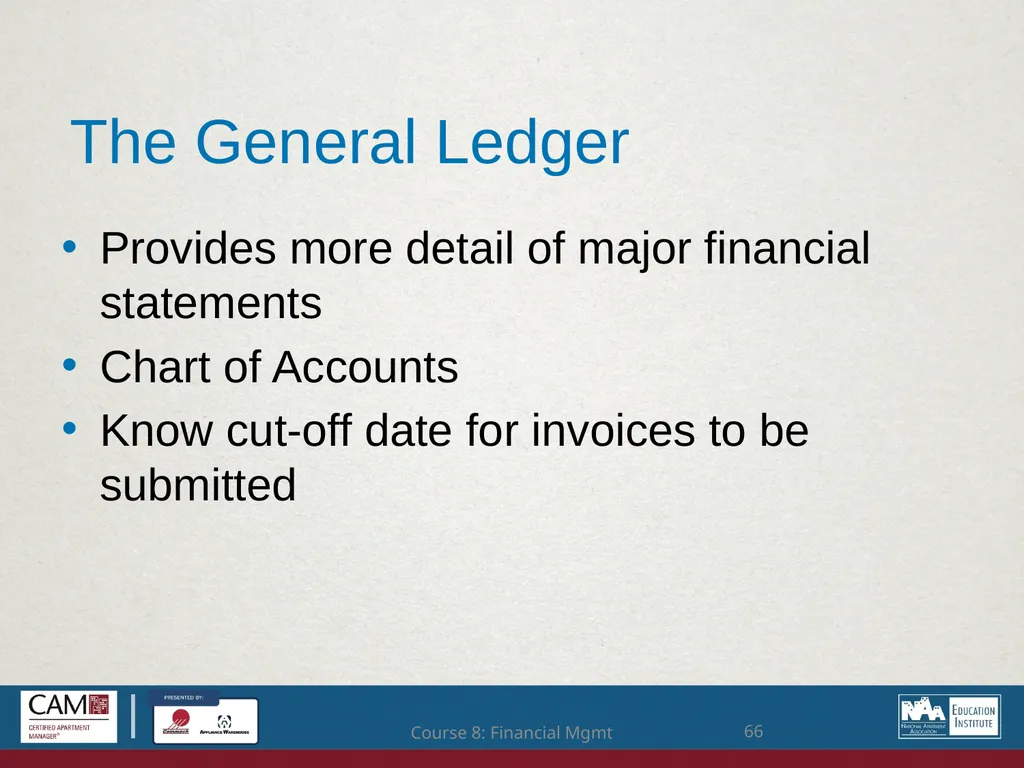
The General Ledger Provides more detail of major financial statements
Chart of Accounts
Know cut-off date for invoices to be submitted Course 8: Financial Mgmt 66<br>
Chart of Accounts
Know cut-off date for invoices to be submitted Course 8: Financial Mgmt 66<br>
66
Skill Check #3 Chapter 3: Economic Analysis of a
Property Course 8: Financial Mgmt 67<br>
Property Course 8: Financial Mgmt 67<br>
67
Chapter 4 Budgets Course 8: Financial Mgmt 68<br>
68
Purpose of a Budget To estimate expected income and expenses to determine what occupancy levels will be needed to cover expenses and provide a return on investment
To monitor the property’s performance
To evaluate performance of personnel Course 8: Financial Mgmt 69<br>
To monitor the property’s performance
To evaluate performance of personnel Course 8: Financial Mgmt 69<br>
69
Lease-up Budget Special attention paid to activities and costs associated with attracting residents, signing leases and generating income
Information used for projecting expenses depends on your and your supervisor’s previous experience Course 8: Financial Mgmt 70<br>
Information used for projecting expenses depends on your and your supervisor’s previous experience Course 8: Financial Mgmt 70<br>
70
Modernization Budget Reflects larger allocations for capital expenses and labor
Must be flexible if the work is dependent on contractors schedules and vendors supplies
May include periods of no rental income while work is being done in part or all of the building
May be prepared separately from the operating budget of a property and be for a short time only Course 8: Financial Mgmt 71<br>
Must be flexible if the work is dependent on contractors schedules and vendors supplies
May include periods of no rental income while work is being done in part or all of the building
May be prepared separately from the operating budget of a property and be for a short time only Course 8: Financial Mgmt 71<br>
71
Stabilized Operating Budget Reflects varying expenses from month to month
Examples:
Utilities for heating would be higher in winter months
Utilities for cooling would be higher in summer months
Snow removal would be posted only for winter months Course 8: Financial Mgmt 72<br>
Examples:
Utilities for heating would be higher in winter months
Utilities for cooling would be higher in summer months
Snow removal would be posted only for winter months Course 8: Financial Mgmt 72<br>
72
Tips for Developing Budgets Use round numbers
Use current figures
Prepare early
Seek input
Extrapolation/Annualization Course 8: Financial Mgmt 73<br>
Use current figures
Prepare early
Seek input
Extrapolation/Annualization Course 8: Financial Mgmt 73<br>
73
CAM Responsibilities Managing the budget
Analyzing variances
Explaining variances
Recommending action Course 8: Financial Mgmt 74<br>
Analyzing variances
Explaining variances
Recommending action Course 8: Financial Mgmt 74<br>
74
Activity #4: Review a Budget Identify figures that may point to extraordinary conditions or needs. Course 8: Financial Mgmt 75<br>
75
Skill Check #4 Chapter 4: Budgets Course 8: Financial Mgmt 76<br>
76
Chapter 5 Property Valuation Course 8: Financial Mgmt 77<br>
77
Property Valuation The process of determining the value of a property in order to make financial decisions regarding the property Course 8: Financial Mgmt 78<br>
78
The Cost Approach Estimates the current cost of reproducing or replacing the improvements, minus the loss in value from depreciation due to age, condition or obsolescence, plus land value
Important when there is no market activity and a sales approach cannot be used to value a property Course 8: Financial Mgmt 79<br>
Important when there is no market activity and a sales approach cannot be used to value a property Course 8: Financial Mgmt 79<br>
79
The Sales Comparison Approach In this approach, the market value of a property is directly related to the prices of comparable competitive properties
Most useful when there are several similar properties in the local market that have been recently sold or are currently for sale Course 8: Financial Mgmt 80<br>
Most useful when there are several similar properties in the local market that have been recently sold or are currently for sale Course 8: Financial Mgmt 80<br>
80
The Income Capitalization Approach This approach uses methods, techniques and math procedures to
analyze a property’s ability to generate income and
convert future earnings to present-day dollars Course 8: Financial Mgmt 81<br>
analyze a property’s ability to generate income and
convert future earnings to present-day dollars Course 8: Financial Mgmt 81<br>
81
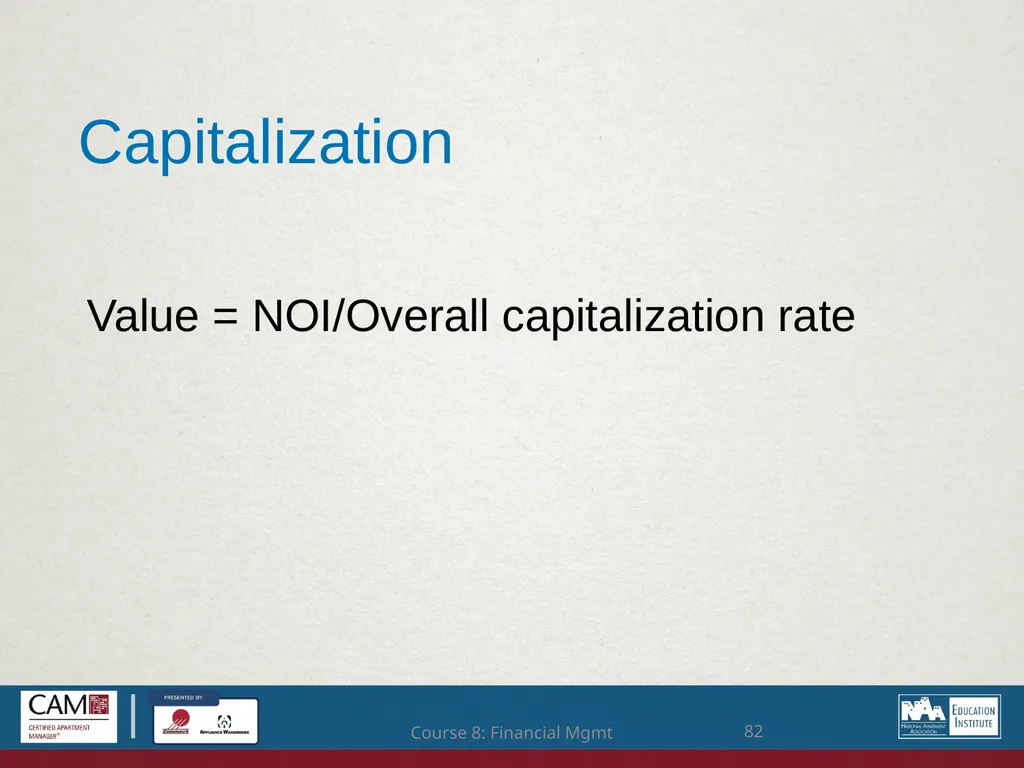
Capitalization Value = NOI/Overall capitalization rate Course 8: Financial Mgmt 82<br>
82
Skill Check #5 Chapter 5: Property Valuation Course 8: Financial Mgmt 83<br>