IPC for Marburg Virus Disease(MVD): Preventing MVD from Entering Your Healthcare Facility Healthcare Settings with Limited to Intermediate Resources Updated: March 2023 Learning Objectives After this presentation, participants will be able
"IPC for Marburg Virus Disease(MVD): Preventing MVD" is the property of its rightful owner. Permission is granted to
download and print the materials on this website for personal, non-commercial use only, and to display it
on your personal computer provided you do not modify the materials and that you retain all copyright
notices contained in the materials. By downloading content from our website, you accept the terms of this
agreement.
Presentation Transcript
01
IPC for Marburg Virus Disease(MVD): Preventing MVD from Entering Your Healthcare Facility Healthcare Settings with Limited to Intermediate Resources Updated: March 2023<br>
02
Learning Objectives After this presentation, participants will be able to
Name the 3 key strategies to prevent introduction Marburg virus disease into health facilities
Explain why screening for Marburg virus disease is important
Describe best practices for screening for Marburg virus disease<br>
03
Discuss Why is it important to identify people who might have Marburg virus disease before they enter your healthcare facility?<br>
04
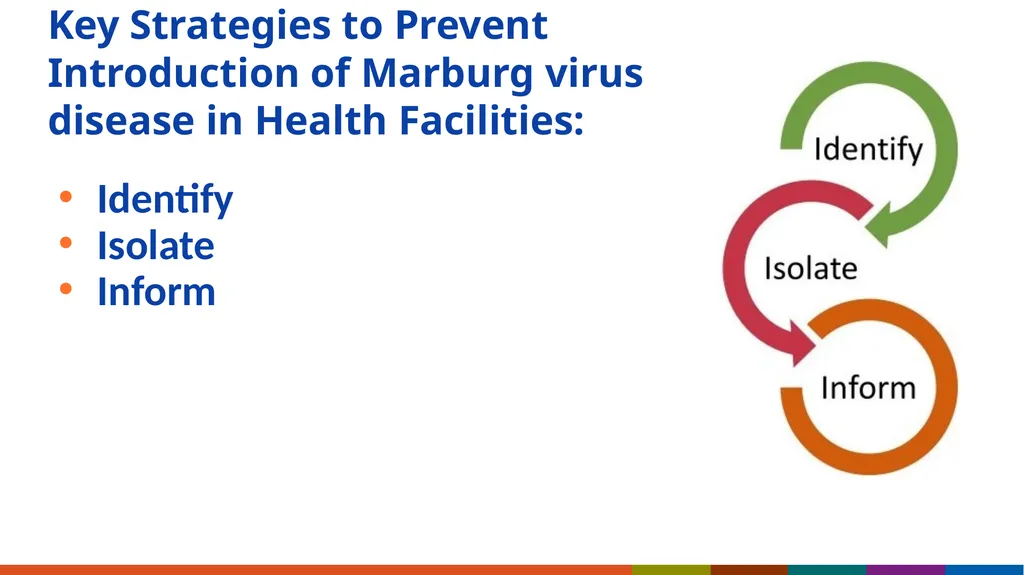
Key Strategies to Prevent Introduction of Marburg virus disease in Health Facilities: Identify
Isolate
Inform<br>
05
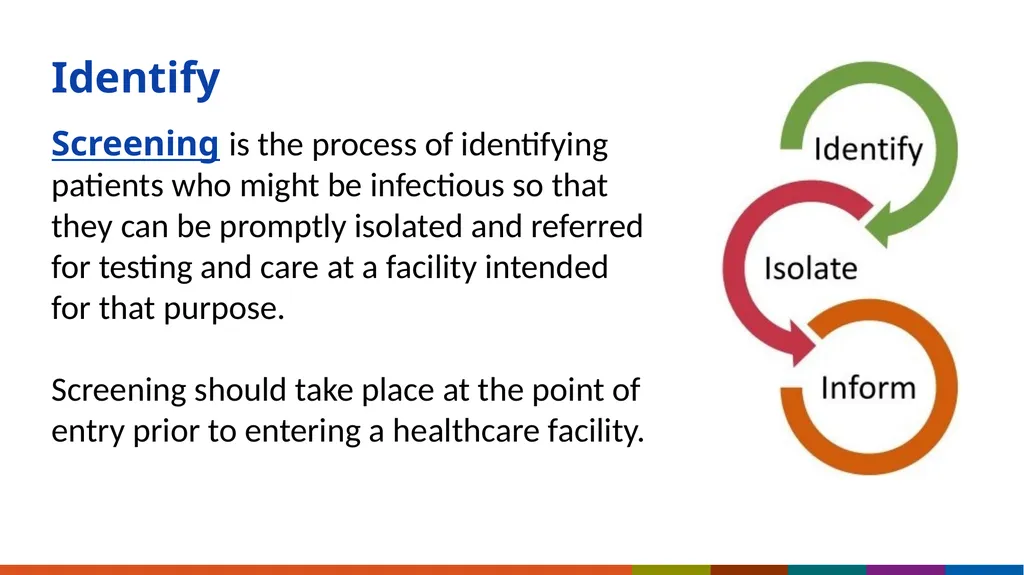
Identify Screening is the process of identifying patients who might be infectious so that they can be promptly isolated and referred for testing and care at a facility intended for that purpose.
Screening should take place at the point of entry prior to entering a healthcare facility.<br>
06
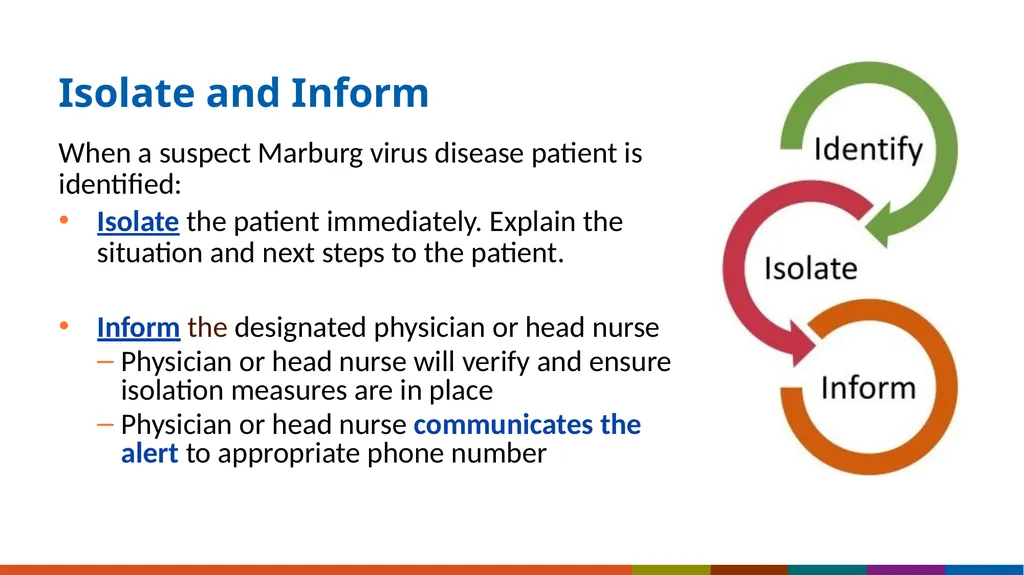
Isolate and Inform When a suspect Marburg virus disease patient is identified:
Isolate the patient immediately. Explain the situation and next steps to the patient.
Inform the designated physician or head nurse
Physician or head nurse will verify and ensure isolation measures are in place
Physician or head nurse communicates the alert to appropriate phone number<br>
07
This protects…
YOU
Your patients
Your community Early identification and separation of suspected Marburg virus disease patients prevents bringing unrecognized Marburg virus disease into your healthcare setting.<br>
08
Screening Basics<br>
09
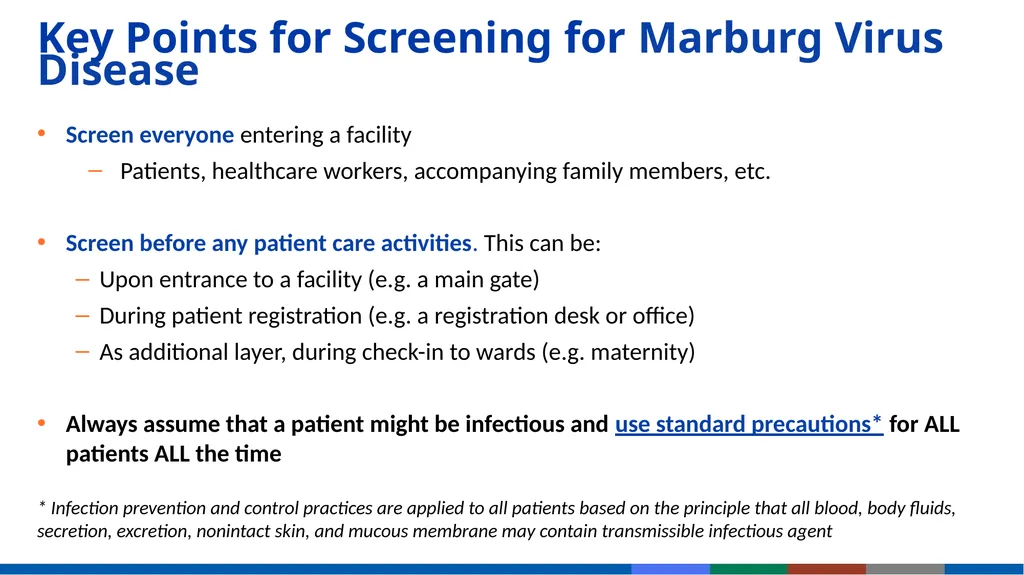
Key Points for Screening for Marburg Virus Disease Screen everyone entering a facility
Patients, healthcare workers, accompanying family members, etc.
Screen before any patient care activities. This can be:
Upon entrance to a facility (e.g. a main gate)
During patient registration (e.g. a registration desk or office)
As additional layer, during check-in to wards (e.g. maternity)
Always assume that a patient might be infectious and use standard precautions* for ALL patients ALL the time
* Infection prevention and control practices are applied to all patients based on the principle that all blood, body fluids, secretion, excretion, nonintact skin, and mucous membrane may contain transmissible infectious agent<br>
10
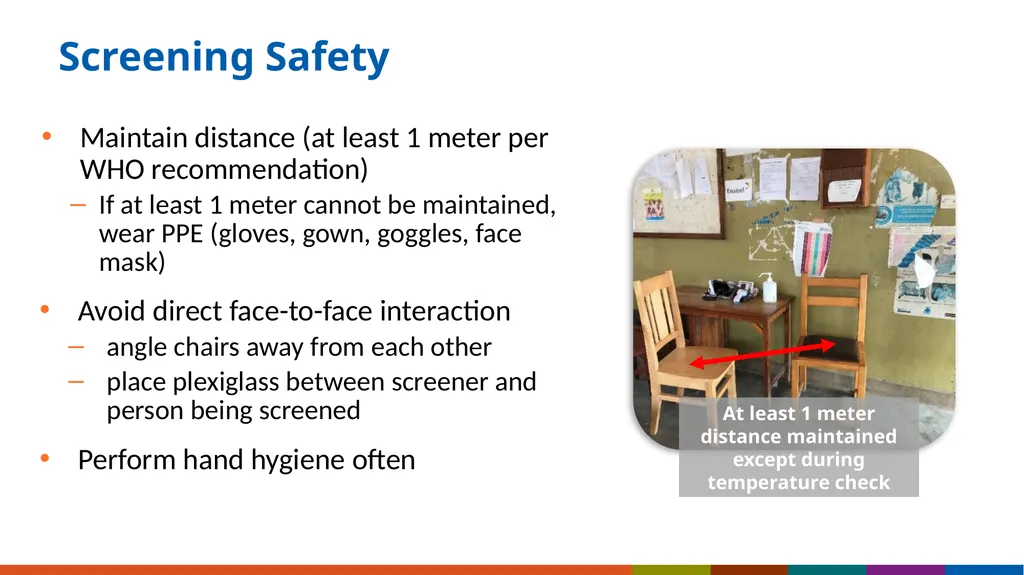
Maintain distance (at least 1 meter per WHO recommendation)
If at least 1 meter cannot be maintained, wear PPE (gloves, gown, goggles, face mask)
Avoid direct face-to-face interaction
angle chairs away from each other
place plexiglass between screener and person being screened
Perform hand hygiene often Screening Safety<br>
11
Screening Involves Two Parts: Temperature check
Questionnaire: signs and symptoms + risk factors in past 21 days<br>
12
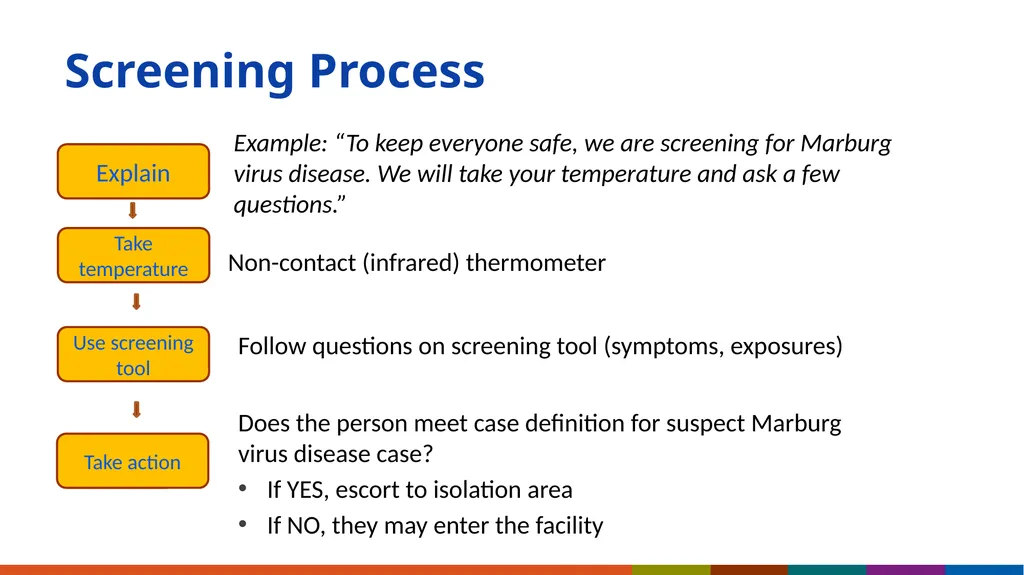
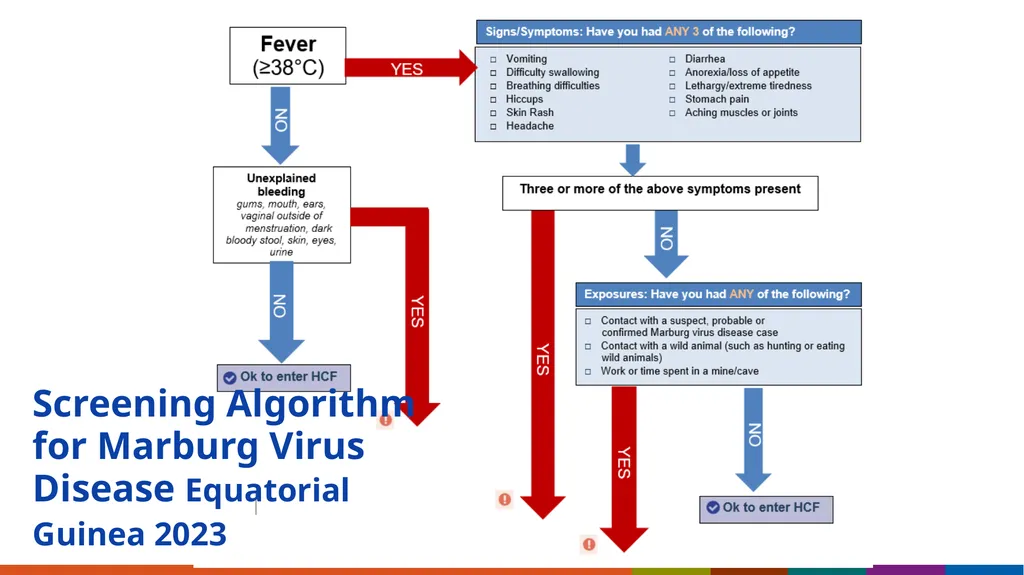
Screening Process Explain Example: “To keep everyone safe, we are screening for Marburg virus disease. We will take your temperature and ask a few questions.” Take temperature Non-contact (infrared) thermometer Use screening tool Follow questions on screening tool (symptoms, exposures) Take action Does the person meet case definition for suspect Marburg virus disease case?
If YES, escort to isolation area
If NO, they may enter the facility<br>
13
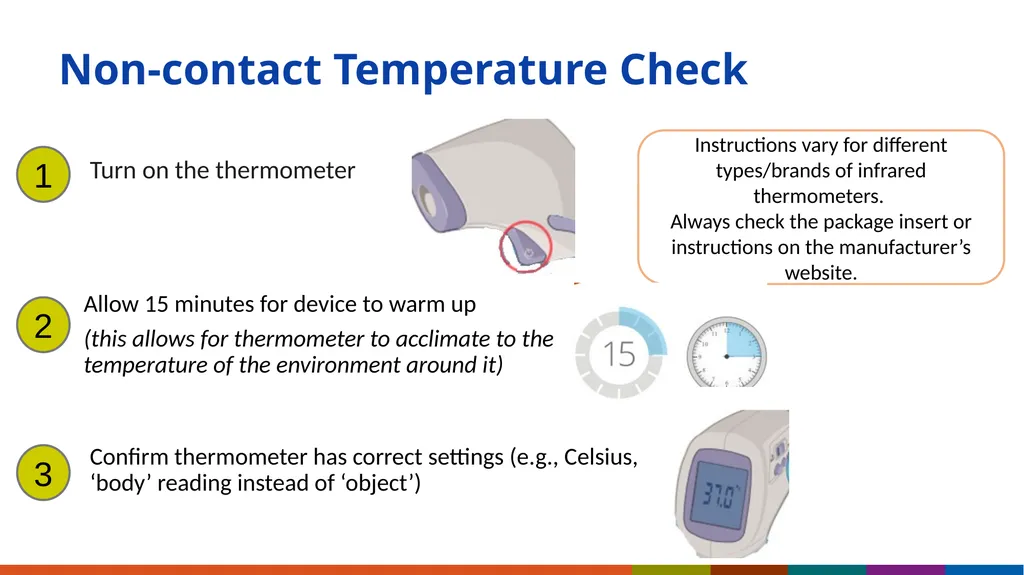
Non-contact Temperature Check Instructions vary for different types/brands of infrared thermometers.
Always check the package insert or instructions on the manufacturer’s website. 1 Turn on the thermometer 2 Allow 15 minutes for device to warm up
(this allows for thermometer to acclimate to the temperature of the environment around it) 3 Confirm thermometer has correct settings (e.g., Celsius, ‘body’ reading instead of ‘object’)<br>
14
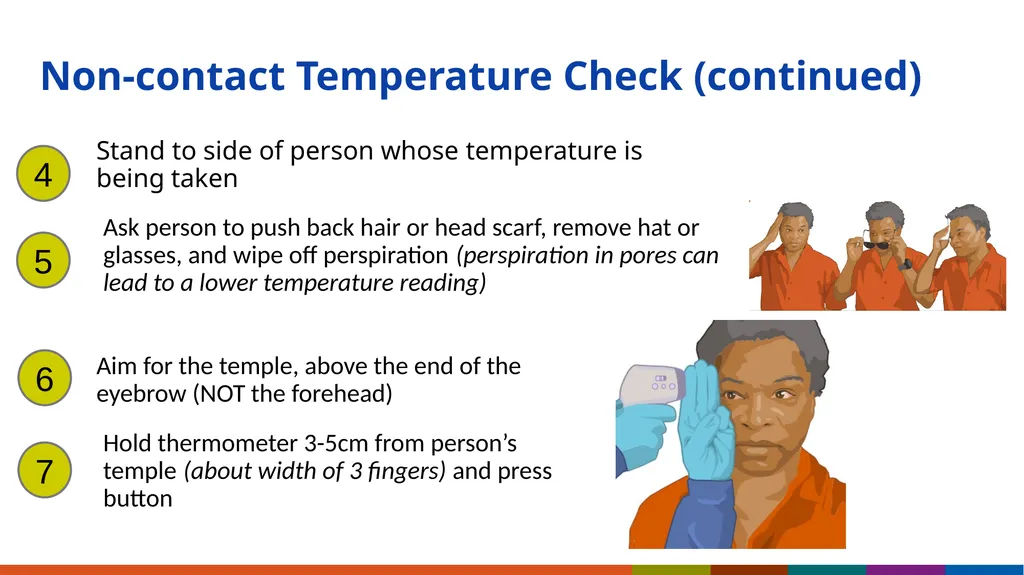
Non-contact Temperature Check (continued) 4 Stand to side of person whose temperature is being taken 5 Ask person to push back hair or head scarf, remove hat or glasses, and wipe off perspiration (perspiration in pores can lead to a lower temperature reading) 6 Aim for the temple, above the end of the eyebrow (NOT the forehead) 7 Hold thermometer 3-5cm from person’s temple (about width of 3 fingers) and press button<br>
15
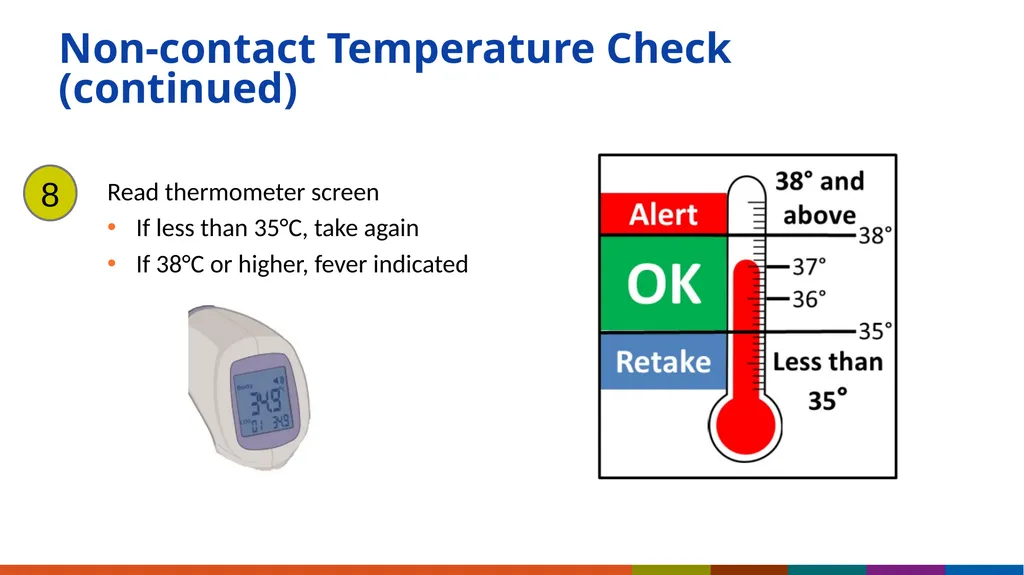
Non-contact Temperature Check (continued) 8 Read thermometer screen
If less than 35°C, take again
If 38°C or higher, fever indicated<br>
16
Screening Algorithm for Marburg Virus Disease Equatorial Guinea 2023<br>
17
Screening Equipment and Supplies Screening stations should have:
Print-out of screening algorithm for reference
Patient register
Infrared (non-contact) thermometer
Thermometer batteries/back-up thermometer
PPE if distance cannot be maintained<br>
18
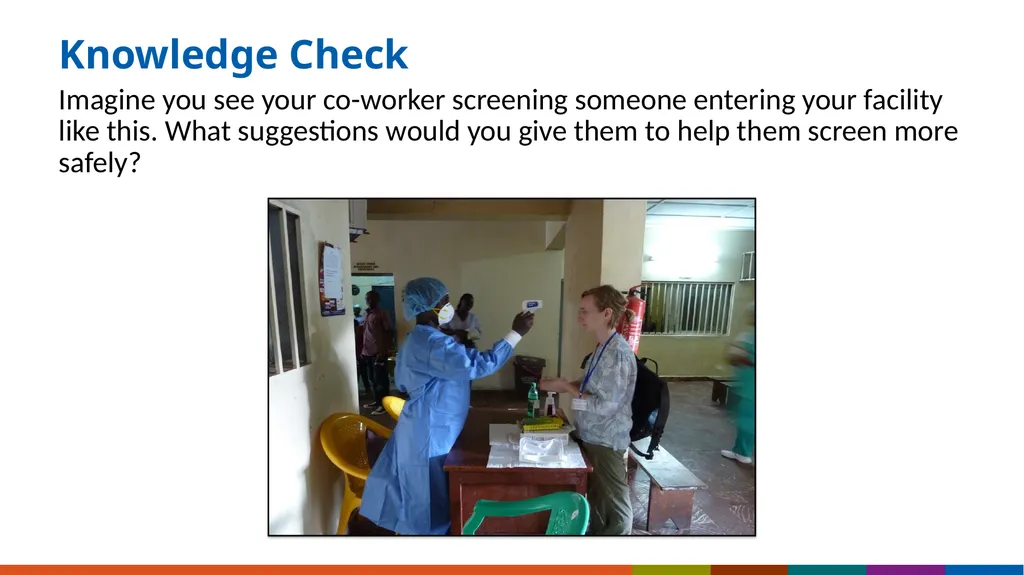
Knowledge Check Imagine you see your co-worker screening someone entering your facility like this. What suggestions would you give them to help them screen more safely?<br>
19
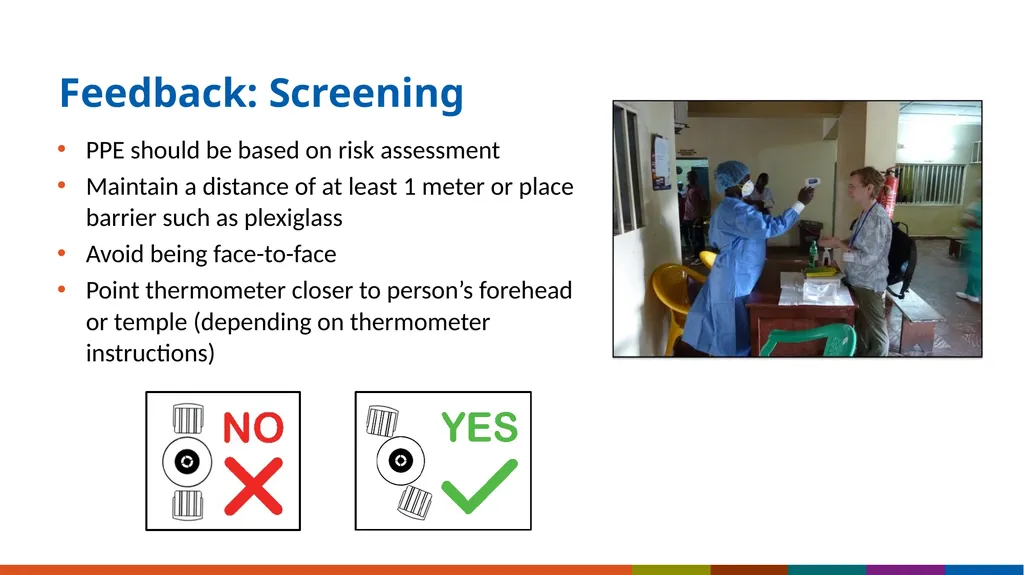
Feedback: Screening PPE should be based on risk assessment
Maintain a distance of at least 1 meter or place barrier such as plexiglass
Avoid being face-to-face
Point thermometer closer to person’s forehead or temple (depending on thermometer instructions)<br>
20
Reflection How is the process of screening for Marburg virus disease similar to or different from screening processes you have followed in the past?
What challenges have you encountered in the past with screening? If you have never had to participate in screening, what challenges do you imagine you might have?<br>
21
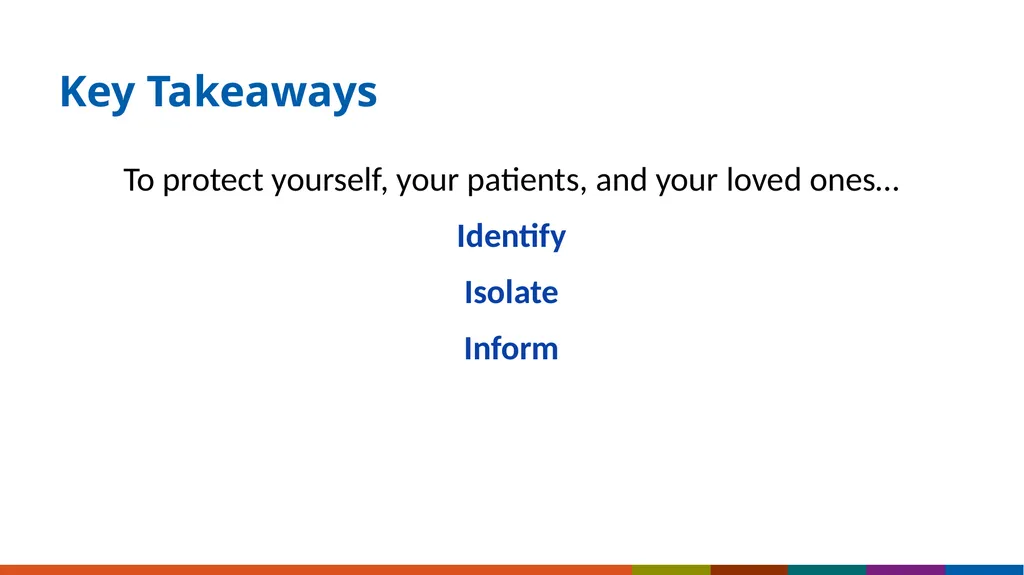
Key Takeaways To protect yourself, your patients, and your loved ones…
Identify
Isolate
Inform<br>