Iraq’s environmental and climate change
Description: Iraqs environmental and climate change commitments May 2022 Stockholm 50 consultations Global Environmental and Climate Change targets Sustainable Development Goals (SDGs) Paris Climate Agreement Sendai Framework for Disaster Risk
Related Topics
Download Presentation
"Iraq’s environmental and climate change" is the property of its rightful owner. Permission is granted to download and print the materials on this website for personal, non-commercial use only, and to display it on your personal computer provided you do not modify the materials and that you retain all copyright notices contained in the materials. By downloading content from our website, you accept the terms of this agreement.
Presentation Transcript
slide1. Iraq’s environmental and climate change commitments May 2022 Stockholm +50 consultations<br>
slide2. Global Environmental and Climate Change targets
Sustainable Development Goals (SDGs)
Paris Climate Agreement
Sendai Framework for Disaster Risk Reduction (SFDRR)<br>
slide3. Environmental Conventions
Convention on Biological Diversity (CBD)
Convention on International Trade in Endangered Species of Wild Fauna and Flora (CITES)
Convention on the Conservation of Migratory Species of Wild Animals (CMS)
Basel Convention on the Control of Transboundary Movements of Hazardous Wastes and their Disposal
Rotterdam Convention on the Prior Informed Consent Procedure for Certain Hazardous Chemicals and Pesticides in International Trade
Stockholm Convention on Persistent Organic Pollutants
Minamata Convention on Mercury
Vienna Convention for the Protection of the Ozone Layer
Multilateral Fund for the Implementation of the Montreal Protocol<br>
slide4. Iraq policies, strategies, targets<br>
slide5. National Development Plan (2018-2022)
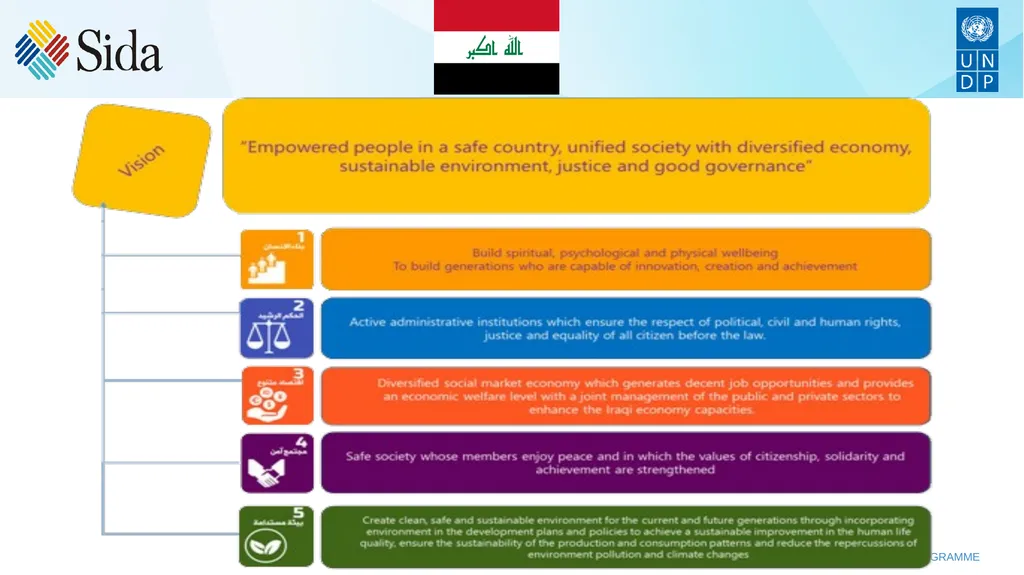
Iraq Vision for Sustainable Development (2019-2030)
Nationally Determined Contributions (2021-2025)
National Environmental Strategy and Action Plan (2013-2017)
National Biodiversity Strategy and Action Plan (2015-2022)<br>
slide6. 1. National Development Plan 2018-2022<br>
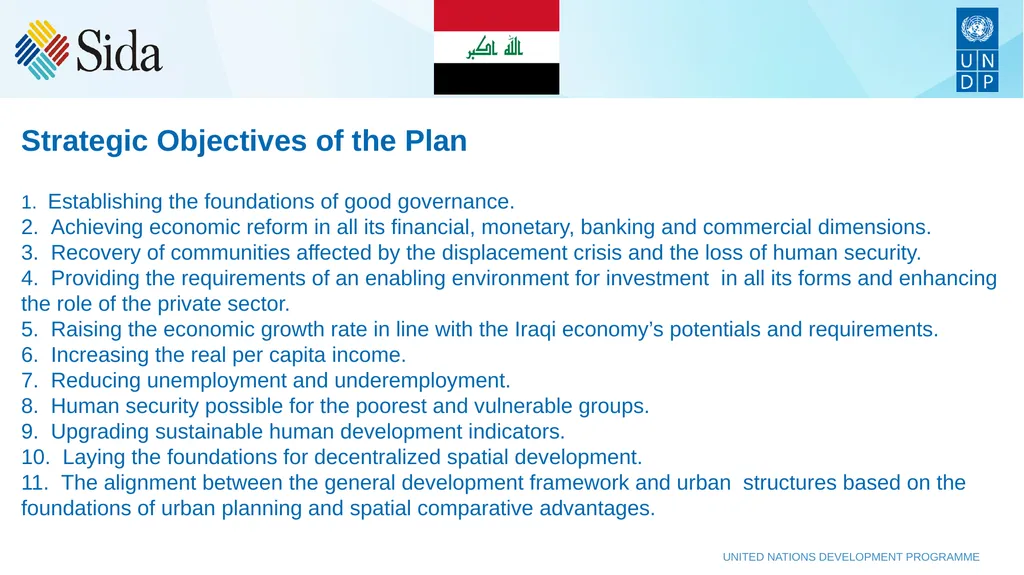
slide7. Strategic Objectives of the Plan
1. Establishing the foundations of good governance.
2. Achieving economic reform in all its financial, monetary, banking and commercial dimensions.
3. Recovery of communities affected by the displacement crisis and the loss of human security.
4. Providing the requirements of an enabling environment for investment in all its forms and enhancing the role of the private sector.
5. Raising the economic growth rate in line with the Iraqi economy’s potentials and requirements.
6. Increasing the real per capita income.
7. Reducing unemployment and underemployment.
8. Human security possible for the poorest and vulnerable groups.
9. Upgrading sustainable human development indicators.
10. Laying the foundations for decentralized spatial development.
11. The alignment between the general development framework and urban structures based on the foundations of urban planning and spatial comparative advantages.<br>
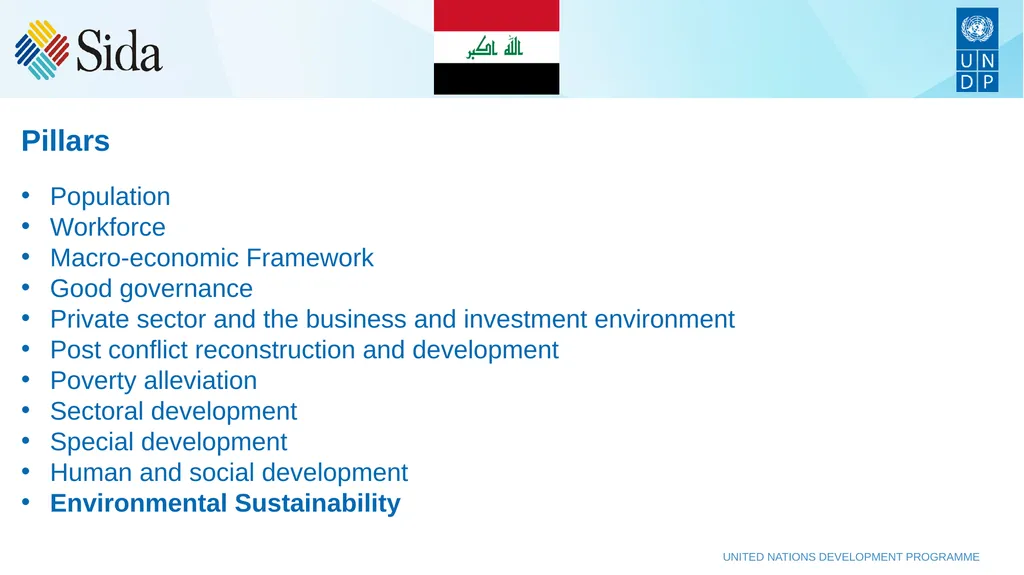
slide8. Pillars
Population
Workforce
Macro-economic Framework
Good governance
Private sector and the business and investment environment
Post conflict reconstruction and development
Poverty alleviation
Sectoral development
Special development
Human and social development
Environmental Sustainability<br>
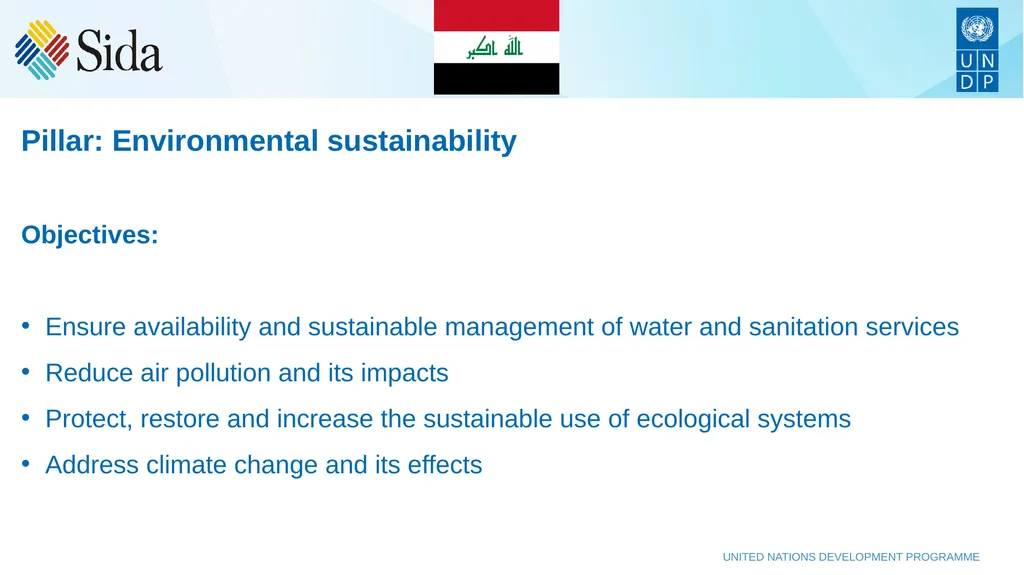
slide9. Pillar: Environmental sustainability
Objectives:
Ensure availability and sustainable management of water and sanitation services
Reduce air pollution and its impacts
Protect, restore and increase the sustainable use of ecological systems
Address climate change and its effects<br>
slide10. 2. Iraq’s vision for sustainable development 2019-2030<br>
slide12. FOUNDATIONS
Growth
Empowerment
Justice and fairness
Good governance
Compatibility between national and local development priorities
Diversified economy
National and international partnerships
Societal peace
Environmental sustainability which enhances a green economy.<br>
slide13. 3. National Priorities
3.1 Man Building
Goal (1-1): Alleviate poverty
Goal (1-2): Create decent and protected job opportunities for all unemployed people
Goal (1-3): High quality and inclusive education system
Goal (1-4): Efficient and inclusive healthcare system
Goal (1-5): Provide decent housing and end informal settlements<br>
slide14. 3. National Priorities
3.2 GOOD GOVERNANCE
Goal (2-1): Uphold rule of law, access to justice and enhance the good governance foundations
Goal (2-2): Improve administrative decentralization and public participation in decision-making
Goal (2-3): Integrity, transparency, and fighting corruption
Goal (2-4): Reform public financial administration and achieve financial sustainability<br>
slide15. 3. National Priorities
3.3 DIVERSIFIED ECONOMY
Goal (3-1): High and sustainable economic growth rate
Goal (3-2): Increase the oil sector efficiency
Goal (3-3): Strong private sector which contributes to the development
Goal (3-4): Develop the agricultural sector and achieve food security
Goal (3-5): Developed infrastructure
Goal (3-6): Active and well-governed financial sector<br>
slide16. 3. National Priorities
3.4 SAFE SOCIETY
Goal (4-1): Enhance the culture of tolerance, dialogue, and community peace
Goal (4-2): Appropriate development of families, women and vulnerable groups
Goal (4-3): Enhance the values of citizenship and reduce the aspects of inequality
Goal (4-4): Establish the values of achievement, initiative and voluntary work
Goal (4-5): Sustainable solutions for displacement and internal and external emigration<br>
slide17. 3. National Priorities
3.5 SUSTAINABLE ENVIRONMENT
Goal (5-1): Reduce environment pollution and greenhouse emissions
Goal (5-2): Efficient use of water resources
Goal (5-3): Environmental conservation
Goal (5-4): Develop the consumption and production patterns to achieve environmental sustainability
Goal (5-5): Protect biodiversity and revive the Mesopotamian marshes<br>
slide18. 3. Nationally Determined Contributions (NDC) 2021-2030<br>
slide19. Emission targets
1-2 % emissions reduction in 10 years with national fund
15 % with international support<br>
slide20. Adaptation Sectors
Water resources
Agriculture
Health
Natural eco-systems and forests
Coastal areas and sea level rise
Sanitation and waste sectors
Climate, reoccurring and slow onset events
Energy
Tourism and world heritage site<br>
slide21. Mitigation Sectors
Energy (oil, gas, electricity, transportation)
Industry
Agriculture
Waste
Housing sector<br>
slide22. Priority mitigation measures for the energy sector:
Reducing flaring at oil and gas facilities,
Improving monitoring to reduce methane venting,
Conducting leak detection and repair campaigns at oil and gas facilities,
Fuel switching from liquid fuels to natural gas,
Improving energy efficiency,
Expanding renewable energy technology, and
Deploying sustainable public transportation technologies.<br>
slide23. 4. National Environmental Strategy and Action Plan (2013-2017)<br>
slide24. Iraqi Environment Status Quo
Reasons of environmental deterioration in Iraqi
1. Population increase (pressure)
2. Urbanization (urban growth)
3. Desertification and land degradation
4. Lack of environmental awareness
5. Inadequate environmental monitoring systems
6. Wars and political situation<br>
slide25. Impact of environmental deterioration in Iraq
Scarcity and pollution of water resources
2. Air pollution
3. Deterioration of biodiversity .
4. Pollution of marine waters
Cost of environmental degradation
Green economy
Responses at the level of environmental policies, legislations and information
Institutional performance and EPI policies
International agreements and conventions<br>
slide26. 26 Protect and improve air quality
Protect and improve water quality
Control land degradation and combat desertification
Maintain marine and coastal environment
Protection and sustainable use of biodiversity
Develop and improve waste management
Reduction of oil pollution
Reduction of radio-active contamination
Integrated management of hazardous chemicals
Developed institutional and legal frameworks for environmental sector<br>
slide27. 5. National Biodiversity Strategy and Action Plan (2015-2020)<br>
slide28. VISION
By 2050 Iraq has spread the knowledge and the awareness about biodiversity importance and uses its natural resources sustainably, for A better life for present and future generations
MISSION
The country strives to achieve A better living condition for its population, by using and valuing biodiversity in A sustainable way and following A widespread increase of knowledge and awareness about biodiversity values.<br>

slide29. THANK YOU<br>
slide2. Global Environmental and Climate Change targets
Sustainable Development Goals (SDGs)
Paris Climate Agreement
Sendai Framework for Disaster Risk Reduction (SFDRR)<br>
slide3. Environmental Conventions
Convention on Biological Diversity (CBD)
Convention on International Trade in Endangered Species of Wild Fauna and Flora (CITES)
Convention on the Conservation of Migratory Species of Wild Animals (CMS)
Basel Convention on the Control of Transboundary Movements of Hazardous Wastes and their Disposal
Rotterdam Convention on the Prior Informed Consent Procedure for Certain Hazardous Chemicals and Pesticides in International Trade
Stockholm Convention on Persistent Organic Pollutants
Minamata Convention on Mercury
Vienna Convention for the Protection of the Ozone Layer
Multilateral Fund for the Implementation of the Montreal Protocol<br>
slide4. Iraq policies, strategies, targets<br>
slide5. National Development Plan (2018-2022)
Iraq Vision for Sustainable Development (2019-2030)
Nationally Determined Contributions (2021-2025)
National Environmental Strategy and Action Plan (2013-2017)
National Biodiversity Strategy and Action Plan (2015-2022)<br>
slide6. 1. National Development Plan 2018-2022<br>
slide7. Strategic Objectives of the Plan
1. Establishing the foundations of good governance.
2. Achieving economic reform in all its financial, monetary, banking and commercial dimensions.
3. Recovery of communities affected by the displacement crisis and the loss of human security.
4. Providing the requirements of an enabling environment for investment in all its forms and enhancing the role of the private sector.
5. Raising the economic growth rate in line with the Iraqi economy’s potentials and requirements.
6. Increasing the real per capita income.
7. Reducing unemployment and underemployment.
8. Human security possible for the poorest and vulnerable groups.
9. Upgrading sustainable human development indicators.
10. Laying the foundations for decentralized spatial development.
11. The alignment between the general development framework and urban structures based on the foundations of urban planning and spatial comparative advantages.<br>
slide8. Pillars
Population
Workforce
Macro-economic Framework
Good governance
Private sector and the business and investment environment
Post conflict reconstruction and development
Poverty alleviation
Sectoral development
Special development
Human and social development
Environmental Sustainability<br>
slide9. Pillar: Environmental sustainability
Objectives:
Ensure availability and sustainable management of water and sanitation services
Reduce air pollution and its impacts
Protect, restore and increase the sustainable use of ecological systems
Address climate change and its effects<br>
slide10. 2. Iraq’s vision for sustainable development 2019-2030<br>
slide12. FOUNDATIONS
Growth
Empowerment
Justice and fairness
Good governance
Compatibility between national and local development priorities
Diversified economy
National and international partnerships
Societal peace
Environmental sustainability which enhances a green economy.<br>
slide13. 3. National Priorities
3.1 Man Building
Goal (1-1): Alleviate poverty
Goal (1-2): Create decent and protected job opportunities for all unemployed people
Goal (1-3): High quality and inclusive education system
Goal (1-4): Efficient and inclusive healthcare system
Goal (1-5): Provide decent housing and end informal settlements<br>
slide14. 3. National Priorities
3.2 GOOD GOVERNANCE
Goal (2-1): Uphold rule of law, access to justice and enhance the good governance foundations
Goal (2-2): Improve administrative decentralization and public participation in decision-making
Goal (2-3): Integrity, transparency, and fighting corruption
Goal (2-4): Reform public financial administration and achieve financial sustainability<br>
slide15. 3. National Priorities
3.3 DIVERSIFIED ECONOMY
Goal (3-1): High and sustainable economic growth rate
Goal (3-2): Increase the oil sector efficiency
Goal (3-3): Strong private sector which contributes to the development
Goal (3-4): Develop the agricultural sector and achieve food security
Goal (3-5): Developed infrastructure
Goal (3-6): Active and well-governed financial sector<br>
slide16. 3. National Priorities
3.4 SAFE SOCIETY
Goal (4-1): Enhance the culture of tolerance, dialogue, and community peace
Goal (4-2): Appropriate development of families, women and vulnerable groups
Goal (4-3): Enhance the values of citizenship and reduce the aspects of inequality
Goal (4-4): Establish the values of achievement, initiative and voluntary work
Goal (4-5): Sustainable solutions for displacement and internal and external emigration<br>
slide17. 3. National Priorities
3.5 SUSTAINABLE ENVIRONMENT
Goal (5-1): Reduce environment pollution and greenhouse emissions
Goal (5-2): Efficient use of water resources
Goal (5-3): Environmental conservation
Goal (5-4): Develop the consumption and production patterns to achieve environmental sustainability
Goal (5-5): Protect biodiversity and revive the Mesopotamian marshes<br>
slide18. 3. Nationally Determined Contributions (NDC) 2021-2030<br>
slide19. Emission targets
1-2 % emissions reduction in 10 years with national fund
15 % with international support<br>
slide20. Adaptation Sectors
Water resources
Agriculture
Health
Natural eco-systems and forests
Coastal areas and sea level rise
Sanitation and waste sectors
Climate, reoccurring and slow onset events
Energy
Tourism and world heritage site<br>
slide21. Mitigation Sectors
Energy (oil, gas, electricity, transportation)
Industry
Agriculture
Waste
Housing sector<br>
slide22. Priority mitigation measures for the energy sector:
Reducing flaring at oil and gas facilities,
Improving monitoring to reduce methane venting,
Conducting leak detection and repair campaigns at oil and gas facilities,
Fuel switching from liquid fuels to natural gas,
Improving energy efficiency,
Expanding renewable energy technology, and
Deploying sustainable public transportation technologies.<br>
slide23. 4. National Environmental Strategy and Action Plan (2013-2017)<br>
slide24. Iraqi Environment Status Quo
Reasons of environmental deterioration in Iraqi
1. Population increase (pressure)
2. Urbanization (urban growth)
3. Desertification and land degradation
4. Lack of environmental awareness
5. Inadequate environmental monitoring systems
6. Wars and political situation<br>
slide25. Impact of environmental deterioration in Iraq
Scarcity and pollution of water resources
2. Air pollution
3. Deterioration of biodiversity .
4. Pollution of marine waters
Cost of environmental degradation
Green economy
Responses at the level of environmental policies, legislations and information
Institutional performance and EPI policies
International agreements and conventions<br>
slide26. 26 Protect and improve air quality
Protect and improve water quality
Control land degradation and combat desertification
Maintain marine and coastal environment
Protection and sustainable use of biodiversity
Develop and improve waste management
Reduction of oil pollution
Reduction of radio-active contamination
Integrated management of hazardous chemicals
Developed institutional and legal frameworks for environmental sector<br>
slide27. 5. National Biodiversity Strategy and Action Plan (2015-2020)<br>
slide28. VISION
By 2050 Iraq has spread the knowledge and the awareness about biodiversity importance and uses its natural resources sustainably, for A better life for present and future generations
MISSION
The country strives to achieve A better living condition for its population, by using and valuing biodiversity in A sustainable way and following A widespread increase of knowledge and awareness about biodiversity values.<br>
slide29. THANK YOU<br>