
IS Management practices Mrs. Geetha Murugesan
AS
Published · 82 slides · 0 views
1 / 1

Description
IS Management practices Mrs. Geetha Murugesan CISA,CRISC , CGEIT (Passed), COBIT 5.0 Knowledge objectives IS Policy IS Procedure Risk Management Human Resources Management Sourcing practices Change management 01 June, 2014 2 Security
Related Topics
Share
Embed code
Download this presentation From Below
"IS Management practices Mrs. Geetha Murugesan" is the property of its rightful owner. Permission is granted to download and print the materials on this website for personal, non-commercial use only, and to display it on your personal computer provided you do not modify the materials and that you retain all copyright notices contained in the materials. By downloading content from our website, you accept the terms of this agreement.
Presentation Transcript
01
IS Management practices Mrs. Geetha Murugesan
CISA,CRISC , CGEIT (Passed), COBIT 5.0<br>
CISA,CRISC , CGEIT (Passed), COBIT 5.0<br>
02
Knowledge objectives IS Policy
IS Procedure
Risk Management
Human Resources Management
Sourcing practices
Change management 01 June, 2014 2<br>
IS Procedure
Risk Management
Human Resources Management
Sourcing practices
Change management 01 June, 2014 2<br>
03
Security Management, Administration and Governance Develop the information security strategy in support of business strategy and direction.
Obtain senior management commitment and support
Ensure that definitions of roles and responsibilities throughout the enterprise include information security governance activities.
Establish reporting and communication channels that support information security governance activities.
Identify current and potential legal and regulatory issues affecting information security and assess their impact on the enterprise.
Establish and maintain information security policies that support business goals and objectives.
Ensure the development of procedures and guidelines that support information security policies.
Develop business case for information security program investments. 3 01 June, 2014<br>
Obtain senior management commitment and support
Ensure that definitions of roles and responsibilities throughout the enterprise include information security governance activities.
Establish reporting and communication channels that support information security governance activities.
Identify current and potential legal and regulatory issues affecting information security and assess their impact on the enterprise.
Establish and maintain information security policies that support business goals and objectives.
Ensure the development of procedures and guidelines that support information security policies.
Develop business case for information security program investments. 3 01 June, 2014<br>
04
Introduction Creation of information security program begins with creation and/or review of an organization’s information security policies, standards, and practices
Then, selection or creation of information security architecture and the development and use of a detailed information security blueprint creates a plan for future success
Without policy, blueprints, and planning, an organization is unable to meet information security needs of various communities of interest 4 01 June, 2014<br>
Then, selection or creation of information security architecture and the development and use of a detailed information security blueprint creates a plan for future success
Without policy, blueprints, and planning, an organization is unable to meet information security needs of various communities of interest 4 01 June, 2014<br>
05
Information Security Policy, Standards,
and Practices Communities of interest must consider policies as the basis for all information security efforts
Policies direct how issues should be addressed and technologies used
Policies should never contradict law
Policies should be disseminated within the organization 5 01 June, 2014<br>
Policies direct how issues should be addressed and technologies used
Policies should never contradict law
Policies should be disseminated within the organization 5 01 June, 2014<br>
06
Policies Policies are statements of management intentions and goals and reflects management guidance and direction in developing controls over:
Information systems
Related resources
IS department processes
Senior Management support and approval is vital to success
General, high-level objectives
Acceptable use, internet access, logging, information security, etc 01 June, 2014 6<br>
Information systems
Related resources
IS department processes
Senior Management support and approval is vital to success
General, high-level objectives
Acceptable use, internet access, logging, information security, etc 01 June, 2014 6<br>
07
Policies (cont.) Information Security Policy
Defines information security, overall objectives and scope
Is a statement of management intent
Is a framework for setting control objectives including risk management
Defines responsibilities for information security management
Defines a set of guidelines and/or rules to control how its information system resources will be used 7 01 June, 2014<br>
Defines information security, overall objectives and scope
Is a statement of management intent
Is a framework for setting control objectives including risk management
Defines responsibilities for information security management
Defines a set of guidelines and/or rules to control how its information system resources will be used 7 01 June, 2014<br>
08
Policies(cont.) High level documents
Must be clear and concise
Set tone for organization as a whole (top down)
Lower-level policies – defined by individual divisions and departments 8 01 June, 2014<br>
Must be clear and concise
Set tone for organization as a whole (top down)
Lower-level policies – defined by individual divisions and departments 8 01 June, 2014<br>
09
Definitions A policy is
A plan or course of action business intends to influence and determine decisions, and actions
Policies are organizational laws
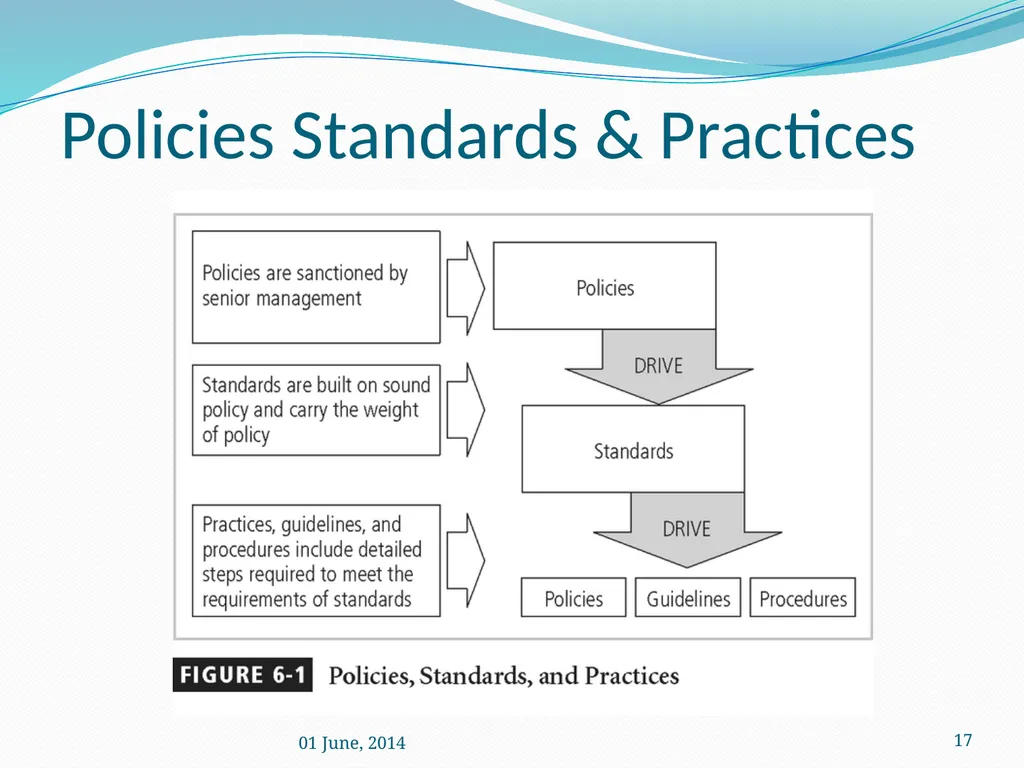
Standards, on the other hand, are more detailed statements of what must be done to comply with policy
Practices, procedures and guidelines effectively explain how to comply with policy
For a policy to be effective it must be properly disseminated, read, understood and agreed to by all members of the organization 9 01 June, 2014<br>
A plan or course of action business intends to influence and determine decisions, and actions
Policies are organizational laws
Standards, on the other hand, are more detailed statements of what must be done to comply with policy
Practices, procedures and guidelines effectively explain how to comply with policy
For a policy to be effective it must be properly disseminated, read, understood and agreed to by all members of the organization 9 01 June, 2014<br>
10
01 June, 2014 Types of Policy In General Management defines three types of security policy:
General or security program policy
Issue-specific security policies – Cyber crime, Payment card industry policy , etc.
Systems-specific security policies – Firewall , IDS , IPS etc. 10<br>
General or security program policy
Issue-specific security policies – Cyber crime, Payment card industry policy , etc.
Systems-specific security policies – Firewall , IDS , IPS etc. 10<br>
11
Policy Management Policies must be managed as they constantly change
To remain viable, security policies must have:
Individual responsible for the policy (policy administrator)
A schedule of reviews
Method for making recommendations for reviews
Specific policy issuance and revision date
Automated policy management 11 01 June, 2014<br>
To remain viable, security policies must have:
Individual responsible for the policy (policy administrator)
A schedule of reviews
Method for making recommendations for reviews
Specific policy issuance and revision date
Automated policy management 11 01 June, 2014<br>
12
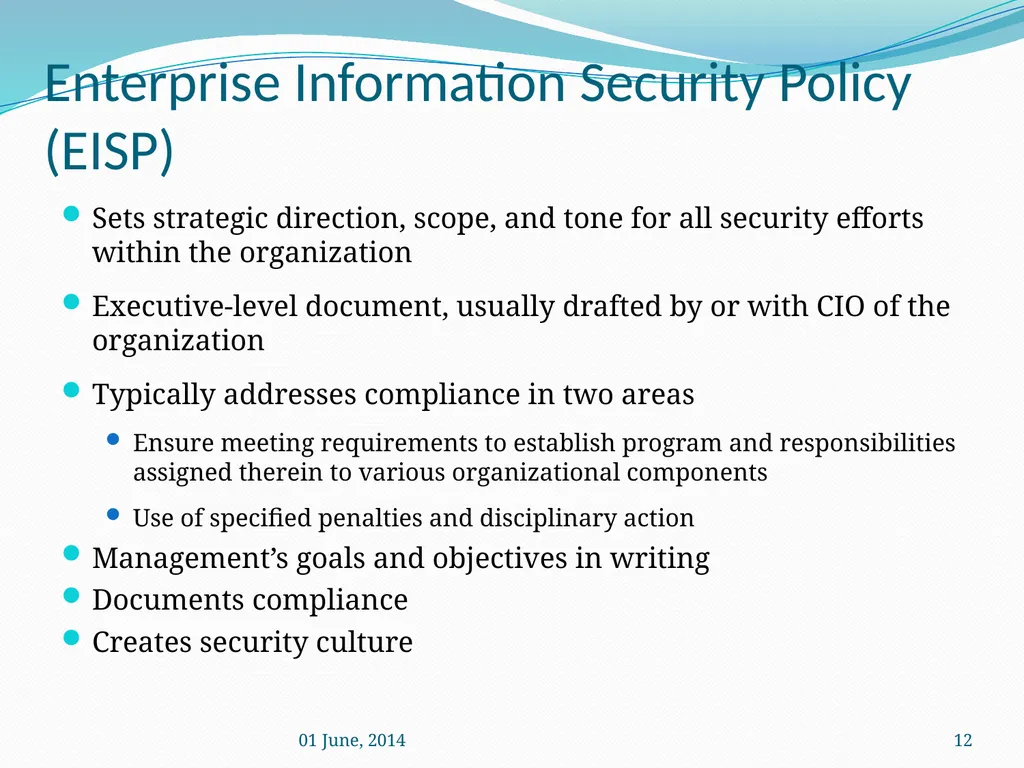
Enterprise Information Security Policy (EISP) Sets strategic direction, scope, and tone for all security efforts within the organization
Executive-level document, usually drafted by or with CIO of the organization
Typically addresses compliance in two areas
Ensure meeting requirements to establish program and responsibilities assigned therein to various organizational components
Use of specified penalties and disciplinary action
Management’s goals and objectives in writing
Documents compliance
Creates security culture 12 01 June, 2014<br>
Executive-level document, usually drafted by or with CIO of the organization
Typically addresses compliance in two areas
Ensure meeting requirements to establish program and responsibilities assigned therein to various organizational components
Use of specified penalties and disciplinary action
Management’s goals and objectives in writing
Documents compliance
Creates security culture 12 01 June, 2014<br>
13
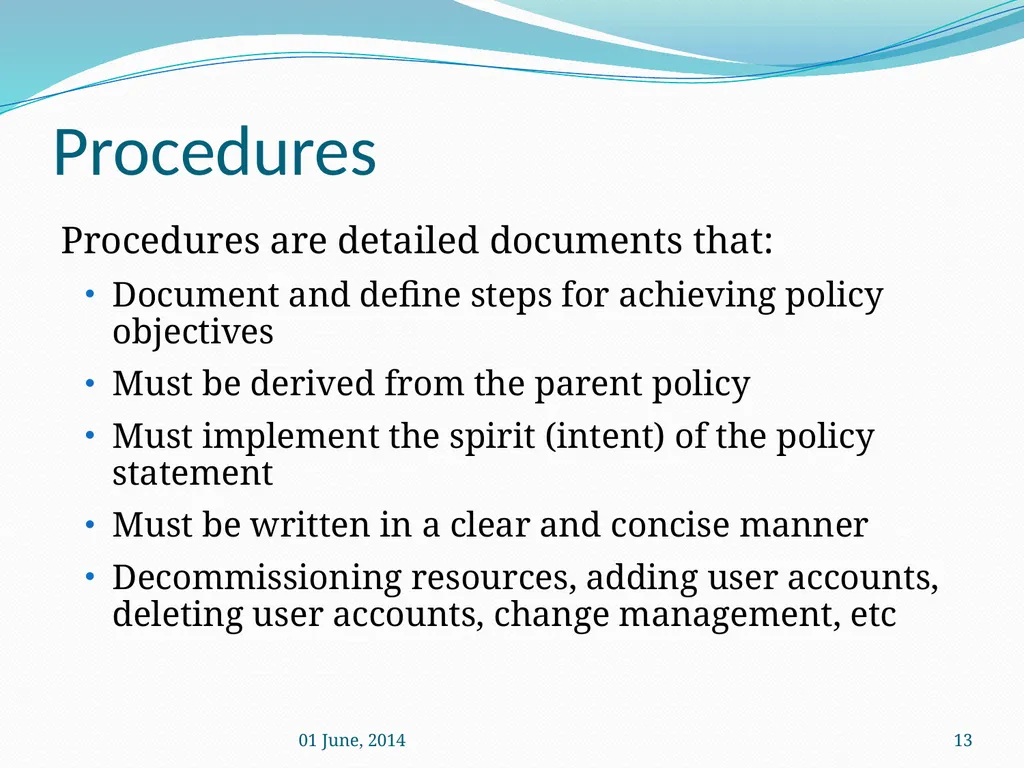
Procedures Procedures are detailed documents that:
Document and define steps for achieving policy objectives
Must be derived from the parent policy
Must implement the spirit (intent) of the policy statement
Must be written in a clear and concise manner
Decommissioning resources, adding user accounts, deleting user accounts, change management, etc 13 01 June, 2014<br>
Document and define steps for achieving policy objectives
Must be derived from the parent policy
Must implement the spirit (intent) of the policy statement
Must be written in a clear and concise manner
Decommissioning resources, adding user accounts, deleting user accounts, change management, etc 13 01 June, 2014<br>
14
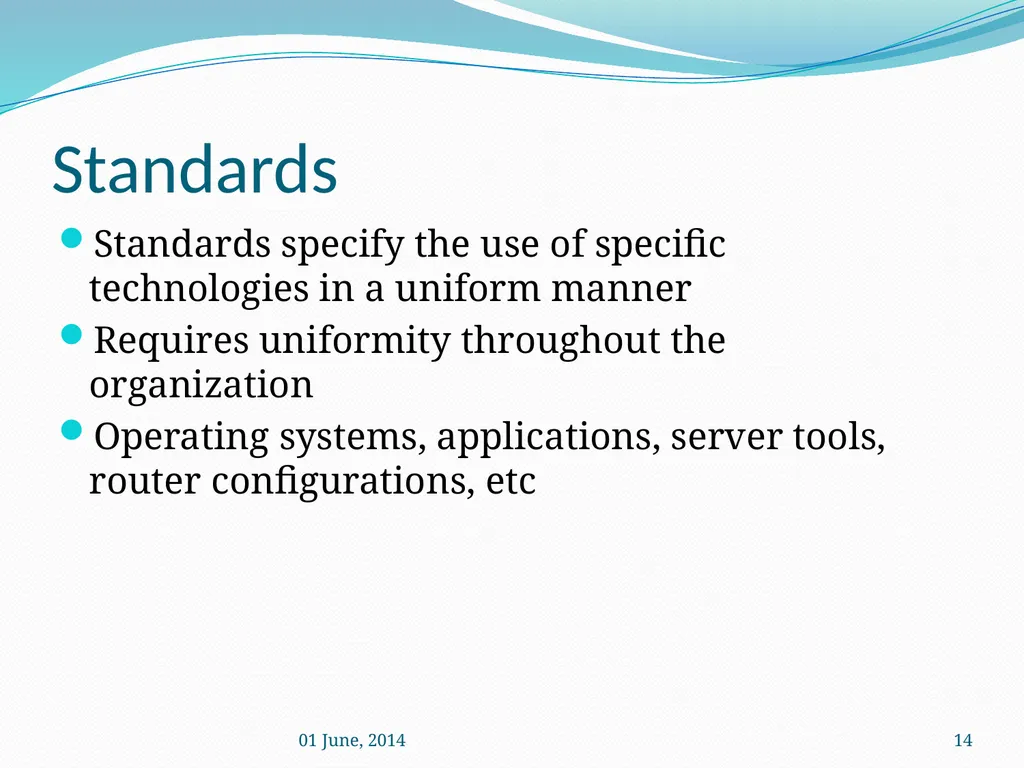
Standards Standards specify the use of specific technologies in a uniform manner
Requires uniformity throughout the organization
Operating systems, applications, server tools, router configurations, etc 01 June, 2014 14<br>
Requires uniformity throughout the organization
Operating systems, applications, server tools, router configurations, etc 01 June, 2014 14<br>
15
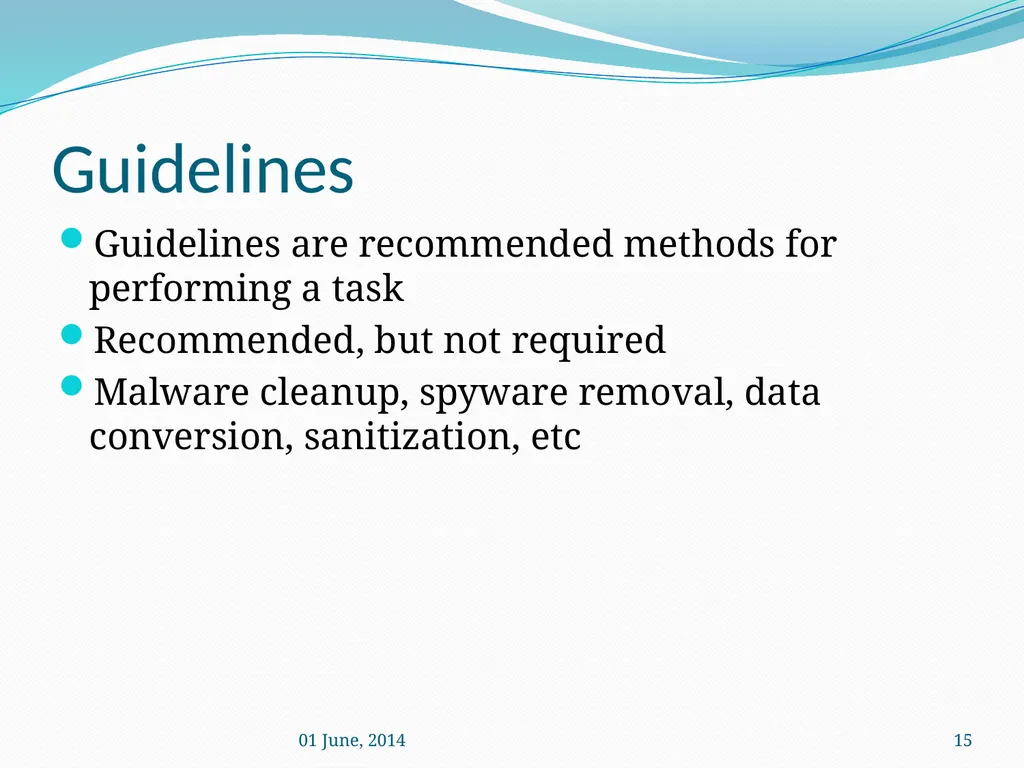
Guidelines Guidelines are recommended methods for performing a task
Recommended, but not required
Malware cleanup, spyware removal, data conversion, sanitization, etc 01 June, 2014 15<br>
Recommended, but not required
Malware cleanup, spyware removal, data conversion, sanitization, etc 01 June, 2014 15<br>
16
Baselines Baselines are similar to standards but account for differences in technologies and versions from different vendors
Operating system security baselines
FreeBSD 6.2, Mac OS X Panther, Solaris 10, Red Hat Enterprise Linux 5, Windows 2000, Windows XP, Windows Vista, etc 01 June, 2014 16<br>
Operating system security baselines
FreeBSD 6.2, Mac OS X Panther, Solaris 10, Red Hat Enterprise Linux 5, Windows 2000, Windows XP, Windows Vista, etc 01 June, 2014 16<br>
17
01 June, 2014 Policies Standards & Practices 17<br>
18
ISMS ISMS requires that everyone is clear about what is required of them, that:
they are trained in what they are meant to do,
they have the facilities and resources they need, etc.
ISMS to initiate the production of standard set of (broad) requirements which all have to be complied with. 01 June, 2014 18<br>
they are trained in what they are meant to do,
they have the facilities and resources they need, etc.
ISMS to initiate the production of standard set of (broad) requirements which all have to be complied with. 01 June, 2014 18<br>
19
Steps of ISMS Establish the ISMS
Implement and operate the ISMS
Monitor and review the ISMS
Maintain and improve the ISMS 01 June, 2014 19<br>
Implement and operate the ISMS
Monitor and review the ISMS
Maintain and improve the ISMS 01 June, 2014 19<br>
20
Security Governance Security Governance is the organizational processes and relationships for managing risk
Policies, Procedures, Standards, Guidelines, Baselines
Organizational Structures
Roles and Responsibilities 01 June, 2014 20<br>
Policies, Procedures, Standards, Guidelines, Baselines
Organizational Structures
Roles and Responsibilities 01 June, 2014 20<br>
21
The Information Security Blueprint Basis for design, selection, and implementation of all security policies, education and training programs, and technological controls
More detailed version of security framework (outline of overall information security strategy for organization)
Should specify tasks to be accomplished and the order in which they are to be realized
Should also serve as scalable, upgradeable, and comprehensive plan for information security needs for coming years 21 01 June, 2014<br>
More detailed version of security framework (outline of overall information security strategy for organization)
Should specify tasks to be accomplished and the order in which they are to be realized
Should also serve as scalable, upgradeable, and comprehensive plan for information security needs for coming years 21 01 June, 2014<br>
22
01 June, 2014 22 InfoSec - Function InfoSec department must be carefully structured and staffed with appropriately credentialed personnel
Proper procedures must be integrated into all human resources activities, including hiring, training, promotion, and termination practices<br>
Proper procedures must be integrated into all human resources activities, including hiring, training, promotion, and termination practices<br>
23
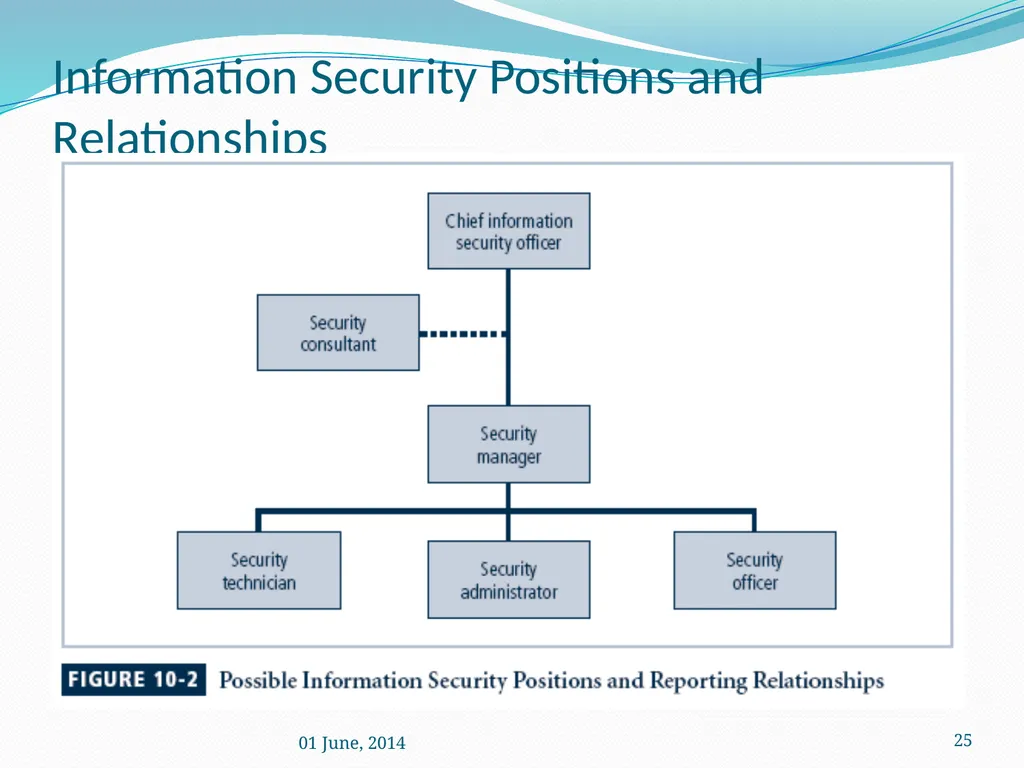
01 June, 2014 23 Chief information Security Officer (CISO) CISO is typically considered the top information security officer in the organization, although the CISO is usually not an executive-level position and frequently reports to the CIO
Although these individuals are business managers first and technologists second, they must be conversant in all areas of information security, including technology, planning, and policy<br>
Although these individuals are business managers first and technologists second, they must be conversant in all areas of information security, including technology, planning, and policy<br>
24
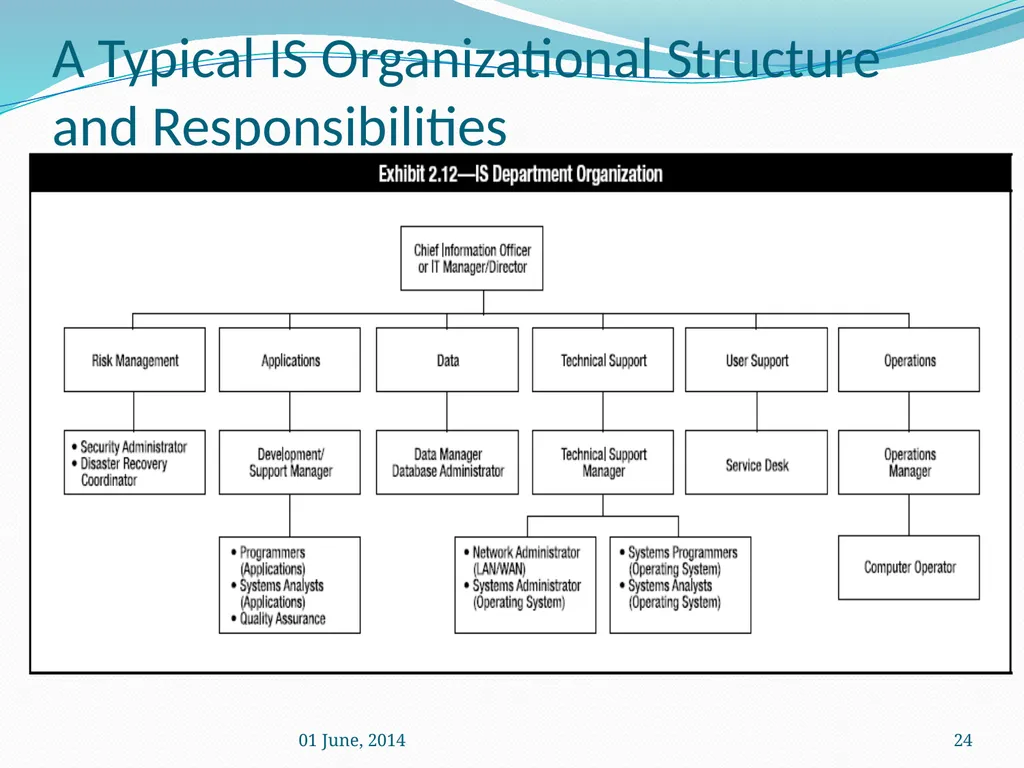
A Typical IS Organizational Structure and Responsibilities 24 01 June, 2014<br>
25
01 June, 2014 25 Information Security Positions and Relationships<br>
26
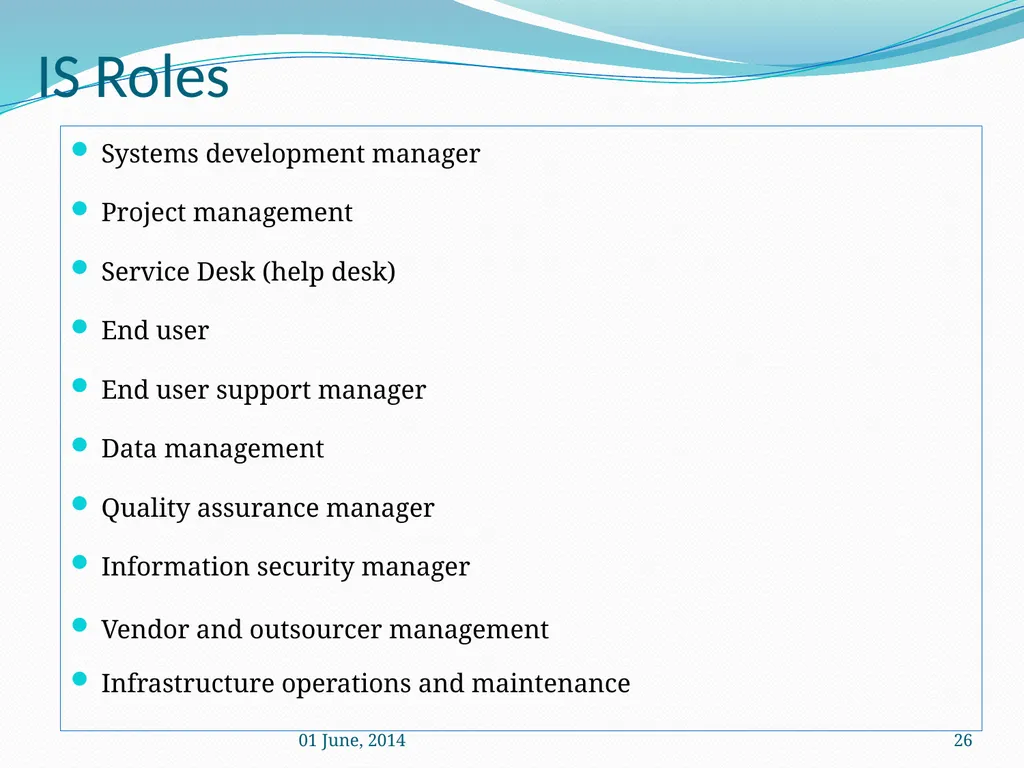
IS Roles Systems development manager
Project management
Service Desk (help desk)
End user
End user support manager
Data management
Quality assurance manager
Information security manager
Vendor and outsourcer management
Infrastructure operations and maintenance 26 01 June, 2014<br>
Project management
Service Desk (help desk)
End user
End user support manager
Data management
Quality assurance manager
Information security manager
Vendor and outsourcer management
Infrastructure operations and maintenance 26 01 June, 2014<br>
27
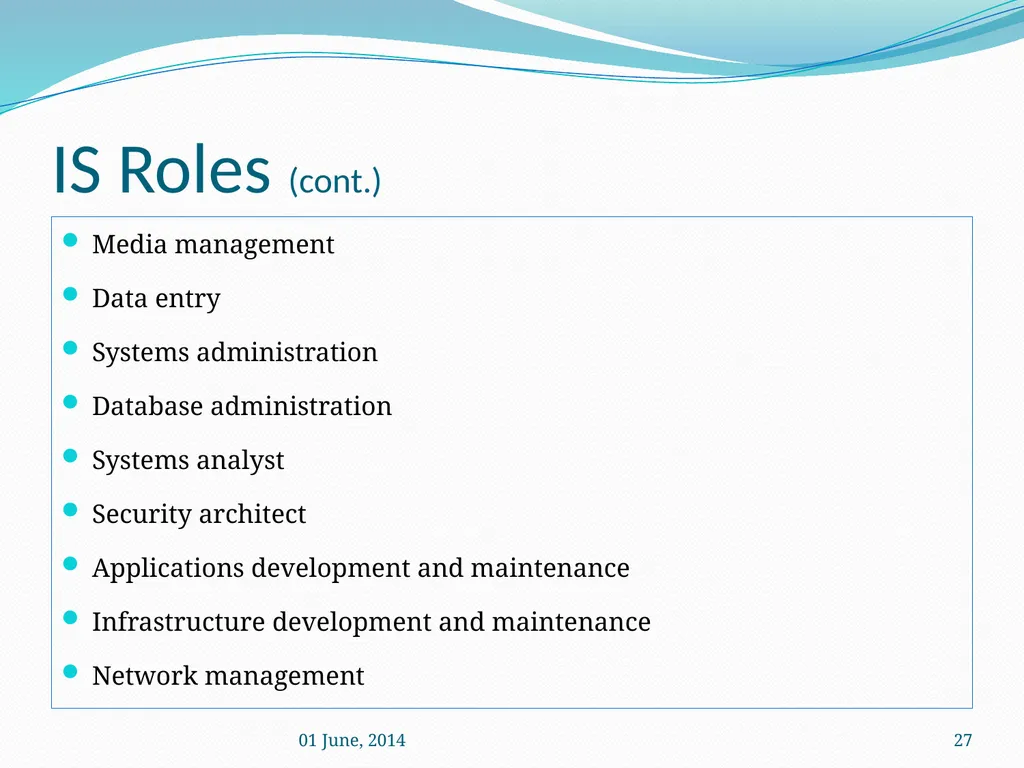
IS Roles (cont.) Media management
Data entry
Systems administration
Database administration
Systems analyst
Security architect
Applications development and maintenance
Infrastructure development and maintenance
Network management 27 01 June, 2014<br>
Data entry
Systems administration
Database administration
Systems analyst
Security architect
Applications development and maintenance
Infrastructure development and maintenance
Network management 27 01 June, 2014<br>
28
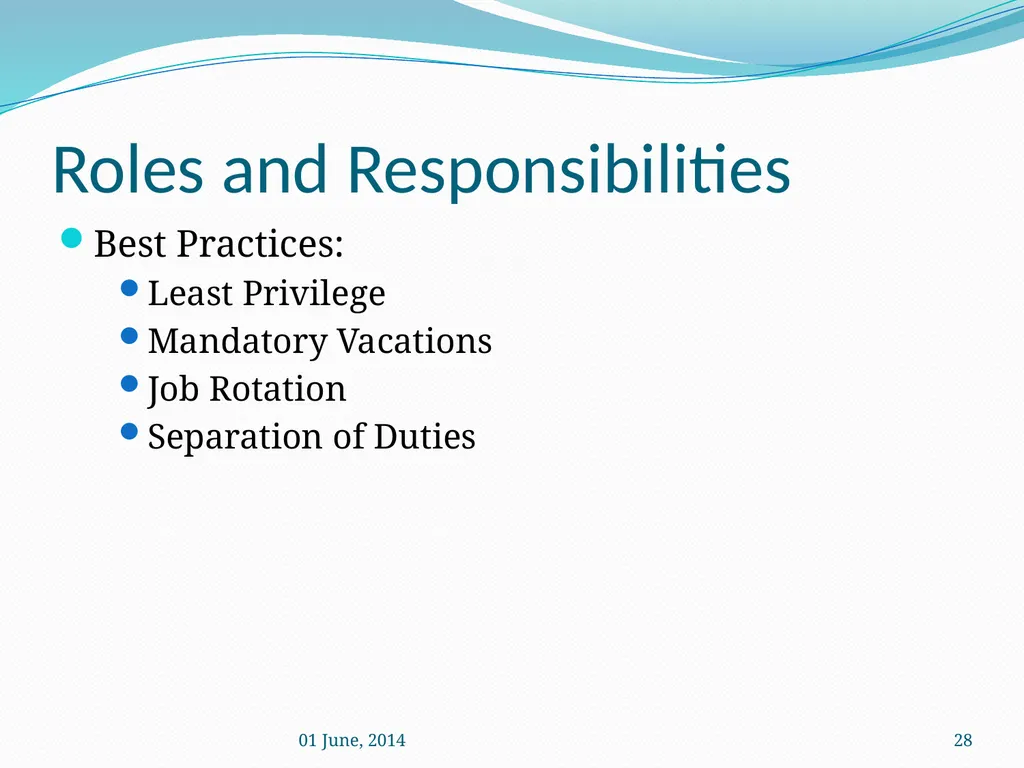
Roles and Responsibilities Best Practices:
Least Privilege
Mandatory Vacations
Job Rotation
Separation of Duties 01 June, 2014 28<br>
Least Privilege
Mandatory Vacations
Job Rotation
Separation of Duties 01 June, 2014 28<br>
29
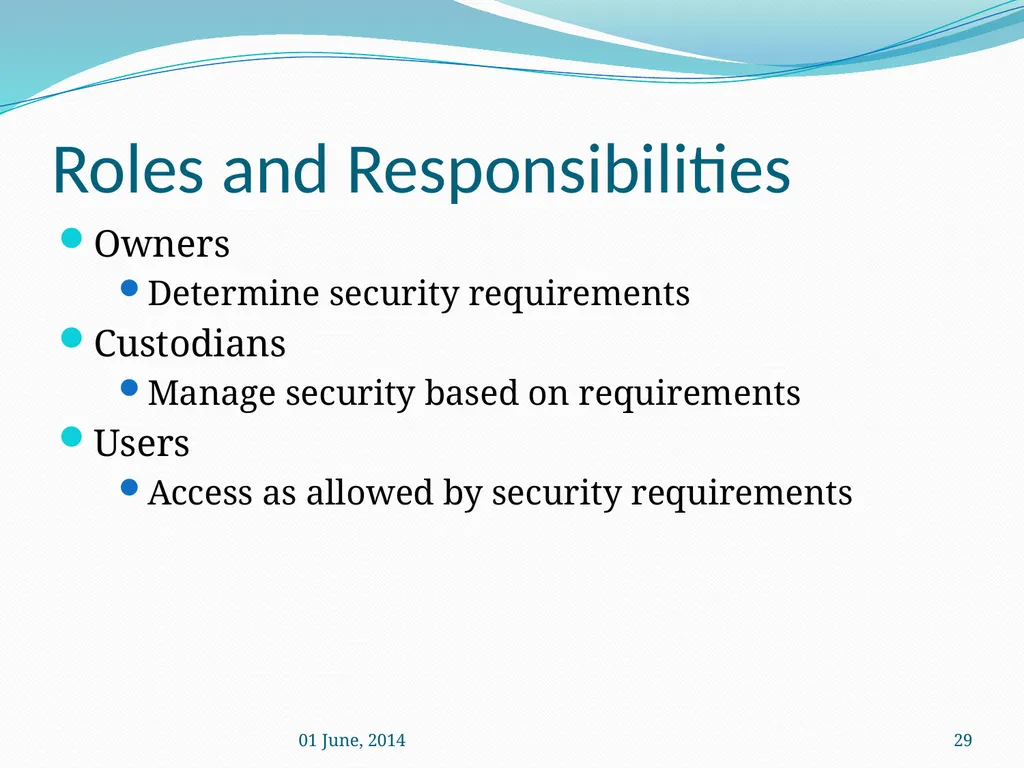
Roles and Responsibilities Owners
Determine security requirements
Custodians
Manage security based on requirements
Users
Access as allowed by security requirements 01 June, 2014 29<br>
Determine security requirements
Custodians
Manage security based on requirements
Users
Access as allowed by security requirements 01 June, 2014 29<br>
30
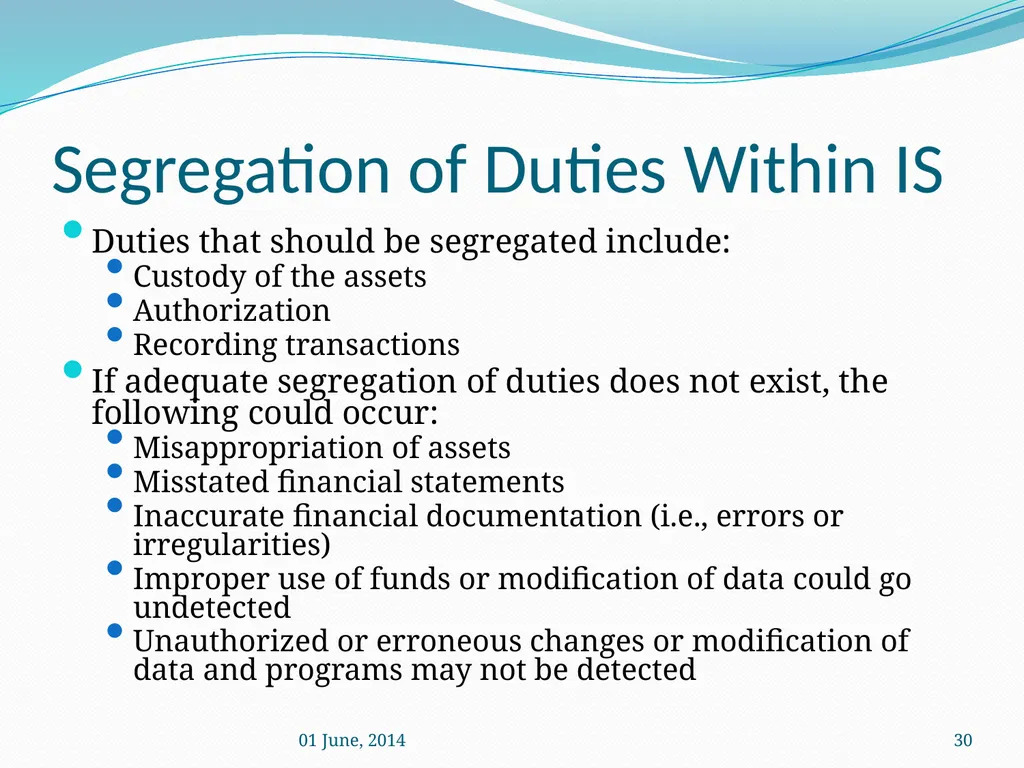
Segregation of Duties Within IS Duties that should be segregated include:
Custody of the assets
Authorization
Recording transactions
If adequate segregation of duties does not exist, the following could occur:
Misappropriation of assets
Misstated financial statements
Inaccurate financial documentation (i.e., errors or irregularities)
Improper use of funds or modification of data could go undetected
Unauthorized or erroneous changes or modification of data and programs may not be detected 30 01 June, 2014<br>
Custody of the assets
Authorization
Recording transactions
If adequate segregation of duties does not exist, the following could occur:
Misappropriation of assets
Misstated financial statements
Inaccurate financial documentation (i.e., errors or irregularities)
Improper use of funds or modification of data could go undetected
Unauthorized or erroneous changes or modification of data and programs may not be detected 30 01 June, 2014<br>
31
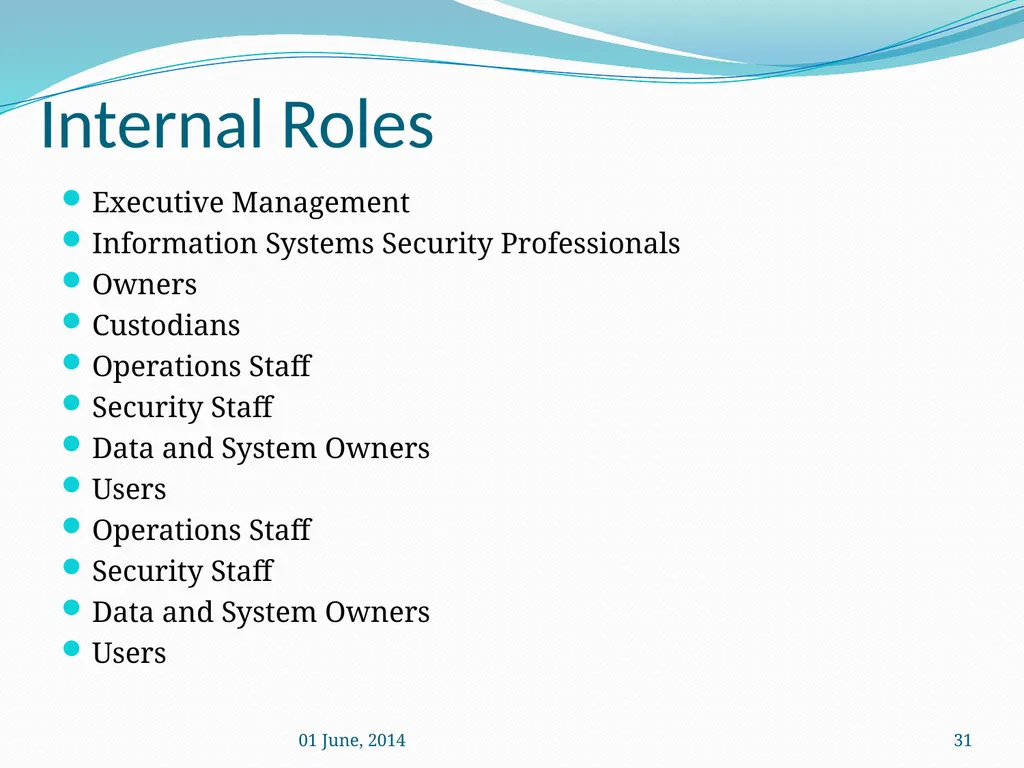
Internal Roles Executive Management
Information Systems Security Professionals
Owners
Custodians
Operations Staff
Security Staff
Data and System Owners
Users
Operations Staff
Security Staff
Data and System Owners
Users 31 01 June, 2014<br>
Information Systems Security Professionals
Owners
Custodians
Operations Staff
Security Staff
Data and System Owners
Users
Operations Staff
Security Staff
Data and System Owners
Users 31 01 June, 2014<br>
32
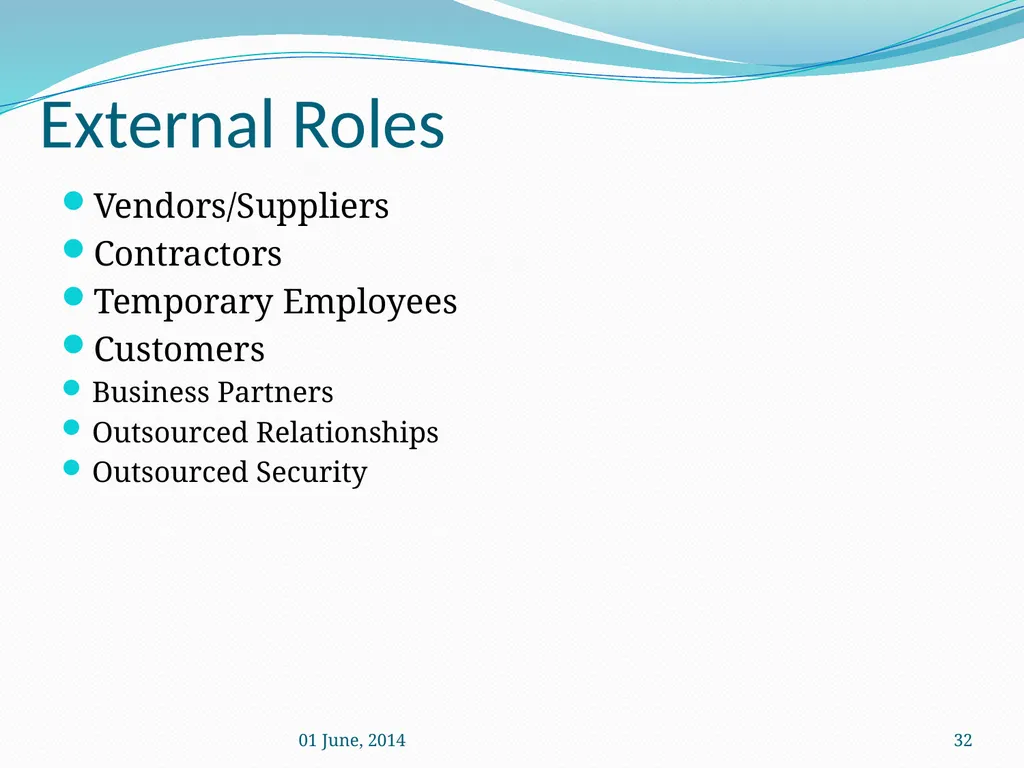
External Roles Vendors/Suppliers
Contractors
Temporary Employees
Customers
Business Partners
Outsourced Relationships
Outsourced Security 32 01 June, 2014<br>
Contractors
Temporary Employees
Customers
Business Partners
Outsourced Relationships
Outsourced Security 32 01 June, 2014<br>
33
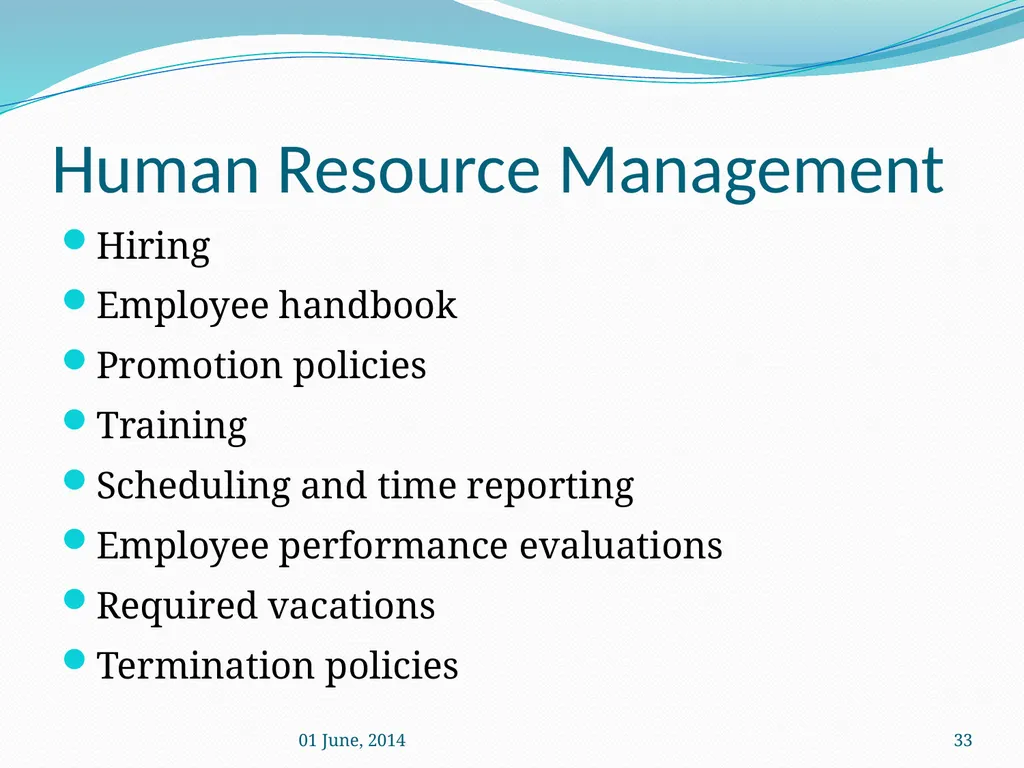
Human Resource Management Hiring
Employee handbook
Promotion policies
Training
Scheduling and time reporting
Employee performance evaluations
Required vacations
Termination policies 33 01 June, 2014<br>
Employee handbook
Promotion policies
Training
Scheduling and time reporting
Employee performance evaluations
Required vacations
Termination policies 33 01 June, 2014<br>
34
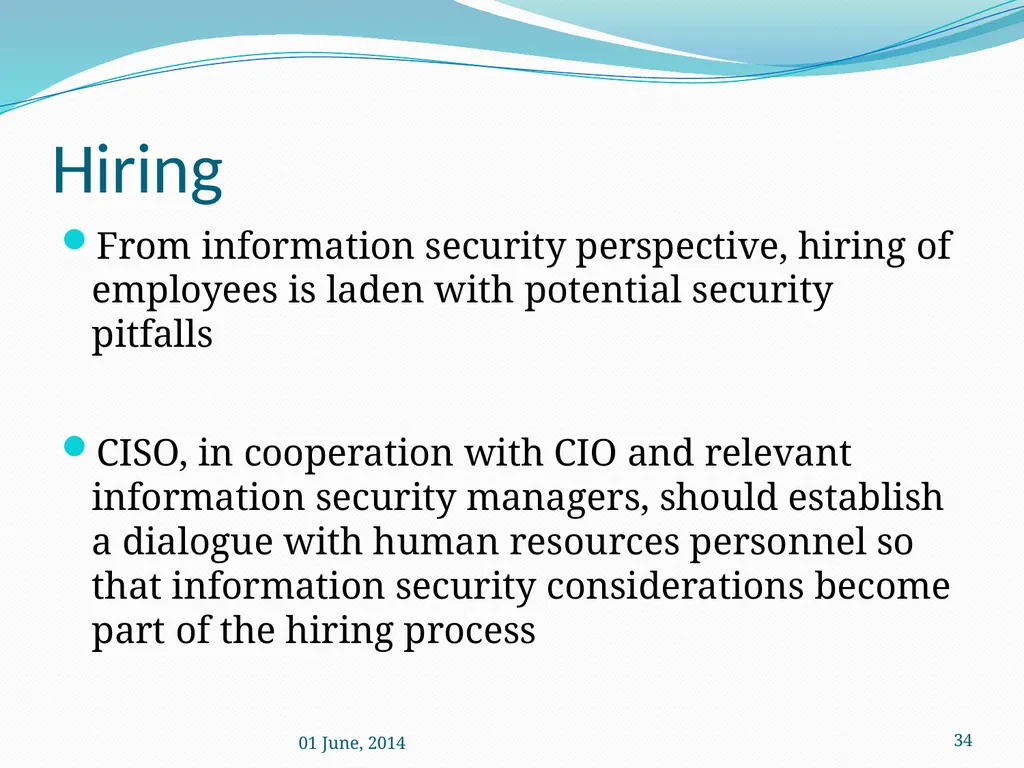
01 June, 2014 34 Hiring From information security perspective, hiring of employees is laden with potential security pitfalls
CISO, in cooperation with CIO and relevant information security managers, should establish a dialogue with human resources personnel so that information security considerations become part of the hiring process<br>
CISO, in cooperation with CIO and relevant information security managers, should establish a dialogue with human resources personnel so that information security considerations become part of the hiring process<br>
35
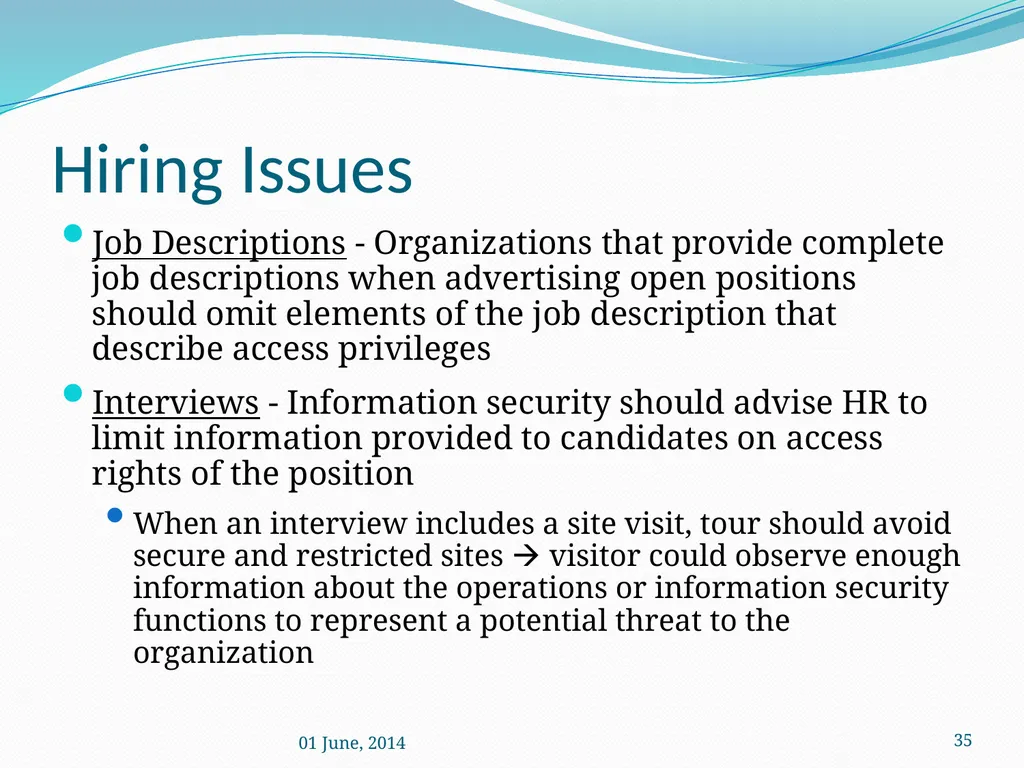
01 June, 2014 35 Hiring Issues Job Descriptions - Organizations that provide complete job descriptions when advertising open positions should omit elements of the job description that describe access privileges
Interviews - Information security should advise HR to limit information provided to candidates on access rights of the position
When an interview includes a site visit, tour should avoid secure and restricted sites visitor could observe enough information about the operations or information security functions to represent a potential threat to the organization<br>
Interviews - Information security should advise HR to limit information provided to candidates on access rights of the position
When an interview includes a site visit, tour should avoid secure and restricted sites visitor could observe enough information about the operations or information security functions to represent a potential threat to the organization<br>
36
01 June, 2014 36 Hiring Issues (Continued) New Hire Orientation - New employees should receive, as part of their orientation, an extensive information security briefing
On-the-Job Security Training - Organizations should conduct periodic security awareness and training activities to keep security at the forefront of employees’ minds and minimize employee mistakes
Security Checks - Background check should be conducted before organization extends an offer to any candidate, regardless of job level<br>
On-the-Job Security Training - Organizations should conduct periodic security awareness and training activities to keep security at the forefront of employees’ minds and minimize employee mistakes
Security Checks - Background check should be conducted before organization extends an offer to any candidate, regardless of job level<br>
37
01 June, 2014 37 Common Background Checks Identity checks: Personal identity validation
Education and credential checks: Institutions attended, degrees and certifications earned, and certification status
Previous employment verification: Where candidates worked, why they left, what they did, and for how long
Reference checks: Validity of references and integrity of reference sources
Worker’s compensation history: Claims from worker’s compensation<br>
Education and credential checks: Institutions attended, degrees and certifications earned, and certification status
Previous employment verification: Where candidates worked, why they left, what they did, and for how long
Reference checks: Validity of references and integrity of reference sources
Worker’s compensation history: Claims from worker’s compensation<br>
38
01 June, 2014 38 Common Background Checks (Continued) Motor vehicle records: driving records, suspensions, and other items noted in the applicant’s public record
Drug history: drug screening and drug usage, past and present
Medical history: current and previous medical conditions, usually associated with physical capability to perform the work in the specified position
Credit history: credit problems, financial problems, and bankruptcy
Civil court history: involvement as the plaintiff or defendant in civil suits
Criminal court history: criminal background, arrests, convictions, and time served<br>
Drug history: drug screening and drug usage, past and present
Medical history: current and previous medical conditions, usually associated with physical capability to perform the work in the specified position
Credit history: credit problems, financial problems, and bankruptcy
Civil court history: involvement as the plaintiff or defendant in civil suits
Criminal court history: criminal background, arrests, convictions, and time served<br>
39
01 June, 2014 39 Contracts and Employment Once a candidate has accepted a job offer, the employment contract becomes an important security instrument
It is important to have these contracts and agreements in place at the time of the hire<br>
It is important to have these contracts and agreements in place at the time of the hire<br>
40
Employee Handbook / Manual A permanent reference guide for employers and employees that contains information about a company, its goals and its current employment policies and procedures. 01 June, 2014 40<br>
41
Security Education, Training, and Awareness Program (SETA) As soon as general security policy exists, policies to implement security education, training, and awareness program should follow
SETA is a control measure designed to reduce accidental security breaches
Security education and training builds on the general knowledge the employees must possess to do their jobs, familiarizing them with the way to do their jobs securely
The SETA program consists of: security education; security training; and security awareness 41 01 June, 2014<br>
SETA is a control measure designed to reduce accidental security breaches
Security education and training builds on the general knowledge the employees must possess to do their jobs, familiarizing them with the way to do their jobs securely
The SETA program consists of: security education; security training; and security awareness 41 01 June, 2014<br>
42
Security Education Everyone in an organization needs to be trained and aware of information security; not every member needs formal degree or certificate in information security
When formal education for individuals in security is needed, an employee can identify curriculum available from local institutions of higher learning or continuing education
A number of universities have formal coursework in information security 42 01 June, 2014<br>
When formal education for individuals in security is needed, an employee can identify curriculum available from local institutions of higher learning or continuing education
A number of universities have formal coursework in information security 42 01 June, 2014<br>
43
Security Training Involves providing members of organization with detailed information and hands-on instruction designed to prepare them to perform their duties securely
Management of information security can develop customized in-house training or outsource the training program
Alternatives to formal training include conferences and programs offered through professional organizations 43 01 June, 2014<br>
Management of information security can develop customized in-house training or outsource the training program
Alternatives to formal training include conferences and programs offered through professional organizations 43 01 June, 2014<br>
44
Security Awareness One of least frequently implemented but most beneficial programs is the security awareness program
Designed to keep information security at the forefront of users’ minds
Need not be complicated or expensive
If the program is not actively implemented, employees begin to “tune out” and risk of security incidents increases 44 01 June, 2014<br>
Designed to keep information security at the forefront of users’ minds
Need not be complicated or expensive
If the program is not actively implemented, employees begin to “tune out” and risk of security incidents increases 44 01 June, 2014<br>
45
01 June, 2014 45 Security as Part of Performance Evaluation To heighten information security awareness and change workplace behavior, organizations should incorporate information security components into employee performance evaluations
Employees pay close attention to job performance evaluations
Including information security tasks in them will motivate employees to take more care when performing their tasks<br>
Employees pay close attention to job performance evaluations
Including information security tasks in them will motivate employees to take more care when performing their tasks<br>
46
01 June, 2014 46 Termination Issues When an employee leaves an organization, the following tasks must be performed:
Access to organization’s systems must be disabled
Former employee must return all removable media
Former employee’s hard drives must be secured
File cabinet locks must be changed
Office door locks must be changed
Former employee’s keycard access must be revoked<br>
Access to organization’s systems must be disabled
Former employee must return all removable media
Former employee’s hard drives must be secured
File cabinet locks must be changed
Office door locks must be changed
Former employee’s keycard access must be revoked<br>
47
01 June, 2014 47 Termination Issues (Continued) Former employee’s personal effects must be removed from the premises
Former employee should be escorted from the premises, once keys, keycards, and other business property have been turned over
Exit interview to remind employee of any contractual obligations, such as nondisclosure agreements, and to obtain feedback on the employee’s tenure in the organization
Two methods for handling employee outprocessing, depending on the employee’s reasons for leaving, are hostile and friendly departures<br>
Former employee should be escorted from the premises, once keys, keycards, and other business property have been turned over
Exit interview to remind employee of any contractual obligations, such as nondisclosure agreements, and to obtain feedback on the employee’s tenure in the organization
Two methods for handling employee outprocessing, depending on the employee’s reasons for leaving, are hostile and friendly departures<br>
48
01 June, 2014 48 Hostile Departure Security cuts off all logical and keycard access before employee is terminated
Employee reports for work and is escorted into supervisor’s office to receive bad news
Individual is then escorted from the workplace and informed that his or her personal property will be forwarded, or is escorted to his or her office, cubicle, or personal area to collect personal effects under supervision
Once personal property has been gathered, the employee is asked to surrender all keys, keycards, and other organizational identification and access devices, PDAs, pagers, cell phones, and all remaining company property, and is then escorted from the building<br>
Employee reports for work and is escorted into supervisor’s office to receive bad news
Individual is then escorted from the workplace and informed that his or her personal property will be forwarded, or is escorted to his or her office, cubicle, or personal area to collect personal effects under supervision
Once personal property has been gathered, the employee is asked to surrender all keys, keycards, and other organizational identification and access devices, PDAs, pagers, cell phones, and all remaining company property, and is then escorted from the building<br>
49
01 June, 2014 49 Friendly Departure Employee may have tendered notice well in advance of actual departure date which can make it much more difficult for security to maintain positive control over employee’s access and information usage
Employee accounts are usually allowed to continue with a new expiration date
Employee can come and go at will, usually collects any belongings and leaves without escort
Employee is asked to drop off all organizational property before departing<br>
Employee accounts are usually allowed to continue with a new expiration date
Employee can come and go at will, usually collects any belongings and leaves without escort
Employee is asked to drop off all organizational property before departing<br>
50
01 June, 2014 50 Termination Issues Concluded In either circumstance, offices and information used by departing employees must be inventoried, their files stored or destroyed, and all property returned to organizational stores
Possible that departing employees have collected and taken home information or assets that could be valuable in their future jobs
Only by scrutinizing system logs during transition period and after employee has departed, and sorting out authorized actions from system misuse or information theft, can the organization determine whether a breach of policy or a loss of information has occurred<br>
Possible that departing employees have collected and taken home information or assets that could be valuable in their future jobs
Only by scrutinizing system logs during transition period and after employee has departed, and sorting out authorized actions from system misuse or information theft, can the organization determine whether a breach of policy or a loss of information has occurred<br>
51
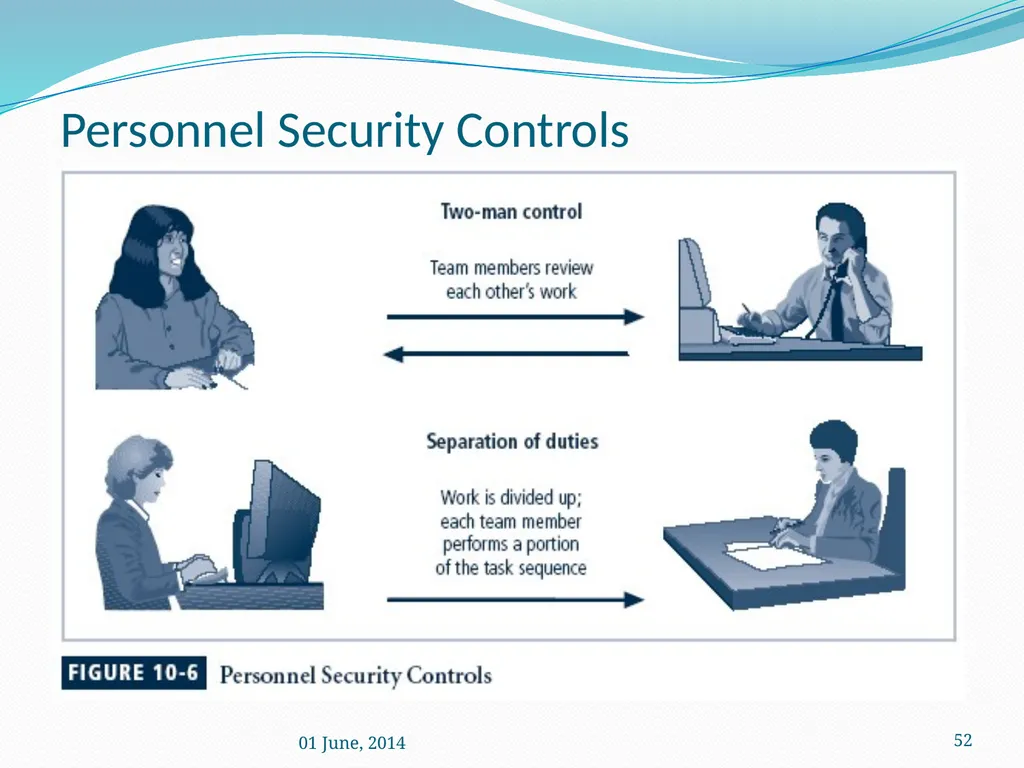
01 June, 2014 51 Personnel Security Practices There are various ways of monitoring and controlling employees to minimize their opportunities to misuse information
Separation of duties is used to make it difficult for an individual to violate information security and breach the confidentiality, integrity, or availability of information
Two-man control requires that two individuals review and approve each other’s work before the task is considered complete<br>
Separation of duties is used to make it difficult for an individual to violate information security and breach the confidentiality, integrity, or availability of information
Two-man control requires that two individuals review and approve each other’s work before the task is considered complete<br>
52
01 June, 2014 52 Personnel Security Controls<br>
53
01 June, 2014 53 Personnel Security Practices (Continued) Job rotation
Another control used to prevent personnel from misusing information assets
Requires that every employee be able to perform the work of at least one other employee
Task rotation
All critical tasks can be performed by multiple individuals
Both job rotation and task rotation ensure that no one employee is performing actions that cannot be knowledgeably reviewed by another employee
For similar reasons, each employee should be required to take a mandatory vacation, of at least one week per year<br>
Another control used to prevent personnel from misusing information assets
Requires that every employee be able to perform the work of at least one other employee
Task rotation
All critical tasks can be performed by multiple individuals
Both job rotation and task rotation ensure that no one employee is performing actions that cannot be knowledgeably reviewed by another employee
For similar reasons, each employee should be required to take a mandatory vacation, of at least one week per year<br>
54
01 June, 2014 54 Personnel Security Practices (Continued) Policy gives organization a chance to perform a detailed review of everyone’s work
Finally, another important way to minimize opportunities for employee misuse information is to limit access to information
Employees should be able to access only the information they need and only for the period required to perform their tasks
This policy gives the organization a chance to perform a detailed review of everyone’s work
Principle of least privilege<br>
Finally, another important way to minimize opportunities for employee misuse information is to limit access to information
Employees should be able to access only the information they need and only for the period required to perform their tasks
This policy gives the organization a chance to perform a detailed review of everyone’s work
Principle of least privilege<br>
55
01 June, 2014 55 Personnel Security Practices (Continued) Similar to the need-to-know concept, least privilege ensures that no unnecessary access to data occurs
If all employees can access all the organization’s data all the time, it is almost certain that abuses—possibly leading to losses in confidentiality, integrity, and availability.<br>
If all employees can access all the organization’s data all the time, it is almost certain that abuses—possibly leading to losses in confidentiality, integrity, and availability.<br>
56
01 June, 2014 56 Security of Personnel and Personal Data Organizations are required by law to protect sensitive or personal employee information, including personally identifying facts such as employee addresses, phone numbers, Social Security numbers, medical conditions, and even names and addresses of family members
This responsibility also extends to customers, patients, and anyone with whom the organization has business relationships
While personnel data is, in principle, no different than other data that information security is expected to protect, certainly more regulations cover its protection
As a result, information security procedures should ensure that this data receives at least the same level of protection as other important data in the organization<br>
This responsibility also extends to customers, patients, and anyone with whom the organization has business relationships
While personnel data is, in principle, no different than other data that information security is expected to protect, certainly more regulations cover its protection
As a result, information security procedures should ensure that this data receives at least the same level of protection as other important data in the organization<br>
57
01 June, 2014 57 Security Considerations for Non-employees Many individuals who are not employees often have access to sensitive organizational information
Relationships with individuals in this category should be carefully managed to prevent threats to information assets from materializing<br>
Relationships with individuals in this category should be carefully managed to prevent threats to information assets from materializing<br>
58
01 June, 2014 58 Temporary Workers Because temporary workers are not employed by the organization for which they are working, they may not be subject to contractual obligations or general policies that govern other employees
Unless specified in contract, temp agency may not be liable for losses caused by its workers
From a security standpoint, access to information for these individuals should be limited to what is necessary to perform their duties<br>
Unless specified in contract, temp agency may not be liable for losses caused by its workers
From a security standpoint, access to information for these individuals should be limited to what is necessary to perform their duties<br>
59
01 June, 2014 59 Contract Employees While professional contractors may require access to virtually all areas of the organization to do their jobs, service contractors usually need access only to specific facilities should not be allowed to wander freely in and out of buildings
In a secure facility, all service contractors are escorted from room to room and into and out of the facility
Any service agreements or contracts should contain the following regulations:
Facility requires 24 to 48 hours’ notice of a maintenance visit
Facility requires all on-site personnel to undergo background checks
Facility requires advance notice for cancellation or rescheduling of a maintenance visit<br>
In a secure facility, all service contractors are escorted from room to room and into and out of the facility
Any service agreements or contracts should contain the following regulations:
Facility requires 24 to 48 hours’ notice of a maintenance visit
Facility requires all on-site personnel to undergo background checks
Facility requires advance notice for cancellation or rescheduling of a maintenance visit<br>
60
01 June, 2014 60 Consultants Consultants have their own security requirements and contractual obligations
Should be handled like contract employees, with special requirements, such as information or facility access requirements, being integrated into the contract before they are given free access to the facility
In particular, security and technology consultants must be prescreened, escorted, and subjected to nondisclosure agreements to protect the organization from intentional or accidental breaches of confidentiality
Just because you pay security consultants, it doesn’t mean that protecting your information is their number one priority
Always remember to apply the principle of least privilege when working with consultants<br>
Should be handled like contract employees, with special requirements, such as information or facility access requirements, being integrated into the contract before they are given free access to the facility
In particular, security and technology consultants must be prescreened, escorted, and subjected to nondisclosure agreements to protect the organization from intentional or accidental breaches of confidentiality
Just because you pay security consultants, it doesn’t mean that protecting your information is their number one priority
Always remember to apply the principle of least privilege when working with consultants<br>
61
01 June, 2014 61 Business Partners Businesses sometimes engage in strategic alliances with other organizations, so as to exchange information, integrate systems, or enjoy some other mutual advantage
A prior business agreement must specify the levels of exposure that both organizations are willing to tolerate
If strategic partnership evolves into an integration of the systems of both companies, competing groups may be provided with information that neither parent organization expected
Level of security of both systems must be examined before any physical integration takes place, as system connection means that vulnerability on one system becomes vulnerability for all linked systems<br>
A prior business agreement must specify the levels of exposure that both organizations are willing to tolerate
If strategic partnership evolves into an integration of the systems of both companies, competing groups may be provided with information that neither parent organization expected
Level of security of both systems must be examined before any physical integration takes place, as system connection means that vulnerability on one system becomes vulnerability for all linked systems<br>
62
Organizational Structure Audit should be separate from implementation and operations
Independence is not compromised
Responsibilities for security should be defined in job descriptions
Senior management has ultimate responsibility for security
Security officers/managers have functional responsibility 01 June, 2014 62<br>
Independence is not compromised
Responsibilities for security should be defined in job descriptions
Senior management has ultimate responsibility for security
Security officers/managers have functional responsibility 01 June, 2014 62<br>
63
Sourcing Practices Sourcing practices relate to the way an organization obtains the IS function required to support the business
Organizations can perform all IS functions in-house or outsource all functions across the globe
Sourcing strategy should consider each IS function and determine which approach allows the IS function to meet the organization’s goals 63 01 June, 2014<br>
Organizations can perform all IS functions in-house or outsource all functions across the globe
Sourcing strategy should consider each IS function and determine which approach allows the IS function to meet the organization’s goals 63 01 June, 2014<br>
64
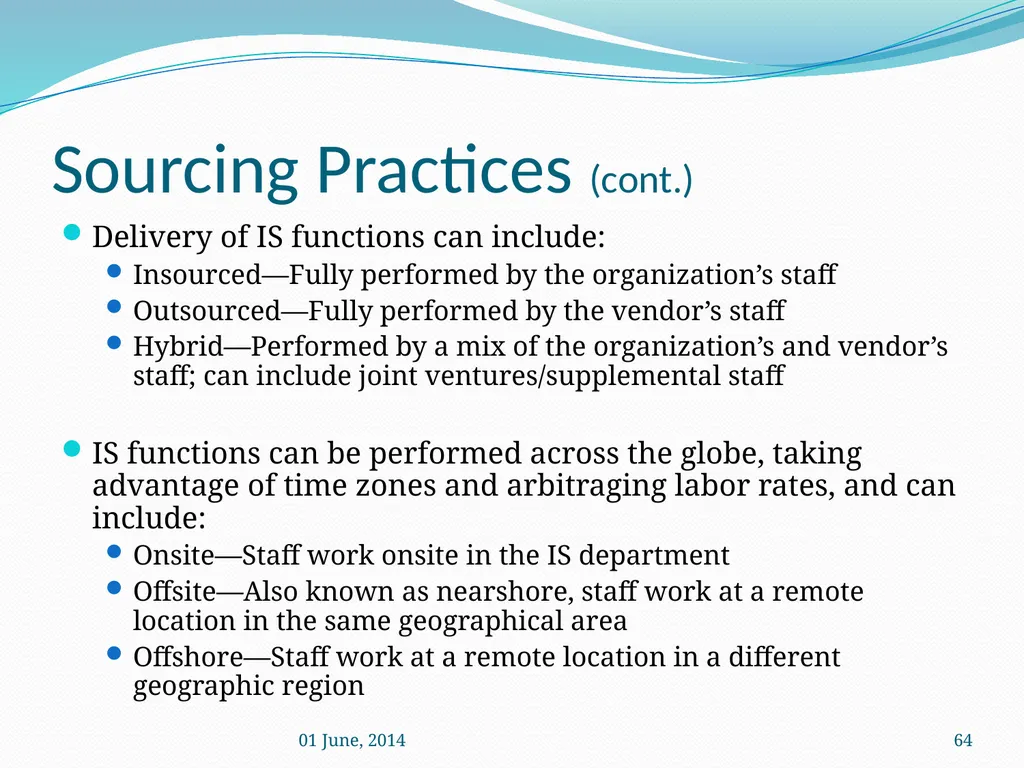
Sourcing Practices (cont.) Delivery of IS functions can include:
Insourced—Fully performed by the organization’s staff
Outsourced—Fully performed by the vendor’s staff
Hybrid—Performed by a mix of the organization’s and vendor’s staff; can include joint ventures/supplemental staff
IS functions can be performed across the globe, taking advantage of time zones and arbitraging labor rates, and can include:
Onsite—Staff work onsite in the IS department
Offsite—Also known as nearshore, staff work at a remote location in the same geographical area
Offshore—Staff work at a remote location in a different geographic region 64 01 June, 2014<br>
Insourced—Fully performed by the organization’s staff
Outsourced—Fully performed by the vendor’s staff
Hybrid—Performed by a mix of the organization’s and vendor’s staff; can include joint ventures/supplemental staff
IS functions can be performed across the globe, taking advantage of time zones and arbitraging labor rates, and can include:
Onsite—Staff work onsite in the IS department
Offsite—Also known as nearshore, staff work at a remote location in the same geographical area
Offshore—Staff work at a remote location in a different geographic region 64 01 June, 2014<br>
65
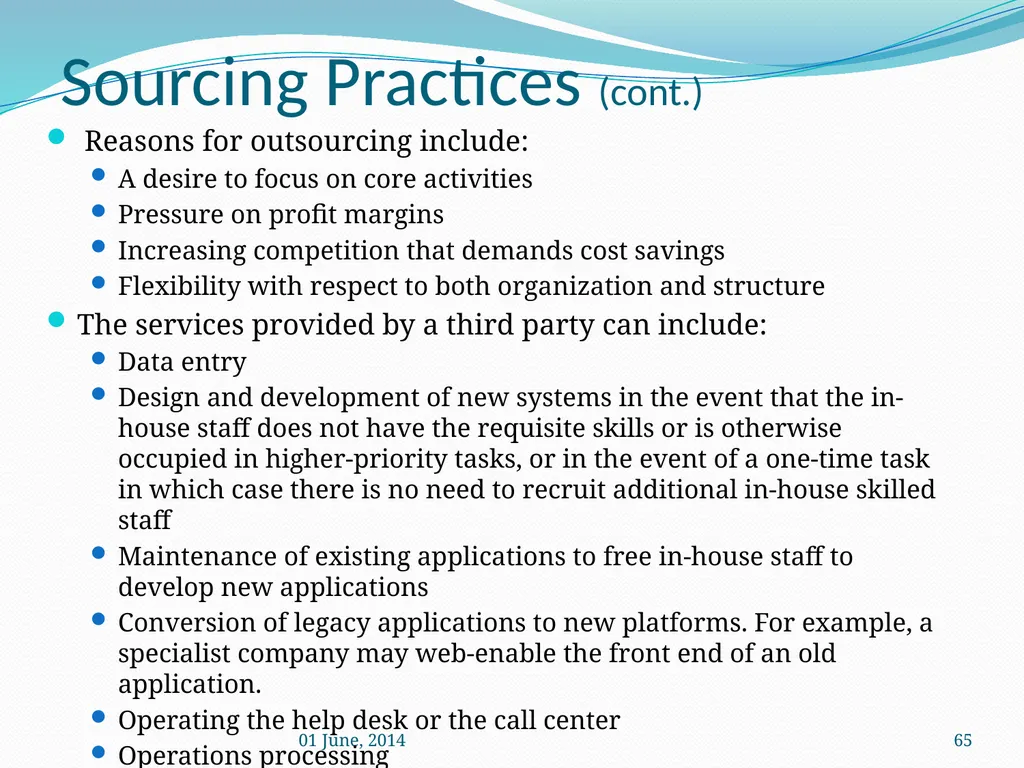
Reasons for outsourcing include:
A desire to focus on core activities
Pressure on profit margins
Increasing competition that demands cost savings
Flexibility with respect to both organization and structure
The services provided by a third party can include:
Data entry
Design and development of new systems in the event that the in-house staff does not have the requisite skills or is otherwise occupied in higher-priority tasks, or in the event of a one-time task in which case there is no need to recruit additional in-house skilled staff
Maintenance of existing applications to free in-house staff to develop new applications
Conversion of legacy applications to new platforms. For example, a specialist company may web-enable the front end of an old application.
Operating the help desk or the call center
Operations processing 01 June, 2014 65 Sourcing Practices (cont.)<br>
A desire to focus on core activities
Pressure on profit margins
Increasing competition that demands cost savings
Flexibility with respect to both organization and structure
The services provided by a third party can include:
Data entry
Design and development of new systems in the event that the in-house staff does not have the requisite skills or is otherwise occupied in higher-priority tasks, or in the event of a one-time task in which case there is no need to recruit additional in-house skilled staff
Maintenance of existing applications to free in-house staff to develop new applications
Conversion of legacy applications to new platforms. For example, a specialist company may web-enable the front end of an old application.
Operating the help desk or the call center
Operations processing 01 June, 2014 65 Sourcing Practices (cont.)<br>
66
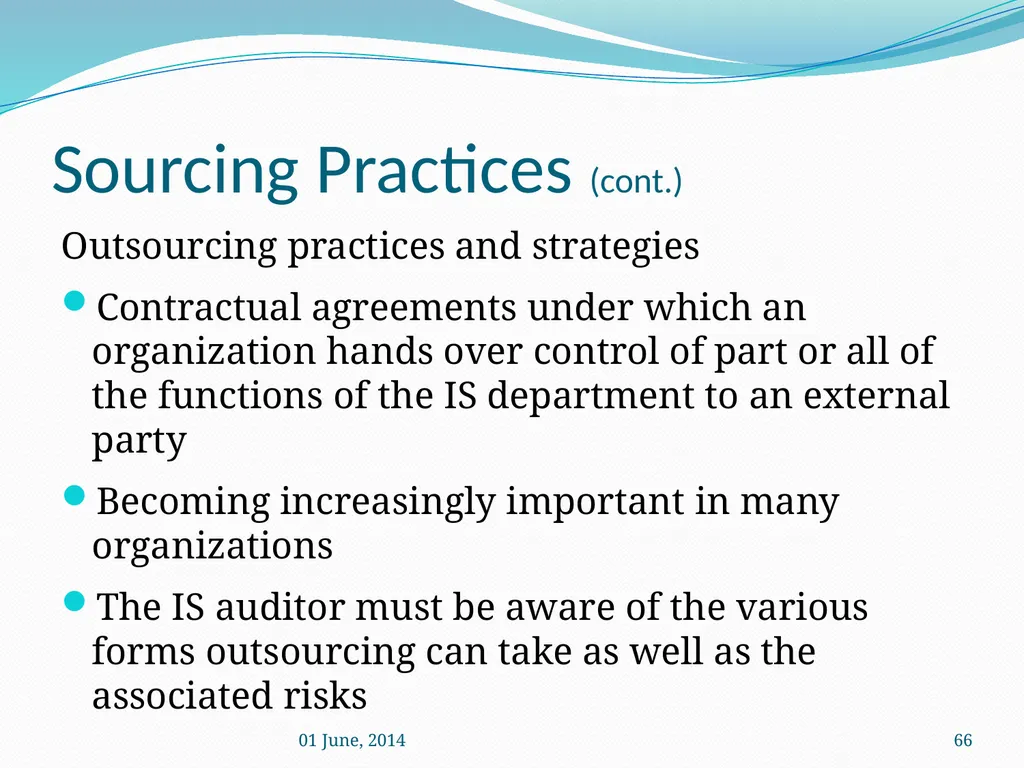
Sourcing Practices (cont.) Outsourcing practices and strategies
Contractual agreements under which an organization hands over control of part or all of the functions of the IS department to an external party
Becoming increasingly important in many organizations
The IS auditor must be aware of the various forms outsourcing can take as well as the associated risks 66 01 June, 2014<br>
Contractual agreements under which an organization hands over control of part or all of the functions of the IS department to an external party
Becoming increasingly important in many organizations
The IS auditor must be aware of the various forms outsourcing can take as well as the associated risks 66 01 June, 2014<br>
67
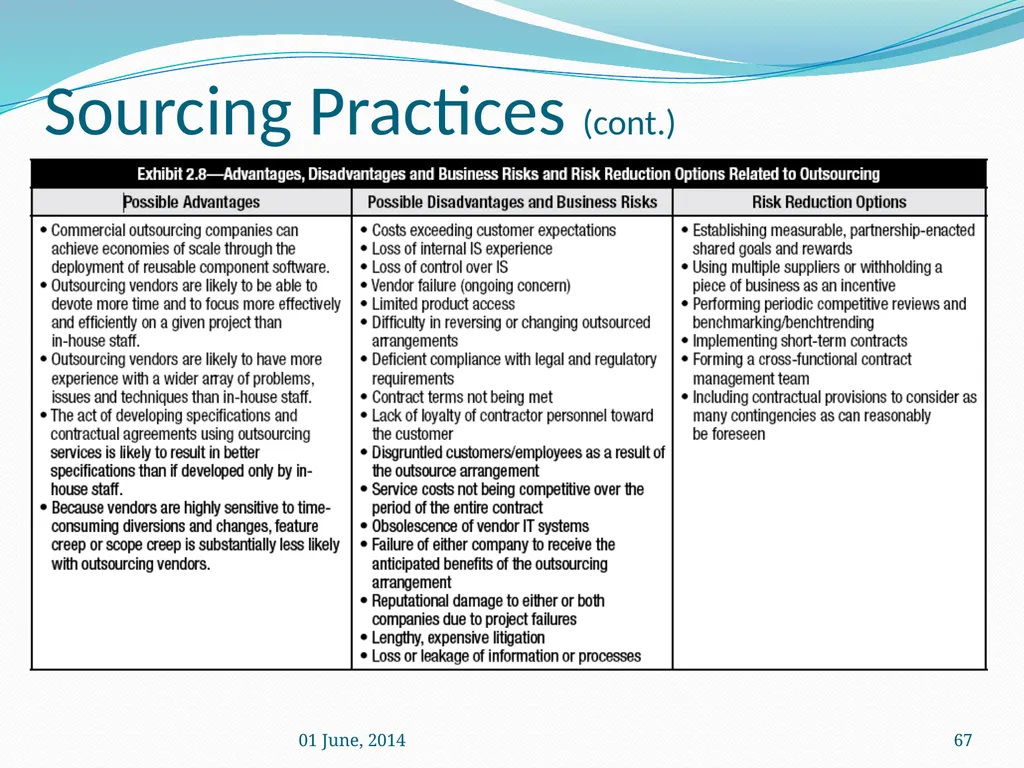
Sourcing Practices (cont.) 67 01 June, 2014<br>
68
Sourcing Practices (cont.) Globalization practices and strategies
Requires management to actively oversee the remote or offshore locations
The IS auditor can assist an organization in moving IS functions offsite or offshore by ensuring that IS management considers the following:
Legal, regulatory and tax issues
Continuity of operations
Personnel
Telecommunication issues
Cross-border and cross-cultural issues 68 01 June, 2014<br>
Requires management to actively oversee the remote or offshore locations
The IS auditor can assist an organization in moving IS functions offsite or offshore by ensuring that IS management considers the following:
Legal, regulatory and tax issues
Continuity of operations
Personnel
Telecommunication issues
Cross-border and cross-cultural issues 68 01 June, 2014<br>
69
Sourcing Practices (cont.) Governance in outsourcing
Mechanism that allows organizations to transfer the delivery of services to third parties
Accountability remains with the management of the client organization
Transparency and ownership of the decision-making process must reside within the purview of the client 69 01 June, 2014<br>
Mechanism that allows organizations to transfer the delivery of services to third parties
Accountability remains with the management of the client organization
Transparency and ownership of the decision-making process must reside within the purview of the client 69 01 June, 2014<br>
70
Sourcing Practices (cont.) Third-party service delivery management
Every organization using the services of third parties should have a service delivery management system in place to implement and maintain the appropriate level of information security and service delivery in line with third-party service delivery agreements
The organization should check the implementation of agreements, monitor compliance with the agreements and manage changes to ensure that the services delivered meet all requirements agreed to with the third party. 70 01 June, 2014<br>
Every organization using the services of third parties should have a service delivery management system in place to implement and maintain the appropriate level of information security and service delivery in line with third-party service delivery agreements
The organization should check the implementation of agreements, monitor compliance with the agreements and manage changes to ensure that the services delivered meet all requirements agreed to with the third party. 70 01 June, 2014<br>
71
Change Management What is change management?
Managing IT changes for the organization
Identify and apply technology improvements at the infrastructure and application level
Change Management ensures that changes are recorded, evaluated, authorized, prioritized, planned, tested, implemented, documented and reviewed in a controlled manner.
The purpose of the Change Management process is to ensure that standardized methods are used for the efficient and prompt handling of all changes, that all changes are recorded and that overall business risk is optimized. 71 01 June, 2014<br>
Managing IT changes for the organization
Identify and apply technology improvements at the infrastructure and application level
Change Management ensures that changes are recorded, evaluated, authorized, prioritized, planned, tested, implemented, documented and reviewed in a controlled manner.
The purpose of the Change Management process is to ensure that standardized methods are used for the efficient and prompt handling of all changes, that all changes are recorded and that overall business risk is optimized. 71 01 June, 2014<br>
72
Change Types Normal
Non-urgent, requires approval
Standard
Non-urgent, follows established path, no approval needed
Emergency
Requires approval but too urgent for normal procedure 72 01 June, 2014<br>
Non-urgent, requires approval
Standard
Non-urgent, follows established path, no approval needed
Emergency
Requires approval but too urgent for normal procedure 72 01 June, 2014<br>
73
Change Advisory Board Change Manager (VITAL)
One or more of
Customer/User
User Manager
Developer/Maintainer
Expert/Consultant
Contractor
CAB considers the 7 Rs
Who RAISED?, REASON, RETURN, RISKS, RESOURCES, RESPONSIBLE, RELATIONSHIPS to other changes 73 01 June, 2014<br>
One or more of
Customer/User
User Manager
Developer/Maintainer
Expert/Consultant
Contractor
CAB considers the 7 Rs
Who RAISED?, REASON, RETURN, RISKS, RESOURCES, RESPONSIBLE, RELATIONSHIPS to other changes 73 01 June, 2014<br>
74
Change Management – Challenges Respond to customers changing business requirements
Respond to business and IT requests for change that will align the services with the business needs
Roles
Change Manager
Change Authority
Change Advisory Board (CAB)
Emergency CAB (ECAB)
80% of service interruption is caused by operator error or poor change control (Gartner) 74 01 June, 2014<br>
Respond to business and IT requests for change that will align the services with the business needs
Roles
Change Manager
Change Authority
Change Advisory Board (CAB)
Emergency CAB (ECAB)
80% of service interruption is caused by operator error or poor change control (Gartner) 74 01 June, 2014<br>
75
Risk Management Risk Management is identifying, evaluating, and mitigating risk to an organization
It’s a cyclical, continuous process
Need to know what you have
Need to know what threats are likely
Need to know how and how well it is protected
Need to know where the gaps are 01 June, 2014 75<br>
It’s a cyclical, continuous process
Need to know what you have
Need to know what threats are likely
Need to know how and how well it is protected
Need to know where the gaps are 01 June, 2014 75<br>
76
Risk Management The process of identifying vulnerabilities and threats to the information resources used by an organization in achieving business objectives.
Avoid
Mitigate
Transfer
Accept 76 01 June, 2014<br>
Avoid
Mitigate
Transfer
Accept 76 01 June, 2014<br>
77
Risk Management (cont.) IT risk management needs to operate at multiple levels including:
The operational level
The project level
The strategic level 77 01 June, 2014<br>
The operational level
The project level
The strategic level 77 01 June, 2014<br>
78
Auditing IT Governance Structure and Implementation Indicators of potential problems include:
Unfavorable end-user attitudes
Excessive costs
Budget overruns
Late projects
High staff turnover
Inexperienced staff
Frequent hardware/software errors 78 01 June, 2014<br>
Unfavorable end-user attitudes
Excessive costs
Budget overruns
Late projects
High staff turnover
Inexperienced staff
Frequent hardware/software errors 78 01 June, 2014<br>
79
Reviewing Documentation – IS Auditor The following documents should be reviewed:
IT strategies, plans and budgets
Security policy documentation
Organization/functional charts
Job descriptions
Steering committee reports
System development and program change procedures
Operations procedures
Human resource manuals
Quality assurance procedures 79 01 June, 2014<br>
IT strategies, plans and budgets
Security policy documentation
Organization/functional charts
Job descriptions
Steering committee reports
System development and program change procedures
Operations procedures
Human resource manuals
Quality assurance procedures 79 01 June, 2014<br>
80
Summary Security Management practices involve balancing security processes and proper management and oversight
Risk Management is a big part of managing holistic security of an organization 01 June, 2014 80<br>
Risk Management is a big part of managing holistic security of an organization 01 June, 2014 80<br>
81
References ISO 27001 : 2013
NIST publications
SP 800-12, The Computer Security Handbook
SP 800-14, Generally Accepted Principles and Practices for Securing IT Systems
SP 800-18, The Guide for Developing Security Plans for IT Systems
SP 800-26, Security Self-Assessment Guide for Information Technology Systems
SP 800-30, Risk Management Guide for Information Technology Systems 81 01 June, 2014<br>
NIST publications
SP 800-12, The Computer Security Handbook
SP 800-14, Generally Accepted Principles and Practices for Securing IT Systems
SP 800-18, The Guide for Developing Security Plans for IT Systems
SP 800-26, Security Self-Assessment Guide for Information Technology Systems
SP 800-30, Risk Management Guide for Information Technology Systems 81 01 June, 2014<br>
82
Questions ? 01 June, 2014 82<br>