
Jackie Kay Revision Lucozade Divorce Bed Gap Year
PT
Published · 81 slides · 0 views

1 / 1















Description
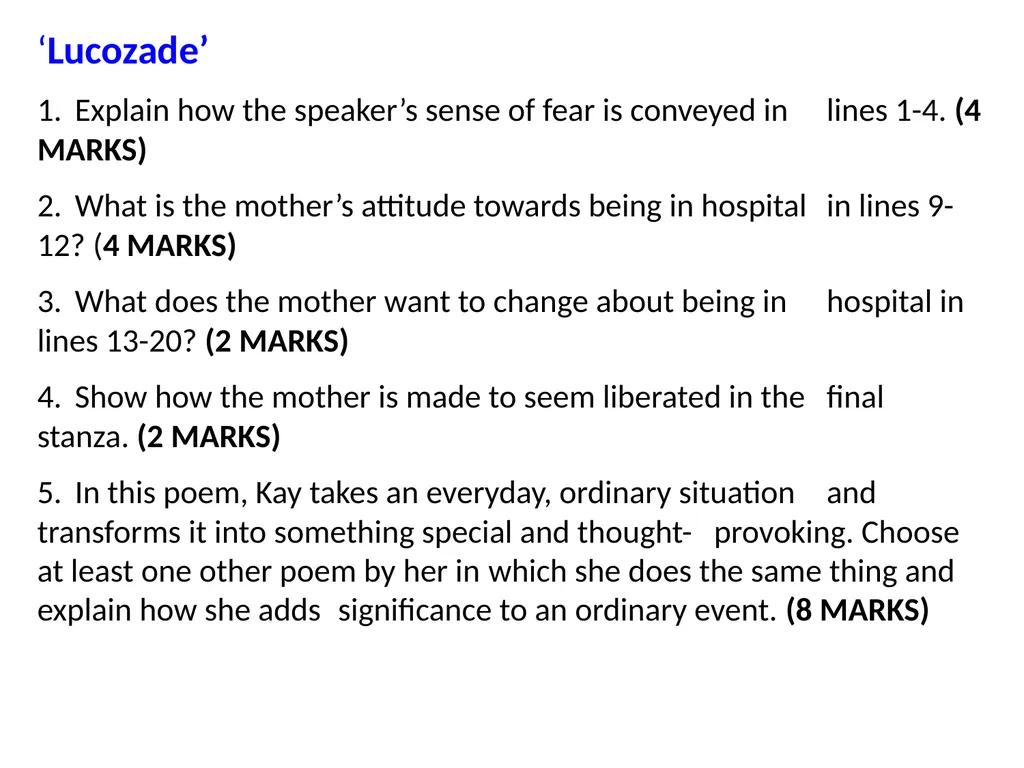
Jackie Kay Revision Lucozade Divorce Bed Gap Year My Grandmothers Houses Keeping Orchids Lucozade 1. Explain how the speakers sense of fear is conveyed in lines 1-4. (4 MARKS) 2. What is the mothers attitude towards being in hospital
Related Topics
Share
Embed code
Download this presentation From Below
"Jackie Kay Revision Lucozade Divorce Bed Gap Year" is the property of its rightful owner. Permission is granted to download and print the materials on this website for personal, non-commercial use only, and to display it on your personal computer provided you do not modify the materials and that you retain all copyright notices contained in the materials. By downloading content from our website, you accept the terms of this agreement.
Presentation Transcript
01
Jackie Kay Revision<br>
02
Lucozade
Divorce
Bed
Gap Year
My Grandmother’s Houses
Keeping Orchids<br>
03
‘Lucozade’
1. Explain how the speaker’s sense of fear is conveyed in lines 1-4. (4 MARKS)
2. What is the mother’s attitude towards being in hospital in lines 9-12? (4 MARKS)
3. What does the mother want to change about being in hospital in lines 13-20? (2 MARKS)
4. Show how the mother is made to seem liberated in the final stanza. (2 MARKS)
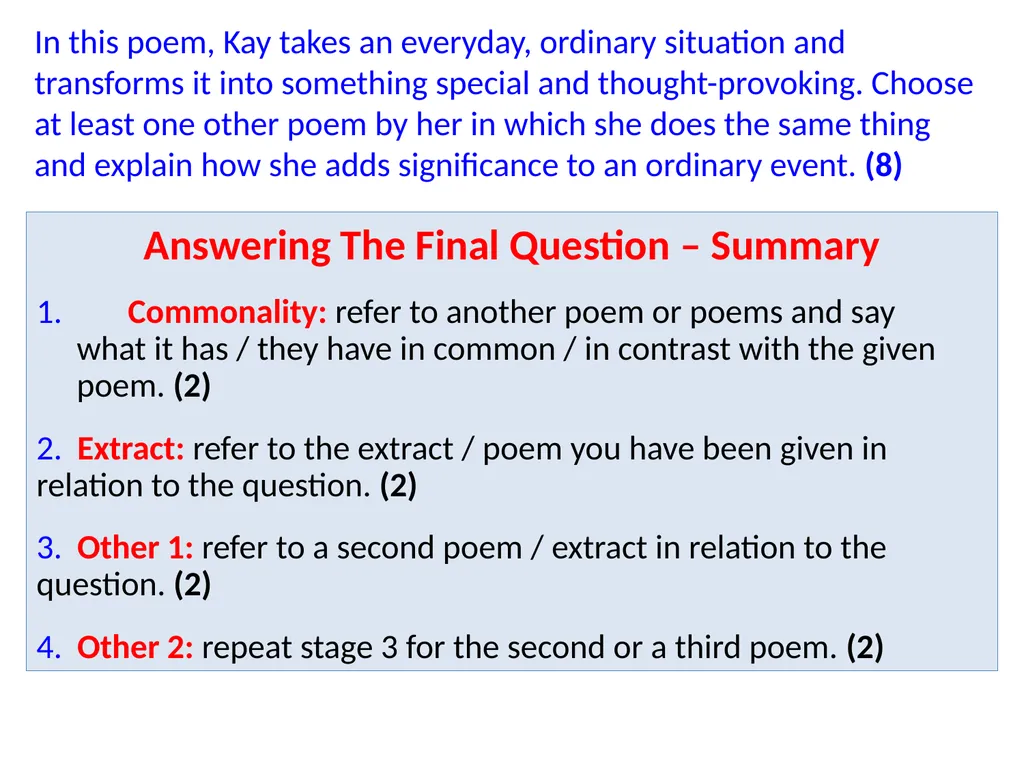
5. In this poem, Kay takes an everyday, ordinary situation and transforms it into something special and thought- provoking. Choose at least one other poem by her in which she does the same thing and explain how she adds significance to an ordinary event. (8 MARKS)<br>
04
‘Lucozade’<br>
05
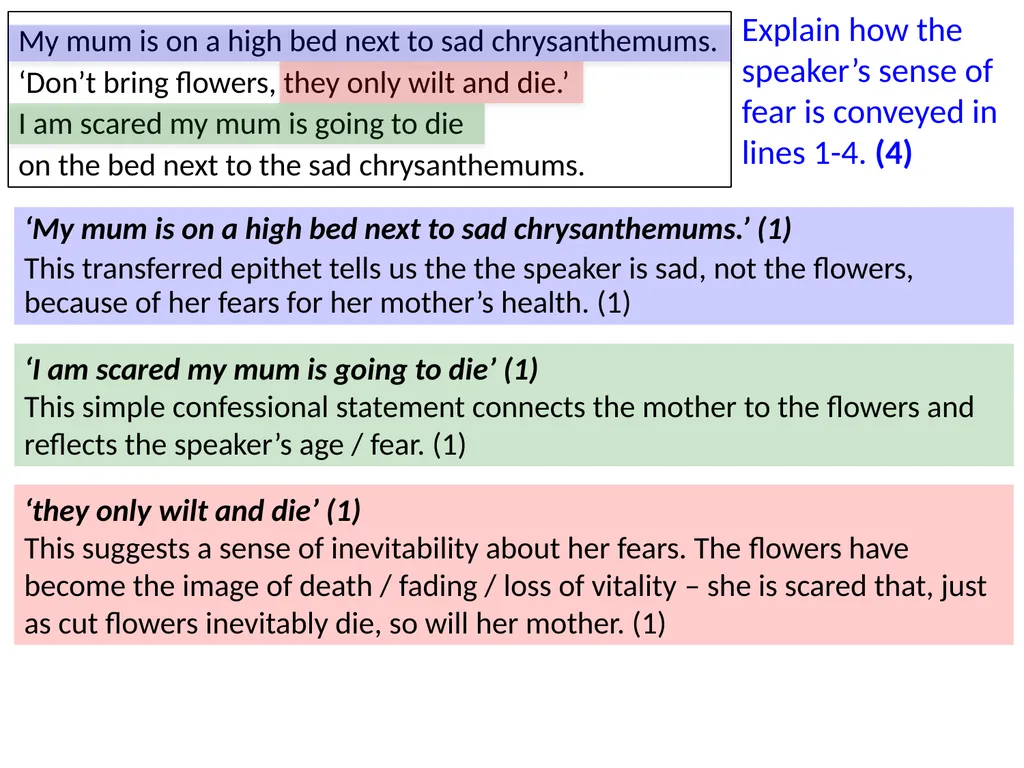
Explain how the speaker’s sense of fear is conveyed in lines 1-4. (4) My mum is on a high bed next to sad chrysanthemums.
‘Don’t bring flowers, they only wilt and die.’
I am scared my mum is going to die
on the bed next to the sad chrysanthemums. ‘I am scared my mum is going to die’ (1)
This simple confessional statement connects the mother to the flowers and reflects the speaker’s age / fear. (1) ‘they only wilt and die’ (1)
This suggests a sense of inevitability about her fears. The flowers have become the image of death / fading / loss of vitality – she is scared that, just as cut flowers inevitably die, so will her mother. (1) ‘My mum is on a high bed next to sad chrysanthemums.’ (1)
This transferred epithet tells us the the speaker is sad, not the flowers, because of her fears for her mother’s health. (1)<br>
06
What is the mother’s attitude towards being in hospital in lines 9-12? (4) ‘The whole day was a blur, a swarm of eyes.
Those doctors with their white lies.
Did you think you could cheer me up with a Woman’s Own?
Don’t bring magazines, too much about size.’ ‘The whole day was a blur, a swarm of eyes.’ (1)
She is feeling objectified, gawped at, irritated by all the attention (1) ‘white lies’ (1)
This recalls the doctors’ white coats and reflects that the mother is frustrated and feels her doctors are dealing in half truths / medical euphemism and not being honest with her. (1) Again reflects the mother’s rejection of the traditional approach to illness / death. (1) ‘Did you think you could cheer me up with a Woman’s Own?
Don’t bring magazines, too much about size.’ (1)
‘cheer me up’ suggests that she is feeling down about being in the hospital. Magazines, traditionally brought by hospital visitors, cannot bring her happiness and shift her low mood. (1)<br>
07
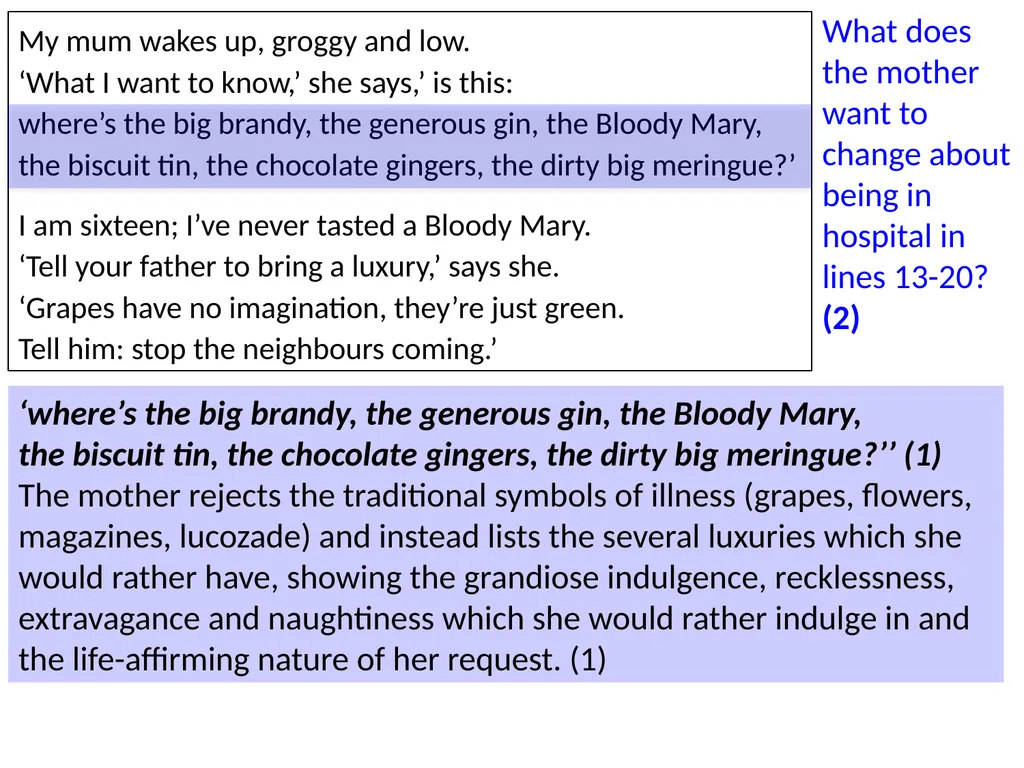
What does the mother want to change about being in hospital in lines 13-20? (2) My mum wakes up, groggy and low.
‘What I want to know,’ she says,’ is this:
where’s the big brandy, the generous gin, the Bloody Mary,
the biscuit tin, the chocolate gingers, the dirty big meringue?’
I am sixteen; I’ve never tasted a Bloody Mary.
‘Tell your father to bring a luxury,’ says she.
‘Grapes have no imagination, they’re just green.
Tell him: stop the neighbours coming.’ ‘where’s the big brandy, the generous gin, the Bloody Mary,
the biscuit tin, the chocolate gingers, the dirty big meringue?’’ (1)
The mother rejects the traditional symbols of illness (grapes, flowers, magazines, lucozade) and instead lists the several luxuries which she would rather have, showing the grandiose indulgence, recklessness, extravagance and naughtiness which she would rather indulge in and the life-affirming nature of her request. (1)<br>
08
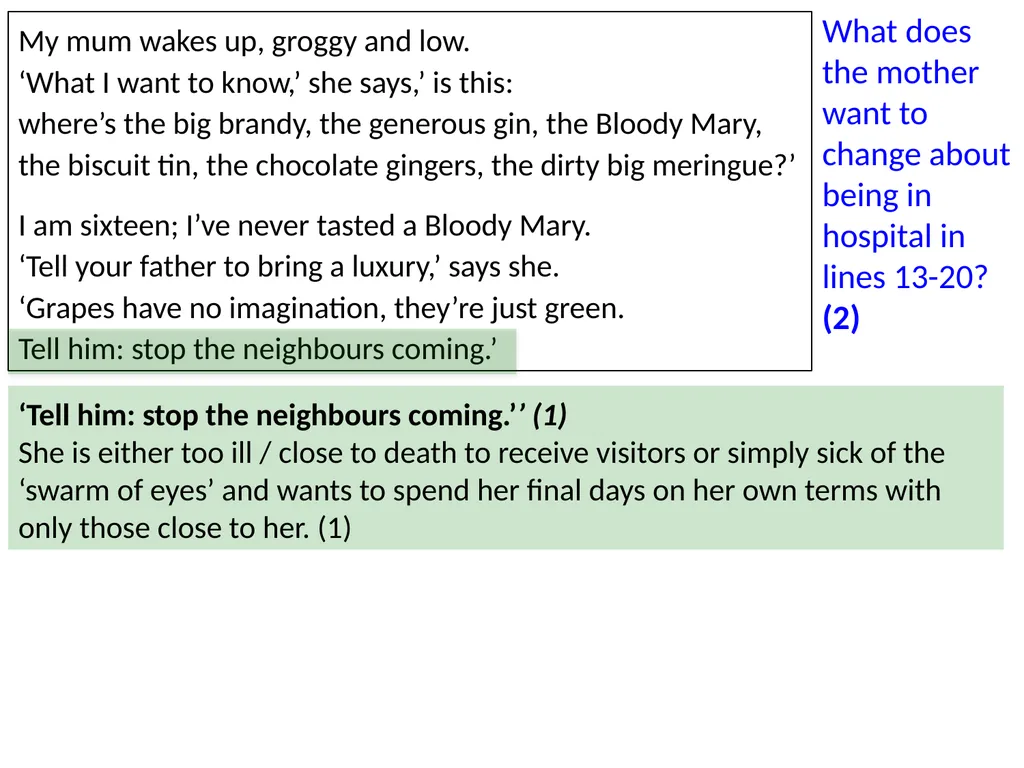
What does the mother want to change about being in hospital in lines 13-20? (2) My mum wakes up, groggy and low.
‘What I want to know,’ she says,’ is this:
where’s the big brandy, the generous gin, the Bloody Mary,
the biscuit tin, the chocolate gingers, the dirty big meringue?’
I am sixteen; I’ve never tasted a Bloody Mary.
‘Tell your father to bring a luxury,’ says she.
‘Grapes have no imagination, they’re just green.
Tell him: stop the neighbours coming.’ ‘Tell him: stop the neighbours coming.’’ (1)
She is either too ill / close to death to receive visitors or simply sick of the ‘swarm of eyes’ and wants to spend her final days on her own terms with only those close to her. (1)<br>
09
Show how the mother is made to seem liberated in the final stanza. (2) My mother, on her high hospital bed, waves back.
Her face is light and radiant, dandelion hours.
Her sheets billow and whirl. She is beautiful.
Next to her the empty table is divine. ‘My mother, on her high hospital bed, waves back.’ (1)
Mother waving back suggests that her energy has returned. She has been revived, not by Lucozade, but by its removal and through her rejection of the expected role of victim / invalid. (1) ‘Her face is light and radiant’ (1)
This is optimistic and there is a sense of her being unburdened (compared to the daughter’s burden as she carries away the trappings of illness). Both words suggest she is feeling positive and uplifted. (1) ‘Her sheets billow and whirl. She is beautiful.’ (1)
This has angelic connotations, emphasised by the soft consonants and vowels. This simple statement of beauty suggests a revelation for the speaker – her mother is free from her previous low mood. (1)<br>
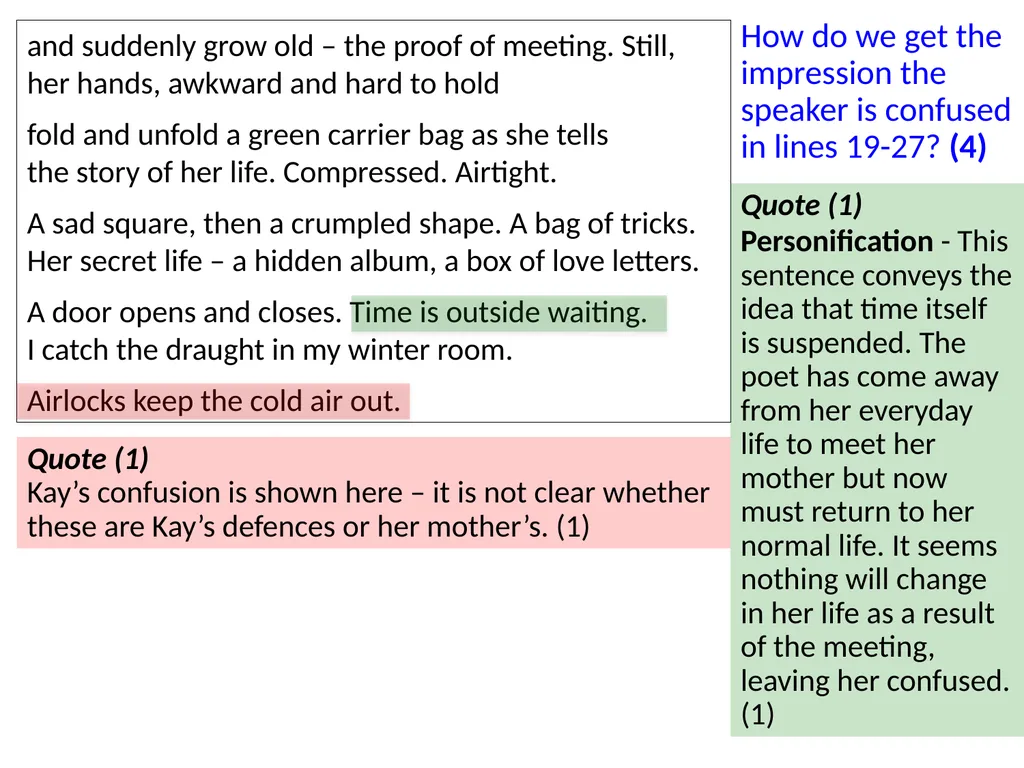
10
Show how the mother is made to seem liberated in the final stanza. (2) My mother, on her high hospital bed, waves back.
Her face is light and radiant, dandelion hours.
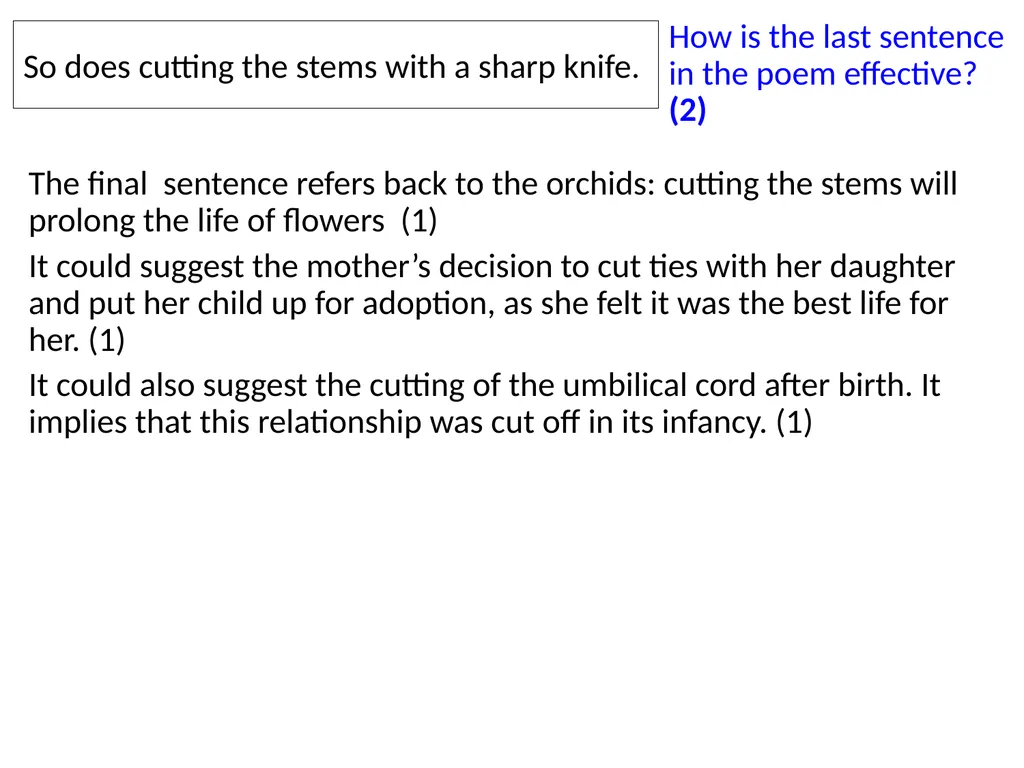
Her sheets billow and whirl. She is beautiful.
Next to her the empty table is divine. ‘Next to her the empty table is divine’ (1)
This continues the image of heaven /angelic transcendence (compared with the negative tone of death in the first stanza). This is a transferred epithet – the mother is divine, not the table. (1)<br>
11
In this poem, Kay takes an everyday, ordinary situation and transforms it into something special and thought-provoking. Choose at least one other poem by her in which she does the same thing and explain how she adds significance to an ordinary event. (8) Answering The Final Question – Summary
1. Commonality: refer to another poem or poems and say what it has / they have in common / in contrast with the given poem. (2)
2. Extract: refer to the extract / poem you have been given in relation to the question. (2)
3. Other 1: refer to a second poem / extract in relation to the question. (2)
4. Other 2: repeat stage 3 for the second or a third poem. (2)<br>
12
Possible points of comparison?
Other poems which have ‘everyday, ordinary situations’ which are transformed ‘into something special and thought-provoking’?<br>
13
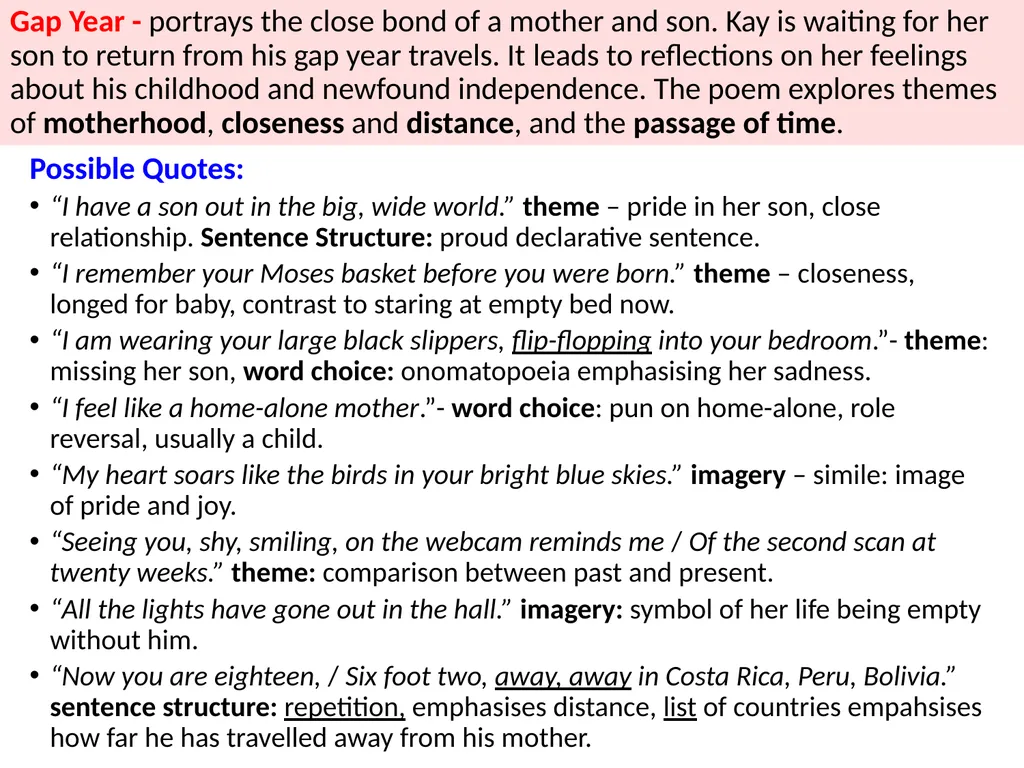
Gap Year - portrays the close bond of a mother and son. Kay is waiting for her son to return from his gap year travels. It leads to reflections on her feelings about his childhood and newfound independence. The poem explores themes of motherhood, closeness and distance, and the passage of time. Possible Quotes:
“I have a son out in the big, wide world.” theme – pride in her son, close relationship. Sentence Structure: proud declarative sentence.
“I remember your Moses basket before you were born.” theme – closeness, longed for baby, contrast to staring at empty bed now.
“I am wearing your large black slippers, flip-flopping into your bedroom.”- theme: missing her son, word choice: onomatopoeia emphasising her sadness.
“I feel like a home-alone mother.”- word choice: pun on home-alone, role reversal, usually a child.
“My heart soars like the birds in your bright blue skies.” imagery – simile: image of pride and joy.
“Seeing you, shy, smiling, on the webcam reminds me / Of the second scan at twenty weeks.” theme: comparison between past and present.
“All the lights have gone out in the hall.” imagery: symbol of her life being empty without him.
“Now you are eighteen, / Six foot two, away, away in Costa Rica, Peru, Bolivia.” sentence structure: repetition, emphasises distance, list of countries empahsises how far he has travelled away from his mother.<br>
14
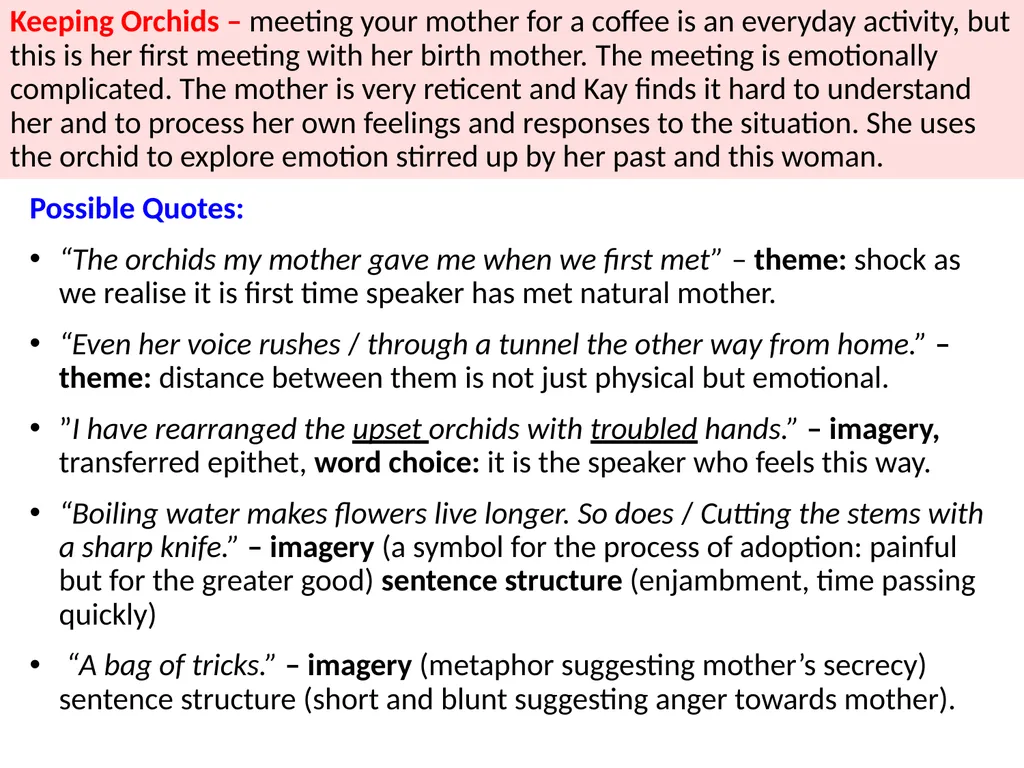
Keeping Orchids – meeting your mother for a coffee is an everyday activity, but this is her first meeting with her birth mother. The meeting is emotionally complicated. The mother is very reticent and Kay finds it hard to understand her and to process her own feelings and responses to the situation. She uses the orchid to explore emotion stirred up by her past and this woman. Possible Quotes:
“The orchids my mother gave me when we first met” – theme: shock as we realise it is first time speaker has met natural mother.
“Even her voice rushes / through a tunnel the other way from home.” – theme: distance between them is not just physical but emotional.
”I have rearranged the upset orchids with troubled hands.” – imagery, transferred epithet, word choice: it is the speaker who feels this way.
“Boiling water makes flowers live longer. So does / Cutting the stems with a sharp knife.” – imagery (a symbol for the process of adoption: painful but for the greater good) sentence structure (enjambment, time passing quickly)
“A bag of tricks.” – imagery (metaphor suggesting mother’s secrecy) sentence structure (short and blunt suggesting anger towards mother).<br>
15
‘Divorce’<br>
16
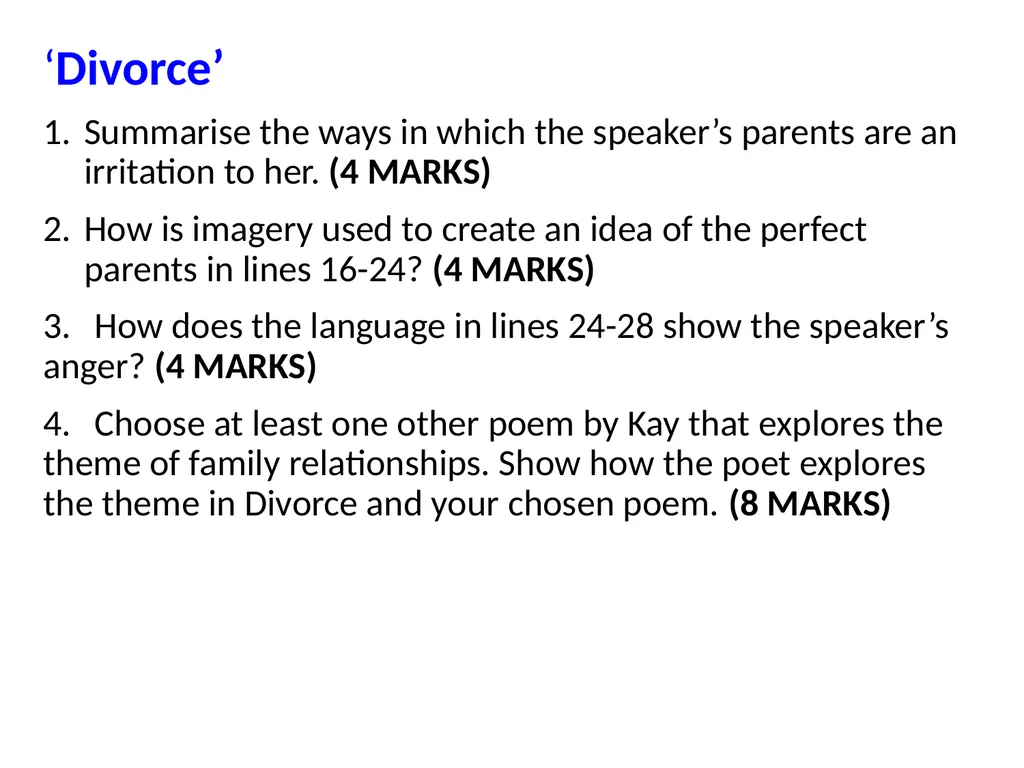
‘Divorce’
1. Summarise the ways in which the speaker’s parents are an irritation to her. (4 MARKS)
2. How is imagery used to create an idea of the perfect parents in lines 16-24? (4 MARKS)
3. How does the language in lines 24-28 show the speaker’s anger? (4 MARKS)
4. Choose at least one other poem by Kay that explores the theme of family relationships. Show how the poet explores the theme in Divorce and your chosen poem. (8 MARKS)<br>
17
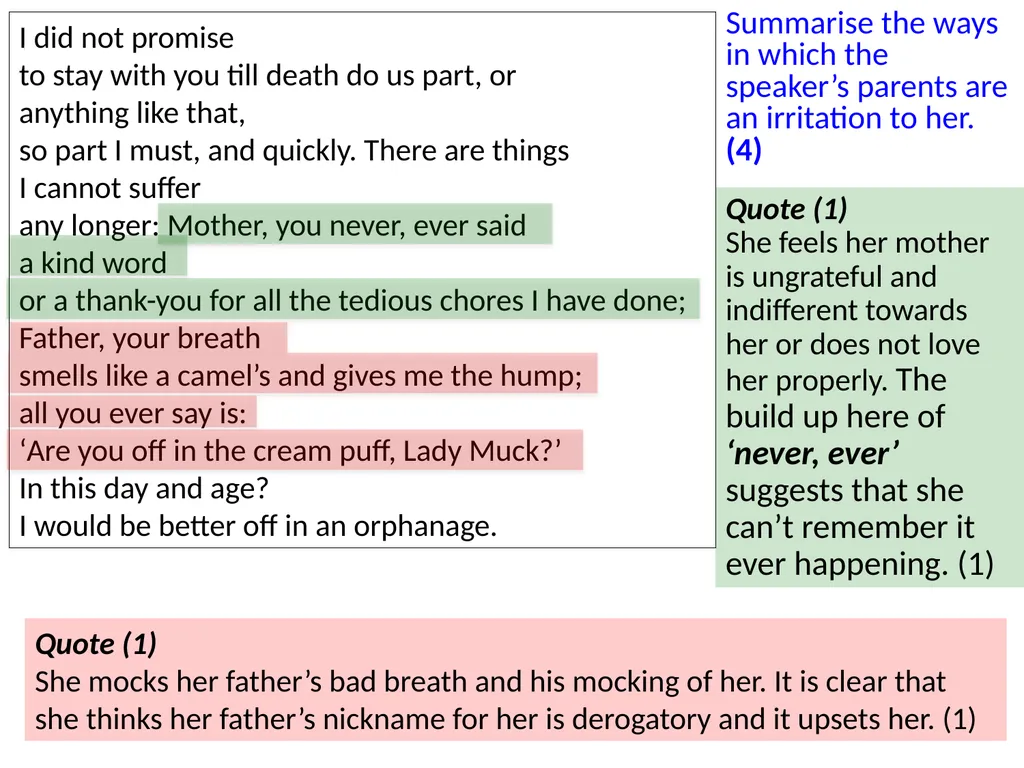
Summarise the ways in which the speaker’s parents are an irritation to her. (4) I did not promise
to stay with you till death do us part, or
anything like that,
so part I must, and quickly. There are things
I cannot suffer
any longer: Mother, you never, ever said
a kind word
or a thank-you for all the tedious chores I have done;
Father, your breath
smells like a camel’s and gives me the hump;
all you ever say is:
‘Are you off in the cream puff, Lady Muck?’
In this day and age?
I would be better off in an orphanage. Quote (1)
She feels her mother is ungrateful and indifferent towards her or does not love her properly. The build up here of ‘never, ever’ suggests that she can’t remember it ever happening. (1) Quote (1)
She mocks her father’s bad breath and his mocking of her. It is clear that she thinks her father’s nickname for her is derogatory and it upsets her. (1)<br>
18
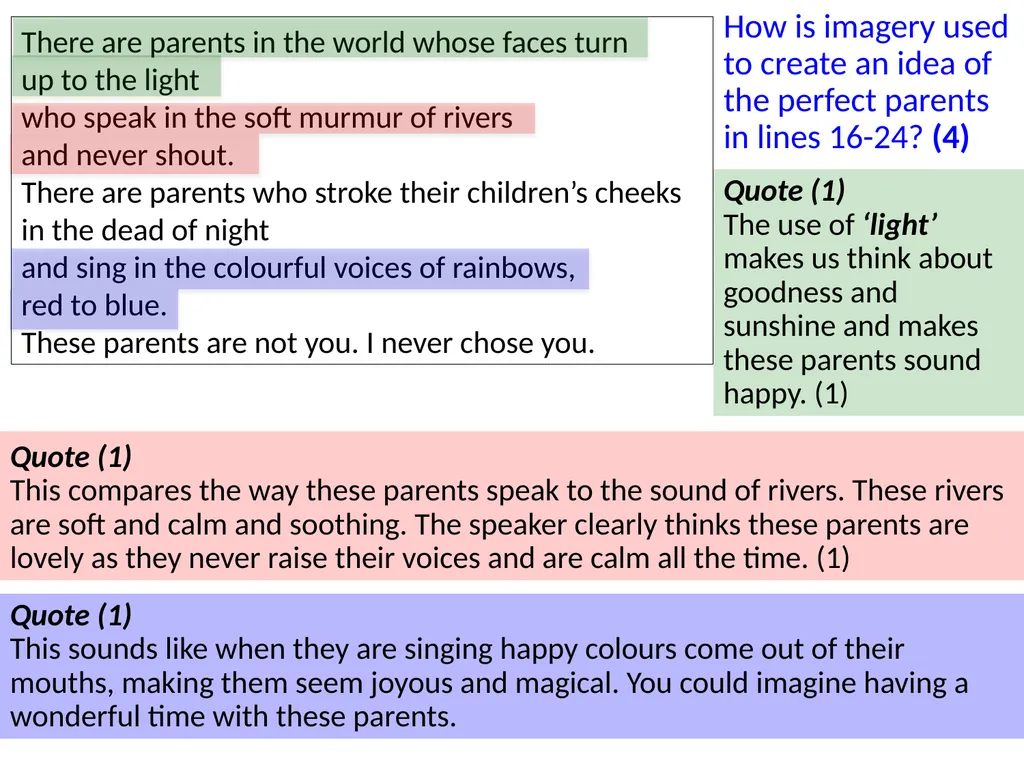
How is imagery used to create an idea of the perfect parents in lines 16-24? (4) There are parents in the world whose faces turn
up to the light
who speak in the soft murmur of rivers
and never shout.
There are parents who stroke their children’s cheeks
in the dead of night
and sing in the colourful voices of rainbows,
red to blue.
These parents are not you. I never chose you. Quote (1)
The use of ‘light’ makes us think about goodness and sunshine and makes these parents sound happy. (1) Quote (1)
This compares the way these parents speak to the sound of rivers. These rivers are soft and calm and soothing. The speaker clearly thinks these parents are lovely as they never raise their voices and are calm all the time. (1) Quote (1)
This sounds like when they are singing happy colours come out of their mouths, making them seem joyous and magical. You could imagine having a wonderful time with these parents.<br>
19
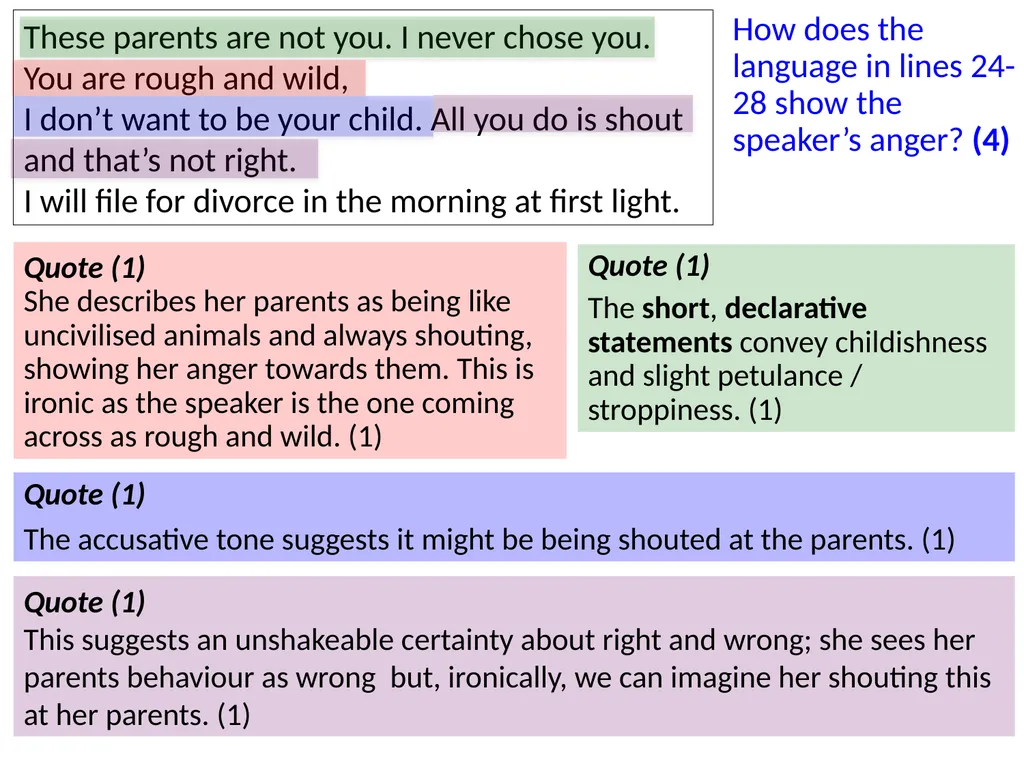
How does the language in lines 24-28 show the speaker’s anger? (4) These parents are not you. I never chose you.
You are rough and wild,
I don’t want to be your child. All you do is shout
and that’s not right.
I will file for divorce in the morning at first light. Quote (1)
The short, declarative statements convey childishness and slight petulance / stroppiness. (1) Quote (1)
She describes her parents as being like uncivilised animals and always shouting, showing her anger towards them. This is ironic as the speaker is the one coming across as rough and wild. (1) Quote (1)
The accusative tone suggests it might be being shouted at the parents. (1) Quote (1)
This suggests an unshakeable certainty about right and wrong; she sees her parents behaviour as wrong but, ironically, we can imagine her shouting this at her parents. (1)<br>
20
Choose at least one other poem by Kay that explores the theme of family relationships. Show how the poet explores the theme in Divorce and your chosen poem. 8 Summary – how to answer the 8 mark question
1. Commonality: refer to another poem or poems and say what it has / they have in common / in contrast with the given poem. (2)
2. Extract: refer to the extract / poem you have been given in relation to the question. (2)
3. Other 1: refer to a second poem / extract in relation to the question. (2)
4. Other 2: repeat stage 3 for the second or a third poem. (2)<br>
21
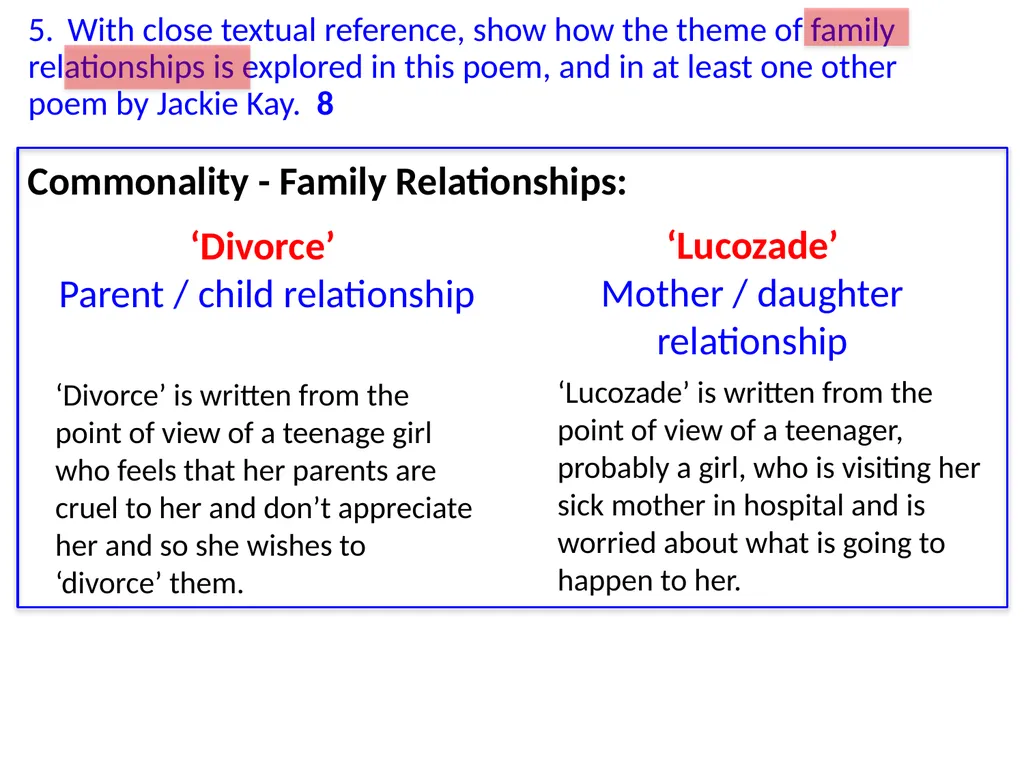
5. With close textual reference, show how the theme of family relationships is explored in this poem, and in at least one other poem by Jackie Kay. 8 Commonality - Family Relationships: ‘Divorce’
Parent / child relationship ‘Lucozade’
Mother / daughter relationship ‘Divorce’ is written from the point of view of a teenage girl who feels that her parents are cruel to her and don’t appreciate her and so she wishes to ‘divorce’ them. ‘Lucozade’ is written from the point of view of a teenager, probably a girl, who is visiting her sick mother in hospital and is worried about what is going to happen to her.<br>
22
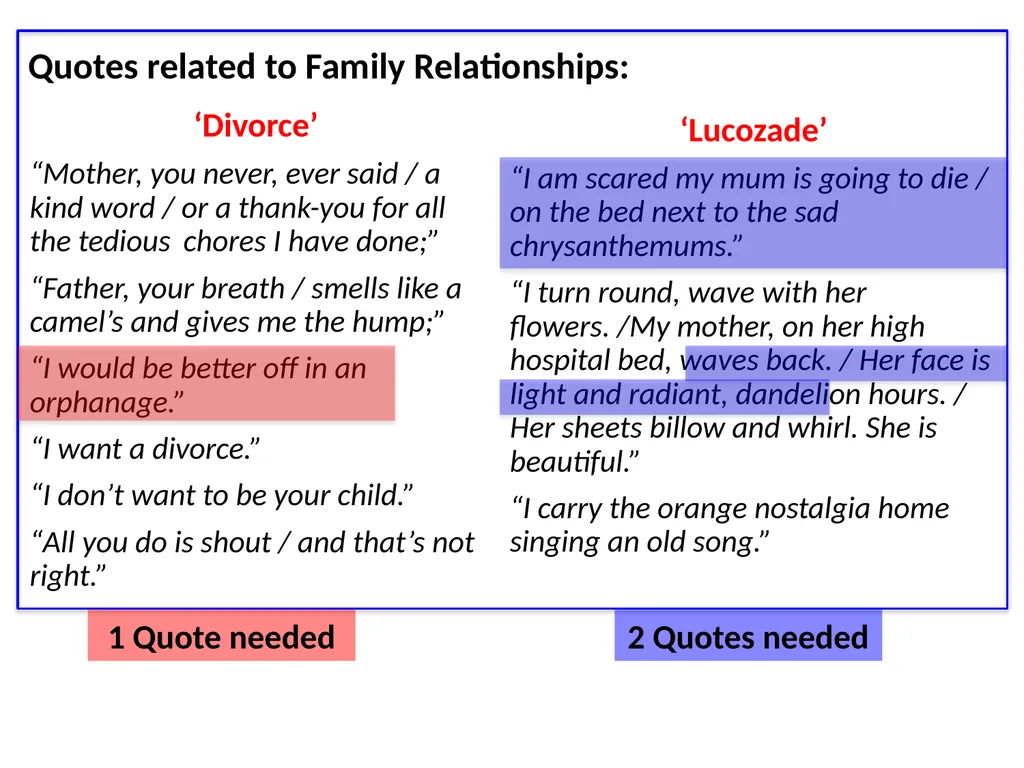
Quotes related to Family Relationships: ‘Divorce’
“Mother, you never, ever said / a kind word / or a thank-you for all the tedious chores I have done;”
“Father, your breath / smells like a camel’s and gives me the hump;”
“I would be better off in an orphanage.”
“I want a divorce.”
“I don’t want to be your child.”
“All you do is shout / and that’s not right.” ‘Lucozade’
“I am scared my mum is going to die / on the bed next to the sad chrysanthemums.”
“I turn round, wave with her flowers. /My mother, on her high hospital bed, waves back. / Her face is light and radiant, dandelion hours. / Her sheets billow and whirl. She is beautiful.”
“I carry the orange nostalgia home singing an old song.” 1 Quote needed 2 Quotes needed<br>
23
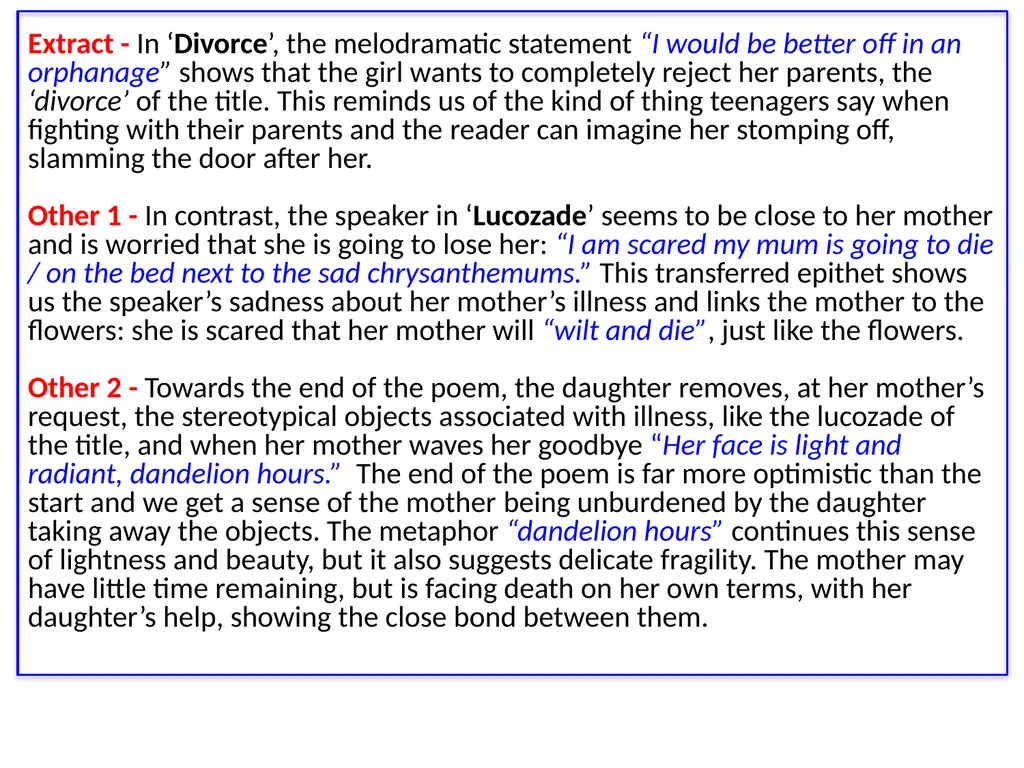
Extract - In ‘Divorce’, the melodramatic statement “I would be better off in an orphanage” shows that the girl wants to completely reject her parents, the ‘divorce’ of the title. This reminds us of the kind of thing teenagers say when fighting with their parents and the reader can imagine her stomping off, slamming the door after her.
Other 1 - In contrast, the speaker in ‘Lucozade’ seems to be close to her mother and is worried that she is going to lose her: “I am scared my mum is going to die / on the bed next to the sad chrysanthemums.” This transferred epithet shows us the speaker’s sadness about her mother’s illness and links the mother to the flowers: she is scared that her mother will “wilt and die”, just like the flowers.
Other 2 - Towards the end of the poem, the daughter removes, at her mother’s request, the stereotypical objects associated with illness, like the lucozade of the title, and when her mother waves her goodbye “Her face is light and radiant, dandelion hours.” The end of the poem is far more optimistic than the start and we get a sense of the mother being unburdened by the daughter taking away the objects. The metaphor “dandelion hours” continues this sense of lightness and beauty, but it also suggests delicate fragility. The mother may have little time remaining, but is facing death on her own terms, with her daughter’s help, showing the close bond between them.<br>
24
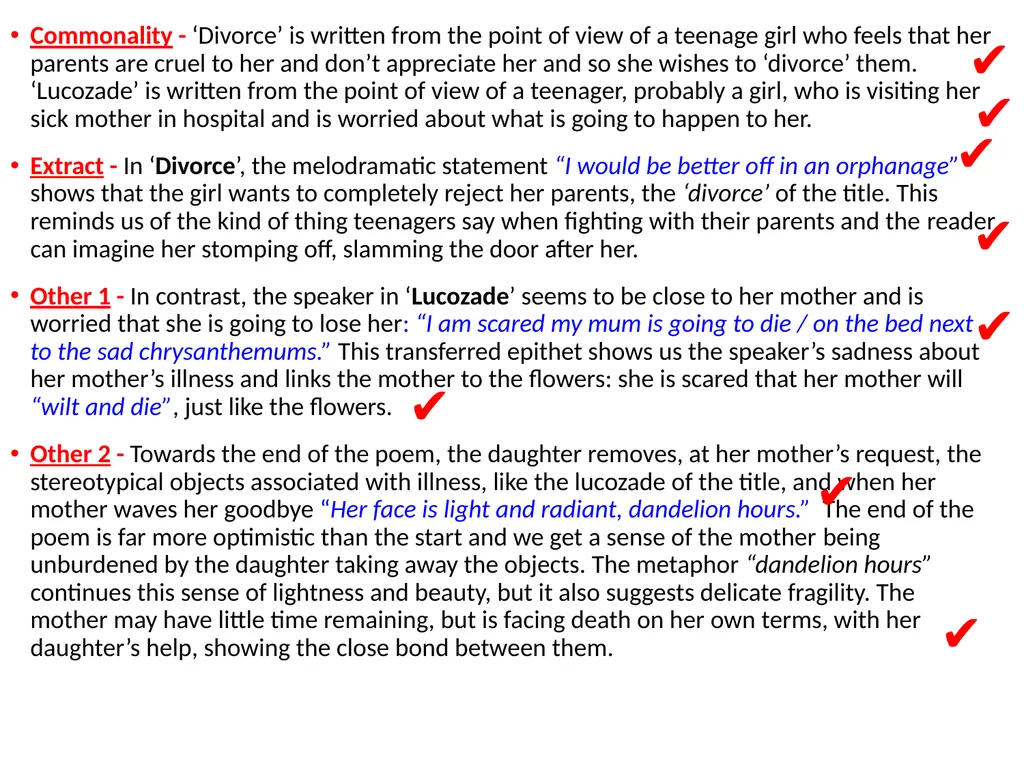
Commonality - ‘Divorce’ is written from the point of view of a teenage girl who feels that her parents are cruel to her and don’t appreciate her and so she wishes to ‘divorce’ them. ‘Lucozade’ is written from the point of view of a teenager, probably a girl, who is visiting her sick mother in hospital and is worried about what is going to happen to her.
Extract - In ‘Divorce’, the melodramatic statement “I would be better off in an orphanage” shows that the girl wants to completely reject her parents, the ‘divorce’ of the title. This reminds us of the kind of thing teenagers say when fighting with their parents and the reader can imagine her stomping off, slamming the door after her.
Other 1 - In contrast, the speaker in ‘Lucozade’ seems to be close to her mother and is worried that she is going to lose her: “I am scared my mum is going to die / on the bed next to the sad chrysanthemums.” This transferred epithet shows us the speaker’s sadness about her mother’s illness and links the mother to the flowers: she is scared that her mother will “wilt and die”, just like the flowers.
Other 2 - Towards the end of the poem, the daughter removes, at her mother’s request, the stereotypical objects associated with illness, like the lucozade of the title, and when her mother waves her goodbye “Her face is light and radiant, dandelion hours.” The end of the poem is far more optimistic than the start and we get a sense of the mother being unburdened by the daughter taking away the objects. The metaphor “dandelion hours” continues this sense of lightness and beauty, but it also suggests delicate fragility. The mother may have little time remaining, but is facing death on her own terms, with her daughter’s help, showing the close bond between them. ✔ ✔ ✔ ✔ ✔ ✔ ✔ ✔<br>
25
You could also discuss family relationships in:
‘Gap Year’ (close relationship between mother and son);
‘Bed’ (strained relationship between mother and daughter);
‘My Grandmother’s Houses’ (close relationship between Kay and her grandmother);
‘Keeping Orchids’ (similar tension and lack of communication between parent and child).<br>
26
‘Bed’<br>
27
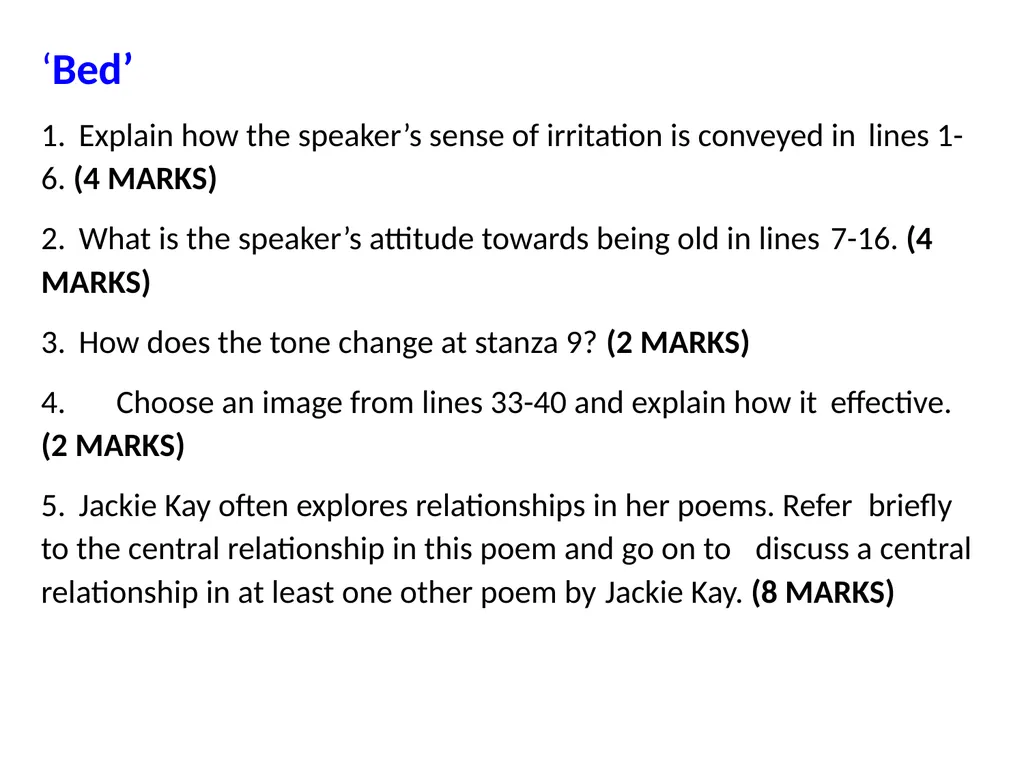
‘Bed’
1. Explain how the speaker’s sense of irritation is conveyed in lines 1-6. (4 MARKS)
2. What is the speaker’s attitude towards being old in lines 7-16. (4 MARKS)
3. How does the tone change at stanza 9? (2 MARKS)
4. Choose an image from lines 33-40 and explain how it effective. (2 MARKS)
5. Jackie Kay often explores relationships in her poems. Refer briefly to the central relationship in this poem and go on to discuss a central relationship in at least one other poem by Jackie Kay. (8 MARKS)<br>
28
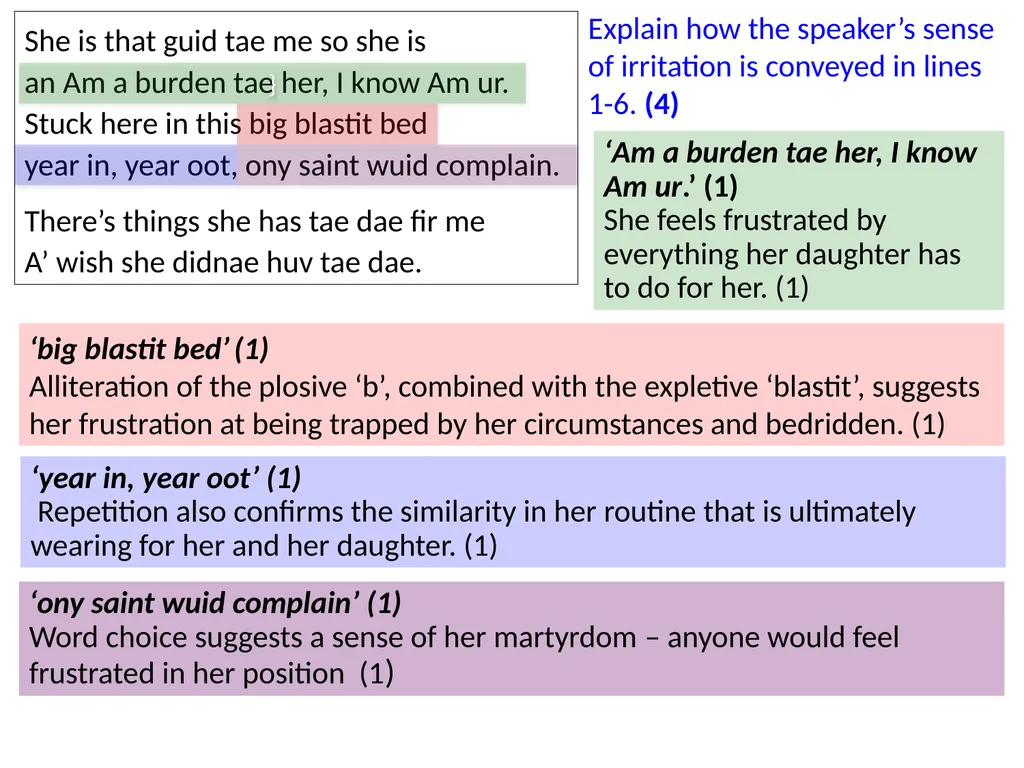
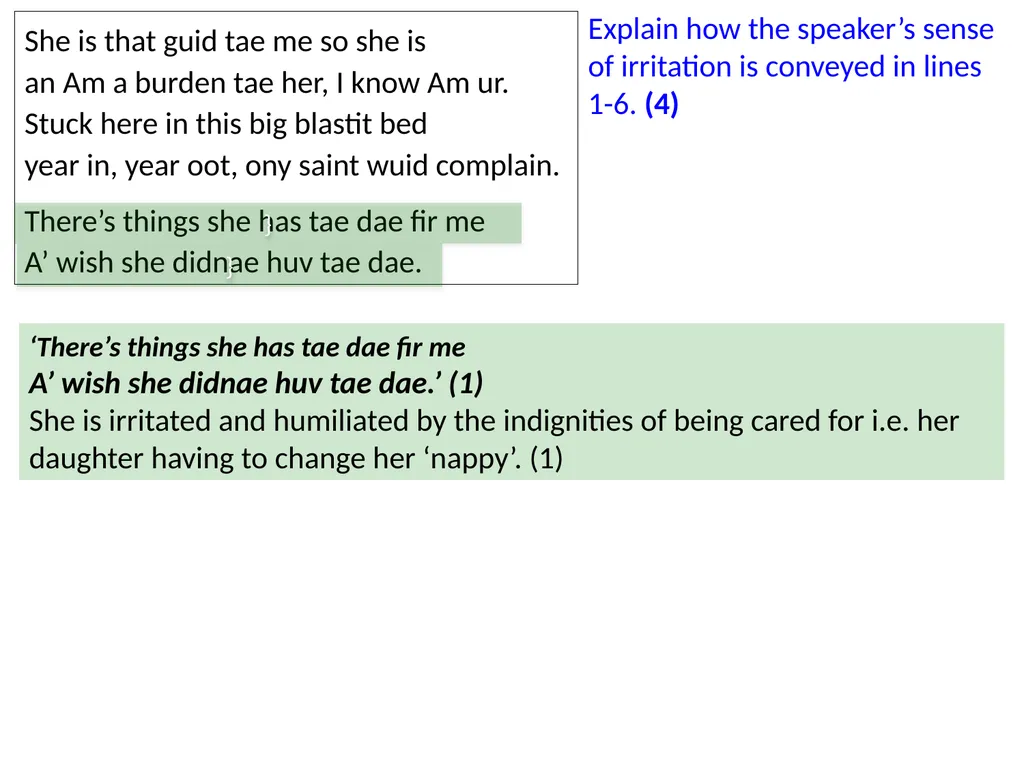
Explain how the speaker’s sense of irritation is conveyed in lines 1-6. (4) She is that guid tae me so she is
an Am a burden tae her, I know Am ur.
Stuck here in this big blastit bed
year in, year oot, ony saint wuid complain.
There’s things she has tae dae fir me
A’ wish she didnae huv tae dae. ‘big blastit bed’ (1)
Alliteration of the plosive ‘b’, combined with the expletive ‘blastit’, suggests her frustration at being trapped by her circumstances and bedridden. (1) ‘year in, year oot’ (1)
Repetition also confirms the similarity in her routine that is ultimately wearing for her and her daughter. (1) } ‘ony saint wuid complain’ (1)
Word choice suggests a sense of her martyrdom – anyone would feel frustrated in her position (1) ‘Am a burden tae her, I know Am ur.’ (1)
She feels frustrated by everything her daughter has to do for her. (1)<br>
29
Explain how the speaker’s sense of irritation is conveyed in lines 1-6. (4) She is that guid tae me so she is
an Am a burden tae her, I know Am ur.
Stuck here in this big blastit bed
year in, year oot, ony saint wuid complain.
There’s things she has tae dae fir me
A’ wish she didnae huv tae dae. ‘There’s things she has tae dae fir me
A’ wish she didnae huv tae dae.’ (1)
She is irritated and humiliated by the indignities of being cared for i.e. her daughter having to change her ‘nappy’. (1) } }<br>
30
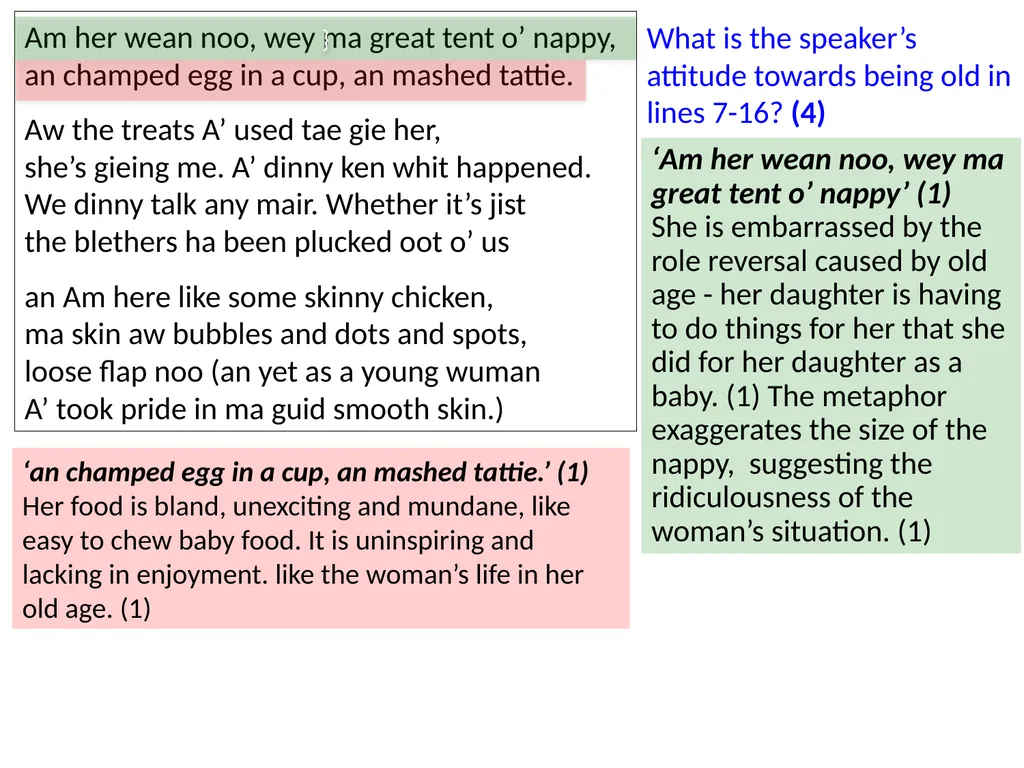
What is the speaker’s attitude towards being old in lines 7-16? (4) Am her wean noo, wey ma great tent o’ nappy,
an champed egg in a cup, an mashed tattie.
Aw the treats A’ used tae gie her,
she’s gieing me. A’ dinny ken whit happened.
We dinny talk any mair. Whether it’s jist
the blethers ha been plucked oot o’ us
an Am here like some skinny chicken,
ma skin aw bubbles and dots and spots,
loose flap noo (an yet as a young wuman
A’ took pride in ma guid smooth skin.) ‘an champed egg in a cup, an mashed tattie.’ (1)
Her food is bland, unexciting and mundane, like easy to chew baby food. It is uninspiring and lacking in enjoyment. like the woman’s life in her old age. (1) } ‘Am her wean noo, wey ma great tent o’ nappy’ (1)
She is embarrassed by the role reversal caused by old age - her daughter is having to do things for her that she did for her daughter as a baby. (1) The metaphor exaggerates the size of the nappy, suggesting the ridiculousness of the woman’s situation. (1)<br>
31
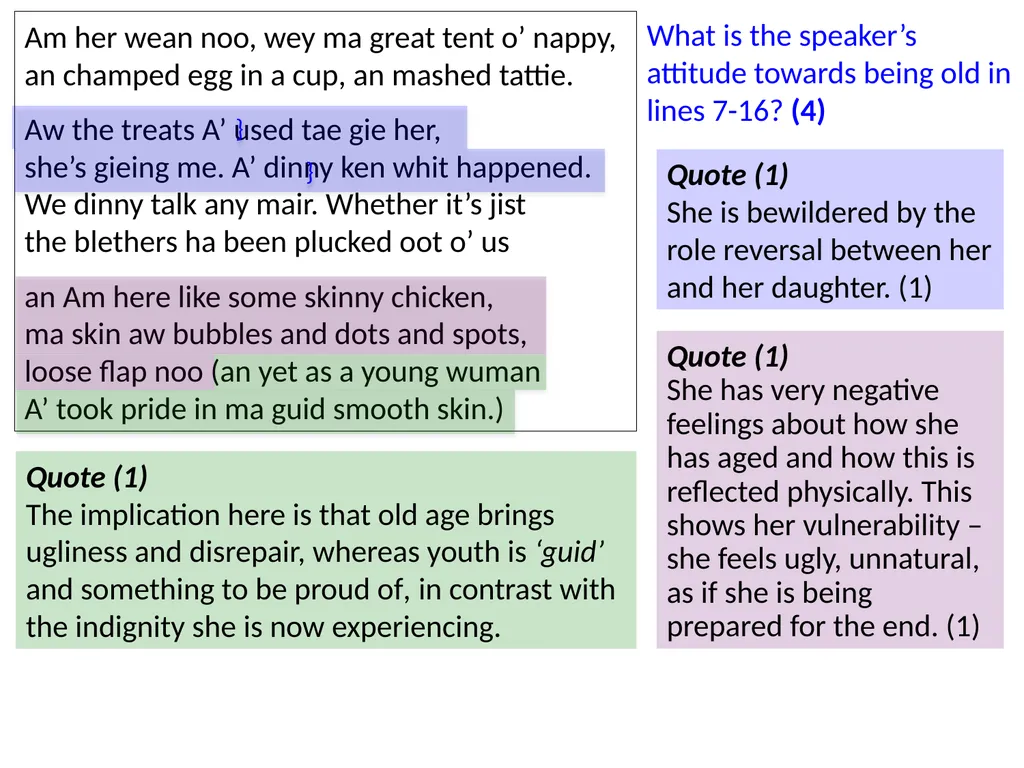
What is the speaker’s attitude towards being old in lines 7-16? (4) Am her wean noo, wey ma great tent o’ nappy,
an champed egg in a cup, an mashed tattie.
Aw the treats A’ used tae gie her,
she’s gieing me. A’ dinny ken whit happened.
We dinny talk any mair. Whether it’s jist
the blethers ha been plucked oot o’ us
an Am here like some skinny chicken,
ma skin aw bubbles and dots and spots,
loose flap noo (an yet as a young wuman
A’ took pride in ma guid smooth skin.) Quote (1)
She has very negative feelings about how she has aged and how this is reflected physically. This shows her vulnerability – she feels ugly, unnatural, as if she is being prepared for the end. (1) } Quote (1)
She is bewildered by the role reversal between her and her daughter. (1) } Quote (1)
The implication here is that old age brings ugliness and disrepair, whereas youth is ‘guid’ and something to be proud of, in contrast with the indignity she is now experiencing.<br>
32
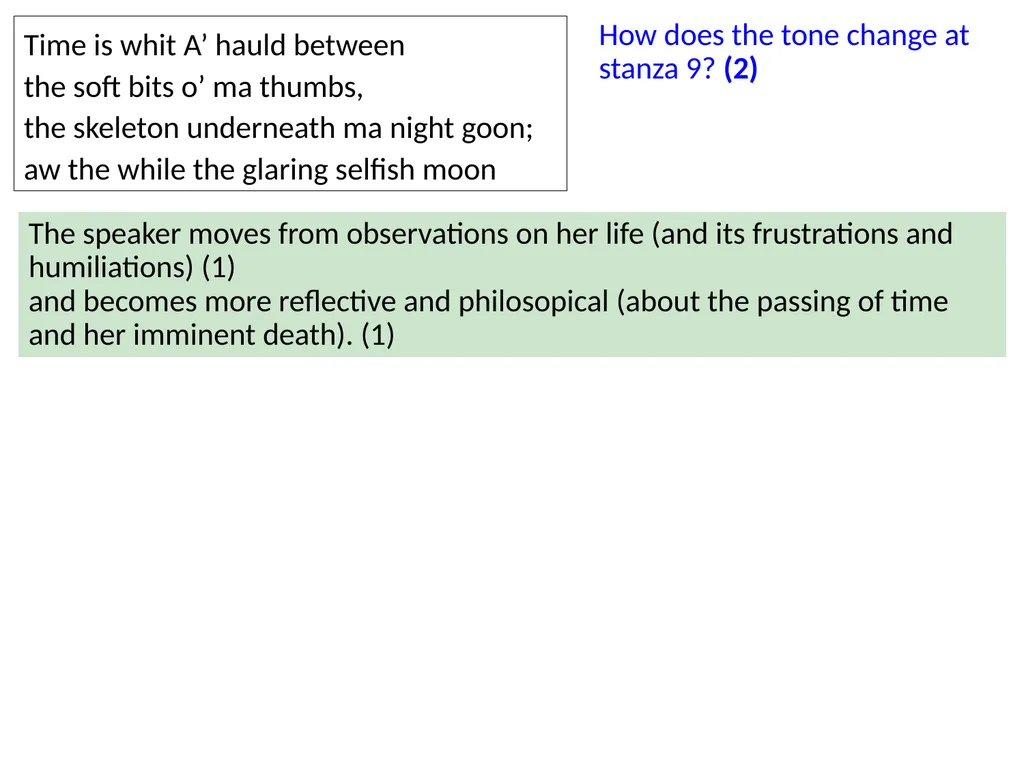
How does the tone change at stanza 9? (2) Time is whit A’ hauld between
the soft bits o’ ma thumbs,
the skeleton underneath ma night goon;
aw the while the glaring selfish moon The speaker moves from observations on her life (and its frustrations and humiliations) (1)
and becomes more reflective and philosopical (about the passing of time and her imminent death). (1)<br>
33
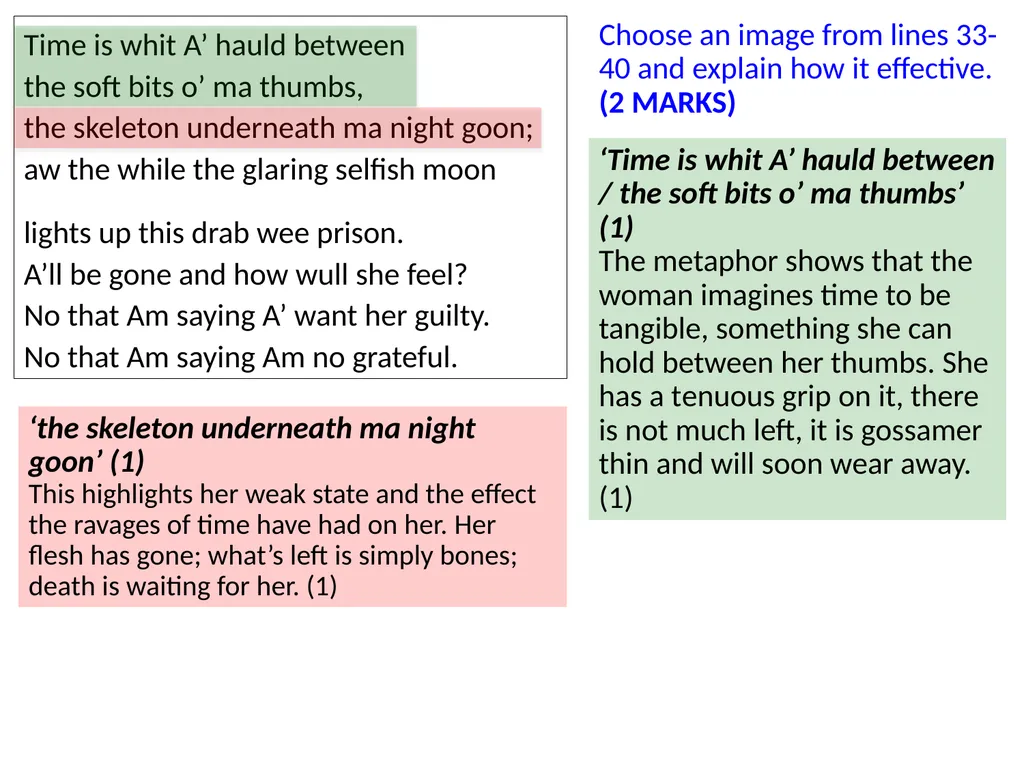
Choose an image from lines 33-40 and explain how it effective. (2 MARKS) Time is whit A’ hauld between
the soft bits o’ ma thumbs,
the skeleton underneath ma night goon;
aw the while the glaring selfish moon
lights up this drab wee prison.
A’ll be gone and how wull she feel?
No that Am saying A’ want her guilty.
No that Am saying Am no grateful. ‘Time is whit A’ hauld between / the soft bits o’ ma thumbs’ (1)
The metaphor shows that the woman imagines time to be tangible, something she can hold between her thumbs. She has a tenuous grip on it, there is not much left, it is gossamer thin and will soon wear away. (1) ‘the skeleton underneath ma night goon’ (1)
This highlights her weak state and the effect the ravages of time have had on her. Her flesh has gone; what’s left is simply bones; death is waiting for her. (1)<br>
34
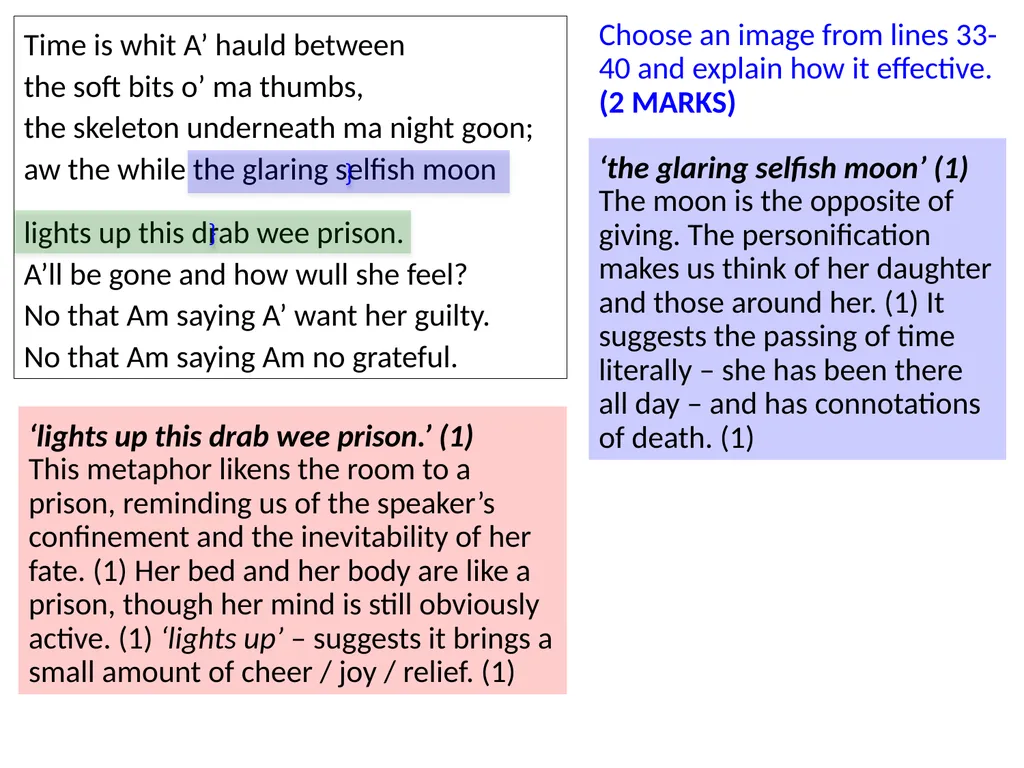
Choose an image from lines 33-40 and explain how it effective. (2 MARKS) Time is whit A’ hauld between
the soft bits o’ ma thumbs,
the skeleton underneath ma night goon;
aw the while the glaring selfish moon
lights up this drab wee prison.
A’ll be gone and how wull she feel?
No that Am saying A’ want her guilty.
No that Am saying Am no grateful. ‘the glaring selfish moon’ (1)
The moon is the opposite of giving. The personification makes us think of her daughter and those around her. (1) It suggests the passing of time literally – she has been there all day – and has connotations of death. (1) ‘lights up this drab wee prison.’ (1)
This metaphor likens the room to a prison, reminding us of the speaker’s confinement and the inevitability of her fate. (1) Her bed and her body are like a prison, though her mind is still obviously active. (1) ‘lights up’ – suggests it brings a small amount of cheer / joy / relief. (1) } }<br>
35
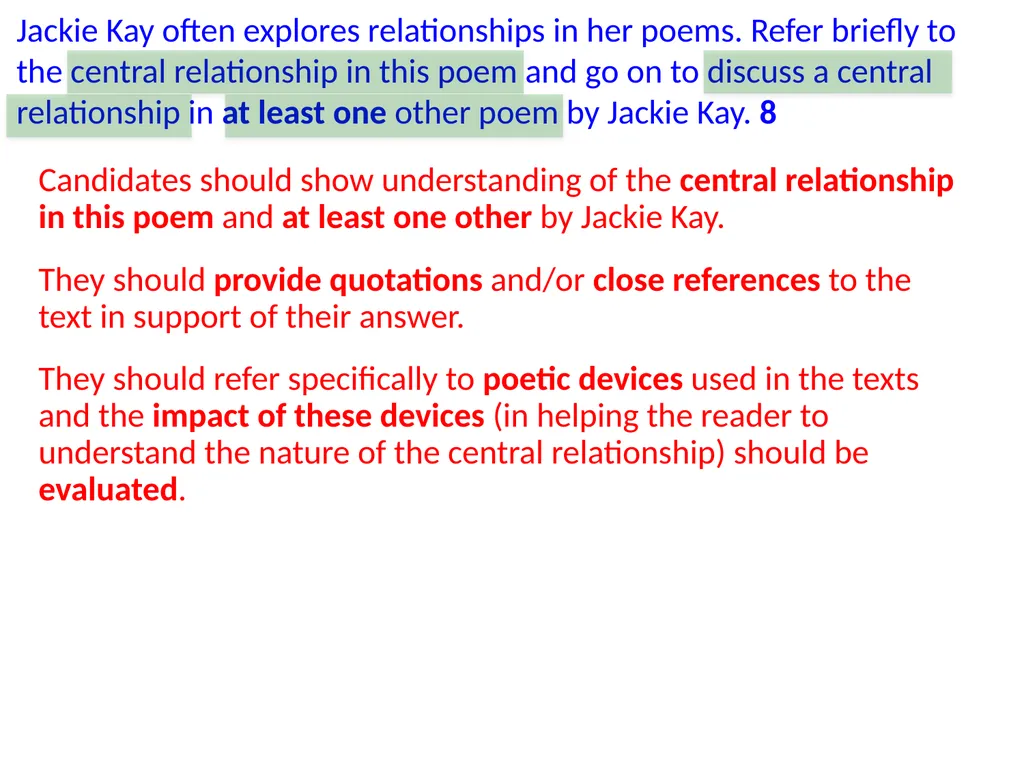
Jackie Kay often explores relationships in her poems. Refer briefly to the central relationship in this poem and go on to discuss a central relationship in at least one other poem by Jackie Kay. 8 Candidates should show understanding of the central relationship in this poem and at least one other by Jackie Kay.
They should provide quotations and/or close references to the text in support of their answer.
They should refer specifically to poetic devices used in the texts and the impact of these devices (in helping the reader to understand the nature of the central relationship) should be evaluated.<br>
36
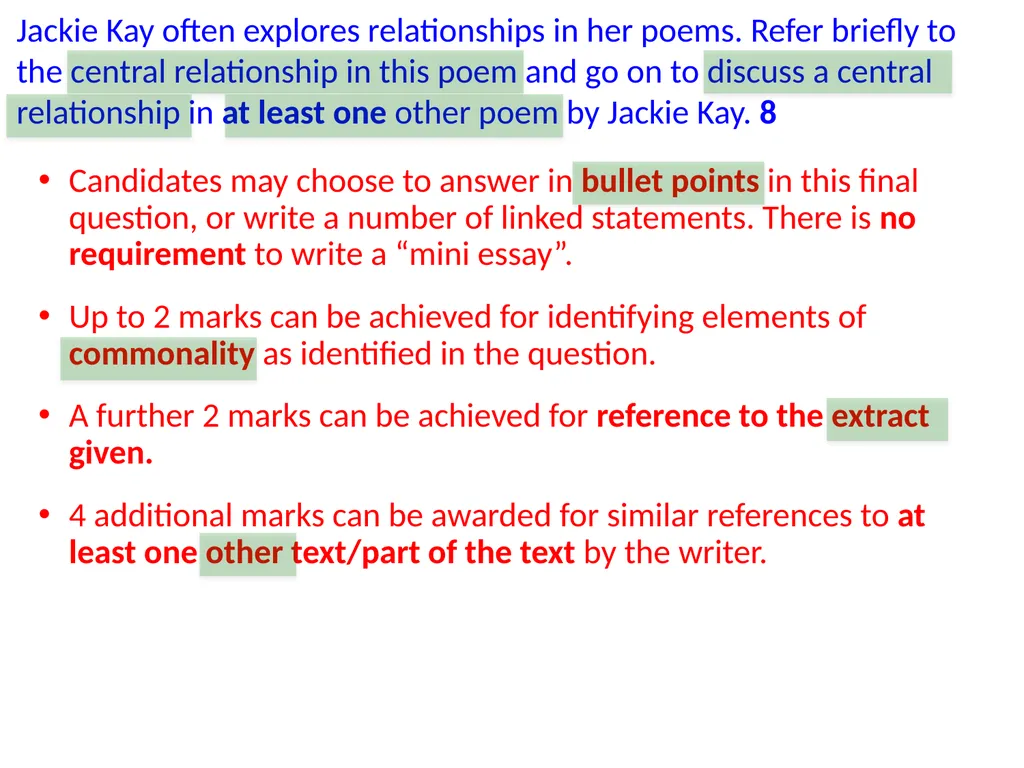
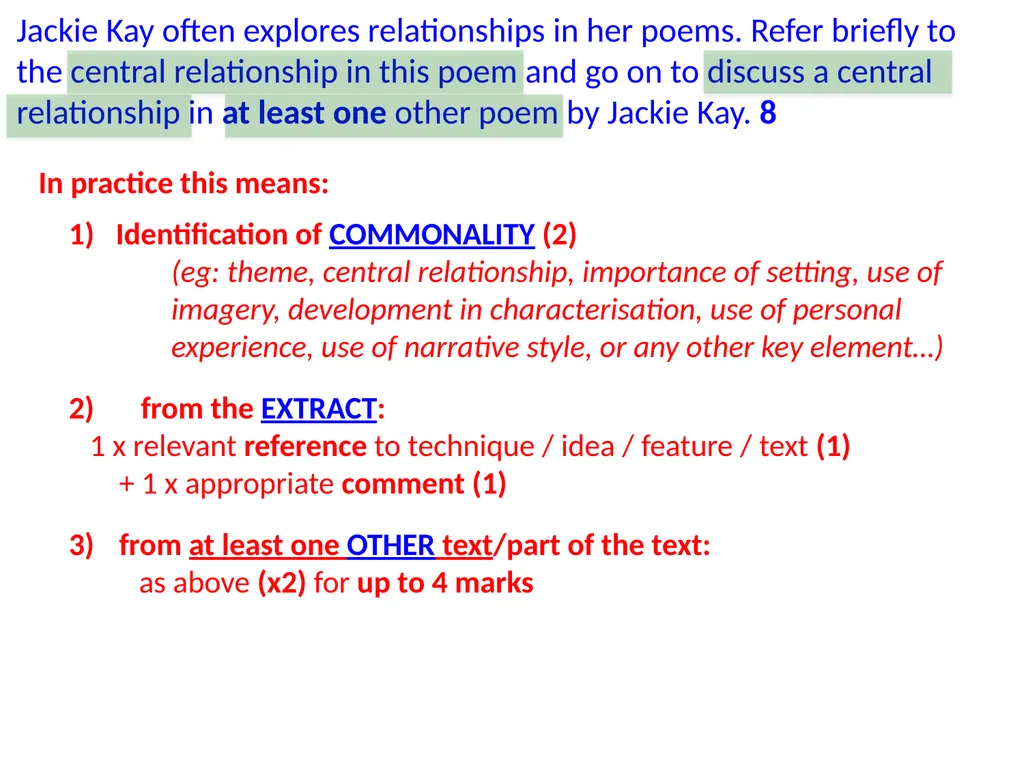
Jackie Kay often explores relationships in her poems. Refer briefly to the central relationship in this poem and go on to discuss a central relationship in at least one other poem by Jackie Kay. 8 Candidates may choose to answer in bullet points in this final question, or write a number of linked statements. There is no requirement to write a “mini essay”.
Up to 2 marks can be achieved for identifying elements of commonality as identified in the question.
A further 2 marks can be achieved for reference to the extract given.
4 additional marks can be awarded for similar references to at least one other text/part of the text by the writer.<br>
37
Jackie Kay often explores relationships in her poems. Refer briefly to the central relationship in this poem and go on to discuss a central relationship in at least one other poem by Jackie Kay. 8 In practice this means:
Identification of COMMONALITY (2)
(eg: theme, central relationship, importance of setting, use of imagery, development in characterisation, use of personal experience, use of narrative style, or any other key element…)
2) from the EXTRACT:
1 x relevant reference to technique / idea / feature / text (1)
+ 1 x appropriate comment (1)
3) from at least one OTHER text/part of the text:
as above (x2) for up to 4 marks<br>
38
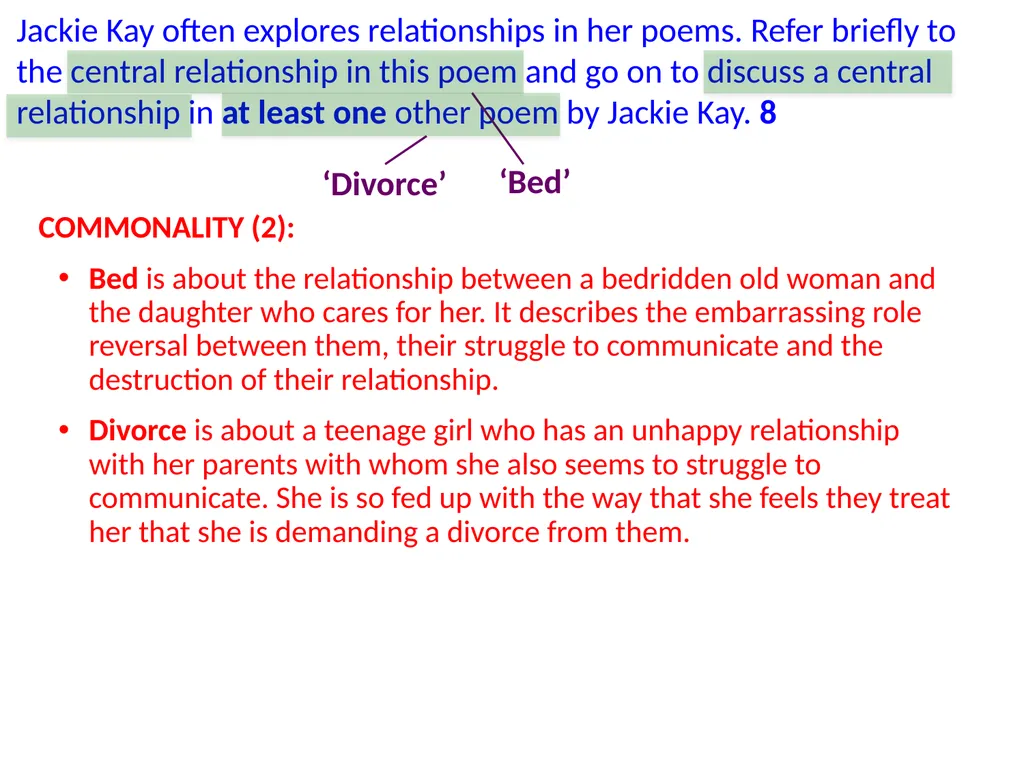
Jackie Kay often explores relationships in her poems. Refer briefly to the central relationship in this poem and go on to discuss a central relationship in at least one other poem by Jackie Kay. 8 COMMONALITY (2):
Bed is about the relationship between a bedridden old woman and the daughter who cares for her. It describes the embarrassing role reversal between them, their struggle to communicate and the destruction of their relationship.
Divorce is about a teenage girl who has an unhappy relationship with her parents with whom she also seems to struggle to communicate. She is so fed up with the way that she feels they treat her that she is demanding a divorce from them. ‘Bed’ ‘Divorce’<br>
39
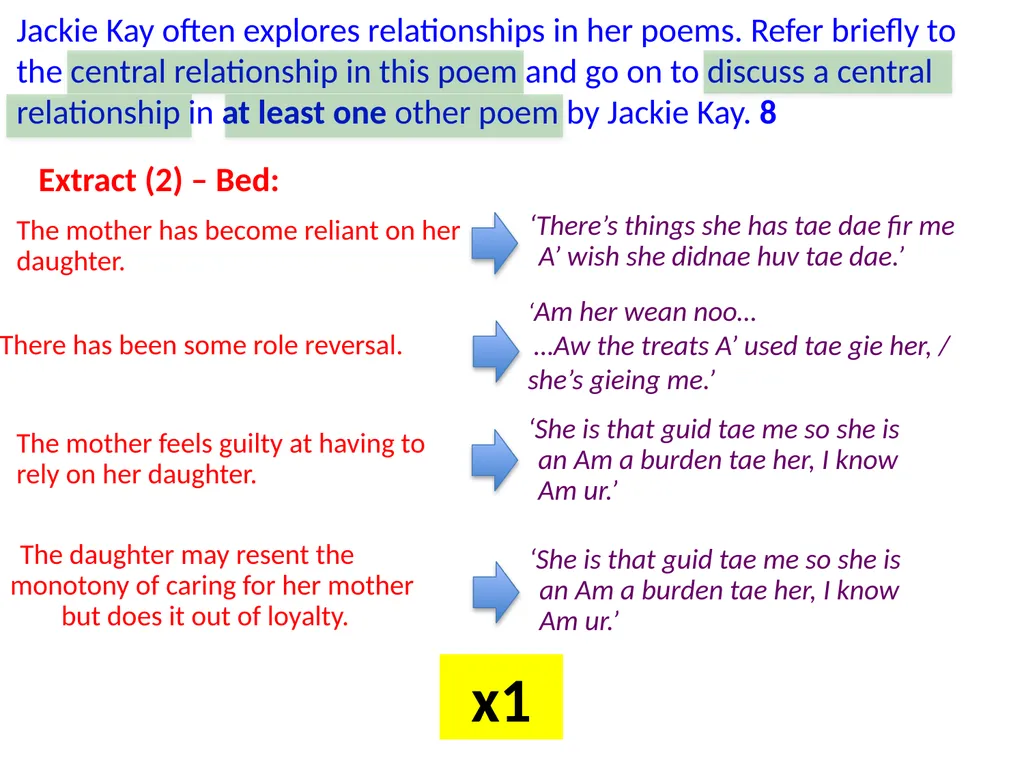
Jackie Kay often explores relationships in her poems. Refer briefly to the central relationship in this poem and go on to discuss a central relationship in at least one other poem by Jackie Kay. 8 Extract (2) – Bed: The daughter may resent the monotony of caring for her mother but does it out of loyalty. The mother feels guilty at having to rely on her daughter. There has been some role reversal. The mother has become reliant on her daughter. ‘There’s things she has tae dae fir me
A’ wish she didnae huv tae dae.’ ‘Am her wean noo…
…Aw the treats A’ used tae gie her, / she’s gieing me.’ ‘She is that guid tae me so she is
an Am a burden tae her, I know Am ur.’ ‘She is that guid tae me so she is
an Am a burden tae her, I know Am ur.’ x1<br>
40
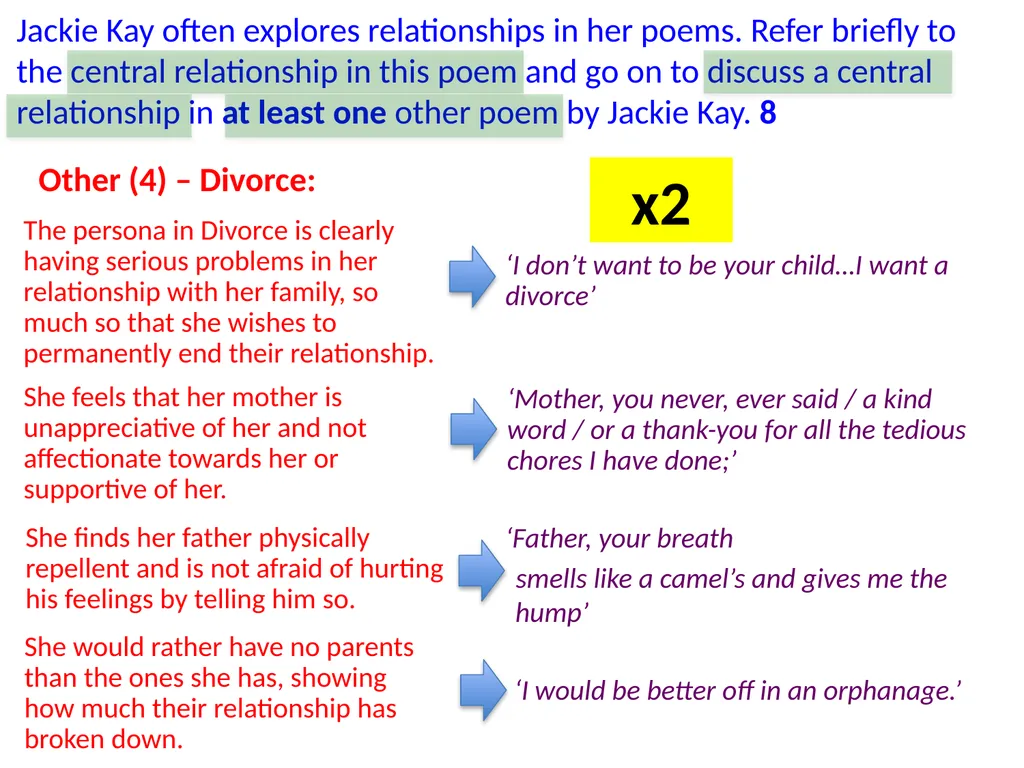
Jackie Kay often explores relationships in her poems. Refer briefly to the central relationship in this poem and go on to discuss a central relationship in at least one other poem by Jackie Kay. 8 Other (4) – Divorce: She finds her father physically repellent and is not afraid of hurting his feelings by telling him so. She would rather have no parents than the ones she has, showing how much their relationship has broken down. She feels that her mother is unappreciative of her and not affectionate towards her or supportive of her. The persona in Divorce is clearly having serious problems in her relationship with her family, so much so that she wishes to permanently end their relationship. ‘I don’t want to be your child…I want a divorce’ ‘I would be better off in an orphanage.’ ‘Mother, you never, ever said / a kind word / or a thank-you for all the tedious chores I have done;’ ‘Father, your breath
smells like a camel’s and gives me the hump’ x2<br>
41
Here are some examples of complete answers which would earn 8 marks:<br>
42
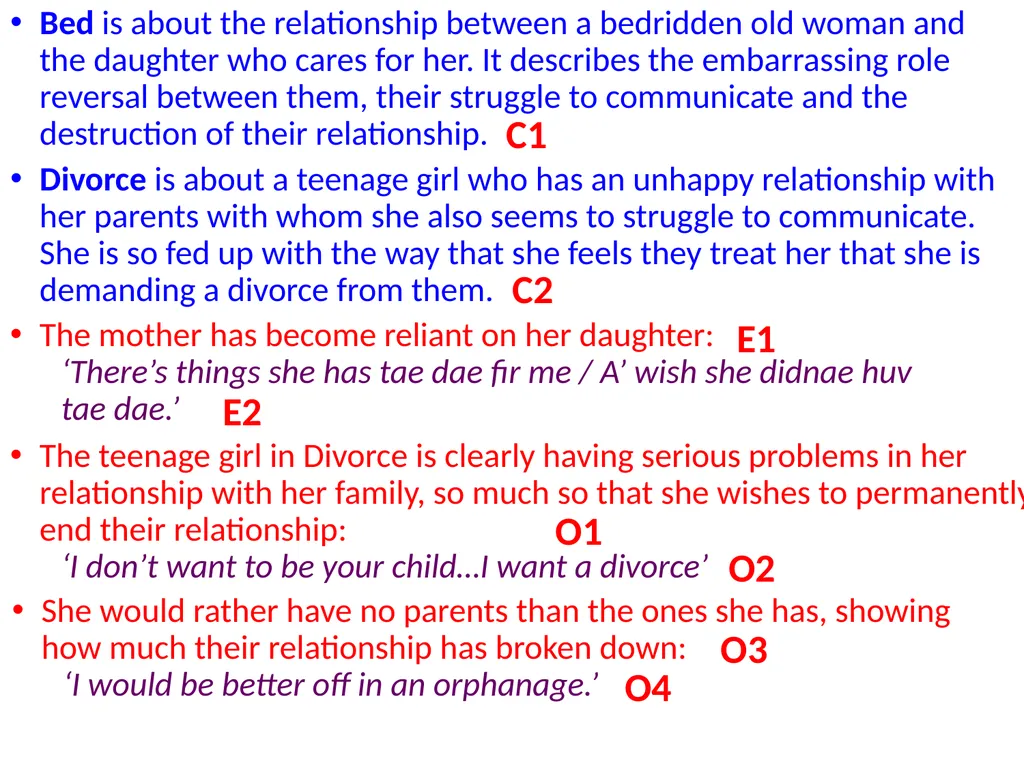
Bed is about the relationship between a bedridden old woman and the daughter who cares for her. It describes the embarrassing role reversal between them, their struggle to communicate and the destruction of their relationship.
Divorce is about a teenage girl who has an unhappy relationship with her parents with whom she also seems to struggle to communicate. She is so fed up with the way that she feels they treat her that she is demanding a divorce from them. C1 C2 The mother has become reliant on her daughter:
‘There’s things she has tae dae fir me / A’ wish she didnae huv tae dae.’ E1 E2 The teenage girl in Divorce is clearly having serious problems in her relationship with her family, so much so that she wishes to permanently end their relationship:
‘I don’t want to be your child…I want a divorce’ O1 O2 She would rather have no parents than the ones she has, showing how much their relationship has broken down:
‘I would be better off in an orphanage.’ O3 O4<br>
43
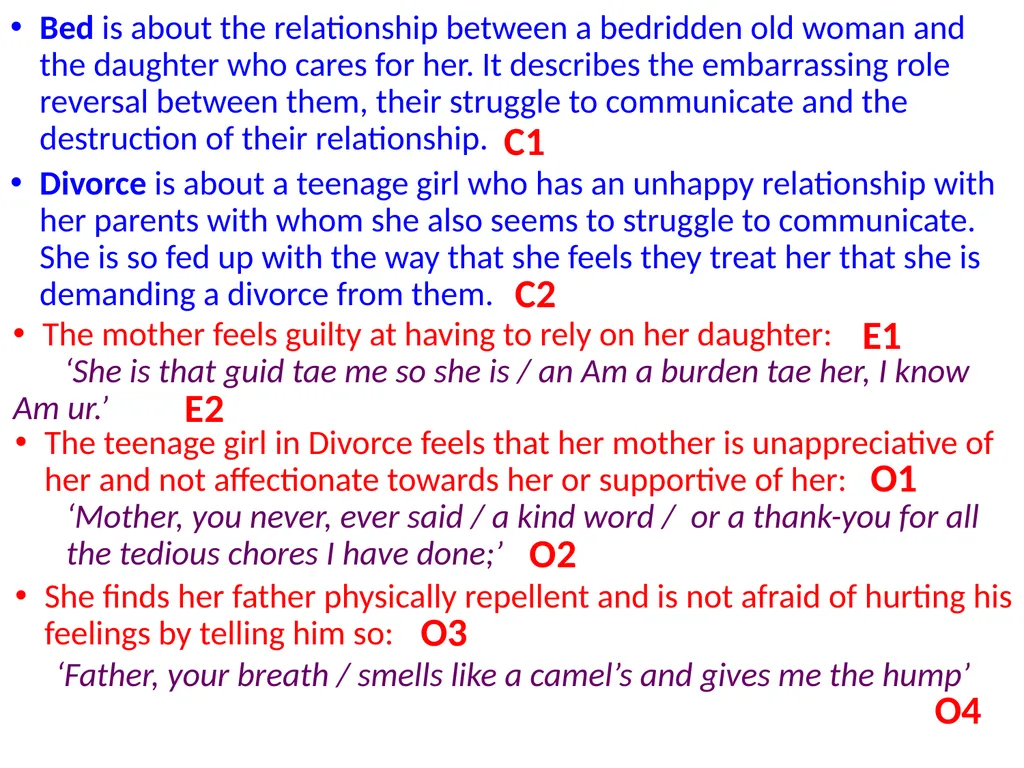
Bed is about the relationship between a bedridden old woman and the daughter who cares for her. It describes the embarrassing role reversal between them, their struggle to communicate and the destruction of their relationship.
Divorce is about a teenage girl who has an unhappy relationship with her parents with whom she also seems to struggle to communicate. She is so fed up with the way that she feels they treat her that she is demanding a divorce from them. C1 C2 The mother feels guilty at having to rely on her daughter:
‘She is that guid tae me so she is / an Am a burden tae her, I know Am ur.’ E1 E2 The teenage girl in Divorce feels that her mother is unappreciative of her and not affectionate towards her or supportive of her:
‘Mother, you never, ever said / a kind word / or a thank-you for all the tedious chores I have done;’ O1 O2 She finds her father physically repellent and is not afraid of hurting his feelings by telling him so:
‘Father, your breath / smells like a camel’s and gives me the hump’ O3 O4<br>
44
‘Gap Year’<br>
45
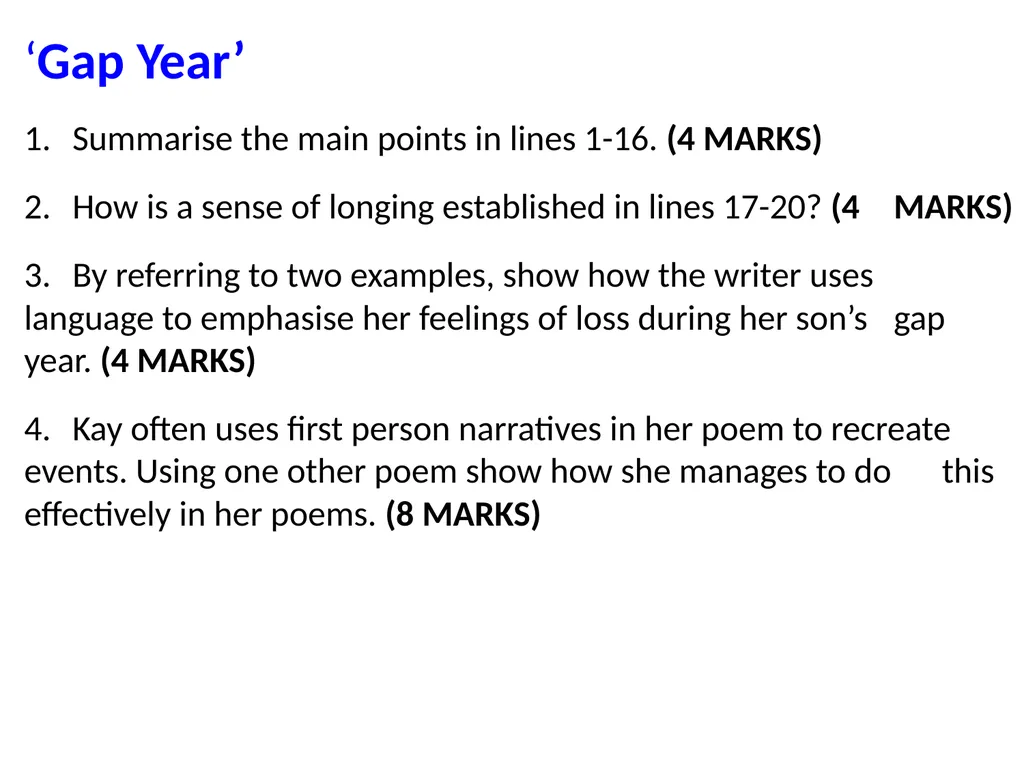
‘Gap Year’
1. Summarise the main points in lines 1-16. (4 MARKS)
2. How is a sense of longing established in lines 17-20? (4 MARKS)
3. By referring to two examples, show how the writer uses language to emphasise her feelings of loss during her son’s gap year. (4 MARKS)
4. Kay often uses first person narratives in her poem to recreate events. Using one other poem show how she manages to do this effectively in her poems. (8 MARKS)<br>
46
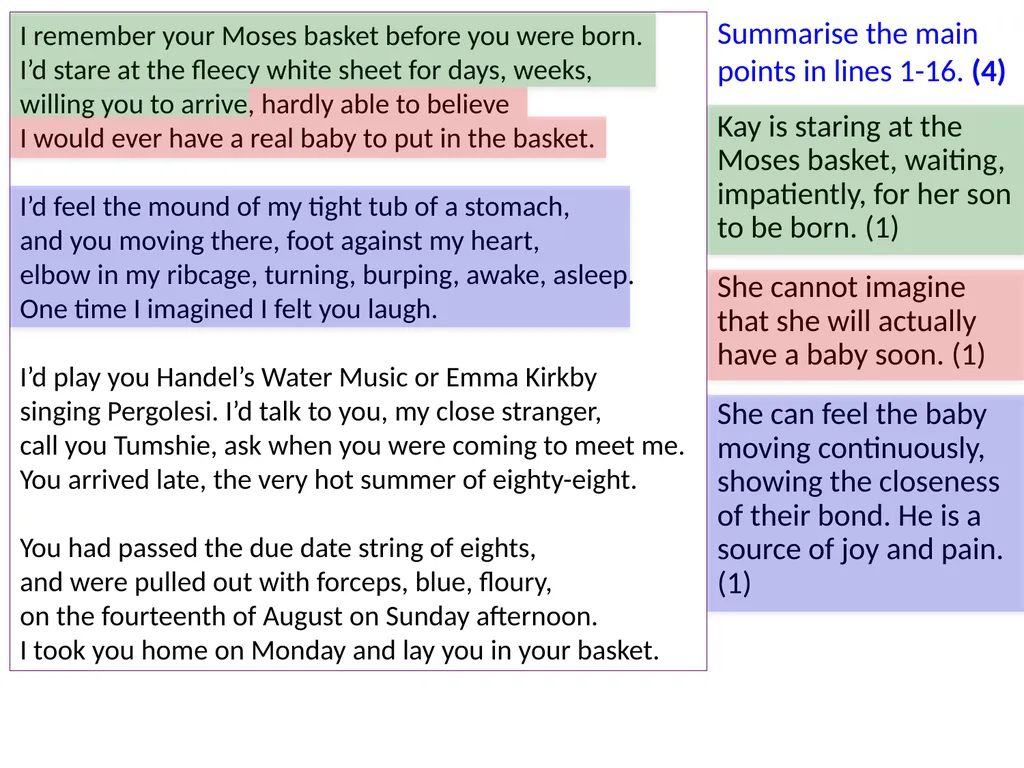
Summarise the main points in lines 1-16. (4) I remember your Moses basket before you were born.
I’d stare at the fleecy white sheet for days, weeks,
willing you to arrive, hardly able to believe
I would ever have a real baby to put in the basket.
I’d feel the mound of my tight tub of a stomach,
and you moving there, foot against my heart,
elbow in my ribcage, turning, burping, awake, asleep.
One time I imagined I felt you laugh.
I’d play you Handel’s Water Music or Emma Kirkby
singing Pergolesi. I’d talk to you, my close stranger,
call you Tumshie, ask when you were coming to meet me.
You arrived late, the very hot summer of eighty-eight.
You had passed the due date string of eights,
and were pulled out with forceps, blue, floury,
on the fourteenth of August on Sunday afternoon.
I took you home on Monday and lay you in your basket. Kay is staring at the Moses basket, waiting, impatiently, for her son to be born. (1)
She cannot imagine that she will actually have a baby soon. (1)
She can feel the baby moving continuously, showing the closeness of their bond. He is a source of joy and pain. (1)<br>
47
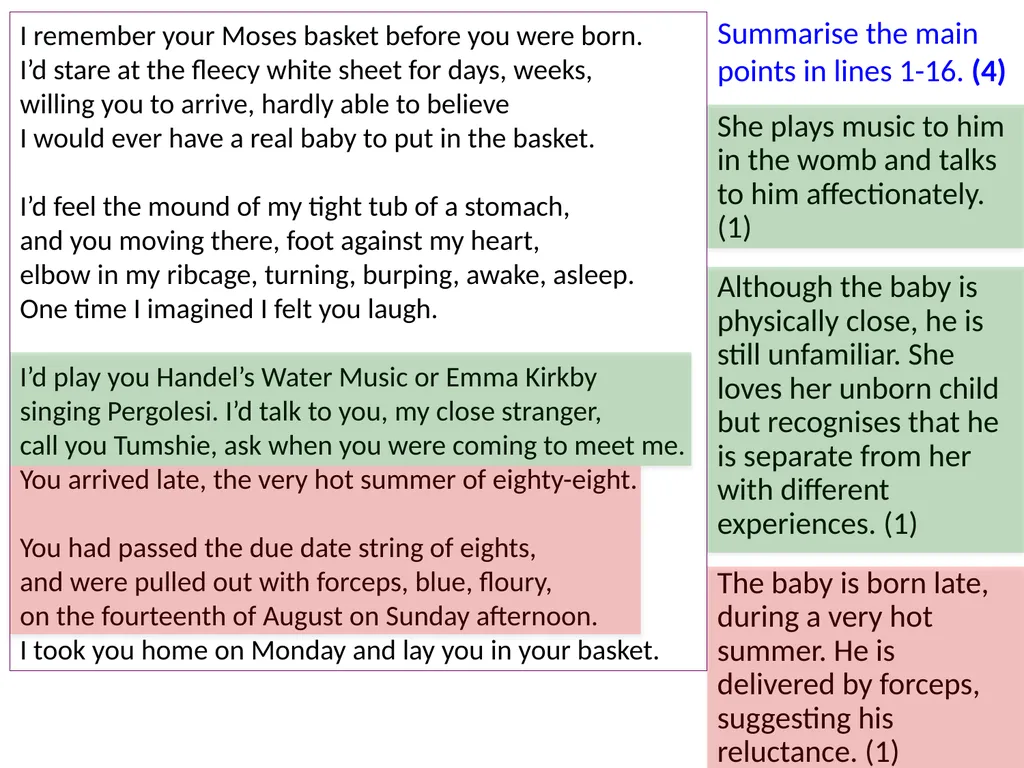
Summarise the main points in lines 1-16. (4) I remember your Moses basket before you were born.
I’d stare at the fleecy white sheet for days, weeks,
willing you to arrive, hardly able to believe
I would ever have a real baby to put in the basket.
I’d feel the mound of my tight tub of a stomach,
and you moving there, foot against my heart,
elbow in my ribcage, turning, burping, awake, asleep.
One time I imagined I felt you laugh.
I’d play you Handel’s Water Music or Emma Kirkby
singing Pergolesi. I’d talk to you, my close stranger,
call you Tumshie, ask when you were coming to meet me.
You arrived late, the very hot summer of eighty-eight.
You had passed the due date string of eights,
and were pulled out with forceps, blue, floury,
on the fourteenth of August on Sunday afternoon.
I took you home on Monday and lay you in your basket. She plays music to him in the womb and talks to him affectionately. (1)
Although the baby is physically close, he is still unfamiliar. She loves her unborn child but recognises that he is separate from her with different experiences. (1)
The baby is born late, during a very hot summer. He is delivered by forceps, suggesting his reluctance. (1)<br>
48
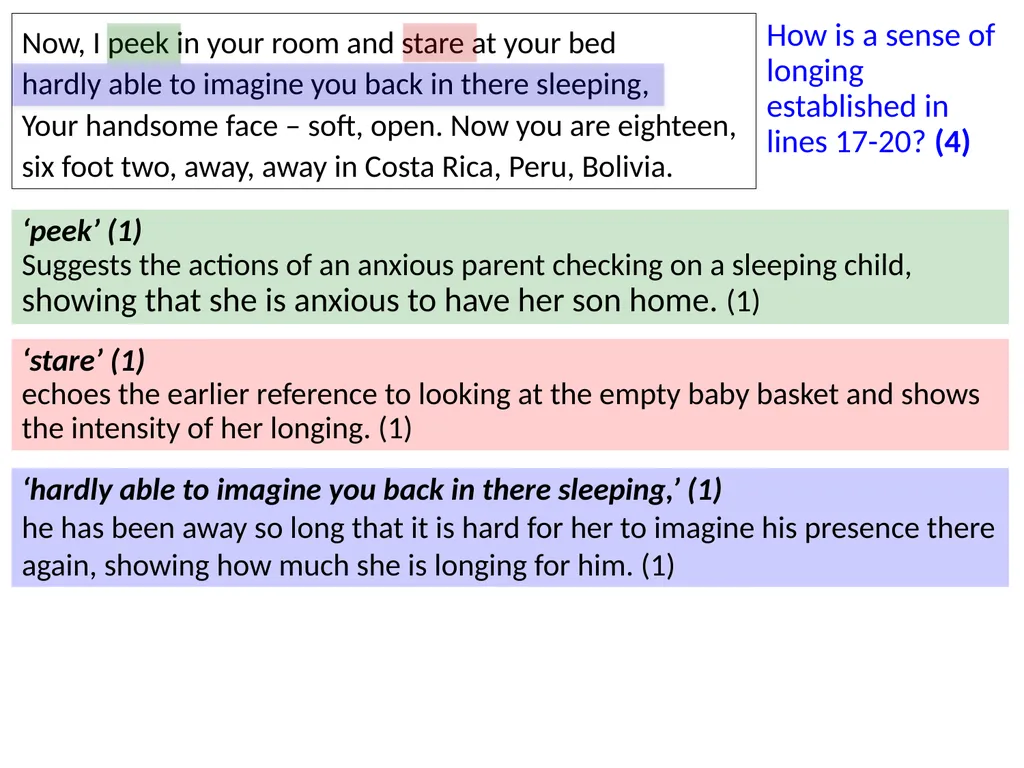
How is a sense of longing established in lines 17-20? (4) Now, I peek in your room and stare at your bed
hardly able to imagine you back in there sleeping,
Your handsome face – soft, open. Now you are eighteen,
six foot two, away, away in Costa Rica, Peru, Bolivia. ‘peek’ (1)
Suggests the actions of an anxious parent checking on a sleeping child, showing that she is anxious to have her son home. (1) ‘stare’ (1)
echoes the earlier reference to looking at the empty baby basket and shows the intensity of her longing. (1) ‘hardly able to imagine you back in there sleeping,’ (1)
he has been away so long that it is hard for her to imagine his presence there again, showing how much she is longing for him. (1)<br>
49
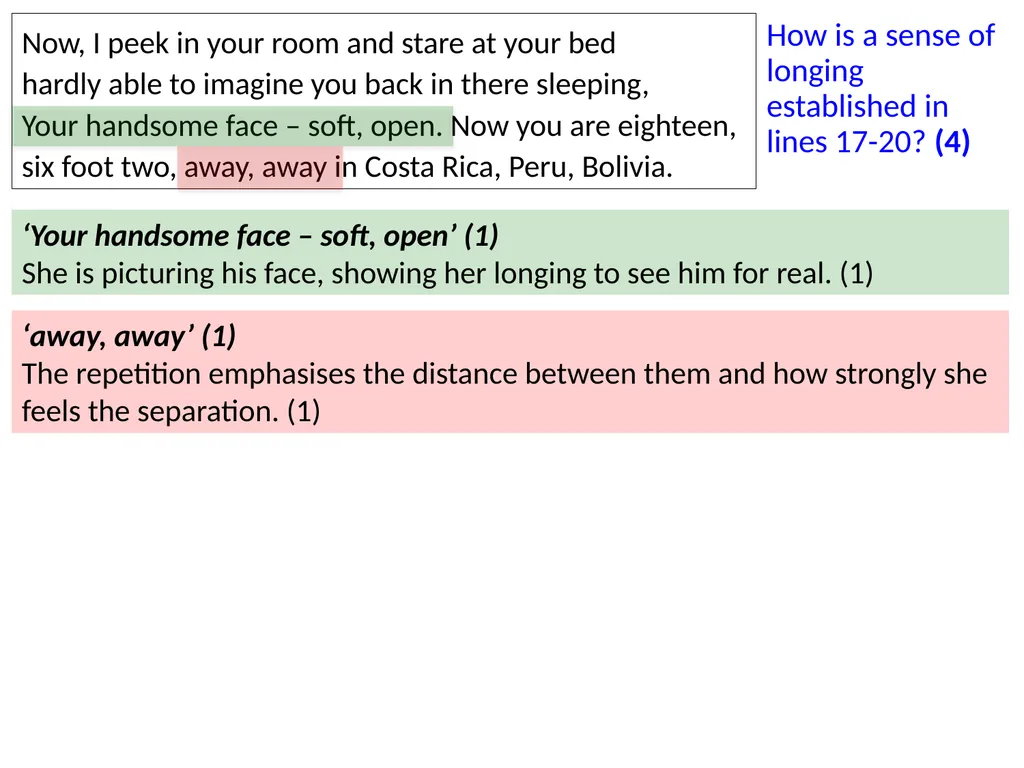
How is a sense of longing established in lines 17-20? (4) Now, I peek in your room and stare at your bed
hardly able to imagine you back in there sleeping,
Your handsome face – soft, open. Now you are eighteen,
six foot two, away, away in Costa Rica, Peru, Bolivia. ‘Your handsome face – soft, open’ (1)
She is picturing his face, showing her longing to see him for real. (1) ‘away, away’ (1)
The repetition emphasises the distance between them and how strongly she feels the separation. (1)<br>
50
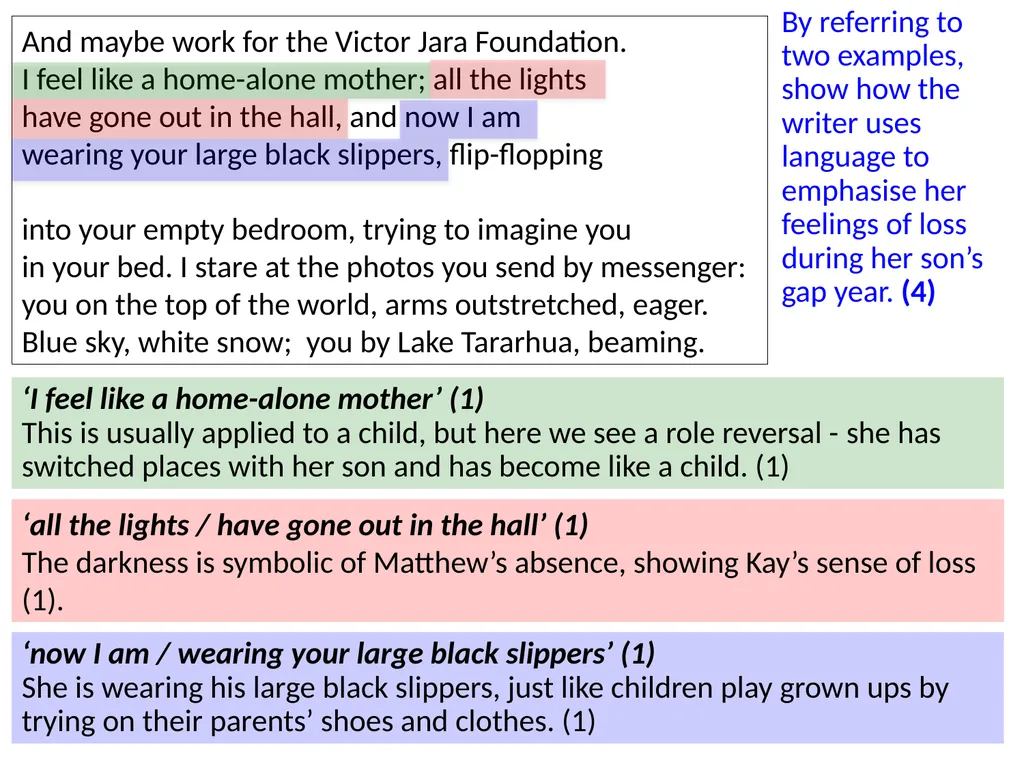
By referring to two examples, show how the writer uses language to emphasise her feelings of loss during her son’s gap year. (4) And maybe work for the Victor Jara Foundation.
I feel like a home-alone mother; all the lights
have gone out in the hall, and now I am
wearing your large black slippers, flip-flopping
into your empty bedroom, trying to imagine you
in your bed. I stare at the photos you send by messenger:
you on the top of the world, arms outstretched, eager.
Blue sky, white snow; you by Lake Tararhua, beaming. ‘I feel like a home-alone mother’ (1)
This is usually applied to a child, but here we see a role reversal - she has switched places with her son and has become like a child. (1) ‘all the lights / have gone out in the hall’ (1)
The darkness is symbolic of Matthew’s absence, showing Kay’s sense of loss (1). ‘now I am / wearing your large black slippers’ (1)
She is wearing his large black slippers, just like children play grown ups by trying on their parents’ shoes and clothes. (1)<br>
51
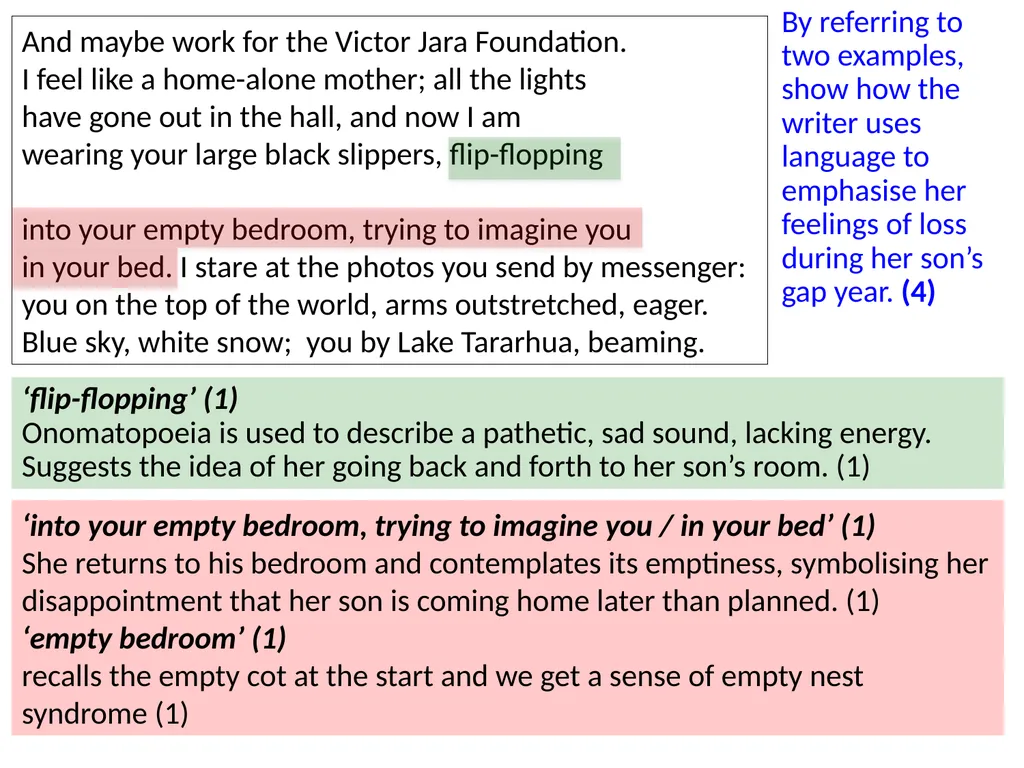
By referring to two examples, show how the writer uses language to emphasise her feelings of loss during her son’s gap year. (4) And maybe work for the Victor Jara Foundation.
I feel like a home-alone mother; all the lights
have gone out in the hall, and now I am
wearing your large black slippers, flip-flopping
into your empty bedroom, trying to imagine you
in your bed. I stare at the photos you send by messenger:
you on the top of the world, arms outstretched, eager.
Blue sky, white snow; you by Lake Tararhua, beaming. ‘flip-flopping’ (1)
Onomatopoeia is used to describe a pathetic, sad sound, lacking energy. Suggests the idea of her going back and forth to her son’s room. (1) ‘into your empty bedroom, trying to imagine you / in your bed’ (1)
She returns to his bedroom and contemplates its emptiness, symbolising her disappointment that her son is coming home later than planned. (1)
‘empty bedroom’ (1)
recalls the empty cot at the start and we get a sense of empty nest syndrome (1)<br>
52
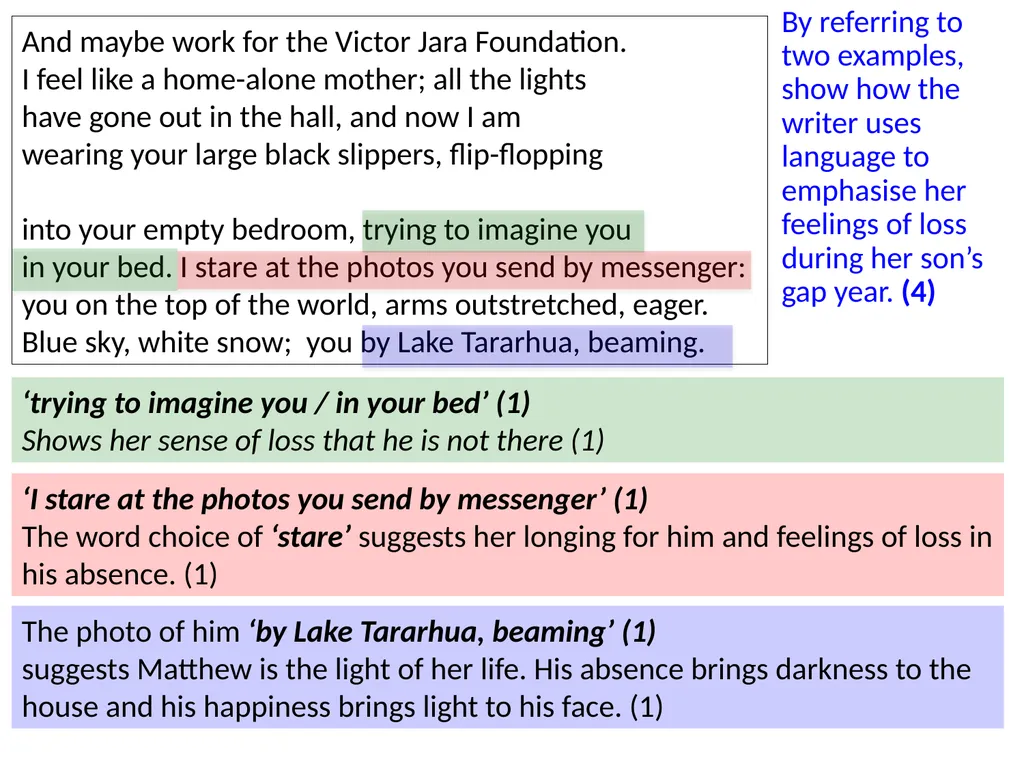
By referring to two examples, show how the writer uses language to emphasise her feelings of loss during her son’s gap year. (4) And maybe work for the Victor Jara Foundation.
I feel like a home-alone mother; all the lights
have gone out in the hall, and now I am
wearing your large black slippers, flip-flopping
into your empty bedroom, trying to imagine you
in your bed. I stare at the photos you send by messenger:
you on the top of the world, arms outstretched, eager.
Blue sky, white snow; you by Lake Tararhua, beaming. ‘trying to imagine you / in your bed’ (1)
Shows her sense of loss that he is not there (1) ‘I stare at the photos you send by messenger’ (1)
The word choice of ‘stare’ suggests her longing for him and feelings of loss in his absence. (1) The photo of him ‘by Lake Tararhua, beaming’ (1)
suggests Matthew is the light of her life. His absence brings darkness to the house and his happiness brings light to his face. (1)<br>
53
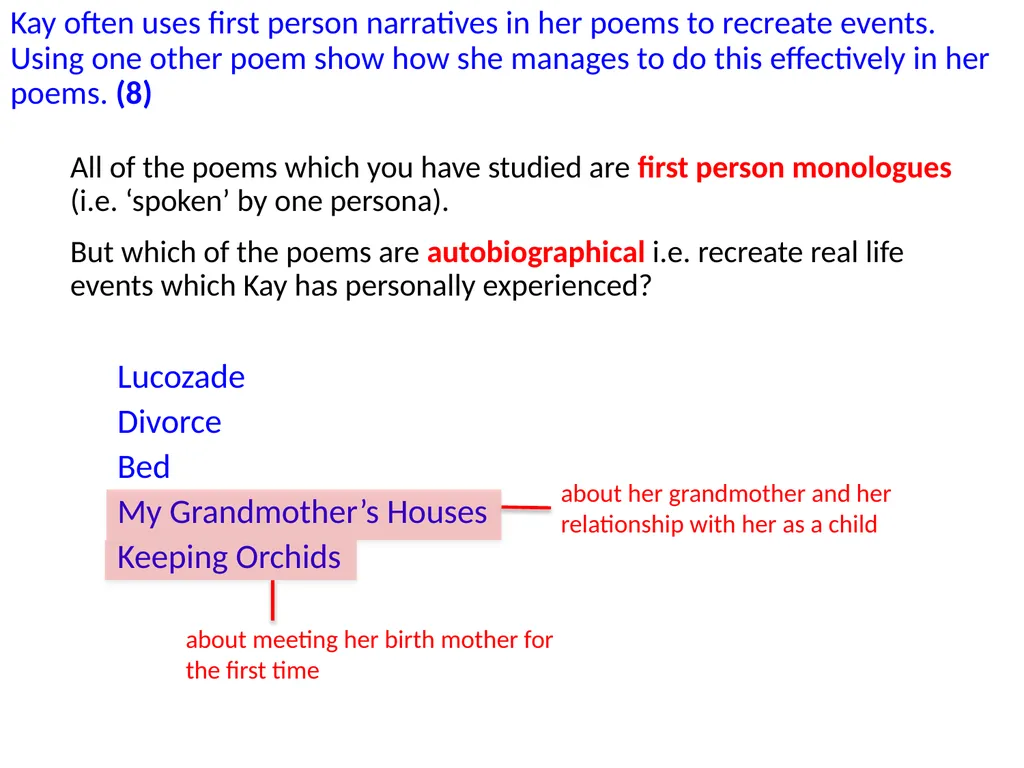
Kay often uses first person narratives in her poems to recreate events.
Using one other poem show how she manages to do this effectively in her poems. (8) All of the poems which you have studied are first person monologues (i.e. ‘spoken’ by one persona).
But which of the poems are autobiographical i.e. recreate real life events which Kay has personally experienced? Lucozade
Divorce
Bed
My Grandmother’s Houses
Keeping Orchids about her grandmother and her relationship with her as a child about meeting her birth mother for the first time<br>
54
‘My Grandmother’s Houses’<br>
55
‘My Grandmother’s Houses’
1. Summarise the things that make the speaker’s grandmother’s house seem like a home from lines 1-14. (4 MARKS)
2. Show one way in which the writer makes the church experience stand out (lines 37-44). (2 MARKS)
3. How do we get a sense that there is a class divide between the speaker and the owner of the house in lines 45-60? (4 MARKS)
4. Choose one technique Kay uses to make the last lines effective (63-65)? (2 MARKS)
5. This poem deals with a series of significant moments and memories. Choose at least one other poem that does this and show how Kay makes her poems seem poignant to the reader. (8 MARKS)<br>
56
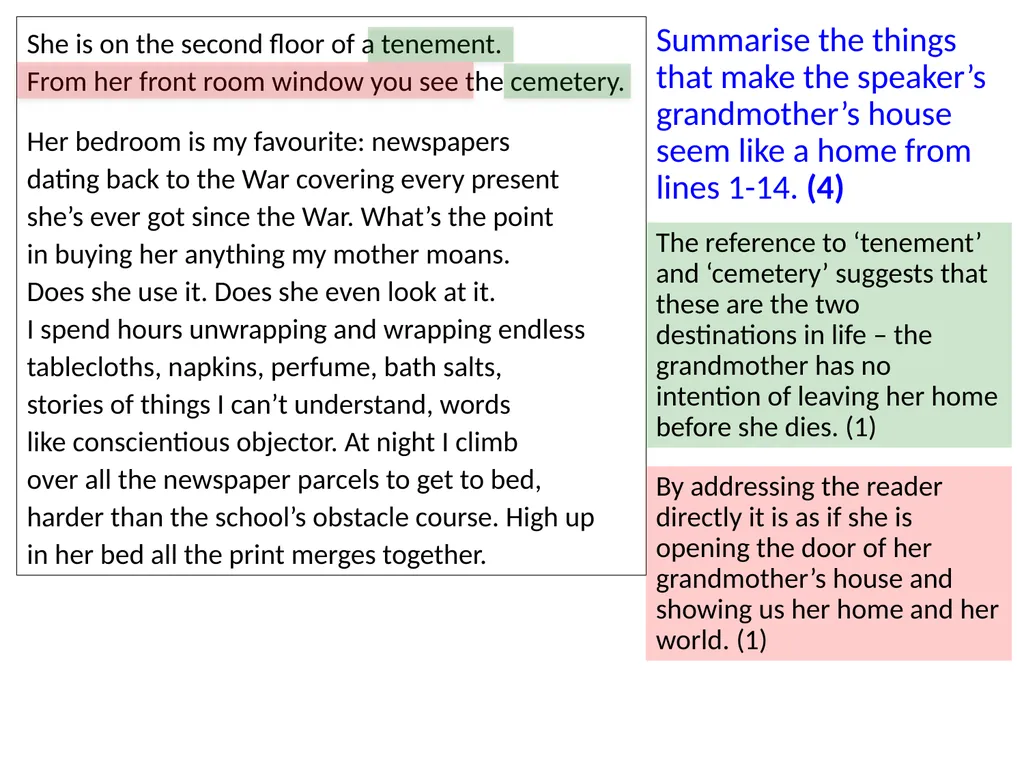
Summarise the things that make the speaker’s grandmother’s house seem like a home from lines 1-14. (4) She is on the second floor of a tenement.
From her front room window you see the cemetery.
Her bedroom is my favourite: newspapers
dating back to the War covering every present
she’s ever got since the War. What’s the point
in buying her anything my mother moans.
Does she use it. Does she even look at it.
I spend hours unwrapping and wrapping endless
tablecloths, napkins, perfume, bath salts,
stories of things I can’t understand, words
like conscientious objector. At night I climb
over all the newspaper parcels to get to bed,
harder than the school’s obstacle course. High up
in her bed all the print merges together. The reference to ‘tenement’ and ‘cemetery’ suggests that these are the two destinations in life – the grandmother has no intention of leaving her home before she dies. (1) By addressing the reader directly it is as if she is opening the door of her grandmother’s house and showing us her home and her world. (1)<br>
57
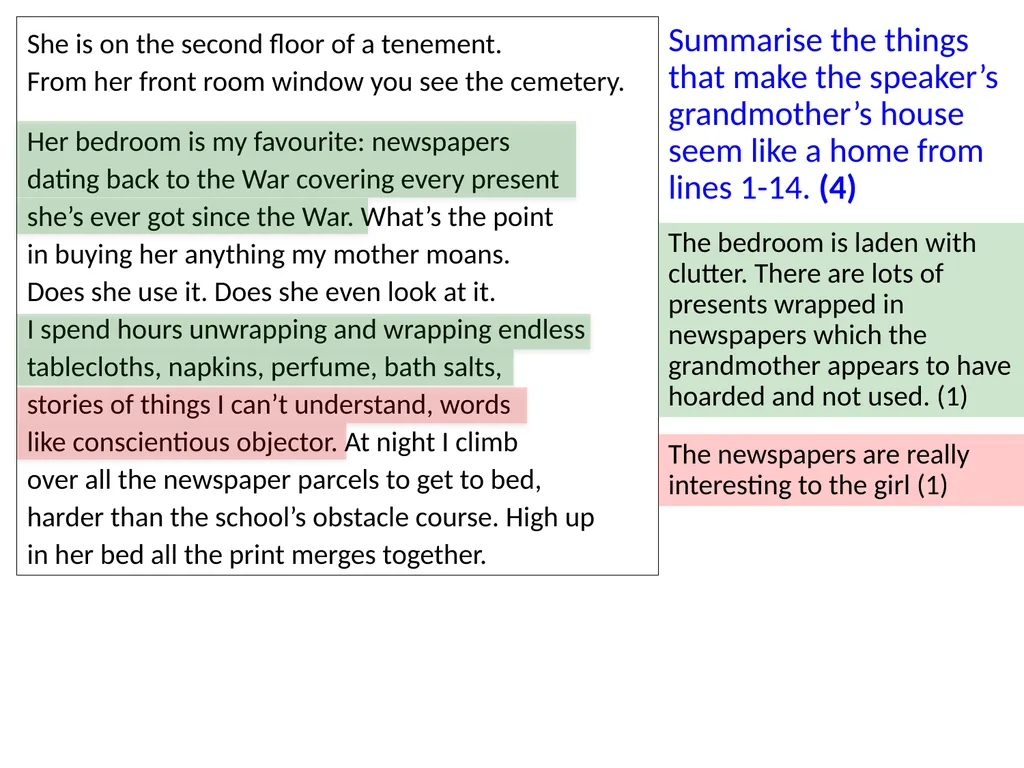
Summarise the things that make the speaker’s grandmother’s house seem like a home from lines 1-14. (4) She is on the second floor of a tenement.
From her front room window you see the cemetery.
Her bedroom is my favourite: newspapers
dating back to the War covering every present
she’s ever got since the War. What’s the point
in buying her anything my mother moans.
Does she use it. Does she even look at it.
I spend hours unwrapping and wrapping endless
tablecloths, napkins, perfume, bath salts,
stories of things I can’t understand, words
like conscientious objector. At night I climb
over all the newspaper parcels to get to bed,
harder than the school’s obstacle course. High up
in her bed all the print merges together. The bedroom is laden with clutter. There are lots of presents wrapped in newspapers which the grandmother appears to have hoarded and not used. (1) The newspapers are really interesting to the girl (1)<br>
58
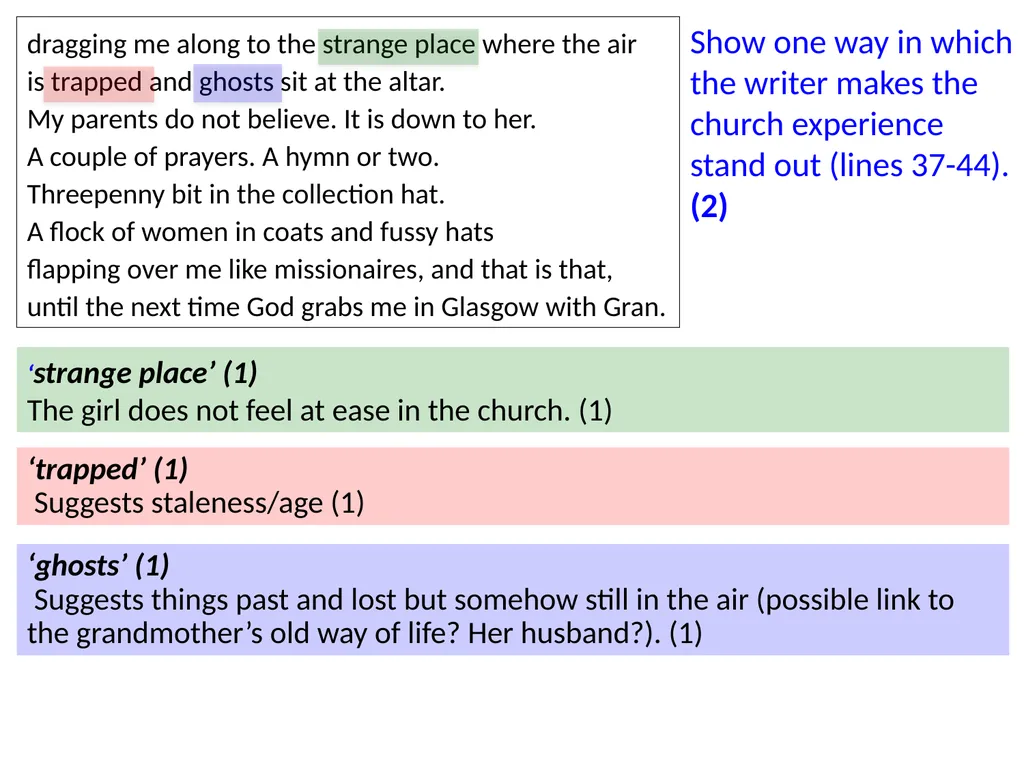
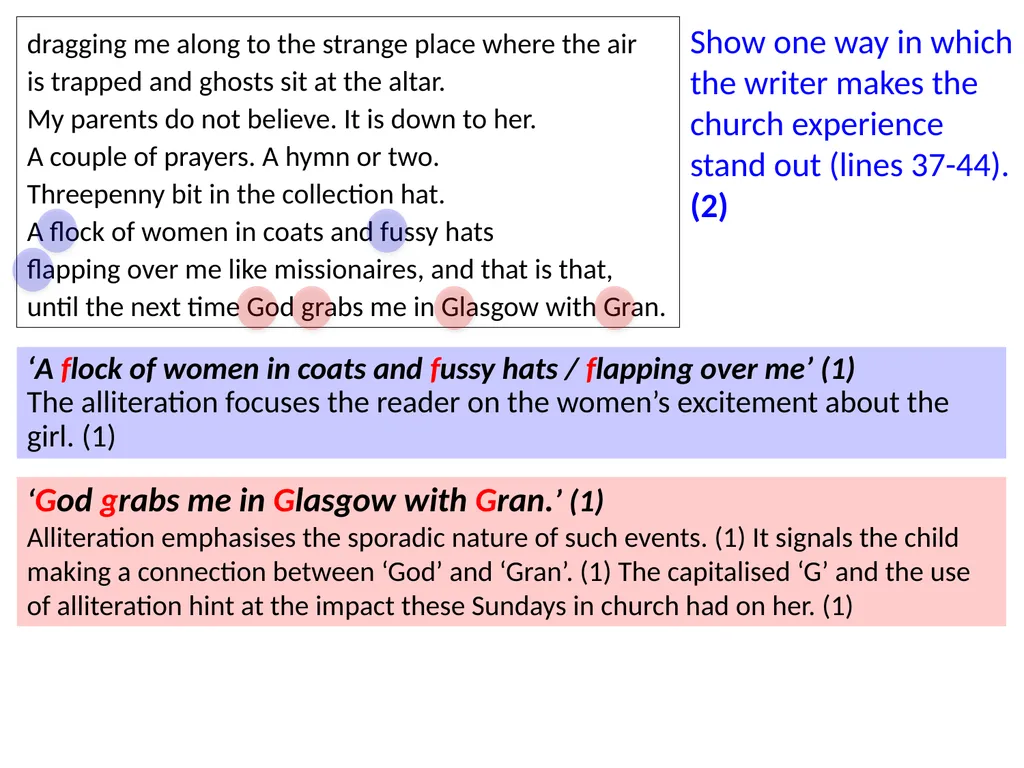
Show one way in which the writer makes the church experience stand out (lines 37-44). (2) dragging me along to the strange place where the air
is trapped and ghosts sit at the altar.
My parents do not believe. It is down to her.
A couple of prayers. A hymn or two.
Threepenny bit in the collection hat.
A flock of women in coats and fussy hats
flapping over me like missionaires, and that is that,
until the next time God grabs me in Glasgow with Gran. ‘strange place’ (1)
The girl does not feel at ease in the church. (1) ‘trapped’ (1)
Suggests staleness/age (1) ‘ghosts’ (1)
Suggests things past and lost but somehow still in the air (possible link to the grandmother’s old way of life? Her husband?). (1)<br>
59
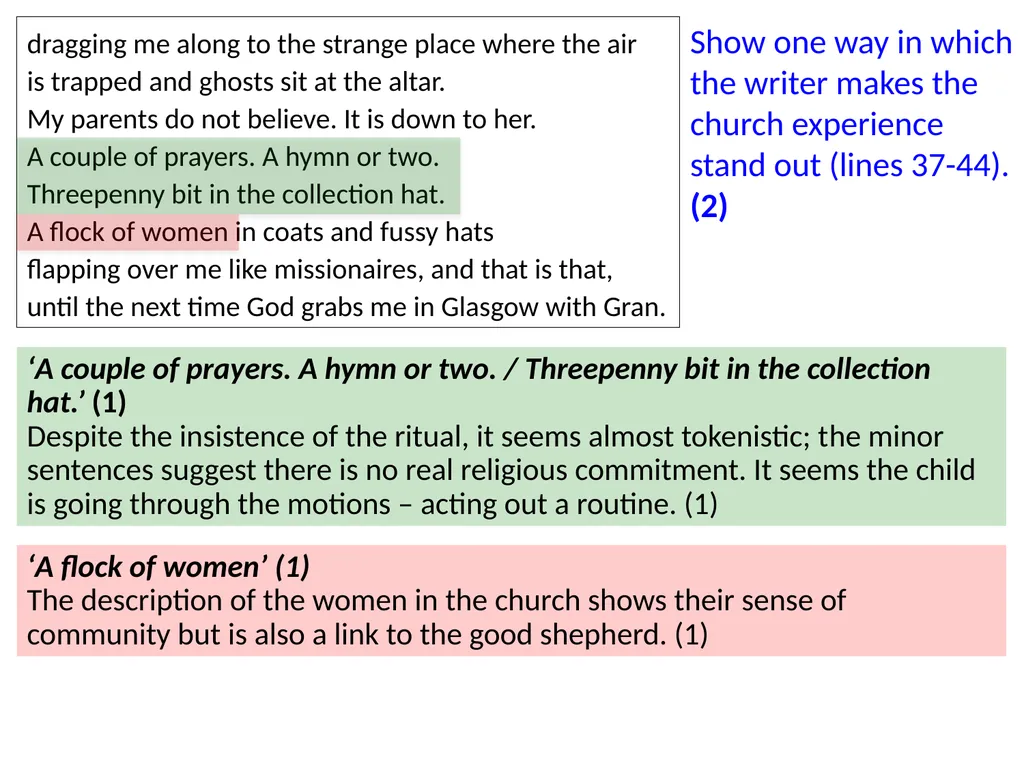
Show one way in which the writer makes the church experience stand out (lines 37-44). (2) dragging me along to the strange place where the air
is trapped and ghosts sit at the altar.
My parents do not believe. It is down to her.
A couple of prayers. A hymn or two.
Threepenny bit in the collection hat.
A flock of women in coats and fussy hats
flapping over me like missionaires, and that is that,
until the next time God grabs me in Glasgow with Gran. ‘A couple of prayers. A hymn or two. / Threepenny bit in the collection hat.’ (1)
Despite the insistence of the ritual, it seems almost tokenistic; the minor sentences suggest there is no real religious commitment. It seems the child is going through the motions – acting out a routine. (1) ‘A flock of women’ (1)
The description of the women in the church shows their sense of community but is also a link to the good shepherd. (1)<br>
60
Show one way in which the writer makes the church experience stand out (lines 37-44). (2) dragging me along to the strange place where the air
is trapped and ghosts sit at the altar.
My parents do not believe. It is down to her.
A couple of prayers. A hymn or two.
Threepenny bit in the collection hat.
A flock of women in coats and fussy hats
flapping over me like missionaires, and that is that,
until the next time God grabs me in Glasgow with Gran. ‘A flock of women in coats and fussy hats / flapping over me’ (1)
The alliteration focuses the reader on the women’s excitement about the girl. (1) ‘God grabs me in Glasgow with Gran.’ (1)
Alliteration emphasises the sporadic nature of such events. (1) It signals the child making a connection between ‘God’ and ‘Gran’. (1) The capitalised ‘G’ and the use of alliteration hint at the impact these Sundays in church had on her. (1)<br>
61
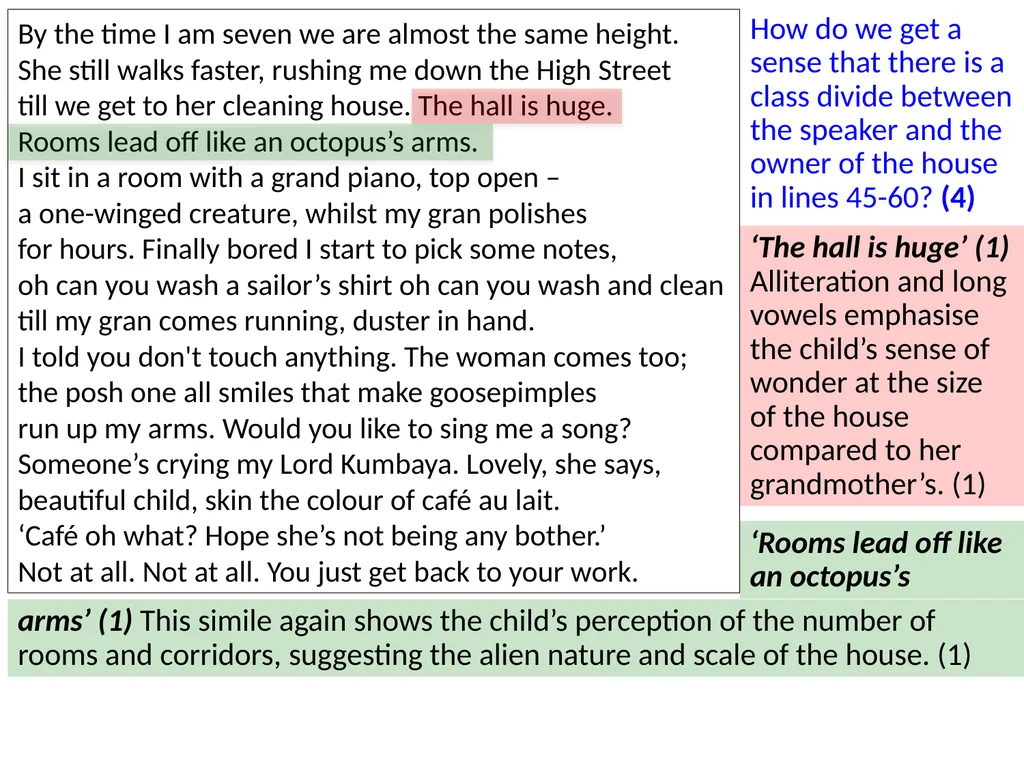
How do we get a sense that there is a class divide between the speaker and the owner of the house in lines 45-60? (4) By the time I am seven we are almost the same height.
She still walks faster, rushing me down the High Street
till we get to her cleaning house. The hall is huge.
Rooms lead off like an octopus’s arms.
I sit in a room with a grand piano, top open –
a one-winged creature, whilst my gran polishes
for hours. Finally bored I start to pick some notes,
oh can you wash a sailor’s shirt oh can you wash and clean
till my gran comes running, duster in hand.
I told you don't touch anything. The woman comes too;
the posh one all smiles that make goosepimples
run up my arms. Would you like to sing me a song?
Someone’s crying my Lord Kumbaya. Lovely, she says,
beautiful child, skin the colour of café au lait.
‘Café oh what? Hope she’s not being any bother.’
Not at all. Not at all. You just get back to your work. ‘The hall is huge’ (1)
Alliteration and long vowels emphasise the child’s sense of wonder at the size of the house compared to her grandmother’s. (1) ‘Rooms lead off like an octopus’s arms’ (1) This simile again shows the child’s perception of the number of rooms and corridors, suggesting the alien nature and scale of the house. (1)<br>
62
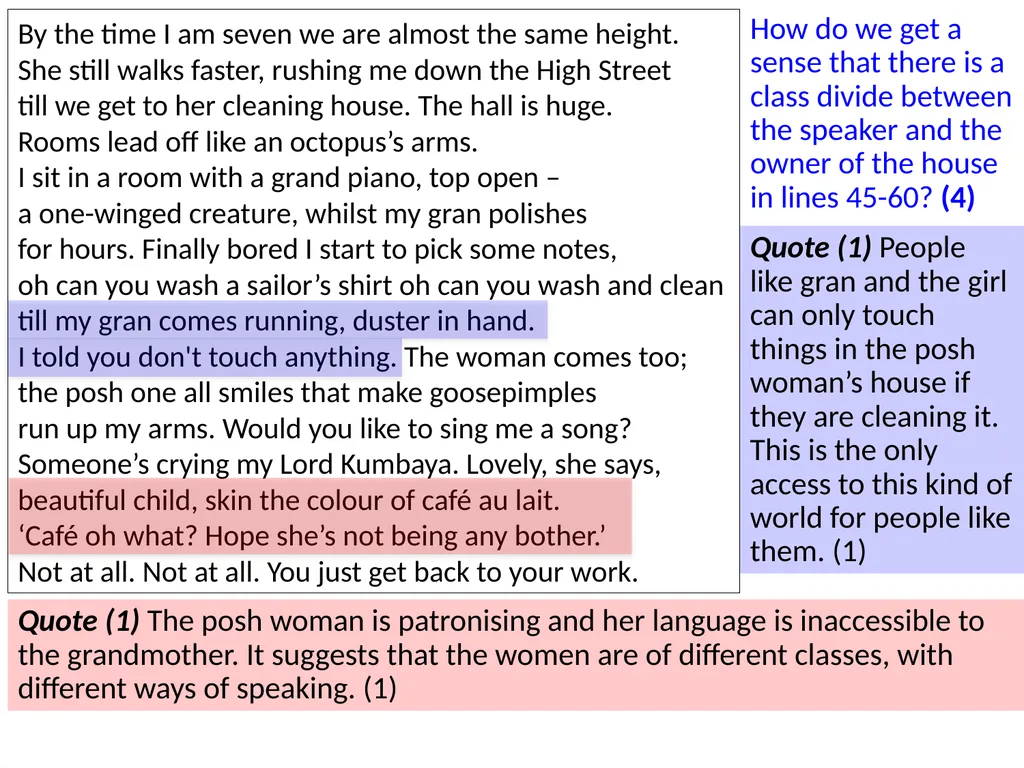
How do we get a sense that there is a class divide between the speaker and the owner of the house in lines 45-60? (4) By the time I am seven we are almost the same height.
She still walks faster, rushing me down the High Street
till we get to her cleaning house. The hall is huge.
Rooms lead off like an octopus’s arms.
I sit in a room with a grand piano, top open –
a one-winged creature, whilst my gran polishes
for hours. Finally bored I start to pick some notes,
oh can you wash a sailor’s shirt oh can you wash and clean
till my gran comes running, duster in hand.
I told you don't touch anything. The woman comes too;
the posh one all smiles that make goosepimples
run up my arms. Would you like to sing me a song?
Someone’s crying my Lord Kumbaya. Lovely, she says,
beautiful child, skin the colour of café au lait.
‘Café oh what? Hope she’s not being any bother.’
Not at all. Not at all. You just get back to your work. Quote (1) People like gran and the girl can only touch things in the posh woman’s house if they are cleaning it. This is the only access to this kind of world for people like them. (1) Quote (1) The posh woman is patronising and her language is inaccessible to the grandmother. It suggests that the women are of different classes, with different ways of speaking. (1)<br>
63
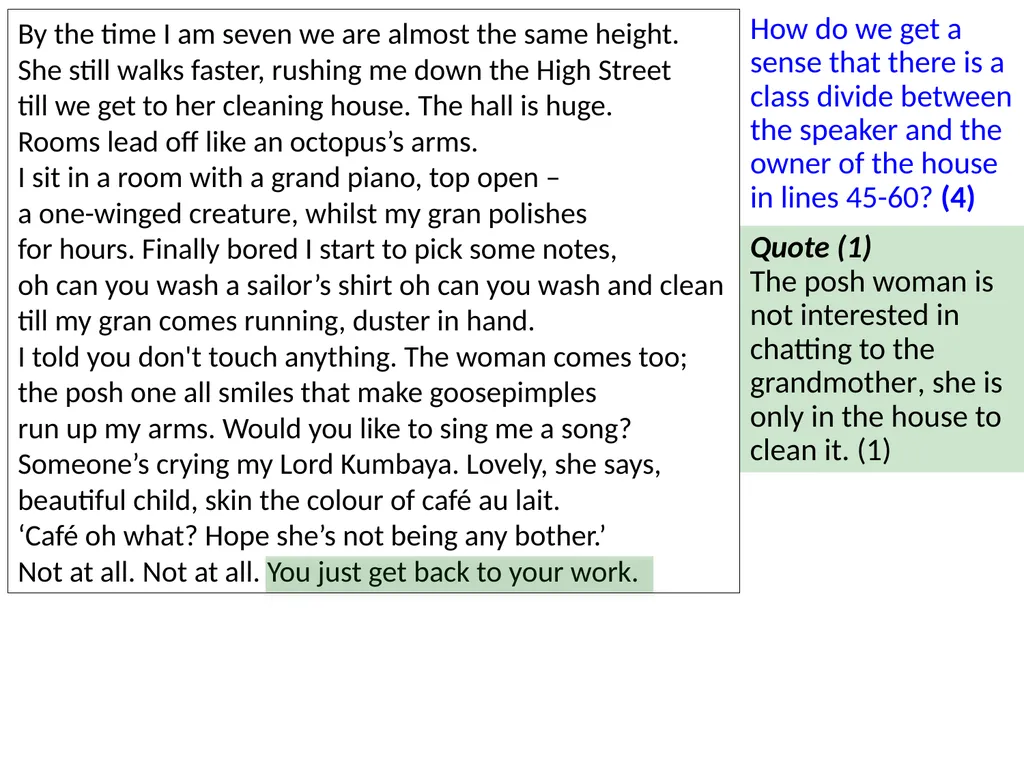
How do we get a sense that there is a class divide between the speaker and the owner of the house in lines 45-60? (4) By the time I am seven we are almost the same height.
She still walks faster, rushing me down the High Street
till we get to her cleaning house. The hall is huge.
Rooms lead off like an octopus’s arms.
I sit in a room with a grand piano, top open –
a one-winged creature, whilst my gran polishes
for hours. Finally bored I start to pick some notes,
oh can you wash a sailor’s shirt oh can you wash and clean
till my gran comes running, duster in hand.
I told you don't touch anything. The woman comes too;
the posh one all smiles that make goosepimples
run up my arms. Would you like to sing me a song?
Someone’s crying my Lord Kumbaya. Lovely, she says,
beautiful child, skin the colour of café au lait.
‘Café oh what? Hope she’s not being any bother.’
Not at all. Not at all. You just get back to your work. Quote (1)
The posh woman is not interested in chatting to the grandmother, she is only in the house to clean it. (1)<br>
64
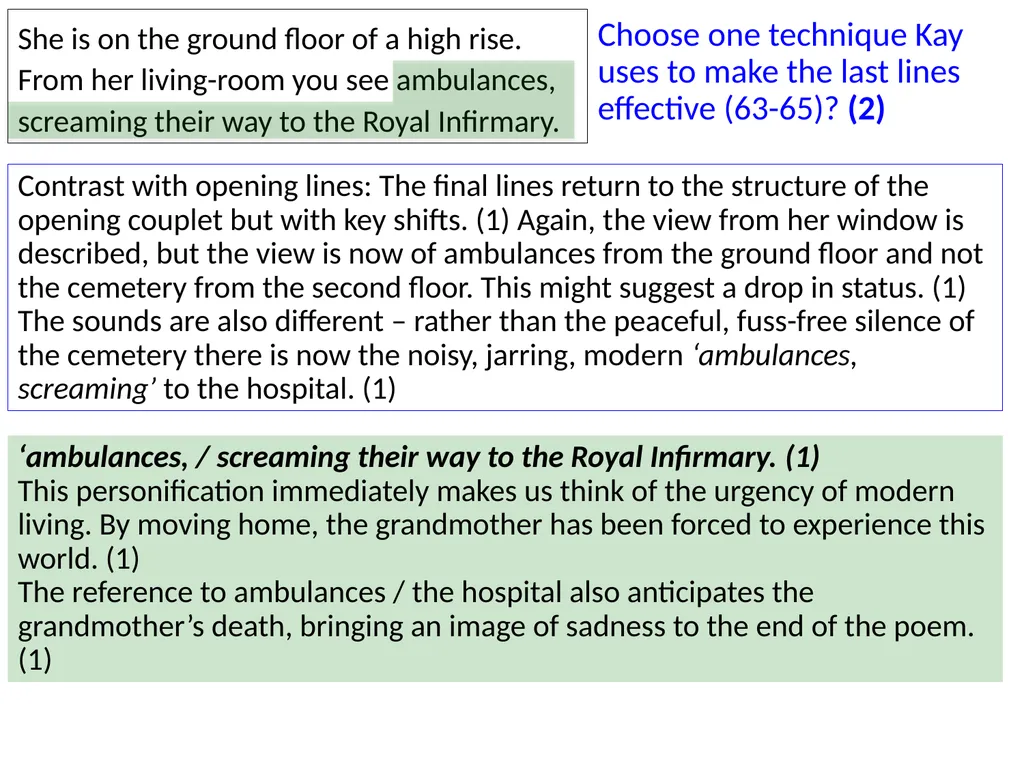
Choose one technique Kay uses to make the last lines effective (63-65)? (2) She is on the ground floor of a high rise.
From her living-room you see ambulances,
screaming their way to the Royal Infirmary. ‘ambulances, / screaming their way to the Royal Infirmary. (1)
This personification immediately makes us think of the urgency of modern living. By moving home, the grandmother has been forced to experience this world. (1)
The reference to ambulances / the hospital also anticipates the grandmother’s death, bringing an image of sadness to the end of the poem. (1) Contrast with opening lines: The final lines return to the structure of the opening couplet but with key shifts. (1) Again, the view from her window is described, but the view is now of ambulances from the ground floor and not the cemetery from the second floor. This might suggest a drop in status. (1) The sounds are also different – rather than the peaceful, fuss-free silence of the cemetery there is now the noisy, jarring, modern ‘ambulances, screaming’ to the hospital. (1)<br>
65
This poem deals with a series of significant moments and memories. Choose at least one other poem that does this and show how Kay makes her poems seem poignant to the reader. (8) What are the key words of the question? Which other poems are based on ‘significant moments and memories’? ‘Gap Year’ Kay is reflecting on her relationship with her son as she waits impatiently for him to come home. ‘Keeping Orchids’ Kay describes her first meeting with her birth mother. What does ‘poignant’ mean? ‘causing or having a very sharp feeling of sadness’ ‘Keeping Orchids’ would be the more appropriate poem to write about.<br>
66
Both ‘My Grandmother’s Houses’ and ‘Keeping Orchids’ deal with significant moments and memories which Kay makes poignant for the reader. MGH describes Kay’s childhood memories of her close relationship with her grandmother and KO describes Kay’s first meeting with her birth mother. ✔C1 ✔C2 One poignant moment in MGH is when Kay describes her grandmother interacting with the ‘posh woman’ in the house which she cleans:
‘Lovely, she says, / beautiful child, skin the colour of café au lait. / ‘Café oh what? Hope she’s not being any bother.’ / Not at all. Not at all. You just get back to your work.’
This clearly shows that the grandmother and ‘posh woman’ come from very different worlds. The grandmother doesn’t even understand the woman’s patronising reference to Kay’s skin colour and the woman directs her to get back to work. The woman is not interested in chatting with her and cleaning is the only contact that people like Kay and her grandmother will have with the posh woman’s world and her expensive, fancy belongings. ✔E1 ✔E2 COMMONALITY EXTRACT<br>
67
Kay describes the orchids which her birth mother gave her at their first meeting:
‘Although / some of the buds remain closed as secrets’
The orchids symbolise the relationship between the two women. Some of them have not opened which is poignant as this connects the flowers to the mother and her reticence about her past. This simile conveys the idea of concealment, mystery, something impenetrable, a truth that’s unknown as her mother refuses to open up emotionally to her daughter. ✔O1 ✔O2 OTHER 1 Another poignant line from KO is when Kay writes:
‘Her voice is fading fast. Even her voice rushes
through a tunnel the other way from home.’
The poet struggles to remember her mother after their meeting, the alliteration in ‘fading fast’ emphasising the loss of connection between the two women. Her mother’s voice ‘rushes through a tunnel’ away from her as she forgets its sound. Kay and her birth mother are moving in opposite directions literally and emotionally. ✔03 ✔04 OTHER 2<br>
68
‘Keeping Orchids’<br>
69
‘Keeping Orchids’
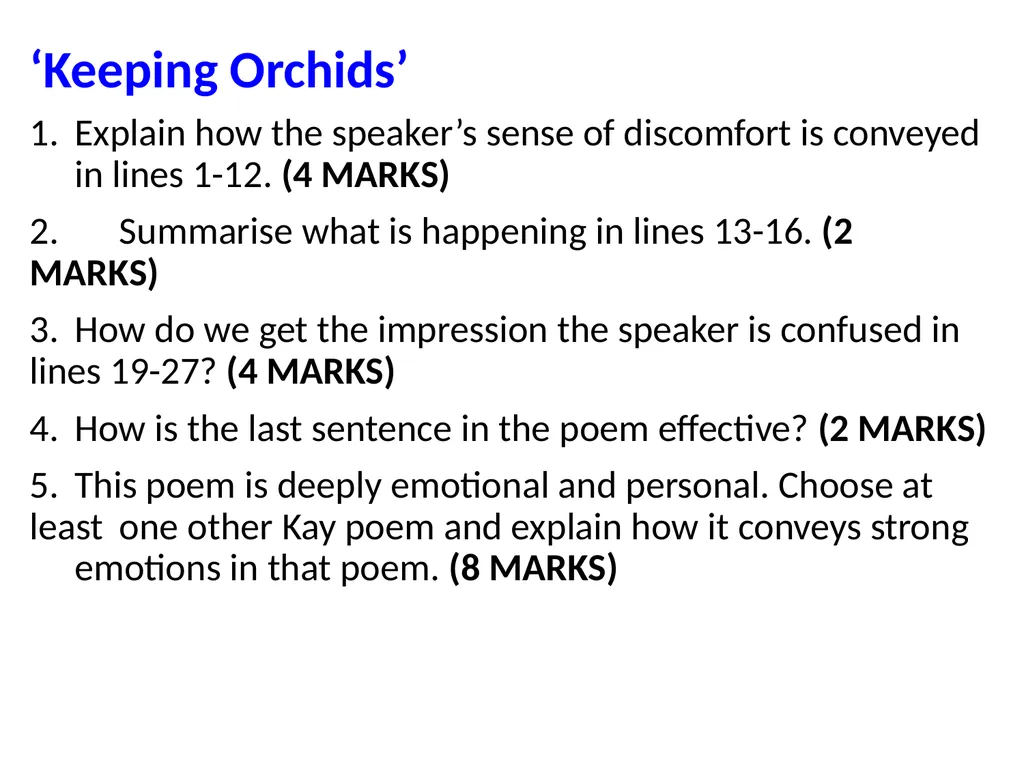
1. Explain how the speaker’s sense of discomfort is conveyed in lines 1-12. (4 MARKS)
2. Summarise what is happening in lines 13-16. (2 MARKS)
3. How do we get the impression the speaker is confused in lines 19-27? (4 MARKS)
4. How is the last sentence in the poem effective? (2 MARKS)
5. This poem is deeply emotional and personal. Choose at least one other Kay poem and explain how it conveys strong emotions in that poem. (8 MARKS)<br>
70
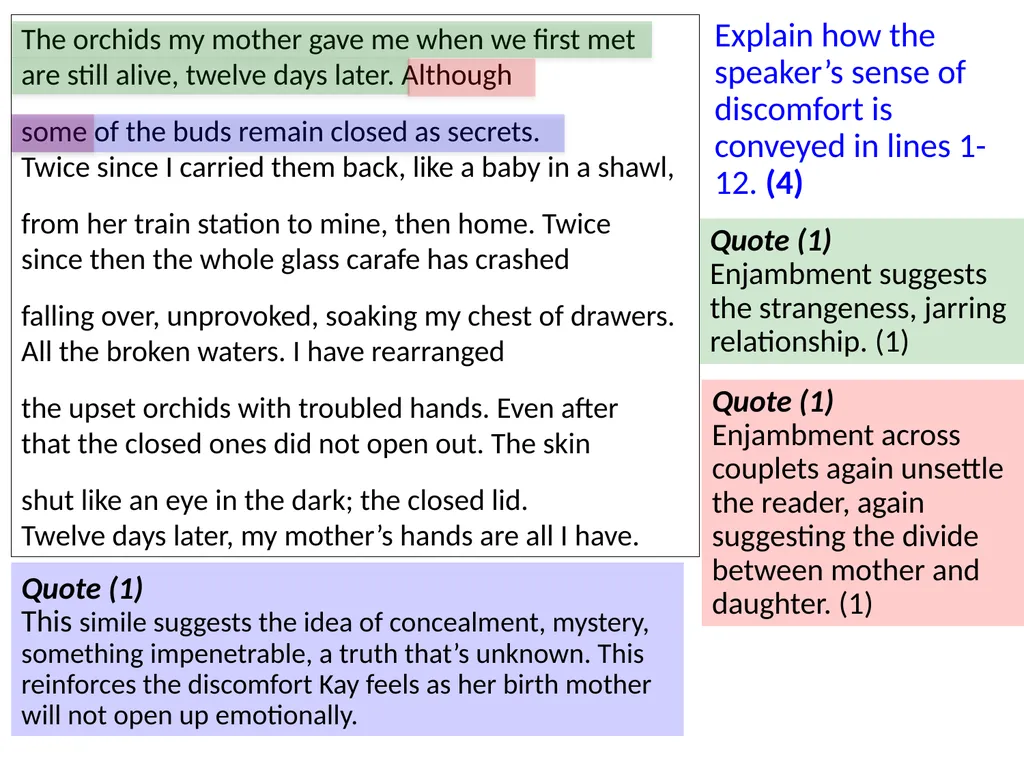
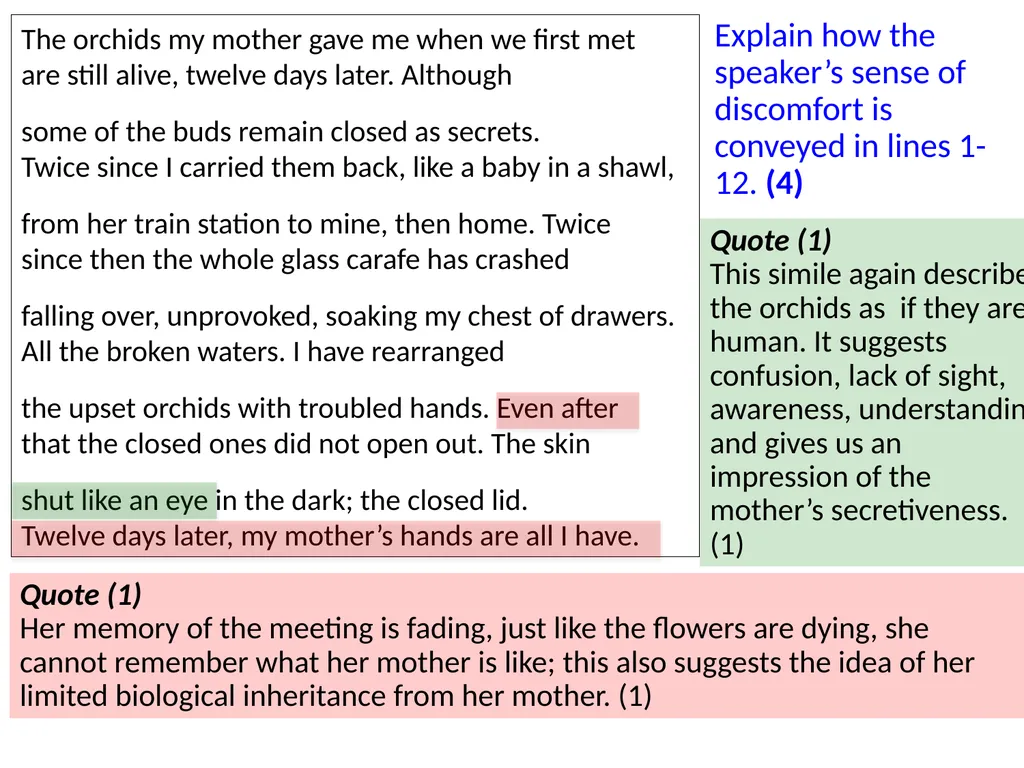
Explain how the speaker’s sense of discomfort is conveyed in lines 1-12. (4) The orchids my mother gave me when we first met
are still alive, twelve days later. Although
some of the buds remain closed as secrets.
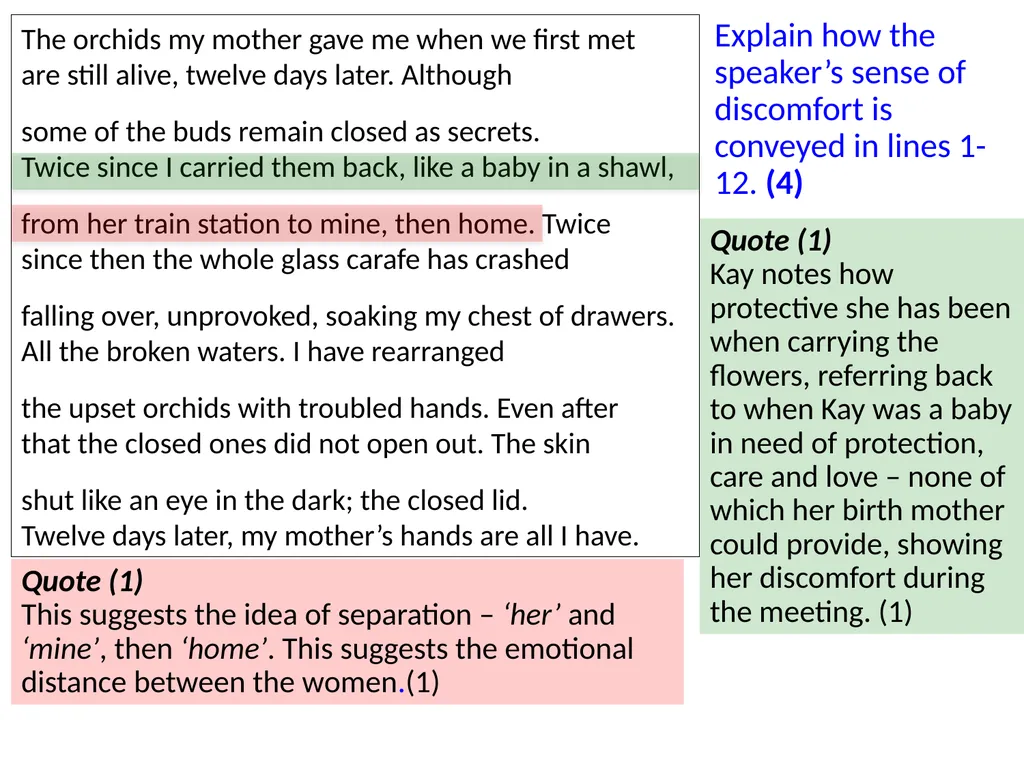
Twice since I carried them back, like a baby in a shawl,
from her train station to mine, then home. Twice
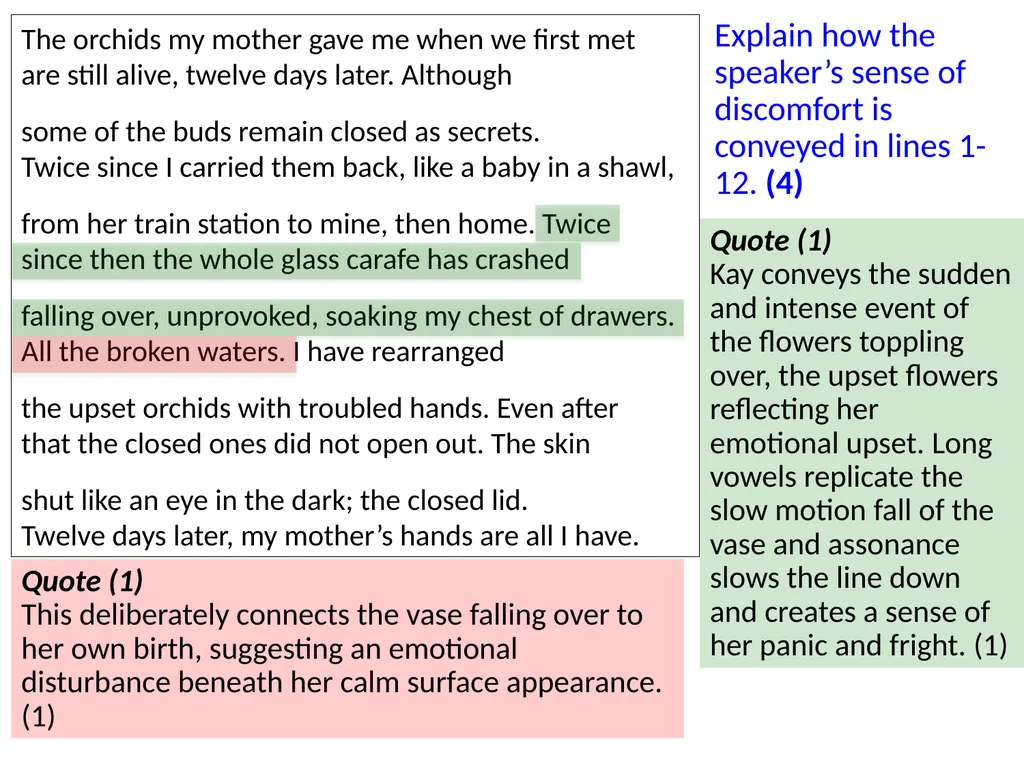
since then the whole glass carafe has crashed
falling over, unprovoked, soaking my chest of drawers.
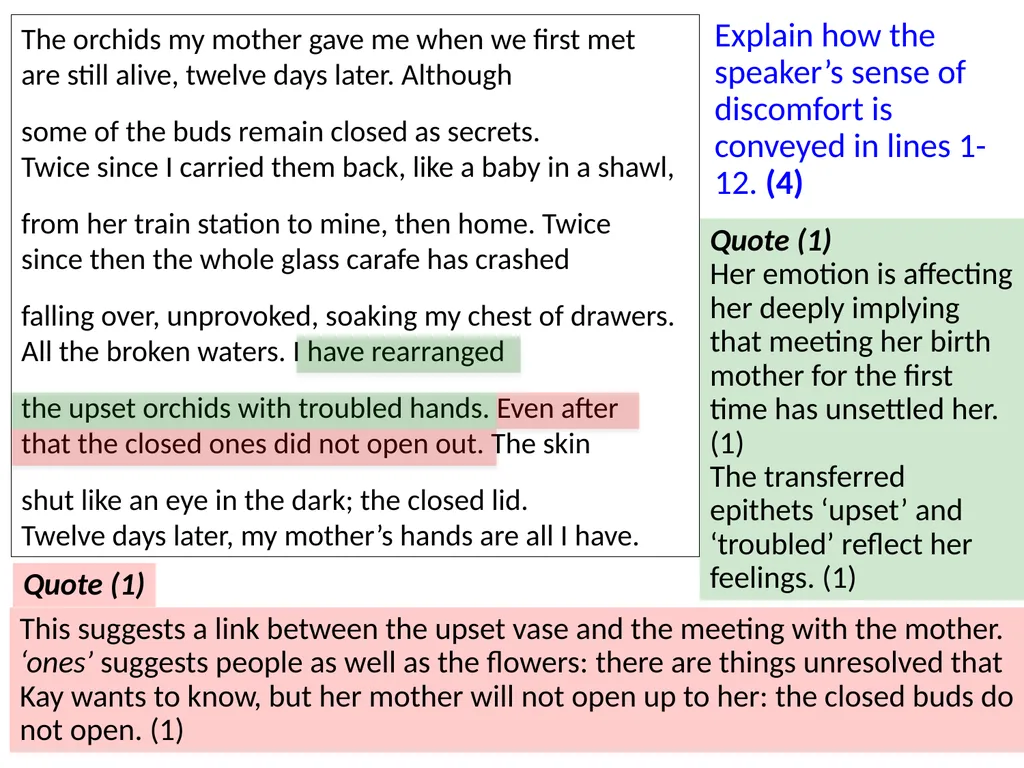
All the broken waters. I have rearranged
the upset orchids with troubled hands. Even after
that the closed ones did not open out. The skin
shut like an eye in the dark; the closed lid.
Twelve days later, my mother’s hands are all I have. Quote (1)
Enjambment suggests the strangeness, jarring relationship. (1) Quote (1)
Enjambment across couplets again unsettle the reader, again suggesting the divide between mother and daughter. (1) Quote (1)
This simile suggests the idea of concealment, mystery, something impenetrable, a truth that’s unknown. This reinforces the discomfort Kay feels as her birth mother will not open up emotionally.<br>
71
Explain how the speaker’s sense of discomfort is conveyed in lines 1-12. (4) The orchids my mother gave me when we first met
are still alive, twelve days later. Although
some of the buds remain closed as secrets.
Twice since I carried them back, like a baby in a shawl,
from her train station to mine, then home. Twice
since then the whole glass carafe has crashed
falling over, unprovoked, soaking my chest of drawers.
All the broken waters. I have rearranged
the upset orchids with troubled hands. Even after
that the closed ones did not open out. The skin
shut like an eye in the dark; the closed lid.
Twelve days later, my mother’s hands are all I have. Quote (1)
Kay notes how protective she has been when carrying the flowers, referring back to when Kay was a baby in need of protection, care and love – none of which her birth mother could provide, showing her discomfort during the meeting. (1) Quote (1)
This suggests the idea of separation – ‘her’ and ‘mine’, then ‘home’. This suggests the emotional distance between the women.(1)<br>
72
Explain how the speaker’s sense of discomfort is conveyed in lines 1-12. (4) The orchids my mother gave me when we first met
are still alive, twelve days later. Although
some of the buds remain closed as secrets.
Twice since I carried them back, like a baby in a shawl,
from her train station to mine, then home. Twice
since then the whole glass carafe has crashed
falling over, unprovoked, soaking my chest of drawers.
All the broken waters. I have rearranged
the upset orchids with troubled hands. Even after
that the closed ones did not open out. The skin
shut like an eye in the dark; the closed lid.
Twelve days later, my mother’s hands are all I have. Quote (1)
Kay conveys the sudden and intense event of the flowers toppling over, the upset flowers reflecting her emotional upset. Long vowels replicate the slow motion fall of the vase and assonance slows the line down and creates a sense of her panic and fright. (1) Quote (1)
This deliberately connects the vase falling over to her own birth, suggesting an emotional disturbance beneath her calm surface appearance. (1)<br>
73
Explain how the speaker’s sense of discomfort is conveyed in lines 1-12. (4) The orchids my mother gave me when we first met
are still alive, twelve days later. Although
some of the buds remain closed as secrets.
Twice since I carried them back, like a baby in a shawl,
from her train station to mine, then home. Twice
since then the whole glass carafe has crashed
falling over, unprovoked, soaking my chest of drawers.
All the broken waters. I have rearranged
the upset orchids with troubled hands. Even after
that the closed ones did not open out. The skin
shut like an eye in the dark; the closed lid.
Twelve days later, my mother’s hands are all I have. Quote (1)
Her emotion is affecting her deeply implying that meeting her birth mother for the first time has unsettled her. (1)
The transferred epithets ‘upset’ and ‘troubled’ reflect her feelings. (1) This suggests a link between the upset vase and the meeting with the mother. ‘ones’ suggests people as well as the flowers: there are things unresolved that Kay wants to know, but her mother will not open up to her: the closed buds do not open. (1) Quote (1)<br>
74
Explain how the speaker’s sense of discomfort is conveyed in lines 1-12. (4) The orchids my mother gave me when we first met
are still alive, twelve days later. Although
some of the buds remain closed as secrets.
Twice since I carried them back, like a baby in a shawl,
from her train station to mine, then home. Twice
since then the whole glass carafe has crashed
falling over, unprovoked, soaking my chest of drawers.
All the broken waters. I have rearranged
the upset orchids with troubled hands. Even after
that the closed ones did not open out. The skin
shut like an eye in the dark; the closed lid.
Twelve days later, my mother’s hands are all I have. Quote (1)
This simile again describes the orchids as if they are human. It suggests confusion, lack of sight, awareness, understanding and gives us an impression of the mother’s secretiveness.
(1) Quote (1)
Her memory of the meeting is fading, just like the flowers are dying, she cannot remember what her mother is like; this also suggests the idea of her limited biological inheritance from her mother. (1)<br>
75
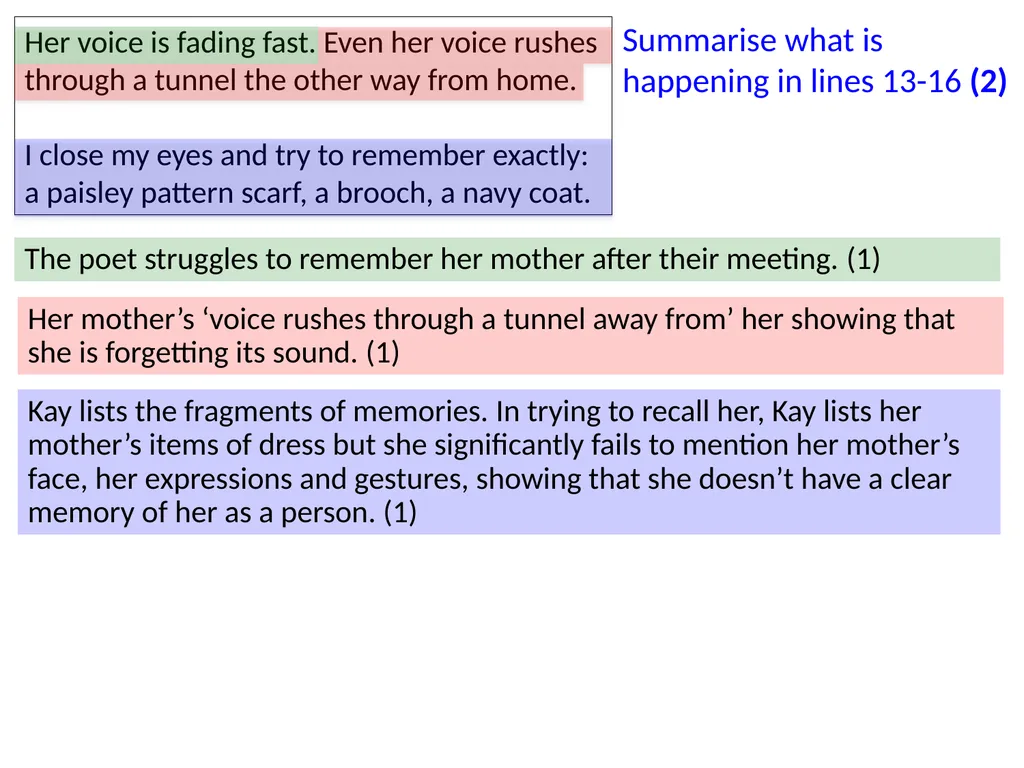
Summarise what is happening in lines 13-16 (2) Her voice is fading fast. Even her voice rushes
through a tunnel the other way from home.
I close my eyes and try to remember exactly:
a paisley pattern scarf, a brooch, a navy coat. The poet struggles to remember her mother after their meeting. (1) Her mother’s ‘voice rushes through a tunnel away from’ her showing that she is forgetting its sound. (1) Kay lists the fragments of memories. In trying to recall her, Kay lists her mother’s items of dress but she significantly fails to mention her mother’s face, her expressions and gestures, showing that she doesn’t have a clear memory of her as a person. (1)<br>
76
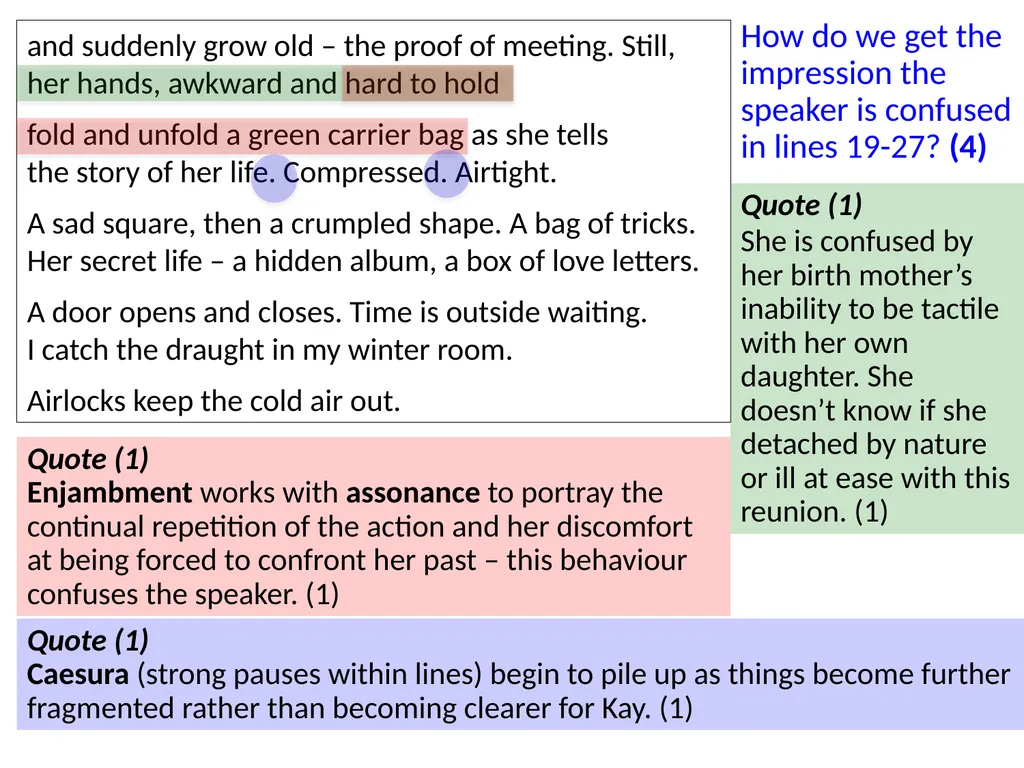
How do we get the impression the speaker is confused in lines 19-27? (4) and suddenly grow old – the proof of meeting. Still,
her hands, awkward and hard to hold
fold and unfold a green carrier bag as she tells
the story of her life. Compressed. Airtight.
A sad square, then a crumpled shape. A bag of tricks.
Her secret life – a hidden album, a box of love letters.
A door opens and closes. Time is outside waiting.
I catch the draught in my winter room.
Airlocks keep the cold air out. Quote (1)
She is confused by her birth mother’s inability to be tactile with her own daughter. She doesn’t know if she detached by nature or ill at ease with this reunion. (1) Quote (1)
Enjambment works with assonance to portray the continual repetition of the action and her discomfort at being forced to confront her past – this behaviour confuses the speaker. (1) Quote (1)
Caesura (strong pauses within lines) begin to pile up as things become further fragmented rather than becoming clearer for Kay. (1)<br>
77
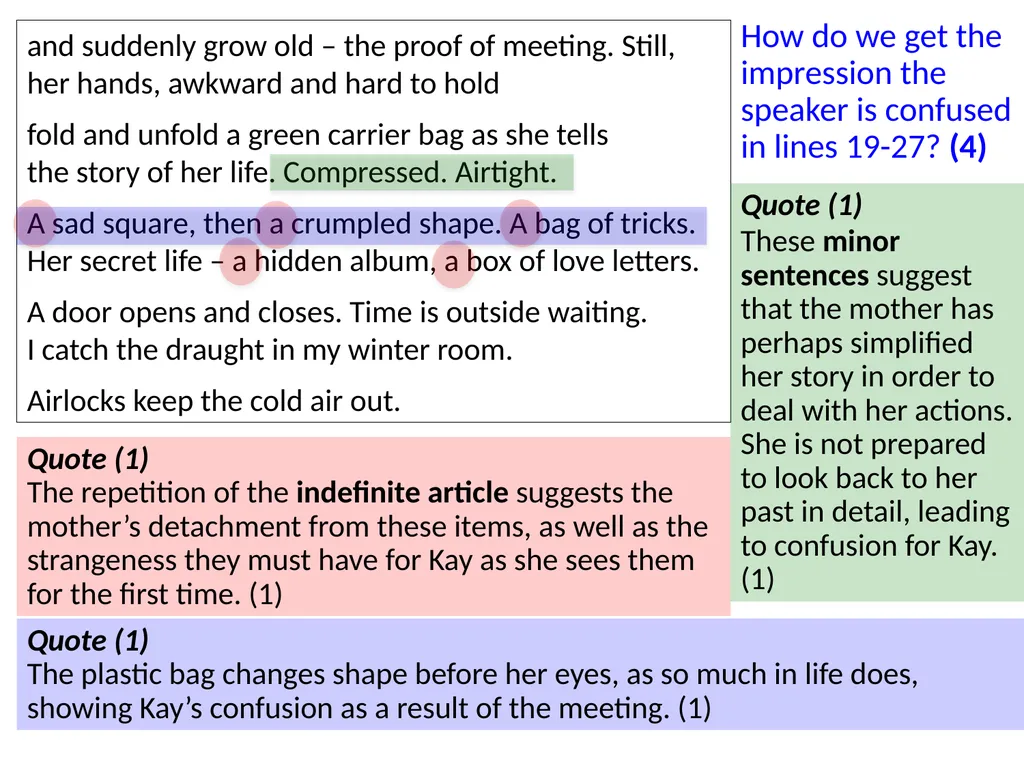
How do we get the impression the speaker is confused in lines 19-27? (4) and suddenly grow old – the proof of meeting. Still,
her hands, awkward and hard to hold
fold and unfold a green carrier bag as she tells
the story of her life. Compressed. Airtight.
A sad square, then a crumpled shape. A bag of tricks.
Her secret life – a hidden album, a box of love letters.
A door opens and closes. Time is outside waiting.
I catch the draught in my winter room.
Airlocks keep the cold air out. Quote (1)
These minor sentences suggest that the mother has perhaps simplified her story in order to deal with her actions. She is not prepared to look back to her past in detail, leading to confusion for Kay. (1) Quote (1)
The repetition of the indefinite article suggests the mother’s detachment from these items, as well as the strangeness they must have for Kay as she sees them for the first time. (1) Quote (1)
The plastic bag changes shape before her eyes, as so much in life does, showing Kay’s confusion as a result of the meeting. (1)<br>
78
How do we get the impression the speaker is confused in lines 19-27? (4) and suddenly grow old – the proof of meeting. Still,
her hands, awkward and hard to hold
fold and unfold a green carrier bag as she tells
the story of her life. Compressed. Airtight.
A sad square, then a crumpled shape. A bag of tricks.
Her secret life – a hidden album, a box of love letters.
A door opens and closes. Time is outside waiting.
I catch the draught in my winter room.
Airlocks keep the cold air out. Quote (1)
Personification - This sentence conveys the idea that time itself is suspended. The poet has come away from her everyday life to meet her mother but now must return to her normal life. It seems nothing will change in her life as a result of the meeting, leaving her confused. (1) Quote (1)
Kay’s confusion is shown here – it is not clear whether these are Kay’s defences or her mother’s. (1)<br>
79
How is the last sentence in the poem effective? (2) So does cutting the stems with a sharp knife. The final sentence refers back to the orchids: cutting the stems will prolong the life of flowers (1)
It could suggest the mother’s decision to cut ties with her daughter and put her child up for adoption, as she felt it was the best life for her. (1)
It could also suggest the cutting of the umbilical cord after birth. It implies that this relationship was cut off in its infancy. (1)<br>
80
This poem is deeply emotional and personal. Choose at least one other Kay poem and explain how it conveys strong emotions in that poem. (8) Which other poems convey strong emotions? Lucozade
Divorce
Bed
Gap Year
My Grandmother’s Houses<br>
81
This poem is deeply emotional and personal. Choose at least one other Kay poem and explain how it conveys strong emotions in that poem. (8) Summary – how to answer the 8 mark question
1. Commonality: refer to another poem or poems and say what it has / they have in common / in contrast with the given poem. (2)
2. Extract: refer to the extract / poem you have been given in relation to the question. (2)
3. Other 1: refer to a second poem / extract in relation to the question. (2)
Other 2: repeat stage 3 for the second or a third poem. (2)<br>