Janis A. Bulgren, Ph.D. 2023 Higher Order Thinking

Published  . 0 views
↓ Download
Janis A. Bulgren, Ph.D. 2023 Higher Order Thinking
1 / 1
Janis A. Bulgren, Ph.D. 2023 Higher Order Thinking - slide 1 of 24 Janis A. Bulgren, Ph.D. 2023 Higher Order Thinking - slide 2 of 24 Janis A. Bulgren, Ph.D. 2023 Higher Order Thinking - slide 3 of 24 Janis A. Bulgren, Ph.D. 2023 Higher Order Thinking - slide 4 of 24 Janis A. Bulgren, Ph.D. 2023 Higher Order Thinking - slide 5 of 24 Janis A. Bulgren, Ph.D. 2023 Higher Order Thinking - slide 6 of 24 Janis A. Bulgren, Ph.D. 2023 Higher Order Thinking - slide 7 of 24 Janis A. Bulgren, Ph.D. 2023 Higher Order Thinking - slide 8 of 24 Janis A. Bulgren, Ph.D. 2023 Higher Order Thinking - slide 9 of 24 Janis A. Bulgren, Ph.D. 2023 Higher Order Thinking - slide 10 of 24 Janis A. Bulgren, Ph.D. 2023 Higher Order Thinking - slide 11 of 24 Janis A. Bulgren, Ph.D. 2023 Higher Order Thinking - slide 12 of 24 Janis A. Bulgren, Ph.D. 2023 Higher Order Thinking - slide 13 of 24 Janis A. Bulgren, Ph.D. 2023 Higher Order Thinking - slide 14 of 24 Janis A. Bulgren, Ph.D. 2023 Higher Order Thinking - slide 15 of 24 Janis A. Bulgren, Ph.D. 2023 Higher Order Thinking - slide 16 of 24 Janis A. Bulgren, Ph.D. 2023 Higher Order Thinking - slide 17 of 24 Janis A. Bulgren, Ph.D. 2023 Higher Order Thinking - slide 18 of 24 Janis A. Bulgren, Ph.D. 2023 Higher Order Thinking - slide 19 of 24 Janis A. Bulgren, Ph.D. 2023 Higher Order Thinking - slide 20 of 24 Janis A. Bulgren, Ph.D. 2023 Higher Order Thinking - slide 21 of 24 Janis A. Bulgren, Ph.D. 2023 Higher Order Thinking - slide 22 of 24 Janis A. Bulgren, Ph.D. 2023 Higher Order Thinking - slide 23 of 24 Janis A. Bulgren, Ph.D. 2023 Higher Order Thinking - slide 24 of 24
Description: Janis A. Bulgren, Ph.D. 2023 Higher Order Thinking and Reasoning (HOTR) Content Enhancement Routines University of Kansas Center for Research on Learning Professional Development Materials: Higher Order Thinking and Reasoning routines

Related Topics

Download Presentation

"Janis A. Bulgren, Ph.D. 2023 Higher Order Thinking" is the property of its rightful owner. Permission is granted to download and print the materials on this website for personal, non-commercial use only, and to display it on your personal computer provided you do not modify the materials and that you retain all copyright notices contained in the materials. By downloading content from our website, you accept the terms of this agreement.

Presentation Transcript

slide1. Janis A. Bulgren, Ph.D. 2023 Higher Order
Thinking and Reasoning (HOTR)

Content Enhancement Routines

University of Kansas Center for Research on Learning<br>
slide2. Professional Development Materials: Higher Order Thinking and Reasoning routines (HOTR) 3 A1 HOTR: Introduction to Higher Order Thinking and Reasoning (HOTR) Routines
A2 HOTR: Alignment of HOTR routines with reasoning standards across content standards
A3 HOTR: Similarities across HOTR routines to facilitate teaching and learning

B1 CCAR: Introduction to the Cross Curricular Argumentation Routine (CCAR)
B2 CCAR: Alignment of CCAR with standards across content areas
B3 CCAR: Expanding Learning with the CCAR Routine

C1 Demystifying Reasoning and Deconstructing Complex Questions
C2 Building Bridges from other Content Enhancement Routines (CERs) to HOTR routines
C3 Scaffolds for gradual introduction of complex HOTR routines

© Janis Bulgren 2023<br>
slide3. HOTR Slide Set C2

Building Bridges from other
Content Enhancement Routines (CERs)
to HOTR routines © Janis Bulgren 2023<br>
slide4. What are Instructional Scaffolds for Higher-Order Thinking & Reasoning? Scaffolded Instruction is a process by which a teacher adds supports for students as they learn new tasks as in “building bridges.”

Teachers gradually build understanding, skills and reasoning processes.

Supports are gradually removed as students progress with learning.

© Janis Bulgren 2023 5<br>
slide5. DISCUSSION Are the dozens of Content Enhancement Routines (CERs) often taught in limited numbers? And one at a time? Why?

Could some Content Enhancements be taught in clusters that support each other to streamline PD and instruction? Which ones can you think of? 6 © Janis Bulgren 2023<br>
slide6. “Building Bridges” When teachers have introduced other Content Enhancement Routines (CERs), they have also been used to showing students how to move into or “bridge” into Higher Order Thinking and Reasoning. Unit Organizer: Planning Cluster Framing: Topics & Details Cluster Concept Mastery: Concept Cluster 7 © Janis Bulgren 2023<br>
slide7. Examples of “Building Bridges” Using a Unit Organizer on Ecosystems to facilitate bridging into
Highlighting Critical Questions
Identifying Types of Reasoning 8 © Janis Bulgren 2023<br>
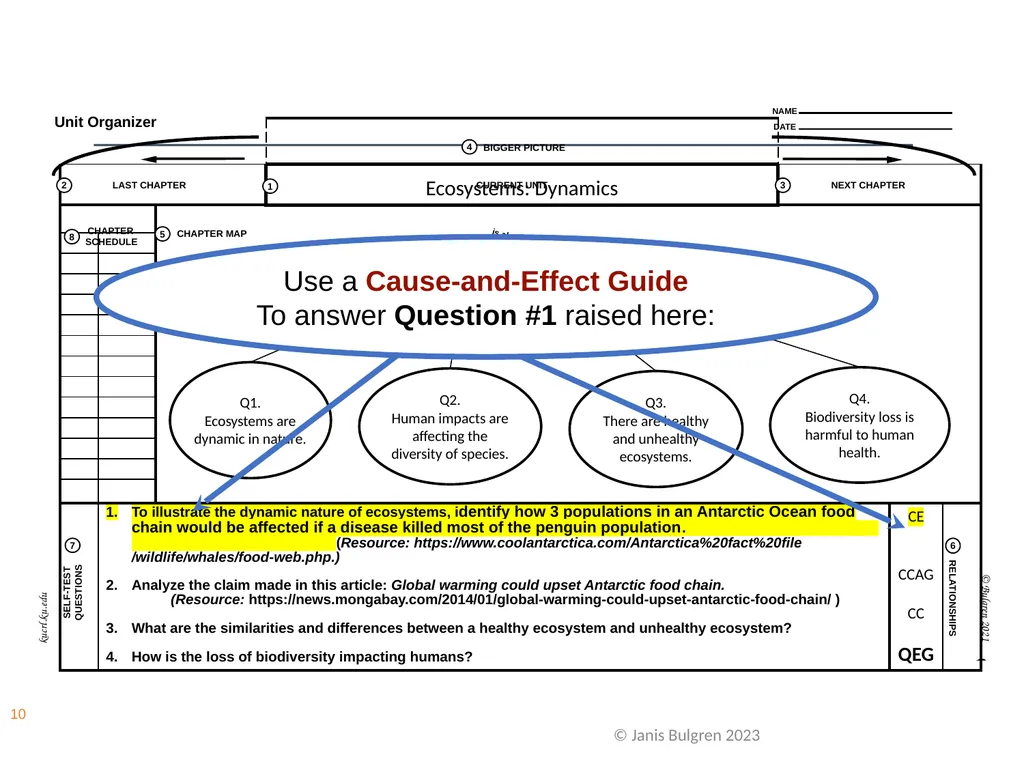
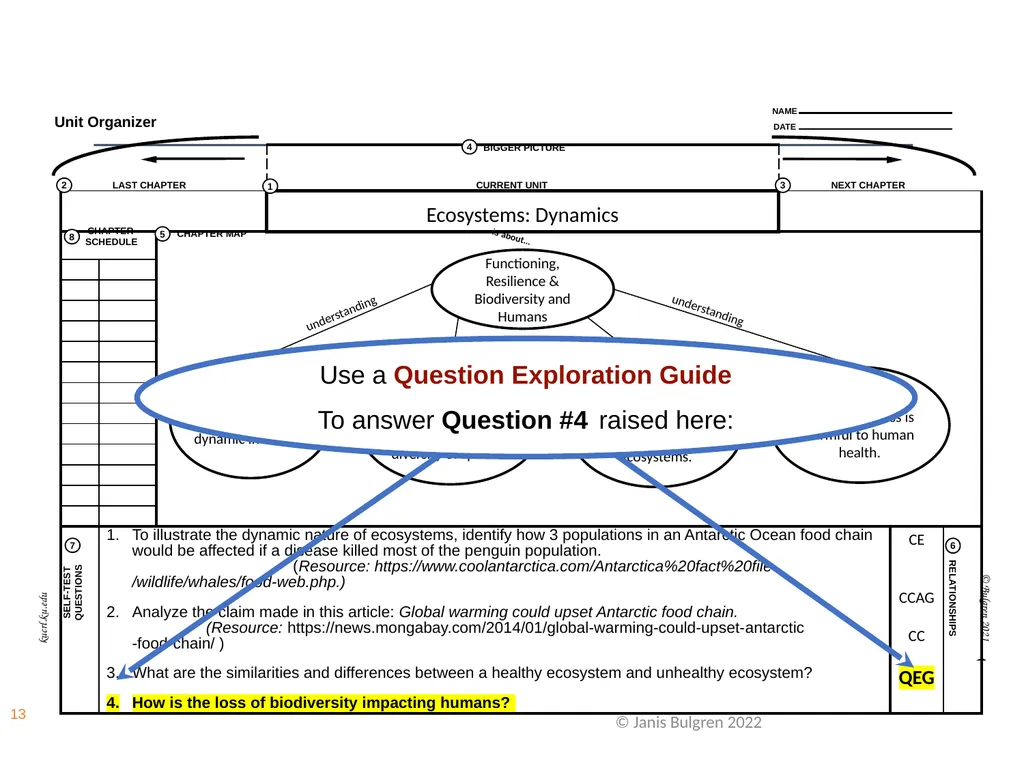
slide8. Using a Unit Organizer to facilitate bridging Highlight the Critical Questions from Section 7. Engage students in paraphrasing the questions. Guide students to focus on reasoning associated with comparisons, questions and answers, causes and effects, decisions to be made, or statements of a claim (argument).
Identify Types of Reasoning from Section 6. Return to students’ paraphrase of the question. Guide students to transfer the type of reasoning identified in the question to Section 6 using the abbreviations of the associated HOTR routine (CC, CE, QEG, DM, CCAR, SAG) in Section 6. 9 © Janis Bulgren 2023<br>
slide9. Unit Organizer kucrl.ku.edu © Bulgren 2021 Functioning, Resilience & Biodiversity and Humans is about... Q4.
Biodiversity loss is harmful to human health. understanding Q1.
Ecosystems are dynamic in nature. Q2.
Human impacts are affecting the diversity of species. understanding understanding Q3.
There are healthy and unhealthy ecosystems. understanding 10 © Janis Bulgren 2023<br>
slide10. Unit Organizer kucrl.ku.edu © Bulgren 2021 Functioning, Resilience & Biodiversity and Humans is about... Q4.
Biodiversity loss is harmful to human health. understanding Q1.
Ecosystems are dynamic in nature. Q2.
Human impacts are affecting the diversity of species. understanding understanding Q3.
There are healthy and unhealthy ecosystems. understanding 11 © Janis Bulgren 2023 Use a Cause-and-Effect Guide
To answer Question #1 raised here:<br>
slide11. Unit Organizer kucrl.ku.edu © Bulgren 2021 Functioning, Resilience & Biodiversity and Humans is about... Q4.
Biodiversity loss is harmful to human health. understanding Q1.
Ecosystems are dynamic in nature. Q2.
Human impacts are affecting the diversity of species. understanding understanding Q3.
There are healthy and unhealthy ecosystems. understanding Use a Cross Curricular Argumentation Guide
To analyze the CLAIM raised here in Question #2: 12 © Janis Bulgren 2023©<br>
slide12. Unit Organizer kucrl.ku.edu © Bulgren 2021 Functioning, Resilience & Biodiversity and Humans is about... Q4.
Biodiversity loss is harmful to human health. understanding Q1.
Ecosystems are dynamic in nature. Q2.
Human impacts are affecting the diversity of species. understanding understanding Q3.
There are healthy and unhealthy ecosystems. understanding 13 © Janis Bulgren 2023 Use a Concept Comparison Table
To answer Question #3:<br>
slide13. Unit Organizer kucrl.ku.edu © Bulgren 2021 Functioning, Resilience & Biodiversity and Humans is about... Q4.
Biodiversity loss is harmful to human health. understanding Q1.
Ecosystems are dynamic in nature. Q2.
Human impacts are affecting the diversity of species. understanding understanding Q3.
There are healthy and unhealthy ecosystems. understanding 14 © Janis Bulgren 2022 Use a Question Exploration Guide
To answer Question #4 raised here:<br>
slide14. Examples of “Building Bridges” Using a FRAME to facilitate bridging:

Focus on the Main Idea.
Focus on the Essential Details.
Focus on the So What?
Focus on the What’s important? © Janis Bulgren 2022<br>
slide15. © Janis Bulgren 2022 Use the
Cause-and-Effect Routine
to analyze causes and effects
of the Key Topic or
Main Idea section<br>
slide16. © Janis Bulgren 2022 Use the
Concept Comparison Routine
to fully explore
similarities and differences
among Essential Details.<br>
slide17. © Janis Bulgren 2022 Use the
Question Exploration Routine to extend learning and synthesize the So What? answer
in the concluding statement.<br>
slide18. © Janis Bulgren 2022 Use the
Cross-Curricular Argumentation
or Decision-Making Routine
to assess the strength of the What’s Important?
concluding statement.<br>
slide19. Example of “Building Bridges”
using CONCEPT MASTERY 20 Focus on explaining main ideas
Focus on causes or effects
Focus on a claim made in a concluding statement or summary
Focus on the examples and non-examples © Janis Bulgren 2022<br>
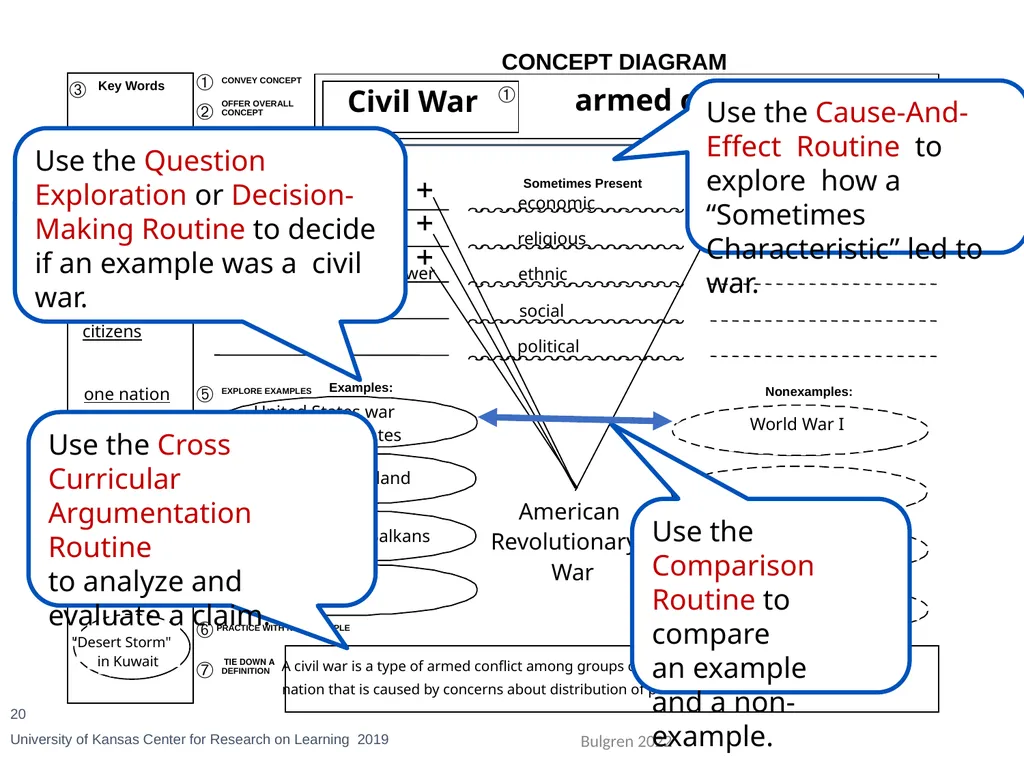
slide20. 21 University of Kansas Center for Research on Learning 2019 Bulgren 2022 Use the Comparison
Routine to compare
an example
and a non-example. Use the Cross Curricular
Argumentation Routine
to analyze and evaluate a claim. Use the Cause-And-Effect Routine to explore how a “Sometimes
Characteristic” led to war. Use the Question Exploration or Decision-Making Routine to decide if an example was a civil war.<br>

slide21. 22 University of Kansas Center for Research on Learning 2019 © Janis Bulgren 2022 1. Identify a war that was started because of a “sometimes” characteristic such as religion or economics.

2. Then explain those causes and the effects of that war using the Cause-and-Effect Routine.<br>
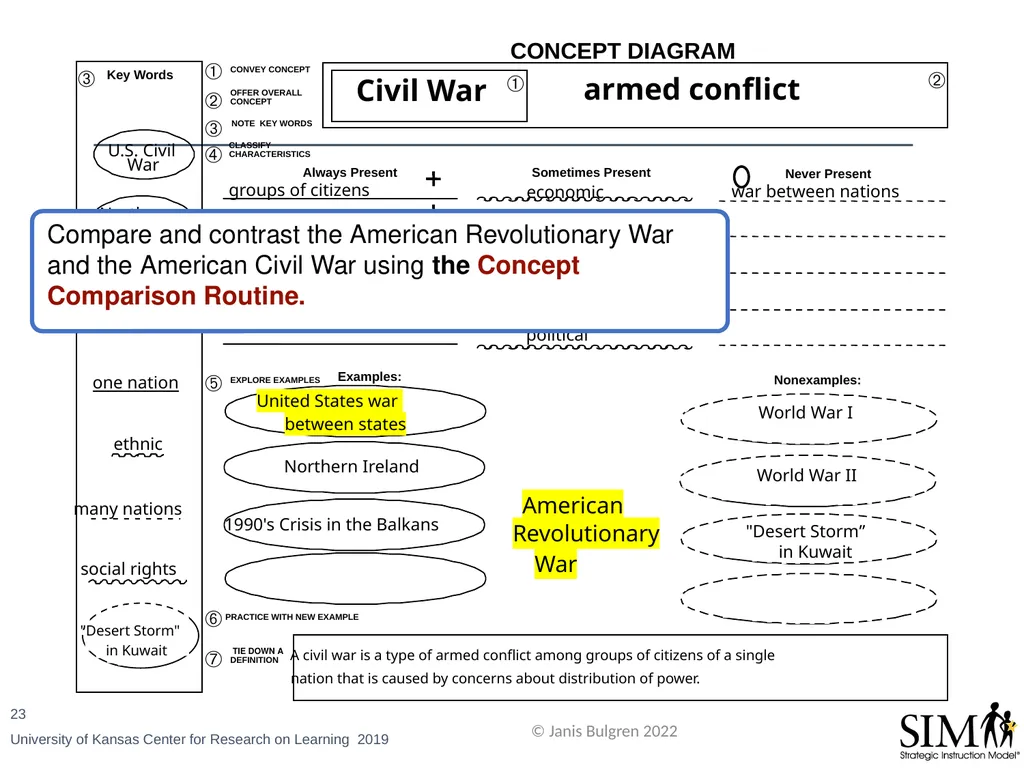
slide22. 23 University of Kansas Center for Research on Learning 2019 © Janis Bulgren 2022 Analyze, Judge, and Make a Decision to accept or reject the claim that:
“The American Revolutionary War was(or was not) a Civil War.” using the Cross Curricular Argumentation Routine<br>
slide23. 24 University of Kansas Center for Research on Learning 2019 © Janis Bulgren 2022<br>
slide24. 25 DISCUSSION

What other Content Enhancement Routines could be used to “build bridges” to HOTRs? How?
What Learning Strategies could support higher order thinking and reasoning? © Janis Bulgren 2022<br>