
Java & Testing Things to have been doing Join UIUC
Description: Java Testing Things to have been doing Join UIUC CS 126 on Piazza Get an iClicker registered Get a GitHub account Install IntelliJ on your laptop (students can get the Ultimate version for free) Review course Policies:
Related Topics
Download Presentation
"Java & Testing Things to have been doing Join UIUC" is the property of its rightful owner. Permission is granted to download and print the materials on this website for personal, non-commercial use only, and to display it on your personal computer provided you do not modify the materials and that you retain all copyright notices contained in the materials. By downloading content from our website, you accept the terms of this agreement.
Presentation Transcript
slide1. Java & Testing<br>
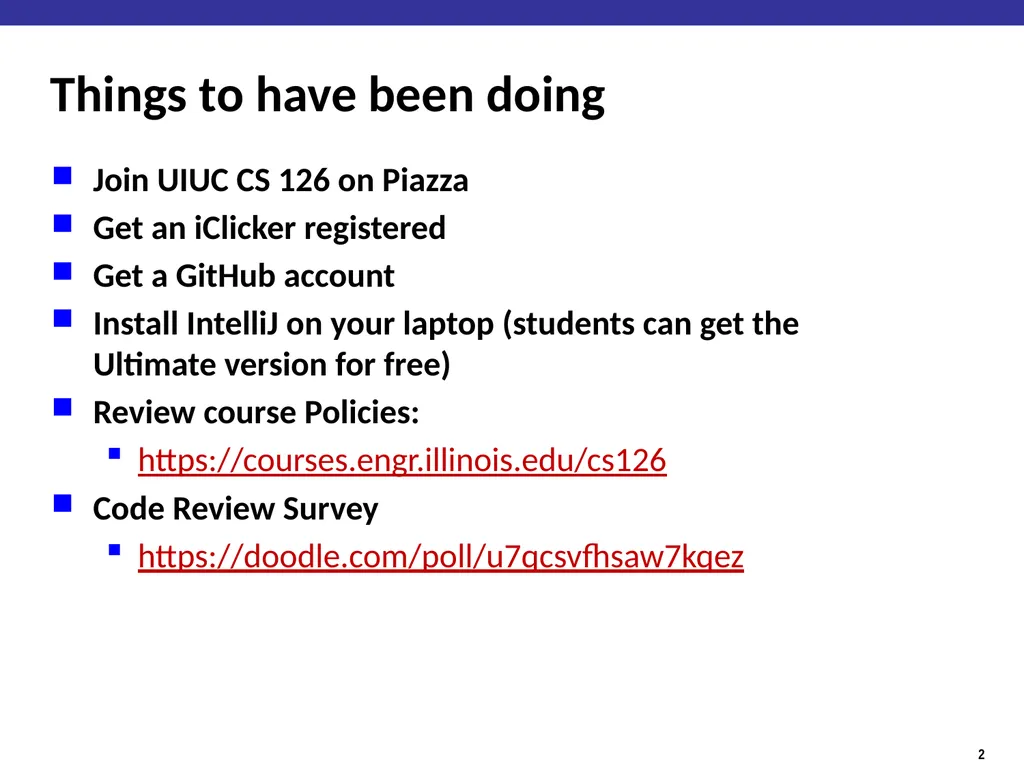
slide2. Things to have been doing Join UIUC CS 126 on Piazza
Get an iClicker registered
Get a GitHub account
Install IntelliJ on your laptop (students can get the Ultimate version for free)
Review course Policies:
https://courses.engr.illinois.edu/cs126
Code Review Survey
https://doodle.com/poll/u7qcsvfhsaw7kqez<br>
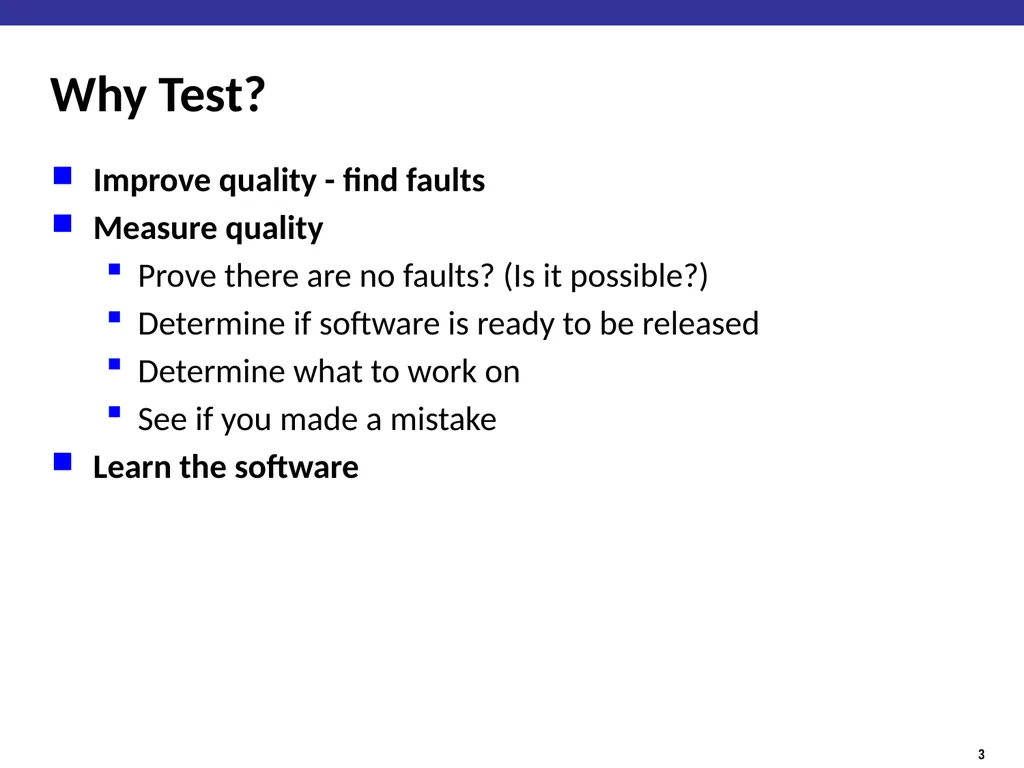
slide3. Why Test? Improve quality - find faults
Measure quality
Prove there are no faults? (Is it possible?)
Determine if software is ready to be released
Determine what to work on
See if you made a mistake
Learn the software<br>
slide4. Testing vs. Debugging Testing is detecting errors
Debugging is a means of diagnosing and correcting the root causes of errors that have already been detected.<br>
slide5. Types of testing Unit Testing
Component Testing
Integration Testing
Regression Testing
System Testing<br>
slide6. Types of testing Unit Testing
The execution of a complete class, routine, or small program that has been written by a single programmer or team of programmers, which is tested in isolation from the more complete system.
Component Testing
Integration Testing
Regression Testing
System Testing<br>
slide7. Two Approaches to Testing Black box testing:
White box testing:<br>
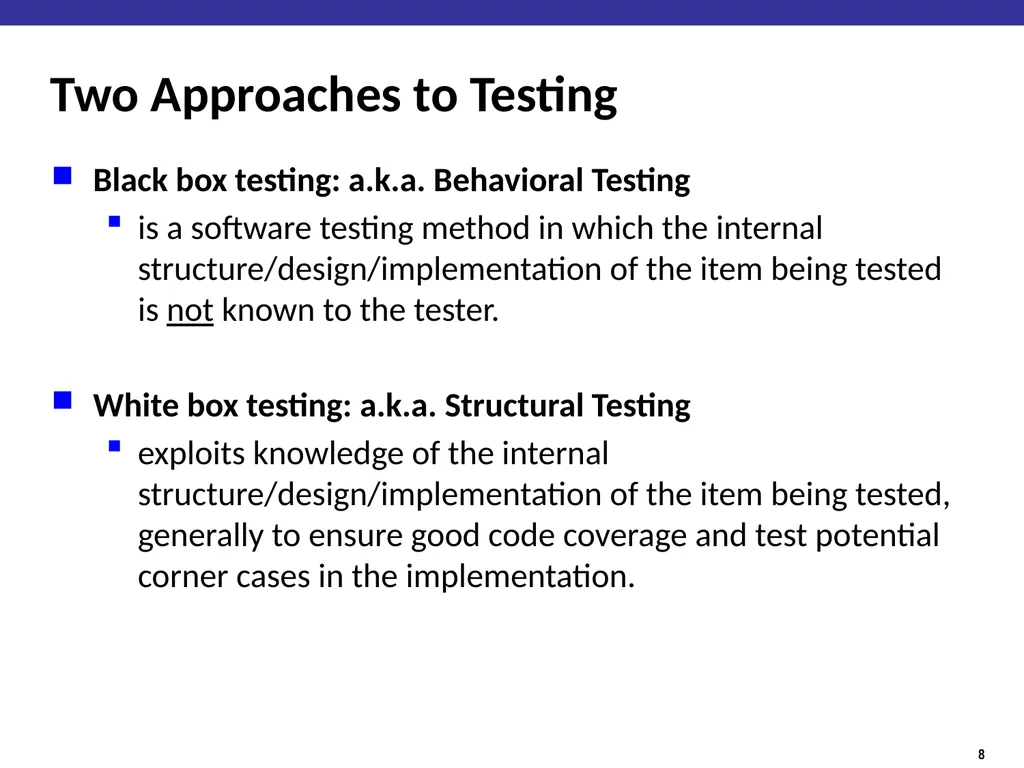
slide8. Two Approaches to Testing Black box testing: a.k.a. Behavioral Testing
is a software testing method in which the internal structure/design/implementation of the item being tested is not known to the tester.
White box testing: a.k.a. Structural Testing
exploits knowledge of the internal structure/design/implementation of the item being tested, generally to ensure good code coverage and test potential corner cases in the implementation.<br>
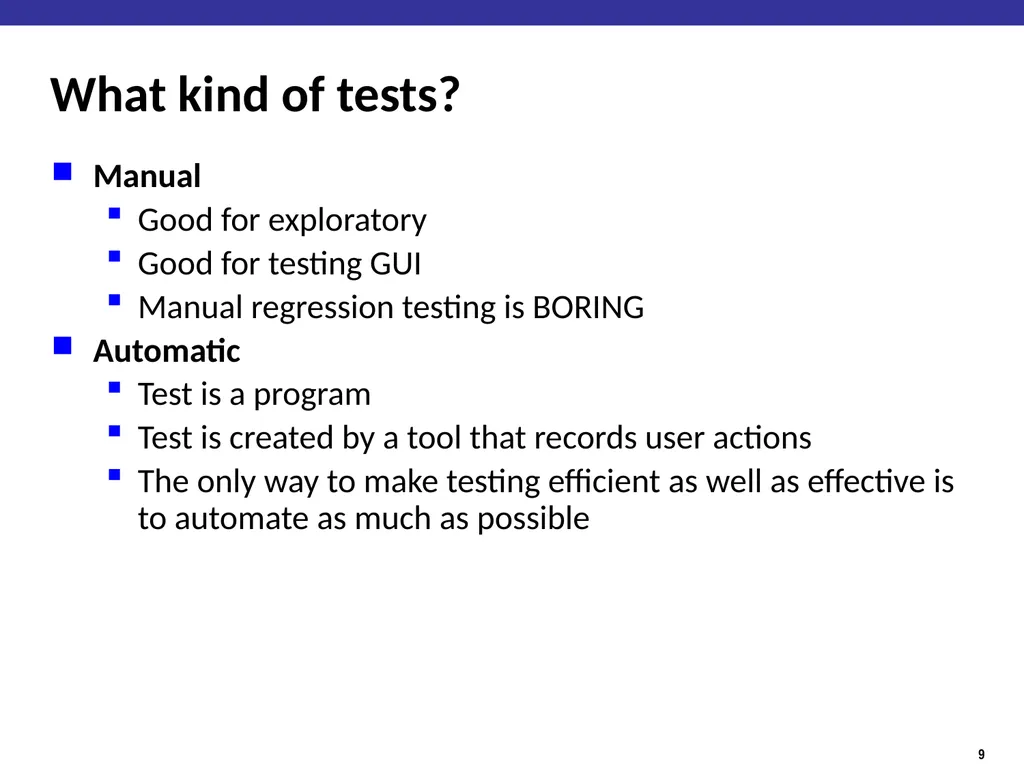
slide9. What kind of tests? Manual
Good for exploratory
Good for testing GUI
Manual regression testing is BORING
Automatic
Test is a program
Test is created by a tool that records user actions
The only way to make testing efficient as well as effective is to automate as much as possible<br>
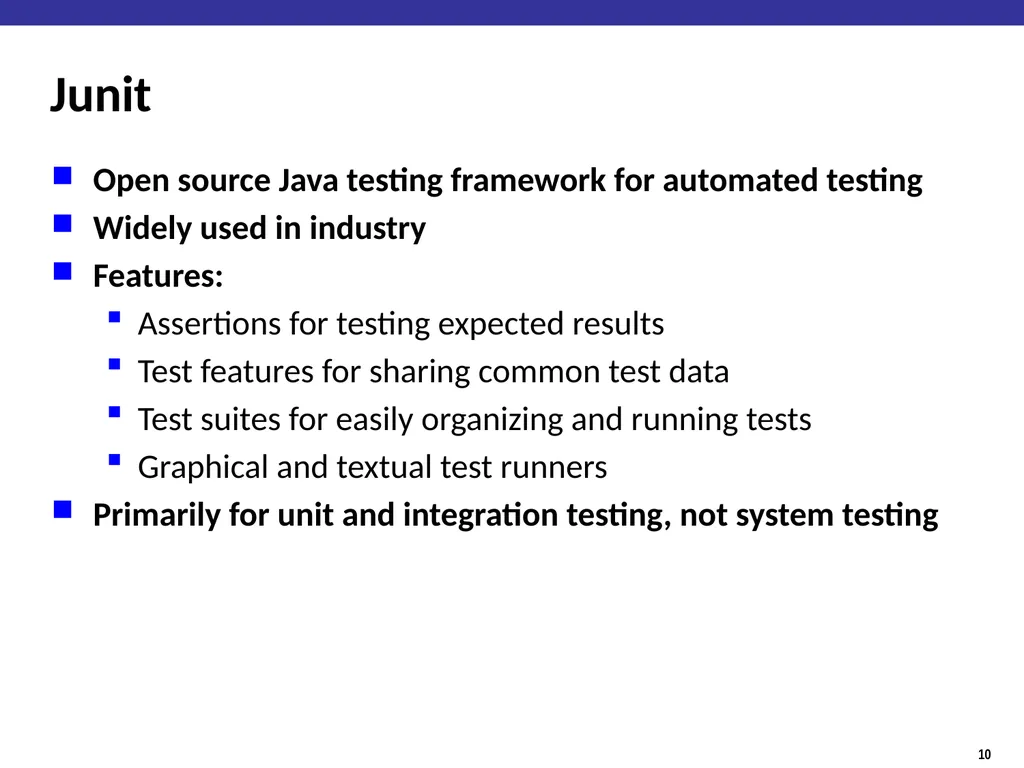
slide10. Junit Open source Java testing framework for automated testing
Widely used in industry
Features:
Assertions for testing expected results
Test features for sharing common test data
Test suites for easily organizing and running tests
Graphical and textual test runners
Primarily for unit and integration testing, not system testing<br>
slide11. Definitions Which kind of testing is “specification testing”
A) Black box testing
B) White box testing<br>
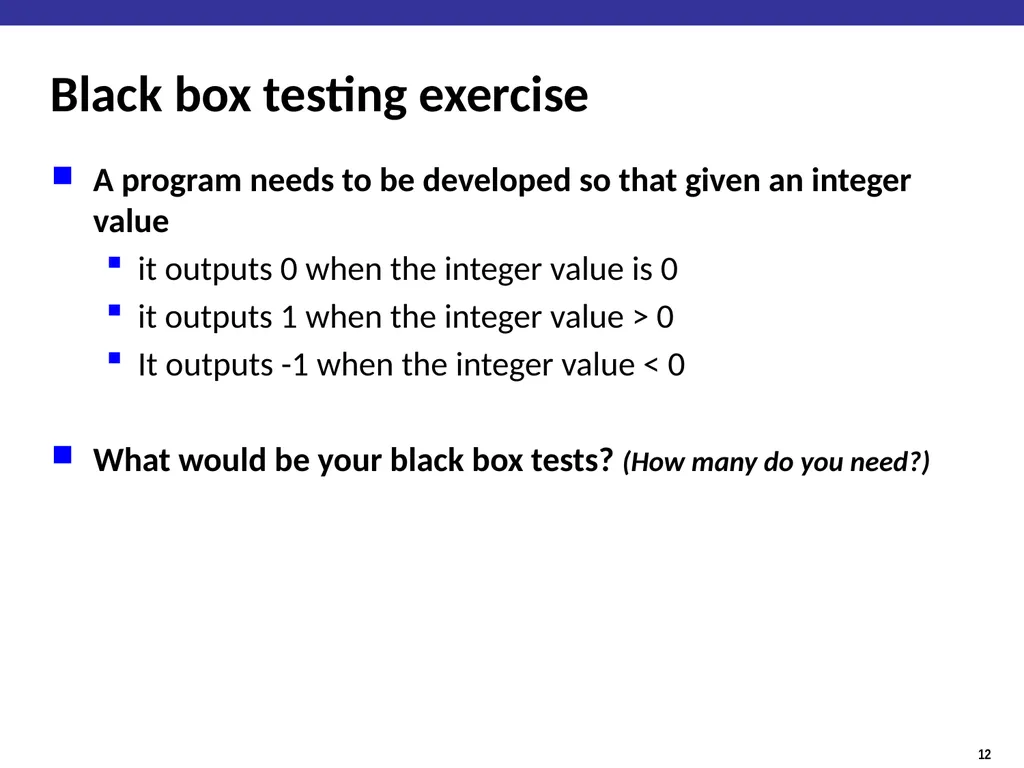
slide12. Black box testing exercise A program needs to be developed so that given an integer value
it outputs 0 when the integer value is 0
it outputs 1 when the integer value > 0
It outputs -1 when the integer value < 0
What would be your black box tests? (How many do you need?)<br>
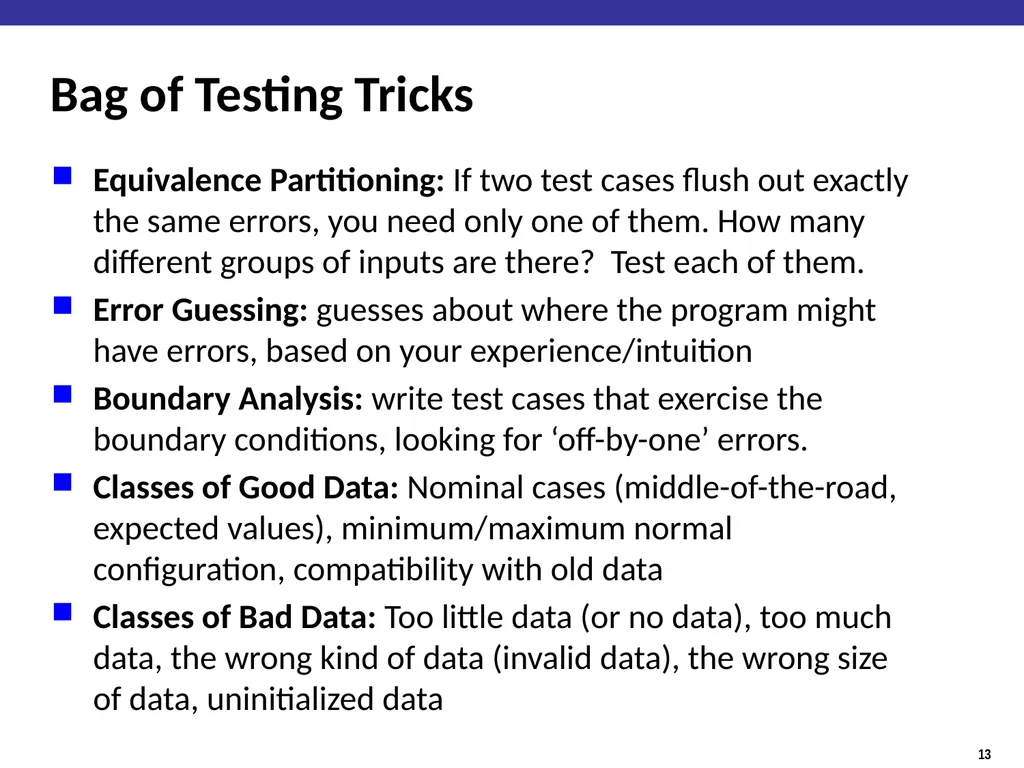
slide13. Bag of Testing Tricks Equivalence Partitioning: If two test cases flush out exactly the same errors, you need only one of them. How many different groups of inputs are there? Test each of them.
Error Guessing: guesses about where the program might have errors, based on your experience/intuition
Boundary Analysis: write test cases that exercise the boundary conditions, looking for ‘off-by-one’ errors.
Classes of Good Data: Nominal cases (middle-of-the-road, expected values), minimum/maximum normal configuration, compatibility with old data
Classes of Bad Data: Too little data (or no data), too much data, the wrong kind of data (invalid data), the wrong size of data, uninitialized data<br>
slide14. Test First or Test Last? (Guess) A) Test First (write tests before you write code)
B) Test Last (write tests after you write code)<br>
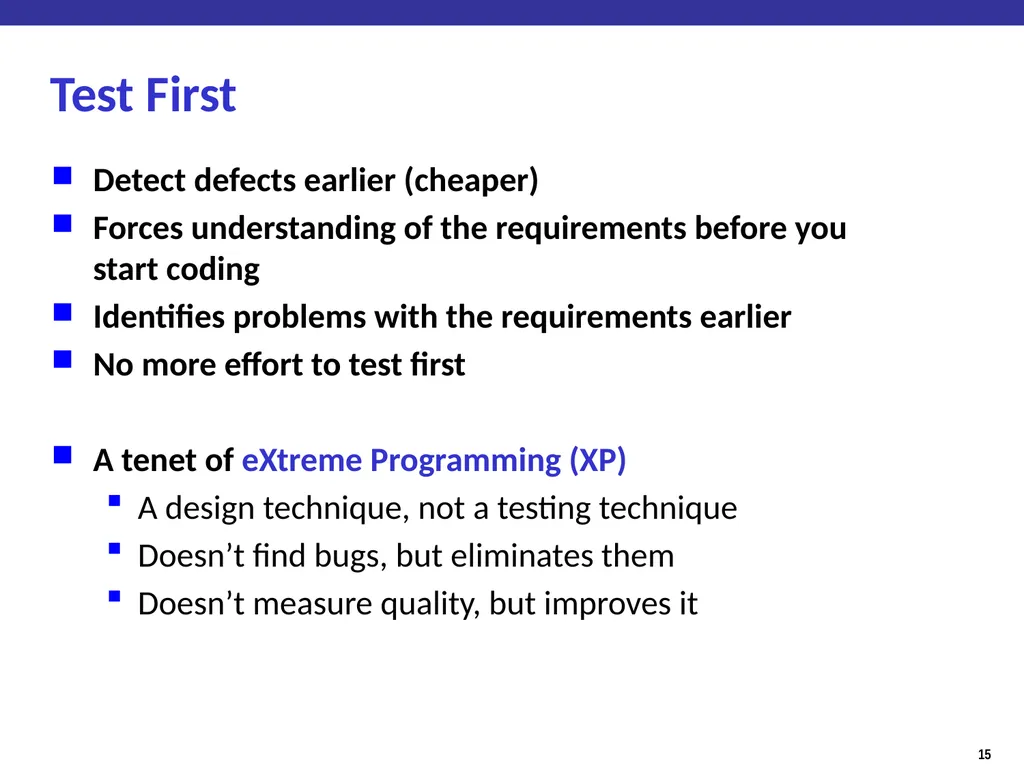
slide15. Test First Detect defects earlier (cheaper)
Forces understanding of the requirements before you start coding
Identifies problems with the requirements earlier
No more effort to test first
A tenet of eXtreme Programming (XP)
A design technique, not a testing technique
Doesn’t find bugs, but eliminates them
Doesn’t measure quality, but improves it<br>
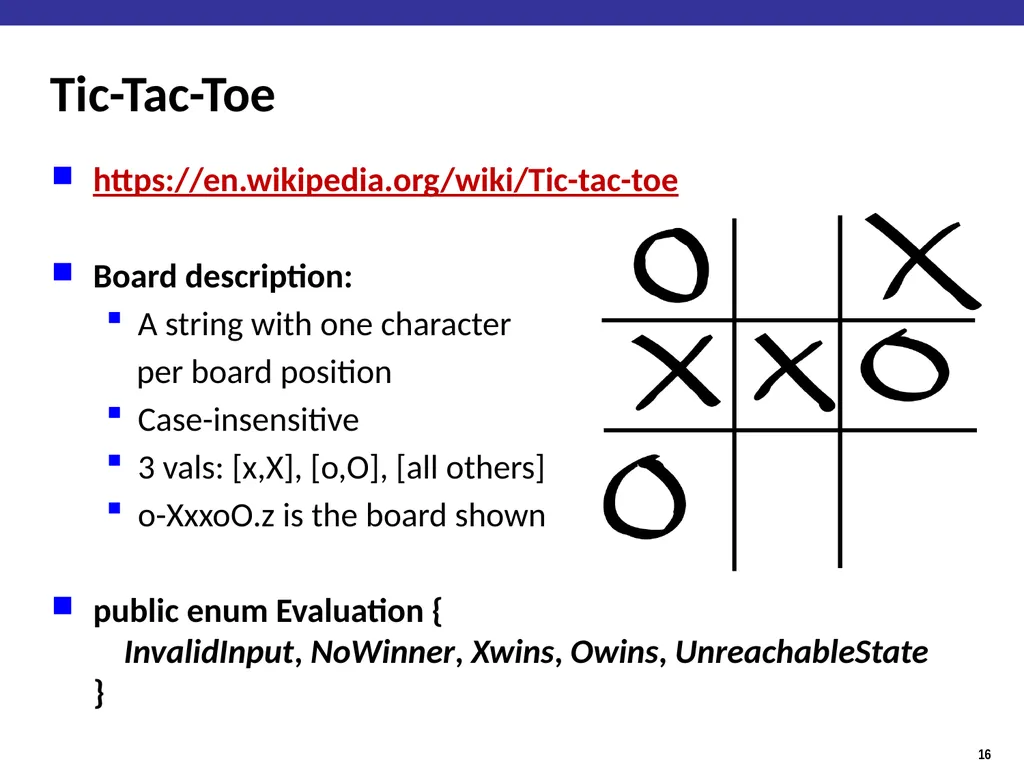
slide16. Tic-Tac-Toe https://en.wikipedia.org/wiki/Tic-tac-toe
Board description:
A string with one character
per board position
Case-insensitive
3 vals: [x,X], [o,O], [all others]
o-XxxoO.z is the board shown
public enum Evaluation { InvalidInput, NoWinner, Xwins, Owins, UnreachableState }<br>
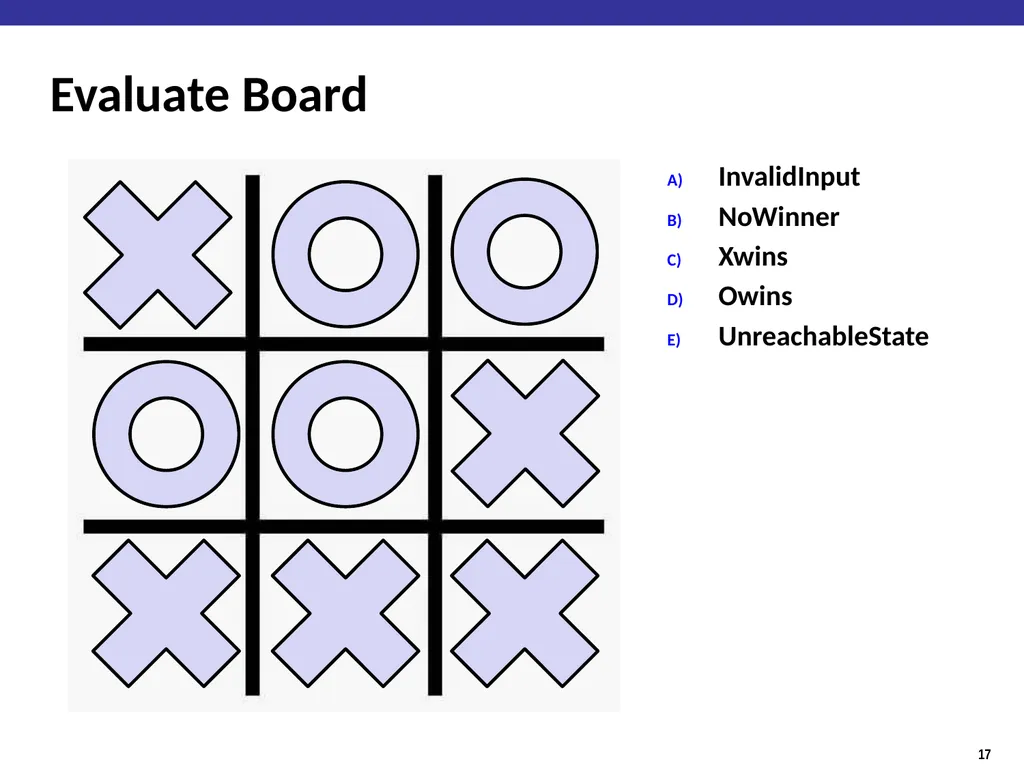
slide17. Evaluate Board InvalidInput
NoWinner
Xwins
Owins
UnreachableState<br>
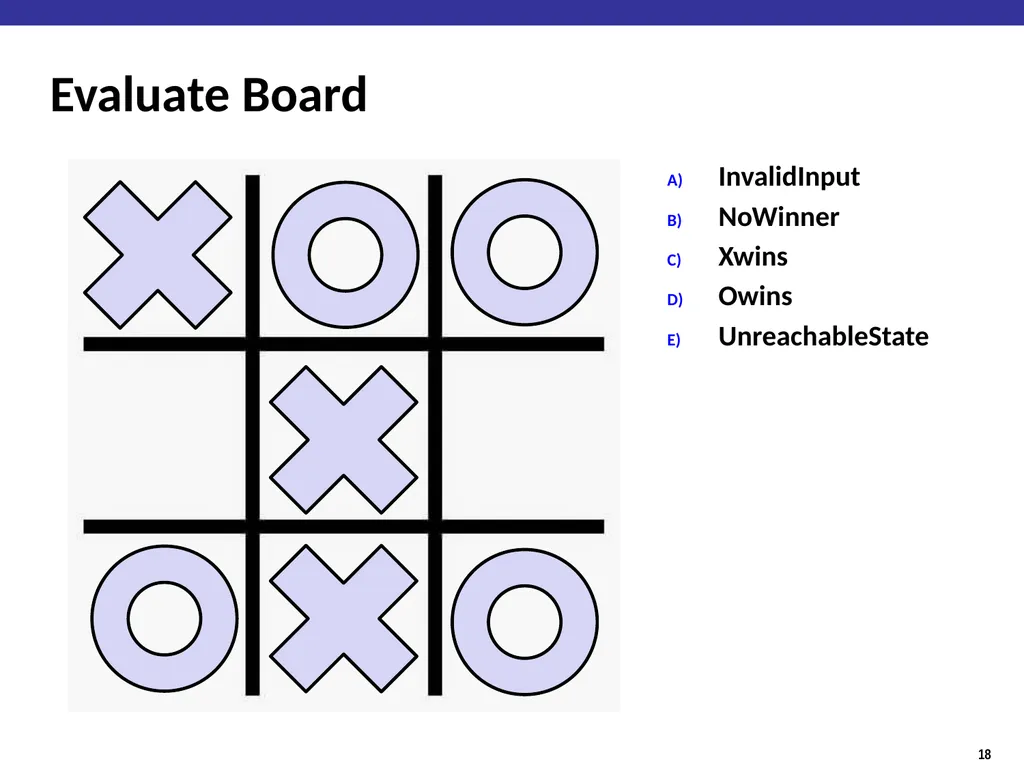
slide18. Evaluate Board InvalidInput
NoWinner
Xwins
Owins
UnreachableState<br>
slide2. Things to have been doing Join UIUC CS 126 on Piazza
Get an iClicker registered
Get a GitHub account
Install IntelliJ on your laptop (students can get the Ultimate version for free)
Review course Policies:
https://courses.engr.illinois.edu/cs126
Code Review Survey
https://doodle.com/poll/u7qcsvfhsaw7kqez<br>
slide3. Why Test? Improve quality - find faults
Measure quality
Prove there are no faults? (Is it possible?)
Determine if software is ready to be released
Determine what to work on
See if you made a mistake
Learn the software<br>
slide4. Testing vs. Debugging Testing is detecting errors
Debugging is a means of diagnosing and correcting the root causes of errors that have already been detected.<br>
slide5. Types of testing Unit Testing
Component Testing
Integration Testing
Regression Testing
System Testing<br>
slide6. Types of testing Unit Testing
The execution of a complete class, routine, or small program that has been written by a single programmer or team of programmers, which is tested in isolation from the more complete system.
Component Testing
Integration Testing
Regression Testing
System Testing<br>
slide7. Two Approaches to Testing Black box testing:
White box testing:<br>
slide8. Two Approaches to Testing Black box testing: a.k.a. Behavioral Testing
is a software testing method in which the internal structure/design/implementation of the item being tested is not known to the tester.
White box testing: a.k.a. Structural Testing
exploits knowledge of the internal structure/design/implementation of the item being tested, generally to ensure good code coverage and test potential corner cases in the implementation.<br>
slide9. What kind of tests? Manual
Good for exploratory
Good for testing GUI
Manual regression testing is BORING
Automatic
Test is a program
Test is created by a tool that records user actions
The only way to make testing efficient as well as effective is to automate as much as possible<br>
slide10. Junit Open source Java testing framework for automated testing
Widely used in industry
Features:
Assertions for testing expected results
Test features for sharing common test data
Test suites for easily organizing and running tests
Graphical and textual test runners
Primarily for unit and integration testing, not system testing<br>
slide11. Definitions Which kind of testing is “specification testing”
A) Black box testing
B) White box testing<br>
slide12. Black box testing exercise A program needs to be developed so that given an integer value
it outputs 0 when the integer value is 0
it outputs 1 when the integer value > 0
It outputs -1 when the integer value < 0
What would be your black box tests? (How many do you need?)<br>
slide13. Bag of Testing Tricks Equivalence Partitioning: If two test cases flush out exactly the same errors, you need only one of them. How many different groups of inputs are there? Test each of them.
Error Guessing: guesses about where the program might have errors, based on your experience/intuition
Boundary Analysis: write test cases that exercise the boundary conditions, looking for ‘off-by-one’ errors.
Classes of Good Data: Nominal cases (middle-of-the-road, expected values), minimum/maximum normal configuration, compatibility with old data
Classes of Bad Data: Too little data (or no data), too much data, the wrong kind of data (invalid data), the wrong size of data, uninitialized data<br>
slide14. Test First or Test Last? (Guess) A) Test First (write tests before you write code)
B) Test Last (write tests after you write code)<br>
slide15. Test First Detect defects earlier (cheaper)
Forces understanding of the requirements before you start coding
Identifies problems with the requirements earlier
No more effort to test first
A tenet of eXtreme Programming (XP)
A design technique, not a testing technique
Doesn’t find bugs, but eliminates them
Doesn’t measure quality, but improves it<br>
slide16. Tic-Tac-Toe https://en.wikipedia.org/wiki/Tic-tac-toe
Board description:
A string with one character
per board position
Case-insensitive
3 vals: [x,X], [o,O], [all others]
o-XxxoO.z is the board shown
public enum Evaluation { InvalidInput, NoWinner, Xwins, Owins, UnreachableState }<br>
slide17. Evaluate Board InvalidInput
NoWinner
Xwins
Owins
UnreachableState<br>
slide18. Evaluate Board InvalidInput
NoWinner
Xwins
Owins
UnreachableState<br>