
Jayasree M Technical Expert (Agri) SLNA CONCEPT
A
Published · 50 slides · 0 views
1 / 1

Description
Jayasree M Technical Expert (Agri) SLNA CONCEPT AND RELEVANCE OF WATERSHED MANAGEMENT WHY WATERSHED MANAGEMENT? Per capita availability of land in 1951 is 0.91ha Per capita availability of land in 2050 will be 0.17ha Per capita availability
Related Topics
Share
Embed code
Download this presentation From Below
"Jayasree M Technical Expert (Agri) SLNA CONCEPT" is the property of its rightful owner. Permission is granted to download and print the materials on this website for personal, non-commercial use only, and to display it on your personal computer provided you do not modify the materials and that you retain all copyright notices contained in the materials. By downloading content from our website, you accept the terms of this agreement.
Presentation Transcript
01
Jayasree M
Technical Expert (Agri)
SLNA CONCEPT AND RELEVANCE OF WATERSHED MANAGEMENT<br>
Technical Expert (Agri)
SLNA CONCEPT AND RELEVANCE OF WATERSHED MANAGEMENT<br>
02
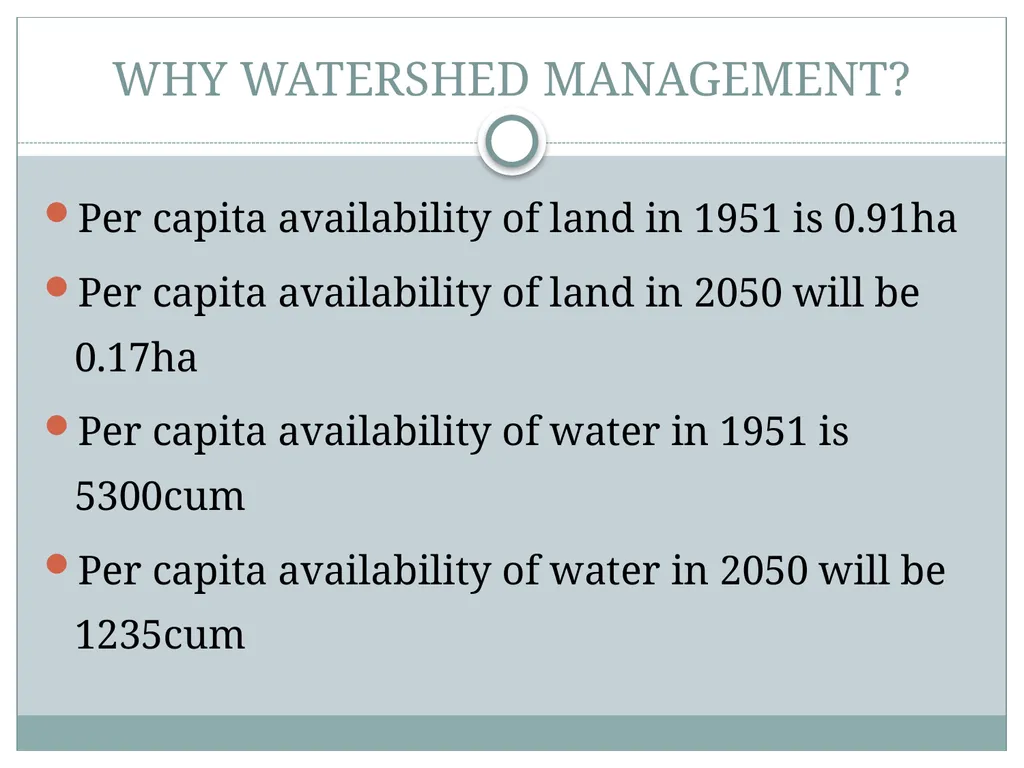
WHY WATERSHED MANAGEMENT? Per capita availability of land in 1951 is 0.91ha
Per capita availability of land in 2050 will be 0.17ha
Per capita availability of water in 1951 is 5300cum
Per capita availability of water in 2050 will be 1235cum<br>
Per capita availability of land in 2050 will be 0.17ha
Per capita availability of water in 1951 is 5300cum
Per capita availability of water in 2050 will be 1235cum<br>
03
Rampant soil erosion and degradation of land and water resources are further posing serious threat to food, environmental, social, economic and livelihood securities.<br>
04
About half of the geographical area of the country is affected by different forms of soil erosion and land degradation .
This causes loss of productivity, floods and droughts and also environmental hazards and reduction in livelihood opportunities.<br>
This causes loss of productivity, floods and droughts and also environmental hazards and reduction in livelihood opportunities.<br>
05
Rainfed areas constitute about two-thirds of nation’s cultivated area.
This rainfed areas are the resource poor areas with low levels of productivity and suffer from land degradation and other vagaries of nature.<br>
This rainfed areas are the resource poor areas with low levels of productivity and suffer from land degradation and other vagaries of nature.<br>
06
Rainfed areas contribute only 45% of the total food production.
Irrigated areas which account for 37% of the cultivated area contribute 55% of total food production.<br>
Irrigated areas which account for 37% of the cultivated area contribute 55% of total food production.<br>
07
Resource degradation and loss are the major adverse impacts of Indian agriculture.
About 5334 million tons of soil is estimated to be eroded annually.
29% is permanently lost into the sea
10% is deposited in reservoirs
61% is transported from one place to another.<br>
About 5334 million tons of soil is estimated to be eroded annually.
29% is permanently lost into the sea
10% is deposited in reservoirs
61% is transported from one place to another.<br>
08
Average annual loss of plant nutrients is 5.3 to 8.4 million tonns.
If this continues one third of the arable land is likely to be lost in a period of 20 years.<br>
If this continues one third of the arable land is likely to be lost in a period of 20 years.<br>
09
First Green Revolution focus on increase in production through new inputs especially in irrigated areas.
The next revolution has to come by introduction of new innovative techniques and use of efficient location specific natural resources management in farms and fields in rainfed areas.<br>
The next revolution has to come by introduction of new innovative techniques and use of efficient location specific natural resources management in farms and fields in rainfed areas.<br>
10
Agriculture must be considered as the primary industry of any country.
Land is the capital of the industry.
A good proportion of our agricultural land is put to non agricultural purposes and for cultivation of non food crops.<br>
Land is the capital of the industry.
A good proportion of our agricultural land is put to non agricultural purposes and for cultivation of non food crops.<br>
11
Water is one of the constituent of the five vital elements of human body.
About 30,000 people die every day especially in the poorer parts of the world due to inadequate supply of water or its unsanitary condition.
WHO estimates that 80% of all illness are related to water.<br>
About 30,000 people die every day especially in the poorer parts of the world due to inadequate supply of water or its unsanitary condition.
WHO estimates that 80% of all illness are related to water.<br>
12
The rainfall remains almost the same but the population depend on this rainfall is on the increase.
Hence conservation and management of water resources must be considered a vital necessity for the humanity to survive.<br>
Hence conservation and management of water resources must be considered a vital necessity for the humanity to survive.<br>
13
STATUS OF KERALA Kerala state is deficit in food production to the tune of 75%, still continue to fill the precious paddy fields for non agricultural purposes and urbanization.
Kerala once had more than 10 lakh ha of paddy field, today only 1.5-2lakh ha.<br>
Kerala once had more than 10 lakh ha of paddy field, today only 1.5-2lakh ha.<br>
14
19 lakh ha in Kerala is already under varying degrees of land degradation causing lowering of productivity of crops, drying up of streams, lowering of ground water etc.<br>
15
KERALA SCENARIO Rivers - 44
Lakes - 34
Rainfall - 3000mm
Inspite of all these we are facing food scarcity and price hike.<br>
Lakes - 34
Rainfall - 3000mm
Inspite of all these we are facing food scarcity and price hike.<br>
16
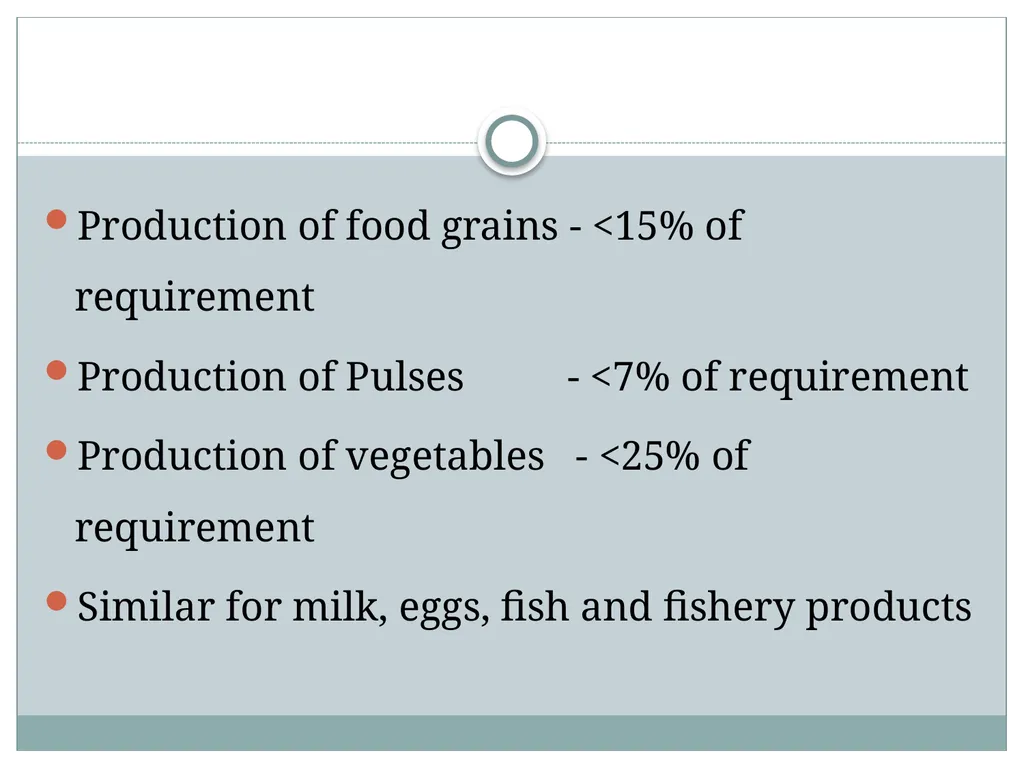
Production of food grains - <15% of requirement
Production of Pulses - <7% of requirement
Production of vegetables - <25% of requirement
Similar for milk, eggs, fish and fishery products<br>
Production of Pulses - <7% of requirement
Production of vegetables - <25% of requirement
Similar for milk, eggs, fish and fishery products<br>
17
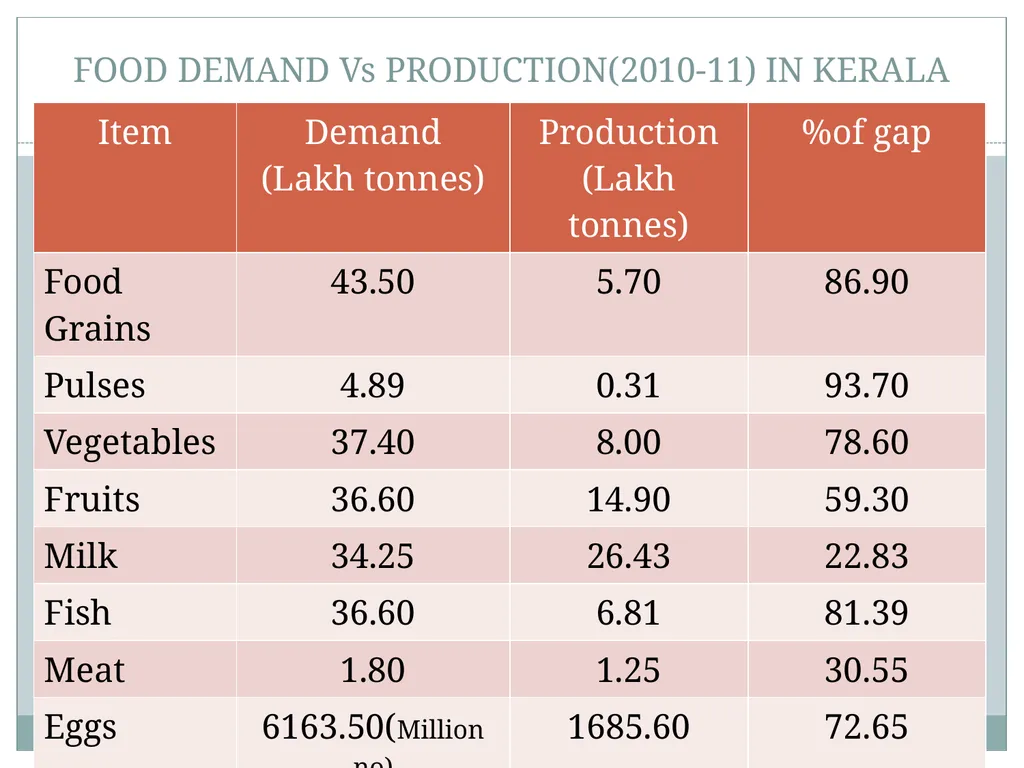
FOOD DEMAND Vs PRODUCTION(2010-11) IN KERALA<br>
18
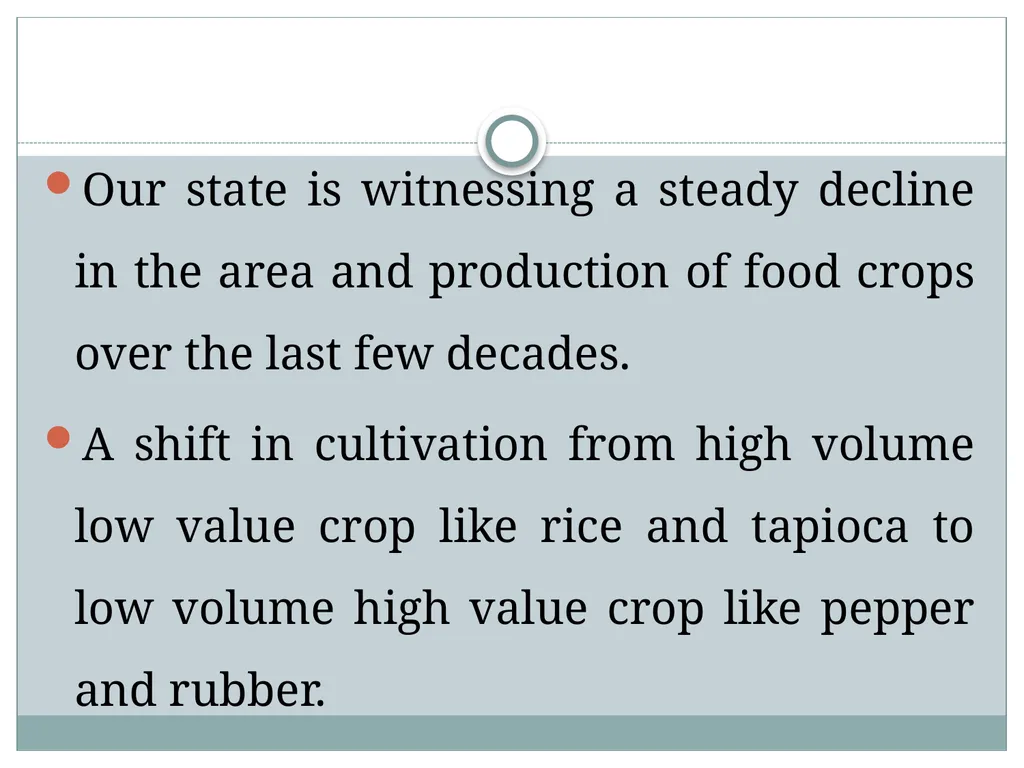
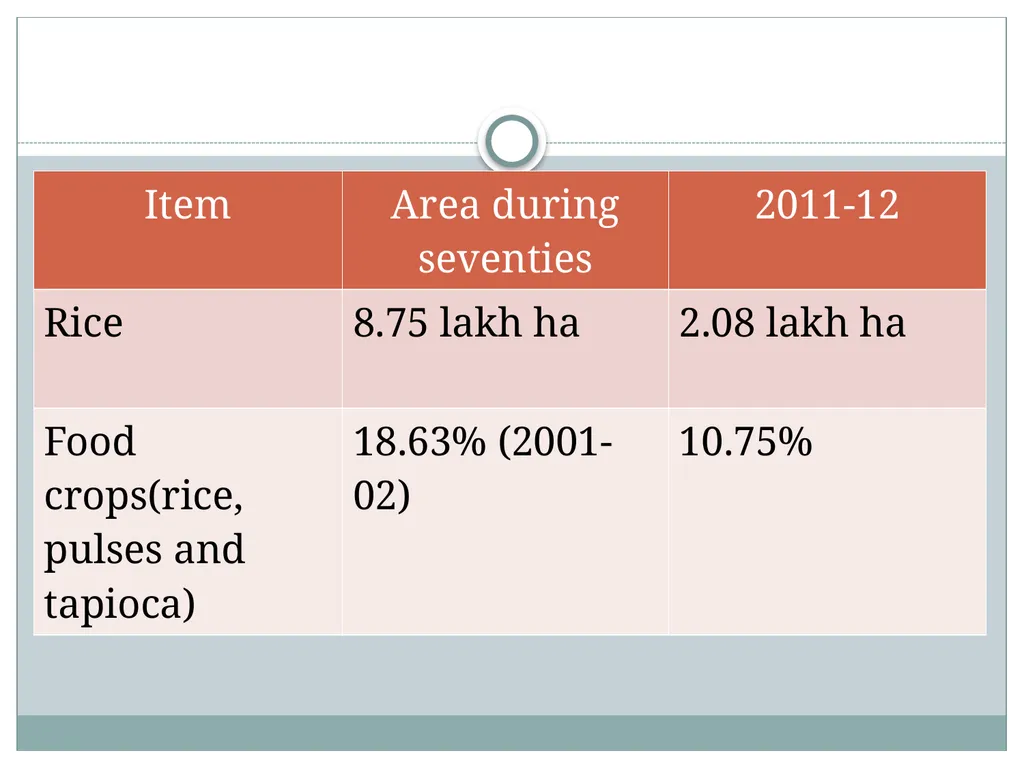
Our state is witnessing a steady decline in the area and production of food crops over the last few decades.
A shift in cultivation from high volume low value crop like rice and tapioca to low volume high value crop like pepper and rubber.<br>
A shift in cultivation from high volume low value crop like rice and tapioca to low volume high value crop like pepper and rubber.<br>
19
We cannot retain even the remaining area under food production.
There was a reduction of 4% in total area under food crops during 2011-12 than 2010-11
For food grains the reduction is 3%<br>
There was a reduction of 4% in total area under food crops during 2011-12 than 2010-11
For food grains the reduction is 3%<br>
20
The question is how long can we survive on food brought from outside?
We must produce the maximum in our state itself.<br>
We must produce the maximum in our state itself.<br>
21
CONSTRINTS IN FOOD PRODUCTION Rapid decline of our natural resources viz; land, water and biomass which are necessary for sustained production.
Declining trend of resource flow to agricultural sector leading to increased indebtedness of small and marginal farmers.
Increase input cost
Decline in productivity
Technology fatigue
Weakened extension services<br>
Declining trend of resource flow to agricultural sector leading to increased indebtedness of small and marginal farmers.
Increase input cost
Decline in productivity
Technology fatigue
Weakened extension services<br>
22
CHALLENGES OF TODAY To satisfy people’s right to food security ie., to feed the escalating population by keeping the prices low for the benefit of poor consumers as well as to reduce production cost to benefit poor growers.
To ensure that natural resource base remains sustainably productive.<br>
To ensure that natural resource base remains sustainably productive.<br>
23
To ensure food security, increase rice production while keeping the production costs low should be the first step.
For increasing production focus should be given to sustainable production systems by strengthening the ecological foundations.<br>
For increasing production focus should be given to sustainable production systems by strengthening the ecological foundations.<br>
24
This requires a holistic approach by considering technological, bio-physical, socio-economic, political and environmental factors.
Food security and environmental sustainability can be attained by improved land and water management adopting eco-friendly technologies and initiating good agricultural practices.<br>
Food security and environmental sustainability can be attained by improved land and water management adopting eco-friendly technologies and initiating good agricultural practices.<br>
25
WATERSHED MANAGEMENT The whole issue of ensuring food security in Kerala has to be viewed in the context of a watershed management
Conservation and augmentation of soil and water resources
Improving productivity by increasing the fertility
Introduction of better yielding crops
Crop diversification<br>
Conservation and augmentation of soil and water resources
Improving productivity by increasing the fertility
Introduction of better yielding crops
Crop diversification<br>
26
Integrated Watershed Management has emerged as a new paradigm for planning, development and management of land, water and biomass resources with a focus on social and institutional aspects .<br>
27
BIO INDUSTRIAL WATERSHED The main thrust of Bio-industrial Watershed is on community rather than natural resources alone.
The strategy is to augment the local agro ecosystem, adding value to the available resources and enhance livelihoods through suitable technological interventions.<br>
The strategy is to augment the local agro ecosystem, adding value to the available resources and enhance livelihoods through suitable technological interventions.<br>
28
OBJCTIVES OF IWMP Harvesting every drop of rainwater for drinking, irrigation etc to create sustainable sources of income for the village community.
Employment generation, poverty alleviation, community empowerment and development of human and economic resources of the rural areas.
Restoring ecological balance by harnessing, conserving and developing natural resources.<br>
Employment generation, poverty alleviation, community empowerment and development of human and economic resources of the rural areas.
Restoring ecological balance by harnessing, conserving and developing natural resources.<br>
29
SALIENT FEATURES It is a centrally sponsored scheme with 90% central assistance and 10% state fund.
Implemented based on the principles envisaged in the ‘Common Guidelines for Watershed Development Projects’.
Duration is 5 years.
A cluster of micro watersheds is selected for treatment<br>
Implemented based on the principles envisaged in the ‘Common Guidelines for Watershed Development Projects’.
Duration is 5 years.
A cluster of micro watersheds is selected for treatment<br>
30
Criteria for selection of watershed Acuteness of drinking water scarcity
Preponderance of ground water resources
Extent of over exploitation of ground water resources
Contiguity of another watershed already treated
Willingness of village community to make voluntary contributions, enforce equitable social regulations for sharing of common property resources
Proportion of SC/ST
Project area should not have assured irrigation
Productivity potential of the land<br>
31
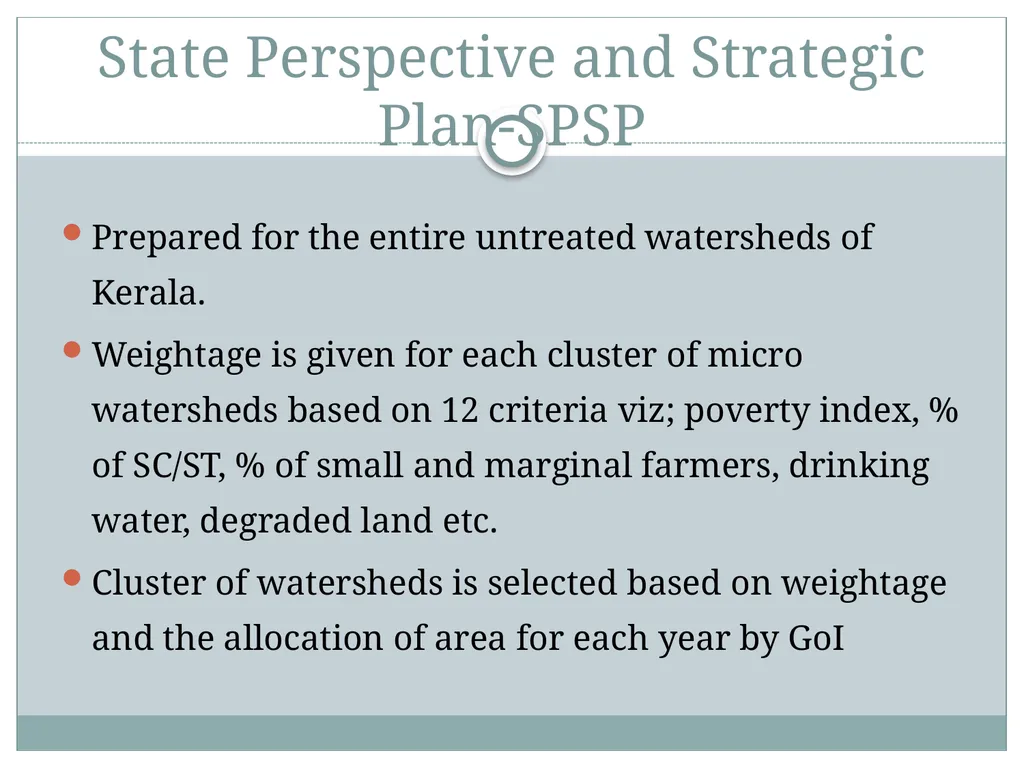
State Perspective and Strategic Plan-SPSP Prepared for the entire untreated watersheds of Kerala.
Weightage is given for each cluster of micro watersheds based on 12 criteria viz; poverty index, % of SC/ST, % of small and marginal farmers, drinking water, degraded land etc.
Cluster of watersheds is selected based on weightage and the allocation of area for each year by GoI<br>
Weightage is given for each cluster of micro watersheds based on 12 criteria viz; poverty index, % of SC/ST, % of small and marginal farmers, drinking water, degraded land etc.
Cluster of watersheds is selected based on weightage and the allocation of area for each year by GoI<br>
32
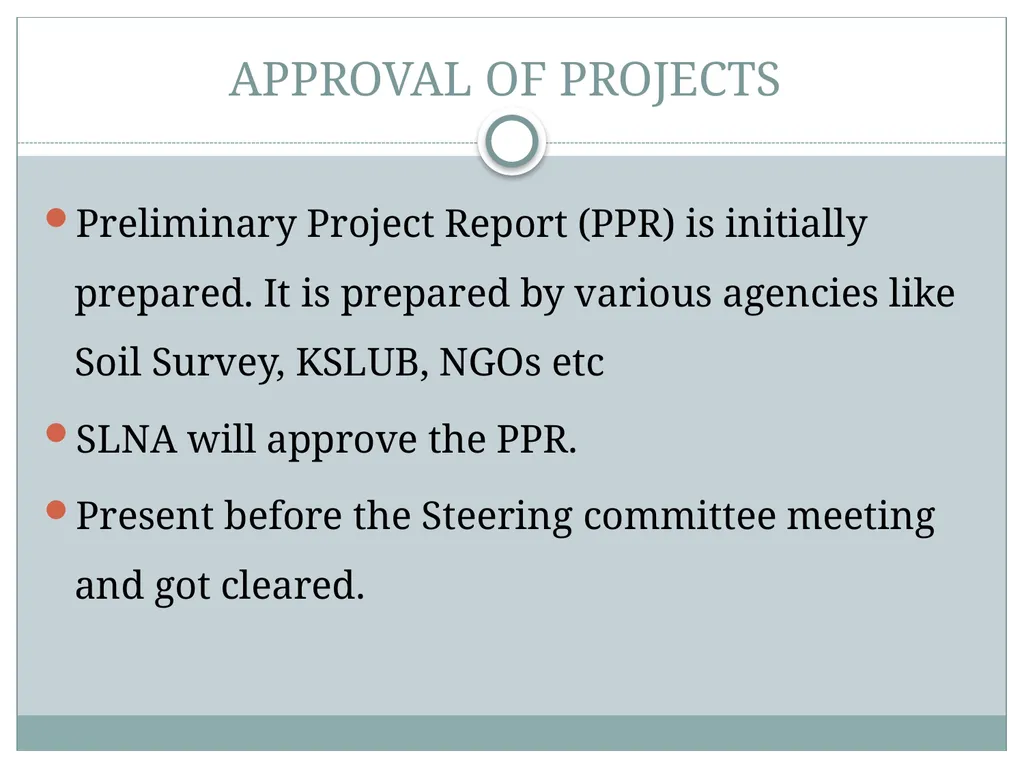
APPROVAL OF PROJECTS Preliminary Project Report (PPR) is initially prepared. It is prepared by various agencies like Soil Survey, KSLUB, NGOs etc
SLNA will approve the PPR.
Present before the Steering committee meeting and got cleared.<br>
SLNA will approve the PPR.
Present before the Steering committee meeting and got cleared.<br>
33
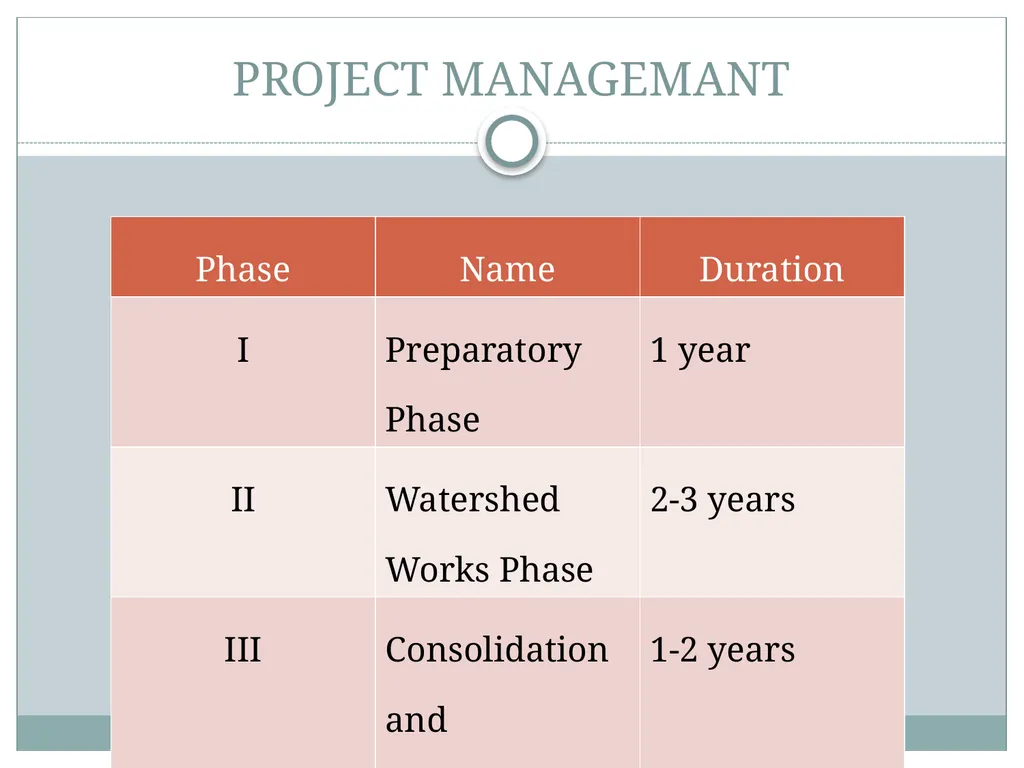
PROJECT MANAGEMANT<br>
34
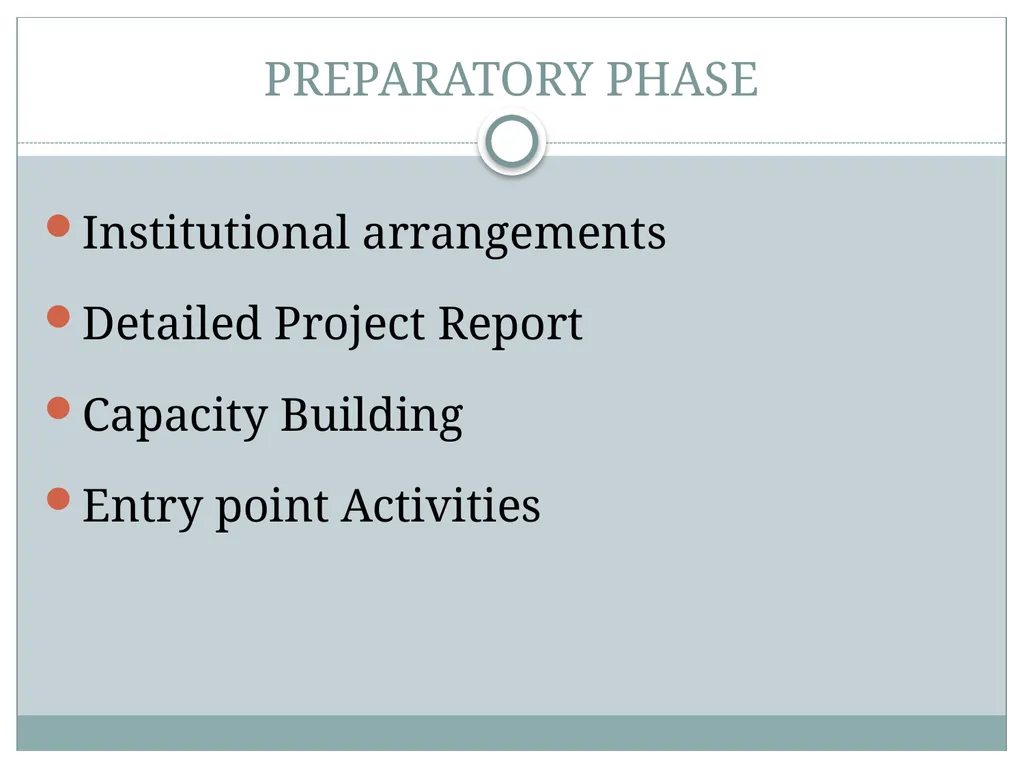
PREPARATORY PHASE Institutional arrangements
Detailed Project Report
Capacity Building
Entry point Activities<br>
Detailed Project Report
Capacity Building
Entry point Activities<br>
35
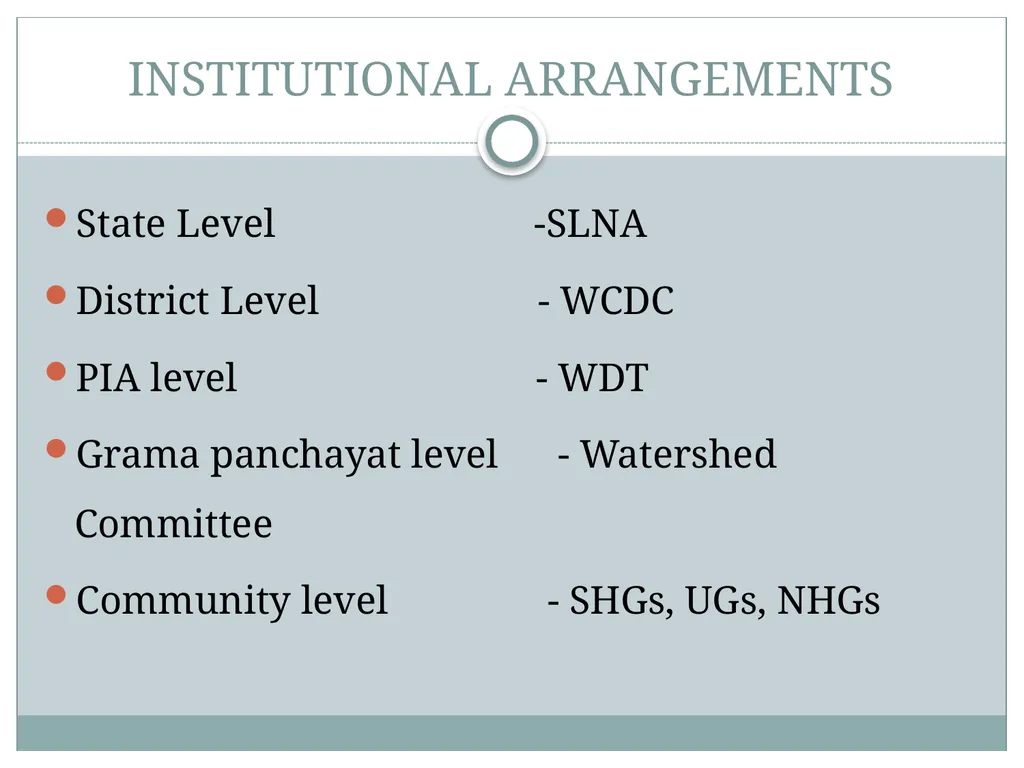
INSTITUTIONAL ARRANGEMENTS State Level -SLNA
District Level - WCDC
PIA level - WDT
Grama panchayat level - Watershed Committee
Community level - SHGs, UGs, NHGs<br>
District Level - WCDC
PIA level - WDT
Grama panchayat level - Watershed Committee
Community level - SHGs, UGs, NHGs<br>
36
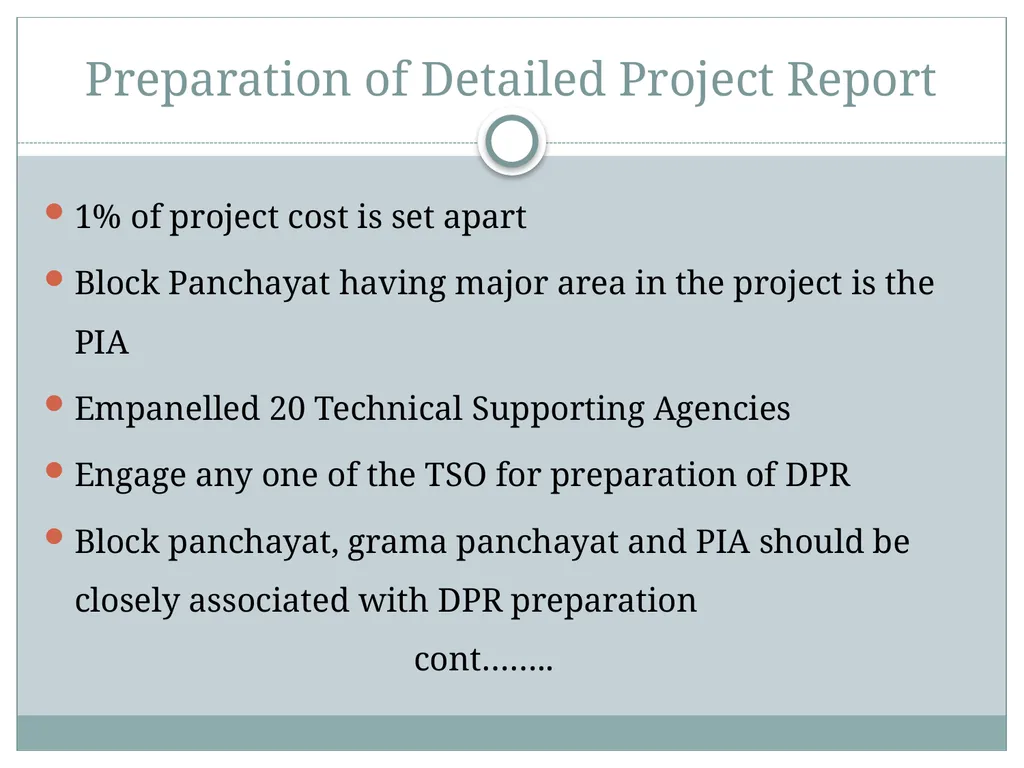
Preparation of Detailed Project Report 1% of project cost is set apart
Block Panchayat having major area in the project is the PIA
Empanelled 20 Technical Supporting Agencies
Engage any one of the TSO for preparation of DPR
Block panchayat, grama panchayat and PIA should be closely associated with DPR preparation cont……..<br>
Block Panchayat having major area in the project is the PIA
Empanelled 20 Technical Supporting Agencies
Engage any one of the TSO for preparation of DPR
Block panchayat, grama panchayat and PIA should be closely associated with DPR preparation cont……..<br>
37
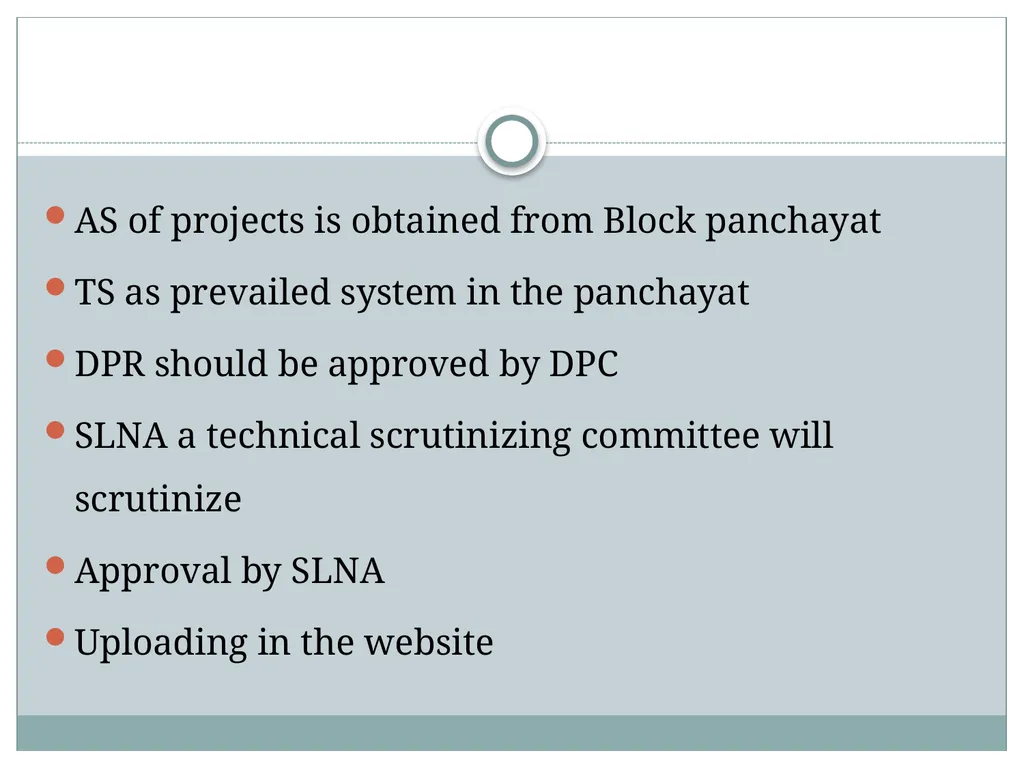
AS of projects is obtained from Block panchayat
TS as prevailed system in the panchayat
DPR should be approved by DPC
SLNA a technical scrutinizing committee will scrutinize
Approval by SLNA
Uploading in the website<br>
TS as prevailed system in the panchayat
DPR should be approved by DPC
SLNA a technical scrutinizing committee will scrutinize
Approval by SLNA
Uploading in the website<br>
38
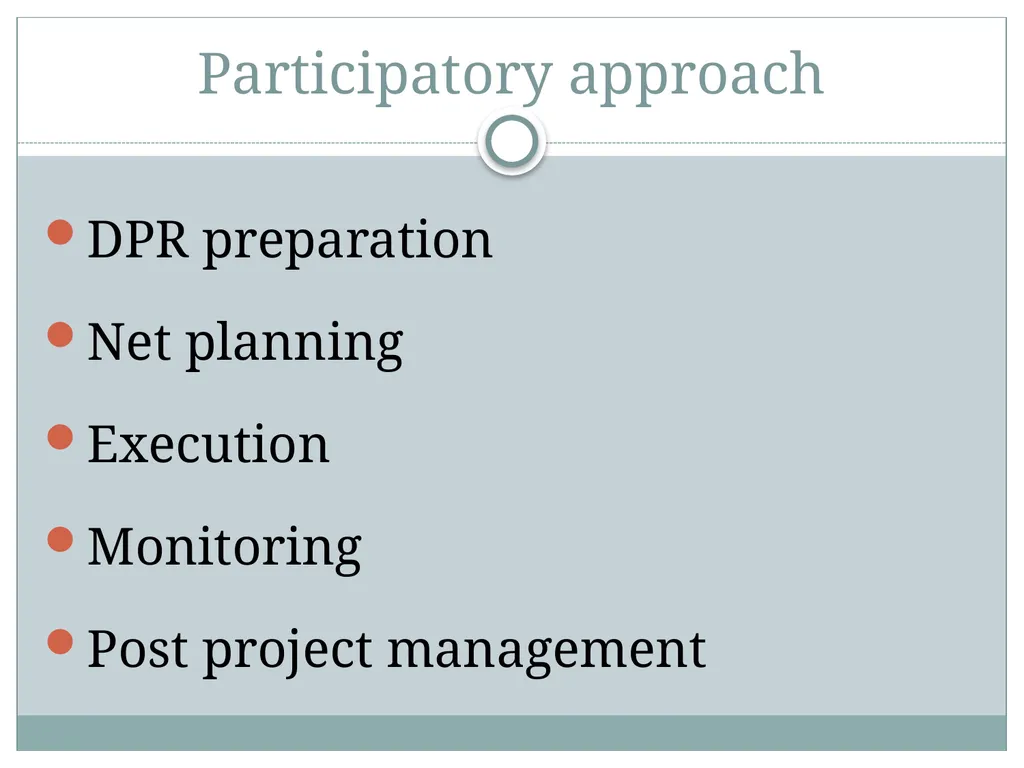
Participatory approach DPR preparation
Net planning
Execution
Monitoring
Post project management<br>
Net planning
Execution
Monitoring
Post project management<br>
39
MANAGEMENT ACTIVITIES IN IWMP NRM-Natural Resource Management
Prodction System and Microenterprises
Livelihood Support System<br>
Prodction System and Microenterprises
Livelihood Support System<br>
40
NRM ACTIVITIES Soil Conservation Activities
Water Conservation Activities
Moisture Conservation Activities
Other Activities<br>
Water Conservation Activities
Moisture Conservation Activities
Other Activities<br>
41
Soil Conservation Activities Earthen bunds
Field bunds
Rubble pitched contour bunds
Vegetative hedges
Contour cultivation
Contour trenches
Staggered trenches<br>
Field bunds
Rubble pitched contour bunds
Vegetative hedges
Contour cultivation
Contour trenches
Staggered trenches<br>
42
Water Conservation Activities Check dam
Farm pond/ Percolation tank
Pond renovation
Drainage line treatment
Roof top rain water harvesting
Pallam conservation<br>
Farm pond/ Percolation tank
Pond renovation
Drainage line treatment
Roof top rain water harvesting
Pallam conservation<br>
43
Moisture Conservation Activities Husk Burial
Mulching
Centripetal terracing
Inward bench terracing
Moisture Conservation pit<br>
Mulching
Centripetal terracing
Inward bench terracing
Moisture Conservation pit<br>
44
Other Activities Conservation of sacred groves
Afforestation<br>
Afforestation<br>
45
PRODUCTION SYSTEM & MICROENTERPRISES Vegetable cultivation
Fallow land cultivation
Betel vine, Pineapple, Banana, Tuber Crops, Medicinal plants, Fodder, Green manure crops etc.
Vermi composting
Soil testing
Fruits and vegetable processing unit
Smithy and carpentry<br>
Fallow land cultivation
Betel vine, Pineapple, Banana, Tuber Crops, Medicinal plants, Fodder, Green manure crops etc.
Vermi composting
Soil testing
Fruits and vegetable processing unit
Smithy and carpentry<br>
46
Apiculture
Sericulture
Pisiculture
Floriculture
Olericulture
Farm Mechanisation
Value added products
Adoption of new innovative technologies
Adoption of Success stories etc.<br>
Sericulture
Pisiculture
Floriculture
Olericulture
Farm Mechanisation
Value added products
Adoption of new innovative technologies
Adoption of Success stories etc.<br>
47
Livelihood Support System Cattle rearing
Goat rearing
Back yard poultry<br>
Goat rearing
Back yard poultry<br>
48
CONVERGANCE POSSIBILITIES MGNREGS
SHM
VFPCK
Fisheries
Dairy Dept
Forest Dept
Minor irrigation
Agriculture Dept
Kudumbasree etc.<br>
SHM
VFPCK
Fisheries
Dairy Dept
Forest Dept
Minor irrigation
Agriculture Dept
Kudumbasree etc.<br>
49
THANKS<br>