
Jeff Moore, Executive Director Walmart: $0.25.
LV
Published · 22 slides · 0 views

1 / 1




Description
Jeff Moore, Executive Director Walmart: 0.25. Whole foods: 0.50. Vending machine: 1 Bar: 2. Hotel: 3 Airport: 5. Bonaroo: 8 Taylor Swift Concert: 6,230 Pricing seems simple Introduction What are your goals for today? What pricing
Related Topics
Share
Embed code
Download this presentation From Below
"Jeff Moore, Executive Director Walmart: $0.25." is the property of its rightful owner. Permission is granted to download and print the materials on this website for personal, non-commercial use only, and to display it on your personal computer provided you do not modify the materials and that you retain all copyright notices contained in the materials. By downloading content from our website, you accept the terms of this agreement.
Presentation Transcript
01
Jeff Moore, Executive Director<br>
02
Walmart: $0.25.
Whole foods: $0.50.
Vending machine: $1
Bar: $2.
Hotel: $3
Airport: $5.
Bonaroo: $8
Taylor Swift Concert: $6,230 Pricing seems simple…<br>
Whole foods: $0.50.
Vending machine: $1
Bar: $2.
Hotel: $3
Airport: $5.
Bonaroo: $8
Taylor Swift Concert: $6,230 Pricing seems simple…<br>
03
Introduction What are your goals for today?
What pricing challenges do you face today?<br>
What pricing challenges do you face today?<br>
04
Understanding pricing Discuss pricing and its importance in business
Discuss the role of in pricing decisions in the innovation process<br>
Discuss the role of in pricing decisions in the innovation process<br>
05
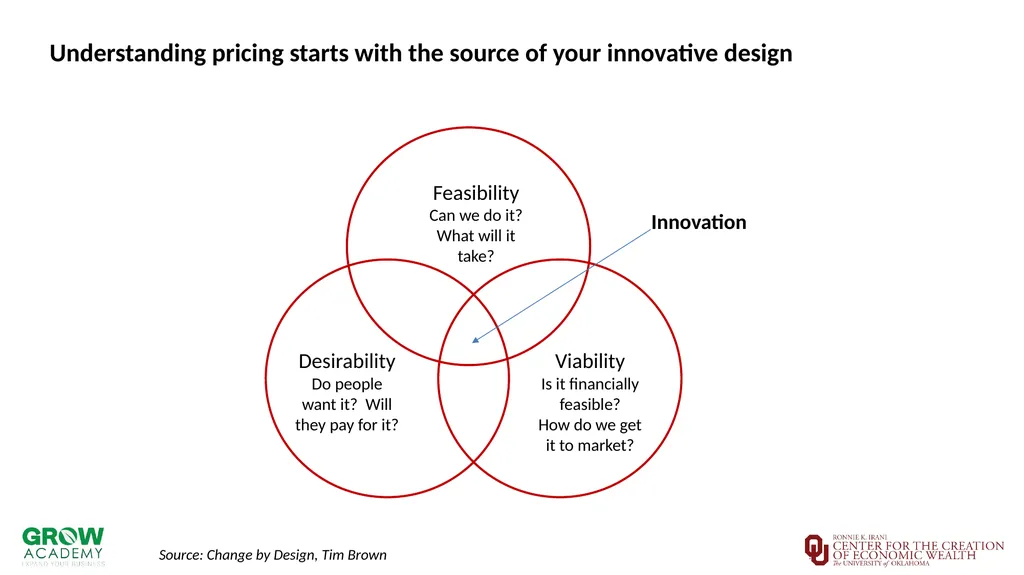
Understanding pricing starts with the source of your innovative design Feasibility
Can we do it? What will it take? Desirability
Do people want it? Will they pay for it? Viability
Is it financially feasible?
How do we get it to market? Source: Change by Design, Tim Brown Innovation<br>
Can we do it? What will it take? Desirability
Do people want it? Will they pay for it? Viability
Is it financially feasible?
How do we get it to market? Source: Change by Design, Tim Brown Innovation<br>
06
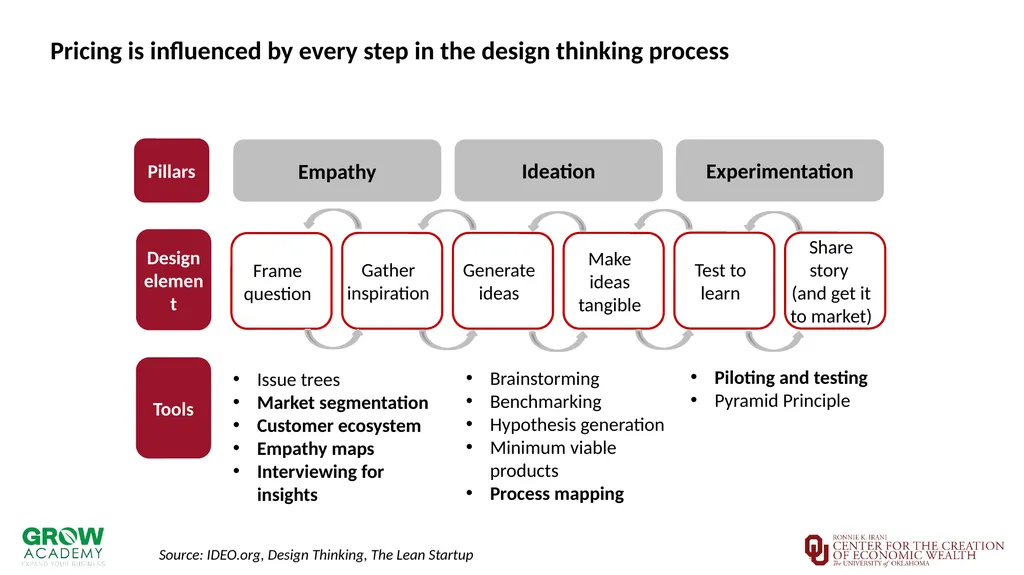
Source: IDEO.org, Design Thinking, The Lean Startup Frame question Gather inspiration Generate ideas Make ideas tangible Test to learn Share story
(and get it to market) Empathy Ideation Experimentation Design element Tools Pillars Issue trees
Market segmentation
Customer ecosystem
Empathy maps
Interviewing for insights Brainstorming
Benchmarking
Hypothesis generation
Minimum viable products
Process mapping Piloting and testing
Pyramid Principle Pricing is influenced by every step in the design thinking process<br>
(and get it to market) Empathy Ideation Experimentation Design element Tools Pillars Issue trees
Market segmentation
Customer ecosystem
Empathy maps
Interviewing for insights Brainstorming
Benchmarking
Hypothesis generation
Minimum viable products
Process mapping Piloting and testing
Pyramid Principle Pricing is influenced by every step in the design thinking process<br>
07
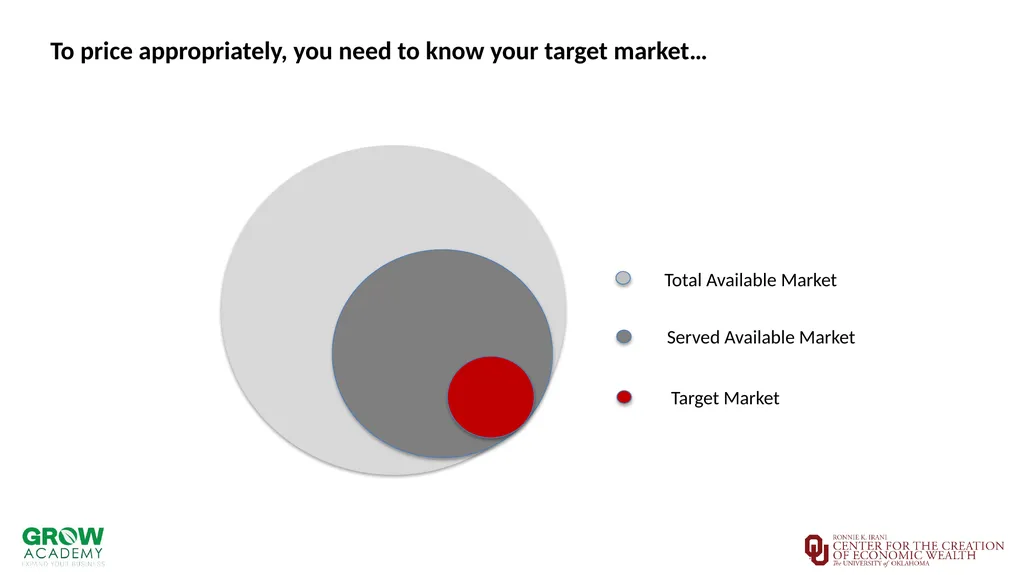
Total Available Market Served Available Market Target Market To price appropriately, you need to know your target market…<br>
08
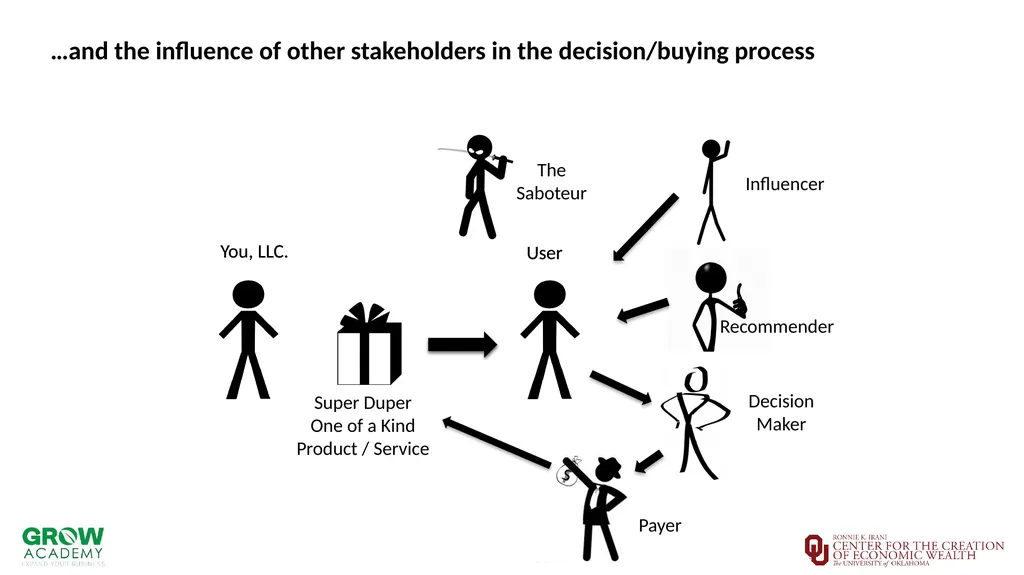
User Tool: Consider all players in the customer ecosystem Super Duper
One of a Kind Product / Service User …and the influence of other stakeholders in the decision/buying process<br>
One of a Kind Product / Service User …and the influence of other stakeholders in the decision/buying process<br>
09
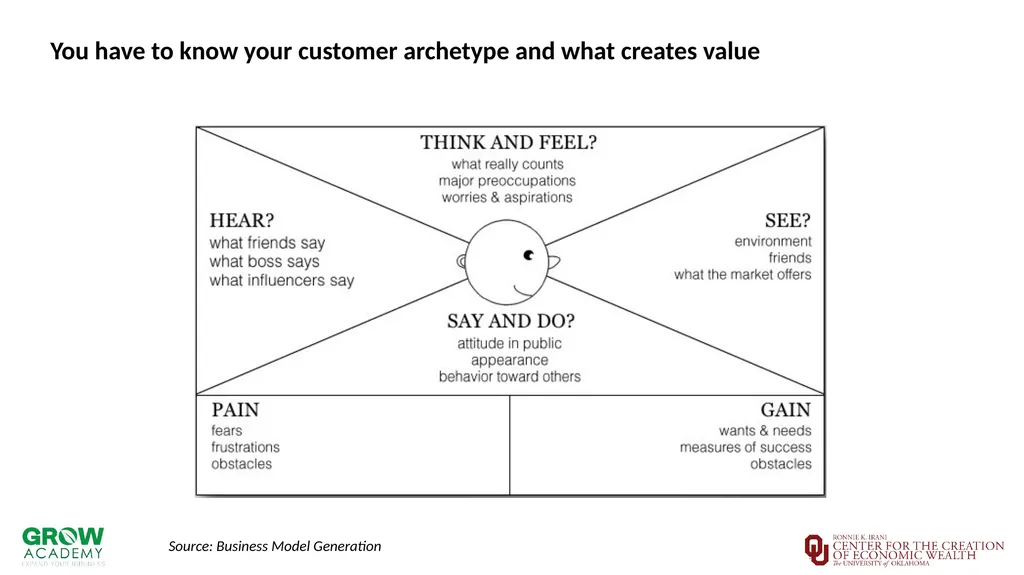
Source: Business Model Generation Tool: Empathy maps help build customer archetypes of behavior and environment You have to know your customer archetype and what creates value<br>
10
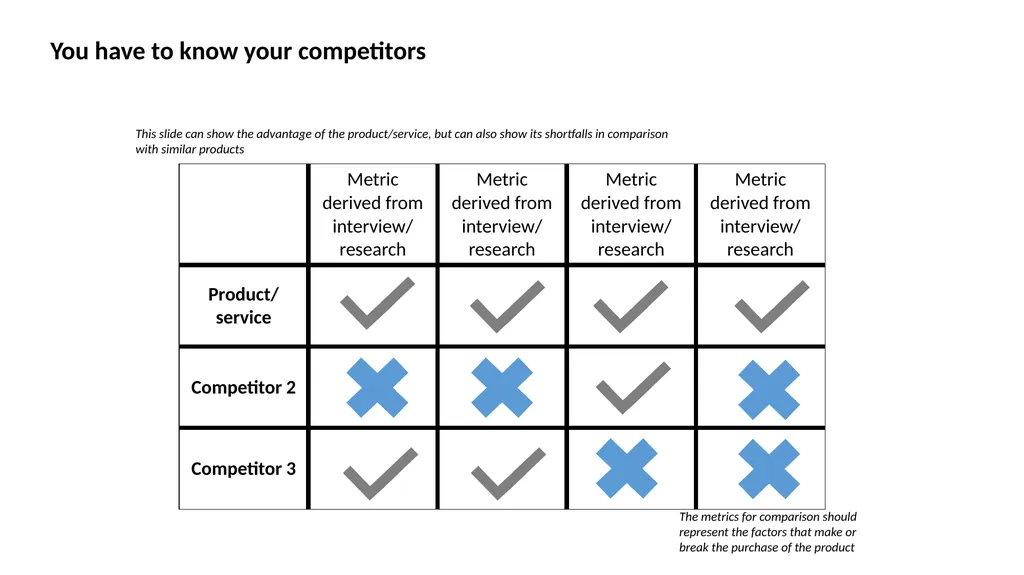
This slide can show the advantage of the product/service, but can also show its shortfalls in comparison with similar products The metrics for comparison should represent the factors that make or break the purchase of the product You have to know your competitors<br>
11
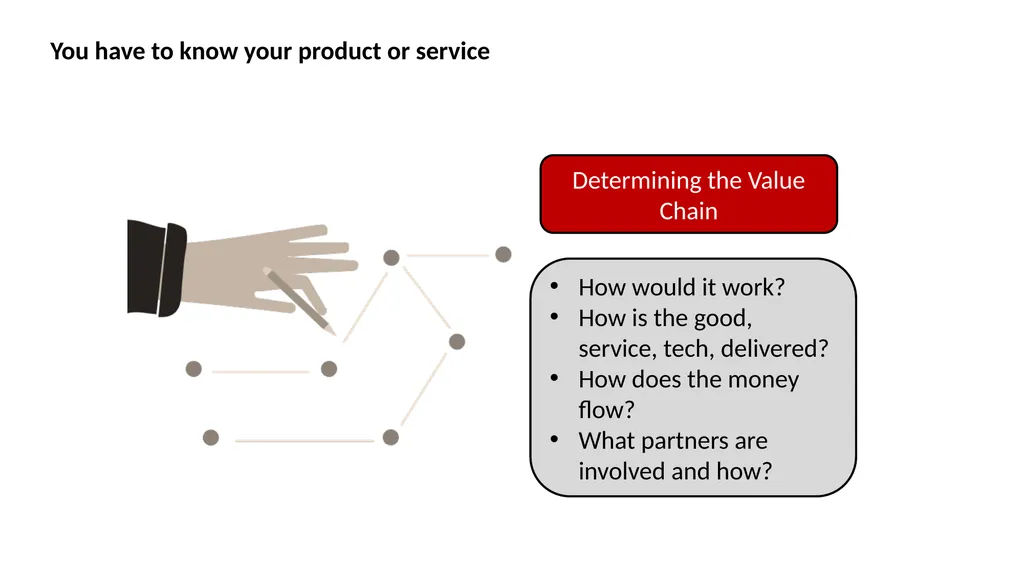
Determining the Value Chain How would it work?
How is the good, service, tech, delivered?
How does the money flow?
What partners are involved and how? You have to know your product or service<br>
How is the good, service, tech, delivered?
How does the money flow?
What partners are involved and how? You have to know your product or service<br>
12
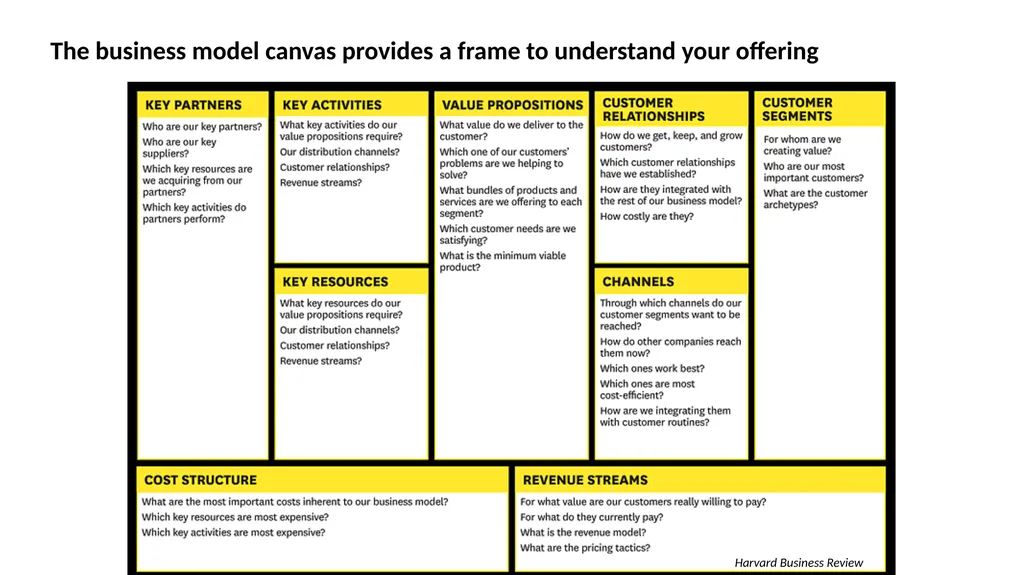
Harvard Business Review The business model canvas provides a frame to understand your offering<br>
13
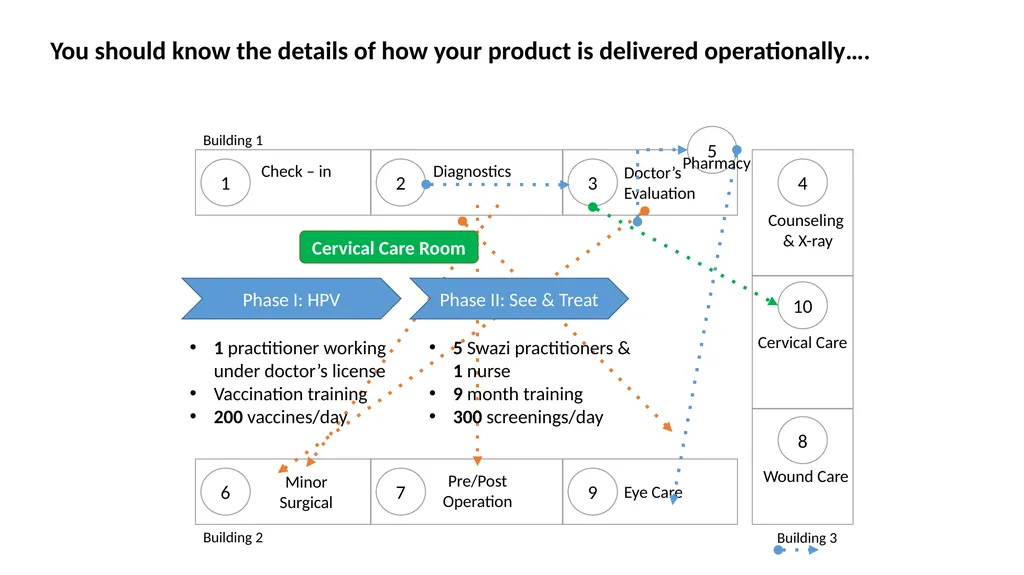
1 8 4 3 2 9 7 6 5 Building 1 Building 2 Building 3 Doctor’s Evaluation Eye Care Pre/Post Operation Minor Surgical Counseling
& X-ray Pharmacy Wound Care Check – in Diagnostics 10 Cervical Care Phase I: HPV Phase II: See & Treat 1 practitioner working under doctor’s license
Vaccination training
200 vaccines/day 5 Swazi practitioners & 1 nurse
9 month training
300 screenings/day Cervical Care Room You should know the details of how your product is delivered operationally….<br>
& X-ray Pharmacy Wound Care Check – in Diagnostics 10 Cervical Care Phase I: HPV Phase II: See & Treat 1 practitioner working under doctor’s license
Vaccination training
200 vaccines/day 5 Swazi practitioners & 1 nurse
9 month training
300 screenings/day Cervical Care Room You should know the details of how your product is delivered operationally….<br>
14
Bruker revenue FY17: $1766 M
Percentage in CALID group: $494.48 M
Bruker Optics share (estimate 11% of market): $54.39 M
Manager estimate of food industry sales (20% of Bruker Optics market): $10.88 M
Estimate of DRIFTS sales (25%): $2.72 M
Estimate of DRIFTS machines sold per year (estimate $2000 per machine): 1350
Sell 50 Buttons @ $1.1 each per machine sold: $74.3K
6% royalty returned to OU: $4.5K Manager estimate of food industry sales (20%) Estimate 60% of customers purchase DRIFTS Estimate $10k cost per machine Division of flow Estimate 11% of market Bruker Optics share: $54.39M Bruker customers in food industry: $10.88 M DRIFTS machines sales: $6.528M Sell 50 Buttons @$1.1 each per machine sold: $35.86K 6% royalty returned to OU: $1.79K DRIFTS machines sold per year: 653 File full utility patent application Pre-licensing requirements Accreditation requirements Bruker revenue FY17: $1766 M
Percentage in CALID group: $494.48 M Percentage in CALID group: $494.48 M Bruker revenue FY17: $1766 M Exclusive license $10K licensing fee +
6% royalty on revenue 10 Buttons for $50 (1288% markup) Sells Buttons to transmission users Complete accuracy and precision tests Best fit manufacturers Manufacturers may apply for ASTM and ANSI requirements Fit criteria Must control a portion of the sampling prep market Experience licensing and developing with universities End users re-verify the device …And you should know the financial implications of the offering Manufacturing and sales End users like academia<br>
Percentage in CALID group: $494.48 M
Bruker Optics share (estimate 11% of market): $54.39 M
Manager estimate of food industry sales (20% of Bruker Optics market): $10.88 M
Estimate of DRIFTS sales (25%): $2.72 M
Estimate of DRIFTS machines sold per year (estimate $2000 per machine): 1350
Sell 50 Buttons @ $1.1 each per machine sold: $74.3K
6% royalty returned to OU: $4.5K Manager estimate of food industry sales (20%) Estimate 60% of customers purchase DRIFTS Estimate $10k cost per machine Division of flow Estimate 11% of market Bruker Optics share: $54.39M Bruker customers in food industry: $10.88 M DRIFTS machines sales: $6.528M Sell 50 Buttons @$1.1 each per machine sold: $35.86K 6% royalty returned to OU: $1.79K DRIFTS machines sold per year: 653 File full utility patent application Pre-licensing requirements Accreditation requirements Bruker revenue FY17: $1766 M
Percentage in CALID group: $494.48 M Percentage in CALID group: $494.48 M Bruker revenue FY17: $1766 M Exclusive license $10K licensing fee +
6% royalty on revenue 10 Buttons for $50 (1288% markup) Sells Buttons to transmission users Complete accuracy and precision tests Best fit manufacturers Manufacturers may apply for ASTM and ANSI requirements Fit criteria Must control a portion of the sampling prep market Experience licensing and developing with universities End users re-verify the device …And you should know the financial implications of the offering Manufacturing and sales End users like academia<br>
15
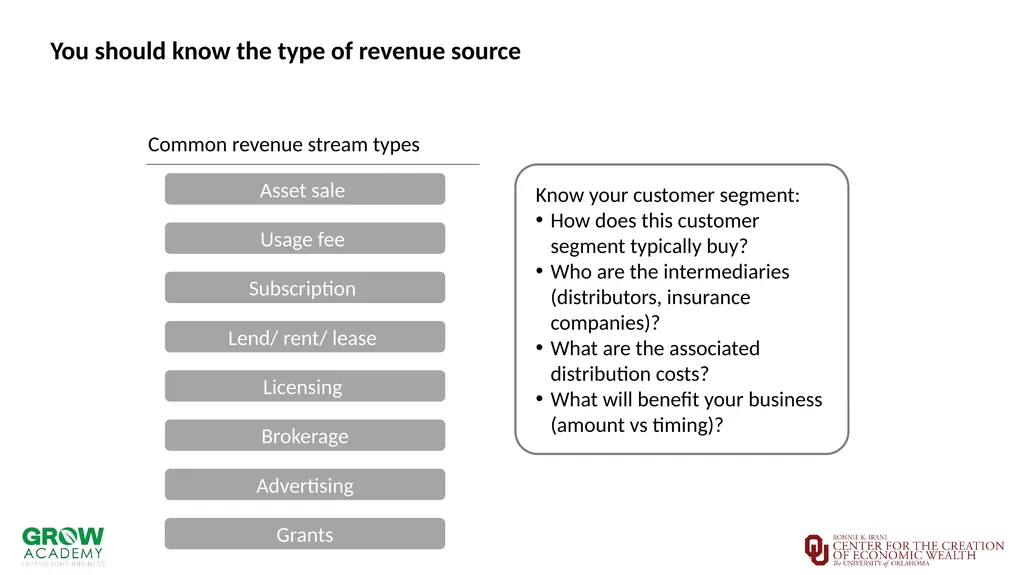
Asset sale Usage fee Subscription Lend/ rent/ lease Licensing Brokerage Advertising Know your customer segment:
How does this customer segment typically buy?
Who are the intermediaries (distributors, insurance companies)?
What are the associated distribution costs?
What will benefit your business (amount vs timing)? Common revenue stream types Grants You should know the type of revenue source<br>
How does this customer segment typically buy?
Who are the intermediaries (distributors, insurance companies)?
What are the associated distribution costs?
What will benefit your business (amount vs timing)? Common revenue stream types Grants You should know the type of revenue source<br>
16
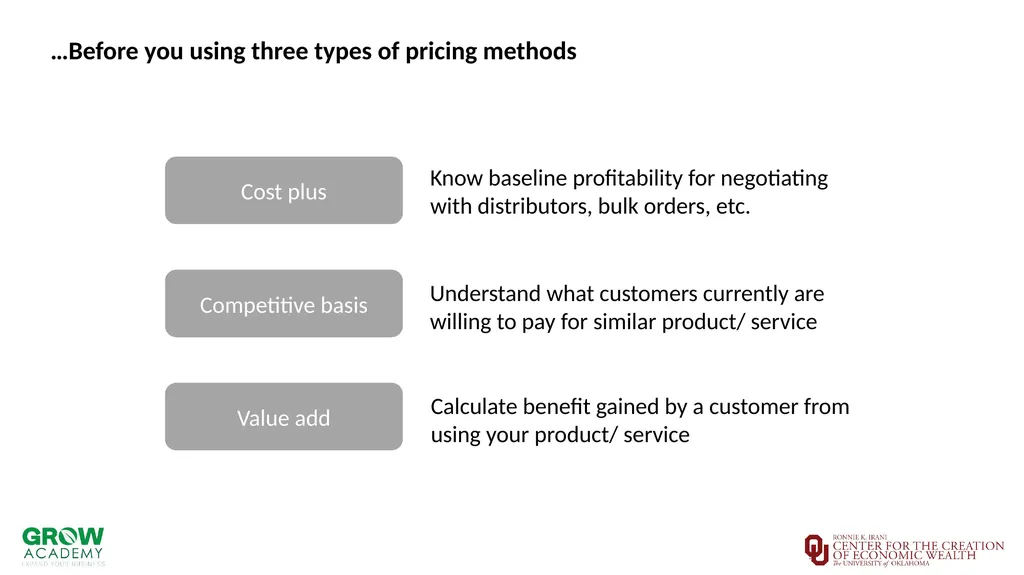
Cost plus Competitive basis Value add Know baseline profitability for negotiating with distributors, bulk orders, etc. Understand what customers currently are willing to pay for similar product/ service Calculate benefit gained by a customer from using your product/ service …Before you using three types of pricing methods<br>
17
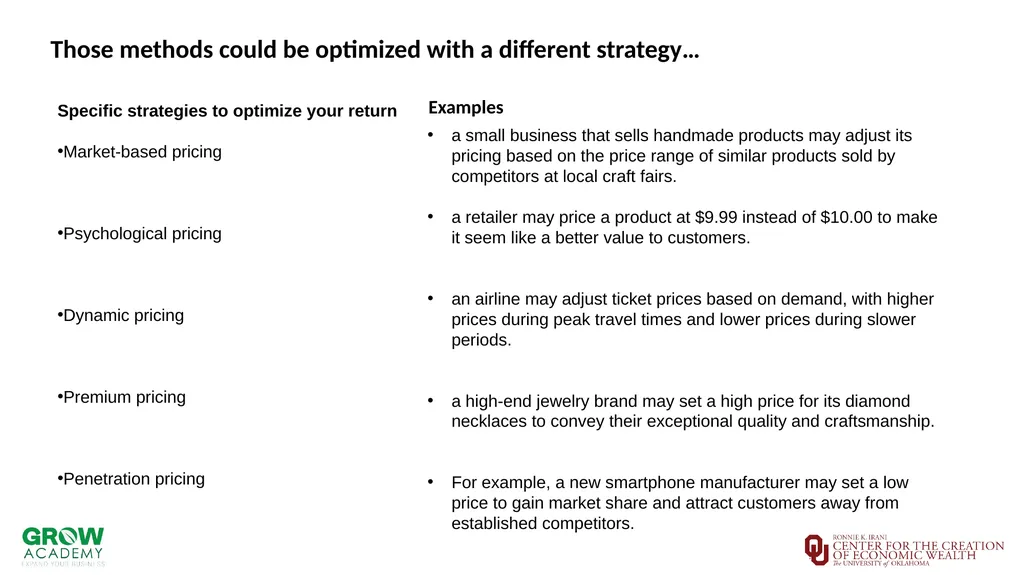
Those methods could be optimized with a different strategy… Specific strategies to optimize your return
Market-based pricing
Psychological pricing
Dynamic pricing
Premium pricing
Penetration pricing a small business that sells handmade products may adjust its pricing based on the price range of similar products sold by competitors at local craft fairs.
a retailer may price a product at $9.99 instead of $10.00 to make it seem like a better value to customers.
an airline may adjust ticket prices based on demand, with higher prices during peak travel times and lower prices during slower periods.
a high-end jewelry brand may set a high price for its diamond necklaces to convey their exceptional quality and craftsmanship.
For example, a new smartphone manufacturer may set a low price to gain market share and attract customers away from established competitors. Examples<br>
Market-based pricing
Psychological pricing
Dynamic pricing
Premium pricing
Penetration pricing a small business that sells handmade products may adjust its pricing based on the price range of similar products sold by competitors at local craft fairs.
a retailer may price a product at $9.99 instead of $10.00 to make it seem like a better value to customers.
an airline may adjust ticket prices based on demand, with higher prices during peak travel times and lower prices during slower periods.
a high-end jewelry brand may set a high price for its diamond necklaces to convey their exceptional quality and craftsmanship.
For example, a new smartphone manufacturer may set a low price to gain market share and attract customers away from established competitors. Examples<br>
18
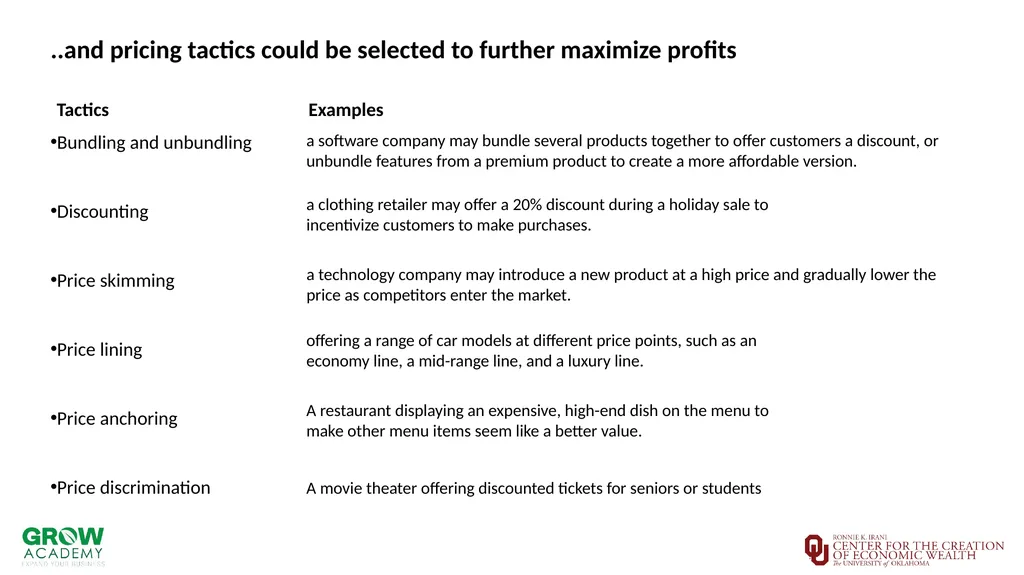
..and pricing tactics could be selected to further maximize profits Bundling and unbundling
Discounting
Price skimming
Price lining
Price anchoring
Price discrimination a technology company may introduce a new product at a high price and gradually lower the price as competitors enter the market. a software company may bundle several products together to offer customers a discount, or unbundle features from a premium product to create a more affordable version. a clothing retailer may offer a 20% discount during a holiday sale to incentivize customers to make purchases. offering a range of car models at different price points, such as an economy line, a mid-range line, and a luxury line. A restaurant displaying an expensive, high-end dish on the menu to make other menu items seem like a better value. A movie theater offering discounted tickets for seniors or students Tactics Examples<br>
Discounting
Price skimming
Price lining
Price anchoring
Price discrimination a technology company may introduce a new product at a high price and gradually lower the price as competitors enter the market. a software company may bundle several products together to offer customers a discount, or unbundle features from a premium product to create a more affordable version. a clothing retailer may offer a 20% discount during a holiday sale to incentivize customers to make purchases. offering a range of car models at different price points, such as an economy line, a mid-range line, and a luxury line. A restaurant displaying an expensive, high-end dish on the menu to make other menu items seem like a better value. A movie theater offering discounted tickets for seniors or students Tactics Examples<br>
19
Conduct surveys
Price Sensitivity Meter (PSM)
Price Rating Scales
Gabor Granger pricing studies
Conjoint analysis
A/B testing
Market research
Trial and error Testing your pricing plan can vary from more research to real world tests "Everybody has a plan until they get punched in the mouth“
-Mike Tyson Testing strategies to get your plan…<br>
Price Sensitivity Meter (PSM)
Price Rating Scales
Gabor Granger pricing studies
Conjoint analysis
A/B testing
Market research
Trial and error Testing your pricing plan can vary from more research to real world tests "Everybody has a plan until they get punched in the mouth“
-Mike Tyson Testing strategies to get your plan…<br>
20
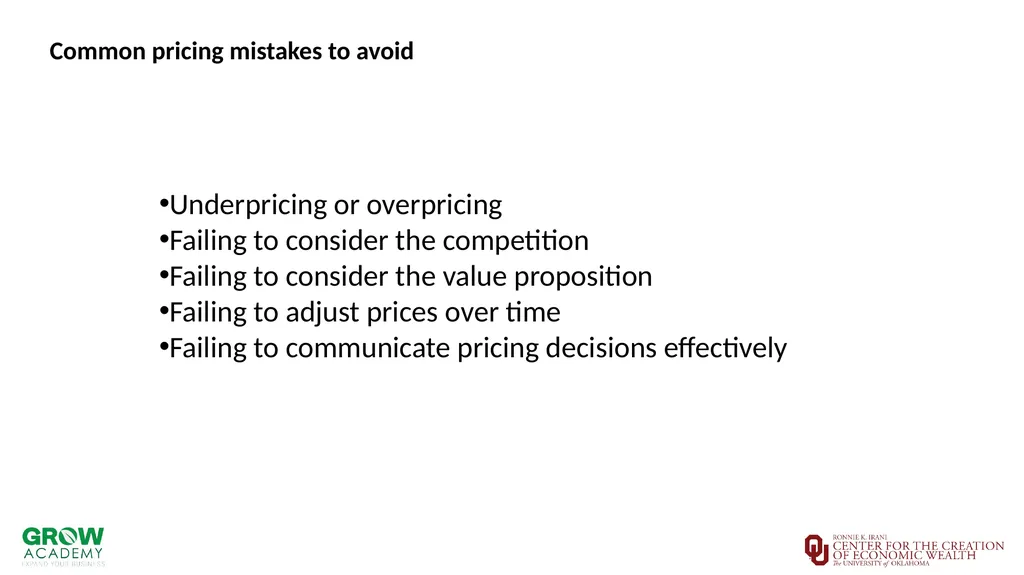
Common pricing mistakes to avoid Underpricing or overpricing
Failing to consider the competition
Failing to consider the value proposition
Failing to adjust prices over time
Failing to communicate pricing decisions effectively<br>
Failing to consider the competition
Failing to consider the value proposition
Failing to adjust prices over time
Failing to communicate pricing decisions effectively<br>
21
Conclusion Pricing requires deep knowledge of your product, market, the target customers, the broader ecosystem, and the competition
There is no silver bullet to choose the best price, the market will tell you
There are many pricing tactics you could use to optimize your return<br>
There is no silver bullet to choose the best price, the market will tell you
There are many pricing tactics you could use to optimize your return<br>
22
Books:
"Priceless: The Myth of Fair Value (and How to Take Advantage of It)" by William Poundstone
"The Strategy and Tactics of Pricing: A Guide to Profitable Decision Making" by Thomas Nagle and John Hogan
"Value-Based Pricing: Drive Sales and Boost Your Bottom Line by Creating, Communicating and Capturing Customer Value" by Harry Macdivitt and Mike Wilkinson
"Pricing for Profit: How to Develop a Powerful Pricing Strategy for Your Business" by Peter Hill
Online resources:
Harvard Business Review - "The Right Way to Manage Unprofitable Customers" by Andreas Hinterhuber and Stephan Liozu
McKinsey & Company - "The Power of Pricing" by Georg Winkler, Scott Keller, and Jim Lattin
Forbes - "The Top 6 Pricing Strategies for Small Businesses" by Hootan Shahidi References for more learning<br>
"Priceless: The Myth of Fair Value (and How to Take Advantage of It)" by William Poundstone
"The Strategy and Tactics of Pricing: A Guide to Profitable Decision Making" by Thomas Nagle and John Hogan
"Value-Based Pricing: Drive Sales and Boost Your Bottom Line by Creating, Communicating and Capturing Customer Value" by Harry Macdivitt and Mike Wilkinson
"Pricing for Profit: How to Develop a Powerful Pricing Strategy for Your Business" by Peter Hill
Online resources:
Harvard Business Review - "The Right Way to Manage Unprofitable Customers" by Andreas Hinterhuber and Stephan Liozu
McKinsey & Company - "The Power of Pricing" by Georg Winkler, Scott Keller, and Jim Lattin
Forbes - "The Top 6 Pricing Strategies for Small Businesses" by Hootan Shahidi References for more learning<br>