Jeopardy! Jeopardy! Final Jeopardy Theorems 1 200 Theorem 6-1 Opposite sides of a parallelogram are . Board Theorems 1 400 Theorem 6-2 Opposite angles of a parallelogram are . Board
Related Topics
Share
Embed code
Download this presentation From Below
"Jeopardy! Jeopardy! Final Jeopardy Theorems #1 –" is the property of its rightful owner. Permission is granted to
download and print the materials on this website for personal, non-commercial use only, and to display it
on your personal computer provided you do not modify the materials and that you retain all copyright
notices contained in the materials. By downloading content from our website, you accept the terms of this
agreement.
Presentation Transcript
01
Jeopardy!<br>
02
Jeopardy! Final Jeopardy<br>
03
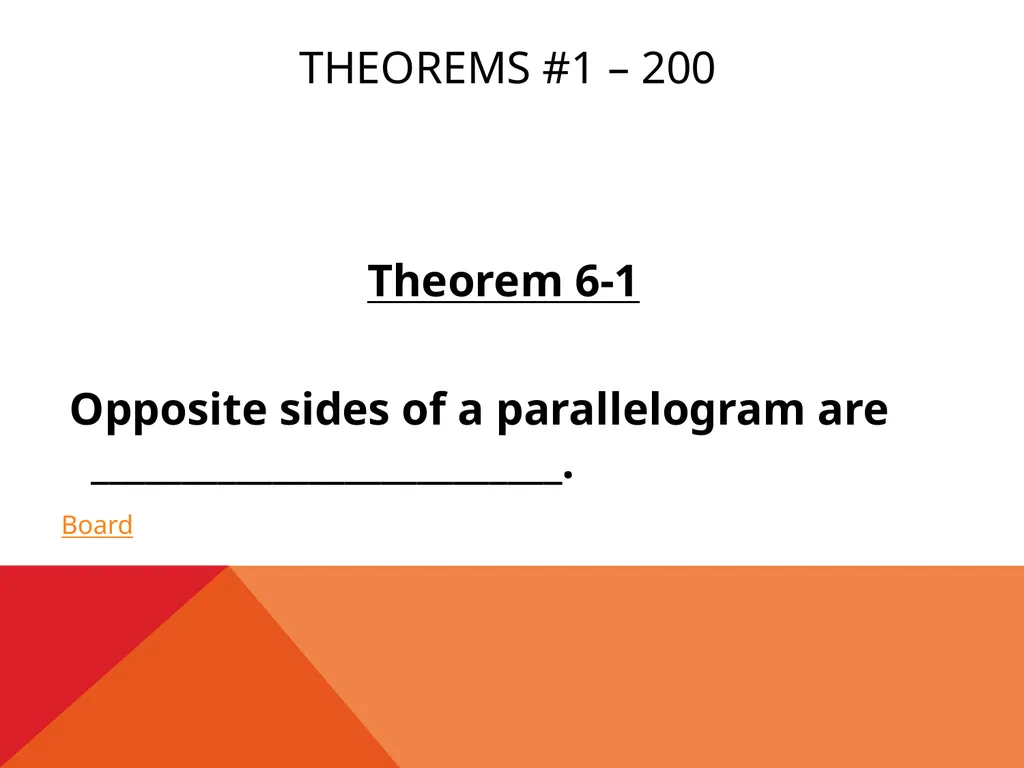
Theorems #1 – 200 Theorem 6-1
Opposite sides of a parallelogram are __________________________. Board<br>
04
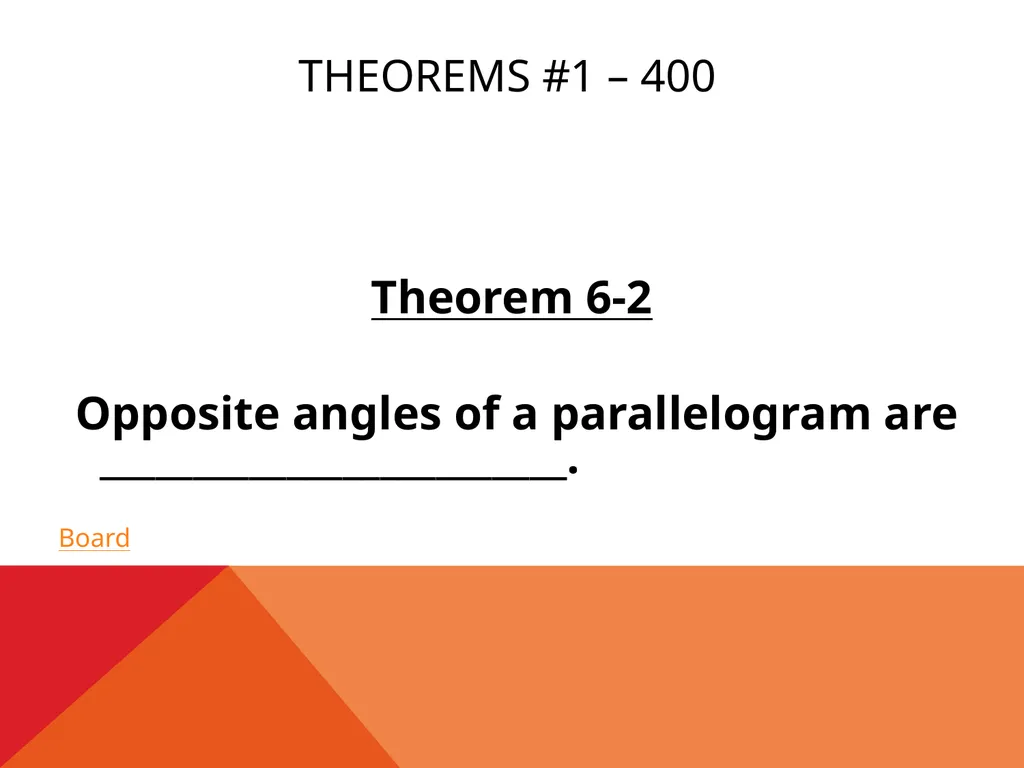
Theorems #1 – 400 Theorem 6-2
Opposite angles of a parallelogram are _________________________. Board<br>
05
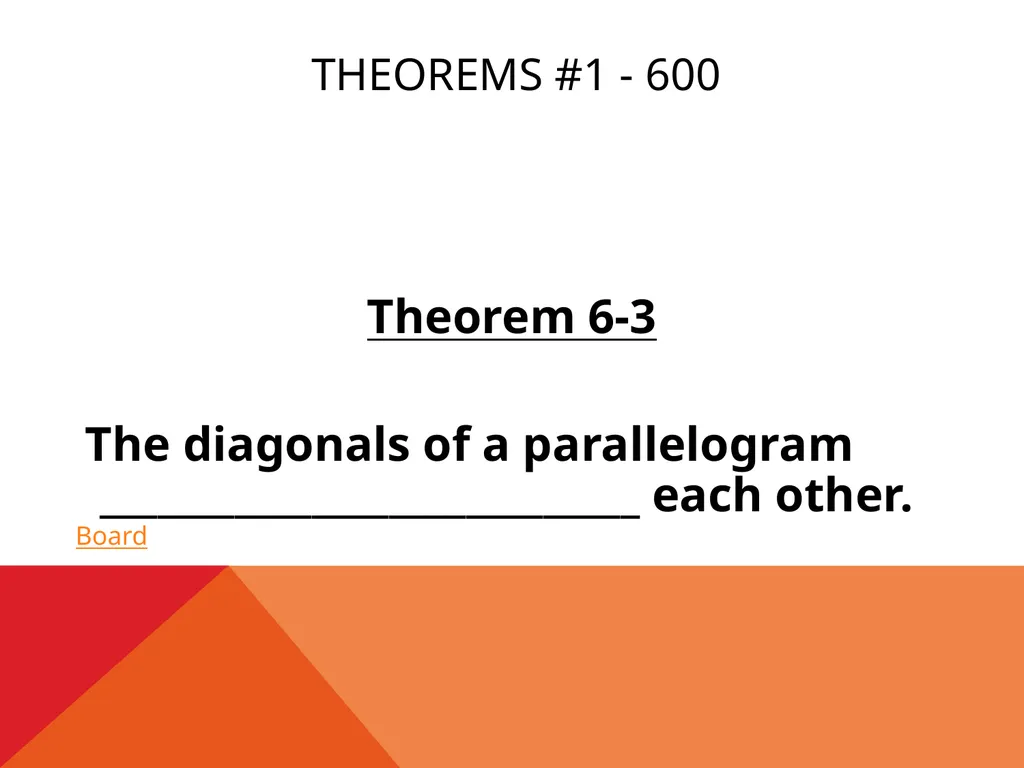
Theorems #1 - 600 Theorem 6-3
The diagonals of a parallelogram ____________________________ each other. Board<br>
06
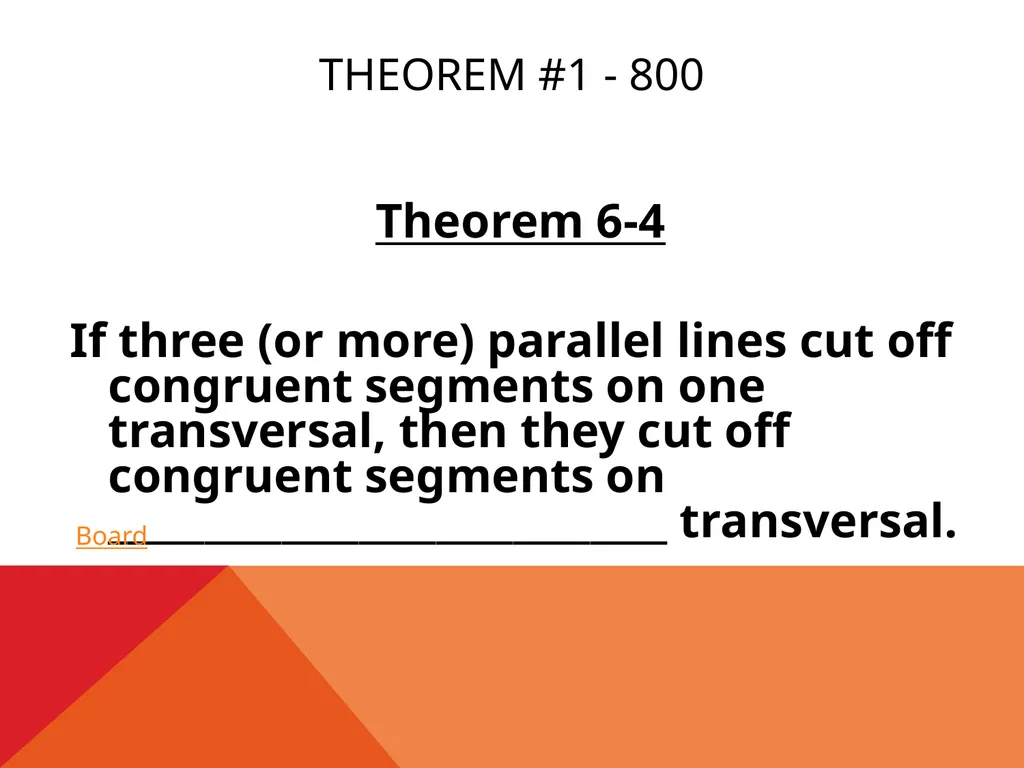
Theorem #1 - 800 Theorem 6-4
If three (or more) parallel lines cut off congruent segments on one transversal, then they cut off congruent segments on _____________________________ transversal. Board<br>
07
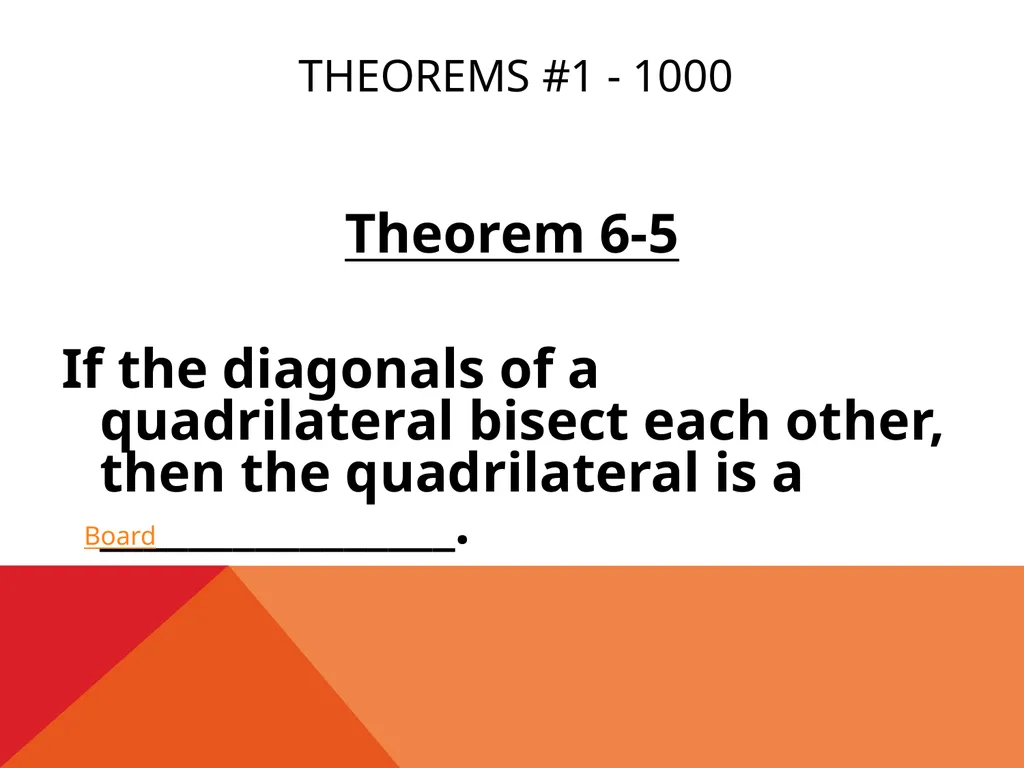
Theorems #1 - 1000 Theorem 6-5
If the diagonals of a quadrilateral bisect each other, then the quadrilateral is a ________________. Board<br>
08
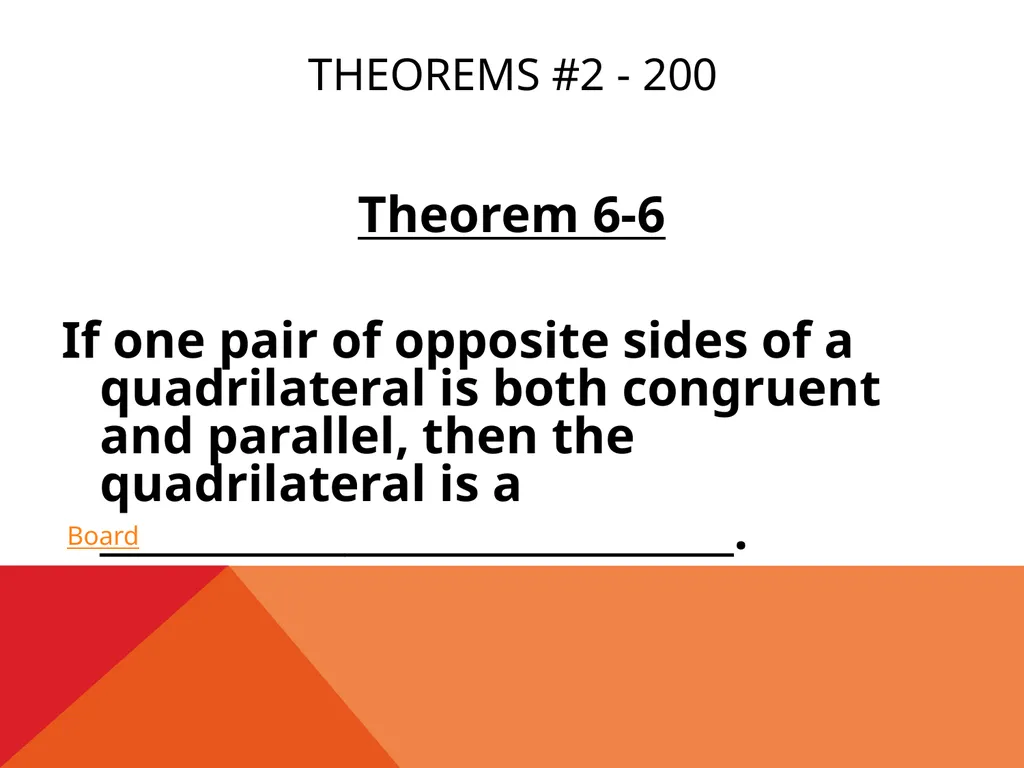
Theorems #2 - 200 Theorem 6-6
If one pair of opposite sides of a quadrilateral is both congruent and parallel, then the quadrilateral is a _______________________________. Board<br>
09
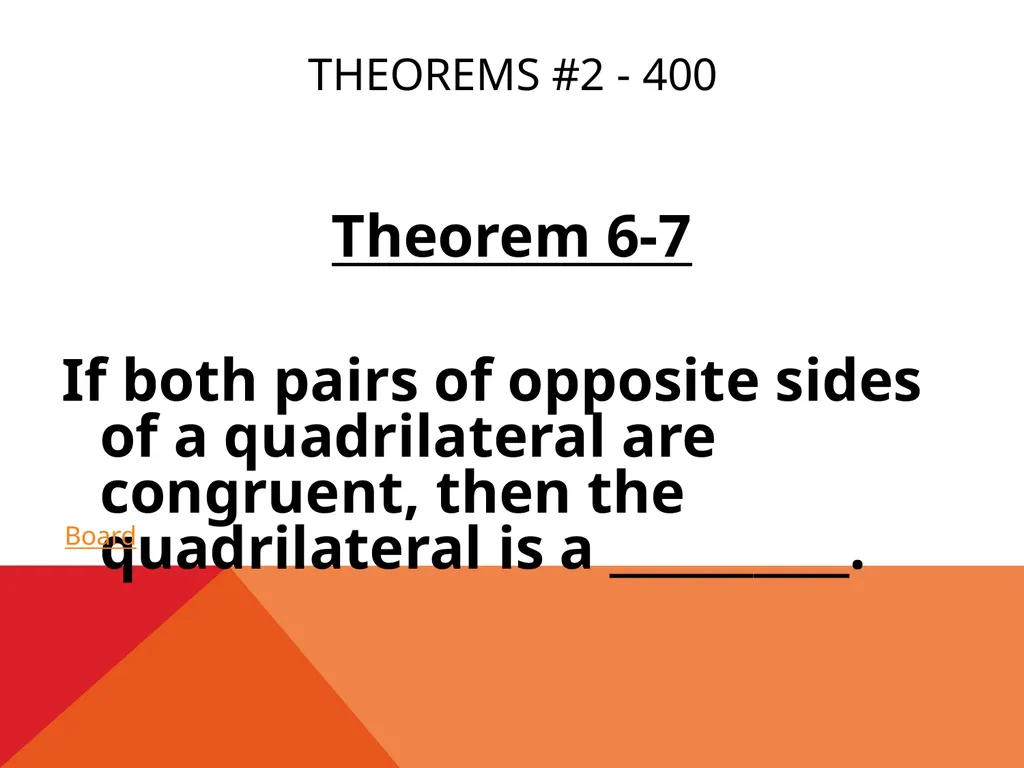
Theorems #2 - 400 Theorem 6-7
If both pairs of opposite sides of a quadrilateral are congruent, then the quadrilateral is a __________. Board<br>
10
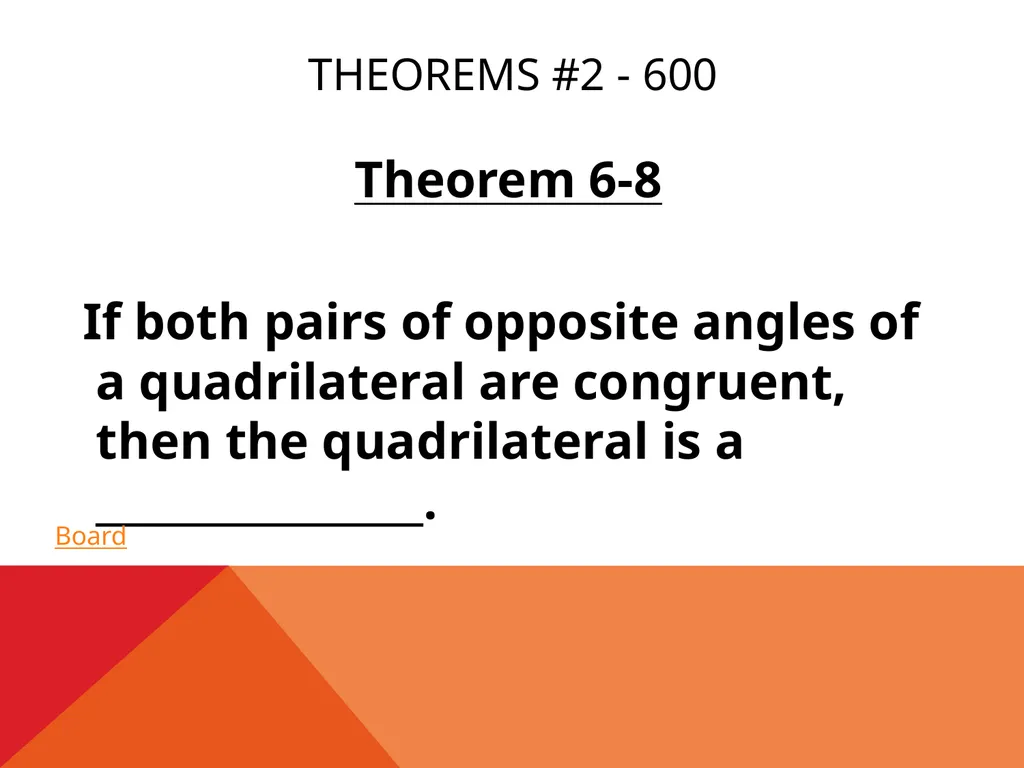
Theorems #2 - 600 Theorem 6-8
If both pairs of opposite angles of a quadrilateral are congruent, then the quadrilateral is a ________________. Board<br>
11
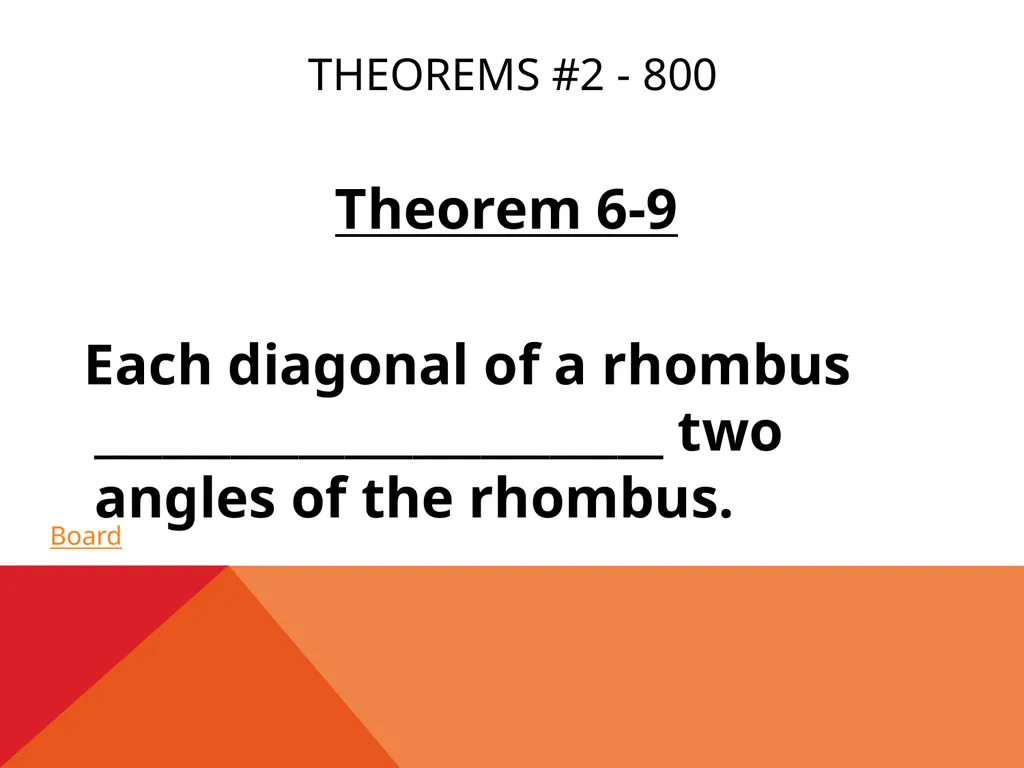
Theorems #2 - 800 Theorem 6-9
Each diagonal of a rhombus _________________________ two angles of the rhombus. Board<br>
12
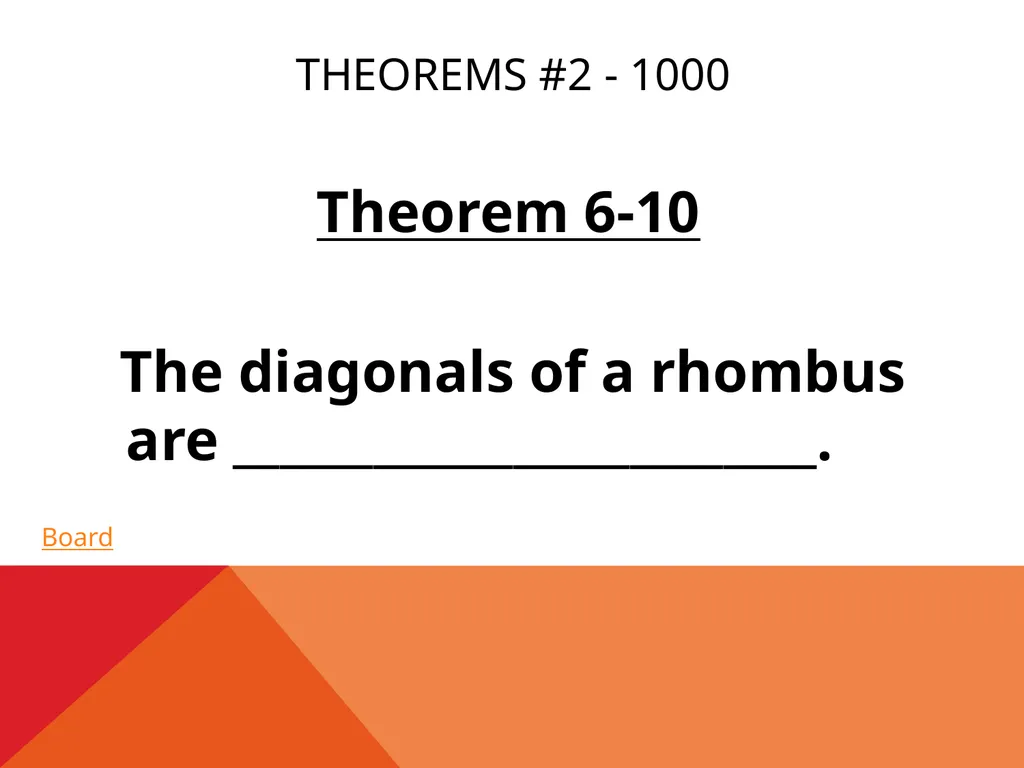
Theorems #2 - 1000 Theorem 6-10
The diagonals of a rhombus are _________________________. Board<br>
13
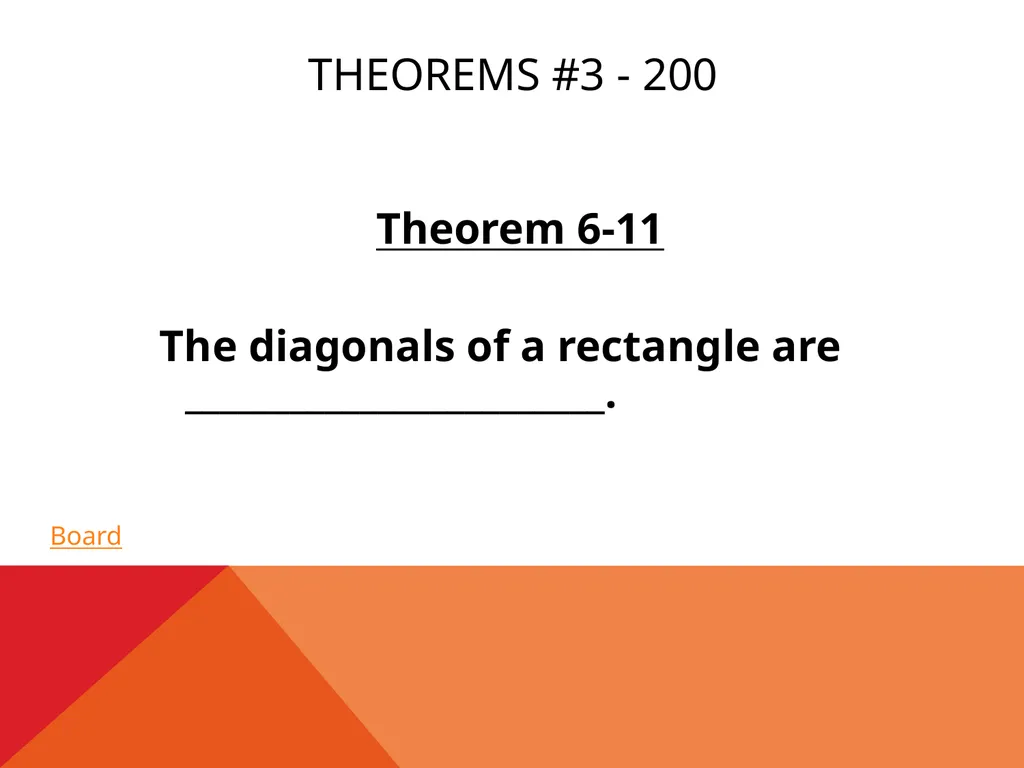
Theorems #3 - 200 Theorem 6-11
The diagonals of a rectangle are ________________________. Board<br>
14
Theorems #3 - 400 Theorem 6-12
If one diagonal of a parallelogram bisects two angles of the parallelogram, then the parallelogram is a ________________________. Board<br>
15
Theorems #3 - 600 Theorem 6-13
If the diagonals of a parallelogram are perpendicular, then the parallelogram is a ________________________________. Board<br>
16
Theorems #3 - 800 Theorem 6-14
If the diagonals of a parallelogram are congruent, then the parallelogram is a ___________________________. Board<br>
17
Theorems #3 - 1000 Board How many theorems did we learn so far in this chapter?<br>
18
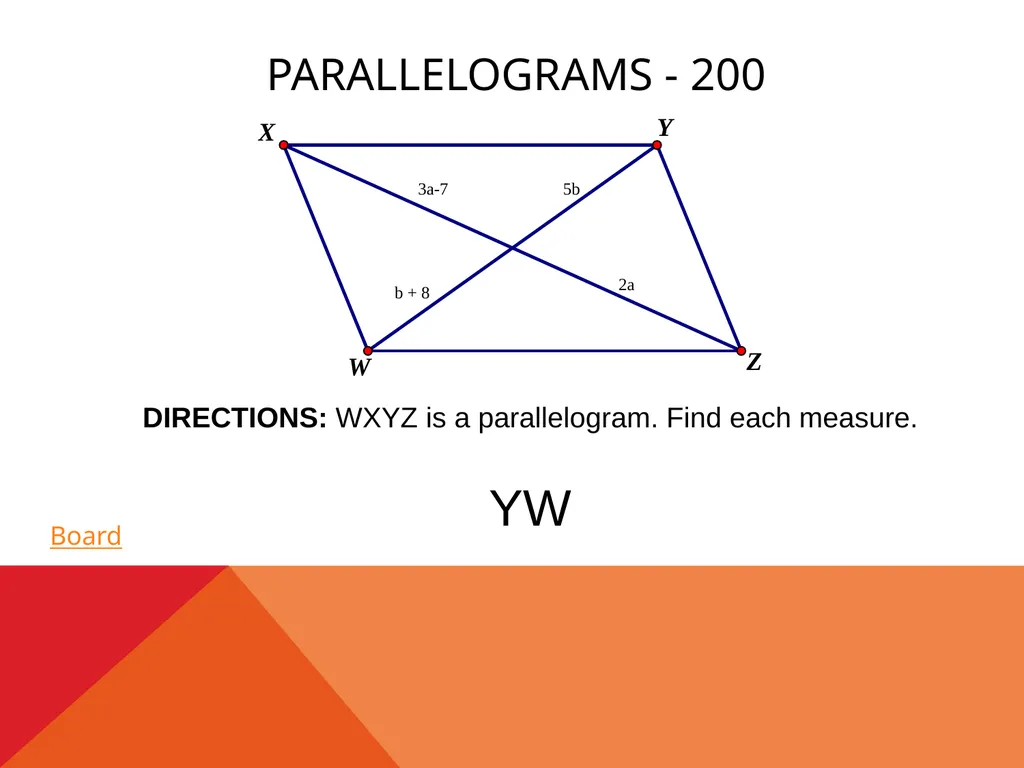
Parallelograms - 200 Board DIRECTIONS: WXYZ is a parallelogram. Find each measure.
YW<br>
19
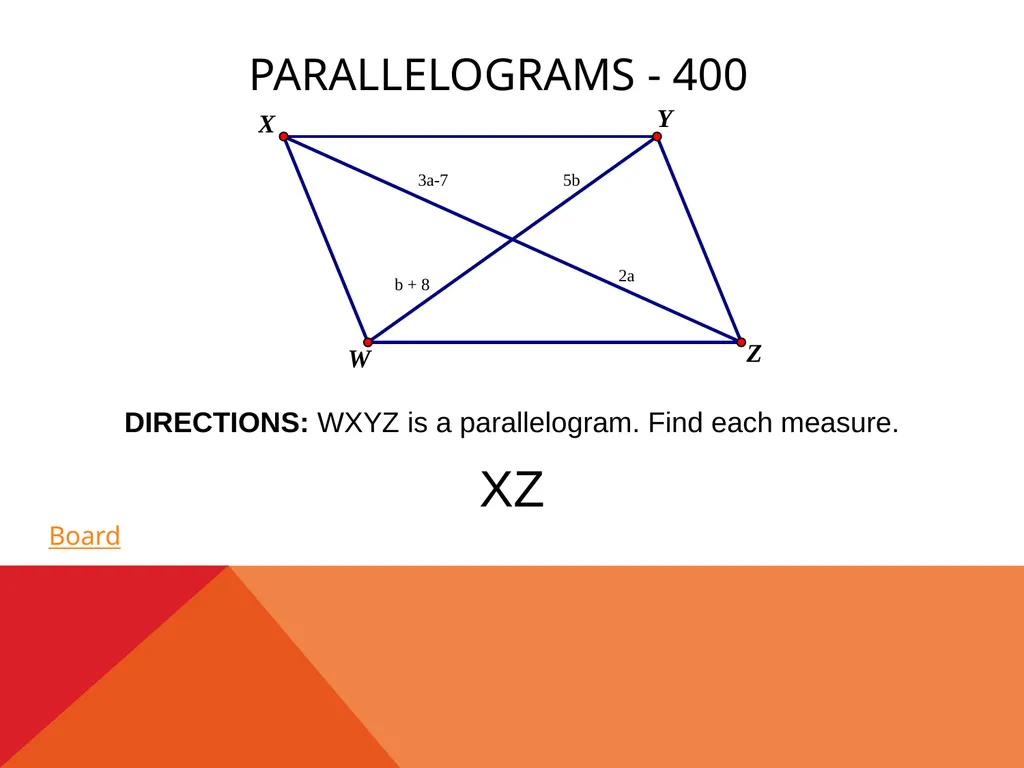
Parallelograms - 400 Board DIRECTIONS: WXYZ is a parallelogram. Find each measure.
XZ<br>
20
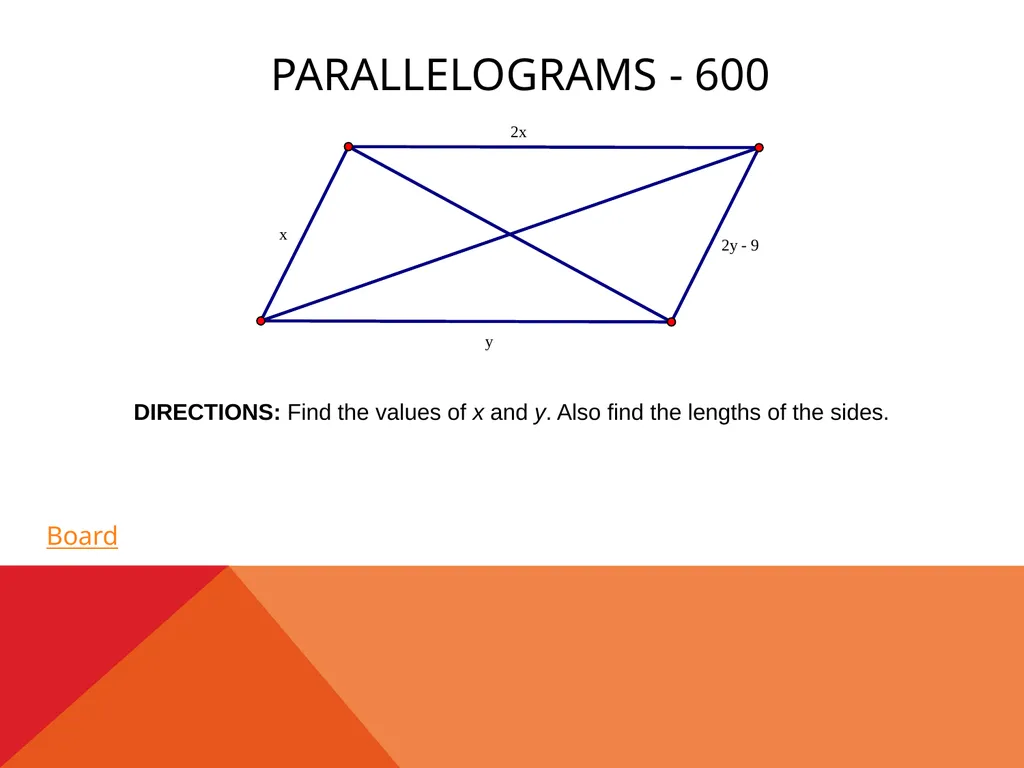
Parallelograms - 600 Board DIRECTIONS: Find the values of x and y. Also find the lengths of the sides.<br>
21
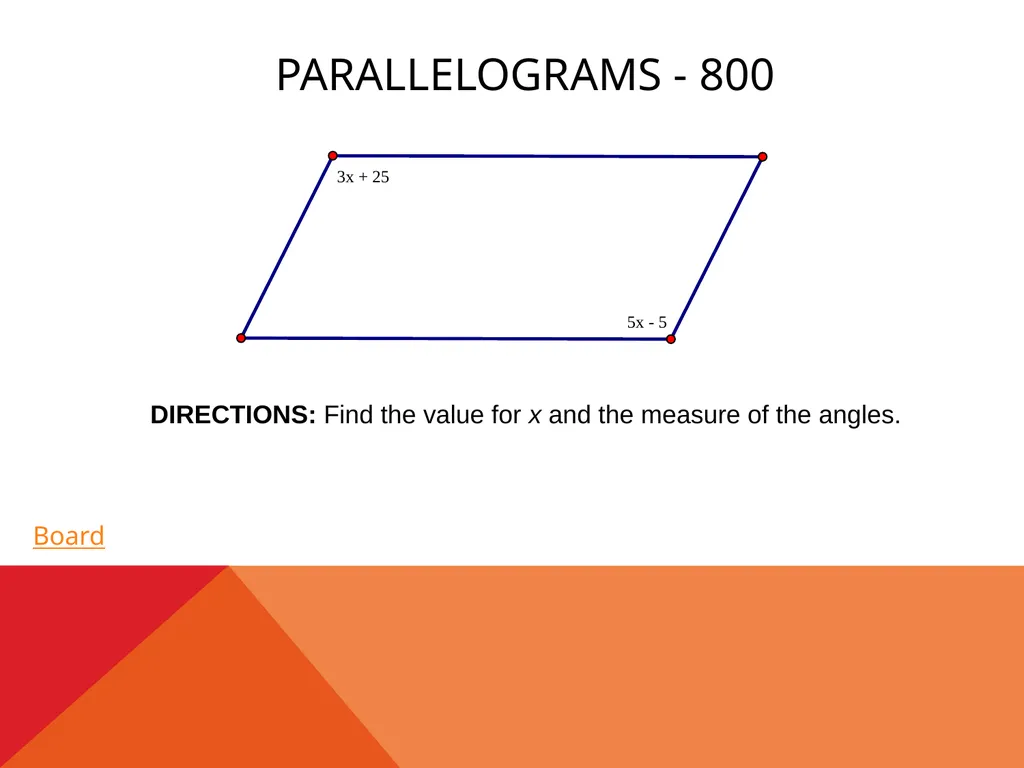
Parallelograms - 800 Board DIRECTIONS: Find the value for x and the measure of the angles.<br>
22
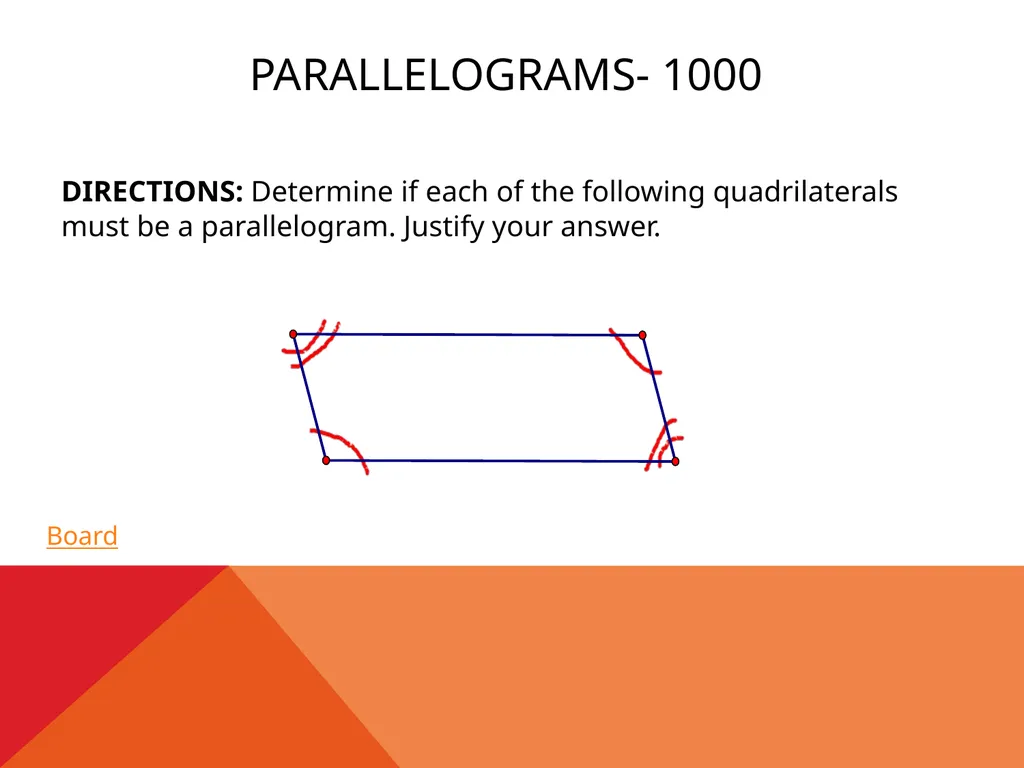
Parallelograms- 1000 Board DIRECTIONS: Determine if each of the following quadrilaterals must be a parallelogram. Justify your answer.<br>
23
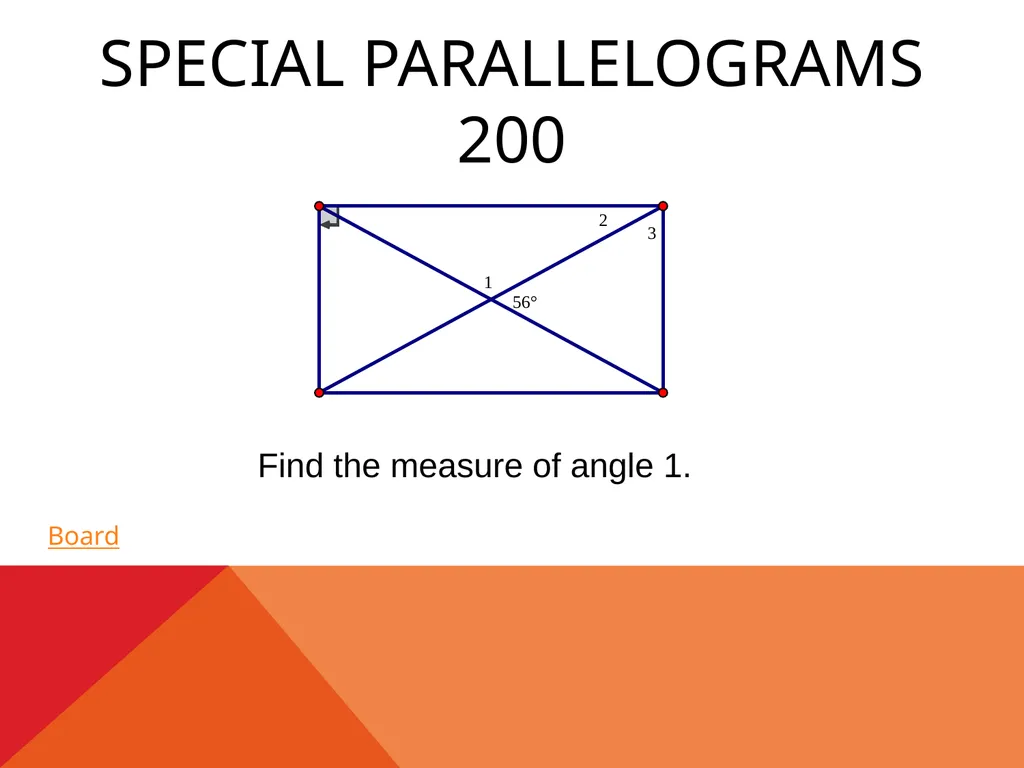
Special parallelograms 200 Board Find the measure of angle 1.<br>
24
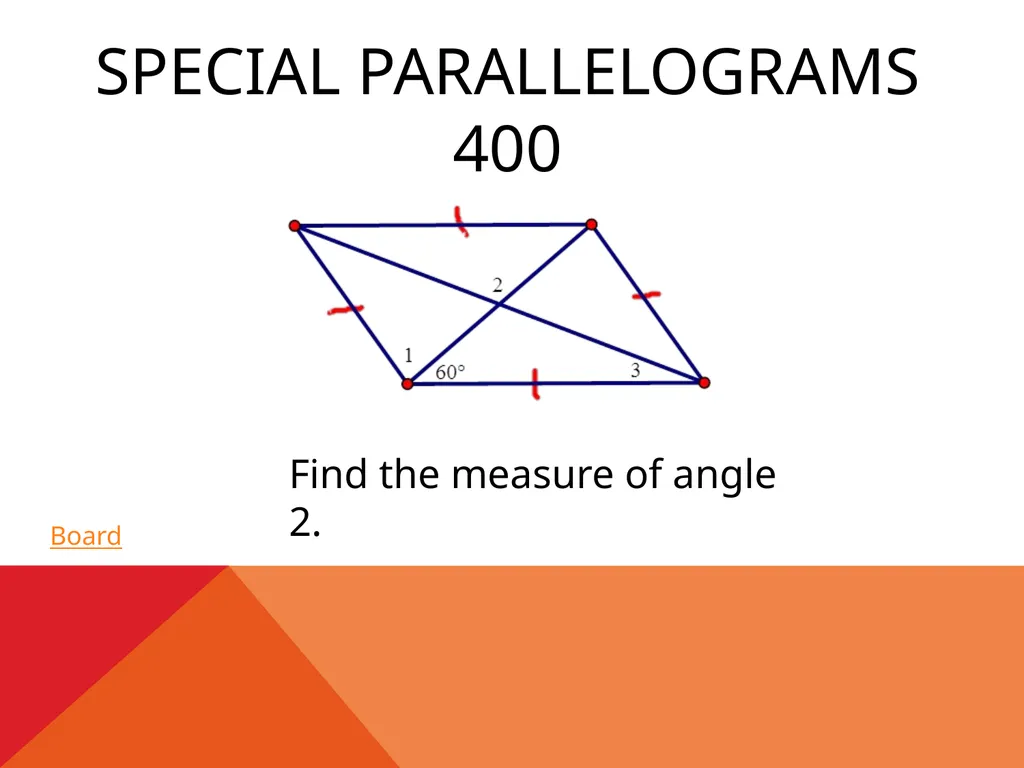
Special parallelograms 400 Board Find the measure of angle 2.<br>
25
Special Parallelograms 600 Board Determine if the following must be a parallelogram. Justify your answer.
Each diagonal is 3 cm long and two opposite sides are 2 cm long.<br>
26
Special Parallelograms 800 Determine if the following must be a parallelogram. Justify your answer.
The diagonals are congruent, but the quadrilateral has no right angles. Board<br>
27
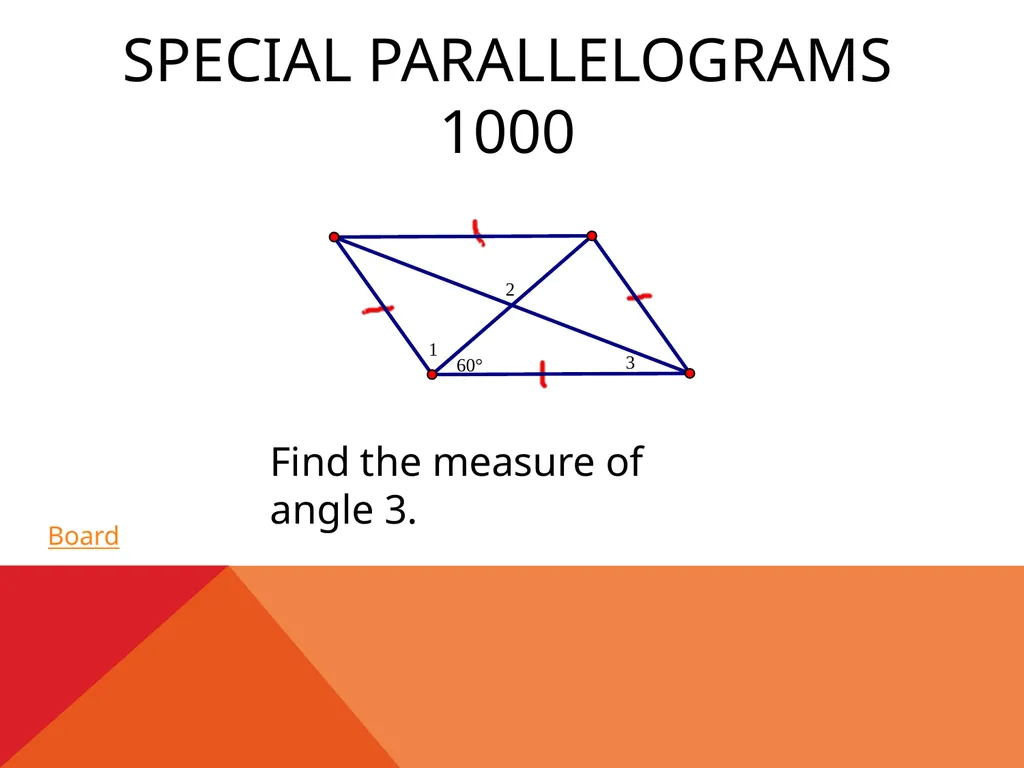
Special parallelograms 1000 Board Find the measure of angle 3.<br>
28
Final Jeopardy! Show that the quadrilateral with the given vertices is a parallelogram. To the clue.<br>
29
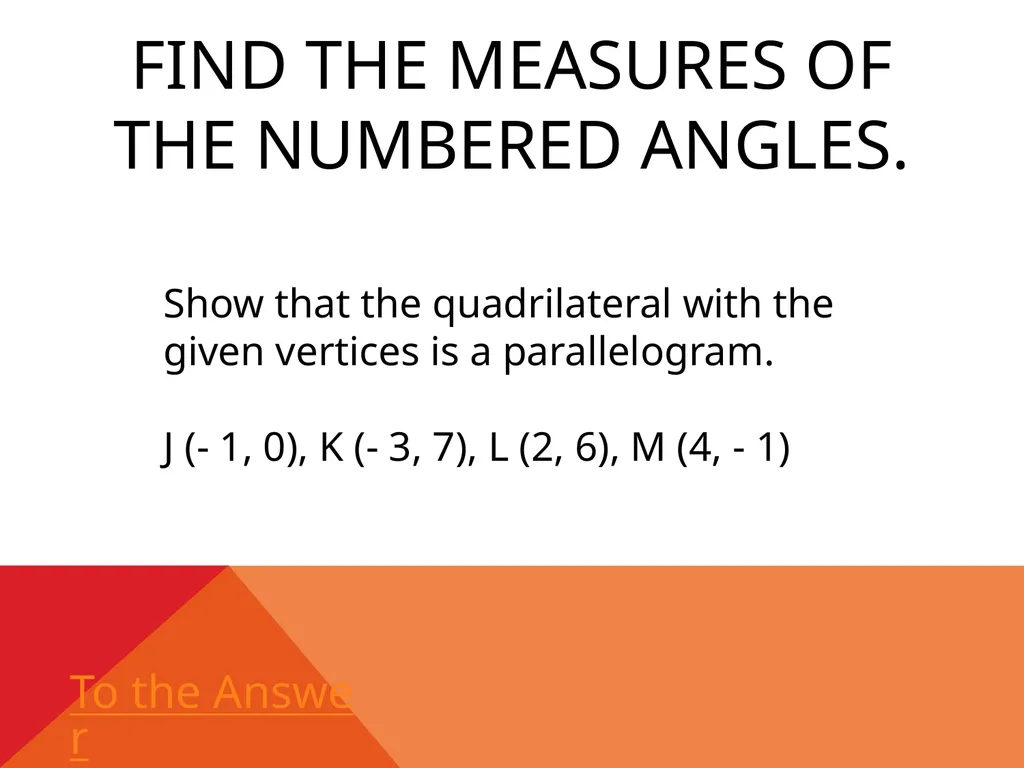
Find the Measures of the numbered angles. To the Answer Show that the quadrilateral with the given vertices is a parallelogram.