
Jesse Leitner, Chief SMA Engineer, NASA GSFC Jesse
GB
Published · 39 slides · 0 views

1 / 1





Description
Jesse Leitner, Chief SMA Engineer, NASA GSFC Jesse dot Leitner at nasa.gov Tupper Hyde Chief Engineer NASA GSFC Phasing COTS parts into low-risk-tolerant missions Outline Electrical, electronic, electromechanical, and electro-optical
Related Topics
Share
Embed code
Download this presentation From Below
"Jesse Leitner, Chief SMA Engineer, NASA GSFC Jesse" is the property of its rightful owner. Permission is granted to download and print the materials on this website for personal, non-commercial use only, and to display it on your personal computer provided you do not modify the materials and that you retain all copyright notices contained in the materials. By downloading content from our website, you accept the terms of this agreement.
Presentation Transcript
01
Jesse Leitner, Chief SMA Engineer, NASA GSFC
Jesse “dot” “Leitner” at “nasa.gov”
Tupper Hyde
Chief Engineer
NASA GSFC Phasing COTS parts into low-risk-tolerant missions<br>
Jesse “dot” “Leitner” at “nasa.gov”
Tupper Hyde
Chief Engineer
NASA GSFC Phasing COTS parts into low-risk-tolerant missions<br>
02
Outline Electrical, electronic, electromechanical, and electro-optical (EEEE) parts assurance history
NASA Electronic Parts and Packaging (NEPP) Program trends
Commercial Off The Shelf (COTS) vs MIL-SPEC dilemma
Current approach of phasing in COTS
Parts Evaluation & Acceptance Laboratory – building (reconstructing) an essential Agency capability
Summary 2<br>
NASA Electronic Parts and Packaging (NEPP) Program trends
Commercial Off The Shelf (COTS) vs MIL-SPEC dilemma
Current approach of phasing in COTS
Parts Evaluation & Acceptance Laboratory – building (reconstructing) an essential Agency capability
Summary 2<br>
03
Updates in Agency guidance and requirements, combined with the results of NESC COTS parts assessments (Phases I & II) as well as mission experience at GSFC and in the wider community, have fueled an expansion in the use of COTS parts within NASA Class D and sub-Class-D robotic missions.
Drastic changes in the balance between government and commercial use of electronics, combined with advances in technology and manufacturing capability, will soon necessitate an inevitable transition to COTS being the dominant class of parts to be used in low risk-tolerance applications and missions.
Analyses and measures used as a basis to justify COTS in applications with a medium to high tolerance for risk may not be sufficient to provide confidence for use in applications with a low tolerance for risk.
Given that application of MIL-SPEC processes exactly as defined is not effective for qualifying and accepting COTS parts, a different approach is needed to enable the use of COTS parts in Class A and B robotic, as well as human space flight missions. Background<br>
Drastic changes in the balance between government and commercial use of electronics, combined with advances in technology and manufacturing capability, will soon necessitate an inevitable transition to COTS being the dominant class of parts to be used in low risk-tolerance applications and missions.
Analyses and measures used as a basis to justify COTS in applications with a medium to high tolerance for risk may not be sufficient to provide confidence for use in applications with a low tolerance for risk.
Given that application of MIL-SPEC processes exactly as defined is not effective for qualifying and accepting COTS parts, a different approach is needed to enable the use of COTS parts in Class A and B robotic, as well as human space flight missions. Background<br>
04
When developing a mission, we need to choose the best parts for the job – they may be MIL-SPEC, they may be COTS, they may be custom
When properly selected, MIL-SPEC and COTS parts can have a basis for reliability
Sometimes there are no parts available or even existing to do the job for the mission that have a basis for reliability
In that case, design practices and system fault tolerance must account for the shortcomings
There are many limitations for MIL-SPEC parts and those limitations are growing as technology and manufacturing evolve
COTS (with no caveats) covers an infinite trade space and critical thinking, sound judgment, and understanding of the concepts of quality and reliability are essential to find the right subset of the trade space
This is not a message to blindly use COTS parts
This is not a message that COTS parts are always the best solution
The best solution comes out of a part-by-part determination that considers performance, reliability, availability of parts, usage constraints, and cost What is the fundamental message, and what isn’t it? Addressing radiation is no different or even more expansive when making broader use of COTS parts<br>
When properly selected, MIL-SPEC and COTS parts can have a basis for reliability
Sometimes there are no parts available or even existing to do the job for the mission that have a basis for reliability
In that case, design practices and system fault tolerance must account for the shortcomings
There are many limitations for MIL-SPEC parts and those limitations are growing as technology and manufacturing evolve
COTS (with no caveats) covers an infinite trade space and critical thinking, sound judgment, and understanding of the concepts of quality and reliability are essential to find the right subset of the trade space
This is not a message to blindly use COTS parts
This is not a message that COTS parts are always the best solution
The best solution comes out of a part-by-part determination that considers performance, reliability, availability of parts, usage constraints, and cost What is the fundamental message, and what isn’t it? Addressing radiation is no different or even more expansive when making broader use of COTS parts<br>
05
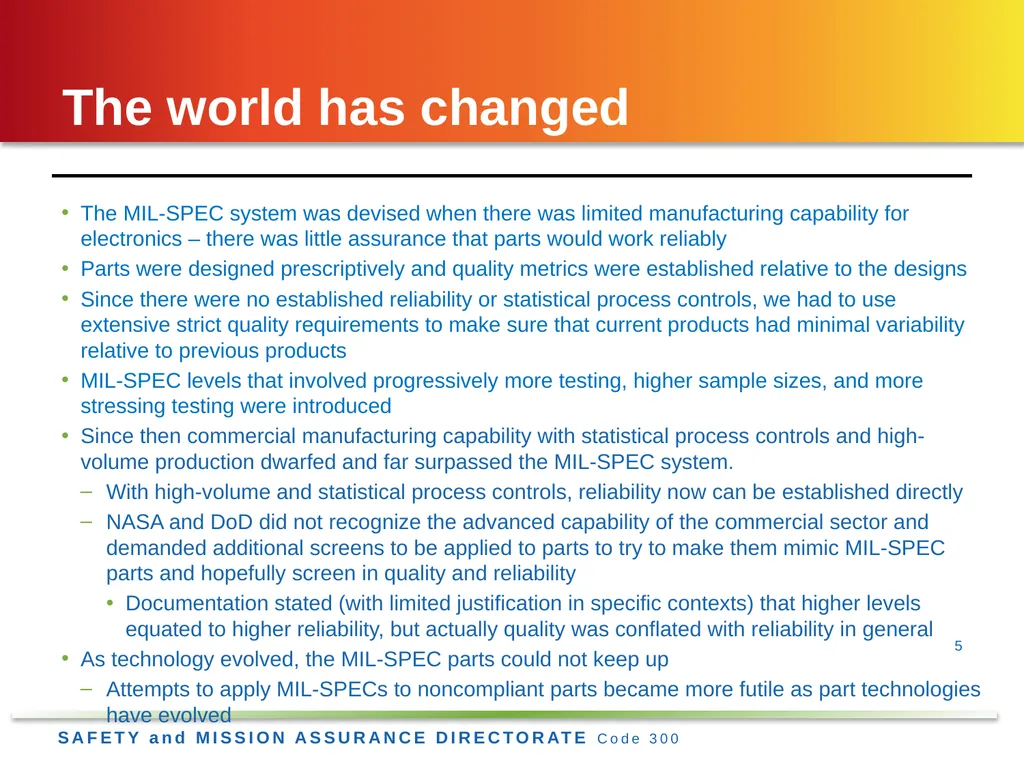
The world has changed The MIL-SPEC system was devised when there was limited manufacturing capability for electronics – there was little assurance that parts would work reliably
Parts were designed prescriptively and quality metrics were established relative to the designs
Since there were no established reliability or statistical process controls, we had to use extensive strict quality requirements to make sure that current products had minimal variability relative to previous products
MIL-SPEC levels that involved progressively more testing, higher sample sizes, and more stressing testing were introduced
Since then commercial manufacturing capability with statistical process controls and high-volume production dwarfed and far surpassed the MIL-SPEC system.
With high-volume and statistical process controls, reliability now can be established directly
NASA and DoD did not recognize the advanced capability of the commercial sector and demanded additional screens to be applied to parts to try to make them mimic MIL-SPEC parts and hopefully screen in quality and reliability
Documentation stated (with limited justification in specific contexts) that higher levels equated to higher reliability, but actually quality was conflated with reliability in general
As technology evolved, the MIL-SPEC parts could not keep up
Attempts to apply MIL-SPECs to noncompliant parts became more futile as part technologies have evolved 5<br>
Parts were designed prescriptively and quality metrics were established relative to the designs
Since there were no established reliability or statistical process controls, we had to use extensive strict quality requirements to make sure that current products had minimal variability relative to previous products
MIL-SPEC levels that involved progressively more testing, higher sample sizes, and more stressing testing were introduced
Since then commercial manufacturing capability with statistical process controls and high-volume production dwarfed and far surpassed the MIL-SPEC system.
With high-volume and statistical process controls, reliability now can be established directly
NASA and DoD did not recognize the advanced capability of the commercial sector and demanded additional screens to be applied to parts to try to make them mimic MIL-SPEC parts and hopefully screen in quality and reliability
Documentation stated (with limited justification in specific contexts) that higher levels equated to higher reliability, but actually quality was conflated with reliability in general
As technology evolved, the MIL-SPEC parts could not keep up
Attempts to apply MIL-SPECs to noncompliant parts became more futile as part technologies have evolved 5<br>
06
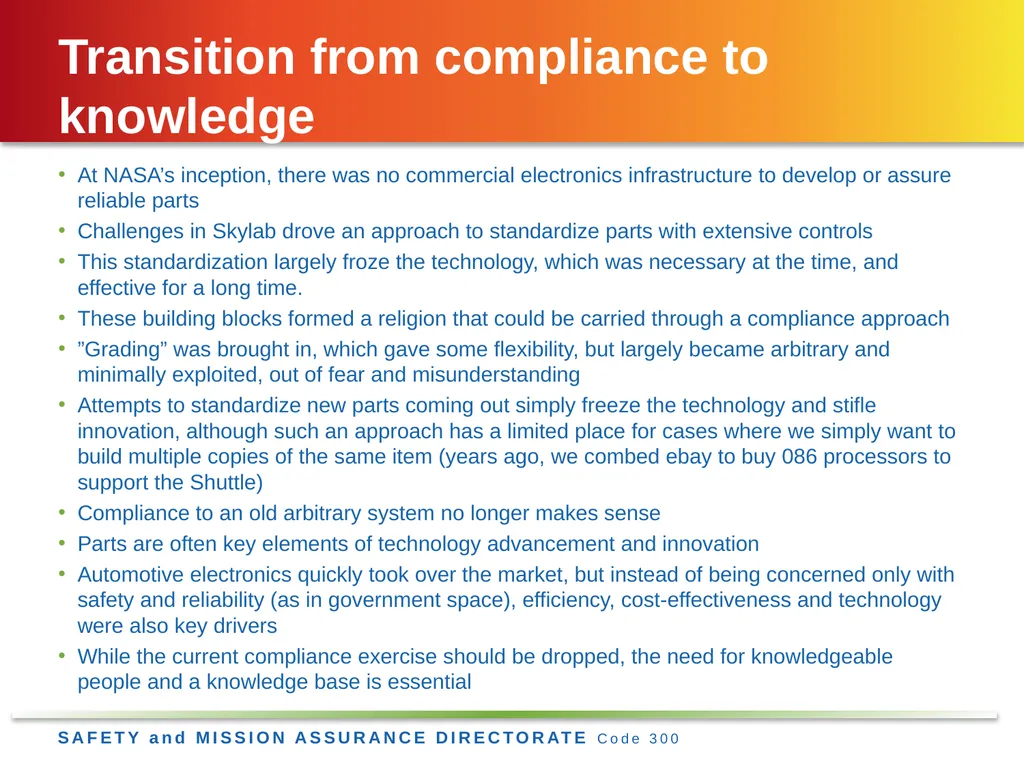
At NASA’s inception, there was no commercial electronics infrastructure to develop or assure reliable parts
Challenges in Skylab drove an approach to standardize parts with extensive controls
This standardization largely froze the technology, which was necessary at the time, and effective for a long time.
These building blocks formed a religion that could be carried through a compliance approach
”Grading” was brought in, which gave some flexibility, but largely became arbitrary and minimally exploited, out of fear and misunderstanding
Attempts to standardize new parts coming out simply freeze the technology and stifle innovation, although such an approach has a limited place for cases where we simply want to build multiple copies of the same item (years ago, we combed ebay to buy 086 processors to support the Shuttle)
Compliance to an old arbitrary system no longer makes sense
Parts are often key elements of technology advancement and innovation
Automotive electronics quickly took over the market, but instead of being concerned only with safety and reliability (as in government space), efficiency, cost-effectiveness and technology were also key drivers
While the current compliance exercise should be dropped, the need for knowledgeable people and a knowledge base is essential Transition from compliance to knowledge<br>
Challenges in Skylab drove an approach to standardize parts with extensive controls
This standardization largely froze the technology, which was necessary at the time, and effective for a long time.
These building blocks formed a religion that could be carried through a compliance approach
”Grading” was brought in, which gave some flexibility, but largely became arbitrary and minimally exploited, out of fear and misunderstanding
Attempts to standardize new parts coming out simply freeze the technology and stifle innovation, although such an approach has a limited place for cases where we simply want to build multiple copies of the same item (years ago, we combed ebay to buy 086 processors to support the Shuttle)
Compliance to an old arbitrary system no longer makes sense
Parts are often key elements of technology advancement and innovation
Automotive electronics quickly took over the market, but instead of being concerned only with safety and reliability (as in government space), efficiency, cost-effectiveness and technology were also key drivers
While the current compliance exercise should be dropped, the need for knowledgeable people and a knowledge base is essential Transition from compliance to knowledge<br>
07
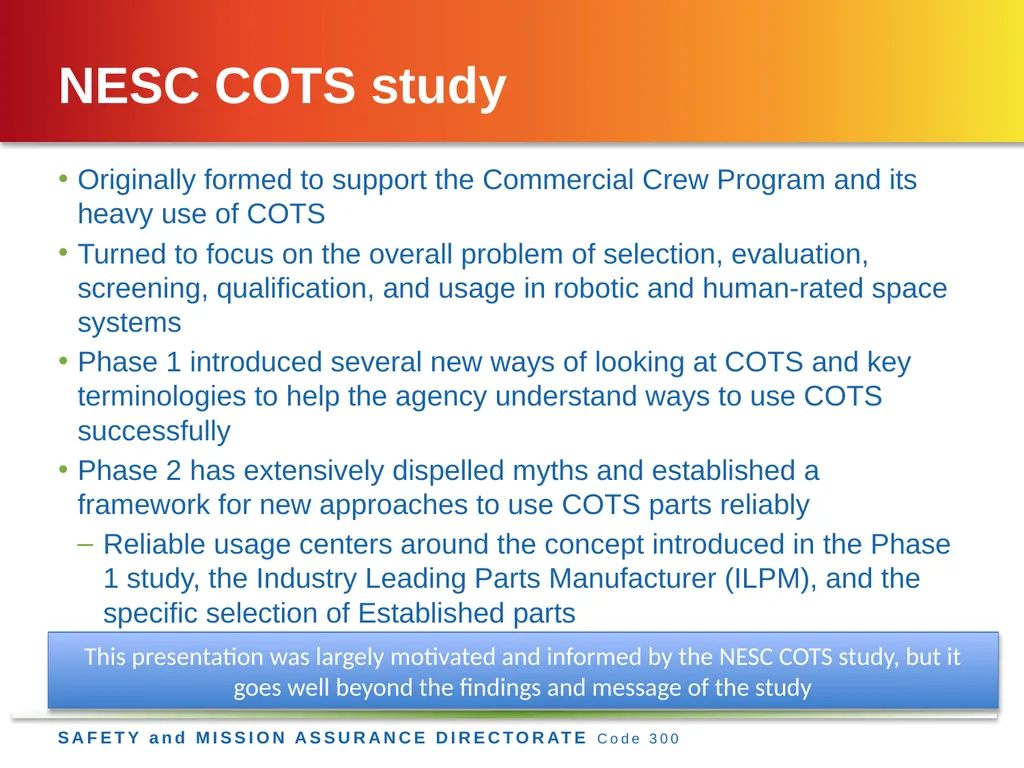
Originally formed to support the Commercial Crew Program and its heavy use of COTS
Turned to focus on the overall problem of selection, evaluation, screening, qualification, and usage in robotic and human-rated space systems
Phase 1 introduced several new ways of looking at COTS and key terminologies to help the agency understand ways to use COTS successfully
Phase 2 has extensively dispelled myths and established a framework for new approaches to use COTS parts reliably
Reliable usage centers around the concept introduced in the Phase 1 study, the Industry Leading Parts Manufacturer (ILPM), and the specific selection of Established parts NESC COTS study This presentation was largely motivated and informed by the NESC COTS study, but it goes well beyond the findings and message of the study<br>
Turned to focus on the overall problem of selection, evaluation, screening, qualification, and usage in robotic and human-rated space systems
Phase 1 introduced several new ways of looking at COTS and key terminologies to help the agency understand ways to use COTS successfully
Phase 2 has extensively dispelled myths and established a framework for new approaches to use COTS parts reliably
Reliable usage centers around the concept introduced in the Phase 1 study, the Industry Leading Parts Manufacturer (ILPM), and the specific selection of Established parts NESC COTS study This presentation was largely motivated and informed by the NESC COTS study, but it goes well beyond the findings and message of the study<br>
08
ILPM: a COTS manufacturer that produces high quality and reliability parts that do not require additional screening and lot conformance testing, common in today’s requirements for using “non-standard” parts in space
Implements a “Zero Defects” program, as described in AEC-Q004 or a similar source.
Designs parts for manufacturability, testability, operating life and fielded reliability.
Manufactures parts on automated, high-volume production lines with minimal human touch labor.
The manufacturer understands and documents all manufacturing and testing processes and the impacts and sensitivities of each process step on product characteristics and quality.
The manufacturer’s end-product testing includes 100% electrical verification of datasheet parameters.
The manufacturer implements rules for removing outlier parts and removing abnormal lots; these rules may apply either in-process or with finished parts.
The manufacturer implements a robust change system that assures all major changes are properly qualified and that customers are notified of major changes
The manufacturer implements a robust Quality Management System acceptable for spaceflight. ILPM Each organization should maintain its own list of ILPMs<br>
Implements a “Zero Defects” program, as described in AEC-Q004 or a similar source.
Designs parts for manufacturability, testability, operating life and fielded reliability.
Manufactures parts on automated, high-volume production lines with minimal human touch labor.
The manufacturer understands and documents all manufacturing and testing processes and the impacts and sensitivities of each process step on product characteristics and quality.
The manufacturer’s end-product testing includes 100% electrical verification of datasheet parameters.
The manufacturer implements rules for removing outlier parts and removing abnormal lots; these rules may apply either in-process or with finished parts.
The manufacturer implements a robust change system that assures all major changes are properly qualified and that customers are notified of major changes
The manufacturer implements a robust Quality Management System acceptable for spaceflight. ILPM Each organization should maintain its own list of ILPMs<br>
09
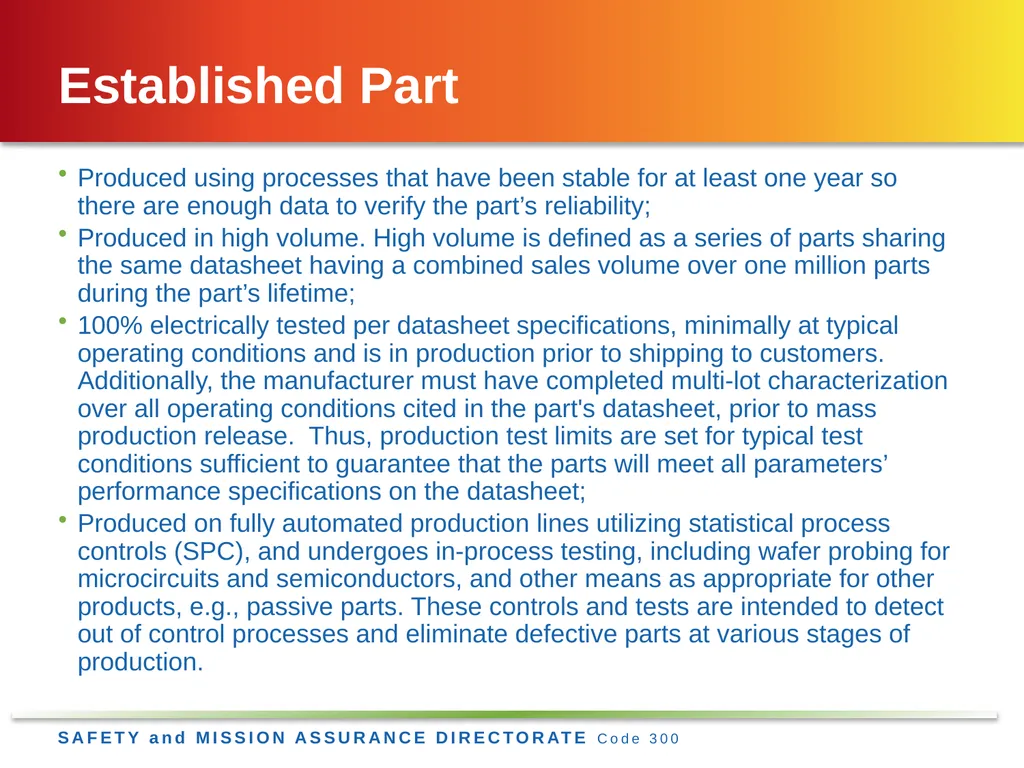
Produced using processes that have been stable for at least one year so there are enough data to verify the part’s reliability;
Produced in high volume. High volume is defined as a series of parts sharing the same datasheet having a combined sales volume over one million parts during the part’s lifetime;
100% electrically tested per datasheet specifications, minimally at typical operating conditions and is in production prior to shipping to customers. Additionally, the manufacturer must have completed multi-lot characterization over all operating conditions cited in the part's datasheet, prior to mass production release. Thus, production test limits are set for typical test conditions sufficient to guarantee that the parts will meet all parameters’ performance specifications on the datasheet;
Produced on fully automated production lines utilizing statistical process controls (SPC), and undergoes in-process testing, including wafer probing for microcircuits and semiconductors, and other means as appropriate for other products, e.g., passive parts. These controls and tests are intended to detect out of control processes and eliminate defective parts at various stages of production. Established Part<br>
Produced in high volume. High volume is defined as a series of parts sharing the same datasheet having a combined sales volume over one million parts during the part’s lifetime;
100% electrically tested per datasheet specifications, minimally at typical operating conditions and is in production prior to shipping to customers. Additionally, the manufacturer must have completed multi-lot characterization over all operating conditions cited in the part's datasheet, prior to mass production release. Thus, production test limits are set for typical test conditions sufficient to guarantee that the parts will meet all parameters’ performance specifications on the datasheet;
Produced on fully automated production lines utilizing statistical process controls (SPC), and undergoes in-process testing, including wafer probing for microcircuits and semiconductors, and other means as appropriate for other products, e.g., passive parts. These controls and tests are intended to detect out of control processes and eliminate defective parts at various stages of production. Established Part<br>
10
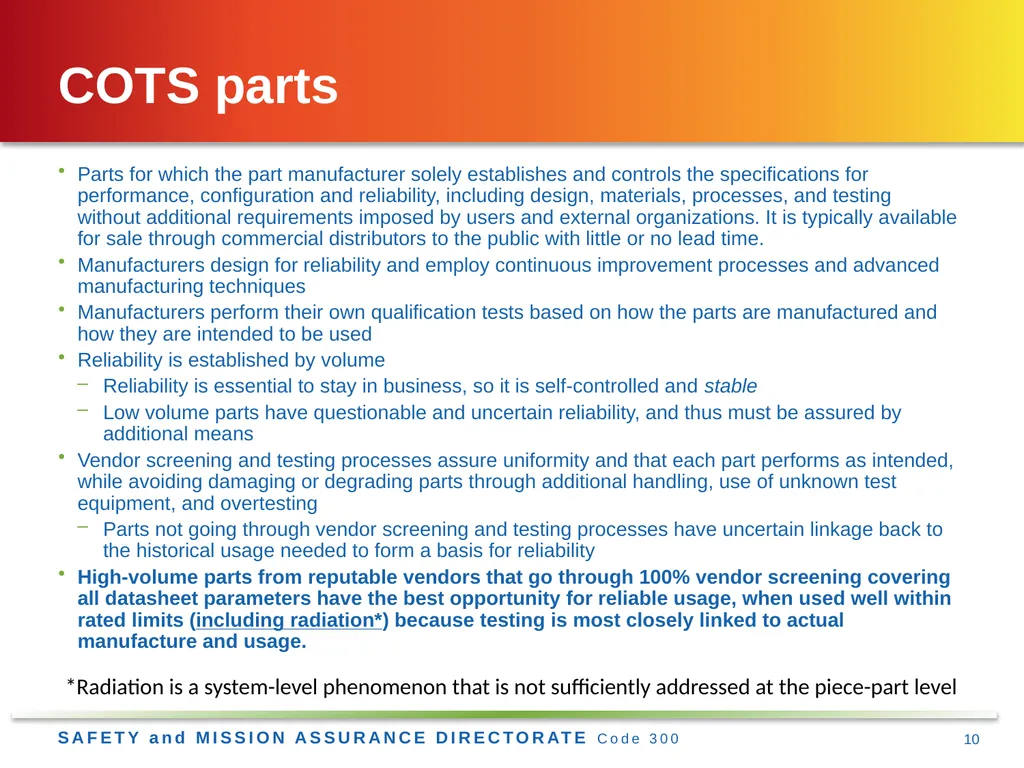
Parts for which the part manufacturer solely establishes and controls the specifications for performance, configuration and reliability, including design, materials, processes, and testing without additional requirements imposed by users and external organizations. It is typically available for sale through commercial distributors to the public with little or no lead time.
Manufacturers design for reliability and employ continuous improvement processes and advanced manufacturing techniques
Manufacturers perform their own qualification tests based on how the parts are manufactured and how they are intended to be used
Reliability is established by volume
Reliability is essential to stay in business, so it is self-controlled and stable
Low volume parts have questionable and uncertain reliability, and thus must be assured by additional means
Vendor screening and testing processes assure uniformity and that each part performs as intended, while avoiding damaging or degrading parts through additional handling, use of unknown test equipment, and overtesting
Parts not going through vendor screening and testing processes have uncertain linkage back to the historical usage needed to form a basis for reliability
High-volume parts from reputable vendors that go through 100% vendor screening covering all datasheet parameters have the best opportunity for reliable usage, when used well within rated limits (including radiation*) because testing is most closely linked to actual manufacture and usage. COTS parts 10 *Radiation is a system-level phenomenon that is not sufficiently addressed at the piece-part level<br>
Manufacturers design for reliability and employ continuous improvement processes and advanced manufacturing techniques
Manufacturers perform their own qualification tests based on how the parts are manufactured and how they are intended to be used
Reliability is established by volume
Reliability is essential to stay in business, so it is self-controlled and stable
Low volume parts have questionable and uncertain reliability, and thus must be assured by additional means
Vendor screening and testing processes assure uniformity and that each part performs as intended, while avoiding damaging or degrading parts through additional handling, use of unknown test equipment, and overtesting
Parts not going through vendor screening and testing processes have uncertain linkage back to the historical usage needed to form a basis for reliability
High-volume parts from reputable vendors that go through 100% vendor screening covering all datasheet parameters have the best opportunity for reliable usage, when used well within rated limits (including radiation*) because testing is most closely linked to actual manufacture and usage. COTS parts 10 *Radiation is a system-level phenomenon that is not sufficiently addressed at the piece-part level<br>
11
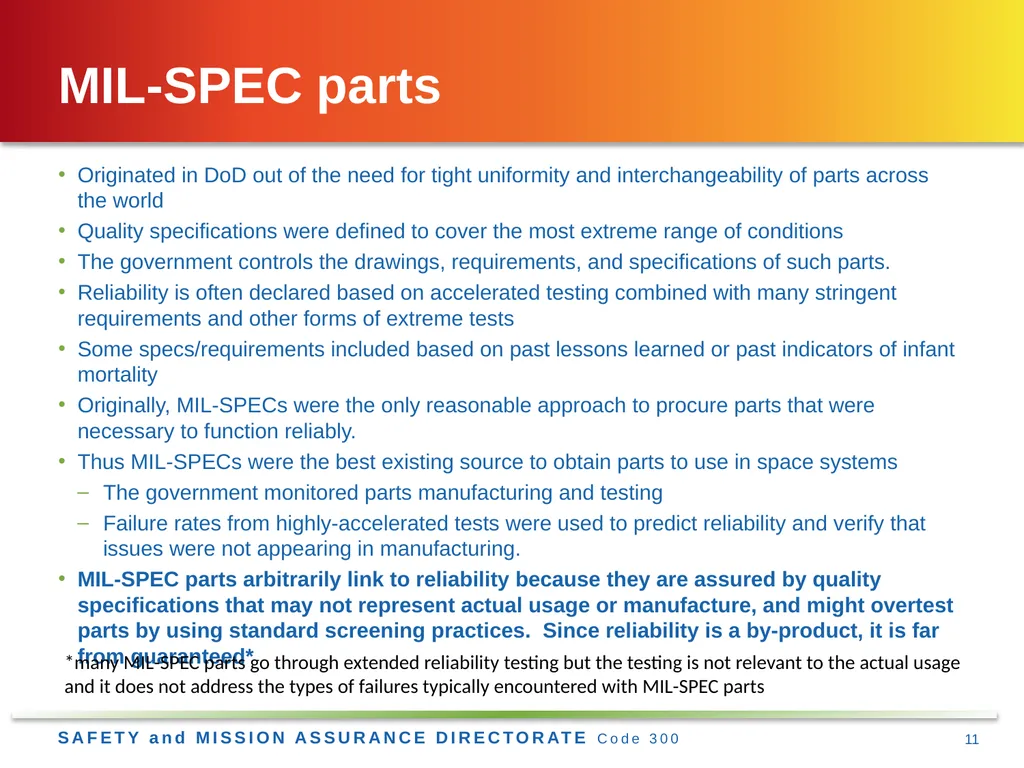
Originated in DoD out of the need for tight uniformity and interchangeability of parts across the world
Quality specifications were defined to cover the most extreme range of conditions
The government controls the drawings, requirements, and specifications of such parts.
Reliability is often declared based on accelerated testing combined with many stringent requirements and other forms of extreme tests
Some specs/requirements included based on past lessons learned or past indicators of infant mortality
Originally, MIL-SPECs were the only reasonable approach to procure parts that were necessary to function reliably.
Thus MIL-SPECs were the best existing source to obtain parts to use in space systems
The government monitored parts manufacturing and testing
Failure rates from highly-accelerated tests were used to predict reliability and verify that issues were not appearing in manufacturing.
MIL-SPEC parts arbitrarily link to reliability because they are assured by quality specifications that may not represent actual usage or manufacture, and might overtest parts by using standard screening practices. Since reliability is a by-product, it is far from guaranteed* MIL-SPEC parts 11 *many MIL-SPEC parts go through extended reliability testing but the testing is not relevant to the actual usage and it does not address the types of failures typically encountered with MIL-SPEC parts<br>
Quality specifications were defined to cover the most extreme range of conditions
The government controls the drawings, requirements, and specifications of such parts.
Reliability is often declared based on accelerated testing combined with many stringent requirements and other forms of extreme tests
Some specs/requirements included based on past lessons learned or past indicators of infant mortality
Originally, MIL-SPECs were the only reasonable approach to procure parts that were necessary to function reliably.
Thus MIL-SPECs were the best existing source to obtain parts to use in space systems
The government monitored parts manufacturing and testing
Failure rates from highly-accelerated tests were used to predict reliability and verify that issues were not appearing in manufacturing.
MIL-SPEC parts arbitrarily link to reliability because they are assured by quality specifications that may not represent actual usage or manufacture, and might overtest parts by using standard screening practices. Since reliability is a by-product, it is far from guaranteed* MIL-SPEC parts 11 *many MIL-SPEC parts go through extended reliability testing but the testing is not relevant to the actual usage and it does not address the types of failures typically encountered with MIL-SPEC parts<br>
12
COTS parts that are screened and/or qualified (level 1 or 2) using MIL-HDBKs via a document such as EEE-INST-002.
Reliability is equivalent to that of COTS parts except that MIL-SPEC tests are applied to the parts, resulting in extra handling and frequent overtesting relative to the part application and often to its datasheet. Thus this option provides the greatest uncertainty for reliability, especially if the COTS parts are low volume or low quality to start with. NASA-screened COTS parts 12<br>
Reliability is equivalent to that of COTS parts except that MIL-SPEC tests are applied to the parts, resulting in extra handling and frequent overtesting relative to the part application and often to its datasheet. Thus this option provides the greatest uncertainty for reliability, especially if the COTS parts are low volume or low quality to start with. NASA-screened COTS parts 12<br>
13
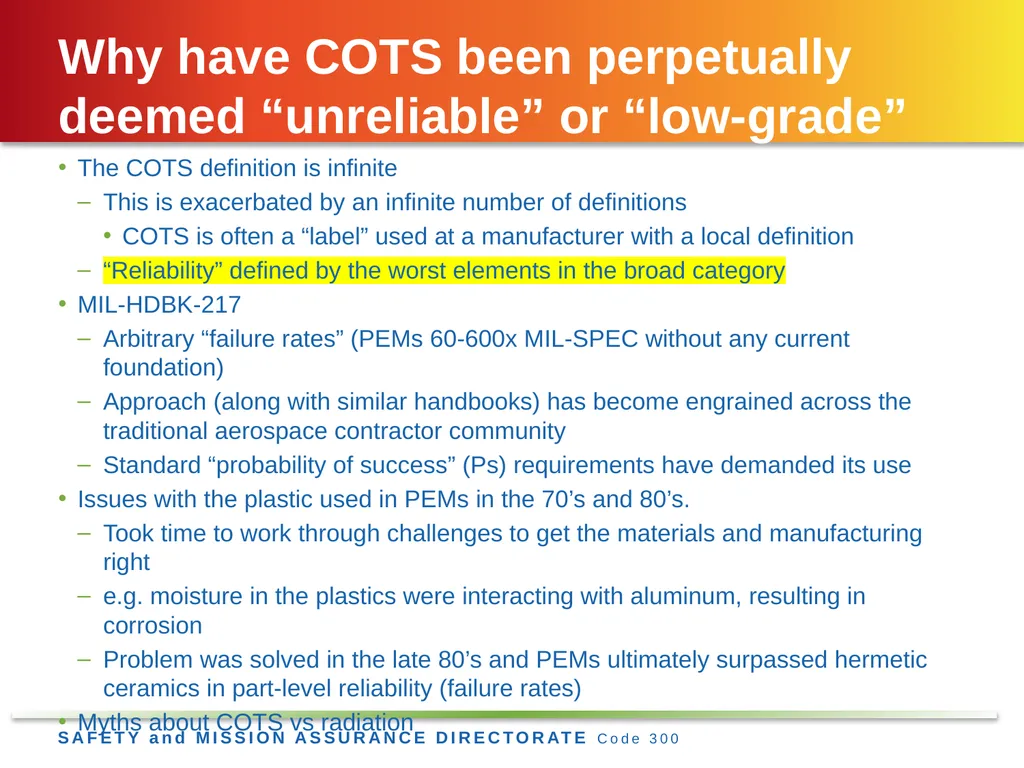
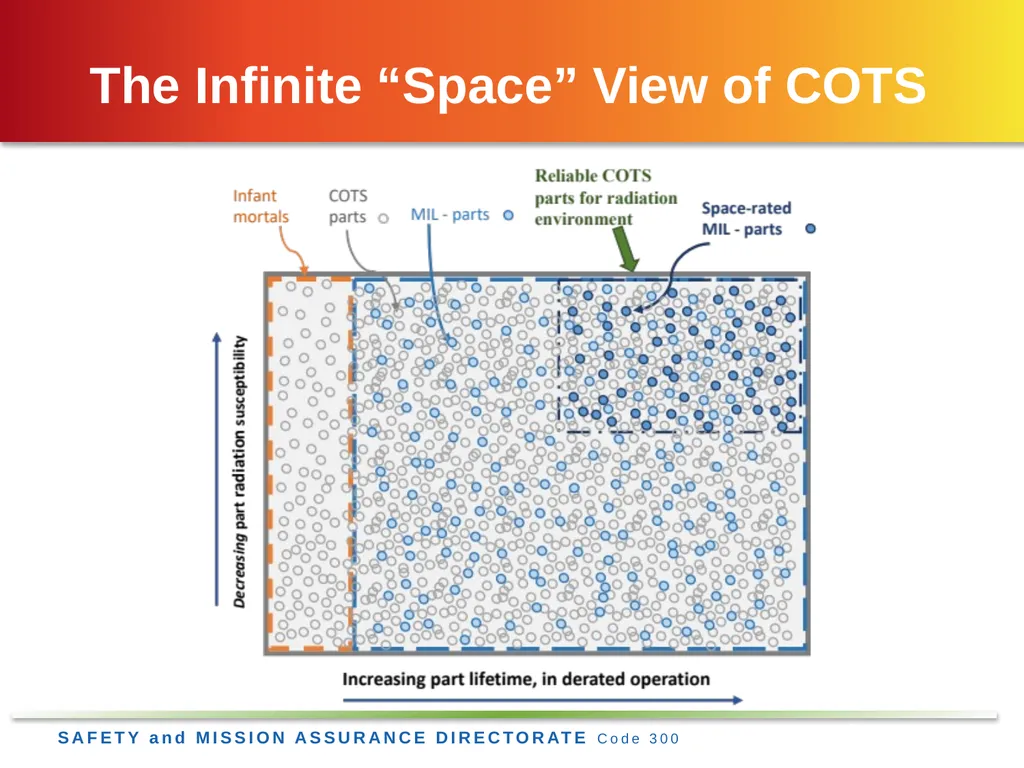
The COTS definition is infinite
This is exacerbated by an infinite number of definitions
COTS is often a “label” used at a manufacturer with a local definition
“Reliability” defined by the worst elements in the broad category
MIL-HDBK-217
Arbitrary “failure rates” (PEMs 60-600x MIL-SPEC without any current foundation)
Approach (along with similar handbooks) has become engrained across the traditional aerospace contractor community
Standard “probability of success” (Ps) requirements have demanded its use
Issues with the plastic used in PEMs in the 70’s and 80’s.
Took time to work through challenges to get the materials and manufacturing right
e.g. moisture in the plastics were interacting with aluminum, resulting in corrosion
Problem was solved in the late 80’s and PEMs ultimately surpassed hermetic ceramics in part-level reliability (failure rates)
Myths about COTS vs radiation Why have COTS been perpetually deemed “unreliable” or “low-grade”<br>
This is exacerbated by an infinite number of definitions
COTS is often a “label” used at a manufacturer with a local definition
“Reliability” defined by the worst elements in the broad category
MIL-HDBK-217
Arbitrary “failure rates” (PEMs 60-600x MIL-SPEC without any current foundation)
Approach (along with similar handbooks) has become engrained across the traditional aerospace contractor community
Standard “probability of success” (Ps) requirements have demanded its use
Issues with the plastic used in PEMs in the 70’s and 80’s.
Took time to work through challenges to get the materials and manufacturing right
e.g. moisture in the plastics were interacting with aluminum, resulting in corrosion
Problem was solved in the late 80’s and PEMs ultimately surpassed hermetic ceramics in part-level reliability (failure rates)
Myths about COTS vs radiation Why have COTS been perpetually deemed “unreliable” or “low-grade”<br>
14
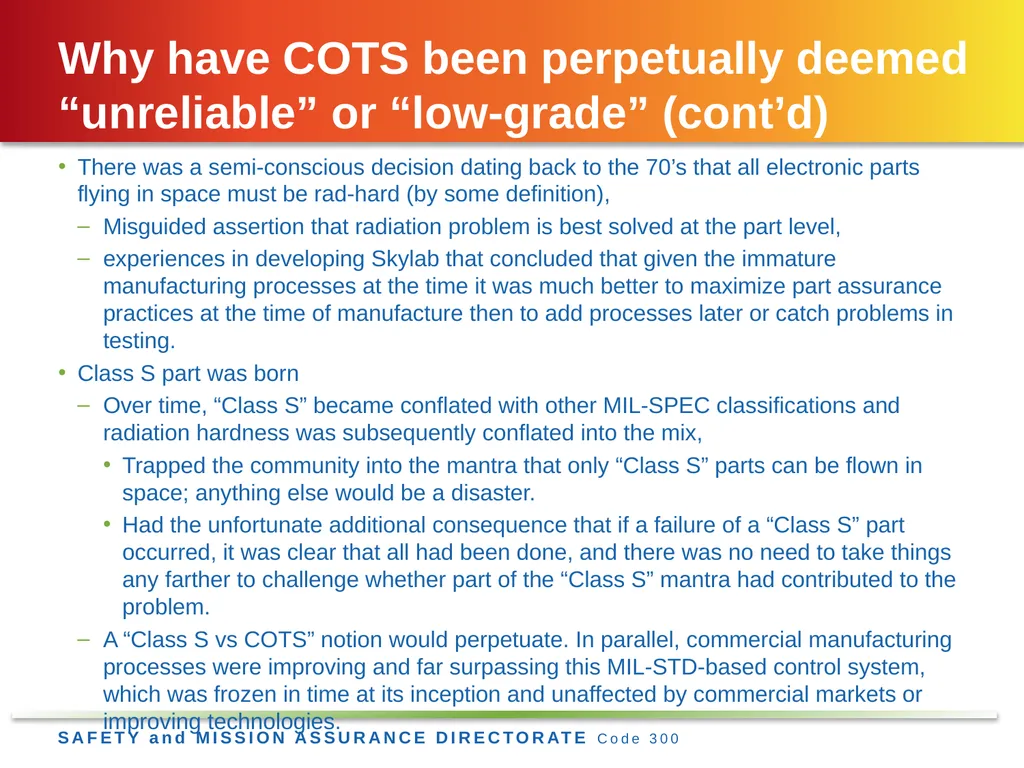
There was a semi-conscious decision dating back to the 70’s that all electronic parts flying in space must be rad-hard (by some definition),
Misguided assertion that radiation problem is best solved at the part level,
experiences in developing Skylab that concluded that given the immature manufacturing processes at the time it was much better to maximize part assurance practices at the time of manufacture then to add processes later or catch problems in testing.
Class S part was born
Over time, “Class S” became conflated with other MIL-SPEC classifications and radiation hardness was subsequently conflated into the mix,
Trapped the community into the mantra that only “Class S” parts can be flown in space; anything else would be a disaster.
Had the unfortunate additional consequence that if a failure of a “Class S” part occurred, it was clear that all had been done, and there was no need to take things any farther to challenge whether part of the “Class S” mantra had contributed to the problem.
A “Class S vs COTS” notion would perpetuate. In parallel, commercial manufacturing processes were improving and far surpassing this MIL-STD-based control system, which was frozen in time at its inception and unaffected by commercial markets or improving technologies. Why have COTS been perpetually deemed “unreliable” or “low-grade” (cont’d)<br>
Misguided assertion that radiation problem is best solved at the part level,
experiences in developing Skylab that concluded that given the immature manufacturing processes at the time it was much better to maximize part assurance practices at the time of manufacture then to add processes later or catch problems in testing.
Class S part was born
Over time, “Class S” became conflated with other MIL-SPEC classifications and radiation hardness was subsequently conflated into the mix,
Trapped the community into the mantra that only “Class S” parts can be flown in space; anything else would be a disaster.
Had the unfortunate additional consequence that if a failure of a “Class S” part occurred, it was clear that all had been done, and there was no need to take things any farther to challenge whether part of the “Class S” mantra had contributed to the problem.
A “Class S vs COTS” notion would perpetuate. In parallel, commercial manufacturing processes were improving and far surpassing this MIL-STD-based control system, which was frozen in time at its inception and unaffected by commercial markets or improving technologies. Why have COTS been perpetually deemed “unreliable” or “low-grade” (cont’d)<br>
15
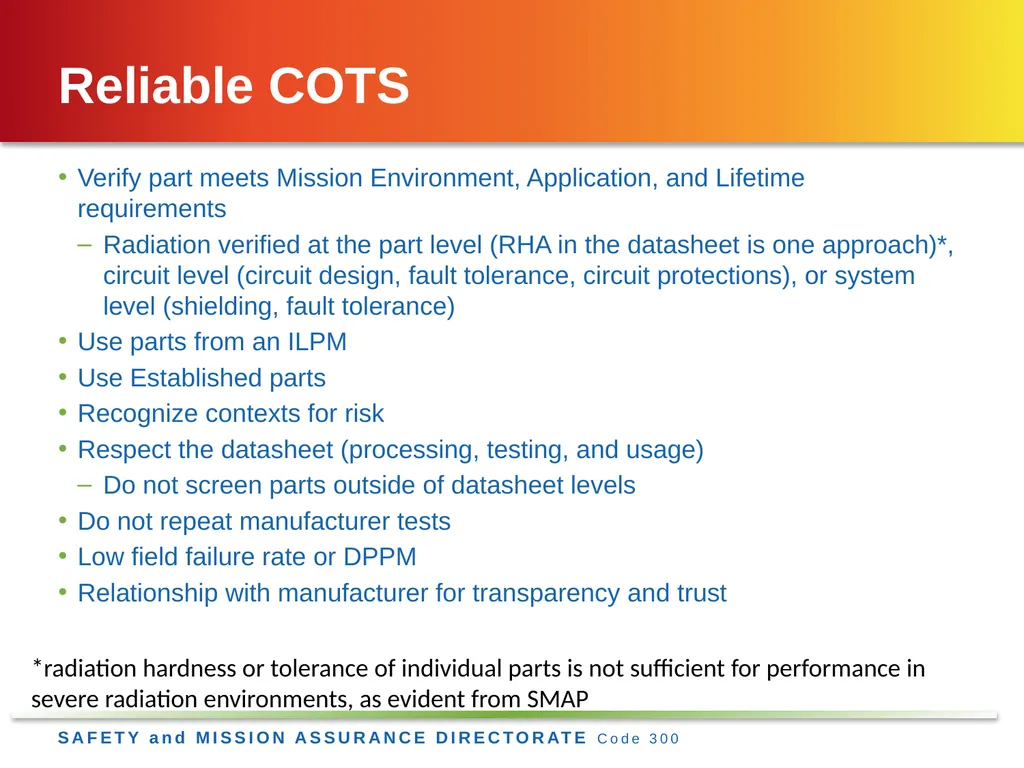
Verify part meets Mission Environment, Application, and Lifetime requirements
Radiation verified at the part level (RHA in the datasheet is one approach)*, circuit level (circuit design, fault tolerance, circuit protections), or system level (shielding, fault tolerance)
Use parts from an ILPM
Use Established parts
Recognize contexts for risk
Respect the datasheet (processing, testing, and usage)
Do not screen parts outside of datasheet levels
Do not repeat manufacturer tests
Low field failure rate or DPPM
Relationship with manufacturer for transparency and trust Reliable COTS *radiation hardness or tolerance of individual parts is not sufficient for performance in severe radiation environments, as evident from SMAP<br>
Radiation verified at the part level (RHA in the datasheet is one approach)*, circuit level (circuit design, fault tolerance, circuit protections), or system level (shielding, fault tolerance)
Use parts from an ILPM
Use Established parts
Recognize contexts for risk
Respect the datasheet (processing, testing, and usage)
Do not screen parts outside of datasheet levels
Do not repeat manufacturer tests
Low field failure rate or DPPM
Relationship with manufacturer for transparency and trust Reliable COTS *radiation hardness or tolerance of individual parts is not sufficient for performance in severe radiation environments, as evident from SMAP<br>
16
The Infinite “Space” View of COTS<br>
17
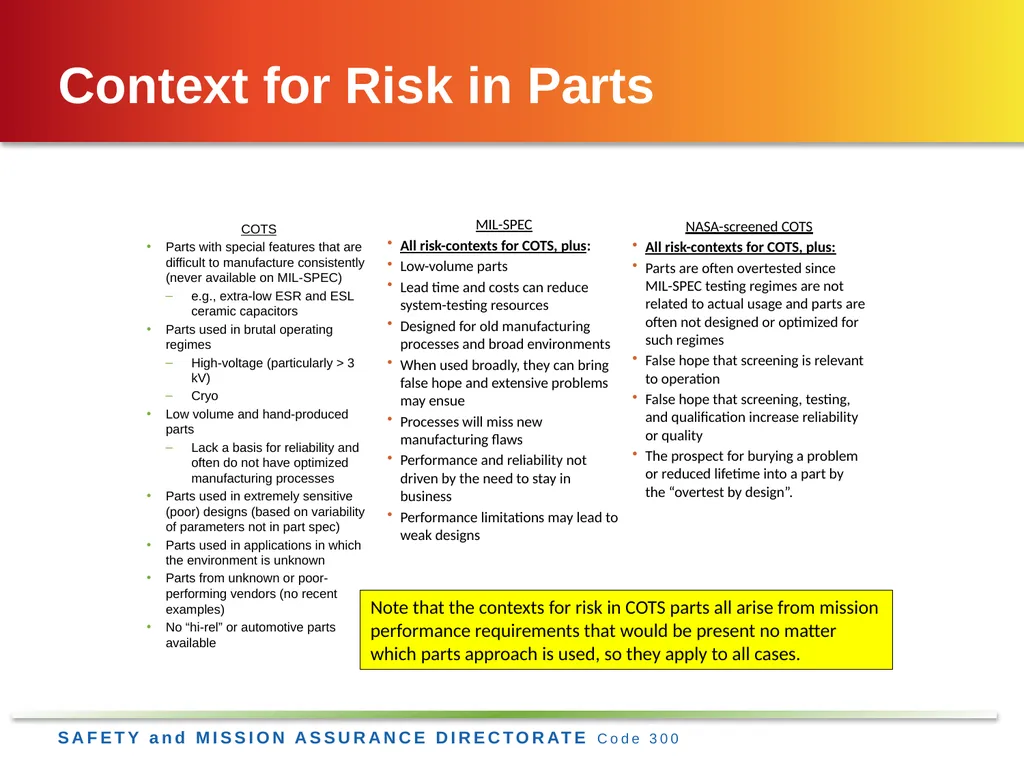
COTS
Parts with special features that are difficult to manufacture consistently (never available on MIL-SPEC)
e.g., extra-low ESR and ESL ceramic capacitors
Parts used in brutal operating regimes
High-voltage (particularly > 3 kV)
Cryo
Low volume and hand-produced parts
Lack a basis for reliability and often do not have optimized manufacturing processes
Parts used in extremely sensitive (poor) designs (based on variability of parameters not in part spec)
Parts used in applications in which the environment is unknown
Parts from unknown or poor-performing vendors (no recent examples)
No “hi-rel” or automotive parts available Context for Risk in Parts 17 MIL-SPEC
All risk-contexts for COTS, plus:
Low-volume parts
Lead time and costs can reduce system-testing resources
Designed for old manufacturing processes and broad environments
When used broadly, they can bring false hope and extensive problems may ensue
Processes will miss new manufacturing flaws
Performance and reliability not driven by the need to stay in business
Performance limitations may lead to weak designs NASA-screened COTS
All risk-contexts for COTS, plus:
Parts are often overtested since MIL-SPEC testing regimes are not related to actual usage and parts are often not designed or optimized for such regimes
False hope that screening is relevant to operation
False hope that screening, testing, and qualification increase reliability or quality
The prospect for burying a problem or reduced lifetime into a part by the “overtest by design”. Note that the contexts for risk in COTS parts all arise from mission performance requirements that would be present no matter which parts approach is used, so they apply to all cases.<br>
Parts with special features that are difficult to manufacture consistently (never available on MIL-SPEC)
e.g., extra-low ESR and ESL ceramic capacitors
Parts used in brutal operating regimes
High-voltage (particularly > 3 kV)
Cryo
Low volume and hand-produced parts
Lack a basis for reliability and often do not have optimized manufacturing processes
Parts used in extremely sensitive (poor) designs (based on variability of parameters not in part spec)
Parts used in applications in which the environment is unknown
Parts from unknown or poor-performing vendors (no recent examples)
No “hi-rel” or automotive parts available Context for Risk in Parts 17 MIL-SPEC
All risk-contexts for COTS, plus:
Low-volume parts
Lead time and costs can reduce system-testing resources
Designed for old manufacturing processes and broad environments
When used broadly, they can bring false hope and extensive problems may ensue
Processes will miss new manufacturing flaws
Performance and reliability not driven by the need to stay in business
Performance limitations may lead to weak designs NASA-screened COTS
All risk-contexts for COTS, plus:
Parts are often overtested since MIL-SPEC testing regimes are not related to actual usage and parts are often not designed or optimized for such regimes
False hope that screening is relevant to operation
False hope that screening, testing, and qualification increase reliability or quality
The prospect for burying a problem or reduced lifetime into a part by the “overtest by design”. Note that the contexts for risk in COTS parts all arise from mission performance requirements that would be present no matter which parts approach is used, so they apply to all cases.<br>
18
Benefits vs Detriments of increasing EEE-INST-002 levels<br>
19
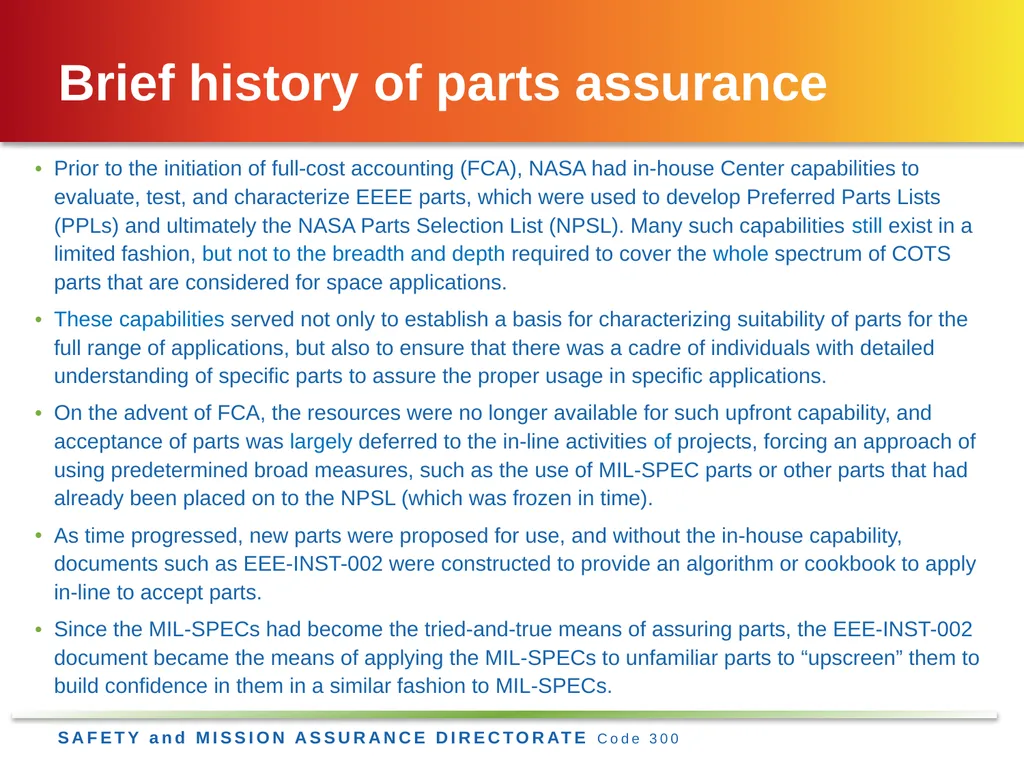
Prior to the initiation of full-cost accounting (FCA), NASA had in-house Center capabilities to evaluate, test, and characterize EEEE parts, which were used to develop Preferred Parts Lists (PPLs) and ultimately the NASA Parts Selection List (NPSL). Many such capabilities still exist in a limited fashion, but not to the breadth and depth required to cover the whole spectrum of COTS parts that are considered for space applications.
These capabilities served not only to establish a basis for characterizing suitability of parts for the full range of applications, but also to ensure that there was a cadre of individuals with detailed understanding of specific parts to assure the proper usage in specific applications.
On the advent of FCA, the resources were no longer available for such upfront capability, and acceptance of parts was largely deferred to the in-line activities of projects, forcing an approach of using predetermined broad measures, such as the use of MIL-SPEC parts or other parts that had already been placed on to the NPSL (which was frozen in time).
As time progressed, new parts were proposed for use, and without the in-house capability, documents such as EEE-INST-002 were constructed to provide an algorithm or cookbook to apply in-line to accept parts.
Since the MIL-SPECs had become the tried-and-true means of assuring parts, the EEE-INST-002 document became the means of applying the MIL-SPECs to unfamiliar parts to “upscreen” them to build confidence in them in a similar fashion to MIL-SPECs. Brief history of parts assurance<br>
These capabilities served not only to establish a basis for characterizing suitability of parts for the full range of applications, but also to ensure that there was a cadre of individuals with detailed understanding of specific parts to assure the proper usage in specific applications.
On the advent of FCA, the resources were no longer available for such upfront capability, and acceptance of parts was largely deferred to the in-line activities of projects, forcing an approach of using predetermined broad measures, such as the use of MIL-SPEC parts or other parts that had already been placed on to the NPSL (which was frozen in time).
As time progressed, new parts were proposed for use, and without the in-house capability, documents such as EEE-INST-002 were constructed to provide an algorithm or cookbook to apply in-line to accept parts.
Since the MIL-SPECs had become the tried-and-true means of assuring parts, the EEE-INST-002 document became the means of applying the MIL-SPECs to unfamiliar parts to “upscreen” them to build confidence in them in a similar fashion to MIL-SPECs. Brief history of parts assurance<br>
20
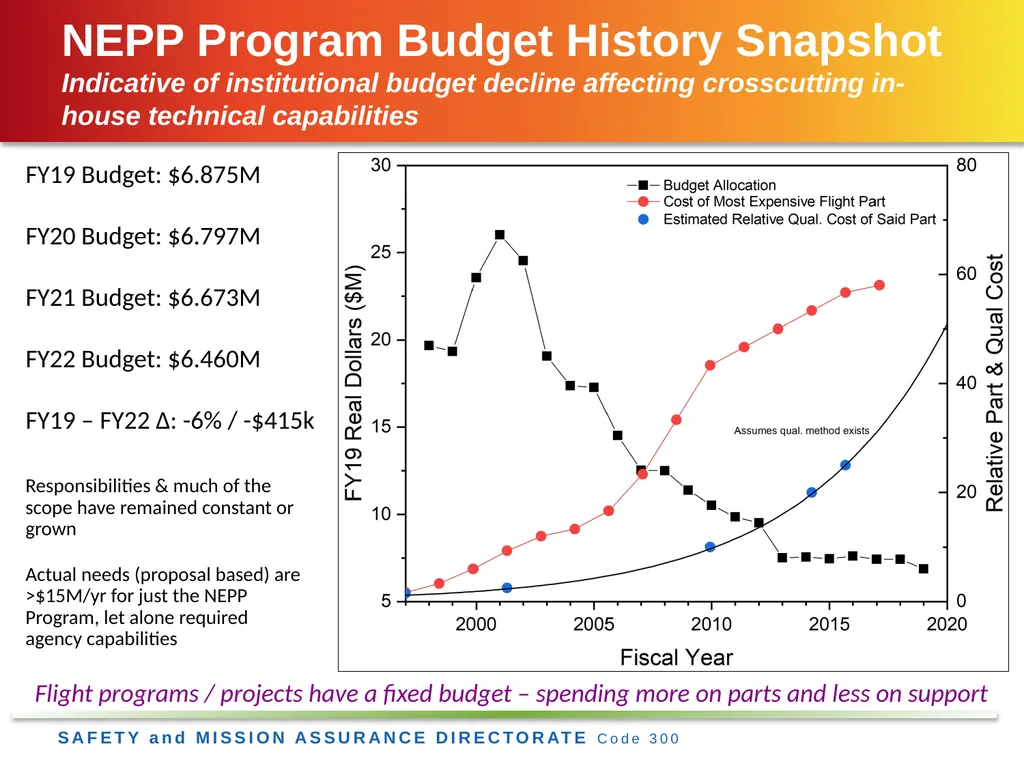
NEPP Program Budget History Snapshot
Indicative of institutional budget decline affecting crosscutting in-house technical capabilities FY19 Budget: $6.875M
FY20 Budget: $6.797M
FY21 Budget: $6.673M
FY22 Budget: $6.460M
FY19 – FY22 Δ: -6% / -$415k Flight programs / projects have a fixed budget – spending more on parts and less on support Responsibilities & much of the scope have remained constant or grown
Actual needs (proposal based) are >$15M/yr for just the NEPP Program, let alone required agency capabilities<br>
FY20 Budget: $6.797M
FY21 Budget: $6.673M
FY22 Budget: $6.460M
FY19 – FY22 Δ: -6% / -$415k Flight programs / projects have a fixed budget – spending more on parts and less on support Responsibilities & much of the scope have remained constant or grown
Actual needs (proposal based) are >$15M/yr for just the NEPP Program, let alone required agency capabilities<br>
21
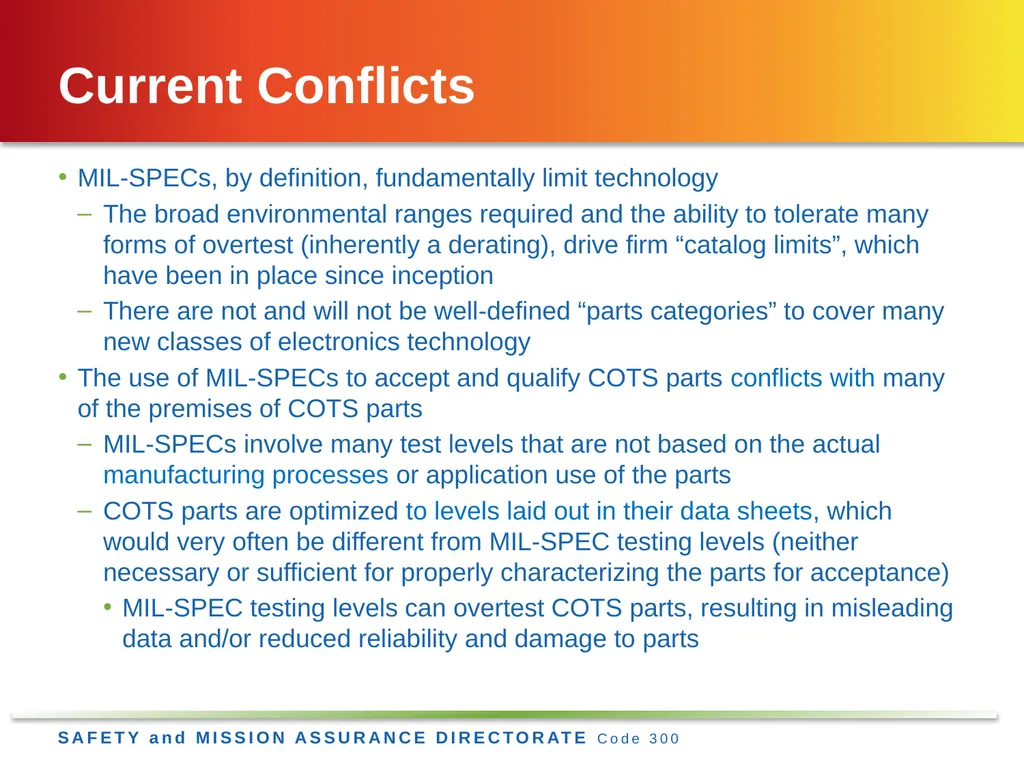
MIL-SPECs, by definition, fundamentally limit technology
The broad environmental ranges required and the ability to tolerate many forms of overtest (inherently a derating), drive firm “catalog limits”, which have been in place since inception
There are not and will not be well-defined “parts categories” to cover many new classes of electronics technology
The use of MIL-SPECs to accept and qualify COTS parts conflicts with many of the premises of COTS parts
MIL-SPECs involve many test levels that are not based on the actual manufacturing processes or application use of the parts
COTS parts are optimized to levels laid out in their data sheets, which would very often be different from MIL-SPEC testing levels (neither necessary or sufficient for properly characterizing the parts for acceptance)
MIL-SPEC testing levels can overtest COTS parts, resulting in misleading data and/or reduced reliability and damage to parts Current Conflicts<br>
The broad environmental ranges required and the ability to tolerate many forms of overtest (inherently a derating), drive firm “catalog limits”, which have been in place since inception
There are not and will not be well-defined “parts categories” to cover many new classes of electronics technology
The use of MIL-SPECs to accept and qualify COTS parts conflicts with many of the premises of COTS parts
MIL-SPECs involve many test levels that are not based on the actual manufacturing processes or application use of the parts
COTS parts are optimized to levels laid out in their data sheets, which would very often be different from MIL-SPEC testing levels (neither necessary or sufficient for properly characterizing the parts for acceptance)
MIL-SPEC testing levels can overtest COTS parts, resulting in misleading data and/or reduced reliability and damage to parts Current Conflicts<br>
22
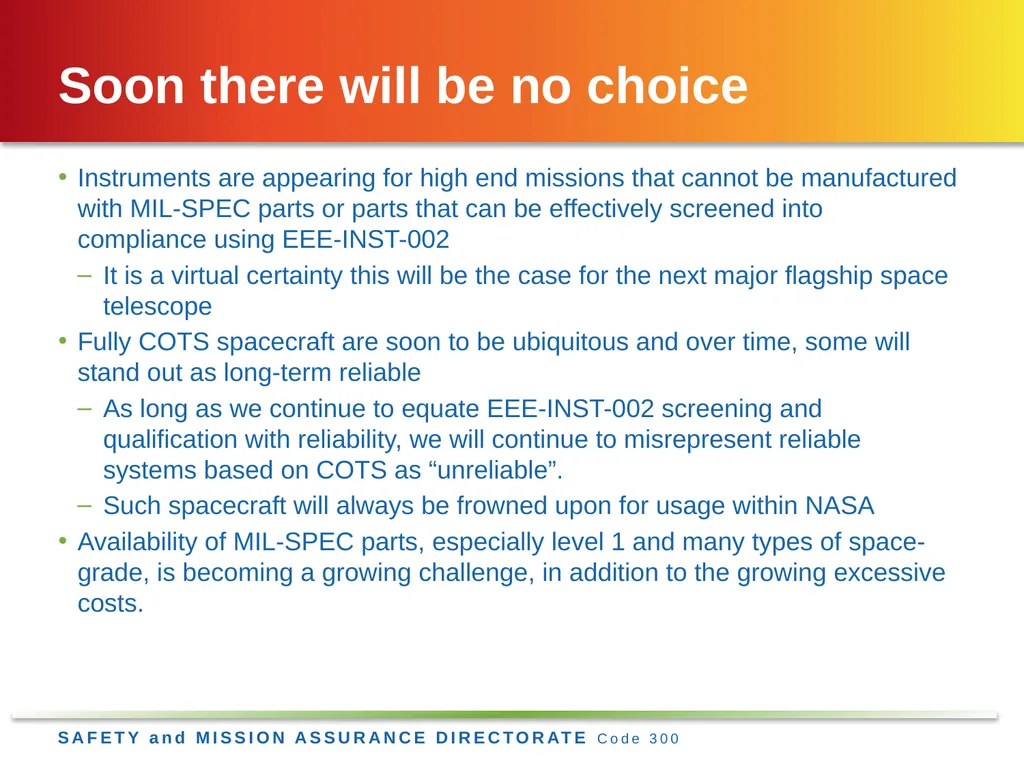
Instruments are appearing for high end missions that cannot be manufactured with MIL-SPEC parts or parts that can be effectively screened into compliance using EEE-INST-002
It is a virtual certainty this will be the case for the next major flagship space telescope
Fully COTS spacecraft are soon to be ubiquitous and over time, some will stand out as long-term reliable
As long as we continue to equate EEE-INST-002 screening and qualification with reliability, we will continue to misrepresent reliable systems based on COTS as “unreliable”.
Such spacecraft will always be frowned upon for usage within NASA
Availability of MIL-SPEC parts, especially level 1 and many types of space-grade, is becoming a growing challenge, in addition to the growing excessive costs. Soon there will be no choice<br>
It is a virtual certainty this will be the case for the next major flagship space telescope
Fully COTS spacecraft are soon to be ubiquitous and over time, some will stand out as long-term reliable
As long as we continue to equate EEE-INST-002 screening and qualification with reliability, we will continue to misrepresent reliable systems based on COTS as “unreliable”.
Such spacecraft will always be frowned upon for usage within NASA
Availability of MIL-SPEC parts, especially level 1 and many types of space-grade, is becoming a growing challenge, in addition to the growing excessive costs. Soon there will be no choice<br>
23
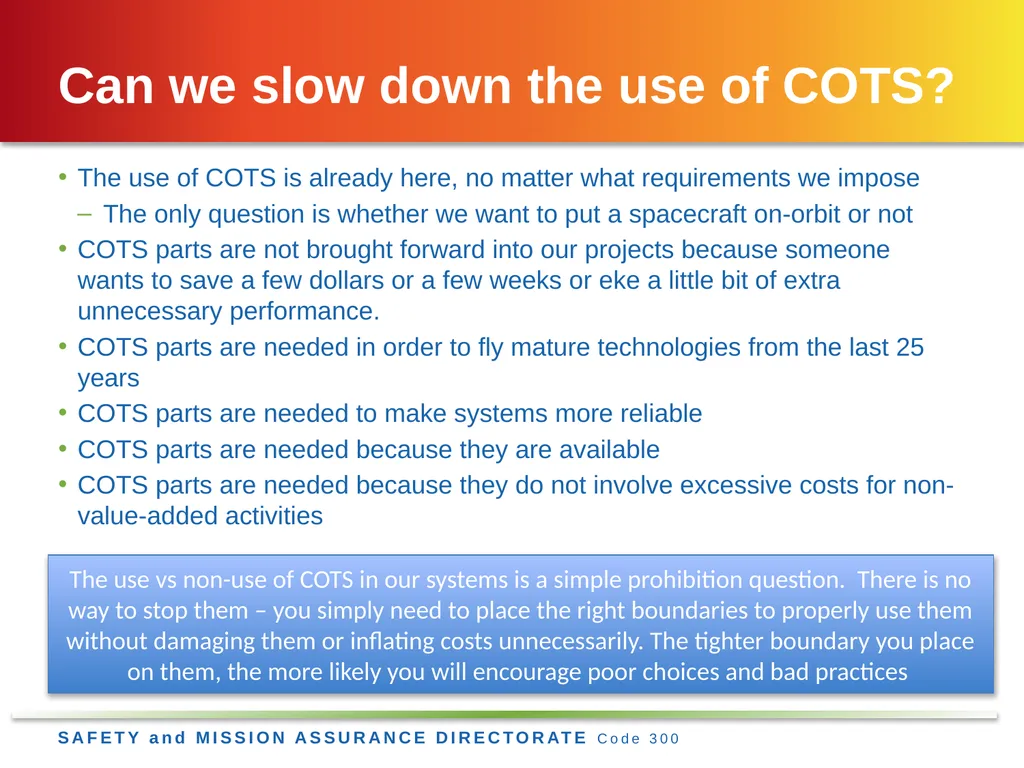
The use of COTS is already here, no matter what requirements we impose
The only question is whether we want to put a spacecraft on-orbit or not
COTS parts are not brought forward into our projects because someone wants to save a few dollars or a few weeks or eke a little bit of extra unnecessary performance.
COTS parts are needed in order to fly mature technologies from the last 25 years
COTS parts are needed to make systems more reliable
COTS parts are needed because they are available
COTS parts are needed because they do not involve excessive costs for non-value-added activities Can we slow down the use of COTS? The use vs non-use of COTS in our systems is a simple prohibition question. There is no way to stop them – you simply need to place the right boundaries to properly use them without damaging them or inflating costs unnecessarily. The tighter boundary you place on them, the more likely you will encourage poor choices and bad practices<br>
The only question is whether we want to put a spacecraft on-orbit or not
COTS parts are not brought forward into our projects because someone wants to save a few dollars or a few weeks or eke a little bit of extra unnecessary performance.
COTS parts are needed in order to fly mature technologies from the last 25 years
COTS parts are needed to make systems more reliable
COTS parts are needed because they are available
COTS parts are needed because they do not involve excessive costs for non-value-added activities Can we slow down the use of COTS? The use vs non-use of COTS in our systems is a simple prohibition question. There is no way to stop them – you simply need to place the right boundaries to properly use them without damaging them or inflating costs unnecessarily. The tighter boundary you place on them, the more likely you will encourage poor choices and bad practices<br>
24
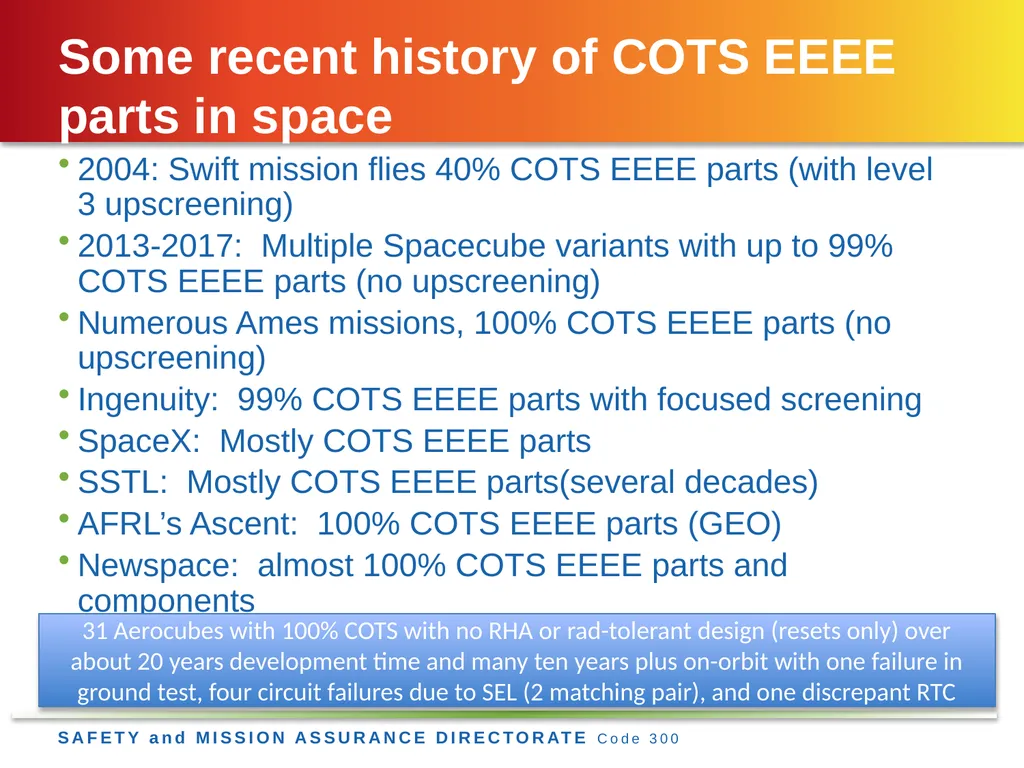
2004: Swift mission flies 40% COTS EEEE parts (with level 3 upscreening)
2013-2017: Multiple Spacecube variants with up to 99% COTS EEEE parts (no upscreening)
Numerous Ames missions, 100% COTS EEEE parts (no upscreening)
Ingenuity: 99% COTS EEEE parts with focused screening
SpaceX: Mostly COTS EEEE parts
SSTL: Mostly COTS EEEE parts(several decades)
AFRL’s Ascent: 100% COTS EEEE parts (GEO)
Newspace: almost 100% COTS EEEE parts and components Some recent history of COTS EEEE parts in space 31 Aerocubes with 100% COTS with no RHA or rad-tolerant design (resets only) over about 20 years development time and many ten years plus on-orbit with one failure in ground test, four circuit failures due to SEL (2 matching pair), and one discrepant RTC<br>
2013-2017: Multiple Spacecube variants with up to 99% COTS EEEE parts (no upscreening)
Numerous Ames missions, 100% COTS EEEE parts (no upscreening)
Ingenuity: 99% COTS EEEE parts with focused screening
SpaceX: Mostly COTS EEEE parts
SSTL: Mostly COTS EEEE parts(several decades)
AFRL’s Ascent: 100% COTS EEEE parts (GEO)
Newspace: almost 100% COTS EEEE parts and components Some recent history of COTS EEEE parts in space 31 Aerocubes with 100% COTS with no RHA or rad-tolerant design (resets only) over about 20 years development time and many ten years plus on-orbit with one failure in ground test, four circuit failures due to SEL (2 matching pair), and one discrepant RTC<br>
25
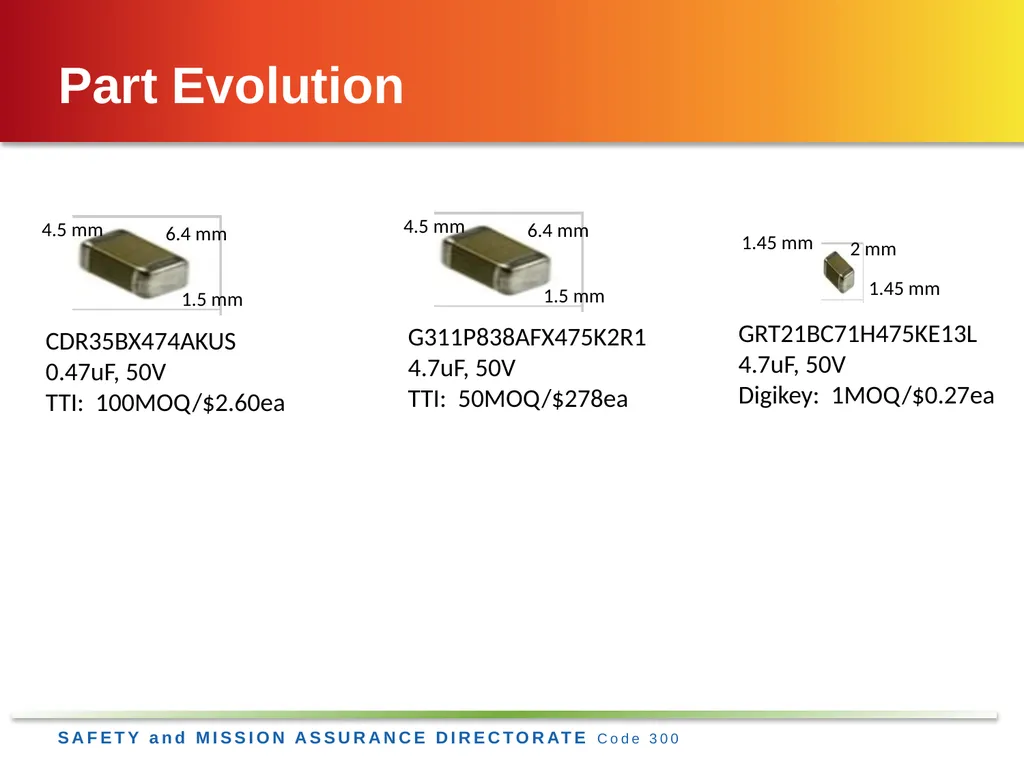
Part Evolution CDR35BX474AKUS
0.47uF, 50V
TTI: 100MOQ/$2.60ea 6.4 mm 4.5 mm 1.5 mm G311P838AFX475K2R1
4.7uF, 50V
TTI: 50MOQ/$278ea 6.4 mm 4.5 mm 1.5 mm GRT21BC71H475KE13L
4.7uF, 50V
Digikey: 1MOQ/$0.27ea 2 mm 1.45 mm 1.45 mm<br>
0.47uF, 50V
TTI: 100MOQ/$2.60ea 6.4 mm 4.5 mm 1.5 mm G311P838AFX475K2R1
4.7uF, 50V
TTI: 50MOQ/$278ea 6.4 mm 4.5 mm 1.5 mm GRT21BC71H475KE13L
4.7uF, 50V
Digikey: 1MOQ/$0.27ea 2 mm 1.45 mm 1.45 mm<br>
26
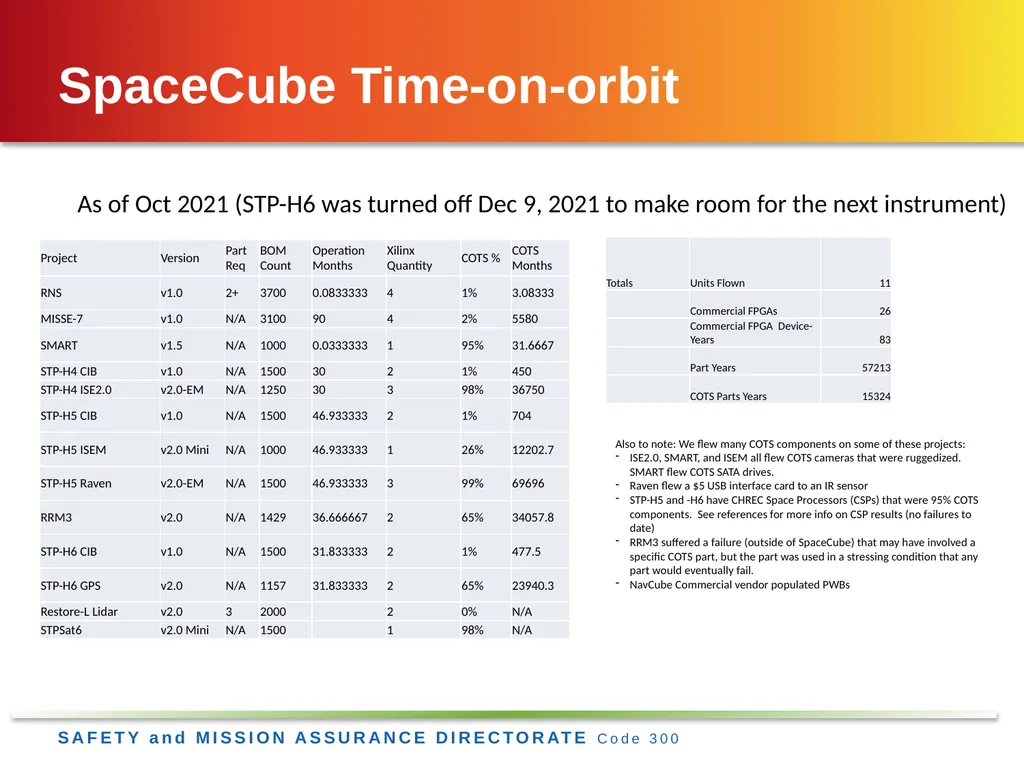
SpaceCube Time-on-orbit Also to note: We flew many COTS components on some of these projects:
ISE2.0, SMART, and ISEM all flew COTS cameras that were ruggedized. SMART flew COTS SATA drives.
Raven flew a $5 USB interface card to an IR sensor
STP-H5 and -H6 have CHREC Space Processors (CSPs) that were 95% COTS components. See references for more info on CSP results (no failures to date)
RRM3 suffered a failure (outside of SpaceCube) that may have involved a specific COTS part, but the part was used in a stressing condition that any part would eventually fail.
NavCube Commercial vendor populated PWBs As of Oct 2021 (STP-H6 was turned off Dec 9, 2021 to make room for the next instrument)<br>
ISE2.0, SMART, and ISEM all flew COTS cameras that were ruggedized. SMART flew COTS SATA drives.
Raven flew a $5 USB interface card to an IR sensor
STP-H5 and -H6 have CHREC Space Processors (CSPs) that were 95% COTS components. See references for more info on CSP results (no failures to date)
RRM3 suffered a failure (outside of SpaceCube) that may have involved a specific COTS part, but the part was used in a stressing condition that any part would eventually fail.
NavCube Commercial vendor populated PWBs As of Oct 2021 (STP-H6 was turned off Dec 9, 2021 to make room for the next instrument)<br>
27
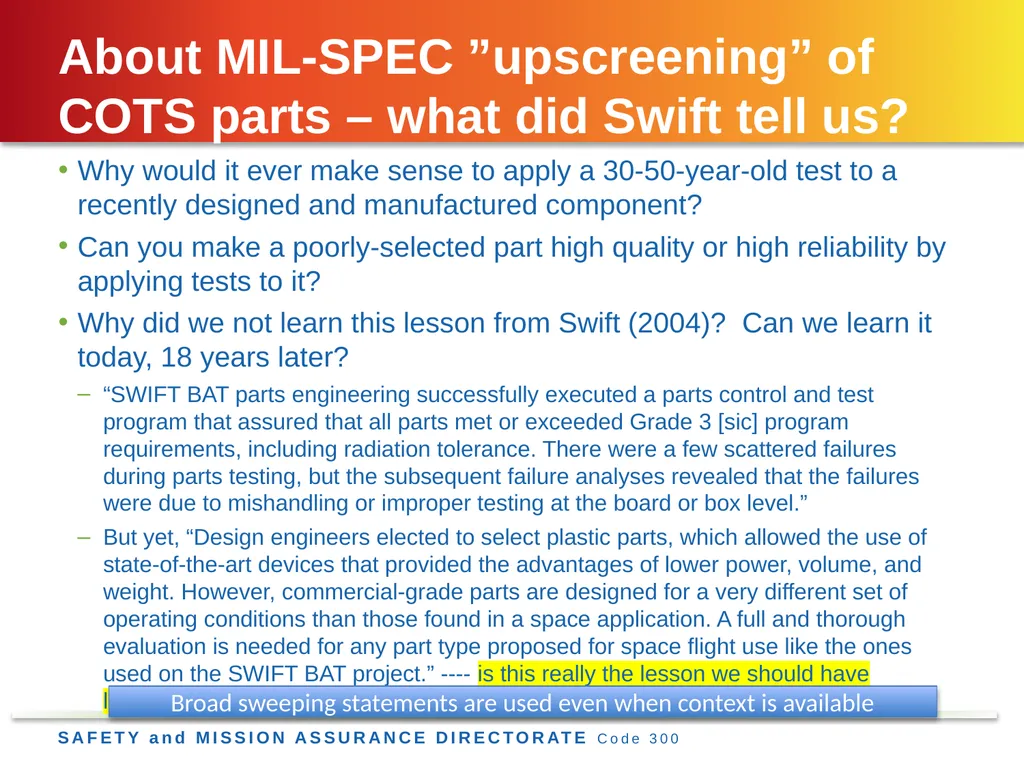
Why would it ever make sense to apply a 30-50-year-old test to a recently designed and manufactured component?
Can you make a poorly-selected part high quality or high reliability by applying tests to it?
Why did we not learn this lesson from Swift (2004)? Can we learn it today, 18 years later?
“SWIFT BAT parts engineering successfully executed a parts control and test program that assured that all parts met or exceeded Grade 3 [sic] program requirements, including radiation tolerance. There were a few scattered failures during parts testing, but the subsequent failure analyses revealed that the failures were due to mishandling or improper testing at the board or box level.”
But yet, “Design engineers elected to select plastic parts, which allowed the use of state-of-the-art devices that provided the advantages of lower power, volume, and weight. However, commercial-grade parts are designed for a very different set of operating conditions than those found in a space application. A full and thorough evaluation is needed for any part type proposed for space flight use like the ones used on the SWIFT BAT project.” ---- is this really the lesson we should have learned? About MIL-SPEC ”upscreening” of COTS parts – what did Swift tell us? Broad sweeping statements are used even when context is available<br>
Can you make a poorly-selected part high quality or high reliability by applying tests to it?
Why did we not learn this lesson from Swift (2004)? Can we learn it today, 18 years later?
“SWIFT BAT parts engineering successfully executed a parts control and test program that assured that all parts met or exceeded Grade 3 [sic] program requirements, including radiation tolerance. There were a few scattered failures during parts testing, but the subsequent failure analyses revealed that the failures were due to mishandling or improper testing at the board or box level.”
But yet, “Design engineers elected to select plastic parts, which allowed the use of state-of-the-art devices that provided the advantages of lower power, volume, and weight. However, commercial-grade parts are designed for a very different set of operating conditions than those found in a space application. A full and thorough evaluation is needed for any part type proposed for space flight use like the ones used on the SWIFT BAT project.” ---- is this really the lesson we should have learned? About MIL-SPEC ”upscreening” of COTS parts – what did Swift tell us? Broad sweeping statements are used even when context is available<br>
28
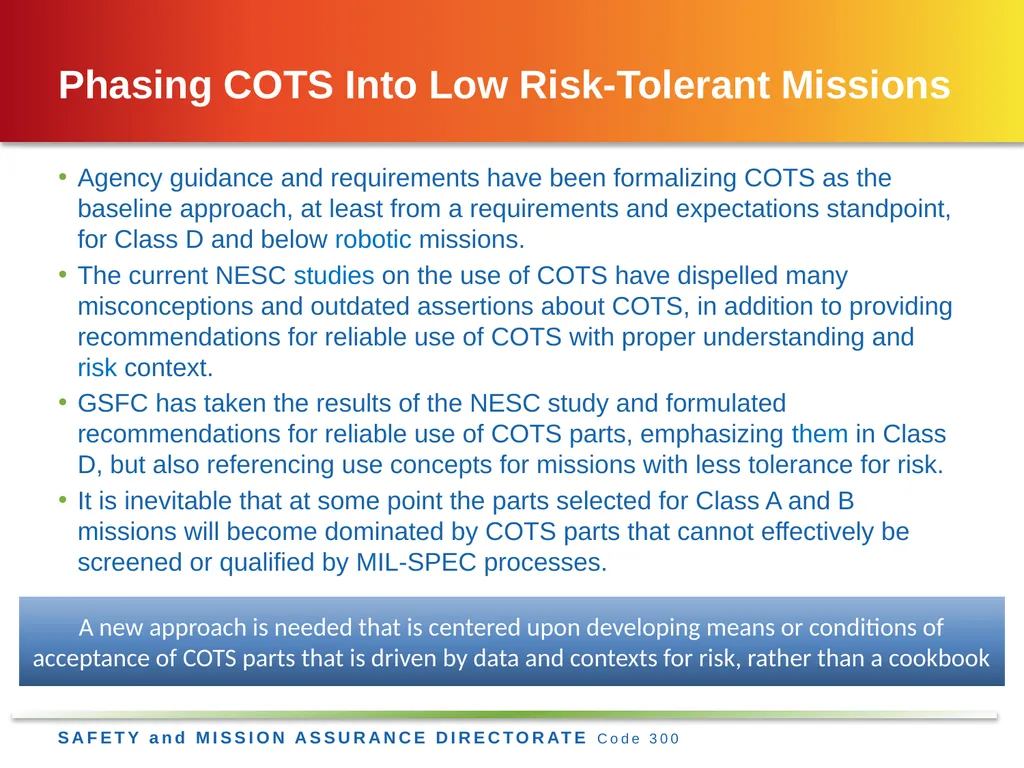
Agency guidance and requirements have been formalizing COTS as the baseline approach, at least from a requirements and expectations standpoint, for Class D and below robotic missions.
The current NESC studies on the use of COTS have dispelled many misconceptions and outdated assertions about COTS, in addition to providing recommendations for reliable use of COTS with proper understanding and risk context.
GSFC has taken the results of the NESC study and formulated recommendations for reliable use of COTS parts, emphasizing them in Class D, but also referencing use concepts for missions with less tolerance for risk.
It is inevitable that at some point the parts selected for Class A and B missions will become dominated by COTS parts that cannot effectively be screened or qualified by MIL-SPEC processes. Phasing COTS Into Low Risk-Tolerant Missions A new approach is needed that is centered upon developing means or conditions of acceptance of COTS parts that is driven by data and contexts for risk, rather than a cookbook<br>
The current NESC studies on the use of COTS have dispelled many misconceptions and outdated assertions about COTS, in addition to providing recommendations for reliable use of COTS with proper understanding and risk context.
GSFC has taken the results of the NESC study and formulated recommendations for reliable use of COTS parts, emphasizing them in Class D, but also referencing use concepts for missions with less tolerance for risk.
It is inevitable that at some point the parts selected for Class A and B missions will become dominated by COTS parts that cannot effectively be screened or qualified by MIL-SPEC processes. Phasing COTS Into Low Risk-Tolerant Missions A new approach is needed that is centered upon developing means or conditions of acceptance of COTS parts that is driven by data and contexts for risk, rather than a cookbook<br>
29
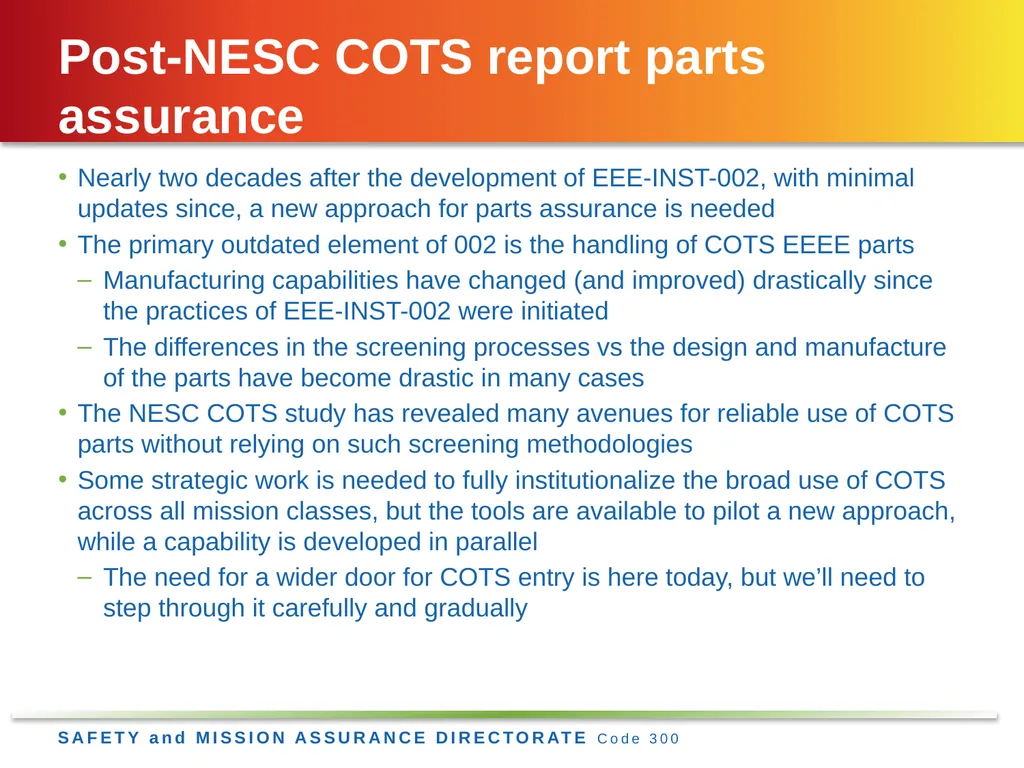
Nearly two decades after the development of EEE-INST-002, with minimal updates since, a new approach for parts assurance is needed
The primary outdated element of 002 is the handling of COTS EEEE parts
Manufacturing capabilities have changed (and improved) drastically since the practices of EEE-INST-002 were initiated
The differences in the screening processes vs the design and manufacture of the parts have become drastic in many cases
The NESC COTS study has revealed many avenues for reliable use of COTS parts without relying on such screening methodologies
Some strategic work is needed to fully institutionalize the broad use of COTS across all mission classes, but the tools are available to pilot a new approach, while a capability is developed in parallel
The need for a wider door for COTS entry is here today, but we’ll need to step through it carefully and gradually Post-NESC COTS report parts assurance<br>
The primary outdated element of 002 is the handling of COTS EEEE parts
Manufacturing capabilities have changed (and improved) drastically since the practices of EEE-INST-002 were initiated
The differences in the screening processes vs the design and manufacture of the parts have become drastic in many cases
The NESC COTS study has revealed many avenues for reliable use of COTS parts without relying on such screening methodologies
Some strategic work is needed to fully institutionalize the broad use of COTS across all mission classes, but the tools are available to pilot a new approach, while a capability is developed in parallel
The need for a wider door for COTS entry is here today, but we’ll need to step through it carefully and gradually Post-NESC COTS report parts assurance<br>
30
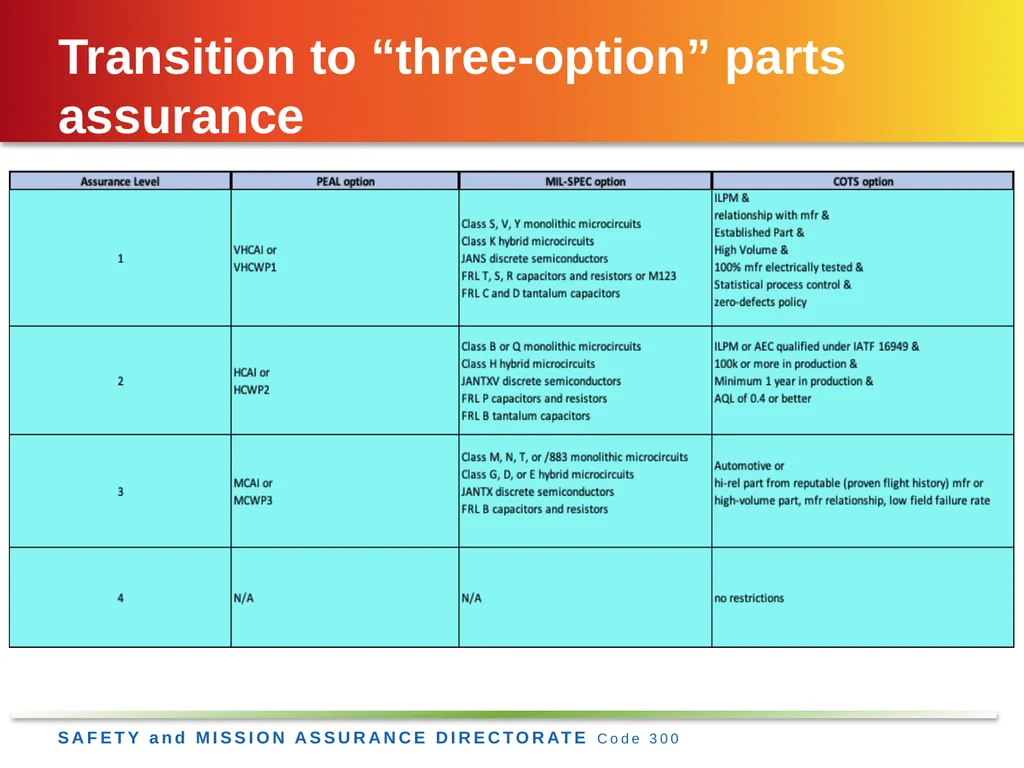
Transition to “three-option” parts assurance<br>
31
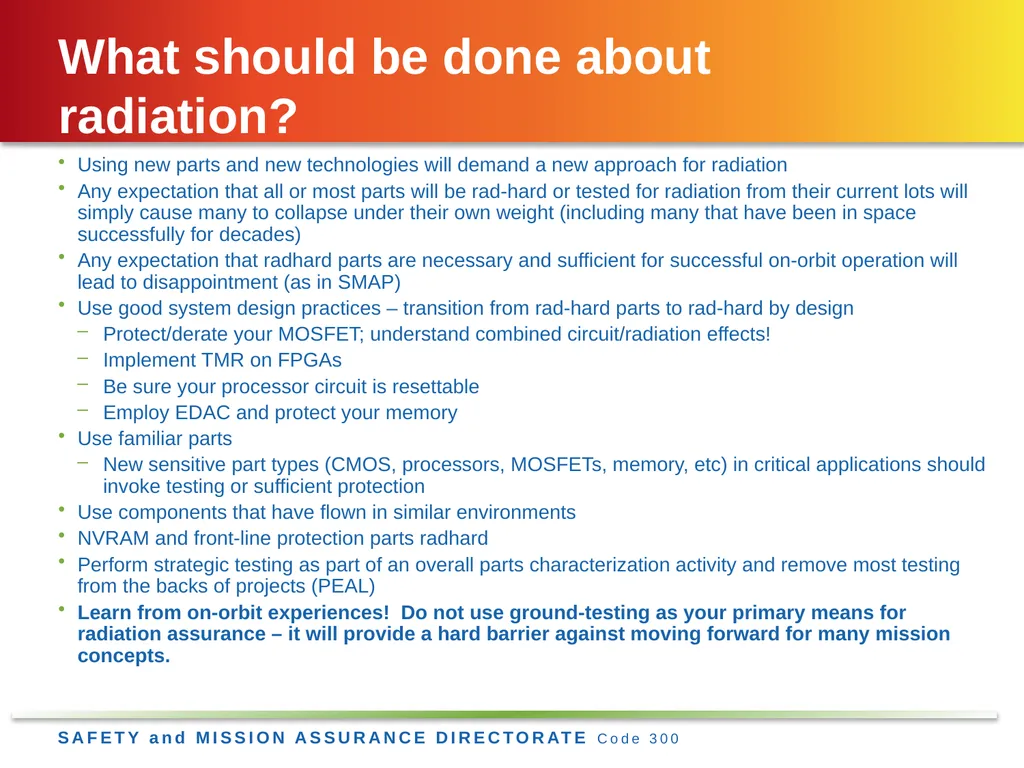
Using new parts and new technologies will demand a new approach for radiation
Any expectation that all or most parts will be rad-hard or tested for radiation from their current lots will simply cause many to collapse under their own weight (including many that have been in space successfully for decades)
Any expectation that radhard parts are necessary and sufficient for successful on-orbit operation will lead to disappointment (as in SMAP)
Use good system design practices – transition from rad-hard parts to rad-hard by design
Protect/derate your MOSFET; understand combined circuit/radiation effects!
Implement TMR on FPGAs
Be sure your processor circuit is resettable
Employ EDAC and protect your memory
Use familiar parts
New sensitive part types (CMOS, processors, MOSFETs, memory, etc) in critical applications should invoke testing or sufficient protection
Use components that have flown in similar environments
NVRAM and front-line protection parts radhard
Perform strategic testing as part of an overall parts characterization activity and remove most testing from the backs of projects (PEAL)
Learn from on-orbit experiences! Do not use ground-testing as your primary means for radiation assurance – it will provide a hard barrier against moving forward for many mission concepts. What should be done about radiation?<br>
Any expectation that all or most parts will be rad-hard or tested for radiation from their current lots will simply cause many to collapse under their own weight (including many that have been in space successfully for decades)
Any expectation that radhard parts are necessary and sufficient for successful on-orbit operation will lead to disappointment (as in SMAP)
Use good system design practices – transition from rad-hard parts to rad-hard by design
Protect/derate your MOSFET; understand combined circuit/radiation effects!
Implement TMR on FPGAs
Be sure your processor circuit is resettable
Employ EDAC and protect your memory
Use familiar parts
New sensitive part types (CMOS, processors, MOSFETs, memory, etc) in critical applications should invoke testing or sufficient protection
Use components that have flown in similar environments
NVRAM and front-line protection parts radhard
Perform strategic testing as part of an overall parts characterization activity and remove most testing from the backs of projects (PEAL)
Learn from on-orbit experiences! Do not use ground-testing as your primary means for radiation assurance – it will provide a hard barrier against moving forward for many mission concepts. What should be done about radiation?<br>
32
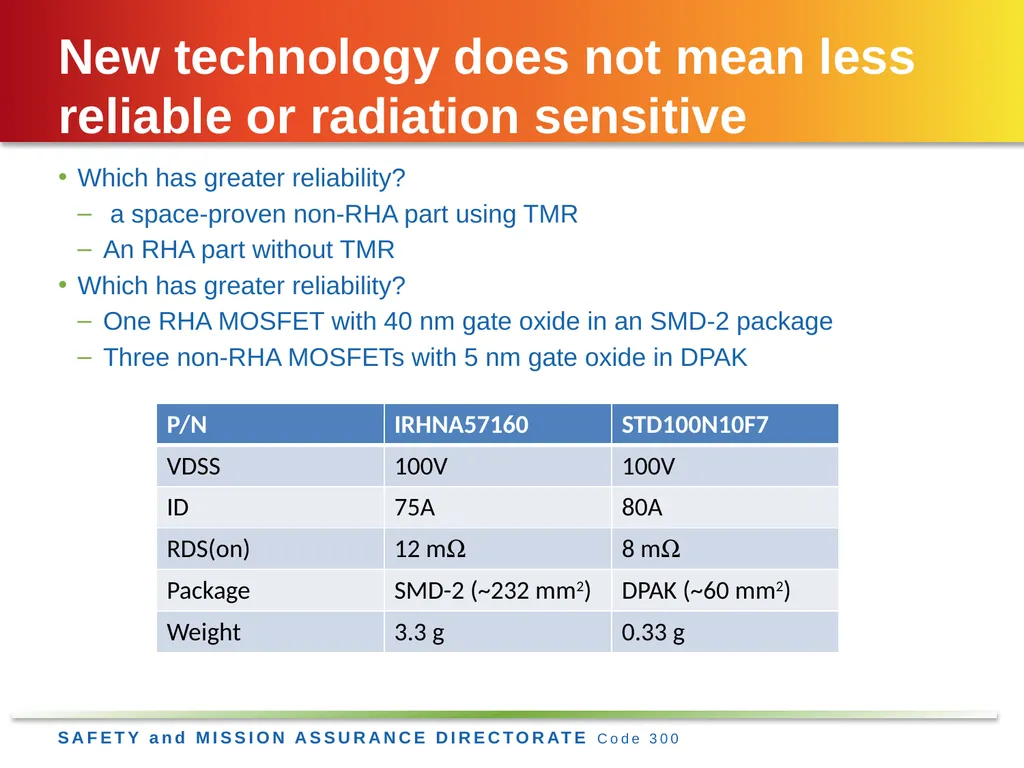
Which has greater reliability?
a space-proven non-RHA part using TMR
An RHA part without TMR
Which has greater reliability?
One RHA MOSFET with 40 nm gate oxide in an SMD-2 package
Three non-RHA MOSFETs with 5 nm gate oxide in DPAK New technology does not mean less reliable or radiation sensitive<br>
a space-proven non-RHA part using TMR
An RHA part without TMR
Which has greater reliability?
One RHA MOSFET with 40 nm gate oxide in an SMD-2 package
Three non-RHA MOSFETs with 5 nm gate oxide in DPAK New technology does not mean less reliable or radiation sensitive<br>
33
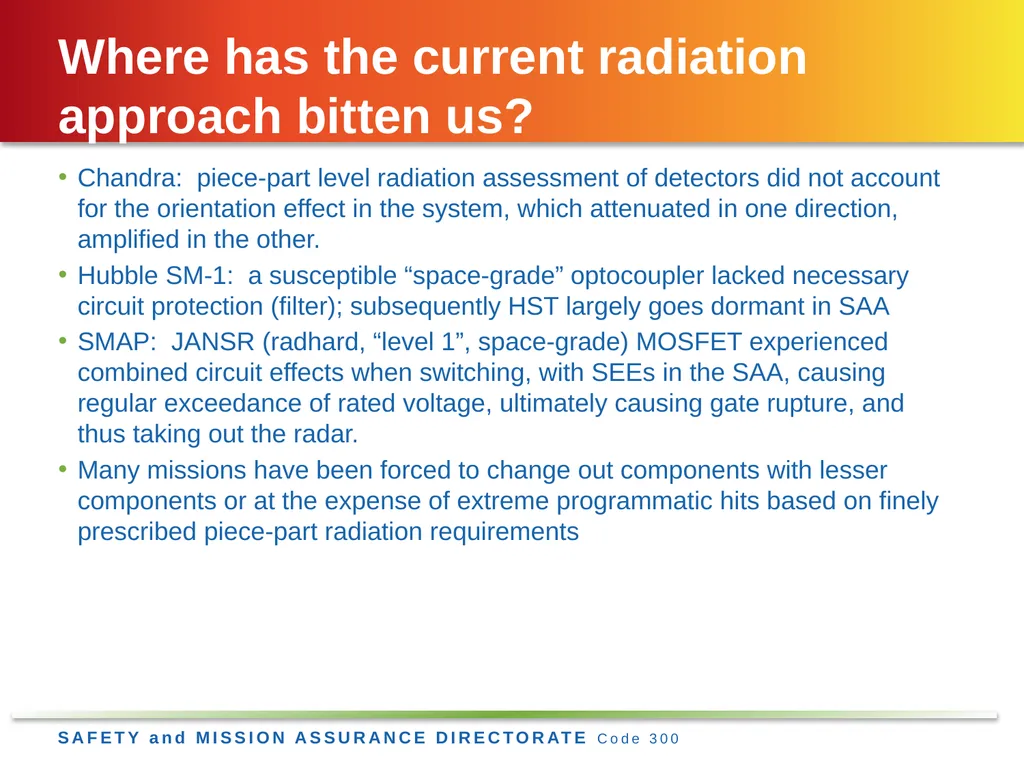
Chandra: piece-part level radiation assessment of detectors did not account for the orientation effect in the system, which attenuated in one direction, amplified in the other.
Hubble SM-1: a susceptible “space-grade” optocoupler lacked necessary circuit protection (filter); subsequently HST largely goes dormant in SAA
SMAP: JANSR (radhard, “level 1”, space-grade) MOSFET experienced combined circuit effects when switching, with SEEs in the SAA, causing regular exceedance of rated voltage, ultimately causing gate rupture, and thus taking out the radar.
Many missions have been forced to change out components with lesser components or at the expense of extreme programmatic hits based on finely prescribed piece-part radiation requirements Where has the current radiation approach bitten us?<br>
Hubble SM-1: a susceptible “space-grade” optocoupler lacked necessary circuit protection (filter); subsequently HST largely goes dormant in SAA
SMAP: JANSR (radhard, “level 1”, space-grade) MOSFET experienced combined circuit effects when switching, with SEEs in the SAA, causing regular exceedance of rated voltage, ultimately causing gate rupture, and thus taking out the radar.
Many missions have been forced to change out components with lesser components or at the expense of extreme programmatic hits based on finely prescribed piece-part radiation requirements Where has the current radiation approach bitten us?<br>
34
It certainly can if you’re in a radiation environment and you pretend it’s not there, but that has nothing to do with COTS.
Typically, about 90% of the overall part count even for large missions are not radiation-hardness-assured (because they don’t need to be).
The majority of places where COTS are really needed are for non-susceptible parts, such as most passives
The problem is no different from that of using a 5962-XXX microcircuit or a JANS2NXXXX BJT (neither of which is radiation hardness assured)
For reference, an IRHM58160 is a COTS part (and it is radiation hardness assured).
No matter whether you use COTS, MIL-SPEC or “special drawing” parts, radiation should be addressed in the same way
As we transition to newer technologies and higher performance, we will have to think about radiation mitigation in different ways because parts with RHA will almost always be multiple generations behind
However, some of the new technology parts will be less susceptible to radiation by the nature of their designs (thinner gate oxides, etc) Will use of COTS cause a radiation nightmare? Intelligent use of COTS is of insignificant difference from our current parts assurance practices from a radiation standpoint<br>
Typically, about 90% of the overall part count even for large missions are not radiation-hardness-assured (because they don’t need to be).
The majority of places where COTS are really needed are for non-susceptible parts, such as most passives
The problem is no different from that of using a 5962-XXX microcircuit or a JANS2NXXXX BJT (neither of which is radiation hardness assured)
For reference, an IRHM58160 is a COTS part (and it is radiation hardness assured).
No matter whether you use COTS, MIL-SPEC or “special drawing” parts, radiation should be addressed in the same way
As we transition to newer technologies and higher performance, we will have to think about radiation mitigation in different ways because parts with RHA will almost always be multiple generations behind
However, some of the new technology parts will be less susceptible to radiation by the nature of their designs (thinner gate oxides, etc) Will use of COTS cause a radiation nightmare? Intelligent use of COTS is of insignificant difference from our current parts assurance practices from a radiation standpoint<br>
35
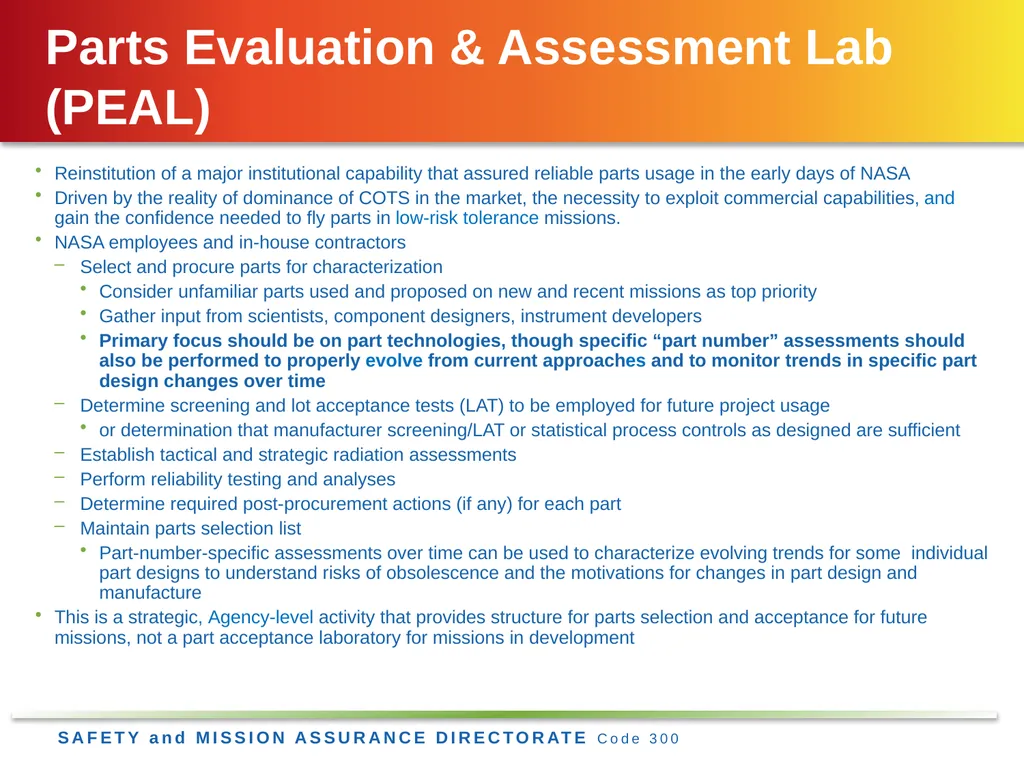
Reinstitution of a major institutional capability that assured reliable parts usage in the early days of NASA
Driven by the reality of dominance of COTS in the market, the necessity to exploit commercial capabilities, and gain the confidence needed to fly parts in low-risk tolerance missions.
NASA employees and in-house contractors
Select and procure parts for characterization
Consider unfamiliar parts used and proposed on new and recent missions as top priority
Gather input from scientists, component designers, instrument developers
Primary focus should be on part technologies, though specific “part number” assessments should also be performed to properly evolve from current approaches and to monitor trends in specific part design changes over time
Determine screening and lot acceptance tests (LAT) to be employed for future project usage
or determination that manufacturer screening/LAT or statistical process controls as designed are sufficient
Establish tactical and strategic radiation assessments
Perform reliability testing and analyses
Determine required post-procurement actions (if any) for each part
Maintain parts selection list
Part-number-specific assessments over time can be used to characterize evolving trends for some individual part designs to understand risks of obsolescence and the motivations for changes in part design and manufacture
This is a strategic, Agency-level activity that provides structure for parts selection and acceptance for future missions, not a part acceptance laboratory for missions in development Parts Evaluation & Assessment Lab (PEAL)<br>
Driven by the reality of dominance of COTS in the market, the necessity to exploit commercial capabilities, and gain the confidence needed to fly parts in low-risk tolerance missions.
NASA employees and in-house contractors
Select and procure parts for characterization
Consider unfamiliar parts used and proposed on new and recent missions as top priority
Gather input from scientists, component designers, instrument developers
Primary focus should be on part technologies, though specific “part number” assessments should also be performed to properly evolve from current approaches and to monitor trends in specific part design changes over time
Determine screening and lot acceptance tests (LAT) to be employed for future project usage
or determination that manufacturer screening/LAT or statistical process controls as designed are sufficient
Establish tactical and strategic radiation assessments
Perform reliability testing and analyses
Determine required post-procurement actions (if any) for each part
Maintain parts selection list
Part-number-specific assessments over time can be used to characterize evolving trends for some individual part designs to understand risks of obsolescence and the motivations for changes in part design and manufacture
This is a strategic, Agency-level activity that provides structure for parts selection and acceptance for future missions, not a part acceptance laboratory for missions in development Parts Evaluation & Assessment Lab (PEAL)<br>
36
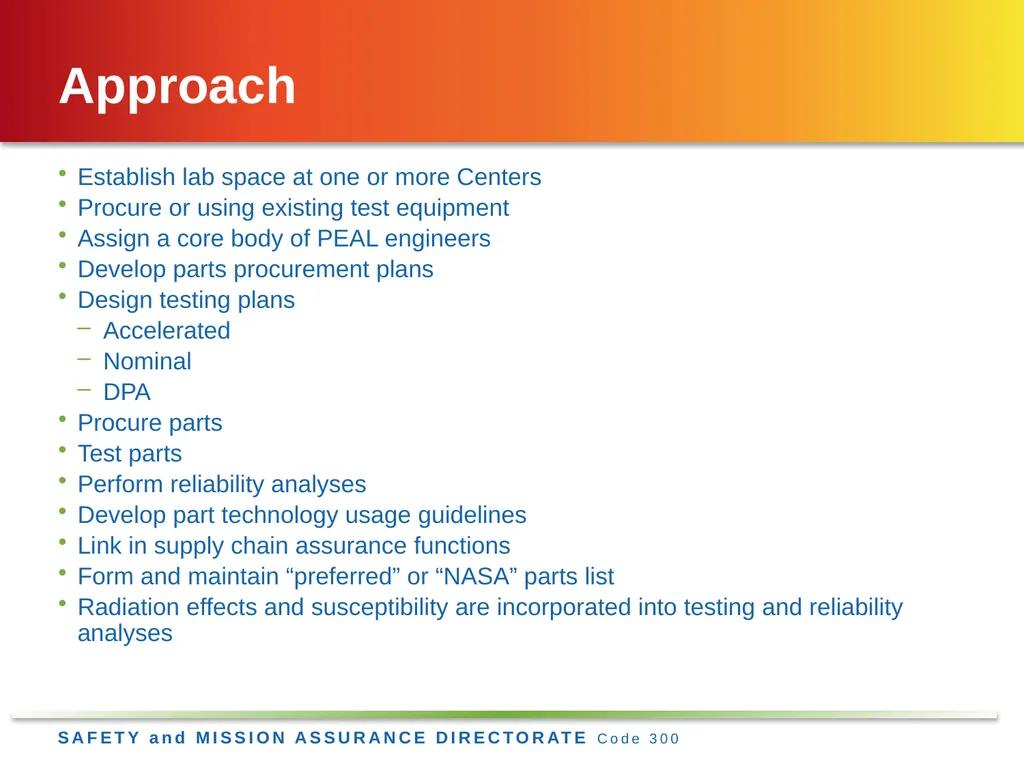
Establish lab space at one or more Centers
Procure or using existing test equipment
Assign a core body of PEAL engineers
Develop parts procurement plans
Design testing plans
Accelerated
Nominal
DPA
Procure parts
Test parts
Perform reliability analyses
Develop part technology usage guidelines
Link in supply chain assurance functions
Form and maintain “preferred” or “NASA” parts list
Radiation effects and susceptibility are incorporated into testing and reliability analyses Approach<br>
Procure or using existing test equipment
Assign a core body of PEAL engineers
Develop parts procurement plans
Design testing plans
Accelerated
Nominal
DPA
Procure parts
Test parts
Perform reliability analyses
Develop part technology usage guidelines
Link in supply chain assurance functions
Form and maintain “preferred” or “NASA” parts list
Radiation effects and susceptibility are incorporated into testing and reliability analyses Approach<br>
37
Keep a cadre of NASA personnel aware of the risk factors, concerns, capabilities, and aspects of usage of all EEEE parts.
Maintain a list of known actions to take given the part technologies involved and in some cases specific part numbers
Maintain an understanding of linkages between such factors as derating (including related to radiation) and reliability (or lifetime in environment, etc)
Provide a convenient part selection list for projects
Track parts supply chain concerns, risks, and issues across all parts categories.
Establish and maintain a NASA-internal list of Industry Leading Parts Manufacturers
Move the radiation characterization effort up front to support multiple projects, to replace overconstraining piece-part compliance approach Benefits of PEAL Provide the necessary confidence needed for using COTS and other types of specialized and custom parts in critical applications. Emphasize the capability developed.<br>
Maintain a list of known actions to take given the part technologies involved and in some cases specific part numbers
Maintain an understanding of linkages between such factors as derating (including related to radiation) and reliability (or lifetime in environment, etc)
Provide a convenient part selection list for projects
Track parts supply chain concerns, risks, and issues across all parts categories.
Establish and maintain a NASA-internal list of Industry Leading Parts Manufacturers
Move the radiation characterization effort up front to support multiple projects, to replace overconstraining piece-part compliance approach Benefits of PEAL Provide the necessary confidence needed for using COTS and other types of specialized and custom parts in critical applications. Emphasize the capability developed.<br>
38
Major impediments against the use of technology from the past 20 years
First priority use of parts that are growingly costly, very long-lead-time, and uncertain delivery, both MIL-SPEC and “special drawing” parts
Lack of knowledge-base in the NASA community about current EEEE part technology, particular best available in the commercial market
Absolute reliance on low-volume, costly, boutique development parts when high volume statistically-process-controlled, high-performance parts are available, in many cases with comparable organic rad-hard-by-design methodologies
Regular activities in resolving issues with special parts upon which we have absolute reliance.
Tendency to maintain outdated heritage designs that are not only costly and time consuming, but keep us rooted in the past Costs of not implementing PEAL Failure to implement PEAL will keep barriers against innovation up in the agency, exacerbate cost and schedule growth issues, and prevent continuous improvement and knowledge building within NASA<br>
First priority use of parts that are growingly costly, very long-lead-time, and uncertain delivery, both MIL-SPEC and “special drawing” parts
Lack of knowledge-base in the NASA community about current EEEE part technology, particular best available in the commercial market
Absolute reliance on low-volume, costly, boutique development parts when high volume statistically-process-controlled, high-performance parts are available, in many cases with comparable organic rad-hard-by-design methodologies
Regular activities in resolving issues with special parts upon which we have absolute reliance.
Tendency to maintain outdated heritage designs that are not only costly and time consuming, but keep us rooted in the past Costs of not implementing PEAL Failure to implement PEAL will keep barriers against innovation up in the agency, exacerbate cost and schedule growth issues, and prevent continuous improvement and knowledge building within NASA<br>
39
The foundation and mechanisms to phase-in COTS parts for Class D and below missions have been established.
The NESC COTS studies have helped to characterize the context for reliable COTS parts usage in missions with allowable low to moderate risk tolerance.
The NESC COTS studies have not on their own established a basis for acceptance of COTS parts for Class A and B robotic missions, to some extent Class C missions, or human space flight missions without substantial pre- and post-procurement actions.
Given the decline of in-house assessment activities to support the NASA part selection list, the Centers have lost their knowledge and capability in dealing with and understanding reliability or necessary screening processes for COTS parts.
The result is extremely costly practices to deal with the inevitable growth in the use of COTS parts in NASA missions
Further, there is no robust capability to facilitate full scale usage of COTS in low-risk tolerance missions
A concept has been proposed to revitalize and strengthen in-house capabilities that support development and maintenance of an evolved and complete NASA part selection list
This will enable cost avoidance and savings of $B and optimize EEEE parts usage on future Class A and B missions, while creating significant new size, weight, power, and performance trade spaces. Summary<br>
The NESC COTS studies have helped to characterize the context for reliable COTS parts usage in missions with allowable low to moderate risk tolerance.
The NESC COTS studies have not on their own established a basis for acceptance of COTS parts for Class A and B robotic missions, to some extent Class C missions, or human space flight missions without substantial pre- and post-procurement actions.
Given the decline of in-house assessment activities to support the NASA part selection list, the Centers have lost their knowledge and capability in dealing with and understanding reliability or necessary screening processes for COTS parts.
The result is extremely costly practices to deal with the inevitable growth in the use of COTS parts in NASA missions
Further, there is no robust capability to facilitate full scale usage of COTS in low-risk tolerance missions
A concept has been proposed to revitalize and strengthen in-house capabilities that support development and maintenance of an evolved and complete NASA part selection list
This will enable cost avoidance and savings of $B and optimize EEEE parts usage on future Class A and B missions, while creating significant new size, weight, power, and performance trade spaces. Summary<br>