
Joint Forward Plan Summary DRAFT – WORK IN
Description: Joint Forward Plan Summary DRAFT WORK IN PROGRESS May 2023 Welcome and Foreword We are delighted to introduce our first Joint Forward Plan which details how the NHS aims to deliver and improve our services to meet the health and
Related Topics
Download Presentation
"Joint Forward Plan Summary DRAFT – WORK IN" is the property of its rightful owner. Permission is granted to download and print the materials on this website for personal, non-commercial use only, and to display it on your personal computer provided you do not modify the materials and that you retain all copyright notices contained in the materials. By downloading content from our website, you accept the terms of this agreement.
Presentation Transcript
slide1. Joint Forward Plan Summary DRAFT – WORK IN PROGRESS May 2023<br>
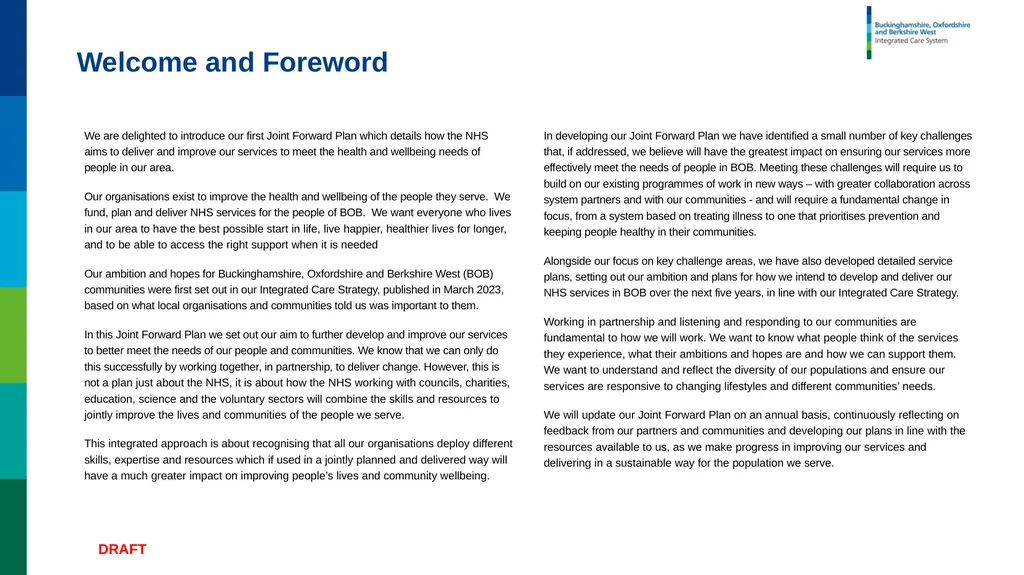
slide2. Welcome and Foreword We are delighted to introduce our first Joint Forward Plan which details how the NHS aims to deliver and improve our services to meet the health and wellbeing needs of people in our area.
Our organisations exist to improve the health and wellbeing of the people they serve. We fund, plan and deliver NHS services for the people of BOB. We want everyone who lives in our area to have the best possible start in life, live happier, healthier lives for longer, and to be able to access the right support when it is needed
Our ambition and hopes for Buckinghamshire, Oxfordshire and Berkshire West (BOB) communities were first set out in our Integrated Care Strategy, published in March 2023, based on what local organisations and communities told us was important to them.
In this Joint Forward Plan we set out our aim to further develop and improve our services to better meet the needs of our people and communities. We know that we can only do this successfully by working together, in partnership, to deliver change. However, this is not a plan just about the NHS, it is about how the NHS working with councils, charities, education, science and the voluntary sectors will combine the skills and resources to jointly improve the lives and communities of the people we serve.
This integrated approach is about recognising that all our organisations deploy different skills, expertise and resources which if used in a jointly planned and delivered way will have a much greater impact on improving people’s lives and community wellbeing.
In developing our Joint Forward Plan we have identified a small number of key challenges that, if addressed, we believe will have the greatest impact on ensuring our services more effectively meet the needs of people in BOB. Meeting these challenges will require us to build on our existing programmes of work in new ways – with greater collaboration across system partners and with our communities - and will require a fundamental change in focus, from a system based on treating illness to one that prioritises prevention and keeping people healthy in their communities.
Alongside our focus on key challenge areas, we have also developed detailed service plans, setting out our ambition and plans for how we intend to develop and deliver our NHS services in BOB over the next five years, in line with our Integrated Care Strategy.
Working in partnership and listening and responding to our communities are fundamental to how we will work. We want to know what people think of the services they experience, what their ambitions and hopes are and how we can support them. We want to understand and reflect the diversity of our populations and ensure our services are responsive to changing lifestyles and different communities’ needs.
We will update our Joint Forward Plan on an annual basis, continuously reflecting on feedback from our partners and communities and developing our plans in line with the resources available to us, as we make progress in improving our services and delivering in a sustainable way for the population we serve.<br>
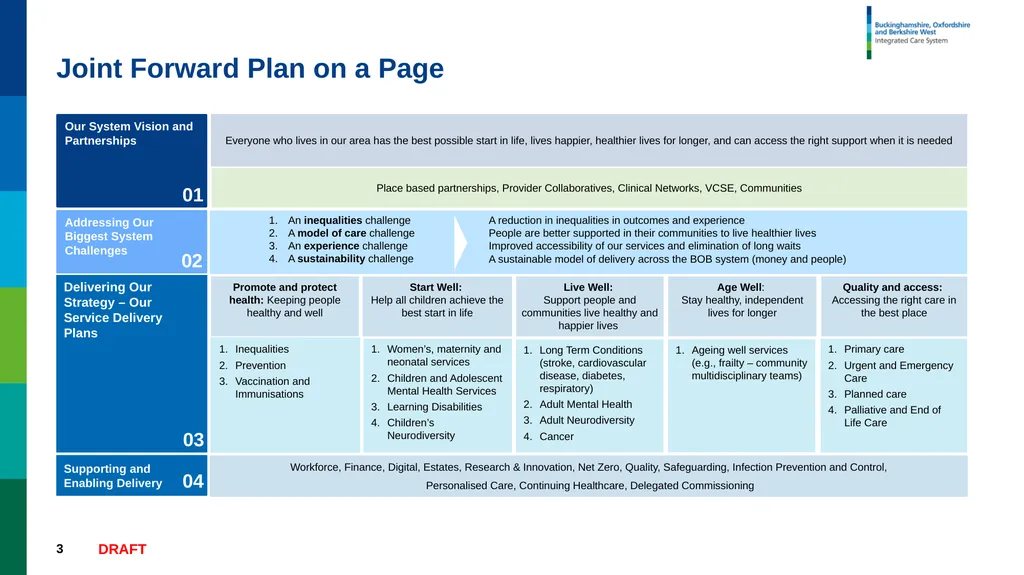
slide3. Joint Forward Plan on a Page 3 Our System Vision and Partnerships Everyone who lives in our area has the best possible start in life, lives happier, healthier lives for longer, and can access the right support when it is needed Inequalities
Prevention
Vaccination and Immunisations Women’s, maternity and neonatal services
Children and Adolescent Mental Health Services
Learning Disabilities
Children’s Neurodiversity Long Term Conditions (stroke, cardiovascular disease, diabetes, respiratory)
Adult Mental Health
Adult Neurodiversity
Cancer Ageing well services (e.g., frailty – community multidisciplinary teams) Primary care
Urgent and Emergency Care
Planned care
Palliative and End of Life Care Supporting and Enabling Delivery Workforce, Finance, Digital, Estates, Research & Innovation, Net Zero, Quality, Safeguarding, Infection Prevention and Control,
Personalised Care, Continuing Healthcare, Delegated Commissioning 01 02 04 Addressing Our Biggest System Challenges 03 02 Place based partnerships, Provider Collaboratives, Clinical Networks, VCSE, Communities A reduction in inequalities in outcomes and experience
People are better supported in their communities to live healthier lives
Improved accessibility of our services and elimination of long waits
A sustainable model of delivery across the BOB system (money and people) Delivering Our Strategy – Our Service Delivery Plans 03 An inequalities challenge
A model of care challenge
An experience challenge
A sustainability challenge<br>
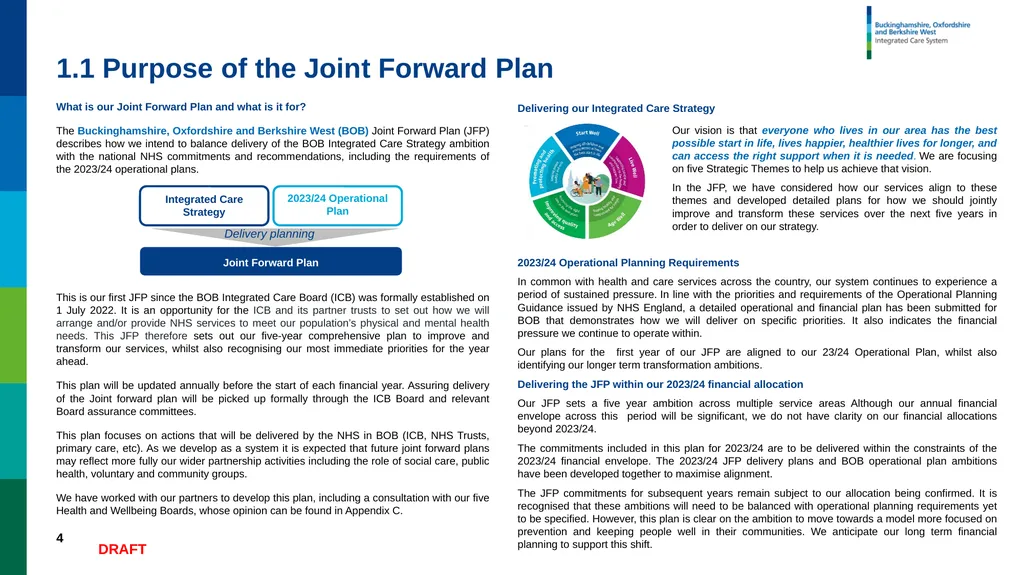
slide4. Delivering our Integrated Care Strategy
2023/24 Operational Planning Requirements
In common with health and care services across the country, our system continues to experience a period of sustained pressure. In line with the priorities and requirements of the Operational Planning Guidance issued by NHS England, a detailed operational and financial plan has been submitted for BOB that demonstrates how we will deliver on specific priorities. It also indicates the financial pressure we continue to operate within.
Our plans for the first year of our JFP are aligned to our 23/24 Operational Plan, whilst also identifying our longer term transformation ambitions.
Delivering the JFP within our 2023/24 financial allocation
Our JFP sets a five year ambition across multiple service areas Although our annual financial envelope across this period will be significant, we do not have clarity on our financial allocations beyond 2023/24.
The commitments included in this plan for 2023/24 are to be delivered within the constraints of the 2023/24 financial envelope. The 2023/24 JFP delivery plans and BOB operational plan ambitions have been developed together to maximise alignment.
The JFP commitments for subsequent years remain subject to our allocation being confirmed. It is recognised that these ambitions will need to be balanced with operational planning requirements yet to be specified. However, this plan is clear on the ambition to move towards a model more focused on prevention and keeping people well in their communities. We anticipate our long term financial planning to support this shift. 4 1.1 Purpose of the Joint Forward Plan What is our Joint Forward Plan and what is it for?
The Buckinghamshire, Oxfordshire and Berkshire West (BOB) Joint Forward Plan (JFP) describes how we intend to balance delivery of the BOB Integrated Care Strategy ambition with the national NHS commitments and recommendations, including the requirements of the 2023/24 operational plans.
This is our first JFP since the BOB Integrated Care Board (ICB) was formally established on 1 July 2022. It is an opportunity for the ICB and its partner trusts to set out how we will arrange and/or provide NHS services to meet our population’s physical and mental health needs. This JFP therefore sets out our five-year comprehensive plan to improve and transform our services, whilst also recognising our most immediate priorities for the year ahead.
This plan will be updated annually before the start of each financial year. Assuring delivery of the Joint forward plan will be picked up formally through the ICB Board and relevant Board assurance committees.
This plan focuses on actions that will be delivered by the NHS in BOB (ICB, NHS Trusts, primary care, etc). As we develop as a system it is expected that future joint forward plans may reflect more fully our wider partnership activities including the role of social care, public health, voluntary and community groups.
We have worked with our partners to develop this plan, including a consultation with our five Health and Wellbeing Boards, whose opinion can be found in Appendix C. Our vision is that everyone who lives in our area has the best possible start in life, lives happier, healthier lives for longer, and can access the right support when it is needed. We are focusing on five Strategic Themes to help us achieve that vision.
In the JFP, we have considered how our services align to these themes and developed detailed plans for how we should jointly improve and transform these services over the next five years in order to deliver on our strategy.<br>
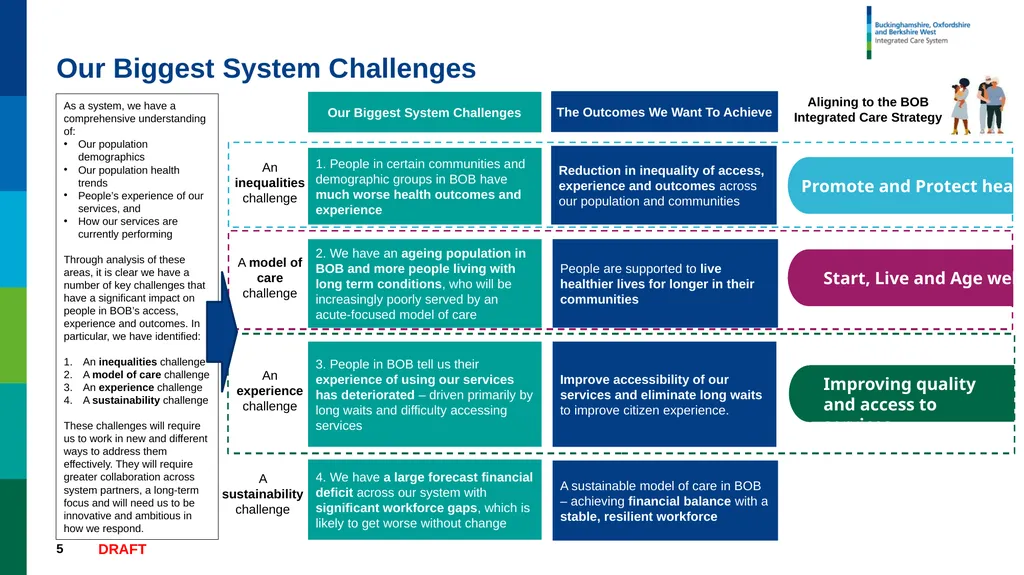
slide5. 2. We have an ageing population in BOB and more people living with long term conditions, who will be increasingly poorly served by an acute-focused model of care 4. We have a large forecast financial deficit across our system with significant workforce gaps, which is likely to get worse without change 3. People in BOB tell us their experience of using our services has deteriorated – driven primarily by long waits and difficulty accessing services 1. People in certain communities and demographic groups in BOB have much worse health outcomes and experience Improving quality and access to services Start, Live and Age well Promote and Protect health Aligning to the BOB Integrated Care Strategy Our Biggest System Challenges The Outcomes We Want To Achieve People are supported to live healthier lives for longer in their communities Reduction in inequality of access, experience and outcomes across our population and communities Improve accessibility of our services and eliminate long waits to improve citizen experience. A sustainable model of care in BOB – achieving financial balance with a stable, resilient workforce 5 As a system, we have a comprehensive understanding of:
Our population demographics
Our population health trends
People’s experience of our services, and
How our services are currently performing
Through analysis of these areas, it is clear we have a number of key challenges that have a significant impact on people in BOB’s access, experience and outcomes. In particular, we have identified:
An inequalities challenge
A model of care challenge
An experience challenge
A sustainability challenge
These challenges will require us to work in new and different ways to address them effectively. They will require greater collaboration across system partners, a long-term focus and will need us to be innovative and ambitious in how we respond. Our Biggest System Challenges An inequalities challenge A model of care challenge An experience challenge A sustainability challenge<br>
slide6. 6 Addressing our Inequalities Challenge Service Plans Reference:
Tackling inequalities is a theme running through all delivery plans. Most actions included in:
Inequalities & Prevention
CYP and Adult Mental Health
Maternity and Neonatal
Long Term Conditions
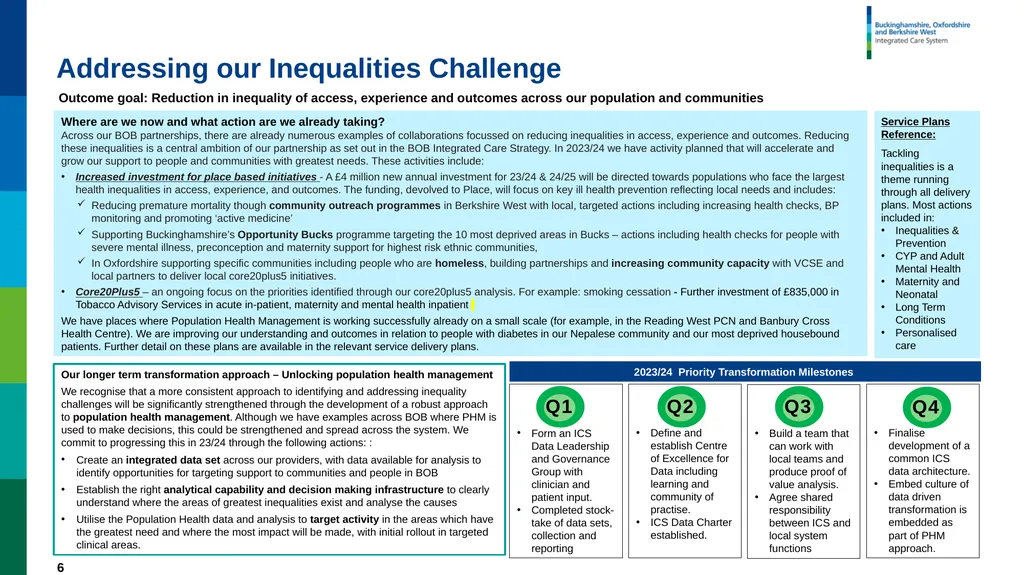
Personalised care Where are we now and what action are we already taking?
Across our BOB partnerships, there are already numerous examples of collaborations focussed on reducing inequalities in access, experience and outcomes. Reducing these inequalities is a central ambition of our partnership as set out in the BOB Integrated Care Strategy. In 2023/24 we have activity planned that will accelerate and grow our support to people and communities with greatest needs. These activities include:
Increased investment for place based initiatives - A £4 million new annual investment for 23/24 & 24/25 will be directed towards populations who face the largest health inequalities in access, experience, and outcomes. The funding, devolved to Place, will focus on key ill health prevention reflecting local needs and includes:
Reducing premature mortality though community outreach programmes in Berkshire West with local, targeted actions including increasing health checks, BP monitoring and promoting ‘active medicine’
Supporting Buckinghamshire’s Opportunity Bucks programme targeting the 10 most deprived areas in Bucks – actions including health checks for people with severe mental illness, preconception and maternity support for highest risk ethnic communities,
In Oxfordshire supporting specific communities including people who are homeless, building partnerships and increasing community capacity with VCSE and local partners to deliver local core20plus5 initiatives.
Core20Plus5 – an ongoing focus on the priorities identified through our core20plus5 analysis. For example: smoking cessation - Further investment of £835,000 in Tobacco Advisory Services in acute in-patient, maternity and mental health inpatient
We have places where Population Health Management is working successfully already on a small scale (for example, in the Reading West PCN and Banbury Cross Health Centre). We are improving our understanding and outcomes in relation to people with diabetes in our Nepalese community and our most deprived housebound patients. Further detail on these plans are available in the relevant service delivery plans. Our longer term transformation approach – Unlocking population health management
We recognise that a more consistent approach to identifying and addressing inequality challenges will be significantly strengthened through the development of a robust approach to population health management. Although we have examples across BOB where PHM is used to make decisions, this could be strengthened and spread across the system. We commit to progressing this in 23/24 through the following actions: :
Create an integrated data set across our providers, with data available for analysis to identify opportunities for targeting support to communities and people in BOB
Establish the right analytical capability and decision making infrastructure to clearly understand where the areas of greatest inequalities exist and analyse the causes
Utilise the Population Health data and analysis to target activity in the areas which have the greatest need and where the most impact will be made, with initial rollout in targeted clinical areas. Q1 2023/24 Priority Transformation Milestones Form an ICS Data Leadership and Governance Group with clinician and patient input.
Completed stock-take of data sets, collection and reporting Define and establish Centre of Excellence for Data including learning and community of practise.
ICS Data Charter established. Build a team that can work with local teams and produce proof of value analysis.
Agree shared responsibility between ICS and local system functions Finalise development of a common ICS data architecture.
Embed culture of data driven transformation is embedded as part of PHM approach. Q2 Q3 Q4 Outcome goal: Reduction in inequality of access, experience and outcomes across our population and communities<br>
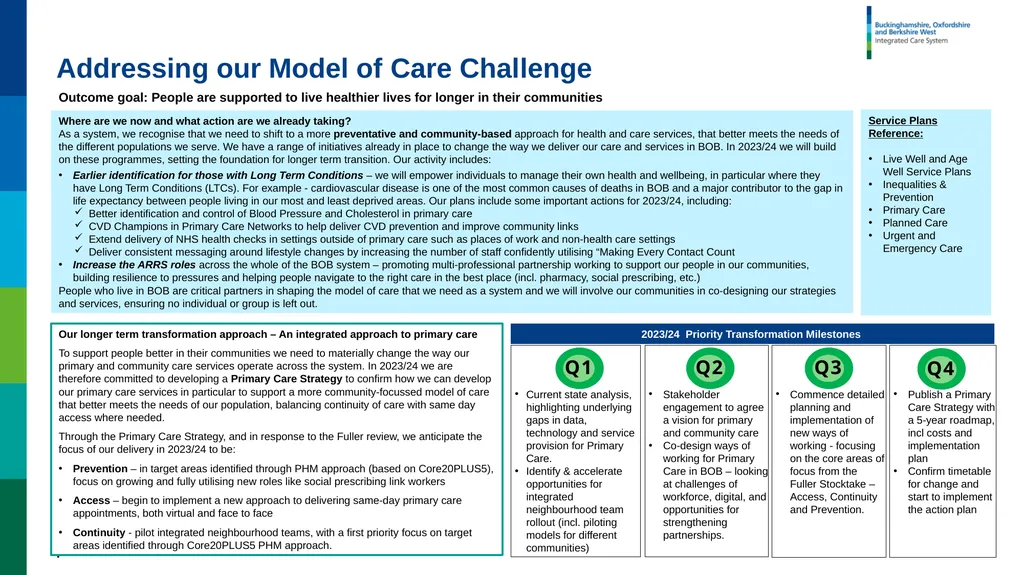
slide7. Current state analysis, highlighting underlying gaps in data, technology and service provision for Primary Care.
Identify & accelerate opportunities for integrated neighbourhood team rollout (incl. piloting models for different communities) Stakeholder engagement to agree a vision for primary and community care
Co-design ways of working for Primary Care in BOB – looking at challenges of workforce, digital, and opportunities for strengthening partnerships. Commence detailed planning and implementation of new ways of working - focusing on the core areas of focus from the Fuller Stocktake – Access, Continuity and Prevention. Publish a Primary Care Strategy with a 5-year roadmap, incl costs and implementation plan
Confirm timetable for change and start to implement the action plan 7 Addressing our Model of Care Challenge Service Plans Reference:
Live Well and Age Well Service Plans
Inequalities & Prevention
Primary Care
Planned Care
Urgent and Emergency Care Where are we now and what action are we already taking?
As a system, we recognise that we need to shift to a more preventative and community-based approach for health and care services, that better meets the needs of the different populations we serve. We have a range of initiatives already in place to change the way we deliver our care and services in BOB. In 2023/24 we will build on these programmes, setting the foundation for longer term transition. Our activity includes:
Earlier identification for those with Long Term Conditions – we will empower individuals to manage their own health and wellbeing, in particular where they have Long Term Conditions (LTCs). For example - cardiovascular disease is one of the most common causes of deaths in BOB and a major contributor to the gap in life expectancy between people living in our most and least deprived areas. Our plans include some important actions for 2023/24, including:
Better identification and control of Blood Pressure and Cholesterol in primary care
CVD Champions in Primary Care Networks to help deliver CVD prevention and improve community links
Extend delivery of NHS health checks in settings outside of primary care such as places of work and non-health care settings
Deliver consistent messaging around lifestyle changes by increasing the number of staff confidently utilising “Making Every Contact Count
Increase the ARRS roles across the whole of the BOB system – promoting multi-professional partnership working to support our people in our communities, building resilience to pressures and helping people navigate to the right care in the best place (incl. pharmacy, social prescribing, etc.)
People who live in BOB are critical partners in shaping the model of care that we need as a system and we will involve our communities in co-designing our strategies and services, ensuring no individual or group is left out. Our longer term transformation approach – An integrated approach to primary care
To support people better in their communities we need to materially change the way our primary and community care services operate across the system. In 2023/24 we are therefore committed to developing a Primary Care Strategy to confirm how we can develop our primary care services in particular to support a more community-focussed model of care that better meets the needs of our population, balancing continuity of care with same day access where needed.
Through the Primary Care Strategy, and in response to the Fuller review, we anticipate the focus of our delivery in 2023/24 to be:
Prevention – in target areas identified through PHM approach (based on Core20PLUS5), focus on growing and fully utilising new roles like social prescribing link workers
Access – begin to implement a new approach to delivering same-day primary care appointments, both virtual and face to face
Continuity - pilot integrated neighbourhood teams, with a first priority focus on target areas identified through Core20PLUS5 PHM approach. Q1 2023/24 Priority Transformation Milestones Q2 Q3 Q4 Outcome goal: People are supported to live healthier lives for longer in their communities<br>
slide8. 8 Addressing our Experience Challenge Service Plans Reference:
Urgent and Emergency Care
Planned Care
Primary Care
CYP Mental Health
Adult Mental Health
Cancer
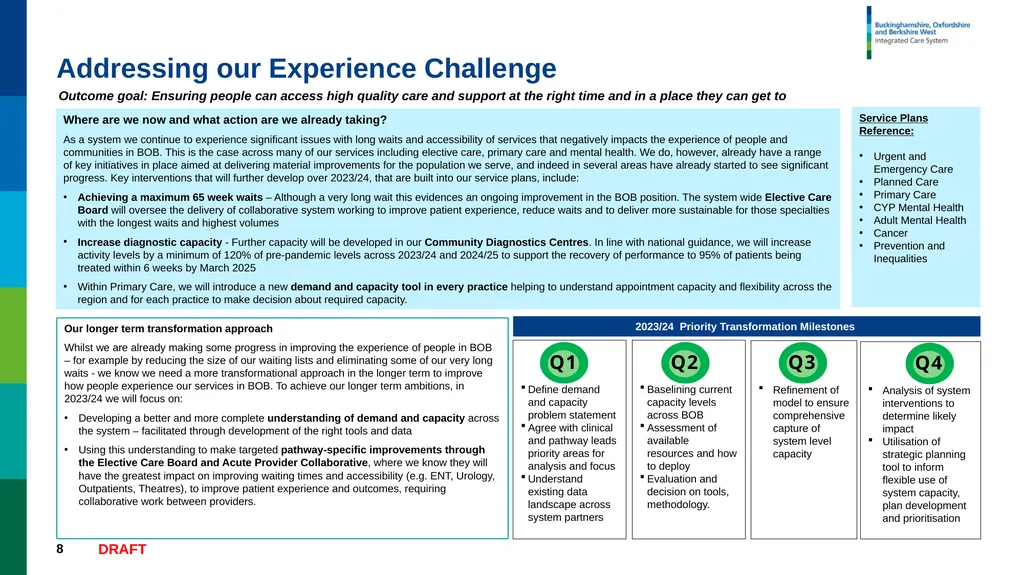
Prevention and Inequalities Where are we now and what action are we already taking?
As a system we continue to experience significant issues with long waits and accessibility of services that negatively impacts the experience of people and communities in BOB. This is the case across many of our services including elective care, primary care and mental health. We do, however, already have a range of key initiatives in place aimed at delivering material improvements for the population we serve, and indeed in several areas have already started to see significant progress. Key interventions that will further develop over 2023/24, that are built into our service plans, include:
Achieving a maximum 65 week waits – Although a very long wait this evidences an ongoing improvement in the BOB position. The system wide Elective Care Board will oversee the delivery of collaborative system working to improve patient experience, reduce waits and to deliver more sustainable for those specialties with the longest waits and highest volumes
Increase diagnostic capacity - Further capacity will be developed in our Community Diagnostics Centres. In line with national guidance, we will increase activity levels by a minimum of 120% of pre-pandemic levels across 2023/24 and 2024/25 to support the recovery of performance to 95% of patients being treated within 6 weeks by March 2025
Within Primary Care, we will introduce a new demand and capacity tool in every practice helping to understand appointment capacity and flexibility across the region and for each practice to make decision about required capacity. Our longer term transformation approach
Whilst we are already making some progress in improving the experience of people in BOB – for example by reducing the size of our waiting lists and eliminating some of our very long waits - we know we need a more transformational approach in the longer term to improve how people experience our services in BOB. To achieve our longer term ambitions, in 2023/24 we will focus on:
Developing a better and more complete understanding of demand and capacity across the system – facilitated through development of the right tools and data
Using this understanding to make targeted pathway-specific improvements through the Elective Care Board and Acute Provider Collaborative, where we know they will have the greatest impact on improving waiting times and accessibility (e.g. ENT, Urology, Outpatients, Theatres), to improve patient experience and outcomes, requiring collaborative work between providers. Q1 2023/24 Priority Transformation Milestones Define demand and capacity problem statement
Agree with clinical and pathway leads priority areas for analysis and focus
Understand existing data landscape across system partners Baselining current capacity levels across BOB
Assessment of available resources and how to deploy
Evaluation and decision on tools, methodology. Refinement of model to ensure comprehensive capture of system level capacity Analysis of system interventions to determine likely impact
Utilisation of strategic planning tool to inform flexible use of system capacity, plan development and prioritisation Q2 Q3 Q4 Outcome goal: Ensuring people can access high quality care and support at the right time and in a place they can get to<br>
slide9. 9 Addressing our Sustainability Challenge - Workforce Service Plans Reference:
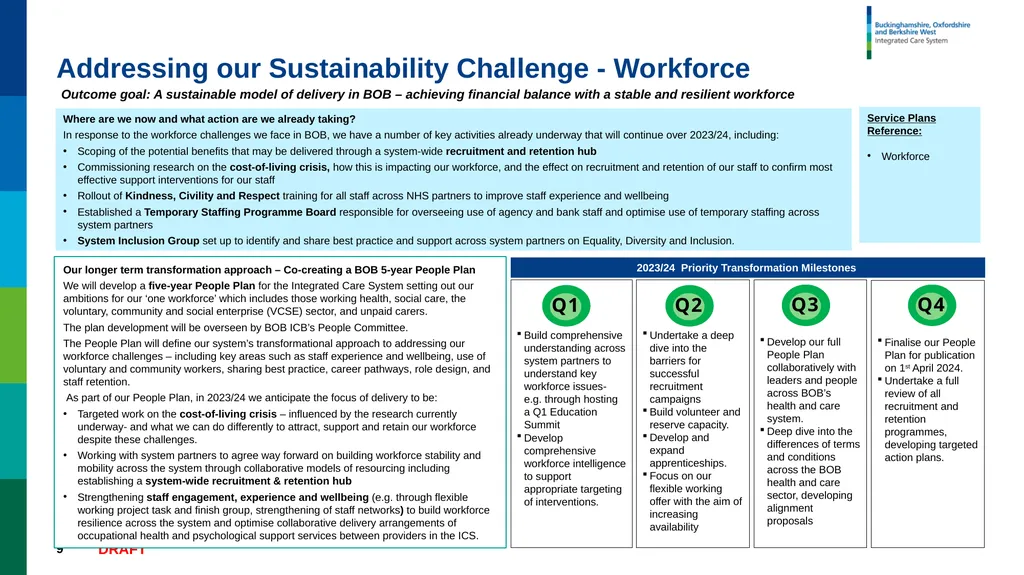
Workforce Where are we now and what action are we already taking?
In response to the workforce challenges we face in BOB, we have a number of key activities already underway that will continue over 2023/24, including:
Scoping of the potential benefits that may be delivered through a system-wide recruitment and retention hub
Commissioning research on the cost-of-living crisis, how this is impacting our workforce, and the effect on recruitment and retention of our staff to confirm most effective support interventions for our staff
Rollout of Kindness, Civility and Respect training for all staff across NHS partners to improve staff experience and wellbeing
Established a Temporary Staffing Programme Board responsible for overseeing use of agency and bank staff and optimise use of temporary staffing across system partners
System Inclusion Group set up to identify and share best practice and support across system partners on Equality, Diversity and Inclusion. Our longer term transformation approach – Co-creating a BOB 5-year People Plan
We will develop a five-year People Plan for the Integrated Care System setting out our ambitions for our ‘one workforce’ which includes those working health, social care, the voluntary, community and social enterprise (VCSE) sector, and unpaid carers.
The plan development will be overseen by BOB ICB’s People Committee.
The People Plan will define our system’s transformational approach to addressing our workforce challenges – including key areas such as staff experience and wellbeing, use of voluntary and community workers, sharing best practice, career pathways, role design, and staff retention.
As part of our People Plan, in 2023/24 we anticipate the focus of delivery to be:
Targeted work on the cost-of-living crisis – influenced by the research currently underway- and what we can do differently to attract, support and retain our workforce despite these challenges.
Working with system partners to agree way forward on building workforce stability and mobility across the system through collaborative models of resourcing including establishing a system-wide recruitment & retention hub
Strengthening staff engagement, experience and wellbeing (e.g. through flexible working project task and finish group, strengthening of staff networks) to build workforce resilience across the system and optimise collaborative delivery arrangements of occupational health and psychological support services between providers in the ICS. Q1 2023/24 Priority Transformation Milestones Build comprehensive understanding across system partners to understand key workforce issues- e.g. through hosting a Q1 Education Summit
Develop comprehensive workforce intelligence to support appropriate targeting of interventions. Undertake a deep dive into the barriers for successful recruitment campaigns
Build volunteer and reserve capacity.
Develop and expand apprenticeships.
Focus on our flexible working offer with the aim of increasing availability Develop our full People Plan collaboratively with leaders and people across BOB’s health and care system.
Deep dive into the differences of terms and conditions across the BOB health and care sector, developing alignment proposals Finalise our People Plan for publication on 1st April 2024.
Undertake a full review of all recruitment and retention programmes, developing targeted action plans. Q2 Q3 Q4 Outcome goal: A sustainable model of delivery in BOB – achieving financial balance with a stable and resilient workforce<br>
slide10. 10 Addressing our Sustainability Challenge - Financial Service Plans Reference:
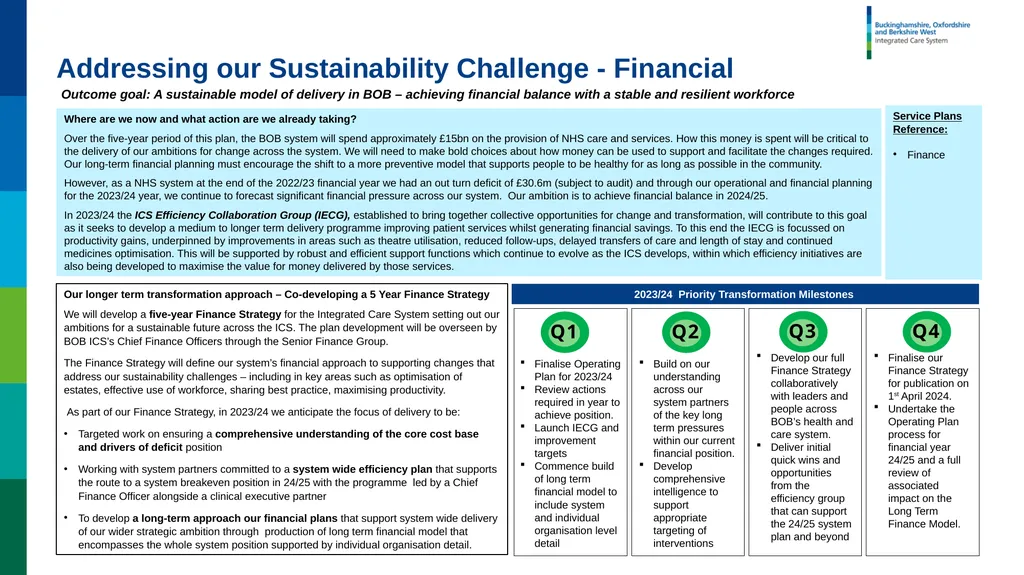
Finance Where are we now and what action are we already taking?
Over the five-year period of this plan, the BOB system will spend approximately £15bn on the provision of NHS care and services. How this money is spent will be critical to the delivery of our ambitions for change across the system. We will need to make bold choices about how money can be used to support and facilitate the changes required. Our long-term financial planning must encourage the shift to a more preventive model that supports people to be healthy for as long as possible in the community.
However, as a NHS system at the end of the 2022/23 financial year we had an out turn deficit of £30.6m (subject to audit) and through our operational and financial planning for the 2023/24 year, we continue to forecast significant financial pressure across our system. Our ambition is to achieve financial balance in 2024/25.
In 2023/24 the ICS Efficiency Collaboration Group (IECG), established to bring together collective opportunities for change and transformation, will contribute to this goal as it seeks to develop a medium to longer term delivery programme improving patient services whilst generating financial savings. To this end the IECG is focussed on productivity gains, underpinned by improvements in areas such as theatre utilisation, reduced follow-ups, delayed transfers of care and length of stay and continued medicines optimisation. This will be supported by robust and efficient support functions which continue to evolve as the ICS develops, within which efficiency initiatives are also being developed to maximise the value for money delivered by those services. Our longer term transformation approach – Co-developing a 5 Year Finance Strategy
We will develop a five-year Finance Strategy for the Integrated Care System setting out our ambitions for a sustainable future across the ICS. The plan development will be overseen by BOB ICS’s Chief Finance Officers through the Senior Finance Group.
The Finance Strategy will define our system’s financial approach to supporting changes that address our sustainability challenges – including in key areas such as optimisation of estates, effective use of workforce, sharing best practice, maximising productivity.
As part of our Finance Strategy, in 2023/24 we anticipate the focus of delivery to be:
Targeted work on ensuring a comprehensive understanding of the core cost base and drivers of deficit position
Working with system partners committed to a system wide efficiency plan that supports the route to a system breakeven position in 24/25 with the programme led by a Chief Finance Officer alongside a clinical executive partner
To develop a long-term approach our financial plans that support system wide delivery of our wider strategic ambition through production of long term financial model that encompasses the whole system position supported by individual organisation detail. Q1 2023/24 Priority Transformation Milestones Finalise Operating Plan for 2023/24
Review actions required in year to achieve position.
Launch IECG and improvement targets
Commence build of long term financial model to include system and individual organisation level detail Build on our understanding across our system partners of the key long term pressures within our current financial position.
Develop comprehensive intelligence to support appropriate targeting of interventions Develop our full Finance Strategy collaboratively with leaders and people across BOB’s health and care system.
Deliver initial quick wins and opportunities from the efficiency group that can support the 24/25 system plan and beyond Finalise our Finance Strategy for publication on 1st April 2024.
Undertake the Operating Plan process for financial year 24/25 and a full review of associated impact on the Long Term Finance Model. Q2 Q3 Q4 Outcome goal: A sustainable model of delivery in BOB – achieving financial balance with a stable and resilient workforce<br>
slide11. 11 2023/24 Building the foundations for change
The actions proposed in previous pages are to address the challenge areas are explicitly and deliberately focussed on 2023/24.
These actions aim to balance activity that will impact people, communities and staff in BOB and the short term with setting a foundation for future change.
However, longer term action plans are required for each of these areas. These need to be developed jointly between BOB ICB, NHS Partner Trusts, and wider system partners. It is proposed these action plans will be co-developed over the course of 2023/24.
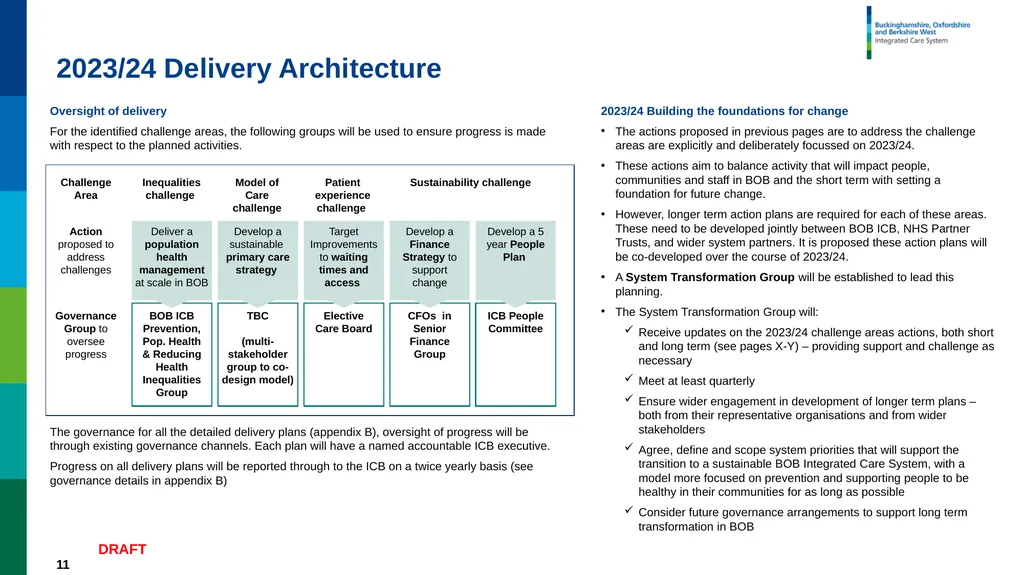
A System Transformation Group will be established to lead this planning.
The System Transformation Group will:
Receive updates on the 2023/24 challenge areas actions, both short and long term (see pages X-Y) – providing support and challenge as necessary
Meet at least quarterly
Ensure wider engagement in development of longer term plans –both from their representative organisations and from wider stakeholders
Agree, define and scope system priorities that will support the transition to a sustainable BOB Integrated Care System, with a model more focused on prevention and supporting people to be healthy in their communities for as long as possible
Consider future governance arrangements to support long term transformation in BOB 2023/24 Delivery Architecture Oversight of delivery
For the identified challenge areas, the following groups will be used to ensure progress is made with respect to the planned activities.
The governance for all the detailed delivery plans (appendix B), oversight of progress will be through existing governance channels. Each plan will have a named accountable ICB executive.
Progress on all delivery plans will be reported through to the ICB on a twice yearly basis (see governance details in appendix B)<br>
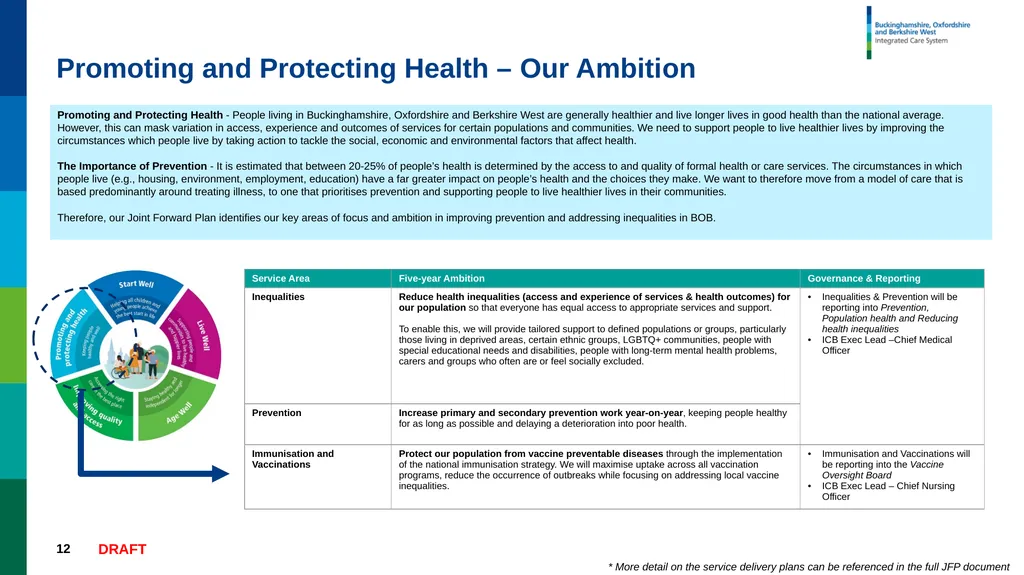
slide12. Promoting and Protecting Health – Our Ambition Start, Live and Age well 12 Promoting and Protecting Health - People living in Buckinghamshire, Oxfordshire and Berkshire West are generally healthier and live longer lives in good health than the national average. However, this can mask variation in access, experience and outcomes of services for certain populations and communities. We need to support people to live healthier lives by improving the circumstances which people live by taking action to tackle the social, economic and environmental factors that affect health.
The Importance of Prevention - It is estimated that between 20-25% of people’s health is determined by the access to and quality of formal health or care services. The circumstances in which people live (e.g., housing, environment, employment, education) have a far greater impact on people’s health and the choices they make. We want to therefore move from a model of care that is based predominantly around treating illness, to one that prioritises prevention and supporting people to live healthier lives in their communities.
Therefore, our Joint Forward Plan identifies our key areas of focus and ambition in improving prevention and addressing inequalities in BOB. * More detail on the service delivery plans can be referenced in the full JFP document<br>
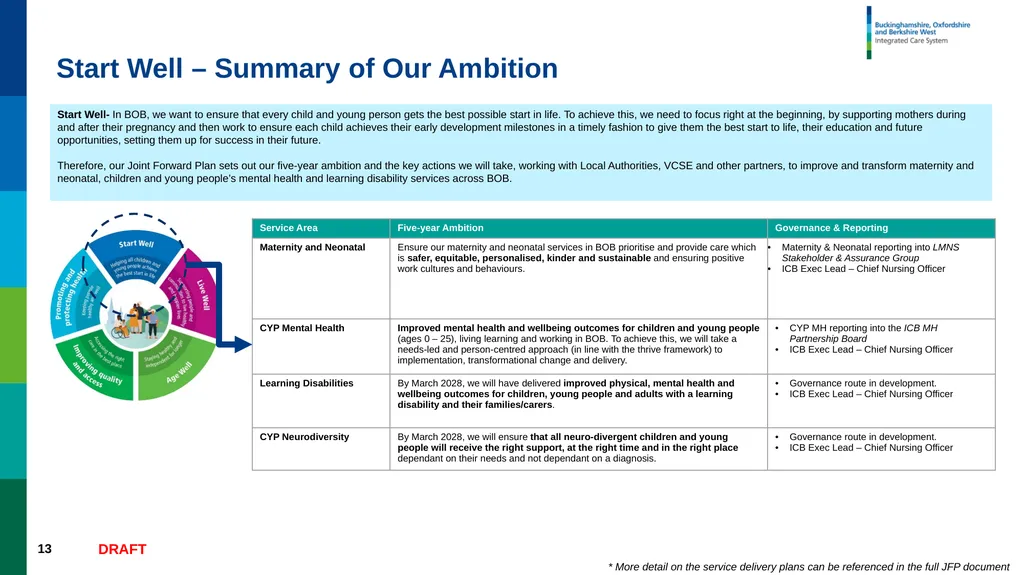
slide13. Start Well – Summary of Our Ambition Start, Live and Age well 13 * More detail on the service delivery plans can be referenced in the full JFP document Start Well- In BOB, we want to ensure that every child and young person gets the best possible start in life. To achieve this, we need to focus right at the beginning, by supporting mothers during and after their pregnancy and then work to ensure each child achieves their early development milestones in a timely fashion to give them the best start to life, their education and future opportunities, setting them up for success in their future.
Therefore, our Joint Forward Plan sets out our five-year ambition and the key actions we will take, working with Local Authorities, VCSE and other partners, to improve and transform maternity and neonatal, children and young people’s mental health and learning disability services across BOB.<br>
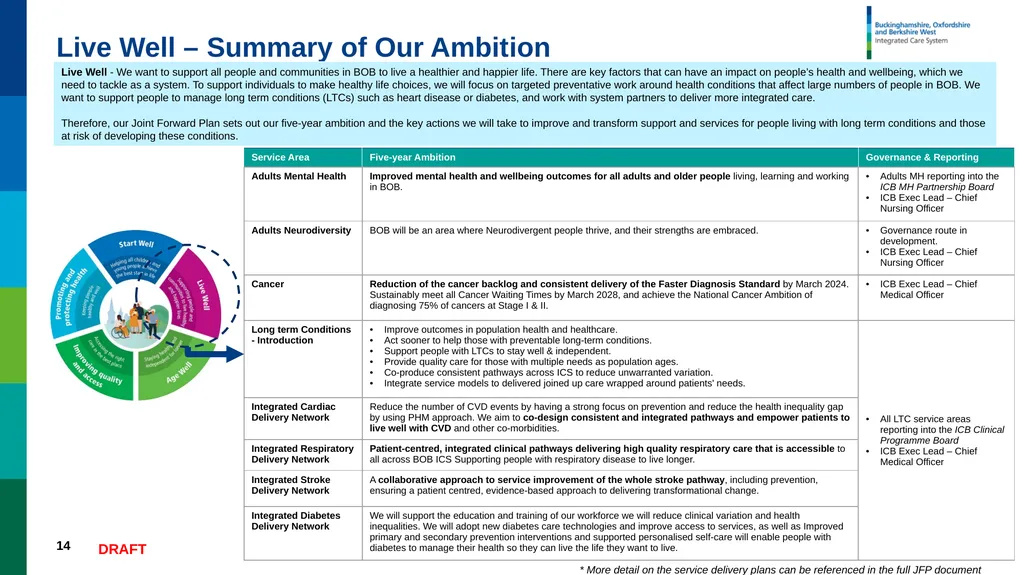
slide14. Live Well – Summary of Our Ambition Start, Live and Age well 14 * More detail on the service delivery plans can be referenced in the full JFP document Live Well - We want to support all people and communities in BOB to live a healthier and happier life. There are key factors that can have an impact on people’s health and wellbeing, which we need to tackle as a system. To support individuals to make healthy life choices, we will focus on targeted preventative work around health conditions that affect large numbers of people in BOB. We want to support people to manage long term conditions (LTCs) such as heart disease or diabetes, and work with system partners to deliver more integrated care.
Therefore, our Joint Forward Plan sets out our five-year ambition and the key actions we will take to improve and transform support and services for people living with long term conditions and those at risk of developing these conditions.<br>
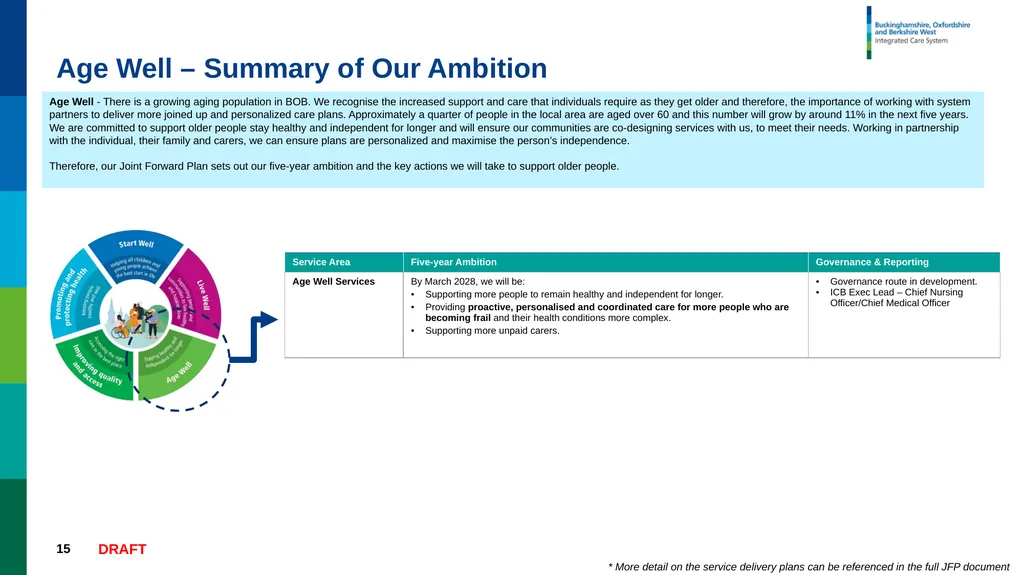
slide15. Age Well – Summary of Our Ambition Start, Live and Age well 15 * More detail on the service delivery plans can be referenced in the full JFP document Age Well - There is a growing aging population in BOB. We recognise the increased support and care that individuals require as they get older and therefore, the importance of working with system partners to deliver more joined up and personalized care plans. Approximately a quarter of people in the local area are aged over 60 and this number will grow by around 11% in the next five years.
We are committed to support older people stay healthy and independent for longer and will ensure our communities are co-designing services with us, to meet their needs. Working in partnership with the individual, their family and carers, we can ensure plans are personalized and maximise the person’s independence.
Therefore, our Joint Forward Plan sets out our five-year ambition and the key actions we will take to support older people.<br>
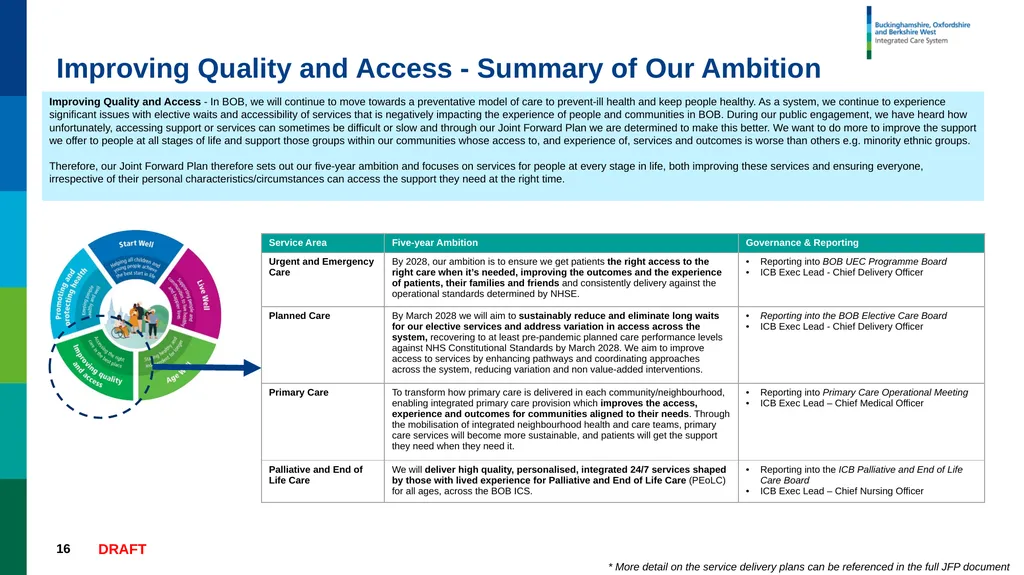
slide16. Improving Quality and Access - Summary of Our Ambition Start, Live and Age well 16 Improving Quality and Access - In BOB, we will continue to move towards a preventative model of care to prevent-ill health and keep people healthy. As a system, we continue to experience significant issues with elective waits and accessibility of services that is negatively impacting the experience of people and communities in BOB. During our public engagement, we have heard how unfortunately, accessing support or services can sometimes be difficult or slow and through our Joint Forward Plan we are determined to make this better. We want to do more to improve the support we offer to people at all stages of life and support those groups within our communities whose access to, and experience of, services and outcomes is worse than others e.g. minority ethnic groups.
Therefore, our Joint Forward Plan therefore sets out our five-year ambition and focuses on services for people at every stage in life, both improving these services and ensuring everyone, irrespective of their personal characteristics/circumstances can access the support they need at the right time. * More detail on the service delivery plans can be referenced in the full JFP document<br>
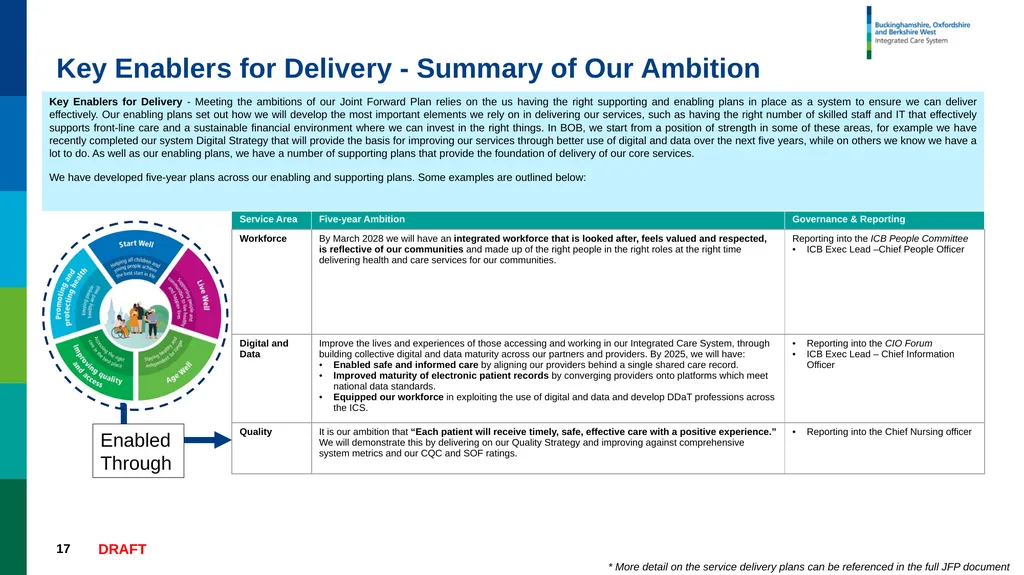
slide17. Start, Live and Age well Enabled Through Key Enablers for Delivery - Summary of Our Ambition 17 Key Enablers for Delivery - Meeting the ambitions of our Joint Forward Plan relies on the us having the right supporting and enabling plans in place as a system to ensure we can deliver effectively. Our enabling plans set out how we will develop the most important elements we rely on in delivering our services, such as having the right number of skilled staff and IT that effectively supports front-line care and a sustainable financial environment where we can invest in the right things. In BOB, we start from a position of strength in some of these areas, for example we have recently completed our system Digital Strategy that will provide the basis for improving our services through better use of digital and data over the next five years, while on others we know we have a lot to do. As well as our enabling plans, we have a number of supporting plans that provide the foundation of delivery of our core services.
We have developed five-year plans across our enabling and supporting plans. Some examples are outlined below: * More detail on the service delivery plans can be referenced in the full JFP document<br>
slide2. Welcome and Foreword We are delighted to introduce our first Joint Forward Plan which details how the NHS aims to deliver and improve our services to meet the health and wellbeing needs of people in our area.
Our organisations exist to improve the health and wellbeing of the people they serve. We fund, plan and deliver NHS services for the people of BOB. We want everyone who lives in our area to have the best possible start in life, live happier, healthier lives for longer, and to be able to access the right support when it is needed
Our ambition and hopes for Buckinghamshire, Oxfordshire and Berkshire West (BOB) communities were first set out in our Integrated Care Strategy, published in March 2023, based on what local organisations and communities told us was important to them.
In this Joint Forward Plan we set out our aim to further develop and improve our services to better meet the needs of our people and communities. We know that we can only do this successfully by working together, in partnership, to deliver change. However, this is not a plan just about the NHS, it is about how the NHS working with councils, charities, education, science and the voluntary sectors will combine the skills and resources to jointly improve the lives and communities of the people we serve.
This integrated approach is about recognising that all our organisations deploy different skills, expertise and resources which if used in a jointly planned and delivered way will have a much greater impact on improving people’s lives and community wellbeing.
In developing our Joint Forward Plan we have identified a small number of key challenges that, if addressed, we believe will have the greatest impact on ensuring our services more effectively meet the needs of people in BOB. Meeting these challenges will require us to build on our existing programmes of work in new ways – with greater collaboration across system partners and with our communities - and will require a fundamental change in focus, from a system based on treating illness to one that prioritises prevention and keeping people healthy in their communities.
Alongside our focus on key challenge areas, we have also developed detailed service plans, setting out our ambition and plans for how we intend to develop and deliver our NHS services in BOB over the next five years, in line with our Integrated Care Strategy.
Working in partnership and listening and responding to our communities are fundamental to how we will work. We want to know what people think of the services they experience, what their ambitions and hopes are and how we can support them. We want to understand and reflect the diversity of our populations and ensure our services are responsive to changing lifestyles and different communities’ needs.
We will update our Joint Forward Plan on an annual basis, continuously reflecting on feedback from our partners and communities and developing our plans in line with the resources available to us, as we make progress in improving our services and delivering in a sustainable way for the population we serve.<br>
slide3. Joint Forward Plan on a Page 3 Our System Vision and Partnerships Everyone who lives in our area has the best possible start in life, lives happier, healthier lives for longer, and can access the right support when it is needed Inequalities
Prevention
Vaccination and Immunisations Women’s, maternity and neonatal services
Children and Adolescent Mental Health Services
Learning Disabilities
Children’s Neurodiversity Long Term Conditions (stroke, cardiovascular disease, diabetes, respiratory)
Adult Mental Health
Adult Neurodiversity
Cancer Ageing well services (e.g., frailty – community multidisciplinary teams) Primary care
Urgent and Emergency Care
Planned care
Palliative and End of Life Care Supporting and Enabling Delivery Workforce, Finance, Digital, Estates, Research & Innovation, Net Zero, Quality, Safeguarding, Infection Prevention and Control,
Personalised Care, Continuing Healthcare, Delegated Commissioning 01 02 04 Addressing Our Biggest System Challenges 03 02 Place based partnerships, Provider Collaboratives, Clinical Networks, VCSE, Communities A reduction in inequalities in outcomes and experience
People are better supported in their communities to live healthier lives
Improved accessibility of our services and elimination of long waits
A sustainable model of delivery across the BOB system (money and people) Delivering Our Strategy – Our Service Delivery Plans 03 An inequalities challenge
A model of care challenge
An experience challenge
A sustainability challenge<br>
slide4. Delivering our Integrated Care Strategy
2023/24 Operational Planning Requirements
In common with health and care services across the country, our system continues to experience a period of sustained pressure. In line with the priorities and requirements of the Operational Planning Guidance issued by NHS England, a detailed operational and financial plan has been submitted for BOB that demonstrates how we will deliver on specific priorities. It also indicates the financial pressure we continue to operate within.
Our plans for the first year of our JFP are aligned to our 23/24 Operational Plan, whilst also identifying our longer term transformation ambitions.
Delivering the JFP within our 2023/24 financial allocation
Our JFP sets a five year ambition across multiple service areas Although our annual financial envelope across this period will be significant, we do not have clarity on our financial allocations beyond 2023/24.
The commitments included in this plan for 2023/24 are to be delivered within the constraints of the 2023/24 financial envelope. The 2023/24 JFP delivery plans and BOB operational plan ambitions have been developed together to maximise alignment.
The JFP commitments for subsequent years remain subject to our allocation being confirmed. It is recognised that these ambitions will need to be balanced with operational planning requirements yet to be specified. However, this plan is clear on the ambition to move towards a model more focused on prevention and keeping people well in their communities. We anticipate our long term financial planning to support this shift. 4 1.1 Purpose of the Joint Forward Plan What is our Joint Forward Plan and what is it for?
The Buckinghamshire, Oxfordshire and Berkshire West (BOB) Joint Forward Plan (JFP) describes how we intend to balance delivery of the BOB Integrated Care Strategy ambition with the national NHS commitments and recommendations, including the requirements of the 2023/24 operational plans.
This is our first JFP since the BOB Integrated Care Board (ICB) was formally established on 1 July 2022. It is an opportunity for the ICB and its partner trusts to set out how we will arrange and/or provide NHS services to meet our population’s physical and mental health needs. This JFP therefore sets out our five-year comprehensive plan to improve and transform our services, whilst also recognising our most immediate priorities for the year ahead.
This plan will be updated annually before the start of each financial year. Assuring delivery of the Joint forward plan will be picked up formally through the ICB Board and relevant Board assurance committees.
This plan focuses on actions that will be delivered by the NHS in BOB (ICB, NHS Trusts, primary care, etc). As we develop as a system it is expected that future joint forward plans may reflect more fully our wider partnership activities including the role of social care, public health, voluntary and community groups.
We have worked with our partners to develop this plan, including a consultation with our five Health and Wellbeing Boards, whose opinion can be found in Appendix C. Our vision is that everyone who lives in our area has the best possible start in life, lives happier, healthier lives for longer, and can access the right support when it is needed. We are focusing on five Strategic Themes to help us achieve that vision.
In the JFP, we have considered how our services align to these themes and developed detailed plans for how we should jointly improve and transform these services over the next five years in order to deliver on our strategy.<br>
slide5. 2. We have an ageing population in BOB and more people living with long term conditions, who will be increasingly poorly served by an acute-focused model of care 4. We have a large forecast financial deficit across our system with significant workforce gaps, which is likely to get worse without change 3. People in BOB tell us their experience of using our services has deteriorated – driven primarily by long waits and difficulty accessing services 1. People in certain communities and demographic groups in BOB have much worse health outcomes and experience Improving quality and access to services Start, Live and Age well Promote and Protect health Aligning to the BOB Integrated Care Strategy Our Biggest System Challenges The Outcomes We Want To Achieve People are supported to live healthier lives for longer in their communities Reduction in inequality of access, experience and outcomes across our population and communities Improve accessibility of our services and eliminate long waits to improve citizen experience. A sustainable model of care in BOB – achieving financial balance with a stable, resilient workforce 5 As a system, we have a comprehensive understanding of:
Our population demographics
Our population health trends
People’s experience of our services, and
How our services are currently performing
Through analysis of these areas, it is clear we have a number of key challenges that have a significant impact on people in BOB’s access, experience and outcomes. In particular, we have identified:
An inequalities challenge
A model of care challenge
An experience challenge
A sustainability challenge
These challenges will require us to work in new and different ways to address them effectively. They will require greater collaboration across system partners, a long-term focus and will need us to be innovative and ambitious in how we respond. Our Biggest System Challenges An inequalities challenge A model of care challenge An experience challenge A sustainability challenge<br>
slide6. 6 Addressing our Inequalities Challenge Service Plans Reference:
Tackling inequalities is a theme running through all delivery plans. Most actions included in:
Inequalities & Prevention
CYP and Adult Mental Health
Maternity and Neonatal
Long Term Conditions
Personalised care Where are we now and what action are we already taking?
Across our BOB partnerships, there are already numerous examples of collaborations focussed on reducing inequalities in access, experience and outcomes. Reducing these inequalities is a central ambition of our partnership as set out in the BOB Integrated Care Strategy. In 2023/24 we have activity planned that will accelerate and grow our support to people and communities with greatest needs. These activities include:
Increased investment for place based initiatives - A £4 million new annual investment for 23/24 & 24/25 will be directed towards populations who face the largest health inequalities in access, experience, and outcomes. The funding, devolved to Place, will focus on key ill health prevention reflecting local needs and includes:
Reducing premature mortality though community outreach programmes in Berkshire West with local, targeted actions including increasing health checks, BP monitoring and promoting ‘active medicine’
Supporting Buckinghamshire’s Opportunity Bucks programme targeting the 10 most deprived areas in Bucks – actions including health checks for people with severe mental illness, preconception and maternity support for highest risk ethnic communities,
In Oxfordshire supporting specific communities including people who are homeless, building partnerships and increasing community capacity with VCSE and local partners to deliver local core20plus5 initiatives.
Core20Plus5 – an ongoing focus on the priorities identified through our core20plus5 analysis. For example: smoking cessation - Further investment of £835,000 in Tobacco Advisory Services in acute in-patient, maternity and mental health inpatient
We have places where Population Health Management is working successfully already on a small scale (for example, in the Reading West PCN and Banbury Cross Health Centre). We are improving our understanding and outcomes in relation to people with diabetes in our Nepalese community and our most deprived housebound patients. Further detail on these plans are available in the relevant service delivery plans. Our longer term transformation approach – Unlocking population health management
We recognise that a more consistent approach to identifying and addressing inequality challenges will be significantly strengthened through the development of a robust approach to population health management. Although we have examples across BOB where PHM is used to make decisions, this could be strengthened and spread across the system. We commit to progressing this in 23/24 through the following actions: :
Create an integrated data set across our providers, with data available for analysis to identify opportunities for targeting support to communities and people in BOB
Establish the right analytical capability and decision making infrastructure to clearly understand where the areas of greatest inequalities exist and analyse the causes
Utilise the Population Health data and analysis to target activity in the areas which have the greatest need and where the most impact will be made, with initial rollout in targeted clinical areas. Q1 2023/24 Priority Transformation Milestones Form an ICS Data Leadership and Governance Group with clinician and patient input.
Completed stock-take of data sets, collection and reporting Define and establish Centre of Excellence for Data including learning and community of practise.
ICS Data Charter established. Build a team that can work with local teams and produce proof of value analysis.
Agree shared responsibility between ICS and local system functions Finalise development of a common ICS data architecture.
Embed culture of data driven transformation is embedded as part of PHM approach. Q2 Q3 Q4 Outcome goal: Reduction in inequality of access, experience and outcomes across our population and communities<br>
slide7. Current state analysis, highlighting underlying gaps in data, technology and service provision for Primary Care.
Identify & accelerate opportunities for integrated neighbourhood team rollout (incl. piloting models for different communities) Stakeholder engagement to agree a vision for primary and community care
Co-design ways of working for Primary Care in BOB – looking at challenges of workforce, digital, and opportunities for strengthening partnerships. Commence detailed planning and implementation of new ways of working - focusing on the core areas of focus from the Fuller Stocktake – Access, Continuity and Prevention. Publish a Primary Care Strategy with a 5-year roadmap, incl costs and implementation plan
Confirm timetable for change and start to implement the action plan 7 Addressing our Model of Care Challenge Service Plans Reference:
Live Well and Age Well Service Plans
Inequalities & Prevention
Primary Care
Planned Care
Urgent and Emergency Care Where are we now and what action are we already taking?
As a system, we recognise that we need to shift to a more preventative and community-based approach for health and care services, that better meets the needs of the different populations we serve. We have a range of initiatives already in place to change the way we deliver our care and services in BOB. In 2023/24 we will build on these programmes, setting the foundation for longer term transition. Our activity includes:
Earlier identification for those with Long Term Conditions – we will empower individuals to manage their own health and wellbeing, in particular where they have Long Term Conditions (LTCs). For example - cardiovascular disease is one of the most common causes of deaths in BOB and a major contributor to the gap in life expectancy between people living in our most and least deprived areas. Our plans include some important actions for 2023/24, including:
Better identification and control of Blood Pressure and Cholesterol in primary care
CVD Champions in Primary Care Networks to help deliver CVD prevention and improve community links
Extend delivery of NHS health checks in settings outside of primary care such as places of work and non-health care settings
Deliver consistent messaging around lifestyle changes by increasing the number of staff confidently utilising “Making Every Contact Count
Increase the ARRS roles across the whole of the BOB system – promoting multi-professional partnership working to support our people in our communities, building resilience to pressures and helping people navigate to the right care in the best place (incl. pharmacy, social prescribing, etc.)
People who live in BOB are critical partners in shaping the model of care that we need as a system and we will involve our communities in co-designing our strategies and services, ensuring no individual or group is left out. Our longer term transformation approach – An integrated approach to primary care
To support people better in their communities we need to materially change the way our primary and community care services operate across the system. In 2023/24 we are therefore committed to developing a Primary Care Strategy to confirm how we can develop our primary care services in particular to support a more community-focussed model of care that better meets the needs of our population, balancing continuity of care with same day access where needed.
Through the Primary Care Strategy, and in response to the Fuller review, we anticipate the focus of our delivery in 2023/24 to be:
Prevention – in target areas identified through PHM approach (based on Core20PLUS5), focus on growing and fully utilising new roles like social prescribing link workers
Access – begin to implement a new approach to delivering same-day primary care appointments, both virtual and face to face
Continuity - pilot integrated neighbourhood teams, with a first priority focus on target areas identified through Core20PLUS5 PHM approach. Q1 2023/24 Priority Transformation Milestones Q2 Q3 Q4 Outcome goal: People are supported to live healthier lives for longer in their communities<br>
slide8. 8 Addressing our Experience Challenge Service Plans Reference:
Urgent and Emergency Care
Planned Care
Primary Care
CYP Mental Health
Adult Mental Health
Cancer
Prevention and Inequalities Where are we now and what action are we already taking?
As a system we continue to experience significant issues with long waits and accessibility of services that negatively impacts the experience of people and communities in BOB. This is the case across many of our services including elective care, primary care and mental health. We do, however, already have a range of key initiatives in place aimed at delivering material improvements for the population we serve, and indeed in several areas have already started to see significant progress. Key interventions that will further develop over 2023/24, that are built into our service plans, include:
Achieving a maximum 65 week waits – Although a very long wait this evidences an ongoing improvement in the BOB position. The system wide Elective Care Board will oversee the delivery of collaborative system working to improve patient experience, reduce waits and to deliver more sustainable for those specialties with the longest waits and highest volumes
Increase diagnostic capacity - Further capacity will be developed in our Community Diagnostics Centres. In line with national guidance, we will increase activity levels by a minimum of 120% of pre-pandemic levels across 2023/24 and 2024/25 to support the recovery of performance to 95% of patients being treated within 6 weeks by March 2025
Within Primary Care, we will introduce a new demand and capacity tool in every practice helping to understand appointment capacity and flexibility across the region and for each practice to make decision about required capacity. Our longer term transformation approach
Whilst we are already making some progress in improving the experience of people in BOB – for example by reducing the size of our waiting lists and eliminating some of our very long waits - we know we need a more transformational approach in the longer term to improve how people experience our services in BOB. To achieve our longer term ambitions, in 2023/24 we will focus on:
Developing a better and more complete understanding of demand and capacity across the system – facilitated through development of the right tools and data
Using this understanding to make targeted pathway-specific improvements through the Elective Care Board and Acute Provider Collaborative, where we know they will have the greatest impact on improving waiting times and accessibility (e.g. ENT, Urology, Outpatients, Theatres), to improve patient experience and outcomes, requiring collaborative work between providers. Q1 2023/24 Priority Transformation Milestones Define demand and capacity problem statement
Agree with clinical and pathway leads priority areas for analysis and focus
Understand existing data landscape across system partners Baselining current capacity levels across BOB
Assessment of available resources and how to deploy
Evaluation and decision on tools, methodology. Refinement of model to ensure comprehensive capture of system level capacity Analysis of system interventions to determine likely impact
Utilisation of strategic planning tool to inform flexible use of system capacity, plan development and prioritisation Q2 Q3 Q4 Outcome goal: Ensuring people can access high quality care and support at the right time and in a place they can get to<br>
slide9. 9 Addressing our Sustainability Challenge - Workforce Service Plans Reference:
Workforce Where are we now and what action are we already taking?
In response to the workforce challenges we face in BOB, we have a number of key activities already underway that will continue over 2023/24, including:
Scoping of the potential benefits that may be delivered through a system-wide recruitment and retention hub
Commissioning research on the cost-of-living crisis, how this is impacting our workforce, and the effect on recruitment and retention of our staff to confirm most effective support interventions for our staff
Rollout of Kindness, Civility and Respect training for all staff across NHS partners to improve staff experience and wellbeing
Established a Temporary Staffing Programme Board responsible for overseeing use of agency and bank staff and optimise use of temporary staffing across system partners
System Inclusion Group set up to identify and share best practice and support across system partners on Equality, Diversity and Inclusion. Our longer term transformation approach – Co-creating a BOB 5-year People Plan
We will develop a five-year People Plan for the Integrated Care System setting out our ambitions for our ‘one workforce’ which includes those working health, social care, the voluntary, community and social enterprise (VCSE) sector, and unpaid carers.
The plan development will be overseen by BOB ICB’s People Committee.
The People Plan will define our system’s transformational approach to addressing our workforce challenges – including key areas such as staff experience and wellbeing, use of voluntary and community workers, sharing best practice, career pathways, role design, and staff retention.
As part of our People Plan, in 2023/24 we anticipate the focus of delivery to be:
Targeted work on the cost-of-living crisis – influenced by the research currently underway- and what we can do differently to attract, support and retain our workforce despite these challenges.
Working with system partners to agree way forward on building workforce stability and mobility across the system through collaborative models of resourcing including establishing a system-wide recruitment & retention hub
Strengthening staff engagement, experience and wellbeing (e.g. through flexible working project task and finish group, strengthening of staff networks) to build workforce resilience across the system and optimise collaborative delivery arrangements of occupational health and psychological support services between providers in the ICS. Q1 2023/24 Priority Transformation Milestones Build comprehensive understanding across system partners to understand key workforce issues- e.g. through hosting a Q1 Education Summit
Develop comprehensive workforce intelligence to support appropriate targeting of interventions. Undertake a deep dive into the barriers for successful recruitment campaigns
Build volunteer and reserve capacity.
Develop and expand apprenticeships.
Focus on our flexible working offer with the aim of increasing availability Develop our full People Plan collaboratively with leaders and people across BOB’s health and care system.
Deep dive into the differences of terms and conditions across the BOB health and care sector, developing alignment proposals Finalise our People Plan for publication on 1st April 2024.
Undertake a full review of all recruitment and retention programmes, developing targeted action plans. Q2 Q3 Q4 Outcome goal: A sustainable model of delivery in BOB – achieving financial balance with a stable and resilient workforce<br>
slide10. 10 Addressing our Sustainability Challenge - Financial Service Plans Reference:
Finance Where are we now and what action are we already taking?
Over the five-year period of this plan, the BOB system will spend approximately £15bn on the provision of NHS care and services. How this money is spent will be critical to the delivery of our ambitions for change across the system. We will need to make bold choices about how money can be used to support and facilitate the changes required. Our long-term financial planning must encourage the shift to a more preventive model that supports people to be healthy for as long as possible in the community.
However, as a NHS system at the end of the 2022/23 financial year we had an out turn deficit of £30.6m (subject to audit) and through our operational and financial planning for the 2023/24 year, we continue to forecast significant financial pressure across our system. Our ambition is to achieve financial balance in 2024/25.
In 2023/24 the ICS Efficiency Collaboration Group (IECG), established to bring together collective opportunities for change and transformation, will contribute to this goal as it seeks to develop a medium to longer term delivery programme improving patient services whilst generating financial savings. To this end the IECG is focussed on productivity gains, underpinned by improvements in areas such as theatre utilisation, reduced follow-ups, delayed transfers of care and length of stay and continued medicines optimisation. This will be supported by robust and efficient support functions which continue to evolve as the ICS develops, within which efficiency initiatives are also being developed to maximise the value for money delivered by those services. Our longer term transformation approach – Co-developing a 5 Year Finance Strategy
We will develop a five-year Finance Strategy for the Integrated Care System setting out our ambitions for a sustainable future across the ICS. The plan development will be overseen by BOB ICS’s Chief Finance Officers through the Senior Finance Group.
The Finance Strategy will define our system’s financial approach to supporting changes that address our sustainability challenges – including in key areas such as optimisation of estates, effective use of workforce, sharing best practice, maximising productivity.
As part of our Finance Strategy, in 2023/24 we anticipate the focus of delivery to be:
Targeted work on ensuring a comprehensive understanding of the core cost base and drivers of deficit position
Working with system partners committed to a system wide efficiency plan that supports the route to a system breakeven position in 24/25 with the programme led by a Chief Finance Officer alongside a clinical executive partner
To develop a long-term approach our financial plans that support system wide delivery of our wider strategic ambition through production of long term financial model that encompasses the whole system position supported by individual organisation detail. Q1 2023/24 Priority Transformation Milestones Finalise Operating Plan for 2023/24
Review actions required in year to achieve position.
Launch IECG and improvement targets
Commence build of long term financial model to include system and individual organisation level detail Build on our understanding across our system partners of the key long term pressures within our current financial position.
Develop comprehensive intelligence to support appropriate targeting of interventions Develop our full Finance Strategy collaboratively with leaders and people across BOB’s health and care system.
Deliver initial quick wins and opportunities from the efficiency group that can support the 24/25 system plan and beyond Finalise our Finance Strategy for publication on 1st April 2024.
Undertake the Operating Plan process for financial year 24/25 and a full review of associated impact on the Long Term Finance Model. Q2 Q3 Q4 Outcome goal: A sustainable model of delivery in BOB – achieving financial balance with a stable and resilient workforce<br>
slide11. 11 2023/24 Building the foundations for change
The actions proposed in previous pages are to address the challenge areas are explicitly and deliberately focussed on 2023/24.
These actions aim to balance activity that will impact people, communities and staff in BOB and the short term with setting a foundation for future change.
However, longer term action plans are required for each of these areas. These need to be developed jointly between BOB ICB, NHS Partner Trusts, and wider system partners. It is proposed these action plans will be co-developed over the course of 2023/24.
A System Transformation Group will be established to lead this planning.
The System Transformation Group will:
Receive updates on the 2023/24 challenge areas actions, both short and long term (see pages X-Y) – providing support and challenge as necessary
Meet at least quarterly
Ensure wider engagement in development of longer term plans –both from their representative organisations and from wider stakeholders
Agree, define and scope system priorities that will support the transition to a sustainable BOB Integrated Care System, with a model more focused on prevention and supporting people to be healthy in their communities for as long as possible
Consider future governance arrangements to support long term transformation in BOB 2023/24 Delivery Architecture Oversight of delivery
For the identified challenge areas, the following groups will be used to ensure progress is made with respect to the planned activities.
The governance for all the detailed delivery plans (appendix B), oversight of progress will be through existing governance channels. Each plan will have a named accountable ICB executive.
Progress on all delivery plans will be reported through to the ICB on a twice yearly basis (see governance details in appendix B)<br>
slide12. Promoting and Protecting Health – Our Ambition Start, Live and Age well 12 Promoting and Protecting Health - People living in Buckinghamshire, Oxfordshire and Berkshire West are generally healthier and live longer lives in good health than the national average. However, this can mask variation in access, experience and outcomes of services for certain populations and communities. We need to support people to live healthier lives by improving the circumstances which people live by taking action to tackle the social, economic and environmental factors that affect health.
The Importance of Prevention - It is estimated that between 20-25% of people’s health is determined by the access to and quality of formal health or care services. The circumstances in which people live (e.g., housing, environment, employment, education) have a far greater impact on people’s health and the choices they make. We want to therefore move from a model of care that is based predominantly around treating illness, to one that prioritises prevention and supporting people to live healthier lives in their communities.
Therefore, our Joint Forward Plan identifies our key areas of focus and ambition in improving prevention and addressing inequalities in BOB. * More detail on the service delivery plans can be referenced in the full JFP document<br>
slide13. Start Well – Summary of Our Ambition Start, Live and Age well 13 * More detail on the service delivery plans can be referenced in the full JFP document Start Well- In BOB, we want to ensure that every child and young person gets the best possible start in life. To achieve this, we need to focus right at the beginning, by supporting mothers during and after their pregnancy and then work to ensure each child achieves their early development milestones in a timely fashion to give them the best start to life, their education and future opportunities, setting them up for success in their future.
Therefore, our Joint Forward Plan sets out our five-year ambition and the key actions we will take, working with Local Authorities, VCSE and other partners, to improve and transform maternity and neonatal, children and young people’s mental health and learning disability services across BOB.<br>
slide14. Live Well – Summary of Our Ambition Start, Live and Age well 14 * More detail on the service delivery plans can be referenced in the full JFP document Live Well - We want to support all people and communities in BOB to live a healthier and happier life. There are key factors that can have an impact on people’s health and wellbeing, which we need to tackle as a system. To support individuals to make healthy life choices, we will focus on targeted preventative work around health conditions that affect large numbers of people in BOB. We want to support people to manage long term conditions (LTCs) such as heart disease or diabetes, and work with system partners to deliver more integrated care.
Therefore, our Joint Forward Plan sets out our five-year ambition and the key actions we will take to improve and transform support and services for people living with long term conditions and those at risk of developing these conditions.<br>
slide15. Age Well – Summary of Our Ambition Start, Live and Age well 15 * More detail on the service delivery plans can be referenced in the full JFP document Age Well - There is a growing aging population in BOB. We recognise the increased support and care that individuals require as they get older and therefore, the importance of working with system partners to deliver more joined up and personalized care plans. Approximately a quarter of people in the local area are aged over 60 and this number will grow by around 11% in the next five years.
We are committed to support older people stay healthy and independent for longer and will ensure our communities are co-designing services with us, to meet their needs. Working in partnership with the individual, their family and carers, we can ensure plans are personalized and maximise the person’s independence.
Therefore, our Joint Forward Plan sets out our five-year ambition and the key actions we will take to support older people.<br>
slide16. Improving Quality and Access - Summary of Our Ambition Start, Live and Age well 16 Improving Quality and Access - In BOB, we will continue to move towards a preventative model of care to prevent-ill health and keep people healthy. As a system, we continue to experience significant issues with elective waits and accessibility of services that is negatively impacting the experience of people and communities in BOB. During our public engagement, we have heard how unfortunately, accessing support or services can sometimes be difficult or slow and through our Joint Forward Plan we are determined to make this better. We want to do more to improve the support we offer to people at all stages of life and support those groups within our communities whose access to, and experience of, services and outcomes is worse than others e.g. minority ethnic groups.
Therefore, our Joint Forward Plan therefore sets out our five-year ambition and focuses on services for people at every stage in life, both improving these services and ensuring everyone, irrespective of their personal characteristics/circumstances can access the support they need at the right time. * More detail on the service delivery plans can be referenced in the full JFP document<br>
slide17. Start, Live and Age well Enabled Through Key Enablers for Delivery - Summary of Our Ambition 17 Key Enablers for Delivery - Meeting the ambitions of our Joint Forward Plan relies on the us having the right supporting and enabling plans in place as a system to ensure we can deliver effectively. Our enabling plans set out how we will develop the most important elements we rely on in delivering our services, such as having the right number of skilled staff and IT that effectively supports front-line care and a sustainable financial environment where we can invest in the right things. In BOB, we start from a position of strength in some of these areas, for example we have recently completed our system Digital Strategy that will provide the basis for improving our services through better use of digital and data over the next five years, while on others we know we have a lot to do. As well as our enabling plans, we have a number of supporting plans that provide the foundation of delivery of our core services.
We have developed five-year plans across our enabling and supporting plans. Some examples are outlined below: * More detail on the service delivery plans can be referenced in the full JFP document<br>