
Juggling Cats While Walking on a Tightrope Over a
TD
Published · 57 slides · 0 views
1 / 1
Description
Juggling Cats While Walking on a Tightrope Over a Burning Pit Recruitment Retention Strategies for The New Abnormal Ron Holifield, CEO, SGR Environmental Scan 1 Overall Context Overall Context Security and certainty is gone all is in
Related Topics
Share
Embed code
Download this presentation From Below
"Juggling Cats While Walking on a Tightrope Over a" is the property of its rightful owner. Permission is granted to download and print the materials on this website for personal, non-commercial use only, and to display it on your personal computer provided you do not modify the materials and that you retain all copyright notices contained in the materials. By downloading content from our website, you accept the terms of this agreement.
Presentation Transcript
01
Juggling Cats While Walking on a Tightrope Over a Burning Pit Recruitment & Retention Strategies for The New Abnormal
Ron Holifield, CEO, SGR<br>
02
Environmental Scan 1 – Overall Context<br>
03
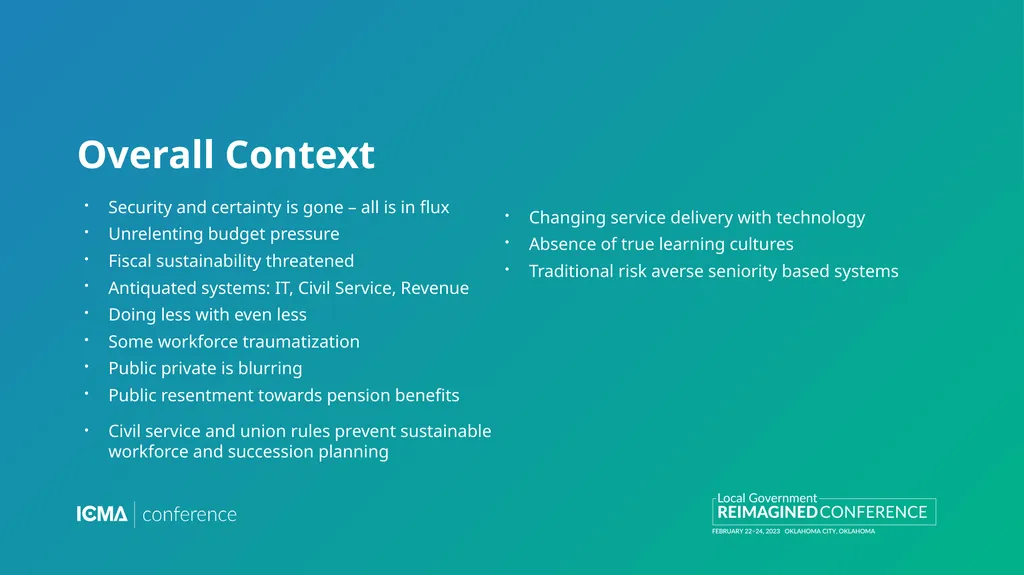
Overall Context Security and certainty is gone – all is in flux
Unrelenting budget pressure
Fiscal sustainability threatened
Antiquated systems: IT, Civil Service, Revenue
Doing less with even less
Some workforce traumatization
Public private is blurring
Public resentment towards pension benefits
Civil service and union rules prevent sustainable workforce and succession planning
Changing service delivery with technology
Absence of true learning cultures
Traditional risk averse seniority based systems<br>
Unrelenting budget pressure
Fiscal sustainability threatened
Antiquated systems: IT, Civil Service, Revenue
Doing less with even less
Some workforce traumatization
Public private is blurring
Public resentment towards pension benefits
Civil service and union rules prevent sustainable workforce and succession planning
Changing service delivery with technology
Absence of true learning cultures
Traditional risk averse seniority based systems<br>
04
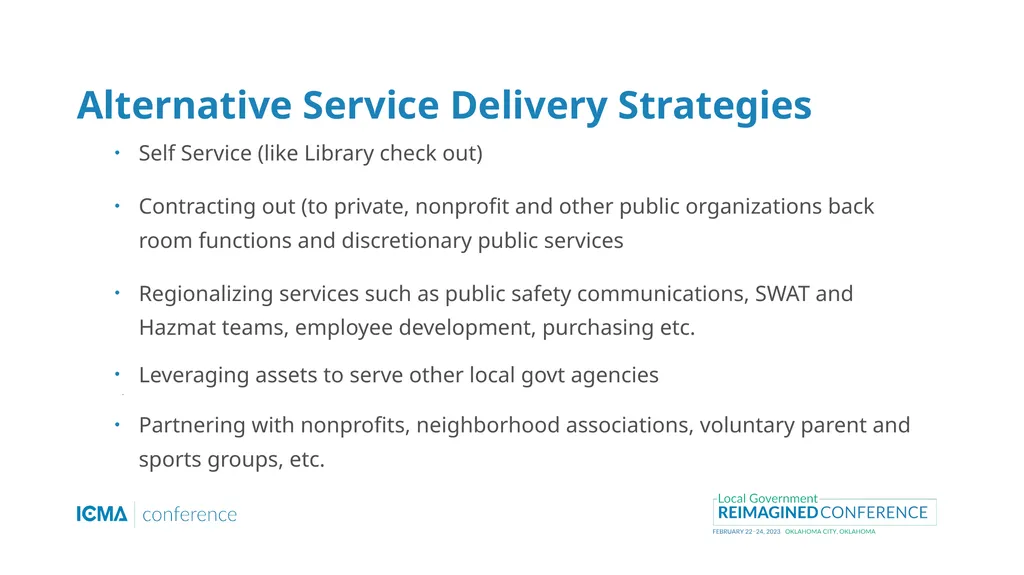
Alternative Service Delivery Strategies Self Service (like Library check out)
Contracting out (to private, nonprofit and other public organizations back room functions and discretionary public services
Regionalizing services such as public safety communications, SWAT and Hazmat teams, employee development, purchasing etc.
Leveraging assets to serve other local govt agencies
Partnering with nonprofits, neighborhood associations, voluntary parent and sports groups, etc.<br>
Contracting out (to private, nonprofit and other public organizations back room functions and discretionary public services
Regionalizing services such as public safety communications, SWAT and Hazmat teams, employee development, purchasing etc.
Leveraging assets to serve other local govt agencies
Partnering with nonprofits, neighborhood associations, voluntary parent and sports groups, etc.<br>
05
Environmental Scan 2 – Resources<br>
06
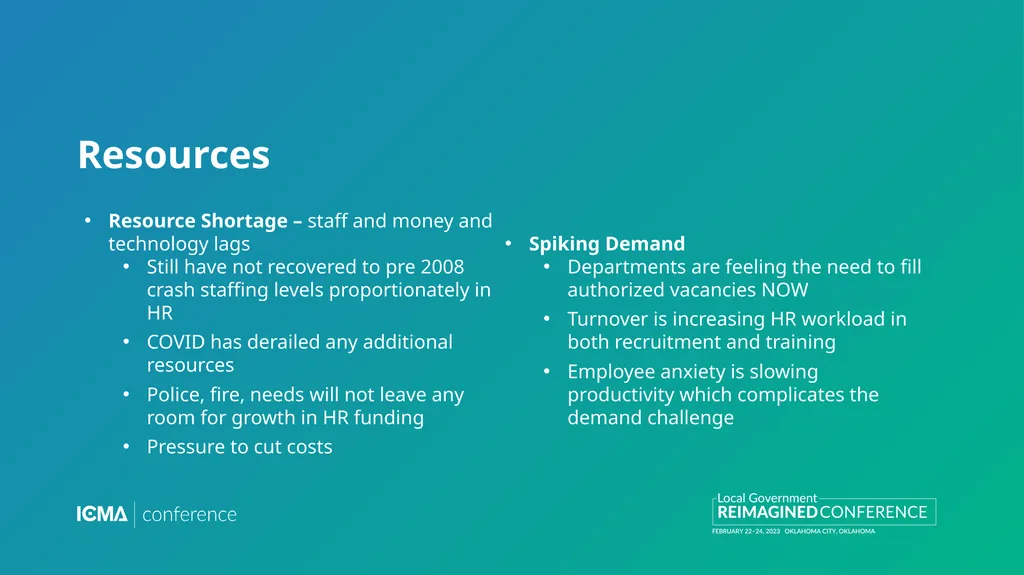
Resources Resource Shortage – staff and money and technology lags
Still have not recovered to pre 2008 crash staffing levels proportionately in HR
COVID has derailed any additional resources
Police, fire, needs will not leave any room for growth in HR funding
Pressure to cut costs
Spiking Demand
Departments are feeling the need to fill authorized vacancies NOW
Turnover is increasing HR workload in both recruitment and training
Employee anxiety is slowing productivity which complicates the demand challenge<br>
Still have not recovered to pre 2008 crash staffing levels proportionately in HR
COVID has derailed any additional resources
Police, fire, needs will not leave any room for growth in HR funding
Pressure to cut costs
Spiking Demand
Departments are feeling the need to fill authorized vacancies NOW
Turnover is increasing HR workload in both recruitment and training
Employee anxiety is slowing productivity which complicates the demand challenge<br>
07
Environmental Scan 3 – Retention<br>
08
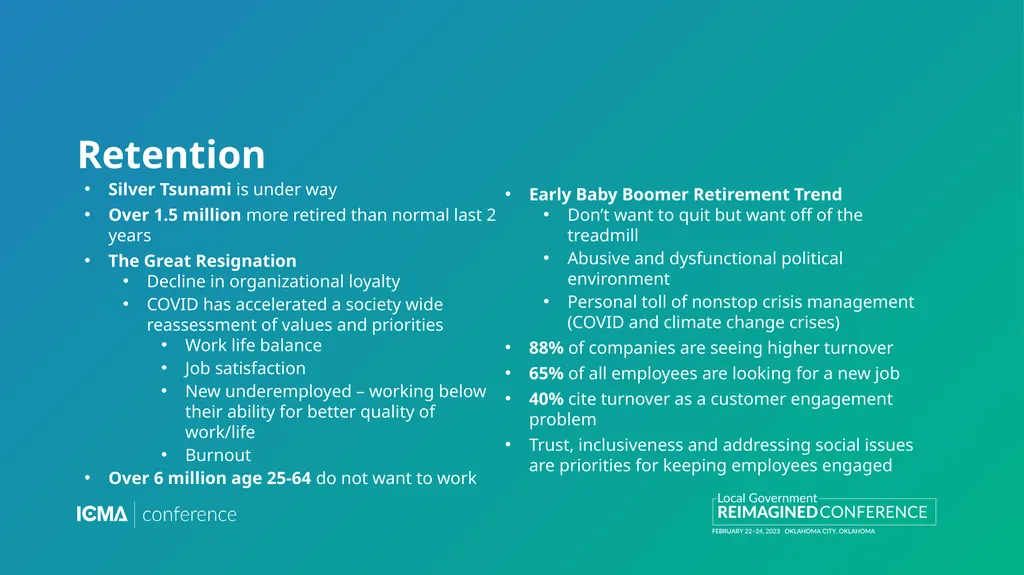
Retention Silver Tsunami is under way
Over 1.5 million more retired than normal last 2 years
The Great Resignation
Decline in organizational loyalty
COVID has accelerated a society wide reassessment of values and priorities
Work life balance
Job satisfaction
New underemployed – working below their ability for better quality of work/life
Burnout
Over 6 million age 25-64 do not want to work
Early Baby Boomer Retirement Trend
Don’t want to quit but want off of the treadmill
Abusive and dysfunctional political environment
Personal toll of nonstop crisis management (COVID and climate change crises)
88% of companies are seeing higher turnover
65% of all employees are looking for a new job
40% cite turnover as a customer engagement problem
Trust, inclusiveness and addressing social issues are priorities for keeping employees engaged<br>
Over 1.5 million more retired than normal last 2 years
The Great Resignation
Decline in organizational loyalty
COVID has accelerated a society wide reassessment of values and priorities
Work life balance
Job satisfaction
New underemployed – working below their ability for better quality of work/life
Burnout
Over 6 million age 25-64 do not want to work
Early Baby Boomer Retirement Trend
Don’t want to quit but want off of the treadmill
Abusive and dysfunctional political environment
Personal toll of nonstop crisis management (COVID and climate change crises)
88% of companies are seeing higher turnover
65% of all employees are looking for a new job
40% cite turnover as a customer engagement problem
Trust, inclusiveness and addressing social issues are priorities for keeping employees engaged<br>
09
Reasons Employees Are Leaving –
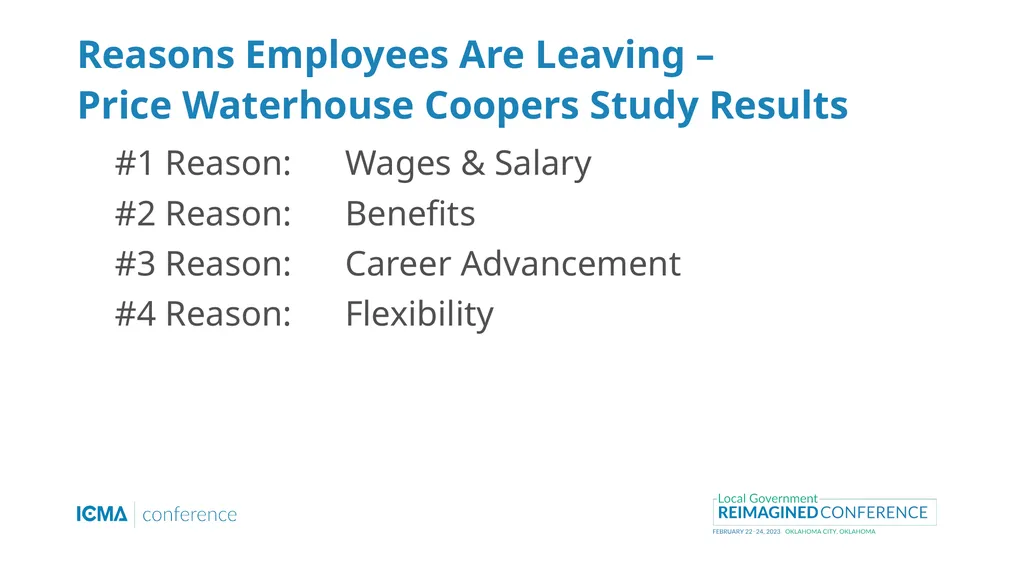
Price Waterhouse Coopers Study Results #1 Reason: Wages & Salary
#2 Reason: Benefits
#3 Reason: Career Advancement
#4 Reason: Flexibility<br>
#2 Reason: Benefits
#3 Reason: Career Advancement
#4 Reason: Flexibility<br>
10
Remote Work to Retain Employees –
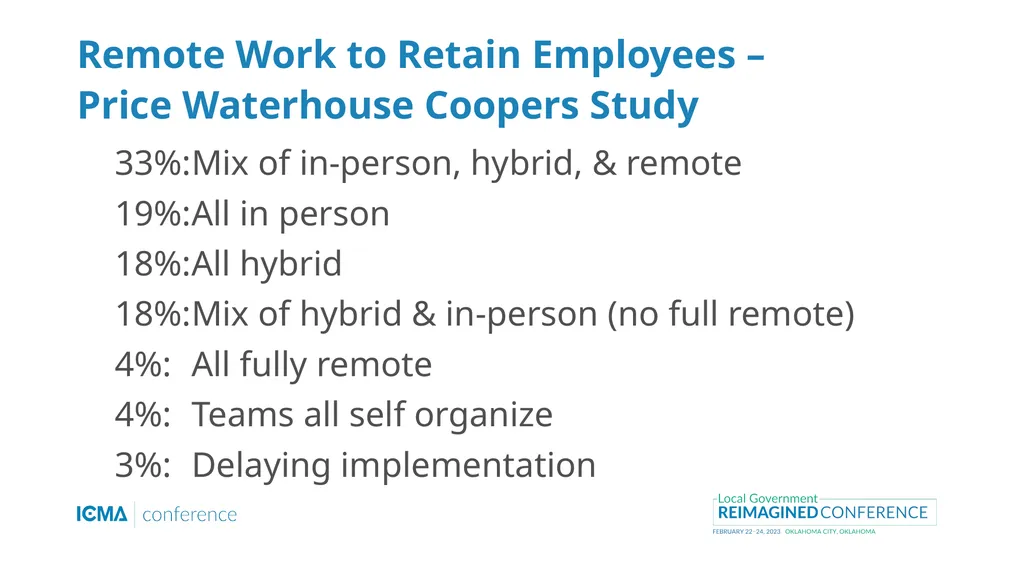
Price Waterhouse Coopers Study 33%: Mix of in-person, hybrid, & remote
19%: All in person
18%: All hybrid
18%: Mix of hybrid & in-person (no full remote)
4%: All fully remote
4%: Teams all self organize
3%: Delaying implementation<br>
19%: All in person
18%: All hybrid
18%: Mix of hybrid & in-person (no full remote)
4%: All fully remote
4%: Teams all self organize
3%: Delaying implementation<br>
11
Remote Work Preferences by Employees–
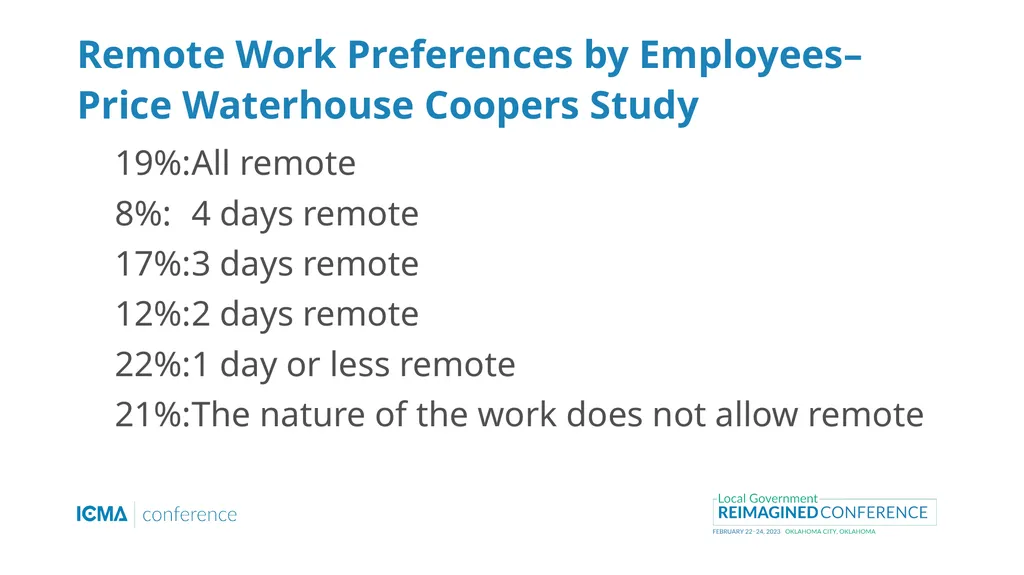
Price Waterhouse Coopers Study 19%: All remote
8%: 4 days remote
17%: 3 days remote
12%: 2 days remote
22%: 1 day or less remote
21%: The nature of the work does not allow remote<br>
8%: 4 days remote
17%: 3 days remote
12%: 2 days remote
22%: 1 day or less remote
21%: The nature of the work does not allow remote<br>
12
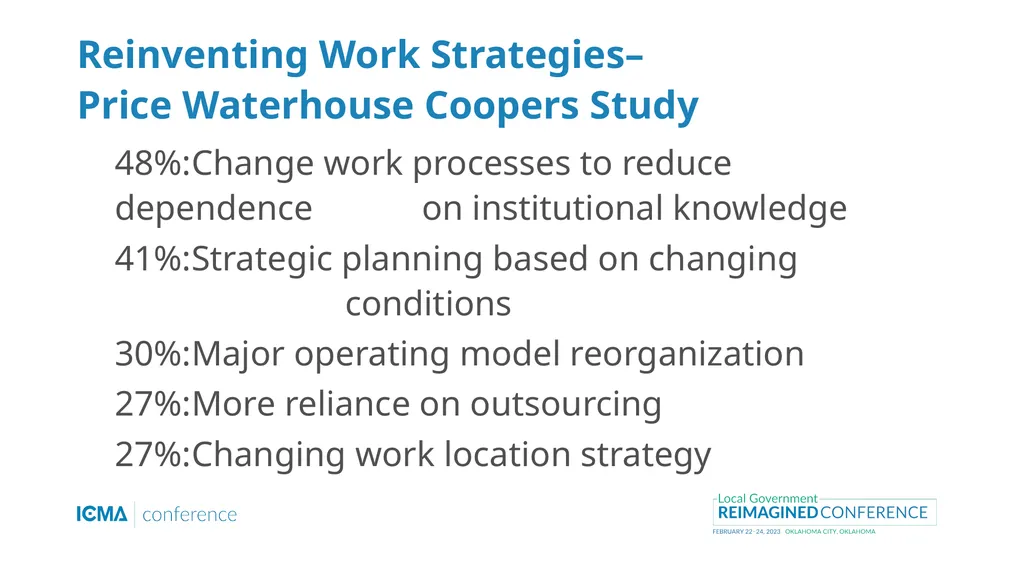
Reinventing Work Strategies–
Price Waterhouse Coopers Study 48%: Change work processes to reduce dependence on institutional knowledge
41%: Strategic planning based on changing conditions
30%: Major operating model reorganization
27%: More reliance on outsourcing
27%: Changing work location strategy<br>
41%: Strategic planning based on changing conditions
30%: Major operating model reorganization
27%: More reliance on outsourcing
27%: Changing work location strategy<br>
13
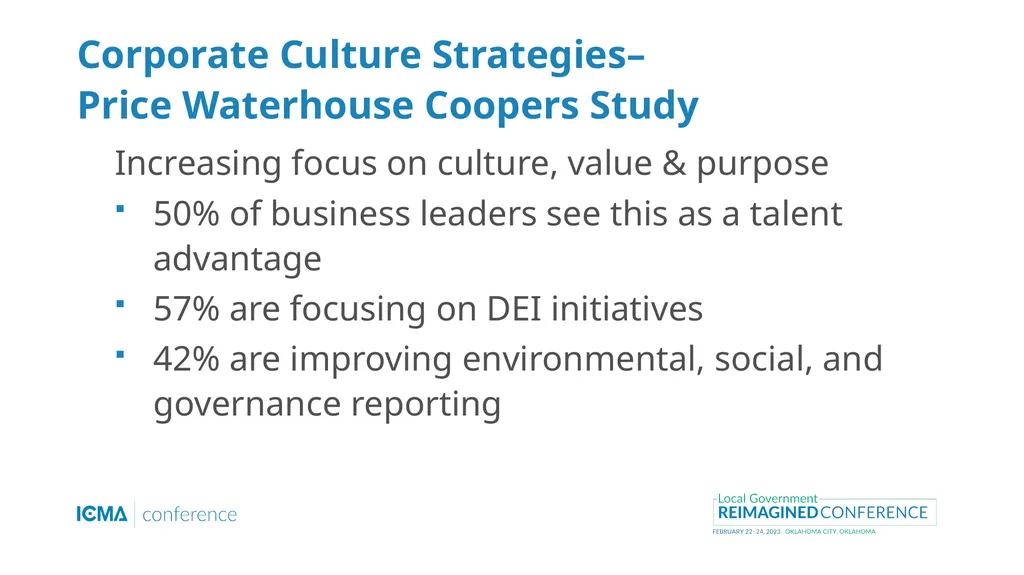
Corporate Culture Strategies–
Price Waterhouse Coopers Study Increasing focus on culture, value & purpose
50% of business leaders see this as a talent advantage
57% are focusing on DEI initiatives
42% are improving environmental, social, and governance reporting<br>
50% of business leaders see this as a talent advantage
57% are focusing on DEI initiatives
42% are improving environmental, social, and governance reporting<br>
14
Environmental Scan 4 – Recruitment<br>
15
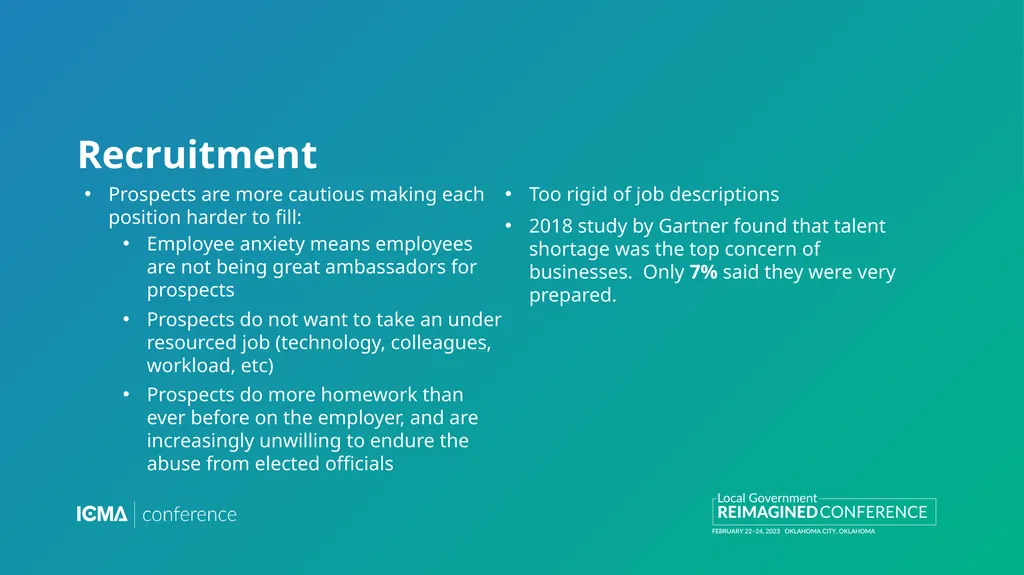
Recruitment Prospects are more cautious making each position harder to fill:
Employee anxiety means employees are not being great ambassadors for prospects
Prospects do not want to take an under resourced job (technology, colleagues, workload, etc)
Prospects do more homework than ever before on the employer, and are increasingly unwilling to endure the abuse from elected officials
Too rigid of job descriptions
2018 study by Gartner found that talent shortage was the top concern of businesses. Only 7% said they were very prepared.<br>
Employee anxiety means employees are not being great ambassadors for prospects
Prospects do not want to take an under resourced job (technology, colleagues, workload, etc)
Prospects do more homework than ever before on the employer, and are increasingly unwilling to endure the abuse from elected officials
Too rigid of job descriptions
2018 study by Gartner found that talent shortage was the top concern of businesses. Only 7% said they were very prepared.<br>
16
SO WHAT DO WE DO ABOUT IT?<br>
17
Strategies for Success – 1
Organizational DNA, Culture, & Values<br>
18
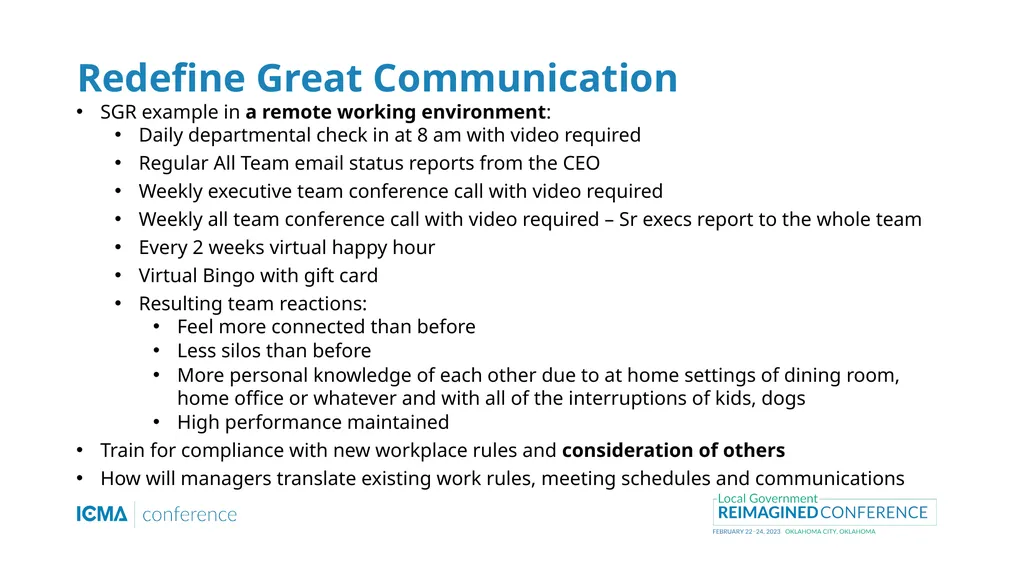
Redefine Great Communication SGR example in a remote working environment:
Daily departmental check in at 8 am with video required
Regular All Team email status reports from the CEO
Weekly executive team conference call with video required
Weekly all team conference call with video required – Sr execs report to the whole team
Every 2 weeks virtual happy hour
Virtual Bingo with gift card
Resulting team reactions:
Feel more connected than before
Less silos than before
More personal knowledge of each other due to at home settings of dining room, home office or whatever and with all of the interruptions of kids, dogs
High performance maintained
Train for compliance with new workplace rules and consideration of others
How will managers translate existing work rules, meeting schedules and communications<br>
Daily departmental check in at 8 am with video required
Regular All Team email status reports from the CEO
Weekly executive team conference call with video required
Weekly all team conference call with video required – Sr execs report to the whole team
Every 2 weeks virtual happy hour
Virtual Bingo with gift card
Resulting team reactions:
Feel more connected than before
Less silos than before
More personal knowledge of each other due to at home settings of dining room, home office or whatever and with all of the interruptions of kids, dogs
High performance maintained
Train for compliance with new workplace rules and consideration of others
How will managers translate existing work rules, meeting schedules and communications<br>
19
Lean Into Culture & Values Use assessments such as Gallup’s Q12 for employee engagement
Conduct Values Workshops for the entire organization
Ensure your systems are aligned with your culture and values<br>
Conduct Values Workshops for the entire organization
Ensure your systems are aligned with your culture and values<br>
20
Re-Evaluate Priorities & Processes<br>
21
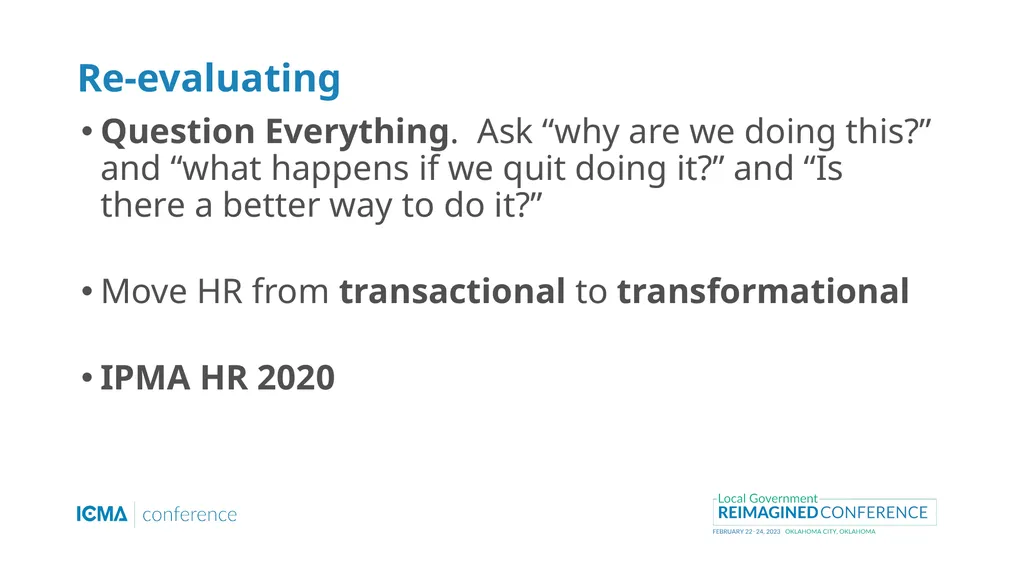
Re-evaluating Question Everything. Ask “why are we doing this?” and “what happens if we quit doing it?” and “Is there a better way to do it?”
Move HR from transactional to transformational
IPMA HR 2020<br>
Move HR from transactional to transformational
IPMA HR 2020<br>
22
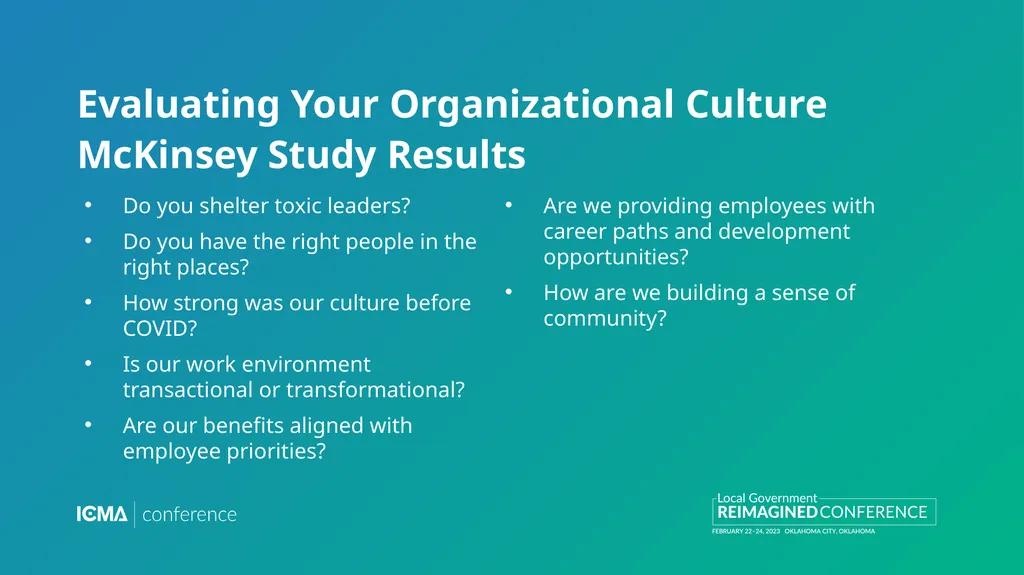
Evaluating Your Organizational Culture
McKinsey Study Results Do you shelter toxic leaders?
Do you have the right people in the right places?
How strong was our culture before COVID?
Is our work environment transactional or transformational?
Are our benefits aligned with employee priorities?
Are we providing employees with career paths and development opportunities?
How are we building a sense of community?<br>
Do you have the right people in the right places?
How strong was our culture before COVID?
Is our work environment transactional or transformational?
Are our benefits aligned with employee priorities?
Are we providing employees with career paths and development opportunities?
How are we building a sense of community?<br>
23
Strategies for Success – 2
Employee Development & Training<br>
24
Move HR from Transactional to Transformational Flatter organizations that push down decision making are more effective AND more efficient AND develop higher skills
But that demands overhauling almost all of our performance evaluation and expectation systems
Embed upskilling training into your culture
Move FROM promoting then preparing
TO Preparing before promoting<br>
But that demands overhauling almost all of our performance evaluation and expectation systems
Embed upskilling training into your culture
Move FROM promoting then preparing
TO Preparing before promoting<br>
25
Invest MORE in Training & Development New workplace rules and expectations
Hygiene Practices
Digital communication pitfalls:
Missing social cues online
Comfort with technology (or lack thereof)
Traditional topics
Upskilling
Remote working<br>
Hygiene Practices
Digital communication pitfalls:
Missing social cues online
Comfort with technology (or lack thereof)
Traditional topics
Upskilling
Remote working<br>
26
Mental Health Support Generational Shift in “talking about it” and expecting employer support
Communicate about your EAP
Equip employees to deal with citizen abuse
Resiliency in Chaos
Mindfulness
Cost impact? Negligible<br>
Communicate about your EAP
Equip employees to deal with citizen abuse
Resiliency in Chaos
Mindfulness
Cost impact? Negligible<br>
27
Create an Executive-On-Loan Program<br>
28
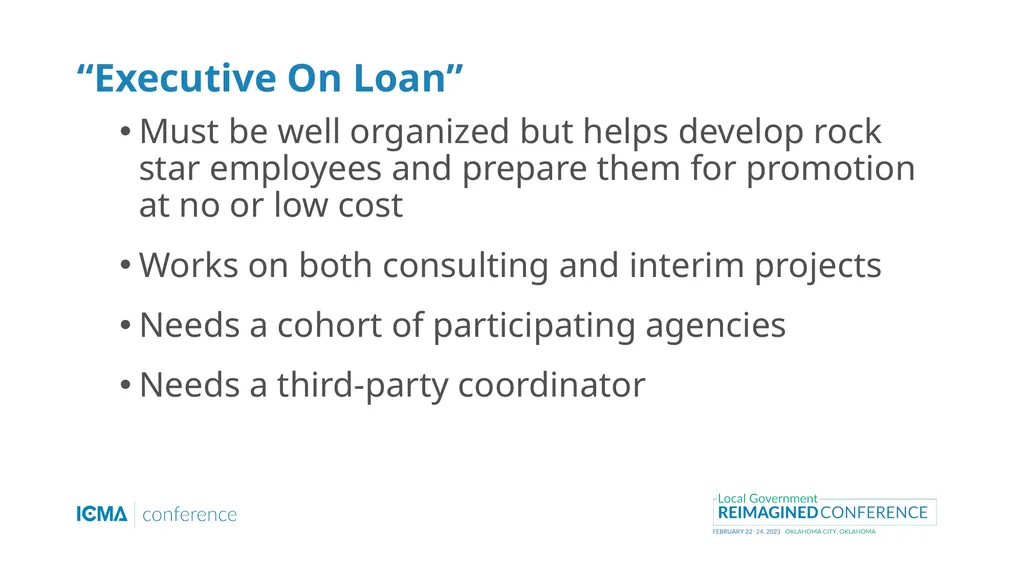
“Executive On Loan” Must be well organized but helps develop rock star employees and prepare them for promotion at no or low cost
Works on both consulting and interim projects
Needs a cohort of participating agencies
Needs a third-party coordinator<br>
Works on both consulting and interim projects
Needs a cohort of participating agencies
Needs a third-party coordinator<br>
29
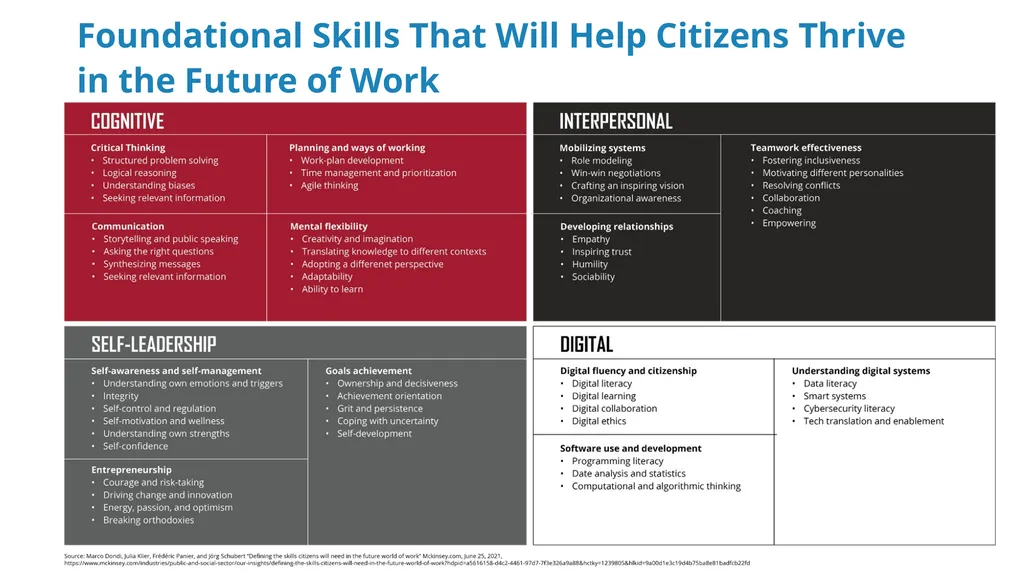
Foundational Skills That Will Help Citizens Thrive in the Future of Work<br>
30
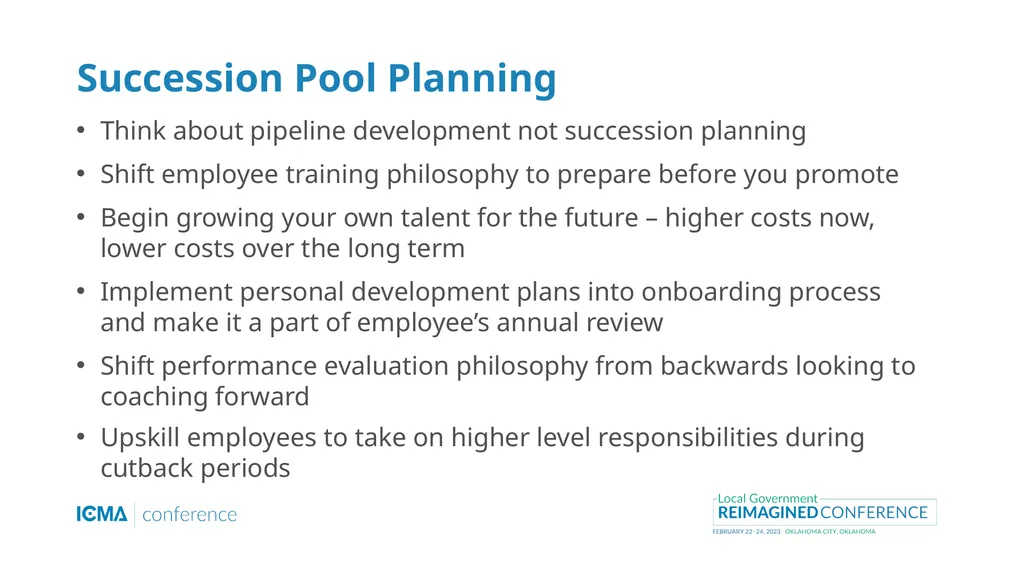
Succession Pool Planning Think about pipeline development not succession planning
Shift employee training philosophy to prepare before you promote
Begin growing your own talent for the future – higher costs now, lower costs over the long term
Implement personal development plans into onboarding process and make it a part of employee’s annual review
Shift performance evaluation philosophy from backwards looking to coaching forward
Upskill employees to take on higher level responsibilities during cutback periods<br>
Shift employee training philosophy to prepare before you promote
Begin growing your own talent for the future – higher costs now, lower costs over the long term
Implement personal development plans into onboarding process and make it a part of employee’s annual review
Shift performance evaluation philosophy from backwards looking to coaching forward
Upskill employees to take on higher level responsibilities during cutback periods<br>
31
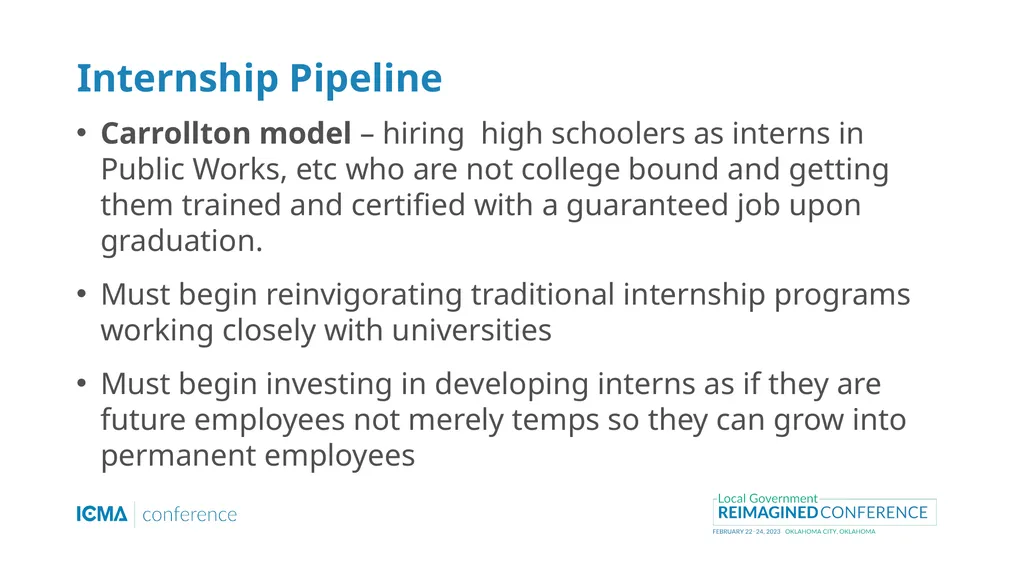
Internship Pipeline Carrollton model – hiring high schoolers as interns in Public Works, etc who are not college bound and getting them trained and certified with a guaranteed job upon graduation.
Must begin reinvigorating traditional internship programs working closely with universities
Must begin investing in developing interns as if they are future employees not merely temps so they can grow into permanent employees<br>
Must begin reinvigorating traditional internship programs working closely with universities
Must begin investing in developing interns as if they are future employees not merely temps so they can grow into permanent employees<br>
32
Training for Digital Transitions & Automation Microsoft CEO said that in 2020 we saw 2 years worth of digital transformation in 2 months.
Mekaworks example
Evidence shows that the benefits of reskilling current staff, rather than letting them go and then finding new people, typically costs less and brings benefits that outweigh the costs. Investing in employees can also foster loyalty, customer satisfaction, and positive brand perception.
Communicate clearly to ally employee anxiety<br>
Mekaworks example
Evidence shows that the benefits of reskilling current staff, rather than letting them go and then finding new people, typically costs less and brings benefits that outweigh the costs. Investing in employees can also foster loyalty, customer satisfaction, and positive brand perception.
Communicate clearly to ally employee anxiety<br>
33
Re-Imagine Organizational Structure<br>
34
Re-Imagine Organizational Structure Rethink how people work best:
McKinsey found in April 2020 that 60% of businesses surveyed said that their new remote sales models were proving as much or more effective than traditional models
One university MPA program cited both anecdotal experience locally as well as a national study that found that learning IMPROVED in the sudden new online environment with college students
You will have to overcome resistance of traditionalists<br>
McKinsey found in April 2020 that 60% of businesses surveyed said that their new remote sales models were proving as much or more effective than traditional models
One university MPA program cited both anecdotal experience locally as well as a national study that found that learning IMPROVED in the sudden new online environment with college students
You will have to overcome resistance of traditionalists<br>
35
Professional Development Starts at
Onboarding & Orientation Don’t skimp on this
Imprint organizational culture and DNA including performance expectations and how to fit in
Create a personal development plan that includes a career growth pathway from the beginning
Assign a mentor to help them thrive and connect<br>
Imprint organizational culture and DNA including performance expectations and how to fit in
Create a personal development plan that includes a career growth pathway from the beginning
Assign a mentor to help them thrive and connect<br>
36
Strategies for Success – 3
Recruitment Practices<br>
37
Successful Recruitment Strategies –
Price Waterhouse Coopers Study Results Schedule Flexibility
Focus on corporate purpose and leadership
Clear career growth opportunities
Upskilling opportunities<br>
Focus on corporate purpose and leadership
Clear career growth opportunities
Upskilling opportunities<br>
38
Accelerate Hiring Process Timeline Slow and inefficient hiring processes will consistently lose top talent from the pool.<br>
39
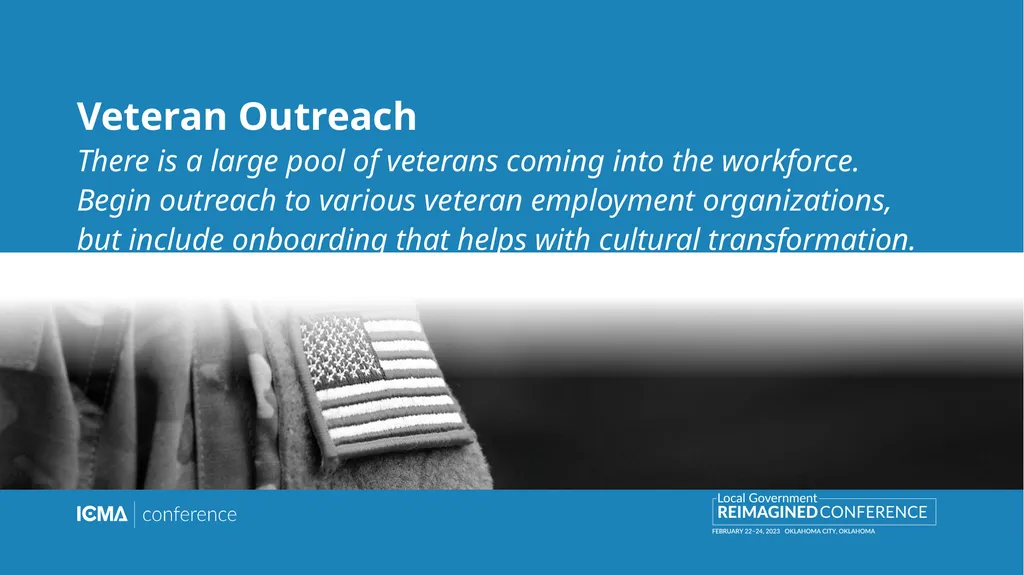
Veteran Outreach There is a large pool of veterans coming into the workforce. Begin outreach to various veteran employment organizations, but include onboarding that helps with cultural transformation.<br>
40
Modernize the way you search for talent<br>
41
Modernize Your Searches Modernize the way you recruit
Professional graphics and visuals are critical
Use social media-oriented memes and ads
Quit wasting money on the wrong job boards. Become highly targeted. (www.SGRjobs.com)<br>
Professional graphics and visuals are critical
Use social media-oriented memes and ads
Quit wasting money on the wrong job boards. Become highly targeted. (www.SGRjobs.com)<br>
42
Use Boomerang Employees Contract with a third party to rehire retirees on a contract basis to keep productivity up while maintaining cutback flexibility
Third party is essential to comply with typical pension laws
Typically same total cost as the previous employee but with much more flexibility
Lower training cost and learning curve<br>
Third party is essential to comply with typical pension laws
Typically same total cost as the previous employee but with much more flexibility
Lower training cost and learning curve<br>
43
Job Descriptions Evaluate job descriptions to eliminate all nonessential job qualification requirements and distinguish between required and desired.
Historically job descriptions have primarily served to make it easy to eliminate candidates from consideration with little or no connection to actual job skills needed.<br>
Historically job descriptions have primarily served to make it easy to eliminate candidates from consideration with little or no connection to actual job skills needed.<br>
44
Strategies for Success – 4
Rethink Employee Benefits<br>
45
Employee Wellbeing
in a Work-from-Home Culture Implement more frequent Town Halls / check ins with senior leaders
Require “video-on” meetings for more face-to-face interaction
Establish “water cooler” opportunities for workers to connect informally
Require availability expectations to be set by each employee
Incorporate mental health services into a telehealth policy
Make company-wide policy announcements regarding changes to benefits such as PTO, vacation, sick leave, etc.
Curate a list of resources for employees to help with physical and mental wellbeing
Provide employee continuing education at a free or reduced cost<br>
Require “video-on” meetings for more face-to-face interaction
Establish “water cooler” opportunities for workers to connect informally
Require availability expectations to be set by each employee
Incorporate mental health services into a telehealth policy
Make company-wide policy announcements regarding changes to benefits such as PTO, vacation, sick leave, etc.
Curate a list of resources for employees to help with physical and mental wellbeing
Provide employee continuing education at a free or reduced cost<br>
46
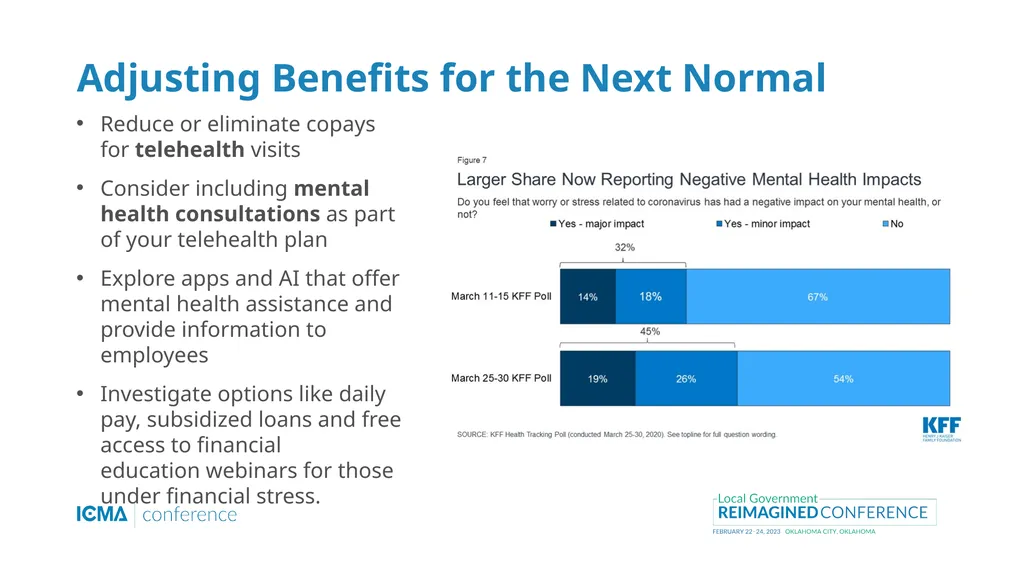
Adjusting Benefits for the Next Normal Reduce or eliminate copays for telehealth visits
Consider including mental health consultations as part of your telehealth plan
Explore apps and AI that offer mental health assistance and provide information to employees
Investigate options like daily pay, subsidized loans and free access to financial education webinars for those under financial stress.<br>
Consider including mental health consultations as part of your telehealth plan
Explore apps and AI that offer mental health assistance and provide information to employees
Investigate options like daily pay, subsidized loans and free access to financial education webinars for those under financial stress.<br>
47
Health Benefits Cincinnati Children’s Hospital reported that in all of 2019, there were a total of 2,000 telehealth visits in their system. By July of 2020 it had grown to 5,000
a week.<br>
48
Flexible Benefits Create the opportunity for employees to craft their own unique benefit package for their desires and stage of life.<br>
49
Strategies for Success – 5
Rethink HR Policies & Practices<br>
50
Accelerate Digital Solutions in HR Implement Applicant Management systems (as low as $200 a month)
Implement online recorded interviews
Expand Zoom live interviewing
Automated reference checks:
Better results –lower cost
$250 per reference ala carte, lower if you subscribe to a system
Move from live to virtual training
$149 vs $29
Consider using an LMS for compliance classes ($10 per employee for 5 compliance classes plus a set up fee starting at $250 for under 25k pop)
Develop online content for routine parts of onboarding… do the values, expectations and culture parts live<br>
Implement online recorded interviews
Expand Zoom live interviewing
Automated reference checks:
Better results –lower cost
$250 per reference ala carte, lower if you subscribe to a system
Move from live to virtual training
$149 vs $29
Consider using an LMS for compliance classes ($10 per employee for 5 compliance classes plus a set up fee starting at $250 for under 25k pop)
Develop online content for routine parts of onboarding… do the values, expectations and culture parts live<br>
51
Remote Work Innovate or fall behind. It is where the world is headed.
BUT remote work has complicated workplace policy implications including perceptions of unfairness, schedules, sick leave, and more.<br>
BUT remote work has complicated workplace policy implications including perceptions of unfairness, schedules, sick leave, and more.<br>
52
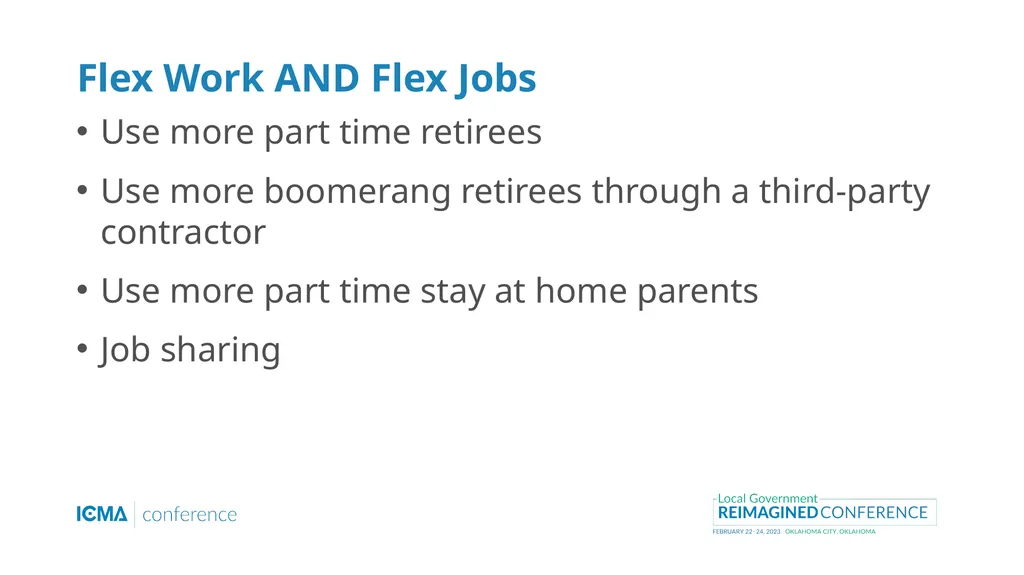
Flex Work AND Flex Jobs Use more part time retirees
Use more boomerang retirees through a third-party contractor
Use more part time stay at home parents
Job sharing<br>
Use more boomerang retirees through a third-party contractor
Use more part time stay at home parents
Job sharing<br>
53
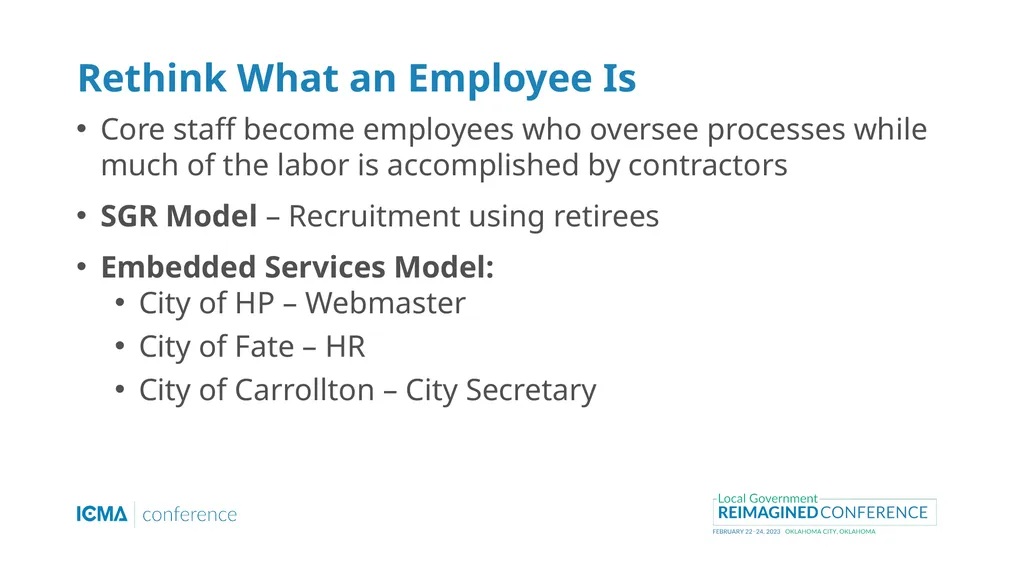
Rethink What an Employee Is Core staff become employees who oversee processes while much of the labor is accomplished by contractors
SGR Model – Recruitment using retirees
Embedded Services Model:
City of HP – Webmaster
City of Fate – HR
City of Carrollton – City Secretary<br>
SGR Model – Recruitment using retirees
Embedded Services Model:
City of HP – Webmaster
City of Fate – HR
City of Carrollton – City Secretary<br>
54
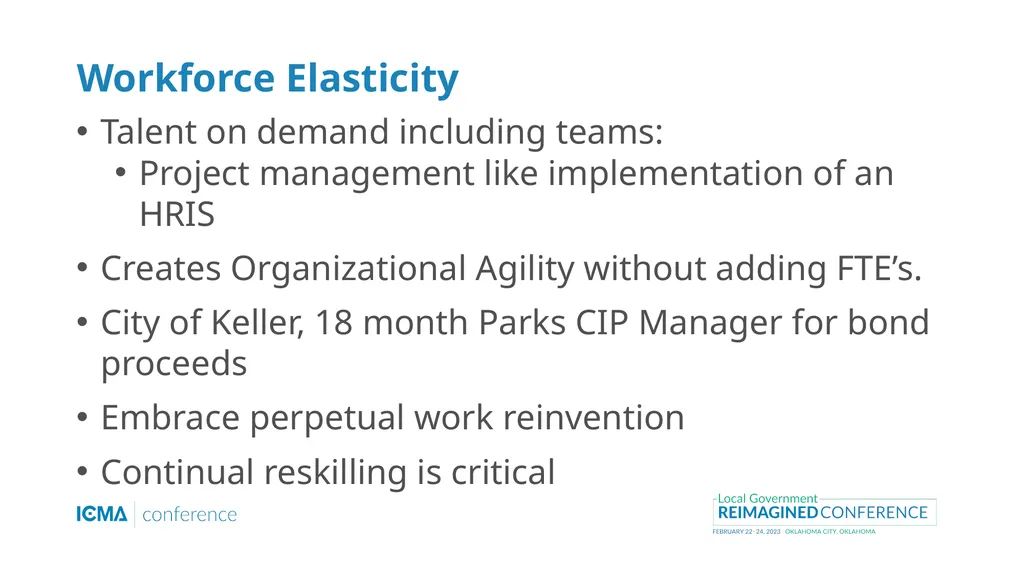
Workforce Elasticity Talent on demand including teams:
Project management like implementation of an HRIS
Creates Organizational Agility without adding FTE’s.
City of Keller, 18 month Parks CIP Manager for bond proceeds
Embrace perpetual work reinvention
Continual reskilling is critical<br>
Project management like implementation of an HRIS
Creates Organizational Agility without adding FTE’s.
City of Keller, 18 month Parks CIP Manager for bond proceeds
Embrace perpetual work reinvention
Continual reskilling is critical<br>
55
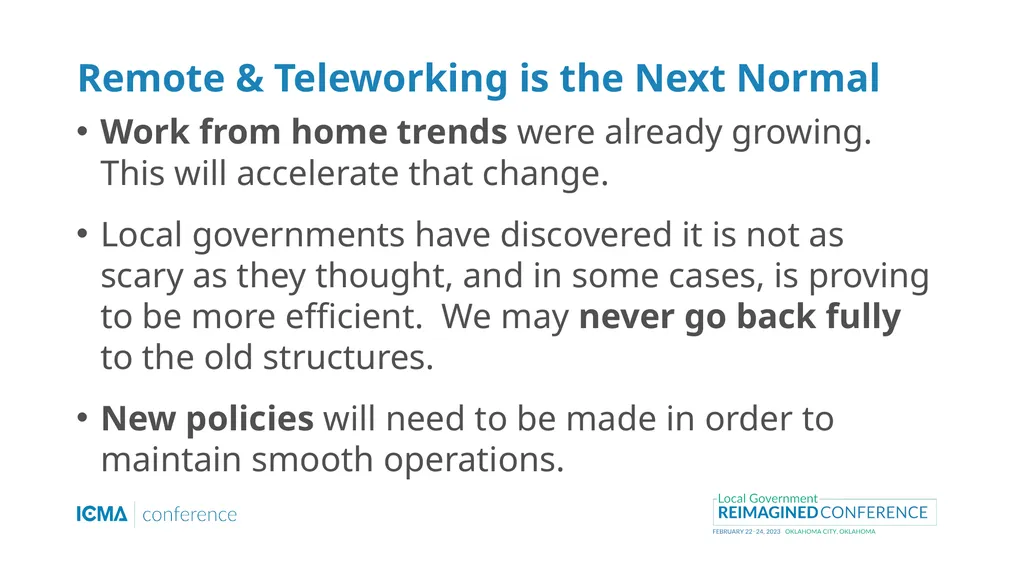
Remote & Teleworking is the Next Normal Work from home trends were already growing. This will accelerate that change.
Local governments have discovered it is not as scary as they thought, and in some cases, is proving to be more efficient. We may never go back fully to the old structures.
New policies will need to be made in order to maintain smooth operations.<br>
Local governments have discovered it is not as scary as they thought, and in some cases, is proving to be more efficient. We may never go back fully to the old structures.
New policies will need to be made in order to maintain smooth operations.<br>
56
Sources for this presentation International Personnel Management Association HR 2020 Report – Moving HR from Transactional to Transformational
Alliance for Innovation White Paper – What’s the Future of Local Government (2011)
Developing a Succession Plan for Your Organization, ICMA Conference Presentation, 2020
Price Waterhouse Coopers Study
McKinsey Consulting, The Great Attrition or the Great Attraction? The Choice is Yours, 2021<br>
Alliance for Innovation White Paper – What’s the Future of Local Government (2011)
Developing a Succession Plan for Your Organization, ICMA Conference Presentation, 2020
Price Waterhouse Coopers Study
McKinsey Consulting, The Great Attrition or the Great Attraction? The Choice is Yours, 2021<br>
57
Questions?
Interested in learning more about Servant Leadership in the New Normal? Sign up for SGR’s free 10 in 10 newsletter:<br>